It was night on October 23rd, 1918 as a series of rowboats silently dipped their oars in the waters of the Piave river in Italy. The Piave had remained as quiet as the rowboats’ occupants since the Italian defensive victory that summer, halting and then repelling an Austro-Hungarian offensive launched with hopes of knocking Rome out of the war. But the men aboard these boats were neither Italian or Austro-Hungarian, but British, members of the Honourable Artillery Company (an infantry battalion, despite the name) and the Royal Welch Fusiliers. While neither company could be viewed as “special forces,” they were most certainly elite forces of the Crown as the HAC had it’s lineage back to 1087 and it’s Captain-General was officially listed as the King George V.
Their assignment was to secure the series of islands on the Piave river that now constituted no-mans-land, starting with the largest island, Grave di Papadopoli. The HAC and Fusiliers landed with bayonets fixed, sneaking and stabbing their away across the island before the soldiers of the Dual Monarchy were finally able to sound the alarm. In a brief, but tough fight, with Italian diversionary troops even being defeated on the southern part of the island, Grave di Papadopoli was captured by Allied forces. The stage was set for the following morning, the one year anniversary of the Italian army’s humiliating defeat at Caporetto, as 1.4 million Allied troops would throw themselves at 1.8 million Austro-Hungarians. The result would be the collapse of the Austro-Hungarian Empire and the end of the 600+ year Habsburg Monarchy.
Vittorio Veneto – a major Italian victory that in historical hindsight looks more like a case of Austrian collapse than anything else
By late October of 1918, it could be questioned whether or not a battle even needed to take place to bring about the end of Austria-Hungary’s participation in the Great War. The same day as the Germans learned that President Woodrow Wilson wouldn’t mediate an armistice based on his Fourteen Points, at least not without strenuous pre-conditions, the Austro-Hungarian Foreign Minister Baron István Burián von Rajecz asked for similar terms from the Allies. As Rajecz made his request, the Allies formally accepted Czechoslovakia into their alliance. Trying to curry favor with the various ethnic groups now striving to break away from the Empire, Emperor Charles I issued an imperial manifesto that days later that would fundamentally changed the Austrian half of the government, giving autonomy to most ethnic states. It wasn’t enough. The literal next day, the Hungarian parliament passed a resolution ending the Austro-Hungarian partnership, despite having just renewed it for two years, and declared independence. The Dual Monarchy was now a singular one (although the formal cancellation of the Austro-Hungarian Compromise of 1867 wouldn’t happen until the end of the month). What remained was rapidly falling apart. (more…)
Big Left – via its wholly owned subsidiaries, Big Government and Big Media – have gotten much exercised about “misinformation” lately. As distinct from “disinformation” – someone actively telling you something that is untrue – “misinformation” is someone telling you anything they disagree with.
Rightly or wrongly.
This campaign has taken many forms – a Scarlet Letter-style whisper campaign on public media, active censorship by private-sector tech companies acting in concert with Big Left.
SCENE: Mitch BERG is riding his bike down a suburban street when Edmund DUCHEY, riding a recumbent bike, pulls out onto the street to cut BERG off. Duchey is proprietor at the (possibly fictional) progressive blog “MinnesotaLiberalAlliance.Blogspot.com”, and was badly scarred by a childhood in which he was routinely bullied – by much younger children
DUCHEY: Merg!
BERG: Jeez, you little feeb, you’re driving like a crazy f***.
BERG: It’s got little to do with carrying anything, anywhere. It’s about a government body being able to arbitrarily restrict law-abiding citizens civil rights in violation of state law.
DUCHEY: Hah! Stupid ammosexual! The State Fair is a private corporation!
BERG: A private corporation that had its own police force, with arrest power? Which has called itself a part of state government in its own court filings for over 100 years? Seems like a bit of a stretch. And Minnesota statute is fairly clear that state governments, outside the judiciary, aren’t allowed to bar law-abiding citizens from practicing their civil rights.
DUCHEY: Stupid wingnuts. So you want to carry your guns, so you can intimidate people at the fair?
DUCHEY: People walking around with guns on their hips, or an AR47 slung over their shoulder, are by definition intimidating.
BERG: I could meet you halfway, if you were smart enough to realize it; open carrying in a crowd is a little tactless. I’d never do it. But the ones who have permits are not the people you need to worry about, and the only time criminals carry openly is when they’re pushing it in your face to rob or carjack you. But again, this isn’t about your feelings. This is about the law, and whether we make the state follow it.
DUCHEY: So you want to carry your little gun concealed? You wingnuts will probably shoot your p****rs off.
BERG: And further down the Berg’s 16th Law rathole we go. But I’ll tell you what – there are over 300,000 carry permittees in MInnesota. If we were having accidental shootings in any significant numbers, you’d be hearing about it.
And when I did carry, it was like a .380. I’d need more like a 10 gauge with slugs. No way to conceal that. Now, for you, a .25 ACP should do the trick.
New York Gov. Andrew Cuomo on Tuesday announced that he would be resigning amid the sexual harassment probe in 14 days.
“New York tough means New York loving, and I love New York and I love you,” Cuomo said, “I would never want to be unhelpful in any way, and I think given the circumstances, the best way I can help now is if I step aside and let government get back to governing, and therefore, that’s what I’ll do.”
I honestly didn’t think it would or could happen, even given that Progressives didn’t much care for Cuomo.
And just watch – his successor will be worse. Maybe not in “groping letch” terms, but policy-wise.
…that actual science is about skepticism, about diligently questioning one’s assumptions, about relentlessly searching for the facts on either side of them, pro or con.
All of that being said?
I’m astounded at how many of my knee-jerk responses to Covid turned out to be scientifically valid.
The virus is spread via the air – not surface contact.
And the latest among them? The J&J vaccine appears, despite some early hysteria from the US government, to be the better bet against Delta – in addition to its initial sales pitch, it’s efficacy against hospitalization and serious symptoms (which, having reason to believe that natural immunity was itself a serious hedge against infection, was my biggest goal), appears to be better at allaying the Delta Variant than Moderna or Pfizer.
It’s not quite a Berg’s Law, but it’s getting there.
There is a new wide-eyed, pants-on-head, bat-s**t crazy, right-wing, Trump-inspired, anti-vaccine conspiracy theory going around. Don’t fall for it. The claim is the vaccine does not prevent people from catching Covid and does not prevent them from spreading it; therefore, the vaccine is useless as a preventative and universal vaccine mandates are unnecessary at best (ignoring side effects) and potentially harmful to some (considering side effects). The claim is supposedly supported by a study which is not peer reviewed, did not appear in any major medical journal and was only reported on one website. Few, if any, mainstream media have covered the story. Don’t be fooled. The entity which conducted the study and published the results has a history of making unsupported claims, errors of judgment and reversing its advice. The study, performed by the Centers for Disease Control and announced in its Morbidity and Mortality Weekly Report, as reported by CNBC, confirms what I’ve been saying all along. Either it’s wrong or I’m right. What a terrible dilemma for the trolls. Joe Doakes
That’s the thing about being a troll. There really are no terrible dilemmas.
In recent years, as the print news business has been slowly unraveling, I’ve read quite a number of nostalgia pieces from “ink stained wretches” lamenting the demises of the papers where they, in effect, grew up. We’ve seen this most recently with the spiralling-in of the City Pages, a vapid lifestyle tabloid in its later years that in its early days spawned some great writers (James Lileks), some journalists (David Brauer, Brian Lambert), one very goodeditor (Steve “Not The Journey Guy” Perry), a generation of “music critics” that further debased an already fairly useless genre of writing, and a lot of laughable, insipid drivel (I won’t name names; if you’ve read this blog for any length of time, you don’t need me to).
I get it. When you get to a certain age, you start to realize that you haven’t had just one life; you’ve had quite a few of them, really. And you try to make sense of them, order them, set them up so that anyone who might be interested in the future knows the story – even if that “anyone” is just you.
I got to thinking about that the other day. This week is the 22nd anniversary of my first day on the radio, back in 1979 [1].
It was at KEYJ, a little 1,000 watt (250 at night) station in Jamestown, North Dakota. It was the #2 station in a two-station market – the competition, the mighty KSJB, with a broadcast radius that covered six states and two provinces, was more a regional thing. But KEYJ was not only absent any delusions of grandeur, but the station intimately knew its niche. While “KS” covered the upper Midwest, with a steady diet of country music in and among a stream of crop reports, regional news and agriculture reporting, KEYJ covered Jamestown and Stutsman County – the news, high school and college sports, city and rural fire calls, reports from the nursing homes, a “swap and shop” show, and a half-hour local talk show. We carried the Twins in the summer, the Jamestown Blue Jays and Jamestown College Jimmies during the school year, and on Saturday afternoons we’d do a “Class B Basketball Game of the Week”, recorded the night before, where the merchants of Ellendale and Kensal and Medina and Ypsilanti would pony up a few bucks in sponsorships to hear their towns kids on the radio.
And some music. Although that was more or less an afterthought – we played middle-of-the-road top forty pop and a lot of “recurrents” from the previous couple decades.
The boss – Bob Richardson, one of the guys who’d put the station on the air in 1953, and who’s still going strong at 90 years old – considered it part of his mission to train local kids who were interested in the craft and technique of doing radio. He always had a couple of high school or college kids on the staff [2]. Not only was it one of the best broadcasting “schools” around, but it was one of the stations new grads from broadcast schools wanted to get into, if they were smart; they, like I, quickly wound up learning how to do literally everything at that station.
No, that’s not me. That’s Dave Howey, who took all the photos in this story when he was the same age I was when I started – the photos are all from 1977-ish, a few years before my time. Dave went on in the business – he’s been dominating morning radio in the Brainerd/Detroit Lakes/Fergus Falls area for the past thirty years or so.
And in August of 1979, it was my turn.
I spent a couple of weeks, starting in late July, shadowing a few of the other guys – Dick Ingstad [3] and John Weisphenning [4], including a day or two spinning records and reading the news and weather. Now it was time for my first solo – on the air, on my own, no training wheels.
It was a pleasant late summer evening in Jamestown when I did my first “solo” couple of hours. I’d be lying if I said I remembered that next six hours especially well – but I remember the first song I ever played on the air. And the second. And actually the third.
It went well enough – I actually got to switch to my regular shift – Saturdays, 5AM to 3PM – the next weekend.
Which led to my ritual, every Saturday morning for the next year and a half or so. Get up at 4:30AM. Hike the four blocks to the station, unlock the doors, start turning on the equipment so it – all ancient tube-driven electronics – could warm up. Most important was the “Remote” – a big, tube-driven stack of amplifiers, rectifiers, and controls that operated the transmitters, two miles away on the south side of town. It’s the sort of stuff you could do on your phone today. Back then – or, really, back in the 1950s, since KEYJ was in effect a museum of the early days of radio – it was a seven foot tall rack of electronics that looked like something from the fire-control plot room from a World War 2 battleship.
This isn’t the remote stack – that’s to the left. This is the pair of ancient reel to reel recorders. That little speaker grill at the top is for a piece of equipment associated with the Emergency Broadcast System, back when it was still called “Conelrad”. That’s how old the gear was/
On a hot day, that studio got downright torpid – there was no air conditioning (other than in the engineering shack, where it was needed); the control room relied on a fan and an open window. On a cold morning, you could hear the tubes struggling harder than I was.
The whole place gave off a scent of ozone. They say smells are among the most powerful memory triggers; ozone does it for me. There was something about the crackle and excitement of being in a radio station, being on the air, that for me is intimately associated with the smell of ozone. If I smell ozone, I get a spring in my step.
Dave Howey’s picture of one of the tubes. From the remote control, or the board, or something else? No idea. But that place was full of ’em.
Spent the next 45 minutes sorting through the 50-odd feet of AP wire copy that had printed on the teletype since signoff, about six hours earlier. Sort out the news, weather, sports and other stuff you’d use for the newscasts – five minutes every hour, plus half-hour blocks of news, weather, sports, and local public affairs stuff at 7AM, 8AM and over the noon hour.
That kept me busy for a good half hour or so.
5:50 AM? The transmitter should be warmed up. Time for standby.
And at 5:55 AM? Hit the sign-on music, read the sign-on script, and it was off to the races.
Dave sent a photo of the control board.
Why, yes, I still know what the controls all do. Those three boxes on the top? “Cart” machines – they played those little rectangular cartridges you see stacked on the right that looked a lot like eight-track tapes (kids, ask your grandparents) because that’s what they were. I have no idea what happened with this board – I think some local collector grabbed saved it from the junkyard. At least, I hope they did. Photo courtesy Dave Howey.
I’ve described it as “looking like the front end of a 1952 Buick”, and compared to modern boards, it kind of does. There is literally not a single piece of digital equipment anywhere in this photo, or anywhere in the room. Or station, anywhere, other than maybe a calculator in the sales office.
How old was it? It was in the studio – above the White Drug on main street in Jamestown – and had been since the station went on the air in ’53. I saw a similar one in a documentary about “black” radio stations in the south from the late ’30s, so “from before the war”, in a year starting with “193…” something, is more likely than not. It felt like old-world craftsmanship; the Bakelite pots had a heft that nothing in a radio station today duplicates; the VU meter, perfectly balanced and looking like something off the Titanic, didn’t herk and jerk up and down like modern meters; perfectly balanced, it swayed majestically, like the much slower time it was built in.
(The “production” board, in the little studio room next door where we produced commercials, the occasional pre-recorded show, and where Bob did the daily half hour talk/interview show, had a “1928” date stamped on the manufacturer’s plate on the side – and it looked and felt like it; it was “Steampunk” twenty years before anyone had heard the term).
This may have been the newest piece of equpment at that station. I think it was from the early ’70s.
I went on to work at much more-modern stations – my next, KDAK in Carrington, had a board from the sixties. When I came “back” to KEYJ (which had become KQDJ), everything was remodeled, with brand new (for the early ’80s) gear, although everything was in the same cramped little space above the drug store.
My career moved on – to KSTP, six years later, with KDWB-AM/FM, WDGY and KFAI to follow in succession. And then it ended.
And when it started again, at AM1280 in 2004, I felt a little bit like Rip van Winkle; there was not a single turntable, reel-to-reel deck, or ever cartridge machine. Even the CD player was largely un-used.
And most jarring, although it took me a while to figure it out?
No smell of ozone. Solid state equipment, much less digital gear, gives off no ozone. Radio stations today smell like…offices.
Don’t get me wrong; the excitement I get from turning on a mike is still there. And I can’t imagine all that ozone was good for the health; radio people seemed to die way too young, from old mens’ diseases, back then.
But I miss that smell, sometimes.
———-
[1] Don’t bother checking my math. I said 22 years, and I meant it.
[2] Many of whom went on to big things. Terry Ingstad – you know him as “Shadoe Stevens”, one of the great LA disc jockeys – started there at 12, and earned a spot in Life Magazine in the process. His youngest brother, Dick, is a morning guy in Louisville today, and was one of my best friends in High School; hanging around with Dick while he did his shifts whetted my appetite enough to want to apply for the job in the first place. Mick Wagner, the great Oregon jazz DJ, Mark Swartzell, Dewey Heggen and many more all started in this old studio.
[3] As noted above, a morning guy in Louisville, who’s had an amazing career.
[4] At the time, John was a student at Moorhead State, majoring in Communications. Last I checked – probably 10 years ago – he’s a communications professor in California.
As Covid cases rise nationwide, it’s become fashionable among administration circles and their media lap dogs to try to make Ron DeSantis (and Greg Abbott) scapegoats – largely to head off both of their obvious ambitions and opportunities in 2024.
Is the slander false?
It’s the Biden administration and the main stream media. What do you think?
My grandmother spoke only Norwegian until she was eight years old. But starting around age eight, like a lot of second-generation Americans from immigrant homes, she switched to English. I remember her teaching us maybe a couple words – and I, like my dad, only remember her speaking it occasionally around Sophie Swenson, another Norwegian woman in the neighborhood.
They were in America. They learned English.
Later, of course, when I started learning Norwegian, I learned Grandma’s dialect, from Sør-Trøndelag, in the hill country near the Swedish border, was pretty much the Appalachians of Norway, and I may have dodged a linguistic and cultural bullet. Nonetheless, I grew up feeling just a skosh deprived – and that was one of the reasons I had for taking seven years of German between secondary and college – I figured in the back of my head it’d help me learn Norwegian one day [1]
I won’t say Grandma marinaded us in the old country’s culture, even without the language; life back in Tydal had been pretty rough. My great-grandfather, Ole Berndson, had two sons and two daughters, and all but the youngest son left Norway in their twenties and early thirties, bespeaking a pretty rough time of things in the 1880s. Grandma told stories of people living on tree bark soup when things got hairy, and that wasn’t unusual. Ole got his farm foreclosed not long after (by the anscestor of someone I’ve met online, and plan to visit one day when I do finally get there, God willing), leaving his son Bersvend to have to adapt, making a fortune as a lumberman. Here, all three married – my two great-great aunts to North Dakota farmers, and my great-grandfather to my great-grandmother up near Thief River Falls.
My Dad and I put most of this together ourselves – Grandma died in 1980, before either of us took on a huge interest in geneology. But she left enough hints so that we were able to get at least the broad outlines.
But I learned my cultural heritage – the parts that matter, anyway. Because I’m American.
And I’m thankful that I leanred it, rather than having it taught to me by a government bureaucrat.
Now, I’m not saying that to wallow in nostalgia, or to claim the old way is always the best.
But while I can’t speak for parents in a culture I neither much know nor understand, I’d have to think a Somali parent who actually cares about the place he moved to must be getting a little dismayed by this story:
There is a new effort underway at Minneapolis Public Schools to make sure Somali students know and understand their language and culture.
“There’s no shame in being bilingual,” said Deqa Muhidin, the MPS district program facilitator. “It’s an asset and we want them to celebrate that.”
Minneapolis does a noxious, toxic, rotten to the bone job of teaching kids the history and meaning of our own culture. Why the hell would any parent want that same pack of dullards teaching their kids – any kids – about their own?
[1] I was about one-third right. German and Norwegian share a little vocabulary, but almost no grammar, syntax and structure. As it happens, Norwegian is a little like speaking English, only with different words for just about everything. And a bizarre structure for definite articles just to make it interesting.
Prince Maximilian von Baden, the newly appointed Chancellor of Germany, was likely as anxious as any member of the German government to hear that Berlin had finally received a response from American President Woodrow Wilson on October 14th, 1918. Ten days earlier, Max, a relatively unknown liberal member of the Prussian nobility and former military staff officer, had publicly declared Germany’s willingness to engage in an armistice based around Wilson’s Fourteen Points. The Prince of Baden had initially resisted the post when offered to him by Kaiser Wilhelm II, knowing full well that even the most generous possible terms of a future armistice would likely cost Germany dearly and Max was not interested in going down in history as the Chancellor who offered up Germany’s de facto surrender.
But following a crown council meeting on September 29th, 1918, both Hindenburg and Ludendorff had advised the Kaiser that nothing short of an armistice could save Germany as neither general could ensure the Empire’s ability to hold together what remained of the Western Front. While there was debate as to what Germany expected from any armistice request – Ludendorff vacillated between viewing an armistice as defeat or as simply a delaying tactic that would allow the German army to regroup – Baden had been tasked with making the offer. The prior Chancellor and government had resigned in protest to news that the Kaiser and his two top generals alone had decided to seek peace, believing that in Berlin’s parliamentary democracy only the Reichstag retained the right to matters of war and peace. Although Baden’s appointment would appease the growing liberal sectors of the Reichstag, the Prince of Baden knew he would be viewed with suspicion by all factors of the parliament – a toady to the conservative Kaiser or as a weak-willed liberal seeking peace.
Baden and others hoped that an armistice based upon Wilson’s Fourteen Points would be temperate in it’s punishments. The message they received on October 14th, 1918 crushed those hopes. Wilson would not lead any armistice negotiations. Indeed, there would be no negotiations and no armistice with the current construction of the German government. If the Kaiser abdicated the throne and Germany stopped their “illegal and inhumane practices” of submarine warfare and scorched earth tactics as they retreated in France, only then could the fighting cease. And any final terms would be dictate by the Allies as a whole, not with America as a mediator.
There would be no easy peace for Germany. And the nation would wrestle with how much they were willing to pay to end the bloodshed.
Max von Baden – center, with mustache. He would resign on the eve of the Armistice, as Germany was plunged into revolution
If there was one issue that the various heads of state and military leaders of the warring powers could agree upon by the fall of 1918 (with perhaps the prominent exception of Erich Ludendorff), it was that an armistice was not only necessary, but desired. But what any armistice would look like or how it would come about were open questions with constantly changing answers. (more…)
I’ll admit it – I thought it was impossible for.a ‘woke’ lefty to get charged with a “hate crime”, and that the entire category was designed to try to gin up numbers for Big Left’s “there’s a wave of white supremacist terror coming that will dwarf 9/11″ thesis.
In the olden days, a king who seized power wrongfully was a “usurper” and knowing that everyone hated him for stealing the throne, the usurper would generally kill as many of his enemies as he could, as quickly as he could, to cement his grip on power. Those he couldn’t kill directly, he’d threaten to intimidate.
When I was a kid in the 1970s, I would tune in out-of-town baseball broadcasts on my trusty AM transistor radio. From our home in eastern Wisconsin, it was easy to catch Merle Harmon and Bob Uecker covering the hapless Brewers on WTMJ in Milwaukee, but when the Brewers fell behind the Orioles 7-2 in the 4th inning, my mind would wander.
I found the alternatives; I also listened to Vince Lloyd covering the Cubs on WGN in Chicago, but only if the Cubs were on the road, and on other nights I might catch the White Sox with Harry Caray and Jimmy Piersall on WMAQ. If I were feeling more ambitious, I could catch the gentlemanly Ernie Harwell on WJR in Detroit, or feisty Jack Buck on KMOX out of St. Louis. Sometimes, but not always, I could catch Herb Carneal on WCCO.
It’s difficult to explain to younger people, but on weeknights you couldn’t watch a game unless you lived in a big city. Writing for the Athletic (paywall, unfortunately), Jon Greenberg and Stephen J. Nesbitt detail what’s been a pastime for 100 years now:
The beauty of baseball on the radio is in its simplicity. It’s theatre of the mind. Even younger broadcasters, who were raised in the TV age, say radio was the sound of their summers, conjuring images of car rides, sifting through static, and listening from a fishing boat in the middle of a lake.
It was the sound of discovery, in the same way that postwar Brits looking for the new sounds would tune in Radio Luxembourg. Those faraway voices suggested there was something more out there, beyond the city limits of wherever you happened to be. If you have an IP today, you can see the world and hear every voice imaginable. While I appreciate the choices arrayed before me, I do miss the thrill of listening to Ernie Harwell through the static on a still August evening.
And…freaking reporting – something nobody else in the Twin Cities media will do on this case, since it impugns the Administration’s immigration non-policy.
Read the whole thing. Let the rage build for mid-terms.
Oppression is bad. We must end oppression. That’s the Secondary Premise.
Logically, then, White college students breathing = oppression = must end. We must stop White college students breathing. And if the individual students won’t stop breathing/oppressing, and the government won’t stop them, individuals will simply have to pitch in to help.
Conclusion: Who’s got an assault rifle?
What? It’s the logical conclusion to the chain of reasoning resulting from the Initial Premise that White people breathing equals oppression. Isn’t mass murder what the prof wanted us to conclude? How else will society get White students to stop oppressing/breathing?
If mass murder is not the Conclusion you expected, perhaps the Initial Premise is incorrect?
Joe Doakes
On the one hand, I’m gonna guess the “professor’s” desired resolution is “reeducation”.
OTOH, what alternative awaits those who won’t willingly be sufficiently enlightened?
There was one time since Ronald Reagan left the stage that I felt like this nation had a genuine chance to succeed – with “success” defined as “being the nation that the founding fathers envisioned it being”. That was during the Tea Party.
Kids, ask your parents.
The Tea Party was organic. It was a mass movement that almost entirely led with its its ideals – from leaving its demonstration sites cleaner than we found them, to focusing on its principles more than any mass movement (worth following) I can recall in my lifetime. Fiscal responsibility, federalism, checks and balances, civil liberties, equality, a tamed bureacracy – what wasn’t to like?
Naturally, this was a threat, both to the Democrat party (whom the Tea Party shellacked in the 2010 midterms) but the GOP establishment; both, with their handmaidens and drinking buddies in the media, combined to undercut the movement via the most defamatory attack PR campaign not waged on behalf of a Clinton that I can recall.
Which led to Trump, for better or worse, as millions of workadaddy, hugamommy people figured playing nice wasn’t going to work (notwithstanding the Tea Party having led one of the great electoral tsunamis in history in 2010 and 2012).
The Tea Party has lurked in the shadows, or in some cases been appropriated by hucksters.
Six months into Joe Biden’s presidency, the opposition to his sweeping agenda is practically nonexistent. This week, in direct violation of his oath of office, President Biden extended a moratorium on evictions despite acknowledging beforehand that doing so would be illegal. Meanwhile, his party is trying to push through a multi-trillion-dollar package that will radically transform the relationship between citizens and government from birth through retirement. This is a five-alarm fire for conservatism and Republicans should be fighting Biden with every tool at their disposal. Instead, Republicans have remained largely silent about his unconstitutional power grab and, far from resisting his spending spree, are greasing the wheels for it by agreeing to pass one of his top priorities — an unnecessary infrastructure bill that is effectively an appendage of the larger social-welfare package…Historically, the path of least resistance was always for Republicans to come to Washington and rubber stamp more spending. At the height of the Tea Party’s power, there was a period during which Republicans were more afraid of voting to increase spending than they were of voting to cut spending. That was an important development that effectively put the brakes on Obama’s legislative agenda after 2010.
It was a brief period – but it showed it could be done.
And that’s what we need to shoot for:
Today, the U.S. is at a scary point in its history. The last time the nation racked up so much debt, it was in response to the short-term crisis of World War II. Yet once that crisis ended, so did the elevated spending.
The Minnesota State Fair board just toss the Minnesota Weapons Collectors Association show – the biggest gun show in Minnesota, and a fairgrounds summer tradition:
“Insurance“ problems.
For an event that has passed without incident for decades.
Anyone want to bet on the political affiliations of the insurance companies board?
Lieutenant Paul Jürgen Vollmer of the 120th Württemberg Landwehr Regiment’s 1st Battalion was hoping that his approaching adjutant was bringing good news that early morning of October 8th, 1918. Most of the reports he had been given had been to retreat as American and French forces slowly but surely carved their way through the Argonne forest, albeit at great cost. The news was indeed good – the Prussian 210th Reserve Infantry Regiment had arrived at the front, perhaps allowing Vollmer to counterattack. The veteran German commander rushed 200 yards to the front to see his reinforcements.
What he saw was only 70 new men sprinkled among his own regiment, all with their weapons on the ground and eating instead. Vollmer vainly attempted to get the men marching; they said they wouldn’t move until they had breakfast. Only the sounds of gunfire and retreating Germans past a nearby hill rallied the 210th to set down their utensils. One of the fleeing Germans shouted “Die Amerikaner Kommen!” as he ran past, prompting a handful of the 210th to throw up their hands in surrender. Vollmer immediately grabbed his pistol and forced a few of them to pick up their weapons. As he did, a few Americans ran at the German position, one of them shooting his M1911 semi-automatic pistol. Vollmer and the rest of his men were sure this had to be the advance scouts of a larger American unit and after Vollmer had emptied his pistol without hitting the lead American – and seeing the American shoot several more of his men – he offered to surrender.
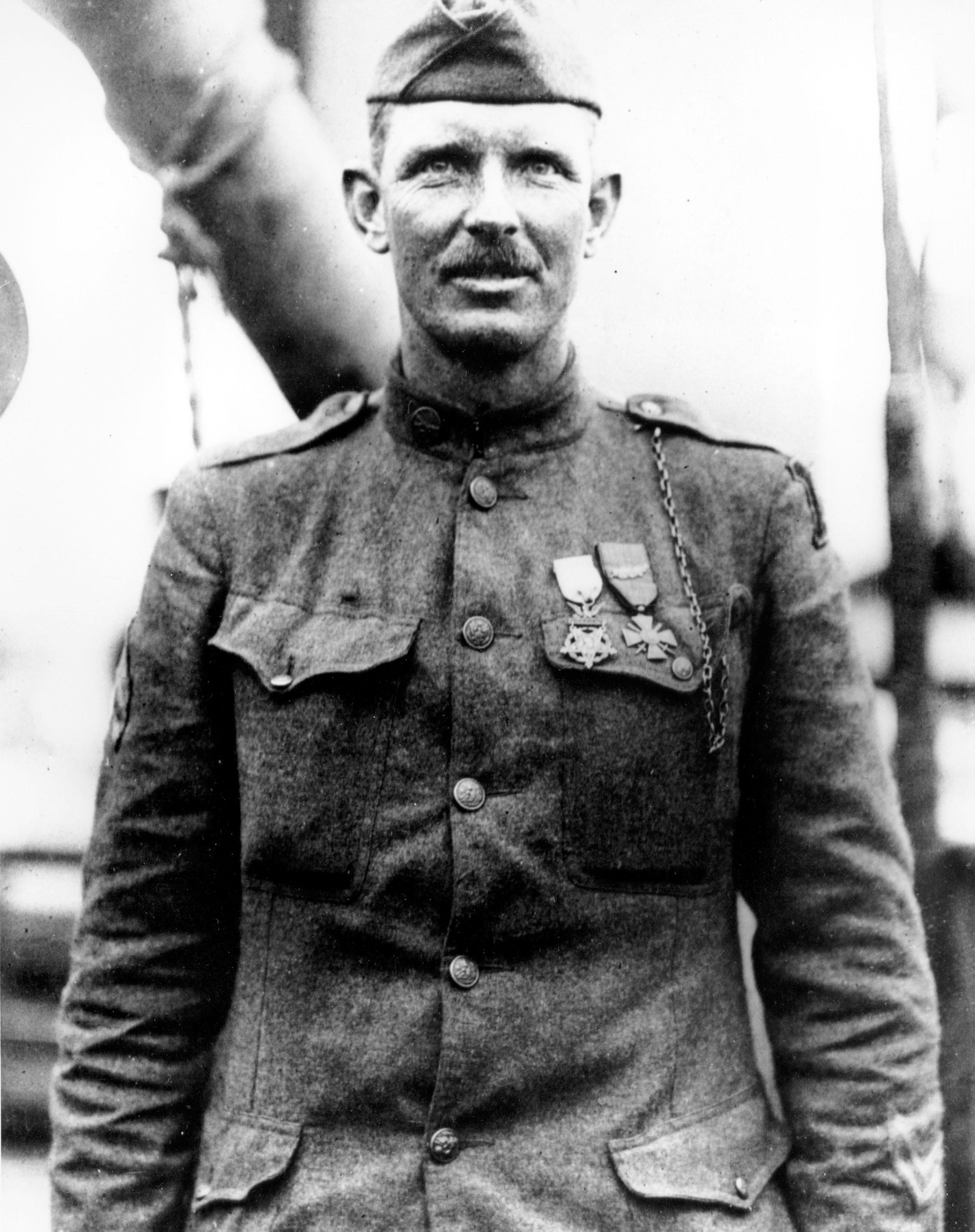
A large American with a red mustache, broad features and a freckled face approached Vollmer and accepted the surrender of the men under Vollmer’s direct command. It was only then that the German realized no American reinforcements were coming. 132 Germans had surrendered to (then) Corporal Alvin York and six other soldiers. The Americans were beginning to learn how to fight and win in the trenches.
Alvin York – he would become one of the most famous individual soldiers in American history, but his post-WWII politics (he was in favor of attacking the Soviet Union) had him fall from public view
The Americans had been served their first real taste of defeat in the opening days of the Meuse-Argonne Offensive, as the German counterattack badly bloodied the 35th Division to the point of nearly destroying it. Among the many casualties had been Lt. Col. George S. Patton who was personally leading from his 304th Tank Brigade. Patton had been frustrated with the inability of his tanks to advance and rounded up some men in a nearby trench to dig out his stuck tanks. One of the soldiers questioned the wisdom of exposing themselves to German artillery for Patton’s tanks – Patton replied by striking the soldier in the head with a shovel. Even Patton remarked in his diary that he may have killed the man, who did not get up after being struck. Patton’s willingness to expose himself and others to dangerous conditions would catch up with him that very same day, as Patton would be hit in the leg with a machine gun bullet that tore a wound the size of a silver dollar through his buttocks. If not for the courage of his orderly, Private Joe Angelo, Patton would have bled to death near the town of Cheppy in the forests of the Argonne. (more…)
So we’re told requiring an ID to vote is irredeemably racist; apparently, minorities can’t keep track of government issued photo ID is, and requiring voter ID would make us corrosively racist, Denmark and the UK.
But in New York City, now, one requires a proof of vaccination – a de facto ID card, one way or the other Dash to participate in much of indoor public and social life.
The logical inference: racism is OK when it is about health?
I’ve read a few good reviews – although I’ve tempered my enthusiasm by remembering that, outside classical music, the “critic” class is bastardized beyond salvation.