Archive for December, 2013

All Memes Necessary, 2013 Edition

Tuesday, December 31st, 2013

The Wombat reminds me that I used to do this sort of thing all the time.

Self-indulgent?  Sure.  Why not?  It’s my blog, and I can do what I want.

1. Was 2013 a good year for you?:  All in all, sure.  Notables:  I got a new job that was a real step forward.  When you’re a contractor for a long time, you find that each year is pretty much a rerun of every other year you spend as a contractor.  I’m an employee for the first time in a while, I’m leading a group, and it’s been a lot of fun so far.

2. What was your favorite moment(s) of the year?:  Seeing my niece Sniperbaby for the first time.  (She’s six, and while Sniperbaby isn’t her actual name, she actually does get hits on prairie dogs at 100 yards with a .22 Magnum).

3. What was your least favorite moment(s) of the year?:  We’ll talk about that over a drink sometime.  If we have a drink sometime.

4. What did you do in 2013 that you’d never done before?:  Went to the east coast of Florida.  Ate scallops.  Played a ukulele.  Kicked one of my demons in the groin.

5. Did you keep your new years’ resolutions, and will you make more for next year?: I never do them.

6. Where were you when 2013 began?:  At home.

7. Who were you with?:  A dog, two cats, and my guitar.

8. Where will you be when 2013 ends?: About the same.

9. Who will you be with when 2013 ends?:  A dog and two cats and my guitars.

10. Did anyone close to you give birth?:  Other than some Facebook friends, no.

11. Did you lose anybody close to you in 2013?:  No, thank God.  It’s been a while.

12. Who did you miss?:  Nobody, really.

13. Who was the best new person you met in 2013?:  No one person.  Lots of new co-workers.  The guy who works for me is a great fella.

14. What was your favorite month of 2013?:   I can’t imagine ever having a favorite “month”.  May was kinda fun.

15. Did you travel outside of the US in 2013?:  I haven’t been outside the US since college.  That kinda depresses me.   I may just drive to Canada this year for the hell of it.

16. How many different states did you travel to in 2013?:  North Dakota, Wisconsin, Florida and Ohio.

17. What would you like to have in 2014 that you lacked in 2013?:  Time for a project I’ve been noodling with for over a year.  I’d like to have something ready to go by April at the latest.

18. What date from 2013 will remain etched upon your memory, and why?:  Plenty of days; no dates.

19. What was your biggest achievement of the year?:  I’m finally managing  people at work.  It’s never been a goal, but it’s an achievement.  Sorta.

20. What was your biggest failure?:  Not finishing the project I mentioned above.

21. Did you suffer illness or injury?:  So far so good.  Knock wood.

22. What was the best thing you bought?:  This is weird – nothing.  I don’t actually recall buying anything all year.  Some books, some music, groceries.

23. Whose behavior merited celebration?:  My kids made some good progress.  Long story, and you’ll have to know me  pretty well to hear the story.

24. Whose behavior made you appalled and depressed?:  Our government at all levels.

25. Where did most of your money go?: The mortgage from hell. I live with it, but it’s the bane of my existence.

26. What did you get really, really, really excited about?:  Music.  Long story.

27. Did you drink a lot of alcohol in 2013?:  I haven’t drunk “a lot” of alcohol since about 1990.  I haven’t had “a lot” of alcohol at one sitting since 2008, and that was only once.  I drink so rarely – seriously, the MOB parties and a couple of semi-regular happy hours with some college and work friends are about it.

28. Did you do a lot of drugs in 2013?:  Ibuprofen.  Which, other than the odd antibiotic, is the only drug I ever use…

29. Did you treat somebody badly in 2013?:  Er…not that I remember?  I usually try to treat people well…

30. Did somebody treat you badly in 2013?:  Nothing I couldn’t not only handle, but mock with style.

31. Compared to this time last year, are you:  A little happier, about the same weight, a little richer.

32. What do you wish you’d done more of in 2013?:  I wish I’d had an actual vacation.  I have been a contractor most of my career, so I have little concept of or skill at down time.

33. What do you wish you’d done less of?:  Worry.  Same as last year.

34. Did you fall in love in 2013?:  Yeah, Kate Mara.  But don’t tell Scarlett Johannson.

35. What was your favorite TV program(s)?:  This is the first time in decades I’ve watched first-run television or cable.  I loved House of Cards and Breaking Bad.  And I hate to say it, but Walking Dead is really good.  And the final episode of “The Office” was really really excellent, in an absolutely absurd way.

36. What song will always remind you of 2013?:  One of my own.  Maybe I’ll let you hear it someday.

37. How many concerts did you see in 2013?:  It occurs to me that I haven’t been to a concert of any kind since Springsteen in 2002.  Pathetic, huh?

38. Did you have a favorite concert in 2013?:  Asked and answered, indirectly.

39. What was your greatest musical discovery?:  Mark Knopfler’s been hiding in plain sight for thirty years.  I’ve always been aware of his most notable stuff, but I’d never really done the deep dive into the Knopfler/Dire Straits catalogue.  I did this year.

40. What was the best book you read?:  “The German Invasion of Norway” by Geir Haar.

41. What was your favorite film of this year?:  I saw some good ones – more than usual.  I used to go to actual theatres maybe once every two years or so. It’s been more frequent this past year.  Best one, though, is probably Lone Survivor.

42. What did you do on your birthday, and how old were you?:  Nothing interesting, and none of your business.

43. What did you want and get?:  A birthday without having to deal with someone else’s crisis.  And for the first time in six or seven years, I got it!

44. What did you want and not get?:  I never want much.

45. What one thing would have made your year immeasurably more satisfying?: Having Premiere start lining me up to replace Limbaugh when he retires.

46. How would you describe your personal fashion concept in 2013?:  Personal fashion concept?  “No beards without mustaches”

47. What kept you sane?: Same as every year; having an outlet.

48. Which celebrity/public figure did you fancy the most?:  Kate Mara was giving Scarlett Johannson a run for the money.

49. Tell us a valuable life lesson you learned in 2013:  Stay hydrated.  Persevere.  Let it turn to something else.

50. Quote a song lyric that sums up your year:   OK:

Heel y’ho boys, let her go, boys

Bring her head round into the weather.

Heel y’ho boys, let her go boys

Sailing homeward to Mingulay!

Anyway – Happy New Year to you and yours!  I hope 2014 is a good year for all of you!

Eurasia Has Never Been At War Yadda Yadda Bla Bla

Tuesday, December 31st, 2013

If you read this blog, you know that “Politifact”, the WaPo’s “Fact-Check” column, accepted as the sine qua non of political fact-checking by many in the industry (and more of the less-informed outside it).

Those people might not know that “Politifact” has been carrying President Obama’s water on the key claims about the Democrat’s flagship Obamcare legislation since the  beginning.  What they might not know is that : “Politifact” and its editor, Angie Drobnic Holan, have not only completely flip-flopped on the story, but are burying the fact that what they called the “Lie of the Year” in 2013, they called “True” with a side order of “you are an ignorant redneck for even asking” in 2008:

The highlight of Holan’s 2013 “Lie of the Year” article was that it completely ignored Holan’s own “True” rating of the “keep your plan” claim back in 2008. A sidebar to the article listed as “related rulings” Holan’s 2013 articles about Jarrett and Obama, and Jacobson’s 2012 article rating the claim as “Half True.” The text of the article cites also the 2009 “Half True” report. But nowhere does the “Lie of the Year” piece even acknowledge that its author once gave Obama’s promise its 100 percent “True” seal of approval.

Now, if you’re a conservative, you know “Politifact” is a Democrat propaganda machine.

The only real question is; do the media – especially those that call themselves “no rant, no slant” objective journalists – know?

“Trust Us: Smoke Never Means Fire!”

Tuesday, December 31st, 2013

James O’Keefe and his merry band of prankersters are able to fraudulently obtain ballots 97 percent of the time:

New York City’s Department of Investigation (DOI) has just shown how easy it is to commit voter fraud that is almost undetectable. Its undercover agents were able to obtain ballots for city elections a total of 61 times — 39 times using the names of dead people, 14 times using the names of incarcerated felons, and eight times using the names of non-residents. On only two occasions, or about 3 percent of the time, were the agents stopped by polling-place officials. In one of the two cases, an investigator was stopped only because the felon he was trying to vote in the name of was the son of the election official he was dealing with.

Clearly, O’Keefe has overstepped the bounds of…

…wait.  I said O’Keefe, didn’t I?  What did the article actually say?

The New York Department of Investigation’s report doesn’t address the serious issue of absentee-ballot fraud, where at least a paper trail to catch fraud can be created. But it does highlight a troubling case indicating that voter impersonation Chicago-style is still with us.

Oh. 

Um…

Fox News!

Scott Gillespie And The Catechism Of Uselessness

Tuesday, December 31st, 2013

Scott Gillespie of the Strib editorialized about the one-year anniversary of Sandy Hook.

At least he ended the piece constructively:

Those 26 faces will stay frozen, though. The children and their teachers, lost forever except in photos and home video. At least — if you believe it will help — say another prayer for them and their families. If we offer nothing else, at least say a prayer.

Other than that?  Gillespie foreshadows what will, I suspect, be the anti-rights movement’s two big hooks in Minnesota this year; guilt, and the vague need to “do something”, even if the “something” is completely useless at preventing actual crime, with both of them always, always, wrapped in the memory of people who would not have been saved by anything that they’re proposing.

But practical responses aren’t the issue, here.  This is about emotions:

You see those faces frozen in time on your TV screen now. They are angels, every one of them. You would like to look away, turn the channel and move on. Our Congress did, and most of our state legislatures. One year later, little has changed.

It’s not the Sandy Hook kids’ faults the were all white and upper-middle-class, and that the media focused on them and not the many, many more children slaughtered in ones and twos in Barack Obama’s Chicago – who are almost entirely black.  But it is Scott Gillespie’s fault that he ignores, or doesn’t know, that not a single law proposed in any state legislature, or in Congress, would have prevented Sandy Hook – but that the City of Chicago has “done something”, a near complete civilian gun ban, that is closely correlated with a skyrocketing murder rate in Chicago.

But those kids are black, and in a Democrat stronghold.  As always, they go unmentioned.

The emotions that Gillespie – and the anti-rights movement whose water he’s carrying – aren’t just about sympathy.  No, there’s gotta be ninety seconds of hate: 

Wayne LaPierre is on the screen now. You can hear the anger in his voice. If he feels any pain, any regret, he hides it. The perfect man for the job. Raise more money and spread more lies. Intimidate. Bully. Threaten. Win at all costs, from coast to coast. Not undefeated, but close.

Scott Gillespie, I hereby challenge you; where was LaPierre wrong?  What are the “lies?”  Let’s talk about that.  Preferably face to face, but I’ll do email.  Let’s hash this out.

No, it’s not that LaPierre lied; he didn’t, and doesn’t have to.  He was right.  His opponents were wrong.  And they – in this case Gillespie, but it could be any lefty columnist – are attacking LaPierre with the dim ad-homina and the scurrilous accusation – the “lies” – because it’s all they have, and a boogeyman, a Goldstein, is what they need.

And then there’s the murderer. We should ignore him and his story, right? Make him as abstract as possible because it’s too hard to answer the why question without that research. There are more like him, but how could we possibly know how to find or stop them? So we move on, trying not to say his name.

Now Gillespie is just making things up.   This is where LaPierre – and all of us on the human rights side of this battle – have been focusing; Adam Lanza.  The current system worked, in that it denied him a gun.  He killed his mother – already illegal in fifty states – to steal her legally-purchased firearms to use in the rampage.

And it’s on the crazies, like him, James Holmes, Harris and Klebold, Seung-Hui Cho and the like, that Wayne LaPierre – and, incidentally, all of the rest of us on the human rights side of the argument – are focused.

And not a one of them would have been affected by any of the laws that were passed in places like Colorado, New York, Pennsylvania or California.

So when Gillespie plaintively asks…:

The anniversary show is over now. Will there be another one next year, or the year after that? Why wallow, right? We are Americans. We press on. We buck up and never look back. Like LaPierre.

…the answer is “maybe, but nothing you’re proposing would change a thing”.

But Gillespie is part of a wave of mainstream media that are working to pave the way for the anti-gun movement’s next big campaign in Minnesota.

More – much more – in coming days and weeks.

Who Knew?

Tuesday, December 31st, 2013

Minneapolis has a car idling law:

We caught about a dozen Minneapolis residents idling their cars past the legal limit this morning, and none of them knew they were breaking the law…15 minutes is all the time you have if you’re within Minneapolis city limits. In below-zero temperatures, drivers in Minneapolis can leave their car idling and unattended for up to 15 minutes. When the temperatures warm above zero, the idling limit is just three minutes.


“Maybe half an hour,” said Kissel, on how long she lets her car warm up. “But I wouldn’t know the difference. It’s the morning. You forget time!”

And yet they have no idle politician law.

It’s not a “green” thing; it’s about preventing auto theft – by making it illegal to leave a car in a condition where it can easily be stolen.

Honestly?  I’d almost prefer the “green” law; at least it’d be stupid, rather than  stupid and insulting.

It’s Not Pining For The Bloody Fjords

Tuesday, December 31st, 2013

Joe Doakes from Como Park emails:

Leftists despair when their own principles collide, leaving it impossible to decide who to hate.  Example:

We all want clean energy.  Windmills seem like the perfect answer, opposed only by Conservatives who love Big Coal.  Hate Conservatives, right?

Except birds fly into the blades and are killed, including protected species like the American Bald Eagle.   In November, Duke Energy was fined a million dollars for killing birds at its wind farms.  So hate Progressives who promote wind farms?  Or hate companies that produce clean energy?

On December 9th, Obama’s Interior Department released new rules giving wind farms a 30-year permit to kill birds, including bald eagles.  So hate President Obama?

Imagine if a Republican president had done this.  No wonder Liberals are distraught these days.  It’s just so hard to know who to hate.

Joe Doakes.

When it’s the only thing you actually create, you can understand why they get touchy about doing it right…

It Seemed Appropriate

Monday, December 30th, 2013

The Vikings are shuffling the Head Coaching deck chairs.

For the full story, I turn the mike over to Howard Cosell:

The old video is a lot more interesting than the actual story.

Gun Control In Minnesota: The Next Useless Wave

Monday, December 30th, 2013

In 2013, the grassroots of the Minnesota human rights movement – pro-Second-Amendment groups like GOCRA, the Twin Cities Gun Owners and other genuine grass-roots organizations – dealt the gun-grabbers a humiliating defeat.  Even though the anti-rights groups were lavishly funded, were supported by a purchased media narrative, and controlled the entire apparatus of Minnesota government, they were unable to jam down any of their useless legislation.

Zero.

It was an epic victory of an army of Davids over a phalanx of obese, arrogant Goliaths.

But 2014 is a whole new year.

Since the last session, the anti-gun movement has made some roster changes.  In place of last year’s leadership – “Protect” MN’s credibility-free Rep. Heather Martens, Moms Want Action’s shrill, self-caricaturing Jane Kay, and the hysterical, deranged Joan Peterson, a flood of Joyce Foundation and Bloomberg money has enabled the anti-rights movement (in this case, “Mayors Against Illegal Guns”) to hire Richard Carlbom, the architect of the campaign to torpedo the Marriage Amendment, and then to pass Gay Marriage in Minnesota.

And this is going to change the game here in Minnesota.

Unlike the Minnesota gun grab movement’s previous leadership, Carlbom is a smooth, polished PR fixer with great talent at running a nuanced, effective campaign – and he’s already got one improbable win against (at face value) longish odds under his belt.

As a result, this is going to be a different campaign, unlike any that Minnesota’s Second Amendment movement has ever faced.

My hunch?  Carlbom will replace Kay/Martens/Peterson’s club-footed yapping, and Michael Paymar’s wide-front legislative bludgeoning, with a more subtle attack:

  • Emotional cruise missiles replace carpet-bombing:  the anti-rights movement has long bludgeoned their audiences with a ham-fisted appeal to emotion.  To be fair, it’s their only argument; to be honest, they haven’t done it well.  Carlbom won the gay marriage debate in part by personalizing the gay marriage issue – showing that gay couples were Just Like The Rest Of Us.  I think you can expect the emotional assault to be much more focused and personalized than in the past; fewer “schoolrooms full of children”; more “let’s talk with this mom, whose son was…[fill in tragic shooting].  Expect those attacks to be far harder to undercut – Carlbom is less likely to focus on the story of a “child” who turned out to be a gang thug than were the hapless Martens or Kay.
  • The friendly face of “reasonable” authority:  The anti-gun movement lost a lot of credibility points by using as its public face the scolding, unctuous, unfluent Martens, the hectoring and red-faced Kay, and irrational Peterson.  Expect those faces to be replaced by Minnesota’s very definition of “reasonable”; lots of Lutheran ministers (ELCA, natch), with their Saint Olaf-bred diction and their carefully-trimmed beards, and liberal-but-not-too-liberal, Jewish-but-not-too-jewish rabbis, carefully and calmly asking for “common sense” measures to “prevent violence” and “promote safety”, and lots of other carefully-focused terms calibrated not to alarm tens of thousands of phone calls and thousands of protesters.
  • Trying to build the “reasonable” brand:  Expect less (overt) talk about attacking puffy-faced white suburban caricatures, and more about how “gun safety” and “violence prevention” appeals to our better natures; the things that make us human, and Minnesotan.   This campaign has, in fact, already begun, with Strib columns by Lori Sturdevant and Scott Gillespie (see this space tomorrow morning) that stake out this emotional, intellectual space (in a campaign that just can’t be coordinated, and I’m sure is just a fluke that won’t, no, won’t get re-iterated in turn by every other Minnesota mainstream media outlet, nosireebob).

It’ll be a campaign calculated not to alarm, and to appeal on at least a shallow level to the conceit most Minnesotans have that we’re a thoughtful, deliberate people, not given to unseemly rash emotionality and open to “reason”.

Underneath and obscured by it all, of course, will be the facts; that none of the measures they’re proposing will affect actual violence in any way.  Nor are they intended to.

But it’ll be done in a way intended to gently gull the gullible, and lull at least a part of the crowd that rose up to repudiate Representatives Paymar, Hausman and Martens in the last session.

So it’s almost time for a new session – one that may be the most dangerous yet for Minnesota’s Real Americans.

Smoke ’em if you got ’em.

CORRECTION:  This past session was 2013, wasn’t it?

MN-GOPAC Endorses Ortman

Monday, December 30th, 2013

The gun-grabber movement is going to make a particularly insidious push to attack your second-amendment rights in the upcoming session.

The Minnesota Gun Owners PAC is launching an opening salvo, getting on the endorsement board for the upcoming Senate race and backing Senator Julianne Ortman:

 “Throughout her time in the Minnesota Senate, Julianne Ortman has been an energetic and consistent advocate for Minnesota’s gun owners, “ said Mark Okern, Chairman, Minnesota Gun Owners PAC.  “She has demonstrated a strong commitment to policies that protect the rights of Minnesotans to hunt, enjoy the shooting sports, and protect their families from violent criminals.”

The gun-grabbers are going to be doing a lot of talk about “common sense”. Ortman gets it – there is no “common sense” to the idea of the gun-show background check:

As a Minnesota State Senator, Julianne Ortman consistently opposed gun control measures that would have impacted the rights of law-abiding Minnesotans while having no impact on violent criminals.  Senator Ortman supported the Minnesota Citizen’s Personal Protection Act in 2003 and 2005.  She also supported Stand Your Ground legislation in 2012 that was later vetoed by Governor Mark Dayton.  Most recently, she was a strong and vocal advocate for gun owners as a member of the Senate Judiciary Committee during several days of hearings.

 “As United States Senator, we are confident Julianne Ortman will continue her strong support for Minnesota’s gun owners and be a leader on this issue not only for Minnesota but also for the nation, “ said Okern.

Ortman has gotten a mixed rap – but, I maintain, has done a good job of earning conservatives’ support, especially that of the communities that support the Second Amendment. She was vital in pushing the “Good Gun Bill” last session – a finger in the eye of the “Let’s Just Ban Something!” crowd.

I think it’s a good call .

Death Rattle

Monday, December 30th, 2013

Liberal-talk radio outlets in major – liberal! – markets are flipping formats:

2014 will mark the beginning of a massive change for liberal talk radio across the country. In New York, WWRL 1600 AM will flip to Spanish-language music and talk, throwing Ed Schultz, Thom Hartmann, Randi Rhodes, and Alan Colmes off the air. In Los Angeles, KTLK 1150 will be dumping Stephanie Miller, Rhodes, Bill Press and David Cruz off the air in favor of Glenn Beck, Rush Limbaugh and Sean Hannity. In San Francisco, KNEW 960 will leave Miller, Hartmann, and Mike Malloy without a radio home in the market.

Liberals – among them the Daily Kos – are trying to portray the flip as a “demotion” for Limbaugh; he (and Beck and Hannity and the whole Premiere Radio rogues gallery) are moving from a 50,000 watt station to…another 50,000 watt station (albeit one with a little less range, but one which still amply covers all of Los Angeles with plenty of oomph to spare).

The real demotion?  In LA, liberal talk is moving from one station to…zero.

And New York.

And San Francisco.

Not Minneapolis, so far.  But how long can Janet Robert afford to keep her long-marginal station on the air with nothing but ads from community coffee-house collectives, unions and non-profits?

Flailing About

Monday, December 30th, 2013

Joe Doakes from Como Park emails:

Leftists despair when their own principles collide, leaving it impossible to decide who to hate.  Example:

Poor people can’t afford to buy their own homes, so they rent.  Renters don’t own the building so they can’t make improvements.  Landlords have little incentive to make improvements that reduce profits.  So poor people live in crappy housing until they can afford to move somewhere nicer.  We should hate the landlord, right?

Except in St. Paul.  Here, the City requires rental properties to be nicer than owner occupied.  I’m not kidding; I was a landlord here for 15 years and earned Class A ratings for my rentals.  I know the codes and how they’re applied.  The truth is the City set the standards for rental properties so high that landlords can’t afford to maintain them.  And when they don’t, the City tears down privately-owned rental properties and partially replaces them with publicly-owned low-income apartments, otherwise known as “Projects.”  Every renter I ever met preferred a dingy rental house with a bit of yard over the city housing Projects.  But if the City is tearing rental houses down, where else can poor people go?

The policy has the effect of eliminating low-density rental housing stock scattered in neighborhoods and herding poor people into high-density housing projects in centralized locations.  The policy mostly impacts people who receive welfare and in St. Paul, that’s mostly people of color.  So the City’s policy causes disproportionate harm to poor Black families.   Under federal Fair Housing Law, that’s called “disparate impact” and it’s a form of illegal discrimination.  Racists discriminating against welfare recipients . . . we should hate Mayor Chris Coleman’s crew?

A group of landlords sued the City on exactly that legal basis and the case was all set for hearing at the United States Supreme Court when the City backed down rather than lose the case.  The City tried to spin it as worry that Conservative justices on the Supreme Court would overturn the civil rights law that the City was violating.  So now what: hate the Supreme Court?

The City is being sued again, for the same policies that have the same racist impact.  The City Attorney assures us the landlord is a big poop so the policy is justified.  But the City is still tearing down private rentals and still pressing ahead with Projects along the Light Rail line.  Despite everything, the City continues discriminating against poor persons of color, in the name of helping poor persons of color, under cover of media blackout.

Can’t really blame the media.  The want to do the right thing.  But it’s just so hard to know who to hate.

Joe Doakes

They’re just following orders, not entirely confident that headquarters really knows what it’s doing.

Happy NARN Year!

Saturday, December 28th, 2013

Today, the Northern Alliance Radio Network – America’s first grass-roots talk radio show – brings you the best in Minnesota conservatism, as the Twin Cities media’s sole source of honesty!

  • I’m in the studio today from 1-3.  I’ll be talking Year in Review, plus PR Stunting 101, the MNSure collapse, and much more.
  • Don’t forget the King Banaian Radio Show, on AM1570 “The Businessman” from 9-11AM this morning!
  • Tomorrow,  Brad Carlson is on “The Closer”!

(All times Central)

So tune in to all six hours of the Northern Alliance Radio Network, the Twin Cities’ media’s sole guardians of honest news. You have so many options:

Join us!

I Gotta Confess…

Friday, December 27th, 2013

…I’ve always wanted to headquarter my talk radio network, cluster of regional radio stations, and social micromedia empire out of a project just like this.

Can’t Keep A Good Firebreather Down

Friday, December 27th, 2013

The legendary Swiftee is back blogging again.

And there was rejoicing.

On the right.

Disaster By Design

Thursday, December 26th, 2013

As we’ve seen with the catastrophic rollout of Obamacare; when you’re working on a big project, design and architectural decisions made early in the process can have unintended, and maybe massive, impacts later in the process.

Seventy years ago tonight – the night after Christmas – at the Battle of the North Cape, one of those chains of design-cause to real-world effect came to a dismal conclusion in the frozen, stormy North Atlantic.

———-

When designing military vehicles – whether a Hummvee, an aircraft carrier, a tank or a fighter plane – designers have to balance four, largely mutually-exclusive factors.  The design of any military vehicle is a result of the inevitable compromise made between those factors, at any given level of technology.

Those factors are usually summed up as “Firepower, Armor, Speed and Payload”, but are better described as:

  • Firepower – how much hitting power the vehicle has.  This can refer to the size of a vehicle’s weapons – but also to the amount of ammunition, or the variety of threats it can attack, or the fire control system that helps it hit its target.
  • Survivability – which is beyond mere “armor”.  For example – US Navy aircraft carriers of World War 2 had little actual metal armor, but they invested immensely in damage control and catastrophe-proofing the ship designs – which led to some of them surviving damage that would have sunk any other nation’s designs.
  • Mobility – This can indeed be raw speed.  But it can also mean the ability to keep moving in conditions that would stymie other vehicles of its type.  That’s a major factor in today’s story, as it happens.
  • (A fourth – Payload – sometimes crops up, usually if you’re building a vehicle whose job it is to carry people, supplies or other vehicles – anything from an armored personnel carrier to an aircraft carrier)

Your job is to design a new tank.  You have a weight and size limit – your tank has to fit evenly onto a flatbed rail car, so it can be moved around the country.  In your design you’re going to cram a huge, powerful cannon into it, along with thick, heavy armor.  But that means you’re going to have to put a big engine into it, so that it can actually move.  Within the size restrictions you have, that means building a taller, more capacious vehicle to hold the engine – but tall tanks are easier to see at hit, which affects survivability.  Making it smaller requires either accepting  a slower tank (compromising Mobility), or a smaller gun, or less ammunition for a larger gun (less Firepower), or making it lighter (reducing armor, and thus reducing Survivability).

Naval ships have the same set of compromises.

Global:  In the early 20th century, it could be fairly said the sun never set on the British Empire.  The Empire and Commonwealth – the network for former colonies that had become independent, but remained part of a close-knit economic and defense alliance – stretched from (using current names except as noted for all the below) Canada, the Bahamas, the Falklands and Belize in the west, east to the Home islands, to colonies, to its Mediterranean holdings (Gibraltar, Malta, and of course the vital Suez Canal, in an Egypt that Britain ruled as a puppet proxy), to the protectorates and Commonwealth states that dominated Africa (Nigeria, Kenya, Tanzania, Uganda, and the commonwealth nations of Rhodesia (now Zimbabwe) and South Africa) and the Middle East (Palestine, Jordan, Iraq, and Britain’s then and present ally and client Oman), its keystone possession India (which then also included what became Pakistan and Bangladesh) and Sri Lanka, and  to its’ far eastern colonies in Malaysia, Singapore, Hong Kong, Fiji, and of course its Commonwealth allies Australia and New Zealand.

And from the 1600s on, the Royal Navy was designed to sail, and fight, anywhere in that massive slice of the world – from the stormy, sub-arctic expanses of the far North Sea and North Atlantic, to the temperate reaches of the Mediterranean, to the dolorous tropics of the Indian Ocean.

And over the years, the Royal Navy arrived at a design formula that institutionalized the order of importance of the four key design factors, based on the mission “fight anywhere in the Empire”.

Mobility came first – in terms of “Seaworthiness”, as opposed to “Speed”.  A British ship had to be able to weather sea conditions ranging from North Atlantic gales to Indian Ocean cyclones.  This meant building ships that were designed and engineered to remain not merely afloat, but controllable in terrible seas.  (Mobility expressed as “range” was less important – Britain’s empire had refueling bases about every 2,000 miles, from Halifax Nova Scotia to the UK to Gibraltar to Suez to Mumbai to Sri Lanka to Singapore to Hong Kong.  British designers assumed those bases would be available.  World War 2 showed it a bad assumption – but we’re jumping ahead, here).

Protection – armor, damage control and catastophe-proofing – as a general rule, came in second.  Firepower came in third; too many, too heavy guns and torpedoes made the ships top-heavy, which made them less stable and harder to handle (and more importantly, handle in a combat-effective way) in heavy seas.

Different nations made the compromise differently.  The Italian navy emphasized speed over range – they fought in the Mediterranean exclusively, and their main goal was to react quickly to contingencies in that ocean.  Its rather placid weather meant “seaworthiness” was less vital.  The US Navy, whose main theater of operations was the Pacific, emphasized long range over pure seaworthiness; their firepower was on paper more modest, although greatly augmented by superior technology like fire control radar.

And the German Navy?   It was designed to operate in the stormy but confined North and Baltic Seas.  Its mission was not to project power around the globe; it was to sink the British Fleet.  Range was more or less irrelevant – most missions were measured in days, not weeks (for surface ships – the submarines, or “U-Boats”, were another matter).   The crux of the design battle was between raw, pure firepower – cannon and torpedoes – and mobility expressed in terms of speed.

With that in mind, the Germans in 1939 commissioned their second most-famous warship (after the Bismarck, of “Sink the Bismarck” fame), the KMS Scharnhorst.
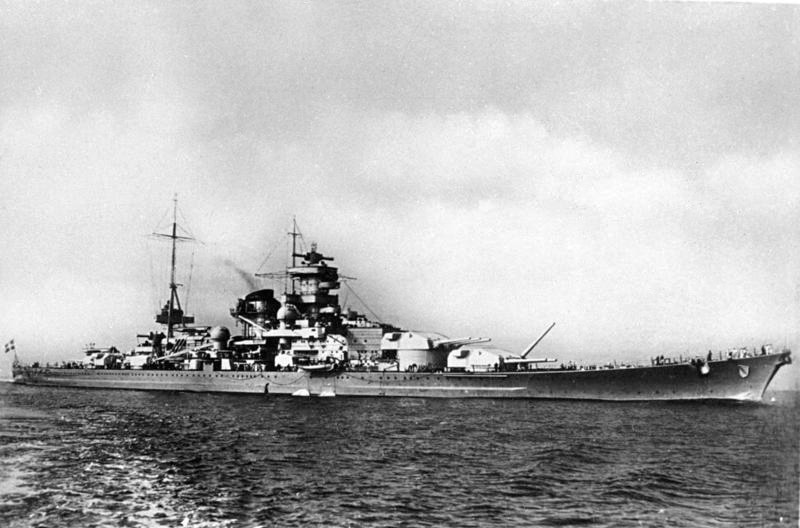
KMS Scharnhorst

Scharnhorst and her sister Gneisenau weren’t really “battleships”; they were “Battle Cruisers”; more speed and less armor (but not much less) than battleships, faster and more heavily armed than cruisers (but not quite as powerful as a battleship), the idea was to be able to kill anything that could catch it, and outrun anything that could kill it.  But it was built to the German design standard; Speed and Firepower trumped raw seaworthiness (although at 32,000 tons, it was still plenty seaworthy).

Floating Tin Cans:  In large ships, like battleships and aircraft carriers, of course, there’s plenty of room to make those compromises.

In smaller ships, it was a much tighter set of compromises.

Destroyers – at least up through the 1960s – were smaller warships designed to escort fleets of larger warships, and to attack much larger warships using (until the missile age) torpedoes.  They have to be fast, to not only keep up with the battleships and aircraft carriers they escorted, but to keep their station in formation with the larger ships as they zigged and zagged in evasive maneuvers.  So a Destroyer would generally be from 1,000 to 2,200 tons (battleships were 26,000 to 80,000 tons, and aircraft carriers were generally from 12,000 to 30,000 tons in World War 2)

To make things more complicated, the various arms control treaties of the 1920s and 1930s – especially the London Naval Treaty, which sought to curb the naval arms race of the era – placed a statutory limit on the size of warships, and the number of tons of warships that could be built in each class.  The limit for most destroyers was 1,500 tons.

So the design challenge for Destroyer builders in the 1930s was, within the treaty tonnage limits, to build an warship that was effective in furthering the nation’s strategic doctrine.

For the British, then, Destroyers were designed within a 1,500 ton limit to be:

  1. Extremely seaworthy, but with relatively short range and modest speed (35 knots, or about 40mph)
  2. Modest armament; 4-5 4.7 inch cannon and 6-8 torpedoes.  More, heavier guns and torpedoes added topweight, which affected stability which was a key factor in seaworthiness, which was the top priority.
  3. Extremely minimal protection; destroyers had no armor.  They had some damage-proofing in design and damage-control.

HMS Hunter. Built in 1936, it was fundamentally similar to nearly every British destroyer build from 1918 to 1943; four 4.7 inch guns, eight torpedoes, 35 knot speed, and very seaworthy. Hunter was sunk at Narvik in 1940.

The Germans, given their mission that was short on range but long on “sinking British ships”, had a different set of compromises.  They enabled these compromises, in part, by ignoring the London Treaty’s limits, and building destroyers that were nearly 1,000 tons heavier than the British ships.  Within that limit, the Germans focused on:

  1. Firepower – in terms of sheer, raw hitting power – was most important.  German destroyers carried mostly five 5-inch guns, and many carried five 6-inch guns, usually found on larger 10,000 light cruisers.  They fired 100 pound shells, to the 40 pound shells fired from the Brits’ 4.7s.
  2. Mobility – in terms of raw speed – was next.  German destroyers clocked from 36-38 knots.  Range was less important – German destroyers rarely expected to be at sea longer than a week, operating from bases like Kiel, Wilhelmshaven, and – after 1940 – occupied Norway, Denmark and France.  Seaworthiness came in well down the list; the heavy gun and torpedo batteries, and the design compromises to enable the high speed, made the ships much less stable than British ships; in bad weather, they’d float, all right – but they’d be rocking back and forth too hard to fire their guns effectively.
  3. Protection, as with all destroyers, was a matter of “not being hit”.  Especially for the Germans – structural strength came in lower on the list of priorities.

The German Z36, short for “Zerstörer 36”, or “Destroyer number 36”. German destroyers were numbered, not named.

Among the nation’s destroyers, a “Tortoise and Hare” comparison works; British destroyers were slower and more lightly armed, but seaworthy enough to not merely survive, but fight, in much worse weather.   The Germans had the edge on speed and firepower.

(The US Navy, by the way, split the difference, more or less.  Our destroyers, until the eve of war, were designed to operate in the vast ranges of the Pacific; an American destroyer could steam three times as far as its Brit counterpart.   They also had only four or five guns – five-inchers firing 60 pound shells.  But those five inch guns were able to shoot at both surface ships and aircraft; this made them a bit heavier than single-purpose anti-ship guns, a technology edge that gave US destroyers an immense advantage in anti-aircraft firepower over those of any other nation on earth at the time, a difference that was absolutely crucial as air power supplanted surface to surface action as the main form of war at sea.  And to pay for the weight that went into fuel and dual-purpose guns, the US destroyers sacrificed some seaworthiness (three sank in a typhoon in 1944) and a little speed and, on the eve of the war, the treaty limits themselves, dumping the 1,500 ton limit and building destroyers of 2,200 and later 3,000 tons).
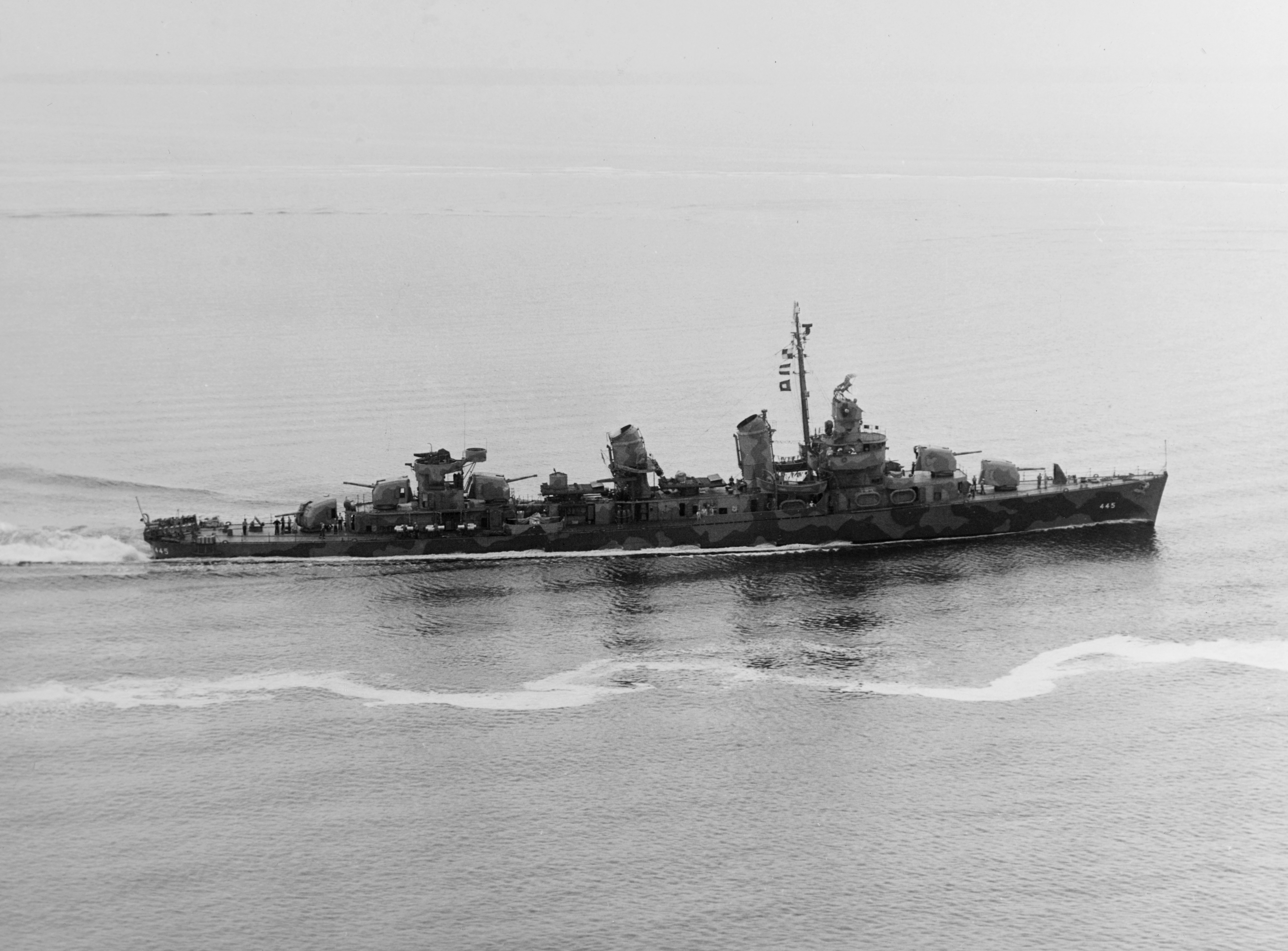
USS Fletcher. Built after the US belatedly abrogated the London Treaty, the Fletchers were 2,200 tons, and armed almost identically to the earlier 1,500 ton ships. This made them rugged, seaworthy, powerful-enough, with plenty of fuel to tackle the vast Pacific – and able to be updated continuously. Fletcher-class destroyers served into the 1970s in the US Navy, and the last one, the Mexican Cuitlahuac ( formerly USS John Rodgers), remained on active service until 2001 – a phenomenal record for a ship class.

Duel In The Sleet:  In December of 1943, the German high command realized that the war was going badly.  Especially on the Eastern Front, where the debacle at Stalingrad had been followed by a series of gruesome setbacks.

Part of the problem for the Germans was that the Soviet military’s main weakness – its inability to support lengthy operations due to the difficulties in providing supplies to the front and communications among units – was being rapidly fixed by an onslaught of American equipment, especially trucks and radios – in addition to weapons to augment the Soviets’ own production, especially fighter aircraft.

A Bell P-39 Airacobra in Soviet service. A failure in US and RAF service, it was a hit with the Soviets; it was vastly more reliable than mid-war Soviet planes, and it amply suited the tactical situation on the Russian front. Counting raw numbers of kills in Soviet service, the P39 may have been the most successful US fighter design of World War 2.

And these supplies were delivered to the USSR via convoys of merchant ships that crossed the North Atlantic, skirted the north cape of occupied Norway, and docked at the Soviet ports of Archangelsk and Murmansk.   These convoy routes served as among the most dangerous and bloodiest – and most unsung – battlefields of the war; attacked by U-boats and aircraft from occupied Norway, and occasionally heavier German surface ships, they were an incredibly risky, but vitally important, sideshow.

And Germany needed the routes blocked.  With that in mind, in December of 1943, German admiral Karl Dönitz ordered Scharnnorst  and a flotilla of five destroyers to sortie from Altafjord to attack a convoy of twenty merchants plus escorts that were headed for the North Cape.

On the afternoon of December 22, German Rear Admiral Erich Bey sailed Scharnhorst and the destroyers to sea.  At the depths of the arctic winter, the “day” involved 45 minutes of daylight, six hours of twilight – and 17:15 of darkness.  This was an advantage to the British; over the course of the war, they and the US had developed radar fire control that allowed their ships to not only find the enemy, but to control their gunfire and shoot almost as effectively at surface ships (as opposed to aircraft) in the dark as in daylight.  The Germans were lagging badly at this in 1943 (and throughout the war).

Even worse – and unbeknownst to the Germans – the Allies were reading German radio communications in almost real time.  As noted earlier in this series, British, Polish and French researchers had thoroughly broken the German “Enigma” code.   The good news for the British?  They knew the exact route the Germans would take to intercept the convoy.  The bad news?  They didn’t have a lot of time.  The convoy – screened by three British cruisers under Admiral Robert Burnett, would have to fend for themselves for a few hours, while a powerful force under Admiral Bruce Fraser, with the battleship HMS Duke of York and the cruiser Jamaica, and four destroyers (one manned by a Norwegian crew) raced to the scene.

At about 8AM on Christmas Day – still in the dark, and in wretched weather – Scharnhorst was spotted by the British cruiser HMS Belfast, who along with Norfolk and Sheffield had interposed themselves between the convoy and the Germans.

HMS Belfast today. It’s a museum ship in the Thames, just upstream from London Bridge. The only surviving WW2 British cruiser, and the only vessel from the Battle of the North Cape never sunk or scrapped, it’s an amazing visit if you’re a ship geek like me. Yep, I’ve been there.

Aided by radar, Belfast fired first.  A lucky hit destroyed the Scharnhorst’s main radar antenna, leaving the ship partially blind (the backup radar didn’t cover the ship’s forward arc; imagine driving with a blocked windshield, and having to weave back and forth to see forward out your side windows).

Scharnhorst‘s mission was to sink merchantmen, not slug it out with cruisers.  Bey disengaged and spent the rest of the day looking for a way to outflank Burnett’s cruisers.

And it was here that the design decisions, made in the 1920s and 1930s and so laboriously explained above, come roaring into the picture.

The weather, bad to begin with, worsened.  A howling gale whipped up mountainous seas.  Snow obscured the already terrible vision.  Imagine some of the worst weather from Deadliest Catch.  Now, imagine trying to load a cannon, or stabilize a range-finder, or even see a target, in that kind of weather.

The German ships, designed for raw speed in calmer waters, were badly-fitted for seakeeping in terrible weather.  The five German destroyers especially suffered; the top-weight of the heavy guns made them roll terribly, to the point where even if they’d seen a target, they’d have had a hard time loading and firing their cannon at all, much less with accuracy.  And the ships’ structures – structurally lighter to save weight and increase speed – weren’t up to the pounding; the destroyers started taking structural damage from the pounding of the icy waves.  Scharnhorst , being much bigger, was structurally sound – but was also built for higher speed in calmer seas; it was forced to slow down, to slow the rolling and to allow the destroyers to keep up.   Finally, hearing reports of serious damage, Bey ordered the destroyers back to base, and sought to engage the convoy himself.

The British ships, on the other hand, were able to not only to continue to sail, and sail toward the enemy, but to fight when they got there. As they – Fraser’s Duke of York task force – closed in, Bey engaged Burnett again, hitting HMS Norfolk twice with his 11-inch guns, knocking out the British cruiser’s gunnery radar. But the three cruisers were a formidable opponent to the German; and Bey withdrew, still hoping to find the convoy.  Belfast kept Scharnhorst under radar surveillance.

And this allowed Fraser to engage Scharnhorst with gunfire from the Duke of York at 4:17 PM – again, in pitch dark.  Fraser’s guns – the 40,000 ton Duke‘s ten 14-inch guns to Bey’s nine 11-inchers – made it a lopsided battle; the superiority in radar made it even worse, allowing the Brits to lock in Bey’s position long before Scharnhorst’s gunners even got close.  And while the German ship had been designed to be able to outrun any ship that could kill it – Scharnhorst could do 32 knots, Duke of York 28 in ideal conditions – in the atrocious seas the British battleship was able to out-steam the German.  And without destroyer escort to hold off the larger British ship to allow Scharnhorst to escape, it was a massacre.

The British battleship pounded the German, knocking out six of the nine main guns and wrecking half of the boilers; two destroyers (HMS Scorpion and the Norwegian-manned HNoMS Stord), fully combat-effective in the weather due to their seaworthiness, hit the German ship with four torpedoes, stopping it.

His Norwegian Majesty’s Ship, the destroyer Stord. An “S-class” destroyer built as HMS Success in 1942, then handed over to the Norwegians and renamed.  It looks a little more rakish than Hunter (way above), but it’s built to almost the same basic design; four guns, eight torpedo tubes, as the ten-years-older Hunter, and it had similar capabilities (although much better equipped with radar and anti-aircraft guns).  It served the Norwegian navy until 1959.

After that, it was a formality; Belfast and sister cruiser HMS Jamaica closed in and finished Scharnhorst off.  The Brits rescued 36 out of a crew of over 1,900.

It was one of many examples in the war of systems that were on paper looked much better than the opposition came up short when exposed to real-world conditions that weren’t accounted for on paper.

Take Heart

Thursday, December 26th, 2013

2013 was a decent year for grassroots Real Americans. 

In Minnesota, we shut down a full-court press for gun control, in a DFL-controlled legislature that should have passed at least some gun-grab bill in a walkover.  The good guys – and there were plenty of DFLers among those good guys, from outstate – broke the unaminity of the DFL majority, and issued the Metrocrats, their media praetorian guards, and their darlings “Protect” MN and “Moms Want Action” a humilating rebuke. 

Of course, guns are about principle; when money’s involved, the DFL cracks the whip even harder.  Minnesota’s home daycare and home-care providers, working in their spare time around their jobs and families, couldn’t quite beat back the unions’ lavishly-funded onslaught; with $2 million a year in union contributions to the DFL at stake, no dissent could be tolerated.  But the plucky providers launched a grass-roots effort that not only won the moral battle and showed the DFL to be even more cynical and craven than we thought before – but they took the fight to court.  And, so far, won. 

Of course, in Colorado Real Americans came within a trice of taking back the state Senate via a meticulously-organized recall campaign against Democrat senators who served as puppets for Michael Bloomberg’s gun-grab campaign; the Democrats held the Senate only because the next target resigned (allowing her seat to be filled with a Democrat) rather than get tossed in a recall (which would have flipped the Senate). 

This past five years have at times been discouraging for conservatives; we’ve felt like the GOP at the highest levels is in the thrall of people with careers and pals to look out for, and the money to make it stick, and who are not above defeating their unruly grassroots erstwhile allies before worrying about the Democrats.  It’s felt at times like the Beltway GOP is more worried about the Tea Party – which is the real soul of the conservative movement – than about Harry Reid and Nancy Pelosi. 

The GOP needs to learn something from its grass roots, here and nationwide.

Not Your Dad’s Craigslist Ad

Thursday, December 26th, 2013

Guy sells his ’96 Nissan Maxima via Craigslist…

…via an ad so creative, Nissan bought the car.

Horatio Alger, Please Call Your Office

Thursday, December 26th, 2013

Joe Doakes from Como Park emails:

I knew unemployment among Black youth was bad, but this bad?

Joe Doakes

I can totally see this as a Minnesota state program.

This Warmed My Heart

Tuesday, December 24th, 2013

A Charlie Brown Christmas, the 1965 animated classic which has been on the TV every Christmas season for 48 years now, beat the finale of The X Factor in the rush ratings last week:

Simon Cowell’s “X Factor” came to an ignominious end on Thursday night. The battered series not only finished third in its time slot, it drew fewer viewers than a rerun of “A Charlie Brown Christmas.”

“A Charlie Brown Christmas” first aired on CBS in 1965. It’s been on TV every year since then. Last night the ABC special pulled 6.41 million total viewers vs. “X Factor” with 6.22 million.

All hope is not lost.

It’s not the best Christmas present ever, but I’m not selling it short either…

Things I’m Supposed To Hate But Like A Tiny Bit Of: America

Monday, December 23rd, 2013

Since the subject was Crosby, Stills and Nash, it’s probably time to turn to one of their seventies Cali-pop offspring; America.

The band – three American air force brats who met in England during the mid-sixties – generally wrapped up all that was the worst about the entire California pop scene that Crosby, Stills and Nash helped spawn; oblique, tired-sounding minor-key noodling wrapped in ornate three-part harmony that never made me want to dance, sing, fight, cuddle or do much of anything but change the station.

Ventura Highway?  Horse With No Name?  Muskrat Freaking Love?   Whatever else they did?  Never could stand it.  Bores me stiff.  Move along.

Except for Sister Golden Hair:

Why, of all of America’s somnolent oeuvre, do I like “Sister?”

I dunno.  Because it has a beat?  A slide guitar?

Maybe because the vocal harmony harkens back to doo-wop more than Haight-Ashbury?

Dunno.  But in a band whose entire catalog works on me faster than an Ambien/NyQuil speedball, “Sister Golden Hair” makes me smile.

Why ask why?

Things I’m Supposed To Love But Usually Can’t Stand: Crosby, Stills, Nash, And Occasionally Young

Monday, December 23rd, 2013

Ever since I’ve been involved in music, it’s seemed there’s been one crowd or another telling me who I’m supposed to like.

In college, the music majors all dug the Alan Parsons Project.  “It’s like…above rock”, they mewled.  Perhaps it was; it was also beneath interesting.

There were others.

(Below the jump, because of all the videos)

(more…)

Christmas Week Plans

Monday, December 23rd, 2013

It’s Christmas week.

And if you’ve been a regular reader of this blog, you’ll know I’m not much of one for “vacations”.

But since traffic falls deep into the tank on Christmas week, this week will have very light posting.

Enjoy the week!

Not In My Zip Code

Monday, December 23rd, 2013

“Affordable Housing” and “Diversity” are big chanting points of blue-state liberals.

Provided that the affordable housing, and the diverse people who pay for it, aren’t actually anywhere near you.

Upper West Side Manhattanites recoil at people living in RVs among them:

Farther uptown, on Central Park West — where the neighborhood’s most expensive rental, a town house with a pool, fetches a cool $75,000 a month — stands a 19-foot, 1975 Dodge Sportsman with gold rims and two cameras affixed to its exterior.

“It looks like it would fit more in the mountains of West Virginia than on the Upper West Side,” said area resident Ron Hoffman.

The Dodge owner, who only gave his name as Robert, refused to answer any questions.

Neighbors are puzzled by the RV’s windows, which are covered by gold curtains.

“He once told me he just uses it to store things — but if that’s the case, why would you have everything blacked out so you can’t see the person inside!” said longtime resident Bill Smith.

“I don’t think it should be here,” added Mario Parisi, 86. “We’re all waiting to park. Sitting there all the time is not a good idea — it’s a monster.”

Diversity is a wonderful thing.

Just not near us.

Remember…

Monday, December 23rd, 2013

…earlier this year, the local leftybots burned a lot of cycles on reports from the Federal Reserve that maintained that while Minnesota was booming, Wisconsin was languishing.

They’ve been a little quiet since then. 

Why?

Because it’s just not true. 

This just in:  Wisconsin’s personal income growth leads the nation:

As I’ve been saying all along – economies aren’t sprints.  They’re marathons.  It’s going to be years before this all shakes out, and that’s assuming the political situation stays stable (and I’m doing my darnedest to make sure it does not in Minnesota).

All Of Our Problems Are Solved

Monday, December 23rd, 2013

Janet Napolitano’s Department of Homeland Security; keeping us safe from pro-lifers, Second and Tenth Amendment activists, tax reformers…

…and purveyors of counterfeit sports paraphernalia.

--> Site Meter -->