Archive for September, 2011

Working For The Weekend (Plural)

Friday, September 30th, 2011

It’s going to be a big couple of weekends on the Northern Alliance Radio Network.

For starters:  tomorrow’s show will be huge.  We’ll be talking with Tony Sutton and Michael Brodkorb about the redistricting effort, the avalanche of outside money that is pouring in to Minnesota to support the DFL’s effort to shanghai our redistricting process, and what you can do about it.

Then, on Sunday night, I’m scheduled to appear on The Late Debate with Jack Tomczak and Ben Kruse, on FM 95.9 in the North Metro, from 10PM til midnight.  I’ll be on a panel with Gary Gross, as well as  Mike Dean of liberal astroturf group “Common Cause Minnesota”, and Kent Kaiser of the “Citizens Commission on Redistricting“.

Finally, next weekend – October 7-8 – I’ll be part of the Northern Alliance’s live broadcasts from the Midwest Leadership Conference, along with Brad “The Closer” Carlson.   We’ll be talking, potentially, with Reince Priebus, Governor Scott Walker, and other special guests.   I said potentially.  Fingers crossed, here.

So tune in – wherever you are!

Apropos Not Much, Part VII

Friday, September 30th, 2011

So in my series on Defamation law so far, I’ve focused on the elements of the defamation case.

But what if you’re accused of defamation?  How do you defend yourself against a defamation suit?

As you may have figured out from an earlier installment, the best way is to prove that what you said is true…

II. Defenses to Defamation

A. Truth

Truth is a complete defense to a defamation claim. This is simply the flip side of the requirement that plaintiff prove the falsity of the alleged defamatory statement.

…or at least not completely false.

And when there’s some public interest to the subject – say, the target/plaintiff is some sort of public figure, or the story relates to some important public issue?   Then it gets a little more complicated.

The Supremes have spoken on this issue directly, although if you’re not a lawyer, not especially clearly.

B. The First Amendment

1. Public Officials/Public Figures: Actual Malice must be proven.

The First Amendment requires that a defamation plaintiff prove actual malice or reckless disregard of the truth when the plaintiff is a public official or public figure. New York Times v. Sullivan, 376 U.S. 254 (1964). This is a much higher burden of proof for a public figure plaintiff. Instead of showing objectively that a “reasonable person” knew or should have known the defamatory statement was false, a public figure plaintiff must prove the intent of the defendant was malicious, or that they acted with reckless disregard for the truth. This allows the defendant to prove its good faith intent and efforts as a defense.

This is a tricky bit – the kind of thing that keeps lawyers in Lexuses.

Here’s how it works:  If I claimed that Brad Carlson (of the Brad Carlson blog – a public figure, to be sure,and the Northern Alliance’s “The Closer” show), was”convicted of drunk driving” [*], and Brad shows it was false, he’d also have to prove that I was being malicious, or acting in reckless disregard of the truth.

How would that happen?

Would it be considered “malicious” if I had spent months tweeting about my anger toward and hatred of Brad [**}?

Or, perhaps, if it were pointed out to me that the “source” I’d used was bogus – like in the example we showed yesterday – and I not only refused to apologize and retract, but indeed doubled own on my story?

Well, again, that’s the kind of thing that makes some lawyers happy, wealthy people.

Therre is more to it, of course.  It’s the law; there’s always more to it:

2. Matter of Public Concern: Actual Malice must be proven.

In cases where the media defendant is treating an issue of public concern, the First Amendment also requires proof of actual malice or reckless disregard of the truth, even if the plaintiff is not a public figure. Gertz v. Robert Welch, 418 U.S. 323, 349-50 (1974). See also Hepps, 475 U.S. at 775 (In non-public concern, non-public plaintiff defamation case, First Amendment does not bar application of mere negligence standard for defamation); Dun & Bradstreet v. Greenmoss Builders, Inc., 472 U.S. 749, 761 (1985) (Powell, J., concurring).

In other words, if my quip about Brad’s (hypothetical) DUI were part of a larger story – say, Brad had uncovered a massive corruption scam at the Ramsey City Hall, and the defamation was part of the larger discussion?   Well, then Brad would have to prove that I acted maliciously, and the courts might well err on the side of protecting my right to free speech.

Maybe.  Probably.

But for purposes of this discussion, let’s just say there’s no larger issue; I just wanted to bag on Brad.  Then – if you read this the quote above at face value – the fact that I’d not gotten my facts straight would be considered, on its own, as malicious.

3. Matter of Public Concern: Plaintiff Must Prove Statement is False.

Proof of falsity required when media defendant addresses topic of public concern; regardless of public/private status of plaintiff. Hepps, 475 U.S. at 775-76.

4. Actual Malice must be Shown by “Convincing Clarity.”

Where the plaintiff is a public official, he must prove actual malice or reckless disregard of the truth with “clear and convincing proof”. New York Times v. Sullivan, 376 U.S. 254, 286 (1964); Gertz, 418 U.S. at 342; Hepps, 475 U.S. at 773.

That means the burden of proof would be on Brad.  And he’d pass that burden with panache, since the only place where Brad shows up as a drunk driver is here.

5. Falsity May Have to Shown by “Convincing Clarity.”

Public figure plaintiffs may have to prove falsity by “clear and convincing evidence” as protected under New York Times v. Sullivan. Sharon v. Time, Inc., 599 F. Supp. 538, 558 (S.D.N.Y. 1984); Firestone v. Time Inc., 460 F.2d 712, 722 (5th Cir. 1972), cert. den., 409 U.S. 875 (Bell, J., specially concurring).

In other words, gray areas are bad.

But there is no gray area there.  Brad never had a DUI, and there is no larger, compelling public interest in the story.

Smells like malice to me.

So go back to the first episode of this piece.  If I were to write – in earnest – that Brad “The Closer” Carlson had been convicted of drunk driving, and…:

  1. …it’s clearly false (which it objective is, with no gray areas) and…
  2. lt’s defamatory (and accusations of infamous crimes, including those involving potential jail time or moral turpitude are considered defamation per se under Minnesota law), and…
  3. One or more third parties heard or read the accusation, and…
  4. it can be shown that I made the accusation out of malice or reckless disregard for the facts at hand, and…
  5. There is no larger public interest served by invoking the First Amendment to defend my right to accuse Brad of drunk driving…

…well, we have not a few lawyers tuned in here.  Do you think Brad’d have a case?

I’m just curious.

More in two weeks or so.

[*] Which he was not.  I mean, seriously.  Not at all. This is just an example.

[**] Which, to be sure, I have not.  I have nothing  but respect for my broadcast colleague.  Indeed, he’s one of the godfathers of conservative political satire in this state, via his tenure as as Protest Warrior.


Due To Regulation

Friday, September 30th, 2011

The Obama Administation was proud to stick it to the banks, limiting the transaction fees they could charge.

Now, the banks are sticking back:

Reuters reports that Bank of America next year will start charging $5 a month for customers who use a debit card.

And when one bank seizes on a revenue stream, the others will follow suit:

“Wells Fargo & Co, JPMorgan Chase & Co and SunTrust Banks Inc are already testing or plan to fully roll out monthly debit card fees.”

But is it really due to more government regulation?

Yep:

Recent regulations — such as restrictions on overdraft programs — have cut into banks’ fee income. And thanks to the Wall Street reform law, starting next month banks will collect less revenue from merchants to process debit card transactions.

Banks have responded by raising fees or introducing new ones for services that traditionally have been free.

Since Barack Obama is the smartest president ever, he should be able to answer this simple question: where do you think “free checking accounts” come from?

The free account fairy?

Managed Risk

Friday, September 30th, 2011

Joe Doakes from Como Park writes:

Twin Cities Slut-Walk scheduled for October 1st at 2:00 p.m. at Saint Anthony Main to prove that women can walk around in skimpy clothes without being sexually assaulted.

Girls, you’re missing the point. A woman couldn’t get sexually assaulted at 2:00 on a Saturday afternoon on Saint Anthony Main if she were stark naked carrying a sign begging for it. At worse, some tourists from St. Paul might take your picture to show the folks back home.

It’s not risky behavior if there’s no risk. Reschedule the event for 2:00 on a Saturday morning on the U of M campus.

I’m not sure if any of these “slut-walkers” have turned up on First Avenue North on any given Friday night in the summer.  It’s kinda passé, I’d think.  But what do I know.

Apropos Not Much, Part VI

Thursday, September 29th, 2011

For the past week that I’ve been writing this series on defamation law in Minnesota, I’ve been focusing on the letter and spirit (as captured in case law) of the law.

Today, I’m going to go down a tangent, and talk about the mechanics of the law – specifically, how legal records work.

Or, rather, how they don’t work.

When you to google and search, for example, for “DUI Records Minnesota“, you get quite a few sites; once you get out of the ad hits with the pink backgrounds, you are helpfullly presented with  quite a few options purporting to allow you to “search Minnesota DUI records online!”.

Sounds promising!  And after all, isn’t that the wonder of the Internet? That all information is instantly available online?

I tried the first one after the ad links; “duirecords.org“, which promises that you can “Search MN DUI Public Arrest Records Online”.  And just to be curious, I typed in my own name.

And I got back something that made my heart sink into my stomach:


…that’s me!

But then I thought about it for a moment.  I’ve never had a DUI.  I’ve never had any form of impaired driving contact with the police – I’ve never been pulled over on suspicion of any sort of drunk driving.  Nothing,  Zero.  Zip.  Never.

There’s a reason for that.  I don’t drive drunk.  Indeed, I rarely have more than two drinks at a sitting.

And yet this site – this site that purports to “Search Public Records” to return DUI convictions – was saying that I’d had a DUI!

So I wondered – given that nearly 10% of Minnesotans do have a drunk driving record, what other Minnesotans have been convicted of driving under the influence?

I picked a few names, completely at random:  I started with Brian “Saint Paul” Ward, of Fraters Libertas, a bunch of known drinkers:
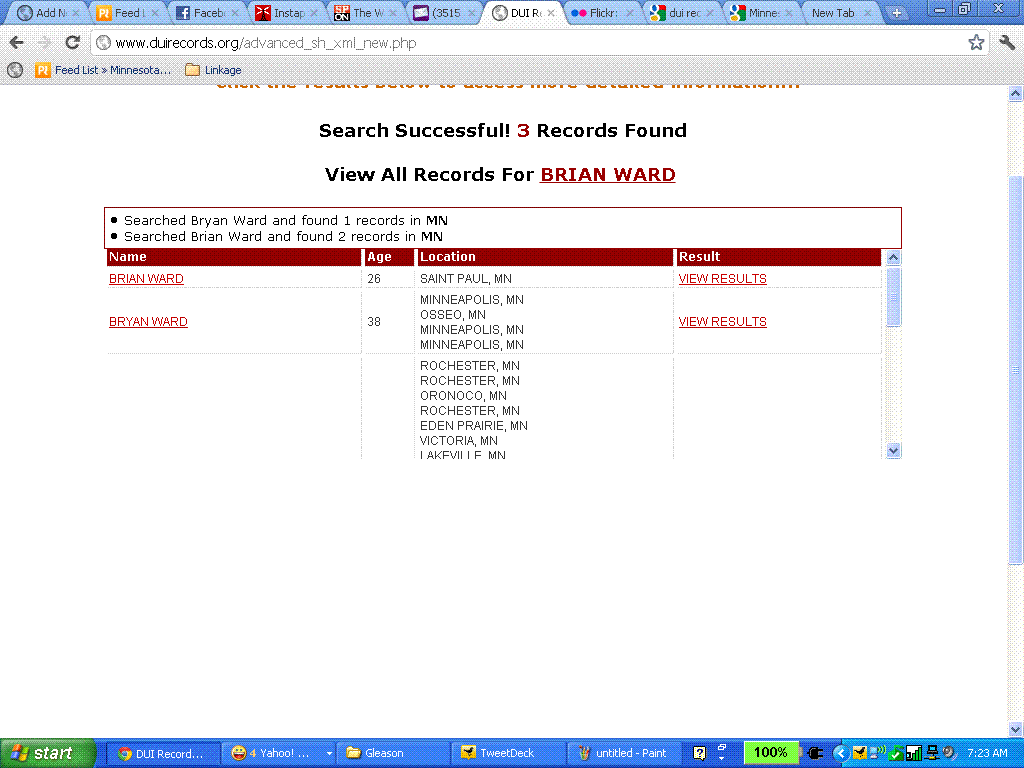
Wow.

Next,  I tried my friend and radio cohort, Ed Morrissey, who has publicly disclosed he lives in Eagan.

And I was shocked:

Holy crap.  You think you know a guy!

Next – since our last gubernatorial race was settled by a bogus “DUI” charge against Tom Emmer, I thought I’d see if what was fair for the goose were fair for the gander.  Does Mark Dayton have a “drunk driving record?”
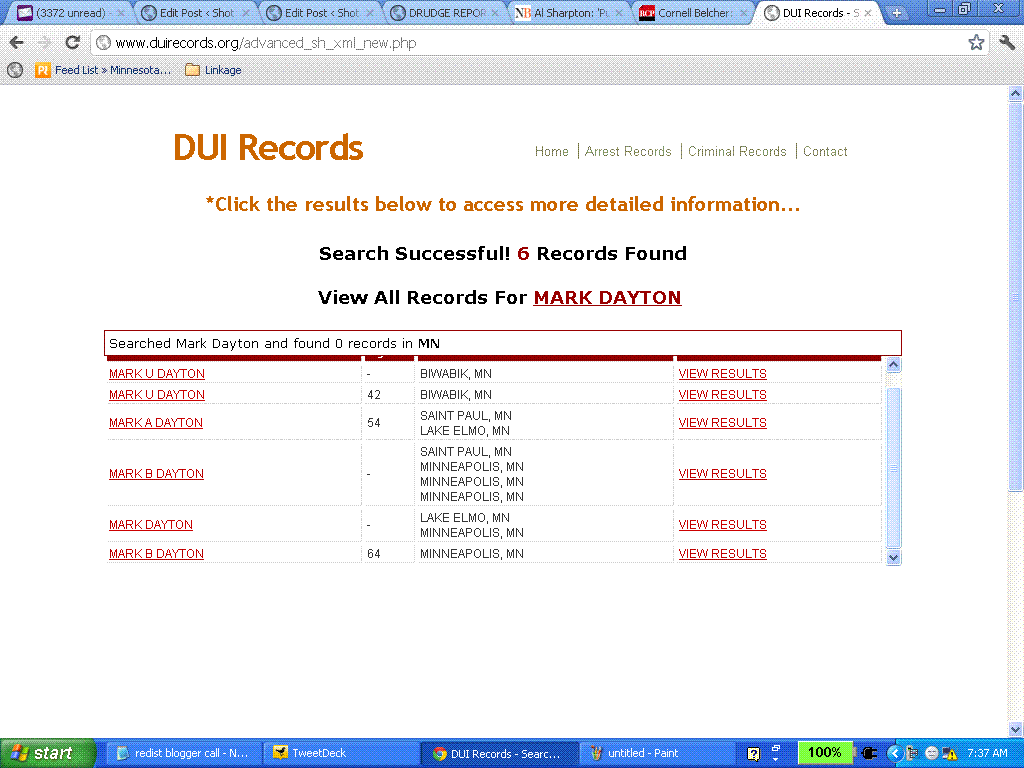
Wow!  Someone tell the media!

But I’m starting to smell a rat.  It almost looks as if this site will turn up a record on almost anyone.

I tried Archbishop John C. Nienstedt, the supreme poobah (I’m a little fuzzy on the terms of the Catholic hierarchy) of the Archdiocese of Minneapolis and Saint Paul:


And, finally, just out of a fit of untrammelled serendipity, I entered the name of my favorite Twin Cities’ blogger, a person whose keen insights, nimble wit and sparkling writing have enlivened many an idle morning, Professor William Gleason, a chemistry professor at the U of M:
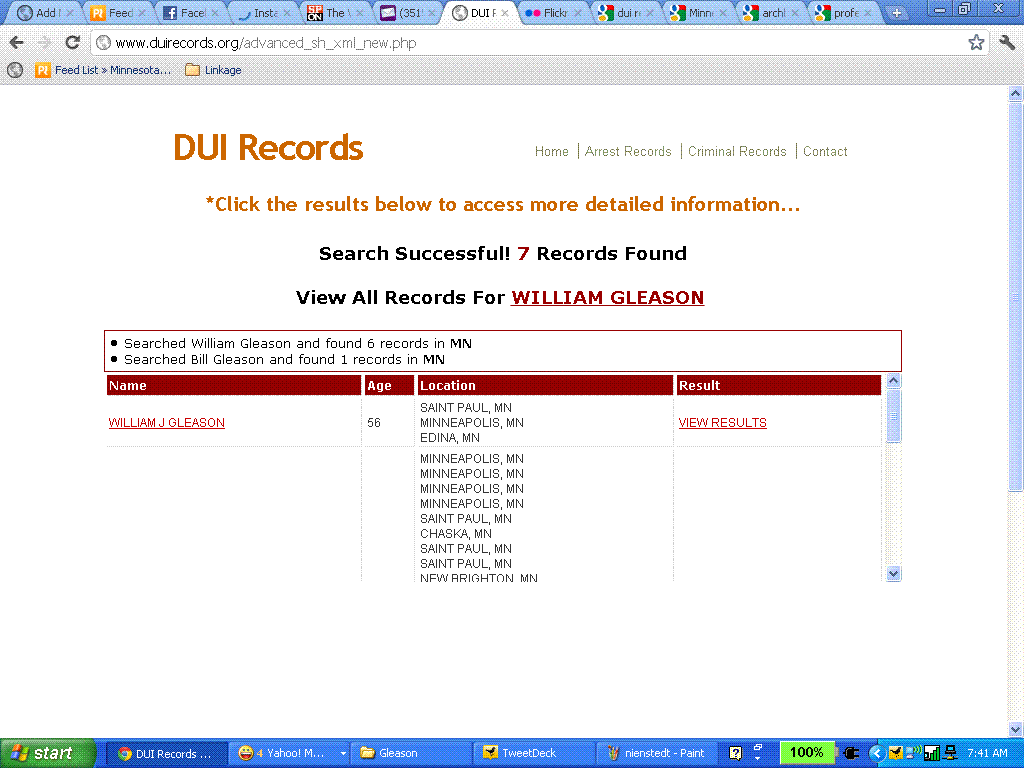
Note:  Someone pointed out that I got Gleason’s middle initial wrong.  No, I did not!  Go search the “database”; there are a plethora of William Gleasons out there!  Dozens!  Including the one with Professor and Blogger Gleason’s middle initial!

It  seems everyone has a DUI!

So I clicked on the “results” link:

What? I’ve gotta pay for public records?

Well,no.  The site above is an advertising site.  Indeed, it’s a form of spam.

Indeed, if you google virtually any form of legal activity – divorce, criminal records, bankruptcy – you will find pages and pages of these spam and scam sites, all designed to get you to pay money for what are, at most, slightly repackaged Google searches.

What “duirecords.org” does is take virtually any input you give it, run a search on, say, Google, spits back the results to make it look like it has something, sucks you in to a link to make you pay for…

…well, that’s as far as I pushed it.  I’m not going to pay to find out.

Now, you can get public records – or at least, names and charges and dates – from the official Minnesota court records (you have to click “Begin Search”, and accept the disclaimer).  Wherein you’ll find that in the past 15 years, there has been no “Mitchell P. Berg” convicted of DUI anywhere in Minnesota – and that I’ve been pulled over for expired tabs and forgetting my insurance card.

Expensive? Dumb?  Sure – but not DUI.

———-

The takeaway is this:  Say I were to write “John Doe, Age 46, of Mazeppa, was convicted of DUI” based on the output of the “DuiRecords.org” website…:
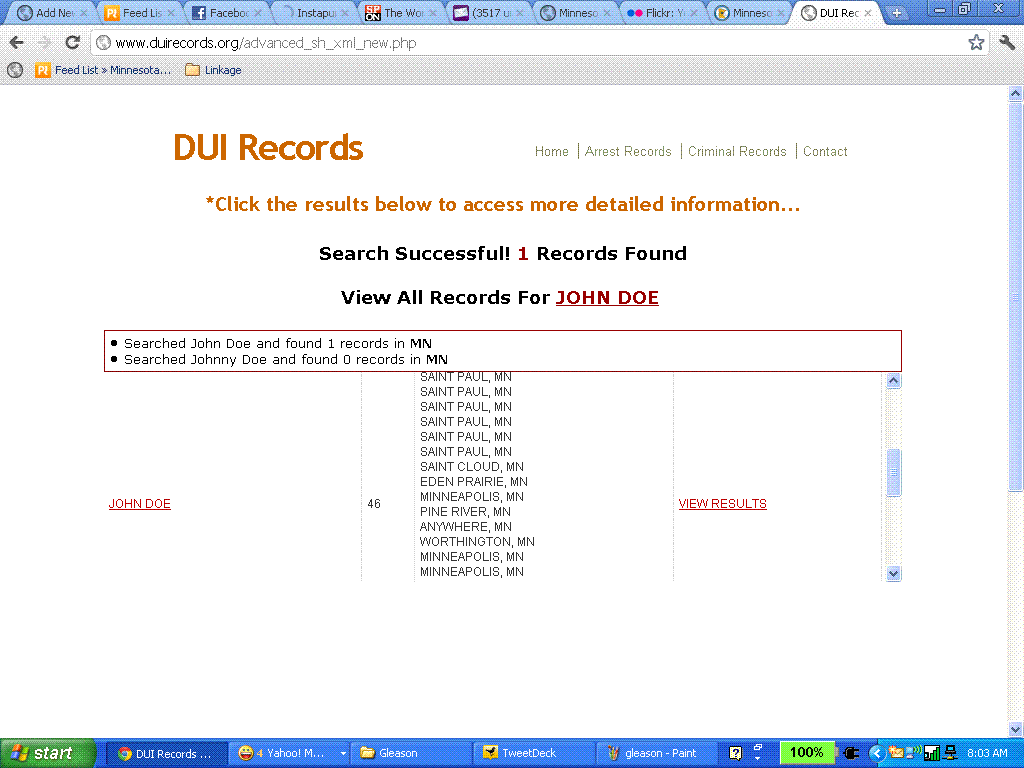
I specifically disclaim any insinuation that any Mr. Doe of Mazeppa has ever committed any crime, by the way. This is just an example.

… believing it to be a genuine public records website, rather than, as we’ve shown, an advertising site that turns up “records” on anyone.  

And ten, say, someone wrote to tell me, specifically, that “your “source” on Mr. Doe is an ad site, not a source of actual public records?”

And yet, I doubled down on my story – redoubling my assertion that Mr. Doe had been convicted of DUI?  Rather than retracting it and apologizing to Mr. Doe?

Well, that could fairly be seen as “failing to take reasonable care” to ensure that a defamatory statement (remember, accusations of infamous crimes are defamation per se under Minnesota law) is accurate”.

OK.  There is no serendipity at all in this series.  There’s a point.

We’re getting to it.

Apropos Not Much, Part V

Thursday, September 29th, 2011

Since I started this series a couple of weeks back, we’ve enjoyed a fascinating journey of learning – in this case, about what “defamation” – libel and slander – really really mean.

Here’s an interesting bit; as we noted yesterday, “false” can mean either “what the defendant said is false”, or “the defendant, with reasonable care, should have known it was false”.  Indeed, the case law makes it pretty clear:

D. Negligence Is Standard Of Liability

In Minnesota, the defendant is liable if it “knew or should have known in the exercise of reasonable care” that the defamatory statement was false. Jadwin, supra. This is the standard formulation for liability based on negligence, that is, liability arising from failure to take due care.

This is a low standard of liability.

In other words, if you accuse someone of having committed an infamous crime because you didn’t take the reasonable care to know that it was not factual, you are liable.

But what about free speech?

However, First Amendment considerations substantially limit the application of this standard.

So the courts will err on the side of free speech if there is any way to do so.

Still – if I were to write “Wang Fui Schlabotnik of Eden Prairie has a child porn conviction”, and Mr. Schlabotnik does not, Mr. Schlabotnik’s attorney might well argue that the First Amendment, free speech, and the rights of an open, unfettered press (in all its forms) aren’t served by my lying about his client’s criminal record – and defamation needs to be false, and false claims of infamous crimes are “defamation per se” under Minnesota Law (as we discussed last week).

And I suspect he’d have a point.

OK.  I’ll cop to it. This series on the legalities behind defamation is not entirely an academic exercise, and it’s really not completely a flight of blitheful serendipity.

But there’s plenty of time to talk about that.

99 weeks, to be exact.

More later.

Due To Gun Control

Thursday, September 29th, 2011

Remember 1982, when Willy DeVille’s twitchy paranoid masterpiece “Due To Gun Control” drew brickbats from (invariably smug left of center) “music critics” because of its “right-wing message”?

Take a listen:

“Only thieves on parole and cops out on patrol walk the street feeling safe anymore”.

Look at the news from Chicago – in this case the story about the the teeth they’ve added to their juvenile curfew.

Chicago has, of course, been racked by gang violence in recent years, “despite” the most comprehensive gun ban in the United States.

Look how it’s working:

“When it’s dark, people can hide in the shadows,” said Da’Quan, somersaulting to the ground and landing firmly on his feet. “In every little corner, there is a piece of the dark where they can hide.”

Even at 10 years old, the fourth-grader grasps the dangers facing children on Chicago’s streets. “It’s in the nighttime that violence breaks out,” said Da’Quan, with a glance toward his mother, who smiled in approval.

Nope.  No post-traumatic stress in little Da’Quan’s future or anything.

With the aim of protecting children from that violence, Chicago officials passed a tighter curfew that takes effect Sunday. Fines for parents who repeatedly ignore the law are going up to $1,500, under the new rules.

By all means: put the law-abiding under a state of siege.  That always works with violent crime…

…well, not really “siege”.  Siege is when the besieged can defend themselves.  What do you call a “siege” where you are completely at the mercy of your besiegers?

“Being held hostage?”

“Prison?”

During the 2010-11 school year, CPS reports that 256 students were shot, and 27 of them were killed.

Good thing those guns were all illegal, huh? 

Nonsense.  Chicago’s nightmare is due to gun control – and the disdain for the rights and worth of the individual that inevitably accompanies it – not in spite of it.

Saturday On The NARN

Wednesday, September 28th, 2011

As center-right bloggers across Minnesota are documenting, there is a nationwide astroturf effort to skew Minnesota’s redistricting process in favor of the DFL – essentially to try to make DFL seats districts disproportionally powerful and to ignore the real demographic changes that have happened since the last redistricting effort.

Conservatives need to wake up – and pass the word to other conservatives that they need to wake up and pay attention; if 1990 didn’t teach you the lesson that redistricting isn’t just for wonks anymore, nothing will.

With that in mind, we’ll have two very special guests on the Northern Alliance from1-3PM on Saturday, on a broadcast where we’re going to devote some extra time to the subject.

More later this week.

Apropos Not Much, Part IV

Wednesday, September 28th, 2011

In the first couple parts of this series – admittedly something I’m writing out of pure unvarnished serendipity – I noted that Minnesota recognizes “defemation” when someone says something false and defamatory about someone, to someone else.

Today, we move on to the definition of “false”.  From this very useful site, which has been my source for much of this series, we will look – in effect, and with a nod to Bill Clinton – into what the meaning of the term “isn’t” is.

C. The defendant knew or should have known that the communication was false

Defamation allows recovery for unfair damage to reputation. As a consequence, if true statements are made about a person which damage their reputation, they cannot maintain a lawsuit.

That’s the first thing they teach you when you start learning how to be a reporter; make sure you’re writing the truth (or at least writing from verifiable fact).  And be ready to support the veracity of what you write; take good notes, and don’t toss them when the story’s done.  Have good solid cites for anything in contention.  Uses sources that you’re sure won’t burn you, and verify even the trustworthy ones. Don’t be a dummy.

Because the surest defense in a defamation suit is the truth.

It hasn’t always been this way:

This is a relatively recent development. One origin of libel and slander laws was a criminal cause of action by the English Crown used to silence its critics; hence, it was the truth of the alleged libel which provoked the lawsuit.

And this – the tradition of suiing over embarassing but true information – is one of the things that makes media work in the UK such a nasty, brutish business; it’s very easy to prove defamation.  And the absolutism with which our system approaches free speech (except when liberals are talking about talk radio) is at least in part a direct result of that tradition.

It’s part of Minnesota’s judicial canon.  I’m going to add just a little bit of emphasis to the following:

For example, the Minnesota Supreme Court has held:

We hold that a private individual may recover actual damages for a defamatory publication upon proof that the defendant knew or in the exercise of reasonable care should have known that the defamatory statement was false.

Remember those two bolded bits.  They may become important later.

Wait – I said this whole series was unvarnished serendipity, didn’t I?

Well, remember them anyway.

The conduct of defamation defendants will be judged on whether the conduct was that of a reasonable person under the circumstances.

Jadwin v. Minneapolis Star & Tribune Co., 367 N.W.2d 476, 491 (Minn. 1985). Other cases follow this reasoning. See LeDoux v. Northwest Publications, Inc., 521 N.W.2d 59, 67 (Minn. App. 1994) (“In order for a statement to be defamatory . . . it must be false.”); Janklow v. Newsweek, Inc., 759 F.2d 644, 648 (8th Cir. 1985), cert. den., 479 U.S. 883 (1987) (“Libel, by definition, consists of publication of a false and unprivileged fact.”).

The article takes great pains to estabish that falsity is a big-kahuna element of defamation..  It’s important.

This part is also pretty vital: the whole statement needs to be false.

Minor inaccuracies are not subject to defamation claims if the overall substance of the statement is true. “The plaintiff cannot succeed in meeting the burden of proving falsity by showing that only that the statement is not literally true in every detail. If the statement is true in substance, inaccuracies of expression or detail are immaterial.” Jadwin, supra, 390 N.W.2d at 441.

In other words, if I wrote “Todd Yamamoto, a Vikings fan from Edina, crashed into a tree”, and Mr. Yamamoto did crash into a tree, but was a Packers fan who is mortified to be associated with the purple and gold?  The suit is likely doomed!

But if I wrote “Bucky Yamamoto, Vikings Fan from Edina, crashed into a tree because he was free-basing with a drunk 16 year old girl”, and there was no freebase and the girl was 35 and his wife?  That’d be a problem.

(Dear Bucky Yamamoto – I don’t know that you exist. If you do, my apologies).

No Defamation by Implication. Failure to report all the facts may lead to a defamatory conclusion by the reader. But unless the overall substance of the statement can be proven false, no defamation claim will arise. “[T]he cause of action known as defamation by implication . . . is not recognized in Minnesota.” Kortz v. Midwest Communications, Inc., 20 Media Law Rep. (BNA) 1860, 1865 (Ramsey County Dist. Ct. 1992). A public official may not maintain a defamation by implication claim. Diesen v. Hessberg, 455 N.W.2d 446, 451 (Minn. 1990).

This was one that surprised, and sometimes infuriates me.  I thought the Strib’s Rochelle Olson defamed Alan Fine back in 2006, when it reported all the “facts” about his ancient domestic abuse arrest except the ones that could have exculpated him in the public eye, just in time for the election.  Not so; Ms. Olson and the Strib got the basic facts right; they just selected or omitted true facts in such a way as to ensure and maximize political damage to Fine and his campaign.

Slimy?  Sure – but not actionable.

Oh, the bit says that the defendant “knows or should have known” that their allegedly defamatory communication was false.

That means if they knew it was false, or they should have after taking reasonable care.

For example, say that I said that “Carrie Ann Trzeszelewska, age 22, of Forest Lake got a DUI”, and someone wrote me to say that there were two Carrie Trzeszelewskas – one age 22, that I wrote about and another woman, Carrie Raye Trzeszelewska, age 44 of Hugo, that actually had the DUI?  And that there was a state website where I could have checked that fact, either before writing the statement (as I should have) or as part of an immediate and humble retraction (as would have been the proper Plan B), but that I disregarded because I either didn’t care or was positive I had the right Carrie Trzeszelewska?

That might cause me a legal problem.

As I said, this entire series is borne of unvarnished serendipity.

OK.  Not entirely.

More tomorrow..

Why Republicans And Democrats Are So Different…

Wednesday, September 28th, 2011

…is pretty perfectly defined by the flap over North Carolina Bev Perdue’s comment about “suspending elections” for two years.

“I think we ought to suspend, perhaps, elections for Congress for two years and just tell them we won’t hold it against them – whatever decisions they make – to just let them help this country recover. I really hope that someone can agree with me on that,” Perdue said.

“You want people who don’t worry about the next election,” she continued.

Of course it was hyperbole.

The dumb part?  That a bunch of politicians, relieved of the pressure of having to justify their political existences to voters, would “solve” anything.


Two-Edged iSword

Wednesday, September 28th, 2011

I’m always amused by media types who smugly proclaim that they – the media – are what stands between the hoi-polloi and tyranny.

Part of it is the whole matter of “”The pen is mightier than the sword” can only have been written by someone who never had to bet his life on it” bit.  And part of it is that the media, like any institution, is no less liable to being co-opted and turned than any other.  Remember – Germany had a “Free Press” from 1918 through 1933.  Fat lotta good it did them.

Ditto the alternative media – and maybe worse.  The alt-media has wrapped itself in the cloak of righteousness…

…but as events in Syria show, it can be co-opted for tyranny just as easily as for freedom. Because while Syria’s government propaganda is the kind of thing that Baghdad Bob could have done, its population of pro-government nerds is drawing blood.

Literally:

They call themselves the Syrian Electronic Army, conducting the most intense cyberwarfare in the Arab world, says Jillian York, with the San Francisco-based Electronic Frontier Foundation.

“I’ve really never seen anything like this before, like the Syrian Electronic Army, which just seems to have so many members,” she says. “I think it’s really just their level of persistence and their level of activity that sets them apart.”

Are they a part of the regime? That is uncertain, says York, although Syrian President Bashar Assad saluted the youth of the Electronic Army in a June speech when they first emerged.

“So it may be that they are supported by the government; it may be that they are independent pro-government forces,” York says.

They’ve co-opted the “social media networks” that were so ballyhooed in the uprisings in Egypt and Bahrain,and hacked into pro-dissident sites in the West, and begun, perhaps, to turn the advantage of the social network into a liability.

Last Stop On The Gravy Train

Wednesday, September 28th, 2011

Joe Doakes from Como Park writes:

Ah, political season, and the start of neutral, objective, even-handed news reporting in the Minneapolis paper.

The Strib’s headline reads “Oil refineries seek huge tax refunds that could force schools to give back money”, and as Joe notes…:

They couldn’t have been any cruder if they’d said: “GOP Presidential candidate Rick Perry taking money from schools to give to oil companies.”

It’s the perfect Progressive attack headline.

Naturally, the story is written in modern techno-thriller style: start with an explosive scene, randomly jump around introducing characters without any context, play up the human tragedy about to unfold unless a hero steps in, blame the usual villains.

It does read a little like someone who didn’t make the cut as a writer for “24” is slumming as a journo…

The story is much less compelling if laid out in a logical format.

  1. There’s crude oil under the ground in Texas.
  2. Crude oil must be refined to be useable as gasoline, diesel fuel, etc.
  3. Hauling crude oil to the refinery is expensive, so
  4. Oil companies built refineries in Texas near the oil fields
  5. People who wanted good-paying jobs came to work for the refineries
  6. Merchants who wanted to sell things to high-paid oil refinery employees built stores near the refineries
  7. Refinery employees, merchants and merchants’ employees built houses near the refineries and started raising kids
  8. The kids needed to go to schools, built near the homes that were built near the refineries
  9. Schools are expensive and are paid for from local property taxes
  10. Property taxes are based on local valuation and refineries are valuable so they paid huge property taxes
  11. Huge property tax payments by refineries meant lower property taxes levied on homes, paid by employees
  12. School districts got used to funding schools with huge property tax payments by refineries
  13. Merchant and employee property tax payers got used to living large on the refineries’ dime
  14. But federal law requires refineries to invest in pollution equipment
  15. And state law gives a tax refund to refineries that invest in pollution equipment
  16. So refineries that did invest in pollution equipment, filed for refunds
  17. Refunding money to refineries would reduce their huge property tax payments
  18. The money refunded to refineries cannot be given to school districts
  19. School districts will have to cut spending or raise local property taxes to make up the shortfall
  20. The state, knowing this, denied the refund claims, which were appealed
  21. The governor appointed a commission to study the problem
  22. The governor is Rick Perry, Republican candidate for President
  23. The governor’s hand-selected commission is leaning toward giving the refunds; therefore
  24. Rick Perry is taking money from schools to give to oil companies

It is a lot more mundane.  It’d sell fewer papers – or get fewer people inflamed against the GOP, whichever.

Well, I guess, in a way, the headline is half-assed, sort-of-true. Good enough for the Star Tribune.

But the entire thing could have been summed up more succinctly as:

“Gravy train ending, women and minorities hurt worst.”

Hell, that’s not news.

But it is campaign material.

Unrealized Potential

Wednesday, September 28th, 2011

Accoriding to Saint over at Fraters Libertas, Pawlenty may have pulled out of the race too early:

Pawlenty’s potential was illustrated in February by Nate Silver. His graphical representation of the GOP field at the time shows where candidates fell on two of the most important variables for this years primary electorate, establishment vs. insurgent and moderate vs. conservative. At that time Pawlenty occupied kind of a sweet spot. Not too hot, not too cold, but just right.

Read the whole thing…


Big Iron

Tuesday, September 27th, 2011

Seventy years ago today, the German U-Boat offensive was at its peak, and the battle that the German Luftwaffe had failed to win in the summer of 1940 was very, very nearly won by Germany’s submarine fleet.

Britain being an island, it depended on foreign trade.  And that trade – and the food, fuel and raw material it provided – were being choked off, rapidly rather than slowly, by the staggering attrition of the world’s merchant fleets.  It was later said that of all the threats the British home island faced during the war, the U-boat threat was by far the one that most vexed Churchill.

The British merchant fleet, and those of the rest of the countries that traded with the UK, were being sunk far faster than the world’s shipbuilding industries could replace them.

——–

With that in mind, it was 70 years ago today that the SS Patrick Henry was launched.

It wasn’t a warship.  It was, in fact, a dumpy, unprepossessing freighter.  Instead of the steam turbine engines that ran most of the world’s fleets of newer ships, and almost all warships, the Henry was powered by a reciprocating steam engine based on an 1890’s-era British design that could drive the ship at 11 knots, maybe, in smooth seas, but was really designed to keep the ship puffing along at a cruising speed of six knots for weeks at a time.

It was a good-sized freighter – 14,000-odd tons – but by no means remarkable in any other way, except for the sheer simplicity of its design.

And yet it was President Franklin D. Roosevelt that gave the ship’s commissioning speech.

What distinguished the Patrick Henry was that it was the first of 14 ships, more or less exactly identical, that would come down the ways that same day.  As a class, they were called “Emergency” freighters.  They were built by auto magnate Henry J. Kaiser, CEO of the Kaiser Motor Company, at the brand-new Kaiser shipyards and, eventually, at many other such yards around the US, using the same techniques pioneered by the American automobile and consumer products industries.

Shipbuilding had been a craftsman’s business since the dawn of navigation.  Even in ships of the same “class”, there had always been considerable differences; each ship was pretty much a one-of-a-kind project, built from the keel up in a slipway, launched, and replaced by another keel. It was more like building a house – even a tract house – than a car or a refrigerator.

But the “Liberty” ships changed all that; their components were as standardized as those of any automobile; indeed, the Kaiser yards adopted the full assembly line idiom, with the keels being trundled down the ways, with frames and engines and plating and fittings and entire prefabricated sections being riveted or welded on at each successive station.  And so the Liberty ships were effectively identical; there were stories, possibly apocryphal, of sailors boarding docked Liberty ships after nights in port and bunking down for the night, only realizing in the morning that they’d boarded the wrong identical ship.

The Kaiser yard at Vanport, Oregon, on the Columbia River. Henry Kaiser built an entire city of 40,000 to serve the yard.

It was a technique that promised to revolutionize shipbuilding – and, more importantly, build ships faster than the Nazis could sink them.

And that was why President Roosevelt orated long and hard about the contributions of the ship’s namesake, and promised that this ship – not one of the sleek new aircraft carriers on the ways, or the fleets of destroyers and submarines working their way from the drawing board to the builders yards – would bring liberty to the people of Europe.

Because it was the most visible symbol of perhaps the most defining feature of World War II; the complete harnessing of the sheer might of American industry in every possible respect.

Beause the Henry, and her thirteen sister ships launched that day, were the first of 2,710 “Liberty Ships” built during the war.

Think about that.  From seventy years ago today until VJ Day, there were roughly – in fact, almost exactly – 1,400 calendar days.

That means after the initial fourteen-ship orgy of launching seventy years ago today, American industry produced very close to two of these freighters every day. Seven days a week.

And that was just the tip of the iceberg.  The American shipbuilding industry, from 1941 to 1945, produced:

  • 33 aircraft carriers
  • 6 battleships
  • Dozens, plural, of 10,000-ton heavy and light cruisers
  • Close to 1,000 destroyers and smaller, slower “destroyer escorts”, many of which served into the 1970s
  • Over 200 submarines.
  • Over 1,000 “Landing Ship, Tank” ocean-going assault ships.
  • Thousands of other freighters, transports and tankers, in addition to the Liberty ships, including over 2,000 “C” class freighters, from the 1,200 ton “C1” class coastal luggers to the 20,000+-ton “C4” heavy lift haulers
  • On top of that, well over a thousand tankers.
  • Thousands of minesweepers, escort frigates,

A WWII-era "C1" steamer, in civilian use after the war.

All of those were ships – ranging from 1,000 ton minesweepers to 55,000-ton battleships.  It doesn’t even count the uncountable thousands of smaller boats – hundreds of PT Boats, sub-chasers, air-sea rescue boats and “PC” patrol craft, thousands of landing craft, and hundreds and hundreds of anonymous little utility craft; net tenders, buoy tenders, fuel lighters, and every other kind of boat needed to do every single job the Navy (and Army, which had its own navy) needed doing afloat.

The Bethlehem Steel Shipyard on Staten Island, which built cargo ships, tankers, landing craft, and a total of 43 destroyers. You can see some of each, here, with a few tankers for good measure.

And that is on top of the tens, plural, of thousands of aircraft, the 55,000+ tanks, and the hundreds (plural) of thousands of trucks, jeeps and other vehicles cranked out to support and supply not only our war effort, but those of most of the rest of the free and Communist worlds.

And it’s a fascinating look at how very different American industry is today compared to 70 years ago.

As he was planning Pearl Harbor – which was well underway seventy years ago today – Japanese admiral Isoroku Yamamoto warned his leadership that the strike against Hawaii would have to be a catastrophic one – because if America wasn’t knocked out of the war immediately, our industry would drown the Empire.

As, indeed, it did.

The most amazing comparison?  We couldn’t do it today if we tried.

If A Charter School Succeeds In The Forest, And Jon Tevlin Doesn’t Write About It…

Tuesday, September 27th, 2011

There’s a reason so many “progressives” are so very very upset that Katherine Kersten remains at the Strib writing columns.

It’s because while the likes of Lori Sturdevant and Jon Tevlin can be counted on, after all the “hard-boiled reporter” BS subsides, to pretty much say “Yep, Mr. Emperor, in the opinion of this ol’-fashioned gum-shoe reporter who really really knows stuff, that suit looks marvelous – and when Arne Carlson ran the GOP, they’d agree”.  Kersten doesn’t.

I’m trying to imagine any of the Strib‘s bullpen of legacy columnists even noticing the story of the Harvest Preparatory School, much less writing about it:

A north Minneapolis school at Olson Memorial Hwy. and Humboldt Avenue has demographics that seem a sure predictor of our state’s most intractable education problem. The student population there is 99 percent black and 91 percent poor, and about 70 percent of the children come from single-parent families.

Such “racial isolation” is widely considered a formula for defeat — a hallmark of the cavernous “achievement gap” that separates poor, minority students from their more affluent white peers. In recent decades, Minnesota has spent billions of dollars attempting to narrow the gap but has little to show for it.

That’s why the achievements of the school I just described should be shouted from the rooftops.

You’d think.

I’m guessing the Strib and the “hard-boiled journalists” in its columnists bullpen haven’t gotten permission from MN2020 to write about schools not approved by the Minnesota Federation of Teachers.

In this year’s state math tests in grades three through eight, this school outperformed every metro-area school district, including Edina and Wayzata. Its students outperformed all state students in reading proficiency (77 percent to 75 percent), and state white students in math proficiency (82 percent to 65 percent).

The complaint I hear most about Kersten – other than the fact that she’s unclean a conservative  – is that she doesn’t have a “background as a reporter”.

But all that “background” doesn’t seem to have taught any of the Strib’s stable of reliable DFL criers to dig behind the party line when it comes to education.  Kersten does:

Black males are among our state’s lowest-performing groups of students, but at Best Academy, 100 percent of eighth-grade boys scored proficient in reading. “Best Academy has the highest proportion of African-American boys of any institution in Minnesota,” says founder and director Eric Mahmoud. “The only institution that competes with us is the prison system.”

How have Mahmoud and his team worked this magic? Mahmoud is an electrical engineer by training. “At the factory I used to run, if we had a failure rate of 0.5 percent, we’d shut down the line until we figured out the problem,” he says. “In our education system, we’re failing with 40, 50, 60 percent of our African-American children, but we keep the system that turns out the same product, year after year.”

Wait – someone has actually addressed the “achievement gap” that seems to have so vexed the Minneapolis, Saint Paul, Anoka-Hennepin, Duluth and other school boards, the Minnesota Department of Education, the waves of superstar superintendents who ride into and back out of town on waves of money and perks, the DFL Caucus in the Legislature, and Tom Dooher and the Minnesota Federation of Teachers, who seem to have been too busy filming commercials to have looked into the issue themselves?

Why, it’s almost like a journalist is actually covering the issue!

Read the whole editorial for the Harvest Prep story – which must drive the relentlessly-feminist “educational academy” nuts, since it entirely confirms Christina Hoff-Summers’ research about how one goes about reaching in particular boys that the system has forgotten.

And ask yourself why it is that in a metro with three school megadistricts that are simultaneously academic and financial sinkholes, with achievement gaps (especially in Saint Paul) that trail even the rest of the nation’s shameful record, and that graduate a shamefully low share of minority students, and that is starving for some good news on education but is fed a constant diet of puffed-up faintly-painted teachers union spin on charter schools, that Kersten’s column is the only coverage that this, and other, charter school success stories have gotten in the Twin Cities news or opinion media?

A Free Association Of Real Americans

Tuesday, September 27th, 2011

This past weekend was the Gun Rights Policy Conference – a nationwide gathering of the people who’ve driven the biggest sustained grassroots political push in recent American history, perhaps the most important human rights campaign in this country since the mid-sixites,the Second Amendment movement.

And with glorious savoir-faire, it was held deep in the belly of the beast – Rahm Emanuel’s Chicago, a city that serves as the Custer’s Last Stand of the anti-gun extremist:.

Gun rights activists from all over the country are heading home after two intense days of panel discussions, networking and comparing notes; energized to continue fighting at the local and national levels to protect and expand their firearms civil rights, now that the final gavel has fallen on the 2011 Gun Rights Policy Conference.

I didn’t get to attend, naturally – although at least one regular commenter to this blog did; perhaps he’ll chime in.

I did notice a few key remarks from the convention:

 They were treated to a luncheon address by Illinois Congressman Joe Walsh (R-8th District). He said matter-of-factly, “Thank God President Obama got elected because he woke this country up.”

He’s right, you know.  With a moderate Republican or responsible Democrat, gun control would have slumbered along in its 2006-era status quo for the better part of a decade.  Faced with an existential threat to our right to self-defense, Americans startled awake and redoubled the efforts that were already feverish before The Obamascenscion.

An old friend turned up in the story:

 Minnesota attorney David Gross, a veteran activist and former NRA board member, referred to “gun-free zones” as “OSHA zones for criminals.”

One of the men of the hour was Otis McDonald, lead plaintiff in the pivotal McDonald V. Chicago case two years ago, which groin-kicked the gun control movement with pointy boots.

Otis McDonald: a real american hero, and a Real American hero. The only reason to oppose his SCOTUS case, by the way, was racism.

McDonald agreed to be a lead plaintiff in the case, which was considered before the U.S. Supreme Court, because as he told ABC News the restrictive firearms laws made him feel like “the city cares more for the thugs than they do me, and I’m the one paying taxes.”

McDonald, four other Chicago residents, the Second Amendment Foundation and the Illinois State Rifle Association sought to have the U.S. Supreme Court apply another Second Amendment case, the District of Columbia v Heller, to Chicago and other cities and states across the country…McDonald’s case expanded the Heller decision when the U.S. Supreme Court ruled on June 28, 2010, that the right of an individual to keep and bear arms protected by the Second Amendment applies to the states.

By all accounts I’ve heard, McDonald’s address was a major highlight:

Chicago’s law enforcement has had to deal with gangs and mob violence, and in 1982, officials there thought the best solution was to ban firearms. But McDonald and many others said it left them unable to defend themselves.

Looking back on his experience, McDonald told Hawaii Reporter today that this experience has meant a lot to him. “In the beginning, I was just thinking about me and my family and my neighborhood, but it quickly increased size wise and effected so many people in the country.” He said his “anger” at being unable to protect himself and his family from criminals – along with prayer – gave him the courage and strength to go forward and continue the legal fight.

McDonald is a hero to all Real Americans.

In related news, Chicago continued to fight for Chicagoans’ “freedom from violence” by mandating children be locked up at night:

With the aim of protecting children from that violence, Chicago officials passed a tighter curfew that takes effect Sunday. Fines for parents who repeatedly ignore the law are going up to $1,500, under the new rules.

According to police statistics, the hours immediately after the new 8:30 p.m. weekday curfew are some of the most deadly.

An analysis of homicides in the first half of 2010 found that slayings spiked between 9 p.m. and 10 p.m., for a total of 29 over six months. According to figures provided by Chicago Public Schools, young people are often the victims.

During the 2010-11 school year, CPS reports that 256 students were shot, and 27 of them were killed.

Good thing they don’t allow guns in Chicago, or Goddess only knows how bad it’d be.

Apropos Not Much, Part III

Monday, September 26th, 2011

I’m just fascinated by the conversation with myself I started about a month ago, about how Defamation law works in  Minnesota.

Today – via this very helpful site – I’ll move on to the second element of a defamation case; there’s gotta be a third party:

B. The Statement was published to third persons

Defamatory statements must be communicated to a third party. You cannot defame someone by speaking to them alone, or by muttering to yourself. This element of defamation is virtually always satisfied when claims are made against newspapers and broadcast media.

Or, for example, when you write something false about someone in an email that only the other party sees (or is intended to see)?  .Or you say it to them on the phone, or when you’re at adjacent urinals in an otherwise-empty public rest room?  There’s no third party – and therefore there’s no defamation.  Your case is headed for a dismissal.

Write it on a blog, or on a social media site?  Like Twitter, to pick a totally hypothetical example?  Especially when other people chime in that they saw the defamatory communication?  As we’ve seen, there are three other criteria that need to be met – but that whole “third party” thing will be covered.

Tomorrow – what does “False” mean?

Again – this whole thing is just an unabashed flight of fancy.  No more.

DrawTheLine MN: Giving “Potemkin” A Bad Name

Monday, September 26th, 2011

According to Russian legend, Catherine the Great’s consort, minister and general, Grigory Potemkin, built fake villages, just shells and faςades and a few serfs going through happy-serf-like motions (see also SEIU – Ed.) along the banks of the Dniepr river – which he’d just seized from the Ottomans in a costly war he’d advocated and led, to impress Catherine with the wisdom of his campaign.

“Potemkin village” – or “Potemkin” – has thus become a synonym for “a hollow, insubstantial faςade, intended to deceive”.

With that in mind, let’s take a look at “Draw The Line Minnesota’s “Citizens’ Redistricting Commission” – a body that should make Grigoriy Potemkin’s descendants sue for trademark infringement.

“Draw The Line MN” is an astroturf “activist” group, a collaboration between Common Cause Minnesota, the League of Women Voters Minnesota, the Minnesota Council of Nonprofits and TakeAction Minnesota – one of the groups behind “Alliance for a Better Minnesota”, which ran the astroturf smear campaign against Tom Emmer last year.  All of them portray themselves as “non-partisan”; all are relentlessly “progressive” astroturf activist groups, all of them fronts for Big Progressive money (and incredibly disingenuous about it).

…who’ve teamed to to masquerade under the “non-partisan” guise of “Draw The Line” (DTL) to try to influence the redistricting process in Minnesota and throughout the Midwest.

DTL’s latest scam?  The “Citizens’ Commission on Redistricting”.

The term is picked carefully; it sounds official, doesn’t it?  Like it’s something sanctioned by the state?

It’s not – no moreso that if I’d sent them out to campaign.

And who are these people?

DTL’s website provides an explanation…

The Commission Members serving on the Minnesota Citizens Redistricting Commission are volunteers, who are committing a significant amount of time and effort to this process. To that end, Draw the Line Minnesota has devised a process we feel is both transparent and limits the necessity of significant days of travel for Commission members.


The Commission will rely heavily on technology, so that much of its work can be done on the internet and by conference call. To that end, public meetings will be livestreamed (where possible) and taped and posted on our website. Any communications received by the Commission or Draw the Line Minnesota, related to map-drawing or redistricting principles, will also be uploaded to our website.


…and a list.  Let’s look into that list a bit.  I’ll add some emphasis here and there:

Lori Berg of Maplewood is a program officer for Minnesota Community Foundation and The Saint Paul Foundation and has worked in the field of philanthropy for twenty-seven years. She was born and raised in rural southwestern Minnesota and through her work is familiar with communities around the state.

Berg – no known relation – has no record of political contributions on the MN CFB, Opensecrets, Newsmeat, or the Federal Elections Commission.

Bruce Corrie of St. Paul is the dean of the College of Business and Organizational Leadership at Concordia University-St. Paul. Dr. Corrie has a Ph.D. in Economics and is an expert on the ethnic markets and has been featured in a wide range of international, national and local media. His website and blog can be found at www.ethnictrends.info.

No political contributions found: Corrie’s work seems to focus on multi-culti stuff.

 Sally Fineday of Pennington is a member with the Leech Lake Band of Ojibwe and Executive Director of Native Vote Alliance of Minnesota. With Native Vote, Sally has helped promote nonpartisan civic engagement and voter participation.

Again – no contributions found; she’s been involved in community politics in Beltrami County.

Kathi Hemken of New Hope currently serves as the community’s Mayor. Previously, she worked as a planner at Honeywell for twenty-years and served on the city’s planning commission. We’re pleased to have Kathy’s local government experience on the Commission.

No contributions listed – and very little on isplay about her tenure as mayor of New Hope, a struggling blue-collar burb west of North Minneapolis.

Kent Kaiser of St. Paul is a professor of communication at Northwestern College. Previously, he served as the communications and voter outreach director in the office of the Minnesota Secretary of State. While with the Secretary of State’s office, he serviced as liaison to the U.S. Census Bureau and on the boards of Kids Voting Minnesota and Kids Voting St. Paul.

Yet again – not a single political contribution found.

Lorna LaGue of Waubun is the Special Projects Director for the White Earth Reservation where she serves in various roles involving community organizing, planning, and development. She works with diverse agencies throughout the State and is a member of the Rediscovery Environmental Learning Center Board and Chair of an enterprise board for the Tribe.

Couldn’t find any political contributions:

Matthew Lewis of Edina is the Communications Director of the Independence Party and a master’s candidate at the Humphrey School of Public Affairs. Last year he served as press secretary to gubernatorial candidate Tom Horner. Previously, in Washington, DC, he worked as a reporter at The Center for Public Integrity covering topics including infrastructure and climate change legislation in conjunction with outlets such as POLITICO.

Lewis is on record giving $2000 to Tom Horner last year.

Elda Macias of Minneapolis is Marketing Director for a large Fortune 300 company, developing new marketing strategies for emerging markets. Elda was formerly active in the DFL Latino Caucus, the Hispanic Chamber of Commerce of Minnesota, and the Scholarship Selection Committee for the Latino Economic Development Center. She is originally from El Paso, Texas.

Macias gave $250 to Obama, and $350 to Patricia Torres-Ray, in addition to her DFL involvement listed above.

Anne Mason of St. Paul is the Assistant Director of Communications at the Humphrey School of Public Affairs. She served as a political appointee for Tax and Budget Policy for the US Department of the Treasury, Communications Director for Congressman Mark Kennedy, and Political Director for the Erik Paulsen for Congress campaign.

The person on the list with any form of Republican affiliation of any kind, Mason seems to show not a single political donation.

Sedric McClure of Brooklyn Park is a Multicultural Counselor in Student and Academic Affairs at Macalester College and has worked in multicultural settings in higher education for fifteen years. A current public policy student as well, Sedric is an avid reader of history and civil rights.

No contributions listed.

Kenya McKnight of Minneapolis is Operations Director of the Northside Economic Opportunity Network, which provides business and economic development services in the areas of training, technical assistance, and loan packaging. She is actively engaged around social and economic justice issues within ethnic communities and serves on the boards of organizations including North Point Health and Wellness and serves as a DFL Director of Senate District 58.

A DFLer (as noted above), McKnight seems to have no record of political donations.

Carl Rosen of Spring Park is a retired social worker, who worked in long-term care nursing homes and at the Hennepin County Psychiatric Unit. He is also a retired Priest and worked at St. John’s Abbey in Collegeville for thirteen years.

Hm. Not a thing.

Karen Saxe of Northfield is Chair of the Department of Mathematics, Statistics, and Computer Science at Macalester College and is actively affiliated with the Mathematics Association of American and the Association of Women in Mathematics. She was also recently elected to serve on the board of the League of Women Voters of Northfield and Cannon Falls.

No political contributions founded.

T. Scott Uzzle of Saint Paul is an attorney with Blaschko & Associates. He was previously an Assistant Commonwealth’s Attorney in Virginia. He has authored a detailed memorandum on voting rights in Richmond, Virginia. Prior to law school, he was the Committee Assistant to the Privileges and Elections Committee of the Virginia House of Delegates.

No political contributions found.

Candi Walz of Lindstrom is an adjunct professor of Political Science at Century College and the small business owner of Let’s Talk Kids, LLC. She was Legislative Correspondent at the state Capitol for fifteen daily newspapers in Northeastern Minnesota, and worked in Government Relations at Minnesota State Colleges and Universities and the Minnesota State College Association.

So there’s the “Citizens’ Commission”.

Now, I look for patterns for my day job.  What did we see above?  A group of people chock full of low-level involvement with “progressive” institutions (the DFL, various non-profits), or with institutions that are aligned with the left (the tribes, academia, especially political science), or who depend for their livelihood on institutions where a strong left-of-center pedigree is vital for survival, much less advancement (Macalester, the Humphrey Institute) – but who have, across the board, give off few of the obvious signs of high level partisanship, like lots of campaign donations, to be held against them.

Now – what are they doing?

More tomorrow..

Crocodile Conversation

Monday, September 26th, 2011

To: Jim Klobuchar
From: Mitch Berg – guy with long memory
Re: You Are Full Of It

Mr. Klobuchar:

I got a kick from this bit from a flak piece you wrote for your daughter, Senator Klobuchar (quoted in Andy Aplikowki’s Residual Forces):

I still remember a time when campaigns were conversations – genuine debates between people of good will and mutual respect.

Baked wind.

I remember the condescension you used to heap on anyone that wasn’t DFL-blessed back in your days as a columnist, and on your old KSTP radio show.

Yo are – and I mean this with all due respect – full of crap.

That is all.

Flip

Monday, September 26th, 2011

Joe Doakes of Como Park writes:

Did political labels flip, and I didn’t notice it?

When I was a lad in school, “Liberal” meant “favored change” which was good, whereas “Conservative” meant “opposed change” which was bad.

But everywhere we look today, Conservatives are the ones desiring change, rolling back government’s over-reaching, while Liberals are opposing change.

Weird.

Only rhetorically.

Is There Some Benefactor, Somewhere…

Monday, September 26th, 2011

…that pays liberal pundits to be gratuitously smug, patronizingand condescending?

In an editorial in the Fairbault Daily News, editor Jaci Smith goes all Mommy on us:

You can’t have it both ways.

Although Smith does, in fact, try to have it both ways.  We’ll get back to that later.

This was a lesson I learned early in life.

I coveted a friend’s toy and wanted her to let me play with it, yet I never wanted to share my favorite toy.

“You can’t have it both ways,” my mom used to tell me. “Either you play only with your own toys or you play with others’ shared toys and you share yours as well.”

A good lesson but apparently one that some state legislators haven’t learned.

Smith – like the rest of the peanut gallery of outstate editorial writers who seem to be longing to sit for a day in Lori Sturdevant’s seat – says Steve Drazkowski and Pat Garofalo, who’ve been warning voters that their school districts got increases, and urging them to vote down referenda to increase taxes yet more, should just shut up:

Garofalo and Drazkowski claim that the state boosted spending to school districts in the budget passed this summer and that the 133 districts statewide seeking levy increases (or the continuation of an existing one) are “double dipping.”

“Despite these very generous funding increases — paid for by you, the taxpayer — 133 school districts statewide are considering asking their local property taxpayers to pony up even more money — the largest number that would call for a vote in a decade,” Drazkowski wrote in a recent newsletter.

Smith says it’s a local thing,and state pols should just. Butt. Out.

Thankfully, Faribault’s GOP Sen. Mike Parry disagrees. He said in a recent interview with the Daily News that referendums are local issues, to be handled locally.

That’s true, as far as it goes.  But here, Editor Smith, er, tries to have it both ways.  Garofalo and Drazkowski are exercising their First Amendment rights to tell people the facts as they see them.  As Legislators, they have no control over how local districts run their affairs, or what local voters vote for.  But they have the same right to speak that anyone – me, Bud Froemking at the liquor store in Faribault, or Jaci Smith for that matter – has.  Both have the advantage of the bully pulpit of elected office – which doesn’t negate their right to speak…

…any more than that of the Teachers Unions and the other groups from outside Faribault that will be speaking, and no doubt ponying up money, to try to push the levy through.

So since Mommy Editor Smith has reminded us that we can’t have it both ways, I wonder which one she’ll pick?

Ahem

Saturday, September 24th, 2011

(Deep breath)

HAHAHAHAHAHAHAHAHAH HAAAAAAHAHAHAHAHAHA HAAAAHAAAAHAAAAHAA

(gasp)

HAAAAA HAAAAAAA HAAAAAAAAAAAAA HAHAHAHAHAHAHA HAHAHAHAHAHAHAHAA HAAAAAAAAAAAAAAAA!

(snort)

HAAAAAAAAAAAAAAAA HAAAAAAAAAAAAA HAAAAAAAAAAAA HAAAAAAAAAAAAAAAA HAAA HAAA HAHAHAHAHA HAAAAH

Bison 37 GoGos 24.

Fun weekend.

I Heard It On The NARN

Saturday, September 24th, 2011

Check out Childcare Union Info for more on MInnesota’s childcare unionization scam.

UPDATE: Fixed link.  Sorry…

The Switch Broke, ‘Cuz It’s Old

Saturday, September 24th, 2011

Today, the Northern Alliance Radio Network brings you the best in Minnesota conservatism!

  • Ed is off on assignment today, so I will hold down the fort for The Headliners from 1-3PM Central. We’ll be talking union daycares with Hollee Saville, the state bond rating with Rep. King Banaian, and Presidential campaigns, among other things.  Tune in!
  • Brad Carlson’s show – “The Closer” – will be up tomorrow, from 6-7PM!
  • The King Banaian Show! – King is on AM1570, Business Radio for the Twin Cities!  Join him from 9-11!

(All times Central)

So tune in to all six hours of the Northern Alliance Radio Network, the Twin Cities’ media’s sole guardians of sanity. You have so many options:

  • AM1280 in the Metro
  • streaming at AM1280’s Website,
  • On Twitter (the Volume 2 show will use hashtag #narn2)
  • UStream video and chat (at HotAir.com or at UStream).
  • Good ol’ telephone – 651-289-4488!
  • And make sure you fan us on our new Facebook page!

Join us!

(Title courtesy Wallo)

Apropos Not Much, Part II

Friday, September 23rd, 2011

As I noted in a post about a month ago, I occasionally take off on flights of knowledge-seeking fancy.

Last month, it was over the subject of “Defamation” – the catchall term for what used to be called “Libel” and “Slander”, back when “old media” was the human voice and “new media” was the printing press.

As I explained back then, the various flavors of defamation occur when someone says, writes, or otherwise transmits…:

  •  …something that is defamatory – in other words, that has a reasonable chance of damaging the subject’s livelihood or reputation (where “reasonable” means “would convince a jury”)…
  • …to one or more third parties – meaning that someone besides the target has to hear it. The communication in question must be…
  • …untrue, as in “there is no truth to it”.
  • And if the target of the statement is a “public figure”, the target needs to prove the person making the statement acted out of malice.

Like most laws, the law as regards Defamation seems pretty straightforward on its surface.  But as anyone who’s had to try to read the law and is, as it happens, not a lawyer has noticed, while laws mean what they say, they also mean a lot more, and that “lot more” isn’t kept very clear for any of us lay people.

And so, as I did last month, I flipped through this site, which is an excellent resource on the subject.  I figured we’d take a quick jaunt through all four of the factors of Defamation, starting with the first.  What is Defamation?

A. A Defamatory Communication

What is a “defamatory” statement?

1. A statement which causes harm to reputation.

A statement is defamatory if it “tends to injure the plaintiff’s reputation and expose the plaintiff to public hatred, contempt, ridicule, or degradation.”

Seems fairly straightforward; if you say something about someone that harms their livelihood and reputation, it’s defamation.

Beyond that?  Some things are seriously fighting words; they are defined – sort of, to a certain level – as defamation any way you slice it:

2. Defamation Per se

Some statements are so defamatory that they are considered defamation per se; and the plaintiff does not have to prove that the statements harmed his reputation. The classic examples of defamation per se are allegations of serious sexual misconduct; allegations of serious criminal misbehavior; or allegations that a person is afflicted with a loathsome disease…When a plaintiff is able to prove defamation per se, damages are presumed, but the presumption is rebuttable.

In other words, if someone says you’re a pedophile, that’s pretty much defamatory.  If they say you killed someone, and you didn’t?  Defamatory!

Of course, it’s not quite that simple:

3. What Constitutes Injury to Reputation?

The plaintiff must establish proof of damage to reputation in order to recover any damages for mental anguish; see Gobin v. Globe Publishing Co., 232 Kan. 1, 649 P.2d 1239, 1244 (1982); Swanson v. American Hardware Mutual Ins. Co., 359 N.W.2d 705, 707 (Minn. App. 1984) (rev. denied) (“To establish a claim in a defamation action [plaintiff] must prove that the [defendant] made false and defamatory statements about them which injured their reputation.”).

If someone claims, for example, that you had been convicted of driving under the influence of alcohol?  Well, that’s a pretty infamous crime in this day and age.  Just ask Tom Emmer, who wasn’t even convicted of it, and still likely lost the Governor’s race – because of two non-convicted incidents that happened decades ago.  The incidents happened, of course – Emmer never hid the fact – so there was no defamation involved, although the context (as I noted at the time) of the DFL’s campaign was very dodgy.

But if there was no conviction, ever?

That’s why lawyers make so much money off of these sorts of cases!

Of course, there are some people that simply can’t be defamed…

The “libel-proof” plaintiff. A plaintiff is “libel-proof” when his reputation has been irreparably stained by prior publications. At the point the challenged statements are published, then, plaintiff’s reputation is already so damaged that a plaintiff cannot recover more than nominal damages for subsequent defamatory statements. Marcone v. Penthouse Int’l Magazine for Men, 754 F.2d 1072, 1079 (3rd Cir. 1985).

Now, we’re talking about people with drastically bad reputations; we’re not as a rule talking parking tickets, here.  Indeed, everyone…:

However, a court will not dismiss a defamation action merely because the plaintiff already has a bad reputation. Schiavone Construction Co. v. Time, Inc., 646 F. Supp. 1511, 1516 (D.N.J. 1986), rev’d, 847 F.2d 1069, 1072-73 (3rd Cir. 1988). Finklea, 742 S.W.2d at 516 (“[E]ven the public outcast’s remaining good reputation is entitled to protection.”) Rather the statement upon which the defamation claim is based should relate to the same matters upon which the prior bad reputation was founded, or to substantially similar matters.

…has a right to try to rehabilitate their reputation.

Well, almost everyone:

In extreme cases, a plaintiff’s general reputation may be so bad that a court will hold a plaintiff libel-proof on all matters. For example, Charles Manson or Adolph Hitler could not be damaged by defamatory statements. Langston v. Eagle Publishing Co., 719 S.W.2d 612, 623 (Tex. App. 1986).

So to sum up this first part:  “Defamation” is when someone says something about you that harms your reputation and livelihood – but you have to be able to show that it caused damage.  A drunk calling you naughty names in a bar – or on their blog – is not the kind of thing that’s going to convince a jury that you’ve been harmed.

Oh, of course there’s more to it than that.

More on Monday.

Again – this is purely a flight of unfettered fancy.

--> Site Meter -->