Archive for July, 2008

The Great Saint Paul Land Grab, Part V

Thursday, July 31st, 2008

Over the past few weeks, we’ve been looking at  Saint Paul ordinance07-1194 4 (”Green Sheet” number 3046791), which the City Council adopted unanimously at its June 25 meeting. The law would require owners of vacant homes listed in Category II (needs a bunch of work) and Category III (almost tear-down material) to get a city-determined laundry-list of improvements, to get buildings of whatever age up to current building codes before they could get a Certificate of Occupancy.  These repairs would add between $20,000 and $100,000 and more to the cost of houses before they could be occupied. These buildings are largely owned by mortgage holders – banks, investment firms, debt traders, Fannie Mae and Freddie Mac. 

They are largely “upside down” – they were largely foreclosed with loan balances much higher than the houses’ current values.  In some cases, the discrepancy is immense. 

Dan Bostrom represents the Sixth Ward – the upper-half of Saint Paul’s East Side.  We spoke on the phone last week. 

“It’s not unusual to see houses with $200,000 balances that aren’t worth $30,000”, said Bostrom. 

And the problem – at least in Saint Paul’s worst-affected neighborhoods, Frogtown and the North End and the lower East Side – is serious.  “There’s one block”, Bostrom notes, citing a block just off Payne Avenue, on the lower East Side, “with 23 houses on it.  12 are vacant”. 

The ordinance is intended to compel banks and other lenders owning foreclosed property in Saint Paul to bring foreclosed property up to current building codes before they can be re-sold.  “The outcome we’re looking for”, said Kathy Lantry, who represents Ward Seven, which includes the hard-hit Payne-Phalen and Dayton’s Bluff neighborhoods as well as the placid proto-suburban expanse of Battle Creek, “is a city with liveable houses, that people can afford to live in”. 

Which is, of course, what everyone wants; it’s the means to the end that are the question.  I wondered if this strategy – putting intensely difficult conditions on selling foreclosed and vacant properties – had been thought through; how likely were institutional mortgage-holders to comply with this ordinance?  Had there been any “market research” done on the percentage of compliance expected?

“No”, said Lantry.  “We did this just for the fun of it”, she quipped sarcastically.  She quickly added that the ordinance was not a hasty decision; “We went over this ordinance with any number of bankers, the St. Paul Association of Realtors”, and other local financing bodies to sanity-check the proposal.

“…there was a fair amount of give and take with local community banks in helping to improve upon earlier drafts of the ordinance, and a local representative of an association of community banks in the area has said that they are relatively comfortable with the final ordinance”, added Ward 4’s Russ Stark in an emailed response.

OK – so there was some buy-in (and I plan on following up with some of the industry sources named in the interviews) from the local financial-services community.  We’ll come back to that (I plan on interviewing some of the industry sources named in my interviews, later this or early next weeks). 

But what if, at the end of the day, the lender doesn’t comply?  If the price to get the house – especially a detriorating, vacant one – saleable in the near future is just too high?  Will they have to sell at a huge loss?

“The goal”, added Lantry, “is to get these companies to negotiate workouts with homeowners, rather than foreclosing”. 

“We have provided a cattle prod to try to get them to negotiate”. 

OK, good – but what if they don’t?  What if the prospect of a huge loss is just not acceptable, for whatever reason?  More to the point – what about the houses in which there’s nobody to negotiate, the city’s huge stockpile of vacant homes (which topped a total of 2003 buildings earlier this week – 80% of which would be affected by the terms of this ordinance)?  

“Unfortunately, many of the properties in question, prior to the ordinance, were already ‘falling through the cracks” and deteriorating to the point of needing to demolished”, said Ward 4’s Stark, referring (I presume) to the 300-odd Category III properties on the vacancy list.

“If the mortgage holders walk away, the house is probably beyond saving”, said Lantry.  “Look – you need to remember that these lenders are not unsophisticated, mom-and-pop lenders.  These are big companies…they have a fiduciary responsibility to their trustees…their responsibility is to maintain [these assets] for their trustees”. 

But what if the lenders did abandon these properties?  And remember, there’s a time limit for properties on the vacancy list.  Hypothetically, let’s assume the worst: that most of the banks involved decline to comply with the ordinance.  They also stop paying property taxes, allowing the properties to go tax-forfeit.  The land forfeits to the State, obviously – but the State then assigns it to the city/county to dispose of.  Assuming the hypothetical “worst case” scenario, what does the city intend to do with all of this new property?

Bostrom denied any interest in this; “We don’t want to own a bunch of houses”.  But how about the land the houses are on?  Bostrom vigorously denied any city plant to gobble up property. 

Russ Stark:  “We’re trying to use this and several other tools at our disposal to avoid the problems that all of us are concerned about — and yes, there is some risk that these tools will not be effective.”

“Remember”, added Lantry, “you have two years to sell a house that’s Category II…if they can build a bridge across the Mississippi in 24 months, they can sell a house in two years.”

Of course, bridges that carry 140,000 cars a day are a bull market.  Houses, these days?  Not so much.

More Friday.

UPDATE:  Of course, it’s Russ Stark.  Matt was an ACLU lawyer.  In 1986.  Blah.

(Read the whole series: Part I, Part II, Part III, Part IV, Part V)
Connecting The Dots

Thursday, July 31st, 2008

Gary Gross at Let Freedom Ring connects the dots on a letter to the editor from Ramsey County Attorney Susan Gaertner about Michele Bachmann’s recent spate of publicity on energy policy.

Susan Gaertner, of course, is the Ramsey County Attorney – and the wife of John Woedele, former Jesse Ventura press flak. Woedele’s working for the Elwin “E-Tink” Tinklenberg campaign.

Conclusion:

The big picture point I’m making is that Ms. Gaertner’s sloppily researched LTE is a poorly disguised hit piece for her hubby’s boss. That certainly isn’t Minnesota Nice. In fact, it’s downright sleazy. If Mr. Tinklenberg suggested that this be written, then the Tinklenberg campaign should apologize for suggesting it. If Ms. Gaertner’s LTE was suggested by her husband, then it’s something that the Tinklenberg campaign should distance itself from ASAP.

In either case, the Tinklenberg campaign’s behavior has been shameful.

Woedele and Gaertner’s relationship is hardly an obscure factoid. You’d think the newspaper would make that clear if they printed her letter. Wouldn’t you?

Nah. Me either.

In Re: The Matter of Mr. Favre

Thursday, July 31st, 2008

To: Everyone

From: Mitch

Re: Favre

Who cares.

That is all.

Mitch

P.S. Unless he goes to the Bears.

The Racism Of Low Fiber

Thursday, July 31st, 2008

Los Angeles puts a moratorium on new fast-food outlets in poor neighborhoods:

The City Council voted unanimously Tuesday to place a moratorium on new fast food restaurants in an impoverished swath of the city with a proliferation of such eateries and above average rates of obesity.

I’m not sure why they didn’t just ban obesity. 

The yearlong moratorium is intended to give the city time to attract restaurants that serve healthier food. The action, which the mayor must still sign into law, is believed to be the first of its kind by a major city to protect public health.

“Our communities have an extreme shortage of quality foods,” City Councilman Bernard Parks said.

They reflect also an extreme shortage of money for paying for “quality foods”.  The poor person’s diet in this country is a paradox; we’re the first society in history (barring maybe the Dutch before the Tulip Crash) where the wages of poverty include obesity.  The staples of the poor person’s diet in this country are starch (ramen, mac and cheese, potato chips, fries, lots of bread in all its forms), carbs (pizza, spaghetti, tons and tons of sugar in a zillion forms, much of it in the form of corn syrup), and fat, fat, fat. 

On welfare?  What gives you the most mileage for your Food Stamp dollar? 

Starch, carbs and fat. 

Shopping at the cheap-o grocery – what fills the bag fastest and cheapest? 

Starch, carbs and fat.

On top of all that, what’s a Two Cheeseburger Value Meal with a large Coke?

Representatives of fast-food chains said they support the goal of better diets but believe they are being unfairly targeted. They say they already offer healthier food items on their menus.

The only real question:  How long before Minneapolis adopts and extends the idea?

(more…)

Kiss-Up Of Death

Thursday, July 31st, 2008

You know it’s bad to be Steve Sarvi when the Congressional Quarterly “upgrades” your campaign to “devoid of hope”, from “pray for a relatively painless death”.

After that, how could it get worse?

Oh, it could:

The Independence Party of Minnesota has endorsed Steve Sarvi for Congress from the south metro Second Congressional District, according to Sarvi and the IP.

Sarvi, former mayor of Watertown, is already the DFL endorsee. He is running against John Kline, the Republican incumbent who is seeking a fourth term.

The “Independence” party endorsement – a nod from Minnesota’s DFL-Lite concoction that has earned a dozen years of “major party” status on the electoral detritus of having ridden a “wrestler’s” coattails to Saint Paul, and is clinging to relevance by an ever-decaying thread – is sort of like winning Ms. Congeniality.

At a boxing tournament.

For Those Of You Who Were Sniffing Glue 30 Years Ago…

Thursday, July 31st, 2008

…I guess this is big news: Cheech and Chong decided to get the band together again:

Cheech Marin told AP Radio that he and Tommy Chong “looked at each other going, `If we’re ever going to do something it has to be now because you’re not getting any younger and neither am I.'”

They tossed around some ideas and figured a comedy tour would be “the most fun” and “the least hassle,” the 62-year-old Marin said.

Like, I suppose, man.

Marin and Chong, who broke up amid creative differences, have tried to reunite before, but have always fought too much.

scraaaaaaatch

“Creative Differences?”

“Like, I wanna do a joke about being stoned, maaaan”.

“Fuchicapesta, I wanna do a joke about being high, man!” 

Marin said he thinks dope humor can be as funny today as it was back in the ’70s

Buy oregano stock.  That’s all I have to say.

The Aloof “Professor”

Wednesday, July 30th, 2008

Jodi Cantor writes a fairly balanced piece on Obama’s pre-politics career as an instructor. As you read this, remember the old adage, people don’t change…very much.

Teaching Law, Testing Ideas, Obama Stood Apart

He was also an enigmatic one, often leaving fellow faculty members guessing about his precise views.

Before he outraised every other presidential primary candidate in American history, Mr. Obama marched students through the thickets of campaign finance law. Before he helped redraw his own State Senate district, making it whiter and wealthier, he taught districting as a racially fraught study in how power is secured.

In the genus of John Kerry, the Clintons and the Kennedy’s, Barack Obama no doubt seeks the Presidency not as a means to an end; rather the end itself.

But Mr. Obama’s years at the law school are also another chapter…in which he seemed as intently focused on his own political rise as on the institution itself. Mr. Obama, who declined to be interviewed for this article, was well liked at the law school, yet he was always slightly apart from it, leaving some colleagues feeling a little cheated that he did not fully engage.

The Chicago faculty is more rightward-leaning than that of other top law schools, but if teaching alongside some of the most formidable conservative minds in the country had any impact on Mr. Obama, no one can quite point to it.

“I don’t think anything that went on in these chambers affected him,” said Richard Epstein, a libertarian colleague who says he longed for Mr. Obama to venture beyond his ideological and topical comfort zones. “His entire life, as best I can tell, is one in which he’s always been a thoughtful listener and questioner, but he’s never stepped up to the plate and taken full swings.”

Michelle, on the other hand may have actually changed quite a bit!

his wife, Michelle, a black woman, loved “The Brady Bunch” so much that she could identify every episode by its opening shots.

Groupies!

As his reputation for frank, exciting discussion spread, enrollment in his classes swelled. Most scores on his teaching evaluations were positive to superlative. Some students started referring to themselves as his groupies.

Liberals flocked to his classes, seeking refuge. After all, the professor was a progressive politician who backed child care subsidies and laws against racial profiling, and in a 1996 interview with the school newspaper sounded skeptical of President Bill Clinton’s efforts to reach across the aisle.

In a calculated fashion, Obama will do or say or refrain from doing or saying anything to attain the post and there is ample evidence of this in his tenure as an instructor and in the observations of those who were colleagues but were never quite able to “know” him or pin him down on his philosophy. 

But the liberal students did not necessarily find reassurance. “For people who thought they were getting a doctrinal, rah-rah experience, it wasn’t that kind of class,” said D. Daniel Sokol, a former student who now teaches law at the University of Florida at Gainesville.

For one thing, Mr. Obama’s courses chronicled the failure of liberal policies and court-led efforts at social change: While students appreciated Mr. Obama’s evenhandedness, colleagues sometimes wanted him to take a stand. Nor could his views be gleaned from scholarship; Mr. Obama has never published any. He was too busy, but also, Mr. Epstein believes, he was unwilling to put his name to anything that could haunt him politically, as Ms. Guinier’s writings had hurt her. “He figured out, you lay low,”

Because he never fully engaged, Mr. Obama “doesn’t have the slightest sense of where folks like me are coming from,” Mr. Epstein said. “He was a successful teacher and an absentee tenant on the other issues.”

As for his fundraising abilities, Obama has come a long way.

“Maybe we charged an audacious $20?” said Jesse Ruiz, now a corporate lawyer in Chicago. Mr. Obama was sheepish asking for even that, Mr. Ruiz recalls. With no staff, Mr. Obama would come by the day after a fund-raiser to stuff the proceeds into a backpack.

Now, watching the news, it is dawning on Mr. Obama’s former students that he was mining material for his political future even as he taught them.

Few question Obama’s intelligence; more his motives, sincerity and true political makeup. The glimpses he has allowed coupled with his voting record reveal a candidate leaning farther left than even his supporters let alone most voters realize.
 

Minneapolis: Soak The GOP!

Wednesday, July 30th, 2008

Last month, we (via the Mindy) noted that the Minneapolis Park and Rec board had jacked its “large tent event” fee from $60.00 to $10,000 dollars for the Republican Convention.

Specifically for the conventionSpecifically to soak Republicans. 

Minneapolis Shadow at the Urban Renaissance Coalition blog finds another:

Take a look at the agenda for the Public Safety and Regulatory Committee Agenda item number one on taxicabs. The time period for the fare increases are during the Republican National Convention.

Instead of being happy to allow the increase in revenue from the activity that the convention brings, such as income from cab rides, they need to raise fares. I find this practice appalling. It is another example of how the city officials purposely go out of their way to discourage business growth, or are just plain stupid when it comes to long term thinking on economic development.

Y’know what?  I’m not going to stop buying things in Minneaopolis.  Nosirreebob.

I’ll come to the Mill City, all right.  And buy clothes.  And unprepared food. 

Lots of it.

Stuff that isn’t taxed. 

Not a damn thing more.

I Want To Ride My Bicycle: Three Months And Change

Wednesday, July 30th, 2008

This season, I tried to start biking around April 1.  You may recall Mother Nature responded by throwing up the most absurdly-cold two weeks I can recall in early April; snowstorms, howling winds, brutal cold.  Thanks, Ma.

But I finally got on the road, making my first bike commute to work around April 15ish.  I think I’ve missed three days since then; I’ve also taken to biking out to the station on Saturdays, and often getting some kind of ride in on Sundays.  Between all of that, I’m up to about 100 miles a week or so.  Nothing major, but not bad for a 45 year old guy who hasn’t biked a lot in the last couple decades.

Upsides?  I got my legs back, I think.  Biking (as I was taught it) is about rhythm; your legs are like diesel engines; they do better if you can just get them running and never stop.  The key (or so I was taught) is to find the pace you’re comfortable at, and use your gears so that you can keep that rhythm as consistently as possible on whatever terrain you encounter (high on the flats, low on the hills, etc).  Ideally, you’re not straining (steep hills aside) or pushing as much as just reinforcing momentum, for the most part.  And as it turns out my natural pace has always been pretty fast.  I get passed by those obnoxious Lycra-clad 20-30somethings on their $4,000 racing bikes, and the occasional freak of nature on an oval-racing bike (single speed, no coaster gear; you have to pedal every inch of the way) – but not many others. It’s not a competitive thing (much), so much as being just how I ride.

So yes – after three months, I’ve got my legs back.

The other upside?  For the first time in probably a decade or more, I can fit into (as the kids say these days, “rock”) size 38 pants.  That’s down a notch or two (depending on where you buy the pants).

The downside?  None.

Well, yeah, there is one.  I do get antsy if I can’t get a ride in every day.  Jitters, almost.

Dog Licks Dog.

Wednesday, July 30th, 2008

Sun Rises.

Ice cream falls from cone to ground.

Labor leader writes a misleading and blatantly-omissive article about the push against the “Employee Free Choice Act”.

Look, I’m not anti-union.  Indeed, unlike most DFLers, I’ve actually been a union member.  I’m a firm believer in collective bargaining – and the right of people to opt out of collective bargaining.  Unions give leverage to groups of workers.  They have their downsides as well – which we’ll go into some other time.

You’ve heard of the EFCA; the DFL in a flurry of publicity, sued the Coleman campaign for “lying” about the bill (and got their case promptly tossed for, um, failing to show a single “lie”).

I keep wanting to ask the proponents of the law – who write about the EFCA with the expected gauzy soft-focus – “What about the secret ballot?   Does your union reject intimidation of dissenters? ”
Bill McCarthy – in a piece apparently written before the courts euthanized the DFL’s lawsuit – writes:

In attacking the EFCA, opponents distort the facts and charge that the legislation would end secret ballot elections in union organizing drives. Not true.

Well, then!  We must be headed for some clarity!

The foundation of modern labor law, the Wagner Act of 1935, provided a path to union recognition when a majority of workers in a workplace signed union authorization cards — simple and fair.

And more or less secret.  Right?

When labor adversaries passed the Taft-Hartley Act in 1947 over President Truman’s veto, however, employers gained the right to reject the workers’ union authorization cards and to petition the National Labor Relations Board to conduct an election to determine if a workplace should become union.

But the NLRB election process bears little resemblance to elections to choose our leaders for local, state and federal government. In the run-up to NLRB elections, employers pull out all the stops to intimidate workers into rejecting the union. These abuses are well-documented, including mandatory attendance at anti-union meetings, one-on-one meetings, threats to close the business if the union wins the vote, and even firing workers for pro-union activity.

So what?

Leave aside the screeching hypocrisy (unions did, and do, all of the above as well), a company’s got the right (or should have the right) to keep itself competitive.  Unions make them less so (or at least that’s the perception; in industries with less-elastic markets, it’s arguably less true, but then few markets stay inelastic for long these days).

The EFCA would give workers, not employers, the right to decide how to express the choice about going union: through the card-check process OR through the NLRB election process.

Ahem:  “What about the secret ballot?   Does your union reject intimidation of dissenters?”

If passed, the EFCA will help expand the number of workers who enjoy union wages and union benefits like health insurance and retirement plans.

(And will diminish the number of workers, period)

And, uh, what about the secret ballot?   Does your union reject intimidation of dissenters?

If passed, the EFCA will help expand the number of workers who have a voice on the job through their union.

Leaving aside whether that “voice” is one that workers really want speaking for them, I’ll try again; What about the secret ballot?   Does your union reject intimidation of dissenters?

Or to put it another way – Does your union reject intimidation of dissenters? What about the secret ballot?

Get back to me, Mr. McCarthy.  Thanks.

Better Late Than Fascist

Wednesday, July 30th, 2008

21 years ago, Florida passed its once-controversial concealed-carry bill. At that point, less than ten states had “shall-issue” laws (the Dakotas among them, if memory serves); Florida was the first big state to adopt one.

Florida state representative Ron Silver famously predicted that the state would turn into “Dodge City West”, with shootouts after fender-benders and blood gushing through the streets. Within a decade, seeing the untrammeled success of Florida’s carry law, Silver famously recanted. In so doing, he sparked a pattern that’s been repeated ever since:

  1. Carry law passes
  2. Chicken littles declare sky will fall
  3. Sky stays snugly above
  4. “It’ll fall! Soon!”
  5. No fall
  6. “Really!”
  7. Nothing.
  8. Silence.
  9. Nada
  10. Finally, after years of mostly nothing, and a few mildly-publicized cases of citizens defending themselves, a thin film of former detractors comes out and admits that concealed carry works just fine, and that they were wrong.

The Rochester Post-Bulletin may have been the first of Minnesota’s anti-gun orcs to break the thin lumpen gray line.

Sort of:

Five years after Minnesota loosened its rules concerning who can legally carry handguns, we must admit our surprise at the lack of problems that have resulted in Olmsted County and Minnesota as a whole.Handgun owners aren’t accidentally shooting themselves. Kids aren’t finding the pistol under Dad’s side of the bed and hurting each other. Vigilantes aren’t taking the law into their own hands. Police officers aren’t being shot as they approach cars during traffic stops.

I suppose it’d be graceless to say “I told you so”…

Clearly, the hoops applicants must go through, including background checks and handgun safety training, have been effective. People aren’t able to buy a gun on impulse and carry it with them the next day when they go to work or to their favorite watering hole. The right to legally carry a gun in public requires a fairly significant investment of time and money — 10 hours of training and a $100 fee — and that’s as it should be.

Actually, there’s no statistical link between safety and up-front financial investment. But let’s not digress just yet.

Hopefully, the above statements will be just as true five years from now, because in the wake of a recent Supreme Court ruling, “right to carry” laws nationwide appear to be on extremely solid ground.

I’d be interested in the editor’s list of instances where “reinforcing the Constitutional rights of the law-abiding has had a bad effect”.

Get back to me on that?

But in southeastern Minnesota, we’re more interested in the number of people who actually feel the need to carry a gun in public. In the eight-county region, which includes Dodge, Fillmore, Goodhue, Houston, Mower, Olmsted, Wabasha and Winona counties, 3,097 people received right-to-carry permits between April 2003 and Dec. 31, 2007.It would be easy to praise that relatively low number, which represents less than 1 percent of the area’s total population. From the “glass is half full” perspective, one could argue that based on this low number, most people in our corner of the world feel safe without pistols under their shirts.

We won’t go that route.

And while that might be a good thing – it was a dry hole – the editors unfortunately swerve into a little orthodoxy that sorta ruins the promise of their initial epiphany:

The fact is that before “right to carry” became a buzzword among gun activists, people in Minnesota had the right to keep a handgun in their homes — where, we’d argue, they are most likely to encounter a situation in which a handgun could be justifiably used in self-defense.

In public, however, we aren’t aware of a single documented instance during the past five years in which a permit-carrying handgun owner has used a gun for self-protection or to aid others who faced a deadly threat.

Then the editor is mistaken. I’ll refer you to Joel Rosenberg, David Gross and company for the details, but yes – there’ve been cases.

As to the first paragraph – “people could already keep guns in the home” – well, that’s well and good (and one of the reasons that “hot” burglaries, where the resident(s) are home during the crime, are 1/4 as common in the US as in Britain), but as usual it misses the point. Indeed, actually using the gun to thwart a crime, while an inherently morally excellent thing, isn’t the point.

“Giving criminals that sense that they could get their brains blown out for threatening a law-abiding citizen, anyplace, any time, without (much) warning” is.

The NRA and its supporters probably will claim that having more guns on the streets — in the hands of law-abiding, permit-holding citizens — has had a preventive effect. After all, violent crime did decline 7 percent last year in Rochester.

And, despite Rochester Police Chief Roger Peterson’s statement that “I don’t think (the law) has had a significant impact on crime, frankly, one way or the other,” [Urban police chiefs are the last people to ask – Ed] we’ll at least admit the possibility that some would-be criminals might be thinking twice before attempting a home invasion or mugging. There’s no doubt that “right to carry” laws have increased the likelihood that a potential victim could respond with deadly force.

Whew. Well, grudging acceptance is still acceptance.

And ignorance is still ignorance:

But our concession comes with a condition: the NRA should admit that mandatory criminal background checks and handgun training do keep guns out of the hands of criminals and aren’t infringements on the public’s right to bear arms.

We won’t hold our breath.

Well, it’s a good thing you won’t, since the NRA – while advocating strict limits to prevent abuse of these background checks and the information gathered – has led the way on legislation that’s actually kept guns out of the lands of criminals.

As opposed to the law-abiding.

Better Than Caffeine?

Wednesday, July 30th, 2008

The last five songs on ITunes, while I’ve been writing:

5. Where Grass Won’t Grow (George Jones & Emmylou Harris)
4. The Road Goes On Forever (Joe Ely)
3. Scherzo from 9th Symphony (Beethoven)
2. Wang Dang Sweet Poontang (Ted Nugent)
1. Town Called Heartbreak (Patty Scialfa)

I’ve never liked Nugent – at least, not his music. His persona – the gleeful counter-counterculture bit, the gun-toting drug-eschewing Republican rock and roll star – was cool (and needed) and all, but good Lord, his music sucked.

Except, y’know, butted up against Beethoven.

Now With 220% More Stupid!

Wednesday, July 30th, 2008

I’ve read MNPublius for years.  I’ve given the principals, Zack and Matt and Sean, a bit of crap over the years (my “giggly fratboys” references), partly as a tongue-in-cheek riff on their ages (they were all in middle school high school college three years ago), partly because they did some frat-boy-y things (squatting on Kennedy Vs. The Machine’s old Blogspot domain when it opened – to which they at least, to their credit, copped).  But despite their occasional propensity to be breathless fanboys of any DFLer anywhere (hey, it’s their right), they are one of the regions more credible leftyblogs.

They could have just scuppered all that:

Starting right now, anyone has the ability to launch an online conversation about anything!  We, of course, won’t allow spam or lies, but liberal, conservative, mundane, or surreal, it may find a home on MNpublius Diaries.  Just as we’ve refused to censor comments, we will not censor content on the basis of our own opinions, but instead embrace a truly open forum for a discussion of Minnesota politics.  Now, we also may promote some especially intelligent diaries to the frontpage, but that will be a thoroughly subjective decision (hey, we’re opening up the diary page, but we still reign on the frontpage!).

Er…best of luck, guys!

When Pigs Sing Aida

Wednesday, July 30th, 2008

Paul Schmelzer at the Minnsoros “Independent” seems to have been huffing cheap paint.

Either that, or he’s getting spin from someone who has:

Ever since Ronald Reagan trounced Jimmy Carter in North Dakota in 1980 (64 to 26 percent), our neighbor to the west has reliably voted Republican in presidential contests: a majority went for the GOP candidate every race at least the last six times. But two new polls suggest that could be changing.A Rasmussen poll two weeks ago show a dead heat between Sens. John McCain and Barack Obama (both garnered 43 percent of the vote). Now a new Research 2000 poll puts McCain with a slight edge: 45 to 42 percent, with a margin of error of +/- 4.5 percent (same as the Rasmussen poll). As of today, Pollster.com’s average of polls still has Obama with a national lead over McCain, 47 to 41.9 percent.

Check your sampling. Five will get you ten they oversampled Grand Forks, Fargo and Minot – home, via UND, NDSU and Minot State – to 80% of the states’ 5,000 or so Democrats, including my Mom.

North Dakota will ban shotguns and Coors before they opt for Obama, or any liberal Democrat.

That is all.

Master of Disaster

Tuesday, July 29th, 2008

I have been accusing Obama of economic illiteracy for some time now as our nation’s impending financial crisis should by far be our chief concern for the future of our nation and voters would be well advised to consider this before conferring their will in November.

Obamanomics Is a Recipe for Recession

…despite his obvious general intelligence, and uplifting and motivational eloquence, Sen. Obama reveals this startling economic illiteracy in his policy proposals and economic pronouncements. From the property rights and rule of (contract) law foundations of a successful market economy to the specifics of tax, spending, energy, regulatory and trade policy, if the proposals espoused by candidate Obama ever became law, the American economy would suffer a serious setback.

A setback hardly sounds ominous in the big scheme but I wonder if the average American has a grasp of how close our economy could be to the abyss right now. It’s one thing to hear consumers lamenting the fare the media serves up as market and economic intelligence. It is quite another to hear accomplished, accredited investors and the well informed talk of collapse.

I have always heard the former and have dismissed it as the flotsam that it is and have advised my clients to do the very same. Hearing the latter of late has me concerned.

There is a fair amount of optimism in the marketplace as well but that may be recalled if Obama ascends to the White House. His personal economic illiteracy is not so much the issue, as we all know the President can’t forge economic policy without the boys and girls on the hill.

Some cite Bill Clinton’s move to the economic policy center following his Hillary health-care and 1994 Congressional election debacles as a possible Obama model. But candidate Obama starts much further left on spending, taxes, trade and regulation than candidate Clinton. A move as large as Mr. Clinton’s toward the center would still leave Mr. Obama on the economic left.

Also, by 1995 the country had a Republican Congress to limit President Clinton’s big government agenda, whereas most political pundits predict strengthened Democratic majorities in both Houses in 2009.

Essentially, Obama will presumably make every effort to drain what’s left of our economy (“Hey, cool! What does this button do?”) and there will be no one to stop him.

History teaches us that high taxes and protectionism are not conducive to a thriving economy, the extreme case being the higher taxes and tariffs that deepened the Great Depression. While such a policy mix would be a real change, as philosophers remind us, change is not always progress.

Consider this: January is not that far away. How much do you expect our economy to recover between now and then? We’ve had a credit and housing meltdown, the lava flow of which has not yet stopped its seething march into the lower regions of our economy. This coupled with record high energy prices and reduced consumer spending have culminated in a near perfect storm. There is just one thing missing to set into action a collapse of our dollar and our economy.

A major disruption in oil production or a terrorist attack would do.

Obama in the White House may suffice as well.

These People Want To Run The Country

Tuesday, July 29th, 2008

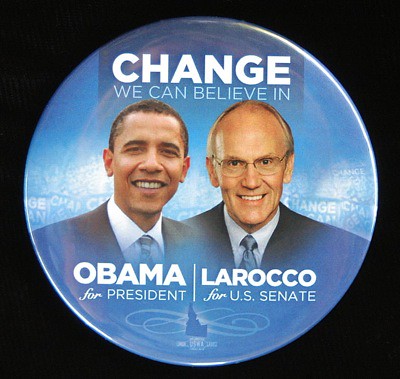
To Democrats, everyone west of the Hudson Elgin is pretty much interchangeable:

Some Democratic campaign buttons made for distribution in Idaho show an unlikely pair: Democratic presidential candidate Barack Obama and Republican Sen. Larry Craig.

But don’t expect the staunch Republican to throw his support behind Obama or for the presidential candidate to ask Craig to change his mind and run for Senate again. Apparently the button manufacturer picked a picture of the wrong Idaho Larry.

Apparently Obama’s campaign believes none of the bitter, gun-clinging Jesus freaks out west’ll know the difference.

I’m Gumby, Dammit

Tuesday, July 29th, 2008

I’m a little late with this one – but, given Al Franken’s latest ad buy (“I was a comedian, er, satirist; sometimes the jokes went off the mark, but that’s comedy.  Minnesota’s future is no joke to me”), I think it’s timely enough.

Last week sometime, Aaron Brown of “Minnesota Brown” kind of summed up the real problem with Franken and his past – quite possibly without knowing it.

Democrat Al Franken, an unusual candidate facing unusual challenges, is fighting to reestablish the narrative of a campaign which has been mired in talk of his past. Franken’s past does not include any of the things most politicians must explain or deny: he has no shady land dealings, love children or criminal activities; but he did enjoy a long, successful career in comedic writing.

And that – along with a hideously expensive, failed radio show – is it.   That’s all there is to Franken’s past.  He went from “Minnesota grade school kid” to “Harvard guy” to “SNL/comedian/satirist” to “liberal talk show host” to “candidate”. 

That is all. 

 This career produced reams of smart and somewhat unsmart jokes and a regretable tax reporting error that has been corrected. And that is the sum of the GOP incumbent’s campaign strategy.

 What else is there to talk about?  He’s never voted on a bill.  He’s never pushed for – or rejected – an earmark.  He’s never written or passed a budget.  He’s never been elected to catch dogs.

He’s written written, joked and talked about politics.

So has Aaron Brown, and for that matter yours truly (indeed, I’ve probably written more about politics than Al Franken has in six years of blogging). 

What else can Coleman address?

Oh, by the way…

 Anyone who knows even the tiniest bit about comedy knows that the moment you have to explain a joke, that joke becomes unfunny, indeed, poisonous. Which is why a rather good campaign by Franken has struggled against a relatively unpopular incumbent with eerily white teeth, Sen. Norm Coleman.

…Mr. Brown will need to explain the teeth reference.

But we digress:

But here’s my personal, highly anecdotal experience. If you were ever at some point far too young for your parents to let you watch Saturday Night Live, especially in the late 1980s and ‘90s when the show took some more crass turns, and then aged to a point where there was some doubt if you were old enough so you snuck over to a friends’ house to watch it, you aren’t bothered by Al Franken’s comedic past.

If you didn’t start sneaking in to watch the show until the late eighties, you have little idea who Al Franken was.  I started sneaking downstairs to watch the show when Chevy Chase still hosted Weekend Update.  And Franken was everywhere on the show back then.  So no, Franken’s comedic past doesn’t bother me (although given the number of droughts SNL has suffered through while Franken was writing for the show, it doesn’t exactly turn my comedic crank, either).  

In fact, if you are a Democrat of that age your first political book was probably “Rush Limbaugh is a Big Fat Idiot.” That book probably influenced your awareness of irony not just in comedy, but in politics.

So that’s what we have to thank for Markos Moulitsas, Jesus’ General, the Democrat Underground and the chanting masses of droogs in Jon Stewart’s audience. 

And so, you probably knew about Franken’s past “low” humor in addition to his many moments of deep insight (the kind of insight that would be useful in some kind of lofty federal office from a prominnt Midwestern state other than Wisconsin).

I’m struggling to remember a moment of “insight” “deeper” than “This is the decade of Al Franken”.  Feel free to fill me in.

 If you are unfamiliar with Franken’s very real transition from SNL jokester to satirist, however, the idea of a comedian gradually shifting gears over to public service seems to many as crazy as that crazy wrestler we elected governor and wasn’t that crazy! Damn kids!

You mean Dean Barkley and Tim Penny’s sock puppet our former “governor”, the 9/11 Truther?  You “kids” have some ‘splainin’ to do.

To get to what is perhaps Aaron Brown’s larger point – the higher-level concept that’s uncontaminated by inconvenient reality – let’s say a conservative comic were to run for, say, Senate.  Let’s say Dennis Miller (I know, more a libertarian than a conservative, but he’s right on most of the issues, and much funnier and politically cogent than Franken ever was) moved to Minnesota to take on Amy “A-Klo” Klobuchar in 2012. 

What would A-Klo’s campaign have to work with, other than thirty years of comedy?  From Dusk ‘Til Dawn Bordello of Blood?  Monday Night Football?   Joe Dirt? His switch from frowzy lefty to 9/11 libertarian?

Would A-Klo be at a loss for much more to talk about in re Miller?

What more is there to Al Franken?

I submit for your approval:  Nothing.

Discuss.

Critical Crass

Tuesday, July 29th, 2008

I’ve always hated humidity.  Heat, I’m fine with.  Humidity – especially the hot, stick garbage we get in Minnesota this time of year, the kind that hangs over the state for weeks and makes foetid morasses of every part of your body where two things rub together – is the bane of my existence.

The exception, since my mid-teens, has always been “unless I can be on my bike and riding like a madman”.  There’s something about a fast, intense ride on a muggy dog day that just feels…good.   Like it cleans your system out a bit – or at least makes the air conditioning at work feel that much better-deserved.  Either way, it’s about the only way I can stand humidity like this week.

So – thank goodness for biking.

Of course, in weather like this, and with as much stress as people these days have in their lives (gas prices, for instance), it’s good not to antagonize people.  Some of them are on the razor’s edge of civility to begin with.

Which brings us to “Critical Mass” the nationwide “group” of bicyclists whose stated goal is to promote bicyclists’ rights, but whose unstated one (if we ignore the likelihood that they’re really just hapless tools of other groups who wish to promote thuggery) seems to be to revel in the adolescent glee of pissing off “bad guys” – in their case, people who drive cars.

As someone who was biking long before most of “you” were born, please – stop your efforts “on my behalf”.  Please.  For all of the high-minded rhetoric accompanying your rides, it’s become a magnet in too many cities for antisocial, solipsistic jagoffs, and does the rest of us much more harm than good, to the point where plenty of people can see this sort of thing and be pretty damn sympathetic to the cop.

“We’ve Got A Campaign Down…We’ve Got a Campaign Down”

Tuesday, July 29th, 2008

Michael Durant – the Black Hawk pilot who survived the shooting down of his helicopter in the Battle of Mogadishu in 1993 – has this to say about Obama’s Landstuhl gaffe:

“Over the last week, Barack Obama made time in his busy schedule to hold a rally with 200,000 Germans in Berlin, hold a press conference with French President Nicholas Sarkozy in Paris, and hold a solo press conference in front of 10 Downing Street in London. The Obama campaign had also scheduled a visit with wounded U.S. troops at Ramstein Air Base in Germany, but this stop was canceled after it became clear that campaign staff, and the traveling press corps, would not be allowed to accompany Senator Obama.

“I’ve spent time at Ramstein recovering from wounds received in the service of my country, and I’m sure that Senator Obama could have made no better use of his time than to meet with our men and women in uniform there. That Barack Obama believes otherwise casts serious doubt on his judgment and calls into question his priorities.”

Oh, I think his priorities are crystal-clear.

Something to do with wanting people to line his path with cloaks and palm fronds.

Process People

Tuesday, July 29th, 2008

I got into the world of business (and out of the world of media and/or bars) about fifteen years ago.

After I’d been in the racket about eight or nine years, I remember sitting in a meeting, to meet a new director for an IT department I was with.
“I’m a process person”, he said, confidently.

“Polish up your resume”, I whispered to the co-worker next to me.

I was right, of course.  When a person has to advertise himself as a “process person”, it’s generally because they’ve found a) it’s easier than focusing on delivering things, and b) has found a ready-enough market of companies whose intrinsic processes are so dysfunctional that he’s been able to string sort of a career together.  Organizations that are dysfunctional enough to need “process people” are generally too hopeless to be fixed by tweaking “process”; they need to be gutted and started over.  In the meantime, if you’re stuck with a “process person” for a manager – well, see the beginning of the post.

And it goes double for people who pronounce the word processes like “pro-ses-SEES”.

All by way of saying I’ve lived this video way too many times.

Question Answered

Tuesday, July 29th, 2008

Last week, the local Leftosphere was all abuzz over the lawsuit placed by a variety of trade unions against “lies” the Coleman campaign was allegedly spreading about the “Employee Free Choice Act”. 

“What were the lies involved in Coleman’s ad?”, we wondered.

So did the Office of Administrative Hearings, which handles such campaign-related flibbertigibbets:

“For purposes of a prima facie determination, the Complainant [the DFL’s Brian Melendez, in this case] must detail the factual basis to support a claim that the violation of law has occurred (Minn. Stat. 211B.32, subd.3.)  Here, the Complainant has not alleged with any specificity why the statements at issue are factually false. The Complaint merely asserts that the statements are false and “contrary to the facts,” without providing any further information.

The Complaint also does not identify the named individual Respondents, nor does it allege any facts to support an allegation that they participated in the preparation or broadcast of the material knowing it was false or with reckless disregard of its falsity.”

Note to DFL politicians, “citizen journalists” and bloggers; merely wishing something to be true, and/or repeating “it’s true!” endlessly and loudly, does not make it so. 

No matter how hard you may wish, how many times or how loudly you repeat it, eventually you’ll need to bring some facts.

Or, y’know, have some.

Dazed And Confusing

Tuesday, July 29th, 2008

Back in 2000, I was teaching a “writing for the web” class at a local college. Since I was (and am) a Usability guy, I took a week or two to teach the basics of usability analysis.

Fortunately we had a prime case study in the news.


The “Butterfly Ballot”, viewed through the non-political, pretty-objective standards usability people use, was a complete disaster. My class and I came up with a solid page of feedback just by going over it; I would have added that “observing people using the ballot, with an aim toward improving the design, would have been interesting” – but of course, we got that all over the news for the next two months.

Before the election? That might have been helpful.

The Times, eight years later, gets the message:

The butterfly ballot in Palm Beach County, Fla., was one of the great debacles in election history. It was so confusing that it was hard to tell which hole to punch to cast a vote for a particular candidate. Many people intending to vote for Al Gore accidentally punched the hole for Patrick Buchanan or punched holes for both Mr. Gore and Mr. Buchanan, which disqualified their votes.

The design, by the way, was equally likely to draw votes away from Bush. But we’ll leave the Times alone for the moment.

The controversy should have led to sweeping reforms, but it didn’t. A study by the Brennan Center for Justice at New York University School of Law lists 13 ballot problems that show up around the country in election after election. One is creating a layout in which it is unclear what hole voters need to punch — or where they need to place a mark — to cast a vote for a particular candidate. Another is placing more than one contest on the same screen of a computer voting machine, which often leads voters not to vote in one of the races. Making matters worse, the instructions that accompany ballots are often confusing.

The response from some commentators – “anyone who’s too stupid to use a ballot is too stupid to vote” – is the kind of thing most interaction designers have heard from programmers, if we’ve been in the business long enough.

It’s wrong, of course; ballots should no more actively confuse, obfuscate or muddle people than should the software you use to do your job or balance your checkbook. In the private sector, the company with the more usable product usually wins. It’s a major reason “Quicken” has beaten “Microsoft Money” for the past decade and a half. It’s why Best Buy and Target and Amazon spend millions designing their real and online stores, and millions more observing how real people do interacting with them under real-world conditions.

Is the integrity of elections as important?

Congress should require that ballots used in federal elections meet minimum design standards. It should also mandate pre-election usability testing and make funds available for it. States and localities need to draw up better guidelines for how ballots are designed and clearer instructions to voters.

Every once in a while, the Times gets one right.

They should also publicly report after each election how many votes are lost because of miscast ballots.

There are, on the other hand, easier and cheaper ways to accomplish this.

A Pox On Those Who Let The Infrastructure Crumble!

Tuesday, July 29th, 2008

According to the Strib, the NTSB has found some new evidence about the 35W Bridge collapse – and it’s not all about the gussets:

The National Transportation Safety Board has not ruled out the possibility that Minnesota transportation officials missed a potential clue to the impending failure of the Interstate 35W bridge, NTSB Chairman Mark Rosenker said Monday.

One year after the structure collapsed, killing 13 people, the federal agency is still studying whether photos of critical gusset plate connections taken by inspectors in 1999 should have prompted MnDOT to take action, Rosenker said. The photos showed bowing or warping of the plates.

Damn you, Carol Molnau!  A Pox upon you, Tim Pawlenty!  Curse you, David Strom and all you tax hawks, for letting the bridge collapse to save a buck!

CORRECTION:  I’m informed that none of the above were in office in  1999.

In 1999, MNDoT was run by this currently DFL-endorsed candidate for Congress; the one that was on WCCO as the last cars were settling into the river, blaming…

…well, see above.

I regret the confusion.

Leaving The Matrix

Monday, July 28th, 2008

I like to keep an open mind to other cultures, viewpoints and philosophies and recently listened to Pema Chödrön’s 3-CD set Getting Unstuckduring my recent road trip to Milwaukee. It was recommended by a favorite client of mine.

Pema Chödrön (formerly known as Deirdre Blomfield-Brown) is an ordained Buddhist nun in the Tibetan vajrayana tradition, and a teacher in the lineage of Chögyam Trungpa. The goal of her work is the ability to apply Buddhist teachings in everyday life.

I hate to boil the whole of Buddhism down to one principle, but my experience is limited to this CD set and the gist of the application of Buddhist teachings in everyday life is quite similar to a quote I cited in my last post at Roosh Five:

It isn’t the burdens of today that drive men mad, but rather regret over yesterday and the fear of tomorrow. Regret and fear are twin thieves who would rob us of today.

That is to say, my takeaway was learning to be “present” as Pema Chödrön puts it, and I thought the audio CD and another recent experience was relevant to the discussion in my previous “Matrix” post.

Now, watch as I turn this whole concept into a justification for the rental of a motorhead boy toy.

Friday, two colleagues and I rented Harleys (mine was actually a 1300cc Yamaha V-Star if you must know) and rode from downtown Minneapolis, headed East, and toured both sides of the Minnesota/Wisconsin border, Wisconsin side down to Pepin and back up the Minnesota side. Our tour terminated in Stillwater where we joined the festivities of Lumberjack Days, already in progress.

We put on a few hundred miles, stopping for whatever reason we saw fit; a beer, a view, or a funnel cloud (we think) over lake Pepin in Lake City.

The essence of riding a motorcycle is the freedom you feel. The disconnection. It’s not just the warm wind buffeting your face, the soundtrack of the big-cans and pipes, the copious torque available at the flick of a wrist or the 360-degree unimpeded view. It’s the fact that done right, a bike ride is on no one’s schedule but your own. One caveat: in the interest of self-preservation, your constant attention to the now is required. Hence, motorcycling requires you to be “present”; or else.

We had no radios, no CB’s, and our Swiss Army Personal Digital Assistants, with their chirps, buzzes and warbles fell on deaf ears buried in the depths of our saddle bags.

I observed one of my colleagues light a cigarette at a red light and smoke it behind the windscreen at highway speeds, but I have never once seen anyone talking on a cell phone or reading a newspaper or texting on a motorcycle. It’s against the laws of nature, I’m sure of it.

As such, we would go as much as a couple hours at a time without connection to the modern world, the fact that we were riding fuel-injected hogs with trip computers and electronic ignition, notwithstanding. Completely incommunicado.

In fact, we rarely even spoke to each other. It was us, the road, the sun and the aural interplay of the throaty rumble and crack of our pipes as we rode in staggered formation through the winding two-lane highways along the river and it’s bluffs that make Western Wisconsin and Southeastern Minnesota some of the most popular and scenic territory for bikers.

Calls went unanswered. Text messages failed to generate urgency. Emails stacked themselves neatly. Severe weather warnings went unheard. The stock market did what it does; just without us on this day.

And it was good.

The Great Saint Paul Land Grab, Part IV

Monday, July 28th, 2008

Last week, I sent this email (with a few subtle variations, depending on the recipient) to every Saint Paul City Councilperson (and each of their Legislative Assistants, just for good measure).

I’m Mitch Berg.  I’m a twenty-year Saint Paul resident.  I live in the Fourth Ward. 

I also write a blog (Shot In The Dark) and host a radio talk show (“The Northern Alliance Radio Network”). 

I have a few questions about a recent City Council decision.

At the June 25 meeting, the City Council passed Ordinance 07-1194 4 (”Green Sheet” number 3046791).  This ordinance amends Legislative Code 33.03, and states that vacant homes (in Category I and II – the most saleable homes) can only be sold if all vacant building fees are paid, and if the owner posts a performance bond or escrow equal to the estimated amount needed to bring the structure up to code.

I have several questions about this ordinance, and I’d appreciate your answers.

1) It seems, on its face, that this ordinance is intended to compel banks and other lenders owning foreclosed property in Saint Paul to bring foreclosed property up to current building codes before they can be re-sold.  Is this accurate?

2) Has the City Council gotten an estimate as to the likelihood of institutional mortgage-holders (banks) complying with this ordinance?  Has there been any “market research” done on the percentage of compliance expected?

3) If a mortgage holder does *not* comply – fails to post the performance bond or escrow, or bring the building up to code – then as I read it, this ordinance means the property remains in limbo, a deteriorating vacant structure.  Is this accurate?

4) Given that the reason most of these homes were foreclosed in the first place was that the amounts owing were greater than their market values, and that it can *easily* cost between $30,000 and $50,000 (or more) to bring an older home up to current code standards, on properties that are already “upside down” (worth less than the bank has lent for them), what percentage of institutional owners (banks) do you expect to comply with the terms of this ordinance? 

5) Did the City Council seriously discuss this scenario?  If so, why did they decide to take the action they did in approving the ordinance?

6) In the event that a large percentage of institutional mortgage holders that own foreclosed, vacant properties in Saint Paul *do not* comply with the ordinance, what is the city’s “fallback plan” for dealing with the large number of vacant, deteriorating properties that would result?  And for the additional drag on the values of *neighboring* properties that will result from having huge numbers of vacant, distressed buildings as neighbors?

Finally, a few questions that deal with the consequences of the ordinance:

7) Hypothetically, let’s assume the worst: that most of the banks involved decline to comply with the ordinance.  They also stop paying property taxes, allowing the properties to go tax-forfeit.  The land forfeits to the State, obviously – but the State then assigns it to the city/county to dispose of.  Assuming the hypothetical “worst case” scenario, what does the city intend to do with all of this new property?

8) Again assuming the “worst case” above – is it the city’s intention to use the epidemic of tax-forfeit property to…:
   a) drag down property values in these distressed neighborhoods
      to make eminent domain settlements against the remaining
      homeowners cheaper, to enable the city to…
   b) redevelop the land according to its own plans, on the relative
      cheap?

9) Finally – what do you, and the Council, *believe* the consequences of making properties much more expensive than they are worth to their owners will be?

Again, when you get a moment, I’d be very interested in your answers to the above.  If email is less convenient for you, feel free to call my cell phone: [redacted].

Respectfully,

Mitch Berg
The Midway

Wednesday, the responses.

(Read the whole series: Part I, Part II, Part III, Part IV, Part V)

--> Site Meter -->