Archive for the 'Money' Category

There is a lot of ruin in a country, especially this one

Thursday, May 26th, 2022

There isn’t enough bad news in the world, so let’s toss another stack of troubles on the table, shall we.

At American Greatness, Adam Mill outlines the financial ruin headed our way.

The coming reckoning for Washington’s insanely irresponsible monetary policy may dwarf the troubles from all recent recessions and periods of inflation.

The Federal Reserve has created a doom loop between the housing market and inflation. For years it has printed tens of billions of dollars each month to buy sketchy securities meant to subsidize the housing market and favor bond traders. This continues even now, in spite of inflation and a red-hot housing market. But the housing market has become dependent on unearned, newly printed money, and stopping the flow might cause a catastrophic correction. If it doesn’t stop, however, inflation will explode.

Let me walk you through some of the math.

Inflation closes the gap between money earned and money spent. Since the financial crisis of 2008, the Federal Reserve expanded M2 money supply from just under $8 trillion to around $22 trillion today. During that time GDP has increased from around $14.6 trillion to around $24.5 trillion today. We’ve gone from a ratio of one dollar chasing $2.20 in goods in services to an almost 1 to 1 ratio today. Inflation during the same period, according to the government, has eroded the dollar by a mere 33 percent.

You think 8 percent inflation is high? Prices need to double to restore any semblance of balance between currency and the things you can buy with currency. We have a long way to go.

Fortunately, his conclusion is even worse. Enjoy your holiday weekend!

To fight inflation, interest rates need to exceed the inflation rate. That means a dollar saved loses purchasing power unless savings interest rates climb from less than 1 percent to something over current inflation (now around 8 percent). One rule of thumb provides that savings interest rates should reach 150 percent of inflation in order to reverse the trend. The theory holds that high interest rates encourage saving cash thus slowing down the speed at which money chases assets. If interest rates are less than inflation, it makes holding cash a losing proposition.

But in this environment, raising interest rates will cause a cascade of problems. The higher interest rates will slow the economy and cause unemployment. It will also swallow up tax revenue as the government has to pay interest on its massive debt. But more critically, it will increase the rate of default on home mortgages. Those defaults will make mortgage-backed securities less valuable and more unpredictable. That’s how the 2008 housing market seized up.

Thus, the doom loop.

Alternatively, the Fed could just let inflation rip as it continues to pour gasoline on the fire. At this point, the latter scenario appears more likely as the Fed engages in half-hearted symbolic inflation-fighting measures. Not surprisingly, the inflation numbers get scarier and scarier. At some point, runaway inflation will force the Fed to take real action. One thing is certain: the longer it waits, the more it will hurt.

Closing the gap between money earned and money spent means cutting government spending, raising interest rates, reducing regulation, and lowering taxes. Government can and should facilitate increases in productivity by reducing its interference in every private transaction. More Americans get a check from the government than pay taxes. The labor participation rate is dangerously low. There just aren’t enough people pulling their weight to make the things needed to sop up all of this excess money.

The most valuable commodity will be corrugated tin for the roof of your hovel

Friday, May 20th, 2022

Since we’ll all be living in Bidenvilles soon, it might be wise to develop some skills that our parents, grandparents and great-grandparents learned during the Great Depression for making do in times of want. Yes, we could just tax the rich and take all their money for ourselves, but between inflation and the stock market tanking, there won’t be any rich people.

-Instead of meat, use oats or beans or lentils
-In the absence of eggs and butter, vinegar and baking soda in breads and cakes
-Make your own soap and cleaning products
-Remember those Home Ec classes that just reinforced hateful gender norms? Take a few. Learning how to sew will come in handy.
-Remember how guns are scary? Learn to use them. Hunting will keep food on the table.
-Raise a few chickens in the backyard. You’ll thank me later.
-You’ll want to learn how to ride a horse, and hook one up to a buggy.

And don’t forget to plant that Victory Garden!

Where will you be in nine years?

Tuesday, April 26th, 2022

The answer may be “in a cave up in the mountains, taking a guard duty shift at the mouth of the cave, projecting how long the canned food can last before another supply run is needed.”

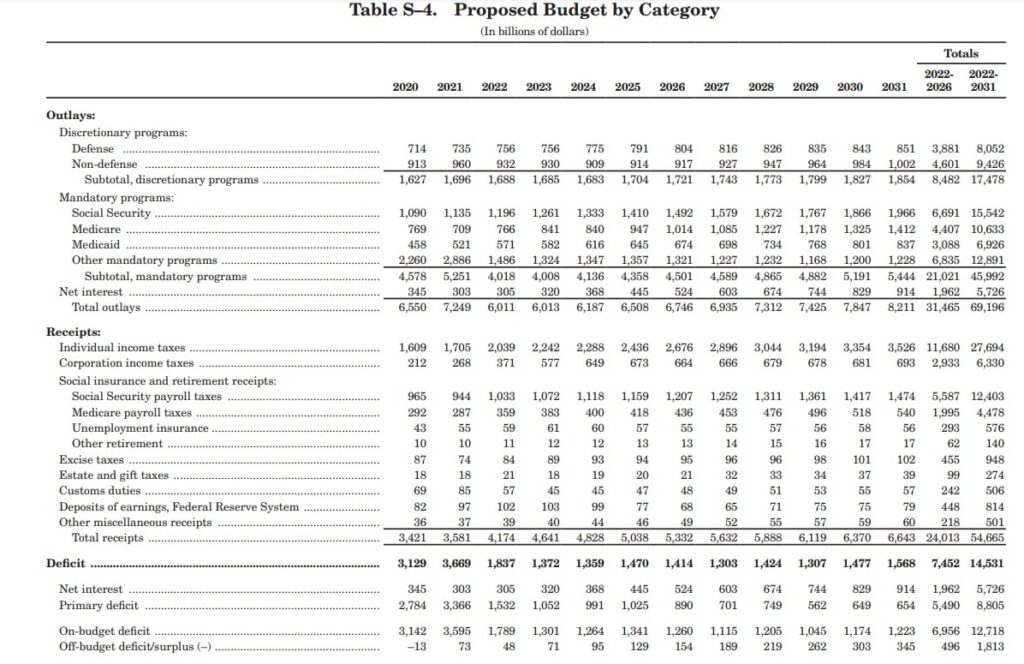
Here is a screen capture from the White House proposed budget for 2022. It shows “accounts payable” and “accounts receivable” over the next nine years. It projects budget deficits in the 1.3-1.5 trillion dollar range.


In addition, it shows expected mandatory outlays. These start at 4 trillion and go to about 5.5 trillion. Dollars. These are things like Granny’s social security check.

Discretionary outlays are in the 1.6-1.8 trillion dollar range.

So, a little back of the envelope math. Public debt is “officially” around 23 trillion dollars, and as seen here only continues to increase at a yearly clip of over a trillion dollars.

How might we get the debt and deficits under control? Well, we could take an axe to discretionary spending and just completely wipe it out. No defense spending, nothing. Does that sound likely? No.

Or, we can cut social spending by a trillion and a half each year. Does that sound likely? No.

Trouble is, reality may do that for us, though. And how smoothly do you think those social changes will go? This from a 2020 SS Trustees report:

Under the Trustees’ intermediate assumptions, OASDI cost is projected to exceed total income starting in 2021, and the dollar level of the hypothetical combined trust fund reserves declines until reserves become depleted in 2035. Figure II.D2 shows the implications of reserve depletion for the combined OASI and DI Trust Funds. Considered separately, the OASI Trust Fund reserves become depleted in 2034 and the DI Trust Fund reserves become depleted in 2065.2 In last year’s report, the projected reserve depletion years were 2035 for OASDI, 2034 for OASI, and 2052 for DI.

2021 was last year by the way, and just after these budget projects run out, Social Security keels over.

How about Medicare? Same story.

The trust fund for Medicare Part A will be able to pay full benefits until 2026 before reserves will be depleted.

That’s the same year as predicted in 2020, according to a summary of the trustees 2021 report, which was released on Tuesday. If the reserves run out for the Hospital Insurance Trust Fund, then the program’s income should be able to cover 91% of scheduled benefits. Medicare Part A covers hospital care for enrollees.

Then there’s interest on the debt. From projections, just the interest on the debt runs from about 8% of net mandatory outlays up to around 17%. And that doesn’t take into account interest rates going higher.

Then there’s interest on the debt. From projections, just the interest on the debt runs from about 8% of net mandatory outlays up to around 17%. And that doesn’t take into account interest rates going higher.

The roughly $300 billion the federal government will spend on interest payments this fiscal year is more than it is expected to spend on veterans’ services and military retirement ($185 billion); transportation ($188 billion); food and nutrition services ($172 billion), including the Supplemental Nutrition Assistance Program (“food stamps”); housing ($100 billion); K-12 and vocational education ($77 billion); and higher education ($42 billion). By FY 2031, interest costs are projected to be larger than federal spending on Medicaid and unemployment compensation, and over 90 percent as large as defense spending.

Under current law, we project interest spending will total $5.1 trillion over the 2021 to 2031 budget window. If interest rates on the projected annual debt stock were 50 basis points (0.5 percentage points) higher than CBO currently projects – reflecting the continuation of the current disparity between projections and reality – interest costs would increase by $1.7 trillion, to $6.8 trillion total. If interest rates were 100 basis points (one full percentage point) above CBO’s forecast, interest costs would total $8.6 trillion over that period, which is a $3.6 trillion increase over current law.

If interest rates begin at 50 basis points (0.5 percentage points) above CBO’s projections and gradually rise to 200 basis points (2 percentage points) above CBO’s forecast – bringing ten-year rates to just above their 30-year average of 4.3 percent by 2031 – interest costs would total $11.1 trillion over the 2021-2031 budget window, which is $6.0 trillion more than under current law.

The asteroid is heading for Earth. Impact is projected to be smack in the middle of North America. And no laser in existence is going to deflect it.

So, be careful on that supply run down into the valley. The cannibal gangs are merciless.

Wake Me Up When December Ends

Thursday, December 12th, 2019

I hate December. It’s cold. It’s dark. And all my year-end bills come due. Annual attorney recertification, vacation condo maintenance fee, hangar rent, Christmas bills plus all the usual expenses. It’s that wallop at the end of the year that annoys me. I hate to see money going out of the checkbook, it should be coming in. Makes me what to cut back,  spend less, live poor. 
“Darkness was cheap, and Scrooge liked it.”
I know exactly how he felt.
Joe doakes

I make a concerted point of enjoying the whole holiday season – which has made me, oddly enough, enjoy the season.

But I get it. I really do.

If I Did One Of Those “Man On The Street” Interviews…

Friday, April 17th, 2015

… I have a hunch I’d be really be depressed at how many people on a typical college campus would take this article seriously, and at face value.

I Vote “Portent”

Wednesday, October 16th, 2013

Joe Doakes from Como Park emails:

EBT computer system in Louisiana went down for a few hours.  The EBT cards did not show a credit limit.  Shoppers were pissed so Wal-Mart management said “Ignore the limit, honor the cards.”

Shoppers went on a spree, cleaning out the store. You know they’ll never have to pay it back.

Question is: is that a particular cultural thing specific to Wal-Mart shoppers, or a portent of things to come when the US government no longer can pay its debts?

Joe Doakes

There are two iron clad rules of human behavior:

  1. In a crisis, humans will exceed authority’s expectations.  Sometimes.
  2. If it’s not a crisis, but merely entropy setting in?  All bets are off.

OK, so those aren’t so much “iron-clad rules” as they are signs I’m un-thrilled about the prospects.

A Little Knowledge

Monday, October 7th, 2013

If there’s one thing I’ve learned from my various liberal lawyer friends, it’s this; when I see news of the filing of an absurd lawsuit demanding a bizarre amount of money for an insane claim, take a step back and a deep breath.  A filing does not equal a judgment; while the occasional batspittle-crazy judgment happens, the vast majority of bizarre lawsuits end in a dismissal on summary judgment; a judge determines that no actual matters of law are involved, so there’s no need for a trial. 

And the bizarre cases that appeared in a splash of laughter and anger disappear, unlamented and

Over the weekend, the word got out among the usual circles about a Swiss proposal to give every single citizen a $2,600 monthly government-paid income

There were two reactions from among Americans I’d broadly call “conservative”; mockery, and a little bit of head-scratching.

We’ll look into the head-scratching first. 

The Big Fix: In his classic book Parliament of Whores, P.J. O’Rourke noted that if we just gave the money we currently spend on social welfare to people whose income is below the poverty line, we could bring every person in the United States up to the poverty line, and save money.  We’d do something that eighty years of “progressive” social policy has “tried” and failed to do; eradicate poverty, at least in a literal, personal-financial sense. 

The Swiss “plan” – assuming it also involved eliminating other poverty entitlement programs – might be a huge step toward simplifying poverty entitlements and, perversely, saving money…

The Swiss Reality– …if there were the slightest chance of it becoming law.

The Swiss federal system allows the National Assembly – the Swiss parliament – to refer bills dealing with major government issues – taxes, spending and big policy issues – to a national vote, very, very easily. 

Switzerland, like Minnesota, is starkly divided along what we’d call “red/blue” lines; the big cities, Zürich and Basel and Geneva, are every bit as clogged with socialist bobbleheads as Minneapolis or Duluth.  But the cantons (states) of greater Switzerland tend to be very conservative. The largest party in the National Assembly is the “Swiss People’s Party” (Scheweizerische Volkspartei, or SVP in German), a center-right party that, unlike many European “conservative” parties, could be recognized as “conservative” by an American Tea Partier. The SVP leads a coalition of center and right-leaning parties that don’t quite have a majority of the Parliament – 94 out of 200 seats in the lower house – but would require absolute unity among their opposition to effectively beat. 

But this isn’t even a parliamentary referendum.  Swiss law allows citizen petitions with 100,000 signatures – out of a population of 8 million citizens, or roughly 2% of the voting population – to force a referendum.

Andthatis how this proposal got on the ballot. 

On the one hand, it allows well-organized grass-roots groups to make a big electoral splash by getting the darnedest hare-brained ideas onto the national ballot. 

On the other?  They almost always get beaten.  A “grassroots” group of Swiss got an initiative to abolish the Swiss military onto the ballot in 2011.  It got a slew of headlines.

And it lost by about a 3:1 margin. 

The election of Jesse Ventura shows that if times are good enough, you can get up to 37% of any population to suspend their good judgement on a lark, when they don’t think it matters that much.

But here, we’re talking money.

This initiative is going to generate a lot of headlines, and a fair amount of mockery from American, left and right, who don’t get how Swiss democracy works…

…and, soon, a 2:1 electoral defeat.

Nicosia On The Potomac

Friday, April 5th, 2013

Joe Doakes from Como Park emails:

It happened once, when the government ran out of money in the midst of a Depression.

Could it happen again?

Good question.

On the one hand, you’d hope people would learn from history.

On the other hand, government isn’t “people” in the sense of “individuals acting in concert toward the mean of their best interests”.

And the record throughout history of “governments empaneled by waves of populist fervor on platforms involving mostly giving stuff to people” just isn’t all that good.

Fumble

Sunday, March 24th, 2013

The Monday Morning Quaterbacking over electronic gambling heats up.

Two gambles that haven’t paid off

When breaking down the various back-up funding plans for the Vaseline Dome, one step was neglected – the finger pointing.

For a funding mechanism that was originally billed to deliver $35 million in revenue per year, and continuously revised down to $17 million and then $1.7, the process of assigning blame should have been viewed as inevitable.  But like a legislative Atlas, who would shoulder the majority of the ownership of such a flawed model?  Gov. Mark Dayton, who was so publicly aggressive in his defense of a new stadium?  The hapless former Republican legislative majorities who acquiesced to the bill?  The Star Tribune, whose rampant conflict of interest with any Metrodome-site construction should have called into question their vocal support?

No, the Star Tribune has decided the real culprit are the gambling firms that provided the electronic pull-tab games:

While flawed, the gambling board’s sales estimates were extremely detailed, including the number of bars and restaurants that would adopt e-gambling, the number of devices in play, what hours they would be played and how much money would be wagered.

It projected 2,500 sites would be selling electronic pulltab within six months, or nearly 14 bars and restaurants joining in per day….

Nearly a year after those projections were made, about 200 Minnesota bars and restaurants offer electronic pulltabs, not the 2,500 that had been predicted. Electronic bingo games have just been introduced.

Average daily gross sales for electronic pulltabs have increased to about $69,000, but sales per gambling device have declined.

The firms may have been making bad assumptions about the capacity for Minnesota to support increased charitable gambling, but at least the firms’ figures came out of experiences in states like Montana, South Dakota and Oregon.  Still, the basic math of the gambling mechanism was public knowledge long before it was formally added to the final bill.

Minnesotans spend about $1 billion in charitable gambling, which equals the comparatively paltry sum of $36 million in revenue.  The Vikings stadium, requiring $35 million a year to cover the State’s $348 million share, would necessitate charitable gambling to either double to $2 billion or entirely overrun the current charitable competition.  In that light, it’s little wonder that other charitable organizations were not asked for their opinion.  A decision that now is being heavily criticized as charities across the State say some version of “I told you so.”

All the finger-pointing in the world doesn’t help hide the reality that the responsibility for flawed legislation needs to rest with the political leadership that authored it – a fact even the Star Tribune acknowledges:

“There was a willful blindness … driven by pressure politics,” charged David Schultz, a Hamline University political analyst and a professor of nonprofit law…

“This was a deal that was going to happen no matter what,” Schultz said. “The governor wanted a stadium. The money couldn’t come from the general fund. The charities had been asking for electronic games.”

A Look Ahead To The 2011 Session

Wednesday, December 29th, 2010

January 3: Session kicks off.  Mark Dayton throws a “blue jeans” inaugural.  Musical highlight: the “Alliance For A Better Minnesota” Choir singing “Look For The Union Label”.  For four solid hours.

January 4:  The Humphrey Institute releases a poll showing that 80% of Minnesotans want the Legislature to pass Mark Dayton’s budget immediately.  Bloggers point out that the poll included only respondents from Kenwood and Crocus Hill. MPR reports that it’s a nice day for a bowl of Cream of Rice.

January 5: The Star Tribune’s Joe Doyle starts a three part series on “obscene corporate profits” and how they benefit “the rich walking among us”.

January 6: Dayton releases his first budget, calling for $40 billion in spending. Delivering the announcement in blue jeans with the SEIU Singers humming “We Are The World” in the background, Dayton notes that he plans to increase revenues to $41 billion. “We’ll finally have a surplus!” he exclaims, as a crowd described by the Star/Tribune as “50,000 womenandchildren at risk” applauds in the Capitol rotunda.  The plan calls for big tax hikes on “obscene corporate profits” and “the rich walking among us”.

January 10: The last of Dayton’s Iron Range supporters are finally bailed out of the Ramsey County lockup after the inaugural.

January 12:  Speaker Zellers refers the Dayton budget to the House Very Special Boom Zoom Committee” – actually a group of legislators’ children wearing “Junior Representative” t-shirts.  Bill dies, and is colored on, and has juice spilled on it.

January 16:  Lori Sturdevant notes that “a seasoned group of bi-partisan policy wonks say that the GOP risks getting tossed out by an angry mob if they don’t raise taxes.  Conservative bloggers point out that “bi-partisan” in this case means DFL and Green Party members.  Presented with the allegations, WCCO TV reports that Brett Favre just loves Chipotle Big Bols.

January 19: Governor Dayton submits a budget bill involving $42 billion in spending and $ 45 billion in taxes.  “A three billion dollar surplus”, Dayton announces to a group of senior citizens (“at least 20,000”, according to the Strib’s Pat Doyle) at the Hockey Hall Of Fame in Eveleth.  “It’s like a billion hat tricks!”.  Keith Ellison solemnly proclaims that the only reason not to vote for the bill is “racism.  Racism from all you crackers.  Pay the **** up, crackers”.

January 27: Speaker Zellers forwards the bill to the House Budget Committee.  The Mississippi House Budget Committee.  Which loses the bill.

February 3: The Humphrey Institute releases a poll showing that eleventy-teen percent of Minnesotans demand tax and spending hikes.  KARE 11 News finds eleventy-teen people on the street that agree.  Frank Newport of the Gallup Group points out that ‘Eleventy-teen” isn’t even a real number, but something Dennis the Menace used to say to show that he couldn’t count.  Rachel Stassen-Berger responded with a piece on “The Override Six, Two Years Later:  Profiles In Courage And Extremism”.

February 18:  Governor Dayton, speaking at a homeless shelter in Brooklyn Center, holds up James Blount, a three-year-old boy, in front of cameras; notes that “this boy is going to go hungry because of GOP extremism and intransigence tonight”.

February 19:  Conservative bloggers point out that the “boy”, Blount, was actually a schnauzer that had wandered over from a nearby housing development.  Eric Black of the MinnPost responded with a piece on how animal shelters are suffering under GOP rule.

February 27:  Dayton submits his third budget, a $39 Billion plan that is very similar to the budget he proposed during the campaign.  Conservative bloggers point out that it has exactly the same problems it had during the campaign; it assumes “the rich” (in this case, Minnesotans who are still employed) will pay the taxes rather than moving or getting Mark Dayton’s financial advisor, that the state can fire contractors whose jobs are both legally mandated and involve skills the state’s workforce doesn’t actually have, among many others.

February 28: The Star Tribune “Minnesota Poll” claims that Minnesotans want the Dayton budget passed, that the people want to carry Governor Dayton through the streets on their shoulders, and that violence is about to break out against the Minnesota GOP.  Bloggers point out that the survey was conducted entirely at one “Drinking Liberally” event in Minneapolis.  Informed of the allegations, KTCA’s “Almanac” embarks on a three-week special on the history of Danish cooking in Minnesota.

March 20:  Speaker Zellers assigns the budget to the House Government Operations and Finance Committee.

March 28:  Rep. Quam (GOP) of Byron demands that the DFL members of the committee play a game of Twister on the House floor if they want the budget to get out of committee.  The committee members comply.

April 8:  Nick Coleman, writing his new colum in the Wayzata Shopper, remembers when his father was running things.  “The wingnuts wanted to play Twister for a better Minnesota”.

April 12: The Dayton budget comes to a vote in the House.  It loses decisively, on state party lines.  To signify the defeat, Speaker Zellers ties the budget to a string hanging from the ceiling of the House chamber, and members of the House Republican Caucus whack at it like a piñata.

April 15: Speaker Zellers tells a cheering crowd of 10,000 at the Tea Party rally on the capitol grounds that the budget is dead on arrival.  Six pro-tax protesters stand across the street wanly chanting in favor of the Dayton budget.

April 16: The Strib editorial reports that a crowd of “dozens” at the Tea Party rally were evenly split, showing the deep partisan divide in Minnesota politics today.

May 1: , Governor Dayton start making contingency plans for a shutdown.  Bloggers point out that the Governor’s plans include evacuating the Governor’s office to Vail, and euthanizing animals in all state parks.  Told of the allegations, Keri Miller of MPR wonders on the air “whatever happened to bipartisanship?”

May 14: A day ahead of the deadline, the GOP Caucus introduces a $33 Billion budget that makes steep spending cuts and balances the budget with no new taxes.  It passes on a straight party line vote, is sent to the Senate, which also passes the budget by the end of the day.  The bill is sent to the Governor.

May 15  Mark Dayton appears at the Hockey Hall of Fame, dressed in a Minnesota Wild Uniform, with Minnesota hockey legend John Mayasich, to veto the GOP budget. “Minnesota demands that we do the responsible thing and pass my budget without all this debate and democracy and crap”, he says, as Mayasich looks on.   Bloggers point out that “Mayasich” is actually Alliance for a Better Minnesota chair Denise Cardinal in a bald wig.  Told of the allegations, KARE 11 news re-runs the January 4 Humphrey Poll.

May 16:  The Strib runs a piece by reporter Pat Doyle, an expose of the “Casualties of the Shutdown”.  Doyle, clearly gunning for a Pulitzer, writes a heartrending tale of Minnesotans standing in line at soup kitchens, of families (mostly “womenandchildren”) living in huge “Zellerville” on the Capitol Mall living on McDonalds coffee, and people lining up to throw themselves off the High Bridge.  Bloggers point out that government hasn’t actually shut down yet, that nothing Doyle wrote had actually happened, and that the piece was clearly pre-written weeks earlier and run by mistake.  Told of the allegations, MPR’s Keri Miller runs a two-hour broadcast on “How Blogs Provide A Chilling Effect On Free Speech”, featuring a bipartisan panel of Larry Jacobs and Nick Coleman.

May 17: Dayton demands the Legislature pass his budget.

May 18: Nobody at the legislature responds.

July 1: Minnesota’s state government shuts down.

July 2:  The Strib re-runs the Doyle piece.

July 22: The state budget office notes that business activity is increasing, and tax receipts are rising.

July 23: The Strib editorial board runs an extended interview with Elmer Anderson, who gruffly demands that Minnesota Republicans “think about what’s best for Minnesota” and adopt Dayton’s budget immediately without any of that “commie wingnut debating crap”.  Bloggers point out that Elmer Anderson died in 1998, and “Anderson’s” rhetoric read like Nick Coleman writing with a bag over his head.  Told of the allegations, MPR’s Mark Zdechlik embarked on a two-week series on “What we can learn about Democracy from the Iroquois”.  Salient observation: the Iroquois tradition of “Local Tribe Aid” was considered inviolate.

August 18: The State Budget Office notes that, with no government expenditures and business thriving, the state is in a surplus.

September 2: Katherine Kersten’s column, “Happy Days Are Here Again”, notes that Minnesota is in a much better state with the government shut down.  Lori Sturdevant muses in her column that in Wendy Anderson’s day, the governor would have told the State Patrol to arrest Kersten for “making terroristic threats”.  Bloggers point out that that is utterly absurd, there is no record of any such demand, anywhere.  There is no response to these allegations.

September 23: With no budget in place and government shut down for weeks, Mark Dayton, operating from his office in Vail, orders the National Guard called out to react to what Dayton’s press secretary Tinucci calls the “Terrorist Threats”.  Bloggers point out that the “threat” was the conclusion of Sturdevant’s slanderous column about Kersten.  The National Guard’s commandant says “the paperwork is in process, call back in July”.

September 24: Dayton exercises his unallotment power on the GOP’s budget.  Senate Majority Leader Amy Koch is left visibly speechless on hearing the news.

September 25: Finished with his line item vetoes, Governor Dayton signs a 27 billion dollar budget.  Alliance For A Better Minnesota’s Denise Cardinal notes that “Mark Dayton has always been the budget-cutting candidate”.  But Andrea Outrage-Guevara, president of Minnesota’s “Alliance of WomynAndChildryn”, speaking at a rally on the capitol grounds that drew “Millions” (according to the Strib), demands that all budget cuts be reinstate immediately or “Dayton will be ousted”.

October 15:  Dayton, relocated his office from Vail, sits on a whoopie cushion left in his office by Tony Sertich.
Trimming The Fat

Monday, November 15th, 2010

Joe Doakes of Como Park writes about New York City’s recent decision to stop using city resources to look for lost pets:

It’s sad the City won’t look for lost pets. We lost a cat once and thinking someone may have turned him in, I searched everywhere, for days, visited shelters and even put up posters, without success. Heartbreaking.

So why is New York City being so cruel, so heartless, so cold – does the city government hate kittens and want them to DIE DIE DIE?

Or is this how it looks when actual leadership makes real world budget decisions in a day of declining revenues? Is this what the word “prioritize” means?

Yes, it’s sad lost pets stay lost; but unless you can convince everybody in town to pony up more money for pet searches instead of, say pothole repair, that’s reality. That’s a decision real leadership must make.

Wonder what city services would look like if St. Paul had any leadership?

I’m going to have to try that next time Saint Paul releases a budget; post it, and then throw it open to the audience to see what we cut.

Can’t be any worse than what we have in Saint Paul now.

Debt History

Friday, November 5th, 2010

Jeff writing at National Debt Busters writes about the history of the national debt:

How do the Presidential Administrations compare?

President George Washington through President Gerald Ford, Presidents 1-38, 1791-1976

Debt Increase: $707,142,528,417.78

President James Earl Carter, 39th President, 1977-1980

Debt Increase: $276,666,000,000.00

President Ronald Wilson Reagan, 40th President, 1981-1988

Debt Increase: $1,672,127,712,041.16

President George Herbert Walker Bush, 41st President, 1989-1992

Debt Increase: $1,462,282,943,480.50

President William Jefferson Blythe Clinton, 42nd Presidnet, 1993-2000

Debt Increase: $1,609,557,554,365.20

President George Walker Bush, 43rd President, 2001-2008

Debt Increase: $4,899,100,310,608.44

President Barack Hussein Obama, 44th President, 2009-present

Debt Increase: $3,031,935,408,476.43 (as of 10/28/2010 report on TreasuryDirect.gov)

Obama is on track to triple Bush’s already-criminal debt load – and that’s if Obamacare’s bill comes in where they project it will, which it will not.

The new GOP House has its work cut out for it.

Let’s all make sure they get to it.

Chanting Points Memo: LGA Cuts Are Killing Minnesota! (Part 1)

Tuesday, May 25th, 2010

I wrote about it yesterday:  the regional left wants to make Governor Pawlenty’s cuts to the “Local Government Aid” program a major issue in the campaign.

If there is any justice – and if Minnesotans can read numbers – it should backfire badly on the DFL.

I wrote yesterday about a piece in Twin Cities leftyblog MNPublius written by Jeff Rosenberg, which led:

As Tim Pawlenty tries to walk into the sunset, he’s got one small problem: He’s left Minnesotans a complete mess.

He went on to quote heavily from a WCCO TV report that showed how grievously cities around Minnesota are suffering because of Governor Pawlenty’s cuts to LGA.

We’ll address the “cuts” later in this series. 

———-

But for today, let’s just talk history. 

“Local Government Aid” was a scheme hatched in the late sixties and early seventies.  There are really two ways to look at it:

“Political Welfare” – Just as “welfare” in its purest, most generally-accepted form seeks to put a safety net over the abyss of poverty, and “corporate welfare” tries to help businesses create jobs in communities that might not otherwise exist (often for good reason), LGA started out as welfare for cities; the state’s taxpayers would subsidize the less well-off parts of the state by redistributing wealth from the parts of the state that were prospering.  At that time, of course, it was the wealthy metro area  subsidizing relatively poor outstate Minnesota.  

But forty years of DFL mismanagement have turned the major cities – Minneapolis, Saint Paul and Duluth into fiscal basket cases; outstate Minnesota is holding its own; the suburbs, especially the Twin Cities’ booming southern and western ‘burbs, are absolutely booming.

And like the original intentions of the personal and corporate welfare systems, Minnesota’s political welfare system, Local Government Aid, has been perverted far outside its original scope.

Which means LGA really more closely resembles…

Money Laundering: Originally intended to give small, poor outstate governments and schools a hand, it now subsidizes DFL-dominated city governments to a vastly disproportionate degree.  And it allows those city governments to diffuse the accountability for their own wasteful, featherbedded spending.

Look at it this way:  A city spends 10 million dollars.  They want to spend fifteen million dollars.  What do you suppose is going to be an easier pill to shove down the city’s taxpayers’ throats?

  • A 50% hike in property taxes?
  • No change in property taxes, and a five million dollar subsidy gotten from the state’s three million taxpayers?

Because when you’re a politician, the best kind of accountability is the kind you fob off on someione else.

And while the DFL caterwauls about the losses that LGA cuts have supposedly inflicted on the cities, the numbers show a very, very different story;  LGA cuts have been far outstripped by property tax hikes.

More, including numbers – lots and lots of numbers – tomorrow.

Killing Entrepreneurship

Friday, April 2nd, 2010

The big nasty untold (by the media) secret of the economy at the moment is that only government is hiring.  And if that stays the case, the country will never be prosperous; prosperity granted to by at the someone else’s sufference (and someone else’s expense) isn’t “prosperity”, it’s being a pet.

If America’s economy is to recover, it’ll be when American business recovers.  Not the “too big to fail” businesses, mind you, because if a business is “too big to fail”, it’s too big to really do anything new, innovative or transformative.  (Indeed, the concept of “too big to fail” needs to be taken out and smothered).

No, America will be back when entrepreneurs can invent the better mousetrap.

And a bill by Senator Dodd seems to try to ensure that that doesn’t happen, by making it very difficult for “angel investors” – investors operating largely outside the formal banking system – to operate.

There are three changes that should have a particular effect on angel investors, a catch-all category which includes everyone from friends and family members who invest in a startup, to unaffiliated wealthy individuals, to side investments made by venture capitalists acting on their own.

Frist, Dodd’s bill would require startups raising funding to register with the Securities and Exchange Commission, and then wait 120 days for the SEC to review their filing. A second provision raises the wealth requirements for an “accredited investor” who can invest in startups — if the bill passes, investors would need assets of more than $2.3 million (up from $1 million) or income of more than $450,000 (up from $250,000). The third restriction removes the federal pre-emption allowing angel and venture financing in the United States to follow federal regulations, rather than face different rules between states.

And boy, nothing’s gonna help small business like waiting four months for government review, limiting the investor pool and subjecting entrepreneurs to the most restrictive regulations available between the states and the feds.

Several investors have written pointed critiques of the bill:

  • Fred Wilson of Union Square Ventures said startups will be “hit by shrapnel” from the bill.
  • Robert E. Litan of the Kauffman Foundation, which researches entrepreneurship, wrote, “It is difficult to know why these provisions are in a much larger bill whose primary aim is to address the fundamental causes of the recent financial crisis.”
  • Mike Masnick at tech policy site Techdirt described the restrictions as “somewhat horrifying.”

Investors offered more criticism on Twitter, with Slide vice president Keith Rabois tweeting, “Anyone still need more evidence that Obama and the Democrats intend to destroy Silicon Valley and the dreams of entrepreneurs?”

Anyone who didn’t figure that out before November of 2008 shouldn’t be working with other peoples’ money in the first place.

Read the whole thing.

And ask yourselves “why would Chris Dodd, a Senator with connections to Wall Street and the formal banking system so tight that he’d embarass a Republican, introduce a bill like this?”

Without Representation

Tuesday, March 23rd, 2010

A DFL legislator would very much like to give school districts the power to raise taxes without voter approval:

“In any other year, I would be horrified by the idea,” said Rep. Mindy Greiling, DFL-Roseville. “But I will consider this as a short-term solution. Education funding should be from the state. But schools need a lifeline right now.”

Greiling, who chairs the House K-12 Education Finance Division, introduced a bill last week that would allow school districts to levy up to $200 per pupil from local taxpayers without voter approval.

The bill is one of three that gives districts more taxing authority. They are scheduled to go in front of Greiling’s committee this week.

Great idea, DFL.  People are hurting, unemployment is booming – shake ’em down for more!

Not every DFLer has lost his mind:

“I’m very hesitant to do that. When property taxes have gone up $3.6 billion since 2003, we don’t need to be raising more property taxes,” said Rep. Paul Marquart, DFL-Dilworth, chairman of the House Property and Local Sales Tax Division.

About three-quarters of school funding — close to $7 billion annually — comes from the state.

The rest comes from property taxes. School districts across the state levied about $2.3 billion for taxes payable in 2010.

That 2.3 billion, by the way, is money that charter schools don’t get; whenever any DFL/MFT/MN2020 flaks tell you “charter schools cost more than public schools”, ask ’em why they’re leaving out a quarter of the budget.

At any rate, here’s the DFL’s message to you; “our institutions can’t operate within a budget, like the rest of you have to, so we’re going to take what we need.  We’ll let you know when we’ve decided what that is. Buh-bye”.

The Shell Game

Friday, February 19th, 2010

The biggest scam in Minnesota politics?  The intertwined three-card-monte game the DFL plays with state Local Government Aid (LGA), county and city taxes, and city budgets.

LGA, for those who weren’t paying attention, was instituted in the sixties and seventies to transfer wealth around Minnesota.  Back then, it ensured outstate towns and school districts got enough money from the economically-thriving Twin Cities to support more spending.  Today, it allows the metro governments – Minneapolis and Saint Paul – to launder their spending through the state, and get the parts of the state that are able to pay their own way to subsidize it.

It’s a very handy political tool.  It allows city governments to spend like crack whores with stolen gold cards, of course, and hide the spending under a mountain of state money.  And for the savvy mayor, paying for essential services with LGA while paying for things like Human Rights offices and $50,000 water fountains gives one incredible political leverage; using the money the city actually controls to pay off special-interest constituencies (neighborhood coalitions, toney arts organizations, unions) with the sure thing money, and using the state money – which is out of the mayors’ control to some extent – as a bludgeon to keep the peasants voters in line.

I noted this during the last budget cycle in Saint Paul, when Mayor Coleman’s annual trifecta of announcements  – “taxes are rising”, “we’re laying off firemen” and “damn you, Tim Pawlenty” – have become a tradition as revered as the Winter Carnival.

http://looktruenorth.com/limited-government/local-control/11344-walter-scott-hudson.html

Walter Scott Hudson – at True North and at his blog, Fightin’ Words – isn’t fooled, either:

Employees of the City of Minneapolis were advised Tuesday of the “extremely damaging” effect Governor Tim Pawlenty’s proposal to solve a $1.2-billion budget deficit could have on “core services.” Pawlenty’s plan would “take another $29 million out of Minneapolis’ 2010 budget,” an e-mail from Mayor R.T. Rybak and City Council President Barbara Johnson stated. On top of $21 million in previous aid cuts, the governor’s proposal would “represent a 56% cut in the Local Government Aid that Minneapolis was supposed to receive from the State in 2010.”

The text of the e-mail seems intent to incite the passions of city employees, and direct those passions toward St. Paul. This came as members of the public employee union AFSCME, a member organization of the AFL-CIO, gathered at the capitol to rally for a budget which “promotes job growth and preserves funds for local governments and state welfare programs.” Pressure is on state legislators to reject the governor’s proposal and keep cities and counties on the dole.

Read the whole thing.

It’s just as conservatives have always said; once our cities get dependent on welfare for more than a generation or two, it’s very hard to get off it.

But with the national economy continuing its Obama swan dive and the state and national moods swinging strongly againt NeoCarterism, I have a hunch the Twin Mayors are in for a rude awakening.  If not this session, then soon.

Dummy

Wednesday, January 20th, 2010

Yesterday:

According to Jim Cramer, a victory by Republican Scott Brown in today’s Massachusetts Senate election will spark a market rally on Wednesday.

Today:

Stocks Post Biggest Drop Since October

As a part-time blogger and full-time wealth management advisor, can I give you some free advice?

Jim Cramer is an entertainer.

Nothing more.

You’re welcome.

Punch Bowl

Wednesday, December 30th, 2009

Ah, the sweet taste of scandal

Ah, the sweet taste of scandal

Between the unseemingly confluence of money and collegiate athletics and the ungangly Bowl Championship Series, the potential for abuse and scandal often seemed to lurk just below the surface.

Enter the Arizona Republic and allegations that employees of the Fiesta Bowl were reimbursed for campaign contributions to local politicians whose votes could influence contracts related to the bowl game.  Some $38,000 were contributed to Arizona pols over the past decade from current and former Fiesta Bowl employees – hardly a massive sum either in sports or politics.  But the scandal has managed to renew talk of a college football playoff series from some high-profile politicos with too much time on their hands:

A Roof Over My Head

Tuesday, November 24th, 2009

…and a hole in the ground.

But an investment? …not so sure any more.

Another advisor and I were just talking about this over lunch on Friday: is one’s home an investment or just a place to live?

The former is only true to the extent that paying off the mortgage and residing in a home long-term is at best a forced-savings plan.

Between 1975 and 2008, the price for houses of comparable quality and size appreciated an average of about 1 percent per year after inflation. You would have earned well over 2 percent per year after inflation had you invested in Treasury bills over the same period. And you would have earned even more on riskier investments: After inflation, Moody’s corporate bond index rose an average of 6 percent per year between 1975 and 2008, while the S&P 500 stock index rose an average of 8 percent per year. Most of the return from owning your home comes not in financial gains but in the benefits you enjoy by living there.

One percent – now figure in the new roof every twenty years, interest, property taxes and other maintenance factors and renting starts looking real good about now.

Short term, home values may stabilize but they are unlikely to grow in value, at least in a sustainable fashion, any time soon. Any bump in values may very well be met by house-poor baby-boomers taking the first opportunity to dump homes larger than they need as their progeny jet off to university and their advisors tell them to take the equity and run.

Economists and real estate experts are grasping for any indication of how much “hidden supply” is out there waiting to come to market. First, there are home buyers who would like to sell but are waiting for better market conditions.

Moreover, the government allows a once-every-five-year opportunity to harvest a half million in equity tax free (for married couples; a quarter million for singles) for your primary residence.

Both of these factors will apply downward pressure to home values for the foreseeable future. The message? It’s all about your time horizon.

If you are young and plan to own a home for twenty years or more, owning will probably still make sense. If you are a late fifties executive living in a home better suited to a family of five, three of which are long gone, you’re probably waiting for the market to pop up so you can sell and invest the proceeds for retirement.

…and rent a nice condo from now on. There isn’t enough time to outgrow the opportunity cost of the down payment or transactional friction of  closing a mortgage and real estate commissions on both ends.

It’s true that if you own, you don’t have to write a check to a landlord. However, you have to cover all the costs of maintaining the house. It is the same house with the same operating costs, whether you pay them directly or whether you pay rent to cover them. By covering these costs as the owner-occupier, what you spend (including your mortgage payment) comes very close to what you would have spent if you rented your house.

Many of us own because it is a way to commit to saving by building equity over time, but we should not expect to make large profits. Housing is an expensive durable good, and durable goods are costly to maintain. The main reason to own is because you really like your home, not because you think it makes you money. It doesn’t.

The Great Recession is proof that the government’s (and especially Barney Frank’s) reach exceeds it’s grasp as it regards converting The American Dream of home ownership into The American Entitlement. So if you are in the market for a home for the first time, don’t let Obama’s tax credit sway you.

Just because you got an $8,000 tax credit toward the purchase of a home doesn’t mean that you actually saved $8,000. In areas where there is strong demand for housing and the supply of new housing is limited — including the Washington metro region — tax credits may result in the bidding up of home prices. In other words, the program has probably led to higher prices in these areas than we would be seeing without it. This means that some of the benefit of the tax credit is being passed on from homebuyers to home sellers.

Plus, anyone that jumped on this deal in 2008 has to pay it back.

As a result of ill-advised liberal intervention, a sea change is afoot as homeowners shaken by the economic carnage of late are questioning any and all assumptions they held dear just a short eighteen months ago.

Ironically, the virtue of home ownership may be one of them.

Northstar-Struck

Tuesday, November 17th, 2009

Yesterday was the first day for the “Northstar” commuter rail service.

Now, commuter rail is one of those areas where I break with some of my conservative friends – with a big, red asterisk.  Unlike Light Rail, which is a pretty universal money pit, Commuter Rail – heavy cars using existing right of way and rails – is relatively inexpensive.  The forty mile Northstar cost less than half of what the seven mile Ventura Trolley did, and is currently coming around a quarter of the ludicrous, city-destroying Central Corridor’s price tag at the moment.  Had the Met Council opted to buy used rolling stock (cars and locomotives) and build its stations on the cheap, and had gas prices remained high and pumped up the ridership, the Northstar could have hypothetically been revenue-neutral and self-supporting in relatively short order.  Which, for a government program, ain’t chicken feed…

…provided you get all those “ifs” out of the way.  The Met bought new rolling stock (enh) and as always used the stations as an excuse to subsidize local artists, and the price came in a good third higher than it might have.

Still, for those who are trying for whatever reason to recalibrate their lives around the shiny new toy, madness awaits:

Trains were on time — the first one arrived three minutes early — but the first day was not entirely free of glitches. At Target Field, the doors of the 7:10 a.m. train didn’t open for a few minutes, so its more than 300 passengers were stuck inside. Once they made their way upstairs to the Hiawatha station, light rail wasn’t there to greet them because of a mechanical problem. A replacement Hiawatha train left the station at 7:25.

During the afternoon rush, there were some frantic dashes for closing doors, some doorway stumbles and even a few people who missed trains and had to wait for the next one. Only one person missed the final train, arriving at Target Field two minutes late on a connecting light-rail transit train.

Metro Transit has a way of letting you down; I can’t count the number of times, back when I did a lot more transit, that buses would run late or sometimes not at all, or schedules would be inaccurate, or bus stops would be incorrectly marked; for that matter, in one year I had two buses break down on me in mid-trip.  Carrying a bike with you in one of the bike racks, I came to realize, is a bit like having a lifeboat on a ship.

Susan Sullivan of Andover hopes not. “When I got to the Government Center, it was 10 minutes later than my bus ever got me there,” she wrote in an e-mail. “And I will be paying $2 more each day for the ‘privilege’ of riding this.”

And then there are those for whom ideology swerves into irrationality:

The sole outbound morning train to Big Lake had 44 customers when it headed northwest at 6:05 a.m. Kate Pound of St. Paul, was one of them and had one of the more complicated commutes. She rode her bicycle to a bus stop, transferred from the bus to a light-rail train and then to Northstar at Target Field. She departed the Big Lake station via a Northstar Link bus to her job as a geology teacher at St. Cloud State University.

“It’s great, it’s cheaper, I’m doing the right thing in terms of my carbon footprint,” she said. “But what if I’m late and miss my connection in Big Lake? As long as I don’t get stuck, this is the way to go.”

Well, no, Ms. Pound – moving to Saint Cloud would be the “right thing in terms of your carbon footprint”.  What you’re doing is salving your precious environmentalist ego, while continuing to live the high-density urban life you no doubt came to love while attending Macalester.  If I were to guess, anyway.

Anyway – if you’re taking the train, enjoy.  It’s a less-dumb option than the Ventura Trolley, and vastly less criminally stupid than the Central Corridor is going to be.

Waste Not

Tuesday, September 22nd, 2009

An observation that eludes many people, especially in these hopey-changey times when the less-“gifted” are seeking a savior from Washington and Michael Moore stalks the land; government is a machine that is designed to waste; waste money, waste resources, waste lives, waste initiative – waste.
R. Steven Rogers – a Minneapolis guy  – observes Minneapolis govenment doing what all govenment does best: on the one hand, demanding more…:

Last year, they sold us the $60 Million per year referendum to increase funding for the Minneapolis Public Schools, assuring us that it would help do things like buy needed books, supplies, and manage class sizes.

…and on the other?  Profligate waste:

Then they closed 4 more schools. That makes for 10 since April of 2007. And at the Folwell School, they are throwing away an entire school, one dumpster at a time. Perfectly good books, tables, sewing machines, sporting equipment, you name it. All of this could be donated to charities, other schools, youth groups; the list of people in need is quite long, especially these days.

Hey – it was all paid for!

By us.

Read the whole infuriating thing.

Krugged

Tuesday, May 19th, 2009

Doug Williams goes after Paul Krugman’s latest:

Krugman is not an idiot. And yet anyone from quick-thinking geniuses to nose-picking morons knew exactly what Krugman’s opinion was going to be about any issue for the past eight years – his opinion was the opposite of whatever the Bush administration supported. Krugman substituted a reliably pure strain of reactionism for thoughtful commentary and bleated it with all the gusto of an agitated sheep. Only now that scary Republicans do not inhabit the land’s highest offices does he feel free again to flex his long neglected thinking parts.

Without getting into a whole “the media is biased” diatribe, this is the problem when media classes turn into left-right cliques. Krugman spent the last eight years in blind, unthinking opposition, and probably made himself more popular because of it. The lefties didn’t want to hear careful thought about a Republican administration. They wanted their smart people to give them smart sounding justifications for their automatic opposition to everything that administration attempted. Krugman more than happily danced to that tune. The fact that this schtick works just as well for right-leaning pundits doesn’t change the basic point – it’s a fundamentally anti-intellectual approach to punditry. Rather than using reason to determine one’s opinion, the opinion comes first and reason is used simply to justify it after the fact.

Read the whole thing.

Start The Rally Without Me

Friday, May 1st, 2009

I hope you can make it to the Tax Cut Rally tomorrow!

I will not be there – the NARN show falls smack in the middle of the rally’s time slot so it’d be dicey (and it’s pretty much a project of a competing radio station, not that I’d boycott it, per se; I just dance with the one that brung me, if you catch my drift). 

Anyway, check here for the details.  And feel free to call into the NARN between 1 and 3PM with updates; we’d love to hear how many Minnesotans have had enough.

Jason Lewis – the host I always wanted to be when I grew up, even if he works for a lesser station today – writes:

In fact, Minnesota Democrats have already proposed over $2 billion in new taxes, notwithstanding the state may receive billions in federal stimulus money. By the way, the stimulus money coming from Washington is part of the greatest spending binge in history. This has resulted in unprecedented federal borrowing as well as massive new tax increase proposals.

Because of this fiscal crisis, we are ratcheting-up our plans for this year’s TAX CUT RALLY. We have expanded the number of activities to include more booths, more points of interest, and even kid-friendly activities such as food, music, and refreshments. We might even have a prize or two for the best sign!

Don’t forget to bring a food donation for metro-area food shelves, sponsored by Hope for the City.

So bring a radio and tune in the NARN while you’re there!

$10,500,000,000,000

Monday, April 27th, 2009

Ten and a half Trillion dollars have been committed by our government for bailouts and stimulus.

The USA’s GDP is around 14 Trillion dollars and according to the CIA, our current debt as a percentage of GDP is around 60%. The fact that Japan is near the top of the global rankings at 170% does not bode well for us.

This may foreshadow our fate: protracted economic stagnation for the US, as we follow in near lockstep with the Japanese by going dangerously deeper into debt and allowing our government to send (print) good money after bad.

Ultimately, delay may be the sole result as efforts to bail out financial institutions, insurance companies, and manufacturers will end in the bankruptcies that should have been allowed to happen by now.

To anyone currently under the age of 55: your retirement plans are hereby revised canceled.

Coordination Of Idiocy

Tuesday, March 17th, 2009

If you have health insurance, you know about Coordination of Benefits; if you have a family and have a spouse or partner who might have health insurance, your plan wants to get their plan to chip in for part of the costs.  It’s understandable…

…when treating run of the mill illnesses.

The Administration wants to extend this idea to veterans; he wants the Veterans Administration to coordinate benefits with veterans’ civilian healthcare providers to help pay for care of vets’ service-related conditions.

The commander of the American Legion is not amused:

It became apparent during our discussion today that the President intends to move forward with this unreasonable plan,” said Commander David K. Rehbein of The American Legion. “He says he is looking to generate $540-million by this method, but refused to hear arguments about the moral and government-avowed obligations that would be compromised by it.”The Commander, clearly angered as he emerged from the session said, “This reimbursement plan would be inconsistent with the mandate ‘ to care for him who shall have borne the battle’ given that the United States government sent members of the armed forces into harm’s way, and not private insurance companies. I say again that The American Legion does not and will not support any plan that seeks to bill a veteran for treatment of a service connected disability at the very agency that was created to treat the unique need of America’s veterans!”

I’m a tax hawk, who is all about finding ways to cut government spending and privatize government functions.

I also believe in restricting government to the places and functions that it’s supposed to be dealing with.

One of those – one of the few, really – is defense.

And so while I’ve mercilessly mocked those stupid “happy to pay for a better Minnesota” signs, and am very penurious about taxes as matter of principle, taxes related to defense, and to taking care of those who volunteer to defend this country (especially their service-related injuries) are among the very few I’ll pay without a whole lot of pushback.

It’s a stupid plan.

And I’m trying to picture what would have happened if a Republican administration would have suggested it.  Thousands of addlepated leftybloggers would launch “Why Does The President Hate Veterans” posts; Jon Stewart would snark and smirk; Anderson Cooper would furrow his brow and scowl.

But now that it’s The One?

--> Site Meter -->