Buchenwald – the name means “Beech Forest” – was among the first of the concentration camps, built in 1937, two years before the war started. And it was the first to be liberated by US troops – although many would follow in the weeks before the war ended.
The video, photographic and dramatic record we have of the liberation of the camps in the West is, of course, one of those things that makes anyone with a human soul wonder what the hell went wrong with humanity. It certainly has for me over the years.
And yet inside Buchenwald in the days before liberation came proof of how not merely resilient, but powerful, humanity actually is.
———-
Buchenwald was one of the first, and largest, in the SS’ Konzentrazionslager (Concentration Camp or “KZ”) system. As such, it wasn’t specifically dedicated to exterminating people, like the later Vernichtungslagern (“Extermination Camps”, or “VZ”); the camp, which was actually the hub of a network of camps, provided slave labor for German war industries, agriculture and other enterprises. But Buchenwald’s command, especially after the war started, emphasized the ideal of Vernichtung dürch Arbeit, “Extermination via Work” – best summed up by Oswald Pohl, the Nazi director, essentially, of slave labor:
The camp commander alone is responsible for the use of man power. This work must be exhausting in the true sense of the word in order to achieve maximum performance. […] There are no limits to working hours. […] Time consuming walks and mid-day breaks only for the purpose of eating are prohibited. […] He [the camp commander] must connect clear technical knowledge in military and economic matters with sound and wise leadership of groups of people, which he should bring together to achieve a high performance potential.
And so for eight years, Buchenwald saw an endless parade of victims. Before the war, it was the Nazis’ political enemies – non-Nazi socialists, communists, clergy that wouldn’t go along with the Nazi’s co-option of the church, and of course Jews, the mentally ill, Gypsies (Roma and Sinti), Jehovah’s Witnesses, homosexuals, the physically-disabled and those with birth defects. After the war started, the population boomed, with more Jews, Poles and other Slavs, and many prisoners of war – mostly Soviet, but some notable Americans as well. Over the years, about a quarter-million people passed through the camp. Official German records record the offical deaths of 56,000 of them, but inmates noted many – especially Soviet POWs – were routinely murdered before they could be registered. Many others died after being “transferred to Gestapo custody”, shipment to other camps (especially VZs like Auschwitz, Majdanek and Sobibor) or, later in the war, forced marches elsewhere.
The camp’s inmates included the famous (Jewish political leaders from France, Poland, Belgium and the Netherlands), the great (Dietrich Bonhöffer, the Lutheran theologian and anti-Nazi dissident, and Elie Wiesel, the humanitarian and Nazi-tracker), and the counterintuitive (Robert Clary, a young French-Jewish actor who’d go on to star as “Lebeau” in Hogan’s Heroes).
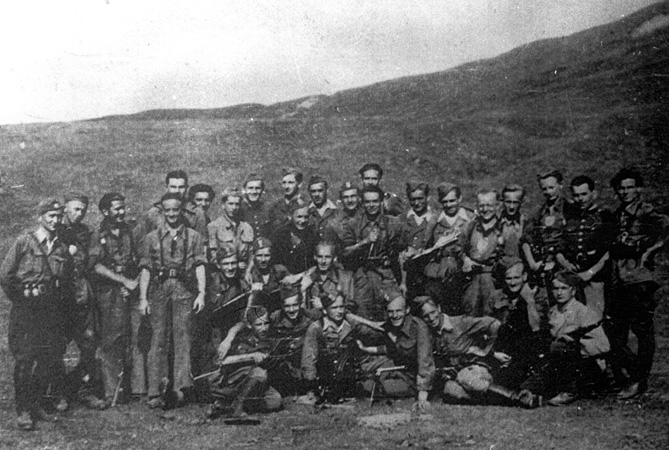
But most notable to today’s story and the theme of this series, there were a group of inmates who had, under the noses of the guards, built a resistance movement. Over the years, the resistance bided its time, shunting children into less-demanding jobs (and taught them skilled trades, to forestall their being shipped to extermination camps), and eventually stealing or otherwise purloining weapons.
And one inmate – Polish engineer Gwidon Damazyn, deported to the camp in 1941 – incredibly managed to build a radio transceiver and a small generator, which were carefully concealed beneath a barracks floor. Using this, the inmates’ resistance committee were able to track the Allies’ progress across Europe, and wait for their moment of liberation.
Touch And Go: As the Americans closed in on Buchenwald and other camps in the west. the Germans got nervous. While the Soviets had liberated several camps in Poland as early as July of 1944, including the Majdanek extermination camp, the fact that the news was filtered through the Soviets – who were often clumsy propagandists – meant the horrific news was taken with a large grain of credulous salt in the West.
The Germans knew it’d be another matter with the Western allies. And so the plan went through – destroy Buchenwald, and its inmates.
Plans started falling into place to evacuate the prisoners via forced march to other camps in the interior (or mass death by starvation and shooting).
But the plans were slowed by the guards’ incipient panic – many checked out and ran before the plans could be carried out – and sabotage by the inmates.
But on the evening of April 10, the inmates figured their window of opportunity was closing. Every day that passed was a day closer to the Nazis pulling the plug on the whole thing. But to rebel without Allies nearby – as earlier inmate rebellions in the Warsaw Ghetto and the extermination camps at Sobibor, Treblinka and Auschwitz had had no choice but to do, in the wilds of rural Poland and long before the tide of war turned – would be suicide. Pointless suicide, with the war clearly nearly over.
So at noon on April 8, 1945, engineer Damazyn and Russian POW Konstantin Leonov took the radio out of hiding, and fired up the transmitter; Damazyn keyed a message in English and German Morse code to any allied units that could hear; Leonov did the same in Russian.
To the Allies. To the army of General Patton. This is the Buchenwald concentration camp. SOS. We request help. They want to evacuate us. The SS wants to destroy us.
The men keyed the messages three times in each language.
Finally – three minutes after the last transmission – an unknown radioman at Patton’s headquarters replied:
KZ Bu. Hold out. Rushing to your aid. Staff of Third Army.
Damazyn reportedly fainted when the reply came through.
The rest of the Buchenwald resistance moved into action. They dug out their stash of weaopns – an incredible 91 rifles and one machine gun – and, three days later on April 11, stormed the guard towers, killing the guards that hadn’t fled.
One prisoner walked into the vacant administrative building, and picked up a ringing telephone. On the other end was a Gestapo officer, asking when they could drop off the truckloads of explosives, to blow up the camp and its inmates.
The prisoner cooly told the Gestapo that the camp had already been blown up.
And that did the trick.
About four hours later, the halftracks of a company of 200 riflemen of the 9th Armored Infantry Battalion, under Captain Fred Keffer, part of Patton’s 6th Armored Division, gingerly entered the camp. That company was the first of a flood of Westerners who’d follow and witness what they discovered with their own eyes. The things they saw are a part of one of the most wrenching public moments of truth in human history.
And the rest is history.
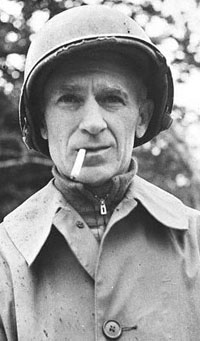
Many other camps were liberated in the month before the war ended; Dachau, Bergen-Belsen, Teresienstadt, Ohrdruf, Nordhausen, and dozens of others. But Buchenwald, along with Dachau, was the first major camp to get the full attention of the western media – including Edward R. Murrow, who produced one of the most immortal news reports in the history of broadcasting:
His report is sonorously grim, and horrific for all Murrow omitted
“I reported what I saw – but only part of it. For most of what I saw, I have no words”.
And yet it had been those same skeletal, starved, half-dead men, the ones Murrow described, who had summoned the energy not only to survive, but – in a miracle of stealth, guile and craft – to kill their tormentors in their hour of liberation.
———-
It was reading the story of the Buchenwald uprising, among the other uprisings, the Warsaw Ghetto and Sobibor and Treblinka and Auschwitz itself, as a high school kid that rocked me back on my heels; this, I thought to myself, is why the people must never be disarmed. This was why our forefathers had the wisdom to recognize our God-given right to armed self-defense; this, and moreso, to prevent it from ever happening again.
And beyond that? When the people are armed, these are the miracles they, humiliated wretches, starved and sick and beaten and fighting against a brutal, well-fed enemy though they may be, can wrench from nowhere.




.jpg "indy")







.jpg/300px-USS_O-10_(SS-71).jpg)