It shows how children in Finland during the Finnish Civil War who became communists and socialists tended to see themselves as, or be, less successful than their fathers, both in occupational and educational terms. In this data set, the pattern became clearer the higher up the educational and occupational scales one went.
Having observed a lot of socialists and other dyspeptic leftists in my time, I don’t think the pattern has changed much in the past 100 years (see: Woody Kane).
Here’s the problem.
“Gen Z” sees itself, statistically, as uniquely burdened by economics, frequently seeing that as the “legacy” of previous generations leaving them nothing.
And this particular failure has many fathers; yes, the educational system that taught them to embrace victimhood; their Millennial siblings and aunts and uncles who set the example of building identities around one’s maladies. And, to be honest, yes – an economy that is currently top-loaded with workers from a couple of very large generations, and a list of other confounding factors – tax rates, zoning laws, the advances in technology that are disrupting traditional job markets – that give the Zoomers some difficulties of their own.
So – does the “socialist loser son” metaphor apply to an entire generation?
Democrats: “Hahaha! Mamdani is mayor and New York hasn’t collapsed yet!”
Normies: “Well, he doesn’t actually get inaugurated for another 7-8 weeks…”
I’m going to start a pool for when Mamdan and his underbosses…er, staffers start complaining that Trump is behind the Mayor’s increasingly obvious failures. Give him a three month honeymoon and some time for reality to sink in.
George Will has deserved plenty of flak over the past 40 years or so.
And he’s caught some for this interview here.
And I think the flakkers got it wrong:
George Will on Zorhan Mamdani: "I want him to win. I think every 20 years or so, we need a conspicuous, confined experiment with socialism so we can crack it up again."
Count the zeros: that’s 90 billion in Pennsylvania…:
Google said it would invest $25 billion in the region in AI and data center infrastructure over the next two years, while investment firm Brookfield said it had signed contracts to provide more than $3 billion of power to Google from two hydroelectric dams on the Susquehanna River in Pennsylvania.
That’s $90 billion, with a “b.” One thing these projects all have in common is that none of them are being built in Minnesota. Instead, this is what we get: from KAAL-TV:
And 33 million in Minnesota:
As KAAL reports, “This new funding is expected to reach 225 new and developing businesses.” That works out to about $147,000 per business. Meanwhile, back in Pennsylvania:
The list of participating CEOs includes leaders from global behemoths like Blackstone, Bridgewater, SoftBank, Amazon Web Services, BlackRock and ExxonMobil and local companies such as the Pittsburgh-based Gecko Robotics, which deploys AI to bolster energy capacity. Gov. Josh Shapiro, a Democrat, will also attend.
Some of this investment would have surely come to Minnesota if not for the many taxes, laws and policies enacted in the past three years to discourage private investment and weaken our electrical grid.
Other than the number of zeros, the big difference is that the big, Pennsylvania number comes from private investors. Ripe marks…er, taxpayers covered it in Minnesota.
So yeah – while I’m not tired of winning at the national level, I’m over it here locally.
Attorney General Keith Ellison’s office recently hosted an all-day continuing legal education program titled, “Price, Access, and Power: Exploring Grocery Costs, Food Access, and Competition.” Several speakers advocated for breaking up grocery retailers and establishing government grocery stores in areas that don’t have them, such as high crime zones and Indian reservations.
A leading candidate for mayor of New York City favors government-operated grocery stores (and you know whatever they get, Minneapolis must have).
The next Democrat crusade is food. They want to take over your grocery store and run it “fairly,” you know, like the Post Office or the DMV.
Thomas Sowell quipped, “Much of the social history of the Western world, over the past three decades, has been a history of replacing what worked with what sounded good.” This sounds like more of that.
I just have one question. After Democrats have made private grocery stores unprofitable and replaced them with government grocery stores, what happens to consumers when AFSCME goes on strike??
Joe Doakes, Wal-Mart Grocery shopper
If government groceries work as well as government schools, we’ll have a raft of remedial programs and consultants and…
We know there’s a battle coming. Congress’s funding resolution runs out March 14. If Trump and Congress don’t reach a deal on a new budget, the government shuts down with all the angst and drama we recall from earlier battles, with all the political risks that have made some Republicans unwilling to fight the battle again. So in the upcoming fight over the budget, what’s our view, the Conservative view?
Personally, I’d like to see something akin to Constitutional government. Article I, Section 8 enumerates the powers given to Congress. Go read it. It’s worth remembering that those are the ONLY powers the Founders wanted Congress to have. To get back to that, we’d have to cut about 80% of the federal government. I concede that’s not realistic in today’s political climate.
What is realistic? How about living within our means? How about balancing income and outgo, revenue and expenditures, same as every family and small business must do? What would it take to get there?
We would have to cut about 2 Trillion dollars of annual spending. Is that possible?
First, let’s remember the last budget was 2019 when Trump was in office. Starting in 2020, Congress ramped up spending to cover the extraordinary costs of fighting a world-ending epidemic of Covid. Leaving aside the possibility that Covid was merely an excuse to promote absentee ballots to steal the election, the spending never stopped. Every year since 2020, Congress passed a continuing resolution which keeps spending the same amount of money as before, plus a little extra for inflation, including the emergency money for Covid and lately, money for Ukraine to the tune of a third-of-a-trillion dollars. Surely some of that can go.
Second, let’s remember that Congress gives money to agencies to promote vague policy objectives like “safe food” or “transportation.” What, specifically, the agency does with that money is up to the bureaucrats. That’s why we get drag queen shows on military bases. Surely some of that can go.
Third, let’s remember that every bureaucrat knows the first rule of budgeting is “spend it or lose it.” They will hide behind a “hostage puppy” to protect the rest of their funding (so named for the famous National Lampoon cover). They will insist that if we cut the funding for drag queens, the puppy will die, the child in Ethiopia will starve, the meat will not be inspected, the Washington Monument will be closed, and Grandma will have to eat dog food to survive. We have heard it all before, surely they can’t expect us to fall for it again?
So what do we do? First, we don’t fall for the hostage puppy, we stand firm. If bureaucrats would rather let the Ethiopian kid starve than give up their drag queen shows, on their heads be it. Second, we empower someone to look through agency budgets to cut out silliness to focus on core functions. Musk’s team is doing that now but it ought to be a full time job for somebody. Third, we insist on real cuts now, not gimmicks like “out year” reductions 10 years down the road. And most importantly, we get tough – we harden our hearts – so we can ride out the wailing and gnashing of teeth, the rending of garments, the accusations of every -ism imaginable.
Why this fight? Why now? Because we’re nearly at the end of the road. We’re short about $2 Trillion a year which we borrowed to get by, but that’s been going on for so long we now owe $36 Trillion dollars which is more than the entire Gross Domestic Product of $26 Trillion. Do you realize what that means? It means we owe more on the national debt than the value of all the goods and services produced in the entire nation.
We pay more for interest on the national debt than the entire defense budget.
By every reasonable measure, the United States is bankrupt.
It comes down to surgical cuts now or default on our debts later and then everything collapses into complete anarchy. Choose wisely. And demand that your elected representatives do the same.
Joe Doakes
One of the upshots of Americans (induced) economic illiteracy is that if they’ve gotten any education in economics at all, it’s been in Keynesianism. As such, they think the natural, effective response to an economic downturn is to pour taxpayer money into the situation.
Which merely stretches out the natural recovery, as it did in 1933, and in 2008.
In an economy with healthy fundamentals, a sharp downturn in a free market serves to kill off a whole lot of bad ideas – unsustainable dotcoms in 2001, subprime mortgages in 2008, and probably a whole lot of bubble-like irrational exuberance over AI today.
Now – are we as a society smart enough to know this? The fact that the Obama regime went back to subsidizing subprime mortgages after the ’08 recession (which their policies dragged out for years) indicates “probably not”.
On the one hand, it’s amusing to see that suddenly “cultural appropriation” – in this case, a bunch of rhythmically-challenged Argentine leftist “Karens”
Until the mid 1940s, Argentina was a wealthy first-world country, with a per capita GDP competitive with the US.
Then, the “Argentine leftists” sold Argentine voters on “Rizz” and “Brat Vibes” with the Perons and a series of socialists, which gutted the economy and led to a series of coups and counter-coups, which also gutted the economy, which led to a war to restore pride that led to humiliating defeat that further gutted not only the economy but national pride, which led to further see-sawing back and forth, finally leading to a complete economic collapse 20 years ago, which has largely been met by further waves of center-to-far-left governments spending money they don’t have (or borrow from the IMF) to keep programs afloat at the expense of, well, everything.
So now the growups, led by Milei, are in charge, and they are showing the world the actual potential of the Argentine economy and people.
So perhaps after his past 70-80 years, it’s best that Argentine leftists stick with club-footed cultural appropriation and dancing with all the rhythmic authority of Swedish disco dancers. They cause less damage (artistic damage notwithstanding).
While this is good – and expected – news, I feel a little cheated.
Walmart, the world’s largest retailer, is rolling back its diversity, equity and inclusion policies, joining a list of major corporations that have been under pressure by conservative activists. The company confirmed on Monday to The Associated Press th… https://t.co/j3oiq5I7VR
Companies are ditching DEI because it’s bad for the bottom line; they can practice equality without flogging “equity”.
But notice how it’s framed: “under pressure from conservative activists”.
I mean, if you’re going to “blame” companies’ rediscovering economic and social sanity on people like me, and least call it “pouncing”, for fox’s sake.
— Frederick Melo, Reporter/Axolotl (@FrederickMelo) August 23, 2024
And Minneapolis:
Building permits have also dropped quite a bit in Minneapolis according to the data. There were 3,000+ total units from 2020-2022, 1,528 in 2023, and 321 so far this year. pic.twitter.com/1PZmKSxlEq
Somehow, though, they’ll be ready to take the entire load (and all those mandated EVs) by 2040?
Reminds me of this classic discourse on solving difficult problems:
I’m going to guess the “miracle”, in this case, will be that everyone involved in setting the policy will be out of government and cashing fat non-profit or lobbying checks by the time energy becomes unaffordable to proles.
Well, at the very least he loved it, back when he was teaching kids “social studies”:
Wow: The Free Beacon dug up this old news article in which Tim Walz defines "communism" as a system in which "everyone is the same and everyone shares." He praised the CCP for providing "food and housing" rations. A real-life communism respecter.https://t.co/OKgcHmGDwUpic.twitter.com/oQUuQN6nG9
There appears to be precious little evidence that he changed anything but his surface decorations (during 12 years as a “moderate” while campaigning in the rural 1st CD).
I always liked the idea of Argentina’s libertarian-conservative President, Javier Milei.
But after seeing this interview, I am actively wondering a bunch of things:
Does the US need to bottom out, as Argentina’s been doing for most of my life – before being ready to, as he says, “put on our long pants?” and embrace the freedom that used to be this nation’s reason to exist?
And where can we get one of him to run for governor in 2026?
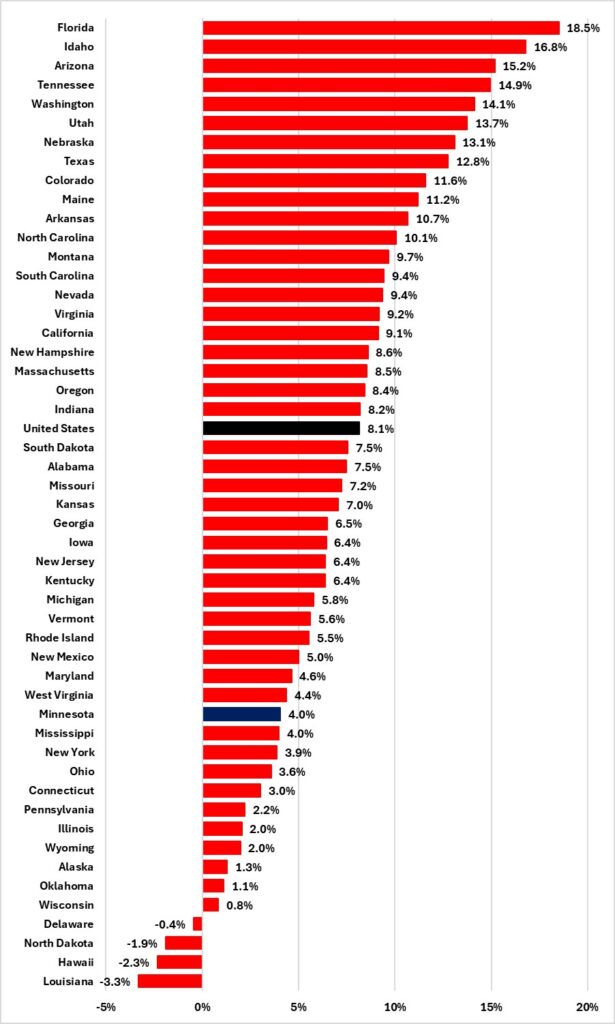
[Since] 2019 — the last pre-COVID year — Minnesota’s real GDP growth has ranked 36th out of the fifty states, coming in at 4.0%, less than half the national rate of 8.1%.
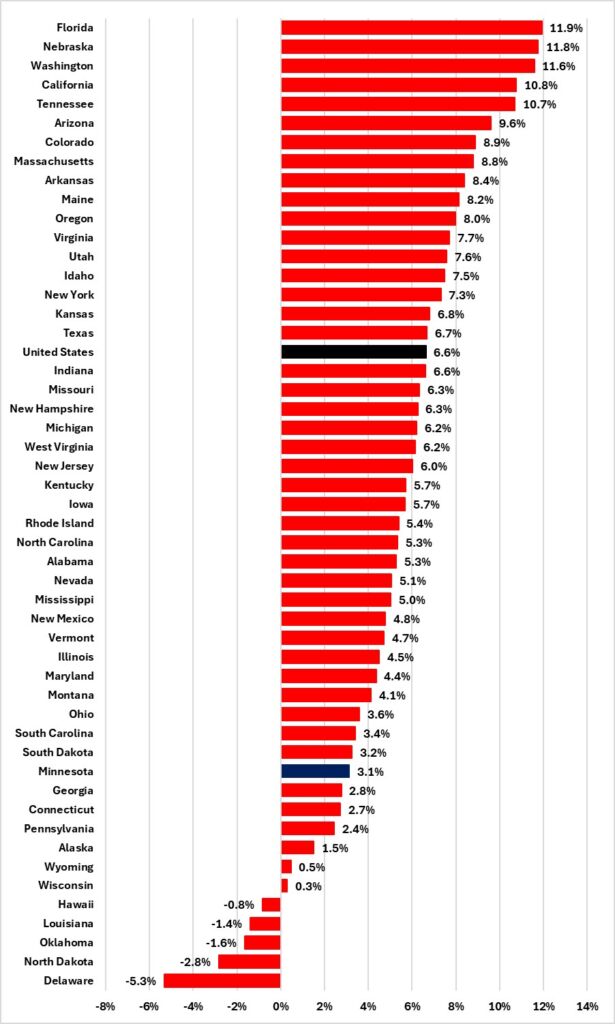
The gross GDP growth comparison is bad. The per capita numbers, even worse:
Minnesota’s recent performance is relatively poor. As Figure 2 shows, between 2019 and 2023, Minnesota’s real, per capita GDP growth ranked 39th out of the fifty states. Again, with growth of 3.1%, Minnesota’s real, per capita GDP growth was less than half that of the United States, 6.6%.
The Walz regime will respond, no doubt, as it always does; with a selfie of “Lieutenant” Governor Flanagan feeding Governor Klink a pronto pup.
Capital, productive citizens and the college kids who are the productive citizens of the future are fleeing. Businesses have been moving their non-white-collar operations out of MInnesota for decades.
You may not win along with it, but that’s your fault for denying reality.
Speaking of denying reality: we warned MInneapolis about the inevitable end results of rent control, high taxes and onerous regulations (aka “everything the Met Council does re housing and transit policy”).
And yet every $%#$%$@# time their chickens come home to roost, they act surprised and angry:
Roughly 7000 apartments in Minneapolis sit empty because landlords refuse to lower their rents to prices our communities can afford.
Thank you @noemptyhomes_mn for hosting a vacancy tour! Landlords letting homes intentionally sit empty during a housing crisis is unacceptable. pic.twitter.com/tlSmWqCF0Q
A significant chunk of the far-left clacque that runs politics in the metro are Marxists, either overtly or under the hood.
And an amazing number of them subscribe to the “Labor Theory of Value” – the idea that labor, as opposed to the other three factors (Capitol, Management and Land) is the dispositive factor of production.
I have been challenging adherents for years – test the theory by taking a group of fast food workers, plopping them on a vacant lot, and seeing if a Hardee’s springs up around them.
It’s an absurd test – exactly the one the theory deserves.
The annual “natural change” in Minnesota’s population (births minus deaths) is not enough to compensate for the number of people moving out of the state. In the little over three years from the last census (April 1, 2020) to July 1, 2023, Minnesota saw a natural increase in residents of about 40,400. These gains were wiped out by the net domestic outmigration (people leaving Minnesota for other states) of 46,000. If not for the net “international migration” of 34,600, Minnesota’s overall population would have fallen over this period.
Young people are leaving the state – which is a huge change from when I first moved here, when the Twin Cities were a destination to a lot of recent grads stepping out into adult live.
But hey, maybe protecting criminals while jamming people into ticky-tack multi unit boxes will fix the problem:
This small apartment building just got built between two single family homes a few blocks from me, it should be legal to do this in every neighborhood. pic.twitter.com/iWwm6XBBpq
The Minneapolis City Council’s vote on minimum wages for independent contractor drivers has driven Lyft out of Minneapolis, and Uber out of both cities.
A friend of the blog emails with an initial reaction very close to my own:
That being said, Uber and Lyft were never affordable here in the Twin Cities like they are elsewhere. That is likely because the market here doesn’t support it like it might in cities with higher density populations.
This article mentions that “Seattle and New York City have passed similar policies in recent years that increase wages for ride-hailing drivers, and Uber and Lyft still operate in those cities.”
Yes, well, the cost to use those services was lower to start with because they actually could make money there. So, they are likely still making money even if passengers are paying more to ride. I would bet those services were barely making it here as it was. It’s not hard to drive most places, it’s not even particularly expensive. The downtowns of MSP are mostly dead anyway, so who is using Lyft and Uber at this stage anymore? As far as I can tell, the council’s stupid ordinance just gave them the excuse to pull out.
That was pretty much what I thought; it was yet another case of a prog city council demanding the world violate the laws of economics to give them what they want.
But wait. There’s more.
It’s the current DFL – so one must always check to see if there’s an ulterior motive involving transferring wealth from taxpayers to the DFL’s non-profit/government complex.
It was still morning in America.Notice, of course, thst it was 34 years ago. Reagan had barely left office. The Berlin Wall had yet to fall, but it was teetering.
But this is a good time to remind d you to be the backlash you want to see.
Imagine this: withdrawing your UBI check that was seamlessly deposited in your public banking account after picking up your kids from awesome public school and then taking green transit back home to your social housing flat
A future we can make happen
— Alex Lee 李天明 (votealexlee.bsky.social) (@alex_lee) March 24, 2023
At first blush, I thought it was parody, and not especially good.
I moved from there to Assumption B – a chuckleheaded sophomore political science major from Austin, or Seattle, or maybe the University of Saint Thomas. It can be hard to tell parody from reality with them, sometimes.
That’s what I thought. Or, let’s be honest, that’s what I hoped. Parody, or young lefty dolt.
But no. Mr. Lee is a California state assemblyman, detailing the world he and most of Big Left hold out as their idea.
No mention of that social credit score you gotta pass to get into your “public bank account”. No mention of who’s going to be teaching at those “awesome public schools” or building, maintaining and operating that “green transit”, or even why either would exist if people get Universal Basic Income. No mention of how in a world without the generation of value and wealth, the “UBI” will pretty much inevitably devolve into ration tickets, to buy…what? Who’s doing the producing, the farming? Robotic cricket mills creating insect paste is about the only logical option.
Modern Monetary Theory says the government can borrow and spend as much as it likes without consequences. If we can afford a gas tax holiday, why not an income tax holiday, a social security tax holiday, a liquor tax holiday?
Or is MMT a lie and the gas tax holiday simply at attempt at buying votes with taxpayer money?
Joe Doakes
It is, of course, a purely academic exercise, like so much of the policy big left has been foisting on this country for the past hundred years and change.
Green, “sustainable” energy policies that make middle class live unsustainable.
Transitioning from houses to apartments, from cars to mass transit.
Moving from meat to vegetables, with maybe some insect thrown in as a treat.
Hyperinflation, which serves mainly to make common savings and investment worthless, but does wonders for the wealth of the plutocrats, “futurists” and pols – who will give up no cars, houses, yachts ,warmth or food.
Seems like the “new world order” looks a lot like the old, pre-1776 world order, doesn’t it?
Victor Davis Hanson – perhaps more optimistic than I feel at the moment – in a piece you should read. Pull quote:
So a reset reckoning is coming—in reaction to the “new orders” championed by Biden and the Davos set.
In the November 2022 midterms, we are likely to see a historic “No!” to the orthodox left-wing agenda that has resulted in unsustainable inflation, unaffordable energy, war, and humiliation abroad, spiraling crime, racial hostility—and arrogant defiance from those who deliberately enacted these disastrous policies.
What will replace it is a return to what until recently had worked.
I hope he’s right. The boundless stupidity of the “send me more stimmies” set – whose votes count just as much as those of smart people – serves as the counterexhibit.