A Meused – Part Two
August 4th, 2021 by First RingerLieutenant Paul Jürgen Vollmer of the 120th Württemberg Landwehr Regiment’s 1st Battalion was hoping that his approaching adjutant was bringing good news that early morning of October 8th, 1918. Most of the reports he had been given had been to retreat as American and French forces slowly but surely carved their way through the Argonne forest, albeit at great cost. The news was indeed good – the Prussian 210th Reserve Infantry Regiment had arrived at the front, perhaps allowing Vollmer to counterattack. The veteran German commander rushed 200 yards to the front to see his reinforcements.
What he saw was only 70 new men sprinkled among his own regiment, all with their weapons on the ground and eating instead. Vollmer vainly attempted to get the men marching; they said they wouldn’t move until they had breakfast. Only the sounds of gunfire and retreating Germans past a nearby hill rallied the 210th to set down their utensils. One of the fleeing Germans shouted “Die Amerikaner Kommen!” as he ran past, prompting a handful of the 210th to throw up their hands in surrender. Vollmer immediately grabbed his pistol and forced a few of them to pick up their weapons. As he did, a few Americans ran at the German position, one of them shooting his M1911 semi-automatic pistol. Vollmer and the rest of his men were sure this had to be the advance scouts of a larger American unit and after Vollmer had emptied his pistol without hitting the lead American – and seeing the American shoot several more of his men – he offered to surrender.
A large American with a red mustache, broad features and a freckled face approached Vollmer and accepted the surrender of the men under Vollmer’s direct command. It was only then that the German realized no American reinforcements were coming. 132 Germans had surrendered to (then) Corporal Alvin York and six other soldiers. The Americans were beginning to learn how to fight and win in the trenches.
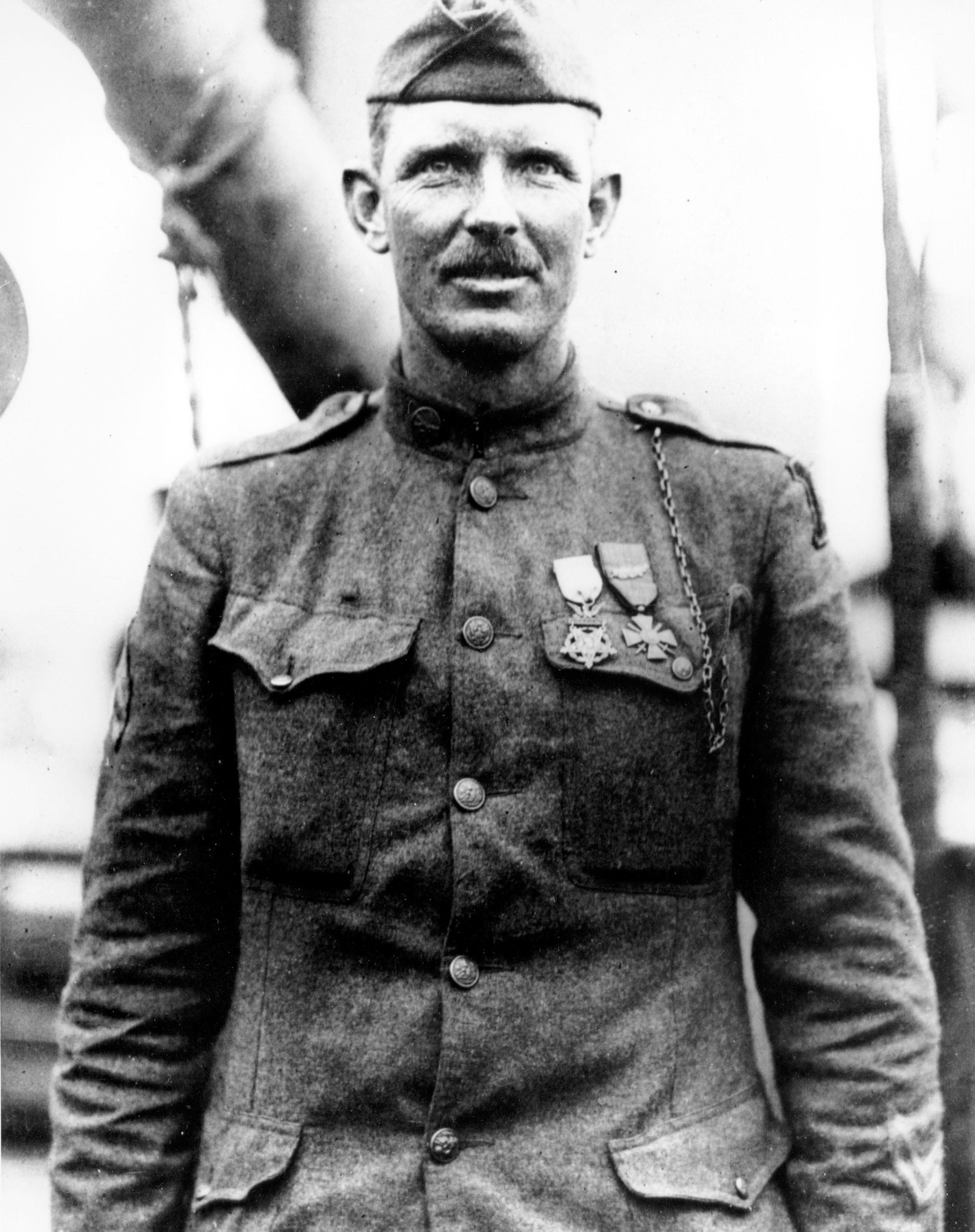
Alvin York – he would become one of the most famous individual soldiers in American history, but his post-WWII politics (he was in favor of attacking the Soviet Union) had him fall from public view
The Americans had been served their first real taste of defeat in the opening days of the Meuse-Argonne Offensive, as the German counterattack badly bloodied the 35th Division to the point of nearly destroying it. Among the many casualties had been Lt. Col. George S. Patton who was personally leading from his 304th Tank Brigade. Patton had been frustrated with the inability of his tanks to advance and rounded up some men in a nearby trench to dig out his stuck tanks. One of the soldiers questioned the wisdom of exposing themselves to German artillery for Patton’s tanks – Patton replied by striking the soldier in the head with a shovel. Even Patton remarked in his diary that he may have killed the man, who did not get up after being struck. Patton’s willingness to expose himself and others to dangerous conditions would catch up with him that very same day, as Patton would be hit in the leg with a machine gun bullet that tore a wound the size of a silver dollar through his buttocks. If not for the courage of his orderly, Private Joe Angelo, Patton would have bled to death near the town of Cheppy in the forests of the Argonne. Read the rest of this entry »