Remorse
Monday, June 13th, 2016Sent by a friend, from a bikepath somewhere in the northwest metro:
If only.
Sent by a friend, from a bikepath somewhere in the northwest metro:
If only.
Another slaughter.
This morning, the media is awash with the usual detritus – liberal hacks demanding gun control, almost visibly re-zipping their pants after getting the news of a new mass shooting (other than the mass shooting that happens every weekend in Chicago, Newark, New Orleans, Detroit, Oakland, Stockton, and North Minneapolis; they’re only concerned about mass shootings of people who look like them)
But if you take anything away from today’s “news” “coverage”, just remember:
It’s the fault of the NRA and “Gun Nuts“.
UPDATE: Maybe the NRA was responsible for this, too?
UPDATE 2: Was Wayne LaPierre behind this?
UPDATE 3: MN’s gun control jackals are having an event at a “pride” event in Golden Valley today. Why do I picture Nancy Nord Bence and Ron Latz doing cartwheels every time news of a shooting comes through?
UPDATE 4: Darn that NRA!~
The similarities between the November attack on the Bataclan nightclub in Paris and that the shooter who appeared to target a gay dance club during the Muslim month of Ramadan “indicates an ISIS-inspired act of terrorism,” Rep. Adam Schiff, D-Burbank, said in a statement.
Intelligence officers are combing through terrorism databases to see if there are any known links between alleged shooter and a terrorist group, Schiff said. Multiple outlets, including CNN, reported Mateen made a 911 call before the attack, pledging allegiance to ISIS.
Whenever an event like this is in the news, I urge people not to believe the news media any more than usual for the first 72 hours; the difference between any ethical reporter and outlet and Katie Couric or Diane Sawyer is one big fat paycheck.
But all the signs so far seem to be pointing toward “terror attack in support of ISIS” rather than “crazy guy with a gun”.
More on Tony Cornish‘s letter to the editor, and Joel Kotkin.
Also – ♫ today’s music list.
Today, the Northern Alliance Radio Network – America’s first grass-roots talk radio show – is on the air! I will be on live from 1-3PM today!
Don’t forget – King Banaian is on from 9-11AM on AM1440, and Brad Carlson has “The Closer” edition of the NARN Sundays from 2-3PM.
So tune in the Northern Alliance! You have so many options:
Join us!
To: Katie Couric and the entire American news media
From: Mitch Berg, peasant
Re: Starting a Conversation
Ms Couric et al,
As we discussed last week, you got busted doing something that, in my day (and yours) would have gotten any young reporter unceremoniously fired; you edited a story specifically to invert the history, record and fact in an interview with a group of Virginia gun rights activists, expressly to mislead the public and drive your chosen narrative.
As Jonah Goldberg notes (in a piece on the left’s new conceit, that any kind of fabulism is OK as long as you’re “starting a conversation”):
“I can understand the objection of people who did have an issue about it,” Couric said. (The “it” here is the deliberate falsifying of the truth). “Having said that, I think we have to focus on the big issue of gun violence. It was my hope that, when I approached this topic, that this would be a conversation-starter.”
Here is the “conversation” about guns – the entire conversation: as law enforcement targets gun criminals, gun crime is dropping, even as the number of guns in the hands of the law-abiding skyrockets. The only exception is in inner cities, where it’s not the law-abiding citizens doing the shooting. Discuss.
There. There’s your conversation.
But I have a better conversation. Let’s talk about when the media became the PR wing of the America left. And that’s fine, to a point – most of us have come to except that, to one point or another, at least considering it part of America’s intellectual background noise.
And that’s fine, to a point – most of us have come to accept that, to one degree or another; it’s part of America’s intellectual background noise.
So let’s “converse” about this:
When Bernie Maddoff sells phony investments, and bilks people of their life’s savings, it’s a huge scandal – justifiably so – and righteous outrage ensues. The entire faith in the investment industry – a vitally important one – took a hit.
When Enron falsifies its records, people like you, the media, jump up-and-down and hoot and holler – and very justifiably so. The lying utterly guts the credibility that was the foundation of that industry. So far so good?
When Wall Street misleads the public, and itself, about what it’s actually investing in, causing a collapse of the entire housing market, that’s a breach of “trust” (or market discipline) that caused huge problems. Ja?
When the police cover up wrongdoing to protect one of their own from the consequences of their wrongdoing, it’s a big story – one that cuts to the foundation of our trust in government, especially law enforcement. Right?
So how is what Katie Couric did any different?
And more importantly, how is the entire news media’s failure (along with their cheerleaders) to rise up and condemn Couric’s perfidy as the blot on whatever trust for the media might still exist any different?
Other than saying you really don’t care anymore?
That is all.
Joe Doakes from Como Park emails:
The Mayflower landed at Plymouth Rock on November 11, 1620.
Four years from this Fall, the United States will celebrate the 400-year anniversary of White People Coming to America.
Who would you rather have as President overseeing that celebration: Donald Trump or Hillary Clinton?
Joe Doakes
And I wonder how many Native Americans are looking at Trump and thinking “he’s got the plan…”?
Preface: I don’t have a whole lot of pet peeves. I really don’t. I’m one of the most easygoing guys you’re likely to ever meet, ever.
But I do have a few:
But the biggest one of all is people who try to tell me what I’m really thinking. People who know what I’m thinking better than I do, and aren’t afraid to tell me not only what it is, but why it’s a horrible thing.
Attention: You – whoever you are – are not qualified to tell me what I’m really thinking.
Ever.
I don’t like it when people do it to me, and I don’t much like people making constant habit of doing it to other people. Telling people what they really think (especially because that’s what your narrative says they’re really thinking) is no less noxious than telling them what they really are.
OK. On to the actual story.
Tony Cornish is a former cop. He’s also been among the most steadfast protectors and advocates for the Right to Keep and Bear Arms in the Minnesota legislature, so he’s one of the good guys.
He’s raised a kerfuffle among the kerfuffling class with a recent op-ed in the Strib that gave some fairly radical advice:
In a letter to the Star Tribune, Cornish lays out rules for interacting with police:
- “Don’t be a thug and lead a life of crime so that you come into frequent contact with police.”
- “Don’t rob people, don’t use or sell drugs, and don’t beat up your significant other.”
- “Don’t hang out on the street after 2 a.m. Go home.”
- “Don’t make furtive movements or keep your hands in your pockets if told to take them out.”
- “Don’t flap your jaws when the police arrive. Don’t disobey the requests of the police at the time. If you think you are wrongfully treated, make the complaint later.”
“Don’t hang out and yell at people after midnight,” he said over the phone. “Don’t be involved in crime. Don’t give police a reason to be there in your face.”
On the one hand, the small-l libertarian in me thinks some of those – especially the whole “don’t be out after 2AM” when you have every legal right to be out at 2AM bit – veer a little close to “if you have nothing to hide, you have nothing to worry about”. And you’d have to be a serious pollyanna to think that some cops don’t abuse the whole “lawful order” thing.
And as far as “making a complaint later”? Yeah, that never works. You’ll be making a complaint about cops, to cops. Or to people whose best interest it is to stay tight with the cops. Either way, what’s the point?
On the other hand? If there’s anyone who’ll make you sympathetic for cops, warts and all, it’s some of their critics:
Cornish says his letter is a response to the activist groups wondering how to reduce the use of police force. He says it’s not complicated, and he provides a list for how to not get shot by police.
In a phone interview with WCCO, Cornish says he’s tired of news stories about police violence in which the *cops* get blamed for using excessive or deadly force against people he calls “thugs.”
“You see all these cop videos where they give order after order, and they just stand there and something bad happens and they wonder why in the world that happened,” he said.
I want to ask “is it too much to wish that everyone in the world, citizens and cops both, had the good common sense not to be idiots and pocket tyrants?”, but if you study any human nature at all, you’ll know it’s really only a rhetorical question.
Speaking of rhetoric (I’m adding emphasis):
[Minneapolis NAACP president Nekima] Levy-Pounds called the letter “racist,” and “intolerable,” with coded language aimed at the African American community.
Coded language.
See my preface above. When someone accuses someone of “coded language”, what they’re saying is “you’re not saying what you think you’re saying, and you’re not thinking what you think you’re thinking. You’re saying and thinking what I say you’re saying and thinking. And boy oh boy, are you an awful person for saying what I’m saying you’re really saying!”
I get it. Political rhetoric ain’t beanbag. But invoking “coded language” is the weasel’s argument.
“He’s drawing upon racial stereotypes that people often use to justify the use of excessive force against African-Americans, even when African-Americans — who are unarmed — are killed by law enforcement,” she said.
While I’m not going to excuse all police shootings – sometimes people make mistakes when the stress is on . And some people, cops included, do just-plain-evil things.
But someone being “unarmed” doesn’t mean they’re not potentially a lethal threat. Every year, among Minnesota’s 90-odd homicides, some portion are people who are beaten to death – including, every year, a couple of “one punch kills”. A big enough guy hitting someone hard enough to break a piece of brain loose, or to drop his head on a curb, can kill them just as dead as any gun will. Circumstances matter.
Levy-Pounds says that’s exactly what the letter is really about — what she calls, “the Jim Crow North.” She’s been leading protests over the over-concentration of police in black neighborhoods, and over-criminalization of African-Americans in Minnesota.
There is certainly a discussion to be had about overcriminalization – and not just of black people in North Minneapolis. There is also a conversation to be had about the collapse of the black family, which is not helping the black community out one little bit.
But the last person who will start that conversation is Levy-Pounds, who (along with many of her followers) will accuse you of “white supremacy” for, for example, disagreeing with her on any point of her agenda. Or for taking the last parking spot. Or for ordering mayo on a sandwich.
If everything is “racist”, then, really, is anything racist?
UPDATE: Commenter Night Writer brought up the good question: Is Chris Rock also a White Supremacist?
If it’s Thursday, a bunch of the usual New Urbanist suspects have ginned up another “study” “proving” the “costs” of “sprawl”.
Combining the the 50 largest metro areas in the U.S., he found, commuters pay more than $107 billion annually, which is about $1,400 per commuter, on average. Those are the dollar costs of the number of additional hours Americans spend traveling to and from work due to sprawling land-use patterns—which, by their methodology, ends up being around 3.9 billion extra hours total, or 50 hours per worker, per year.
To get to those rather staggering numbers, Hertz developed a unique methodology: He took the average commute length, in miles, for America’s 50 largest metros (as determined by the Brookings Institution), and looked at how much shorter those commutes would be if each metro were more compact. He did this by setting different commute benchmarks for clusters of comparably populated metros: six miles for areas with populations of 2.5 million or below, and 7.5 miles for those with more than 2.5 million people. These benchmarks were just below the commute length of the metro with the shortest average commute length in each category, but still 0.5 miles within the real average of the overall category.
He multiplied the difference between the benchmark and each metro’s average commute length by an estimated cost-per-mile for a mid-sized sedan, then doubled that number to represent a daily roundtrip “sprawl tax” per worker, and then multiplied that by the number of workers within a metro region to get the area’s daily “sprawl tax.” After multiplying that by the annual number of workdays, and adding up each metro, he had a rough estimate of how much sprawl costs American commuters every year.
Wow. All of those suburbanites sure must be stupid, moving where life costs more!
Except it doesn’t. City living nickels and dimes you to death; taxes are higher, the cost of non-slum rent or mortgages are higher, city services will get you coming and going, and then there’s the psychic cost of living in a city, almost inevitably run by Democrats with the attendant lousy services, dodgy schools and arrogant, imperious bureaucrats, to say nothing of the psychological cost involved in high-density living; apartment life, mass transit life, and all the other petty miseries of big city life.
No – the free market created the suburbs, as millions of GIs returning from spending the best years of their lives jammed “nuts to butts” on troop trains, troop ships and in barracks sprang for some elbow room for their kids; subsequent generations dabbled in the city, looked around, and skedaddled for the subs when the kids came along. More on that point tomorrow.
As Kevin Williamson points out, the most powerful word in the free market is “no”; three generations of families have said “no” to “high density” life, and “yes” to the burbs.
Representative government requires trust – above all, trust that everyone, king and commoner alike, is equal in the eyes of the law and “the system” – and everyone follows more or less the same rules.
But we’re not doing that anymore. Marc Rich scammed people, and got pardoned for being a Democrat bigwig; Bill Clinton did things that would have gotten a dozen Republicans like Bob Packwood thrown out of Congress; Hillary’s email server issue alone is vastly bigger than the transgression that destroyed David Petraeus’ career (to say nothing of the passive-aggressive institutional arrogance protecting her). And Obama? From nominating a budget chief who owed enough taxes to get a dozen mere middle class mortals jailed, to an Obamacare consultant that tittered like a pajamaboy about lying to the rubes about the costs of the program, to changing the rules and running around the Legislative Branch when Obamacare went up on the rocks, to the lies about the Iran deal, Obama has trampled the rules in a way no citizen ever could ream about.
And as Glenn Reynolds notes in one of his most scathing commentaries ever, that’s a problem, if we care about the kind of society we plan to have:
Being law-abiding for its own sake is a traditional part of bourgeois culture, and our ruling class has lately treated the bourgeoisie with contempt as well. Which raises the risk that this contempt will be returned.
Back in the midst of the financial crisis, Gonzalo Lira looked at how people were responding to the mortgage meltdown and warned of a coming middle-class anarchy. He wrote:
“A terrible sentence, when a law-abiding citizen speaks it: Everybody else is doing it — so why don’t we? … What’s really important is that law-abiding middle-class citizens are deciding that playing by the rules is nothing but a sucker’s game.”
America has been — and, for the moment, remains — a high-trust society. In high-trust societies, people extend trust to strangers and follow rules for the most part even when nobody is watching. In low-trust societies, trust seldom extends beyond close family, and everybody cheats if they can get away with it.
Try life in Romania, Somalia or the Congo if you don’t believe it. Get back to us on that.
High-trust societies are much nicer places to live than low-trust ones. But a fish rots from the head and the head of our society is looking pretty rotten. As Lira says, “I’m likeWayne Gretsky: I don’t concern myself with where the puck has been — I look for where the puck is going to be.” Where will our society be in a decade if these trends continue? And what can we do to ensure that they don’t?
How long can a society stay free without trust? It’s not like trust goes underground or anything…
Detroit Free Press article calls for the murder of Republicans…
…for voting for school choice.
What was it that Gandhi said? First they ignore you, then they mock you, then they attack you. Then you win.
Or, in the case of Detroit, “win”.
Joe Doakes from Como Park emails:
Illegal alien injured on the job, confessed to using false documents to obtain employment, was put on unpaid leave until he could prove he was eligible to work in the United States, sued employer for retaliation, Minnesota Court of Appeals takes his side.
Court says the purpose of federal law is to prevent employers from hiring illegal aliens. But once you’ve illegally hired them, you can’t fire them when you find out about their illegal status – at least, not if you discover it during a worker’s comp case. That would be retaliation against the employee for bringing a worker’s comp claim and retaliation is illegal under state law. So in order to uphold state law, the employer is required to continue to violate federal law by continuing to employ the illegal alien.
That’s idiotic. Putting the illegal alien on unpaid leave isn’t retaliation for the worker’s comp claim – the worker’s comp claim was merely the mechanism by which the employee’s illegal status was brought to light. Stopping the illegal employment merely brings the employer into compliance with federal law where it would have been all along, but for the employee’s illegal use of a fraudulent social security number. And even if putting him on unpaid leave were retaliation for bringing the claim that got his crime discovered, illegal aliens who aren’t supposed to be here shouldn’t be entitled to keep their illegally obtained employment. Firing the employee for perpetrating a fraud and a crime is perfectly sensible as it deters others from committing the same fraud, the same crime.
Of course, this is Democrat-dominated Minnesota where all the jurists are Democrat appointees. The first sentence of the court’s opinion sets the tone: “Appellant Anibal Sanchez immigrated to the United States in December of 1998.”
Immigrated? No, he didn’t. “Immigrated” would entail a legal process of entry and regularization of status. What he did was he sneaked in, he slipped across a porous border, swam the river, hid in a fruit truck, stole someone’s identity and committed fraud. He’s a criminal and should not be allowed to profit from his crime.
The entire case would be moot if the Federal government was performing the core function for which we pay taxes: to defend our borders. If, now that his status and location are known, the feds were to deport him, this entire case would go away, as it should. The time and money spent taking the case to the Court of Appeals is yet another cost of President Obama’s willful disregard of his duty to uphold the law.
Joe Doakes
Laws are for little people.
More later.
Paul Mirengoff at Powerline on former Secret Service agent Gary Byrne’s book on life in the Clinton White House; I’ve added some emphasis:
Secret Service agents are, of course, charged with protecting the physical well-being of the president. Byrne says they had discussions about the possibility of having to protect Bill Clinton from Hillary’s physical attacks. He recalls that the couple had one “violent encounter” the morning of a key presidential address to the nation.
Byrne also remembers arriving for work one day in 1995 following a loud fight between the Clintons the night before. He says the dustup resulted in light blue vase “smashed to bits” and left Bill with a “real, live, put-a-steak-on-it black eye.”
Don’t let anyone tell you that Hillary isn’t a fighter.
Mirengoff also adds, after noting the many, er, social provocations Bill presented her during those years:
For Hillary, her options regarding Bill may have seemed like “fight or flight.” Flight, apparently, was out of the question, given her ambitions.
But if it were the other way around (and the subjects weren’t the Clintons), if a husband found a wife in flagrant delicto and decided to take “direct action” against her? Society has a term for that; “domestic abuser”. It doesn’t matter if one’s wife is sleeping with the entire staff at Jiffy Lube, in your bed, without changing the sheets after; you call a lawyer (and an STD test provider); you don’t hit her.
That there’s a double standard for women is obvious; that there’s a triple standard for Hillary is – assuming the accuracy of Byrne’s account – a new one.
And it should be damning – but for Democrats, it won’t be.
…that the left is trying to get traditional western culture treated as a thoughtcrime, it‘s really not hyperbole:
Kathleen Taylor, a neurologist at Oxford University, said that recent developments suggest that we will soon be able to treat religious fundamentalism and other forms of ideological beliefs potentially harmful to society as a form of mental illness.
Big deal. Breshnev was claiming the same thing 50 years ago.
Bonus: art imitates life! Kathleen Taylor of Oxford:

Suzanna Hamilton in the movie (or was it?) 1984:

Accidental? I think not.
…they really need to get some perspective.
The Philippine president-elect has encouraged the public to help him in his war against crime, urging citizens with guns to shoot and kill drug dealers who resist arrest and fight back in their neighborhoods.
In a nationally televised speech late Saturday, Rodrigo Duterte told a huge crowd in the southern city of Davao that Filipinos who help him battle crime will be rewarded.
“Please feel free to call us, the police, or do it yourself if you have the gun — you have my support,” Duterte said, warning of an extensive illegal drug trade that involves even the country’s police.
If a drug dealer resists arrest or refuses to be brought to a police station and threatens a citizen with a gun or a knife, “you can kill him,” Duterte said. “Shoot him and I’ll give you a medal.”
That’s more than a wall.
This is getting very very close.
Joe Doakes from Como Park emails:
My health insurance company requires me to take an annual health assessment and participate in a well-being program, to get a discount on my co-pay. They are at the forefront of trendiness, of course, and Sitting Is The New Smoking, so getting me up and moving is all the rage. Some thoughts:
We can’t all be rail-splitters. Some jobs require patient, focused, concentrated examination of documents. That’s an activity not well-suited to bouncing on an exercise ball.
Labor-saving devices were invented precisely to avoid having to move, lift, bend or exert physical force over inanimate objects. How far down must civilization devolve to suit the Phy Ed fanatics? Is it enough if I make my wife scrub our clothes by hand in a tub or must she also carry the water in a bucket from Lake Como while I forage for dandelion greens in the park across the street?
Glenn Reynolds, the Instapundit, is fond of saying “I’ll believe it’s a crisis when the people who claim it’s a crisis start acting like it’s a crisis.” That’s a handy way to poke fun at global warming alarmists flying private jets to exclusive conferences. But I can go one better:
“I’ll believe Sitting is the new Smoking when Democrats tax it to fund a stadium.”
Joe Doakes
Look for people with sedentary jobs to get hit with fees via Obamacare.
Today’s jokes are tomorrow’s policy.
Today, on the 72nd anniversary of the D-Day landings, I’m genuinely pessimistic that this nation learned – or can learn – one of the most important lessons of the war.
Indeed, it seems that there are those in our society who really don’t want this country to learn it.
Words like “Fascist” and “Brownshirt” have been overused, mainly but not quite exclusively by the left, over the past 4-5 decades One might even say they’ve been devalued, if you’re conspiracy-minded.
In light of events this past week, they need to be re-valued, and Americans need to get a quick education in political history.
Alliance Für A Better Deutschland: With the collapse of the Weimar Republic, German politics returned to a state that hadn’t been seen since the chaotic late teens and early twenties; political parties retained private groups of thugs to harass, intimidate, and attack political opponents’ demonstrations, meetings and events.
And it wasn’t just eggs and water bottles; in the ’20s, German parties enlisted Freikorps, groups of armed World War I veterans who fought gangland battles and, in some cases, pitched military engagements in the streets of German cities.
The biggest participants were the Communists and and, to a lesser degree, the Socialists on what’s conventionally called “the left”, and their opponents (called “the Right”, although the sought to govern scarcely less as authoritarians and totalitarians than did their opponents), of whom the National Socialists (the Nazis, of course) became the leader.
Like I said, it got bloody . On July 17 1932, “Bloody Sunday”, Communist “direct action” activists attacked a Nazi rally in Altona, Germany, killing 18; revenge and counter-revenge played out across Germany afterwards, as it had before.

Altona in the wake of Bloody Sunday
This was one of many events that framed the Nazis final ascent to control of the country six months later.
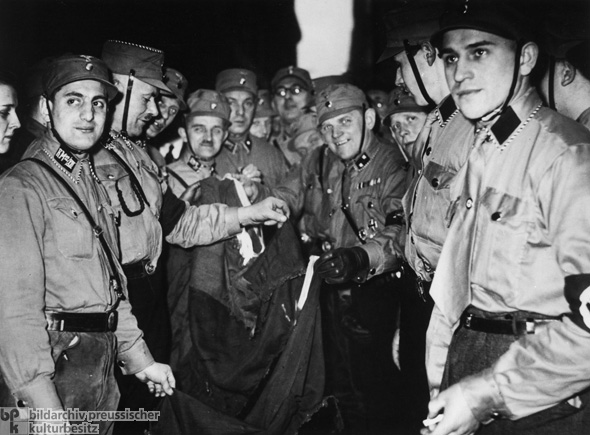
“Brownshirts” – the official name was Sturmabteilung, or “Assault Detachments” – and members of Stahlturm (Steel Helmet, a Nazi veterans group) burn Weimar flags as the Nazis assume control of the Reichstag, or Parliament. The evening, and the coming months, saw more pitched battles in the streets between party thugs, before the government moved on to more decisive means.
Not only have Americans living today never seen such a thing – groups of thugs acting as a direct action wing of political parties – but in fact the little information they have about this is pollyannaish in the extreme. It wasn’t just Germany, it didn’t end 80 years ago, and it can happen here.
In Poland in 1980,

Polish “riot police” – thugs with shields – take down an enemy of the state in 1981.
In Panama in the late eighties,

Manuel Noriega’s “Dignity Battalions” – a make-work program that put thugs to work attacking dissidents and protesters.
in Iran in 2008,

Basiji assaulting Tehran University, putting down the uprising in 2008 (with the tacit support of Barack Obama).
And here in the US, today:

Thugs, likely with the support of liberal plutocrats with deep pockets, attack a Trump rally last week in San Jose. As usual.
There’s precious little difference between the people above and the people below:
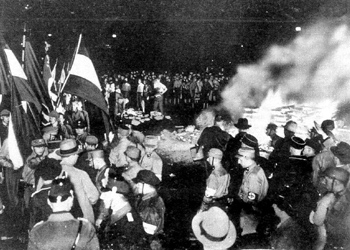
And I don’t know that I trust Americans to know this anymore.
Politics + force = where horrible things come from.
Bing – a search engine I rarely use (mostly out of habit) has this as its cover today – June 6, a rather significant date in world, especially Western, history:

Don’t know your historical geography? It’s Pointe Du Hoc- the German strongpoint overlooking Omaha Beach, captured at immense cost by American Rangers who climbed a sheer cliff under fire 72 years ago today, with 64% casualties in a matter of hours.
Google – which, two weeks ago, honored America-hating radical and Bin Laden supporter Yuri Kochiyama with a Doodle – has this:

Not that Microsoft is a saint in the whole “undercutting America” thing, but it’s getting a little insane.
(Via commenter JustPlainAngry)
Reagan, speaking 32 years ago at Pointe Du Hoc, above Omaha Beach:

“The Rangers looked up and saw the enemy soldiers — the edge of the cliffs shooting down at them with machineguns and throwing grenades.

And the American Rangers began to climb. They shot rope ladders over the face of these cliffs and began to pull themselves up. When one Ranger fell, another would take his place. When one rope was cut, a Ranger would grab another and begin his climb again. They climbed, shot back, and held their footing.

Soon, one by one, the Rangers pulled themselves over the top, and in seizing the firm land at the top of these cliffs, they began to seize back the continent of Europe.
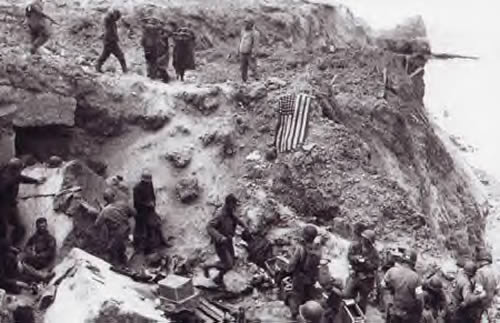
Two hundred and twenty-five came here. After 2 days of fighting, only 90 could still bear arms.
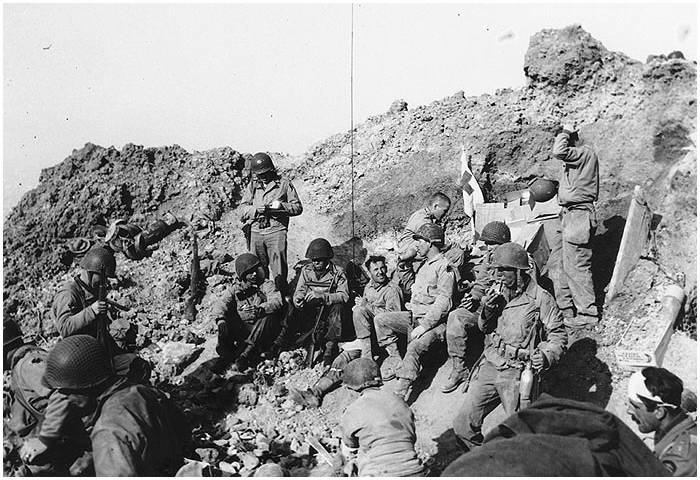
Behind me is a memorial that symbolizes the Ranger daggers that were thrust into the top of these cliffs. And before me are the men who put them there.”

– Ronald Reagan, 1984
Leave. And take your husband.
#ProblemSolved.
Joe Doakes from Como Park emails:
The Mayor of Paris says they can’t have little shanties and camps scattered around, they need one big camp to concentrate the refugees in one place. A concentration camp, lovely idea. But that’s a temporary solution to a temporary problem. Aren’t refugees supposed to go home, eventually? Or is she talking about establishing another permanent refugee problem, like the Palestinians after the Israeli war, and like America without a Southern Border? In that case, shouldn’t we be talking about long-term solutions? The French don’t have a Third Amendment – maybe the government can require citizens to open their homes to immigrants, which would set an international precedent so President Obama could require it here.
Joe Doakes
“Another permanent refugee problem” – the Frogs are still paying for the way they handled refugees from Algeria 50 years ago.
And if it’s good enough for the French, Secretary du Etat Kerry will wanna know more.
Despite rough seas, the HMS Hampshire was making good time on June 5th, 1916. Having left the main British naval base in Scapa Flow, Scotland, the cruiser was easily outrunning its destroyer escort.
With the wound of Jutland fresh in the minds of the admiralty, the HMS Hampshire had been assigned a circuitous route through the Orkney Islands to avoid German U-boats and yet another British naval casualty. Besides, the HMS Hampshire was carrying precious cargo – the Secretary of State for War, Lord Herbert Horatio Kitchener. The man whose image had called millions of Britons to service in the Great War, had seen his political star dim by 1916, as his support of tertiary British fronts and efforts just short of conscription hadn’t produced his promised results. Still, Kitchener maintained some of his pre-war aura as the heroic pragmatist with a golden touch. His dire warnings on British manpower – that the war would be won by the nation capable of finding the “last million men” – had echoed in the halls of power only months earlier.
Kitchener’s mission aboard the HMS Hampshire had him en route to the Russian port of Arkhangelsk, where the Secretary was charged with negotiating yet another agreement for supplies with the Tsar’s failing government. He would never arrive.
At 7pm, an explosion tore through the hull of the HMS Hampshire – the victim of a U-boat placed mine. The ship starting listing immediately, on it’s way to sinking within 15 minutes. As sailors scrambled towards the few lifeboats that were being lowered, a figure caught their eye. Standing calmly on the starboard side of the vessel, casually chatting with fellow officers was the War Secretary himself. It would be the last time anyone would see Lord Kitchener again.
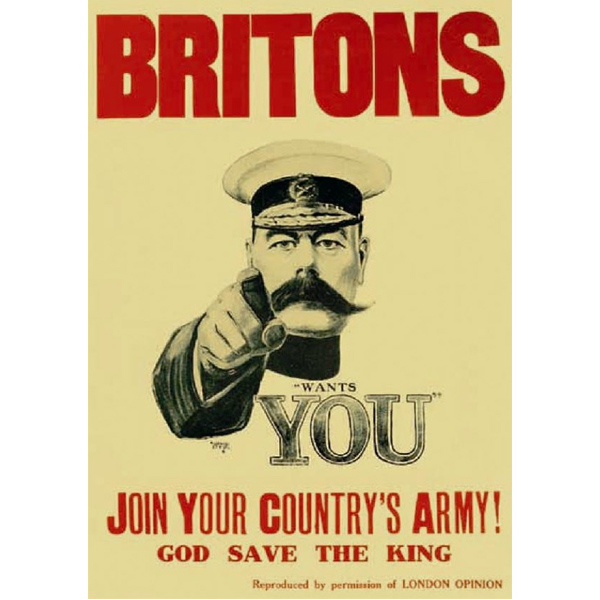
Kitchener the Recruiter – the War Secretary’s call to patriotism swelled the ranks of Britain’s armies (at first)
“We hoped against hope, but no doubt now remains. A great figure gone. The services which he rendered in the early days of the war cannot be forgotten…He made many mistakes. He was not a good Cabinet man. His methods did not suit a democracy. But there he was, towering above the others in character as in inches, by far the most popular man in the country to the end, and a firm rock which stood out amidst the raging tempest.”
–Journalist Charles Repington upon Kitchener’s passing
With the passage of 100 years, the reputation and impact of Herbert Horatio Kitchener is difficult to relay without invoking the comparison to another titan of war-time Britain just a conflict later – Winston Churchill. Like Churchill in World War II, Kitchener was an aging war hero; a walking anachronism that nevertheless personified the English ethos of their eras and inspired a generation’s trust and admiration. Unlike Churchill, Kitchener would never live to see his legacy repaired by victory. (more…)
The days might have been getting longer across Europe in June of 1916, but in the capitals of the Entente, the second summer of war only appeared to be getting darker.
France was bleeding to death in the trenches of Verdun. Italy was reeling from an Austro-Hungarian offensive that threatened their main army at Isonzo. Even the vaunted British Royal Navy had suffered a tactical defeat days earlier at Jutland.
Yet perhaps nowhere did the Entente’s fortunes look worse than in Tsarist Russia. Malnourished, under-trained, and overwhelmed with anti-Tsarist/anti-war propaganda, Nicholas II’s armies (now directly under his command) had suffered devastating blow after blow. After losing nearly five million soldiers by the fall of 1915, the Russians had failed to advance against the Central Powers just months earlier despite an overwhelming advantage in men and material. On June 4th, 1916, they were being asked to assume the offensive once more.
Near the Galician city of Lutsk (now in modern Ukraine), the Russians would yet again attack – only this time without a significant advantage in manpower. Nor would they be aided by a massive artillery barrage. In fact, their commander had specifically requested that artillery not pound the Austro-Hungarian line for days in advance. Even the Stavka, the Russian High Command, saw little chance of success. To them, the offensive was being conducted for political, not military, reasons, in order to shore up Russia’s support of the Chantilly Agreement of inter-Allied coordination.
Within 72 hours of the first shots being fired, the entire complexion of the Great War would change – and Russia would emerge victorious from one of the largest offensives in history.

Gen. Aleksei Brusilov – an under-rated general, Brusilov’s offensive would temporarily change the direction of the entire Great War
After nearly two years of war, the recipe for offensive warfare could have easily been viewed as numbingly rote, if not for the horrible carnage. Lined in trenches, forces would advance in human-wave conditions after a sustained barrage of heavy artillery. Gaines and losses could be measured in meters, not miles, and even in victory, the cost in lives were high. (more…)
Glenn Reyholds’ piece on the fish of society rotting from the head.
Powerline’s videos of the fascist mobs in San Jose.
And, of course, ♫ today’s NARN playlist.


You are currently browsing the Shot in the Dark weblog archives for June, 2016.


