Archive for July, 2011

Fractured Aphorisms

Friday, July 22nd, 2011

If you give a man a fish, you feed him for a day.

If you teach a man to fish, you feed him for life.

If you toss a man a can of bait worms and tell him to figure it out, you feed him for life and give him the problem-solving skills he needs to truly succeed. Or feed him for a day.  One or the other.

Chanting Points Memo: “Reagan Was A Moderate!”

Friday, July 22nd, 2011

Two things that make me think “something’s just not right here”, and warrant some investigation:

  • Teenagers asking “so, are you going out Friday night?”
  • Liberals citing Reagan.

Lately, there’s been a plague of liberals, in print/blogs/on Twitter, stating without fear of contradiction (because, if you’re a Twin Cities liberal, nobody has ever contradicted you) that “today’s conservatives would never nominate Ronald Reagan”.

It’s a claim based on two dubious premises:

  • Reagan wasn’t especially tough on abortion
  • The claim that “Reagan raised taxes”

We dispensed with the second point last week; leaving aside that the “Reagan tax hikes” were entirely a result of Reagan keeping up his end of a bargain and the Democrats welching on theirs, Reagan’s tax cuts were 50% bigger, in terms of percent of the budget, than his tax hikes.  The fact that the hikes accounted for in absolute dollars than in percentage in fact proves the conservative point; Reagan’s tax cuts contributed to the economy reversing from the Carter era malaise to the mid-eighties boom – a boom that could absorb some hikes (whether it was a wise idea or not) – certainly better than it could have in the middle of a recession.

As to the abortion issue – that, again,shows how little the left understands the Tea Party.  Abortion is a key conservative issue – but when the economy is in the tank, it’s not the most important issue facing the Chief Executive.  As Reagan allocated political capital among his key priorities – the economy, defeating communism – his metaphorical “abortion” budget was squeezed down to “using the bully pulpit against the practice”…

…which is pretty much where today’s Tea Partiers are with the issue; mortally opposed, but focused on other things at the moment.

The lesson?  As your liberal friends start parrotting these memes, by all means set ’em straight.

(Closed-circuit to liberal commenters: Go ahead.  Point out that “Reagan legalized abortion in California”.  I dare you)

Whilst Pondering

Friday, July 22nd, 2011

Summer – like any season, really – brings back a flood of memories.

When I think hot, dry humidity, I remember most summers in North Dakota, and being dry and hot – at baseball practice, caddying for my dad, sitting in the stands at baseball games craving a Coke.

But when it’s hot and the humidity is up near tropical, I think first about my time at International Music Camp, back in seventh and eighth grade.

Both years, I won scholarships to go to the camp, up at the International Peace Gardens, on the boarder between North Dakota and Manitoba.  The camp – about half a mile on the US side – was a summer program teaching a variety of genres of music in one-week chunks throughout the summer.  Being a cello player, I went for Orchestra both years.  It was a high-speed week, spent intensely rehearsing for a concert held every Sunday.  There were two full-group rehearsals a day, along with sectionals and small-group clinics to try to improve on the instrument.

Not being an especially good cellist at the time, I was in the “lower” of the two orchestras.  Both orchestras had guest directors brought in from hither and yon.  Both years, my director was a guy named Howard Leyton-Brown, an Australian native who was a violinist and conductor at the Regina Conservatory in Saskatechewan.  On the program, I noted that among his credits he listed having flown in the Royal Air Force during the war.

One day after a late rehearsal, I approached him, and asked what kind of plane he’d flown.  “I flew a Handley-Page Halifax”, he replied, seeming astonished that a bobble-headed American junior-high kid would ask – and moreso that I knew what he was talking about.

And apropos not much, it occurred to me to test the miracle of Google, and see if I could find any reference to Mr. Leyton-Brown.

And I did – in this case, an audio account of his time as a bomber pilot.

A Busy Day

Thursday, July 21st, 2011

It’s been an incredibly busy day.  Two, really – yesterday and today are both shaping up to be bruisers.

So if it’s all the same to everyone, posting is likely going to be very light today.

So much to talk about tomorrow – unpacking the shutdown settlement, especially.  Stay tuned!

The Conductor

Wednesday, July 20th, 2011

It was a chilly, rainy night in March of 1983.

I had a horrible cold – but no matter.  I was standing on a riser in a tumbledown little church in Pendelton, Oregon, with 69 or so other college kids.   And by this time in the tour, cooped up on buses for day after day, most of us were sharing colds.

I had just finished a brisk walk up to the stage for the second of three sets of the evening’s performance.  It was our seventh or eighth concert in as many days and nights.

The house lights dimmed, and the stage lights came up, blotting the audience from view.  We focused on the conductor’s podium, where presently a guy in a formal tuxedo climbed onstage.  His cheeks were puffy and red, but his eyes were clear and sharp- “fierce”, I’d say, if the fashion industry hadn’t so devalued the word.  He smiled -partly greeting, partly saying “can you keep up with me?”

He lifted his hands, and brought them down.  And we sang – launching a capella and without fanfare directly into “Have Ye Not Known/Ye Shall Have A Song”, two movements from Randall Thompson’s oratorio “The Peaceable Kingdom”, a piece lifted from Isaiah 40:21:

Have ye not known?

Have ye  not heard?

Hath it not been told you from the beginning?

Hath it not been told from the foundations of the earth?

(Here’s a high school choir doing it).

I sang my part, nestled into the midst of seventy college kids who, for a couple of hours, felt like a single organism that was much better than the sum of our parts, as the conductor – listed on the program as Dr. Richard Harrison Smith, and never anything else – wrung the last little bit of execution, passion and yes, joy out of the evening.

And while I didn’t dare make any facial expression, or even take my eyes off the podium, I smiled inside.

———-

I remember “Dick” Smith, as my dad always called him, probably about the same time he moved to Jamestown, ND.  He and his family – his daughters, Kristin and twins Karen and Kathryn, all about my age – came by our old house in Jamestown, along with his wife, June, who’d just been hired as Dad’s colleague in the Jamestown High School English department.   Smith had just taken over the music department at Jamestown College, after earning a PhD in music and an MA in Biochemistry.  I wonder sometimes if academia today would know what to make of a guy like him.

But  I was years away from knowing any of this.  I was six years old.

Now, if there’s one thing people in small college towns appreciate – or appreciated, in those days before the internet and ubiquitous TV and travel – it’s whatever scraps of culture they can get.  And Dr. Smith quickly started producing some amazing culture.

In town, we noticed this mostly from the college’s annual Christmas concerts – which morphed from sleepy little affairs into six-night runs with choir, concert band and elaborate production, lighting and sets, that drew packed houses and TV coverage.  Packing into the college’s Voorhees Chapel, to the smell of pine boughs and scorched gels, is one of the most potent memories of Christmas as a child.

Unbeknownst to me – because I was years away from caring about such things – Dr. Smith, starting in 1969, built the JC Concert Choir into one of the premiere college choirs in the United States.  One review from the seventies – and no, I couldn’t find it if I tried – placed JC’s choir among the top three small-college choirs in the US – in the same league as the legendary St. Olaf Choir, in the (choir geeks will know this) Christenson era.    In 1972, the Jamestown College choir became the first American choir to sing at Notre Dame Cathedral in Paris.  In 1978, he engineered a visit to Jamestown by the Saint Paul Chamber Orchestra to accompany the choir in a concert – the highlight being Bach’s Magnificat, if I recall correctly.

You might be thinking “this is a small college choir that fought above its weight”.  It was – but that wasn’t even the amazing part.

The amazing thing about Smith’s choirs throughout their history?  While the other top-flight choirs, like St. Olaf’s, were made up of music majors and especially voice students, Jamestown just wasn’t that big.  In the seventies, the place had 600-700 students, maybe a couple of dozen of them music majors.   Over ten percent of the entire campus sang in the choir – less than a quarter of them music majors.  Imagine a tournament-grade basketball team that was 3/4 walk-ons from the Theatre and English and Nursing departments; it was the same basic idea.

And so year after year, for almost thirty years, Dr. Smith created top-flight college choirs from virtually nothing.

———-

When I graduated from high school.  I didn’t know what I wanted to be – but I knew I wasn’t going to major in music.  Still, I’d had some musical training – none of it involving singing.  I played guitar, cello and harmonica, and sang in a garage band, in a voice that was best suited for shouting out Rolling Stones and Clash covers.  That was all the singing I ever wanted to do.  I was an instrumental guy, and proud of it.

I’d known Dr. Smith and his family for about 12 years by that point – his wife June was my high school creative writing teacher; Karen and Kathryn were classmates at Jamestown High School (Kristin graduated a year before me).

My mom worked as a secretary in the nursing department at Jamestown College, which would net me a nice tuition break, so in the spring of 1981 I enrolled at “JC”.  Of course, every penny counted, so I seized on every scholarship I could find.  I got a grant to work as a stagehand in the theatre department and, late in the game, was recuited to play cello in a chamber group, and percussion and guitar for the concert and stage bands.

One day, my senior year of high school, I went up to the campus to close the deal on the music grants.  I walked into Voorhees Chapel for a chat with Linda Banister – and my spidey-sense started buzzing away; something seemed just a little bit off.

There were always plenty of women auditioning. then and always, for 35 or so soprano and alto slots – but in a school like JC, finding guys who could fill the choir’s 35-odd tenor, baritone and bass seats was a constant battle.   Smith, and his assistant, Linda Banister (a voice teacher who did double duty as the choir’s manager) prowled the campus, looking for guys who sounded like they that could be jury-rigged into instruments in a choral ensemble; they filtered through high school transcripts looking for hidden semesters in “choir”; they staked out football practice, listened in the cafeteria, and even (rumor had it) prowled the dorms, listening for guys singing in the shower.  The men’s sections – the tenors, baritones and basses – were a grab bag of football players, computer-department night owls, and just-plain guys who could, to their amazement, carry a tune, most of them with absolutely no musical training whatsoever, most of them enticed by having $1,000 a year  lopped off their $4,000+ tuition; such was the choir’s clout.

Anyway – after a too-short discussion that ended up with grant in hand way too quickly, Mrs. Bannister said “Now you need to go down to Dr. Smith’s office”.

“Er – to  talk about the instrumental stuff?” I asked, warily.

“Yeah, sure!” she said, fast enough to make me even more suspicious.

I walked downstairs into Dr Smith’s office, in the basement of the chapel.  He was already sitting behind the piano.

“Hi, Mitch”, he said – first names were fine, he’d known me forever.  Then, before I could respond, “OK, say “Mi Mi Mi” and sing along with this pattern”.  He pounded out a “C” arpeggio.

Nonplussed, I sang.  “Mi Mi Mi Mi Mi Miiii”, up and down the “C” chord..

He walked me through several more patterns, up and down the keyboard, figuring out my range.  “You have a good ear; we can work on the technique.  You’re a baritone!”

And that was pretty much it. I’d been shanghaied. Linda Banister was waiting outside the office.  “We really need you in the choir…” she said.  Being a small-town Scandinavian, my need to please others would have kicked in even had she not told me that singing in the choir was worth a $500/semester off tuition.

And so I joined the choir.  I’d be in the baritone section come the fall.

———-

Or would eventually, anyway.  Because before we could start choir that fall, Dr. Smith – and all of us, really – had a wrenching, existential diversion.

On top of being a great musician, arranger and director, Dr. Smith was also a footnote in medical history.  A very important one, actually.

In the summer of 1981 – the hot, arid three months before I started college – word made the rounds in Jametown that Dr. Smith had gotten very, very sick at the family’s lake cabin in northern Minnesota.  A very rare congenital enzyme deficiency had caused his body to start to destroy its own liver. He was in a coma and near death at a hospital in Fargo.

And at the metaphorical and literal last moment, the decision was made to fly him to the University of Pittsburgh for a medical procedure that teetered on the brink of science fiction at the time; a liver transplant.

At the time, liver transplants were almost as rare and difficult as heart transplants; the liver may be, after the brain, the body’s most complex organ.  The biochemical system that the liver manages is as convoluted as anything in nature.  And it showed, medically speaking; at the time, nobody had lived even a year with a transplanted liver.   The body inevitably rejected the tranplant, as if it was a bacterium or a splinter.  The way it was designed to do.

Liver transplants were so experimental, insurance companies were still years away from covering them.  The key to success – and it was an immutably elusive key, up until the spring of 1981 – was to quell the body’s immune system’s natural response of sequestering it off and killing it.

Shortly before Dr. Smith flew to Pittsburgh that summer, a new drug – Ciclosporin – was introduced.  Refined from a fungus found in the soil somewhere in Norway, it’d been used in treating a variety of other diseases – but it was going to be tried for the first time to prevent organ transplant rejection.

And Dr. Smith was Patient 1.

It wasn’t just the drugs.  Some of the very equipment and techniques that make the miracle of liver transplantation seem so commonplace today were invented as a result of Dr. Smith’s surgery.  From a Pitt Medical School publication on the transplant:

Fortunately, a donor liver became available. As Dr. Starzl  (the surgeon who pioneered the technique of the live transplant at Pittsburgh) pointed out in his book, the surgical team fought throughout the night to control the bleeding during Richard’s surgery.

Anesthesiologist Dr. John Sassano administered two hundred units of blood, pumping each unit by hand. When Richard survived the operation and Dr. Sassano’s job was done, Dr. Starzl reported that Dr. Sassano broke down and cried out of relief and exhaustion. Dr. Sassano went on to invent the Sassano pump, a rapid blood infusion system still in use today.

The surgery lasted 14 hours.

That I’m writing this article today should tell you it worked – all the pieces; the surgical skill, the brand-new, untried techniques and drugs, and of course the liver, from a 19 year old auto-crash victim.

———-

It was a solid semester before he came back to the choir.  The cocktail of drugs he’d been given, including the Ciclosporin, had played hob with his system.  He’d gained a lot of weight; his formerly hawk-like face was swollen.  And he could only direct for short periods, sitting on a stool, before he’d get tired and hand the choir over to his backup director.

But once he started, you could tell he lived for it.

And during the second semester of my freshman year, Dr. Smith gradually worked his way back onto the podium; by the time of our spring tour, he managed to direct (as I recall) every concert at every stop on the way.

I’ll let that sink in; in eight months, he went from comatose to doing his job (albeit not at 100% just yet), with a stop along the way for a gruelling, body-crushing, experimental, never-before-seen bit of beyond-major surgery.

We knew it was remarkable back then; having nobody to compare it with – every previous liver transplantee had died in that kind of time – none of us knew how remarkable it was.

———-

If my experience with high school music groups – orchestra, stage band and the like – was like Pop Warner football, choir with Dr. Smith was like suddenly walking into Vince Lombardi’s training camp.

Smith was a renowned arranger and conductor; his specialty, oddly, was traditional Afro-American spirituals; a Canadian paper once praised the Choir for being the most authentic-sounding choir of rural white kids they’d ever heard.

Beyond that?  The programming every year was very non-trivial.  It spun between spirituals, modern/avant garde choral work, and the classics of the repertoire – and by classics, I mean the hard stuff.

The highlights?  Every couple years, Smith would break out a new Bach double-choir motet.  My freshman and senior years, it was Motet Number 7, Singet Dem Herrn.  15 minutes and 90-odd pages long, it required the choir to split into two separate choirs, singing Bach’s, well, baroque composition in eight part counterpoint and harmony.

All from memory.  Smith allowed no sheet music on stage, and the choir was rarely accompanied (as in, one song that I recall in four years).

Go ahead and try it in the shower when you get a moment.

That took discipline.  All practices were mandatory; you got two excused absences a semester, and even those were discouraged (I don’t remember taking more than one in four years).  The rules on stage were simple and uncompromising; once Smith stepped on the podium, in concert or late “concert rules” rehearsals, you didn’t look away, at the risk of a ferocious tongue-lashing during the break.   If you got sick on stage, you did not walk offstage; you sat down on the riser and your neighors closed ranks around you.  If your nose itched?  You let it itch; scratching your nose, or anywhere on your face, inevitably looked like picking your nose.  You didn’t question Dr. Smith on any of this.

The choir practiced four days a week, over the noon hour, to accomodate everything from after-school football practices to afternoon chem labs.   You earned that $500 tuition break every semester.

To turn that throng of misplaced football players, dorm-potatoes, waylaid cross-country runners, computer science majors and the odd musician into a solid choir, Dr. Smith smacked us with something that most of us had never encountered before, and only rarely since; an uncompromising demand for excellence.

Excellence is a word that’s gotten abused horribly in the past thirty years.  A wave of business books perverted the terms into meaning  “a businessperson given him/herself license to be a prick”.

The word itself never came up, that I recall, in four years with the choir.  But it’s what Dr. Smith demanded of all of us.  Whoever we were – wrestlers, pre-meds and vocal majors alike, we had it in us to do great music – Bach, or spirituals, or avant-garde adaptations of Shaker liturgical chants alike – the way God himself intended them to be done.   Perfectly.

And he didn’t tolerate half-assed choral music, and he never cared who knew about it.  Botching an entrance or scooping a high note could earn a section, or a singer, a chewing out in front of the whole choir – and the privilege of singing the part yourself, solo, over and over, as the whole choir sat and listened, until you hit it perfectly.

So we – wrestlers, pre-meds, dorm-potatoes, phy-ed majors and voice majors alike – developed a keen ear and a sense of precision that was new to many of us, even if we had some experience with formal classical music.

He had no time for contemporary music.  At least once a year, he’d get frustrated by some bit of pop-music frippery, and bellow “Do you think people will be listening to the Beatles in 300 years?”  I was often tempted to respond “if there’s an entire academic discipline dedicated to seeing that it does, then sure!”, but he didn’t sound like he wanted a discussion…

Even other choirs felt his wrath.  A choir from another college performed an assembly before practice one day.  A “contemporary” choir with microphones and a PA and accompanists and a repertoire of mediocre modern choral music, they were also – by Smiths’ standards – unforgivably sloppy in their intonation and timing; they were also slow in tearing down their elaborate stage rig as we filed onto the stage for our noon practice, and milled about in the chapel, chattering away, getting ready to go back on the road themselves.   We saw Smith, fuming at both the late start and the sloppy music, and took our places quickly and silently as the other choir milled about the place.  We just knew this could not end well.

When Smith finally got the podium, his face was red with rage.  He uncorked one of his vein-bulging jeremiads about the worthlessness of sloppy, inferior music – he referred to “this…crap!”, as I recall, which shut the other choir’s kids up but fast.  He ran down their intonation, their entrances, their reliance on a mixer to balance their – shudder – microphones, their sloppiness – and compared some of our own traits with what he’d just endured.  Then he had us ready up one of our own songs, in a tone that strongly hinted we’d best blow the doors off that tune.

And we did, as I remember.  We didn’t dare not stick the landing.  We sang the hell out of that tune, as the other choir silently shrank from the sanctuary.

We were the JC Choir, dammit.

Of course, Smith’s temper was tempered with a sense of humor and an approachable affability.  Sitting in his office, or on the choir tour bus, or during a good rehearsal, he was quick with a joke – usually awful – and a smile and a word of encouragement.

And it’s worth noting that his relentless pursuit of precision and perfection didn’t cover every aspect of his life.  Navigation was a good example.  While on tour, generations of choir members learned the meaning of the”Smith block”, as in Smith ordering the bus to a stop in some strange city in a place where the bus had a hard time finding our destination, and telling everyone to grab their luggage and walk the rest of the way.  “It’s just a block”, he’d assure us.  I remember walking a solid mile through the streets of Basel, Switzerland, enjoying a warm, humid evening on a “Smith Block”-long stroll, lugging my backpack and my concert clothes down the Totengässlein, feeling like a tourist.

Smith could laugh about that along with everyone. There’s a reason generations of students loved the guy.

———-

Jamestown College was a small, private, Presbyterian-affiliated school – a sister-school to Macalester, although without the political implications, in those days.  And like a lot of small colleges, Jamestown went through some lean years.  Part of it was the farm crisis; lots of small colleges failed back then.  Part of it was bad management; the college had a really, really bad president for a few years there.

But the school excelled at three things; athletics (the football, basketball and track programs were at the top of the NAIA Division III standings), nursing (one of the best nursing programs in the US at the time) and the Choir.

And so part of the job was to go out and raise money for the college.  For four years, our “spring break”, every year, was to go out on the road on a national concert tour.  Tours involved long days on the bus, taking off often before the sun rose, arriving in a new town late in the afternoon, setting up our risers and lights (that was my gig – I was a stagehand, after all), suiting up for the gig, taking a deep breath, singing a couple of hours, and then going home with a host family from the church that was sponsoring the gig.  We got a free day at the apex of the tour.

As of spring break my Freshman year, the biggest city I’d ever seen was Fargo.  Tour changed all that; each stop in turn, St. Cloud and Madison and Toledo and Philadelphia and Washington DC, was the biggest city I’d ever been in.
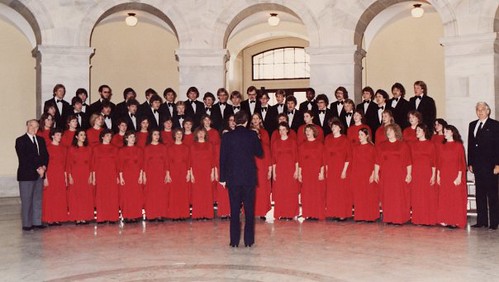
That’s us. We’re in the rotunda of the Cannon Congressional Office building, March 17, 1982. I’m in the third row, eighth from the left. Dr. Smith is conducting, natch. On the right is former longtime ND Congressman Mark Andrews.  Photo courtesy Katie Hall, who is “Doctor Hall” to you now, and lives in Fargo and is, I think, the far right girl in the front row.  

And in the three following spring breaks – Seattle, Denver and Phoenix, and every mid-sized city and tiny town with a Presbyterian church with a music-loving minister in between, we toured, ten or twelve days at a shot.

And the biggest tour of all – our trip to Europe, in 1983.  We sang in little villages – Uitgeest, Holland, and Altenburg, in Schwabia – and major cities, Basel and Mainz and Köln and, biggest and best of all, Notre Dame de Paris.

Where we stood, in a church nearly a thousand years old, built long before sound amplification systems were built, in a building designed to magnify the unamplified human voice, and sang at a mass stuffed with Bishops and Archbishops and other popery, and sang to packed houses, and thought for a brief moment that God had taught Man to build buildings like this just for choirs like ours.

And a few days later, in Köln, where we sang a duo concert with the Köln Polezeichor, the city’s police choir, themselves an excellent group.  After the show, the cops hauled us all and sundry to a bar frequented by Köln’s finest; our money was no good there.  And it was noted that Dr. Smith’s liver was now of legal age.  And as we partied into the wee hours, Dr. Smith had a beer (with his doctor’s blessing; Dr. Smith was as diligent with the gift that had saved his life as any human could be).  And as we walked – I was probably staggering more than walking – back to our hotel through the streets of Köln in the weeest hours of the morning, I looked at Dr. Smith.

And he was as happy as happy gets.  This – making music, and getting flocks of kids to make it, and make it very very well, was his happy place.

———-

The last time I sang with Dr. Smith was October, 1994.  The college threw a 25 year “All Choir Reunion”.  About 400 people – around half of the people who’d ever sung in the choir in those 25 years – came back to Jamestown to sing a concert with Dr. Smith.  It was such a huge event, we used the Jamestown Civic Center.   And people from my class in the choir sat with and sang among several generations of choir “kids”; some who’d been there at the beginning in 1968, and who’d been at that first “gig” at Notre Dame in 1972; some who’d just graduated, and hadn’t yet assimilated all that Dr. Smith had taught them.

And it was a joyous night – one of a short list of highlights of my own life.  I was able to tell Dr. Smith pretty much exactly that; how glad I was to make the reunion, and the impact he’d had on my life.  Of course, I had to stand in a long line; I think everyone was there to say the same thing, one way or the other.

Smith retired in 1998.  The travelling was harming his health.

———-

The average liver transplant holds out for ten years.  Partly it’s due to the whole “new liver” thing – all the risks attendant to transplants.

Partly it’s the drugs that bombard the body to make the transplant happen at all.  They take a terrible toll on the rest of the body – especially the kidneys.   Dr. Smith got a kidney transplant in 1997 – from his wife June, incredibly.   It bought time – and bought it for a guy who’d already run the account a lot further than anyone could reasonably expect.

Dr. Smith was the longest-lived person in the world with a liver transplant.  His transplant surgeon, Thomas Starzl, “the father of the transplant”, featured Smith prominently in his book Puzzle People – his own look into medical miracles and the people who live them.   Starzl chalked Smith’s survival up to many things – an iron-clad constitution, rock-solid faith, and a mission in life among other things- but at the end of the day, even that most gifted of medical scientists had little empirical idea how Smith had so clobbered the odds.

But the run ran out.  Dr. Smith died late last night; the kidneys, and the liver which had served two owners so well, finally gave out.  He was 73.  He leaves behind June – one of my favorite high school teachers – and his daughters, Kristin (a reproductive endocrinologist on Long Island), and the twins, Kathryn and Karen, my high school classmates, a teacher and nurse respectively, both in the Fargo area.  They’ll miss him of course – and so will the thousand or so of us whose lives he touched as director, and the hundreds of thousands who watched and listened to his work over the decades.

Yeah, me too.

Rest in peace, Dr. Smith.  And from the bottom of my heart, my condolences to June, Kristin, Kathryn and Karen.

———-

Back on that rainy night in Pendelton in 1983, the song turned into its homestretch; from the bombastic “Have Ye Not Known!” of the fanfare, through a turbulent middle section that seemed to represent the nagging doubts of the faithful, into the ending, the best part; a three-minute canon, simply repeating one line, over and over again:

And gladness of heart…

The line never changed – starting with the sopranos, quietly hinting it; the altos came in, more broadly, then the tenors, and then the basses, in a broad, three-minute crescendo.  But the song modulated through a circle of…fourths?  Fifths?  Mostly?  Big, broad, beefy resolutions  that just as suddenly modified into another set of fourths, like doubts resolving into answers and then into more doubts with even bigger, more satisfying answers.

I looked at Dr. Smith, on the podium, growing more animated as the volume swelled- because looking at the director, and nothing else in the world, what you did in the choir.  But as the song swelled, the diffusion from the stage lights seemed to me to form a corona of refracted light around the Conductor; maybe it was a trick of the light, or maybe it was my eyes getting every-so-watery from the sheer sonic glory of it all.  And as his arms thrashed at the air, wrenching more sound, more passion, more joy from the moment, Dr. Smith looked ecstatic; the song and the choir were like a natural phenomenon, like he was playing a pipe organ whose pump was driven by a hurricane, like he’d wrapped his arms around a tornado with a “speed” button that only he could control.

Like God Himself could hear his choir, so he’d better keep us on our A game.

And I stood in the middle of that swirl of spine-tingling modulating fourths and fifths and ricocheting parts and,  for one shiver-up-the-spine moment, felt as close to transcending the here and now as I ever had, or have, in my life.

And I think Dr. Smith did, too.

It may have been a first for me.

Dr. Smith?  With all the choirs of farm kids and wrestlers and business majors that he wrangled into musicians?  He was a regular there.

Aiming Low

Wednesday, July 20th, 2011

The Twin Cities’ lefty sorosphere is all atwitter over the latest results from the Wisconsin recall primaries (and one actual election).

Eric “Big” Pusey at Minnesota “Progressive” Project tweetched:

Eric Pusey – The results from the 1st round of recall elections in #WI are in http://ow.ly/5IX81 Doesn’t look good for teabaggers #1U #stribpol

What happened was that the Republicans who entered the Democrat primary races…got beaten.  In Democrat primaries.

That’s not exactly Man Bites Dog.  More like dog sniffs dog.

And the other big news – the one actual election – went…well, about as expected.  From Kos:

Today, incumbent Democratic Senator Dave Hansen thoroughly crushed his Republican opponent in the first of the recall elections pitting a Democrat against a Republican. Hansen retains his seat and the FitzWalkerstan cult leaders in Madison are feeling the heat.

They’re “feeling the heat” over…the Dems holding a seat.  In Green Bay – which isn’t much less Democrat than Saint Paul.  By the same margin, or slightly less, than he won in 2008 (look up Senate District 30).

If this is the big tonic for the lefty troops the day after their defeat in Minnesota, it’s a pretty warm, weak one so far.

The Settlement

Wednesday, July 20th, 2011

The Legislature and the Governor passed a budget last night.

Downsides

The K12 Budget Shift:  The budget “borrows”  money from the next year’s K12 budget.  It’s just plain bad policy – but such was the price of “compromise”.   Naturally, the GOP’s good faith is met by DFL perfidy; though they and the governor demanded, indeed whined about “compromise”, now that the deal is signed the DFL (and their de-facto management company, “Alliance For A Better Minnesota”) is trying to spin it, hoping people don’t notice the fact that the shift is smaller than the one in Governor Dayton’s original budget.

Having To Listen To Thissen And Bakk: Paul Thissen’s sound bite, from the floor overnight, claimed that the GOP was “leaving four billion dollars in debt for future generation”.  Is there any way someone can glitter this hamster?   Money that was requested as part of the bureaucracy’s forecast, that is not spent, is not a debt.

Wading Out Of The Swamp Of DFL Chanting Points; From Blois Olson’s Morning Take, the DFL has marshalled its chanting points:

  • “This is the most reckless and irresponsible budget in state history.  This is a beg, borrow and steal budget that just kicks the can down the road and leaves our children billions of dollars in debt”  Sounds like Algore is writing for them today.  This is what you get for “compromising” with the DFL.  All the more reason to get out and win this next election in a big way.  I’m feeling better about that today.
  • “Rather than asking millionaires to pay their fair share of taxes, Republicans are instead choosing to borrow billions of dollars from our schools while leaving our children and grandchildren billions of dollars in debt”.   For a few months.  And hey, I’m fine with never doing that again.  Since it was a key part of Dayton’s budget, that’s another “compromise” that needs to be reached.
  • “Republicans can no longer claim to be the party of fiscal responsibility”  The DFL is trying to  make people think “raising taxes in the middle of the recession so that the machinery of government can stay fat and happy” is “responsble”.  It’s a crime against the language.
  • “This budget spends billions of dollars we don’t have, and simply puts the state’s bills on a credit card”.  Yep.  One that has to be paid off early next year.   Not a great idea, but survivable.
  • “I’m disappointed that Republican’s refusal to compromise resulted in such a fiscally irresponsible budget solution, but I respect Gov. Dayton for doing everything in his power to end this shutdown and get Minnesotans back to work” Five will get you ten Dayton’s a one-term governor.
  • ‘Unfortunately, we will be paying for the Republicans’ beg, borrow, and steal budget for decades to come.”  But I’m guessing we’ll be as short as specifics on that as we were on specifics for Dayton’s “budgets”.

Upsides

Reforms: King Banaian’s Sunset Commission made it into the final cut.   The commission – which will shut down government agencies that have outlived their usefulness (or, initially, never had any) is now law.

News on other reforms later today and/or tomorrow.

The Tax Conveyor Belt Is Closed: The DFL banked on being able to browbeat the GOP into keeping “Business as Usual”.   The idea that government must be kept fat and happy at all costs, no matter how the rest of us are doing, was finally blunted.  Not defeated – it would have been better to have gotten a $32 billion budget with no shifting and no borrowing from the Tobacco blackmail fund – but blunted.  The bureaucracy had best learn that the DFL’s browbeating is obsolete.

The HHS Budget Elevator Is Closed:  Health and Human Services spending has had one of the most corrosive features in state politics; an automatic increase in funding.  If anyone suggested reducing the increase, the DFL immediately trotted out single mothers and homeless people to attack the “decrease”, which was in fact merely a smaller increase than the automatic increase formula.  That automatic increase has been repealed.

Outstate Gets It: The metro base that put Dayton in office is in full dudgeon – what else?   But Governor Dayton’s abrupt switch on the budget last week shows, I think, that outstate, even key DFL constituencies were un-thrilled with the DFL’s case.   While some DFLers are saying this shutdown will lead to a return of the Legislature to DFL control, I’m thinking it’ll be neutral at worst and – given that redistricting will favor the GOP as well – maybe a slight gain.  To sum it up – it was the people who voted for Dayton who for the most part even noticed the shutdown.   At worst, they will vote even more vigorously DFL in the next elections.

In Need Of ‘Splainin’

Wednesday, July 20th, 2011

I have a question for the media types in the audience.

But first, an homage to the best wife of the day, Yesterday edition:  Wendi Murdoch, who clocked dipsh*t Brit “comedian” Robert “Glittery Pony” Erickson “Jonnie Marbles” after his asinine shaving-cream pie attack on Rupert Murdoch:

Punch happens at about the :34 mark.

Kudos.

Now – let’s be clear on the fact that Britiish tabloid-style “journalism” is unacceptable. Of course, nobody’s come up with any evidence that any of Murdoch’s American properties have done any of the same kind of hacking – indeed, due to technical and procedural differences in the way British and US telcos handle cell phone security, it’d be more difficult, albeit not impossible, to hack into American cell phones.

But let’s talk ideology.

When someone points to, say, a very liberal person, family or group owning or publishing a newspaper – think the Sulzbergers at the NYTimes, or Joel Kramer at the Strib – newsies always say “No! No no no! There is a rigid dividing line between the newsroom and the business!”

But with Murdoch – let me try to keep this straight – the front office has intimate control over everything going on in the newsroom?

Just curious.

“The Way We Used To Do Things In Minnesota”

Tuesday, July 19th, 2011

The Twin Cities media have largely been dutiful stenographers during the shutdown, carrying the DFL’s message pretty much verbatim while gundecking the GOP pretty consistently.

Let’s let all that slide for the moment.  We’ll come back to it, naturally.

But let’s talk for a moment about the “Old” Twin Cities media’s moldiest meme; that there was once a time when the parties just got along, and agreed to do “what was best for Minnesota”.

It’s baked wind, of course; to the extent things ever worked that way, it’s because the MNGOP used to be both extremely moderate, in the Rockefeller/Stassen mold, and also very weak, especially after Watergate.  So when the Twin Cities Old Media says “they just got along and did what was best for Minnesota”, what they mean was “they shut up and passed a “progresssive”, tax and spend agenda without a whole lot of muss and fuss”.

So let’s accept them at their word for a moment.  Let’s say that they, the old-school, dead-tree media (I’m looking at you, Lori Sturdevant and Doug Grow and Rachel Stassen-Berger) really do believe in that myth, and really think it led to “good government”.

So how does the behavior of Senate Minority (aaah) leader Tom Bakk and House Minority leader Paul Thissen fit into that meme?

The GOP and Governor Dayton had reportedly reached an agreement on June 30 – the day before the shutdown.  The shutdown that had the Twin Cities media wetting its collective pants was minutes away from being averted.  Governor Dayton had agreed to drop tax increases – any of them – from the agreement.

Problem solved?

Until Bakk and Thissen entered the picture – as related by Gary Gross at LFR, with emphasis added?

[State GOP deputy chair Michael] Brodkorb said he could confirm that Sen. Bakk and Rep. Thissen were in the room when Speaker Zellers and Leader Koch returned to say that they’d accept Gov. Dayton’s offer. At that time, Gov. Dayton said that he’d changed his mind and that tax increases had to be part of the final solution.

It’s important to remember that Speaker Zellers and Sen. Koch returned only 45 minutes after Gov. Dayton’s initial offer. The only thing that’d changed was that Sen. Bakk and Rep. Thissen weren’t in the room when Gov. Dayton made his initial offer but they were there when he’d reversed himself.

Let’s make this perfectly clear; it appears that Bakk and Thissen, after spending the entire session lighting farts in their offices (*), coming out periodically to wag their fingers on Almanac and heckle the GOP’s various plans to their various stenographers the media, did exactly one substantive thing during the entire session; scupper a settlement two weeks ago.

It’s pretty clear that they believe they could play the shutdown for their political benefit in 2012, and get that benefit on the back of state employees, contractors, the service-using public, and those that depend on the state  for whatever reason.

Brodkorb then said that “The only thing that Sen. Bakk and Rep. Thissen had done since the start of the session was cash paychecks. You can quote me on that.”

With pleasure.

When will the Minnesota Media raise its collective eyebrow over Bakk, Thissen and the DFL’s exploitation of this shutdown?  The region’s conservative blogs have done everything but engrave the story on the back of a “Society of Professional Journalists” award and walk the story into the Strib’s office.

It’s clear at this point that if Thissen and Bakk could tie defective strollers to the GOP, they’d both roll prams full of infants down the Capitol steps, with cameras rolling and the Strib’s editorial staff pondering with mock sincerity  “why don’t the Republicans just compromise and fight Big Stroller?”

(*) Figuratively and rhetorically speaking.  I have no idea if anyone lit a single fart, and if they did, it’s none of my business.  It’s a figure of speech implying sloth, negligence, and passive-aggressive idleness, and as such it’s richly, if disgustingly, appropriate.

It Was Twenty Years Ago Today, Part CXXVII

Tuesday, July 19th, 2011

It was Friday, July 19, 1991.

A few weeks back, Joe Hanson had tipped me off that KSTP-AM was looking for a new “Executive Producer” – sort of a Program Director, but less power.

That night, I wrote a resume.  It took some stretching; the sum total of my experience was…

  • A year and change at KEYJ/KQDJ back in high school.  A great learning experience, to be sure – I reported news, did sports, and wrote and cut commercials as well as spinning records – but it was a year and change of part-time work.
  • A summer at KDAK in Carrington, ND as a full-time jock, play by play guy, and the station’s main commercial production guy.
  • Another couple of years part-timing at KQDJ in college.
  • My year and change at KSTP-AM, producing Don Vogel and Geoff Charles and doing my weekend graveyard show.
  • The year and a half watching the needle bob at K-63 and answering phones and running the occasional board at KDWB.

I guess my talent as a writer didn’t start with my blog.  I came indoors from some yard work to a message on the answering machine (!) from Ginny Morris, asking for a call back about perhaps talking about the executive producer gig.

I called back, and got through to her secretary.  She wondered if I could come in to the station on Monday.

I sure could.

I hung up, and frantically scoured the house for my suit.  I reassembled it, and whispered a silent prayer than it hadn’t shrunk.

And then I started trying to figure out how to convince Ginny Morris I was management material.

———-

Does it seem to you that this opportunity dropped into my life suddenly, even abruptly?

It seemed that way to me too, at the time.  I heard about the opening one day in June.  I sent the resume the next day.  And while I kept my fingers crossed, that’s about all the thought I put into it.  I’d pretty much given up on anything happening.

Until it did.

And They’re Back

Tuesday, July 19th, 2011

At around 11ish, Governor Dayton launched the special session to bang out a new state budget.

The good news;  while the MNGOP, and conservatives, are unhappy with the fact that we’re “borrowing” $1.4 Billion more than the state has in revenues (from the next biennium’s revenues), the compromise seems likely to include some things that were “hills to die on”, rhetorically speaking, for conservatives.

The big ones, for me and many other conservatives: Zero Based Budgeting and King Banaian’s Sunset Commissions; some sort of move toward Voter ID would be great as well.

It’s high time you called your legislators – both GOP and, if you live in a swing-y district, the DFL ones as well.  They need to know where the people stand; goodness knows the Unions will have their people lighting up the switchboards.

Swag

Tuesday, July 19th, 2011

Joe Doakes of Como Park writes about the bonding bill that is one of Mark Dayton’s demands to end his shutdown.

It’s infuriating.

Naturally, the Star Trib editors praise the bonding bill, saying “Not all government borrowing is created equal.”

They’re exactly correct, of course. Sometimes government borrows money to build unnecessary buildings that benefit a tiny few; sometimes it borrows money to build public improvements that benefit hundreds of thousands. This bonding bill is almost entirely the former.

This bill is not slated to pay for a Vikings stadium – sorry, Zigi.

But some of the spending is almost as misguided:

New buildings at the U of M and St. Cloud State. Should have come from the school budget via capital funding or alumni fundraising, like any private school would have to do, not a separate state-wide funded bonding bill.

Civic center upgrades to Rochester, St. Cloud and Mankato. These are local projects to benefit local communities – they should raise the money locally, not by a state-wide funded bonding bill.

And this part:

Development of more mass transit corridors in the Twin Cities. “Corridors” reads LIGHT RAIL which benefits (if anybody), local residents, not state-wide population and therefore should be funded locally (or not at all).

And there you go.

Why shouldn’t these things be decided, and paid for, locally rather than by state and metro-wide planning bodies?

Here’s the only line in the article with which I agree:

Bonding is an appropriate and desirable practice when it allows for investment in the infrastructure and amenities that will pay economic dividends in the long run. But it’s a travesty when it’s used for short-term consumption and leaves the future bereft.

True; sadly, the editors cannot distinguish between adding lanes to 35W versus adding The Mark Dayton Wing to the Mankato Civic Center.

Is this bonding bill enough of a stinker to scuttle the budget deal? No, probably not. It’s as infuriating to see the Governor hold up the entire state for pure pork as to see the GOP go along with it. But the enemy of good is perfect, and although this deal isn’t perfect, it’s good enough for now.

Joe Doakes

Como Park

It may well be good enough – depending on the reforms that get through the process.  Reportedly, Zero-Based Budgeting and the Sunset Commission are on the bubble – which, beyond any set of financial figures, are the big goals of this legislature for conservatives.

Making It Up As He Goes Along

Tuesday, July 19th, 2011

100% of sitting presidents seem to have a problem with making stuff up as he goes along.  Last week, he claimed 80% of Americans support tax hikes – which would seem to be an epic turnaround in eight months, if it were true.

If it were true:

Where is he getting this 80% figure? How about “out of his hind end.” Gallup doesn’t back him up. Neither does Rasmussen. Gallup gets you closest, but you have do get a little creative with the numbers and even it shows that 50% would prefer a deal with no “revenues” at all (Ras shows 55% on that side).

Obama’s just scattin’ and be-boppin’ and makin’ stuff up.

Where is Snopes?  Politicfact?  All of our legions of journalistic “fact-checkers?”

Kosciuszko

Tuesday, July 19th, 2011

I’ll grant you that Peter Garrett’s preening gets obnoxious at times. His far far far left politcs, ditto.

But I just love listening to the way all the many, many moving parts go together in this song without squeezing out all the raw power of the song.

Because anyone can do “angry” (and every Twin Cities leftyblogger does “smug). But musicianship? Like being able to sing in four parts competently as you play a song with that many consecutive changes (because this is no three-chord blues song)?

Sorry. I was just in the mood.

This Explains So Much

Tuesday, July 19th, 2011

What was Keith Olberman doing all those months?

Real Hope

Monday, July 18th, 2011

Ever since I was a kid – hell, ever since I was a liberal – I remember Republicans running for Congress (among other offices) promising to “do something” about the deficit. 

And “nothing” usually ended up being the “something” they did, because our budget situation has not only not improved, it’s gotten worse.

And over the decades, we conservatives – as opposed to Republicans – dreamed about Republicans, or conservatives really, who’d put principle ahead of political expediency.

And according to that conservative tool the NYTimes, we may just finally have them:

“Re-election is the farthest thing from my mind,” said Representative Tom Reed, a freshman Republican from upstate New York. “Like many of my colleagues in the freshman class, I came down here to get our fiscal house in order and take care of the threat to national security that we see in the federal debt. We came here not to have long careers. We came here to do something. We don’t care about re-election.”

The Times – committed as they are to the David Brooks school of “conservatism” – is cautious…:

It is not clear how genuine or widespread that sentiment is in Congress, but regardless, it has upended what President Obama said on Friday had been a “difficult but routine process” in past years.

…but notes a key factor in the evolution of the GOP; it’s become a conservative party with a mission. 

The sheer size of the debt and its rapid growth in recent years have emboldened fiscal conservatives in the House, prompting some of them to pledge not to vote for a higher debt ceiling even if a compromise can be reached before Aug. 2, when the Treasury Department says it will hit the $14.3 trillion debt cap and run out of borrowing authority.

And that’s what’s really got the Democrats scared.

Chanting Points Memo: “Taxes Don’t Hurt Business!”

Monday, July 18th, 2011

Remember last year?  While New York and California, where noted conservative tools Andrew Cuomo and Jerry Brown instituted sweeping tax cuts and austere budgets, opted to cut budgets and rein in spending, Illinois swam against the tide, jacked up business taxes in a downright Daytonian orgy of confiscation.

So how’s that going for ’em?

How do you think?

Doug Whitley, president and CEO of the Illinois Chamber of Commerce, says his members aren’t happy with the state’s approach toward businesses.

“Big-name, household-name companies that are long-standing Illinois businesses have begun to rattle the cage and say, you know, this isn’t the best environment,” he says.

The tax hikes were serious and, for companies rattled by the simultaneous collapses of the housing and credit markets, a kick in the corporate teeth:

Construction equipment manufacturer Caterpillar was among the first corporate giants to complain in January, when Illinois raised the corporate income tax rate from 4.8 percent to 7 percent.

The latest complaint comes from an iconic company along the Chicago River: CME Group, the parent of the Chicago Mercantile Exchange and Chicago Board of Trade.

CME Group Chairman Terry Duffy spoke to NBC about moving the company’s headquarters out of Illinois.

“All our transactions are taxed in Illinois. Whether they’re coming from Mumbai or some other part of the world, they’re being taxed here in Illinois. That’s absolutely unjust,” he said.

Retail giant Sears is also making noise about leaving, as the tax incentives that kept the company in Illinois almost 25 years ago are set to expire.

And that’s the big companies, like Sears; in Minnesota terms, companies like USBank, that squeedged tax concessions out of the city to stay in Saint Paul while smaller companies decamped en masse for Eagan, Woodbury and Minnetonka.

Some suggest the big-name companies are just posturing to get larger tax breaks, a strategy some smaller employers complain they can’t use.

“There are 372,000 companies operating in Illinois. We cannot afford to give hundred-million-dollar deals to all those companies; it’s inefficient and impractical. What we really need to do is talk about creating a level playing field environment that makes Illinois a magnet,” Whitley says.

The “we can’t give everyone a hundred-million-dollar break” bit is just a dumb strawman – but it leads you to the “level playing field”; cut taxes, and make them low, but fair, across the board.

Y’know – the way Minnesota’s also aren’t.

Mark Yer Scorecards

Monday, July 18th, 2011

As we kick off the special session sometime this week, probably, Gary Gross at LFR tallies up winners and losers from the regular session.

Business?  They get a draw:

Minnesota businesses still pay too high an income tax but at least it isn’t getting worse. With this settled for at least another 2 years, businesses can breath a sigh of relief.

Gary counts coup for the legislative freshmen, and a few upperclasspeople who just plain got the message:

Steve Gottwalt and Dave Thompson emerged as the next generation of GOP leaders thanks to Sen. Thompson’s stout-hearted defense of conservative principles and Rep. Gottwalt’s seizing the moment to push Gov. Dayton into settling the shutdown. These gentlemen deserve high praise for being great spokesters/legislators for conservative principles.

King Banaian and Keith Downey are winners because they stood their ground on important reforms to state government’s makeup and King’s priority-based budgeting reform of the budgeting process. These gentlemen have proposed legislation that would change how government operates and how it spends money. These aren’t tiny considerations.

I’m looking – and I’m saying this out of hope as much as expectation – to the Freshmen to take great advantage of the out-year session.  I think by the time this budget deal is done, the GOP stock is going to be a strong “buy and hold”.  Yes, I’m biased; with good reason, I think.

And I’m with Gary here:

Speaker Zellers and Leader Koch deserve credit for keep the troops unified. It wasn’t difficult picturing scenarios where moderates could abandon the GOP on this or that vote. That they didn’t is a testimony to their whip operations and their leadership.

Koch and Zellers were at the business end of a regional media that, when they could be bothered to report at all, were hostile to the point of scandalousness, but for the fact that that same media also decides on what is or is not a “scandal” outside the wonk class.  And Gary’s right; they held the caucus together.  To be fair to previous GOP leaders, more of this class was in St. Paul on a mission than some of the previous classes.  To be realistic, pressure is pressure.

The biggest loser was Gov. Dayton. He lost on his signature issue. Initially, Gov. Dayton wanted to raise taxes on the rich. After getting defeated on that, he tried settling for shaking down whoever he could shake down. Both attempts were defeated.

That’s the crux, so far, as we head into the special session; while the GOP didn’t get a perfect 100 – I’d say 75 – an honest appraisal of Dayton as of last Friday had to say “20” to you.

You know the DFL is reeling; it was the height of cynicism to see the DFL’s minions in the media demanding compromise on Wednesday, and on Friday saying that the GOP giving the governor his putative spending figure was “borrow-and-spend”.

Further proof that “compromising” with the DFL is always a lousy idea.

http://www.letfreedomringblog.com/?p=10789

I Heard It On The NARN

Saturday, July 16th, 2011

We talked with Tammy Nerby about the “Comedy For Grayson” event, tomorrow. Here’s the info.

Also, if people can’t come to the comedy show, they can send a check here:

Grayson Barry Benefit
Castle Rock Bank
Box 9
Farmington MN 55204

Live!

Saturday, July 16th, 2011

Today, the Northern Alliance Radio Network brings you the best in Minnesota conservatism from 9AM-3PM, live from the Ramsey County Fair!

  • Ed and I – The Headliners – will be on from 1-3PM Central.
  • Brad Carlson is off on assignment.  The Minnesota Voters Alliance will be in from 3-5!
  • The King Banaian Show! – King is onAM1570, Business Radio for the Twin Cities!  Join him from 9-11!

(All times Central)

So tune in to all six hours of the Northern Alliance Radio Network, the Twin Cities’ media’s sole guardians of sanity. You have so many options:

  • AM1280 in the Metro
  • streaming at AM1280’s Website,
  • On Twitter (the Volume 2 show will use hashtag #narn2)
  • UStream video and chat (at HotAir.com or at UStream).
  • Podcast at Townhall, usually by Monday
  • Good ol’ telephone – 651-289-4488!
  • And make sure you fan us on our new Facebook page!

Join us!

(Title courtesy Mick and Joe)

Shutdownapacalypse: Lessons Learned

Friday, July 15th, 2011

The budget deal’s not done yet; it remains to see if the July 14 compromise will get through the special session that, we are told, is upcoming.

But I’ll suggest that we can learn the following lessons so far:

You Can Never “Compromise” With The DFL: Remember three days ago?  When the leftybloggers and the media (pardon the redundancy) were on demanding “compromise?”  How “Governor Dayton has already compromised, so the MNGOP needs to”, even though the GOP caucus had already gone four billion hard dollars above their original hard goal, and Dayton’s “compromise” was a couple billion in vapor money that exists, in government terms, only on paper.   Still – “compromise” was the word.  “Everyone needs to grow up and learn to compromise” was the chanting point for weeks.

And now that Dayton accepted the deal, what are the leftyblogbuildup saying?

“It’s teh GOP’s budjet!”

In dealing with the DFL, you have to remember that they will do their best to use everything you say or do against you in the court of public opinion.  It is a fact that while they own the governor’s office, we have to compromise some.

That just means we have to extend our control of the House and Senate to be able to override his vetoes next election – which is a tough goal, but doable, especially given the demographic collapse of the state’s DFL strongholds – and, most importantly, winning the Governorship and the state offices back in 2014.  The DFL only compromises for two reasons; when they can turn it against the GOP, or when they have no other choice short of being crushed.

The goal?  Give them no choice other than being crushed.  We’ll work on that at the polls.

This Is Not Your Father’s MNGOP:  The GOP of 20 years ago would have caved in weeks ago, to avoid being called nasty names.  The GOP of 20 years ago didn’t have the stomach for a serious fight, and even if they did, they were largely a “moderate” party, not a conservative one.

Someone tell Arne Carlson; that GOP is dead and gone, forever and ever, and I’ll whiz on its grave.

This year, the GOP majority was new; there were more Republican freshmen in the Senate than there had been GOP senators in the previous session.  And they stood against the usual array of obstacles – the Strib, WCCO, the unions, the bureaucracy, all of Alita Messinger’s and the Rockefeller family’s millions in smear money – and, unlike the GOP of 1990, hung on.

The unspoken hope; that the GOP will take the experience to heart in the next session; knowing that all of the unions’ screeching and all of “Alliance For A Better Minnesota’s” smearing and all of Mark Dayton’s phumphering and all of the Star-Tribune’s dutiful, slanted stenography aren’t going to hurt them.  Next time, when they need to get tough with the DFL minority, they’ll have been through the worst the DFL has to offer, and they’ll stick to their guns.

Our Education System Needs Work: I was listening to “Davis and Emmer” this morning, on the lesser talk station.  They had just finished an interview with MNGOP Deputy Chair Michael Brodkorb, in which Michael explained that the “$35 Billion” budget is really just one among many budgets – the “General Fund” – that the state runs, which total $60 Billion every two years among them.

Davis started sounding frustrated; after Michael got off the air, he said (paraphrasing closely) “it all sounds like gobbledygook”.

Now, something can sound like “gobbledygook” for one of two reasons:

  1. The reasoning, facts, logic and English usage are indecipherably bad: Think most leftyblogs.
  2. You just don’t understand what the speaker is saying:  The person telling you the “gobbledigook” is explaining things adequately, but you have no basis in knowledge to understand it. (Think most leftyblogs when you try to explain basic concepts like “economic liberty” and “humor” and “sex”).

…or some combination of the two.

When it comes to state budgets, I’ve always been pretty much #2; until recently, I didn’t know what I didn’t know.   I’m like one of those people who looks at the daily Dow Jones results, and thinks that’s the barometer of the economy, even though it just represents one measure of it.

Likewise with the state budget.  The General Fund – the one where Dayton asked for $38 Billion, the GOP started at $30, and that will be right around $34 when all is said and done for the next two years – is just one of several budgets totalling about $60 billion every two years.

I know this – but it’s a recent thing.  You have to want to learn this stuff to learn it.  And most people don’t.

And who’s fault is that?  Beyond our own, anyway?  Our education system, and our media (which can’t be bothered to explain it), and yes, Bob Davis and Tom Emmer, who go on the air without knowing it – and, for that matter, me, who has done the same until recently.

Perfect Is Still And Always The Enemy Of Good Enough:  I actually heard a Republican on the Davis and Emmer show calling in to say “we got beat”.  The fact is, until we have a veto-proof majority, or better yet control the governor’s mansion and both houses of the Legislature, politics is going to be a matter of compromise.   Our legislators did the best they could, and it could have been – and for most of the past forty years, has been – much worse.   The lesson?  We need complete control – and there is a large, well-funded, powerful bunch of interests who will be doing their best to prevent that, so we’ve got our work cut out for us (which will make it all the more fun to achieve!).

There is a current in Twin Cities conservatism that if you don’t get everything you want, right away, it’s the same as “losing”.   There is a certain talk show host at a lesser talk station, a good friend of mine, whose line this seems to be.

By that logic, the reform of Minnesota’s handgun carry laws wasn’t a victory; it was seven defeats (and, finally, a win).    But that’s a ludicrous way to look at it; it’s the end result that matters, not the fact that the struggle took some time.

It’s not that we can waste a lot of time, or grow complacent, or put the hard work that goes along with changing our smug, entitled government machine off for another time; far from it.  But you have to take a longer view, and learn some patience, as well; we made a good start.   We’ll get further next year; the DFL’s minions may not know they got beat, but their leadership sure does.

The DFL is spinning like mad – and not very effectively.  Let’s not do their work for them.

———-

Is it the victory we wanted?  Nope.  Is it better than the alternative, had we not won last November?  Hell yeah.

Don’t panic, people.  This is a marathon, not a wind sprint.

Rhetorical Separated At Birth

Friday, July 15th, 2011

Wisconsin Senate candidate Shelly Moore (D-Trotsky):

…and Dwight Schrute giving a speech…:

…written by Mussolini.

Compare and contrast.

I Give It A 75

Friday, July 15th, 2011

I sorta spiked the ball in the endzone yesterday with the news that Gov. Dayton had, more or less, accepted the GOP’s budget deal.

Was I premature?  Of course.  But as I noted yesterday, even if they call the play back,  spiking the ball is fun.  And what the heck – I was happy, and there’s nothing libs hate more than unsanctioned happiness.

The deal – accepting the GOP’s budget, in exchange for an eduction budget shift (a bit of accounting flummery), $500 million in bonding, and backing off Keith Downey’s “15 by 15” plan to reduce the state workforce by 15% by 2015, and of the “social bills” – everything from stem cell research restrictions to Voter ID.

Dayton did not get his big goal – a tax hike to chastize entrepreneurs.  He got his “compromise” budget number, sort of – by using the shift, not via his pride and joy, the highest income tax rate in the nation.

Gary Gross over at LFR notes:

I don’t have a problem with the removal of the so-called social issues from the budget bill. There’s plenty of time to debate those issues. I’m ok with removing Keith Downey’s 15 by 15 reform with one condition: that Rep. King Banaian’s HF2 priority-based budget reform legislation, including his Sunset Commission provision, be part of the final package.

That’s the money line right there; beyond making government “live within its means” – which the GOP did, albeit not as far within its means as I’d like – we need to get budget reforms out of this session.

Getting serious, significant budget reforms out of this session has got to be the deal-breaker.   I’m hoping our legislative freshmen come back for the special session loaded for bear.

In Memoriam

Thursday, July 14th, 2011

I was at my high school reunion last weekend.

I had an absolute blast.  It was an utterly wonderful time, in just about every possible way.

Of course, any gathering of mid-fortysomethings is going to have its share of bad news.  Up until last year, we’d lost a total of six classmates out of 251; the usual stuff, really – a suicide, an Air Force crew chief who died when his C5 crashed in the run-up to Desert Storm in 1990, a couple of freak illnesses, an accident or two.

Then, we lost five classmates in one year; a fall, a couple of unspecified illnesses, and one who died of cancer.  The streak concluded with two deaths in one day, last May 17th.

One of the classmates who died that day was a guy named Dwight Rexin.

I met Dwight in tenth grade.  He’d been in my hometown’s Seventh Day Adventist school up ’til then.  Like a lot of parochial-school kids who come to the public schools, even in those simpler days, Dwight seemed like a bit of a fish out of water.  He was extremely smart – indeed, he was one of very few high school kids I’ve met, then or since, who could have made a serious claim to being an intellectual.   Blazingly well-read in history, sci-fi, political science and a slew of other areas, trying to keep up with Dwight in an intellectual conversation was like trying to waterski behind a cigarette racer; at the beginning, you just held on and tried not to get too embarassed.

Or at least I did.  And as it happened, Dwight was embarking on a bit of a quest himself.  Seventh Day Adventist school could be fairly called “sheltered”; he knew little of pop culture, the music of the day, and the stuff teenagers did just because they were teenagers, even in that simpler and less frantic time.  Not that I was any kind of party vegetable – indeed, I had exactly one beer in high school, which may have been one more than Dwight had.  But I knew music backwards and forwards; I was working at the radio station, I was a pop-culture vacuum cleaner, and I, like Dwight, enjoyed tying little pictures into bigger pictures.  Seventh Day Adventist kids weren’t supposed to go to movies, or dance, or do any secular music.  But he was relaxing some of the rules; I introduced him to Tom Petty (he liked), Bruce Springsteen and the Clash (not as much) ; I cast him as the evil magnate in a one-act melodrama I directed my senior year, which I always thought was ironic, starring in a play before, I think, he’d ever attended one.

Back then, there were two crowds in summer school at Jamestown High School; the ones that had to be there, since they’d flunked a required class, like English or Biology or Government, and the ones that wanted to be there, either to get ahead on required classes or to escape taking the Government class from one particularly boring and disdained teacher (who will remain unnamed, although any Jamestown High School grads from the era on this thread will know who I mean).  A small crew us us – Bob Martin, Dove Boe, Dwight and I – were in the latter crowd.  So in the summer of 1980 – 31 years ago this week, as luck’d have it – we spent six weeks in a sweltering classroom taking our Government class.

It was a fun time for the subject.  The 1980 election was shaping up, and at this point was still a close race.  I was, by the way, a liberal.  Not an especially articulate or well-informed one, but still outspoken and not a little arrogant.  I would have probably been a famous leftyblogger had I been born twenty years later.

But I digress.  All of my assumptions redounded with lefty “conventional wisdom”.  In early June, I’d gone to North Dakota Boys State, a mock government put on by the American Legion, and wandered my way into being a state party chairman.  I wrote a platform that might have made Paul Wellstone walk into Jesse Helms’ office to admit maybe the left had gone too far and totally ruined the younger generation.

So when we had to give our final presentations, I did some sort of giggly treacle on foreign aid.  Passable work – I got an A, but then I always did with social studies like history, geography and government.

And Dwight cut loose with an hour-long,  Buckleyesque jeremiad on the entitlement pyramid, on the need to get government out of peoples’ private lives, on what the Tenth Amendment really meant, on the links between cartel capitalism and big “progressive” governments like Carter’s…

…that, frankly, I found offensive.  I questioned him sharply; he responded even moreso.  Shot down all my objections without breaking a sweat.  Left me angry (in a civil, intellectual sort of way) and frustrated…

…largely because, although it’d be years before I admitted it, he was right.    At that time of my life, I wasn’t one to casually admit even a badly-thought-out premise of mine was wrong.  I was a teenager, hey?   I had always associated conservatives with icky things – just like the media raises young “progressives” to do to this day.

Dwight and I were also college classmates; we worked on our college newspaper together.  And as my journey from right to left started, and then accelerated, it was Dwight who was my sounding board, my mental test lab for all these new ideas.

I’ve credited a number of people with helping push me down the road as I wandered away from liberalism and, gradually, became a conservative; my first radio boss, Bob Richardson; my college English prof, Dr. Blake, who acquainted me with Solzhenitzyn and Dostoevskii and O’Rourke and Paul Johnson and the other great minds that led me to where I am.

But Dwight?  He was the first peer of mine, the first guy in my age group, who ever seriously challenged me.

I last saw Dwight in 1993.  We met for a couple of beers when I was in Portland, Oregon on business.  I was recently married, with two brand-new kids; he was a systems analyst at Nike.  We talked techology, and family, and caught up on classmates since the 10 year reunion.  He never came to the 20 or 25 year reunions, for whatever reason.  I’d hoped he’d make this last one; I’d hoped to let him know some of the stuff I’m writing in this post.

Anyway – rest in peace, Dwight Rexin.

So Here’s A Question For All You Regulatory Types Out There

Thursday, July 14th, 2011

As part of its passive-aggressive, “let the peasants feel the pain” approach to the shutdown, the Dayton Administration shut down all of the state’s publicly-visible databases.

Including that of the Campaign Finance Board.  I know this, because whenever the Strib tries to pass some businessman or private citizen off as a “non-partisan” commentator on politics, a quick glance at the CFB usually shows that they are committed DFLers.

We can’t do that now.

Now, since most of Dayton’s campaign money, including the campaign to justify the shutdown – and make no mistake, it is a campaign, being paid for by liberals with deep pockets, like Alita Messinger and the rest of the Dayton family – is being paid for by what amount to campaign contributions, and those that “regulate”, or at least transcribe, these contributions are out of the office (or at least not maintaining databases), doesn’t that give Democrat groups ample chance to…

…well, cheat?

I mean, how would we know?

--> Site Meter -->