There must be a legislative session coming up; the MinnPost – a local group-blog funded by liberals with deep pockets employing a rogue’s gallery of recycled local big-media people – is back on the gun beat.
Last week, Susan Perry – their “consumer health reporter”, whose sloppy reporting on this subject we’ve repeatedly, even routinely, beaten up in this space – wrote a fluff piece about a metastudy (a repackaging of the data in other studies) appearing in the Annals of Internal Medicine that shows that having a gun in the home doubles chance of a murder, and triples the chance of suicide.
And it reminded me of an episode from twenty years ago.
Let’s flash back, shall we?
The Gullible, Biased Hack Beat: Back in the early nineties, the anti-gun media (which was most of them, back then) breathlessly recited a factoid; a study in the New England Journal of Medicine had showed, we were told, that a gun in the home was 43 times as likely to kill the owner, or someone the owner knew, than it was to kill a criminal.
The media reported this uncritically, without question, much less the faintest pretense of analysis of the data that led to that very specific number.
Of course, some Real Americans in the Second Amendment movement did dig into the study, back when “the internet” was still “Usenet” for most people.
They found that the data came from King County, Washington, during a period of several years in the late eighties. And the “43:1” ratio actually broke out, over the period of time, to nine justifiable deaths of criminals that the shooter didn’t know, against something like 380-odd other firearms deaths.
And of those 380-odd firearm deaths, the vast majority were suicides – enough to account for 36-37 of the “43”. Of the remaining 6 from the “43” – 50-odd firearms deaths – there were a few accidents; the rest were murders or manslaughters of one kind or another. And note that it only counted the presence of a gun in the home, not whether it was used; if someone broke into your home and shot you as you were peeling potatoes at your kitchen counter, but there was a gun in the house, it went into the “43”.
Suicide is obviously a problem – but it doesn’t depend on firearms. Japan, where guns are unobtainable, has double the US’ suicide rate. But leaving out suicides, the rate dropped to more like six to one.
But there were other clinkers in the way the “43:1”, or even the 6:1, figures were generated, and related to the public by a media that, at best, didn’t know what it was talking about and, at worst, didn’t care.
Walt White Knew Jack Welker!: The phrase “gun owner or someone they know” was the first problem.
Someone who shoots himself, obviously, is “killing themselves or someone they know”. But then so is a drug dealer shooting a rival, or a customer that owes them money, is “killing someone they know”, as is a gang-banger shooting a long-time rival So is a woman shooting an ex-husband that’s been stalking and threatening her. So is someone killing a robber that they had met, even once, ever.
The NEJM study didn’t distinguish between those types of killings. The “1” in the “43:1” ratio only included justifiable homicides where the shooter had never met the victim.
Why So Bloodthirsty?: Did you notice that the only “good” results in the New England Journal study – the “1” in “43:1” – were the nine justifiable killings of complete strangers?
Leaving aside the likelihood (indeed, fact) that some of the homicides of acquaintances were justifiable – why is a justifiable killing of a complete, malevolent stranger the only legitimate use of a firearm?
The study didn’t account for deterrences of other crimes. A gun used to scare away a burglar or a stalker doesn’t have to kill anyone to have a beneficial effect – deterring a felony without a shot being fired.
The Real Results?: So when you take the numbers from the “43:1” ratio, and then…:
- factor out suicides (which are a problem, and were the vast majority of the deaths in the study, but are entirely different than crimes committed with malice against others)
- move the justifiable homicides of “acquaintances” – ex-spouses and the like – into the “good” column”
- Account for the “bad” shootings that involved someone who was drunk or high, or had a criminal record
- Add in estimates of the number of crimes that would have been deterred by law-abiding citizens with guns in the same area during the same period
…then the original New England Journal of Medicine study’s numbers came out more like this:
- A gun in a home in which one or more residents had a criminal record, drinking or drug problem was equally likely to be involved in a murder or unjustified killing as it was to deter a crime.
- A gun in a home without any of those problems was dozens or hundreds of times as likely to deter a crime (depending on the estimate of deterrences you accepted – from the conservative FBI estimate to the much more expansive estimate by Gary Kleck, which by the way tracks pretty well with the Centers for Disease Control’s recent work on the subject) as to be involved in an unjustifiable homicide. That’s dozens at least, hundreds at most.
So How About Sue Perry’s Article?: A quick scan of the metastudy in Annals shows that it (or, more proximately, the studies it mines for data) does not, in fact, control for…:
- drug abuse
- Alcohol abuse
- criminal records
…among the subjects in the “study”.
Like the reporting on the NEJM study twenty-odd years ago, it considers firearms in a vacuum, without accounting for any of the human factors – criminal activity of the owner, sustance abuse issues, or mental illness.
Neither does it distinguish between justifiable homicide – which accounts for 2-3% of all firearms deaths in America in a given year – and murder, manslaughter or accidental deaths.
It’s junk science…
…well, no. It’s junk social science, which is the worst kind.
Susan Perry is doing junk reporting of junk non-science, to report a meaningless, junk conclusion.
Why?
Remember: The MinnPost operates with the assistance of a large annual grant from the Joyce Foundation.
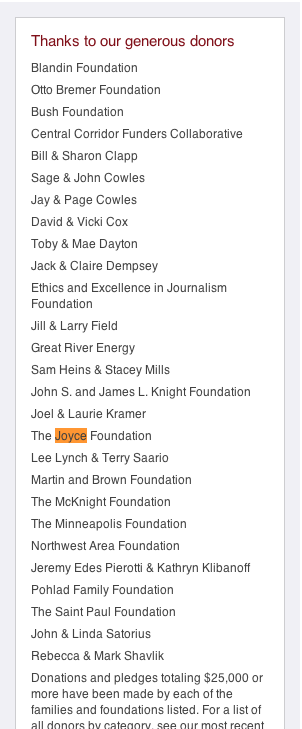
Follow the money. Journos do it – when it’s not Alida Messinger or Michael Bloomberg’s money, anyway.
The Joyce Foundation also funds…
- “ProtectMN”, the closest Minnesota gets to an actual gun control “organization”,
- “TakeActionMN”, which essentially serves as an unregulated “progressive” political party whose mission is to drive the DFL to the left. It may be the most successful political party in Minnesota today – precisely because the laws that apply to the GOP and (to some extent) DFL don’t apply to it.
All “journalism” about guns – and politics and general – from the MinnPost must be considered with that in mind.
So why would the MinnPost publish a continuous chain of stories about Second Amendment issues that range from bad science to bad history to bad scholarship to really, really bad reporting?
Because, I suggest, it’s what they’re being paid to do.
There was a time when “journalists” would have recoiled at any suggestion that their coverage was bought and paid for to secure some special interest’s narrative.
Those days are long past us – to everyone who pays attention.