Disaster By Design

December 26th, 2013 by Mitch Berg

As we’ve seen with the catastrophic rollout of Obamacare; when you’re working on a big project, design and architectural decisions made early in the process can have unintended, and maybe massive, impacts later in the process.

Seventy years ago tonight – the night after Christmas – at the Battle of the North Cape, one of those chains of design-cause to real-world effect came to a dismal conclusion in the frozen, stormy North Atlantic.

———-

When designing military vehicles – whether a Hummvee, an aircraft carrier, a tank or a fighter plane – designers have to balance four, largely mutually-exclusive factors.  The design of any military vehicle is a result of the inevitable compromise made between those factors, at any given level of technology.

Those factors are usually summed up as “Firepower, Armor, Speed and Payload”, but are better described as:

  • Firepower – how much hitting power the vehicle has.  This can refer to the size of a vehicle’s weapons – but also to the amount of ammunition, or the variety of threats it can attack, or the fire control system that helps it hit its target.
  • Survivability – which is beyond mere “armor”.  For example – US Navy aircraft carriers of World War 2 had little actual metal armor, but they invested immensely in damage control and catastrophe-proofing the ship designs – which led to some of them surviving damage that would have sunk any other nation’s designs.
  • Mobility – This can indeed be raw speed.  But it can also mean the ability to keep moving in conditions that would stymie other vehicles of its type.  That’s a major factor in today’s story, as it happens.
  • (A fourth – Payload – sometimes crops up, usually if you’re building a vehicle whose job it is to carry people, supplies or other vehicles – anything from an armored personnel carrier to an aircraft carrier)

Your job is to design a new tank.  You have a weight and size limit – your tank has to fit evenly onto a flatbed rail car, so it can be moved around the country.  In your design you’re going to cram a huge, powerful cannon into it, along with thick, heavy armor.  But that means you’re going to have to put a big engine into it, so that it can actually move.  Within the size restrictions you have, that means building a taller, more capacious vehicle to hold the engine – but tall tanks are easier to see at hit, which affects survivability.  Making it smaller requires either accepting  a slower tank (compromising Mobility), or a smaller gun, or less ammunition for a larger gun (less Firepower), or making it lighter (reducing armor, and thus reducing Survivability).

Naval ships have the same set of compromises.

Global:  In the early 20th century, it could be fairly said the sun never set on the British Empire.  The Empire and Commonwealth – the network for former colonies that had become independent, but remained part of a close-knit economic and defense alliance – stretched from (using current names except as noted for all the below) Canada, the Bahamas, the Falklands and Belize in the west, east to the Home islands, to colonies, to its Mediterranean holdings (Gibraltar, Malta, and of course the vital Suez Canal, in an Egypt that Britain ruled as a puppet proxy), to the protectorates and Commonwealth states that dominated Africa (Nigeria, Kenya, Tanzania, Uganda, and the commonwealth nations of Rhodesia (now Zimbabwe) and South Africa) and the Middle East (Palestine, Jordan, Iraq, and Britain’s then and present ally and client Oman), its keystone possession India (which then also included what became Pakistan and Bangladesh) and Sri Lanka, and  to its’ far eastern colonies in Malaysia, Singapore, Hong Kong, Fiji, and of course its Commonwealth allies Australia and New Zealand.

And from the 1600s on, the Royal Navy was designed to sail, and fight, anywhere in that massive slice of the world – from the stormy, sub-arctic expanses of the far North Sea and North Atlantic, to the temperate reaches of the Mediterranean, to the dolorous tropics of the Indian Ocean.

And over the years, the Royal Navy arrived at a design formula that institutionalized the order of importance of the four key design factors, based on the mission “fight anywhere in the Empire”.

Mobility came first – in terms of “Seaworthiness”, as opposed to “Speed”.  A British ship had to be able to weather sea conditions ranging from North Atlantic gales to Indian Ocean cyclones.  This meant building ships that were designed and engineered to remain not merely afloat, but controllable in terrible seas.  (Mobility expressed as “range” was less important – Britain’s empire had refueling bases about every 2,000 miles, from Halifax Nova Scotia to the UK to Gibraltar to Suez to Mumbai to Sri Lanka to Singapore to Hong Kong.  British designers assumed those bases would be available.  World War 2 showed it a bad assumption – but we’re jumping ahead, here).

Protection – armor, damage control and catastophe-proofing – as a general rule, came in second.  Firepower came in third; too many, too heavy guns and torpedoes made the ships top-heavy, which made them less stable and harder to handle (and more importantly, handle in a combat-effective way) in heavy seas.

Different nations made the compromise differently.  The Italian navy emphasized speed over range – they fought in the Mediterranean exclusively, and their main goal was to react quickly to contingencies in that ocean.  Its rather placid weather meant “seaworthiness” was less vital.  The US Navy, whose main theater of operations was the Pacific, emphasized long range over pure seaworthiness; their firepower was on paper more modest, although greatly augmented by superior technology like fire control radar.

And the German Navy?   It was designed to operate in the stormy but confined North and Baltic Seas.  Its mission was not to project power around the globe; it was to sink the British Fleet.  Range was more or less irrelevant – most missions were measured in days, not weeks (for surface ships – the submarines, or “U-Boats”, were another matter).   The crux of the design battle was between raw, pure firepower – cannon and torpedoes – and mobility expressed in terms of speed.

With that in mind, the Germans in 1939 commissioned their second most-famous warship (after the Bismarck, of “Sink the Bismarck” fame), the KMS Scharnhorst.
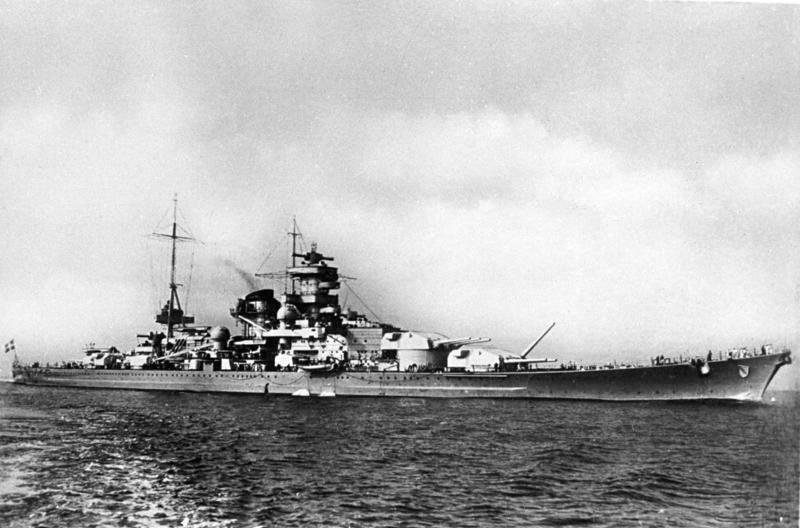
KMS Scharnhorst

Scharnhorst and her sister Gneisenau weren’t really “battleships”; they were “Battle Cruisers”; more speed and less armor (but not much less) than battleships, faster and more heavily armed than cruisers (but not quite as powerful as a battleship), the idea was to be able to kill anything that could catch it, and outrun anything that could kill it.  But it was built to the German design standard; Speed and Firepower trumped raw seaworthiness (although at 32,000 tons, it was still plenty seaworthy).

Floating Tin Cans:  In large ships, like battleships and aircraft carriers, of course, there’s plenty of room to make those compromises.

In smaller ships, it was a much tighter set of compromises.

Destroyers – at least up through the 1960s – were smaller warships designed to escort fleets of larger warships, and to attack much larger warships using (until the missile age) torpedoes.  They have to be fast, to not only keep up with the battleships and aircraft carriers they escorted, but to keep their station in formation with the larger ships as they zigged and zagged in evasive maneuvers.  So a Destroyer would generally be from 1,000 to 2,200 tons (battleships were 26,000 to 80,000 tons, and aircraft carriers were generally from 12,000 to 30,000 tons in World War 2)

To make things more complicated, the various arms control treaties of the 1920s and 1930s – especially the London Naval Treaty, which sought to curb the naval arms race of the era – placed a statutory limit on the size of warships, and the number of tons of warships that could be built in each class.  The limit for most destroyers was 1,500 tons.

So the design challenge for Destroyer builders in the 1930s was, within the treaty tonnage limits, to build an warship that was effective in furthering the nation’s strategic doctrine.

For the British, then, Destroyers were designed within a 1,500 ton limit to be:

  1. Extremely seaworthy, but with relatively short range and modest speed (35 knots, or about 40mph)
  2. Modest armament; 4-5 4.7 inch cannon and 6-8 torpedoes.  More, heavier guns and torpedoes added topweight, which affected stability which was a key factor in seaworthiness, which was the top priority.
  3. Extremely minimal protection; destroyers had no armor.  They had some damage-proofing in design and damage-control.

HMS Hunter. Built in 1936, it was fundamentally similar to nearly every British destroyer build from 1918 to 1943; four 4.7 inch guns, eight torpedoes, 35 knot speed, and very seaworthy. Hunter was sunk at Narvik in 1940.

The Germans, given their mission that was short on range but long on “sinking British ships”, had a different set of compromises.  They enabled these compromises, in part, by ignoring the London Treaty’s limits, and building destroyers that were nearly 1,000 tons heavier than the British ships.  Within that limit, the Germans focused on:

  1. Firepower – in terms of sheer, raw hitting power – was most important.  German destroyers carried mostly five 5-inch guns, and many carried five 6-inch guns, usually found on larger 10,000 light cruisers.  They fired 100 pound shells, to the 40 pound shells fired from the Brits’ 4.7s.
  2. Mobility – in terms of raw speed – was next.  German destroyers clocked from 36-38 knots.  Range was less important – German destroyers rarely expected to be at sea longer than a week, operating from bases like Kiel, Wilhelmshaven, and – after 1940 – occupied Norway, Denmark and France.  Seaworthiness came in well down the list; the heavy gun and torpedo batteries, and the design compromises to enable the high speed, made the ships much less stable than British ships; in bad weather, they’d float, all right – but they’d be rocking back and forth too hard to fire their guns effectively.
  3. Protection, as with all destroyers, was a matter of “not being hit”.  Especially for the Germans – structural strength came in lower on the list of priorities.

The German Z36, short for “Zerstörer 36”, or “Destroyer number 36”. German destroyers were numbered, not named.

Among the nation’s destroyers, a “Tortoise and Hare” comparison works; British destroyers were slower and more lightly armed, but seaworthy enough to not merely survive, but fight, in much worse weather.   The Germans had the edge on speed and firepower.

(The US Navy, by the way, split the difference, more or less.  Our destroyers, until the eve of war, were designed to operate in the vast ranges of the Pacific; an American destroyer could steam three times as far as its Brit counterpart.   They also had only four or five guns – five-inchers firing 60 pound shells.  But those five inch guns were able to shoot at both surface ships and aircraft; this made them a bit heavier than single-purpose anti-ship guns, a technology edge that gave US destroyers an immense advantage in anti-aircraft firepower over those of any other nation on earth at the time, a difference that was absolutely crucial as air power supplanted surface to surface action as the main form of war at sea.  And to pay for the weight that went into fuel and dual-purpose guns, the US destroyers sacrificed some seaworthiness (three sank in a typhoon in 1944) and a little speed and, on the eve of the war, the treaty limits themselves, dumping the 1,500 ton limit and building destroyers of 2,200 and later 3,000 tons).
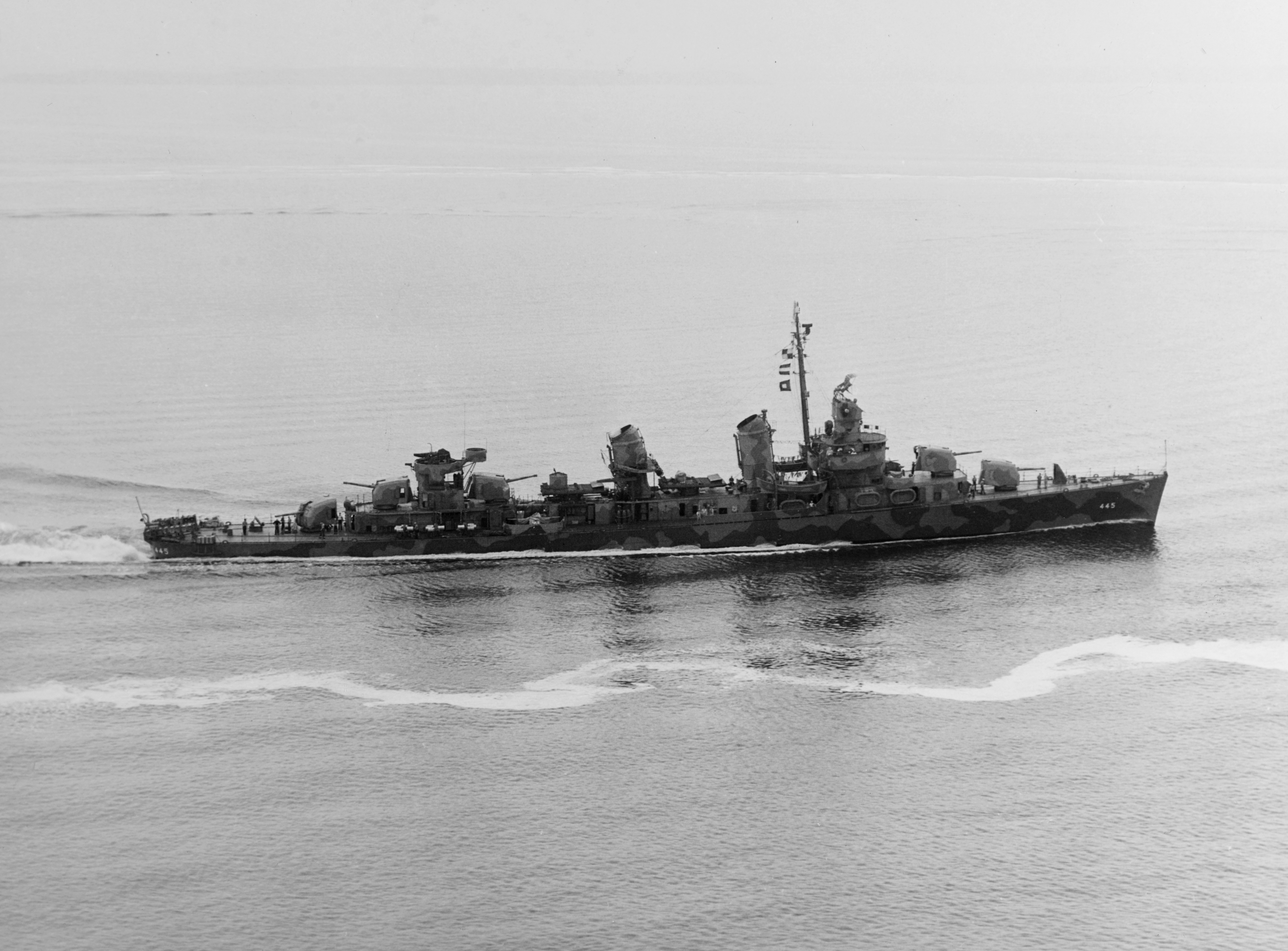
USS Fletcher. Built after the US belatedly abrogated the London Treaty, the Fletchers were 2,200 tons, and armed almost identically to the earlier 1,500 ton ships. This made them rugged, seaworthy, powerful-enough, with plenty of fuel to tackle the vast Pacific – and able to be updated continuously. Fletcher-class destroyers served into the 1970s in the US Navy, and the last one, the Mexican Cuitlahuac ( formerly USS John Rodgers), remained on active service until 2001 – a phenomenal record for a ship class.

Duel In The Sleet:  In December of 1943, the German high command realized that the war was going badly.  Especially on the Eastern Front, where the debacle at Stalingrad had been followed by a series of gruesome setbacks.

Part of the problem for the Germans was that the Soviet military’s main weakness – its inability to support lengthy operations due to the difficulties in providing supplies to the front and communications among units – was being rapidly fixed by an onslaught of American equipment, especially trucks and radios – in addition to weapons to augment the Soviets’ own production, especially fighter aircraft.

A Bell P-39 Airacobra in Soviet service. A failure in US and RAF service, it was a hit with the Soviets; it was vastly more reliable than mid-war Soviet planes, and it amply suited the tactical situation on the Russian front. Counting raw numbers of kills in Soviet service, the P39 may have been the most successful US fighter design of World War 2.

And these supplies were delivered to the USSR via convoys of merchant ships that crossed the North Atlantic, skirted the north cape of occupied Norway, and docked at the Soviet ports of Archangelsk and Murmansk.   These convoy routes served as among the most dangerous and bloodiest – and most unsung – battlefields of the war; attacked by U-boats and aircraft from occupied Norway, and occasionally heavier German surface ships, they were an incredibly risky, but vitally important, sideshow.

And Germany needed the routes blocked.  With that in mind, in December of 1943, German admiral Karl Dönitz ordered Scharnnorst  and a flotilla of five destroyers to sortie from Altafjord to attack a convoy of twenty merchants plus escorts that were headed for the North Cape.

On the afternoon of December 22, German Rear Admiral Erich Bey sailed Scharnhorst and the destroyers to sea.  At the depths of the arctic winter, the “day” involved 45 minutes of daylight, six hours of twilight – and 17:15 of darkness.  This was an advantage to the British; over the course of the war, they and the US had developed radar fire control that allowed their ships to not only find the enemy, but to control their gunfire and shoot almost as effectively at surface ships (as opposed to aircraft) in the dark as in daylight.  The Germans were lagging badly at this in 1943 (and throughout the war).

Even worse – and unbeknownst to the Germans – the Allies were reading German radio communications in almost real time.  As noted earlier in this series, British, Polish and French researchers had thoroughly broken the German “Enigma” code.   The good news for the British?  They knew the exact route the Germans would take to intercept the convoy.  The bad news?  They didn’t have a lot of time.  The convoy – screened by three British cruisers under Admiral Robert Burnett, would have to fend for themselves for a few hours, while a powerful force under Admiral Bruce Fraser, with the battleship HMS Duke of York and the cruiser Jamaica, and four destroyers (one manned by a Norwegian crew) raced to the scene.

At about 8AM on Christmas Day – still in the dark, and in wretched weather – Scharnhorst was spotted by the British cruiser HMS Belfast, who along with Norfolk and Sheffield had interposed themselves between the convoy and the Germans.

HMS Belfast today. It’s a museum ship in the Thames, just upstream from London Bridge. The only surviving WW2 British cruiser, and the only vessel from the Battle of the North Cape never sunk or scrapped, it’s an amazing visit if you’re a ship geek like me. Yep, I’ve been there.

Aided by radar, Belfast fired first.  A lucky hit destroyed the Scharnhorst’s main radar antenna, leaving the ship partially blind (the backup radar didn’t cover the ship’s forward arc; imagine driving with a blocked windshield, and having to weave back and forth to see forward out your side windows).

Scharnhorst‘s mission was to sink merchantmen, not slug it out with cruisers.  Bey disengaged and spent the rest of the day looking for a way to outflank Burnett’s cruisers.

And it was here that the design decisions, made in the 1920s and 1930s and so laboriously explained above, come roaring into the picture.

The weather, bad to begin with, worsened.  A howling gale whipped up mountainous seas.  Snow obscured the already terrible vision.  Imagine some of the worst weather from Deadliest Catch.  Now, imagine trying to load a cannon, or stabilize a range-finder, or even see a target, in that kind of weather.

The German ships, designed for raw speed in calmer waters, were badly-fitted for seakeeping in terrible weather.  The five German destroyers especially suffered; the top-weight of the heavy guns made them roll terribly, to the point where even if they’d seen a target, they’d have had a hard time loading and firing their cannon at all, much less with accuracy.  And the ships’ structures – structurally lighter to save weight and increase speed – weren’t up to the pounding; the destroyers started taking structural damage from the pounding of the icy waves.  Scharnhorst , being much bigger, was structurally sound – but was also built for higher speed in calmer seas; it was forced to slow down, to slow the rolling and to allow the destroyers to keep up.   Finally, hearing reports of serious damage, Bey ordered the destroyers back to base, and sought to engage the convoy himself.

The British ships, on the other hand, were able to not only to continue to sail, and sail toward the enemy, but to fight when they got there. As they – Fraser’s Duke of York task force – closed in, Bey engaged Burnett again, hitting HMS Norfolk twice with his 11-inch guns, knocking out the British cruiser’s gunnery radar. But the three cruisers were a formidable opponent to the German; and Bey withdrew, still hoping to find the convoy.  Belfast kept Scharnhorst under radar surveillance.

And this allowed Fraser to engage Scharnhorst with gunfire from the Duke of York at 4:17 PM – again, in pitch dark.  Fraser’s guns – the 40,000 ton Duke‘s ten 14-inch guns to Bey’s nine 11-inchers – made it a lopsided battle; the superiority in radar made it even worse, allowing the Brits to lock in Bey’s position long before Scharnhorst’s gunners even got close.  And while the German ship had been designed to be able to outrun any ship that could kill it – Scharnhorst could do 32 knots, Duke of York 28 in ideal conditions – in the atrocious seas the British battleship was able to out-steam the German.  And without destroyer escort to hold off the larger British ship to allow Scharnhorst to escape, it was a massacre.

The British battleship pounded the German, knocking out six of the nine main guns and wrecking half of the boilers; two destroyers (HMS Scorpion and the Norwegian-manned HNoMS Stord), fully combat-effective in the weather due to their seaworthiness, hit the German ship with four torpedoes, stopping it.

His Norwegian Majesty’s Ship, the destroyer Stord. An “S-class” destroyer built as HMS Success in 1942, then handed over to the Norwegians and renamed.  It looks a little more rakish than Hunter (way above), but it’s built to almost the same basic design; four guns, eight torpedo tubes, as the ten-years-older Hunter, and it had similar capabilities (although much better equipped with radar and anti-aircraft guns).  It served the Norwegian navy until 1959.

After that, it was a formality; Belfast and sister cruiser HMS Jamaica closed in and finished Scharnhorst off.  The Brits rescued 36 out of a crew of over 1,900.

It was one of many examples in the war of systems that were on paper looked much better than the opposition came up short when exposed to real-world conditions that weren’t accounted for on paper.

Take Heart

December 26th, 2013 by Mitch Berg

2013 was a decent year for grassroots Real Americans. 

In Minnesota, we shut down a full-court press for gun control, in a DFL-controlled legislature that should have passed at least some gun-grab bill in a walkover.  The good guys – and there were plenty of DFLers among those good guys, from outstate – broke the unaminity of the DFL majority, and issued the Metrocrats, their media praetorian guards, and their darlings “Protect” MN and “Moms Want Action” a humilating rebuke. 

Of course, guns are about principle; when money’s involved, the DFL cracks the whip even harder.  Minnesota’s home daycare and home-care providers, working in their spare time around their jobs and families, couldn’t quite beat back the unions’ lavishly-funded onslaught; with $2 million a year in union contributions to the DFL at stake, no dissent could be tolerated.  But the plucky providers launched a grass-roots effort that not only won the moral battle and showed the DFL to be even more cynical and craven than we thought before – but they took the fight to court.  And, so far, won. 

Of course, in Colorado Real Americans came within a trice of taking back the state Senate via a meticulously-organized recall campaign against Democrat senators who served as puppets for Michael Bloomberg’s gun-grab campaign; the Democrats held the Senate only because the next target resigned (allowing her seat to be filled with a Democrat) rather than get tossed in a recall (which would have flipped the Senate). 

This past five years have at times been discouraging for conservatives; we’ve felt like the GOP at the highest levels is in the thrall of people with careers and pals to look out for, and the money to make it stick, and who are not above defeating their unruly grassroots erstwhile allies before worrying about the Democrats.  It’s felt at times like the Beltway GOP is more worried about the Tea Party – which is the real soul of the conservative movement – than about Harry Reid and Nancy Pelosi. 

The GOP needs to learn something from its grass roots, here and nationwide.

Not Your Dad’s Craigslist Ad

December 26th, 2013 by Mitch Berg

Guy sells his ’96 Nissan Maxima via Craigslist…

…via an ad so creative, Nissan bought the car.

Horatio Alger, Please Call Your Office

December 26th, 2013 by Mitch Berg

Joe Doakes from Como Park emails:

I knew unemployment among Black youth was bad, but this bad?

Joe Doakes

I can totally see this as a Minnesota state program.

This Warmed My Heart

December 24th, 2013 by Mitch Berg

A Charlie Brown Christmas, the 1965 animated classic which has been on the TV every Christmas season for 48 years now, beat the finale of The X Factor in the rush ratings last week:

Simon Cowell’s “X Factor” came to an ignominious end on Thursday night. The battered series not only finished third in its time slot, it drew fewer viewers than a rerun of “A Charlie Brown Christmas.”

“A Charlie Brown Christmas” first aired on CBS in 1965. It’s been on TV every year since then. Last night the ABC special pulled 6.41 million total viewers vs. “X Factor” with 6.22 million.

All hope is not lost.

It’s not the best Christmas present ever, but I’m not selling it short either…

Things I’m Supposed To Hate But Like A Tiny Bit Of: America

December 23rd, 2013 by Mitch Berg

Since the subject was Crosby, Stills and Nash, it’s probably time to turn to one of their seventies Cali-pop offspring; America.

The band – three American air force brats who met in England during the mid-sixties – generally wrapped up all that was the worst about the entire California pop scene that Crosby, Stills and Nash helped spawn; oblique, tired-sounding minor-key noodling wrapped in ornate three-part harmony that never made me want to dance, sing, fight, cuddle or do much of anything but change the station.

Ventura Highway?  Horse With No Name?  Muskrat Freaking Love?   Whatever else they did?  Never could stand it.  Bores me stiff.  Move along.

Except for Sister Golden Hair:

Why, of all of America’s somnolent oeuvre, do I like “Sister?”

I dunno.  Because it has a beat?  A slide guitar?

Maybe because the vocal harmony harkens back to doo-wop more than Haight-Ashbury?

Dunno.  But in a band whose entire catalog works on me faster than an Ambien/NyQuil speedball, “Sister Golden Hair” makes me smile.

Why ask why?

Things I’m Supposed To Love But Usually Can’t Stand: Crosby, Stills, Nash, And Occasionally Young

December 23rd, 2013 by Mitch Berg

Ever since I’ve been involved in music, it’s seemed there’s been one crowd or another telling me who I’m supposed to like.

In college, the music majors all dug the Alan Parsons Project.  “It’s like…above rock”, they mewled.  Perhaps it was; it was also beneath interesting.

There were others.

(Below the jump, because of all the videos)

Read the rest of this entry »

Christmas Week Plans

December 23rd, 2013 by Mitch Berg

It’s Christmas week.

And if you’ve been a regular reader of this blog, you’ll know I’m not much of one for “vacations”.

But since traffic falls deep into the tank on Christmas week, this week will have very light posting.

Enjoy the week!

Not In My Zip Code

December 23rd, 2013 by Mitch Berg

“Affordable Housing” and “Diversity” are big chanting points of blue-state liberals.

Provided that the affordable housing, and the diverse people who pay for it, aren’t actually anywhere near you.

Upper West Side Manhattanites recoil at people living in RVs among them:

Farther uptown, on Central Park West — where the neighborhood’s most expensive rental, a town house with a pool, fetches a cool $75,000 a month — stands a 19-foot, 1975 Dodge Sportsman with gold rims and two cameras affixed to its exterior.

“It looks like it would fit more in the mountains of West Virginia than on the Upper West Side,” said area resident Ron Hoffman.

The Dodge owner, who only gave his name as Robert, refused to answer any questions.

Neighbors are puzzled by the RV’s windows, which are covered by gold curtains.

“He once told me he just uses it to store things — but if that’s the case, why would you have everything blacked out so you can’t see the person inside!” said longtime resident Bill Smith.

“I don’t think it should be here,” added Mario Parisi, 86. “We’re all waiting to park. Sitting there all the time is not a good idea — it’s a monster.”

Diversity is a wonderful thing.

Just not near us.

Remember…

December 23rd, 2013 by Mitch Berg

…earlier this year, the local leftybots burned a lot of cycles on reports from the Federal Reserve that maintained that while Minnesota was booming, Wisconsin was languishing.

They’ve been a little quiet since then. 

Why?

Because it’s just not true. 

This just in:  Wisconsin’s personal income growth leads the nation:

As I’ve been saying all along – economies aren’t sprints.  They’re marathons.  It’s going to be years before this all shakes out, and that’s assuming the political situation stays stable (and I’m doing my darnedest to make sure it does not in Minnesota).

All Of Our Problems Are Solved

December 23rd, 2013 by Mitch Berg

Janet Napolitano’s Department of Homeland Security; keeping us safe from pro-lifers, Second and Tenth Amendment activists, tax reformers…

…and purveyors of counterfeit sports paraphernalia.

Controlled Deflation

December 23rd, 2013 by Mitch Berg

Even as American progressives continue to ramp up their push to make our social welfare state as European as they can make it, the Europeans are actually getting smarter.

The Dutch are following the Swedes in tightening up their welfare system:

The Dutch have just announced a massive reform of their welfare system, designed to reduce dependency and put a new emphasis on work. For example, welfare applicants will now be required to prove that they spent at least 4 weeks actively searching for a job before they become eligible for any assistance. And once they begin to receive benefits they will either have to work or perform volunteer community service. Dutch welfare recipients would be required to take available jobs even if they had to move or commute up to three hours per day…According to the Dutch government, the reforms will ensure that welfare is seen as “a safety net, rather than a right.”

No word if “Occupy Den Haag” has reacted yet.

Faint Damnation

December 23rd, 2013 by Mitch Berg

Joe Doakes from Como Park emails:

Report finds no evidence of widespread sexual misconduct in Secret Service.  Good to know.

Of course, that depends on what “sexual misconduct” means.  We all remember “I did not have sexual relations with that woman.”

And what “widespread” means (get your mind out of the gutter, we’re talking about sexual misconduct not . . . oh, never mind).Joe Doakes

The bar for “right” versus “wrong” has been set so low these days.  , a snake could get over it without jumping.

It’s Beginning To Look A Lot Like NARN

December 21st, 2013 by Mitch Berg

Today, the Northern Alliance Radio Network – America’s first grass-roots talk radio show – brings you the best in Minnesota conservatism, as the Twin Cities media’s sole source of honesty!

  • I’m in the studio today from 1-3.  I’ll be talking about the Duck Dynasty thing – in reference to a lot of muuuuuch more important things.  Plus the economy, and things you can be thankful for as a conservative in this past year.
  • Don’t forget the King Banaian Radio Show, on AM1570 “The Businessman” from 9-11AM this morning!
  • Tomorrow,  Brad Carlson is on “The Closer”!

(All times Central)

So tune in to all six hours of the Northern Alliance Radio Network, the Twin Cities’ media’s sole guardians of honest news. You have so many options:

Join us!

Anatomy Of The Liberal Argument

December 20th, 2013 by Mitch Berg

(SCENE:  Mitch BERG is sitting in a book store coffee shop with Adriana TROMP and Jamal BECKETT, two College Republican activists visiting from Wyoming and Texas, respectively.  The three are drinking coffee and engrossed in a conversation). 

BECKETT:  I find that hard to believe.

TROMP:  Yeah, me too.  You expect us to believe that all arguments with liberals follow the same exact template?

BERG: Of course not.  It’s arguments with 95% of liberals – I’m being generous – in one-party liberal cesspools like the Twin Cities, New York and Chicago.  They’re people who come from “progressive” families, come up through an educational system run by “progressive” academics and union workers, attend a college or university run by “progressives” where conservative dissent is actively squelched, and in many cases go on to work in institutions like government, academia or the non-profit sector where only “progressive” thought is ever heard. 

So, basically, arguments with that 95% of liberals go like this:  Stage 1:  The pat premise.  When that is contested, we move to Stage 2, the Single Round of Factoids.  These factoids are almost always taken from the current round of Democrat chanting points, and are pretty much inevitably debunked with countervailing fact.  Which leads us to Stage 3:  Frustrated deflection.  Desperate for anything to try to retain the supremacy to which they believe they are entitled, they’ll toss any rhetorical crap they can out there to deflect from the actual argument.  When called on it, they move to Stage 4:  The Ad Hominem.  At which point the argument is over. 

BECKETT:  It seems like a stretchy premise…

(BERG sees Avery LIBRELLE walking into the coffee shop.  He squelches his urge to look away and avoid LIBRELLE’s eye, but instead waves and beckons LIBRELLE to the table). 

BERG:  OK, watch this.  I’ll signal you the stages with my fingers.  OK?  (Waves at LIBRELLE, who has arrived at the table)  Avery Librelle!  Hi!  How ya doing!  This is Adriana Tromp and Jamal Beckett.  They’re college kids. 

LIBRELLE:  Ah!  May the spirit of Wellstone be with you this season.  And (looks at BECKETT) happy Kwanzaa to you!

BECKETT:  Um, we’re Methodists…

BERG:  Hey, the DFL is sure setting Minnesota up to botch things in the next year. 

LIBRELLE:  We have a billion dollar surplus, thanks to the DFL in the Legislature and governor’s office!

(BERG holds up one finger)

LIBRELLE:  Yes.  The DFL is #1.

BERG:  In the sense my elementary school teacher used, yes.  But that “surplus” is a $200 million increase in an $800 million surplus that the GOP racked up, on top of erasing a $6 Billion deficit, without raising taxes.  And the DFL hiked taxes $2 Billion to get that extra $200 million.  That’s not really a huge return on the investment. 

LIBRELLE:  Pfft.  Numbers are numbers.

(BERG holds up two fingers)

LIBRELLE: Yes.  Peace.

BERG:  But the worst of the DFL’s job, business and revenue-killing taxes, like the B2B and Warehouse taxes, haven’t even kicked in yet!   This is going to turn another epic deficit!

LIBRELLE:  Oh, yeah?  What were you doing when Tim Pawlenty ran up a six billion dollar deficit?  Huh?

(BERG holds up three fingers.  BECKETT nods, TROMP smiles in recognition).  Er, Avery?  The DFL controlled the legislature completely in 2009 and 2010.  The legislature passes the budget.  Pawlenty fought as hard as he could, but he couldn’t completely resist a two-chamber press of tax-and-spend DFLers.  The DFL passed that deficit, and spent the past four years trying to fob the blame onto Republicans. 

(Berg’s pinky finger twitches)

LIBRELLE:  You are ugly and stupid.

BERG, TROMP and BECKETT:  Four!  (They trade high-fives).

LIBRELLE:  You conservatives are sure weird.  (Ambles away, dribbling latte).

TROMP:  Is that a man or a woman?

BECKETT:  I can’t tell.

BERG:  Oh, that?  Well, it’s like this…

(And SCENE).

Pol Position Deux – Frankensense

December 20th, 2013 by First Ringer

We return to look at the nascent Minnesota GOP race for U.S. Senate.  We broke down the GOP governor’s battle royale here.

____

While the Minnesota GOP governor’s race has attracted most of the attention from the state’s punditry and conservative activists, the race for U.S. Senate has been at best a political red-headed stepchild – an electoral Clint Howard.  A bevy of unheralded candidates and little money raised hasn’t fundamentally altered the state of the race since July.  This despite the increasingly polling weakness of Sen. Al Franken.

Much like the man who he’ll likely be sharing the top of the DFL ticket with, Gov. Mark Dayton, Sen. Al Franken has seen his approval rating collapse, with the last six months essentially undo six years of polling gains following his contested 312-vote margin of victory.  Franken’s approval rating has dipped to 39%, with a bare majority of 51% disapproving.  Ideologically sympathetic pollsters have pegged Franken’s percentages much higher, but his 10-12% early head-to-head numbers against a mostly unknown GOP field suggests Minnesota’s junior senator hasn’t found the political elixir that Sen. Amy Klobuchar rode to victory just a scant 12+ months ago.  The question remains whether Republicans can take advantage. Read the rest of this entry »

Pol Position Deux – The Race to Summit (Ave)

December 20th, 2013 by First Ringer

We breakdown the state of the GOP race for governor.  We offer a similar analysis of the GOP Senate contest here.

___

The seasons have changed significantly since our last detailed analysis of the GOP governor’s race – and so has the political climate.

Last July, Minnesota’s political commentariat had all but official declared Gov. Mark Dayton the winner in his 2014 re-election effort.  Sporting a 57% approval rating, despite a legislative session that saw no shortage of controversial bills (including a warehouse tax even the Star Tribune editorial board begged Dayton to reconsider), Dayton looked in good position to cruise through the fall and winter political doldrums.

Fast-forward six months and Mark Dayton’s numbers are dropping as quickly as the temperature.  Dragging a 52% disapproval rating into the 2014 session, Dayton has been eager to recast his imagine as a traditional tax-and-spend liberal, suggesting he’d return the bulk of Minnesota’s projected $1.1 billion surplus (minus erasing the shift in education dollars) as tax cuts.  The reception to the concept has only been slightly warmer than absolute zero in the DFL caucus, framing a potential conflict between Dayton’s yearning for re-election aid and the legislative desires for more spending.

Tax cuts or not, Dayton’s greatest potential saving grace may simply be his opposition. Read the rest of this entry »

The Many Lies Of “Protect” MN, Part XXV: Prevention!

December 20th, 2013 by Mitch Berg

Heather Martens (DFL 66A), on the line from fantasy-land:  “There is no history of [a citizen with a legally-carried firearm] being a meaningful deterrent or being able to stop an attack”.   (Star-Tribune, November 27, 2012).

Reality:  Man with carry permit thwarts armed robbers who’d pistol-whipped shopkeeper in Northeast Minneapolis:

Inside his neighborhood market, Mohamed S. Ahmed was screaming for help after a pair of armed robbers had left him bleeding.

They’d pistol-whipped him, pointed the gun at his face – and they weren’t done yet:

Outside the northeast Minneapolis store, two men pounded on the window, trying to get back into the University Market after Ahmed managed to lock them out.

“They seemed really agitated, super agitated,” said Matt Dosser, who was walking by about 9:30 p.m. Tuesday. At first, “nothing made sense, then I saw the gun.”

Dosser, who has a permit to carry a gun, reached for his own weapon.

One of the robbers “turned around and looked at me,” Dosser recalled. “He stared at me. I had my weapon up. I didn’t point the gun at the person. I had it at the ready, out of the holster.

The robbers scampered away like the cowardly pieces of demi-human garbage they are.

On Wednesday, police spokesman John Elder called Dosser’s actions “a noble thing. He acted honorably. Did this person possibly save [Ahmed’s] life? Absolutely.”

Why does Representative Heather Martens hate Arab grocery store workers?

UPDATE – And More Reality!:  Shelley Leeson sends another recent episode; an Uptown resident scares off a crowbar-wielding burglar. 

Why does Heather Martens hate construction workers and fathers?

Open Letter To Radio Advertisers

December 20th, 2013 by Mitch Berg

To:  Radio Advertisers
From: Mitch Berg, uppity peasant
Re:  Bad Marketing

Dear Advertisers:

On the off chance I hear your ad at all, please note that I do tune out every word after the phrase “.,.one weird trick”.

That is all.


Something Is Rotten In Reykjavik

December 20th, 2013 by Mitch Berg

Joe Doakes from Como Park emails:

A buddy forwarded this message to me:

Cops had to shoot the guy because he’s mentally ill and wasn’t getting proper care.

Icelandic website Visir later named the man as Sigrid Oscar Jónasdóttur and his sister Sigridur Jónasdóttir blamed poor health care for the mentally ill for the man’s death. “There are no resources for these people,” she told the site. 

That story doesn’t ring true.  Iceland has nationalized health care.

Healthcare in Iceland is universal. The healthcare system is largely paid for by taxes (85%) and to some extent by service fees (15%) and is administrated by the Ministry of Welfare. A considerable portion of government spending is assigned to healthcare. There is almost no private health insurance in Iceland and no private hospitals.[

Since it’s national health care, it MUST be the best possible system.  We know thatfrom endless assurances by Democrats that nationalized, universal care is the key to the best health for all.  So this shooting shows obviously some other plot afoot.

Obama blames Phil Robertson.

The American Chilton © Manual

December 19th, 2013 by Mitch Berg

It was almost 20 years ago that Newt Gingrich earned his claim to fame, engineering one of the most radical turnarounds in the history of American politics; flipping Congress to the GOP for the first time since the Great Depression. 

And he did it using one of the most radical techniques in the history of politics; telling the people what his movement stood for, and what it’d stand by. 

It worked; the 1994 elections were one of the most sweeping turnarounds in American political history.  The ’94 election did for Congress what Reagan did for the White House; put conservatism on the table. 

It didn’t stick, of course; the Gingrich Congress gave way to the Frist Congress.  The Class of 94 slowly went Beltway Native.  But noting that merely proves one of the most important points of political activism; it’s a marathon, not a sprint.  Getting people elected is only the first half of the problem; keeping them honest is just as important.

But that’s history.  I’m here to talk about the present.

A New American Repair Manual:  Of course, the name “Contract with America” had that patina of legalism that smacks of the same thing that gave us the problem in the first place.  The System.

I think conservatives need to revisit the notion of putting down a hard set of…not “campaign” promises, but lines in the sand, things that separate them from the Democrat party for all to see.  Something that everyone, from a movement conservative to a college kid looking for a job to a working, not-overly-political family with a cancelled insurance policy and a skyrocketing premium can look at, compare with “Hope and Change!”, and find some red meat to support. 

It’s not a “Contract”.  It’s a repair manual.  Sort of like a Chilton © manual for the 2014 United State of America. 

Here’s my suggestion for that repair guide:

It’s Your Money – Not Government’s!:  Return all personal, inheritance and capital gains taxes to 2004 levels, immediately.  You earned it.  You use it. 

The Government Diet:  Freeze spending at 2010 levels.  I know, that’s already too high – but Americans lack the stomach for radical change.  And economic growth will make that sustainable, eventually.  Especially if we…:

Rebuild the Economy:  Three points to this one:

  • Roll back Obama’s regulatory orgy – Especially those related to energy – because we’re gonna…
  • Drill, baby!  Drill!  – when Obama took office, gas was under $2 a gallon; with North America awash in oil, coal and natural gas, there’s no reason gas can’t be cheaper than it was.  Turning into a net energy exporter for the first time in over 40 years will be a huge boost to the economy – and start a domino effect that will, along with the regulatory rollback. 
  • Slash corporate taxes and push R&D tax credits.  The cuts will be more than repaid in revenue from new business and paying jobs. 

Focus On The Real Enemies:  On the one hand, stop warrantless domestic spying.  Immediately.  Completely.  The NSA and CIA exist for a reason – to protect us from foreign enemies.  Focus on them.  Put some teeth into the FISA warrant laws.  Stop the NSA, CIA, DHS and IRS from spying on, oppressing, watch-listing and persecuting Americans going about their daily business.  Reinstate the Fourth Amendment in all its prickly glory. 

And in the process, move from being the world’s policeman to the world’s ninja.  Stay out of foreign affairs that don’t affect us – and when we do get involved, do it judiciously, economically, and with an aim toward accomlishing a defined mission and getting out.  This is one area where the French have a lot to teach us.  Like the Frogs, we should become the porcupine – a porcupine with a baseball bat and a couple of rattlesnakes in the closet.  Remain magnificently above the world’s niggling jabbering squabbles, unless it’s something very important that’s utterly immutable to diplomacy.  Then hit it so hard they spend the next hundred years wondering what hit them.  Go home.  Let them pick up their pieces and reflect on the lesson they just learned.

Path To Dignity:  Focus federal welfare efforts on getting people to work.  Transition federal welfare spending to grants to state that use methods that show success at getting the poor back to work. 

Go Back To Your Own Doctor:  Repeal Obamacare.  Replace it with one of the Republican plans that leverage Medicaid while preserving the private market.  Abolish laws forbidding purchasing insurance across state lines.  We’ve invested half a trillion dollars in a failed website, and that’s only the beginning of the problems.  Cut it loose.  Abandon it.  Stop throwing good money after bad – and worse, screwing up the lives of average Americans. 

It’s not a contract.  It’s a repair manual.  Because that’s what this country needs after six years of our experiment of letting a bunch of giggly fratboys run the country; the country is like a frat house that’s going to need a summer’s worth of repairs to be ready for the fall semester.

So let’s start repairing things. 

And here, locally? :  Most of the same points apply here in Minnesota.  More on that tomorrow or early next week.

Like Chicago, With Lousy Football

December 19th, 2013 by Mitch Berg

Let’s see; we have a state majority installed largely through money coordinated by the Governor’s ex-wife and paid for by the her and his buddies from the country club.

When Governor Messinger Dayton speaks, his lips are controlled by his chief of staff Bob Hume, who is very credibly rumored to be “romantically involved” – evidence indicates dating or married to, but the principals keep it under wraps – with Carrie Lucking, “executive director” of the Alliance for a “Better” Minnesota (Of course, we don’t know anything official; merely that during the Governor’s last budget speech, Lucking was tweeting picayune details of the budget that seem unlikely to have come from someone who hadn’t had an advance look at the proposal.  Some say it’s because Hume must have given Lucking an advance look at the Governor’s budget.  I’d suspect it was more like Lucking let Hume look at it.  But I digress).

And of course, the director of Minnesota’s flailing “MNSure” program spent two weeks during the catastrophic rollout of her website playing little spoon in Costa Rica to the state Medicaid director’s big spoon.

So I suppose the real question about Governor Messinger Dayton’s hiring of Minnesota DFL Executive Director Ken Martin’s wife as his deputy chief of staff isn’t “why all the nepotism”.  It’s “why isn’t the spouse of every powerful DFL functionary making six figures on the public teat”.

Because clearly someone reliable needs to be able to spell Bob Hume in making sure Governor Messinger Dayton doesn’t deviate from the chanting points.  Bob’s gotta be exhausted.

It’s party time, Dems!

(PS: Love the headline.  Governor Messinger Dayton hires a “well-connected” deputy?  No!  He hired his party chair’s wife.  Nope.  No media bias whatsoever in the Twin Cities).

I Am Going To Start Training Our Nation’s Elite!

December 19th, 2013 by Mitch Berg

For years, now, the highest tiers of our university system have turned out our nation’s “elites”.

And the reason we know they are our “elites” is because they are smart.

And the reason we know they are smart is because they got good grades from an “elite” university.

So I’m going to start an “elite” university. 

You’ll know my university’s students are the best in America – because they’ll all get A+++es on their transcripts.  Which, as we know, is better than an A++, to say nothing of an A+. 

Oh, relax.  It’s not like Harvard does pretty much the same thing.

“Don’t Be Paranoid! NoH8!”

December 19th, 2013 by Mitch Berg

Just remember – it’s paranoid to think that just because they legalized gay marriage because “it’s all about love!”, that they’ll start working to recognize love for multiple spouses, or for children.

Perish the thought.

The New Liberal Math

December 19th, 2013 by Mitch Berg

Joe Doakes from Como Park emails:

Mathematics – particularly statistics – are racissss

A buddy of mine worries about the implications.  He says “Rahm Emmanual knows that to lower crime, he needs to alter the racial makeup of his community.  So Chicago – the hotbed of anti-gun libs and ground zero of violent crime in the US – will step up the efforts to ship Blacks to welfare-happy Minnesota, with Governor Deer-in-the-Headlights only too happy to meet them at the border with the key to the treasury.”

Nah, couldn’t be.

Joe Doakes

What the Czarist Russians did with Siberia…

--> Site Meter -->