Archive for January, 2016

“Nobody Wants To Take Your Guns!”

Thursday, January 21st, 2016

Yes, as a matter of fact, they do.

One of the gun grabbers’ chanting points of late is “Obama hasn’t confiscated a single gun”.  Perhaps, but states like New York, Connecticut and California are.  And Obama needn’t send a single SWAT team out on a single “search and confiscate” mission to “win” his real goal; start changing the culture back to the intolerance of guns we had forty years ago, to set the stage for making the Second Amendment irrelevant.

The good guys can not give ground ever.  Not on anything.  We are dealing with people who are fundamentally dishonest.  We need to treat them as such.

Reasons I’d Love To Get Into Doing Actual AI Code

Thursday, January 21st, 2016

My stomach still hurts from laughing.

A Modest Question 3: More Of The Shifting Dream

Thursday, January 21st, 2016

Joe Doakes from Como Park emails:

The reason for exploring all this American Dream stuff is the poor performance of Black students on achievement tests.  Are the tests measuring the right things?

The modern White American Dream seems to be clean, indoor, meaningful work that pays well enough for an apartment with high-speed WiFi and a Light Rail Pass, such as sitting in a cubicle at a non-profit, saving the whales.  For that, students need basic arithmetic, reading, writing and not much more, certainly not college level expertise.  Any American who shares that dream – Asian, Hispanic, Black, Native American, Muslim, Jewish, or refugee – needs the same skills.  Any high school should be capable of teaching what they need to know and our traditional achievement math and reading tests should be capable of measuring it.

What about people who don’t share that Dream, who reject it?  Those people don’t do well in those White Dream schools because the skills being taught aren’t relevant to their futures.  Those students become a stereotype (which doesn’t fit every rebel but fits enough to have a grain of truth or the stereotype wouldn’t be useful) of Black Male Troublemakers, disrupting the school, fighting with others, preventing everyone else from learning.

So what is those rebels’ dream?  What skills would they prefer to learn, to succeed at their Dream?

If the Young Black Man Dream was as silly as the hateful racists claim – free sex, free stuff, free time – then the required skills would not be the same level of math and reading skills required for the White American Dream. Instead, young Black men would need verbal skills to convince fat White chicks to bed them and to hand over their welfare checks.  They would need to speak English poorly enough to get along with their peers but well enough to convince probation officers that they were doing nothing wrong when the police arrested them.  They would need pattern recognition skills to decipher gang colors and tattoos to avoid trouble.  They would need enough arithmetic to make change from selling drugs and buying bullets.  Yes, I’m intentionally being absurd to illustrate the point:  all students want to learn things they think will be helpful in their future lives as they imagine them.  The question is: how do Black male students imagine their future lives?

So back to education: if you are a young Black man and the school isn’t teaching skills relevant to your Dream – whatever Dream that is – then naturally you’re be bored stiff in class after about 8th grade.  You’ve learned all the useful knowledge the school has to offer – the rest isn’t relevant to your Dream.  Bored, restless, disciplined, disrespectful, fighting . . . and doing poorly on tests: do we have a discipline problem, or a Dream problem?

Should we accommodate the Dream?  Or try to change it?

Joe Doakes

It’s way past time to change the terms by which we define “the dream”.

Good Spirit. Lousy Idea.

Wednesday, January 20th, 2016

Anyone with a living soul was nauseated by the display in Cologne on New Years Eve, where thousands of men of “North African” descent roamed the street in gangs, sexually assaulting women and impeding the police’s attempts to respond.

Here in the US – where this sort of thing is thankfully very rare – the responses depended on the responder’s politics.

People on the left strenuously denied there was a problem, or blamed it on fraternities affiliated with the NRA.

People on the right bought another box of ammo.

Either would be more productive, I suspect, than this group of…er, males in the Netherlands:

The sign says “If you’re not wearing pants, you make less of a mess when they attack you”. No, that’s not true. It says “Don’t make women dress chaste / keep your hands to yourself”. That’ll show ’em.

I’m sure the women of Cologne are thankful for the “solidarity”.

A more productive statement?  Germans are doing their best to arm themselves, as best they can given Germany’s patriarchal gun laws.

And where real people try to arm themselves, you can count on the media to get the Victorian vapours.

The caption says “The Weapons industry profits from the Refugee crisis”. Naturally. Blame Big Gun.

Or in this case, I suppose, the Hohenzollern vapours.

Which group do you suppose will actually benefit the women of Germany – the shooters or the Dutch guys in dresses?

As The Shark Looks Skyward

Wednesday, January 20th, 2016

Palin endorses Trump.

Sorry, Sarah.  For what it’s worth, you just pawned the last of your political capital with me.

We’re Finally #1!

Wednesday, January 20th, 2016

To:  All you Obama voters
From:  Mitch Berg, uppity peasant
Re:  Thanks for nothing

Gabbling Hamsters,

Minnesota has the highest healthcare premium increases in the nation under Obamacare.

Please recuse yourselves from voting.  Forever.

That is all.

A Modest Question 2: The Ever-Shifting Dream

Wednesday, January 20th, 2016

Joe Doakes emails:

“The American Dream” has changed several times.

Used to be, laborers living in filthy tenements in New York or Chicago dreamed of traveling West where they could bust the sod, build a home, and make a new life for their families.

Used to be, GI’s in foxholes dreamed of finding a nice girl to settle down with and a job in a factory to afford a bungalow on a quarter-acre lot.

Used to be, parents worked overtime to send their kids to college to be doctors and lawyers, so they wouldn’t have to work with their hands and could afford a McMansion in Eagan plus a lake cabin Up North.

For young Americans nowadays, The American Dream might consist of an college degree in Sociology to get a job working in a cubicle for a non-profit so you can live in a converted warehouse and ride Light Rail.

Notice what they have in common?  They’re all White dreams.  Black people living in pre-Civil War days had entirely different dreams of freedom.  Black GIs came home to segregated dreams.  And since the 1970’s, Black families have fragmented and crime in Black neighborhoods has skyrocketed.

What is The American Dream for Black youth today?  What should the schools be teaching to help them achieve that dream?

Joe Doakes

More on this tomorrow.

Halpert The Headless Thompson Gunner

Tuesday, January 19th, 2016

I saw 13 Hours over the weekend.

Several reactions:

Worst Fears Not Realized:  I’ve been rooting for this movie for a long time – ever since I met “John “Tig” Tiegen (Dominic Fumusa), and Mark “Oz” Geist (portrayed in the movie by Dominic Fumusa and Max Martini, respectively), and got a chance to interview them on my show last year.

But when I saw that Michael Bay was directing it, I felt my hope curdle into a icy ball of despair.  Bay was behind the loathsome Pearl Harbor and all the bad Transformers movies that followed on after the good one.    (Of course, he also did The Rock and the very underrated Pain and Gain, so perhaps I’m being a little harsh on the Bayver).

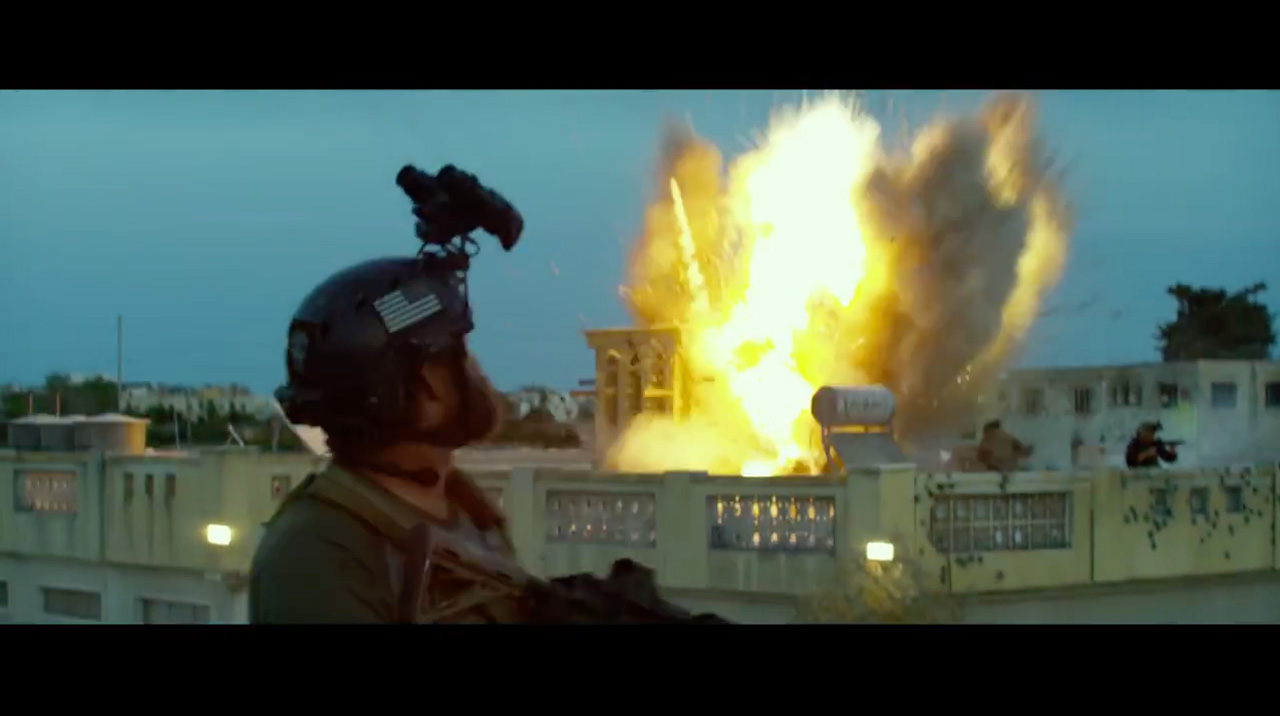
In a Michael Bay movie, .223 rounds apparently use napalm as a propellant.

But while it included some of Bay’s signature moves – the MTV-era editing, the slow-mo explosions, the Die Hard-style wisecracking between battle scenes – it all actually worked well.  And sometimes superlatively – as in a scene when a group of State Department employees in an armored Mercedes are getting shot at at point-blank range by a group of locals.  Really, really stunning sequence.

But the movie largely focused on the story.  And it’s there that things get interesting.

The Story Behind The Story:  The movie, of course, is about one of the most controversial events in recent years – the September 11, 2012 attack on the US diplomatic compound in Benghazi, Libya.  During the attack, the US Ambassador, a State Department communications staffer, and two CIA security contractors were killed.   The situation could have gotten much worse but for the team of CIA contractors – ex-military men working as guards for the CIA compound – who responded, defending the State Department compound for 13 hours, until a scratch team of American intelligence and military led a friendly Libyan militia to the rescue.

In a typical Michael Bay movie, there’d be a twist at this point. I won’t give you any spoilers, but any infantryman can probably tell you how this turns out.

The controversy – for those of you who’ve been asleep for the past three years – is over whether a “stand down” order was given to successive levels of potential US paramilitary and military response, from the contractors on the scene all the way up to the Air Force in Italy and the 10th Special Forces group in Croatia.  If so, of course, then the Ambassador and the contractors were left dangling for half a day without any government support.  The Administration and the CIA have angrily denied it; Hillary Clinton said it made no difference at this point; the contractors on the scene all swear by it.

It’s Michael Bay – and yet it works.

The movie plays a little peek-a-boo with the issue, but for one key episode; as the State Department and CIA staffers on the scene ask, then beg, for support, we are treated to scenes of CIA contractors being held on their leash; F16s in Italy sitting on the runway, unmanned; Green Berets in the Balkans, sitting and waiting.

Why?  That question is left danging out there.

And two of the conservative reviews I’ve actually read mirror the controversy; Armond White thinks Bay defers to entertainment over substance, using the tension as just another showy Michael Bay editing trick.   Cranky T-Rex at Hot Air thinks it’s a feature, not a bug:

Bay and screenwriter Chuck Hogan wisely avoid having the story they are telling sidetracked by political concerns.  Instead they are able to hammer home the horrible truths about Benghazi that have thus far been written off as Republican political pandering.

Of course, this blog’s standard procedure is to assume all bureaucrats are lying, so you know where my money is.

The movie has been portrayed as a challenge to the inevitability of Hillary’s coronation.  I’m way too cynical to think the American people are that perceptive – but hope springs eternal.

Brothers In Arms:  The casting, of course, was interesting to say the least.

For starters – if there’s one actor in Hollywood that’s benefitted from being utterly and completely typecast, it has to be Max Martini, as Mark “Oz” Geist.

Martini and Geist at the opening. The resemblance is more than just physical.

I interviewed Geist last year – and met him, shortly after that, at an event on the 13 Hours book tour – which was the first time I’d heard that the book was going to become a feature film (which shows you how closely I follow all things Hollywood.

And while I can’t honestly say I thought “Max Martini would be the perfect casting choice to portray Geist”, it all made perfect sense, personally as well as in terms of resemblance, in the actual movie.

Of course, the casting of Jon Krasinski as the pseudonymous and fictional “Jack Silva”, portrayed as a former SEAL colleague of Tyrone “Ty” Woods (played by James Badge Dale, of Longmire fame) is a little riskier.   I thought, going in – “Jim Halpert as a SEAL?”

It’s not Krasinski’s first take at a military character (he played a bit part in Jarhead, in 2005), but it’s his first since he became “Jim Halpert” in The Office, one of the best sitcoms of the century so far.  Did he blast out of the typecast?

Yes and no – and to the extent that he didn’t, that’s OK, since he’s not in the movie to portray a real former SEAL with a striking resemblance to a sitcom character; he’s basically the audience’s third-person-omniscient stand-in in the story.

Does he pass as a SEAL?  Well, he doesn’t pass as the Hollywood stereotype of a SEAL – which is probably a good thing.

So yes, it took me a bit to get past the habits picked up in 11 years of watching The Office (and yes, I’ve seen every episode, at least in the first seven seasons, at least a few times, and yes, it’s better than the Brit version), but I pulled it off.

(The film’s other Office alum, David Denman – who played warehouse worker and Pam’s first fiance “Roy”, plays the real-life David “Boon” Benton, and passes pretty easily as a former Airborne Ranger).

Krasinski and Denman.

Conclusions:  As filmmaking craft?   It was great bit of filmmaking.  The things that play as whiz-bang cliches in most Michael Bay movies generally work, here.

Acting?  It never stretches credulity.

The message?

Well, I’ll let you watch it, and leave it to each of you to figure out what you think about it.

Worth seeing in a theater.

America’s Oldest Civil Rights Organization

Tuesday, January 19th, 2016

In recent years, I’ve had two fascinating interviews on my show, on a subjects that gets short-to-nonexistent shrift in the mainstream media and academia; the role of our Second Amendment in the Civil Rights movement.  Charles Cobb’s This Non-Violent Stuff’ll Get You Killed chronicles the role of armed blacks in protecting the nascent civil rights movement of the sixties, while Nicholas Johnson’s Negroes and the Gun: The Black Tradition of Arms documents the history of armed black resistance to racism.

Another story that needs to be told – especially in the wake of President Obama’s “town hall meeting” about guns two weeks ago, and the wave of the President’s minions trying to paint gun control as a racial issue, is the inextricable involvement of the nation’s oldest civil rights organization in protecting the nascent civil rights movement.

That’d be the National Rifle Association.

A group called the “Deacons of Defense” – largely black military veterans – sprang up to defend civil rights workers and leaders, including Martin Luther King, as well as helping defend blacks in general from the Klan’s depredations.

It wasn’t an academic exercise:

On a hot July night, a cavalcade of 25 Klan automobiles drove through a black neighborhood in Bogalusa, shouting vile comments at women and spewing racial insults. Some Klansmen then randomly fired into some houses. To the Klansmen’s shock, the response was a fusillade of return fire. The Klan members sped away in fear.

“They finally found out that we really are men,” one Deacons leader remembered, “and that we would do what we said, and we meant what we said.”

The escalating crisis forced the hand of the U.S. Department of Justice. Previously timid about expending political capital against the Klan’s alliance with local police, the DOJ unleashed Civil Rights Division head John Doar. For the first time ever, the DOJ took action against pro-Klan local law enforcement. By the end of the year, the Louisiana Klan had been devastated.

The Deacons were rigidly politically neutral – the snubbed Stokely Carmichael’s “black power” agitation, sticking to self-defense – but their impact was immense:

Black dignity—the responsible protection of family and community—was a CORE value of the Deacons. For centuries, adult black men had been called “boy,” and—because of fear of white violence—often acted in servile manner to those whites who treated them with disdain. No longer.

And that thought alone terrifies the Big Left.

And let nobody forget that the NRA was right there with them (I’ve added various bits of emphasis):

As America’s youngest civil rights organization, the Deacons received support from America’s oldest civil rights organization—the NRA, which, like the Deacons, was dedicated to training Americans in the responsible exercise of constitutional rights. At the time, the NRA was the authorized public representative of the U.S. Army’s Civilian Marksmanship Program, and could sell army surplus ammunition at discounts to NRA members.

So the Deacons for Defense—as NRA members—bought ammunition in bulk, and distributed it for free to individual members. It’s little wonder, though, that the NRA was the Deacons’ arsenal. For most of the 20th century, the NRA shooting range in Washington, D.C., had been one of the few public accommodations in the city that was not racially segregated. Virtually alone among the sporting organizations of the late 19th and early 20th century, the NRA had always remained open to members of all races.

As for firearms, the Deacons already had plenty of their own—especially in the “Sportsman’s Paradise” of Louisiana. As it had back in 1775, a strong tradition of hunting provided a solid foundation for armed defense of liberty.

Initially, the Deacons’ main arms were shotguns, plus some handguns. Over time, there were efforts to standardize the Deacons with .30-cal. M-1 carbines [obtained from the Civilian Marksmanship Program, administered by the NRA] and .38 Special revolvers.

Read the whole thing.

And spread it around.

A Modest Question

Tuesday, January 19th, 2016

Joe Doakes from Como Park emails:

Everyone wants our children to be educated so they can achieve The American Dream.  But even in school districts run by Black administrators, Black students do poorly on reading and math tests.

According to the article, that’s because Black students lack White Privilege which consists of parental supervision, respect for teachers, education is valued, correctly spoken English at home, homework done and checked for errors, security from violence at home and teachers who have high expectations.

Of course, those are precisely the behaviors that constitute Acting White and which no self-respecting authentic Black youth would be caught dead doing, lest he be ridiculed as an Uncle Tom by peers and in the media.

Worse, the tests measure knowledge that might have been essential to success in 19th Century Prussia, on which our educational system was based.  But is it knowledge essential to success as a 21st Century American? What is “success?”  The Amish don’t define “success” the same as the Clintons and President Obama’s vision of being an American seems nothing like Ronald Reagan’s vision.  Do Blacks define “success” the same as Whites or Asians or recent Central American immigrants or African refugees?   What should schools teach when it’s obvious that students do not share the same definition of “success” and how can different measures of “success” constitute one American Dream?

Why should all students take the White Success tests? Maybe there should be a different tests to measure Black success?  I’m not talking about racist joke tests like “Jasper steals three watermelons . . .” but a serious inquiry into what constitutes “success” for modern Black Americans and what knowledge, skills and abilities are essential to achieve that success?

I’m asking for a serious inquiry:  what is The American Dream?

Joe Doakes

As we’ve discussed in this space before, “class” privilege is every bit as big an issue as “white privilege” – which is why BLM is protesting so furiously about the white variety.

But “class privilege” is exactly behind our current school system’s definition of “success”.

“I Have Been To The Mountaintop”

Monday, January 18th, 2016

My dad was a speech teacher.  I think I may have grown up around a record collection with more speeches than music, until I started buying records.

So a great speech is a wonderful thing.

And I lament the fact that great oratory is such a dying art – although the likes of Marco Rubio and Ted Cruz both practice it with great panache.

But Martin Luther King was one of the greats in the history of oratory, even if you don’t bother with his civil legacy.

And here – the day before his murder – was one of his great ones, submitted as I usually do on King’s birthday.

Oh, I Tried. I Tried.

Monday, January 18th, 2016

David Bowie’s “Modern Love”, flowcharted:

I’d forgotten how much I liked that song. What the heck, let’s play the whole thing:

Do You Remember…

Monday, January 18th, 2016

…why smart nations didn’t negotiate with terrorists?

Some of you do.  I know this.

Have a word with our idiot administration.

“It’d Be A Shame If The Country Broke”

Monday, January 18th, 2016

Joe Doakes from Como Park emails:

The Supreme Court will hear a public sector union case: does forcing government employees to pay Fair Share dues interfere with their First Amendment right?

George Will’s view differs from John Choi’s view.

First, why is John Choi expressing a view at all?  He’s an executive branch government official.  Shouldn’t he keep his mouth shut and let the judicial branch decide without political influence?

Second, this line from Choi’s column:

“If the Friedrichs decision upends existing labor law, it could jeopardize our ability to ensure effective delivery of services.”

In other words, if you don’t let public employees organize into unions that contribute to the Democrats, police and firemen won’t do their jobs.  Nice city you got there, be a shame if anything happened to it.

Ronald Reagan fired the air traffic controllers who were trying to cripple the nation with an illegal strike and replaced them with military controllers until new non-union employees could be trained.  Barack Obama is no Ronald Reagan.  He won’t deploy the military to serve as police and firemen.  You can bet he’s told Justice Roberts as much.  The nation is being held hostage by the Democrat-controlled public employee unions.

This is EXACTLY what Conservatives predicted would happen before public employees unions were allowed.

Joe Doakes

I’m inclined to say “let ’em strike”; most of the “services” provided by government would be better done by the private sector, or nobody at all.

But Joe’s right.  The fix is in.  It’ll never happen.

I Heard It On The NARN

Saturday, January 16th, 2016

Amy Alkon’s books:  I See Rude People and Good Manners For Nice People Who Sometimes Say F*%#

And here’s ♫

We’re Fools To Make War On Our Brothers In NARN

Saturday, January 16th, 2016

Today, the Northern Alliance Radio Network – America’s first grass-roots talk radio show – is on the air! I will be on live from 1-3PM today!

Today on the show,

  • I’ll be talking with Amy Alkon, author of Good Manners For People Who Sometimes Say F**k.
  • Enge will have the final results on his “Over Under” for the President’s State of the Union.

Don’t forget – King Banaian is on from 9-11AM on AM1570, and Brad Carlson has “The Closer” edition of the NARN Sundays from 1-3PM.

So tune in the Northern Alliance! You have so many options:

Join us!

Pretense Aside

Friday, January 15th, 2016

SCENE: Mitch BERG is waiting in line at the Rack Shack on South Robert.   Stephanie Marie ANNAN – Community organizer for the 5th CD Libertarian Party – enters with a great clatter, vigorously stomps off her boots, and gets in line, finally noticing BERG. 

ANNAN:  Hey, Merg!  I don’t like all that stuff you’ve been saying about how us Ron Paul people just like to throw…what do you call it?”

BERG:  “Turd bombs”.

ANNAN:  Yeah!  The GOP did it first, back in 2008!

BERG:  Yeah, so I’ve been told.  That was about three years before I got involved in the GOP beyond going to caucuses, by the way.  I know there’s been going on eight years of tit-for-tat between the Ron Paul clicque and the “establishment”, which I’m told I’m part of, even though I got involved in the party after the Tea Party.

ANNAN:  You’re already boring me.

BERG:  That seems to happen a lot.  You all apprently got “bored” with Kurt Bills after you you all went to Tampa in 2012…

ANNAN:  Hey – there’s a special primary coming up in a house district 68B!

BERG:  Yeah, it’s been in all the papers.

ANNAN:  I suppose you’re supporting the Republican candidate, like some mindless sheeple?

BERG: No, I support the endorsed Republican candidate because I’m an intelligent, informed voter. I think the endorsed candidate, Mindy Pilph, is an excellent choice.  Although I don’t actually live in the district.

ANNAN:  I plan on supporting her primary opponent!

BERG:  Who?  Jesse Duff?

ANNAN:  Yes!

BERG:  Duff supports doubling the gas tax, banning civilian firearm ownership, rolling back school choice and instituting an entirely grievance-based curriculum, and adopting the North Korean style socialist philosophy of “Juche“, an isolationist firm of Stalinism based on all-seeing, all-knowing, omnipotent state.  Which seems – pardon me for saying so – counterintuitive for someone who was a high ranking functionary in the Ron Paul campaign four years ago.  Since Duff would seem to be the polar opposite of Libertarian, I gotta say, that’s a zig when I expected a zag.

ANNAN:  But he’s independent from the Minnesota Republican Party.

BERG:  Well, with good reason. He stands for everything the party rejects.

ANNAN:  But he’s independent!

BERG:  But he’s the exact opposite of Libertarian.

ANNAN:  So?

BERG:  So yet again, it seems that “libertarian principle” isn’t really as big a deal as trying to TP the MNGOP….

ANNAN:   Squirrel!

(ANNAN leaves the room.  And SCENE)

A Good Guy With A Gun

Friday, January 15th, 2016

Guy with a carry permit saves the day. 

RIP Alan Rickman

Friday, January 15th, 2016

When a great actors dies?  Well, that’s Sheila O’Malley’s turf.  And she’s got Alan Rickman’s obit over at rogerebert.com.  I loved the graf about my favorite Rickman film, Truly, Madly, Deeply, which was his American big-screen follow-up to Die Hard:

Rickman could have had a nice career playing villains. But 1990’s “Truly Madly Deeply”, directed byAnthony Minghella, upended expectations. Rickman played Jamie, the ghost of Juliet Stevenson’s dead lover. Stevenson’s character had been grieving the loss for a year, and one night she sits down to play the piano. As she plays, a cello suddenly starts up off-screen, and “Jamie,” who had played the cello in real life, is seen sitting behind her. The reunion that follows is one of such wrenching emotion that it puts “Ghost” to shame. It’s barely romantic. They clutch and hold, they weep and coo, they sob. As “Jamie,” Rickman is both hilarious (he’s always freezing, always cranky) and tragic (if she can’t let him go, then he really can’t let her go.) An entire new world opened up for Alan Rickman, at least in terms of the audience who had only seen him in a gigantic blockbuster as a multinational terrorist-villain. When Jamie says to Nina, “Thank you for missing me,” his tone is quiet and thoughtful, but Rickman filled the line with a sense of almost humility: “This fabulous woman grieved ME this intensely? I have this much value?” His line-reading cracks open the heart of the film.

A sample of his Shakespearean work:

More temporal?

RIP, Alan Rickman.

Tangled Web

Friday, January 15th, 2016

Joe Doakes from Como Park emails:

Lying about having lied.  It’s like she just can’t stop herself.  Learned it from Bill?  Taught it to him?

“It would have been perfectly acceptable to say “Hell yes, I knew it was a terrorist attack as soon as it happened.  But knowing that doesn’t tell you where this bunch came from, who’s supporting them, who’s funding them, so we can stop the next attack.  We needed to keep the public spotlight off these terrorists while our agents and investigators back-traced them and their support network.  So yes, I lied about the attack in the immediate aftermath, in order that I would not have to lie after future attacks, because there would BE no future attacks.  And there haven’t been.  Your side is the one that keeps screaming we’re in a war, now you’re bitching that I lied to the enemy to buy time to hunt them down and kill them.  Make up your minds – do you want to fight terrorism, or not?”

Instead she lies to the families, and to the world, and then lies about having lied to them.  For what possible benefit?  It’s like she can’t help it.  She’s just a liar.

Joe Doakes

Why We Fight, Part IV: The Underdog

Thursday, January 14th, 2016

In Charles C.W. Cooke’s fantastic piece in National Review last week on the power of emotion in the gun debate, he made an excellent point; the gun debate is about more than just cold numbers.

Much more.

Influence:  I grew up in a family that was very uncomfortable around guns.  My mom didn’t let me have toy guns when I was a kid; and while I enthusiastically built my own, parts of the whole distaste rubbed off on me.

Until I was about 14 years old.  Then, on one of my sojourns through the history section at the Jamestown public library, I found a copy of The Black Book – a collaborative record of the history of Nazi atrocities against the Jews in Europe, and of Jewish resistance.

The Synogogue in Baden-Baden, ablaze after Kristallnacht.

Maybe I was way too young to read it. Maybe it caught me in my formative years.  Maybe it warped me.

All I know is, nobody ever had to teach me “Never Again”.

And it occurred to me; barring the Jews that managed to get out before the war started, or the lucky few who were hidden and smuggled away by the resistance, the Jews that survived were the ones who found guns, and fought their way through the war.
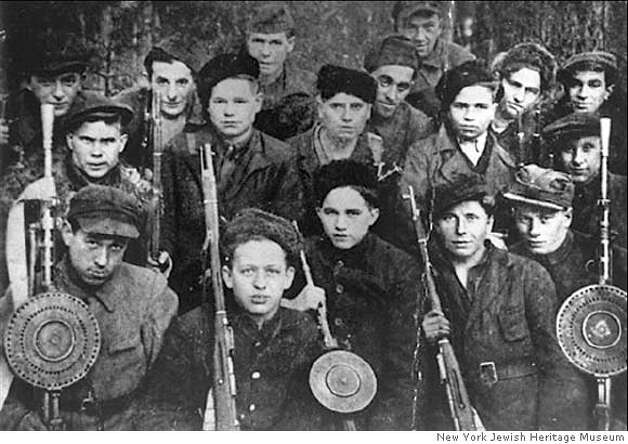
The Bielski Brothers gang; a group of Jews, mostly escapees from the various ghettos, who fought for years in the swamps of Belarus. Hundreds of Bielski’s people survived the war – the largest single Jewish partisan group.

And even from the depths of Concentration and Extermination camps, access to even a few guns bought some lucky, tenacious Jews a shot at survival.
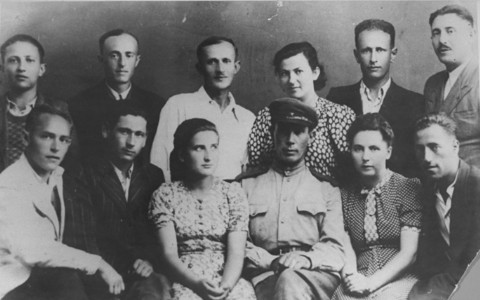
Some of the 50-odd survivors of the uprising at Sobibor, soon after the war. The guy on the right in the back row is Leon Feldhendler – a mild-mannered businessman from Krakow who led the revolt, who killed SS troopers with a homemade shiv, led 300 to freedom and 50 to survival, and who lived to the end of the war – to be killed by antisemitic goons in 1946. Evil never sleeps.  Its why we fight today.

And even if they didn’t survive – was it not better to die on ones feet, facing the enemy, maybe taking a few with, than to be slaughtered like sheep?  To be an instrument of God’s vengeance, in some  way small or large?

(There is a sliver of the academic grievance-mongering community that believes memorializing those who were able to fight back is prejudiced against those who died without fighting.  Nonsense.  Anyone who says they would or would not be among those who, under mortal but imponderable threat, absolutely would leave the world of the normal to go out and fight against an enemy that seems, at that moment and in that place, omnipotent and unbeatable, has been watching too many movies.  Although having the mindset is a good start.  At any rate, that particular bit of grievance-mongering is simply daft; do you think those who died in the gas chambers begrudged those who fought in the forests the shot they’d taken at freedom?  Do you not think those who fought in the forests fought, as best they could, on behalf of the victims who could not?  This sort of academic navel-gazing repulses me at a level too deep to discuss).

It’s not “the” Holocaust; it’s Rwanda. The things that are supposed to “never” happen “again” keep coming back to haunt us.

And so, even when I still called myself a “liberal”, maybe even a “progressive”, I slowly, furtively began feeling my way toward being a Second Amendment supporter.

It’s been accepted as a truism among Real Americans for decades – there’s never been a totalitarian dictatorship in a country with civilian gun ownership.  It’s not entirely true – the Nazis allowed some tightly regulated civilian guns – but one of the first of the Nuremberg restrictions on Jewish life barred Jews from having guns.
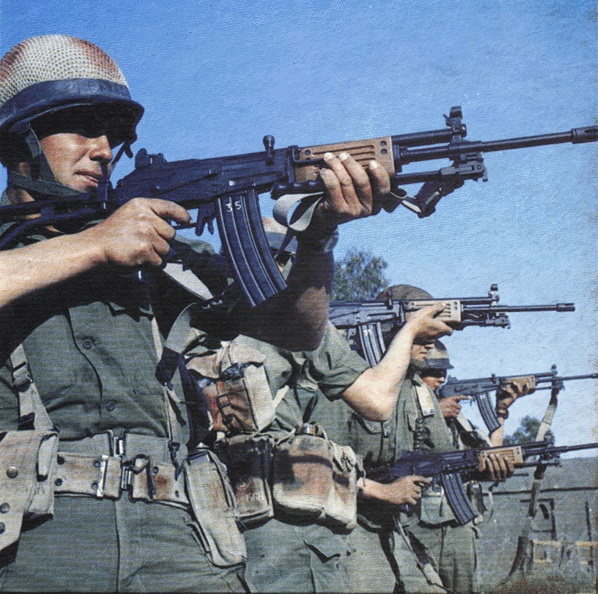
“Never Again”, Israeli-style.

It was the first, necessary step on the road to the Holocaust – denying the Jews the actual ability to be more than a speed bump on the way to extinction.

And I, and every Real American who learned the right lessons from history, live “never again” every day we go to the range.

Enforcing Non-Violence:  But one needn’t go to Europe, or even back seventy-five years, to find oppressed citizens winning their freedom through force of arms – in this case, the threat of it.

Martin Luther King gets a lot of credit – justifiably so – for leading the fight for civil liberty for blacks in South at the end of the Jim Crow era.   And even when I was in school, not all that long after the fact, we were taught that King’s victory was a victory of non-violent resistance.

The March on Selma was dangerous enough outside the watchful eye of the media. Out in the backwoods of Alabama and Mississippi, what was a civil rights worker’s recourse?

And it was true – in places like Montgomery and Birmingham, where and when the northern, urban media was there to keep a spotlight on things.

But much of the battle for justice and political equality was fought outside the glare of the media’s Klieg lights, in sharecroppers shantytowns and hollers and delta villages that hadn’t changed much since the Civil War.

The militia? You’re damned right it was.

And there – as documented in the book This Non-Violent Stuff’ll Get You Killedby Charles Cobb – it was black men and women, World War II veterans and lone activists and mutual-self-defense groups, with hunting shotguns and war-surplus rifles and relics handed down from God only knows when, black people seeking equality, their franchise and their justice stared down the Klan over open sights, deterring the worst of the violence, just as their great-grandparents, back from the Union Army, had nearly a century before.
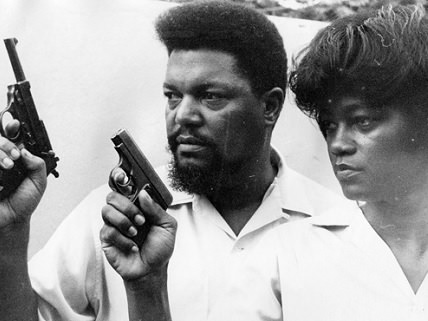
Black man, German pistol. BTW, don’t EVER put your fingers on the trigger until you’re ready to shoot. How many accidents has this photo inspired? Good Lord, people…

Even King himself carried a handgun through most of his travels, and his home was reportedly an “arsenal”.

Nicholas Johnson goes back further than Cobb, in Negroes and the Gun: the Black Tradition of Arms.   The case is convincing; had blacks not been able to deter Klan and supremacist violence in the sixties, the battle for equality would have been at the very least an incredibly bloody one, and at worst been either impossible, or a fault-line leading to another civil war.

All Together Now:  So we are a nation that is built on not merely the idea of freedom, but the notion that it’s our job to stay that way.   We are a people who know that government is at best imperfect at protecting us from crime, much less insulating us from tyranny.  And we – the ones who pay attention – know that at times, heaven forefend, it’s The People’s job to seize that freedom back.

Iraqi Christians, arming themselves to resist ISIS. What, you thought genocide ended in Rwanda?

And while the gun-grabbers ascribe a lot of motives to Real Americans’ struggle, from “defending gun industry profits” to “compensating for something, yuk yuk”, those are the reasons that keep us fighting, year in, year out.  They are the reasons we, the Real Americans, are the most successful grass-roots political movement in recent years.

And they are the reasons we can not rest on our laurels.  Evil never sleeps.  Either can we.

There you go, Heather Martens and Kim Norton and Barack Obama.  That’s why we fight.

And why you will lose.

To Sum It Up In A Sentence:  Freedom is endowed to us by our creator – but not everyone got the memo; history shows that the need to deter or repel threats to freedom, and life, are lamentably common.

This Series:

Small Victories

Thursday, January 14th, 2016

Making government follow the rules?  Should be a gimme.

It’s never a gimme.

But the folks at the Gun Owners Civil Rights Alliance (GOCRA) notched a couple of wins earlier this week.  You can, in fact, fight city hall.

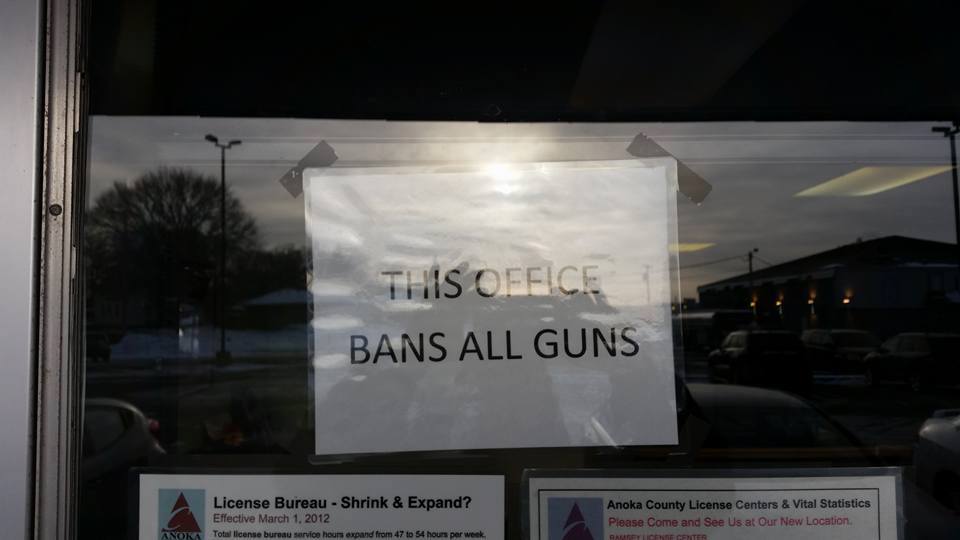
First?  A DMV office in Anoka tried to post itself “No Guns Allowed” – which is in fact against the law.

12417692_10154446347902542_31124408396677323_n

Click to see full-sized image. All photos courtesy GOCRA.

But the sign is gone now.   Which is a reminder, BTW – state and local government offices, except for courthouses and buildings that include courtrooms, can not be posted (Federal buildings can – don’t carry there).

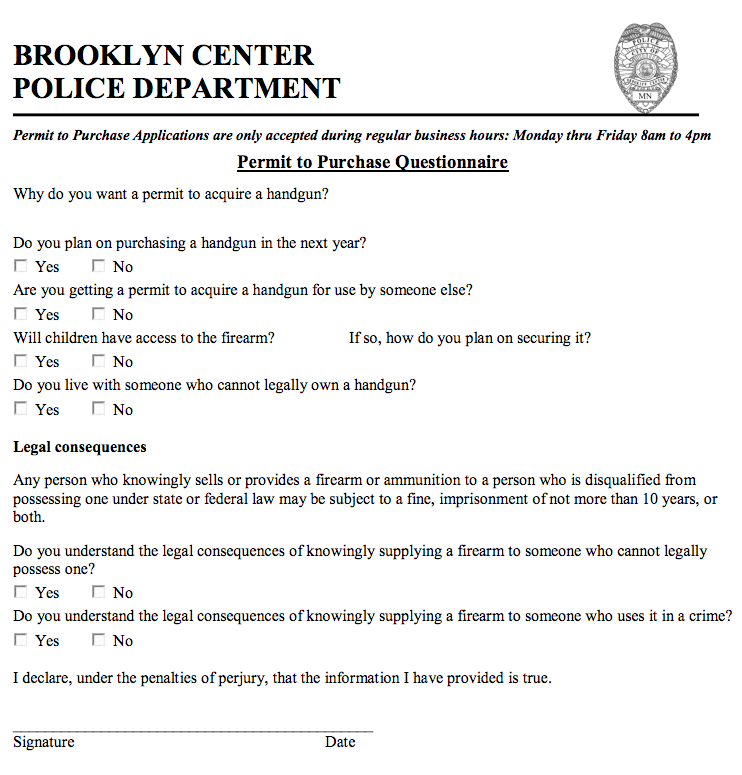
And the city of Brooklyn Center added its own special, extra-intrusive, and extralegal questionnaire to its “permit to purchase” process:

12541114_10154445718812542_4805513702416547423_n

Nosey much? Click to see full-size.

But it‘s gone now, too.

That, by the way, is a way you can help.  While most of the “No Guns Allowed” signs disappeared from private businesses within months of the passage of “Shall Issue” (gun owners are better customers and better tippers than the general public), every few months we see the occasional government office trying to sneak one in.

No dice, people.  Our civil rights are not negotiable.

Just a quick reminder – GOCRA has been in the civil rights business for 26 years, now.  It’s one of a number of great civil rights groups in the Twin Cities – and, on 2nd Amendment issues, it’s the big one.


Adrift

Thursday, January 14th, 2016

Joe Doakes from Como Park emails:

Justice Scalia says separation of church and state isn’t Constitutional law and shouldn’t be used to purge religion from the public eye.  I’d go farther and suggest the lack of shared moral behaviors is destroying the country.  If some of the country thinks it’s just fine to give false testimony against their neighbors (UVA “rape” scandal) and to covet their neighbors’ goods (Bernie Sanders), then the rest of the country never can be certain when they’ll be the next target, when they’ll lose their job to a false accusation, when their bank account will be looted, when their children’s future will be threatened.  And how does a nation obtain shared moral behaviors?


Joe Doakes

When you ask “atheists” “why is murder wrong”, and they (many of them) start with “it just is

, dude”, and work their way down to photomemes about how dumb Christians are, I’d say we’ve got a problem.

Why We Fight, Part III: The Public Good

Wednesday, January 13th, 2016

In Charles C.W. Cooke’s fantastic piece in National Review last week on the power of emotion in the gun debate, he made an excellent point; facts and statistics aren’t enough to really win this battle.  There’s a real, living, breathing emotional case to be made for the Second Amendment.  And while Real Americans have been winning the factual, statistical and legal case for decades, we need to win the emotional case – the case that speaks to America’s heart and gut and liver – before we can really relegate gun control to the shallow intellectual grave it belongs in.

History Repeats:  A longtime friend of this blog, long known as “Buddhapatriot”,  a charter MOB member, sent me a poem the other day.

“Community Organizers” in Mongol-run China

It’s from a post he wrote a couple years back:

Last year the edict forbidding us to ride horseback;
This year another edict saying we cannot carry a bow.
Yet we still hear about all those robbers who by the light of day
Ride their horses and shoot people on the empire’s highway.

Technology aside, it looks like it could have been written by anyone in Chicago, slaving away under a de facto gun ban as hoodlums shoot up his neighborhood.  It could even have been Otis McDonald himself.

But it was written in China, under Mongol occupation, in the 1300s.

Some things never change.

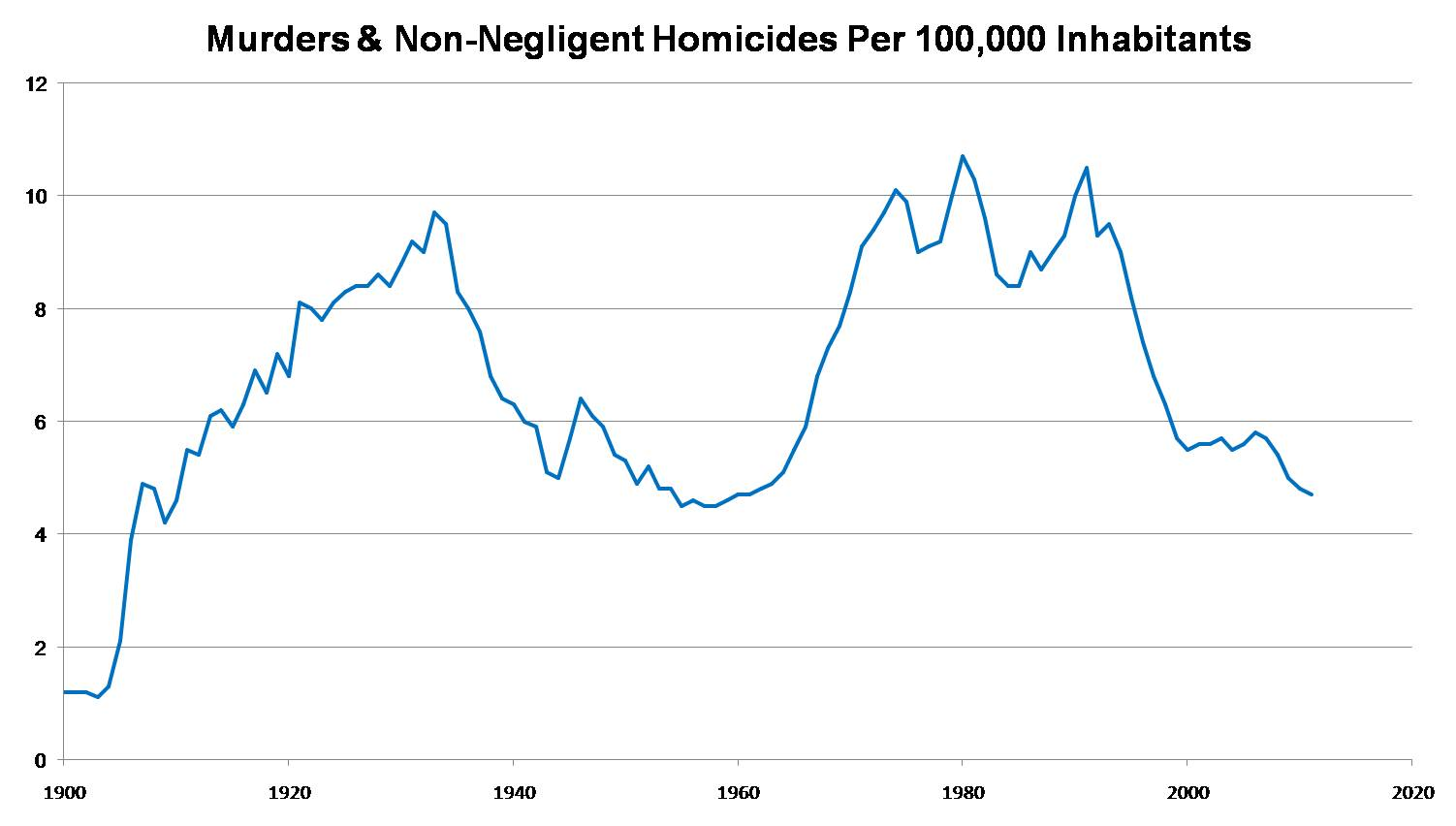
Numbers:  When America was founded, there was really no such thing as a municipal police force.  County sheriffs – with their strictly limited powers, and their volunteer posses – were often days away if trouble sprang up.

And yet crime in America, as a general rule, was exceptionally low.

Murder Rates Since 1900

That changed, somewhere along the way, of course.  About 100 years go, a variety of factors – urban crime, Prohibition and the concomitant explosion in organized crime and turf-protection murders – and then the War on Drugs and the 1968 Gun Control Act all correlated with massive surges in criminal homicide.

Do It Yourself:  Real Americans have always had an organic sense of law-enforcement; civic responsibility is part and parcel of participatory democracy.

And it’s by no means a given everywhere in the world.  Attitudes of civilians and citizens toward “law enforcement” vary widely, even wildly, around the world – and for good reason, since “enforcing the laws” (or engaging in a sham version of it) is often accompanied by brutal tactics, unaccountable power, and stunning, stunting corruption.  Worse than Chicago, even.

Even in “democracies”, the role of the citizen versus “law enforcement” is sometimes – for lack of a better term – brain-damaged.

As, indeed, it was in the United States.  At the nadir of the gun debate in the late seventies and early eighties, as major cities were enacting de facto or de jure gun bans, the individual right to self-defense was very much on the ropes.

I remember reading advice to people living in major cities in the seventies, urging people to carry a “mugging” wallet, with a little money – not too much to break you, not so little that the mugger would get angry – to give to muggers when you got stuck up. It was an abdication of our streets to our criminals – the smarter among us knew it.

Some New Yorkers are nostalgic for the Lindsay and Dinkins years. I suspect they may be the type of people who look forward to colonoscopies and tax audits.

And at the very nadir of that awful period came Bernard Goetz – who, sick and tired of the regular mugging, carried a gun.  It was against the law, of course – unless you had the political clout to get a carry permit, which many media and business figures did for the asking.

But not Goetz.  The humble electrical engineer, mugged one time too many, shot his way out of a jam in the New York subway in 1984.

The police arrested him, and New York’s pencil-necked, pasty, pusillanimous prosecutors, operating at the behest of an administration that figured armed criminals was better than safe people, prosecuted Goetz to the fullest extent of the law.

And a funny thing happened; America – even New York City’s cowed, pseudo-European subjects – feted Goetz as a folk hero.  Oh, the establishment media reviled Goetz, of course; What’ll happen if regular schnooks kill all the criminals, they gasped.

But Real America looked at Goetz, I think, and they saw…

…themselves.

In the early eighties, at the nadir of the American right to keep and bear arms, and the peak of the urban crime wave that only started to break 20 years ago, it was very easy to identify with Goetz; robbed over and over, first by street thugs, and then by thugs with law degrees or working for newspapers, Goetz’ situation reflected a lot of peoples’ fears – and his response sparked a lot of imaginations.

It may be uncaused correlation, a complete coincidence, that on the day Bernard Goetz shot his muggers, exactly eight states had “shall issue” laws, requiring states to prove one should not have a permit to carry a firearm;  by 1990, it was 15; by the 10th anniversary of his trial, 20; today, 42 of the fifty states have either “Shall Issue” or “Constitutional Carry”.

Was Bernard Goetz the cause celebre that led, slowly and circuitously, to the state we’re in today, with Real Americans in the ascendant?

I like to think they’re related.  Prove me wrong.

Beyond The Stats:  The statistics of civilian gun ownership in combating crime have been part of the diet on this blog since Day 1` – literally.

But beyond the numbers and the charts and the books?

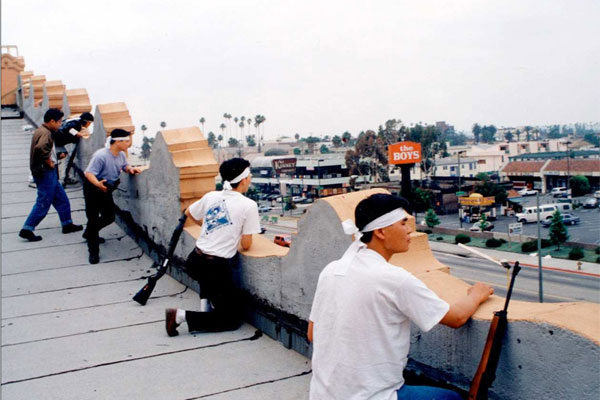
Americans (of Korean descent) protecting their property and lives during the LA Riots. If this doesn’t make you proud to be an American, then you need both heart and brain transplants.

There might be people in this country who don’t crack a smile when a typical schnook with a gun saves dozens of lives; whose step doesn’t quicken when the little woman with the kids repels the big bad robber; whose hearts don’t well up with pride when regular American schnooks seize order from disorder, as Los Angeles’ Korean shopkeepers did during the 1992 riots; They might exist.

But they’re not my  countrymen.

We are a nation, historically, that treats “keeping order” as a community activity.  And the message is getting out to The People, a majority of whom now believe that civilian carry makes us all safer.

May it ever be so.

That’s why we’re here.

To Sum It Up In A Sentence:   Americans were never intended to be helpless in the face of evil.

This Series:

Sources

Wednesday, January 13th, 2016

SCENE:  Avery LIBRELLE is sitting in a dilapidated Subaru outside Mitch Berg’s house.  LIBRELLE is peering through binoculars, and starts visibly when a glimpse of BERG is visible through the door window. 

Shortly, BERG emerges, walking his golden retriever. 

LIBRELLE:  (Leaps from car).  Merg!

BERG:  (Turns sharply, then relaxes as alarm turns to a groaning acceptance) Oh, hi, Avery.  (BERG notes the windows of LIBRELLE’s car).  Um, been waiting long?

LIBRELLE:  There’ve been seventeen killed in Chicago in the past ten days!

BERG:  Right.  And 117 total shot.  So…?

LIBRELLE:  By guns!

BERG:  Right.  It’s been in all the papers for years.  Parts of Chicago are incredibly violent,l even with all of the celebrated gun control they have.

LIBRELLE:  Hah!  But those guns come from rural red states!

BERG:  Come again?

LIBRELLE:  You heard the President in his Town Hall meeting!  All the guns used in urban shootings come from guys in vans selling them from their trunk in parking lots in rural red states!

BERG:  Well, for starters, no, they’re mostly stolen.  Often sold to others after being stolen.   Some come from straw buyers.  Almost none come from people selling otherwise legal guns.

LIBRELLE:  But if guns weren’t so available in the neighboring areas, urban crime wouldn’t be so high.

BERG:  If access to guns were the problem, wouldn’t the crime rate in rural Indiana be higher than in the middle of Chicago?

LIBRELLE:  (Mouth flaps open and shut a few times, like a boated bass).

(BERG continues on his walk)

(And SCENE).

--> Site Meter -->