Meth For Map Geeks
Monday, September 16th, 20131013 years of the European map.
1013 years of the European map.
I’ll be broadcasting live from Gander Mountain in Lakeville (I35 at the County 50 Exit).
You’re going to want to make it out there; they’re having another of their big defensive firearm days; you can actually try out sample firearms from factory representative for free at the Gander range. It’s fuuuuuun! (And I’m looking at the CZ75 in a whole new way)
I’ll be talking with Mark Walters and Rob Pincus from Armed American Radio about the victory in Colorado and the battle we Real Americans face in the coming year.
Come on out to Lakeville between 1 and 3PM tomorrow!
Joe Doakes from Como Park:
Hey Mitch, do SITD readers eat Booya?
I’m trying to decide whether to put it on my Bucket List, or give it a pass. Let’s take a poll: what’s the readership’s opinion?
Joe Doakes
Como Park
For the first time since before the 2008 election – actually, probably since 2006 – I re-read my 2004 series, “Secession Diaries“, the other day.
After the 2004 election, pouting lefties proposed allowing the blue states to secede and unite with Canada, creating two countries – the “United States of Canada”, the progressive blue/Canadian union, and “Jesusland”, the red states.
My series explored the results of a potential split. And it was fictional.
Or…was it?
In rereading the series, I was a litte amazed at how many of my comic japes from nine years ago have actually come to pass. Example: in the story, a hurricane devastates the Mid-Atlantic. Relief efforts are hampred by union goons ejecting non-union relief workers. Fact or fiction? Both!
I will submit it for your approval. And partly to start my head churning for an update.
Since the end of World War II, the mantra of government and business is that “we need more kids to grow up to study Science, Technology, Engineering and Math” – aka “STEM”.
And yet if you work in technology, you know that in vast swathes of the field, there’s no real shortage of people. Especially in IT; even as baby boomers retire, there is plenty of unemployment among IT people; even as demand for IT workers booms, the supply seems to more than keep pace. Have you checked out the contract rate for web coders or support analysts lately?
And yet the government keeps cajoling our “best and brightest” to go into STEM.
Why?
To keep the costs down, perhaps?
As this piece in the IEEE Spectrum notes, not only is there no shortage of STEM professionals, there’s an apparent skills mismatch, with many “STEM” careers being held by non-STEM degree-holders (I’d be one of them, by the way), and many STEM degree-holders working outside science and technology.
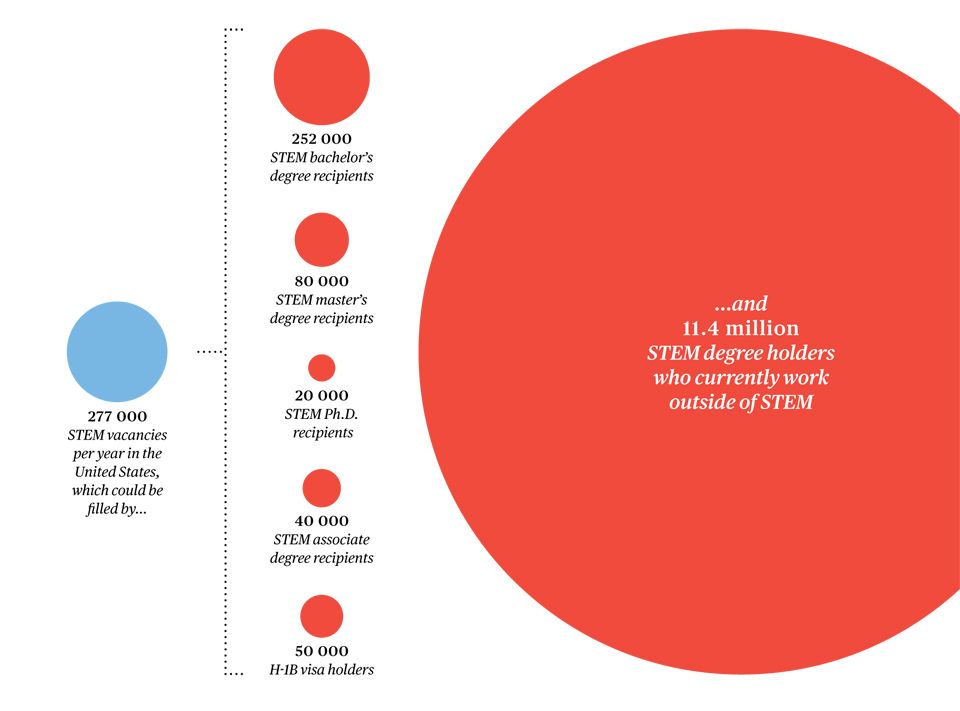
And yet the establishment keeps driving more people into STEM, and importing more programmers, engineers and technicians from overseas.
Why?
Clearly, powerful forces must be at work to perpetuate the cycle. One is obvious: the bottom line. Companies would rather not pay STEM professionals high salaries with lavish benefits, offer them training on the job, or guarantee them decades of stable employment. So having an oversupply of workers, whether domestically educated or imported, is to their benefit. It gives employers a larger pool from which they can pick the “best and the brightest,” and it helps keep wages in check. No less an authority than Alan Greenspan, former chairman of the Federal Reserve, said as much when in 2007 he advocated boosting the number of skilled immigrants entering the United States so as to “suppress” the wages of their U.S. counterparts, which he considered too high.
And it helps inflate the higher-ed bubble, too:
And the perception of a STEM crisis benefits higher education, says Ron Hira, because as “taxpayers subsidize more STEM education, that works in the interest of the universities” by allowing them to expand their enrollments.
An oversupply of STEM workers may also have a beneficial effect on the economy, says Georgetown’s Nicole Smith, one of the coauthors of the 2011 STEM study. If STEM graduates can’t find traditional STEM jobs, she says, “they will end up in other sectors of the economy and be productive.”
The problem with proclaiming a STEM shortage when one doesn’t exist is that such claims can actually create a shortage down the road, Teitelbaum says. When previous STEM cycles hit their “bust” phase, up-and-coming students took note and steered clear of those fields, as happened in computer science after the dot-com bubble burst in 2001.
Emphasizing STEM at the expense of other disciplines carries other risks. Without a good grounding in the arts, literature, and history, STEM students narrow their worldview—and their career options. In a 2011 op-ed in The Wall Street Journal, Norman Augustine, former chairman and CEO of Lockheed Martin, argued that point. “In my position as CEO of a firm employing over 80 000 engineers, I can testify that most were excellent engineers,” he wrote. “But the factor that most distinguished those who advanced in the organization was the ability to think broadly and read and write clearly.”
For all the sneering people are doing at humanities these days – and I have a BA in English with minors in History and German – the selling of the STEM “crisis” seems to be a move to commoditize technical skill. Communications is no commodity, though – and it seems to be what still what separates a bench engineer and their supervisors.
So is the education system short-changing students by preaching STEM as the be-all and end-all of opportunities?
If you packed the entire world’s population together equal to the densities of some of the world’s major cities, how much area would that entire population cover?
This, and many other questions, are answered among the “40 Maps that will Help you Make Sense of the World”

This stuff is like crack to me.
“No guns in capitol!”,
Michael Paymar says amid
Capitol Police.
Mulligan Session!
The only real question is
which “Fail” to start with.
The NARN is Fair-bound!
Again, the constant battle
against the cheese curd.
Chaos in Egypt.
How often must I explain
it’s not that “Morsi”.
35 choices
as Minneapolis votes.
“Instant” runoff? Hah!
The history books
Say we’re created equal.
Some, moreso, I guess.
Ryan Winkler called
Clarence Thomas “Uncle Tom”.
Thomas: “Sorry – who?”
Zygi Wilf? A crook?
He seemed so above reproach!
Who woulda thunk it?
Governor Dayton
sees Alida, starts to sweat.
“No more shock collar!”
Welcome, darling kids!
Time to meet your new sitter
Sal “Bug-Eyes” Rossi.
Ryan Rhodes on the Twitterverse live-tweeting the Declation of Independence.
I’m hesitant to link it. Someone from the “Jon Stewart is the News!” set will write it down on an essay test.

Apropos nothing.
Anyway, read it.
Hop to it!
Although there was a general assumption when I was in high school and college that I’d wind up in some kind of graduate school or another, I stopped with the formal schooling (as distinct from getting an education) with my BA.
I did it for a couple of reasons:
So unless I hit the powerball – which might lead me to a design-your-own “Masters” in German, writing, history and filmmmaking from whatever institution that’d let me put it together – I strongly doubt you’ll see me darken the door of a grad school, ever.
But if this were closer than Boulder, I could see myself changing my mind.
The Goodyear Blimp is going to be replaced by the Goodyear Zeppelin.
Don’t know the difference (I did – as a result of a long jag of obsessive reading about lighter-than-air craft in elementary school and junior high)?
Well, you will.
For years, I’ve said that measuring relative incomes is a lousy way to gauging a society’s economic success; it’d be much more useful to try to gauge, on an individual level, upward and downward lifetime income mobility.
And voila – the NYTimes has released what it terms as a “ground-breaking” study on income and social mobility in America…
…and promptly turned it into a plea for more government intervention in the economy.
Climbing the income ladder occurs less often in the Southeast and industrial Midwest, the data shows, with the odds notably low in Atlanta, Charlotte, Memphis, Raleigh, Indianapolis, Cincinnati and Columbus. By contrast, some of the highest rates occur in the Northeast, Great Plains and West, including in New York, Boston, Salt Lake City, Pittsburgh, Seattle and large swaths of California and Minnesota.
“Where you grow up matters,” said Nathaniel Hendren, a Harvard economist and one of the study’s authors. “There is tremendous variation across the U.S. in the extent to which kids can rise out of poverty.”
I’ll take a break from the conclusions for a moment to show this pretty slick map from the Times piece:

It measures the probability that a child born into the bottom fifth of incomes would rise to the top fifth, which is noted in the graphic’s fine print as $70K by age 30 or $100K by age 45.
The “study” shows correlation and doesn’t attempt to find causations – although plenty of lefty commentators have tried to do it for them.
My native North Dakota shines, of course – the western parts of the state used to be relatively poor, and are now explosively wealthy. But even the oil-free parts of the state, like my native Stutsman County, are solidly in the 20% range.
As, for that matter, are the more Republican-leaning parts of Minnesota. And no, I’m not ascribing causation. Merely noting a correlation.
Back to the Times:
That variation does not stem simply from the fact that some areas have higher average incomes: upward mobility rates, Mr. Hendren added, often differ sharply in areas where average income is similar, like Atlanta and Seattle.
The gaps can be stark. On average, fairly poor children in Seattle — those who grew up in the 25th percentile of the national income distribution — do as well financially when they grow up as middle-class children — those who grew up at the 50th percentile — from Atlanta.
The article ascribes a few conclusions to the study; mainly, location matters, as does the proximity of wealth to poverty. Which might seem to make sense – if a poor kid can see the consquences of applying oneself, they may well stand a better chance to improve their lot in life, maybe, hopefully.
But as in the quote above, the article focuses on Atlanta (go ahead, read it) and juxtaposes it with Seattle, by way of noting that the Deep South is the biggest blotch of low income-mobility in the country.
I’m going to suggest (and it’s only a suggestion, since I have neither the time nor money to conduct a full-fledged study elaborating on these results) that the cause of it all ties back to local society’s valueing upward mobility. Big swathes of this country are descended fron pioneers and immigrants who saw upward mobility as an unalloyed good. But for much of antebellum (and a good chunk of post-bellum) southern society, upward mobility was historically either a serious risk (for slaves, getting “uppity” could have life-altering consequences) or irrelevant (for “white trash”, who were a peasant class in every way but name, upward mobility was just not part of the vocabulary).
So I’d say upward mobility is as much a matter of the part of society you were born into as it is geographical location (and the arrangement of “rich” and “poor” zip codes and the density of mass transit that goes along with it).
Again, just an opinion.
ADDITIONAL THOUGHT: I’m wondering – why can’t we do the same sort of analysis on schools? Specifically, instead of analyzing school test scores, look at the progress (or lack of it) by individual student. Especially when comparing traditional public school students with charter school students.
To: American Psychiatric Assocation (APA)
From: Mitch Berg, uppity peasant
Re: Cyberphrenia
To whom it may concern,
Please accept the following submission for the sixth edition of the Diagnostic and Statistical Manual (DSM-6), whenever you release it:
Cyberphrenia: a personality disorder which presents with a complete dissociation between the subject’s “online” and offline personalities.
This usually (but not uniformly) manifests as a subject developing an “online” personality that manifests as negative ideation ranging from mild impulse-control and conduct disorders to symptoms resembling full-blown sociopathy or narcissistic personality disorder.
Keep me posted.
That is all.
…is when can I take it to work in the morning?:
Like most Americans, I observed the Independence Day holiday.
And given the state of the nation, it got me thinking; liberty and conservative-minded people need a new observance.
Because as Ben Franklin noted, a republic is a great form of government, if you can keep it
So once the declarations are read and the fireworks are shot off? That’s when the hard part – keeping your democracy – begins.
And what better day for than July 5th?h
Joe Doakes from Como Park is a pretty peripatetic writer. Some weeks, he sends me a couple emails on a couple of issues.
Other weeks, I think he may write more stuff than I do. And he doesn’t actually want to write for this blog, per se; just likes to send “letters to the editor”.
And I figured it was time I pared down some of the backlog. So today, I’m going to run a slew of Joe’s emails that, for whatever reason, I didn’t run during this past week or so.
Starting with this one:
Come on, give the guy a break. It’s like Elizabeth Warren claiming to be an Indian, Halle Berry claiming to be a Black woman, or President Obama claiming to be an American – it’s a matter of desire, not evidence.
joe doakes
The guy doesn’t look a day over 85…
The time of year for senseless-but-fun studies trying to associate peoples’ traits, behaviors and peccadilloes to their politics.
Today? What your choice of beer says about yoru politics:

Smithwick’s is never mentioned. What are they afraid of?
(And who am I kidding? It’s always that time of year. Although I’m sure it’s time for a “study” “proving” that liberals are smarter, any ol’ time here).
A slew of bars in New Jersey, including 13 franchised TGI Fridays, were busted for selling caramel-colored rubbing alcohol as top-rail scotch, among other things:
At one bar, a mixture that included rubbing alcohol and caramel coloring was sold as scotch. In another, premium liquor bottles were refilled with water – and apparently not even clean water at that.
State officials provided those new details Thursday on raids they conducted a day earlier as part of a yearlong investigation dubbed Operation Swill.
Twenty-nine New Jersey bars and restaurants, including 13 TGI Fridays, were accused of substituting cheap booze – or worse – for top-shelf brands while charging premium prices.
That would explain a lot of the “top shelf” scotch I’ve had, come to think of it…
…when you find that in some area of you life where you always felt like a freak…

…that you’re not as alone as you thought.
For instance, when the lefties start tittering about some self-serving study that claims to show liberals are smarter – another round of which we’re no doubt due for.
It’s good for a giggle – or, if you’re not so bright, as a keystone of your worldview.
So it’s with that subtext in mind that I submit this without additional comment.
Answering spam emails:
From: Carl Catlin <ccatlin[redacted]@yahoo.com>
To: [Me]
Sent: Monday, April 29, 2013 2:56 PM
Subject: Philippines Trip(Sad News)……..Carl Catlin
Just hoping this email has reached you well, I’m sorry for this emergency and for not informing you about my urgent trip to Manila, Philippines but I just have to let you know my present predicament.
Everything was fine until I was attacked on my way back to the hotel, I wasn’t hurt but I lost my money, bank cards, mobile phone and my bag in the course of this attack. Immediately contacted my bank in order to block my cards and also made a report at the nearest police station.
I’ve been to the embassy and they are helping me with my documentation so i can fly out but I’m urgently in need of some money to pay for my hotel bills and my flight ticket home, will definitely REFUND as soon as back home .
Kindly let me know if you would be able to help me out so I can forward you the details required for a wire transfer.
Waiting to hear back from you..
Sincerely,
Carl
My response:
Carl,
Bubbie! Sorry to hear about your predicament.
I’d love to help, since I just know you’re good for the money.
Sorry to say, though, that we’re birds of a feather as always. I, too, am in the Philippines, sightseeing near Manila, in the city of Las Piñas. And I, too, was waylaid by ruffians. Six of them.
I killed the first five – two with my bare hands. The six, I let go, as is – as you’re well aware, my old friend – my wont.
As the sixth ran away, a Philipino policeman walked up to me to take the report. As the sixth yegg ran toward the horizon, the policeman asked me if I was up for a wager; could I hit the blackguard?
Well, the ne’er-do-well was nearly 300 yards away, and I had a little .380 pistol, but you know how I like a bet – and what happens in Las Piñas stays in Las Piñas! So I went all-in – all the money I had.
Well, I choked, and it took me two shots to fell the miscreant. But a bet is a bet.
So I’m afraid I’m not only a tad short at the moment, but in the same boat you are.
Sorry about that. Drat the luck!
Your friend,
Mitch
I’m dying to see the response.
It had to happen:
I’m figuring it’s more a “Byerly’s” thing than a “Rainbow” thing.
Joe Doakes from Como Park emails:
Minutes of meeting of Chief of Naval Operations and staff:
CNO: “You know, I have one simple request. And that is to have sharks with frickin’ laser beams attached to their heads! Now evidently my colleague informs me that that cannot be done. Ah, would you remind me what I pay you people for, honestly? Throw me a bone here! What do we have? ”
Joe Doakes
Como Park
Hint: buy stock in armature companies.
…I offer that should a certain Japanese megacorporation ever have to file bankruptcy, I’ve already filed my claim on the blog post title “Tempus Fujitsu“.
That is all
Jenna from Shoreview sent me this story; an owl attacked several suburban-Chicago dogs:
Fresh from an Army tour in Iraq, Evans’ daughter Amy was visiting for the holidays with her husband, five kids and two dogs. One of her dogs, Ramadi, a 7-pound shih-poo (a mix between a shih-tzu and miniature poodle), was in the back yard with her parents’ rottweiler, Eli, and their 70-pound boxer, Sadie.
“When I came out the door I saw Sadie on top of something and thought it must be another dog, but it was really dark so I couldn’t see,” Evans said.
He called the rottweiler inside. Little Ramadi came running too, dragging something, with Sadie giving chase.
“Suddenly I realized an owl had its talons sunk into Ramadi and Sadie was trying to get it off of her,” Evans said. “When they got to the door we were able to separate Sadie from the owl and my wife pinned the owl to the ground with her foot as I ran to get some gloves.”
According to some sources, the long winter is making owls a little more bold in their hunting.
Me? I think we need to devote some scientific effort to domesticating the owl. I think police owls would be a lot more cool than police dogs – and police dogs aren’t un-cool themselves.
Apropos not much.
The Monday Morning Quaterbacking over electronic gambling heats up.

Two gambles that haven’t paid off
When breaking down the various back-up funding plans for the Vaseline Dome, one step was neglected – the finger pointing.
For a funding mechanism that was originally billed to deliver $35 million in revenue per year, and continuously revised down to $17 million and then $1.7, the process of assigning blame should have been viewed as inevitable. But like a legislative Atlas, who would shoulder the majority of the ownership of such a flawed model? Gov. Mark Dayton, who was so publicly aggressive in his defense of a new stadium? The hapless former Republican legislative majorities who acquiesced to the bill? The Star Tribune, whose rampant conflict of interest with any Metrodome-site construction should have called into question their vocal support?
No, the Star Tribune has decided the real culprit are the gambling firms that provided the electronic pull-tab games:
While flawed, the gambling board’s sales estimates were extremely detailed, including the number of bars and restaurants that would adopt e-gambling, the number of devices in play, what hours they would be played and how much money would be wagered.
It projected 2,500 sites would be selling electronic pulltab within six months, or nearly 14 bars and restaurants joining in per day….
Nearly a year after those projections were made, about 200 Minnesota bars and restaurants offer electronic pulltabs, not the 2,500 that had been predicted. Electronic bingo games have just been introduced.
Average daily gross sales for electronic pulltabs have increased to about $69,000, but sales per gambling device have declined.
The firms may have been making bad assumptions about the capacity for Minnesota to support increased charitable gambling, but at least the firms’ figures came out of experiences in states like Montana, South Dakota and Oregon. Still, the basic math of the gambling mechanism was public knowledge long before it was formally added to the final bill.
Minnesotans spend about $1 billion in charitable gambling, which equals the comparatively paltry sum of $36 million in revenue. The Vikings stadium, requiring $35 million a year to cover the State’s $348 million share, would necessitate charitable gambling to either double to $2 billion or entirely overrun the current charitable competition. In that light, it’s little wonder that other charitable organizations were not asked for their opinion. A decision that now is being heavily criticized as charities across the State say some version of “I told you so.”
All the finger-pointing in the world doesn’t help hide the reality that the responsibility for flawed legislation needs to rest with the political leadership that authored it – a fact even the Star Tribune acknowledges:
“There was a willful blindness … driven by pressure politics,” charged David Schultz, a Hamline University political analyst and a professor of nonprofit law…
“This was a deal that was going to happen no matter what,” Schultz said. “The governor wanted a stadium. The money couldn’t come from the general fund. The charities had been asking for electronic games.”


You are currently browsing the archives for the Geekery category.


