Archive for April, 2013

An Idea Whose Time Has Come

Tuesday, April 23rd, 2013

The best legislation happens when sarcasm turns into policy:

When Rep. Steve Drazkowski, R-Mazeppa, introduced an amendment that would require drug tests for Minnesota welfare recipients, Rep. Tina Liebling, DFL-Rochester, countered with an amendment to the amendment. If welfare recipients had to pee in a cup before they could get a check from the state, she said, state lawmakers should have to do the same.

“You should be ashamed. You should really be ashamed to be using poor kids” to score political points, Liebling told Drazkowski during floor debate.

Blanket drug tests for lawmakers, she said, makes about as much sense as blanket testing of participants in the Minnesota Family Investment Program, or MFIP.

To which every single Minnesotan responds “Hell yeah!”   And those of us who work in the private sector added “if we have to take the whiz test before job offers become official, then yes, let’s make sure both welfare recipients and the legislature, and maybe every single government employee, does the same”.

To their credit, so did the House:

Liebling’s amendment might have been ironic, but it won enthusiastic support from both sides of the aisle. Liebling’s amendment to the amendment was adopted with the support of all but a dozen lawmakers, including House Speaker Paul Thissen. Drazkowski’s amendment passed by a vote of 83-49.

I’m sure the amendment will get scrubbed out over time.  But for the moment, it makes epic sense.

Slump

Tuesday, April 23rd, 2013

Remember when the President’s gun control bill had overwhelming public support?

Either does the public.

Picking Winners

Tuesday, April 23rd, 2013

Remember when Democrats claimed to be for the little guy and against big institutional businesses?

Obama supports the “Marketplace Fairness Act”, which would tax online purchases:

Senators advanced the bill in 74-20 procedural vote on Monday evening, just one vote short of the backing it received in a test vote last month. Twenty-six Republicans joined Democrats in moving forward with the bill.

(Or when Republicans claimed to be pro-business?)

Oh, yeah – both A-Klo and Stuart Smalley voted for the bill.

Major retailers are putting all their lobbying muscle behind the legislation, arguing it would close an unfair loophole that benefits online merchants over brick-and-mortar stores. The National Retail Federation, which represents chains such as Best Buy, Macy’s and J.C. Penney, and the Retail Industry Leaders Association (RILA), which counts Target and others among its membership, announced it would score lawmakers’ votes.

The bill would also make it possible for states to tax financial transactions – trades for your IRA, moving money around in your 401K and the like.

But signs of trouble for the bill also emerged as Wall Street groups urged the Senate to slow down and eBay began marshalling its users in a massive campaign to kill it.

The Securities Industry and Financial Markets Association and the Financial Services Roundtable said the measure could pave the way for financial transaction taxes on the state level, an idea that Wall Street and its supporters fiercely oppose.

“A transaction tax on financial services products will hurt retail investors, retired Americans, and small businesses, effectively making it more expensive for them to invest and plan for the long-term. Without hearings, these implications and others will not be properly addressed” [said Scott Talbott, senior VP of public policy at the Securities Industry and Financial Markets Association and the Financial Services Roundtable]

Democrats (and some Republicans); dragging the parts of the economy that work down into the same pit of suck that the rest of the economy is in.

Nature Abhors A Vacuum

Tuesday, April 23rd, 2013

Joe Doakes from Como Park writes:

The Gosnell trial is in its 5th week but until six days ago, the Star Trib’s policy on the case was:


[crickets]


What changed was this column by USA Today columnist Kirsten Powers, published April 11th .  Shameful, Star Trib.  Just pathetic.

Joe Doakes

Como Park

 If they had any sense of shame at the editorial level, they wouldn’t be the paper they are today.

Groundhog Year

Monday, April 22nd, 2013

When Second Amendment human rights activists saw the movie Groundhog Day, we had two reactions:

  • How the hell was it that Andie McDowell was the big break-out actress from the movie Sex, Lies and Videotape, and Laura San Giacomo languished in obscurity on LIfetime movies and the series “Just Shoot Me”?  [*]
  • This isn’t a comedy.  This is a documentary.

Repeating the same day over and over and over and over and over and over again – it’s sort of what we Second Amendment activists do.  Only the cycle, at least in terms of the media’s approach to the issue, runs about every five years or so.

Because there are  no new questions on this issue.  Since the 1960s, it’s been the same tiny set of points, accusations, strawmen, red herrings and the odd honest question, over and over and over again.

I’ve been active in the Second Amendment human rights movement since the eighties.  I’ve been through a series of cycles in media and astroturf interest in the subject; the wave of post-office mass murders in the eighties (whose main vestige today is the phrase “going postal”), the Florida “shall issue” bill, the Stockton schoolyard massacre, the Luby’s massacre and a few copycat episodes, the Shall Issue debate in Minnesota, Columbine and the small wave of copycat school shootings (including the Red Lake massacre in Minnesota), Virginia Tech, and finally the three big shootings of this past year and a half, the Giffords, Aurora and Newtown shootings (but never, it seems over Washington DC or Chicago).

Each of the episodes had a different story.  But each of them brought out basically the same set of questions, largely from media people who thought they were the first to ask the questions.  They start with the simple, situational questions – “why does anyone need a thirty round magazine?” – and graduate to The Big Questions, “what does the Second Amendment really mean, and do we need it at all?”.

Every.  Single.  Time.

Anyway – Eric Black at the MinnPost spun the wheel this past week, writing a three part iteration of a whole long slew of the same questions about the Second Amendment that, depending on how long you’ve been a Second Amendment human rights activist, you might have lost count of the times you’ve answered.

But the goal, always, for the Second Amendment human rights supporter, isn’t to do the end-zone happy dance over past triumphs.  It’s about convincing and persuading successive generations of people about the rightness of the cause.

And so as this week progresses I’ll be addressing the points in Black’s series.

Stay tuned through the week.

(more…)

Because Hitler

Monday, April 22nd, 2013

NPR’s Nina Temple-Raston intones to her white, upper-middle-class, degreed, free-range-alpaca-wearing, Volvo driving audience last Wednesday that the Boston Marathon Bomber was probably a white extemist…

…because right-wingers love April.

It’s the anniversary of Waco, Columbine and Hitler’s birthday, after all.

I wasn’t aware the Klebold and Harris were right-wing figures.  Hitler shouldn’t be, although some on the “extreme right” have accomplished that ex post facto.

It’s also the month of the Warsaw Ghetto uprising.  But not a word about Jewish extremists, for some reason.

This was two days before we learned that the alleged bombers weren’t right-wingers at all.

But remember – there is no liberal bias at NPR.

No Crisis To Waste

Monday, April 22nd, 2013

The anti-gun movement thought they smelled blood in the water; the Tsarnaev brothers had guns.

Which meant – to the anti-gun orcs – that they were an example of what any law-abiding schnook with a Glock might become.

But no – the Tsarnaevs had their guns illegally:

In the confrontation with police on the streets of a Boston suburb, Tamerlan and Dzhokhar Tsarnaev were armed with handguns, at least one rifle and several explosive devices, authorities say.

But neither brother appears to have been legally entitled to own or carry firearms where they lived, a fact that may add to the national debate over current gun laws. Last week, the U.S. Senate rejected a bill to expand background checks on gun purchases, legislation that opponents argued would do nothing to stop criminals from buying guns illegally.

Tamerlan Tsarnaev, 26, who was killed in the shootout with police, would have been required to apply for a gun license with the local police department where he lived in Cambridge, Massachusetts.

But there is no record of him having done so, according to Cambridge Police Department spokesman Dan Riviello.

Even if he had earlier received a gun license from somewhere outside Cambridge, that license would have to be registered with Cambridge police upon becoming a resident of the city, Riviello said. In Massachusetts, gun licenses are issued by municipal police departments.

“There is no record of him having a license to carry,” Riviello told Reuters.

The left so, so hoped that this would help re-start their failed gun grab efforts.

They Warned Us…

Monday, April 22nd, 2013

…that if we gave carry permits to civilians, and allowed people outside law enforcement to carry firearms, there’d be people pointing guns at each other over trivial things.

And they were right!

It’s The People, Stupid

Monday, April 22nd, 2013

Joe Doakes from Como Park emailed me a link to this piece, by Richard Fernandez of Belmont Club in re not so much the police response to the Boston Marathon bombing, but our newfound cultural non-response to all sorts of violent threats:

Read the whole thing, natch – but here’s the money quote;

We focus on things because it is prohibited to focus on people. The TSA looks for things — scissors, liquids, shoes, etc — but it doesn’t stop the underwear bomber. People now want to blame “access to guns” for the Tsarnaevs. But it would be uncouth to ask about what they heard from their imam or their teachers.

This is in contrast to the “El Al” system of screening. They look at the man first. “Who are you?” is in many ways more important than “How long are your scissors?” But since we can’t inquire into the man, might as well look into the scissors.

As time passes, more and more acquaintances will come forward saying, “Well, come to think of it he did say this and that and this. …” It will transpire that many knew. Many suspected.

But no one came forward. Why not? Because the system doesn’t do things. It doesn’t do people. It doesn’t do mental strife. But the system has really nifty swords. Armored vehicles, dogs, drones, thermal scanners, .50 cal sniper rifles. Heck, there might even be a minigun or two out in Watertown. Betcha they work real good too. Pity they might have to be used in those neighborhoods.

It’s easier to clean up messes afterwards (and creates more unionized public works jobs!) than to risk the lawsuits involved in getting it right in the first place.

I Heard It On The NARN

Saturday, April 20th, 2013

Here’s the article in New Yorker I talked about.

NARN Today

Saturday, April 20th, 2013

Today, the Northern Alliance Radio Network – America’s first grass-roots talkradio show – brings you the best in Minnesota conservatism, as the Twin Cities media’s sole source of honesty!

  • I’ll be in from 1-3PM.
  • Brad Carlson is back on “The Closer” from 1-3 tomorrow. Tune on in!

(All times Central)

So tune in to all four hours of the Northern Alliance Radio Network, the Twin Cities’ media’s sole guardians of honest news. You have so many options:

  • AM1280 in the Metro
  • Streaming at AM1280’s Website
  • Streaming on IHeartRadio
  • On Twitter (the Volume 2 show will use hashtag #narn2)
  • Via UStream video and chat
  • Send us an SMS text message – 651-243-0390
  • Good ol’ telephone – 651-289-4488
  • Podcasts are now available; for my show and for Brad’s
  • And make sure you fan us on our new Facebook page!

Join us!

Tonight’s The Night!

Friday, April 19th, 2013

It’s the eighth or ninth annual Minnesota Organization of Bloggers Winter Party!

It starts at 7 at Ol’ Mexico, and lasts until we’re done.

Ol’ Mex is in Roseville, just north of Larpenteur on Lexington.


View Larger Map

Whoever you are – blogger or reader, liberal or conservtive or just don’t care, fan or detractor, writer or subject – we’d love to meet you! Drop on by!

Far Beyond Hope

Friday, April 19th, 2013

I started reading about the Holocaust way too young. In ninth grade, I tackled the Black Book – the B’nai B’rith’s compendium of Nazi atrocities against the Jews of Europe.  In retrospect, it may have been one of the things that started me thinking that maybe liberalism wasn’t for me; it certainly started me on the road toward being a Second Amendment supporter.

But we’re getting way ahead of ourselves, here.

One of the themes of the book – and of the story of the Holocaust, in retrospect -was that it snuck up on people; that many, even as they saw their rights being gutted and their businesses confiscated and their lives upended, just couldn’t imagine that it’d get worse.   Even as they were being loaded up and sent to ghettoes in Poland, they just figured there’d have to be a rational conclusion to it all.

The history of human tragedy is that the people who see it coming get labeled as crazies, politely inoculated off from society.

The other theme?  The few who saw through the illusion of rationality were capable of nearly superhuman courage.  As the Holocaust spun up to full speed about this time seventy years ago, there were a painfully few people who managed to make it hurt the Nazis just a little.

It was seventy years ago today that the Warsaw Ghetto Uprising began.

The story is well-known to people who know their history – which means most Americans know nothing about it.

Before there were concentration and extermination camps, the Nazis used the traditional Jewish “Ghettos” of Eastern Europe as natural “camps” in which to confine the Jews, Gypsies and the rest of their targets. They systematically deported Jews from all over Poland, Ukraine and Russia – and then all over Europe – to these small enclaves in Polish, Baltic and Ukrainian cities, using them as holding tanks until the camps – the last link in the Final Solution – were ready.

And in early 1942, they were ready.  The Germans started shipping Jews off to Treblinka, the first of the Vernichtungslagern, or Extermination camps.

And in the overcrowded, starving, disease-ridden Warsaw Ghetto – the realization that the end was near provoked a response from some of the inmates; it’d be better to die fighting.

And so a resistance movement,armed with a few stolen handguns and rifles and grenades and some homemade bombs, had formed.  In the previous months, it had managed to disrupt some of the roundups to the camps, throwing the Germans’ plans – as precise as any industrial supply chain management system – into disarray. And on April 19, the Germans’ military response was met with armed resistance.

On the morning of April 19, the Nazis marched into the Ghetto to begin the final liquidation, a brutal process like the one Steven Spielberg captured in the horrific scenes in the “Krakow Ghetto” in Schindler’s List.

It was a scene that’d repeated itself all over Eastern Europe; the SS would forcibly haul the Jews out of the Ghetto and herd them onto boxcars for transportation to one death camp or another.

But this time was different.  As the Germans came through the gate, the were met with gunfire and explosives and molotov cocktails.  They retreated in disorder, with 12 dead.

For the first time, the Germans had come for the Jews, and the Jews beat them back.

It couldn’t last, of course; the Jews’ guns numbered in the dozens, the German troops in the thousands.  They came back again, this time fighting block to block with artillery and flamethrowers.

They killed everything in their path in a fit of retributive blood lust.

The Jews – hopelessly outnumbered and virtually unarmed by military standards – somehow dished out a military setback to the Germans, holding the Germans out of the Ghetto for nearly a month.

It couldn’t last, of course.  The Germans advanced building-to-building, killing nearly everyone as they went – an estimated 56,000 inmates died in the battle or the aftermath.

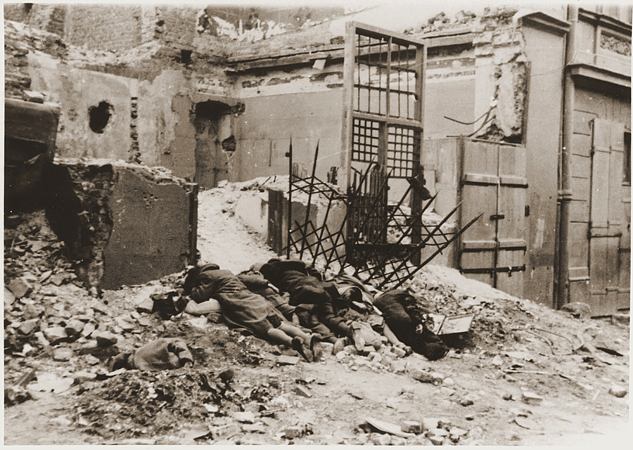
The Germans trashed the Ghetto as thoroughly as Ground Zero. They shipped the very few they didn’t kill or burn or bury out of hand off to Treblinka (itself to end in another doomed uprising in the near future).

They literally razed the entire Ghetto to the ground.

The Ghetto after the battle.

Serious resistance ended in about a week – which is itself amazing.  I urge you to remember; these were people armed with pistols who started the battle with an average of 6-7 rounds of ammunition; a few rifles with the 5 rounds in their magazines and not much more; accounts vary as to whether the Jews even started the fight with a machine gun (they may have picked a few off of dead Germans).  A few stolen grenades.  Molotov cocktails and a few homemade bombs.  Knives, spears, clubs.

Nothing more.

Pockets of resistance held out much longer, though; the Germans declared the battle over in Mid-may, with the symbolic dynamiting of the Great Synogogue of Warsaw on May 16.

The Great Synogogue of Warsaw in the 1910s.

And so the battle was over.

There were few survivors – but the few thto got away cut wide swathes. Marek Edelman,  last surviving leader, passed away a few months after i wrotw the first version of this piece, back in 2009, after a life spent as an activist for freedom, including a role in the rebirth of a free Poland in 1989.  Rhe handful of survivors and witnesses continue to tell their stories.  But like our own World War Two generation, the Holocaust’s few survivors – and the fewer still who survived the Ghetto – are dying off.

And as they do, we should worry – justifiably – that society is going to forget about what happened; that society might forget the consequences of racism (the real kind), hatred, dminishing the humanity of ones’ enemies (or scapegoats) to try to justify all manner of inhumanities and horrors upon them. And of course, worry that some will take away the wrong lesson, as another loathsome person did fourteen years ago today.

I read the story of the Ghetto and the Uprising when I was in junior high; it probably took many more years for me to really absorb it.  The lessons were these; never let this happen here.  Call out the prejudice that leads to this sort of eliminationist hatred when you see it, and do it without stint or mercy.  Never let society be left at the mercy of the thugs and the autocrats; it’s why we have a First and, if all else fails, a Second Amendment.

Above all, uphold humanity.

(more…)

Bring The Whisky And Cigars To The Funeral

Friday, April 19th, 2013

This year’s battle to destroy the Second Amendment is dead – at least in DC.

I’ve said it for years; the gun control debate is the most ironic battle in American politics.

The left – the movement that floats on Soros and Rockefeller and Allen and Opperman and Messinger money – loves to paint itself as the party of the working stiff, the fabled “99%”; it likes to pretend the right is white, rich and disconnected from the world.  The left, back to its historical roots, is built on the idea of struggle between classes.

And yet gun control is the most class-focused debate in America today.  Our elites – of both parties, in some cases – loathe the Second Amendment, or at the very least think it’s a quaint doddering relic.  It’s the American mainstreet – the real 99% -that supports the Second Amendment.

The plebeians just keep defying those patricians.

Reason notes this as well:

Whatever the merits and popularity of the specific measures that went down to defeat in the Senate on Wednesday, I think the Establishment fails to appreciate the depth of American support for the Second Amendment. NPR and other media have lately noted a growing libertarian trend in American politics. That’s not just about taxes, Obamacare, marijuana, and marriage equality. It also involves gun rights. After each high-profile shooting, support for gun control rises. But it tends to fall again in short order, as public opinion reverts to the baseline of strong support for gun rights.

And the fact that controlling guns is only a vital issue to 4% of the people indicates that the vast majority know the score; guns don’t kill people, people do.

I’m going to add emphasis below:

I was struck by this poll graphic in the Washington Post on Wednesday. Despite the virtually unanimous support for stricter gun control in the national media, along with other opinion shapers such as Hollywood and the universities, and despite the mass shootings that have received so much attention in our modern world of 24-hour news channels, Americans are becoming more convinced that guns make your family safer.

The media in particular exhibits a persistent form of Pauline Kael syndrome on the subject of guns; they accept gun control as an ideal almost completely without question, and seem nonplussed that the nation ignores them.

But yet they continue their narrative – that the NRA is a astroturf checkbook advocacy group supported by Big Gun and Big Business.  Yesterday, some in the media breathlessly reported the departure of Adolphus Bush from the NRA board as a “blow to the NRA”.

It’s not.  The group’s membership is up nearly a quarter since Newtown.  It’s just shown the entire country that it can shut the media down on Capitol Hill.  It’s just shown it commands more of the hearts and minds of this country’s real people than the President does, at least on the gun issue.

But that’s not the narrative, now, is it?

The Exposed Id Of The Modern Left, Part MMMCCXIV

Friday, April 19th, 2013

Salon writer David Sirota tweets:

To this “elite” lefty, disagreeing with a government and its politics must translate to hating the people. By his “logic” – heh – I, a conservative living in Minnesota, must hate myself. He went on to say:


That’s right – cops and firemen and paramedics are the same as socialized medicine and institutionalized welfare and quantitative easing and…

Most conservatives believe first responders are a legitimate role of government. We would just like to have the right amount of government, not too much.

Which isn’t “hate’.

I don’t think.

“Please Let It Be A White Male”

Friday, April 19th, 2013

One Boston Marathon bombing suspect dead, one on the lam, one cop dead.

Black hat (who David Sirota hopes is named “Billy Bob Bodine”) killed in shooting. White hat (Sirota hopes it’s “Todd Thorstenson”) still on the loose.

First responders; on the off chance you see this, stay safe out there.

The Hit

Thursday, April 18th, 2013

Admiral Isoroku Yamamoto was, by a long stretch, the greatest Japanese leader of World War 2.  A naval genius, the primary planner behind Pearl Harbor, he had an impact far beyond any other Japanese leader on the conduct of the war.

And while the general American public have lionized leaders in the past – Patton, MacArthur, Schwartzkopf, Petraeus – it’s hard for Americans to comprehend what a huge public figure a successful leader could become in a society as militaristic as pre-1945 Japan.  Rarely since the Vikings had there been a society that so revered accomplishment on the battlefield.

And rarely had any society a warrior leader as accomplished as Japanese admiral Isoroku Yamamoto.

Admiral Yamamoto’s PR head shot. It was his plan that conquered the entire Pacific Ocean, from the shores of China and New Guinea all the way to Hawaii’s doorstep at Midway Island.

And the Americans knew it. And seventy years ago today, they carried out an unprecedented action to change that – an action that showed the strengths, weaknesses, and ludicrous foibles of both sides of the war in the Pacific.

———-

The Japanese military was deeply divided before and during World War 2.  “Interservice rivalry” is, of course, endemic in every nation.

Healthy expressions of esprit de corps are a good thing in the military, of course; what would the Marines be if they didn’t think they were better than the rest of the services?

But in Japan, the problem swerved almost beyond caricature.  The Japanese military was divided between the Army and the Navy, and the Generals and the Admirals operated their services like feudal fiefdoms, to the point where both services were nearly completely redundant to each other.  Not only did the Army and Navy each have their own air forces (with completely separate development, procurement and manufacturing efforts, with all the duplication of effort and waste that attended such redundancy), each duplicated each others branches; the Japanese Army built its own navy (including cargo-carrying submarines), and the Navy’s “Marines” served as a duplicate Army.

And each service had its own culture.

The Japanese Army was steeped in the samurai tradition and “State Shinto”, the militaristic Japanese state religion; it was insular, Japanese-culture-centric, and by western standards a little barbaric.   It became moreso over time; before World War 2, most of the Army served in Korea (a Japanese colony at the time), Manchuria (which Japan had annexed in 1931) and China (which Japan had invaded in 1937); its entire background was in Asian societies that had changed little in hundreds of years.

The Navy, on the other hand, had been heavily influenced by the British, adopting British design standards and working with many British advisors.  While it had its samurai traditions as well, it was much more cosmopolitan than the Army.

The IJN Kongo. The first world-class Japanese battleship, and the oldest Japanese battleship to serve in World War 2, it was actually built in 1912 in Britain (as Japanese engineers observed, building its three sisters in Japan). Leave aside the “pagoda” bridge; the rest of the ship looks exactly like a World War 1-era British battleship.

Young Japanese naval officers went on long training cruises before the 1930s, routinely docking in in Western ports, including San Francisco and Seattle.

Yamamoto knew America; he’d studied at Harvard (1919-21) and as Naval Attache (1925-28).

A young Yamamoto with US Navy Secretary Curtis Wilbur.

Yamamoto’s respect for America varied; he didn’t much care for the Navy’s officer corps, thinking them a bunch of careerist golf-course commandos.

But he had much respect for America’s industry, and its drive to innovate.  And as he rose through the ranks, he urged the Army to show a little restraint about engaging the US in a war he felt Japan could not win in the long run.

The road to Pearl Harbor led through an epic political battle between the Army – especially its radicals who believed that they could sweep aside the soft, effete British, French, Dutch  and American presences in the Pacific – and the Navy, which favored expansion (indeed, needed it to get the resources they’d need to continue expanding, to say nothing of the justification for more Navy).

In 1938, the Army won the political battle, empaneling Hideki Tojo – an Army man – as Prime Minister.  While some worried that that could have resulted in Yamamoto’s ouster or even murder, Tojo kept Yamamoto on as head of the Combined Fleet – the highest operational command in the Navy – and charged him with planning to sweep the enemy from the Pacific.

Gen. Hideki Tojo, prime minister during most of the war years.

Yamamoto realized that the only way to effect this against the US was to wipe out its Pacific Fleet, buying the Japanese fleet (carrying the army) time to consolidate the advances into a position that the US couldn’t recover.

The rest is history; they nearly did it.  But for the fact that the Navy’s aircraft carriers had left Pearl Harbor for a training exercise, Yamamoto might have won World War 2 in the Pacfic on December 7.   It nearly worked anyway.

And Yamamoto’s stock soared; in a nation that revered martial accomplishment, he became a superstar.

And the US needed to fix that.

———-

In recent years, as information has been released with the end of the Cold War, the story of US intelligence’s great coup in cracking Japanese codes has become less obscure.  Like the British efforts against the Germans, the US code-breaking effort led to our knowing most of what the Japanese were doing in nearly real time; the biggest Japanese successes, like Pearl Harbor, were the ones that relied on absolutely no radio traffic.

And in the spring of 1943, Navy code breakers found out that Admiral Yamamoto would be touring Navy installations in the southwest Pacific.  In particular, the tour – aboard a couple of Japanese bombers that were being used as passenger ferries – would spend a bit of time on the Japanese-held island of Bougainville, in the Solomon Islands chain.

Japanese G4M medium bomber. Codenamed “Betty” by the Allies, it was a fast, long-ranged bomber with a heavy bomb or torpedo load. It was a very successful plane during the first two years of the war. By 1943, the Japanese were starting to discover it was vulnerable, and didn’t absorb damage well – to Yamamoto’s chagrin.

Which was about 400 miles away from the nearest US base, on the island of Guadalcanal.

It was the Navy’s job – but 400 miles was beyond the range of any current Navy or Marine fighter planes.  So the Navy “borrowed” the US Army Air Force’s 339’s Fighter Squadron.  The 339th flew the Lockheed P-38 Lightning – the longest-ranged fighter in the US arsenal at the time.

The P38 Lighting. Tell me that’s not one cool airplane. I dare you. It had two engines, for added range and reliability – but unlike most two-engined fighter planes of the war years, it was agile enough to mix it up with enemy fighters on more than even terms. The highest-scoring US ace in history, Superior, Wiscinsin’s Richard Bong, flew a P38 for all of his 40 air-to-air kills.

To avoid detection by Japanese radar, the Navy and Army planners drew a route for the 339th that would take it far out to sea at wavetop level and approach the airfield indirectly, from over the mountains; four of the P38s would drive straight for Yamamoto’s plane, while the rest would fly top cover against any escorting fighters; then, with no further need for stealth, they’d fly the 400 miles directly back to Guadalcanal.

And seventy years ago this morning, the mission went ahead.

———-

The mission was a very difficult one in the context of the times; in the days long before GPS or any other electronic navigation aids, the pilots navigated by dead reckoning and timing. Flying very, very low was dangerous, with little visual cue as to actual height and no radio altimeters (which would have tipped the Japanese off anyway); one of the P38s actually brushed the water with its propellors, but averted disaster, recovered and kept flying.

The attack itself went off as planned; as the cover team rocketed up to altitude, the four planes of the killer team saw the two Japanese “Betty” bombers in the landing pattern, with six escorting “Zero” fighters orbiting above.

Two  P38s, flown by Captain Thomas Lanphier and 1st Lt. Rex Barber, engaged the first of the two bombers; Lanpher fired in a slashing attack from the front, while Barber lined up behind the “Betty”, which burst into flame and disappeared, crashing into the jungle.

Artists conception of Barber closing in for the kill

Barber and another pilot, 1st Lt. Besby Holmes, attacked a second bomber which was trying to sneak away at wavetop level; the bomber crashlanded in the ocean.
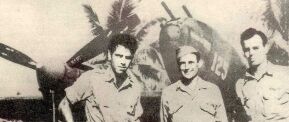
Capt. Lanphier, Lieutenants Holmes and Barber

The first bomber carried Yamamoto; all aboard, including the Admiral, were killed.  The second plane yielded three survivors, including Yamamoto’s chief of staff, Admiral Matome Ugaki.

The wreck of Yamamoto’s plane today. A Japanese search party retrieved the bodies from the plane shortly after the raid; Yamamoto’s ashes were returned to Japan on a battleship.

One P38 was apparently shot down by the escorting Zeros, although the plane, flown by 1st Lieutenant Ray Hine, was not seen to get hit or crash, and apparently fell into the sea.   Hine was the only US casualty; the remaining P38s made it back to Guadalcanal, so short of fuel that some of the  planes’ engines sputtered to a stop on rollout after landing.  As he came in on final approach, Lanphier radioed ” “That son of a bitch will not be dictating any peace terms in the White House” – a huge security breach that risked tipping the Americans’ intelligence hand to their enemies.

But the secret was safe.

The Japanese government, knowing the blow Yamamoto’s death would be, concealed the news from the public for six weeks.  The American press ran it immediately, of course – with the cover story that Yamamoto’s plane had been spotted taking off by Australian “Coastwatchers”, scouts who operated on the small islands in the middle of Japanese territory with radios and binoculars.  They were a key part of the Allied intelligence network (and played a key role in John F. Kennedy’s crew’s survival after the sinking of PT109), but had no involvement; the story was intended to prevent the Japanese from figuring out that their codes were nearly transparent to the Navy’s code breakers.

———-

But the story didn’t end there.  It went on for nearly fifty more years.

Lanphier immediately claimed credit – and popular accounts, starting with a Time Magazine story in 1943, and including the first story I myself read about the raid as an eight year old history geek, credited Lanphier – who was a one-man public relations machine.  Indeed, one of his squadron-mates noted that Lanphier started a manuscript in which he claimed to have gotten the kill himself.

Lanphier at the end of the war. Promoted to Colonel, he’s with his father – also an Army colonel – and mother.

That – and a meeting after the war with one of the Japanese fighter pilots that’d unsuccessfully escorted Yamamoto – irked Barber, who appealed to the Air Force, getting half credit for the kill.  The case between Barber, Lanphier and the Air Force wended its way through channels until 1991, when the US Ninth Circuit refused to hear it; good thing, as the Ninth Circuit would have awarded the kill to Michael Moore.
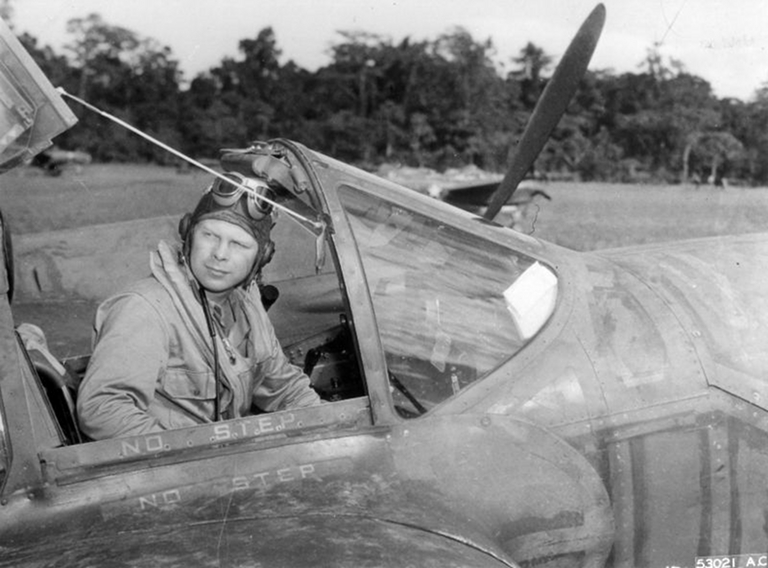
Major Richard Bong  in the cockpit of his P38. The Superioe native remains the too-scoring fighter pilot in US history.  He had nothing to do with the Yamamoto mission – dour changing photos from an iPhone is a pain.  .

Lanphier died in 1987 after a career in the Idaho Air National Guard; Barber passed away in 2001 after working as an insurance salesman and Little League baseball supporter.

And in 2003, after both men were long gone, an examination of the wreck showed that all of the damage to Yamamoto’s plan came from fire from the rear – Barber’s approach.  At long last, the Air Force gave full credit for the kill to Barber.

MOB! MOB! MOB!

Thursday, April 18th, 2013

When I got a late start scheduling the Minnesota Organization of Bloggers winter party, I sheepishly called it the Winter(ish) Party, since I figured the ice would be melted and I’d be biking to work.

Well, that didn’t work out, did it?

But don’t blame my late scheduling start for the return of winter.  For that, you can blame the fact that I put my snowblower up for spring a few weeks back.

Anyway.

The MOB Party is tomorrow night at Ol’ Mexico in Roseville!


View Larger Map

The party starts at 7, and runs until it stops! Or closing…

And if you’re reading this, you’re invited!

Cloak And Dagger

Thursday, April 18th, 2013

As far as Governor Messinger Dayton’s mystery Fortune-500 Biotech company coming to Minnesota, I can’t say much that Andy Aplikowski didn’t say better in his excellent piece on the topic (which <a “href=http://residualforces.com/2013/04/17/dfl-secretly-proving-republicans-are-better-for-business-and-jobs/”>you should go read now.

Except this: if your taxes are at a point where government provides a reasonable value for business, you don’t need to give big Tax Increment Finance breaks (AKA “Picking Winners”) to attract business and jobs.

“Your Numbers Are Like Voodoo”

Thursday, April 18th, 2013

(SCENE:  Mitch BERG is standing in the line for car tabs at the Saint Paul Sears with Avery LIBRELLE)

LIBRELLE:  I saw your blog post about the restaurant in Mower County that is offering discounts for gun nuts who bring guns into their restaurants.

BERG:  Yeah.  That’s pretty cool.

LIBRELLE:  I’m sure there’ll be a mass shooting there soon.

BERG:  (shakes head silently, with deep weariness)

LIBRELLE:  What this does mean is that they should raise their minimum wage.

BERG:  (wearily)  OK, I’ll bite.  Why’s that?

LIBRELLE:  Because the owner is giving away money.

BERG:  Er…huh?

LIBRELLE:   Discounts.  That’s money he’s giving away.  That means he could afford to increase his staff’s wages.

BERG:   Er, the discount – leaving aside the extent to which it might be a personal protest statement – is what’s called a “loss leader”.  It’s designed to get people to come out, bring their non-gun-carrying friends – to get people in the door.  Once they’re through the door, that’s more traffic, more word of mouth, more potential to win over customers that keep coming back and spending more money.

Sort of like when Chipotle has their Free Burrito Day.  They lose money on that day’s burritos – but hopefully create loyal repeat customers who come back later to pay full price.

LIBRELLE:  Well, if they can do that, they can afford to pay the dish washers and waitresses and counter staff more.

BERG:  Er, why do you think businesses do that?

LIBRELLE:  Because they’re rolling in money at the expense of the worker!

BERG:  No, it’s to increase business.  It’s called Marketing, and Advertising; spending a little money so that there’s more business, which in turn brings in more money, which eventually goes into things like paying off investors and turning a profit and expanding and remodeling and buying a new oven and, by the bye, salaries.   Because a successful restaurant can afford to give a raise, while an unsuccessful one can’t even retain workers.

LIBRELLE:  Giving away the workers’ money in this way is like the Bush Tax Cuts.  That money is needed.

BERG:  Government doesn’t need to advertise or market.  And even if the money were “the workers’ money”, it’s part of marketing a business, to try to make it successful  Like spending money on advertising, or on having clean restrooms and unripped seats, or laminated menus, or quality ingredients and attractive preparation and presentation; it’s about making people come to your business, and then making them want to come back.

But – and I can’t stress this enough – the business’ revenue is not “the workers’ money”.  The person or people who started and run the restaurant – which provides the jobs for “the workers” – has the job of using that money to the business’ best advantage, to promote and maintain the business.  Which includes paying salaries.

LIBRELLE:  It’s more important that they pay the salaries.  Without the workers, the owner is nothing.

BERG:  Er, what now?

LIBRELLE:  It’s the workers that make the business.  Without the workers, there’d be no business.

BERG:  I’m sure that’s news to every sole-proprietor entrepreneur out there…

LIBRELLE:  Look at Bain Capital.  Mitt Romney didn’t even show up to work for months at a time.  And yet the janitors had to show up every day.  Bain could have prospered without Romney, but not without janitors.  The janitors deserved the money more than Romney.

BERG:  (Stands, gobsmacked in stunned silence)

LIBRELLE:  Without those janitors, Bain would have failed.

BERG:  So you’re saying that janitors can manage venture capital better than managers can empty trash and sweep floors?  Or that restaurants would spontaneously form in Mower County without someone to rent a building, set up a kitchen and a counter and some tables and buy some inventory and hire and train some cooks and waiters and dishwashers.

LIBRELLE:  Of course not.

BERG:   OK, then…

LIBRELLE:  I’m saying that without janitors sweeping the floors, the capital would never have been managed.  Without a dishwasher, there’d be no restaurant.

LOUDSPEAKER:  “Number 36”

BERG:  Oh, that’s my number.  What’s yours?

LIBRELLE:  Oh, I don’t have one.  I just love hanging out here.

BERG:  (shuffling toward the window)  You what?

LIBRELLE:   Yeah.  It’s a great lesson on how business should work!

BERG:  Huh.  Wow.  And to think some people say liberals don’t understand business.

LIBRELLE:  I know.  Right?

(And SCENE)

(more…)

Lefty Heartbreak, Part 2

Thursday, April 18th, 2013

The alleged killer of the two Texas prosecutors and a spouse has turned out to be…

…the a former judge and his wife.

Not the “Aryan Brotherhood”, ad so many on the left and in the media desperately hoped predicted.

Government employees. I tell ya.

Watch for this story to vanish without a trace.
.

Open Letter To President Obama

Thursday, April 18th, 2013

To: President Barack Obama
From: Mitch Berg, Uppity Peasant
Re:  Optics

President Obama,

You made a big show of flying the “Newtown Parents” – white, upper-middle-class suburban Americans all – to the White House on Air Force One.

I have nothing but sympathy for the parents of Newtown.  Losing a kid is the worst thing I can imagine.  And God willing, imagining is all I have to do so far.  Knock wood.

But I’m wondering – were there any bereaved parents from Chicago on the plane?   Any standing with you in the Rose Garden yesterday?

No, Mr. President.  You surrounded yourself with bereaved parents who looked like NPR producers and CNN reporters, rather than residents of projects and parents of “working families”.  Why was that?

Because it looks to me like you’re trying less to make America – including the parts of it where black people are being gunned down daily – safer, and more like you’re trying to get white, upper-middle-class people to dig deeeeeep for the next Congressional election.

That is all.

Crisis Wasted

Thursday, April 18th, 2013

President Obama’s effort to jam down a gun grab died yesterday in the Democrat-controlled Senate.

The effort was politically dodgy from the beginning; even with the saturation media coverage of the Newtown massacre, most Americans weren’t fooled; the facts remain that mass shootings are at low historical rates and violent crime overall is dropping (outside Chicago).   Only 4% of the American people consider controlling guns a vital issue.

But that didn’t stop The One from trying.

Krauthammer put it well; the entire push was emotional blackmail (emphasis added):

“If you’re going to make all of these emotional appeals,” he said, “you’ve gotta show that if this had been law, it would have stopped Newtown. It would not have. It’s irrelevant. I wouldn’t have objected, I might’ve gone the way of McCain or Toomey on this, but it’s emotional blackmail to say ‘You have to do it for the children.’ Not if there’s no logic in this, and that I think is what’s wrong with the demagoguery that we’ve heard out of the president on this issue.”

And in defeat, the emotional badgering only got worse.  From the President’s Rose Garden speech immediately after the vote (emphasis added):

“The gun lobby and its allies willfully lied about the bill,” Mr. Obama said in the White House rose garden about 90 minutes after the vote. “It came down to politics.” …

“This pattern of spreading untruths … served a purpose. A minority in the U.S. Senate decided it wasn’t worth it. They blocked common-sense gun reforms, even while these families looked on from the Senate gallery. It’s not going to happen because 90 percent of Republicans just voted against that idea.” …

And, as always, he accused Republicans of politicizing the issue.

Remember Berg’s Seventh Law:  “When a Liberal issues a group defamation or assault on conservatives’ ethics, character or respect for liberty or the truth, they are at best projecting, and at worst drawing attention away from their own misdeeds.”   When President Obama accuses Republicans of “politicizing the issue”, he’s saying he’s angry because they politicized it better than he did.

The gun legislation was never about controlling guns, and it was never “about the children”.

John Hinderaker at Power Line spelled it out clearly (emphasis added):

As we have noted more than once, pretty much everything Obama does is intended to stir up the Democratic Party’s base to drive turnout in 2014. Obama knows he can’t do much of anything as long as the GOP holds the House, so his primary goal is to stoke outrage on the left, in hopes that 2014 will look like 2008 and 2012, and not like 2010. So no doubt he hoped that some gun control measure–any gun control measure!–could get through the Senate, so that pressure, probably irresistible, could be brought to force a vote on the same proposal in the House. Not so that it might pass, but so that House Republicans would be on record voting against gun control. Obama could have raised countless millions from his fervently anti-gun base to go after the more vulnerable such Republicans. Now, the issue won’t even come up in the House, and Obama and the Democrats will have to find something else.

That, I think, is the best explanation for the profound disappointment that Obama showed today.

If those children hadn’t promised Obama a way to save the second half of his term, Obama would have never attached his political future to it.   They’d have been of no more use to him than, say, the people killed in Benghazi.

And the media would have let it fade into tragic history three months ago.  Like Benghazi.

I Want To Ride My Bicycle, Year 7-ish: Cyclus Interruptus

Wednesday, April 17th, 2013

It was back in 2007, working at a job in downtown Saint Paul, that I was able to start biking to work for the first time.

And I loved it; for most of the next four summers, I biked every morning I was able to; in 2008, that was every morning from about April 23 on (because the spring of 2008 was almost as late as this one seems to want to be) into early December; 2009, less so.

Back around election time in 2010, I went back to contracting – at a place that had no locker room.  I’m not one of those guys who can bike to work without a shower handy; cue Sammy Hagar, but I can not ride slow.  If I see someone on a bike half a mile ahead of me, I’ll try to catch them.

From there, I went to a job in Minnetonka.  The bad news; it was 16 miles each way, which after the previous winter required a little getting in shape to do the whole thing reliably.  The good news?  I did it; in late summer of 2011, after a month or two of riding from Park and Ride lots in the western subs to work, I did the whole thing for the first time, there and back…

…and as I sat at a stoplight at Prior and Marshall, after climbing the long, grueling hill up from the Marshall-Lake bridge, got a cell phone call about a family medical emergency that ended the biking season, and pretty much everything else, for the next three months.

After that, I spent a year at another contract at another building without a locker room, silently gnashing my teeth at the fates that left me commuting in a car through such a gorgeous summer for riding.

But now – knock wood – things may be looking up.

Started a new gig last week.  It’s not too far away – ten miles, by the usual bike routes.  And they’ve got a locker room.   The route is a beautiful one – a little dangerous in places, but it’s gonna be a fun ride.

I’m chomping at the bit, here.

And the weather seems to know it.

A Crisis Not To Be Wasted

Wednesday, April 17th, 2013

It’s best to try to engage your opponents’ best arguments; that makes your own arguments stronger.

David Sirota’s Salon piece, “Let’s hope the Boston Marathon bomber is a white American“,  is not one of our opponents’ better arguments:

As we now move into the official Political Aftermath period of the Boston bombing — the period that will determine the long-term legislative fallout of the atrocity — the dynamics of privilege will undoubtedly influence the nation’s collective reaction to the attacks. That’s because privilege tends to determine: 1) which groups are — and are not — collectively denigrated or targeted for the unlawful actions of individuals; and 2) how big and politically game-changing the overall reaction ends up being.

According to Sirota, “white privilege” has prevented white males from coming under the sort of scrutiny that, say, Arabs have for ghastly crimes.

This has been most obvious in the context of recent mass shootings. In those awful episodes, a religious or ethnic minority group lacking such privilege would likely be collectively slandered and/or targeted with surveillance or profiling (or worse) if some of its individuals comprised most of the mass shooters. However, white male privilege means white men are not collectively denigrated/targeted for those shootings — even though most come at the hands of white dudes. 

Likewise, in the context of terrorist attacks, such privilege means white non-Islamic terrorists are typically portrayed not as representative of whole groups or ideologies, but as “lone wolf” threats to be dealt with as isolated law enforcement matters. Meanwhile, non-white or developing-world terrorism suspects are often reflexively portrayed as representative of larger conspiracies, ideologies and religions that must be dealt with as systemic threats — the kind potentially requiring everything from law enforcement action to military operations to civil liberties legislation to foreign policy shifts.

Yeah, it could be the “white privilege”.

Or it could be the fact that nearly all of the Arab mass murderers – from Major Hassan up to the 9/11 hijackers – have actually been members of, or allegedly explicit sympathizers with, major extranational military/terror movements, while the white males have represented tiny fringes of tiny fringes of our society:

By contrast, even though America has seen a consistent barrage of attacks from domestic non-Islamic terrorists, the privilege and double standards baked into our national security ideologies means those attacks have resulted in no systemic action of the scope marshaled against foreign terrorists.

“Consistent barrage?”

The examples Sirota gives (drawn from the lefty idiotblog Crooks and Liars – the only blog in the world that can’t shake its head at what dolts the Daily Kos diary writers are) are largely lone crazies, many of them implicated in “white supremacy” by the thinnest of threads; some of them (John Patrick Bedell) are actually lefties; the article itself considered the Gabby Giffords shooting a “terror attack”.

And beyond that?

In fact, it has been quite the opposite — according to Darryl Johnson, the senior domestic terrorism analyst at the Department of Homeland Security, the conservative movement backlash to merely reporting the rising threat of such domestic terrorism resulted in DHS seriously curtailing its initiatives against that particular threat.

Sirota is apparently writing to an audience of the addled; DHS Secretary Napolitano’s “reporting” (along with her camp followers at the Southern Poverty Law Center) was less “reporting” than “releasing a list of groups that opposed the Democrats”.  The right was correct to mock both “efforts”.

Is there an element of “racism” in the way our society treats crime?  Sure – although the term might better be called “we-ism”.  Everyone in the world is a “we-ist”; they’re more tolerant of people who look, speak and act more like them, and less tolerant of those who don’t.  It’s true of everyone; middle-class black professionals are twitchy around urban Latinos; alpaca-clad Volvo-driving fashionably-gray NPR-listening upper-middle-class white liberals get nervous around leather-wearing Bud-drinking bikers.  Our society is still largely white, and the male half of that majority is, well, male; to the extent that the idea of a “white male majority” includes both David Sirota and, well, me, I guess you could say “we” are more forgiving of people like “us”, whoever they are.

So you could chalk this up to “white privilege”.

Or maybe to the fact that so many Arabs who’ve attacked us have expressed sympathy with the goals of the groups that attacked us in 9/11 (notwithstanding the fact that the vast majority of American Arabs are no less American than anyone in Bemidji), while the vast majority of “white terror” suspects have indeed been lone wolves (I mean, if you’re going by evidence rather than Sirota’s fervent, nearly evidence-free wish that it were otherwise) might have something to do with it.

--> Site Meter -->