Archive for the 'Deep Thoughts' Category

The Matrix: It’s not Paranoia

Monday, March 9th, 2009

…when they really are out to get you.

keeping tabs on every Web site they visit, every keystroke they tap, every instant message they send–even the contents of the messages on their personal Hotmail or Gmail accounts.

Besides financial fraud, companies find less insidious but still costly forms of abuse such as employees spending long, production-sapping stretches on Facebook or YouTube.

To help avoid cases of worker fraud, companies are increasingly using monitoring and tracking software. “Employee fraud definitely increases in economic hard times,” says Frank McKenna, co-founder and chief fraud strategist of BasePoint Analytics, a firm that offers fraud consulting and software for banks, mortgage lenders, and credit-card companies.

Consider yourself warned.

I’m a Jerk. You’re a Jerk.

Wednesday, February 18th, 2009

Welcome to the club. Please pass the Grey Poupon.

The richer people are, the ruder they are, according to Dacher Keltner, a psychology professor at the University of California, Berkeley.

Are rich people rude?

…or are rude people rich?

And yet while the rich may be rude because they are wealthy, it is just as likely to be the other way around. Just as plausibly, they are wealthy because they are rude.

So screw you.

Jerks.


PS Aw, shucks. Sorry. *Hug*

Synchronicity

Tuesday, February 10th, 2009

I don’t have much patience for – I’ll try to be civil, here – really dumb arguments.

The one that I hear the most on blogs and talk shows, lately, is “you’re just reciting talking points”, stated as a way to simply dismiss an argument or point of view.

Let’s take a moment to unpack what a misguided and nonproductive statement that is, when abused – and these days, it most usually is abused.

Let’s take a hypothetical example:  Say you, a liberal, construct an argument about, hypothetically, a political issue, one that springs from your perspective.  That perspective has a lot of background to it; your background, your own life experiences, conclusions you’ve reached after a lifetime of thought and – since the issue in the example is a political one – bits and pieces of the political philosphy you’ve adopted. 

Given that you are a liberal, is it not reasonable that, in among the bits and pieces of your argument will have things in common with some of the overarching ideas and ideals of liberalism?

So what are you doing?

  • Creating an argument based on your interpretation of a philosophy that you agree with – knowing that since you agree with the philosophy, and are not alone, that there may be points in common with other people? Or…
  • “Reciting talking points?”

I thought about this while guesting on Marty Owings’ “Radio Free Nation” last weekend.  A caller responded to one of my statements with “you’re just reciting conservative talking points”.

And the possible responses ponged about my mind like four-year-old boys who’ve gotten into the chocolate espresso beans:

  • Of course, the oldie but goodie: “Please show me where this memo is from which I supposedly get these “points”, because I sure never read it”.
  • Given that these are supposedly “conservative talking points”, please tell me – who is the “authority” that makes these “points” up for the rest of us?  The “Conservative National Committee?”  There is no such author or authoring body
  • Perhaps you mean “Republican” talking points, since there’s actually a group of officials that do that kind of thing for the GOP?  But wait!  Given the abysmal record of the National and State GOP in getting anything done over the past four-eight years, what makes you think that even if a GOP official were to send me some “talking points”, I’d use them?  What has the GOP done for us lately?
  • I’m 46.  I’ve been “working” as a self-appointed pundit of sorts for most of my adult lifetime.  In that time, I’ve developed some form of opinion or another about just about every topic you can think of, from cuisine (Mediterranean!) to liquor (Polish Vodka!) to music (Springsteen, Richard Thompson, Tchaikowski, Mahler, Marah, Emmylou Harris!) to literature (Dostoevskii and Hemingway!) to sports (don’t care about much but Baseball!) to guitars (rosewood fingerboards!) to firearms (Garand, Colt, Heckler und Koch!) to politics (need I go into details?).  In every case, if I’ve bothered to develop an opinion, it’s because I’ve become convinced that “that’s the way it should be”, through a process whose intellectual rigor you are not equipped to understand – merely emulate, in your own way, in  your own mind.  In short, I don’t need anyone to give me “talking points”; I write my own. 
  • The same, indeed, holds true for pretty much everyone (who doesn’t write for “Minnesota Progressive Project”, anyway). 

In other words – Duh.  I’m a conservative.  Some of the things I believe will be common to many, even most, other conservatives.  That’s why it’s called a “movement”, rather than a “completely random instance of applied interpersonal chaos theory”. 

I think the actual response I used with the caller was “You need to quit snacking on the lead paint chips in your efficiency apartment, go gather up the scraps of the pathetic excuse for a life that you are supposedly living, try to find a sack so you can sack up and head out on the street and try to make something other than “a piece of walking semi-sentient suet” out of yourself”. 

Karl Rove told me to say it.

As Long As They Don’t Get Behind the Wheel, I’m Fine With That

Monday, January 26th, 2009

I enjoy Glenfiddich 12-year-old Scotch and almost any Red Wine, but have often wondered how mankind discovered alcohol.

Did Cro-Magnon man have a little still in his cave? Was it the social lubricant that it is today? Having invented the wheel and alcohol, did early man anticipate the trouble the two would cause generations later when used together?

We may never know the answers to these vexing questions, but it appears the imbibing of fermented fruits and grains is a natural thing.

A large variety of creatures consume alcohol in the wild, ranging from bumble-bees to elephants. Hooch finds its way into their diets via the fermenting fruit, sap and nectar of various plants, and many exhibit signs of inebriation after they’ve enjoyed a good feed. Their weakness for the substance au naturel is understandable: ethanol is a rich food, with 75 percent more calories than refined sugar, and its distinctive aroma makes it easy to locate. This natural thirst has been exploited by man since the dawn of history. Aristotle noted that wild monkeys were caught by setting out jars of palm wine — the creatures would drink, then pass out, leaving them easy prey. The same method of trapping was still in use in the 19th century and commented on by Darwin in the opening chapter of “The Descent of Man,” when drawing similarities between humanity and the rest of creation. Monkeys could get drunk like men. They also got hangovers: “On the following morning they were very cross and dismal; they held their aching heads with both hands, and wore a most pitiable expression: when beer or wine was offered them, they turned away with disgust, but relished the juice of lemons.”

Interestingly, a few species of mammals including the slow loris and the pentailed treeshrew (with which we share a common ancestor) not only have a predilection for alcohol but also a natural tolerance. When the latter species find an especially rich batch of fermented palm nectar in their native Malaysian rainforests, they’ll visit it several times each night and consume the equivalent, in human terms, of nine standard drinks, without any evident deterioration in their behavior. Perhaps we drank deep before we were fully human?

Well, isn’t the pentailed treeshrew a lucky bird. Modern man, after “drinking deep” is usually not so fortunate.

The propensity of a variety of domesticated animals to drink is well documented. Clearly, it’s cruel to force alcohol on them — tantamount to poisoning them: Mad Jack Mytton killed one of his horses when he made it bumper a bottle of port after it had won a race. However, some, including dogs, goats, cows, and pigs, develop a taste for it on their own. Aristotle noted that Greek swine became inebriated “when they were filled with the husks of pressed grapes.” A similar phenomena was common in colonial-era New England, where cider production and consumption, in per capita terms, were colossal, and where hogs were fed on windfalls and pomace (the pulp from the bottom of the cider press) both of which ferment. Their subsequent inebriation was often a matter of comment, and may have been the inspiration for the term “hog-whimpering drunk.”

I hadn’t heard that term, but it does explain the more common “drunk as a pentailed treeshrew.”

Pair Of Docks

Monday, January 26th, 2009

The local chattering classes are tittering merrily; the guy who rammed his “SUV” (or was it a pickup truck?) into Saint Paul’s Baby Meat Mill Planned Parenthood Clinic was “mentally ill”:

Stop the murderers,” Matthew L. Derosia quoted Jesus as telling him, a criminal complaint said.Derosia, 32, who has a history of mental illness, faces two counts of first-degree criminal damage to property.

This blog does not endorse physical violence to curb infanticide.  Why, had Derosia driven a bigger truck, the clinic might have been put out of action even longer.  Why, who knows?  Someone – say, the next person Jesus talks to – might drive a bulldozer or a tank.  That’d really cause problems, wouldn’t it?

Still, I think it’s interesting;  Planned Parenthood represents a movement that believes the only thing separating “life” and “unviability” is a four-inch trip down the birth canal – but we call Derosia “mentally ill”.

Obama Won’t Leave The Matrix

Tuesday, January 20th, 2009

Obama won’t give up his Blackberry!

This is news?

Why should he? He’s the Chief Executive. He’s the boss.

I’m all for Obanana keeping his smart phone.

He’s not just the first African American President. He’s the first President that won’t look stupid thumbing his old racketeering pals a message.

“Dude. Like this is so cool. Did you guys see my new ride?”

He needs to be kept abreast when he’s sunning his washboard abs.

“I want to be able to have voices, other than the people who are immediately working for me, be able to reach out and send me a message about what’s happening in America.”

For example, soon-to-be disappointed voices like Peggy Joseph.

Security issues.

“I think we’re going to be able to hang on to one of these. My working assumption, and this is not new, is that anything I write on an email could end up being on CNN,” he said.

Oops. What the President-Elect meant to say was:

“Anything that CNN writes for me to say…”

National Security?

“So I make sure to think before I press ‘send’,” he said.

Let’s hope as President he thinks before he presses any buttons.

Obama’s Blackberry can take the place of his teleprompter when he’s on the fly.

“If I’m doing something stupid, somebody (in Jail-JR) in Chicago can send me an e-mail and say, ‘What are you doing?’

That might happen a lot.

The Pitter-Patter of Billions Of Little Feet

Monday, January 19th, 2009

For most of human history, humans have had to reproduce as fast as they could; children were the only 401K, and infant/child mortality was harder on that retirement plan than the recession is on your Roth IRA today.
Capitalism and the generalized prosperity that’s attended it in the past 150-odd years has changed that dynamic. In a sense relative to the rest of the world throughout history, capitalism and general prosperity has taken human  life from “nasty, brutish and short” to “relatively civilized, at least modestly comfortable, and where obesity is the biggest health problem among the poor“.

One of the blessings that’s attended these changes is the existence, throughout the world, of “cheap food”.  When I say “cheap”, I’m not talking about supermarket shelf price, by the way; 500 years ago, over 95% of the world’s population worked from dawn to dusk six or seven days a week trying to subsist.  Do you work two shifts seven days a week just to feed your family and live in a hovel?  Who does?  No – food is incomparably cheap these days, historically speaking, even if the price of eggs is getting kinda out of hand.

“Cheap food” has enabled the parts of the world still governed by dictators, petty overlords and warlords to sustain populations that would have been mathematically and logistically impossible 100 years ago.  Of course, the lack of actual personal prosperity, and the attendant uncertainty of life, has kept the birthrates in these places high (albeit lower than when I was a kid).  The presence of global media, communications and markets have also made life safer in the parts of the world run by despots, warlords, and amok bureaucrats; it’s a truism that no famine can take place in a nation with a free market and a free media (every famine in the past 100 years has taken place in places with neither); the globalization of communications and markets has made it possible for weathy nations (with their epic surpluses of food) to ameliorate the worst ravages of famines, the great population-leveler of days gone by.

So on the one hand, a tide that has been rising since the birth of the modern world has been lifting all boats.
On the other, this has led the world into two basic demographic paths:

  1. “First World” countries, with safe, practically-boundless supplies of food and historically-unprecedented prosperity, find it unneccessary to reproduce as much – even, in the case of Western Europe, to fall below replacement level, leading in just a few generations (from the end of WWII to today)  to the specter of being demographically “upside down”, with average ages creeping up into the forties and retirees outnumbering working citizens, and thus having to choose between economic shrinkage (with its attendant ravages on taxes to support  “service”-heavy governments – but let’s not digress) or importing working-age labor from…
  2. “Third World” countries, for whom the relative affordability of food (historically speaking) but the relative scarcity of economic freedom has led to populations that are booming, young (average age less than twenty in many countries) and, since they live in despotic, anarchic or socialist countries, underemployed and poor.

This might lead to a vicious cycle – as we’re starting to see in Western Europe, where ageing populations, which for almost two generations have been at zero or negative native population growth are having to import labor from other younger, poorer countries.  Who are changing the political face of these countries – sometimes against immense resistance from the natives, and all of the attendant strife.

(There are actually two vicious cycles:  overpopulation in the world’s current context happens when populations in un-free nations continue pre-prosperity growth rates; there’s a reason that Paul Ehrlich, overpopulation alarmist of the sixties and seventies, is largely a risible figure these days; widening prosperity (in a historical context) obsoleted his theory in many countries that he’d used as case studies.  Remember when people expected India to become a famine-ridden wasteland?).
The US’ average age is still relatively low – partly due to immigration, partly because our national birth rate is above replacement levels (and even moreso outside the “blue” states – which could reflect anything from lower standards of living or greater optimism in the red states, depending on your point of view, and it’s a digression we won’t follow in any case), but we have a “baby boom” moving through the pipeline that’ll drag things upward a bit in short order.  Still, the US is faring better than most, controversies over illegal immigration notwithstanding.

But here’s the question:  how does the “First” world react to the demographic fact that prosperity itself renders its populations older and less capable of continued economic growth?

  1. The French model – work to pound immigrants into line behind a national set of standards set by the dominant culture (which, culturally, resists assimilation of immigrants)
  2. The Dutch model – try (at least in theory) to carefully regulate and balance immigration to provide needed labor and skills without overly diluting the national culture (which is marginally less resistant to assimilation than France)
  3. The American model – work to assimilate immigrants into a cultural system comprising a set of ideals rather than ethnic cultural norms
  4. The Japanese model – actively reject all but the most desperately needed immigrants, and aggressively marginalize the few that do get in.
  5. The Russian model – wallow in cultural depression and drink oneself into a stupor, and let your nation’s underworld fleece, terrorize, brutalize and co-opt the immigrants into a permanent, but distracted, underclass.
  6. The Finnish model – watch your national median age skyrocket – but live in a place to which nobody actually wants to migrate.
  7. The (ahem koff koff) model – subsidize fecundity.  Give tax breaks and/or other rewards to families that reproduce above the replacement rate, promoting measured growth and helping to keep the nation’s median age down to a reasonable level, to ensure future economic growth and national viability in everything from defense to beach scenery.

What’s a hypothetical, ageing society to do?

(more…)

It’s A Dog’s Column

Wednesday, December 31st, 2008

We’ll jump to Bogus Doug’s conclusion

about PiPress columnist Bob Shaw’s take on a story (a dog is cured by a canine stem cell treatment that is not legal for humans using human stem cells):

Anyway there are two very basic problems with this column. The first is that Shaw is opining in an area of science he apparently lacks very basic knowledge about (Science-journalism: All the whiz-bang and drama of science fiction, without the realization they’re frequently making stuff up). The second is that Shaw’s point isn’t even about what he thinks it is, but seems to rather be a call to lessen the regulatory burden on bringing medical treatments to market; with a kind of endorsement that the medical standards for dogs should be good enough for us.

What led to the conclusion?

Go to BoGo and read up. It’s worth the trip.

A Long December

Friday, December 19th, 2008

Steve Miller said it; you’ve got to go through hell before you get to heaven.   Or maybe it was Saint Augustine.

December ends in Christmas, of course – the most joyous time of the year, for those of us who believe, or who merely want it to be joyous whatever it takes (and I’m firmly in both camps).  And yet it starts so hard; the days collapse inward to the shortest days of the year.  The dark reaches out to get you earlier and earlier every day, engulfing the afternoon and eating up the parts of the day you don’t owe to The Man.  It’s fraught with symbolism, all of it (save Christmas) tied up in mythological angst.

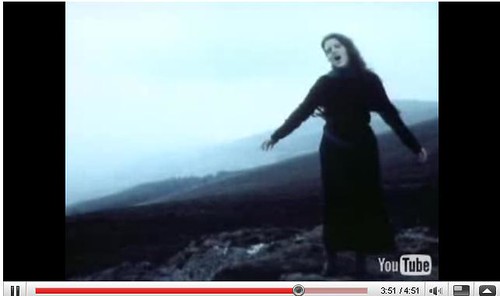
And it’s the part before Christmas I think of when I hear this song:

It’s Maria McKee, formerly of Lone Justice – one of my favorite no-hit wonders of the eighties.  If anything, her solo career was shorter and less successful.

And yet this song infiltrates me every year about this time.  I’ve written in the past about songs that are inextricably tied  to things in my mind; places and times and moments.  “Breathe” is always December 16-20 for me; the striking, eloquent sadness; the wondering stare into the beautiful abyss.
Part of it is the guitar part, by Richard Thompson.  In some ways, this song is one of the most ingenious bits of guitar in Thompson’s ingenuity-clogged forty-year career as the world’s greatest living guitar player.  Elegantly jagged, beautiful and yet disturbing in its almost random harshness, it descends on you like a snow squall engulfing the aurora borealis.

Soon it’ll give way to the Christmas carols, the Hallelujah Chorus, Auld Lang Syne, just as the cold will fall before the apple cider and the lefse and the cocoa, just as sin and decay fall before redemption.

And yet Christmas wouldn’t be as hopeful but for the dark, the dread and the cold that it contrasts with.

A Matter of Pride

Tuesday, December 9th, 2008

Since I was a boy I have had a fascination with cars. I made them with my Legos. We’d set four folding chairs in the yard and imagine we were on road trips. My neighborhood buddy and I sketched countless pictures of them. Always set in action, with smoking rear wheels, quarter panels repleat with flames and pipes and vents and the requisite jack job on the back with over sized rear wheels.

…and always decidedly American.

When I was a kid, imports were “Jap Crap.”

It didn’t matter that my Dad’s brand new company car, a then downsized 1981 Oldsmobile Cutlass Supreme was a gutless piece of crap with a V6 that was as smooth and as powerful as a coffee grinder and paint that came from the factory looking like it had already baked in the sun for a few years.

No one considered the Japanese playas yet.

My first car was a used 1973 Ford Pinto Squire Wagon, with yes, you guessed it, the woody decals and plastic “wood” trim down the flanks. $1,100; borrowed from the bank. What a piece of shit that car was…but it was mine all mine.

Lucky for me, girls didn’t seem to care if your car was cool. It was enough that you had one.

(more…)

The Matrix: Collective Intelligence

Tuesday, December 2nd, 2008

We text, email, phone and make purchases in an ever inter-connected world. As our point of accessing the internet has shifted from stationary PC’s to smaller and more mobile devices, The Matrix is matching what we are looking for with where we are at the time and rending the data in the new world of Collective Intelligence, the term now emerging to describe the data trail we all leave behind, knowingly, willingly, or not.

Propelled by new technologies and the Internet’s steady incursion into every nook and cranny of life, collective intelligence offers powerful capabilities, from improving the efficiency of advertising to giving community groups new ways to organize.

…and the result? A plebe in the White House, but I digress.

Wireless and internet technologies afford consumers and businesses unprecedented freedom and productivity in the age of the Matrix. What are the consequences? Is it a fair trade?

But even its practitioners acknowledge that, if misused, collective intelligence tools could create an Orwellian future on a level Big Brother could only dream of.

Collective intelligence could make it possible for insurance companies, for example, to use behavioral data to covertly identify people suffering from a particular disease and deny them insurance coverage. Similarly, the government or law enforcement agencies could identify members of a protest group by tracking social networks revealed by the new technology. “There are so many uses for this technology — from marketing to war fighting — that I can’t imagine it not pervading our lives in just the next few years,” says Steve Steinberg, a computer scientist who works for an investment firm in New York.

Alas, I know of few that would give up their Blackberry, the aforementioned President-Elect counted among them.

In the balance, the benefits will hopefully outweigh the perils. Some will be more obvious than others.

Assisting policymakers…

a few weeks ago, Google deployed an early-warning service for spotting flu trends, based on search queries for flu-related symptoms.

Day traders…

It could see, for example, that people who worked in the city’s financial district would tend to go to work early when the market was booming, but later when it was down.

It also noticed that middle-income people — as determined by ZIP code data — tended to order cabs more often just before market downturns.

…and bar hoppers.

The consumer application, Citysense, identifies entertainment hot spots in a city. It connects information from Yelp and Google about nightclubs and music clubs with data generated by tracking locations of anonymous cellphone users.

Moving forward into the past?

“For most of human history, people have lived in small tribes where everything they did was known by everyone they knew,” Dr. Malone said. “In some sense we’re becoming a global village. Privacy may turn out to have become an anomaly.”

Like it or not, with the advent of an ever-growing array of sensory technologies, it will become difficult if not impossible to avoid the grasp of The Matrix.

A Walk in Paradise

Sunday, November 30th, 2008

This morning I found myself taking stock of all the adventures I have had in my adult life. Most recently, I have walked Broadway in New York from the depths of Ground Zero through the blaze of Times Square to the greenery of Central Park and the Upper West Side. I’ve hiked the historic streets of Washington DC, the white sand beaches of Kaanapali and Grand Cayman and floated in the mist under Niagara Falls.

While I am fortunate to have the means and opportunity to have gathered these vivid and treasured memories it was the mundane setting of the stacks of dry goods and produce under the grid of fluorescence at Cub Foods this morning that underscored their only common denominator.

It was there that I found myself flush with gratitude and good fortune as I watched my wife pluck a small jar of sea salt from the shelf.

Wise men know that no one bears the the scars of our existence more willingly or ably than our brides. I’ve always said “Show me a successful man and I will show you a man that married well.”

It is the dividends of a marriage to a wonderful woman, undeservedly so I might add, that make even the most prosaic activities a bounty to my being. I am in awe of the fierce but gentle love and concern she has for her brood and the tolerance she has for my foibles, not the least of which, my ego.

If I were King, she would be the crown that legitimizes my station.

As we walked the sterile isles of Cub, our over-burdened cart informing of the three at home, I realized how hard it will be someday when the littlest leaves the nest but at the same time looked forward to having her to myself again some day.

…and that is what I am thankful for this season.

The Matrix Is On Line Two

Tuesday, November 25th, 2008

Last week in the process of renewing a business credit line, my bank checked my credit as a matter of course.

The next day, “Jeff” with “American Equity” or something along those lines left me a message. He was “verifying” a recent transaction and was calling “…to assure me that the terms of my loan were the best options available to me or to make sure that I was offered the best terms available in the marketplace”….or some other malarkey.

It was pretty convincing. It sounded like someone calling on behalf of my bank. It would have to be right? My bank wouldn’t inform any other entities of my business dealings with them…right?

So I called “Jeff” back. He was a bit surprised by my accusatory tone once he informed me that he had nothing to do with my bank and where he got the information.

It turns out Jeff’s company, which has absolutely nothing to do with my bank, subscribes to a service that alerts them to credit checks of highly qualified borrowers. Within 24 hours. Name, phone number and amount borrowed are all provided for a fee.Who provides this data you ask? Is it a form of identity theft?

It turns out Experian, one of the “Big Three” credit bureaus, provides this data to other lenders when you apply for credit. Apparently, they don’t have to inform you, and if I hadn’t received “Jeff’s” cold call, I would never have known that my name, phone number, credit score and transaction information are available to anyone willing to pay a fee for it.

Cross-Sell Triggers (sm)

Daily triggering tool for expanding customer relationships.

Cross-Sell TriggersSM, an event-based triggering tool, empowers you to deliver daily cross-sell and up-sell offers based on customer-initiated inquiries for new credit occurring within the last 24 hours.

Retain your most profitable customers

Cross-Sell Triggers allows you to respond immediately to retain customers who inquire about credit elsewhere.

Build loyalty and expand customer relationships

Respond to changing customer needs by making the right offer at the right time, thereby increasing your product-to-customer ratio.

That’s nice. I’d actually prefer a little privacy when I shop for credit.

Scumbags.

I haven’t verified this yet but apparently you can call Experian and opt out. Gee, thanks for the consideration. Thanks for taking up my time to call you, presumably wait on hold, and take back my rights to privacy.

Scumbags.

I guess I always considered the credit bureaus to be in the business of tracking and evaluating potential credit consumers. I also assumed that my credit information was not accessible without my consent.

Wrong on both counts.

Word to the wise.

Ha-Ha Funny vs. Ha-Ha Weird

Friday, November 7th, 2008

In the wake of the “historic change” on Tuesday, the question “who has a better sense of humor – liberals or conservatives?” may become a pivotal one.

And the answers? Well, they’ll surprise…

…well, anyone who hasn’t been paying attention, or who is driven entirely by media meme and dogma. You know who I’m talking about.

Psychology Today notes:

To look into this question we approached 285 individuals in public places in Boston, asking them to answer a few questions about their political beliefs, and most importantly to rate how funny they found 22 jokes (see all jokes below). Some of the jokes we used were more funny, some were less funny, and in general they fell into seven categories: race, religion, golf, employment, Jack Handey’s deep thoughts, marriage, and family. Participants were asked to rate each joke on a scale from 1 (not funny at all) to 9 (hilarious).

At the end we had 140 self declared liberals and 145 self declared conservatives, and the results were not at all what we expected. As it turned out conservatives gave significantly higher rating to the jokes in each of the seven categories (see table below)!

So, is the stereotype of liberals as being funnier completely off? When we asked our respondents to self-report how funny they are, liberals indicated that they were funnier. This means that liberals are not finding life to be funnier, but they think they are.

If you’ve comparison-shopped a MOB party and “Drinking Liberally”, or gone to both Nihilist In Golf Pants and Clicking Spot for entertainment, this comes as no surprise.

This piece in the NYTimes analyzes the “issue” further, and draws more – and similar – conclusions:

“Conservatives tend to be happier than liberals in general,” said Dr. Martin, a psychologist at the University of Western Ontario. “A conservative outlook rationalizes social inequality, accepting the world as it is, and making it less of a threat to one’s well-being, whereas a liberal outlook leads to dissatisfaction with the world as it is, and a sense that things need to change before one can be really happy.”

And of course, there’s a certain amount of Pauline Kael Effect going on, too:

Another possible explanation is that conservatives, or at least the ones in Boston, really aren’t the stiffs they’re made out to be by social scientists. When these scientists analyze conservatives, they can sound like Victorians describing headhunters in Borneo. They try to be objective, but it’s an alien culture.

The studies hailing liberals’ nonconformity and “openness to ideas” have been done by social scientists working in a culture that’s remarkably homogenous politically. Democrats outnumber Republicans by at least seven to one on social science and humanities faculties, according to studies by Daniel Klein, an economist at George Mason University. If you’re a professor who truly “seeks new experiences,” try going into a faculty club today and passing out McCain-Palin buttons.

Could it be that the image of conservatives as humorless, dogmatic neurotics is based more on political bias than sound social science? Philip Tetlock, a psychologist at the University of California, Berkeley, who reviews the evidence of cognitive differences in his 2005 book, “Expert Political Judgment,” said that while there were valid differences, “liberals and conservatives are roughly equally closed-minded in dealing with dissonant real-world evidence.”

A friggin’ commie professor would say that.

(Via Sanden Totten @ MPR’s LoopHole)

Happy (%#@^@*&!!) Holidays! (?)

Thursday, November 6th, 2008

Caribou and Starbucks apparently think we’ve breached the Holiday season already.

The barista behind the counter this morning offered me a sample of their holiday cookies. I inquired as to how they would be keeping them fresh until the holidays actually arrived

…well, I thought it was funny.

He…not so much.

I haven’t been to the mall of late, but I can only assume they are stringing popcorn, blinking lights and tinsel all over their stores as well.

Querry: Is this too much too soon or more of a good thing?

Discuss.

Democrats, Disturbed

Monday, November 3rd, 2008

Over the weekend, I appeared on Marty Owings’ “Radio Free Nation“, a Blogtalkradio show on which I’m generally the sole conservative voice.

After listening to a steady cavalcade of callers who were already revelling in an Obama victory, I had to ask (the victim in this case was an African American fellow from Detroit) – “So let’s say, hypothetically, that McCain wins.  What do you do?”

“He ain’t gonna win”, the caller exclaimed.

“But, hypothetically, what if he wins?”

“Then I’ll move to Canada”, the guy exclaimed without skipping a beat.

So what about the rest of you libs?  What are you going to do if Mac does manage to pull this thing off?

And “He’s not going to pull it off” is not acceptable as an answer; the entire premise of the question is based on the hypothetical issue of a McCain victory, whether you find it plausible or not. 

So let’s hear it, libs…

One Big Homegenous Family

Tuesday, October 28th, 2008

On the odd Saturday night, I can be found sitting in on Marty Owings’ show, “Radio Free Nation, on BlogTalkRadio.  One of the occasional callers is a fellow from Detroit – also a BlogTalkRadio host – who usually hits two talking (or, more accurately, bellowing and slurring) points:

  1. “I favor unity.  Americans need to be united!  I want to lead Americans to unity!”
  2. “I’m not using any Republican ideas.  Republican ideas are all bool-shee-yut”.

In other words, “let’s have unity; everyone agree with me”. 

I was reminded of the caller when I read this bit – an interview with French lefty philosophe Bernard-Henri Lévy – last week. 

It’s a reminder of the big reason I bailed out on the left over 20 years ago – because so much of what The Left believes is just so utterly awful.

Lévy

Why Obama should be chosen, in my opinion: No. 1, because it would mean really the end — and the complete victory of the battle begun in the ’60s. No. 2, because it will mean the end of a new American evil, which is the dividing, the Balkanization of American society. This is another counter-effect of a great idea, which was tolerance. You so much tolerate that you tolerate the American society to be in separate bubbles having their own peculiarities, and so on.

Obama must stamp out “peculiarities”? 

The first time I read this, I thought perhaps it was an artifact of the translation from French to German (the piece originally appeared in Spiegel) and thence to English.

No such luck:

Obama as president will mean all these bubbles submitted to a real ideal of citizenship.

The “real ideal of citizenship?”

Lévy is part of the intelligentsia – which seems to be a union gig in France – but to me the “real ideals of citizenship” in America are:

  • To exist as part of a free association of equals – not a cog in a “unified” machine.
  • To pull like hell for what I believe until the election is over, and then support – at least as a matter of principle – the results, as a member of a representative Republic. 

Not, might  I point out, falling in mutely line behind an elected leader’s idea of “unity” just for the sake of stomping out Lévy’s “bubbles”.  Especially when that elected leader’s ideas are so patently awful.

And I think I was right to begin with; there is a loss in translation.  Not so much between languages, but between worldviews.  Lévy – and Obama – seems to believe that “unity”, a lack of “bubbles”, is a useful end in and of itself. 

Indeed, the more of the piece you read, the less it seems Lévy understands of America, or the small-l liberal ideals that this country has, in its better moments, always espoused:

And No. 3, you have another ideal in the America of today, which I call the competition of victims. Competition of memories. If you are in favor of the Jews, you cannot be in favor of the blacks. If you remember the suffering of slavery, you cannot remember too much the suffering of the Holocaust, and so on and so on. The human heart has not space enough for all the sufferings. This is what some people say. Obama says the contrary. It will mean the end of this stupid topic, which is competition of victimhood.

And to believe otherwise is apparently racist. 

Read the whole depressing thing.

The Back 40

Sunday, October 12th, 2008

Click for Larger Size

It Wouldn’t Be A Crisis…

Tuesday, October 7th, 2008

…without the Minnesoros “Independent” sending ace reporter Molly “Is It White In Here” Priesmeyer – AKA “The Margaret Grebe of the 21st Century” – out to the nightclubs to show how the Sturm and Drang of the Zeitgeist was causing Angst among people who are…er, hanging around in bars on a weeknight:

The cover photo of this week’s Time magazine has been lurking in the psyche of America for the past two weeks: A bread line, circa 1931, buttressed by the headline “The New Hard Times.” Whether or not that’s overstating things by the liberal media elite remains to be seen, but I took my own pulse of America this week, stopping in at Minneapolis bars and music clubs (and one strip club), to imbibe in the healing qualities of good music and gathered people, and to gauge the post-crash mood.

Unlike the Republican candidate for vice president, it wasn’t pretty. In fact, the only comparable such club tour I’ve taken was in the week immediately following 9/11, when hushed roomfuls of people stuck their head in the live music sand and wondered what the bleep would happen next.

Profound.

UPDATE:  My bad; the piece was in the MNPost, and it’s by Jim Walsh, who is not a bad music critic.  Which is sort of like saying “Leukemia isn’t such a bad cancer”; I’ve gotten progressively less and less tolerant of “rock critics” over the years, in the same way “sports journalism” has come to strike me as an oxymoron among all but a few “sports journalists” tiny enough in number to fit into Frank DeFord’s jacket pockets.

UP-UPDATE: OK, I lied.  I knew it was Walsh all along – and I followed the “Priesmeyer Tangent” because “Rock Criticism” frequently – usually? – falls back on the same trite answers to life’s persistent questions that seem to dominate her oeuvre.  Perhaps it’s because most rock critics are lousy writers (and the craft’s dubious standards, in this era of freebie, “citizen” “journalism”, seems to be eroding year by year; I’m flummoxed to think of a rock in the AAA leagues who’s fit to carry Dave Considine or Jim DeRogatis’ Ipod case.  Perhaps the eternal adolescence of the rock club world – a place that’s a combination of Peter Pan and Logan’s Run, a place where everyone, whether musician or bartender or booker or waitress or the audience, either stays a pissed-off 21-year-old or eventually disappears, un-lamented and unremembered – makes the whole enterprise terminally self-limiting. 

And for those of us who disappear from those clubs – those of us who stomped around The Entry’s claustrophobic stage, fought with The Uptown’s cranky sound system and crankier booking agent, cadged drinks from girls at Lyle’s for a year or four, and then…disappeared, vanished into a world of babies and mortgages and day jobs and newer lives lived in daylight?

I’m not going to speak for all of us – but I’m not exactly hanging on Liz Phair’s reaction to the economic crisis.  Or anything.

But, as I said, Walsh is not one of the semi-literate slapnuts that glut “rock criticism” today.  He’s a sharp guy, a good writer and, often enough to notice, a sharp observer.

And amid the pop-culture dross, he scores a few good points:

After 9/11, the president famously told Americans to go shopping. At the moment, it might behoove him to remind “we the people” that going out — to clubs, bars, music venues — gets us out of ourselves and out of our own burrowed-in blues, and that it’s important to keep the blood pumping and the elbows rubbing, even when the world can make you feel, as one mourner put it to me at a funeral home recently, “I’m lost.”

You could ask – “did we grow up and stop having fun because life got difficult, or did life get difficult because we grew up and stopped having fun?”   The answer would be “probably not entirely”, of course, because life is rarely that black-and-white. 

So no – you won’t see me giving a rat’s ass about what some adolescent, or arrested-adolescent, in a bar on a Tuesday night thinks about politics or the economy.  But Walsh is right – isolation is as big a killer than the stress that isolates us.

The Matrix: In your back seat.

Wednesday, September 24th, 2008

Sure enough. As predicted, black boxes in cars will be required in all motor vehicles by 2012.

The device can be used by the manufacturer to determine if the car was abused in the case of warranty issues (fair enough) but can also be used by attorneys or law enforcement to gather data that “can and will be used against you in a court of law” (no thanks).

A Florida man named Scott Weires (who is an attorney incidentally – JR) has canceled the order for his long-awaited Nissan GT-R. Why? It’s not that he was disappointed in the car’s performance credentials, far from it. The problem is that the GT-R is equipped with a ‘black box’, similar in theory to the kind found on airplanes to help determine what went wrong in case of an accident or breakdown. By the end of 2012, car buyers won’t have a choice as to whether their new car is equipped with a ‘black box,’ or Electronic Data Recorder — they will be federally mandated to carry one.

Florida man cancels Nissan GT-R order due to ‘black box’ 

That’s at least one consumer voting with his checkbook. No word yet on whether the devices will be defeatable.

I want my Matrix

Friday, September 12th, 2008

…and I want it for free. 

Dear Starbucks, 

Screw you. 

Caribou, Bruegger’s, Dunn Brothers and a host of ma/pa coffee shops and restaurants give me WIFI access to the Matrix for free. I got it this morning while waiting for my oil change at Walser.

If I buy an Americano for three dollars plus, I expect you to throw in a few Megabits. 

I’ll not access your Web, if it’s not for free. 

No!  – No, Thank You to thee 

I need this great wonder invented by Gore 

But make me pay, and I’m out the door 

I do enjoy your extra burnt Espresso, 

But when I am surfing, you’ll not get my American Expresso. 

Regards, 

JRoosh 

PS Say “Hi” to Howard 

What is the Matrix?

The Battle Of The Wilderness

Monday, September 8th, 2008

“Flyover Land” – the part of this country between the Hudson at the Sierras, with a few islands like Minneapolis and Chicago and Boulder, outposts of faux-coastal-transplant cosmopolitanism – is a place that exposes a lot of ignorance on the part of people who don’t live in it.

And we all know that ignorance breeds fear at least, and hate at worst. The coastal media treats “flyover land” with a mix of superstitious stupefaction and condescension.

And via accident or design, the McCain/Palin campaign is pouncing on it. For me, the most memorable line of Sarah Palin’s acceptance speech was her smacking of Obama’s hypocrisy – pandering to blue collar workers and farmers one day, tittering about God and guns and the Bible the next behind closed doors in San Francisco. 

I say right now – it will be the deciding factor in this election. The “Red/Blue divide” in 2000 and 2004 was a demographic happenstance, a series of blotches on a map. In this election – says me – it’s going to be the fulcrum on which McCain and Palin put the lever that lets them move a mountain.

Did I say ignorance and hatred? Bill Maher, as near a posterboy as exists for smug establishment liberalism, wrote in Salon (via Peg Kaplan):

New Rule: Republicans need to stop saying Barack Obama is an elitist, or looks down on rural people, and just admit you don’t like him because of something he can’t help, something that’s a result of the way he was born. Admit it, you’re not voting for him because he’s smarter than you.

No, and I’m smarter than Bill Maher too. But we both digress.

Karl Rove described Obama as “the guy at the country club with the beautiful date, holding a martini, and making snide comments about everyone who passes by.” Unlike George Bush, who’s the guy at the country club who makes snide comments, and then passes out. Now this characterization, of course, was something Mr. Rove just completely pulled out of his bulbous, gelatinous ass, but remember this is America, a land where people believe anything they hear. One of McCain’s ads casts Obama as “the one,” implying he thinks he’s the Messiah. Good, maybe he can raise McCain from the dead.

Barack Obama can’t help it if he’s a magna cum laude Harvard grad and you’re a Wal-Mart shopper who resurfaces driveways with your brother-in-law. Americans are so narcissistic that our candidates have to be just like us.

And there you have it. We – the lumpen proles in flyoverland – should shut up and fall in line behind our betters.

If you live between the Hudson and the Sierras (outside Chicago, the Twin Cities, Boulder, Austin or Santa Fe), you are a rube, good only for paying taxes and defending the nation. Otherwise, shut up.

That is the attitude – indeed, it’s accepted with near-religious certainty – of the east and west coast media. And McCain, by accident or design, knows it and is capitalizing on it. This attitude – and Mac and Sarah’s response – threatens to do something that the last four GOP candidacies haven’t been able to manager; re-form the Reagan Republicans.

That storied electoral mass – blue-and-white collar voters from the nation’s less-fashionable zip codes – may or may not pay much attention to politics, but they know the economy, because they live in it. They know national security, because it’s their brothers, sons, daughters, cousins…them that serve in our military in vast geographic disproportion.

It’s the part of this nation that takes the flag seriously, and had anscestors not only in World War II, but in Vietnam and the first Gulf War.

It’s the part of the nation that sees this ad (go and watch it) and not only feels a clutch in the stomach for the subject, and thinks “Yes, Lee Greenwood is a sap, and his song is mawkish and hypersentimental, but &*#$*#, I do feel a swell in my heart when I see the flag go by”.  They shop and Walmart and watch NASCAR – and, for that matter, have BAs in English and raise kids and write rings around Bill Maher.

The hatred is more than just a matter of this campaign.  The Guardian’s Nick Cohen traces its recent roots:

In Britain, the most snobbish attacks on Margaret Thatcher did not come from aristocrats but from the communist historian Eric Hobsbawm, who opined that Thatcherism was the ‘anarchism of the lower middle classes’ and the liberal Jonathan Miller, who deplored her ‘odious suburban gentility’. More recently, George Osborne, of the supposedly compassionate Conservative party, revealed himself to be a playground bully when he derided Gordon Brown for being ‘faintly autistic’.

 And it’s not just a matter of personality, whether Thatcher’s, Palin’s, or even Bush’s:

Hatred is the most powerful emotion in politics. At present, American liberals are not fighting for an Obama presidency. I suspect that most have only the haziest idea of what it would mean for their country. The slogans that move their hearts and stir their souls are directed against their enemies: Bush, the neo-cons, the religious right.

In this, American liberals are no different from the politically committed the world over. David Cameron knew that he would never be Prime Minister until he had killed the urgent hatred of the Conservative party in liberal England. A measure of his success is that hardly anyone now is caught up by the once ubiquitous feeling that no compromise is too great if it stops the Tories regaining power. Hate can sell better than hope.

Seeing the left vent its conventional “wisdom” over Palin, so it seems.

And yet…it’s not working:

But instead of following a measured strategy, they went berserk. On the one hand, the media treated her as a sex object. The New York Times led the way in painting Palin as a glamour-puss in go-go boots you were more likely to find in an Anchorage lap-dancing club than the Alaska governor’s office.

On the other, liberal journalists turned her family into an object of sexual disgust: inbred rednecks who had stumbled out of Deliverance. Palin was meant to be pretending that a handicapped baby girl was her child when really it was her wanton teenage daughter’s. When that turned out to be a lie, the media replaced it with prurient coverage of her teenage daughter, who was, after all, pregnant, even though her mother was not going to do a quick handover at the maternity ward and act as if the child was hers.

When a hate campaign goes wrong, however, disaster follows. And everything that could go wrong with the campaign against Palin did. American liberals forgot that the public did not know her. By the time she spoke at the Republican convention, journalists had so lowered expectations that a run-of-the-mill speech would have been enough to win the evening.

It’s the true genius of the McCain/Palin strategy; the Reagan Coalition always saw themselves as the underdogs – and the left (thanks, Bill Maher!) was happy to oblige the impression!

As it was, her family appeared on stage without a goitre or a club foot between them, and Palin made a fighting speech that appealed over the heads of reporters to the public we claim to represent. ‘I’m not going to Washington to seek their good opinion,’ she said as she deftly detached journalists from their readers and viewers. ‘I’m going to Washington to serve the people of this country.’

Anyway – keep condescending, lefties.  Keep trying to slap that glass ceiling above an actual woman of accomplishment who should be a hero to feminists (if feminism were still about, y’know, empowering women).  Keep attacking a very typical middle-American family, with accomplishments and problems all rolled into one.  Please, please have Bill Maher keep telling Middle America what a bunch of dumb schlubs we all are, and how lucky we are “The One” deigns to walk among us at all.

It does our work for us.

There’s fifty-seven channels and nothin’ on

Thursday, August 21st, 2008

An ad banner in right field at the Twins game today gave me pause (more on the banner in a moment) and since the game wasn’t exactly riveting (the Twins did win) my mind wandered, as any blogger’s mind surely will.

Most Americans by now I trust have heard of the study that shows societies whose median income is just above the subsistence level are in essence the happiest with their lives.

I wish I could find the study (or was it a book – give me minute, I’ll find it) but I do remember its thesis.

The premise is that one would think Americans, given the variety of choices we have in all things, especially as consumers, should find ourselves the happiest culture on earth.

But its not so.

Why is that?

Ah, there it is. It was a book.

The Paradox of Choice: Why More is Less by Barry Schwartz

from a review:

Schwartz and his colleagues developed a “maximization scale,” by means of which subjects rate their relative maximizer/satisficer proclivities. People are asked to rate themselves on a seven-point scale from “completely agree” to “completely disagree” with such statements as, “When shopping, I have a hard time finding clothing that I really love” or “Whenever I watch TV, I channel surf.” Most people cluster near the middle in such scales, but 10 percent of Schwartz’s subjects were classified as extreme maximizers, those who think long and hard about every decision. They tend to make objectively better decisions than the rest of us, but they are less satisfied both with what they’ve chosen and with life in general.

To be deprived of all choice is to be brutalized. Yet beyond a certain point more choice means less happiness. The more choices we ponder or the more time we invest in making a certain choice, the worse we tend to feel.

Researchers in the latter field have known for some time that people don’t think like adding machines, tallying up potential positive and negative outcomes (“gains” and “losses”), but feel worse about a given unit of loss than about a corresponding unit of gain. And when we contemplate a choice (this or that, yes or no), we know that doing one thing means foregoing another. Foregone alternatives — “opportunity costs,” in economists’ terms — are losses. Because maximizers think about more alternatives, or think more about alternatives, they also experience more opportunity costs, the sum of which may be greater than the gain from the chosen alternative. They’ve programmed themselves to be acutely aware of what they’re not getting.

Okay, let me catch my breath.

Most insidious of all is hedonic adaptation. Whenever we find something that does make us happier, we eventually get used to it, and our sense of well-being returns to where it was before the new thing came into our lives. We can never make progress on the hedonic treadmill.

There was a simpler time in America where one’s family was a “Ford” family. Or a “Chrysler family. Or a “Chevrolet” family, or what have you. When it came time to replace the family station wagon (and it was of course a station wagon), Dad knew what to buy and where to buy it.

Grandpa bought Fords (or whatever) and therefore so did Dad. Old Faithful was traded in on the latest iteration and that was that. Dad was happy. He knew what he wanted and when he brought it home and parked it in the garage, that was that. Grandfather had his reasons for being a Ford man and that was good enough for Dad.

Now if Dad achieved a station higher in life than Grandpa did, he would graduate to a Lincoln. But for the most part, people whose economic status was best represented by a Buick didn’t shop for a Cadillac. They knew better.

The Big Three and their strata was all there was and all there needed to be.

Nowadays, the minute you put yourself behind the wheel of your new ride, you are bombarded with the twenty other choices you could have made. You should have made. You’re never quite sure you’ve made the optimal choice. Never quite satisfied.

Couple that with the fact that you may very well have signed for a car you really can’t afford, because you’d so very much like to impress the Jones’, and you have sixty months of dissatisfaction.

Turn on the TV twenty five years ago and you had PBS and three network affiliates. On a given night your family was a “CBS” family or a “PBS” family. And it was fine. Carol Burnett was plenty funny without saying “F*ck” or showing us her breasts.

Nowadays, turn the TV on, and as a wise man by the name of Springstein exhorted:

bought a bourgeois house in the Hollywood hills
With a truckload of hundred thousand dollar bills
Man came by to hook up my cable TV
We settled in for the night my baby and me
We switched ’round and ’round ’til half-past dawn
There was fifty-seven channels and nothin’ on

Well now home entertainment was my baby’s wish
So I hopped into town for a satellite dish
I tied it to the top of my Japanese car
I came home and I pointed it out into the stars
A message came back from the great beyond
There’s fifty-seven channels and nothin’ on

So – the ad at the Metrodome today?

You, Happier.

BestBuy

If only.

Our entire economy, if not our culture, is designed to convince the consumer that whatever you drive, whatever you wear, whatever sits on your desk, or hangs on your wrist is obsolete the moment the purchase is transacted.

The consumer that can’t afford the new Lexus, Benz or Bimmer gives no mind to whichever has the best collision avoidance system or GPS navigation system. The 1995 Honda Accord with 100,000 miles on the dial is just fine thank you. Those things not in reach have no appeal.

For an ever increasing number of American consumers however, little is not within reach. A luxury becomes a necessity twenty four hours later. 

And there you have it. Even the average American has, by the world’s standards, a menu of choices in almost every aspect of their life. You’d think we’d be happier. But apparently we’re not.

The moral? You’ll have to decide that for yourself.

Sorry.

The Matrix has Found You

Thursday, August 14th, 2008

I wrote about location-centric devices in the car a few months back and how you may some day be driving along and up pops a banner ad of sorts on your navigation screen. Or who knows, maybe the ads on your radio will be customized based on the businesses you are currently driving by.

The technology already exists. The Matrix will soon know where you are. And maybe whether you like it or not.

Customized advertising may be the least intrusive application of location technology.

There are already black boxes in passenger vehicles that gather data on throttle position, speed, steering angle, brake application and other data that can and have been subpoenad by insurance companies and in court.

Its not a stretch to think that these boxes will soon gather, store and maybe even report location data without your knowledge.

In the mean time, Yahoo would like to make use of it now, and at least for now, will ask for your permission.

Yahoo knows where you are

On Tuesday at Yahoo’s San Francisco-based skunk works – known as the Brickhouse – the embattled Internet company unveiled a new location services platform dubbed Fire Eagle.

Location is one of those things that has huge potential for adding a layer of context to all kinds of services on the Web.  Geo-tagging – the practice of adding geographic information to Web sites, photos and videos – is gathering steam across all sorts of Internet-based properties, from restaurant review sites to social networks and house hunting services. What has been missing, however, is an easy way to insert yourself into that growing stream of geographic information.

In essence, that is what Fire Eagle does. You either tell Fire Eagle where you are, or give permission for some device to do it on your behalf – say your mobile phone –  and Fire Eagle broadcasts your location information to the services that you have approved.

Which all sounds cool, and there may be some constructive, relevant use of this technology for consumers – as long as they retain the right to turn it on and off. I have Google Maps on my Treo, but at least for now, you have to tell it where you are. Equipping it to automatically know where you are would be useful.

“Where’s the nearest Caribou?”

So imagine that all your friends on Facebook now get feeds on your location, by city, neighborhood or even street address. If you are driving through a neighborhood house hunting, you could get updates on homes on the market, past sale prices and upcoming open houses. Hungry for Italian? The closest places for a decent plate of pasta come streaming to your phone. Note that you can do much of this today with individual services, but you have to tell each of them where you are. With Fire Eagle, you give your location once, and all kinds of services can access it (again, only with your permission).

If advertisers know where you are, they can entice you with deals/coupons/menus on the spot.

Apple is in on it as well. No surpise there.

Yahoo will face competition from the likes of Apple (AAPL), which has made scores of location-based services available as downloads for the iPhone, and Google (GOOG), whose Android mobile phone platform is expected to do the same for a range of mobile devices.

“No Elizabeth, I’m not at Rielle’s place again. I promise.”

In every case, whether it’s a social network or an advertiser, a person’s location will only be made available to those services that individuals approve. And if you don’t want anyone to know where you are – illicit affair, job interview – you have the option of hiding your location for a period of time you determine, or even lying.

“We think it’s a good idea that users can lie about where they are,” says Tom Coates, head of product at Yahoo’s Brickhouse. “Like I don’t always tell my mother where I am.”

Repeat after me:

You can’t get away from the Matrix. The Matrix always knows where you are. You need the Matrix.

Surviving The Matrix

Monday, August 11th, 2008

The Core of The Matrix is the wireless smart phone. A device as reviled as it is praised. It has brought freedom to our lifestyles while at the same time been the subject of “Hang Up and Drive” bumper stickers.

I installed Facebook on mine today. I’ve never been more connected with more people in more places, from Cedar Rapids to San Francisco; South Minneapolis; Switzerland to Italy.

Save the distraction these devices surely cause to drivers (and apparently walkers alike), the health risk these devices pose whilst pressed to one’s cranium for sometimes hours at a time is not yet clear.

Numerous studies have been conducted, the lion’s share by the wireless industry itself, lending the “all clear” declaration dubious merit at best.

Why Cell-Phone Health Concerns Persist 

If putting Garfield in the microwave causes the critter mortal harm (anecdotally speaking of course), it stands to reason, even allowing for the difference in frequency and power, that a cellular telephone likely has some effect on the brain – certainly the side of your head.

Whether that effect is a slight rise in temperature akin to the hysteria-inducing magnitude cited in the Man-Made Global Warming/Cooling/Change movement or tumors the size of golf balls has yet to be conclusively determined. Cell phones have enjoyed societal saturation for about ten years. Brain tumors reportedly have a gestation period that is more often than not at least that.

As for me my approach is as my approach to God and Nutritional Supplements.

I believe in God and Vitamins because I’d rather be wrong and have had faith all the while than the other way around when I’ve written my last blog post.

So I use a headset and forward my cell phone to my desk phone as much as possible. I don’t give my kids cell phones. I use the Bluetooth system in my car and I don’t care if you can’t hear me as well.

I moderate the pressing of the flesh with my Treo 755p.

What say you?

--> Site Meter -->