Archive for the 'History And Its Making' Category

Uncommon Valor

Tuesday, July 2nd, 2013

It was 150 years ago today, as the Battle of Gettysburg wound into its second day, that General Winfield Scott Hancock, commander of the Union II Corps, saw that the neighboring III Corps under flamboyant General Daniel Sickles had moved forward without communicating Sickles’ intentions to Hancock, leaving a yawning gap in the lines between II and III Corps as a Confederate force was moving toward the area.  Left open (and it would be left open; Sickles’ corps, exposed in open ground, was mauled and rendered nearly combat-ineffective in a matter of minutes), the gap gave the Confederates a wide-open shot at taking Cemetary Ridge, which would break the Union defensive line. 

Hancock knew reinforcements –  20,000 men from V and VI Corps – were on the way, hoofing it in from the north and east.  But he needed to buy time.

He ordered the nearby First Minnesota Volunteer Infantry Regiment to charge into the gap and drive off the encroaching Confederate brigade until help could arrive.

We’ll come back to that.

———-

To people whose understanding of the US military comes from its post-Spanish-American-war form, the Army before about 1914 is a confusing enigma that reflects American political sentiments that started after the Revolution.

The “United States Army” in 1861 was a  relatively tiny regular force of long-service career soldiers.  Confoundingly, the “US Army” as a whole played very little role in the Civil War; it mostly guarded major federal installations, Washington, and the frontier (including a garrison at Fort Snelling).  With the exception of artillery units and a few specialist units (signallers, telegraphists, some logistics units, and a couple of elite “Sharpshooter” regiments, who were analogous to today’s Airborne Rangers and which were very active in the early years of the war), the US Army played little part in the Civil War.

The bulk of the Union Army (and, likewise, the Confederate Army, which was organized on similar principles) was made up of the mass of “volunteer” units raised by the states, and then tendered to the Federal government for periods spelled out in the various units’ terms of enlistment. 

One of those units – the First Minnesota Volunteer Infantry Regiment – put together from ten companies, each of around 100 volunteers from towns around sparsely-settled frontier Minnesota.  The companies were:

    • “A” and “C” Companies (Captains Alexander Wilkin and Wiliam Acker) from Saint Paul
    • “B” Company , Capt. Carlyle Bromley, Stillwater.
    • “D” Company, Captain Henry Putnam, from Minneapolis.
    • “E” Company, Captain George Morgan, from the then-independent city of Saint Anthony, which would one day become Northeast Minneapolis.
    • “F” Company, Captain William Colvill, Red Wing.
    • “G” Company, Capt. William Dike, from Faribault.
    • “H” Company, Dakota County (Hastings), under Captain Charles Adams.
    • “I” Company, from Wabasha, under Capt. John Pell.
    • “K” Company, from Winona, commanded by Captain Henry Lester. 

In those days, commanding a volunteer unit – as a captain with a company, or a Colonel in charge of an entire Regiment – was good for immense name recognition, so many politicians called in markers for the charter to commission regiments of their own.  Junior officers and non-commissioned officers – the captains, lieutenants, sergeants and corporals – were usually elected by the men.  Military experience was by no means a prerequisite. 

The First Minnesota was fortunate to to have been organized by Colonel Willis Gorman.  A 45-year-old self-taught lawyer from Kentucky who’d been a five-term Indiana congressman, Gorman had left Congress to volunteer as a private in the Third Indiana Regiment to serve in the Mexican-American war; he’d been promoted to First Sergeant by the end of his one-year enlistment, and elected Colonel of the new Fourth Indiana in his next year.  That’s right – from private to full colonel commanding a regiment in under two years.  Gorman led the Fourth Indiana in the capture of Mexico City.  After the war, he returned to law and politics, including two more terms representing Indiana in Congress, followed by four years as governor of the pre-statehood Minnesota Territory.  After statehood, he remained in Saint Paul, building a law practice until the start of the Civil War.

As the war started, Gorman raised the First Minnesota.

And by a fluke of fate, as Gorman was mustering the ten companies from around the southeast part of the state into a regiment, Governor Alexander Ramsey was in Washingon on business with President Lincoln.  Getting news of the commencement of hostilities and of Gorman’s new unit, he was the first of the Union state governors to offer his state’s troops to the Federal government for service in the new war; he was literally in the right place at the right time.

So the First Minnesota was, in fact, the first unit in the vast army that would, over the next four years, fight the bloodiest conflict in American history.

Gorman was not a popular officer with his men, initially – but by all accounts, he ran the First Minnesota like a military unit – which was by no means a given in the vast army of volunteers that was forming.  Having been in combat, Gorman was remorselessly professional, and demanded the same from his officers and men.   He worked relentlessly, according to the history of the unit, to drill into his men not only the rote tactics of the day, but the esprit de corps that so often separates the successful military unit from the pack of uniformed rabble.

This paid off at the unit’s first engagement, the First Battle of Bull Run.  The battle – in the no-man’s-land between the duelling capitols of Washington and Richmond – was a rout, with most of the Union army, commanded by their inexperienced officers and elected NCOs, breaking and running away.  The First Minnesota distinguished itself by being the one of the last Union units to leave the battlefield, and one of the few to leave it in good order – as an organized fighting line, rather than a panicked mob.  Indeed, the other two regiments in its brigade had run away, leaving the Minnesotans to carry on alone, suffering among the heaviest casualties (49 dead, 107 wounded) of any regiment in that first disastrous battle.   Gorman was promoted to Brigadier General after Bull Run. 

More casualties – 16 dead and 94 wounded – followed at Antietam, in 1862. 

But it was 150 years ago today that the Regiment earned its place in history.

———-

The story is being told all over Minnesota, in all sorts of media, today; General Hancock, seeing General Sickles’ III Corps moving forward, and then retreating in disorder, and the brigade of Alabama troops under Brigadier General Wilcox approaching, grabbed the only organized troops he could find – eight companies of the First Minnesota, with 262 men – and ordered them to charge at the 1200-strong Alabama brigade, to try to buy enough time for reinforcements to plug the gap.

The Regiment – led by John Colville, who’d started the war as the captain in charge of Company F, been promoted to Major after Bull Run and Lieutenant Colonel and second-in-command in time for Antietam – set off at double-time, with bayonets fixed. 
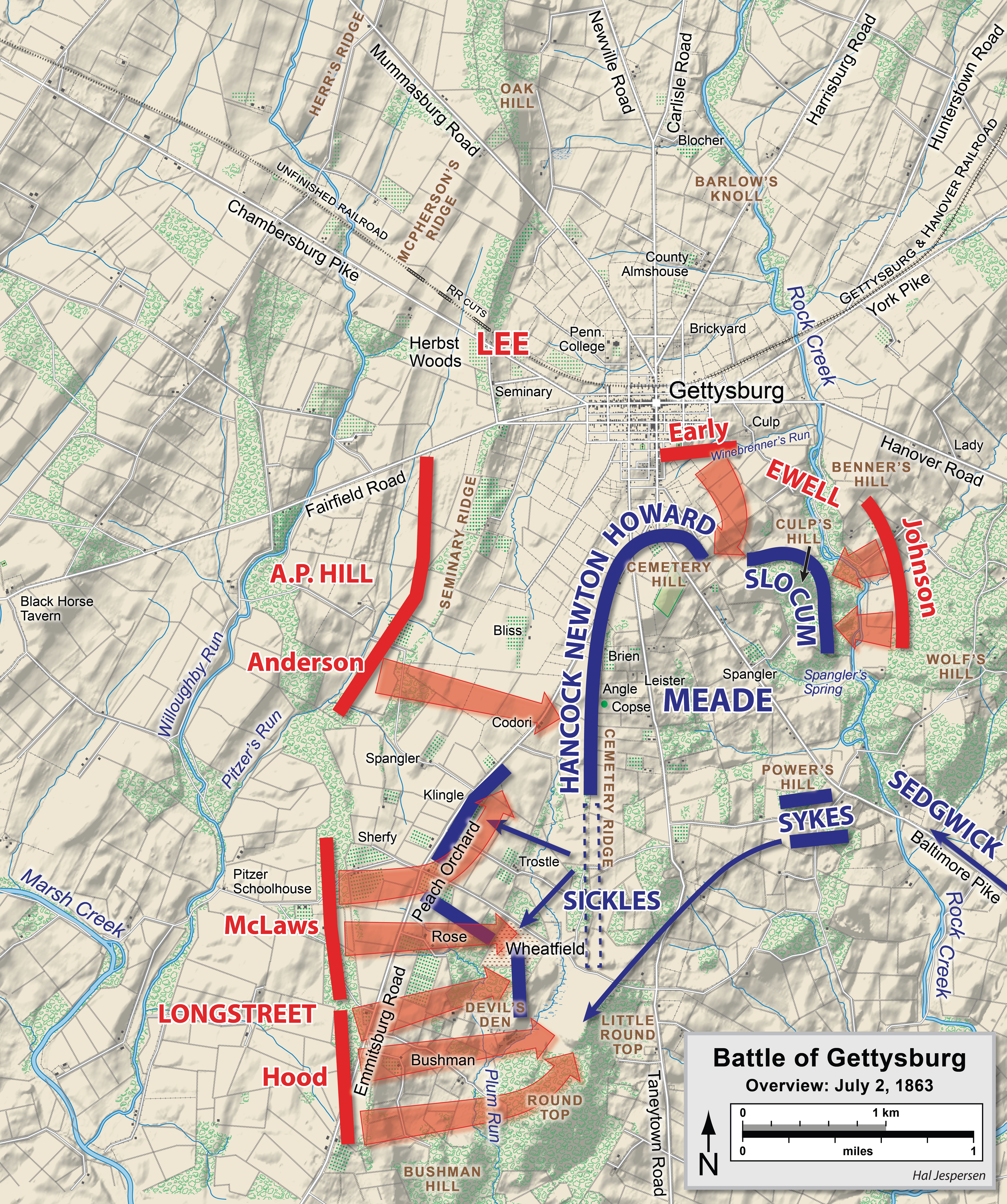
The map of the second day of the Battle of Gettysburg. The little blue arrow between Cemetary Ridge and LIttle Round Top is the First Minnesota.

The Alabamans blazed away at the Minnesotans, who pressed the attack home with a ferocity that sent the larger force reeling, even though outnumbered by 5:1.  Brigadier General Cadmus Wilcox, the Confederate general, wrote in his official report a few weeks after the battle (I’ll add emphasis):

“This stronghold of the enemy [i.e., Cemetery Ridge], together with his batteries, were almost won, when still another line of infantry descended the slope in our front at a double-quick, to the support of their fleeing comrades and for the defense of the batteries [he’s referrring to artillery, here – Ed].

Seeing this contest so unequal, I dispatched my adjutant-general to the division commander, to ask that support be sent to my men, but no support came. Three several times did this last of the enemy’s lines attempt to drive my men back, and were as often repulsed. This struggle at the foot of the hill on which were the enemy’s batteries, though so unequal, was continued for some thirty minutes. With a second supporting line, the heights could have been carried. Without support on either my right or left, my men were withdrawn, to prevent their entire destruction or capture. The enemy did not pursue, but my men retired under a heavy artillery fire, and returned to their original position in line, and bivouacked for the night, pickets being left on the pike.”

The charge drove back a force five times the size of the First.  It bought the time needed for Hancock to get the reinforcements into the line and consolidate Cemetary Ridge. 

And the First Minnesota stayed right there; the 47 men still standing (along with F company, which had been on detached duty on July 2, and missed the charge, bringing the “regiment’s” strength back up to around 80) were waiting when Lee launched General Pickett’s division on its ill-fated charge up the ridge the next day, July 3, the “High Water Mark of the Confederacy”.  At it was here, where the First was stationed, that Picket’s charge came closest to success; part of Pickett’s division reached the Union line, and spilled through; once again, a counterattack by the First Minnesota (commanded now by Captain Coates, who’d started the war in “A” Company) drove back the Rebel spearhead.  Private Marshall Sherman of “C” Company captured the battle flag of one of the attacking units, the 28th Virginia, winning the Medal of Honor (one of two for the Regiment that day;  the other went to Corporal Henry O’Brien, who, wounded in head and hand, picked up the First’s fallen flag under ferocious fire.  The Minnesotan kept their flag, and the Virginians’ as well.  It remains in Minnesota to this day, at the Minnesota Historical Society, the subject of some controversy between Minnesota and the Commonwealth of Virginia. 

The 28th Virginia’s regimental standard, seized at Gettysburg 150 years ago on July 3. Every so often, groups of Virginians make noises about wanting the flag back. They are met by shouts from vainglorious Minnesotans who urge them to march up here and take it. Apparently Ryan Winkler is now a Second Amendment advocate. Who knew?

The regiment served until the following April, when its enlistment ended.  Most of the volunteers served in other Minnesota units for the rest of the war; Colville became a legislator.

It’s amazing, the number of First Minnesota veterans who went on to prominence in the new state after the war.  This roster site has a fascinating list of biographies of an amazing number of First Minnesota veterans.  It’d be a fun game to see how many of these men have streets named after them in your community.

Groundhog Year Part III: In Plain Sight

Friday, May 10th, 2013

In Eric Black’s three part series about the Second Amendment a few weeks back (part 1, 2 and 3), Black – writing in the MInnPost, which operates in part through the generosity of a big grant from the anti-gun zealot Joyce Foundation – notes the not-exactly-earthshaking conclusion that the Second Amendment can confuse people.

Ooh! Confederates! That must mean the MinnPost is writing about bitter gun-clinging Jeebus freaks again!  Seriously, MinnPost – I’m never letting you live this down.

And the underlying themes of his series were – as I read ’em – that the Second Amendment is:

  1. Linguistically and legally inscrutable
  2. Confusing
  3. Obsolete.

We’ll address the first two of these today.

Black notes the definitions that vex a surface-level reading of the Second Amendment:

What’s a militia? If you aren’t in a militia, does this have anything to do with you? Or perhaps (and this is roughly the current Supreme Court interpretation) what if “militia” is just an 18th century word for all the able-bodied males in a state who had better have access to arms in case their state needs them to secure its freedom…But if “militia” doesn’t refer to an organized group, what’s “well-regulated” doing in there?

It’s a good question.  But it’s hardly a new one.

For much of US history, it didn’t need an answer – since hardly anyone questioned the notion that Militia meant…

…both.  The Militia Act of 1903 codified what had been followed in practice since the Militia Act of 1792; the the Militia was composed of…:

  • The Organized Militia – the National Guard and the Naval Militia, and…
  • the Unorganized Militia – every able-bodied male between 17 and 45 years of age who wasn’t a member of the Organized Militia.  In other words, everyone.  Including Eric Black.

But even answering “it’s in the law!” misses the most important point.

The answer to the question “What does the Second Amendment really mean?” started taking its currently definitive shape with the publication, about 20 years ago, of “The Embarassing Second Amendment“, by Dr. Sanford Levinson.  At the time, Levinson was a professor at the U of Texas School of Law; the article appeared in the Yale Law Review.

Levinson was and is an arch-liberal with portfolio, who described himself then and now as a card-carrying ACLU member who was very uncomfortable around the notion of civilians owning guns.   He’s no mossy originalist; he’s called for a Second Constitutional Convention.

The article – about 80 pages, half of them footnotes – is a highly detailed analyis of the textual, historical, structural, doctrinal, prudential and ethical history of the Second Amendment, its related case law, and analysis of all the above.

And the conclusion was all wrapped up in the title; Levinson, unabashed anti-gun liberal that he is, is embarassed to conclude that the “NRA” was right, and the gun-grabbers were wrong.

It came out a solid decade and a half before the Heller decision, but it was one of the key waypoints on the path between the silly, collectivist post-Miller-decision miasma and the Court’s curent stance on the issue.  It was the argument that started even arch-liberal Laurence Tribe on his path from dismissing the originalist interpretation (as Levinson notes in the article) to acceptance that the Amendment is in fact a right “of the people”.

The road to Heller and McDonald started with Levinson’s article.

And he started from the same question Eric Black did: what does “well-regulated militia” mean?

In textual terms – the strict reading of the words?  Not much help there: “The text at best provides only a starting point for a conversation. In this specific instance, it does not come close to resolving the questions posed by federal regulation of arms. Even if we accept the preamble as significant, we must still try to figure out what might be suggested by guaranteeing to “the people the right to keep and bear arms;” moreover, as we shall see presently, even the preamble presents unexpected difficulties in interpretation.”

But in historical terms?   Things are clearer:

Consider once more the preamble and its reference to the importance of a well-regulated militia. Is the meaning of the term obvious? Perhaps we should make some effort to find out what the term “militia” meant to 18th century readers and writers, rather than assume that it refers only to Dan Quayle’s Indiana National Guard and the like. By no means am I arguing that the discovery of that meaning is dispositive as to the general meaning of the Constitution for us today. But it seems foolhardy to be entirely uninterested in the historical philology behind the Second Amendment.

I, for one, have been persuaded that the term “militia” did not have the limited reference that Professor Cress and many modern legal analysts assign to it. There is strong evidence that “militia” refers to all of the people, or least all of those treated as full citizens of the community. Consider, for example, the question asked by George Mason, one of the Virginians who refused to sign the Constitution because of its lack of a Bill of Rights: “Who are the militia? They consist now of the whole people.” 48 Similarly, the Federal Farmer, one of the most important Anti-Federalist opponents of the Constitution, referred to a “militia, when properly formed, [as] in fact the people themselves.” 49 We have, of course, moved now from text to history. And this history is most interesting, especially when we look at the development of notions of popular sovereignty. It has become almost a cliche of contemporary American historiography to link the development of American political thought, including its constitutional aspects, to republican thought in England, the “country” critique of the powerful “court” centered in London.

One of the school’s most important writers, of course, was James Harrington, who not only was in influential at the time but also has recently been given a certain pride of place by one of the most prominent of contemporary “neo-republicans,” Professor Frank Michelman. 50 One historian describes Harrington as having made “the most significant contribution to English libertarian attitudes toward arms, the individual, and society.” 51 He was a central figure in the development of the ideas of popular sovereignty and republicanism. 52 For Harrington, preservation of republican liberty requires independence, which rests primarily on possession of adequate property to make men free from coercion by employers or landlords. But widespread ownership of land is not sufficient. These independent yeoman would also bear arms. As Professor Morgan puts it, “[T]hese independent yeoman, armed and embodied in a militia, are also a popular government’s best protection against its enemies, whether they be aggressive foreign monarchs or scheming demagogues within the nation itself.” 53

Which gets us into the third of Black’s conclusions, which we’ll come back to later in the series.

As to the notion that the “Right of the people to keep and bear arms” refers to a National Guard that the founding fathers didn’t envision:

Consider that the Fourth Amendment protects “[t]he right of he people to be secure in their persons,” or that the First Amendment refers to the “right of the people peaceably to assemble, and to petition the Government for a redress of grievances.” It is difficult to know how one might plausibly read the Fourth Amendment as other than a protection of individual rights, and it would approach the frivolous to read the assembly and petition clause as referring only to the right of state legislators to meet and pass a remonstrance directed to Congress or the President against some government act. The Tenth Amendment is trickier, though it does explicitly differentiate between “state” and “the people” in terms of retained rights. 42 Concededly, it would be possible to read the Tenth Amendment as suggesting only an ultimate right revolution by the collective people should the “states” stray too far from their designated role of protecting the rights of the people. This reading follows directly from the social contract theory of the state.( But, of course, many of these rights are held by individuals.)

(If you haven’t read Levinson’s entire piece – you need to.  It’s one of the most politically influential law-review articles in recent history – and it’s not a bad read, either).

As to “well-regulated?”    Levinson doesn’t address it directly – in the parlance of the 1790s, it meant “can do the job”, or “can hit their targets”, a definition that’s changed in the past two-odd centuries -because it’s irrelevant.  It’s a right of the people, necessary to the preservation of a free state.  It’s a secondary question at most, in the lee of the real question “what is a right of the people?”.

As noted in Heller, it’s not an absolute right; states can ensure that people who aren’t good citizens, felons and the like, don’t get guns.  They can legislate the types of guns, within reason; the whole “can you get a flamethrower or a cannon” argument is a strawman, although it’s worth arguing on its own merits (if I’m a law-abiding schnook with a .380 or a shotgun, why wouldn’t I be with a howitzer or a bomb?).

The “What does the Second Amendment Really Mean?” argument – like the “The Second Amendment existed to protect slavery!” argument we dispensed with a few months back – is a manufactured controversy, a re-hashing of questions that were answered literally decades ago among those who pay attention to the issue.

But the gun control movement rarely makes its appeals to people who pay attention to the issue.

Up next – probably Tuesday – the notion that the Second Amendment is just plain obsolete.

Groundhog Year, Part II: The History Of An Illusion

Tuesday, May 7th, 2013

As I noted about a week back, being a Second Amendment activist for any length of time – I started in the late eighties – is a little like being Bill Murray’s character in Groundhog Day; every time the argument cycles, you wind up answering exactly the same questions.  Over and over and over.

Some of the questions -“aren’t you compensating for something?” – are stupid conceits.  Some – “isn’t a gun in the home many times more dangerous to the owner or people he knows than to criminals?”, or “wasn’t the Second Amendment put in place to protect slave holders?” – are well-worn, long-debunked tropes that keep coming back, just like the villain in the last two minutes of a monster movie.

And others?  Well, despite both sides’ oversimplifications, they keep coming back because the Second Amendment is a complex issue, full of historical, linguistic and legal nuance.

Notice I said “complex”.  Not “inscrutable”.  Because it’s Groundhog Day, and everything, including answering nearly all the questions, has happened before.  Maybe several times.

Eric Black – one of the phalanx of deans of Minnesota political journalism – wrote a series a few weeks back at the MinnPost (which is the recent recipient of a big grant from the Joyce Foundation, an anti-gun group that lavishly funds anti-gun astroturf groups around the country).  The first of the three parts, “The Second Amendment is a Mess“, came out probably three weeks ago.

Confederate soldiers. With guns. Be afraid; your betters have declared that the Constitution is all about slavery.  Except the First Amendment, and of course the emanations of penumbras that give us abortion.  But I digress.  Prejudicial? Do you think?  The MinnPost ran this in a piece about the Second Amendment, and I’m never going to let them live it down.

In stating the case that the Amendment is “a mess”, Black writes:

…the interpretation of any law must start with the actual language of the law as enacted. So, for today, let’s just put the text of the Second Amendment under the microscope. Here is its full text:

A well regulated Militia, being necessary to the security of a free State, the right of the people to keep and bear Arms, shall not be infringed.

It’s a marvelously unclear statement, to modern sensibilities – and yet for some reason it defined a policy, more or less, through nearly 200 years.  Until the 1960s, nobody really questioned that the “…right of the people” in the Amendment meant anything different than “of the people” meant in the First, Third or Tenth Amendments.

We’ll come back to that.  I’ll return to Eric Black…

…while noting that I’m getting that feeling Bill Murray had during the last three-quarters of Groundhog Day; it’s deja vu:

It’s a disaster. Seriously. Here’s just a sample of problems it presents.

What’s a militia? If you aren’t in a militia, does this have anything to do with you? Or perhaps (and this is roughly the current Supreme Court interpretation) what if “militia” is just an 18th century word for all the able-bodied males in a state who had better have access to arms in case their state needs them to secure its freedom even though they might not actually “belong” to what we 21st century-types would recognize as a militia, like a National Guard unit that you actually joined and were trained by and that actually has a command structure.

A fair point…

But if “militia” doesn’t refer to an organized group, what’s “well-regulated” doing in there? Who gets to decide whether the (actual or theoretical) militia you are in is well-enough-regulated to trigger (no pun intended) whatever impact the militia clause has? Who is doing the regulating? The state? The United States? The (non-existent but theoretical) organization of all the gun-owners in the state acting as self-regulators?

…and a vexing one.

Indeed, Black’s series seems to focus on three allegations about the Second Amendment:

  1. It’s linguistically and legally inscrutable
  2. It’s confusing
  3. In an era where the US has a standing military, it’s obsolete.

But the first two were rendered null and void nearly a generation ago.    And the third exhibits a myopia about history, to say nothing of the Constitution, that needs to be actively fought.

But none of them are new. Indeed, it’s been nearly 20 years since the first two points were put out to pasture among people who are serious about the issue of the Second Amendment.

As to the third?  Stay tuned.

We’ll come back to that on Thursday.

Far Beyond Hope

Friday, April 19th, 2013

I started reading about the Holocaust way too young. In ninth grade, I tackled the Black Book – the B’nai B’rith’s compendium of Nazi atrocities against the Jews of Europe.  In retrospect, it may have been one of the things that started me thinking that maybe liberalism wasn’t for me; it certainly started me on the road toward being a Second Amendment supporter.

But we’re getting way ahead of ourselves, here.

One of the themes of the book – and of the story of the Holocaust, in retrospect -was that it snuck up on people; that many, even as they saw their rights being gutted and their businesses confiscated and their lives upended, just couldn’t imagine that it’d get worse.   Even as they were being loaded up and sent to ghettoes in Poland, they just figured there’d have to be a rational conclusion to it all.

The history of human tragedy is that the people who see it coming get labeled as crazies, politely inoculated off from society.

The other theme?  The few who saw through the illusion of rationality were capable of nearly superhuman courage.  As the Holocaust spun up to full speed about this time seventy years ago, there were a painfully few people who managed to make it hurt the Nazis just a little.

It was seventy years ago today that the Warsaw Ghetto Uprising began.

The story is well-known to people who know their history – which means most Americans know nothing about it.

Before there were concentration and extermination camps, the Nazis used the traditional Jewish “Ghettos” of Eastern Europe as natural “camps” in which to confine the Jews, Gypsies and the rest of their targets. They systematically deported Jews from all over Poland, Ukraine and Russia – and then all over Europe – to these small enclaves in Polish, Baltic and Ukrainian cities, using them as holding tanks until the camps – the last link in the Final Solution – were ready.

And in early 1942, they were ready.  The Germans started shipping Jews off to Treblinka, the first of the Vernichtungslagern, or Extermination camps.

And in the overcrowded, starving, disease-ridden Warsaw Ghetto – the realization that the end was near provoked a response from some of the inmates; it’d be better to die fighting.

And so a resistance movement,armed with a few stolen handguns and rifles and grenades and some homemade bombs, had formed.  In the previous months, it had managed to disrupt some of the roundups to the camps, throwing the Germans’ plans – as precise as any industrial supply chain management system – into disarray. And on April 19, the Germans’ military response was met with armed resistance.

On the morning of April 19, the Nazis marched into the Ghetto to begin the final liquidation, a brutal process like the one Steven Spielberg captured in the horrific scenes in the “Krakow Ghetto” in Schindler’s List.

It was a scene that’d repeated itself all over Eastern Europe; the SS would forcibly haul the Jews out of the Ghetto and herd them onto boxcars for transportation to one death camp or another.

But this time was different.  As the Germans came through the gate, the were met with gunfire and explosives and molotov cocktails.  They retreated in disorder, with 12 dead.

For the first time, the Germans had come for the Jews, and the Jews beat them back.

It couldn’t last, of course; the Jews’ guns numbered in the dozens, the German troops in the thousands.  They came back again, this time fighting block to block with artillery and flamethrowers.

They killed everything in their path in a fit of retributive blood lust.

The Jews – hopelessly outnumbered and virtually unarmed by military standards – somehow dished out a military setback to the Germans, holding the Germans out of the Ghetto for nearly a month.

It couldn’t last, of course.  The Germans advanced building-to-building, killing nearly everyone as they went – an estimated 56,000 inmates died in the battle or the aftermath.

The Germans trashed the Ghetto as thoroughly as Ground Zero. They shipped the very few they didn’t kill or burn or bury out of hand off to Treblinka (itself to end in another doomed uprising in the near future).

They literally razed the entire Ghetto to the ground.

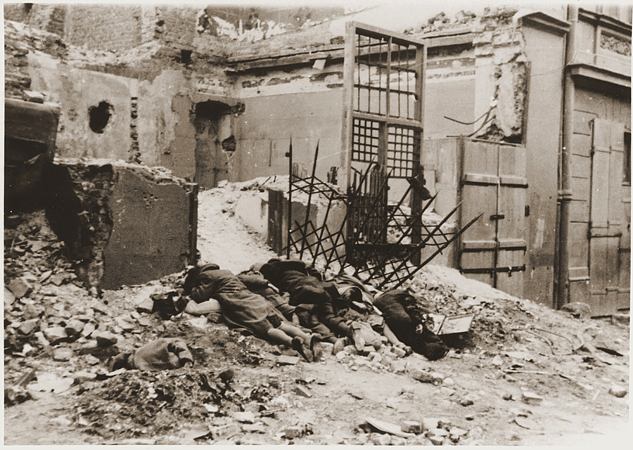
The Ghetto after the battle.

Serious resistance ended in about a week – which is itself amazing.  I urge you to remember; these were people armed with pistols who started the battle with an average of 6-7 rounds of ammunition; a few rifles with the 5 rounds in their magazines and not much more; accounts vary as to whether the Jews even started the fight with a machine gun (they may have picked a few off of dead Germans).  A few stolen grenades.  Molotov cocktails and a few homemade bombs.  Knives, spears, clubs.

Nothing more.

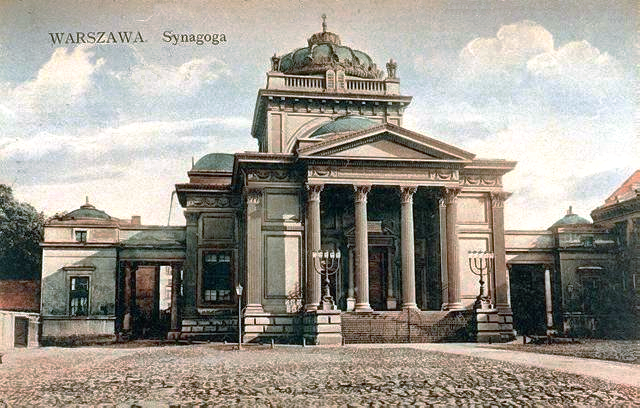
Pockets of resistance held out much longer, though; the Germans declared the battle over in Mid-may, with the symbolic dynamiting of the Great Synogogue of Warsaw on May 16.

The Great Synogogue of Warsaw in the 1910s.

And so the battle was over.

There were few survivors – but the few thto got away cut wide swathes. Marek Edelman,  last surviving leader, passed away a few months after i wrotw the first version of this piece, back in 2009, after a life spent as an activist for freedom, including a role in the rebirth of a free Poland in 1989.  Rhe handful of survivors and witnesses continue to tell their stories.  But like our own World War Two generation, the Holocaust’s few survivors – and the fewer still who survived the Ghetto – are dying off.

And as they do, we should worry – justifiably – that society is going to forget about what happened; that society might forget the consequences of racism (the real kind), hatred, dminishing the humanity of ones’ enemies (or scapegoats) to try to justify all manner of inhumanities and horrors upon them. And of course, worry that some will take away the wrong lesson, as another loathsome person did fourteen years ago today.

I read the story of the Ghetto and the Uprising when I was in junior high; it probably took many more years for me to really absorb it.  The lessons were these; never let this happen here.  Call out the prejudice that leads to this sort of eliminationist hatred when you see it, and do it without stint or mercy.  Never let society be left at the mercy of the thugs and the autocrats; it’s why we have a First and, if all else fails, a Second Amendment.

Above all, uphold humanity.

(more…)

The Hit

Thursday, April 18th, 2013

Admiral Isoroku Yamamoto was, by a long stretch, the greatest Japanese leader of World War 2.  A naval genius, the primary planner behind Pearl Harbor, he had an impact far beyond any other Japanese leader on the conduct of the war.

And while the general American public have lionized leaders in the past – Patton, MacArthur, Schwartzkopf, Petraeus – it’s hard for Americans to comprehend what a huge public figure a successful leader could become in a society as militaristic as pre-1945 Japan.  Rarely since the Vikings had there been a society that so revered accomplishment on the battlefield.

And rarely had any society a warrior leader as accomplished as Japanese admiral Isoroku Yamamoto.

Admiral Yamamoto’s PR head shot. It was his plan that conquered the entire Pacific Ocean, from the shores of China and New Guinea all the way to Hawaii’s doorstep at Midway Island.

And the Americans knew it. And seventy years ago today, they carried out an unprecedented action to change that – an action that showed the strengths, weaknesses, and ludicrous foibles of both sides of the war in the Pacific.

———-

The Japanese military was deeply divided before and during World War 2.  “Interservice rivalry” is, of course, endemic in every nation.

Healthy expressions of esprit de corps are a good thing in the military, of course; what would the Marines be if they didn’t think they were better than the rest of the services?

But in Japan, the problem swerved almost beyond caricature.  The Japanese military was divided between the Army and the Navy, and the Generals and the Admirals operated their services like feudal fiefdoms, to the point where both services were nearly completely redundant to each other.  Not only did the Army and Navy each have their own air forces (with completely separate development, procurement and manufacturing efforts, with all the duplication of effort and waste that attended such redundancy), each duplicated each others branches; the Japanese Army built its own navy (including cargo-carrying submarines), and the Navy’s “Marines” served as a duplicate Army.

And each service had its own culture.

The Japanese Army was steeped in the samurai tradition and “State Shinto”, the militaristic Japanese state religion; it was insular, Japanese-culture-centric, and by western standards a little barbaric.   It became moreso over time; before World War 2, most of the Army served in Korea (a Japanese colony at the time), Manchuria (which Japan had annexed in 1931) and China (which Japan had invaded in 1937); its entire background was in Asian societies that had changed little in hundreds of years.

The Navy, on the other hand, had been heavily influenced by the British, adopting British design standards and working with many British advisors.  While it had its samurai traditions as well, it was much more cosmopolitan than the Army.

The IJN Kongo. The first world-class Japanese battleship, and the oldest Japanese battleship to serve in World War 2, it was actually built in 1912 in Britain (as Japanese engineers observed, building its three sisters in Japan). Leave aside the “pagoda” bridge; the rest of the ship looks exactly like a World War 1-era British battleship.

Young Japanese naval officers went on long training cruises before the 1930s, routinely docking in in Western ports, including San Francisco and Seattle.

Yamamoto knew America; he’d studied at Harvard (1919-21) and as Naval Attache (1925-28).

A young Yamamoto with US Navy Secretary Curtis Wilbur.

Yamamoto’s respect for America varied; he didn’t much care for the Navy’s officer corps, thinking them a bunch of careerist golf-course commandos.

But he had much respect for America’s industry, and its drive to innovate.  And as he rose through the ranks, he urged the Army to show a little restraint about engaging the US in a war he felt Japan could not win in the long run.

The road to Pearl Harbor led through an epic political battle between the Army – especially its radicals who believed that they could sweep aside the soft, effete British, French, Dutch  and American presences in the Pacific – and the Navy, which favored expansion (indeed, needed it to get the resources they’d need to continue expanding, to say nothing of the justification for more Navy).

In 1938, the Army won the political battle, empaneling Hideki Tojo – an Army man – as Prime Minister.  While some worried that that could have resulted in Yamamoto’s ouster or even murder, Tojo kept Yamamoto on as head of the Combined Fleet – the highest operational command in the Navy – and charged him with planning to sweep the enemy from the Pacific.

Gen. Hideki Tojo, prime minister during most of the war years.

Yamamoto realized that the only way to effect this against the US was to wipe out its Pacific Fleet, buying the Japanese fleet (carrying the army) time to consolidate the advances into a position that the US couldn’t recover.

The rest is history; they nearly did it.  But for the fact that the Navy’s aircraft carriers had left Pearl Harbor for a training exercise, Yamamoto might have won World War 2 in the Pacfic on December 7.   It nearly worked anyway.

And Yamamoto’s stock soared; in a nation that revered martial accomplishment, he became a superstar.

And the US needed to fix that.

———-

In recent years, as information has been released with the end of the Cold War, the story of US intelligence’s great coup in cracking Japanese codes has become less obscure.  Like the British efforts against the Germans, the US code-breaking effort led to our knowing most of what the Japanese were doing in nearly real time; the biggest Japanese successes, like Pearl Harbor, were the ones that relied on absolutely no radio traffic.

And in the spring of 1943, Navy code breakers found out that Admiral Yamamoto would be touring Navy installations in the southwest Pacific.  In particular, the tour – aboard a couple of Japanese bombers that were being used as passenger ferries – would spend a bit of time on the Japanese-held island of Bougainville, in the Solomon Islands chain.

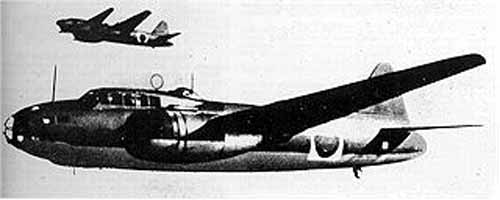
Japanese G4M medium bomber. Codenamed “Betty” by the Allies, it was a fast, long-ranged bomber with a heavy bomb or torpedo load. It was a very successful plane during the first two years of the war. By 1943, the Japanese were starting to discover it was vulnerable, and didn’t absorb damage well – to Yamamoto’s chagrin.

Which was about 400 miles away from the nearest US base, on the island of Guadalcanal.

It was the Navy’s job – but 400 miles was beyond the range of any current Navy or Marine fighter planes.  So the Navy “borrowed” the US Army Air Force’s 339’s Fighter Squadron.  The 339th flew the Lockheed P-38 Lightning – the longest-ranged fighter in the US arsenal at the time.

The P38 Lighting. Tell me that’s not one cool airplane. I dare you. It had two engines, for added range and reliability – but unlike most two-engined fighter planes of the war years, it was agile enough to mix it up with enemy fighters on more than even terms. The highest-scoring US ace in history, Superior, Wiscinsin’s Richard Bong, flew a P38 for all of his 40 air-to-air kills.

To avoid detection by Japanese radar, the Navy and Army planners drew a route for the 339th that would take it far out to sea at wavetop level and approach the airfield indirectly, from over the mountains; four of the P38s would drive straight for Yamamoto’s plane, while the rest would fly top cover against any escorting fighters; then, with no further need for stealth, they’d fly the 400 miles directly back to Guadalcanal.

And seventy years ago this morning, the mission went ahead.

———-

The mission was a very difficult one in the context of the times; in the days long before GPS or any other electronic navigation aids, the pilots navigated by dead reckoning and timing. Flying very, very low was dangerous, with little visual cue as to actual height and no radio altimeters (which would have tipped the Japanese off anyway); one of the P38s actually brushed the water with its propellors, but averted disaster, recovered and kept flying.

The attack itself went off as planned; as the cover team rocketed up to altitude, the four planes of the killer team saw the two Japanese “Betty” bombers in the landing pattern, with six escorting “Zero” fighters orbiting above.

Two  P38s, flown by Captain Thomas Lanphier and 1st Lt. Rex Barber, engaged the first of the two bombers; Lanpher fired in a slashing attack from the front, while Barber lined up behind the “Betty”, which burst into flame and disappeared, crashing into the jungle.

Artists conception of Barber closing in for the kill

Barber and another pilot, 1st Lt. Besby Holmes, attacked a second bomber which was trying to sneak away at wavetop level; the bomber crashlanded in the ocean.

Capt. Lanphier, Lieutenants Holmes and Barber

The first bomber carried Yamamoto; all aboard, including the Admiral, were killed.  The second plane yielded three survivors, including Yamamoto’s chief of staff, Admiral Matome Ugaki.

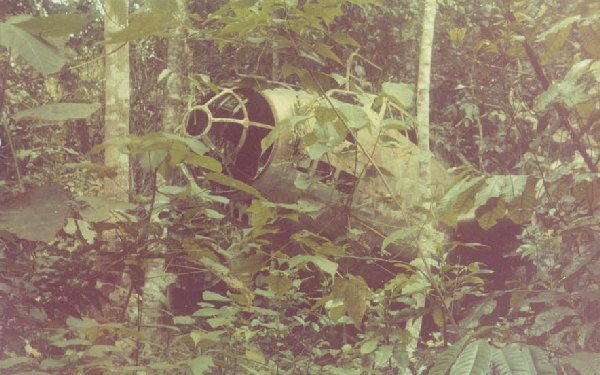
The wreck of Yamamoto’s plane today. A Japanese search party retrieved the bodies from the plane shortly after the raid; Yamamoto’s ashes were returned to Japan on a battleship.

One P38 was apparently shot down by the escorting Zeros, although the plane, flown by 1st Lieutenant Ray Hine, was not seen to get hit or crash, and apparently fell into the sea.   Hine was the only US casualty; the remaining P38s made it back to Guadalcanal, so short of fuel that some of the  planes’ engines sputtered to a stop on rollout after landing.  As he came in on final approach, Lanphier radioed ” “That son of a bitch will not be dictating any peace terms in the White House” – a huge security breach that risked tipping the Americans’ intelligence hand to their enemies.

But the secret was safe.

The Japanese government, knowing the blow Yamamoto’s death would be, concealed the news from the public for six weeks.  The American press ran it immediately, of course – with the cover story that Yamamoto’s plane had been spotted taking off by Australian “Coastwatchers”, scouts who operated on the small islands in the middle of Japanese territory with radios and binoculars.  They were a key part of the Allied intelligence network (and played a key role in John F. Kennedy’s crew’s survival after the sinking of PT109), but had no involvement; the story was intended to prevent the Japanese from figuring out that their codes were nearly transparent to the Navy’s code breakers.

———-

But the story didn’t end there.  It went on for nearly fifty more years.

Lanphier immediately claimed credit – and popular accounts, starting with a Time Magazine story in 1943, and including the first story I myself read about the raid as an eight year old history geek, credited Lanphier – who was a one-man public relations machine.  Indeed, one of his squadron-mates noted that Lanphier started a manuscript in which he claimed to have gotten the kill himself.

Lanphier at the end of the war. Promoted to Colonel, he’s with his father – also an Army colonel – and mother.

That – and a meeting after the war with one of the Japanese fighter pilots that’d unsuccessfully escorted Yamamoto – irked Barber, who appealed to the Air Force, getting half credit for the kill.  The case between Barber, Lanphier and the Air Force wended its way through channels until 1991, when the US Ninth Circuit refused to hear it; good thing, as the Ninth Circuit would have awarded the kill to Michael Moore.

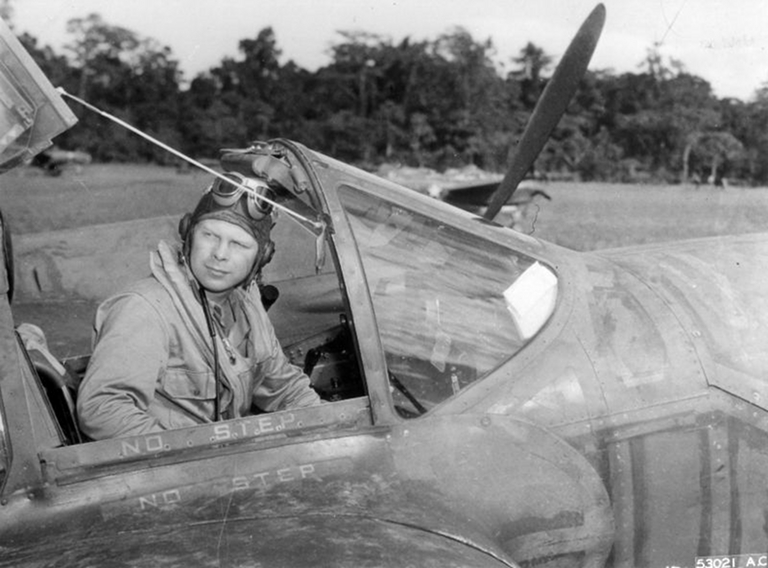
Major Richard Bong  in the cockpit of his P38. The Superioe native remains the too-scoring fighter pilot in US history.  He had nothing to do with the Yamamoto mission – dour changing photos from an iPhone is a pain.  .

Lanphier died in 1987 after a career in the Idaho Air National Guard; Barber passed away in 2001 after working as an insurance salesman and Little League baseball supporter.

And in 2003, after both men were long gone, an examination of the wreck showed that all of the damage to Yamamoto’s plan came from fire from the rear – Barber’s approach.  At long last, the Air Force gave full credit for the kill to Barber.

Eternal Patrol

Wednesday, April 10th, 2013

Today marks the 50th anniversary of the sinking of the USS Thresher.

At the time Thresher was a super-weapon – one of the main demonstrations of America’s Cold-War technological prowess.  Faster and deeper-diving than any previous class of submarines, with a nuclear power plant giving it effectively-unlimited range, armed with the latest guided torpedos and anti-submarine missiles (including the nuclear-tipped SUBROC), it was the lead ship of what was initially intended to be a class of 14 boats.  It incorporated every lesson that the US had learned about submarine warare in World War 2, and everything they’d learned from the defeated Germans, and from the decade and a half of tete-a-tete up to that point in the Cold War.

The sub left Portsmouth, New Hampshire 50 years ago yesterday for a series of deep dive tests, part of its fleet acceptance trials – so a number of the men onboard were civilian contractors from the Portsmouth Navy Yard.  After a day of trim testing, at about 7:47AM, Thresher began its descent to its “test depth” – which, in submarine terms, is deeper than its “operating depth”, but about half of its estimated “crush depth”.

At an estimated depth of about 1,000 feet, a chain of problems occurred, as reported to the attendant sub rescue ship USS Skylark over the “Gertrude”, an acoustic telephone  (developed before World War 2, and still in service on submarines around the world) that allows voice communications underwater;  a silver-braised thru-hull tube apparently ruptured, spraying high-pressure air all over the engine room…

The Skylark, a World War 2-era converted fleet tugboat recommissioned as a submarine rescue ship.

…which shorted out electrical panels, causing the reactor to “scram”, or shut down.

Navy standard operating procedure was to shut off the steam system, helping prevent overly-rapid cooling of the reactor (which could itself cause catastrophic problems under the wrong circumstances, although over a time frame that wouldn’t have mattered in the Thresher’s case.  

Nuclear submarines don’t usually “blow” their ballast tanks to surface (pump out the water with high-pressure compressed air); they usually rely on their “planes” (think airplane elevator fins) and their engine power to surface.  But with the engine shut off and the engine room getting heavier from the burst pipe, the skipper, Commander John Harvey, ordered a “blow” of the tanks.

Which led to the next link in the catastrophic chain; when compressed air expands, it cools off.  The further and faster the compression drops, the colder the air gets.  Spray a can of compressed-air computer cleaner for a few seconds to test it; it gets cold.  Dropping from 3,000 PSI apparently caused the released air to freeze over the ballast tanks’ outflow valves, preventing the ballast from being blown.

The sub likely sank stern-first, down to about 400 feet below its estimated crush depth of 2,000 feet, before the hull imploded, sending a ram of water through the boat at a speed later estimated at 4,000 miles per hour, ripping the three-inch-thick steel of the boat’s hull to shreds.

A piece of badly twisted brass pipe, testimony to the force of the implosion.

The loss of the Thresher – still the worst loss of life in any submarine disaster in history – was a watershed moment in submarine design. At a time when submarines were being built to operate at depths four times greater than during World War 2 – which, let’s remember, was only a decade in the past when Thresher was designed, 15 years when it launched in 1961 – the notion of “quality control” needed a radical upgrade.  The US Navy started its “Sub Safe” program as a result – a relentlessly difficult quality control program that set the standard for intensity of effort and scrutiny of vendors, and may have been one of the most successful government programs in history.

Which has led to a perception that submarines are very safe.  The Thresher disaster garnered massive publicity fifty years ago – and other than the sinking of the USS Scorpion six years later (due apparently to a fire in a torpedo, which led to another safety program of its own), it was the last submarine disaster the US has suffered.

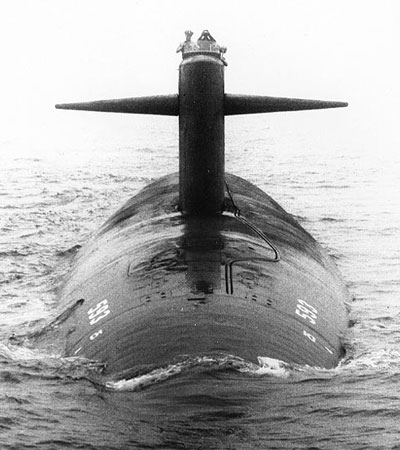
USS Scorpion. An older boat from the class preceding Thresher, its’ loss has been a favorite for conspiracy theorists ever since it sank in 1969; the theory is that the Soviets torpedoed it. It’s the sister of the USS Snook, on which my uncle served, for those of you keeping track.

For the past 44 years, submarine disasters are something that happens to other countries; five Soviet and one Russian nuclear submarines have sunk since Thresher‘s loss.

We’ve had some near-misses; a couple of submarines (USS San Francisco and USS Ulysses S. Grant) collided with undersea mountains and suffered massive damage, but returned to port with their crews alive (and their skippers headed for tours commanding radio towers in Nevada) – but nothing like the Thresher, knock wood.

And yet submarine accidents used to be distressingly common, even in the US; Thresher was the 17th of 18 US submarines lost to accidents.

Apropos not much.

Ten Men And The End Of The Nazi Bomb

Wednesday, February 27th, 2013

I first wrote about this episode three years ago; today is the seventieth anniversary of the Ryukan Raid,  in which ten Norwegian commandos with the British “Special Operations Executive” raided a hydroelectric dam that produced most of the world’s supply of “Heavy Water”, a key component of the process the Nazis were using to try to build an atomic bomb.

It was a good piece, so I’m going to re-run it, with a few suitable revisions.

———-

I’ll cop to it; after the 2009 “Nobel Peace Prize” award to a president who, as of the award deadline, had done nothing to warrant it, and has done even less since, my self-esteem-respect as an American of Norwegian anscestry has taken a bit of a beating.

But it’s on days like today – the 70th anniversary of the Norwegian raid on the Vemork heavy-water plant at Ryukan, Norway – that I get a bit of that old Norse møjø back.

You may not have heard the story – largely because most American history teachers are illiterate about history, and partly because the font of all historical knowledge for most of them, Hollywood, transformed the event into an Anglo-American triumph (the atrocious Heroes of Telemark).

Like much of what you learn about “history” from Hollywood, it’s BS.

A little scientific and historical background:  nuclear reactors need something to “moderate” their fission reactions – i.e. to keep them under control.  The United States program used a mixture of Cadmium and Graphite.  The Germans, for reasons best explained by a physicist, chose Deuterium Oxide – aka “Heavy Water” – a compound found in infinitesimally tiny quantities in all water.  All you need to do is refine it out of all the regular water.

And in all of Europe in the early 1940s, there was exactly one facility that could refine bulk lots of Deuterium Oxide in the quantities a nuclear weapons program would need; the Vemork plant near the village of Rjukan, Norway.

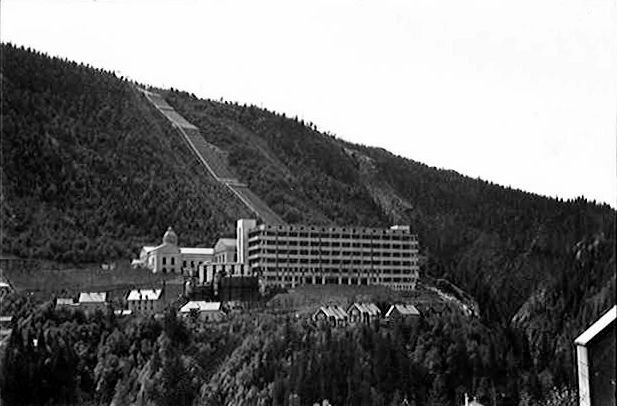
Vemork in 1940
Vemork

Vemork sat by a hydroelectric dam – so both  water and the electric power needed to find the Heavy Water were available in immense abundance.

The British had wanted to attack the plant ever since they learned of its significance.  The British “Special Operations Executive” – a wartime organization that sat at the intersection of intelligence and special operations, much like “Special Operations Command” in the US does today, and whose American analogue, the “OSS”, became the anscestor of the CIA and US Special Forces – established an agent inside the plant (Einar Skinnarland) who smuggled out blueprints and paved the way.

Einar Skinnarland
Einar Skinnarland

In October of 1942, an SOE reconnaisance team with four more Norwegian operators (Jens Anton Poulsson, Arne Kjelstrup, Knut Haukelid and Claus Helberg), men who’d fled to the UK after the German invasion and undergone commando and intelligence training, were infiltrated into Norway to reconnoiter the area for a followup British commando raid.  The four men were air-dropped into a remote area far from Ryukan, and skied for days through the gathering mountain winter before they could even begin their mission.

A plan came together…

…and then completely unraveled.  The followup British commando raid to attack the plant failed catastrophically, with gliders and tow planes crashing in the snow and all the commandos either dying in the crashes or being caught and executed by the Gestapo, after revealing under torture the target of their raid.  The Germans reinforced Vemork, in case the Brits tried again.

The four-man recon team had to not only survive a mountain winter, but do it with an alerted enemy actively searching for them, and stay on the grid and able to assist the followup mission that had to come.

Later that winter, it fell to them and six more Norwegian commandos to finish the job.

The six reinforcements – Joachim Holmboe Rønneberg, Knut Haukelid, Fredrik Kayser, Kasper Idland, Hans Storhaug and Birger Strømsheim – dropped into Norway, linked up with Poulsson, Kjelstrup, Haugland and Helberg, and carried out the plan.

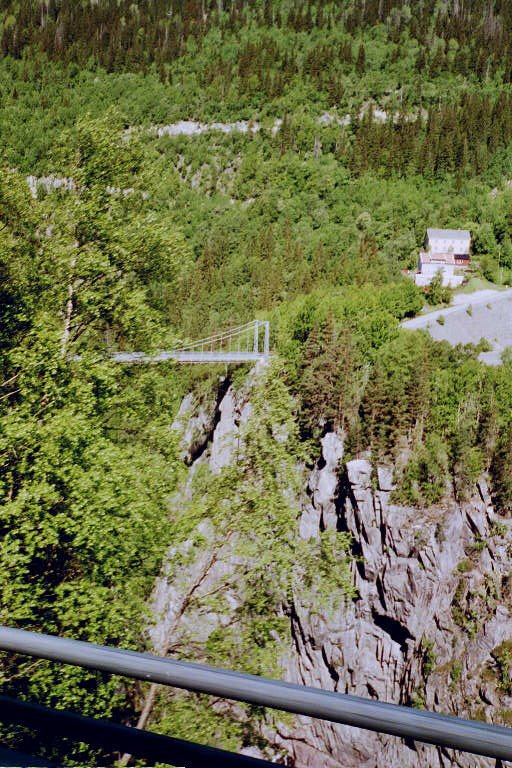
Bypassing the heavily-guarded bridge that ran 600 feet above the Maan River, the team descended from the plateau above into the river gorge, snuck across the icy stream, up a cable tunnel, and through a window.

Up for a bit of a climb?

They encountered a caretaker – who turned out to be a Norwegian who was happy to help.

The team placed the bombs – which destroyed the entire 1000-pound heavy-water supply – and escaped unscathed.  The Germans dispatched 3,000 troops to try to catch the commandos – but all escaped, with six of them staying in Norway to carry on the battle, and the other five skiing to Sweden to return to the UK to carry on the war.

Most of the team, after the war. Front: Poulsson, commander Leif Tronstad, Rønneberg. (Back) Storhaug, Kayser, Idland, Helberg, Strømsheim.

Being lucky and skillful, they all survived the war.

Being Norwegian, most of them lived long, healthy lives afterwards; all but Idland lived into the 1990’s; Poullson and Knut Haugland in the past few years, Strømsheim just last December.  Haugland was probably best-known to Americans, having participated in Thor Heyerdahl’s famous Kon Tiki expedition in the late forties. Joachim Rønneberg is still alive.

There are those who say, with some factual backing, that the German nuke program could never have caught up with the US program, even without the Vemork raid.

Perhaps.

Thanks to eleven brave underdogs and their mission, patched together against impossible odds, we never needed to even try to imagine what London and Moscow would look like as craters.

PBS’ Nova did an excellent documentary on the Vemork raid and its larger context, the Nazi nuclear weapons program.  It includes  a useful bio page on the whole group of Vemork raiders.  This site also explains the raid, and the science, in excellent detail.

The BBC also did a documentary – some forty years ago, now – on the subject. Hopefully it’ll stay available for a while:

It’s funny; listening to the guys from the raid (when I heard them on a different documentary from about ten years ago, since removed from Youtube), you’d think you were looking at and listening to old Norwegian guys at a Lutheran church lutefisk dinner in Park Rapids – and then you remember these are guys who sailed across the North Sea, went through British commando school, airdropped into Norway, spent a winter in a forester’s cabin living on reindeer meat and moss, and then carried out the kind of raid that ends up in the history books.

Every American schoolchild should be forced to listen to Rønneberg’s send-off at the end of the third installment of the documentary (around the 7:50 mark):

You have to fight for your freedom. And for peace. It’s not something that you have every day; you have to fight for it every day, to keep it.  It’s like a glass boat; it’s easy to break.  It’s easy to lose.

Whenever the Nobel committee embarasses Norway, I remember them, and feel much better, mange takk.

———-

Nearly everything I needed to write about today’s anniversary, I wrote three years ago – with one exception.

For most of the past 40-50 years, the conventional wisdom was that the Vemork raid, and the equally-daring followup the next year (in which Norwegian resistance fighters and SOE agents sank a ferry boat carrying the little heavy water that’d been salvaged by the Nazis) merely “bounced the rubble” of the German nuke program; that the bravery, endurance and ingenuity of the ten Norwegians was a great human story, but had little to do with affecting the outcome of the war.  The Nazis were never close to having a bomb, says the revisionist history.

The revisionism needs to be revised, though.

Tim Gawne, who’s spent a considerable amount of time researching ORNL’s archives and the Weinberg papers, recently came across a declassified Nov. 8, 1945 memo from Weinberg and L.W. Nordheim, the first physics director at the Oak Ridge lab (then called Clinton Laboratories), to Compton. Weinberg, who later directed ORNL for 18 years, died in 2006.

“We are writing in order to correct what we believe to be a very prevalent misconception concerning the state of the art as known to the Germans in 1945,” Weinberg and Nordheim wrote in the three-page memo, noting they had read a few of the relevant German documents.

There has been a lot written, of course, regarding Germany’s work on the atomic bomb and various analyses. I’m no scholar on the topic, by any stretch, but the Weinberg/Nordheim memo seems to offer a more generous assessment of Germany’s progress than some other post-war reports and subsequent analyses.

They addressed multiple questions in the memo, including a concluding one, “What bearing does this have on the general question of our ‘secrets’?”

Here’s part of their answer:

“On this we can presume to speak only as individuals.

“The general impression from the German reports is that they were on the right track and that their thinking and developments paralleled ours to a surprising extent. The fact that they did not achieve their chain reaction is primarily due to their lack of sufficient amounts of heavy water.

“In one of the reports a vivid description is given of the German efforts in this respect. The heavy water factories in Norway were designed for a capacity of 3-4 tons a year and were successfully operating during part of 1942 and 1943. This capacity would have been sufficient for the construction of a pile (reactor). However, the production was interrupted by sabotage and finally the main factory was destroyed by a bombing attack. Toward the end of 1944 plans were made to initiate production of heavy water in Germany and to use enriched uranium in order to reduce the material requirements.

In other words, the Germans never came close to having the bomb – in large part because due to the Vemork Raid, they could never get a reactor built.

Pass as Prologue

Tuesday, February 19th, 2013

By February of 1943, the American military was starting to get use to combat.  For a military force that rivaled Portugal in size in the early 1940s, the U.S. Army had to undergo a rapid education in modern military tactics against better trained, sometimes better equipped opponents.  There had been plenty of bloodied noses in this trial-by-fire – Pearl Harbor, Bataan, Guadalcanal, the U-boat attacks of ’41/’42 – but one opponent remained to be engaged: the Wehrmacht.

On February 19th, 1943, American troops received their first education of German military tactics by the regime’s most noted teacher, Gen. Erwin Rommel.  The school was a dusty spot in the Tunisian desert known as Kasserine Pass.

Kasserine Pass was not the first time American troops had come under German fire, but it would become the most notable of the early engagements following the Allied invasion of French North Africa.  Operation Torch in November of 1942 was the largest Allied invasion of the war thus far, placing 107,000 British and American troops in Morocco and Algeria.  Coinciding with the British offensive at El Alamein, the goal had been a grand-scale encirclement of German and Italian forces in Libya and western Egypt.  Instead, Hitler doubled-down on the North African front, committing 250,000 more troops and drawing the Allies into another protracted desert campaign.

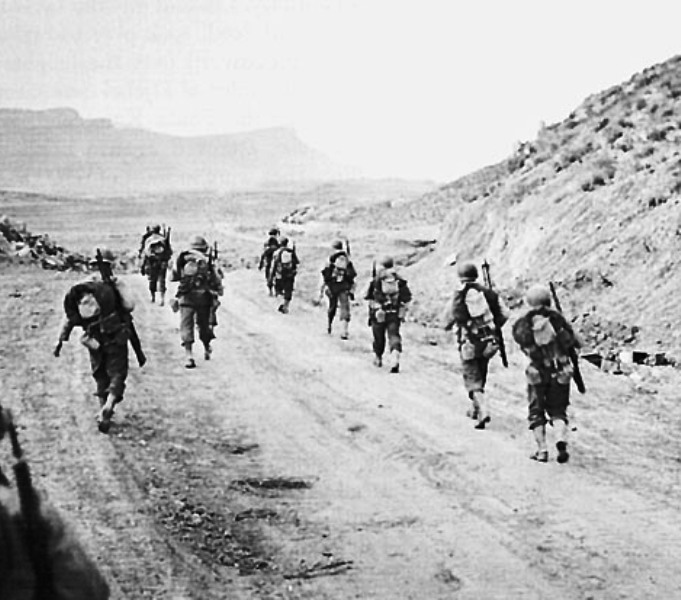
American troops in Tunisia: the Allies lost more men in 11 days at Kasserine Pass than in 6 months at Guadalcanal

(more…)

The Harvest Home (30th Anniversary)

Thursday, February 14th, 2013

I wrote this piece five years ago yesterday, on the 25th anniversary of what had to have been the most famous crime in North Dakota history, the Medina Shootout.

Not much has change for me, or the story, since then.  So while I usually don’t re-run pieces, I’m going to basically just update the piece from 2008.

———-

I was a 20 year old college kid working a grindingly-boring Sunday afternoon shift at KQDJ Radio in Jamestown, ND on February 13, 1983.

I was doing what I usually did on those boring Sunday shifts; playing records, doing homework, taking transmitter readings.

Then, the police scanner in the “newsroom” next door, which normally burbled with the desultory reports of DWIs and bar fights and traffic stops that make up the lives of most small town cops, suddenly erupted.  There’d been a shootout; officers were down; cops and sheriff’s deputies were being dispatched to Medina, a town of about 400 people about 35 miles west of Jamestown on I94.

It took hours to untangle the story, which became perhaps the most famous crime in North Dakota history, the Medina Shootout.

Two US Marshals, dispatched from Fargo to try to arrest a group of tax-protesters affiliated with the neo-Nazi-sympathetic “Posse Comitatus”, had been killed in the shootout that ensued.  Their leader, Gordon Kahl, and several others fled the scene.  The scanner reported ambulances on their way to the hospital in Jamestown bringing the wounded, which included Yorie Kahl, criticially injured by a gunshot; in one of the many ironies that day, Kahl’s life was saved by the doctor on duty in the Emergency Room that day, Dr. Evan Kostick, father of my high school pal David (himself a doctor today), and one of Jamestown’s tiny Jewish community.

The scene of the shootout when the first TV station, from Bismarck, arrived on the scene.

Yesterday was the thirtieth anniversary of the shootout.  The anniversary passed without much notice in the regional media.  Five years ago it was another matter; the Fargo Forum led the coverage; others from the Bismark Trib pitched in; former Forum staffer James Corcoran wrote “Bitter Harvest”, the definitive book on the event, relating not only the shootout and the apocalyptic trial of the survivors, but the social sturm und drang that the event caused on the Northern Plains.

———-

Times were brutally tough in the Dakotas in the early ’80s.  The rest of the US was slowly recovering from a recession; it’d be hard to call what happened on the Plains anything less than a depression.  What the foreclosure crisis is to the inner city today, the farm crisis of the ’80s was to the Great Plains.

The Medina water tower. The tower was there in 1983, although without the antennae.

Some farmers – and some of the workers whose livelihoods depended on agriculture, which in North Dakota back then accounted for pretty much every job in the place – did what human nature naturally bids some people to do; blame someone else.  And for some – like Kahl and a thin film of like-minded people – it wasn’t a big leap from “losing your farm to the bank” and “losing your farm to Jewish Bankers”.  The Times’ review of “Bitter Harvest” notes:

The book that turned his head at an early age was ”The International Jew: The World’s Foremost Problem,” and it was written by Henry Ford.

It is based on a 1918 treatise called ”The Protocols of the Elders of Zion,” which purported to be the minutes of a cabal of Russian Jews plotting to destroy Christianity and the white race and take over the world. Ford wrote ”The International Jew” in 1920, and it was not until 1929 that he finally conceded that ”The Protocols” was a fabrication concocted by czarist Russian anti-Semites.

Even so, as a young man in the 1940′s, Mr. Kahl believed it totally. He had considerable encouragement. He came of age at a time when the velvet voice of the Rev. Charles Coughlin, a Roman Catholic priest who reached into almost as many homes with his weekly radio show as Fred Allen, broadcast some of the nastiest anti-Semitic propaganda ever heard on the airwaves; when Gerald L. K. Smith established the Jew-baiting Christian Nationalist Crusade in Arkansas and gained a national following, and when Gerald Winrod, an apocalyptic fundamentalist preacher in central Kansas gained tens of thousands of adherents to a movement that came to be known as the Jayhawk Nazis.

Winrod’s son, George Gordon Winrod, kept the ministry alive.  I remember his followers leaving corrosively anti-semitic leaflets under the windshield wipers of cars in the church parking lot when I was in ninth grade.

Nobody in my circle bought into it, of course – but we all knew people for whom it rang true.  There was an audience, out there.

And they – like Kahl – weren’t necessarily easily identifiable:

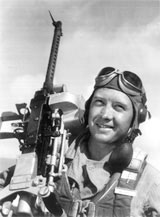
When Mr. Kahl came home from World War II, he was 25 years old, and he was regarded as a hero. He had shot down 10 enemy planes as a turret gunner on B-25′s, and he had won the Silver Star, the Bronze Star, two air medals, a Presidential unit citation and two Purple Hearts. That was not all the metal he brought home. Surgeons never did get out all the shrapnel he took in the jaw, chest and hip.

Kahl in World War 2

So the combination of hard times and ready scapegoats found some adherents.

———-

Kahl escaped that day; with two federal agents dead, the federal law-enforcement machinery sprung into place.  Two blocks from the house where my father still lives in Jamestown, in Stutsman County’s then-brand-new courthouse, the FBI and an alphabet soup of other federal law-enforcement agencies set up their command post; local hotels were jammed with brusque men and women in sharp suits and/or, occasionally, battledress utilities.

Kahl

And they were not happy.  Rumors began to circulate; the Feds were tramping about the prairie with big, nasty boots; they were conducting no-knock raids, presuming the locals guilty until proven innocent, acting like a hostile occupying power – or so said the rumors.

The previous summer, I’d worked at KDAK, a little station in Carrington, a town of about 2,000 about 40 miles north of Jamestown.   The station had also just hired a new “News Director”, a pretty mid-20-something named Peggy Polreis who’d just come from Carrington’s newspaper.  One of my jobs had been to make her broadcast-worthy.  I did a good job.

One day, a few days after the shootout, Peggy got a tip from a source that the Feds were going to search a farmhouse near nearby Fessenden.  She arrived on the scene to find that the press were being cordoned away from a farmhouse located a solid half-mile up the road, behind a shelter belt.

Peggy slipped away from the group, and crawled – so the story went – a quarter of a mile along the shelter belt, keeping out of sight of the cops.  She was, apparently, the only non-cop to see what happened.

The police – and, as I recall, a North Dakota National Guard armored personnel carrier – had surrounded the farmhouse.  A dog darted from an outbuilding; a policeman shot the dog dead.  The gunshot sparked more gunfire, and before long the farmhouse was completely riddled with bullet holes.  Finally, the police moved in…

This is a photo, as I recall, from the search near Fessenden. That’s an M-114 Armored Reconnaissance Vehicle on the right, a ND National Guard vehicle that was pretty much the only armored vehicle in the state at the time that wasn’t intended to carry cash.

…to discover the farmhouse empty.

It was one of many incidents that angered, and occasionally alienated, the locals from the Feds.

———-

How you look at the events of that winter (and the ensuing spring and summer, when the manhunt for Kahl led to a final shootout in Arkansas that left Kahl and another Christian Identity supporter dead) depends on who, and where, you were back then.

If you were a local, you knew that North Dakotans tend to be good, law-abiding people; they’ve voted Republican in pretty much every Presidential election since statehood, making them marginally less conservative than Utah.  And yet the Posse, and Christian Identity, found recruits and adherents – and it was no mystery why.  Radical fringes were no stranger to the plains; the Non-Partisan League, the Grangers, the Bund and other fevered activists had gestated in the area in response to other crises since the 1890′s.

The seven Kahl case defendants

So we weren’t surprised that some of the locals were sympathetic.  It was a minority – a small one – but it drew attention.  One of them even wrote and recorded – on a home cassette player, I think – a song praising and rooting for Kahl, during the manhunt and before the final fatal shootout in Arkansas.  It got a little play – mostly from news organizations who were reporting on the acceptance Kahl, the Posse and other extremists got from the area.

If you weren’t from the area, and didn’t understand it, it must have seemed odd.  And maybe a little scary.

———-

Hollywood certainly knows nothing of the area, and understands less about it.  But that didn’t stop it from making a made-for-TV movie, based rather loosely on Bitter Harvest, in 1991.  Line of Duty: Manhunt in the Dakotas starred Rod Steiger as Kahl, andMichael “Family Ties” Gross as an FBI agent from New York who flew to the state to help solve the crime.

The show got the basic facts right; the names, the places (most of the show was putatively set in Jamestown), the timeline (sort of).

But the Hollywood take on the area, and the locals, was bemusingly warped.  Part of it was the Central Casting version of small-town people; although North Dakota is a place where you can hear the Fargo accent (“Yah, sure, you betcha”) in a hundred little main street cafes and bars, the show had the local farmers speaking with cornpone Arklahoma drawls.  The locals, to Hollywood, were out of Gomer Pyle or, given the sinistry of the subject matter, maybe Deliverance.

Rod Steiger as Kahl, during the shootout scene.

Worse?  While there was support for Kahl (and even more criticism of the Feds’ heavy-handedness, arrogance, and occasional contempt for due process in the way they carried out the manhunt in the immediate wake of the shootout), Manhunt in the Dakotas showed something that was almost an active guerilla movement, with rocks and shots aimed at passing police cars, threats, Gross (and Larry Hunt as “Chief Walters”, a composite and sympathetic Jamestown police chief) being harrassed while driving in the countryside, and – in the movie’s climactic scene – the two walking, nervous, down “Jamestown”‘s main street as the “local radio station” played the pro-Kahl song (with a cheery intro from the DJ), both of them keenly aware of the hateful gazes of the locals (by now all of them seemingly Kahl-sympathizers) boring through them both, as if they were fully-bedsheeted Klansmen scurrying through Compton.

“Main Street in Jamestown”, from “Manhunt in the Dakotas”. Note the 1986 Honda Civic wagon inserted into a story set in 1982. Also note the movie theatre – and I’ll point out the relative lack of local significance to “The Alamo” in rural North Dakota. Perhaps that’s why all the “Locals” in the movie had Arklahoma accents.

It was crap, of course, factually (no station in the state played the song, except as news) as well as socially (Jamestown is a college town of 16,000 that hosts a state hospital, and a school for the profoundly disabled, where Kahl had little traction; Kahl’s base of support was out on the isolated drift prairie).  But it was interesting, seeing how inscrutable “flyover land” was to the people who actually produce these things, and the almost-superstitious fear the place engenders.

———-

That part of North Dakota is a huge place in terms of the land and the sky; the human geography is much smaller.  In the 27-odd years since I left the place, whenever I meet other expats, it’s hard to go more than thirty seconds without finding a common acquaintance.

It’s the same with events.  Besides Dr. Kostick, and Peggy Polreis, I knew Darrell Graf – Medina’s police chief at the time (and Graf has actually turned up on this blog) and people in his family.  Scott Kopp was another – a guy I remember as a Stutsman County deputy who lost a finger from a Kahl shot that could have done much worse.  Another guy – a Medina cop who was on the periphery of the action – was my friend’s sister’s boyfriend (and, the last I checked, husband of about twenty-five years).

The internet can make you acquainted with even more people.  Scott Faul – one of the Posse members who was arrested, tried and did prison time for his role in the shootout – had a blog, although it hasn’t been updated since the first time this piece ran.

Thirty years is a long time, even out there.  But memories are longer still.

A Live Hero

Tuesday, February 12th, 2013

Clinton Romesha becomes the fourth living Medal of Honor recipient, for his actions at the ill-fated Forward Operating Base Keating:

“I’m feeling conflicted with this medal I now wear,” Romesha told reporters outside the West Wing after the ceremony. “The joy comes from recognition for us doing our jobs as soldiers on distant battlefields, but is countered by the constant reminder of the loss of our battle buddies, my battle buddies, my soldiers, my friends.”

Eight U.S. soldiers were killed in the fighting and other 22 wounded, including Romesha, who was peppered with shrapnel from a rocket-propelled grenade in the hip, arm and neck. But he fought through his wounds to help lead other soldiers to safety, defend the burning camp from encroaching Taliban fighters, personally taking out at least 10, and retrieve the bodies of the fallen Americans.

And although he’s not a native, I’m going to give a  homer shout-out:

Romesha grew up in the small town of Lake City, Calif., and deployed out of Fort Carson, Colo., fulfilling a tradition of military service shared by his grandfather, his father and his brothers. He now lives in Minot, N.D., with his wife and three children and works in the oil fields.

That’ll be a conversation starter in Minot.

I’d hope to run into the sergeant next time I’m in Minot – but I’d imagine he’ll be busy.

Taking It On the Chindits

Friday, February 8th, 2013

As conventional forces went, they were an unconventional bunch.

The unit was weighed down by equipment (70 pounds of gear per man), experience (most were second-line reservists) and age (older draftees).  Their leader was forged in the classic mold of the British eccentric, perfect for a forgotten front against a larger opponent filled with combat veterans.  But neither the obstacles or the odds daunted the men of the King’s Liverpool Regiment and 2nd Gurkha Rifles, together better known to history as the Chindits, as the crossed into Japanese-controlled Burma on February 8th, 1943.  Their mission would be part of the beginning of the modern-era of Special Forces.

The Burma that the Chindits marched into was far from friendly territory – even before the Japanese invasion.

Burma had been among the last of the British possessions captured in the colonial era.  The Anglo-Burmese wars of the mid-19th Century sapped the Burmese monarchy and military, leading to fall of the capital Rangoon after the Third Anglo-Burmese war and the absorption of Burma into a province of India in 1886.  The Burmese populace responded with a grueling four-year guerrilla war followed by decades of hostility.

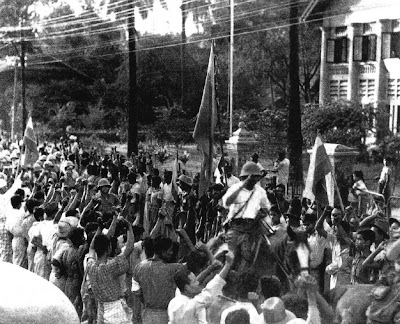
The Rising Sun In Burma: the Japanese were welcomed as liberators but massacres of civilians like at Kalagong village quickly revealed the Japanese as far more brutal colonial masters

(more…)

It Needs Occasional Reiteration

Thursday, February 7th, 2013

This was forwarded to me in an email chain the other day – one of those “please forward to your friends” kinds of things.

Now, I never, ever forward email.   I probably don’t even forward email that I should, sometimes.

But this, I figured, was worth forwarding to a lot more people than I could ever pick out of my email address book:

Holocaust denial isn’t exactly mainstream today – but since I first interviewed high-profile revisionist Ernst Zündel in 1987, it’s gotten a lot less outlandish, too.

And that’s bad; the worst evils are the ones that have become banal and commonplace.

Happy Gipper Day!

Wednesday, February 6th, 2013

Today would be the 102nd birthday of the greatest president of my lifetime.

People say “there’s no Ronald Reagan in American politics today”.  And they’re right – but as his son Michael told me in an interview a few years ago, it’s not that there couldn’t be.

Because Reagan had three great talents:   he was a great, natural communicator (who, unlike a lot of “natural communicators”, honed his craft with relentless discipline);  he developed a vision and he stuck to it with determination and focus; and most importantly for today’s  conservatives, he knew how to build coalitions, rather than exclude people from them.

We have plenty of people who can communicate well, although the conservative movement has had its share of duds in that department too.  And we have not a few who can visioneer with the best of them  – in fact, with the rise of the Tea Party, our movement’s best years may be to come, provided they keep the faith.

But as to building coalitions?

Today, we’re better at building silos.

Reagan did something that conservatives are terrible at today; he got social conservatives (at the peak of their notoriety and political cachet), blue-collar Democrats who the economy had turned into instant fiscalcons, Jack Kemp-style economic hawks and paleocons together…

…by focusing remorselessly on what they agreed on;  fixing the economy, and ending Communism.

And once in office, that’s what he focused on.  Oh, he paid lip service to issues that were to him tangents – and lip service from the world’s greatest bully pulpit ain’t chicken feed. But he didn’t fritter his political capital away with excessive natterings about issues that were tangential to his vision, and the vision his coalition all agreed on in electing him.  He spoke eloquently on issues – many of them – and that speaking had its effect.

Some call that an abdication; it was in fact a matter of leaving that work to the members of his coalition (example:  he exerted very little executive effort on abortion and gun control – but the efforts to roll both back at the state and local level started to coalesce during his time in office anyway – in part because of his leadership from the bully pulpit.  But for all that, always, the focus was on “dancing with the one what brung him” to DC at the head of an impossibly-diverse coalition; his rock-solid, bone-simple two point agenda, fixing the economy and toppling the Commies.

As I moderated the “Where Do We Go From Here” event last week at the Blue Fox, and listened to some of the friction and cat-calling across the party’s various factions, I thought there was a lot of focus on what divided us.  And so my final question to the panel was “what do we all – all of us, from socialcons like Andy Parrish to libertarians like Marianne Stebbins, actually agree on?”  Because that is the only real way forward for any of the factions – since if any faction takes Parrish’s (tongue in cheek?) advice and forms a separate party, it’s the road to mutual palookaville, with multiple parties that are less than the sum of the parts they once were.

So for my annual Gipper Day celebration, it’ll be the usual; jelly beans at my desk, taking the kids out to dinner to talk about what Reagan’s legacy has meant in their lives (other than the uninformed, out-of-context crap the DFLers in their lives’ll say)…

…and asking my fellow conservatives “what do we agree on?”

No Respect

Saturday, January 26th, 2013

One of my favorite lines about resurrecting history is from a movie – Braveheart, I want to say – and goes something like “History is written by those who kill the heroes”.

Much of what we Americans today “know” as received conventional wisdom about World War 2 is the self-serving version that the victor gets to write.  The idea that the Poles were anachronistic bumblers who charged at tanks with cavalry lances was a German propaganda fiction, ladled on top of centuries of ethnic and tribal prejudice. The notion that the French were cowardly “cheese eating surrender monkeys” is more of the same, filtered through American Cold War-era impatience with the frustrating inscrutability of their post-Gaullist foreign policy – and the enduring references to “Maginot Mentality” is a begged historical question, using the conclusion that “France Fell” as evidence that the Maginot Line was in and of itself a dumb idea.

It’s tempting to say the Italians got the same short shrift; it’s almost equally tempting to say their reputation as bumbling Barney Fifes who couldn’t shoot straight and whose tanks had one speed forward and four in reverse would seem to have been amply supported by their record during World War II.  From their misguided adventures in Abyssinia (Ethiopia and Eritrea today) to their snake-bitten attempt to subdue Greece (drawing the Germans into war on a second front) to their inability to break into France even as the Germans were mauling the bulk of the French army, to the collapse of their North African army (drawing the Germans into war on a fourth front), the Italian war effort seemed often to provide comic relief to those who wrote the history books.

Of course, as Ringer and I have written this series, we’ve found bits and pieces of some inconvenient truths about the Italians; as inept as Mussolini had left the military’s higher leadership, and as poorly as the anemic socialized economy allowed Italy to equip her troops (especially the Army), there were some examples of redoubtable courage, esprit de corps and can-do-ism; the Italian Marines’ special forces attacks that crippled a significant chunk of the British fleet in the Eastern Mediterranean, and the daring guerrilla war that the Italian remnants fought amidst the ruins of Mussolini’s East African “Empire”…

…and, seventy years ago today, in the midst of the disaster that would doom the German/Italian advance in Russia, one of the most titanic displays of sheer force of will in military history, around and about a forgotten little village in the middle of the endless steppe.

———-

Mussolini, seeking to increase his stock value after having been bailed out by the Germans in Greece and North Africa, committed a force of about 60,000 men in three divisions to support the initial invasion of the USSR in 1941; he shortly quadrupled down, increasing the force to almost 240,000 men in ten regular divisions, plus a German division and brigades of Croatians and Camicia Neri (“Blackshirts”) as a reserve and to fight Russian guerillas.

Priest ministering to Italian troops in Russia

The 8th Army deployed to the German’s southern offensive, holding the flanks of the German’s high-water strike deep into southern Russia.  By the winter of 1942, the Italians, along with Romanian and Hungarian troops, were holding the flanks of the German spearhead as it tried to fight its way out of being stopped cold at Stalingrad.

Mussolini inspects Italian troops from the initial “mobile” contingent. If the trucks don’t look very uniform – they’re not. They were impressed from commercial uses.

The Italians were never intentionally the focal point of the action – or at least the Germans didn’t intend for them to be.  The main goal of the Italians, and the Hungarians on their own flanks, was to make sure nothing snuck behind the Germans to cut them off at Stalingrad.

Although the original Italian deployment was intended to be a “Mobile” force, the 8th Army itself was not only mostly foot-borne and horse-drawn, but it had virtually no tank support. The Italians had to settle for a few captured Russian vehicles, like this T-34.

But on December 16, 1942, two Soviet Armies – the 1st and 3rd Guards Armies, a total of some 100,000 battle-hardened Soviet troops – crossed the Don River and attacked the 8th Army, in temperatures that dipped to -40F at night.  A follow-up attack in early January overwhelmed most of the 8th Army, destroying three divisions outright.  The Hungarians on the other flank also gave way, and the Soviet Guards encircled what was left of the 8th Army – which amounted to the “8th Alpini Corps”, composed of three Alpini (mountain) divisions (the Tridentina, Julia and Cuneense Alpine Divisions), among the elite of the Italian Army – before pressing on toward the town of Rostov, through which the German lines of communications to Stalingrad ran.  The Soviets, with an overwhelming force of tanks, proceeded to capture Rostov, putting 120 miles of Soviet-held territory between safe German lines and Stalingrad…

Troops of Tridentina in the Russian winter.

…and, cut off to the northwest of Stalingrad, the 8th Alpini.   The Italians had two options – surrender, or fight their way to friendly lines.
They opted to fight.  
The Alpini, along with stragglers from the other Italian units and a few German, Hungarian and Croatian troops, began fighting their way across the steppe, through the brutal Russian cold.  The Italians had never been well-equipped with vehicles; so badly-equipped was the Italian Army, most of the trucks from the two “motorized” divisions had been commandeered commercial vehicles with their company logos still on the doors and side panels – and those vehicles were long dead and gone.  A few German tanks led the column, which was led by the Tridentina division, the least-mauled by this point.  The vast mass of those 40,000 men walked.
120 miles.  In 15 days.  Through temperatures that never got above 0F, and frequently dipped down to -40F.
The Russians were at a disadvantage, too; the focus of their effort was on moving into German-held territory, to the West.  But they left behind troops in every village, and every one of these village defenses put up a fight, and the fight to pass through every village ate time, energy and manpower that the Italians didn’t have.   
And yet they carried on.  And as of 70 years ago today, the Alpini and the rest of the survivors were on the brink of safety…
…and the Soviets knew it.  They reinforced the force holding the village of Nikolaevka with a division with 6-10,000 infantry – outnumbered by the Italians, but with supplies of food and ammunition.  
The Tridentino was down to 4,000 effective soldiers.  Julia and Cuneense were in worse shape still, and the rest of the force was mostly stragglers in small groups, none of them an effective or sizeable fighting force.  
Tridentino attacked on the morning of the 26th – and bogged down fighting the superior Russian force; the Italians’ chief of staff died fighting for one Soviet strongpoint. 
The battle – and the fate of the entire Italian force – hung in the balance.  To break through the Soviets meant safety; to fail meant death, either on the battlefield or in captivity.  
As legend has it the commander of the Tridentino, General Luigi Reverberi, jumped on top of one of the last three functioning German tanks, and bellowed “Tridentini Aventi” – Forward Trident.  The exhausted, frozen Tridentini picked themself up and charged one last time.  The example caused the rest of the mass of stragglers to grab their rifles (or whatever weapon they had) and follow into the attack, which turned into a barely-organized melee, more a feeding frenzy, ending with the Soviet division being overwhelmed.  There were no more Soviets between the Alpini and safety.  
Of the 45,000 Alpini that had started the battle on January 13, there were fewer than 6,000 left.  And the remnant of 8th Army that they led was well under 40,000 out of about 150,000 that had been in the lines six weeks earlier.  

He Who Writes The Cultural Textbook

Tuesday, December 11th, 2012

I saw Argo a few months back.  As I noted at the time, it was an excellent movie; engrossing, well-acted, and good enough that I forgot I was watching Ben Affleck.

But as I watched it, it was pretty inevitable – something stuck in my craw.

The narrative – especially the narrated backstory, taking us back to the CIA-engineered topping of the last pre-Shah president, Mossadegh – was suspiciously heavy on anti-American cant, but light on the role Jimmy Carter’s pusillanimity played in installing the mullahs to begin with.

Andrew Klavan at PJM notes that this is part of a larger and more ominous trend; Democrat-friendly Hollywood rewriting history in the only textbook that matters, anytmore, pop culture:

This sort of Democrats-do-no-wrong and Republicans-do-no-right propaganda is subtle but pervasive in Hollywood historical movies. Consider Charlie Wilson’s War, a strong Tom Hanks film that celebrated a Democrat’s role in the Cold War. In both the film and the book, the right wingers who made Wilson’s efforts possible are denigrated. And just the fact that Hollywood found practically the only 80′s Democrat who did anything to help Reagan defeat the Soviets — whereas they’ve never made a tribute to Reagan himself — is telling.

And after that movie came out, do you remember how many leftybloggers suddenly became experts on the end of the Cold War – at least, Hollywood’s version of it?

This is precisely what Conservatives have to learn to counter. The newspapers and history books may get it right — may — but it’s the movies people will remember. I’ve quoted him before, but I’ll do it again. When former Ambassador Joseph Wilson had his questionable actions rewritten as heroism in the dishonest film Fair Game, he said, “For people who have short memories or don’t read, this is the only way they will remember the period.”

The imagination is the only nation where Democrats get it right. We need to conquer that country.

Put another way – low-information voters’ votes count the same as the rest of ours.  We can’t keep ceding them to the Dems in perpetuity either.

The Accidental Commando

Monday, December 10th, 2012

Birger Strømsheim passed away over the weekend, at age 101.

Birger Edvin Martin Strømsheim was born Oct. 11, 1911, in Alesund, Norway. His parents had a small farm. In addition to his son, survivors include a daughter, Liv Kristen Oygard; four grandchildren; and three great-grandchildren. His wife, Aase Liv, died in 1997.

“Birger who?”

Well, if you read this blog, you’ve met Mr. Strømsheim before.  He was one of the commandos who, seventy years ago this February, destroyed the German heavy-water operation in a daring raid on the Norsk Hydro plant in Rjukan, Norway.  I won’t rewrite the whole story (’til February, anyway), but here’s the piece I wrote about the raid a couple of years back.

Strømsheim didn’t start out that way, though; he had no military experience.  When Germany occupied Norway, he was working as a contruction contractor; he even found work building barracks for the occupiers, before escaping to Scotland:

 After the Germans took control of Norway in 1940, Mr. Stromsheim and his wife were among many people who left for England. Mr. Stromsheim had not been a soldier in Norway, but he became part of the Special Operations Executive, which the British formed to support and coordinate resistance in the occupied countries of Europe.

The mild-mannered Strømsheim, an expert cross-country skier and hunter, became an explosives expert, and the leader if not commander of the raiding party.  Older than the rest of the team, his calm stoicism (even by Norwegian standards) anchored and centered the rest of the team on the raid.

  He and other members of the mission at Norsk Hydro received medals from several Allied countries. In 1965, Hollywood produced “The Heroes of Telemark,” a film starring Kirk Douglas and Richard Harris that included shootouts, dramatic chases through the snow and love scenes. The soldiers roundly panned the movie as unrealistic.

 “He saw that,” Mr. Stromsheim’s son said. “He didn’t like it. It was too glamorous.”

And totally unbefitting the men who actually did the job.

RIP, Birger Strømsheim.

The More Things Change…

Thursday, November 29th, 2012

Joe Doakes from Como Park emails:

November 27, 1095, Pope Urban II preached the First Crusade while attending an ecclesiastical conference in Clermont, France. His exact speech is disputed but history shows his words were sufficient to inspire all of Christendom to wage war upon the Muslims then occupying Jerusalem.

September 13, 2001, a different crusader preached the same message in fewer words: “We should invade their countries, kill their leaders, and convert them to Christianity . . . This is war.”

It’s been a thousand years and we still haven’t solved the problem.

Joe Doakes

Como Park

One of those faiths went through a Renaissance, a Reformation, and a half a millennium of civil evolution. The other largely did not.

A Day Late, But With Undiminished Agreement

Tuesday, November 27th, 2012

Joe Doakes emailed me yesterday:

I make a point each morning of reading the Wikipedia page for the day, to see what happened in history.

Today, November 26, is the birthday of Willis Carrier. Born in 1876, died in 1950, he has been one of my greatest heroes every Minnesota summer and I never knew his name until today.

In 1906, Willis Carrier invented . . . air conditioning.

Joe Doakes

Como Park.

Salute!

The Battle of Brisbane

Monday, November 26th, 2012

The 738th American MP Battalion was surrounded.  Unaccustomed to being in the midst of fighting, the scattered remnants of the unit grabbed any weapon they could in a vain attempt to defend a Red Cross Service Station and PX against hundreds of enemy troops.  A handful of shotguns were distributed to go with the MP’s standard issue Smith & Wesson Victory Revolver.  They knew reinforcements weren’t coming – thousands of American & Allied troops were engaged in street-by-street fighting.  The 738th left their defensive positions in the Red Cross building and meant the enemy head on in hand-to-hand fighting on November 26th, 1942.

The battlefield wasn’t in the sands of North Africa, nor the jungles of New Guinea, but the streets of Brisbane, Australia.  And for two nights, the opponents weren’t the Axis powers.  For two nights in 1942, America and Australia went to war.

The Aussie & The Yank

The phrase “they’re overpaid, oversexed, and over here” has usually been attributed to British attitudes about the influx of American servicemen in World War II.  Yet the same was said by many an Australian as the Yanks came marching in by the thousands.

Over one million American soldiers would pass through Australia from 1942 until the end of the Pacific War, increasing the overall population of the country by 10%.  Nearly overnight, Australian cities on the populous eastern coast found themselves overrun with American servicemen.  Brisbane was among the worst affected.  By the end of 1942, the city of 300,000 now had to provide food and utilities for a population of over 600,000 – the difference all made up in U.S. GI’s.  The sewers and electrical grid couldn’t possibly adapt quickly enough.  For many Aussies, the Yanks brought brownouts, garbage in the streets, and increased crime and prostitution – not protection from the Japanese.

The View From Down Under: Americans saw the Aussies as quaint and the Australian front as a relaxing sideshow

Much like in England, the GIs also brought a considerably higher paycheck than their Allied counterparts, a fact that chaffed relations largely because American servicemen could afford to woo the locals with chocolates and silk stockings – luxuries in wartime.  Over 12,000 Australians married American GIs during the course of the war, but it wasn’t a lifetime of companionship that Australian troops were searching for when they grumbled that the ladies of Brisbane preferred the handsome foreigners who could buy otherwise limited goods at American PXs.  Compounding the Aussie’s frustrations were that the Yanks hadn’t just taken all the girls, but all the booze.  Alcohol shortages were so common that hotels became limited to two one-hour long servings each day – leading to binge drinking among civilians and servicemen of both countries.

Actions on the frontlines hardened attitudes as well.  The brutal Buna-Gona campaign in New Guinea was being waged at the same time with Allied forces counter-attacking well-fortified Japanese defense in the thick New Guinea jungle.  The percentage of casualties at Buna exceeded the better known Battle of Guadalcanal 3-to-1 and the brunt of the fighting was being borne by Australian troops.  That fact mattered little to General Douglas MacArthur, who reported on “U.S. victories” at Buna-Gona while setbacks were attributed to the Australians.  Aussies who had fought and bled in hard-won victories returned to Brisbane unable to get a date or a drink while reading that nearly non-existent American forces had won the day.

The American Invasion: Members of the US Navy march in Brisbane

By the end of November, 20 brawls a night between Aussies and Yanks were being broken up, mostly by American MPs.  Not only would the MPs usually believe their fellow Americans, getting them out of trouble, but the MPs quickly developed a reputation as violent and arrogant.  More and more Australians took to mob justice when they felt wronged.  20 Australian civilians jumped a group of American submariners just nights before November 26th, beating them mercilessly.

With this backdrop, it was somewhat surprising that what touched off two nights of intense rioting started with Australian servicemen trying to defend an American from an American MP.

Private James Stein of the U.S. 404th Signal Company had been abusing the limited alcohol policies of Brisbane, and like many soldiers was trying to get to a new bar that would soon be open for one-hour only.  Clearly drunk, Stein found himself in front of an MP demanding to see a leave pass.  The MP’s verbal abuse caused several Australian soldiers that Stein had been talking with to engage the MP, trying to get him to lay off a drunk but not AWOL Stein.  The MP’s response was to lift his baton as if to strike one of the Aussies.  One of the Aussies struck first instead.  A melee ensued as more MPs, Australian and American soldiers ran to the fight outside the American PX.  News of the initial fight spread, starting new brawls.  By 8pm – just an hour after the first fists were thrown – over 5,000 people, civilian and military, were engaged in a series of battles across Brisbane.

Japanese Propaganda: Much like the Nazis in Europe, the Japanese played upon fears of lustful American troops

The fights quickly became more than drunken brawls.  Guns and grenades were passed about on both sides.  Shots were fired by MPs and Aussies.  One correspondent called Brisbane “the most furious battle I ever saw during the war.”  By night’s end, at least one Australian soldier was confirmed dead – shot by an American MP – and dozens more were seriously injured by gunshot, stabbing or clubbing.

The passage of a day did little to calm matters.  500-600 Australian troops surrounded the PX the next night, eager to get revenge.  The MPs were better prepared, armed with machine guns and rifles.  What started as a mob turned into a battle line as both sides took up defensive positions and prepared to assault the other.  Australian MPs sent to break up the crowd took off their armbands and joined instead.  With neither side willing to make a move, elements of the Australian mob moved elsewhere, assaulting Americans around the city.  Unconfirmed reports suggested that several Americans were killed that night, either shot or beaten to death by the Australian mob.

The fighting was almost entirely ignored by the wartime press.  Other than a brief bulletin mentioning an incident that left one dead and six wounded, media both in Australia and the U.S. were censored to prevent news of the incident from spreading.  If the censorship was designed to cool tensions, it backfired.  Brisbane sources spread rumors of absurd levels of violence, including a suggestion that 15 Australian servicemen had been shot by Americans with machine guns – their bodies stacked like cordwood outside a Post Office.  Although that report is almost certainly false, the true number of dead or wounded has never been released.

Few were punished for the fighting.  Units on both sides involved were transferred out of the city.  The MP responsible for killing an Australian was acquitted.  And despite five convictions on the Australian side, only one served any jail time – for a total of six months.  The incident was pushed down the memory hole and forgotten.

Other “battles” would occur in Australia and New Zealand.  A similar fight, named the Battle of Manners Street in Wellington, New Zealand had over 1,000 participants in 1943.  And much like the Battle of Brisbane, the fight was blacked out by the media.

Living As A Conservative In A Place Like Saint Paul…

Monday, November 19th, 2012

…let’s just say I find this premise utterly plausible.

Vichyssoise

Tuesday, November 13th, 2012

The end was but hours away.  A small French force, numbering less than 50,000, took up a last-ditch defense; horribly outnumbered by the 1st & 7th German Armies crashing down upon them.  Even the Italian 4th Army was managing to swallow territory and POWs.  The French government radio broadcasts vainly tried to rally their people to the defense, but such cries fell on deaf ears.  The defeat was total.

Only this wasn’t June of 1940.  Nor was it the fall of the Third Republic.  Rather, the soldiers who fought and died on November 10-12, 1942 did so under the colors of the État Français or French State.  It was among the final chapters – but not quite the last – of the Vichy collaboration with the Nazis.

Defeat in 1940 had cost the French more than their freedom; it cost them their identity.

Hitler’s brutal terms of the June 22nd armistice stripped France of little actual territory – only the long fought over Alsace-Lorraine region changed hands (and even that wasn’t actually annexed).  Most of the northern half of the country, and the Atlantic coastal region, was deemed the “occupied zone”, allowing for German troops to remain stationed against any potential Allied invasion, but be civilly administered by the new French government based out of Vichy.

Petain assumes command.  The Victor of Verdun immediately blamed democracy for the fall of the Third Republic and adopted a quasi-fascist government model

Petain assumes command. The Victor of Verdun immediately blamed democracy for the fall of the Third Republic and adopted a quasi-fascist government model

At the helm was a man hailed as a French national hero.  Marshal Philippe Pétain had rallied French troops amid the slaughter of Verdun in World War I and was widely credited at home as having turned the tide of the war against the Germans.  Pétain’s patriotism and anti-German credentials were seen as beyond question.  It was little wonder then that as Prime Minister Paul Reynaud resigned (his cabinet refused to support his intention of relocating the government to North Africa and continuing the war), Pétain was tapped to succeed him as PM.  At 84 years of age, Pétain took charge of a nation reeling from a shocking German offensive.  Six days into his government, with still more than half the nation free of German occupation, Pétain chose surrender to resistance.

His choice set the stage for the next 2 1/2 years.

(more…)

For The Veterans

Sunday, November 11th, 2012

It’s hard to come up with words – beyond the too-simple but thoroughly-heartfelt “Thank you” – for our veterans.

Most of what I need to say, I said on 9/11.  For those of you – to all of you in the audience who served on ships, subs, planes, tanks, cheeseboxes, or carried rifles, typewriters, cable spools or maps for trucks to follow in wars hot, cold and in-between over the past three generations – who spent the best years of your lives in uniform, thank you.

Gallup-ing Towards The Finish

Sunday, October 21st, 2012

They don’t call it a horse-race for nothing.

As a rule in polling, outliers tend to get ignored.  Or you can choose to believe that Bush won Hawaii in 2004, Alf Landon won a 1936 landslide, or that Clinton v. Dole was a nail-biter.

But it becomes harder to ignore an outlier when it’s A) close to the election and B) one of the oldest and most respected polling outfits in the nation.  Thus as the media enters Campaign 2012’s home stretch, the narrative of a nip-and-tuck contest looks decidedly jeopardized by Gallup showing Mitt Romney with a 7% lead – and such an outcome apparently has to be challenged:

With a record of correctly predicting all but three of the 19 presidential races stretching back to 1936, Gallup is one of the most prestigious names in the business and its outlier status has other polling experts scratching their heads.

“They’re just so out of kilter at the moment,” said Simon Jackman, a Stanford University political science professor and author of a book on polling. “Either they’re doing something really wacky or the other 18 pollsters out there are colluding, or something.”

The caveats to Gallup’s polling (as with any pollster) are well-versed.  But to find an answer as to why Gallup posts a major Romney lead while the Real Clear Politics average of pollsters shows essentially a tie has nothing to do with credibility or collusion.  It has everything to do with turnout.

Take the recent IBD/TIPP poll as Gallup’s doppleganger with Obama leading by 5.7%.  Democrats are outsample Republicans by 7%.  The UConn Courant showing Obama up 3%?  The sample shows Democrats with an 8-point advantage.  Gallup plays their cards close to the vest, not showing the partisan affiliation of their likely voter model.  But their registered voter breakdown still shows a Romney lead, albeit of a modest 3% and is likely based on their party affiliation polls showing Democrats up 4 points.

Gallup says it determines its “likely voters” by asking whether they have voted in the past, if they know where their polling place is located, and other similar questions. The formula has been tweaked this year to take into account the increasing prevalence of early voting.

Gallup’s Newport pointed out that the firm’s likely-voter formula has more accurately predicted the election results than its wider poll of all registered voters going back to the 1990s and, in fact, the likely voter prediction tended to slightly favor Democratic candidates.

The idea of a single pollster being simply a part of a larger trendline is accurate, even if most media outlets tend to overlook that fact to trumpet their own poll to the exclusion of competitors and thus create news rather than report it.  Yet even if we exclude Gallup’s results, the trendlines have to be concerning for Obama’s camp.  Despite wielding turnout margins better than what propelled him into office four years ago, many polls show Barack Obama at best narrowly ahead – and more commonly tied or behind.

Gallup might be overstating Romney’s support, although the pollster’s worst estimations of support were in the 5-6 point range and happened in 1936 and 1948.  In the modern era, if anything Gallup has consistently overestimated Democratic support at the polls, giving Obama 2% more, Kerry 0.7% more and Clinton 2.8% and 5.7% more in his campaigns.  Which may mean that despite a 7% lead causing headaches among the media, Mitt Romney may…hold for dramatic effect…lead by more.

Desperate Measures

Saturday, October 13th, 2012

In an era where the United States can send troops and inflict mayhem halfway around the world with, it seems, little visible effort, it’s hard for modern American to realize what a major undertaking simply getting troops across the atlantic, much less halfway around the world, was.

Not just getting them there, mind you, but keeping them supplied with food, ammunition, fuel and everything else a military needed to fight in the field.

And then there was the whole fighting thing.

It was seventy years ago yesterday that the 164th Infantry Regiment landed on Guadalcanal.

“Who?  What?  Where?”

Listen up.

———-

For all the shock and awe that Pearl Harbor was, World War 2 itself didn’t catch America flat-footed.  Much of the nation’s leadership had seen war as more or less inevitable for the better part of a decade.  FDR had started a national buildup to war in the mid-thirties, modernizing and adding to the US Navy starting in about 1934.

And he’d started calling up the National Guard not long after Hitler’s ransacking of Europe.

And so the 164th Infantry Regiment – comprising most of the North Dakota Army National Guard – had been called into federal service 20 months earlier, in February of 1941.

Troops of the 164th Infantry, drilling at Camp Claiborne five months before Pearl Harbor.

By Pearl Harbor, they had been training for ten months, and were among the most combat ready units in the US Army, and were thus selected to make the long trip across the Pacific Ocean with two other National Guard regiments – the 182nd Infantry from the Massachusetts National Guard, and the 132nd Infantry from Illinois – to the island of New Caledonia.  There, the three units were organized into a division, the “Americal Division”, short from “American Caledonian” (later officially called the 23rd Infantry Division) in May of 1942.


Over the first six months of the war, Allied planners juggled two disparate goals; find some way to start taking offensive action against the Japanese, and defend Australia.

Achieving the first goal, naturally, was the subject of a massive strategic wrangle; the Army, led in the Pacific by General MacArthur, favored an “island-hopping” campaign through the southwest Pacific up through the Philippines; the Navy (along with the Marines) favored a direct assault through the Central Pacific.  The battle between the two strategies would be the major strategic decision of the war in the Pacific…

…and was rendered moot by the news that the Japanese were building an airstrip on a dismal, malarial island in the Solomon Islands chain, Guadalcanal.  In combination with other airfields in the Solomons, this could support further advances on bases like Fiji, New Caledonia and New Guinea; if each of those fell, the supply lines from the US to Australia would be cut off, rendering Oz useless as a base.  With Darwin already under air attack, the threat to Australia was dire.

Henderson Field. Today, it’s Honiara International Airport, serving the Solomon Islands.

And so the first step in MacArthur’s island-hopping campaign went ahead. On August 7, the First Marine Division – the first division-sized unit in the Pacific ready for combat – landed on Guadalcanal and seize the Lunga Point landing strip from the Japanese engineers who had just completed the field the night before; the Japanese engineers had gotten an extra ration of sake rice wine for getting the job done early.  The Marines quickly took the airfield, renamed it Henderson Field (after a Marine squadron commander killed at Midway Island in June), and landed Marine fighters and dive bombers, who promptly went into action.

Over the next two months , the battle seesawed back and forth; the Marines decimated the first round of Japanese defenders and counterattackers; the Japanese ran reinforcements to the island and, after dealing the US Navy a bloody defeat at the naval Battle of Savo Island in mid-August, bombarded the airfield with several of their cruisers and battleships.  Mired in the malarial, swampy muck, the Marines held their perimeter.

The 164th Infantry, under Colonel Robert Hall, was dispatched from New Caledonia to reinforce the Marines against the fresh Japanese troops.  Seventy years ago today, they landed; two of the regiment’s three battalions took positions on the east side of the perimeter, allowing the Marines to consolidate against the expected attack from the west.  The third battalion, the 3rd/164th, was held in reserve.

Ten days later, on the night of October 24th, the Japanese would launch what would end up being the most serious ground attack on Henderson, attacking the Marines along the Matanikau river, the western anchor of the beachhead.  Their scouts had uncovered a gap in the Marine lines inadvertently left when one of the Marine battalions changed its orientation to the south.  The Japanese, heavily outnumbering the Marines, launched an attack into the gap against one 700 man Marine battalion, the 1st Battalion of the 7th Marine Regiment.  While the attack was badly coordinated, it still drove a wedge into the Marine lines.  The Marines called for reinforcements; the 3rd of the 164th moved into the line as the Japanese attacks peaked.

The 164th had some disadvantages; they were new to combat – indeed, they were the first US Army unit to take offensive action in World War 2; except for the Army garrison in the Philippines, they were the first Army unit to fight at all.  And they were being fed into the line piecemeal, in platoon and company-sized groups (40 to 160 men), to react to various crises on the Marine front as the situation developed.

They had a few advantages, too.  They were the first American unit to carry the M1 “Garand” rifle in action.  The rifle – the first semi-automatic rifle issued in large numbers to combat troops – would go on to be called “the greatest implement of war ever invented” by General Patton later in the war.  Patton was being a little hyperbolic, but the M1 gave each North Dakotan roughly double the firepower of the Marine fighting along side him, who was still carrying the World War 1 vintage M1903 Springfield bolt-action rifle, to say nothing of the Japanese infantry with their bolt-action Arisaka rifles (cousins of the Springfield via their mutual design parent, the German G98 Mauser, but firing a much weaker round of ammunition).   And in the desperate, confused action in the dark and in the jungle, when the Japanese closed to ranges too close for the Marines’ artillery to be used, the extra firepower was vital.  And they were from North Dakota, where even today the average eight year old can hit a running squirrel in the head with a .22 in the dark at 75 yards.  [1]

The M1 Garand. The standard American infantry rifle for the rest of the war, it served through Korea, and with some troops in Vietnam, Latin America and reserve units in the the South Korean military until the 1980s.

The North Dakotans held up, meeting and beating the Japanese in the brutal night jungle fighting, and went on to carry the attack to the Japanese, helping drive them from the island (or, as it’s known in the annals of the First Marine Division, The Island).

Troops of the 164th on Guadalcanal.

And the regiment of 2,200 North Dakota tractor drivers and mechanics and teachers and railroad workers and high school kids earned a rare honor.  While the Marines, then as now, have made it a matter of their own esprit de corps to look down on the Army (they usually referred to soldiers as “Doggies”.  But the Marines’ commander, General Vandegrift, paid the 164th a very rare honor after the Battle of the Matanikau:

But that was all a week and a half in the future.  Seventy years ago today, the 164th were just the first US Army unit to take offensive action when they stepped ashore on a malarial cesspool that none of them could have found on a map six months earlier.

164th Infantry troops on Guadalcanal

And when I was a kid growing up in Jamestown thirty-odd years later, most of my classmates couldn’t find it, either.  The town’s National Guard unit at the time, H Company (which had been a part of 2nd Battalion of the 164th) had been an Guadalcanal.  Many of the names on the Roll of Honor above the junior high entrance, listing Jamestown High School graduates who’d died in the wars up to that time, had served in the 164th – and the ones that came back, and were in not a few cases still serving as senior NCOs in the town’s National Guard unit at the time, like most World War 2 veterans, were still years away from talking about their war.

I used to dream of being able to write their story – doing a Steven Ambrose-style reconstruction of the war that that regiment of depression-era kids from the middle of nowhere fought, in a place that could not possibly have been less like North Dakota.  Other priorities intervened, of course; the guys who were in their late sixties when I hatched the idea of doing the history of the 164th are in their eighties and nineties now, the ones that are still with us at all.

Chalk it up among my life’s great regrets.

[1] I made that part up.  Allow a guy a little homer hyperbole, will ya?

Anchors Aweigh

Saturday, October 13th, 2012

Happy Birthday United States Navy!

(more…)

--> Site Meter -->