Mobilization
By Mitch Berg
It was on a brutally cold February 10, in the middle of a long, cold prairie winter, seventy years ago today that the 164th Infantry Regiment – the largest part of the North Dakota National Guard – was activated by Franklin D. Roosevelt.

There, they joined – for a time – the 34th Infantry Division, which would become known as the “Red Bulls” later in the war, with troops from Minnesota and Iowa. That didn’t last long; being at a higher state of readiness than the rest of the Division, they were detached from the 34th in early 1942 and packed off to defend New Caledonia from a possible Japanese invasion; the 34th fought in North Africa, and with great distinction in the brutal campaign in Italy, while the 164th would spend the entire war in the South Pacific.
More on that next year.
The 164th Infantry was not the first National Guard regiment to be mobilized; it would not be the last. It was just one of the most visible signs, here in the upper Midwest, of a term that has little meaning to people today, but was a life or death matter to young men of the era – “mobilization”.
Today, warfare has a lot more in common with the way war was practiced in Europe in the 17th and 18th centuries; relatively small, elite armies of volunteers – professional soldiers (and sailors and airmen and Marines, naturally) for whom warfare is a job, a career, a calling. Since the end of Vietnam, and especially the end of the Cold War, that ancient ethos has quietly re-established itself (making a convoluted exception for the American “Militia” tradition, via the highly-professionalized National Guard).
Maryland National Guard airmen in 1940 - back when the Air Force was part of the Army
But Napoleon introduced to Europe the idea of levying huge masses of conscripts, trained in the absolute basics (load, fire and stab on command and, above all, do not run away on pain of savage, ritualized death) and sent en masse to overwhelm the small, elite professional armies across the rest of the Continent.

English cartoon pillorying Napoleon's conscription program
The American Civil War added the full weight and might of a first-world industry to the mix; the Franco-Prussian War of 1870 tacked on the management principles of of enrolling the entire nation’s manpower and harnessing them toward the strategic goal; World War I rolled the whole idea of “Total Warfare”, with nation’s entire populations, economies and beings focused on the war, and targeted in turn, into one cohesive whole.

A Union army supply depot. The Union was able to move supplies to its troops in a way no army had ever managed before; it was the first war where the logicistician was as important as the front-line general.
And so the idea of “mobilization” was a term fraught with significance throughout the US, and every major country in the world. It meant much more than calling up the reserves. It means setting into motion the harnessing of the nation’s entire economy toward total warfare; starting to convert, or build from scratch, the industrial capacity needed to support the expansion of a military from under 300,000 men to millions; to not only build the rifles for the Army to carry, but their cannon and tanks, and the ammunition to shoot from them, and the fuel to move the men and the equipment around, and the food to feed them at home and in the field, and the trucks and trains to carry all the men and supplies hither and yon; to mine, smelt and form all the iron and steel and aluminum to build all the rifles and tanks and planes and ships; to build the factories and warehouses and barracks and blast furnaces and railroads to build, store, man and create all of them. To build a Navy from hundreds of ships to thousands; an Air Force from a few hundred plans to tens of thousands; to build a Merchant Marine of thousands, plural, of ships to supply those troops, planes, ships, tanks, and everything they needed, worldwide – and train the millions of men (and women, eventually) it’d take not only to carry the rifles and fire the cannon and drive the tanks and fly the planes and sail the ships, but to maintain all the weapons and vehicles and ships and planes, and to carry the supplies not only to do the fighting, but all the maintenance, plus the men and women themselves, and to take care of administering it all so that the men, rifles, tanks, cannon, ships, planes, food, ammo, winter clothes, summer clothes, spare parts and every other needed by millions of people outside their natural environment got to the right place at the right time to actually fight the enemy.
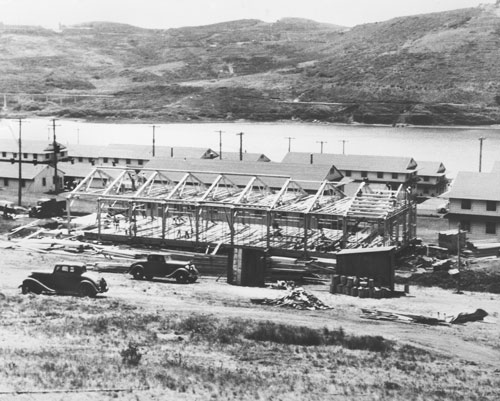
Barracks under construction at Fort Cronkhite, near Monterey, California
It’s instructive to note that, for all of America’s industrial might and technological prowess today, we could not do what we did in World War Two again if we had to. Which, fortunately and God willing, we won’t.
So even though Pearl Harbor was still a solid ten months in the future, Roosevelt had been getting ready for war for years. He’d put the Navy – of which was a a former Assistant Secretary – on a crash rebuilding program in the thirties.

A 16 inch gun for the new, fast battleship USS North Carolina, being hoisted into place at the Brooklyn Navy Yard, 1940
It was in part a Depression-era stimulus program – but the program focused buying and building the things needed to fight a war over the vast expanses of the Pacific, again Japan, whom Roosevelt considered the most likely enemy at the time; aircraft carriers and the planes to fly from them; destroyers to escort them, with the range to sail the Pacific; submarines capable of carrying their crews thousands of miles across the trackless ocean and staying on patrol station for a month before making the voyage home, keeping men and equipment in a condition to fight effectively in freezing cold and tropical misery alike.

Woman working at Douglas Aircraft in 1942. As men volunteered or were drafted, women started taking assembly-line jobs. Normal today; unheard of in 1940.
And by the late thirties, as World War 2 started in Europe, the Army was in on the plan as well. The Army’s “expansion” budget had multiplied sixteen-fold between 1936 and 1940, to eight billion dollars – which may buy you an aircraft carrier or two weeks of Obamacare today, but was an unimaginable investment at the time.
USS Ludlow, one of the "Benson" class destroyers, one of hundreds of warships built in a frantic buildup between 1937 and 1941.
The point? Pearl Harbor was a tactical surprise – and a brilliant one. But the war itself caught nobody by surprise. The US was getting ready for it in every possible way – and in ways that pushed the edges of what was possible, given the technology and economy of the time.
And the politics. But we’ll come back to that this fall.
As for today? Seventy years ago, in the middle of the brutally cold winter of 1940-41, the orders went out; by telegram, phone call, good ol’ fashioned mail – to hometown armories across North Dakota, from the Headquarters Company in Williston to Company H in Jamestown and a dozen or more towns in between. And farm boys and city kids and a few middle-aged guys who’d been through all of this in 1916 (when parts of the 164th were called up to guard New Mexico against Pancho Villa) and 1917 (where the unit shipped out to France) started reporting to their armories, and got ready to ship out to the foetid malarial swamps of Camp Claiborne, Louisiana, carrying the same Springfield rifles their fathers and uncles – and in the cases of a few senior NCOs, they themselves – had carried in France in 1918.
They’d have a very, very busy war, fraught with danger, full of distinction. Of the 3,000 or so of them, about 325 would not come home.
We’ll rejoin them in about a year and a half.


February 10th, 2011 at 8:54 pm
This was a great post, Mitch.
WW2 was won — and lost — by socialist regimes. During the war years the US was as much of a command economy as Germany or the USSR.
This was a lesson learned in WWI by all the combatants. Achieving victory meant putting as many people as possible in uniform and supplying them. If you are an Eisenhower you must recognize that your troops are on average no more intelligent, aggressive, or courageous than your civilians.
There were heroes and less-than-heroes on both sides.
In Kirk Douglas’s autobiography, The Ragman’s Son Douglas candidly describes his experience as a naval officer in WW2. He didn’t want to fight and held off enlisting until he more or less was forced to join up. Douglas describes the incompetence of his captain and fellow officers (all very “green”) with no pleasure. In the Mid-Pacific, enroute to his first posting, He took sick and was evacuated back to the States by submarine. He was discharged soon afterwards without, happily for him, seeing a shot fired.
And then you’ve got people like Dick Bong: http://en.wikipedia.org/wiki/Richard_Bong
The next time you are in the Duluth-Superior area you should really pay a visit to the museum: http://www.bvhcenter.org/
February 11th, 2011 at 9:03 pm
[…] Shot in the Dark » Blog Archive » Mobilization (tags: MOB WWII history weekendreading) […]
October 14th, 2012 at 9:45 am
[…] Infantry Regiment – comprising most of the North Dakota Army National Guard – had been called into federal service 20 months earlier, in February of 1941. Troops of the 164th Infantry, drilling at Camp Claiborne […]