Eternal Patrol
By Mitch Berg
Today marks the 50th anniversary of the sinking of the USS Thresher.
.jpg)
At the time Thresher was a super-weapon – one of the main demonstrations of America’s Cold-War technological prowess. Faster and deeper-diving than any previous class of submarines, with a nuclear power plant giving it effectively-unlimited range, armed with the latest guided torpedos and anti-submarine missiles (including the nuclear-tipped SUBROC), it was the lead ship of what was initially intended to be a class of 14 boats. It incorporated every lesson that the US had learned about submarine warare in World War 2, and everything they’d learned from the defeated Germans, and from the decade and a half of tete-a-tete up to that point in the Cold War.
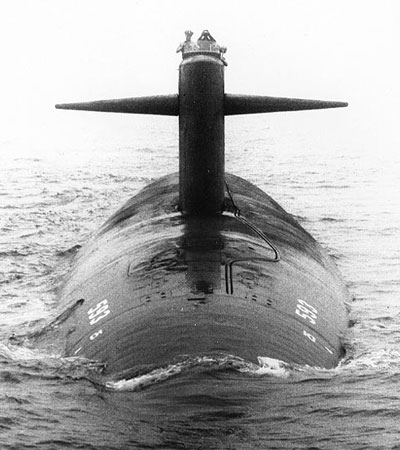
The sub left Portsmouth, New Hampshire 50 years ago yesterday for a series of deep dive tests, part of its fleet acceptance trials – so a number of the men onboard were civilian contractors from the Portsmouth Navy Yard. After a day of trim testing, at about 7:47AM, Thresher began its descent to its “test depth” – which, in submarine terms, is deeper than its “operating depth”, but about half of its estimated “crush depth”.
At an estimated depth of about 1,000 feet, a chain of problems occurred, as reported to the attendant sub rescue ship USS Skylark over the “Gertrude”, an acoustic telephone (developed before World War 2, and still in service on submarines around the world) that allows voice communications underwater; a silver-braised thru-hull tube apparently ruptured, spraying high-pressure air all over the engine room…
.jpg/300px-USS_Skylark_(ASR-20).jpg)
The Skylark, a World War 2-era converted fleet tugboat recommissioned as a submarine rescue ship.
…which shorted out electrical panels, causing the reactor to “scram”, or shut down.
Navy standard operating procedure was to shut off the steam system, helping prevent overly-rapid cooling of the reactor (which could itself cause catastrophic problems under the wrong circumstances, although over a time frame that wouldn’t have mattered in the Thresher’s case.
Nuclear submarines don’t usually “blow” their ballast tanks to surface (pump out the water with high-pressure compressed air); they usually rely on their “planes” (think airplane elevator fins) and their engine power to surface. But with the engine shut off and the engine room getting heavier from the burst pipe, the skipper, Commander John Harvey, ordered a “blow” of the tanks.
Which led to the next link in the catastrophic chain; when compressed air expands, it cools off. The further and faster the compression drops, the colder the air gets. Spray a can of compressed-air computer cleaner for a few seconds to test it; it gets cold. Dropping from 3,000 PSI apparently caused the released air to freeze over the ballast tanks’ outflow valves, preventing the ballast from being blown.
The sub likely sank stern-first, down to about 400 feet below its estimated crush depth of 2,000 feet, before the hull imploded, sending a ram of water through the boat at a speed later estimated at 4,000 miles per hour, ripping the three-inch-thick steel of the boat’s hull to shreds.

A piece of badly twisted brass pipe, testimony to the force of the implosion.
The loss of the Thresher – still the worst loss of life in any submarine disaster in history – was a watershed moment in submarine design. At a time when submarines were being built to operate at depths four times greater than during World War 2 – which, let’s remember, was only a decade in the past when Thresher was designed, 15 years when it launched in 1961 – the notion of “quality control” needed a radical upgrade. The US Navy started its “Sub Safe” program as a result – a relentlessly difficult quality control program that set the standard for intensity of effort and scrutiny of vendors, and may have been one of the most successful government programs in history.
Which has led to a perception that submarines are very safe. The Thresher disaster garnered massive publicity fifty years ago – and other than the sinking of the USS Scorpion six years later (due apparently to a fire in a torpedo, which led to another safety program of its own), it was the last submarine disaster the US has suffered.
USS Scorpion. An older boat from the class preceding Thresher, its’ loss has been a favorite for conspiracy theorists ever since it sank in 1969; the theory is that the Soviets torpedoed it. It’s the sister of the USS Snook, on which my uncle served, for those of you keeping track.
For the past 44 years, submarine disasters are something that happens to other countries; five Soviet and one Russian nuclear submarines have sunk since Thresher‘s loss.
We’ve had some near-misses; a couple of submarines (USS San Francisco and USS Ulysses S. Grant) collided with undersea mountains and suffered massive damage, but returned to port with their crews alive (and their skippers headed for tours commanding radio towers in Nevada) – but nothing like the Thresher, knock wood.
And yet submarine accidents used to be distressingly common, even in the US; Thresher was the 17th of 18 US submarines lost to accidents.
Apropos not much.


April 10th, 2013 at 2:46 pm
Swiftee trivia: I served aboard the Skylark’s sister ship, which to confuse my insane stalker corps I will only identify as *not* being the USS Pigeon (ASR-21), which starred in the 1978 film “Gray Lady Down” during the filming of which I was probably steaming somewhere between San Diego & Subic Bay, pining for some forgotten chick back home which, although all ASR (Sub Rescue & Salvage) ships were named after birds, was also *not* the USS Pigeon (ASR-21).
Got that AssProf? Go get ’em kid!
April 10th, 2013 at 7:08 pm
The very nature of Navies (at least the best ones) demands proven performance. My favorite navy the British Royal Navy of the Georgian era had a fetish about ship handling skills, precision navigation and fighting aggression in commanders. The Articles of War and the salty and observant eyes of the Sea Lord’s of the Admiralty made sure that success was rewarded and failures removed from command. Fortunately, as a result of our British inheritance that tradition of sea going excellence rolled over into its offspring the U. S. Navy from its very beginnings.
The consequences of poor and incompetent leadership upon a warship at sea even in peacetime is so profoundly serious that little leeway is generally given by senior commanders to questionable leadership. Ship handling whether an 18th century British frigate of the inshore squadron on blockade duty off the shoal infested coast of France in winter time or in our own time a sleek American nuclear attack boat patrolling the depths of the western Pacific requires the absolute best of its officers and men one hundred percent of the time. Any laxness in discipline or an incomplete skill set could be fatal at worst and damage the vessel’s ability to perform its mission.
This in my view is why I think the Navy is by far the most professional of the armed forces. They may at times be the most tiresomely traditional and formal particularly at sea but they invariably have uncompromising standards of performance enforced by reliefs of command if warranted. The U. S. Army might take note.
April 11th, 2013 at 7:16 am
Someone read Emery the liner notes from Master and Commander…..
April 11th, 2013 at 7:28 am
I have a Master Captain’s license (100 ton) and worked my way through college ferrying yachts in the summer months.
April 11th, 2013 at 10:10 am
You went to college?
April 11th, 2013 at 8:39 pm
It sounds as if Darla has developed a ‘man-crush’ on Alfalfa.
Don’t go broke-back mountain on me now swiftee