Doublespeak
Monday, September 23rd, 2013Nancy Pelosi:
“But overwhelmingly for the American people, this [Obamacare] is a liberation,” House Minority Leader Nancy Pelosi said on CNN today.
Words mean what they say they mean, dammit.
Nancy Pelosi:
“But overwhelmingly for the American people, this [Obamacare] is a liberation,” House Minority Leader Nancy Pelosi said on CNN today.
Words mean what they say they mean, dammit.
Joe Doakes from Como Park emails:
Capitol Police told not to help Metro Police during the Navy Yard shooting, but to stay to protect the Capitol.
Same excuse for why we didn’t send troops to Benghazi:
“GEN. DEMPSEY: They weren’t told to stand down. A stand down means don’t do anything. They were told to — that the mission they were asked to perform was not in Benghazi but was at Tripoli Airport.”
Geez, you’d think they were all a bunch of government union employees protecting their turf.
Suddenly, the reports of a second and third man wielding AR-15’s makes sense. They were there, then suddenly they weren’t there. Now we know why the cops have stopped looking for them. What we don’t know is how many people died when they retreated.
And I doubt we will. Not from the American media, anyway.
So many links from today’s show:
Today, the Northern Alliance Radio Network – America’s first grass-roots talk radio show – brings you the best in Minnesota conservatism, as the Twin Cities media’s sole source of honesty!
(All times Central)
So tune in to all four hours of the Northern Alliance Radio Network, the Twin Cities’ media’s sole guardians of honest news. You have so many options:
Join us!
Don’t forget – tomorrow evening is the 9th or 10th annual Minnesota Organization of Bloggers Summer Party.
We’ll be at Keegan’s Irish Pub in Northeast Minneapolis – just west of Hennepin on University, across from Surdyk’s.
The party starts at 7, and runs until everyone leaves – and I’m usually there until midnight at least.
Hope to see you there!
To: Joel Kramer (CEO/Editor), Roger Buoen and Susan Albright (Co-Managing Editors) Don Effenberger (News Editor)
From: Mitch Berg, Uppity Peasant
Re: They Get What They Pay For
Esteemed Editors:
I was never much of a reporter. I could always do the “who, what, when, where, why and how” of a story just fine, and earned a living at it, off and on. But it was never really my thing.
But I do remember, when I worked in the business, that the fastest way to get a reporter, producer or editor up on their back legs was to suggest that journalism partner with business or government to do the job. They would say – with righteousness rivaling any Baptist minister or Trappist monk – that Journalism’s mission was to be a check and balance on government, business, anyone with power. To comfort the afflicted and afflict the comfortable. Any whiff of filthy lucre was to be kept on the other side of the thick wall and locked door that separated the Sales department from the newsroom.
Media analysts – I’m thinking Garfield and Gladstone’s “On The Media” on NPR, and the whole Romanesko borg – go through gyrations worthy of a Talmud symposium sifting through the ethics of mixing journalism and money.
Now, theMinnPosttalks a big game about journalism. And you’ve certainly staffed your site with a lot of people with long pedigrees in the regional news business. And Brian Lambert.
But I’ve noticed on one issue that your site gets a fair chunk of money from from the Joyce Foundation. The Joyce Foundation also bankrolls most of the major gun control organizations in the United States, including Mayor Bloomberg’s efforts and “Protect Minnesota“.
And along with this financial link, the MinnPost’s coverage of Second Amendment issues has gotten more and more slanted, and not a little bit risible in the bargain:
The MinnPost gets big bucks from Joyce, and starts a wave of anti-Second-Amendment (I’ll be charitable) cheerleading. Coincidence?
Which leads us to this week, and Susan Perry’s piece on an academic “study” on gun violence. It was a puff piece about a junk study…
…and it was sponsored – as noted in the story’s headline – by UCare. An arm of the government of the State of Minnesota. Now, leave aside that that government is currently controlled by the extreme metrocrat wing of the DFL party. Here’s the question: if journalism is supposed to hold government accountable, should be finacially beholden to government?
Or does that only count when it’s not a DFL sacred cow being promoted?
Because when your “journalism” is being done at the behest of issue-oriented non-profits and the government you’re theoritically supposed to hold accountable, isn’t it really just public relations? Or campaign media?
Thanks,
Mitch Berg
Uppity Peasant
How Doakes from Como Park emails:
Libya will let reporters interview the terrorists who blew up our consulate in Benghazi, but not FBI agents who want to arrest them. The area where the terrorist live is too dangerous.
One word, Mr. President: Noriega.
Joe Doakes
Carter is actually looking pretty good in comparison these days.
The US 8th Circuit Court of Appeals has slapped slapped an injunction on the daycare union jamdown::
Officials of the National Right to Work Legal Defense Foundation, which is representing Minnesota providers who oppose unionization, said they received notice late Thursday that their motion for an injunction blocking the law was granted by the 8th Circuit Court of Appeals.
According to lawyers for the group, that means the child-care union election cannot take place until the injunction is lifted. The appeals court said it wants to wait to see if the U.S.Supreme Court decides to hear an appeal on a related case dealing with unionization of home-care workers. That case is called Harris v. Quinn.
Its just a stop in the way – tw battle isn’t nearly over.
But its great news anyway.
Rep. Franson, one of te leaders in the fight against the jam down, released a statement
“While the legal battle over this law is far from over, I’m happy Minnesota moms and dads and their childcare providers can be breath a little easier for now as the threat of forced childcare unionization is no longer imminent.”
The good guys and gals have ha to work themselves to exhaustion against an exceptionally well-funded union push. This ha to feel good.
It’s gonna be a gorgeous evening Saturday – and I hope you can make it out to the 9th or 10th annual Minnesota Organization of Bloggers Summer Party, at Keegans Irish Pub in Minneapolis.
We’ll start at 7PM, and go until everyone decides to leave, which is usually around 11 or 12 or so. Whatever works. Just stop by.
The MinnPost – a non-profit-run institutional blog established the the intention to get a jump on the next wave of institutional journalism – gets a whole bunch of money from the Joyce Foundation. Joyce also bankrolls Minnesota’s “largest” gun grabber group, “Protect Minnesota”, and Michael Bloomberg’s “Mayors Against Illegal Guns”, as well as paying academics to deliver the conclusions they want.
Is that financial relationship related to the fact that the MinnPost has, whenever the subject of guns and the Second Amendment is at hand, turned itself into a risible propaganda organ for the gun-grabbing extreme left?
From Eric Black’s recycling long-obscure legal theories about the origins of the Second Amendment to Doug Grow’s naked puff-piecemongering in support of Heather Martens’ checkbook advocacy group, the MinnPost would seem to be working hard to earn the $50K or so they got from Joyce.
The latest? Susan Perry, a “Health” reporter who has pulled her weight in the past on theMinnPost’santi-gun beat.

Confederate soldiers! With guns! Defending slavery! This is what the MinnPost think you, the law-abiding gun owner, genuflect to.
Yesterday came this piece, entitled…
Well, no. We’ll get to the title in a bit. But I’m going to pull a quote from the end of the story first. I’ll add emphasis for weasel words and a particularly dim strawman:
“Although correlation is not synonymous with causation,” write Bangalore and Messerli, “it seems conceivable that abundant gun availability facilitates firearm-related deaths. Conversely, high crime rates may instigate widespread anxiety and fear, thereby motivating people to arm themselves and give rise to increased gun ownership, which, in turn, increases availability. The resulting vicious cycle could, bit-by-bit, lead to the polarized status that is now the case with the US.”
“Regardless of exact cause and effect, however,” they add, “the current study debunks the widely quoted hypothesis purporting to show that countries with the higher gun ownership are safer than those with low gun ownership.”
So – seventeen paragraphs into a nineteen paragraph article, we hear that the reasearchers aren’t actually drawing conclusions (in attacking a “widely quoted hypothesis” that nobody quotes at all).
Which is a bit of a letdown for a story whose headline…:
“Idea that ‘guns make a nation safer’ is debunked in study”
…fairly screams “We’ve got a big big big conclusion here!”
The Rhetorical Slalom Between The Strawmen: I’ll throw this out to the shooters in the audience. Was this premise…:
The idea that “guns make a nation safer”
…as new to you as it was to me?
Anyway – the “premise”…
…is not true, according to a study published today in The American Journal of Medicine.
In fact, the study found just the opposite: Countries with a low rate of gun ownership have significantly fewer gun-related deaths than those with a high rate.
Right. In the same way that areas where couples marry have higher divorce rates than areas where they just shack up.
The study – and Perry’s piece – are honest, in a very dishonest sense; they scrupulously point out that gun death rates are, mirabile dictu, lower in places fewer guns. But the “study” is equally scrupulous in avoiding apples to apples comparisons, or correlating their conclusions to any data that doesn’t fit inside their razor-thin premise…
…which is to attack a case (“Nations with few guns have higher gun crime rates!”) that, for the life of me, I’ve never heard a single credible person make – about nations, anyway.
Cherry-Picked: Perry notes that…
The U.S. leads in gun ownership — and gun deaths
The analysis found that the United States has far and away the highest rate of gun ownership, with 88.8 privately owned guns for every 100 people (“almost as many guns as it has people,” Bangalore and Messerli note)…The United States also has the highest firearm-related death rate: 10.2 deaths per 100,000 residents…At the other end of the spectrum are Japan and the Netherlands. Japan has a gun-ownership rate of 0.6 guns per 100 people, while the Netherlands’ rate is 3.9.
Those two countries also had two of the lowest death-by-gun rates: 0.06/100,000 for Japan and 0.46/100,000 for the Netherlands.
But neither Japan nor the Netherlands is fighting a “Drug War”; neither nation has policies that have turned their inner cities into shooting galleries, controlled by people who have nothing to lose by resorting to violence to protect their markets, using entry-level employees who grow up in a culture that glorifies violence and ignores consequences.
Neither Japan nor the Netherlands has a major geographical region dominated by a culture that was practicing duelling and honor-killing and treating violence as a way of life long before there was a United States – a culture whose crime rates are, at worst, on par with the worst of the inner cities.
Indeed, both Japan and the Netherlands are extremely homogenous countries; homogenous societies tend to be pretty placid – until they have to flirt with heterodoxy (ask the Koreans and the Ainu in Japan, or the Indonesians in the Netherlands).
Indeed, Perry’s article points – unwittingly – at the truth:
The only country that was a bit of an outlier was South Africa. It had a relatively low gun ownership rate of 12.5/100, but a high (the second-highest, just below the U.S.) gun-related death rate of 9.41/100,000.
And of the countries on the list, South Africa is the only one with a significantly – indeed, pivotally – heterodox society. One with massive urban dysfunction, to boot.
Which might lead the rational observer to conclude – or see a correlation, anyway – that guns don’t kill people; societal dysfunction does.
Math Is Hard, And Psychiatry Is Harder: But let’s look at the “gun death” numbers Perry actually does deign to report – the relative gun murder rates in the US, the Netherlands, Japan and…:
[…the] United Kingdom also ranked low on both lists. It has a gun-ownership rate of 6.2 per 100 people and a gun-death rate of 0.25 per 100,000.
But fully half of the US “gun death rate” is suicides. And the suicide rate in the US (12/100,000) is half of Japans (21.7/100,000), and equal to the UK’s (11.8), and both the US and UK are 50% higher than the Dutch, at 8.8/100,000.
We’re not sure if the “study” concluded that guns and depressed, mentally-ill or chemically-addled people don’t mix, or not. Perhaps the Joyce Foundation will write a grant to study that?
No?
Is This A Strawman, Or A Begged Question?: Perry’s piece continues:
Their conclusion: “There was no significant correlation between guns per capita per country and crime rate, arguing against the notion of more guns translating into less crime.”
This is the third time in Perry’s piece the “notion” that anyone is comparing national gun rates to crime – at least in nations with working legal and law-enforcement systems, which is what the “study” is limited to.
And for the record, I’m at a complete loss as to a single credible pro-gun advocate who’s made that claim – between nations. The variables – societal heterodoxy, cultural conditions, criminal justice issues, different judicial systems – are far too complex to make such a case in an intelligent way.
But when you start eliminating variables? By just considering different firearms ownership rates in the US? It’s not rocket surgery – even I can do it, even though I don’t have to because John Lott et al already did. At worst, in the United States, places with higher legal gun ownership are very generally safer.
And that’s just a correlation. I’m not ascribing causation.
And unlike Susan Perry, I’ll admit that without any obfuscation.
So Let’s Summarize: Susan Perry’s article reports on a non-comprehensive study whose own authors admit it’s a non-“debunk”-ment, that reached no meaningful conclusion about a premise that nobody advanced.
Follow The Money: We mentioned the Joyce Foundation – which bankrolls both the MinnPost and the state’s “largest” gun control group.
One might ask – is it possible to expect honest “journalism” from a publication that has a financial interest in reporting an organization’s slant on the news?
I’ll ask – because as Perry’s article notes in its heading, in addition to the Joycers…
This content is made possible by the generous sponsorship support of UCare.
So not only is the MinnPost an organ of an anti-gun extremist group, it’s also on the payroll of…
…the State of Minnesota.
Edward R. Murrow would vomit.
As you know, I am a Second Amendment activist. This blog has always reflected this; indeed, the first post on this blog was a gun rights article. It’s one of my most active topics.
So consider that when I say this: Starbuck’s CEO was right to ask gun owners to please not carry openly in his chain’s stores.
It’s his business – and annual “Starbucks Appreciation Days” aside, the vast majority of his chain’s clientele is going to be people on the political center-to-left – people who, rightly or wrongly, find firearms disconcerting.
Bear in mind he’s not posting his stores to tell concealed carriers to keep their guns out; he’d just appreciate Real Americans not rattling the ninnies among the center-left masses who stop by every day for their Frangelicaccinos.
That’s it.
The Bill of Rights enumerates our rights to speak, publish, assemble, worship and keep and bear arms. That means you have the right to give a pro-Vikings speech in front of a Packers bar, to march your Communist Re-Enactor club through a suburb full of Holodomor survivors, hold a southern Baptist revival meeting outside a mosque, or carry your firearms into a gathering of Vegan Nuns for Cesar Chavez. Not only are none of them good ideas, all of them are just plain bad manners.
Along those lines? There is no genre in libertarian alt-media than the bobbleheads who film themselves walking down the road with an AR-15 slung over their shoulders, almost literally begging for a cop to pull over and ask what he’s doing, allowing the bobblehead the opportunity to lecture the cop on what the law really says. The bobblehead is right – but it’s still stupid.
Joe Doakes from Como Park emails:
Initially, media assumed he was a right-wing kook NRA member killing innocents with an assault rifle.
Now, it turns out he’s a liberal Obama fan with mental health issues who drives a Prius and used an ordinary shotgun.
So we’ll never hear another word about him.
Joe Doakes
Many mainstream media also transformed the Queens native into a “Texan”.
Note to all you folks thinking of moving to North Dakota to start cashing in on the oil boom: North Dakota is cold.

There aren’t a lot of trees. And outside of the eight or nine significant-sized cities (Fargo, Grand Forks, Jamestown, Devil’s Lake, Bismark/Mandan, Minot, Williston, Dickinson, and maybe Valley City), there just aren’t a whole lot of people.
More below the jump, so the rest of the page can load…
Fascinating article in “First Things” about an aspect of Warren Zevon I did not know the first thing about.
OK, I’m being hyperbolic. David Frum is not an idiot.
But he is no more accurate than any other liberal on Second Amendment issues – as we see in his Daily Beast insta-opinion on the Navy Yard shooting, which is chock-full of enough ripe inaccuracy to be a Heather Martens piece.
He tries to diagnose gun violence in America:
Yet the gun enthusiasts do have one point on their side: for all the horror of these massacres, they are only a small part of the story of gun violence in America. Most casualties of gun violence will not die at the hands of a mentally disturbed killer seeking random victims. Most gun casualties occur in the course of quarrels and accidents between people who would be described as “law-abiding, responsible gun owners” up until the moment when they lost their temper or left a weapon where a 4-year-old could find it and kill himself or his sister.
It’s a convenient theory. It fits nicely with the narrative – that it’s the presence of guns, not the people, that’s the problem.
It’s utterly wrong.
“Most” gun casualties, as in “the vast majority”, are suicides. All of which are tragic; seeing to peoples’ mental health and preventing suicide is important. But it is in no way the same as street crime.
Of those? Most occur as a result of “quarrels”, all right – quarrels between rival gangs, or between drug dealers arguing over turf, or adolescent gang wannabees who feel “disrespected”, or small-time hoods who lose their temper or their control and turn crimes of convenience into crimes of passion.
While Frum isn’t Heather Martens or David Bloomberg or Doug Grow, he does share some of their congenital illogic about the issue:
As David Hemenway notes in his study Private Guns, Public Health, Americans have experienced similar debates in the recent past. “Cars don’t kill people; bad drivers kill people,” could have been the slogan of the auto industry when it resisted safety regulation in the 1960s. The garment industry could have argued: “Flammable pajamas don’t kill children; careless smokers kill children.” And so on. Every accident has many causes, of course, and public safety progresses by addressing each one. To reduce car fatalities, we both installed seat belts and cracked down on drunken driving. Child deaths by fire have been reduced both because pajamas are safer and because adults smoke less.
Are we supposed to believe that David Frum, a leading public intellectual of the center-center-center-sorta-right, doesn’t know the difference between “making a product do its main job – carrying people, clothing children – safer against the vagaries and tragedies of normal life” and “misuse of a product that is designed to violently poke holes in things”?
I’d certainly hope so.
Likewise, better mental-health provision would contribute to the reduction of gun massacres. But America’s uniquely grisly record of gun death cannot be addressed without addressing guns.
“Addressing guns”, like “we have to doooooooooooo something”, is one of those vague, generalized blandishments that shows the writer is out of ideas.
And after this past year, I suspect the anti-gun movement is exactly that.
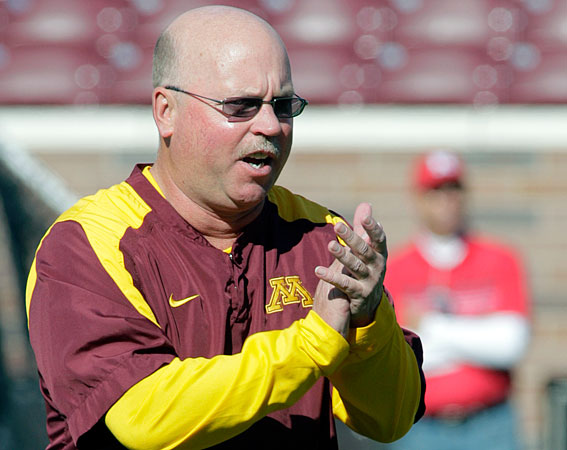
Jerry by the Numbers: 12 wins, 4 seizures (and 16 losses)
The debate over the future of Jerry Kill’s tenure at the U of M gets seized by political correctness.
The scene last Saturday at TCF Bank Stadium was tragically familiar – the Minnesota Golden Gophers head coach lying down, surrounded by medical staff, the victim yet again of his epileptic condition. It was the fourth such game-day incident since Jerry Kill inherited the mess of a program left by booster-in-chief Tim Brewster. And as reports trickled in throughout the weekend, conflicting stories surfaced about how many off-field seizures Kill has had since joining the Gophers, with numbers as high as nearly a dozen seizures in one week being casually thrown about by sports radio talking heads.
Ever-present in the wake of Kill’s latest health scare was the maddening silence from Athletic Director Norwood Teague, or any official from the University of Minnesota. Teague would eventually issue the standard press release of support backing his head coach, but not before Star Tribune columnist Jim Souhan did what most journalists and sports commentators have apparently found verboten to discuss – is Jerry Kill’s health a determinant to the football program?
Even those who admire him most can’t believe that he should keep coaching major college football after his latest episode. Either the stress of the job is further damaging his health, or his health was in such disrepair that he shouldn’t have been hired to coach in the Big Ten in the first place.
The face of your program can’t belong to someone who may be rushed to the hospital at any moment of any game, or practice, or news conference. No one who buys a ticket to TCF Bank Stadium should be rewarded with the sight of a middle-aged man writhing on the ground. This is not how you compete for sought-after players and entertainment dollars.
The reaction to Souhan’s comments showed precisely why few, if any, major media figures have dared to broach the subject.
Souhan’s column was deemed “ill-informed, dishonorable, and just plain nasty.” Callers into Dan Barreiro’s KFAN radio show denounced the topic even being discussed, with one caller even comparing the questioning of Kill’s fitness to coach as a form of bigotry. Multiple voices demanded Jim Souhan be fired. And all this just for questioning the health of a coach whose had four seizures in 28 games.
Souhan’s harshest criticism was directed not at Jerry Kill, who has little control over the frequency and severity of his seizures, but at Teague’s combination of silence and dismissive attitude on the matter. The lack of information from Teague allows speculation to run rampant (how many seizures has Kill really had since coming to Minnesota?) and fosters the concern that Kill’s health is a bigger hurdle to the program than assumed. Such silence doesn’t help when there are legitimately poorly-informed commentaries on the issue, such as CBS Sports‘ Gregg Doyel who believes Kill is taking his life in his hand by continuing to coach. But credit Jim Souhan for starting a conversation that needs to be taking place, if not in public, than at least in private within the University.
Removing Jerry Kill based solely on his health is almost certainly impossible, as the University would quickly run into Americans with Disabilities Act provisions. But a negotiated buyout of Kill’s contract, right now at $1.2 million a year for the next five years, might be possible – if extraordinarily expensive.
The better question is should Kill step down?
Let’s dispense, if we can, with the obvious. Jerry Kill is admirable for coming as far as he has with his condition and seems like an honorable man and a competent coach. Stepping down from his job would be a major career reversal and disappointment for both Kill and fellow epileptic individuals from whom he rightly ought to be a role model. But if stress is a major factor in Kill’s epilepsy, how exactly will that stress lessen as the coach of a Big 10 team on gameday? What if Kill suffers another seizure while leading against a top-ranked team? Or in a major bowl game? Will fans be as accommodating with his condition if they believe, rightly or wrongly, that his health cost them a game? Forget the opinion of fans, how will recruits react to Kill’s health?
If Kill’s condition worsens, even with the program reducing his day-to-day activities, at what point has the University reduced Jerry Kill to more of a figurehead than an administrator? Given the trajectory of Kill’s health, with seemingly an increasing number of seizures, that point may be coming sooner than anyone wishes.
ADDENDUM: The Star Tribune editorial board, rarely a fount of wisdom, offers the definitive assessment of the impact Jerry Kill’s health has on the team – and it comes from the coach himself:
[Kill] confessed that a seizure he suffered during halftime of last November’s Michigan State game had been a low point for him because he realized “you can’t be the head football coach and miss half of the game.” If that were happening all the time, “the university wouldn’t have to fire me,” Kill said. “I’d walk away if I didn’t think I could do it.”
There’ve been more mass shootings on Obama’s watch than any other presidency except Clinton’s – and Obama’s on track to pass that dismal record.
And that’s even as violent crime has been plummeting.
It’s a factoid, and I don’t see that it’s necessarily a comment on the Obama administration itself…
…but both the violent crime rates and mass murder rates dropped during Dubya’s terms.
Go figure.
Aaron Alexis, the alleged Navy Yard shooter, originally hailed from Queens. He spent some time in Seattle.
But the BBC and NPR referred to him as a “Texan”. And CNN went one further, calling him a Texan and a military contractor, for the lefty narrative bifecta.
(He was a “military contractor”, inasmuch as he was working for a firm that was subcontracting with Hewlett-Packard…to work on the Navy’s intranet. Think Blackwater, only for networking geeks).
The narrative, above all, must be served.
Whenever there’s a big story involving firearms, you can be sure the media will be ready to provide comic relief.
Like Piers Morgan’s reference to Aaron Alexis and his “legally purchased AR15 shotgun“.
Or the NY Daily News (“Like MSNBC, Only In Print!”) front page story about the AR15 Alexis owned…
…even though it appears that not only didn’t he have one, but didn’t – as was reported yesterday – steal one from one of the base police he murdered after all.
The Media. On Second Amendment issues, they are the real low-information voters.
Joe Doakes from Como Park emails:
Only a person obsessed with racial issues would worry about why there aren’t more people of color brewing craft beer.
I’m guessing the reason there are few Black beer crafters is the same reason there are so few Black start-up business owners: they don’t know anyone who ever did it so why would they consider it possible? Instead, they look at the other choices they see patterned for them by the adults around them and that’s what they take up. Entrepreneurship is a learned behavior but our First Black President’s administration is working vigorously to kill it.
Only a dog can hear a dog whistle. Only a racist sees racism everywhere.
Joe Doakes
Technically speaking, there are two ways to be a “post-racial” president; when there is no more racism, and when racism is the norm.
Just remember: when there’s a mass-shooting going on, and seconds count, you can depend on the authorities to respond in minutes:
D.C. police quickly deployed an “active shooter team” within seven minutes of reports of shots fired, Ms. Lanier said.
The Navy Yard – a “gun free zone” but for any security on the site – was as defenseless as Fort Hood.
A carry permit holder would have reduced that time from “seven minutes” to “as long as it took to get his or her firearm out of its holster”.
There’s been a shooting at the Washington Navy Yard – headquarters for the US Navy’s procurement bureaucracy. Recent experience shows us that nearly every first report on these sorts of things is wrong – but current reports indicate 4-6 13 dead.
And nobody remotely close to being an “authority” has even begun to speculate on who the shooter/s were and why they did it; one dead shooter is apparently a former Navy employee (Nope, NBC retracted that)
I urge everyone to direct your prayers, or whatever thoughts your worldview admits, toward the victims, their families, and everyone involved in this tragedy.
Now: It’s time to place your bets. We’re taking bets in several categories:
The Obama Pool: How long until The One tries to link this shooting to the defeat of his gun-grab agenda?
Bobblehead Roulette: At what time will the first Twin Cities leftyblogger issue a post blaming the shootings on the NRA?
The Martens Parlay: At what time will Representative Heather Martens (DFL-67A) release a statement blaming the shooting on the failure of the Paymar gun grab bills and/or the Colorado recall? (UPDATE 6PM: She did it!)
Black Gun Bingo: At least one initial report says “assault weapons” were used in the shooting. Who will be the first lefty pundit to claim that if only “assault weapons” were banned, this (apparently) multi-party, coordinated assault would not have taken place?
The Elephant In The Room Pool: How many mainstream and left-leaning alt-media outlets will mention that a) the Navy Yard is in Washington DC, which retains among the most draconian anti-gun laws in the country, and that in addition b) the Navy Yard, like all military facilities, is a “gun free zone?” (Note: “Zero” is already taken. Pick a different number). Bonus question: how many will blame the shooting on Virginia’s more liberal gun laws, without asking why the atrocity didn’t take place in Virginia?
UPDATES: Adding a few as I go here:
Tea For Three: Current reporting says there may have been three gunmen (Nope. Just one gunman). Which media outlet will be the first to blame the Tea Party?
Numb3rs: How many reports will the major media have to retract about names of victims (1 so far), shooters (UPDATE 6PM: At least once), number of shooters (UPDATE: Twice!) , motives, number of victims (UPDATE 6PM: Many times)…
The “T” Word: Some early reports claim this might be a workplace shooting – as in “disgruntled workers”. But if there are indeed multiple shooters? The idea of a “team of disgruntled workers” doesn’t pass the sniff test, does it?
Place your bets!
Joe Doakes from Como Park emails:
For SITD Junior Members needing college career advice, best and worst paid majors
Joe Doakes
The graph at the link is the usual link you see on the subject this time of year; engineering good, social “sciences” and humanities bad, at least in terms of money earned right after graduation.
Of course, there are some questions: the graph counts people with degrees in a field who get jobs in that field. Not all engineering majors get jobs directly in their fields (as we talked about a few weeks ago) – and not everyone with a degree in technology or engineering has a degree in the field (many of the best software engineers I’ve worked with had degrees in music).
And not everyone who goes into social “science”, humanities or even arts works in those fields after graduation, and fewer still do it for an entire career. How many history majors do you know who became managers? Most of us Twin Cities beer drinkers know the example of the CEO of Summit Brewing, who started out as a psych major. And in my own field – which is a bastard child of engineering and psychology – I’ve worked with people who graduated with degrees in music, computer science, folklore, math, graphic design, education, and not a few English majors like me.
Not a few very successful lawyers majored in theatre.
And the Elizabethan Poetry major who goes to work selling insurance, cars, real estate, institutional software, drilling equipment or a raft of other things can, with talent and hard work, make a ton of money – and never recite a single couplet.
The mania for matching degrees with post-graduate salaries is completely understandable, as education costs are hitting a peak even as the higher ed bubble starts to implode with all the grace of a whoopie cushion.
But it’s a little misleading, too.
How many of you are working in the field in which you got your BA?
How many of you could have even predicted where you’d be now, given your undergraduate degree?
1013 years of the European map.
The official media narrative about the martyrdom – er, wait, that should be murder – of Matthew Shepard has become part of the nation’s media folklore:
On the night of October 6, Shepard met “two strangers” in the Fireside Lounge in Laramie. The two men offered Shepard a ride home but instead drove him to a remote area, robbed him, beat him with pistols, and left him splayed on a fence.
Cops found the bloody gun along with Shepard’s shoes and wallet in the truck of the two men — Aaron McKinney and Russell Henderson.
McKinney and Henderson claimed the “gay panic” defense, that they freaked out when Shepard came onto them sexually and killed him in a rage. They made other claims, too, but were convicted and sentenced to life in prison.
Almost immediately Shepard became a secular saint, and his killing became a kind of gay Passion Play where he suffered and died for the cause of homosexuality against the growing homophobia and hatred of gay America.
Indeed, a Mathew Shepard industry grew rapidly with plays and foundations along with state and even national hate crimes legislation named for him. Rock stars wrote songs about him, including Elton John and Melissa Etheridge. Lady Gaga performed John Lennon’s “Imagine” and changed the lyrics to include Shepard.
But like many narratives, there’s more there than meets the eye:
But what really happened to Matthew Shepard?
He was beaten, tortured, and killed by one or both of the men now serving life sentences. But it turns out, according to Jiminez, that Shepard was a meth dealer himself and he was friends and sex partners with the man who led in his killing. Indeed, his killer may have killed him because Shepard allegedly came into possession of a large amount of methamphetamine and refused to give it up.
The book also shows that Shepard’s killer was on a five-day meth binge at the time of the killing.
Murder is bad, whether it’s a hate crime, a crime of passion, or just business.
And that should be the point; to a big chunk of our society, Shepard’s murder is worth less – his value as a human is less – if his demise can’t be chalked up to hate.
His worth as a human – to some people – is worth less than his weight as a cudgel


You are currently browsing the Shot in the Dark weblog archives for September, 2013.


