Archive for July, 2013

Pol Position – Frankensense

Monday, July 8th, 2013

Back in March, we broke down the various Republican contenders and pretenders looking to make a statewide bid in 2014.  Since then, there’s been a bevy of candidates and plenty of armchair analysis that’s been backlogged.

We start by breaking down the emerging GOP race for US Senate.  We take a similar look at the Governor’s race here.

—–

On the surface, Minnesota Republicans should have 312 reasons to want a strong challenger to Sen. Al Franken.

But with a party mired in debt and warring factions, and following a nearly one million vote margin of defeat against Sen. Amy Klobuchar, there have been ample reasons why Franken has been off the GOP radar as a potential target.  Running for Senate is an extremely expensive proposition, with a price-tag likely around $10-15 million minimum (Franken raised $22.5 million in 2008) – a tall order for anyone, especially candidates with limited name ID.

Still, Franken remains the candidate who won in a bitterly contested race and whom even Democrats had doubts about, hence the last-minute primary candidacy of Priscilla Lord Faris in 2008.  Franken leads potential rivals right now by margins around 15-16%, a testament in part to the incumbent’s name ID.  Keep in mind, Norm Coleman lead Franken by 15% as late as July of 2008 (an admitted outlier of a poll, to be sure), reminding activists of all stripes of the “tempest in a tea pot” nature of all polling data.

(more…)

Rebuilding The State Economy

Monday, July 8th, 2013

I met my friend Avery LIBRELLE yesterday out on the bike trail.  Avery, naturally, rides a recumbant bike.  Go figure.

LIBRELLE:  Hah!  Tom Stinson, the state economist, says that Minnesota is doing pretty well!  And that our education system is one of the reasons! 

MITCH:  Well, good!

LIBRELLE: Hah!  Better than good!  It means the DFL plan for leading the state is the right one!

MITCH: What?  Give “eduation” everything it wants?

LIBRELLE: Yes!  Raise your hand for the children!

MITCH:  Oboy.  OK.  For starters, yes – a workforce that can do the job, whatever the job is, is a good thing.  But as we saw last week, to a great extent education – at least, big institutional education – follows prosperity.  Not the other way around. 

And Minnesota prospered, especially during the “Minnesota Miracle”, as much due to its human, social and economic geography as anything else.  It was the economic, social, population and communications center of a large, productive region – especially at a time when the United States as a whole had no competition.  So while it certainly helped that Minnesota had a strong education system, it helped even more that we were in the right place at the right time. 

LIBRELLE: All the more reason to spend more on education!

MITCH: Is it?  Is our education system in Minnesota worth what we spend on it now? 

Especially given the number of black, Latino and Asian Minnesotans who are being served so very very badly by our current system?  Pouring money into a status quo that is decaying fast and is doing little more than resting on the laurels of an earlier era – and let’s not even address whether those laurels were especially deserved – is a huge mistake. 

LIBRELLE: You are clearly a racist. 

MITCH:  For wanting to fix a system that discriminates against minority Minnesotans?

LIBRELLE:  Yep!  Sometimes you have to show them what’s right!

MITCH: Huh.

(And SCENE)

I Know It Was A Rhetorical Question

Monday, July 8th, 2013

There were ten dead and 55 wounded in gun-free Chicago over the weekend.

The carnage impelled one Chicagoan to wonder (with emphasis added by me):

“It’s crazy,” said Rashauda Tolbert, a niece of [one of the weekend’s victims]. “Kids can’t play outside. People can’t sit on their porches.

“The shooting has been going on for days,” said Tolbert, who she was on her way to her security job when she heard about what happened and rushed back to her family. “Why we gotta be prisoners in our homes?”

It’s simple, Ms. Tolbert.  Because you live in a city where the government fears the law-abiding citizen more than the gang-bangers that are destroying your neighborhood.

Special

Monday, July 8th, 2013

Joe Doakes from Como Park emails:

This is hilarious. During the Zimmerman trial, a cop called to testify wore her uniform with all her ribbons. Some sharp-eyed blogger recognized the ribbons and posted about it, resulting in this revelation.

She’s not authorized to wear those ribbons.

Why didn’t they come up with their own, or adopt those used by other law enforcement agencies like NYPD or LAPD? Is this a symptom of the over-militarization of police, along with armored vehicles and assault rifles?

Why does the police department NEED to award ribbons to cops? I don’t get any ribbons at my job. And yes, now I wonder if I should be getting ribbons. And medals. And special days of honor and parades. On a related note it always annoys me when a cop or fireman funeral is excuse to tie up traffic for miles around. And excuse to tie up resources, burn up gas sending cops/firemen from anywhere within a 1000 miles or more. What would be the cop response to a parade of garbage trucks for a funeral, tying up traffic, blocking intersections for a half day or more, etc? I’m guessing that then special permits would be needed and non-available.

Joe Doakes

I don’t mind the police funerals.

The militarization of the police, on the other hand, is a huge danger to our society. More later.

NARN!

Saturday, July 6th, 2013

Today, the Northern Alliance Radio Network – America’s first grass-roots talkradio show – brings you the best in Minnesota conservatism, as the Twin Cities media’s sole source of honesty!

  • I’m off on assignment. E.J. Haust fills in from 1-3PM. She’ll be talking with Jason Hoyt.
  • Don’t forget the King Banaian Radio Show, on AM1570 “The Businessman” from 9-11AM this morning!
  • Brad Carlson is back on “The Closer” from 1-3 tomorrow. Tune on in!

(All times Central)

So tune in to all four hours of the Northern Alliance Radio Network, the Twin Cities’ media’s sole guardians of honest news. You have so many options:

Join us!

Open Letter To Badge-Carrying Journos

Friday, July 5th, 2013

To: “Badge-Carrying” Journalists
From: Mitch Berg, uppity peasant
Re:  Here’s My F***ing Badge

Two whom it may etc etc,

Over the past 11 years or so, not a few journos have asked “citizen journalists” to show you their “journalist badges”.

I haven’t eaten Cracker Jacks in years, so I don’t even know how I’d get one.

But as a blogger, here’s my “badge”:  In the SCOTUS case of Lovell v. Griffin (1938), Chief Justice Charles Evans Hughes wrote for a unanimous Supreme Court:

“The liberty of the press is not confined to newspapers and periodicals. It necessarily embraces pamphlets and leaflets. These indeed have been historic weapons in the defense of liberty, as the pamphlets of Thomas Paine and others in our own history abundantly attest. The press in its connotation comprehends every sort of publication which affords a vehicle of information and opinion.”

Given that we uppity bloggers are the ones that actually “defend liberty”, I think that settles that.

That is all.

A Flagrant Proposal

Friday, July 5th, 2013

Like most Americans, I observed the Independence Day holiday.

And given the state of the nation, it got me thinking; liberty and conservative-minded people need a new observance.

Because as Ben Franklin noted, a republic is a great form of government, if you can keep it

So once the declarations are read and the fireworks are shot off? That’s when the hard part – keeping your democracy – begins.

And what better day for than July 5th?h

“Rindfleischetikettierungs-überwachungsaufgaben-übertragungsgesetz” ist Vorbei

Friday, July 5th, 2013

In German, if you need a new noun, you just cram other nouns together.  It makes for some long, long words.  

But even German has its limits.  They just dropped the longest official word, “Rindfleischetikettierungsüberwachungsaufgabenübertragungsgesetz” from their language. 

No, really:

The word – which refers to the “law for the delegation of monitoring beef labelling”, has been repealed by a regional parliament after the EU lifted a recommendation to carry out BSE tests on healthy cattle.

It is interesting that many of the longest, least-decipherable words come from the bureaucracy…

Friday, July 5th, 2013

Joe Doakes from Como Park emails:

When I was a lad, there were Colored People. They became Afro-Americans for a while, then African-Americans, then Black and now are Persons of Color, which seems to be full circle but apparently is not.

Persons of Color is politically correct but Colored People is a deadly insult, even though the nation’s largest enforcer of political correctness – the National Association for the Advancement of Colored People – still uses the deadly insult as an essential part of its own name.

I don’t know about you, but speaking for myself as middle-aged White Male Americans, it’s getting harder every day to remember who I’m oppressing and who I’m subsidizing.

Joe Doakes

It does get confusing.

Quinn’s Priorities

Wednesday, July 3rd, 2013

While Illinois governor Pat Quinn vetoed a firearm carry bill passed by a veto-proof, bipartisan majority of the Illinois (!) Legislature – for no better reason than to paymar the law-abiding gun owner – he did find the time to sign a bill that went way past “useless” and into “ritualistic depravity”:

The governor’s comments came after he signed a bill into law that would require local school districts to conduct safety drills to prepare for a possible shooting. The measure, which took effect immediately, will require schools to partner with local law enforcement agencies to develop and conduct a shooting drill at least once a school year. It’s up to each school whether students must be present for the exercise, and parents can choose to have their children sit out.

Of course, schools’ only response to a mass shooting is to “lock down” – i.e., provide shooters nice long rows of rooms full of orderly victims – and hope the police arrive.

The drill is useless at preventing mass deaths in these incidents – but it does train people, especially children, that without government intervention there is no hope.  Which is a key part of our public schools’ mission.

But I digress. 

And when the police arrive, they’ll do exactly law-enforcement has been trained to do with active mass shooter situations since the disaster at Columbine; try to get a shot at the perp as soon as possible.  Which is the only way to interrupt a mass-shooting; killing the shooter, or breaking their fantasy so they give up or kill themselves.

Which is something any civilian, or teacher, with a gun can do, and have done repeatedly.

Trampling Choice

Wednesday, July 3rd, 2013

Aetna and UHG exit the individual health insurance market in California, rather than deal with the mandates in Obamacare’s California exchange. 

The change will affect about 50,000 individual subscribers (which, when you tack on family members, stretches out to around 150,000 people. 

And and it’s a sample of what’s going to happen in most other states, as private insurers, looking at expensive coverage mandates and limited revenue, dump out of the private coverage business.

Exactly as conservatives said

He who laughs last laughs loudest – although this kind of laughing isn’t that funny.

I Would Have Gone With Scheiβgewitter

Wednesday, July 3rd, 2013

I’m a language geek.  I also minored in German in college,und weil ich noch mehr Übung brauche, spreche ich’s noch gern.

So I’m rosenkitzelt to report that Germany’s latest official word (according to their equivelent of the Oxford English Dictionary) is…

“S***storm”.

 The word appears to have caught on in Germany during a scandal involving Karl-Theodor zu Guttenberg .

The word appears to have caught on in Germany during the financial crisis and a plagiarism scandal which claimed the job of Karl-Theodor zu Guttenberg, the then defence minister.

In Germany, the phrase is used to denote a public outcry, especially one that gathers pace on the internet.

…but that words can apparently officially enter the German language through the most delightful back channel:

The phrase won ‘Anglicism of the Year’ in February last year, with a jury saying: “S—storm fills a gap in the German vocabulary that has become apparent through changes in the culture of debate.”

It added that established German words, including ‘Kritik’, meaning criticism, were not descriptive enough.

We can learn from the Germans.  I propose the following noun:

Schitzkrieg:  the Alliance for a Better Minnesota’s patented smear campaign.

Pass it on.

Alles Klar?

IL Governor Quinn Wants To Paymar Gun Owners

Wednesday, July 3rd, 2013

Illinois Governor Pat Quinn vetoed the Illinois Legislature’s bipartisan firearm carry bill that would have brought the state into compliance with court orders and also the Second Amendment. 

Bear in mind that the bill passed Illinois’ legislature by a veto-proof majority.  Quinn’s only goal would seem to be to try to paymar the bill (to lard it up with bitchy little measures to punish the law-abiding gun owner and make anti-gun zealots feel better about themselves that will affect crime not in the least). 

The fight is just beginning, of course:

[Bill sponsor, Rep. Brandon] Phelps said he expects lawmakers to return to Springfield next week and override the governor’s changes. [Phelps expects Quinn to propose paymars that]include limiting the number of firearms a person could carry to one — the bill has no limit — and requiring that the weapon be completely concealed, not just partially hidden. Phelps said he also believes the governor will ban guns from all places that serve alcohol, not just businesses where booze makes up the majority of sales. The governor also could strip out a provision that would allow people to store a loaded gun in their car and leave it there should they be banned from bringing it into a building.

His next step?  Require law-abiding gun owners to wear aluminum foil pants.

Agents Of Decay

Wednesday, July 3rd, 2013

I’m of several minds about MNGOP Chair Keith Downey’s broadside at the MNDFL and the “Alliance for a Better Minnesota” in the Pioneer Press last Thursday. 

On the one hand, acknowledging it is a sign that the Minnesota Left’s campaign – relying as it does on relentless name-calling and smearing – works. 

On the other hand – it does work.  You don’t need to be a pollster to know that the “Emmer Had Two DUIs” jape likely cost Tom Emmer the 2010 gubernatorial election all by itself. 

And on the third hand, not acknowledging it won’t make it go away. 

And there’s a fourth hand.  We’ll come back to that. 

Downey:

Demonizing personal insults flow far too easily from Minnesota Democrats these days. The latest: Rep. Ryan Winkler calling Supreme Court Justice Clarence Thomas “Uncle Thomas.” Offensive enough on its own, worse, Winkler’s attack is but a symptom.

DFL Party Chair Ken Martin and Alliance for a Better Minnesota’s Executive Director Carrie Lucking have perfected a systematic program in Minnesota that takes political name calling to a new level.

This strategy is straight out of Saul Alinsky’s “Rules for Radicals.” Alinsky’s Rule #5 states: “Ridicule is man’s most potent weapon.” Rule #12 says: “Pick the target, freeze it, personalize it, and polarize it.”

Ken Martin at a meeting with Alida Messinger


And the two – Martin, who’s spent a career as Alida Messinger’s cringing lapdog and bag man, and Lucking, a woman who gives off that “my life peaked in high school” vibe, a former junioir high social studies teacher who was a spectacular two-time failure as a campaign manager (oh, crapt, now I’m doing it.  I’m sorry) – have certainly raised name-calling to a low, profane art.

The Democrats’ implementation in Minnesota is intentional and well-developed:

Step one: Attach a negative personal label to an opponent that appeals to emotion and has nothing to do with governing.

Step two: Spend a few million dollars to make the label stick.

Step three: Have your candidates pretend to take the high road.

Although Ryan Winkler never got that memo.

Representative Winkler

DAMMIT!  I’m doing it again!  The slope of civility sure is slippery!

Of course, neither Lucking nor Martin can do anything else; Conservatives on Twitter know that neither of them has the brains or the information to debate at a level higher than name-calling…

…sorry.  I slipped again. 

Downey:

Unfortunately, this formula has proven effective for Democrats. It is now a rapid-response machine. As any Republican candidate steps forward to run for public office in 2014, within hours, usually minutes, Martin and Lucking flood the online and traditional media. Here is a recent sampling: “just another rich guy who likes to fire people”; “just another hypocritical, Gingrich politician”; “vulture capitalist and Minnesota Romney wannabe #2”; “anti-government government official”; “isn’t quite ready for the bright lights”; “failed businessman, failed gubernatorial candidate and right-wing talker”; “a voice for the hard-core right-wing, not hard-working families”; “an extreme choice for Minnesota.”

As I noted a few weeks back, it’s having a noxious effect on politics in Minnesota; I know personally of one potential candidate for significant office for which the specter of the ABM smear machine is a serious consideration; they seriously wonder if it’s worth the damage their families will take at the hands of the droogs that take ABM’s lies seriously. 

Minnesota voters deserve better, and even in politics the truth matters. Public officials and candidates put their lives and careers on hold to step forward and serve the people of Minnesota. Attack their ideas, fair enough; but build a messaging machine to insult them personally?

Now, let’s depart for a moment from Lucking and Martin who, let’s be honest, are just sled dogs pulling the way their musher tells them to. 

Who lets them get away with it?

The media brahmins in the editorial suites at 425 Porland, 5th and Cedar and 7th and Cedar like to wax rhapsodic about the need for civility, an informed electorate, and a better brand of politics – usually intoned while looking down their aquiline noses at (conservative) talk radio. 

And conservatives – most of talk radio and their alternative media included – almost invariably take the high road.  And the closer you get to the seats of conservative power, the less likely you are to see anyone getting their hands dirty. 

Ken Martin, Carrie Lucking and “Governor” Dayton getting ready for a meeting with Alida Messinger.

But ABM’s toxic sleaze campaign is paid for by Mark Dayton’s ex-wife and the group lavishly funded by his biggest supporters –  the unions and liberal plutocrats – and run by the significant other (girlfriend or wife – Lucking is cagey on her domestic specifics) of “Governor” Dayton’s Chief of Staff. 

And you will find not a f****ng word about it in the Twin Cities media

Not one word.

Rachel Stassen-Berger at the Strib, Bill Salisbury at the PiPress, the entire “Capitol Stenography Press Corps”, everyone is hands-off ABM.  TheMinnPost?  Hell, that’s turned into another DFL PR firm.

Nobody prodded the coziness of the relationship – one might call it “chain of command” – between Dayton’s office and the attack-PR firm his ex-wife pays his chief of staff’s girlfriend/wife/whatever to run. 

It’s another example of the media abdicating what some used to call its “responsibility”.

Uncommon Valor

Tuesday, July 2nd, 2013

It was 150 years ago today, as the Battle of Gettysburg wound into its second day, that General Winfield Scott Hancock, commander of the Union II Corps, saw that the neighboring III Corps under flamboyant General Daniel Sickles had moved forward without communicating Sickles’ intentions to Hancock, leaving a yawning gap in the lines between II and III Corps as a Confederate force was moving toward the area.  Left open (and it would be left open; Sickles’ corps, exposed in open ground, was mauled and rendered nearly combat-ineffective in a matter of minutes), the gap gave the Confederates a wide-open shot at taking Cemetary Ridge, which would break the Union defensive line. 

Hancock knew reinforcements –  20,000 men from V and VI Corps – were on the way, hoofing it in from the north and east.  But he needed to buy time.

He ordered the nearby First Minnesota Volunteer Infantry Regiment to charge into the gap and drive off the encroaching Confederate brigade until help could arrive.

We’ll come back to that.

———-

To people whose understanding of the US military comes from its post-Spanish-American-war form, the Army before about 1914 is a confusing enigma that reflects American political sentiments that started after the Revolution.

The “United States Army” in 1861 was a  relatively tiny regular force of long-service career soldiers.  Confoundingly, the “US Army” as a whole played very little role in the Civil War; it mostly guarded major federal installations, Washington, and the frontier (including a garrison at Fort Snelling).  With the exception of artillery units and a few specialist units (signallers, telegraphists, some logistics units, and a couple of elite “Sharpshooter” regiments, who were analogous to today’s Airborne Rangers and which were very active in the early years of the war), the US Army played little part in the Civil War.

The bulk of the Union Army (and, likewise, the Confederate Army, which was organized on similar principles) was made up of the mass of “volunteer” units raised by the states, and then tendered to the Federal government for periods spelled out in the various units’ terms of enlistment. 

One of those units – the First Minnesota Volunteer Infantry Regiment – put together from ten companies, each of around 100 volunteers from towns around sparsely-settled frontier Minnesota.  The companies were:

    • “A” and “C” Companies (Captains Alexander Wilkin and Wiliam Acker) from Saint Paul
    • “B” Company , Capt. Carlyle Bromley, Stillwater.
    • “D” Company, Captain Henry Putnam, from Minneapolis.
    • “E” Company, Captain George Morgan, from the then-independent city of Saint Anthony, which would one day become Northeast Minneapolis.
    • “F” Company, Captain William Colvill, Red Wing.
    • “G” Company, Capt. William Dike, from Faribault.
    • “H” Company, Dakota County (Hastings), under Captain Charles Adams.
    • “I” Company, from Wabasha, under Capt. John Pell.
    • “K” Company, from Winona, commanded by Captain Henry Lester. 

In those days, commanding a volunteer unit – as a captain with a company, or a Colonel in charge of an entire Regiment – was good for immense name recognition, so many politicians called in markers for the charter to commission regiments of their own.  Junior officers and non-commissioned officers – the captains, lieutenants, sergeants and corporals – were usually elected by the men.  Military experience was by no means a prerequisite. 

The First Minnesota was fortunate to to have been organized by Colonel Willis Gorman.  A 45-year-old self-taught lawyer from Kentucky who’d been a five-term Indiana congressman, Gorman had left Congress to volunteer as a private in the Third Indiana Regiment to serve in the Mexican-American war; he’d been promoted to First Sergeant by the end of his one-year enlistment, and elected Colonel of the new Fourth Indiana in his next year.  That’s right – from private to full colonel commanding a regiment in under two years.  Gorman led the Fourth Indiana in the capture of Mexico City.  After the war, he returned to law and politics, including two more terms representing Indiana in Congress, followed by four years as governor of the pre-statehood Minnesota Territory.  After statehood, he remained in Saint Paul, building a law practice until the start of the Civil War.

As the war started, Gorman raised the First Minnesota.

And by a fluke of fate, as Gorman was mustering the ten companies from around the southeast part of the state into a regiment, Governor Alexander Ramsey was in Washingon on business with President Lincoln.  Getting news of the commencement of hostilities and of Gorman’s new unit, he was the first of the Union state governors to offer his state’s troops to the Federal government for service in the new war; he was literally in the right place at the right time.

So the First Minnesota was, in fact, the first unit in the vast army that would, over the next four years, fight the bloodiest conflict in American history.

Gorman was not a popular officer with his men, initially – but by all accounts, he ran the First Minnesota like a military unit – which was by no means a given in the vast army of volunteers that was forming.  Having been in combat, Gorman was remorselessly professional, and demanded the same from his officers and men.   He worked relentlessly, according to the history of the unit, to drill into his men not only the rote tactics of the day, but the esprit de corps that so often separates the successful military unit from the pack of uniformed rabble.

This paid off at the unit’s first engagement, the First Battle of Bull Run.  The battle – in the no-man’s-land between the duelling capitols of Washington and Richmond – was a rout, with most of the Union army, commanded by their inexperienced officers and elected NCOs, breaking and running away.  The First Minnesota distinguished itself by being the one of the last Union units to leave the battlefield, and one of the few to leave it in good order – as an organized fighting line, rather than a panicked mob.  Indeed, the other two regiments in its brigade had run away, leaving the Minnesotans to carry on alone, suffering among the heaviest casualties (49 dead, 107 wounded) of any regiment in that first disastrous battle.   Gorman was promoted to Brigadier General after Bull Run. 

More casualties – 16 dead and 94 wounded – followed at Antietam, in 1862. 

But it was 150 years ago today that the Regiment earned its place in history.

———-

The story is being told all over Minnesota, in all sorts of media, today; General Hancock, seeing General Sickles’ III Corps moving forward, and then retreating in disorder, and the brigade of Alabama troops under Brigadier General Wilcox approaching, grabbed the only organized troops he could find – eight companies of the First Minnesota, with 262 men – and ordered them to charge at the 1200-strong Alabama brigade, to try to buy enough time for reinforcements to plug the gap.

The Regiment – led by John Colville, who’d started the war as the captain in charge of Company F, been promoted to Major after Bull Run and Lieutenant Colonel and second-in-command in time for Antietam – set off at double-time, with bayonets fixed. 
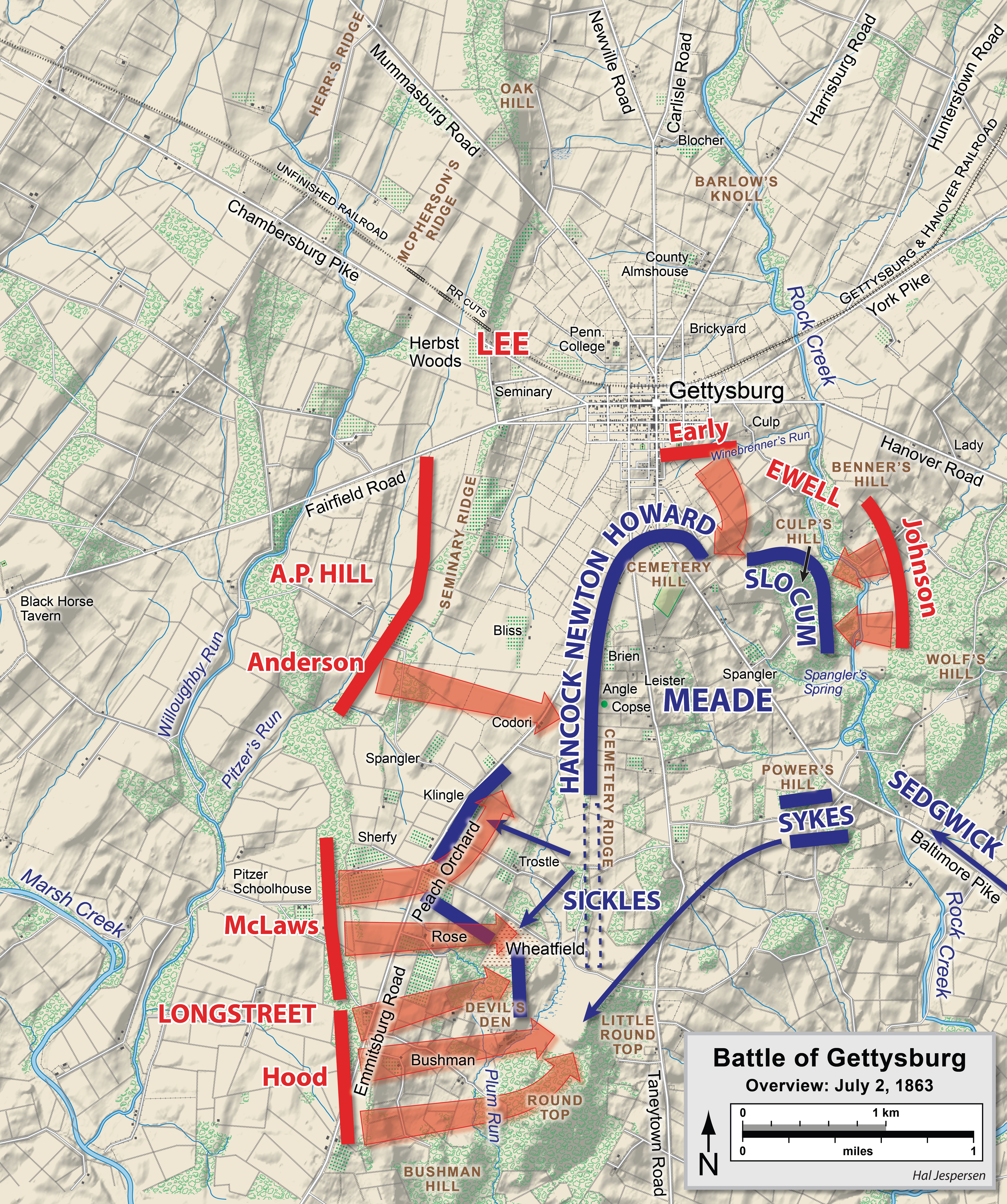
The map of the second day of the Battle of Gettysburg. The little blue arrow between Cemetary Ridge and LIttle Round Top is the First Minnesota.

The Alabamans blazed away at the Minnesotans, who pressed the attack home with a ferocity that sent the larger force reeling, even though outnumbered by 5:1.  Brigadier General Cadmus Wilcox, the Confederate general, wrote in his official report a few weeks after the battle (I’ll add emphasis):

“This stronghold of the enemy [i.e., Cemetery Ridge], together with his batteries, were almost won, when still another line of infantry descended the slope in our front at a double-quick, to the support of their fleeing comrades and for the defense of the batteries [he’s referrring to artillery, here – Ed].

Seeing this contest so unequal, I dispatched my adjutant-general to the division commander, to ask that support be sent to my men, but no support came. Three several times did this last of the enemy’s lines attempt to drive my men back, and were as often repulsed. This struggle at the foot of the hill on which were the enemy’s batteries, though so unequal, was continued for some thirty minutes. With a second supporting line, the heights could have been carried. Without support on either my right or left, my men were withdrawn, to prevent their entire destruction or capture. The enemy did not pursue, but my men retired under a heavy artillery fire, and returned to their original position in line, and bivouacked for the night, pickets being left on the pike.”

The charge drove back a force five times the size of the First.  It bought the time needed for Hancock to get the reinforcements into the line and consolidate Cemetary Ridge. 

And the First Minnesota stayed right there; the 47 men still standing (along with F company, which had been on detached duty on July 2, and missed the charge, bringing the “regiment’s” strength back up to around 80) were waiting when Lee launched General Pickett’s division on its ill-fated charge up the ridge the next day, July 3, the “High Water Mark of the Confederacy”.  At it was here, where the First was stationed, that Picket’s charge came closest to success; part of Pickett’s division reached the Union line, and spilled through; once again, a counterattack by the First Minnesota (commanded now by Captain Coates, who’d started the war in “A” Company) drove back the Rebel spearhead.  Private Marshall Sherman of “C” Company captured the battle flag of one of the attacking units, the 28th Virginia, winning the Medal of Honor (one of two for the Regiment that day;  the other went to Corporal Henry O’Brien, who, wounded in head and hand, picked up the First’s fallen flag under ferocious fire.  The Minnesotan kept their flag, and the Virginians’ as well.  It remains in Minnesota to this day, at the Minnesota Historical Society, the subject of some controversy between Minnesota and the Commonwealth of Virginia. 

The 28th Virginia’s regimental standard, seized at Gettysburg 150 years ago on July 3. Every so often, groups of Virginians make noises about wanting the flag back. They are met by shouts from vainglorious Minnesotans who urge them to march up here and take it. Apparently Ryan Winkler is now a Second Amendment advocate. Who knew?

The regiment served until the following April, when its enlistment ended.  Most of the volunteers served in other Minnesota units for the rest of the war; Colville became a legislator.

It’s amazing, the number of First Minnesota veterans who went on to prominence in the new state after the war.  This roster site has a fascinating list of biographies of an amazing number of First Minnesota veterans.  It’d be a fun game to see how many of these men have streets named after them in your community.

Our Worthless Media

Tuesday, July 2nd, 2013

Remember when the media’s mission was not only to afflict the comfortable and comfortable the afflicted, but to serve as an independent watchdog of government?

Either does the media.

But Don’t You Dare Call Them Death Panels

Tuesday, July 2nd, 2013

Unprecendented shortage of trace elements is killing people, especially children.

The shortage traces back to the Obamacare bureaucracy.

Things I’m Supposed To Like Less But Like More Anyway: “The Office” (US)

Monday, July 1st, 2013

OK, TV hipsters.  Here’s your red meat.

The Office (US) is better.

And by “Better”, I mean “Oh, shut up. Who needs to choose? The Offices are two very very different shows built around the same basic premise, and why compare?”

The US Office lasted nine seasons – two of them short ones, but most of them with twice as many episodes as the entire run of the British series.  That’s a lot of hours of TV – which doesn’, in and of itself, make the US version better.  Hell, Laverne and Shirley and The Brady Bunch were on the air forever, too. 

Both shows started with the same premise – strangers stuck in an artificial environment.  Ricky Gervais’ British version ran for 14 episodes of over the top absurdism.  The American version had to fill in a few other things to fill all that time; characters that developed over time, stories that had legs, nuances and subreferences and a depth to the writing that may not have been as explosively outrageous as the Brit original, but keeps a lot better over time; I have watched most of the US episodes several times – because there’s a reason to keep going back; I’ve seen each Brit one twice, and after two years I can probably think about doing it again, maybe. 

So put a sock in it, hipsters.

Things I’m Supposed To Love But Am Less Crazy About: “The Office” (UK)

Monday, July 1st, 2013

Ask any hipster; the stuff that nobody but they have seen is infinitely cooler than the stuff everyone else knows about.

And if you talk television, one of the things hipsters and the too-cool-for-thou all agree on is that the British version of The Office is sooooo much better than the American version (which just signed off the air after nine seasons).

They’re wrong.

Don’t get me wrong; I’ve seen all fourteen episodes of The Office (UK).  It’s funny.

In fact, it’s almost too funny. 

And that’s part of the rub.

The Brit original, starring Ricky Gervais – who’s credited as creater for the series on both sides of the pond – aired for two six-episode seasons on the Beeb, along with a two-episode “retrospective” that tied up all the loose ends that’d been left. 

The series – there as here – was about what happens when you pack a bunch of very disparate people into the artificial environment of the modern office.  Also, about Ricky Gervais’ flair for the outrageous. 

The show reminds me of “Fawlty Towers” – John Cleese’s classic seventies-era BBC series about a bumbling, henpecked hotelier.  In “Fawlty”, Cleese’s protagonist, Basil Fawlty, would spend each episode spiraling down a vortex of self-induced and ever-more-absurd social pratfalls, aggravated by Fawlty’s arrogance and provincialism, ending inevitably in a classic volcanic meltdown.  It was ingenious stuff; the comic tension building as Fawlty’s ineptitude and duplicity built on each other to almost superhuman levels of absurdity.  There’s no way to explain it.  If you haven’t watched it, find it and do. 

And you might just find as I do – that you can only watch Fawlty every couple of years. Fawlty Towersis to comedy what Fourth of July is to fireworks; if you do it every day, it loses its impact. 

Gervais’ British Office is the same.  The David Brent character is like Fawlty – it’s all so gloriously over the top that the comic tension is almost unbearable. 

And it is the show.  Oh, there are other layers, nuances in the show – but they can only get developed so far in a show that only lasted fourteen episodes.  The “Tim and Dawn” romance is rushed and perfunctory, basically to give a breather from Brent’s antics. 

It’s hilarious – and, likeFawlty Towers, it wears me out. 

Which is fine.  But sometimes I want more…

…which we’ll come back to in a bit here.

The “Wreck Everything” Legislature

Monday, July 1st, 2013

Before the 2012 elections, the DFL tried to call the previous, GOP-run legislature a “do-nothing” legislature.

Leaving aside the obvious – the government that governs best governs least – it was a lie. The 2011-2012 legislatures accomplished some useful stuff – hobbled by a “governor” who was fully-owned by extremist special interests and some very un-conservative detours like the Vikings stadium.

But as we wait at the halfway point of a session of one-party government, what does the DFL have to show for their unfettered power?

  • Business taxes – especially the warehousing tax – that lop a serious chunk off of Minnesota business’ bottom line, and that already have businesses heading for the exits.
  • Two extra billion dollars taken out of the productive parts of the state’s economy.  Remember – Minnesota’s GDP is about $267 Billion.  Another two billion is nearly a percent – on top of the 30-odd billion in state spending that the state already sucks out of productive use.  Imagine having an additional 1% of your productive income taken out of circulation – $500 a year if you make $50K.   It’s not chicken feed. 
  • A home daycare system saddled with useless graft to the public employee unions, and with its revenue further cut by the state’s move into all-day kindergarten – which adds virtually nothing to kids’ education, but does create lots of new union jobs that pay dues to the DFL. 

And all of that at the end of a session that wasted months arguing about DFL social-domination issues (gun control, gay marriage) and power-acquisition. 

In exchange for what? 

So far, nothing but damage.

I’ll take “do nothing”, thanks.

Priorities

Monday, July 1st, 2013

Over the weekend, Governor MessingerDayton sent out a fundraising email blast (that didn’t involve asking Sotheby’s to help him hock a Renoir).

The interesting part (emphasis added)?

I ran for Governor because I knew that our state was falling behind. Cuts to education, endless gridlock, and budget gimmicks jeopardized our shared future.

We’re starting to turn Minnesota around by investing in our schools, training our workers, and, critically, recognizing the freedom to marry.

The school and “worker training” “Investments” are the usual double-talk, of course…:

But was gay marriage really “critical?”

I mean, sure – to gays marriage activists it was. And one can even argue it was (or was not) the right thing to.

But to the overall conduct of this state? Especially it’s economy?

If you’re a jobless mine worker? If you just got laid off from your medical device manufacturing job? If your company is moving to Texas? If you’re shopping for new daycare?

How “critical” was gay marriage?

Is gay marriage “critical?”

--> Site Meter -->