Archive for November, 2010

The Great Poll Scam, Part IV: Hubert, You Magnificent Bastard, I Read Your Numbers!

Monday, November 15th, 2010

The Hubert H. Humphrey Institute is a combination public-policy study program and think tank at the University of Minnesota in Minneapolis.  Named for the patriarch of the Democratic Farmer-Labor party – a forties-era amalgamation of traditional Democrats and neo-wobbly Farmer-Labor Union members whose Stalinist elements Humphrey famously purged in the mid-forties – the institution serves as a clearinghouse of soft-left chanting points and a retirement program for mostly left-of-center politicians and heelers.

The Institute has been doing general public opinion polling for years; in 2004, in conjunction with Minnesota Public Radio, they dove into the horserace game.

Let’s just sum up their performance in each of the five Presidential, Gubernatorial and Senate races they’ve polled in that time:

2004 Presidential Race

  • HHH Poll:  Kerry 43, Bush 37
  • Actual Election Results: Kerry 51, Bush 47
  • Bush underrepresented by 10.61, Kerry by 8.09.

2006 Gubernatorial Race]

  • HHH Poll: Hatch 45, Pawlenty 40
  • Actual Election Results: Pawlenty 46.45.
  • Pawlenty underrepresented by six, Hatch polled accurately.

2006 Senate Race

  • HHH Poll: Klobuchar 54, Kennedy 34
  • Actual Election Results: Klobuchar 58.06, Kennedy 37.94
  • Kennedy underpolled by 3.94, Klobuchar by 4.06 – but it was a blowout.  We’ll come back to this.

2008 Presidential Election

  • HHH Poll: Obama 56, Mccain 37
  • Actual Election Results: Obama 54.2, McCain 44.
  • Obama overrepresented almost two points; McCain, almost seven points under. A ten point race was portrayed as a 20 point landslide.

2008 US Senate Race

  • HHH Poll: Franken 41, Coleman 37
  • Actual Election Results: Franken by 41.99 to 41.98.
  • Franken underrepresented by less than a point; Coleman, by almost five.  A tie race was portayed as a convincing five points beat-down.

2010 Governor Race

  • HHH Poll: Dayton 41, Emmer 29.
  • Actual Election: Dayton 43.63, Emmer 43.21, recount in progress.
  • A tie race was depicted as a 12 point blowout.

A polling guru will say that these gross inaccuracies are a function of the Humphrey’s likely voter model – which for whatever reason assumed in each case that Democrats were much more likely to vote than Republicans, and likely to make up a greater portion of the electorate.

And yet the Humphrey Institute’s heuristics – the procedural, institutional and methodological rules by which institutions develop intelligence about things like voter behavior – seem to be stuck, for whatever reason, in the eighties.  The average HHH poll shows Republican candidates to be polling over five and a half points lower than Democrats in their real-life election performances.

Coincidence?

In five of the six races covered above, the errors in measurement underrepresented the GOP.  It’s an figure lower than that of the “Minnesota Poll” only because they’ve been in business sixty years fewer than the Strib’s poll.

Why would this be?

More next week.

In our next installment: I’ve shown you the behavior of both polls in horseraces across the board.  But a particularly interesting bit of behavior comes out if you throw out the blowouts – the 30 point massacre in the 1994 Governor race, the 20 points slaughter in the 2006 Senate contest – and focus on the tight races.

More on Wednesday.

———-

\The series so far:

Monday, 11/8: Introduction.

Wednesday, 11/10: Polling Minnesota – The sixty-six year history of the Strib’s Minnesota Poll. It offers some surprises.

Friday, 11/12: Daves, Goliath:  Rob Daves ran the Minnesota Poll from 1987 ’til 2007.  And the statistics during that era have a certain…consistency?

Monday, 11/15: Hubert, You Magnificent Bastard, I Read Your Numbers!:  The Humphrey Institute has been polling Minnesota for six years, now.  And the results are…interesting.  In the classic Hindi sense of the term.

Wednesday, 11/17: Close Shaves: Close races are the most interesting.  For everyone.  Including you, if you’re reading this series.

Friday, 11/19: The Hay They Make: So what does the media and the Twin Cities political establishment do with these numbers?

Monday, 11/22: A Million’s A Crowd:  Attention, statisticians:  Raw data!  Suitable for cloudsourcing!

Logic For Leftybloggers: Begging The Question

Monday, November 15th, 2010

Here’s a typical argument that I’ve been having with more than a few lefties lately:

ME: Here’s some more evidence that fraudulent votes were cast in the election.

THEY:  You shouldn’t say that.  Minnesota has the best voting system in the country.

ME:  Maybe, maybe not – but there’s some room for improvement, as these stories show.

THEY: But you shouldn’t impugn the voting system.  You’ll discourage voting.

ME: No, I’m encouraging people to hold their idiot government accountable.

THEY:  But your “evidence” is wrong.

ME: Why?

THEY: Because we have the best voting system in the country.

ME: (Looks for ways to change the subject)

It’s called “Begging the Question” – which may be the most mis-used term in the whole world of logic, by the way.  Correctly used, it means “Using the presumption that your claim is correct as evidence that your claim is correct”.

Constant repetition that Minnesota has the best electoral system in the country, even if it’s true (and it’s becoming clearer and clearer to me that it’s a ludicrous claim, unless the sole goal is to rack up vote counts, which is a stupid goal) doesn’t pre-empt evidence that there are issues.

Trimming The Fat

Monday, November 15th, 2010

Joe Doakes of Como Park writes about New York City’s recent decision to stop using city resources to look for lost pets:

It’s sad the City won’t look for lost pets. We lost a cat once and thinking someone may have turned him in, I searched everywhere, for days, visited shelters and even put up posters, without success. Heartbreaking.

So why is New York City being so cruel, so heartless, so cold – does the city government hate kittens and want them to DIE DIE DIE?

Or is this how it looks when actual leadership makes real world budget decisions in a day of declining revenues? Is this what the word “prioritize” means?

Yes, it’s sad lost pets stay lost; but unless you can convince everybody in town to pony up more money for pet searches instead of, say pothole repair, that’s reality. That’s a decision real leadership must make.

Wonder what city services would look like if St. Paul had any leadership?

I’m going to have to try that next time Saint Paul releases a budget; post it, and then throw it open to the audience to see what we cut.

Can’t be any worse than what we have in Saint Paul now.

Them’s fightin’ words

Sunday, November 14th, 2010

Reading the Sunday Strib online (I buy a paper copy every once in a while for kindling)  I find it amusing how the Strib words the following passages…emphasis mine…

Minneapolis and St. Paul will face major budget deficits if the state reneges on its local government aid (LGA), a program that helps pay for services in hundreds of Minnesota cities.

Cities have to lock next year’s budgets into place in less than a month. Yet the governor’s race remains undecided, while Republicans have wrestled control of the Legislature from DFLers, and an estimated $6 billion state budget shortfall clouds the picture.

I might offer a revision for the former: if state legislators are forced to cut subsidies to cities not able to live within their means as the state itself now must?

…and for the latter: as voters wrestled control of a state legislature dominated by the DFL for decades and handed it to Republicans, ostensibly sending a message of confidence lost in the former and gained in the latter.

Meanwhile, Nick Coleman (I am still surprised to see him gainfully employed) suffers from the same malady as President Obama: if only we had communicated our plans better, the American people would have voted differently.

DFL legislators who never put up an effective fight against the No New Tax mantra of Gov. Tim Pawlenty and never had a comprehensive strategy for communicating the goals of all their legislative maneuverings should share the credit for the GOP takeover.

Or, they were actually, absurdly proposing resolving our employment and economic maladies by raising taxes and increasing spending and for the first time in decades, Minnesota said “Nyet!”

It will be months before we know the full scope of the corporate politics behind the legislative takeover. We may never know the sources of much of the money, since anonymous contributions are permitted in the anything-goes political climate.

Careful there Nick, remember if you point one there’s four pointing back at you.

But one Democrat who felt the sting of the corporate lash was David Bly, a state representative from the cow-and-college precincts of Northfield who was seeking a third term. Bly, a high school English teacher, has been a leader in the fight for a universal health care plan for Minnesotans and other progressive causes. He was told by DFL Party leaders that his seat was safe, then stood by helplessly as business interests paid for an endless blizzard of attack ads — a dozen or more — that were mailed to voters in District 25B. Bly abided by spending limits for lawmakers — spending about $31,000 on his campaign — while the Minnesota Chamber of Commerce Leadership Fund, the Minnesota Coalition of Businesses, and something called NFIB, the National Federation of Independent Business, may, when final reports are in, turn out to have spent far larger amounts on behalf of his opponent.

Nick, don’t confuse the DFL’s inability to hear the train coming down the tracks with treachery on the part of their opponents.

For the record, Bly has supported a balanced approach to state budgeting, including cuts and tax increases where necessary.

…and to a liberal legislator they’re always necessary. Minnesotans seem to have rejected the notion that yet another tax hike is a “balanced” approach.

So relax, everyone. Business is picking up. And business just picked up a new Legislature coming into office in January.

That’s right Nick, business – you know, the sector that actually creates jobs and pays taxes.

Many of the new lawmakers probably don’t even know where the Capitol is.

…only Nick Coleman and his ilk would think that’s a bad thing.

I Heard It On The NARN

Saturday, November 13th, 2010

Dan McGrath of Election Integrity Watch and the Minnesota Majority.

Poor, poor Nancy

Saturday, November 13th, 2010

Oh, the humanity…

First, there was a plummeting “favorability” rating of 29 percent, nearly half of her “unfavorable” score, according to a recent Gallup poll. Then there was the staggering loss of 60 seats in the House of Representatives, a resounding midterm election “shellacking” if there ever was one.

Now, Nancy Pelosi can add “embattled” to her list of woes. On Friday, the lame duck speaker of the house announced her plan to fight to be house minority leader for the next session of Congress. Frankly, that decision sort of left me scratching my head and wondering how strong the Kool-Aid is in Pelosi’s office.

Turns out her new office might not have a Kool-Aid dispenser, among other amenities lost now that America has thrown her out on her saggy ass orderly asserted itself via the democratic process.

Gone will be the spacious office suite with its federalist decor, the rides home aboard a military plane, and a good chunk of her staff. “It’s a profoundly humbling experience”

she’ll lose the right to authorize overseas congressional trips and dole out prime office space to lawmakers. She will also shed 10 percent of her $5.1 million office budget and lose nearly half of what records show is a staff of over 50.

Sniff. Sniff.

…A World In White Is On The Way

Saturday, November 13th, 2010

Today, the Northern Alliance Radio Network brings you the best in Minnesota conservatism from 9AM-3PM.

  • Volume I “The First Team” –  Brian and John or some combination thereof kick off from 11-1.
  • Volume II “The Headliner”Ed and I follow from 1-3PM Central.  We’ll be talking about a very busy week in review, and having a chat with Dan McGrath of Minnesota Majority about the irregularities seen on election day.
  • The King Banaian Show! – King – hopefully “Representative Banaian” to you – is on hiatus, still.  With any luck, he’ll be back soon from 9-11 on AM1570, Business Radio for the Twin Cities!  We’re broadening the franchise; two stations, now!
  • And for those of you who like your constitutionalism straight up with no chaser, don’t forget the Sons of Liberty, from 3-5!

(All times Central)

So tune in to all six hours of the Northern Alliance Radio Network, the Twin Cities’ media’s sole guardians of sanity. You have so many options:

  • AM1280 in the Metro
  • streaming at AM1280’s Website,
  • On Twitter (the Volume 2 show will use hashtag #narn2)
  • UStream video and chat (at HotAir.com or at UStream).
  • Podcast at Townhall, usually by Monday
  • Good ol’ telephone – 651-289-4488!
  • And make sure you fan us on Facebook!

Join us!

News Conference

Friday, November 12th, 2010

Mitch Berg is arriving for his press conference.  He takes his place behind the podium.  The press bustle forward to get the best spots in front of the podium.

Berg waves his hands, and the press gradually quiet down.

BERG: OK, for starters; everyone knows Tom Emmer has won the election, and that his inauguration is inevitable.  And so, while the election did fall within the statutory limit requiring a recount of the vote, as required by Minnesota State Law, I urge the DFL and the Dayton campaign not to interfere with the obvious inevitability of Emmer’s victory by pursuing the process that is legally mandated and out of their control anyway.

Furthermore, when the inevitable happens at the end of this mandatory process that the DFL should not pursue anyway, I urge Mark Dayton and the DFL from restraining their lawyers from filing stupid lawsuits, regardless of whatever grounds they say they may have, for a Better Minnesota. 

We especially urge the Dayton campaign to refrain from filing lawsuits over so-called “irregularities” or “fraud” in the process.  Everybody knows we have the best electoral system in the world, so it’s a moot point.

And when all those lawsuits are dismissed, I implore the DFL not to sic throngs of SEIU goons on Republican recount watchers, offices and the homes of GOP activists in revenge for their inevitable loss. 

I will now take questions.

ERIK BLACK: Er, Mitch?  Why are you calling Emmer’s victory “inevitable”? 

BERG: Because it is, and has always been.  Next?

RACHEL STASSEN-BERGER: Er, has there been any indication whatsoever from the Dayton campaign that they plan on filing frivolous lawsuits simply to pointlessly extend the recount process and delay the transfer of power?

BERG: You just report what I say, OK?  Next question.

TOM SCHECK: Er, this bit about “not raising objections over irregularities” – that is their legal right as part of this process…

BERG: Right, but it will only detract from the inevitability of Emmer’s victory.   It’s stupid, and just between the two of us, it’s a sign that they hate children.  Next?

TIM PUGMIRE: This reference to SEIU goons – where does that come from?

BERG: Look, I’m not saying that they will sic goons or lawyers on anyone.  Not at all.  You have the context all wrong.  I’m just saying that when they inevitably lose the recount and Governor Emmer is inevitably inaugurated – as every sensible person who doesn’t secretly yearn for child porn can say will happen, once this pointless yet legally-mandated recount is over – it’d be very bad for a party to sic hordes of union goons on those they disagree with.

MARTY OWINGS: But Mitch – nobody’s talking about siccing goons on anyone.

BERG: I’m just asking questions.

PAT KESSLER: That wasn’t a question.  That was  a statement.  You told the DFL to refrain from siccing goons on people if they lose the recount.

BERG: Well, that’s just common sense.  You want a good state, and  you believe in democracy?  Ixnay on the goons!

Final question?

BILL SALISBURY:   So to sum it up, you’re asking the DFL and Dayton to refrain from doing things they never said they were going to do in the first place, and decline to do things that are obligations that are out of their hands according to Minnesota law. 

BERG: Yep.  That, and not kill people for revenge when Tom Emmer’s inevitable inauguration takes place.  Thanks!

Berg leaves the stage, as Brian Melendez silently takes notes in the back of the room.

Looking for Love in All The Wrong Places

Friday, November 12th, 2010

I almost feel sorry for Barack Obama. He’s traveling the world over, looking for some love, and coming up empty.

America handed him an epic rejection of virtually everything he has “accomplished”  just two years in. Knowing fully well what was coming, he skipped the country on a trade mission, a multi-bazillion-dollar entourage in tow, hoping to bring home a trade agreement…or…something.

President Obama’s hopes of emerging from his Asia trip with the twin victories of a free trade agreement with South Korea and a unified approach to spurring economic growth around the world ran into resistance on all fronts on Thursday, putting Mr. Obama at odds with his key allies and largest trading partners.

Does the whole world hate Obama?

After five largely harmonious meetings in the past two years to deal with the most severe downturn since the Depression, major disputes broke out between Washington and China, Britain, Germany and Brazil.

OK, maybe not the whole world, just a majority of the largest economies of the world, so technically there are countries out there, theoretically, that don’t think America’s fiscal and monetary policies are being crafted by an administration consisting of a band of arrogant bookworms that have never owned, created or run anything resembling an enterprise.

In two years, the Obama administration has effectively rendered America to the economic equivalence of adolescence, world leaders now treating Obama and his staff like underclassmen.

As if a global scolding wasn’t embarrassing enough for the soon-to-be one-term President, his Treasury Secretary, steeped in academentia, was fending off attacks from back home.

The disputes were not limited to America’s foreign partners. Treasury Secretary Timothy F. Geithner got into a trans-Pacific argument with one of his former mentors, Alan Greenspan, the former chairman of the Federal Reserve, after Mr. Greenspan wrote that the United States was “pursuing a policy of currency weakening.” Mr. Geithner shot back on CNBC that while he had “enormous respect” for Mr. Greenspan, “that’s not an accurate description of either the Fed’s policies or our policies.” He added, “We will never seek to weaken our currency as a tool to gain competitive advantage or grow the economy.”

Well, if you say so.

…well, at least not again…because the Fed’s current plan to buy $600 Billion of government securities is precisely, explicitly that.

Does Geithner actually believe we are all that stupid or that he’s so much smarter?

Much of the rest of the world seemed to share Mr. Greenspan’s assessment. Moreover, Mr. Obama seemed to be losing the broader debate over austerity. The president has insisted that at a moment of weak private demand, the best way to spur economic growth is to have the government prime the pump with cheap credit and government stimulus programs. He quickly found himself in an argument with Prime Minister David Cameron of Britain and Chancellor Angela Merkel of Germany.

Wait, who? Great Britain? Isn’t Great Britain…like, our Huckleberry? How retarded does the President and his staff have to be to screw up that relationship?

America isn’t subscribing to this administration’s ineptitude and neither is the rest of the world.

Playing a fools game, hoping to win, telling those sweet lies and losing again.

The Great Poll Scam, Part III: Daves, Goliath

Friday, November 12th, 2010

Rob Daves took over the Minnesota Poll in 1987.

Rob Daves

Rob Daves

I have never met Rob Daves.  Either, to the best of my knowledge, has anyone else.  I don’t know that his alt-media bete noir, Scott Johnson, has even met him, despite not a few requests for interviews.

I have no idea what Rob Daves thinks, believes, wants, says or does.  I know nothing about his personal life, and I really don’t want or need to.  For all I know, he’s a perfectly wonderful human being.

But for a 20 year period under his direction, the Minnesota Poll turned into an epic joke.

How epic?

The numbers don’t lie.

———-

During the Rob Daves years, party politics in Minnesota skittered all over the map.  The governors office started DFL, changed hands, and maybe have changed back last week – we’ll see.  The Reagan/Bush 41 era seesawed to Clinton, then Dubya, and now Obama; both Senate seats started Republican; both switched to the DFL, eventually.

There has, in short, been a lot of variety, at least in terms of the Party ID winning the various elections.

But the Minnesota Poll has been oddly homogenous.

Throughout the Rob Daves era, the Democratic or DFL candidate in Presidential, Gubernatorial and Senate races has gotten an average of 45.68% of the vote, to 45.21% for the GOP.  That’s very, very close.

Some of the races have been blowouts – Amy Klobuchar’s 20 point drubbing of Mark Kennedy, Arne Carlson’s 30 point hammering of John Marty – and some, like our 2008 Senate and 2010 Governor races, have been (or still are) painfully close.

But you’d never know it from the Minnesota poll. The average vote totals – between the blowouts and upsets and squeakers – during Daves’ 1987-2007 tenure favored the DFL, barely, by 45.98 to 45.34%.  But the Minnesota Polls released just before all those elections showed the population favoring the DFL by 43.33 to 39.89%.

And of 18 total contests, the polling inaccuracies skewed in the direction of the DFL in 15.   The average skew toward the DFL came to almost three percentage points.

When you break things out, the differences get wider; in the five Presidential elections, the Minnesota Poll discerned a 49.67 to 36% DFL lead; the actual results were 50.13 to 41.64%.  The Minnesota Poll underrepresented the GOP by an average of 5.64% in Presidential elections during the Daves years.   The Strib Poll showed every single GOP candidate coming up short of his actual election performance:  George HW Bush polled 3.80% light; Dole, 7.00%;  Dubya, 8.50 and 6.61; McCain also polled seven points under his real performance.  The Democrats, on the other hand, seemed to be polled fairly accurately; the average error poll  and election for Democratic presidential candidates was less than half a point.

The Senate races are a little closer – the Republicans underperform the election results 4.29% to 3.14%, a difference of 1.15% under their election results, which isn’t very significant – if you just look at raw numbers.  Well come back to that next Wednesday.

In the Gubernatorial races during the Daves years, though, the polling results were pretty lockstep. In gubernatorial races since 1987, the GOP has outpolled the DFL by an average of 46.77 to 38.91% – including one huge blowout (1994) and several squeakers.  But the Minnesota Poll has shown Minnesotans’ preferences at 40.17 to 36.67 in favor of the GOP.  Republicans’ performance was underpolled by 6.6% in the Minnesota poll – that of the DFL by only 2.24%.  The Minnesota poll showed Minnesotans underselecting Republicans by almost triple the margin of the actual elections.

A classic – and large – example was the 2002 Governor race.  The election-eve Minnesota Poll showed Pawlenty tipping Moe by 35-32.  The real margin was 44-36.  While the poll oversampled Independence Party candidate Tim Penny by a fairly impressive margin, the fact is that while the final MN Poll undershot Moe’s support by 4%, it underrepresented Pawlenty’s by nine solid points.

All in all, of the 20 Presidential, Senate and Gubernatorial races during the Daves era, 16 of them showed the Minnesota Poll underpolling the GOP by a greater degree than the DFL.

And that’s just counting all the races.

———-

Daves was let go at the Strib in 2007.  The Minnesota Poll was taken over by “Princeton Research Study Group”, which also does polling for Newsweek (whose polling is generally considered atrocious).

The 2008 races were very different, of course; the Senate race was a virtual tie, while Obama beat McCain handily.

But the day before the election, the Minnesota poll said McCain was polling just 37%; he ended up with 44%.  It overestimated Obama’s support by under a point, calling him at 55% when he got 54.2%.  The Minnesota Poll sandbagged Mac by seven points.

And Franken v. Coleman?   The day before the election, the poll showed Coleman almost four points below his actual performance (38% versus 41.98) ; it nailed Franken almost dead-on (42% i the poll, 41.99% by the time the recount was over).

PRSA showed both GOP candidates performing drastically off their real pace on election eve.

And three weeks ago, a week before the gubernatorial election, the Minnesota Poll showed Emmer at 34%; he got 43.21%.  Nine points better than the Minnesota poll indicated.

The upshot?  Of the 20 total election contests in the Rob Daves and PRSA eras, the Minnesota Poll has underpolled GOP support in 17 – 85% – of those races.

And PRSA polling has, on average, underpolled the GOP by 6.12% in those three elections.   In other words, PRSA’s errors have favored the DFL to the tune of six points – which is more than the three-plus points of the Rob Daves era.

One might think that random statistics would scatter on both sides of the middle more or less equally.  And in the first 42 years of the Minnesota poll, in aggregate, they did, as we showed Wednesday.

But during the Daves years, and continuing with PRSA, the errors developed a consistency – shorting Republicans – and grew in magnitude.

———-

Of course, those averages hide some big swings; some races in those averages were real blowouts.

It’s been my theory that the Minnesota Poll’s “peculiarities” are most pronounced during close elections.

We’ll test that out next Wednesday, when we’ll examine races that were decided by the proverbial cat’s whisker.

First – Monday – we’ll meet the Hubert H. Humphrey Institute Poll.

———-

The series so far:

Monday, 11/8: Introduction.

Wednesday, 11/10: Polling Minnesota – The sixty-six year history of the Strib’s Minnesota Poll. It offers some surprises.

Friday, 11/12: Daves, Goliath:  Rob Daves ran the Minnesota Poll from 1987 ’til 2007.  And the statistics during that era have a certain…consistency?

Monday, 11/15: Hubert, You Magnificent Bastard, I Read Your Numbers!:  The Humphrey Institute has been polling Minnesota for six years, now.  And the results are…interesting.

Wednesday, 11/17: Close Shaves: Close races are the most interesting.  For everyone.  Including you, if you’re reading this series.

Friday, 11/19: The Hay They Make: So what does the media and the Twin Cities political establishment do with these numbers?

Monday, 11/22: A Million’s A Crowd:  Attention, statisticians:  Raw data!  Suitable for cloudsourcing!

MN Poll Result: 42.79 Elecction Result;: 46.61 Difference: -3.83   MN Poll Result: 49.62 Elecction Result;: 50.97 Difference: -1.35   Total/Lean DFL 21.00 13.00 0.62 Average Skew: 2.48

Best Voting System In America

Friday, November 12th, 2010

Just keep chanting it.

And Don’t Think It’s Escaped My Attention…

Thursday, November 11th, 2010

…that two straight rememberances of American military veterans have coincided with seventieth-anniversaries of stories of British heroism – Dunkirk this past Memorial Day, and Taranto today.

It’ll all balance out in the end.  There’s still five more years of WWII to do…

Torino, Torino, Torino

Thursday, November 11th, 2010

It was seventy years ago today that the British Royal Navy brought the naval world into the 20th century – and gave the  Imperial Japanese Navy a bright idea that would come back to haunt us.

First, a look back at some world and literary history.  Then, some technology.

———-

For big nations in the 1500s through the 1940s, having a neighbor with a big, powerful navy was sort of like knowing one of your neighbors has a badly-trained pit bull and a hole in their fence; even if you don’t see the dog, you make sure all your barbecues are in the back yard; even if the enemy navy never comes out to gight, you have to keep in mind that they could, with dire results in lost ships and wrecked commerce and severed military lines of communication.  This equation has dominated much of modern Western history; from King George’s ships of the line to the Great White Fleet to the Dreadnoughts to the entire NATO fleet of the fifties through the eighties (built to fight a Soviet submarine fleet that, thanks to Ronald Reagan, is now largely long-scrapped or rusting away at dockyards around Russia).

Of course, the daring admiral’s solution is to go to where the enemy fleet is holed up, and destroy it.  That way, your nation doesn’t have to compensate for that big, unseen threat anymore.  Sometimes it doesn’t work – Xerxes came to grief when he tried to root out the Greek fleet at Salamis, and got rooted out himself.

  Sometimes it does; Duncan at Camperdown and Nelson at The Nile  and Decatur’s sailors and Marines at Tripoli managed to change the fates of nations and the courses of wars by sailing not only into harm’s way, but into their enemies’ home ports to destroy them and render them moot as strategic factors.
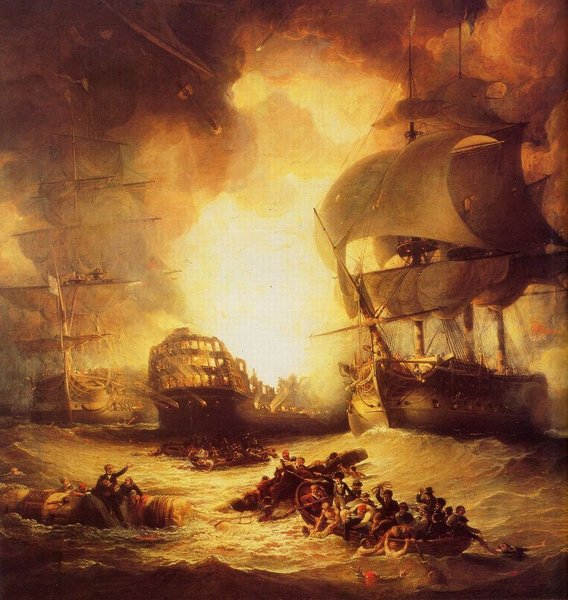
French flagship LOrient exploding at the Battle of the Nile

French flagship "L'Orient" exploding at the Battle of the Nile

In 1925, Hector Bywater’s novel The Great Pacific War described a fictional Japanese attack on Pearl Harbor and the Philippines, with the intent of taking control of the western Pacific.  The scenario involved a line of Japenese battleships steaming into Pearl Harbor by surprise and wreaking havoc.

Fanciful? Of course.  Everyone knew you couldn’t sail a hostile battleship into Pearl Harbor!

Still, the idea of somebody destroying US naval power in the Pacific in a surprise coup de main was floating around.  Implausible – Bywater was most likely called an “paranoid southern wingnut” by liberals of the day who were ignorant that he was the Times of London’s naval affairs corrrespondent – but it was out there.

We’ll come back to that.

———-

There have been few times in the history of warfare when technology advanced as fast as it did in the fifteen years between 1930 and 1945.

In 1930, the tank was a rattling, unreliable contraption assembled with rivets and armed with a popgun and almost as much danger to its own crew as to any enemy.  Infantrymen carried bolt-action rifles not much different than the ones their fathers carried in 1900.  Air forces were composed of biplanes that puttered along at 180 mph.  And the world’s navies were largely dominated by battleships.

HMS Queen Elizabeth - one of the worlds most powerful ships in 1930

HMS Queen Elizabeth - one of the world's most powerful ships in 1930

And when navies went to sea to duke it out, they found each other more or less the same way they had 130 years earlier, in the age of Nelson and Decatur – via the human eye.

Of course, the lookouts reported their findings to other ships via radio, which was edgy stuff even in 1930.  And some of those lookouts flew in airplanes – floatplanes launched from battleships and cruisers and, in a few navies, launched from the world’s first aircraft carriers.

For all of its reputation for hidebound traditionmongering, the British Royal Navy led the world at seeing the utility of aircraft at sea.  They built the world’s first seaplane carrier – the HMS Campania, in 1916, which launched float planes with crude bombs to attack the Zeppelin bases that were launching the air raids that were terrorizing London – and, in 1918, they converted a fast ocean liner into the world’s first flat-top aircraft carrier, the HMS Argus:
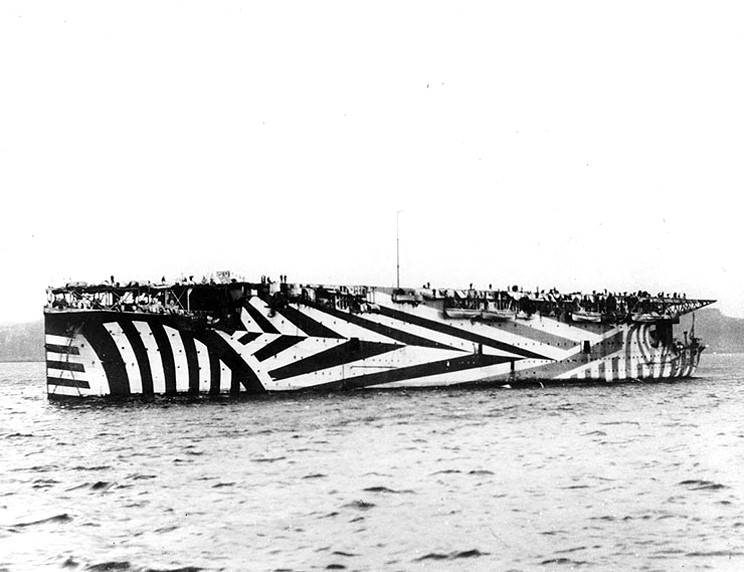
HMS Argus, the worlds first operational aircraft carrier, in 1918.  The ship served throughout World War II. HMS Argus, the world’s first operational aircraft carrier, in 1918. The ship served throughout World War II.

They saw the role of the aircraft carrier to be not just scouting for the fleet and correcting the gunfire of the battleships, but attacking enemy ships.   They developed the world’s first torpedo bombers – allowing a tiny, flimsy airplane made of doped canvas and wood and string to sink the most powerful battleship – in theory.

So as the technology to deliver an attack literally and figuratatively zoomed ahead, the technology to detect an incoming attack – the human eyeball – stayed more or less the same way it’d been for all of naval history.

Which meant that if a lookout on a ship saw aircraft coming in at twenty miles out, flying at the then-blistering pace of 120 mph (that was a fast torpedo plane indeed, in 1930), it gave ten minutes’ warning to get an aircraft carrier’s fighters scrambled off the deck – plenty of time to attack incoming planes that hand to come in at low altitude to drop torpedos. 

But after 1930, technology started taking off.  Airplanes became faster; the 100 mph torpedo bomber of 1930 was replaced by planes that could do very nearly 200 mph by 1935.  The United States Marines invented Dive Bombing  (with the Germans and Japanese enthusiastically copying the tactic)- meaning the enemy could not only come in at 200 knots, but do it at 15,000 feet, meaning interceptors needed to add that much more time to climbing to meet the enemy. 

And the speed of ships started climbing, too; most of the world’s battleships in 1930 were red-lined at 23 knots (27mph); by 1935, the British, Germans and Americans had battleships on the drawing boards that could do 28-30.

And so when the Royal Navy decided in the early thirties that they needed a generation of aircraft carriers to fight the next war, it built them on the assumption that the technology of the attack would stay well ahead of the technology of detection – and that their carriers would have to thus be able to shake off plenty of damage and keep operating.  The Illustrious class carriers first laid down i 1934 were fast enough to get away from enemy battleships, but armored well enough to withstand damage from lesser enemy ships, cruisers and destroyers.  Most importantly, their flight decks were armored, to allow them to shake off bomb hits as well as protect the aircraft on the hangar deck down below.

HMS Invincible, 1940

HMS Illustrious, 1940

Britain also scrupulously adhered to the arms control treaties of the day, in those innocent-seeming days when “arms races” involved warships rather than nuclear weapons; in addition to being bombproof, they had to come in under 24,000 tons.  To do all that, something had to give; that something was capacity.  Illustrious could hold 36 aircraft in its original form.  The Admiralty figured it’d be better to have 36 aircraft that would get into action reliably than 52 on one of its older carriers that would risk getting sunk before launching an attack.

And given their initial assumptions and constraints (the “human eyeball” range of detection and the London Naval Treaty), they were correct.

But with war coming on fast, most of the world’s nations – especially Germany and Japan – stopped observing the London Treaty; ship displacement and firepower started creeping upward.  And in 1936, the first radar set was tested, removing the “human eyeball” limit to detecting incoming attacks.   And this revolutionized naval warfare just as much as it did war over land.  When the United States Navy started designing it’s fleet of carriers, it did so knowing that it could “see” attacks far beyond visual range, day or night, allowing the carriers to scramble fighters to break up the incoming raid. and avoid enemy surface ships altogether.  Carriers’ main defense became their air wings rather than their armor plating; with less need to ward off bombs and shells, the carriers could…carry.  The American carriers that were being designed at about the same time – the Yorktown and Essex class ships that carried the US Navy through World War II and much of the Cold War as well – could carry between 72 and 100 planes.  This made the huge carrier-borne sweeps later in the war possible.  The Brits, especially early in the war, were limited to smaller, pinpoint raids against vital enemy targets.  Their carriers just didn’t carry enough planes to carry off bigger operations.

Fortunately for the Royal Navy, just such an operation presented itself, seventy years ago tonight.

———-

The invasion of Greece showed Churchill that the Mediterranean was going to be anything but a backwater front in the war.  This was no small issue for Britain; the key to the British Empire in the Eastern Hemisphere was the Suez Canal, which made communication with the vast bulk of the empire – India, Singapore, Australia, East Africa and many other holdings – cheaper and more feasible.

And since the Italians had a large army in Libya, it was vital to keep supplies going to Egypt to defend the canal.  And to avoid a months-long plod around the Cape of Good Hope up to the Red Sea and thence to Suez, it was vital to keep supplies going across the Mediterranean.

And the Italian Navy had the potential to put a serious crimp in that supply line.

———-

Know what an awesome bit of technology a Ferrari Testa Rossa is?  Italian ships were about the same.
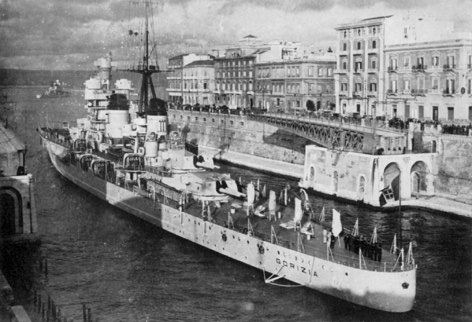
Italian cruiser Gorizia

Italian cruiser Gorizia

Fast, well-armed, but with “short legs” – a very short cruising range – Italian ships were built for dashing across the restricted waters of the Mediterranean to hit enemy fleets and scamper back to base.  And a huge squadron of them – six battleships, nine cruisers and a slew of destroyers – were stationed at the nail on the toe on the foot of the boot of Italy, at the base at Taranto.

The battleship Giulio Cesare at Taranto

The battleship "Giulio Cesare" at Taranto

It was nothing new.  The British had been eyeing up the Italian Fleet as long as there’d been an Italy, for nearly eighty years.  “How to remove Taranto” had played in several international crises over the previous century.   There’d been many plans, many ideas; in the 1800s, the Admiralty had planned to take the city and port with the Royal Marines, in a pinch.

Well before the war began, the Fleet Air Arm was training in the exacting art of making torpedo attacks at night in shallow water.   In November of 1940, they were the only fleet in the world that could carry the mission off.  While most of the world believed it was impossible to launch airborne torpedos in a harbor (on the theory that the “fish” would plunge into the bottom before stabilizing themselves), the Brits figured it out before the Germans

And seventy years ago tonight, a British task force centered around the HMS Illustrious arrived 150 miles off the Italian coast…

HMS Illustrious

HMS Illustrious

…and launched 24 “Swordfish”  torpedo bombers.

The Swordfish torpedo bomber

The Swordfish torpedo bomber

That’s right.  Biplanes.  Not a whole lot different than the ones that flew from Argus in World War I.  During its Depression-era financing drought, the Royal Navy had enough money to build an excellent class of aircraft carriers – but had only just started figuring out the best airplanes to put on them when the war began. 

But it was the software – the pilots and aircrew – that made up for the ancient equipment. They’d been training to do night-time torpedo attacks for years.   In the days since Desert Storm, we take these sorts of things for granted; in 1940, night torpedo attacks from the air were just this side of science fiction, and almost entirely a function of navigation and piloting skill.

And at just before midnight, that’s what they did.  Two of the 24 planes dropped bombs on the port’s oil tanks as a diversion, and then dropped flares over the harbor.  Ten more dropped bombs on the cruisers and destroyers, mainly to keep the anti-aircraft guns busy.  And the other 12 swept across the harbor, torpedoing three Italian battleships.  Two  – Littorio and Caio Duilio  – were damaged severely enough to leave them under repair in the dockyard for months; the other,  Conte Di Cavour, was out for the rest of the war.

The cost to be Brits?  Two Swordfish shot down by Italian flak.  One crew – two men – killed, one taken prisoner.
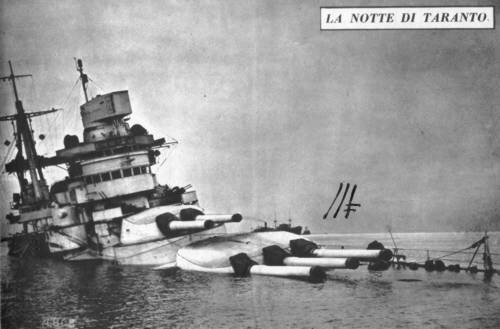
Sunken Italian Battleship

Conte Di Cavour, sunk at its moorings and on the DL for the rest of the war.

The attack changed the war in the Mediterranean; the Italians pulled their surviving ships out of Taranto and moved them farther up the coast to Naples, where their short range made their mission more difficult, and the longer approach made them more vulnerable to British submarines.  They were never really a factor in the war again.

And it changed the rest of the war in even bigger ways.  Because the commander of the Japanese Combined Fleet, Isoruko Yamamoto, had studied in the United States in the mid-twenties.  He was familiar with naval history, including the desirability of sinking your enemy before he could sail to threaten you.  He had read at the very least the reviews of The Great Pacific War, if not the book itself – and in any case, as a Japanese strategist in training, had been noodling about the idea of how to destroy the American fleet at Pearl Harbor (and the British one at Singapore, and the Dutch one at Surabaja) his whole career. 

And the daring torpedo attack seventy years ago tonight at Taranto gave him and his staff an idea…

Chanting Points Memo: Everyone’s Extreme!

Thursday, November 11th, 2010

If A Conservative orders a pizza in the woods, and no liberal is there to hear him, is he still an “extremist?”

Over this past eight years or so, the Minnesota DFL has deprived the word “extremist” of all meaning.

“Blue Man In A Red District” writes about Glenn Gruenhagen, who won a close race in House District 25A over DFL apparatchik Mick McGuire.

Blue, not unpredictably, refers to Gruenhagen as “extreme“. 

But what does that mean?

How extreme is Gruenhagen?
At a statewide school board association meeting Gruenhagen pushed his extremist agenda.
Resolutions:

Let’s run through the list of “extreme” resolutions and their vote totals from the “State School Board Association” – of whom more later:

Stop labeling and drugging students – 2 for; 103 against.  The empowerment of teachers to make sweeping mental health and behavioral judgments with a power that borders on a medical diagnosis – with none of the expertise or experience or judgment required to make those “diagnoses” – has been an unmitigated disaster for a generation of children, especially boys.  Especially mine.  Anyone who voted against that resolution can rot in hell. 

Emphasize rote learning – 2 for; 130 against: Not sure what Blue means by this; he doesn’t favor us with a link to any original context.  Most of us agree “Rote Learning” – regurgitating factoids on command – is a Bad Thing.  But students today are woefully deficient in some just plain basic facts; I learned the multiplication tables by “rote” – as in, endless hours of drills in fourth grade; my kids did not.   Are they better off for having to find a calculator to find that 9 times 7 is 63?

Implement phonics reading – 8 for; 94 against. It seems to work for many kids.  So sue us.

Teach principles of patriotism – 13 for; 88 against.  THE HORROR.  Seriously –  would it kill kids to know that there’s a reason most of the world wants (or wanted, until 2008) to come to the US?  The changes we wrought and the good we brought to this world?  It’d spawn fewer little DFL drones, but other than that, what’d be the problem?

Oh, wait.

Implement abstinence – 7 for; 95 against.  Wouldn’t wanna stop encouraging teenage effing pregnancy, would we?

Separate classes by gender – 16 for; 86 against. Never mind that it works.  There are not a few charter, and even public, programs that get excellent results by separating the genders.  It’s a politically inconvenient truth that boys and girls are differnet.  They learn differently.  Girls are verbal and social; boys, spatial and competitive.  Both genders do better when they learn in environments that play to those strengths.   The only reasons not to separate genders, indeed, are the inconvenience of teaching teachers who came up through the feminized education academy to deal with boys as boys, and the PC imperative.

Teach fallacies of macro evolution – 7 for; 100 against. That’s one of those extreeeeeemly broad subjects where, again, context might be useful.  Does it mean “teach creationism?”  Or does it mean “show them that the scientific method really has nothing to say about philosophy”, and “science still has no idea how life as we know it really originated”?  We dont’ know.  Is it because the original resolution really was the single line “Teach fallacies of macroevolution”, or was it because Blue didn’t bother to favor us with the original context? 

It’d be fun to know.

All children are gifted – 12 for; 89 against.  Again, not sure about specifics.  Clearly, all children are not “gifted”.  But all children have some “gift” or another.  The public schools aren’t interested in “gifts” that go much beyond “sitting on ones seat and doing homework really really well”, other than tolerating a well-regulated interest in music or art or sports.  The kid whose “gift” is mechanics?   Cooking?  Raising his/her siblings while the parents are at work, and doing it really really well?  Not as much.

Blue:

At his best, 14% of school board association members supported his proposals. And this guy is going to get things done for Greater Minnesota?

Looking at the eight “extreme” resolutions, I’d almost respond “I wonder who the real extremists are…”

…until I remember that in Saint Paul, the monolithic politburo that is the Saint Paul School Board probably would have voted a straight ticket against all of those – and most Minnesotans on the street would have supported five or six without breaking a sweat.

If you’re not an EdMinn/SEIU/DFL drone, your mainstream is what they call “extreme”.

Thanks

Thursday, November 11th, 2010

If you’re a Veteran, anyway.

Ritchie: Conflicted?

Thursday, November 11th, 2010

Sheila Kihne at Activist Next Door is after Mark Ritchie now – and she’s not alone:

Our second close statewide election in two years has piqued the interest of renowed researcher and blogger, Trevor Louden, at the New Zeal blogspot. (New Zealand)

The blog post is titled “Mark Ritchie File 1 Conflict of Interest? Minnesota SOS Adjudicated Committee Colleagues’ Election results”

Loudon describes Ritchie’s connections to Wellstone Action (which are pretty well know around these parts) but he points out what should be very obvious: there is a major conflict of interest in serving on the Advisory Board for Wellstone action and being a “non-partisan” overseeing a statewide recount.

For those of you from out of state – “Wellstone Action“, named for the late Senator, is a political action organization dedicated to getting “progressive” organizing and training, to get “progressives” elected.

Ritchie is also backed by the “Secretary of State Project“, a Soros-backed PAC dedicated to getting “progressive” Secretaries of State elected – because Soros and the left’s power and money elite know that the best way to control this nation is to control its election system.

Sheila’s got plans:

This is getting interesting.

I have to hit the library tomorrow for more on Ritchie’s ties to far-left RONGEAD– a French NGO where Mark Ritchie is currently listed as a member of their Steering Committe (and Minnesota’s Secretary of State!!) Hey-Pat Doyle, did you know about RONGEAD in 2006 when you glossed over Ritchie’s coordination with a French NGO to produce United States federal government trade secrets? How about you Sharon Schmickle when you covered this story in the late 80’s when Ritchie was at the MN Dept of Agriculture? Unbelievable.

Pat Doyle, sugarcoating DFLers and cherrypicking stories against Republicans?  Who’da thunk it?

It aint illegal. They know it aint good for ’em. And they don’t give a rip.

Wednesday, November 10th, 2010

I don’t begrudge your choice to smoke cigarettes as long as you:

1) Keep it out of my face.

2) Keep it out of my kids’ face.

3) Quit throwing them out of your god-damned window.

4) Pay your fair share: don’t expect me to pay higher life, disability or health insurance premiums. You should though.

5) Let me bum one off of you once a year or so for old times.

But seriously, if you don’t know smoking is dangerous by now, is it because the government hasn’t done an adequate job of edumacating you?

Apparently the government thinks you’re so damn stupid that the dangers can only be conveyed to you in pictures.

Corpses, cancer patients and diseased lungs are among the images the federal government plans for larger, graphic warning labels that would take up half of each pack of cigarettes sold in the United States.

Whether smokers addicted to nicotine will see them as a reason to quit remains a question.

Sounds like another shovel-ready project to me.

The share of Americans who smoke has fallen dramatically since 1970, from nearly 40 percent to about 20 percent, but the rate has stalled since about 2004. About 46 million adults in the U.S. smoke cigarettes.

In the same period, the average cost per pack has gone from 38 cents to $5.33. Much of those increases are from state and federal taxes.

It’s unclear why declines in smoking have stalled. Some experts have cited tobacco company discounts or lack of funding for programs to discourage smoking or to help smokers quit.

I would submit to you that there are a certain percentage of us that are going to smoke cigarettes.  They like to smoke. It aint illegal. They know it aint good for ’em. And they don’t give a rip.

In the mean time are we to assume the federal government intends to spend more and more of everyone’s tax dollars until there are no smokers left? Maybe we should just let evolution run its course.

Dear Governor Ventura,

Wednesday, November 10th, 2010

Thank you for the one thing you did for us “shocked” Minnesotans: My license tabs used to be $105-195.

Today I paid $360 for a 2008 model car. The tabs are a very cool color – red – for 2011. It’s a shame to stick them on my plates because I paid enough for them to be jewelry. I’m glad the DMV takes Visa because that way I am able to spread out the payments.

I’m sure that money will be well-spent on our awesome Minnesota streets, roads and highways.

I miss you (at the moment). Say hello to Terry.

That is all.

One Day At The Crow Wing County Courthouse

Wednesday, November 10th, 2010

Last week – just before the election – the nation got a look at about twenty minutes of video depicting a group of citizens questioning officials from Crow Wing County – think Brainerd – about an apparent incident of ballot-stuffing.

The video left more questions than it answered.  Who were these people?  What did they see?

The media has touched on the story – and largely asked the really important questions, like “who did the people in the video vote for?”.  We’ll come back to that.

I figured it was time to talk with the actual people involved.

The weekend before election day, Monty Jensen of Brainerd took his girlfriend to the Crow Wing County courthouse to vote in person with an absentee ballot.  He had to take a partial day of vacation to do it; he commutes from Brainerd to the Twin Cities every day to work. His girlfriend commutes with him; she’s in pharmacy school at the U of M in Minneapolis.  “I’m on the road fifteen hours a day”, he points out.  So taking the time out to vote was a bit of an effort.

A little after 4:30 on Friday, October 29, Jensen and his girlfriend walked into the Crow Wing County Courthouse, and went upstairs to the Auditor’s office.  “It was full of people”, Jensen recalls.  They submitted their applications to the auditor, and took a seat to wait their turn to vote. .

“We waited for about fifteen minutes”, Jensen said, “and I noticed there were a lot of people there who seemed to have issues”; they were disabled.  “I didn’t think anything of that”, Jensen added.  

We’ll come back to that later in the story.

There appeared to be a dozen, maybe fifteen handicapped people, and perhaps three supervisors. 

“But what alarmed me”, said Jensen, “was, I’m looking across at a poll booth, and I see a staffer walk over with an individual who’s mentally handicapped, put down ballot w/pen.  The guy walked away from the booth.  She called him back over – you could tell by her body language she was getting impatient, and the guy wouldn’t come back.  So she filled out his ballot.  Then she retrieved hjim, and had him turn in his ballot.”

Jensen continued “So I went “what the hell?”  I couldn’t[ believe she filled out the guy’s ballot!”

“As I’m voting, the woman was 2 booths down with another invividual.  She was talking like he’s a child.  Telling him who he should vote for.  I think “This isn’t right”.   Going right down line, candidate by candidate. I look over – her hand was on the pencil.”  Jensen told me he overheard him instructing the man to vote a straight DFL ticket; “it was DFL candiates – Dayton, Oberstar, Taylor Stevens, Ward, right down the ballot, every candidate.”

Jensen said he asked the woman what she was doing. “She grabbed him, went across the room to other station, and continued filling out the ballot.  I’ve seen her dictate two people’s votes.  My perception is these people [the group of voters] don’t know where they’re at”.

Jensen became concerned.  “I went to counter and asked the county worker – “Is this legal?” 

Jensen stopped for a moment, and pointed out that he knows that it’s perfectly legal for people to help people to vote.  “I’m a disabled veteran.  I support the rights of the disabled”.

But, he added,  “this was more than “assistance”.

He went to a county worker, and asked if she was aware of what was going on.  “She says “Well, yeah””, Jensen continued.  “She seemed nervous. Eventually she said  “You don’t know the half of it.  This is the fourth group we’ve had today”. 

Jensen pointed out that his girlfriend witnessed this statement.  I’ll be talking with her shortly.

Jensen was so upset by this point that he left the courthouse.  “I didn’t really know what to do”. 

That would come later.

More later this week.

Ye Can Take Mah Analogies, But Ye Canna Take Mah Freedom!

Wednesday, November 10th, 2010

John “Not Jon” Stewart, of the official Clan Stewart blog, Night Writer, finds an analogy I wish I’d beaten him to; re-staging Braveheart with Michele Bachmann as William Wallace, and John Boehner and the GOP establishment as Robert the Bruce and the Scots nobles:

In 1297 the central players in an uneasy alliance were William Wallace, the upstart rebel who shocked and demoralized the English with a dramatic victory in the Battle of Stirling Bridge, and Robert Bruce, the scion of a wealthy and politically powerful Scottish family. In 2010, Republican lion and presumptive Speaker of the House John Boehner plays Robert the Bruce to Michelle Bachmann’s Wallace. Bachmann was out-front for the burgeoning Tea Party movement, driving her enemies to distraction and helping spark a historic Republican rout that changes the balance of power in much the same way that Stirling Bridge did. Her decision to now run for a leadership position in the Republican caucus has been greeted coolly by her nobles. I know there are those who will raise an eyebrow or a guffaw at equating Michelle Bachmann with a figure as historically significant as William Wallace but at the heart of the matter there are similarities.

Bachmann is derided by her enemies (both in and outside the Republican party) for being out-spoken, outrageous and deliberately provocative. That’s pretty much how Wallace was presented in Braveheart: coarse, blunt and sometimes appearing to be making it up as he went along. The way the Scottish nobles fought the English in those days is also not too different from the way the Republican leadership has historically contended with the Democrats: a show of force before the battle which merely sets the stage for a parley in the center of the field that ends in negotiation. When Wallace showed up — nearly unwanted — before one battle he was told to hang back and be quiet. When he rode forward to be part of the parley anyway someone asked him what he was doing and his response was “picking a fight.” The passion and taunts of Wallace and his men discomfited the “civilized” combatants who weren’t expecting to be mooned or to be told that their general could bend over and “kiss his own arse.” Similarly, Bachmann and her unwillingness to “play nice” is barely tolerated by the party elite, while the passion and populism of the Tea Party rallies and town halls has shaken the political professionals and pundits who hope it is an aberration and not a new fact of life.

Rrread the whooole thaing, Jimmeh.

The Great Poll Scam, Part II: Polling Minnesota

Wednesday, November 10th, 2010

My interest in the Minnesota Poll as an individual institution started right about the time I started this blog, six or eight years ago.

Now bear in mind that I, Mitch Berg, have made skepticism of the media at least a hobby, if not a fringey living, since 1986.  I have believed that the media needed to be distrusted and then verified for pretty much my entire adult life.

And yet until very recently, I maintained, if not a naive faith in the public opinion polling about elections, at least a detached sense that, somehow or other, they all evened out.   It was the same naivete that we all have about where babies and Christmas presents come from when we’re nine, or how entitlements get paid for when we’re 18 (50 for Minnesota government employees), or how sausage and bacon are made.

Ignorance is, indeed, bliss.

The scales started falling from my eyes when I started reading PowerLine.  Scott Johnson has been keeping his eye of the MNPoll for most of a decade, now; he’s led the pack of Minnesota bloggers in documenting the poll’s abuses.

And in reading the history of conservative criticism of the Minnesota Poll, I started wondering – what is the historical context?

There’s more of it than I’d figured.

———-

The Star Tribune started running public opinion polling of the Minnesota electorate in 1944.  It’s polled Minnesotans over a variety of topics, but the marquee subjects are always the big three elections – State Governor, US Senate and Presidential elections.

Now, if you’ve lived in Minnesota in the past fifty years or so (I go back half of that time – I moved here in ’85), it’s hard to believe that Minnesota used to be a largely Republican state.  Of course, the Republicans we had up until very recently were the type that make the likes of Lori Sturdevant grunt with approval – “progressive” Republicans like Elmer Anderson and Wheelock Whitney and the like.

I bring this up to note that while the various parties have changed – Republicans used to be “progressive”, Democrats used to be “America First” – that Minnesota party politics for the past 66 years have been a little more evenly-matched than current political consciousness – shaped as its been by Humphrey and Mondale and “Minnesota Miracle” and Wellstone and Carlson – might make you believe.

Now, if you look at the Minnesota Poll’s statistics for the past 66 years – going back to the 1944 elections, for Governor, Senator and President – the Minnesota Poll is actually fairly even.  In that time, Republicans have gotten an average of 46.85 percent of the vote for all those offices, to 49.37% for DFLers.  During that time, the Minnesota Poll’s “election eve” predictions have averaged 44.1% for Republicans, and 46.77% for Democrats.  That means that over history, the big final Minnesota Poll has shown Republicans doing 2.75 points worse than they turned out, with DFLers coming in 2.59 points worse than they finally turned out.  The results have tended to be, over the course of 66 years, infinitesimally more accurate – .16% – for Democrats.  It’s insignificant, truly.

Indeed, when you go through the numbers from the forties and the fifties, you can see some blogger back in 1958 decrying two things – the lack of an internet to blog on, and a serious pro-Republican bias in the Minnesota poll; in polls run before 1960, the Minnesota poll predicted Republicans would get 51.58, while GOP candidates for the big three offices actually got 50.32% of the vote – the poll overestimated Republicans by an average of 1.26%.  The DFL got an average of 49.73% of the vote during those years, while the Minnesota Poll had them at an average of 43.51% –  which is 6.22% lower than they actually turned out doing (although this number gets inflated by a truly horrible performance in the 1948 Gubernatorial election, where the MNPoll had John Halstead at 25% in their pre-election poll; he ended up losing, but with 45%. That had to be frustrating).  In all, before 1960, the Strib “Minnesota Poll”‘s pre-election poll overestimated the GOP’s performance compared to the DFL’s in 76% of elections; the poll’s overestimates favored the GOP by an average of almost 7.5%.

By the mid-sixties, of course, Minnesota politics changed drastically; by the middle of the decade, the golden age of “progressive” politics and the DFL, led by the likes of Hubert H. Humphrey and Walter Mondale for the DFL, and Elmer Anderson for the GOP, left Minnesota a very different state.  During those years – from about 1966, after Barry Goldwater re-introduced a partisan divide to national politics for the first time, really, since the war – the DFL won the average vote 50.97 to 46.61.  The Minnesota Poll predicted DFL victories, on average, of 49.62 to 42.79; they underreported the final support for Republicans by an average of 3.83%, and DFLers by 1.35%, an average skew of almost 2.5% in favor of the DFL.

But if you look at the actual elections covered in those years – from 1966 to 1990, the “Golden Age of the DFL” – of the 21 contests for President, Governor and Senator, the Minnesota Poll showed the Democrat doing better than they turned out doing by a greater margin than the Republican in 13 of the elections, and inflating the GOP candidates results in eight.  The 1980 Presidential election skewed things a bit – the MNPoll underestimated Jimmy Carter’s performance by 12.5% (Carter got 46.5%, while the MNPoll predicted 34%; it also overestimated Reagan’s performance by a little over a point, leading to one of the biggest pro-Republican skews in the recent history of the Minnesota Poll).

Overall, for the entire history of the Minnesota Poll from 1944 to 1986, the Minnesota Poll showed the public voting, on election eve, for the DFL by a 48.25% to 46.34% average margin; the actual elections favored the DFL to 51.10 47.81; the poll underpolled Republicans by a 1.47% average, and Democrats by an average of 2.85%.  Of the 41 total contests in that time, the DFL was overestimated by a greater margin than the GOP in 44% of the polls – again, not a really significant number.

In other words, the poll’s statistical vicissitudes were fairly balanced through its first 42 years.

But in 1987, the Strib hired Rob Daves to run the Minnesota Poll.

And things would change.

———-

The series so far:

Monday, 11/8: Introduction.

Wednesday, 11/10: Polling Minnesota – The sixty-six year history of the Strib’s Minnesota Poll. It offers some surprises.

Friday, 11/12: Daves, Goliath:  Rob Daves ran the Minnesota Poll from 1987 ’til 2007.  And the statistics during that era have a certain…consistency?

Monday, 11/15: Hubert, You Magnificent Bastard, I Read Your Numbers!:  The Humphrey Institute has been polling Minnesota for six years, now.  And the results are…interesting.

Wednesday, 11/17: Close Shaves: Close races are the most interesting.  For everyone.  Including you, if you’re reading this series.

Friday, 11/19: The Hay They Make: So what does the media and the Twin Cities political establishment do with these numbers?

Monday, 11/22: A Million’s A Crowd:  Attention, statisticians:  Raw data!  Suitable for cloudsourcing!

MN Poll Result: 42.79 Elecction Result;: 46.61 Difference: -3.83   MN Poll Result: 49.62 Elecction Result;: 50.97 Difference: -1.35   Total/Lean DFL 21.00 13.00 0.62 Average Skew: 2.48

A Class Act Even Now

Tuesday, November 9th, 2010

Former President Bush waxes transparently, assessing his own presidential shortcomings:

The former president said he still feels “sick about” the fact no weapons of mass destruction were found in Iraq. His response to Hurricane Katrina could have been quicker, he said, and he should have landed Air Force One two days after the storm instead of viewing the destruction through the plane’s window. And he said he didn’t see the financial meltdown coming.

Why?

Why?!

Why?!!!!

Why…Mr. President, did you have to do this on Oprah?

PS Don’t feel bad Mr. President. Warren Buffet and a the vast majority of the world of finance didn’t see it coming either.

Bush had nothing negative to say about President Barack Obama, whom Winfrey famously supported in 2008.

“I didn’t like it when people criticized me,” Bush said. “And so you’re not going to see me out there chirping away (at Obama). And I want our president to succeed. I love our country.”

George Bush may not have been conservative enough for many of us, but I believe he was honest in his dealings as President and he remains to this day one of the most respectable, reverent and selfless leaders to have ever occupied the White House.

…in stark contrast with The One there now.

Erosion

Tuesday, November 9th, 2010

Did you ever wonder why Big Gay spent so much time and effort trying to demonize Target for donating to pro-business (ergo pro-Republican) PACs? 

Well, it certainly wasn’t because, as they claimed, Target was “anti-gay”; even in religiously-“progressive” Minneapolis’s business community, Target has stood out for decades in its support for “progressive” ideals; it’s been one of those “good corporate citizens” that the left always barbers about wanting companies to be.

Partly, of course, was that it didn’t want Twin Cities companies to get the impression that they’re allowed to leave the DFL reservation.  Dictators know you have to keep the peasants in line lest they get uppity.

But at least partly it must be due to the fact that Democratic hold on gay voters juuust might be slipping away from the left:

Gay men, lesbians and bisexuals who self-identified to exit pollsters made up 3 percent of those casting ballots in House races on Tuesday, and 31 percent of them voted Republican. By itself, that number is amazing, especially when you consider that way too many people think being gay and voting Democratic are one in the same. But that percentage is ominous news for a White House viewed with suspicion by many gay men and lesbians, because that’s four percentage points higher than the change election of 2008.

Self-identified gays have been slowly sidling up to the GOP for a while now. In the 2008 presidential race, they made up four percent of the vote and gave 27 percent of their votes to Sen. John McCain (R-Ariz.) against then-Sen. Barack Obama. In the 2006 midterm elections, when the House and Senate flipped to Democratic control, gays made up three percent of the electorate with the Republicans snagging 24 percent of their ballots. And in the 2004 presidential elections, President George W. Bush got 23 percent of the gay vote. They comprised four percent of those polled.

There’s no point in embroidering the fact that one wing of conservatism – the southern, social variety – isn’t especially pro-gay.  The other two wings are much more live-and-let-live about social issues – either through culture or libertarian bent.  

Either way – the idea that gays are finding increasing traction with the conservative message, even despite the inhopitability of one wing of the movement, has got to have Big Gay scared out of its mind:

Jimmy LaSalvia, Executive Director of the gay conservative group GOProud, is heralding the uptick in votes from gay men, lesbians and bisexuals for Republicans.

“The gay left would have you believe that gay conservatives don’t exist. Now we see that almost a third of self-identified gay voters cast ballots for Republican candidates for Congress in this year’s midterm,” continued LaSalvia. “This should be a wake-up call for the out-of-touch so-called leadership of Gay, Inc. in Washington, D.C., which has become little more than a subsidiary of the Democrat Party.”

It’s an exit poll, of course, with a large margin of error.  But those polls have been creeping upward, margins and all, for most of a decade.

By Any Means Necessary

Tuesday, November 9th, 2010

I got this email.  The author asked to remain anonymous:

Mitch, in 2008 my mentally incompetent mother at an assisted living facility in St. Paul probably voted. We never had her declared incompetent, but the staff knew she was completely out of it. They also knew she was so afraid of being kicked out of a place she liked she would do whatever the staff person told her to do. She literally didn’t know what day of the week it was let alone who was running for office. I was the responsible party. I never changed her voter registration when she moved. Somehow she registered to vote at her new address. I found absentee ballot application information in her apartment as well as an I Voted sticker on her walker. I was livid, but it was after the election so there was nothing I could do. Before senile dementia had set in she adored Norm Coleman but you can bet her vote went to Franken.

I suspect a lot of this goes on. After all, SEIU represents a lot of nursing home staff.

I have a hunch this state could keep an army of investigators busy.

It might be a good Obama “shovel-ready” project.

Pay No Attention To The Scandal Behind The Curtain

Tuesday, November 9th, 2010

A Democrat-linked student group is accused of wholesale vouching of voters:

Members of Students Organizing for America, a group of students aligned with the Democratic Party, may face a criminal investigation and possible felony charges after confrontations with an election judge over voter vouching during Tuesday’s election.

Ginny Gelms, the interim elections director in Minneapolis, said she will submit a report to the Hennepin County attorney’s office and the Minnesota Secretary of State‘s office today. The offices will investigate a possible incident of improper vouching.

Gelms said she was told by the University Lutheran Church precinct’s chair election judge there were two incidents of individuals trying to vouch for people they did not personally know.

Read the whole thing.

And keep telling yourself “Minnesota has the best, fairest, most transparent electoral system in the country!”

--> Site Meter -->