Archive for the 'History And Its Making' Category

The Sherman

Monday, April 18th, 2011

It was seventy years ago today that the US Army selected the “T6 Medium Tank” for production as the standard “medium” tank for the United States Army.
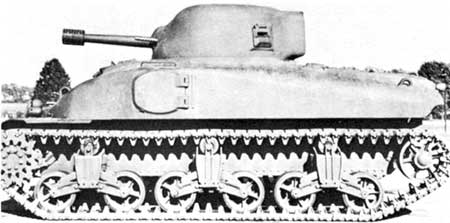
The T6 - the first of over 50,000 "Sherman" tanks.

The process of standardization led to the Army’s procurement bureaucracy to give it an “M” designation- “M4”, in this case.  The Army’s public relations bureaucracy also supplied the tank a name – a custom that had started with British usage the previous summer in the Western Desert, where they named US-built M3 Light tanks the “General Stuart”, after the Civil-War-era Confederate cavalryman, a bit of PR to win American hearts and minds to the British cause that came, at least in part, from Winston Churchill’s desk.

They chose “General Sherman”.

And so the vehicle that would serve as the standard tank for the US Army and Marine Corps – and the British, Canadian, Free French, Free Polish, Indian, Nationalist Chinese and part of the Soviet armies – throughout World War 2 and into the Korean Conflict, entered the American lexicon.

And it showed, literally and figuratively, some of the nagging weaknesses as well as overwhelming strengths of the American war effort for the war that, for the US, was still eight months away.

To call something as tough, as subtle, as powerful or as nuanced “as a Sherman tank” is a metaphor that’s passing from common American usage, as the generation that drove them or grew up with those who did drive them ages out of the prime simile-generating years – but for the first forty-odd years after World War 2, the metaphor was pretty well understood.

And a little misplaced.

Designing any military vehicle, from a ship to a jeep to a fighter jet, is a matter of reconciling three key mutually-exclusive factors; mobility, firepower and survivability (at any given technological level), along with some minor factors (cargo space, habitability, ease of maintenance and so on).    For example – it’s a simple matter to build a tank that can go 80mph.  But can it carry a gun?  Or enough armor to make it survive a hit from an enemy tank?  And can you imagine the maintenance nightmares taking care of the engine and suspension capable of that kind of performance?

Likewise, it’s theoretically easy to build a tank that can’t be killed – build a thick armored shell!  But can it actually move in such a manner as to threaten the enemy?  If not, you have basically a semi-mobile bunker.  And if it can move, how big will it have to be to hold a powerful-enough engine, plus the fuel, plus the crew – and some kind of weapon to boot?

The Sherman was a reflection of how that compromise was made in the US in 1941 , and of a vision that, arguably, went very very wrong.

The United States Army was, arguably, one of the most conservative armies in the world by the 1930’s.  Since the Civil War, its primary experience had been fighting Indian tribes and Philipino insurgents and,briefly, the Spanish and for about a year and  a half, a frantic bout of modern industralized war in France during World War I.

When the tank was invented in the last few years of World War I, it was a revolutionary bit of technology, dropped into the most conservative institutions on earth – the world’s various militaries, most of which had absorbed a century’s worth of technological change since 1815 but which in terms of organization and tactical doctrine were not that much different in 1914, or even 1918, than they’d been at Waterloo in 1815.  Every army, in 1920 as in 1815,  had three branches; Infantry, Cavalry and Artillery.  Thus it had always been.  And most of the world’s armies, being conservative, tried to fit the new technology of the tank into the old idiom of the three-branch Army.

And so by the mid-thirties, most armies built two types of tanks; the slow, well-armored “Infantry Tank”, designed to accompany and support troops as they advanced at the speed of the human leg; tanks like the French Char B and British Matilda…

The French Char B

The British Matilda tank, fighting in Libya 70 years ago

…and variations on the “Cavalry Tank” – fast, lightly armed and armored, built to do what the horse cavalry had always done, scouting and raiding and, when the infantry and tanks blasted a hole in the enemy’s front line, dashing through and wreaking havoc among the enemy’s headquarters and supply lines – tanks like the British Mark VI and the French Somua…

British Mark VI Tank

French Somua Cavalry tank - arguably the best tank in the world in 1940 although plagued with the same sort of mechanical trouble that plague all French automotive products to this day.

The United States did the same – indeed, due to the deep divisions between branches, the Army decreed that in the United States, a “tank” served the infantry, and the cavalry used “Combat Cars” – basically, lighter, faster tanks.

US M1 Combat Car - a cavalry "tank" armed with machine guns. It looks like an antique; it's a contemporary of all the tanks above.

Indeed, the US Army in 1940 still had more cavalry on horses than on tracks:

US Cavalry on maneuvers. In 1940

The only exception?  Germany – which had been barred by the Versailles treaty from having tanks at all.  With no ancient military traditions to honor, the Germans started from scratch – by adapting the writings of British military theorist Basil Liddell-Hart…

Basil Liddell-Hart

…who advocated using masses of tanks as a huge armored fist supported by motorized infantry, aircraft and mobile artillery to blast through the enemy lines and strike straight for the enemy’s vitals in a decisive burst of armored fury.  It was a theory that dominated warfare from 1939 through the invasion of Iraq in 2003 – but it was the Germans called it Blitzkrieg. And  they, via his enthusiastic German disciples Guderian and Rommel, would make Basil Liddell-Hart the father of modern warfare.

And since the Germans had no backwash of Napoleonic or Great Plains Indian-fighting  tradition to protect, they started from scratch, building a generation of one-size-fits-all tanks; tanks whose job was neither to support infantry nor to scout the enemy, but simply to break through and wreak havoc.

The German Panzerkampfwagen III tank - the anscestor of the "Tiger" tanks we'll meet later in the story.

Like most theories, it remained an intellectual exercise – until the ten-month stretch in 1939-1940 between the invasion of Poland and the fall of France.  Militaries around the world realized the World-War-I-era calculus was out of date.

And America looked at developments – strategic and technical – in Europe, and realized that not only was their technology a suicidal decade out of date, but their tactical doctrine, which had changed little since the Civil War, was even worse.

And so the Army’s theorists reacted with, by military standards, blazing speed.  They recognized that there’d been a revolution in how wars were fought, and that it needed to be met by revolutionary means.

And they – led by General Leslie McNair, an artilleryman who’d read Liddell-Hart, and developed his own set of theories – went to work.

Lesley McNair

A group of officers led by McNair concocted a revolutionary series of changes in America’s tactical doctrine.  They reorganized the US Army, on the fly, into a whole new force:

  • The Infantry and Artillery would continue to blast holes through the enemy lines – with an aim toward releasing…
  • …the new Armored Force, which would drive through that gap and hurtle cross-country toward the enemy’s headquarters, capitols, supply dumps – strenuously avoiding tank-vs.-tank combat, to be left to…
  • …the newly-formed Tank Destroyer branch – armed with towed and self-propelled anti-tank guns called “Tank Destroyers”.

An early Tank Destroyer - basically a lightly armored half-track with a WWI-vintage cannon.

An M10 Tank Destroyer, later in the war. It looks like a tank, but its armor is only heavy enough to ward off bullets and shell fragments, not tank/antitank shells.

The theory – the tanks would be armed and armored to fight enemy infantry and rear-area troops.  The tank destroyers, being fast (because of their thin armor) would keep the enemy’s tanks at bay.

So the Sherman had about 2.5 inches of armor in front (where it needs to be the heaviest, provided that it’s facing the enemy, like it’s supposed to) and a low-velocity 75mm gun, designed for blooping high-explosive and smoke rounds at enemy infantry (the lower velocity meant devoting less of the shell to structural strength and more to explosives), and not as good for shredding enemy armor as a higher-velocity gun.

And it was with the Sherman and the tank destroyers that the US went to war.

Not all revolutions work out well.

(It wasn’t McNair’s only idea that turned out badly for the US serviceman; the General remains one of the most controversial leaders of the period.  We’ll revisit McNair in a few years).

———-

The Sherman went into action with the British Army in 1942, at the battle of El Alamein.
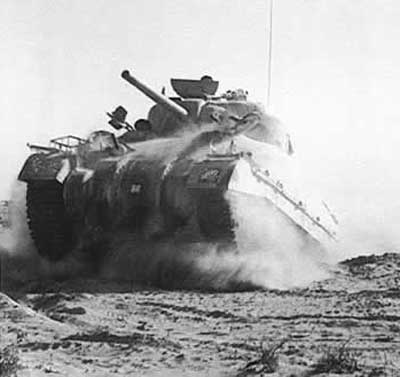
A Brit Sherman in the Western Desert

It was a huge success; its gun, facing some of the older German tanks that were vulnerable to its short-barreled gun, performed well.

More importantly, the tank – which adopted forty years of American automotive experience – was phenomenally reliable, for a tank.  Especially compared to their British counterparts; British tanks were even less reliable than Brit cars; some British tanks had an average of under 20 miles between major breakdowns.

So the US Army went into D-Day feeling pretty good about its main mount.

But the German Army, in the two years between El Alamein and D-Day, had been fighting a whole different war.  The Russians, with virtually their entire early-war tank force destroyed by the Germans, had deployed a new, even more revolutionary tank – the T34:

The Soviet T34 Tank

The T34 was unbelievably crude by German standards – ideal for use by hastily trained peasant soldiers to learn and maintain (as well as for rough, unsophisticated factories, some of them working in the open air, to build); it wasn’t “reliable” in the same sense that the Sherman was.  But it had a powerful gun,  and its armor was steeply sloped, making all hits into glancing blows, multiplying the effective thickness of the armor plating.  And it had an American-designed suspension that allowed it to be blazingly fast by tank standards.  It caught the Germans by surprise, shredding their Mark III and Mark IV tanks’ armor, and outmaneuvering them as well.

The Germans responded by developing a new generation of tanks – the “Tiger”…:

The PzKw VI "Tiger" heavy tank

…which looked like a traditional German tank, only much bigger, with a four-inch-thick hide and an 88mm gun – the legendary “Eighty-Eight”, a converted anti-aircraft gun – which could easily punch through even the T34’s sloped armor at long range, and the Panther…:

The Mark V Panther

…which was a direct response to the T34; fast, with thick, sloped armor, and a very long, very high-velocity 75mm antitank gun that could tackle the T34 at vastly better than even odds.

And it was these tanks – and upgraded versions of their older ones, with thicker armor and more powerful guns, that the Sherman met in Normandy after D-Day.

And as the Sherman and the rest of the Army slogged its way across Normandy – a two-month bloodbath – it became clear that the pre-war theory was drastically wrong.   The German tanks were not lining up as obliging targets for the Tank Destroyers.   The Infantry couldn’t break through and give the tanks the clean break they needed to make the dash they were designed for.

And so the Sherman found itself fighting German tanks, and anti-tank guns, that had been built to fight the T34 – and it was found grossly wanting.
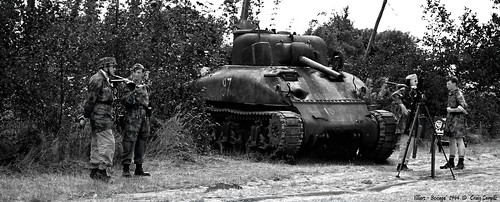
A Sherman, knocked out in Normandy

The armor, utterly adequate against the early-war German guns, was too thin against the new generation of German tank and antitank artiller; the Panther’s long 75mm gun and the Tiger’s 88 could punch through the Sherman’s armor at any practical range.  The Sherman’s gun could not penetrate the frontal armor of either enemy tank much beyond 500 yards, if at all.

Sherman in British service, destroyed by a German anti-tank gun in Italy.

Worse?  The design of the Sherman’s ammunition stowage – racks of round slots to hold the cannon’s shells, stacked up along the inside of the tank’s hull, above the tracks and next to the turret – was extremely likely to lead to catastrophic ammunition fires if a German shell penetrated the armor.  And when the ammo went up, it turned the tank in seconds into a swirling inferno of sequenced explosions from which the crew rarely escaped alive.  To a lesser extent, the decision to power the Sherman with gasoline engines rather than the less flammable diesel ones led to catastrophic fuel fires if German shells penetrated the gas tanks – a reason that most tanks are diesel-powered today.
A Sherman's ammunition begins to explode

The Army developed a grim bit of math; it banked on losing five Shermans for every knocked out German tank.

Between all of those factors, the Sherman developed a bad reputation.  British tankers called it the “Ronson”, after the cigarette lighter that “lights up on the first try every time”.  Polish soldiers in exile called it the “Rolling Coffin”. Germans called it “Tommy Cooker” – “Tommy” being the slang term for British soldier.

The life expectancy of an Allied tanker in a Sherman wasn’t all that good.

———-

The Sherman had one other key advantage.  It was built in the US, at the peak of its manufacturing power in relation to the rest of the world.

American industry produced something like 50,000 Shermans in all its variants.

Tracks installed on a Sherman at a Chrysler plant in Detroit

So while the math said we’d lose five Shermans for every German tank, we hit them with ten or fifteen of them.

It left enough tanks to supply US needs, and equip most of the British, Australian, Indian and Canadian and Chinese armies, and the Free French and Free Polish armies, with some left over for the Soviets as well.

A Sherman of the Polish Army in Exile, in Italy.

Shermans fought in every theater of the war.

———-

But in August of 1944, the US broke through the German lines at Saint Lo.  “Operation Cobra” unleashed Patton’s Shermans to blaze across France, showcasing its strengths – its reliability and endurance.  Patton noted that had he been equipped with British or German tanks, he’d have been bogged down with mechanical problems.

The Sherman?  It just kept rolling:
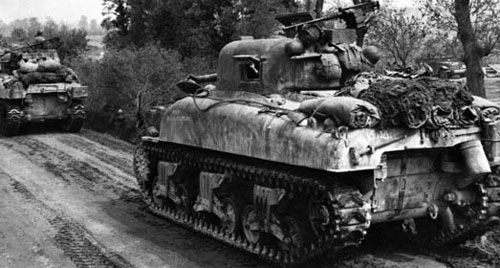
Shermans gobbling up the miles in France

The Sherman was designed to run with engines – repurposed aircraft and bus engines – that were similar to commercial engines that many American troops had been working on for years.  It was built for relatively easy maintenance and efficient manufacture.

So when a US tank company lost five Shermans killing a Tiger, there were five more in action the next day.  And the day after that.

The Sherman’s reliability was legendary, especially compared with the temperamental German designs.  It was said a company of 17 Shermans could count on arriving in action with 16 or 17 tanks in mechanical order to fight.  A company of 14 Tigers or Panthers might get into action at half strength, with the rest back in the repair depot (at best; by D-Day, allied air superiority meant that company would also lose a couple of tanks on the road, or on the railroad tracks that hauled the cranky German tanks any distance).

But when the Sherman ran into serious opposition, it usually meant at least a few blazing tanks and broken GIs.

There were attempts made to upgrade the Sherman.  There were up-armored, up-gunned versions, culmnating in the M4A4E8 – the “Easy Eight” – with more, steeper-sloped armor, a more-powerful 76mm gun, and which stowed the ammunition in racks surrounded by water, down on the tank’s floor, which cut the rate of explosions dramatically, improving survivability.  Earlier Shermans had as much as an 80% chance of catching fire when the armor was penetrated; with an Easy Eight, it was under a quarter.
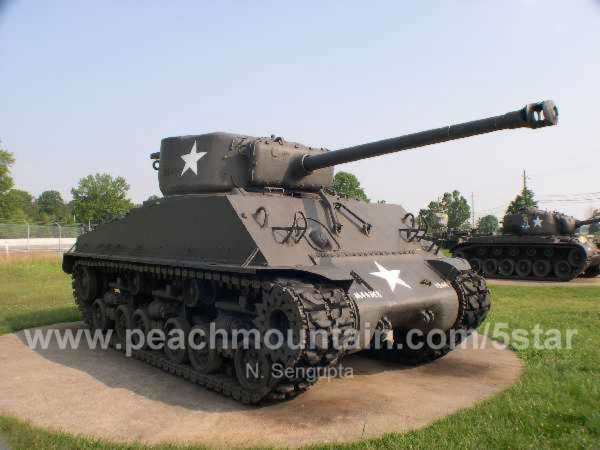
An "Easy Eight" at a museum. Note the longer, higher-velocity gun, better able to tackle German tanks - although still not nearly good enough.

The British added a very-high-velocity anti-tank gun, the “Seventeen-Pounder”, to the Sherman – the gun was actually too big for the turret, requiring them to move most of the turret’s contents, like the radio, into a box behind the turret:

A British "Firefly" Sherman liberates a piece of Holland.

The adaptation, the “Firefly”, could kill Tigers and Panthers at the same ranges they could kill Shermans.  But its long barrel, in relation to the rest of the Shermans of the day, made it a prime target for German gunners.

The Brits offered the Firefly to the Americans.  We turned it down.  It didn’t fit General McNair’s doctrine.

But American tankers also learned how to use the Sherman’s strengths – speed, turret that could turn three times as fast as the turrets on German tanks – to its advantage.  One US Sherman unit – the 8th Tank Battalion of Patton’s Fourth Armored Division – caught a German Panther unit from the flank and killed 23 of the superior German tanks, with very light losses.  The preferred tactic; keep a “White Phosphorus” smoke round in the chamber to fire at a German tank.  The smoke round had no chance of killing the German tank from the front – but then, either did the regular round.  But it did blind the German tank/s, hopefully long enough for the Sherman to maneuver around to the side of the German tank, where the armor was much thinner.  It didn’t always work -but it gave a well-trained, experinced crew a shot at surviving and winning a face-to-face battle with a German tank.

And America’s greatest tank ace, Lafayette Pool who, with his gunner Willis Oiler, destroyed over 200 German tanks, personnel carriers, assault guns, and other vehicles, including a few “impossible” shots, killing Panthers with a Sherman at ranges up to a mile.

Napoleon Poole and his tank, "In The Mood".

But the fact remained that for many thousands of GIs, the Sherman was a death trap.

——–

For all its faults, the Sherman story didn’t end in 1945.  The Easy Eight version remained the mainstay of the US armored force in the Korean War, where was better able to operate in the primitive conditions than the later, more  modern but more temperamental American tanks.

An "Easy Eight", along the Han River in Korea.

It bested the North Koreans’ T34s in the rare tank-to-tank actions – due more to experience, training and coordination than to merely technical merit.

And in the 1950’s the Israelis – short on funds and friends but long on ingenuity – refitted a group of surplus Shermans with French-built high-velocity guns.

An Israeli "Super Sherman"

Israeli Super Shermans served on the front lines in the 1956 and 1967 wars; the updated weapons and excellent handling by their Israeli crews allowed them to clobber Egyptian, Syrian, Jordanian and Iraqi tanks built ten years and a technological generation later.

They also served – on both sides – in the Indo-Pakistani wars, where they fared rather less well:

Pakistani Sherman, knocked out in action against Indian forces, in the 1965 war. Note the three shell holes. That was one badass Indian gunner.

The Sherman served into the eighties and even the nineties in Nicaragua, Yugoslavia, and – in combat – in the pro-Israeli Lebanese Falange militia.

The Sherman was a tank.  And a metaphor, in many ways, for the best and worst aspects of America’s industrial, doctrinal and bureaucratic approach to the war.

Special Forces

Friday, March 4th, 2011

From the dawn of the nation-state until the confluence of the age of Napoleon and the industrial revolution, warfare was largely a matter of professionals duking it out with other professionals (or natives).

There were exceptions, of course; the American Revolution involved a citizen militia (initially) battling a professional army supported by Loyalist militias.

Napoleon changed all that, conquering most of Europe with an army of draftees (backstopped by his Old Guard and New Guard – like most tyrants from the Caesars to Gaddafi, he kept a special elite as his backup, jujst in case).  The Civil War set the pattern for the other big wars of the following hundred years; mass armies (usually draftees or “national service” men), supported by a mobilization of an industrialized society.  The Franco-Prussian War, World War I and World War II followed the same model – as, in fact, did the Cold War, although the main event of that war never got underway.  Thank God.

But in 1941, Britain’s big, industrialized military was on the ropes.  It had stood off Germany’s invasion attempt the previous summer – barely – but it had left almost all of its best equipment – modern artillery, virtually all of its tanks (that weren’t in North Africa), even its machine guns – on the beaches at Dunkirk the previous June.   British industry was working frantically to replace it – and was buying equipment in the US to help fill the gaps, which would become a big story in coming months.

But in the interim, the gap in the Home Islands was filled by an amazing grab-bag of stopgaps – including arming “Home Guard” men (sort of the British version of the well-regulated militia – civilians who patrolled beaches and landing grounds and such) with everything from quail guns to pikes.

But Churchill wanted to start striking back.  He knew that re-taking the continent in force was out of the question until the Army was re-armed (and, likely, until the US got into the war in a substantial way), so his only real means to hit back at the moment was through a bombing campaign (which was undergoing terrible teething pains), through harrying German coastal shipping with air raids, submarines and torpedo boat attacks…

…and through an idea Churchill had been nursing since his days reporting on the British Army during the Boer War, forty years before in South Africa. There, he’d been impressed by the “Boer” (literally ,Afrikaans for “Farmer”, but used to refer to all Dutch-descended South Africans at the time) troops, citizen militias full of expert marksmen on horseback, loosely organized into groups called “Kommandos” (Afrikaans for “commands”) whose pinprick, hit-and-run raiding so vexed the Brits during that dismal little war.

And so in the aftermath of Dunkirk, Churchill hatched the notion of small groups of highly-trained professionals, who would carry out devastating hit-and-run surprise attacks on German and Italian territory, and christened the new units “Commandos”.

There was no problem getting volunteers; the recruiters for the new units spent the first weeks of the rigorous training, in the craggy, damp, inhospitable Scots Highlands near the town of Achnacarry weeding down the pool of would-be Commandos to the best of the best; men not only adept at infantry fieldcraft and marksmanship, but with the special inner toughness of someone who’ll die before he leaves a job undone.

Commandos on an endurance course cross a creek near Achnacarry

Churchill pushed the idea – but it met considerable resistance from the regular military, who resisted having not only many of their best men, but stocks of scarce equipment and training grounds, absorbed into the new units.  The bureaucratic scuffling carried on through the winter…

More training

…but finally, seventy years ago today, the Commandos got their first workout.   Boarding two fast transports, with an escort of five Brit destroyers, two “Commandos” – British parlance for commando battalions – sailed for the Lofoten Islands, well above the arctic circle off the Norwegian coast near Narvik.  The target – a fish oil factory (German explosive manufacturing used fish oil as part of its process).  The bigger target – a PR victory, showing the world that the Empire could strike back, and showing the British military that the Commandos were for real.

The operation was codenamed “Claymore” The ground commander was Lord Lovat – who would become a legend on D-Day.  But we’ll come back to that in a couple of years.

Landing in the early morning of March 4, 1941, the Commandos achieved complete surprise, and the mission was a complete success.   They destroyed 11 German-held fish oil plants and 800,000 gallons of fish oil, sank five German trawlers and factory ships, and captured the entire 225-man German garrison along with 60 Norwegian Quisling soldiers.  They also brought back 300-odd volunteers for the Norwegian forces in exile.  The only casualty?  A Commando officer who’d shot himself in the leg.

Oil tanks blaze as the Brits withdraw.

One victory was kept very hush-hush, of course.  The Commandos retrieved from one of the German ships a set of rotors from the “Engima” code machine, helping supercharge the hyper-secret process of breaking the “Enigma” code.  Of this, much more soon.

The military victory was small; the PR victory was immense.  The Germans up and down the Atlantic coaast became conscious of the fact that they weren’t safe on the continent (several other raids – by no means always as successful or with casualties so light) followed), causing them to expend a lot of time and manpower guarding against the chance of more such raids.

It was effective in the US as well; as the US was starting to mobilize an immense draftee military, some officers – facing even stiffer bureaucratic resistance than in the UK – eyed the performance of the Commandos, and started pondering the idea of similar units, which led directly to the creation of the first US “Ranger” units after the US entered the war; they trained, initially, alongside the Brits at Achnacarry, on their way to their epic, defining battle at Point Du Hoc on D-Day.  And, thence, to the Airborne Rangers and British Marine Commandos that’ve carried on so much of the War on Terror.

But, again, we’ll return to that.

The Last Doughboy

Tuesday, March 1st, 2011

Frank Buckles – the last surviving American veteran of World War I – has rejoined the rest of his comrades.  He passed away yesterday, age 110.

Buckles, who also survived being a civilian POW in the Philippines in World War II, died peacefully of natural causes early Sunday at his home in Charles Town [West Virginia], biographer and family spokesman David DeJonge said in a statement. Buckles turned 110 on Feb. 1 and had been advocating for a national memorial honoring veterans of World War I in Washington, D.C.

There are two known WWI survivors left in the world; an Australian man and a British woman, 109 and 110 respectively.

Buckles in 1917 and 2007 - via NBC

Buckled certainly had an action-packed life:

Buckles served in England and France, working mainly as a driver and a warehouse clerk. The fact he did not see combat didn’t diminish his service, he said: “Didn’t I make every effort?”

An eager student of culture and language, he used his off-duty hours to learn German, visit cathedrals, museums and tombs, and bicycle in the French countryside…

…In 1941, while on business in the Philippines, Buckles was captured by the Japanese. He spent 3½ years in prison camps.

“I was never actually looking for adventure,” Buckles once said. “It just came to me.”

I’d often wondered; what must it be like to be the last of…any group, much less a group of nearly five million?

“I knew there’d be only one (survivor) someday. I didn’t think it would be me,” he was quoted as saying in recent years.

RIP, Frank Buckles.

Mobilization

Thursday, February 10th, 2011

It was on a brutally cold February 10, in the middle of a long, cold prairie winter, seventy years ago today that the 164th Infantry Regiment – the largest part of the North Dakota National Guard – was activated by Franklin D. Roosevelt.

There, they joined – for a time – the 34th Infantry Division, which would become known as the “Red Bulls” later in the war, with troops from Minnesota and Iowa.   That didn’t last long; being at a higher state of readiness than the rest of the Division, they were detached from the 34th in early 1942 and packed off to defend New Caledonia from a possible Japanese invasion; the 34th fought in North Africa, and with great distinction in the brutal campaign in Italy, while the 164th would spend the entire war in the South Pacific.

More on that next year.

The 164th Infantry was not the first National Guard regiment to be mobilized; it would not be the last.  It was just one of the most visible signs, here in the upper Midwest, of a term that has little meaning to people today, but was a life or death matter to young men of the era – “mobilization”.

Today, warfare has a lot more in common with the way war was practiced in Europe in the 17th and 18th centuries; relatively small, elite armies of volunteers – professional soldiers (and sailors and airmen and Marines, naturally) for whom warfare is a job, a career, a calling.  Since the end of Vietnam, and especially the end of the Cold War, that ancient ethos has quietly re-established itself (making a convoluted exception for the American “Militia” tradition, via the highly-professionalized National Guard).

Maryland National Guard airmen in 1940 - back when the Air Force was part of the Army

But Napoleon introduced to Europe the idea of levying huge masses of conscripts, trained in the absolute basics (load, fire and stab on command and, above all, do not run away on pain of savage, ritualized death) and sent en masse to overwhelm the small, elite professional armies across the rest of the Continent.

English cartoon pillorying Napoleon's conscription program

The American Civil War added the full weight and might of a first-world industry to the mix; the Franco-Prussian War of 1870 tacked on the management principles of of enrolling the entire nation’s manpower and harnessing them toward the strategic goal; World War I rolled the whole idea of “Total Warfare”, with nation’s entire populations, economies and beings focused on the war, and targeted in turn, into one cohesive whole.

A Union army supply depot. The Union was able to move supplies to its troops in a way no army had ever managed before; it was the first war where the logicistician was as important as the front-line general.

And so the idea of “mobilization” was a term fraught with significance throughout the US, and every major country in the world.  It meant much more than calling up the reserves.  It means setting into motion the harnessing of the nation’s entire economy toward total warfare; starting to convert, or build from scratch, the industrial capacity needed to support the expansion of a military from under 300,000 men to millions; to not only build the rifles for the Army to carry, but their cannon and tanks, and the ammunition to shoot from them, and the fuel to move the men and the equipment around, and the food to feed them at home and in the field, and the trucks and trains to carry all the men and supplies hither and yon; to mine, smelt and form all the iron and steel and aluminum to build all the rifles and tanks and planes and ships; to build the factories and warehouses and barracks and blast furnaces and railroads to build, store, man and create all of them.  To build a Navy from hundreds of ships to thousands; an Air Force from a few hundred plans to tens of thousands; to build a Merchant Marine of thousands, plural, of ships to supply those troops, planes, ships, tanks, and everything they needed, worldwide – and train the millions of men (and women, eventually) it’d take not only to carry the rifles and fire the cannon and drive the tanks and fly the planes and sail the ships, but to maintain all the weapons and vehicles and ships and planes, and to carry the supplies not only to do the fighting, but all the maintenance, plus the men and women themselves, and to take care of administering it all so that the men, rifles, tanks, cannon, ships, planes, food, ammo, winter clothes, summer clothes, spare parts and every other needed by millions of people outside their natural environment got to the right place at the right time to actually fight the enemy.

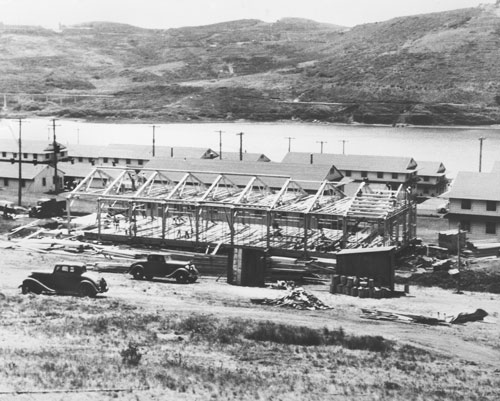
Barracks under construction at Fort Cronkhite, near Monterey, California

It’s instructive to note that, for all of America’s industrial might and technological prowess today, we could not do what we did in World War Two again if we had to. Which, fortunately and God willing, we won’t.

So even though Pearl Harbor was still a solid ten months in the future, Roosevelt had been getting ready for war for years.  He’d put the Navy – of which was a a former Assistant Secretary – on a crash rebuilding program in the thirties.

A 16 inch gun for the new, fast battleship USS North Carolina, being hoisted into place at the Brooklyn Navy Yard, 1940

It was in part a Depression-era stimulus program – but the program focused buying and building the things needed to fight a war over the vast expanses of the Pacific, again Japan, whom Roosevelt considered the most likely enemy at the time; aircraft carriers and the planes to fly from them; destroyers to escort them, with the range to sail the Pacific; submarines capable of carrying their crews thousands of miles across the trackless ocean and staying on patrol station for a month before making the voyage home, keeping men and equipment in a condition to fight effectively in freezing cold and tropical misery alike.

Woman working at Douglas Aircraft in 1942. As men volunteered or were drafted, women started taking assembly-line jobs. Normal today; unheard of in 1940.

And by the late thirties, as World War 2 started in Europe, the Army was in on the plan as well.   The Army’s “expansion” budget had multiplied sixteen-fold between 1936 and 1940, to eight billion dollars – which may buy you an aircraft carrier or two weeks of Obamacare today, but was an unimaginable investment at the time.

USS Ludlow, one of the "Benson" class destroyers, one of hundreds of warships built in a frantic buildup between 1937 and 1941.

The point?  Pearl Harbor was a tactical surprise – and a brilliant one.  But the war itself caught nobody by surprise.  The US was getting ready for it in every possible way – and in ways that pushed the edges of what was possible, given the technology and economy of the time.

And the politics.  But we’ll come back to that this fall.

As for today?  Seventy years ago, in the middle of the brutally cold winter of 1940-41, the orders went out; by telegram, phone call, good ol’ fashioned mail  – to hometown armories across North Dakota, from the Headquarters Company in Williston to Company H in Jamestown and a dozen or more towns in between.  And farm boys and city kids and a few middle-aged guys who’d been through all of this in 1916 (when parts of the 164th were called up to guard New Mexico against Pancho Villa) and 1917 (where the unit shipped out to France) started reporting to their armories, and got ready to ship out to the foetid malarial swamps of Camp Claiborne, Louisiana, carrying the same Springfield rifles their fathers and uncles – and in the cases of a few senior NCOs, they themselves – had carried in France in 1918.

They’d have a very, very busy war, fraught with danger, full of distinction.  Of the 3,000 or so of them, about 325 would not come home.

We’ll rejoin them in about a year and a half.

Sincerest Form Of Flattery

Monday, February 7th, 2011

Yesterday was the centenary of Reagan’s birth.

A sweep through Twitter and the leftblogs saw the usual wave of fact-challenged, context-denuded twaddle the left always rolls out when the topic turns to Reagan; deficits, tax hikes, the debt, the Soviet Union would have fallen anyway, Iran/Contra  (to which the answers are “the deficits paid for themselves, the hikes came to a small fraction of his cuts, hello Tip O’Neill, and nobody’s perfect”, respectively).

But just like during the glory days of the Cold War, when Sovietologists would pore over Soviet television broadcasts and reading Pravda and Izvestiya to find the subtle hints the regime would send via its official media, you can find a lot between the lines of the offical news organs of the American left as well.  In this case, National Public Radio.

Over the weekend, NPR ran a piece on Reagan’s 100th birthday.  The piece largely focused on…Barack Obama’s various mentions and tributes to Reagan, and the comparisons some (on the left) make between Obama and the greatest American president of any of our lifetimes.

Toby Harnden at the Telegraph notes the meme, by way of pointing out the cold water some of us are throwing on it:

Perhaps more surprising is that there is a new claimant to the Reagan throne this year: President Barack Obama. Having once routinely derided Reagan as, in the words of Democratic greybeard Clark Clifford, an “amiable dunce”, the liberal establishment is now seeking to embrace him.

Obama first tried to grab Reagan’s mantle three years ago when he cited the Gipper as a way of taking a shot at the Clintons by saying that the Republican had “changed the trajectory of America” in a way that Richard Nixon and Bill Clinton had not. Reagan, he added, responded to a feeling that “we want clarity, we want optimism, we want a return to that sense of dynamism and entrepreneurship”.

Harnden correctly points out what NPR wouldn’t; it’s just plain wrong:

Some Republicans fear that Reagan is facing a posthumous political emasculation by Democrats who play down his conservatism and recast him as a squishy conciliator.

There is little doubt that Reagan would have been dryly derisive of Obama’s policies and presidency. “Government is like a baby,” Reagan once quipped. “An alimentary canal with a big appetite at one end and no sense of responsibility at the other.”

Obama, by contrast, views government as a kindly nurse and the people as the baby. According to his mindset, the people should submit to those in government who know better and whose role is to make decisions and control the purse strings.

Comparisons between their speaking styles are both superficial (delivery is important – and still not the main point) and wrong (Reagan kept delivering great speeches from the beginning of his administration ’til the end; Obama’s fabled oratorical chops have seemed more rote and canned over time).

Just saying.

Reagan

Sunday, February 6th, 2011

Today would have been Ronald Reagan’s 100th birthday.

When I was in my early twenties, growing up amid the missile fields of North Dakota, I used to wonder what was the point of having kids?  They’d all wind up dying in a nuclear war anyway – even if I could afford to have any, which given the economy of the Carter years (and, naturally, the first half of Reagan’s first term) seemed unlikely.

Like most shallow lefties (which I was until about 1984), I was terrified of Ronald Reagan when he was elected.  “He’s going to send us all off to fight in Saudi Arabia!”, I chanted along with all the other bobbleheads – proving that “the facile meme aimed at the ill-informed” isn’t a post 2000 phenomenon.

But somewhere along the way, between 1980 (when I knew Jimmy Carter was a boob, but I would have gargled Drano rather than vote for Reagan, had I been about five weeks older and able to vote) and 1984, when I furtively punched the butterfly ballot for Reagan but didn’t tell anyone, not even my closest friends, about it (because I didn’t want them to lump me in with “those” conservatives, the Jerry Falwells and the like), I changed my mind.  It wasn’t all Reagan, of course – my college English major advisor, Dr. Blake, gave me a great primer on the real principles of conservatism – but also on how Reagan embodied them.

And let’s be honest; Reagan explained those principles, the timeless ones, Hayek and Jefferson, Adams and De Tocqueville, better than anyone that’s had the bully pulpit he’s had to do it from.  And he was doing it long before he became President:

And while there were pundits and thinkers who believed the Soviet Union couldn’t last forever, they were both in the minority and, well, pundits and thinkers.  Not those who could do something about it.

Reagan did something about it.

And so we, the people who remember and the ones who’ve learned – like the crowd of twentysomethings at the Reagan’s 100th Birthday bash at O’Gara’s on Friday, none of whom could possible have remembered Reagan himself – commemorate the life of the greatest president we’ve seen…

…even as we recognize that he represents a past that needs to guide, not obsess, us today.

“We Have No Downlink”

Friday, January 28th, 2011

It is, of course, the 25th anniversary of the Challenger explosion .

I was in the control room at KSTP-AM, getting ready for the Michael Jackson show to come down the satellite.  An alert came down the AP wire – John MacDougall called in to control from the newsroom that “the shuttle has blown up”, and that I should monitor the ABC News feed for special coverage.  It was there; switched over to the live coverage, for a few moments, until we realized there just wasn’t much to cover.  We went back to Jackson, in progress, who was covering the explosion non-stop, of course.

I sat, buzzing with adrenaline, as the program continued.  When Jackson ran out of information – it didn’t take long; he went to the phones.

The first call was a smug, unctuous, counterculture-sounding jagoff; “Yes, Michael, I think we had this coming; it’s revenge for this nation’s excessive macho”.

I got as angry as I have ever been in my life; I bit my tongue so hard, trying to concentrate, that I think I drew blood. I don’t remember.

That night, Reagan gave one of his great speeches.

And we needed it.

I needed it.

The Watershed

Monday, January 24th, 2011

I was on the air back in 1979 when the AP ticker clicked a “FLASH” story; “students” had seized the US Embassy in Iran.

For the next 444 days, the incident became a watershed in US society in so many ways.

Fifteen of the surviving hostages, and five survivors of the “Desert One” mission to try to rescue them, including a few of the charter members of “Delta” force, had a reunion over the weekend at West Point:

This reunion is not only about catching up with old friends, but also educating cadets who weren’t even born when the hostage crisis occurred. They are attending panel discussions about their experiences and Iran.

“We’re going to have people involved in a crisis in American history actually talk to the future leaders of our military about something that is very, very important,” said [former embassy press secretary Joe] ]Rosen.

In 1981, the hostages were flown to nearby Stewart Airport and driven in a caravan of busses to the military academy. Yellow ribbons and cheering crowds welcomed their return. Today, even in the snow covered hills, the feelings are just as warm.

The mayor of nearby Highland Falls NY had his townspeople put yellow ribbons in front of their houses, as well.

Temple University historian David Farber wrote a book on the hostage crisis called, “Taken Hostage” and says the crisis brought Americans together during a difficult time for the nation. Farber told Fox News, “This was a time of economic crisis. ” He says “that ironically in their debacle, in their frustrating experiences was a place where Americans could unify; Conservatives, Liberals, Democrats, Republicans… everyone was behind the dream of getting those hostages home safe.”

The group will meet local people at a wine and cheese party, attend the Army-Navy basketball game, and reflect on the meaning of their ordeal. They will also meet five survivors of the ill-fated rescue mission that resulted in the crash of helicopters that killed 8 U.S. servicemen.

The West Point Chief of Staff, Colonel Charles (Gus) Stafford, was one of the cadets who welcomed them home in 1981. He told Fox News that “to physically see those people here and know how happy they were and that they were and home and they were free, it just made your heart burst, it was wonderful.”

The reports noted that this is really the first time that the bulk of the former hostages, and their would-be rescuers, have been gathered together in all these years.  Given all that’s happened in the past thirty years – especially the past ten – it’s a crying shame.

For those who weren’t around back then, it’s impossible to overstate how important the Hostage Crisis actually was, even today:

  • It changed the media; it gave Cable News Network, which launched months after the hostages were seized, a subject for the sort of instant, 24/7 coverage that we now live with, day in and day out.  ABC turned Ted Koppel’s nightly reports on the hostage crisis into the long-running “Nightline” , the Big Three’s first nod to the notion that the traditional news cycle was dead.
  • It changed the military.  Desert One followed on the tails of several military debacles – Vietnam, the Mayaguez incident – that showed the US military had a very difficult time adjusting to wars that weren’t like World War 2.  The response launched a push for reforms that led to sweeping changes in the military and, in 1987, the civilian control of the military, with the Goldwater Nichols Act of 1987.
  • It changed politics.  While conservatism had been creeping its slow way back to the fore of GOP politics for some years, the crisis – and the Desert One debacle – fatally undercut the Carter administration, which was clearly overmatched.  It helped sweep Ronald Reagan into office, which not only ended the crisis, but changed much of the world we live in today.

Reading about the reunion has been a fascinating blast from the past.

Attention Ron Reagan

Monday, January 17th, 2011

Lets’ dignify  your absurd allegations with speculation –  more than they deserve.

All it proves is that a conservative with Alzheimers is a better president than a liberal.

That is all.

Dick Winters

Monday, January 10th, 2011

Dick Winters, the Pennsylvania Quaker who became famous later in life as the commander of E  Company/506th Parachute Infantry (and later of the Regiment’s 2nd Battalion) in Stephen Ambrose’s Band of Brothers, and the eponymous TV series, has passed away:

Dick Winters led a quiet life on his Fredericksburg farm and in his Hershey home until the book and miniseries “Band of Brothers” threw him into the international spotlight. Since then, the former World War II commander of Easy Company had received hundreds of requests for interviews and appearances all over the world.

And the Greatest Generation got a lot smaller.

The Winters that came through in the book and miniseries was an estimable person:

Ambrose, the author of “Band of Brothers,” said in a 2001 BBC interview that he hopes young people say. “I want to be like Dick Winters.”

“Not necessarily as soldiers, but as that kind of leader, that kind of man, with basic honesty and virtue and an understanding of the difference between right and wrong,” Ambrose said

I had a chance to meet Herb Suerth – who was a driving force beyind getting the original veterans together for Stephen Ambrose’s book – last fall.  He’s one of two of the company’s 37 survivors living in Minnesota (Frank Soboleski lives in International Falls).

We’re Down To One Shopping Month…

Wednesday, January 5th, 2011

…til the official Shot In The Dark holiday, Reagan’s Birthday.

So it’s time to do all the usual stuff to get ready for the big day:

  • Lay in a supply of jelly beans.
  • Find a tomato-free recipe for dinner.
  • Make your Reagan’s Birthday resolutions.

I’ll be thinking about resolutions over the coming weeks.  More later.

She Could Do It

Friday, December 31st, 2010

Geraldine Hoff Doyle, the woman on whom the iconic World War 2 home-front “We Can Do It” poster and template for the “Rosie the Riveter” image was reputedly modeled, passed away today.  She was 86.

She didn’t know it at the time, of course; she’d had a still snapped for a news story by an AP photographer, and the wartime art machine took it from there.

Doyle didn’t realize she had a famous face until she was flipping through a magazine in 1982 and spotted a reproduction of the poster, her daughter told The New York Times.

It’s good to remember sometimes that the name “Rosie” used to mean “the Riveter”, rather than “O’Donnell”.  If there’s justice, maybe it will once again.

Norway’s Favorite Son

Thursday, December 9th, 2010

Today would have been the 96th birthday of one of World War II’s great unsung (at least in the US) heroes – Max Manus.  I’m not sure if McGyver had a real-life model, but if he did, it may have been Manus.

Born in Bergen in 1914, Manus had quite a life before the war, galavanting about the jungles of Latin America for some years (his father, a Norwegian businessman, had spent many years in Spanish-speaking countries on both sides of the Atlantic; he’s changed his name to “Manus” from “Magnusson” to fit in better; Max’s full name was the very un-Nordic “Maximo Guillermo Manus”), adventures that later became the subject of a book published in Norway and translated into English.

From there, at age 25, he transitioned to the motti of Finland, volunteering to fight against the Soviets during Finland’s Talvesota, the “Winter War“.  But on on April 9, hearing news of the German invasion of Norway,  gathering a company of 130 men around him to fight on in the interior until resistance ended.

Manus quickly connected with the resistance –  serving mainly as a weapons collector as well as printing illicit counterpropaganda newspapers – until his group was betrayed and Manus was arrested by the Gestapo.  He escaped with the aid of a sympathetic doctor, and escaped to Sweden.  There, he was approached by the British “Special Operations Executive” (SOE), and escaped across the USSR, Turkey, Saudi Arabia, South Africa, and thence across the ocean to the USA.  Hitchhiking to Canada to join Norway’s small army in exile, he returned to Scotland in 1941 for more training with the SOE.

There, recognized for his combat experience, coolness under fire and mechanical aptitude, he was recuited into the elite – the Lignekompaniet, the exile army’s Commando unit.  Trained in sabotage, close combat and parachuting, Manus and a small team of saboteurs were air-dropped into the woods near Oslo.

There, Manus spent the rest of the war making life hell for the occupiers.  His specialty was sinking ships – big merchant ships needed by the Germans for supplying their garrison and hauling much-needed goods back to Germany from Norway.  In 1945 alone, using home-made magnetic mines and a few homemade torpedos, he sank two large cargo ships, as well as many smaller bombings and the killings of not a few German officers and Gestapo agents.  There’s an excellent accounting of his wartime record here.

As the war ended and the royal family returned, Manus was rewarded by being put in charge of King Haakon’s security detail.  He spent the rest of his life – until 1996 – running a variety of businesses, indulging his wanderlust, and eventually living in Spain.  He apparnently suffered from nightmares and a bit of a drinking problem; his years in the (literal) cold took their toll.

But he was one of the great heroes of World War II.   Big enough to get his own movie:

Hope 73. Tyranny 0.

Wednesday, December 8th, 2010

It’s hard for us, today, to picture what the world was like seventy years ago.

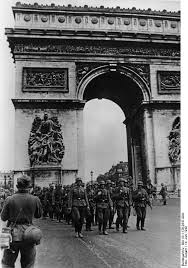
The Nazis march into Paris.

For the better part of a decade, much of the world’s intelligentsia actively wondered if democracy’s day had come and gone.  Various flavors of totalitarianism – whose ghastly crimes against humanity had been hidden from the world by a compliant media – had their adherents and even admirers in the West; Hitler and Stalin had both won Time’s “Man of the Year” award – making trains run on time impressed journalists then no less than now.

Here in Minnesota, as in much of the US heartland, the demoralization of the thirties led to a splintered worldview; the Minnesota Democratic Farmer/Labor party was cozied up to Stalin (and would stay that way until Hubert H. Humphrey, in one of his great contributions to the integrity of American politics, tossed the reds from the party six years later), to the point where it opposed war with Germany, with whom Stalin was then allied via the Molotov/Ribbentrop Pact.  In the meantime, the upper Midwest was a haven for the Deutsche-Amerikanische Bund, which favored rapprochement with the Nazis.

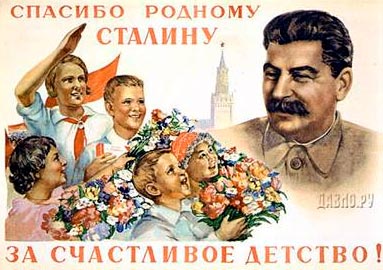
Stalin, from a Gus Hall fan site. Gus Hall was from Minnesota. The poster says “Happy To Pay For A Better Smolensk”.

Worse?  The totalitarians had just spent four years showing that their supporters in the West might have a point.  They conquered Spain.  Naziism dragged Germany out of the Great Depression (which had started ten years earlier in Germany than the rest of the west) well ahead of the rest of Europe or the US.  By all appearances, the Soviets were doing quite well too.

Poster for Nazi “Kraft Durch Freude” (Strength Through Joy) movement. Remind you of any recent City Pages ads? Me too

And World War II seemed to be the final nail.  Germany had swallowed up Austria and Czechoslovakia without a struggle; Poland, Norway, Denmark, Belgium, the Netherlands, Luxembourg and, finally, France – theretofore Europe’s greatest military power – all fell in dazzlingly short order, sending the Brits reeling across the Channel.  Britain had beaten back the Luftwaffe the previous summer, but everyone expected Hitler to get ready for another invasion attempt in the spring; his U-boat campaign to starve Britain into submission looked, to insiders, to have a great chance of doing just that.

London burns after Scottish soccer fans, angered by three straight 0-0 tie games, run riot.

The Japanese also were going great guns, as well as rolling up vast swathes of China before their military juggernaut.  State Shinto – a pseudoreligion not a whole lot different than Naziism in its own way – seemed a viable option to many as well.

And everyone expected war between the US and Japan, and probably Germany and Italy as well.  It was a year away – but the buildup to war had already begun; Roosevelt had instituted the draft and called up great swathes of the National Guard already.

And so even though the world hadn’t fallen off the cliff into complete cataclysm – Germany wouldn’t invade the USSR for another eight months – everyone knew that the world was a horribly bleak place on December 8, 1940.  And nowhere was it bleaker than for the world’s democracies.  There were those that thought the classical American notion of liberty was on its last legs.

To say nothing of America itself.  As the fascist wave crested, the Nazi and Fascist and State Shinto leaders arrogantly looked at America, demoralized by a decade of depression and softened by the decadence of its “refrigerators” and “telephones” and “movies” and “vaudville”, and thought that America would love its prosperity too much to fight for others’ liberty – or even defend its own.

The “experts” around the world counted America out.

It was the day of the eighth playing of the 1940 NFL Championship.    And the Washington Redskins were the prohibitive, odds-on favorite of the same media and punditry that had applauded Mussolini, who lauded and feted Hitler and Lenin, who’d uncritically published and eaten up Walter Duranty’s mash notes to Joseph Stalin.

Against them stood the Chicago Bears.  The Bears had been a dynasty in the thirties, but it was a new, harrowing decade, and, like Darth Vader swallowing up the Republic, things in the NFL had changed as badly for the worse as they had in every other part of the world.  The Redskins, led by Sammy Baugh, seemed to tower invincibly over the plucky Bears, like Dolph Lundgren over Sylvester Stallone.

Sammy Baugh

The Skins had beaten the Bears 7-3 three weeks earlier, toward the end of the regular season.  As the teams headed toward the championship, at Griffith Stadium in DC, the Skins’ owner, George Preston Marshall, told the media (who else?) that the Bears were quitters and crybabies – exactly as Hitler was telling his minions about America, halfway around the world.

The Bears, like the Brits, like the Chinese, like capitalism, like democracy itself, had no chance.  Everyone knew it.

The “experts” said so.

———-

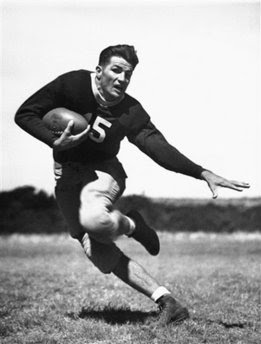
The Bears brought some of the same things to the table that America itself did, though.  Indeed, the juxtaposition should escape nobody; the Skins, led by the German-descended Baugh [*], faced the Bears, as polyglot a bunch of Yanks as the squad in any World War II war movie – with names like Musso, Osmanski, Clark, Stydahar, Macafee, Maniaci, Kavanaugh –  led by Brooklyn-born Sid Luckman, the son of pogrom refugees, and perhaps the greatest Jewish quarterback in the history of pro football.

Sid Luckman

And the Bears were at the forefront of a change in tactics; they ran from the “T Formation”, allowing greater flexibility compared with the ‘Skins’ single-wing formation – especially for Luckman, who’d become known by the end of his 12 year career as the NFL’s first great long-ball passer, even as under the bleachers at the nearly University of Chicago, other Jewish refugees were revolutionizing warfare forever as they carried off the first nuclear fission reaction.

The Bears, like America itself, brought a love of the underdog, and not a little bit of good ol’-fashioned America ingenuity and improvization skill.

———-

And so that morning, inflamed by Marshall’s arrogance just as their forebears had been enraged by Santa Anna’s brutality at the Alamo, the Bears took the field, and took the game directly to the Redskins, like the RAF’s Spitfires and Hurricanes tearing into the Luftwaffe’s bombers.

And like the RAF – and like the US Navy would do a Midway a year and a half later, and the US Army would do at Omaha Beach in three and a half years, and in the Bulge in a little over four years – the Bears, against all odds, not only prevailed…

…but kicked the favorites’ asses.

73-0.

The “weak”, “crybaby” underdogs prevailed against the favorites.

Just as America itself did, five years later.

Would it have happened without The Bears’ epic victory, 70 years ago today?

Thankfully, we’ll never need to know.

But it’s worth observing that, as America’s fortunes waxed during the war years, so did those of The Bears, who won championships in 1941, the pivotal year 1943 and then again in 1946, setting up the successful reconstruction of Europe.

The 1940 Bears. Not just champions; titans of liberty.

The point being that the fortunes of America the nation, the shining city and the great experiment are inextricably intertwined with those other palimpsests of all that is great about America, the Bears and conservative exceptionalism.

It was in 1963 when our nation – a month past the murder of its beloved, patriotic president – needed strength.  And the Bears, led by Bill Wade and the first of many great Bears linebacking threesomes (Joe Fortunato, Bill George, and Larry Morris), gave it to them with another come-from-underdog win against the New York Giants, featuring airtight defense and an appearance by a young Polish-American tight end, Mike Ditka, upsetting the Giants and putting a comforting coda on the end of a horrible chapter in American history.  Americans could to go bed that night knowing that all was well.

Of course, the Bears’ fortunes ebbed for the next twenty-two years – as did those of conservatism, and of America itself.  And the nation’s fortunes, as always, reflected that waning.  The drought years of the sixties and seventies coincided with the epic droughts in the rest of American society; the Bears, America and the GOP reached their nadirs, with  the fall of Saigon, Abe Gibron’s years as head coach, the WIN button, Stagflation, Watergate, Desert 1 – simultaneously.

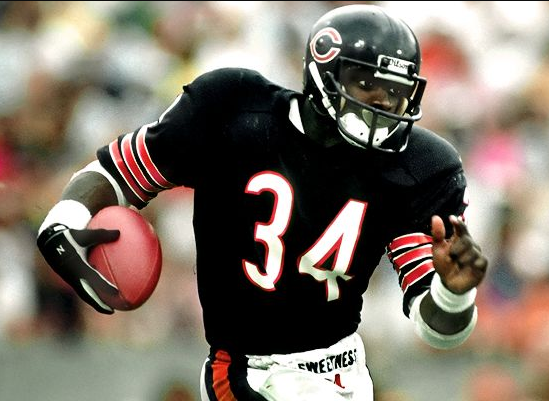
And yet three great Americans rose from the ashes during this time, laying the groundwork for a resurgence; Walter Payton, and Republicans Ronald Reagan and Mike Ditka.  Payton led the Bears out of the Wilderness just as surely as Reagan led America.

Walter Payton…

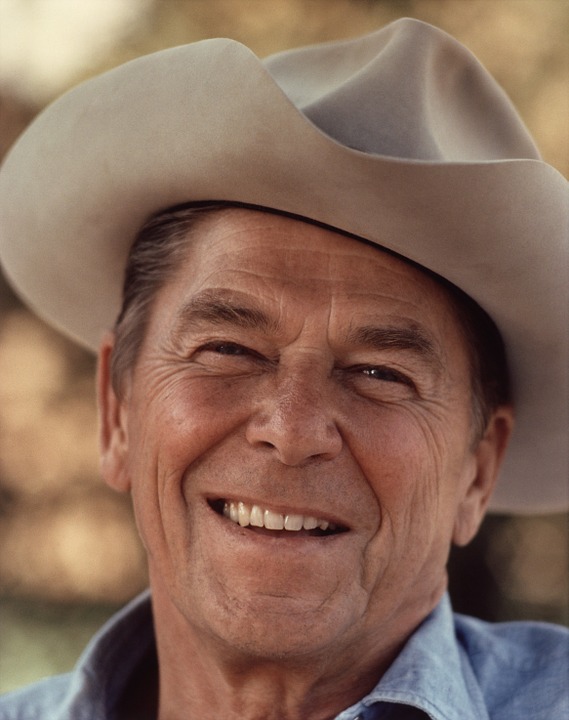
Reagan and…

...Ditka. When America needed all three, they were there.

…Ditka. When America needed all three, they were there.

And in 1986, at the depths of the Cold War, when once again “the experts” united to claim that America had seen its best days and the “nuclear clock” was supposedly ticking down as remorselessly as the timer in “24”, and that the USSR and the Patriots might well be viable and unstoppable in the modern world, Ditka (mirroring the rise of that other great Pole, Walesa) and Reagan and Payton rose up, leading other great Americans, Singletery and Weinberger, Dent and Schultz, Kirkpatrick and McMahon, and against all odds scored epic victories for freedom at the 1986 Super Bowl and the Rejkjavik talks, both leading in their way to the fall of the Berlin Wall and the collapse of communism and, finally, the re-ascendancy of Western Civilization.

But history didn’t end in 1990.  The Bears, like freedom itself, choked in 2006, against the Democrats and the Clots, leading directly to the defeats of 2008.

And after those dismal seasons, there were those that said the Bears and Real America would need years of rebuilding to be contenders again – if, indeed, either could do it at all.  That The Bears, like conservatism itself, were relics of a past unlamented by the likes of pundits Keith Olberman and Ed Schultz, or sportscasters Ed Schultz and Keith Olberman.

But when America, and Western Civilization, need to be saved, then the true heroes who walk among us will step up;   The Bears unpredictably have been rising out of nowhere to shock the league; the Mama Grizzlies, likewise, rose from nowhere to shock the political world.

Will it stick?  On the one hand, it’s too early to tell if justice, the Bears or conservatism will win out in 2011 or 2012.

On the other hand – we owe it to posterity to see that all of them do win.

But on the field as in and about the land, there is hope.  For conservatism is rising, and the Bears are contending, and for now there is hope.

Today, as seventy years ago today, you can thank God, Guns, Guts, and the Bears.

[*] Yeah, I stretched that metaphor too far.  Baugh was a great American, and was named “The most versatile player in NFL History” by the NFL network.  Luckman, for his part, served in the wartime Merchant Marine, playing in odd spare Sundays with the Bears.

The Shot Heard Round The World

Tuesday, December 7th, 2010

Today is the 69th anniversary of Pearl Harbor.

Sixty-nine years after Japanese planes bombed Pearl Harbor, survivors of the attack are due to gather at the base to remember those killed.

Some 100 survivors, the youngest of whom are in their late 80s, have traveled from around the country to attend Tuesday’s ceremony.

Minnesota is also holding a ceremony, at the Veterans building at the foot of the Capitol Mall.   It’s a little-known fact even in Minnesota that the very first shots fired at Pearl Harbor – hours before the air raid – were fired by a Navy Reserve gun crew from Saint Paul, serving aboard the rehabbed World War I-era destroyer USS Ward, on anti-sub patrol outside the Harbor.

The Saint Paul gun crew that fired the first shots at a Japanese midget sub. The gun in the photo is on permanent display north of the Veterans Building in Saint Paul.

George Thill – one of the survivors of that gun crew – will speak at the ceremony today. 

Wish I could be there.

Attention Italy: Suck It

Monday, November 29th, 2010

Genetic evidence found in Iceland that the Norse actually were in North American 1,000 years ago:

Pity poor Leif Ericsson. The Viking explorer may well have been the first European to reach the Americas, but it is a certain Genoan sailor who gets all the glory. Thanks to evidence that has until now consisted only of bare archeological remains and a bunch of Icelandic legends, Ericsson has long been treated as a footnote in American history: no holiday, no state capitals named after him, no little ditty to remind you of the date of his voyage.

I blame the mob.

But a group of Icelandic and Spanish scientists studying one mysterious genetic sequence – and one woman who’s been dead 1,000 years – may soon change that.

Ten years ago, Agnar Helgason, a scientist at Iceland’s deCODE Genetics, began investigating the origin of the Icelandic population. Most of the people he tested carried genetic links to either Scandinavians or people from the British Isles. But a small group of Icelanders – roughly 350 in total – carried a lineage known as C1, usually seen only in Asians and Native Americans. “We figured it was a recent arrival from Asia,” says Helgason. “But we discovered a much deeper story than we expected.” (From the Archives: See TIME’s cover story on the Vikings.)

Helgason’s graduate student, Sigridur Sunna Ebenesersdottir, found that she could trace the matrilineal sequence to a date far earlier than when the first Asians began arriving in Iceland. In fact, she found that all the people who carry the C1 lineage are descendants of one of four women alive around the year 1700. In all likelihood, those four descended from a single woman. And because archeological remains in what is Canada today suggest that the Vikings were in the Americas around the year 1000 before retreating into a period of global isolation, the best explanation for that errant lineage lies with an American Indian woman: one who was taken back to Iceland some 500 years before Columbus set sail for the New World in 1492.

Skål!

And Don’t Think It’s Escaped My Attention…

Thursday, November 11th, 2010

…that two straight rememberances of American military veterans have coincided with seventieth-anniversaries of stories of British heroism – Dunkirk this past Memorial Day, and Taranto today.

It’ll all balance out in the end.  There’s still five more years of WWII to do…

Torino, Torino, Torino

Thursday, November 11th, 2010

It was seventy years ago today that the British Royal Navy brought the naval world into the 20th century – and gave the  Imperial Japanese Navy a bright idea that would come back to haunt us.

First, a look back at some world and literary history.  Then, some technology.

———-

For big nations in the 1500s through the 1940s, having a neighbor with a big, powerful navy was sort of like knowing one of your neighbors has a badly-trained pit bull and a hole in their fence; even if you don’t see the dog, you make sure all your barbecues are in the back yard; even if the enemy navy never comes out to gight, you have to keep in mind that they could, with dire results in lost ships and wrecked commerce and severed military lines of communication.  This equation has dominated much of modern Western history; from King George’s ships of the line to the Great White Fleet to the Dreadnoughts to the entire NATO fleet of the fifties through the eighties (built to fight a Soviet submarine fleet that, thanks to Ronald Reagan, is now largely long-scrapped or rusting away at dockyards around Russia).

Of course, the daring admiral’s solution is to go to where the enemy fleet is holed up, and destroy it.  That way, your nation doesn’t have to compensate for that big, unseen threat anymore.  Sometimes it doesn’t work – Xerxes came to grief when he tried to root out the Greek fleet at Salamis, and got rooted out himself.

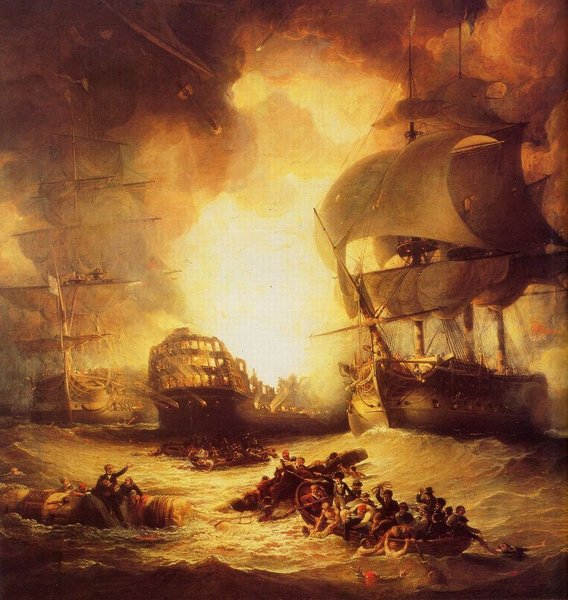
  Sometimes it does; Duncan at Camperdown and Nelson at The Nile  and Decatur’s sailors and Marines at Tripoli managed to change the fates of nations and the courses of wars by sailing not only into harm’s way, but into their enemies’ home ports to destroy them and render them moot as strategic factors.

French flagship LOrient exploding at the Battle of the Nile

French flagship "L'Orient" exploding at the Battle of the Nile

In 1925, Hector Bywater’s novel The Great Pacific War described a fictional Japanese attack on Pearl Harbor and the Philippines, with the intent of taking control of the western Pacific.  The scenario involved a line of Japenese battleships steaming into Pearl Harbor by surprise and wreaking havoc.

Fanciful? Of course.  Everyone knew you couldn’t sail a hostile battleship into Pearl Harbor!

Still, the idea of somebody destroying US naval power in the Pacific in a surprise coup de main was floating around.  Implausible – Bywater was most likely called an “paranoid southern wingnut” by liberals of the day who were ignorant that he was the Times of London’s naval affairs corrrespondent – but it was out there.

We’ll come back to that.

———-

There have been few times in the history of warfare when technology advanced as fast as it did in the fifteen years between 1930 and 1945.

In 1930, the tank was a rattling, unreliable contraption assembled with rivets and armed with a popgun and almost as much danger to its own crew as to any enemy.  Infantrymen carried bolt-action rifles not much different than the ones their fathers carried in 1900.  Air forces were composed of biplanes that puttered along at 180 mph.  And the world’s navies were largely dominated by battleships.

HMS Queen Elizabeth - one of the worlds most powerful ships in 1930

HMS Queen Elizabeth - one of the world's most powerful ships in 1930

And when navies went to sea to duke it out, they found each other more or less the same way they had 130 years earlier, in the age of Nelson and Decatur – via the human eye.

Of course, the lookouts reported their findings to other ships via radio, which was edgy stuff even in 1930.  And some of those lookouts flew in airplanes – floatplanes launched from battleships and cruisers and, in a few navies, launched from the world’s first aircraft carriers.

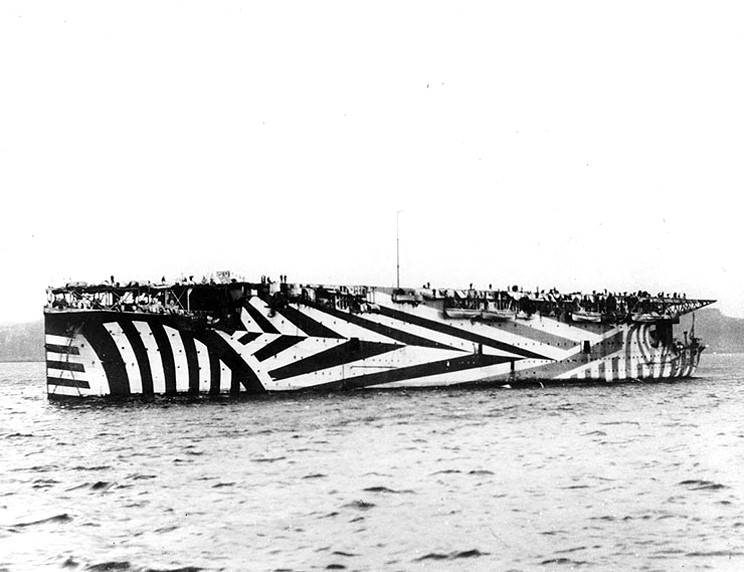
For all of its reputation for hidebound traditionmongering, the British Royal Navy led the world at seeing the utility of aircraft at sea.  They built the world’s first seaplane carrier – the HMS Campania, in 1916, which launched float planes with crude bombs to attack the Zeppelin bases that were launching the air raids that were terrorizing London – and, in 1918, they converted a fast ocean liner into the world’s first flat-top aircraft carrier, the HMS Argus:

HMS Argus, the worlds first operational aircraft carrier, in 1918.  The ship served throughout World War II. HMS Argus, the world’s first operational aircraft carrier, in 1918. The ship served throughout World War II.
They saw the role of the aircraft carrier to be not just scouting for the fleet and correcting the gunfire of the battleships, but attacking enemy ships.   They developed the world’s first torpedo bombers – allowing a tiny, flimsy airplane made of doped canvas and wood and string to sink the most powerful battleship – in theory.

So as the technology to deliver an attack literally and figuratatively zoomed ahead, the technology to detect an incoming attack – the human eyeball – stayed more or less the same way it’d been for all of naval history.

Which meant that if a lookout on a ship saw aircraft coming in at twenty miles out, flying at the then-blistering pace of 120 mph (that was a fast torpedo plane indeed, in 1930), it gave ten minutes’ warning to get an aircraft carrier’s fighters scrambled off the deck – plenty of time to attack incoming planes that hand to come in at low altitude to drop torpedos. 

But after 1930, technology started taking off.  Airplanes became faster; the 100 mph torpedo bomber of 1930 was replaced by planes that could do very nearly 200 mph by 1935.  The United States Marines invented Dive Bombing  (with the Germans and Japanese enthusiastically copying the tactic)- meaning the enemy could not only come in at 200 knots, but do it at 15,000 feet, meaning interceptors needed to add that much more time to climbing to meet the enemy. 

And the speed of ships started climbing, too; most of the world’s battleships in 1930 were red-lined at 23 knots (27mph); by 1935, the British, Germans and Americans had battleships on the drawing boards that could do 28-30.

And so when the Royal Navy decided in the early thirties that they needed a generation of aircraft carriers to fight the next war, it built them on the assumption that the technology of the attack would stay well ahead of the technology of detection – and that their carriers would have to thus be able to shake off plenty of damage and keep operating.  The Illustrious class carriers first laid down i 1934 were fast enough to get away from enemy battleships, but armored well enough to withstand damage from lesser enemy ships, cruisers and destroyers.  Most importantly, their flight decks were armored, to allow them to shake off bomb hits as well as protect the aircraft on the hangar deck down below.

HMS Invincible, 1940

HMS Illustrious, 1940

Britain also scrupulously adhered to the arms control treaties of the day, in those innocent-seeming days when “arms races” involved warships rather than nuclear weapons; in addition to being bombproof, they had to come in under 24,000 tons.  To do all that, something had to give; that something was capacity.  Illustrious could hold 36 aircraft in its original form.  The Admiralty figured it’d be better to have 36 aircraft that would get into action reliably than 52 on one of its older carriers that would risk getting sunk before launching an attack.

And given their initial assumptions and constraints (the “human eyeball” range of detection and the London Naval Treaty), they were correct.

But with war coming on fast, most of the world’s nations – especially Germany and Japan – stopped observing the London Treaty; ship displacement and firepower started creeping upward.  And in 1936, the first radar set was tested, removing the “human eyeball” limit to detecting incoming attacks.   And this revolutionized naval warfare just as much as it did war over land.  When the United States Navy started designing it’s fleet of carriers, it did so knowing that it could “see” attacks far beyond visual range, day or night, allowing the carriers to scramble fighters to break up the incoming raid. and avoid enemy surface ships altogether.  Carriers’ main defense became their air wings rather than their armor plating; with less need to ward off bombs and shells, the carriers could…carry.  The American carriers that were being designed at about the same time – the Yorktown and Essex class ships that carried the US Navy through World War II and much of the Cold War as well – could carry between 72 and 100 planes.  This made the huge carrier-borne sweeps later in the war possible.  The Brits, especially early in the war, were limited to smaller, pinpoint raids against vital enemy targets.  Their carriers just didn’t carry enough planes to carry off bigger operations.

Fortunately for the Royal Navy, just such an operation presented itself, seventy years ago tonight.

———-

The invasion of Greece showed Churchill that the Mediterranean was going to be anything but a backwater front in the war.  This was no small issue for Britain; the key to the British Empire in the Eastern Hemisphere was the Suez Canal, which made communication with the vast bulk of the empire – India, Singapore, Australia, East Africa and many other holdings – cheaper and more feasible.

And since the Italians had a large army in Libya, it was vital to keep supplies going to Egypt to defend the canal.  And to avoid a months-long plod around the Cape of Good Hope up to the Red Sea and thence to Suez, it was vital to keep supplies going across the Mediterranean.

And the Italian Navy had the potential to put a serious crimp in that supply line.

———-

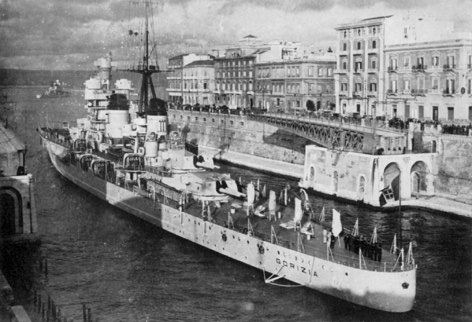
Know what an awesome bit of technology a Ferrari Testa Rossa is?  Italian ships were about the same.

Italian cruiser Gorizia

Italian cruiser Gorizia

Fast, well-armed, but with “short legs” – a very short cruising range – Italian ships were built for dashing across the restricted waters of the Mediterranean to hit enemy fleets and scamper back to base.  And a huge squadron of them – six battleships, nine cruisers and a slew of destroyers – were stationed at the nail on the toe on the foot of the boot of Italy, at the base at Taranto.

The battleship Giulio Cesare at Taranto

The battleship "Giulio Cesare" at Taranto

It was nothing new.  The British had been eyeing up the Italian Fleet as long as there’d been an Italy, for nearly eighty years.  “How to remove Taranto” had played in several international crises over the previous century.   There’d been many plans, many ideas; in the 1800s, the Admiralty had planned to take the city and port with the Royal Marines, in a pinch.

Well before the war began, the Fleet Air Arm was training in the exacting art of making torpedo attacks at night in shallow water.   In November of 1940, they were the only fleet in the world that could carry the mission off.  While most of the world believed it was impossible to launch airborne torpedos in a harbor (on the theory that the “fish” would plunge into the bottom before stabilizing themselves), the Brits figured it out before the Germans

And seventy years ago tonight, a British task force centered around the HMS Illustrious arrived 150 miles off the Italian coast…

HMS Illustrious

HMS Illustrious

…and launched 24 “Swordfish”  torpedo bombers.

The Swordfish torpedo bomber

The Swordfish torpedo bomber

That’s right.  Biplanes.  Not a whole lot different than the ones that flew from Argus in World War I.  During its Depression-era financing drought, the Royal Navy had enough money to build an excellent class of aircraft carriers – but had only just started figuring out the best airplanes to put on them when the war began. 

But it was the software – the pilots and aircrew – that made up for the ancient equipment. They’d been training to do night-time torpedo attacks for years.   In the days since Desert Storm, we take these sorts of things for granted; in 1940, night torpedo attacks from the air were just this side of science fiction, and almost entirely a function of navigation and piloting skill.

And at just before midnight, that’s what they did.  Two of the 24 planes dropped bombs on the port’s oil tanks as a diversion, and then dropped flares over the harbor.  Ten more dropped bombs on the cruisers and destroyers, mainly to keep the anti-aircraft guns busy.  And the other 12 swept across the harbor, torpedoing three Italian battleships.  Two  – Littorio and Caio Duilio  – were damaged severely enough to leave them under repair in the dockyard for months; the other,  Conte Di Cavour, was out for the rest of the war.

The cost to be Brits?  Two Swordfish shot down by Italian flak.  One crew – two men – killed, one taken prisoner.

Sunken Italian Battleship

Conte Di Cavour, sunk at its moorings and on the DL for the rest of the war.

The attack changed the war in the Mediterranean; the Italians pulled their surviving ships out of Taranto and moved them farther up the coast to Naples, where their short range made their mission more difficult, and the longer approach made them more vulnerable to British submarines.  They were never really a factor in the war again.

And it changed the rest of the war in even bigger ways.  Because the commander of the Japanese Combined Fleet, Isoruko Yamamoto, had studied in the United States in the mid-twenties.  He was familiar with naval history, including the desirability of sinking your enemy before he could sail to threaten you.  He had read at the very least the reviews of The Great Pacific War, if not the book itself – and in any case, as a Japanese strategist in training, had been noodling about the idea of how to destroy the American fleet at Pearl Harbor (and the British one at Singapore, and the Dutch one at Surabaja) his whole career. 

And the daring torpedo attack seventy years ago tonight at Taranto gave him and his staff an idea…

Thanks

Thursday, November 11th, 2010

If you’re a Veteran, anyway.

The Great Poll Scam, Part II: Polling Minnesota

Wednesday, November 10th, 2010

My interest in the Minnesota Poll as an individual institution started right about the time I started this blog, six or eight years ago.

Now bear in mind that I, Mitch Berg, have made skepticism of the media at least a hobby, if not a fringey living, since 1986.  I have believed that the media needed to be distrusted and then verified for pretty much my entire adult life.

And yet until very recently, I maintained, if not a naive faith in the public opinion polling about elections, at least a detached sense that, somehow or other, they all evened out.   It was the same naivete that we all have about where babies and Christmas presents come from when we’re nine, or how entitlements get paid for when we’re 18 (50 for Minnesota government employees), or how sausage and bacon are made.

Ignorance is, indeed, bliss.

The scales started falling from my eyes when I started reading PowerLine.  Scott Johnson has been keeping his eye of the MNPoll for most of a decade, now; he’s led the pack of Minnesota bloggers in documenting the poll’s abuses.

And in reading the history of conservative criticism of the Minnesota Poll, I started wondering – what is the historical context?

There’s more of it than I’d figured.

———-

The Star Tribune started running public opinion polling of the Minnesota electorate in 1944.  It’s polled Minnesotans over a variety of topics, but the marquee subjects are always the big three elections – State Governor, US Senate and Presidential elections.

Now, if you’ve lived in Minnesota in the past fifty years or so (I go back half of that time – I moved here in ’85), it’s hard to believe that Minnesota used to be a largely Republican state.  Of course, the Republicans we had up until very recently were the type that make the likes of Lori Sturdevant grunt with approval – “progressive” Republicans like Elmer Anderson and Wheelock Whitney and the like.

I bring this up to note that while the various parties have changed – Republicans used to be “progressive”, Democrats used to be “America First” – that Minnesota party politics for the past 66 years have been a little more evenly-matched than current political consciousness – shaped as its been by Humphrey and Mondale and “Minnesota Miracle” and Wellstone and Carlson – might make you believe.

Now, if you look at the Minnesota Poll’s statistics for the past 66 years – going back to the 1944 elections, for Governor, Senator and President – the Minnesota Poll is actually fairly even.  In that time, Republicans have gotten an average of 46.85 percent of the vote for all those offices, to 49.37% for DFLers.  During that time, the Minnesota Poll’s “election eve” predictions have averaged 44.1% for Republicans, and 46.77% for Democrats.  That means that over history, the big final Minnesota Poll has shown Republicans doing 2.75 points worse than they turned out, with DFLers coming in 2.59 points worse than they finally turned out.  The results have tended to be, over the course of 66 years, infinitesimally more accurate – .16% – for Democrats.  It’s insignificant, truly.

Indeed, when you go through the numbers from the forties and the fifties, you can see some blogger back in 1958 decrying two things – the lack of an internet to blog on, and a serious pro-Republican bias in the Minnesota poll; in polls run before 1960, the Minnesota poll predicted Republicans would get 51.58, while GOP candidates for the big three offices actually got 50.32% of the vote – the poll overestimated Republicans by an average of 1.26%.  The DFL got an average of 49.73% of the vote during those years, while the Minnesota Poll had them at an average of 43.51% –  which is 6.22% lower than they actually turned out doing (although this number gets inflated by a truly horrible performance in the 1948 Gubernatorial election, where the MNPoll had John Halstead at 25% in their pre-election poll; he ended up losing, but with 45%. That had to be frustrating).  In all, before 1960, the Strib “Minnesota Poll”‘s pre-election poll overestimated the GOP’s performance compared to the DFL’s in 76% of elections; the poll’s overestimates favored the GOP by an average of almost 7.5%.

By the mid-sixties, of course, Minnesota politics changed drastically; by the middle of the decade, the golden age of “progressive” politics and the DFL, led by the likes of Hubert H. Humphrey and Walter Mondale for the DFL, and Elmer Anderson for the GOP, left Minnesota a very different state.  During those years – from about 1966, after Barry Goldwater re-introduced a partisan divide to national politics for the first time, really, since the war – the DFL won the average vote 50.97 to 46.61.  The Minnesota Poll predicted DFL victories, on average, of 49.62 to 42.79; they underreported the final support for Republicans by an average of 3.83%, and DFLers by 1.35%, an average skew of almost 2.5% in favor of the DFL.

But if you look at the actual elections covered in those years – from 1966 to 1990, the “Golden Age of the DFL” – of the 21 contests for President, Governor and Senator, the Minnesota Poll showed the Democrat doing better than they turned out doing by a greater margin than the Republican in 13 of the elections, and inflating the GOP candidates results in eight.  The 1980 Presidential election skewed things a bit – the MNPoll underestimated Jimmy Carter’s performance by 12.5% (Carter got 46.5%, while the MNPoll predicted 34%; it also overestimated Reagan’s performance by a little over a point, leading to one of the biggest pro-Republican skews in the recent history of the Minnesota Poll).

Overall, for the entire history of the Minnesota Poll from 1944 to 1986, the Minnesota Poll showed the public voting, on election eve, for the DFL by a 48.25% to 46.34% average margin; the actual elections favored the DFL to 51.10 47.81; the poll underpolled Republicans by a 1.47% average, and Democrats by an average of 2.85%.  Of the 41 total contests in that time, the DFL was overestimated by a greater margin than the GOP in 44% of the polls – again, not a really significant number.

In other words, the poll’s statistical vicissitudes were fairly balanced through its first 42 years.

But in 1987, the Strib hired Rob Daves to run the Minnesota Poll.

And things would change.

———-

The series so far:

Monday, 11/8: Introduction.

Wednesday, 11/10: Polling Minnesota – The sixty-six year history of the Strib’s Minnesota Poll. It offers some surprises.

Friday, 11/12: Daves, Goliath:  Rob Daves ran the Minnesota Poll from 1987 ’til 2007.  And the statistics during that era have a certain…consistency?

Monday, 11/15: Hubert, You Magnificent Bastard, I Read Your Numbers!:  The Humphrey Institute has been polling Minnesota for six years, now.  And the results are…interesting.

Wednesday, 11/17: Close Shaves: Close races are the most interesting.  For everyone.  Including you, if you’re reading this series.

Friday, 11/19: The Hay They Make: So what does the media and the Twin Cities political establishment do with these numbers?

Monday, 11/22: A Million’s A Crowd:  Attention, statisticians:  Raw data!  Suitable for cloudsourcing!

MN Poll Result: 42.79 Elecction Result;: 46.61 Difference: -3.83   MN Poll Result: 49.62 Elecction Result;: 50.97 Difference: -1.35   Total/Lean DFL 21.00 13.00 0.62 Average Skew: 2.48

Sea Change

Thursday, November 4th, 2010

It was thirty years ago today that the pivotal political event of my lifetime so far – the 1980 Presidential Election – took place.

Morning In America?

Tuesday, November 2nd, 2010

28 years ago, when I was working at my first country-western radio job, about the time the early eighties recession was at its deepest, I first heard this Merle Haggard song. It was in the “recurrent” bin – music the station had played for a good six months before I started – but never quite left the rotation.

And it captured the spirit of 1980 and 1981 was well as any song of the era…:

…and really, life in Minnesota, today, as well.

And if the Republicans sweep the nation?  Especially if Emmer wins?

I haven’t felt like that since 1991 – when the Berlin Wall fell.

And nothing captured that era better than this ditty:

Watching the nation wake up from that Obama buzz won’t be quite as fun as watching the USSR gurgle down the drain…

…but this is the battle we’ve been dealt.

I’m game!

Thought For Today: “Too Extreme”

Tuesday, November 2nd, 2010

Our elites thought these people were a bunch of crazy, out-of-control wingnuts, too.

There were those who thought these people were “too extreme for the times”:

And today, they – the media, the Twin Cities’ nagging, hectoring establishment – is telling that freedom, the market, individual initiative, getting government out of the way, is “extreme”, too.

“They” deserve the same answer “they” got 20 and 30 years ago.

Chaos

Thursday, October 28th, 2010

It was seventy years ago today that Italy invaded Greece.

We’ll come back to that.

———-

Chaos Theory is a mathematical, physical and, occasionally, philosophical theory that says among other things that any action can, theoretically, have a hypothetically infinite set of consequences – even consequences that would never have been predictable.

Such was Italy’s invasion of Greece – from whose language, ironically, the word “Chaos” comes.

———-

Mussolini, feeling left out of the big conquest-go-round (he’d been stymied by French resistance in the Alps during the Battle of France, had had only captured a few square miles of the country, and his total so far had been the occupation of Albania in early 1939, and the 1935 conquest of Ethiopia – and even that wasn’t going all that well.  Mussolini decided he needed to rack up a trophy.

Months  of diplomatic maneuvering followed, of course.  The Greek Government was actually fundamentally friendly to the Nazis; the Greek dictator, Ioannis Metaxas, was fundamentally a Fascist in the classical sense of the term, and sought friendly relations with Hitler (who, to be fair, seemed to be the winning side at this point in the war).

Metaxas

Metaxas

But Mussolini saw low-hanging fruit.  His few successes in the war so far had come at the expense of the British; he’d swept aside a token British force to occupy British Somaliland.  Since Britain seemed to be on the ropes so far, he sought to build up bases from which to securely pick over what he thought would be the corpse of British power in the Eastern Mediterranean – Egypt, the Suez Canal, Palestine – to add to his new Roman Empire.

Italian troops in East Africa.

Italian troops in East Africa.

So seventy years ago yesterday, Mussolini demanded that Metaxas allow his troops free passage through Greece to occupy strategic locations – naval and air bases that could be used as jumping-off points in the Eastern Med.

It was an absurd request, designed to be rejected – and Metaxas knew it.   When the Italian ambassador presented Mussolini’s ultimatum, Metaxas replied in French (at the time, the lingua franca – hah! – of diplomacy), “”Alors, c’est la guerre” – “Then it’s war”.  This was passed on to the Greek people in a single word – Ochi.  “No”.

It was a setup, of course; the Italians invaded promptly, seventy years ago today, with half a million men and a division of tanks and six times as many planes as the Greeks owned.

Italian CV33 tankette - small tank - deploying to Albania before the invasion.

Italian CV33 "tankette" - small tank - deploying to Albania before the invasion.

The Greeks were a small country – but they were an exceedingly tough nation.  The people who hewed a living from the rocky peninsula had just won their independence from the Turks within the previous generation, and still held their independence dearly.  And they had had generations of experience fighting in the rocky, inhospitable mountains.

Greek troops moving into the mountains, 1940

Greek troops moving through the mountains, 1940

While the nation was poor, it had invested heavily in its military – then as now.  Even today, the Greek military is exceedingly large for the nation’s size and strategic position; it’s hereditary hatred of Turkey, whose military is equally exaggerated, keeps things tuned to a fever pitch.

And partly due to that national history, and partly due to Metaxas’ militant nationalism, the Greeks were ready.  They’d built a line of fortifications in the extremely rugged country along the Albanian border.  The Italian offensive smacked into the Elaia-Kalamas line – and bounced off.

By mid-December, the Italian offensive had petered out.  A Greek counteroffensive tossed the Italians out of whatever parts of Greece they’d conquered, and the riposte lopped off a quarter of Albania by April.

Greek soldier sitting on disabled Italian tankette, or mini-tank.

Greek soldier sitting on disabled Italian "tankette", or mini-tank.

In March, concerned by the potential threat to vital British territory at Suez and Crete, Churchill diverted British troops from Africa to Greece to help backstop the Greeks.  Faced with the complete implosion of his ally and, potentially, the loss of North Africa, Hitler responded by invading Greece in April of 1941.  Invaded from Albania and Bulgaria – Hitler’s ally – Greece fell in a three-week Blitzkrieg of immense brutality, leading to four years’ occupation (and fierce Greek resistance).

———-

So let’s go back to chaos theory.

The invasion of Greece set off a chain of events that, directly and indirectly, changed the course of World War II.

  • The Neutralization of Italy: Along with the crushing defeats that’d come in North Africa the following year, Italy proved itself a paper tiger.
  • The Costliest Rescue: Hitler, to bail out his paper-tiger ally, diverted troops from his planned invasion of the Soviet Union to conquer the Greeks.  He was forced to push back the invasion – Operation Barbarossa – by a couple of months to make up for it.
  • The Costliest Counter-Rescue: The British diversion of troops and resources to Greece weakened their position in North Africa, leaving their holdings overextended and ripe for counterattack by German general Erwin Rommel, who would become known as the Desert Fox.
  • Pyrrhic Victories: While the British – overextended, at the end of their supply lines – got clobbered in their attempt to rescue Greece, they were largely able to evacuate.  Many evacuated to Crete – where a German airborne assault managed to conquer the Island in June of 1941, but with casualties so horrific that the Germans never attempted another airborne assault.
  • The Sandy Backwater: Rommel’s success in the deserts of Libya and Egypt led to the diversion of immense British resources to countering him – which led eventually to the turning-point Battle of El Alamein, in early 1942.
  • Supply Lines: The attempt to supply the British forces in Greece passed through and by the key British base at Malta led to one of the epic ongoing naval and air battles in history, as the Germans and Italians pounded the British-held island of Malta.  After Greece fell, Malta became a threat to German/Italian supply lines to North Africa, making the skies above Malta one of the most ferocious air battles of the war, and the seas around Malta a graveyard of British and Italian ships and submarines; the ongoing battle around Malta may have been one of the costliest naval campaigns in history.
  • Diversion: The imperative to lift the threat to Malta, clear the Germans and Italians from Africa and open the Mediterranean to ease the threat on the Suez Canal prompted the first great US land campaign in Europe – “Operation Torch”, the invasion of Morocco and Algeria.  Fraught with costly blunders against the experienced Germans, it was a bloody education for US troops.
  • A Stitch In Time: The two months delay in the launching of the attack on the USSR meant that Hitler’s troops arrived at the gates of Moscow as winter fell, rather than at the beginning of autumn.  It meant their drive to the Caucasus, and the vital oil fields, bogged down in the frozen rubble of Stalingrad, rather than passing through.  This crippled the Germans’ timetable, and enabled the USSR to rebuild its army, to absord Lend-Lease equipment from the US, and to eventually go on to win the war in the East.
  • Echoes: The Greek resistance to the Nazis, esconced in the rugged mountains of that craggy land, was among the largest in occupied Europe.  And like many resistance movements, it was deeply divided between Nationalists loyal to the pre-war government, and Communists whom Metaxas had forced underground and who had been engaged in resistance even before the war. Both sides took their tolls on the Nazis, Italians and Bulgarian occupiers.  Both sides absorbed immense aid from the UK, USSR and, eventually, the US. And after the war, they turned their attention on each other in a bloody civil war that threatened to put Greece in the Soviet bloc for a decade, and into deep-seated political feuding that made the Greek communist party a serious contender for power into the eighties, and has made left-right politics in Greece a bloodsport until this very day, with consequences the Greek nation is feeling even as we speak.

And so a small,  pointless, ego-driven sideshow had side-effects that tipped the outcome of World War II, the Cold War, and our current economic climate.

Opa.

Anniversary!

Tuesday, October 12th, 2010

Today is the sixth anniversary of Mark Dayton’s closing of his US Senate office.

Dayton, advised that there was a threat of a terror attack against DC, opted to send his staff home, and fled to Minnesota, leaving the business of government to the 543 other Congresspeople.

The episode sealed his place as America’s Worst Senator.

And it made him a hero to America’s 9/11 truthers:

It seems like yesterday.

Never moreso than today.

--> Site Meter -->