More Like Guidelines

April 7th, 2015 by Mitch Berg

Joe Doakes from Como Park emails:

May 1st is Law Day. It was the idea of Charles Rhyne, President of the American Bar Association in 1958. He thought Americans should have a day to reflect on the Rule of Law in the foundation of the country and recognize its importance for society. He chose May 1st specifically because it was the day Communists celebrated their totalitarian rise to power.

The notion that we are a nation of laws, that no public official is above the law, that Congress makes the laws and the President upholds and faithfully executes them . . . are obsolete remnants of racist patriarchal oppression. The Obama Administration honors Law Day only in the breach.

Joe Doakes

Breach is the new Integrity.

It’s Pledge Week

April 6th, 2015 by Mitch Berg

I’ve been blogging away for thirteen years, now.  I have an average of 600-800 people a day reading this blog – which is about 10 to 20 times more than I’d dreamed about possibly reaching when I started this blog back in 2002.

I have said this many times in the past; I’d still write every day even if nobody read me, here; writing is just part of what I am and do.

But every April in recent years I’ve passed the hat for whatever spare change people feel this blog is worth to them, provided they can spare it, and only then.  Contributions mostly go toward hosting, and a few other little things (and, in some of my past years with more parlous fiscal circumstances, self-preservation; I’m not there, this year, knock wood, and I’m happy for it!)

So if you enjoy what you read here, and have a buck or two to spare, I’d be much obliged.


UPDATE: I fixed the broken button. I think. Sorry!

Either way, thanks for reading!

The Chinese Finger-Trap

April 6th, 2015 by First Ringer

Everywhere, Japan was in retreat.

In April of 1945, the Japanese Empire was being pushed on almost every front.  Americans bombers were decimating Japanese cities and industry.  British troops were reoccupying Burma.  U.S. forces were slowly driving Japanese troops out of their positions on Okinawa – all with frightening levels of casualties for Japanese soldiers and civilians alike.

But on one front, Japanese troops were advancing – China.  On April 6th, 1945, the Empire of Japan began their last offensive of the war.  An offensive they hoped would finally end the fighting on a front that had consumed nearly 10 million combatants and taken almost 25 million lives.

—

A Japanese soldier stands guard at the Great Wall. The Sino-Japanese War rivaled only the Eastern Front in terms of scale; over 25 million Chinese and Japanese died in China from 1937 to 1945. Even more were wounded

Throughout the course of this series, we haven’t commented on the fighting between China and Japan.  That’s unfortunate, because while World War II officially started on September 1st, 1939, it could just as easily have been said to have started on July 7th, 1937. Read the rest of this entry »

No Waves

April 6th, 2015 by Mitch Berg

In my heart, I’m still a rock and roll musician.  The urge to start another band – if only for the fun of it – someday still lurks deep in my heart.

But it’s been a long time since I’ve been able to make the time.  The last time I played a gig in public was July of 1996.  The last time I actually had a band was the winter of 2001 – we never played out.  And the last time I actually saw a band live in a bar was probably sometime in the fall of 2002.

So when I was walking up Wabasha in downtown Saint Paul back around the end of March, by the Amsterdam Bar, and saw a poster for “Katrina, formerly of The Waves” doing a show on April 4, the idea of actually seeing it flashed briefly, then went out.

And then I stopped, and turned around, and looked at the poster.

And thought “why not?”

And so when I got home, I got on Ticketfly, and ordered a ticket.  And thought; “how do I do club concerts anymore?

Going Down To Uppertown To Do Nothing:  We’ve talked about Katrina and the Waves; their past as a “one hit wonder” that shouldn’t have been here in the US, combined with a slew of really excellent pop music that had a bunch of hits in Canada and Europe.

Of course, the Waves broke up in 1999, after a brief comeback in 1997 in the UK; their lead-singer, the iron-lunged Katrina Leskanich, has had a spotty solo career since then.

So I figured why not?

Red Wine And Jack Daniels:  I’d never been to the Amsterdam before (at least not since it was “Pop”, back around 2010-ish).  The front of the house – the bar and restaurant – is “bohemian” with an uptown sheen.   The back of the joint – the “Hall” – affects “rock and roll club”, all black and worn and rough-hewn, without the whole “sticking to the seats” and “getting pounded by bouncers” experience that the real thing always gave you back in your twenties.

I got there late; I missed the first act, and caught the last two songs of the mid-card act, “The Flaming Ohs”, a band I first saw during Ronald Reagan’s first term, and didn’t like much during the second (and only two of whose original members are still alive).

I was a little gratified to notice that on this, my first venture back to a club in 12 years, I was actually right around median age; lots of forty and fiftysomething fans turned out for this, the band’s first stop in the Twin Cities since Mikhail Gorbachev was in power.

Walking On Stage Light: The surest sign everyone involved had grown up?  The band got onstage promptly at the advertised time, 9:50:

I started taking a selfie at 9:50; as i was trying to get the light right, Katrina walked on stage. Yep, that’s her.

And they were on!

That’s them; Katrina, along with bassist Sean Koos, drummer Kevin Tooley, and guitar player Jimi K Bones.

The setlist was concise, and actually a pretty decent mix of crowd faves from the eighties and Katrina’s new stuff (or, for all I know, stuff from after 1988; let’s be honest, I didn’t pay that much more attention to them than anyone else…):

  • Rock and Roll Girl
  • Red Wine And Whiskey – it’s always been my favorite Waves song
  • Going Down to Liverpool – including a nice shout-out to the Bangles, whose cover of this song opened the door for the Waves making it in the US
  • That’s The Way – their very underrated single from their 1986 followup album, a song that should have been a big hit.
  • Sun Coming Upper – the single off of her new album.
  • Texas Cloud – another new one, with sounds like it was written on a long Stevie Ray Vaughan jag
  • Show Me Every Scar – at least I think that was the title; I wasn’t familiar with it.
  • Where The Roses Grow – another new one, but a good one.
  • Do You Want Crying – another great one from the eighties
  • If You Can – again, guessing at the title, but it was a good tune…
  • Don’t Want No Washed Up Man – a waved-up cover of an Etta James song
  • Walking On…wait for it… Sunshine.

Katrina, during some between-song patter.  Turns out she’s working on a book on diners – and she’d never heard of Mickey’s Diner.  Some had dragged her over there after she’d gotten into town from Milwaukee earlier in the day Saturday.  She approved.

Cry To Me:  Katrina is not Katrina and the Waves.  That’s neither and both bad and good.

Comparing the material from her post-Waves albums, it’s easy to see how the
Waves-era material benefited from being a team effort (“Walking on Sunshine” was written by Waves guitarist Kim Rew; “Do You Want Crying” by bassist Vince De La Cruz).  A team effort that catches a stray bit of fire, like the Rew/De La Cruz/Leskanich efforts did for couple of glorious years in the eighties, is a rare and largely very focused thing.

The newer material is all over the map; “Texas Cloud” sounds like one of the ZZ Top songs that Leskanich performed in cover bands before the Waves made it big; “Sun’s Coming Upper” was moody and introspective and a big swerve from the stuff that put the band on the map.

I went there expecting a musical roller coaster ride; most gigs from musicians that have been and out of the public eye for a generation are.  The muse is a fickle critter.

The band – journeyman session drummer Kevin Tooley,  guitarist Jimi K Bones (of one of later-era versions of Joan Jett’s Blackhearts, as well as Kix),  and bass player Sean Koos (another former Blackheart, among many other bands) was actually a lot tighter than I’d ever seen the Waves;  they took what could have come across as a Holiday Inn lounge nostalgia act and made it crackle with energy.

Bones takes a solo.

And that was by no means a given; the show at the Amsterdam was the final stop on a fifteen-gig tour that started Saint Patrick’s Day in New York.  And for bands that aren’t currently lighting up the Top Forty, that means road travel, not flying, for the most part.

Second sign that everyone had grown up in the past thirty years?  The show was over not too terribly long after 11, and most of the crowd hit the doors; there was no chanting for an encore.

Which meant it was a nice, relaxed little group that greeted Leskanich and the rest of the band when they came out into the hall about half an hour later.  I got a chance to talk rock and roll history with Bones, and tell Leskanich how much I’d enjoyed her music.  Nothing major, just fun.

Sort of like the show as a whole.

Read the rest of this entry »

“For Most Of The Things I’ve Seen, I Have No Words”

April 4th, 2015 by Mitch Berg

Buchenwald – the name means “Beech Forest” – was among the first of the concentration camps, built in 1937, two years before the war started.  And it was the first to be liberated by US troops – although many would follow in the weeks before the war ended.

The video, photographic and dramatic record we have of the liberation of the camps in the West is, of course, one of those things that makes anyone with a human soul wonder what the hell went wrong with humanity.  It certainly has for me over the years.

And yet inside Buchenwald in the days before liberation came proof of how not merely resilient, but powerful, humanity actually is.

———-

Buchenwald was one of the first, and largest, in the SS’  Konzentrazionslager (Concentration Camp or “KZ”) system.  As such, it wasn’t specifically dedicated to exterminating people, like the later Vernichtungslagern (“Extermination Camps”, or “VZ”); the camp, which was actually the hub of a network of camps, provided slave labor for German war industries, agriculture and other enterprises.  But Buchenwald’s command, especially after the war started, emphasized the ideal of Vernichtung dürch Arbeit, “Extermination via Work” – best summed up by Oswald Pohl, the Nazi director, essentially, of slave labor:

The camp commander alone is responsible for the use of man power. This work must be exhausting in the true sense of the word in order to achieve maximum performance. […] There are no limits to working hours. […] Time consuming walks and mid-day breaks only for the purpose of eating are prohibited. […] He [the camp commander] must connect clear technical knowledge in military and economic matters with sound and wise leadership of groups of people, which he should bring together to achieve a high performance potential.

And so for eight years, Buchenwald saw an endless parade of victims.  Before the war, it was the Nazis’ political enemies – non-Nazi socialists, communists, clergy that wouldn’t go along with the Nazi’s co-option of the church, and of course Jews, the mentally ill, Gypsies (Roma and Sinti), Jehovah’s Witnesses, homosexuals, the physically-disabled and those with birth defects.  After the war started, the population boomed, with more Jews, Poles and other Slavs, and many prisoners of war – mostly Soviet, but some notable Americans as well.  Over the years, about a quarter-million people passed through the camp.  Official German records record the offical deaths of 56,000 of them, but inmates noted many – especially Soviet POWs – were routinely murdered before they could be registered.  Many others died after being “transferred to Gestapo custody”, shipment to other camps (especially VZs like Auschwitz, Majdanek and Sobibor) or, later in the war, forced marches elsewhere.

The camp’s inmates included the famous (Jewish political leaders from France, Poland, Belgium and the Netherlands), the great (Dietrich Bonhöffer, the Lutheran theologian and anti-Nazi dissident, and Elie Wiesel, the humanitarian and Nazi-tracker), and the counterintuitive (Robert Clary, a young French-Jewish actor who’d go on to star as “Lebeau” in Hogan’s Heroes).

But most notable to today’s story and the theme of this series, there were a group of inmates who had, under the noses of the guards, built a resistance movement.  Over the years, the resistance bided its time, shunting children into less-demanding jobs (and taught them skilled trades, to forestall their being shipped to extermination camps), and eventually stealing or otherwise purloining weapons.

And one inmate – Polish engineer Gwidon Damazyn, deported to the camp in 1941 – incredibly managed to build a radio transceiver and a small generator, which were carefully concealed beneath a barracks floor.  Using this, the inmates’ resistance committee were able to track the Allies’ progress across Europe, and wait for their moment of liberation.

Touch And Go:  As the Americans closed in on Buchenwald and other camps in the west. the Germans got nervous.  While the Soviets had liberated several camps in Poland as early as July of 1944, including the Majdanek extermination camp, the fact that the news was filtered through the Soviets – who were often clumsy propagandists – meant the horrific news was taken with a large grain of credulous salt in the West.

The Germans knew it’d be another matter with the Western allies.  And so the plan went through – destroy Buchenwald, and its inmates.

Plans started falling into place to evacuate the prisoners via forced march to other camps in the interior (or mass death by starvation and shooting).

But the plans were slowed by the guards’ incipient panic – many checked out and ran before the plans could be carried out – and sabotage by the inmates.

But on the evening of April 10, the inmates figured their window of opportunity was closing.  Every day that passed was a day closer to the Nazis pulling the plug on the whole thing.  But to rebel without Allies nearby  – as earlier inmate rebellions in the Warsaw Ghetto and the extermination camps at Sobibor, Treblinka and Auschwitz had had no choice but to do, in the wilds of rural Poland and long before the tide of war turned – would be suicide.  Pointless suicide, with the war clearly nearly over.

So at noon on April 8, 1945, engineer Damazyn and Russian POW Konstantin Leonov took the radio out of hiding, and fired up the transmitter; Damazyn keyed a message in English and German Morse code to any allied units that could hear; Leonov did the same in Russian.

To the Allies. To the army of General Patton. This is the Buchenwald concentration camp. SOS. We request help. They want to evacuate us. The SS wants to destroy us.

The men keyed the messages three times in each language.

Finally – three minutes after the last transmission – an unknown radioman at Patton’s headquarters replied:

KZ Bu. Hold out. Rushing to your aid. Staff of Third Army.

Damazyn reportedly fainted when the reply came through.

The rest of the Buchenwald resistance moved into action.  They dug out their stash of weaopns – an incredible 91 rifles and one machine gun – and, three days later on April 11, stormed the guard towers, killing the guards that hadn’t fled.

One prisoner walked into the vacant administrative building, and picked up a ringing telephone.   On the other end was a Gestapo officer, asking when they could drop off the truckloads of explosives, to blow up the camp and its inmates.

The prisoner cooly told the Gestapo that the camp had already been blown up.

And that did the trick.

About four hours later, the halftracks of a company of 200 riflemen of the 9th Armored Infantry Battalion, under Captain Fred Keffer, part of Patton’s 6th Armored Division, gingerly entered the camp.  That company was the first of a flood of Westerners who’d follow and witness what they discovered with their own eyes.   The things they saw are a part of one of the most wrenching public moments of truth in human history.

And the rest is history.

Many other camps were liberated in the month before the war ended; Dachau, Bergen-Belsen, Teresienstadt, Ohrdruf, Nordhausen, and dozens of others.  But Buchenwald, along with Dachau, was the first major camp to get the full attention of the western media – including Edward R. Murrow, who produced one of the most immortal news reports in the history of broadcasting:

His report is sonorously grim, and horrific for all Murrow omitted

 “I reported what I saw – but only part of it.  For most of what I saw, I have no words”.

And yet it had been those same skeletal, starved, half-dead men, the ones Murrow described, who had summoned the energy not only to survive, but – in a miracle of stealth, guile and craft – to kill their tormentors in their hour of liberation.

———-

It was reading the story of the Buchenwald uprising, among the other uprisings, the Warsaw Ghetto and Sobibor and Treblinka and Auschwitz itself, as a high school kid that rocked me back on my heels; this, I thought to myself, is why the people must never be disarmed.  This was why our forefathers had the wisdom to recognize our God-given right to armed self-defense; this, and moreso, to prevent it from ever happening again.

And beyond that?  When the people are armed, these are the miracles they, humiliated wretches, starved and sick and beaten and fighting against a brutal, well-fed enemy though they may be, can wrench from nowhere.

I Heard It On The NARN

April 4th, 2015 by Mitch Berg

Here’s the Conor Friedersdorf piece I discussed, as well as the one from the New Objectivist.

Here’s Casting for Cures – Web and Facebook 

And here’s info on CFACT’s appearance with Ron Paul.  Go here for tickets.

There’s No Stopping The NARN From Hopping

April 4th, 2015 by Mitch Berg

Today, the Northern Alliance Radio Network – America’s first grass-roots talk radio show – is on the air! I will be on from 1-3PM today!

Today on the show,

  • I’ll be talking with Dennis Prager about his new book, The Ten Commandments: Still The Best Moral Code.  Check out the book, by the way.
  • I’ll interview Corey Larson from “Casting for the Cure”
  • Finally, I’ll be talking with Allison Maass from CFACT about the upcoming visit from Ron Paul.

Don’t forget – King Banaian is on from 9-11AM on AM1570, and Brad Carlson has “The Closer” edition of the NARN Sundays from 1-3PM.

So tune in the Northern Alliance! You have so many options:

Join us!

If You Like Greek Food…

April 3rd, 2015 by Mitch Berg

…get ready for a bull market.  Because I have a strong hunch there’ll be a lot of Greek restaurants opening around the US, sooner than later.

Why?

Just a hunch.

The Greatest Recovery Ever…

April 3rd, 2015 by Mitch Berg

….continues in the style to which we have become accustomed.

Most chilling?  The labor force participation rate remains not a whole lot better than it was at the nadir of the recession.

Public Notice

April 3rd, 2015 by Mitch Berg

If I were asked to live-blog a gay wedding – for my customary live-blog fee of $1,000, and my requisite total editorial freedom – I am currently undecided as to whether or not I’d take the gig, on purely religious grounds.

Please feel free to proffer me a request to do so (backed with certified funds), so that I have to decide whether I want to be a test case, or to take your $1,000.  Come to the table ready to sign the contract, and have your lawyers ready to go just in case.

Thanks.

There But For The Grace Of Christie Go Ye

April 3rd, 2015 by Mitch Berg

I’ve written in the past about the case of Shaneen Allen, the Philadelphia mother and Pennsylvania carry permit holder who accidentally strayed across the Delaware River into New Jersey, got pulled over on a routine traffic stop, told the cop that she was carrying her firearm (which was legal mere miles up that very road), and was arrested for what was in Jersey a felony.

Her prosecutor, John McLain, opted to make an example of the black single mother, rejecting her for a diversion program (on his way to legal notoriety for letting NFL star Ray Rice skate on charges of especially brutal domestic abuse).

Yesterday, after nearly two years of back-and-forth, Governor Christie – never known as a friend of the Second Amendment – pardoned Allen:

I, Chris Christie, governor of the State of New Jersey, by virtue of the authority conferred upon me by the Constitution of the State of New Jersey and the statutes of the state, do hereby grant Shaneen Denise Allen, a full and free pardon for all criminal charges and indictments arising from the arrest occurring October 1, 2013 to include the aforesaid crimes, and this order is applicable solely to said criminal charges and indictments, and to no other.

On the one hand, this is good news.  Christie did the right thing.

On the other, it shows the perilous state that the various states’ paternalistic approach to carry laws leaves the citizen in.  If you’re a Minnesotan with a carry permit, and you forget to stop at a gas station on the Minnesota side of the Wisconsin, Iowa, or either Dakota border, you could have precisely the same problem.

It’s why the Commissioner of Public Safety need to do the job he was charged to do in 2004, and make Minnesota’s carry permits reciprocal with every state that (according to the law) has a permitting process substantially similar to ours (e.g. – a background check, the basic assurance that the applicant knows the laws).

I Gotcher Journalistic Ethics Right Here

April 2nd, 2015 by Mitch Berg

If you listen over the weekends to American Public Media is “On The Media”, heard on NPR stations nationwide, you’ll hear the hosts, Brooke Gladstone and Bob Garfield, sniffling and shuffling about the state of the modern media. Periodically, the subject turns to “journalistic ethics”.

Most media organizations will point to something called the “Code of Ethics,” from the Society of Professional Journalists”. No, we’ve been over the Code before; it basically does nothing but give news media a framework by which they can declare just about any behavior “ethical”.

And just you watch – that’s exactly what is going to happen with this story :

ABC-57 reporter Alyssa Marino’s editor sends her on a half-hour drive southwest of their South Bend studio, to the small town of Walkerton (Pop. ~2,300). According to Alyssa’s own account on Twitter, she “just walked into their shop [Memories Pizza] and asked how they feel” about Indiana’s new Religious Freedom Restoration Act.

Owner Crystal O’Connor says she’s in favor of it, noting that while anyone can eat in her family restaurant, if the business were asked to cater a gay wedding, they would not do it. It conflicts with their biblical beliefs. Alyssa’s tweet mentions that the O’Connors have “never been asked to cater a same-sex wedding.”

What we have here is — as we called in journalism school jargon — “no story.” Nothing happened. Nothing was about to happen.

If I were forced to mark out a story line, it would be this: A nice lady in a small town tries to be helpful and polite to a lovely young reporter from “the big city.”

In other words, Memories Pizza didn’t blast out a news release. They didn’t contact the media, nor make a stink on Twitter or Facebook. They didn’t even post a sign in the window rejecting gay-wedding catering jobs. They merely answered questions from a novice reporter who strolled into their restaurant one day – who was sent on a mission by an irresponsible news organization.

So I’m gonna make sure I tune in “On the Media” this weekendand, to see by what logically torturous path they find this behavior by the media justified.

I don’t know how they’ll do it.

I only know that they will.

Grab Your Leggings And Headbands

April 2nd, 2015 by Mitch Berg

Dig out those Members Only jackets, and crank some Duran Duran. It’s “Back to the 80s” week, all over Europe!

Only not in A fun way:

BODO, Norway — From his command post burrowed deep into a mountain of quartz and slate north of the Arctic Circle, the 54-year-old commander of the Norwegian military’s operations headquarters watches time flowing backward, pushed into reverse by surging Russian military activity redolent of East-West sparring during the Cold War.

“I am what you could call a seasoned Cold Warrior,” the commander, Lt. Gen. Morten Haga Lunde, said, speaking in an underground complex built to withstand a nuclear blast.

Because the Cold War is back in all of its bunkered down, hunkered down glory, in northern and eastern Europe:

Russia has itself fed the scaremongering with bursts of belligerent language, like the recent comment by Moscow’s ambassador to Copenhagen that Danish warships “will be targets for Russia’s nuclear weapons” if Denmark contributes radar to a Europe-based missile defense system planned by NATO. Denmark’s foreign minister, Martin Lidegaard, dismissed the threat as “unacceptable.”

Russia’s muscle-flexing is due in part simply to the fact that the country is spending more on its military and has re-established abilities eroded during the post-Soviet chaos of the 1990s. When Mr. Putin first became president in 2000, Russia spent $9.2 billion on its military, but this has since risen 10 times and will increase again this year despite a slumping economy, hammered by a collapse in the price of oil and also by Western sanctions.

Good thing Pres. Obama hit the “reset” button on US Russia relationships, isn’t it?

Apparently he didn’t know what it was going to reset to.

I Shall Open A Bakery

April 2nd, 2015 by Mitch Berg

I believe I’m going to open a bakery.

And at this bakery, I’m going to serve cake to pretty much everyone who wants it. White, black, straight, gay, you name it. Because everybody’s money cashes about the same.

The one exception?

I will refuse to serve giggly bobbleheads who try to weave rhetorical “gotchas” out of Christian scripture they neither understand nor appreciate.

As You Can See…

April 1st, 2015 by Mitch Berg

…by the output so far this morning, my  head cold is still addling my attention span pretty badly.

So output is going to be mighty light today, as well.

The World Of Tomorrow, Today

April 1st, 2015 by Mitch Berg

Bionic ants might become the new factory workers.

They’ve been beta-testing them as “Daily Show”, “Colbert” and “Daily Kos” audience members for about ten years now, actually.

Meet The New Snarkmeister

April 1st, 2015 by Mitch Berg

Same as the Not appreciably different from the old snarkmeister.

The Hail Mary Shot

March 31st, 2015 by Mitch Berg

There’s nothing shooters like more than a good fish story.

And there is no group of shooters that participates in legend-mongering with as much glee as partisans of the Colt M1911A1, which was the service handgun of the US military for over eighty years, and over 100 years after its development is still one of the world’s premier defensive firearms. 

But 72 years ago today, this story – possibly but probably not aprocryphal – may have established itself as the grand-daddy of all handgun legends.

In 1943, the Tenth Air Force was the smallest, most isolated, and most under-reported unit in the US militiary.  Flying out of airfields in rural India, they hauled supplies over the Himalayas – “over the Hump” – to support US and Chinese troops cut off from the coast by Japanese invaders; they also harassed the Japanese supply lines. 

On one of those raids, by the 9th Bomber Squadron of the 7th Bomb Group, was against a railroad bridge between Rangoon (today called “Yangon”) and Mandalay, in Japanese-occupied Burma.  One of the planes – at the right wing of the squadron leader – was a B-24 “Liberator” flown by 1st Lieutenant Lloyd Jensen.  His co-pilot was 2nd Lieutenant Owen Baggett. 

On the approach to the bridge, the formation was attacked by Japanese fighters.  The squadron leader was badly wounded; Jensen’s plane took severe damage.  After an uncontrollable fire broke out, Jensen ordered the crew to bail out.  Five of the nine man crew escaped before the plane exploded.

The Japanese pilots then began shooting at the airmen in their  parachutes, killing two of them, and grazing 2LT Baggett’s arm with a bullet.

And then…:

The pilot who had hit Baggett circled to finish him off or perhaps only to get a better look at his victim. Baggett pretended to be dead, hoping the Zero pilot would not fire again. In any event, the pilot opened his canopy and approached within feet of Baggett’s chute, nose up and on the verge of a stall. Baggett, enraged by the strafing of his helpless crew mates, raised the .45 automatic concealed against his leg and fired four shots at the open cockpit. The Zero stalled and spun in.

Jensen, Baggett and one of the gunners were captured by the Japanese.  And it was in a POW camp that Baggett learned the unbelievable:

A few months later, Col. Harry Melton, commander of the 311th Fighter Group who had been shot down, passed through the POW camp and told Baggett that a Japanese colonel said the pilot Owen Baggett had fired at had been thrown clear of his plane when it crashed and burned. He was found dead of a single bullet in his head. Colonel Melton intended to make an official report of the incident but lost his life when the ship on which he was being taken to Japan was sunk. Two other pieces of evidence support Baggett’s account: First, no friendly fighters were in the area that could have downed the Zero pilot. Second, the incident took place at an altitude of 4,000 to 5,000 feet. The pilot could have recovered from an unintentional stall and spin. Retired Colonel Baggett, now living in San Antonio, Tex., believes he shot down the Japanese pilot, but because that judgment is based on largely indirect and circumstantial evidence, he remains reluctant to talk much about it. We think the jury no longer is out. There appears to be no reasonable doubt that Owen Baggett performed a unique act of valor, unlikely to be repeated in the unfolding annals of air warfare.

Try that with a .357 Magnum!

Blech

March 31st, 2015 by Mitch Berg

Minimal posting today.

Downside Of Presbyterianism

March 30th, 2015 by Mitch Berg

Things like this almost never happen in church.

The Elmer Gantries

March 30th, 2015 by Mitch Berg

When it comes to Second Amendment rights groups, I’ve always said “let a thousand flowers bloom”.

You prefer to fight the national fight by proxy?  Send your $35 to the NRA.  Want to get more into the thick of things nationally?  Contribute to the Second Amendment Foundation.

Wanna affect what happens in the Minnesota legislature?  Support GOCRA.  Wanna affect who gets elected to the Legislature?  Support MNGOPAC.  Feel like taking it to the streets?  The Twin Cities Carry Forum is the place to go.

If you want to donate money to an organization that seems to have little tie to Minnesota, that is closely linked to a network of similar organizations that seem to do more harm than good in the legislature in other states (Iowa, Colorado and Mississippi), which probably means it’s a good thing all that Minnesota fundraising has no visible impact in the Legislature itself?

A bipartisan group of pro-Second-Amendment legislators would like to have a word with you about that:

IMG_3368.PNG

This bipartisan group of legislators, most of whom have been key leaders in pushing back the Bloomberg-financed gun grab bills, are urging you not to be fooled.

Now, I’ve written a bit about “Minnesota Gun Rights”, as well as “Iowa Gun Owners” and the “National Association of Gun Rights” in the past year and a half.  And I get two questions about the subject:

  • “Berg, aren’t you connected with GOCRA?  Isn’t this just trying to thin out the competition?”:  I’m “connected” with just about everyone in the Second Amendment movement.  I network like a madman.  Hello – I’m a blogger and talk show host; I go where the info is. And no – “competition” is good, where the goal is “who can be the first to drag Governor Flint-Smith kicking and screaming to the table to sign the legislation we want”.  As I believe I and the sixteen oversigned legislators have established, MGR isn’t really competing on that front.
  • “MGR stands for Constitutional Carry – GOCRA, the NRA and MNGOPAC don’t.  If we pass Constitutional Carry, we won’t need any of the other legislation.  Why waste time?”:  That’s a little like saying I’m swearing off dating until Morena Baccarin returns my calls.  I mean, if I get into a position where Morena Baccarin returns my calls, great – but until I do (and I’m not), what then?    Saying “We’ll accept nothing but Constitutional Carry, and any lesser legislation merely accedes to government’s power to regulate  your God-given right to self-defense”.  Which is true – in a philosophical sense.  The law is not philosophy.  If the Minnesota gun movement had adopted that idea in 1994, we’d still be begging our police chiefs for carry permits, mostly in vain.  And the simple fact is, until we get a pro-Second Amendment governor, and legislatures that are not just mostly pro-Second Amendment (as they are today) but very strongly so, we’re not going to get Constitutional Carry.  Minnesota is not Arizona or Wyoming or Alaska.  By the way, passing Constitutional Carry won’t solve many of the other gun related issues – like reciprocity, the Capitol felony trap, or the right to purchase in non-contiguous states.  It just won’t.
  • “Isn’t ‘Shall Issue’ just a moneymaker for the carry permit instructors that run GOCRA?”:  No more so than fund-raising over a pie-in-the-sky proposal that is years away from passage, assuming everything goes perfectly from an electoral perspective (which Minnesota Gun  Rights is doing absolutely nothing to assure).

More later.

Devalued

March 30th, 2015 by Mitch Berg

Joe Doakes from Como Park emails:

The Obama Administration’s Middle East policy is a puzzle, probably because there is no plan, only reaction to crises. Which is a good thing, according to some.

“But amid the confusion, some experts said that there cannot be an overarching American policy in the Middle East at the moment. The best the White House can do, they said, is tailor policies according to individual crises as they flare up. “I would be more concerned if we had some sort of overly rigid policy,” said Barbara Bodine, another former American ambassador to Yemen who is now the director of the Institute for the Study of Diplomacy at Georgetown University. “It is messy. It is contradictory. That’s foreign policy.”

Can you imagine being the next guy:

“Hello, Mr. Prime Minister? Hi, I’m the new President of the United States. I’m calling to invite your country to be allies with mine. What’s that you say — lied to and back-stabbed last time? Well, things will be different under my leadership. How long? The next two years for sure. After that, of course, I’ll have to start campaigning for re-election so certain compromises might have to be made, but . . . hello? Hello?”

Joe Doakes

We’re going to be paying for this presidency for generations.

You’ll Have To Answer To The Guns Of NARN

March 28th, 2015 by Mitch Berg

Today, the Northern Alliance Radio Network – America’s first grass-roots talk radio show – is on the air! I will be on from 1-3PM today, live from Bill’s Gun Shop and Range in Robbinsdale for the Shooter Show!

Today on the show,

  • I’ll be talking with a bunch of the good folks at Bill’s
  • I’ll have Andrew Rothman of the Gun Owners Civil Rights Alliance to talk about the mid-session legislative picture for Second Amendment issues

Don’t forget – King Banaian is on from 9-11AM on AM1570, and Brad Carlson has “The Closer” edition of the NARN Sundays from 1-3PM.

So tune in the Northern Alliance! You have so many options:

Join us!

Hot Gear Friday: The Energizer Machine Gun

March 27th, 2015 by Mitch Berg

Between its partition from the Austro-Hungarian empire in 1918, and its down-the-river sale at the hands of Neville “Like Obama, Only Just Clueless Rather Than Malevolent” Chamberlain twenty years later, Czechoslovakia actually had a brief vogue as an a-list industrial economy, backstayed by a weapons industry that rivaled Europe’s most legendary names; Brno, Czeskoslovenska Zbrojovka and Skoda were in the same league with Krupps, Enfield, Bofors, Hotchkiss, and Springfield.

They were behind some of the premier weapons of the inter-war era.  The Skoda Model 38 tank was among the best in the world at the beginning of World War II

So superior was it to contemporary German designs that after the annexation, the Wehrmacht took the tank into service; they played a major role in the conquest of France (Rommel’s 7th Panzer, which led the charge to the Channel, led it in Panzer 38s) and the first part of the invasion of Russia.  Outmoded as tanks by 1943, the Germans converted them to self-propelled artillery, anti-aircraft vehicles, and the famous “Hetzer” tank destroyer, which served into the 1970’s in Switzerland.

In the early 1930s, the world’s armies were starting to re-arm; war was clearly imminent, and their stockpiles of World War I-vintage weapons were old and wearing out.

During the war, machine guns were either heavy, water-cooled weapons fed by canvas or metal-link belts, capable of immense sustained fire but weighing 80-150 pounds loaded…:

A British “Vickers” heavy machine gun. Eighty pounds, with a jacket full of water but without ammo loaded. Ammo, and a water condenser can that accompanied the gun in action, not shown.

…or “light” guns extemporized during the war for infantry to haul around more handily.

The French Chauchat light machine gun. With its clunky, complex long-recoil system full of fragile moving parts, and its open-sided magazine practically designed to scoop up the mud that is synonymous with “trench warfare”, it may have been the single least reliable firearm ever issued in numbers.  And it was close to 30 pounds – a heavy “light” gun.

The products of desperation, the “light” guns were rarely especially light, and often frighteningly unreliable, and incapable of much sustained fire before their barrels overheated, stopping them entirely.

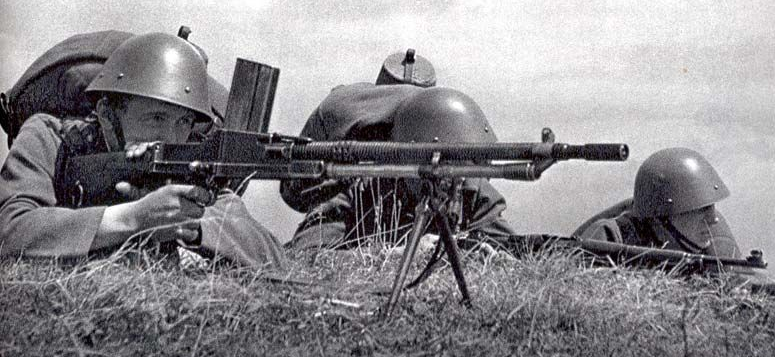
The Czech Zbrojovka Brno – “Brno Weapons” –  works developed a light machine gun in the mid-twenties which served as the starting-point for a new line of design.   The “VZ26” was light enough for an infantryman to haul around…

A VZ26 in Czech service.

…but heavy enough to remain accurate when firing full-automatic, it had one other radical feature; a quick-change barrel.  After a few magazines of sustained fire (interrupted by magazine changes, which slowed the overheating process a bit), the assistant gunner could unlock and (while wearing an asbestos glove) remove the barrel, and replace it with a spare that he carried for the purpose.  If the crew was in heavy action, they could swap the two barrels back and forth, allowing one to cool while the other was firing.

The British Army, looking for a new light machine gun to replace its World War I-era Lewis guns, held trials in the mid-thirties – and the ZB26 swept the field (as it did for armies all over the globe; it still serves, in modified form, in the Paraguayan Army).

The British made two key modifications; they added a handle to the barrel (in case a gunner lost his asbestos glove in the heat of battle), and they rechambered it to their .303 Enfield round – a clunky old round with a rimmed base that necessitated the curved magazine on top.

And, using the peculiar British habit of the day of making new compound words for their weapons, they named it the “Bren” gun – short for “Brno”, where it was designed, and “Enfield”, where it was built in the UK.

The Brits had intended to adopt a rimless round – like the German 7.92 Mauser (which the ZB 26 used) or the American 30.06 – but their staff judged, correctly, that time didn’t permit such a radical change before the war would likely start (they didn’t finally retire the .303 from front line service until 1957).

No matter – the Bren worked just fine with the new round.  They were built in mass lots, and equipped the British Army (and the parts of the Canadian and Australian armies that went into action) by the beginning of the war.

Reliable, relatively simple to manufacture, and ideal for its role – providing covering fire to a squad of 8-12 men as they leapfrogged forward and backward and around enemy positions, the Bren served out the war.

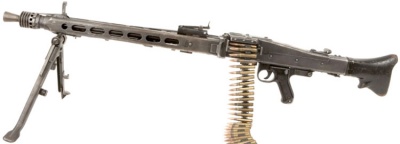
And then, like most “light machine guns”, it was supplanted by the latest military fad.  The German military had dispensed with the separate categories of Heavy and Light machine gun, and generally equipped the Wehrmacht with just one machine gun – the MG34 or, later in the war, the dreaded MG42:

The MG42. Remember the machine gun in “Saving Private Ryan” that fired so fast it sounded like ripping carpet? That’s this one. The post-war German army kept the design, and it serves to this day in the German, Norwegian and (I think) Spanish armies.

That was it. They hung a tripod from the barrel, and issued it to their squads (of 8-12 men) for relatively light close-up covering fire; they’d mount it on a tripod, and issue it to crews of 3 men to haul it and its ammo around as a heavier fire-support weapon for companies of 160 or battalions of 800 men.

The world’s militaries jumped on that bandwagon hard.  When the Brits re-tooled their ammunition and retired the Bren and Vickers guns, they adopted the Belgian FN-MAG as a “General Purpose Machine Gun”…:

The FN-MAG. It serves in most of the western world’s militaries today – including the US, as the M-240, as a company-level support weapon.

…capable of going into the field with a bipod as a squad support gun and a tripod in the weapons platoons of larger units.

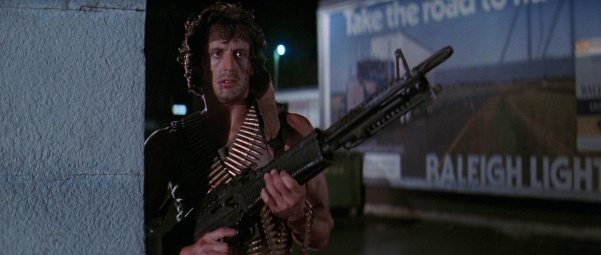
The US adopted the M-60, which served from the early sixties into the nineties, but is probably most famous to non-serving Americans of a certain age range…:

Admit it.

…in Sylvester Stallone’s hands.

But along the way, an interesting thing happened.

During and among the world’s various brushfire wars of the sixties and seventies, infantrymen had a word or two with the world’s military theorists; the “light” version of the General Purpose Machine Gun wasn’t all that light when one was hauling it, a load of person gear, and a few belts of ammo through a jungle, or through the backstreets of Belfast.

And quietly, some of the world’s military units that had the clout to do so (or, conversely, the lack of clout that allowed them to get away with it), went back to the past.  The British military – especially the Parachute Regiment and the Royal Marines – who depended on foot mobility, and needed something lighter than the clunky MAG for use in their rifle squads, quietly pulled the Brens out of the armories, and re-chambered them for the modern 7.62x51mm NATO caliber (same as the MAG and M60), and built some straight-walled magazines, and re-issued the Bren to elements of the British Army that needed a light, light machine gun:

A British Marine, armed with a rechambered Bren, in action in the Falkland Islands in 1982. An MAG gunner is in the background.

And it served in British reserve units through the 1990s, and in reserve units of the Irish army until 2006.

And that bit of tapdancing to fill a need for lighter, handier, but still reliable and powerful weapon at the squad level led to a wave of design of genuinely *light* machine guns, including the US’ modern “M249 Squad Automatic Weapon” – which is another light machine gun.

“But wait, Mitch”, you may say.  “Hot Gear Friday is supposed to refer to hot gear – guitars and firearms, mostly – that you’ve personally used, yourself.  What gives?”

Well, you’re right.  But we’ll be fixing that tomorow, with any luck.  Rumor has it that a .303 Bren is among the pieces for rent at Bill’s Gun Shop and Range – where I’ll be tomorrow for the Shooter Show.  And I’ve been putting away a couple bucks a months since last March, getting ready to light up some targets with it, about this time tomorrow.

There Was A Time…

March 27th, 2015 by Mitch Berg

… when I would’ve probably resolved this situation by advocating a name like “European Conquerors”.

But I have to say, I’m trending towards the “no name” response.

--> Site Meter -->