So the assumption that’s driven a lot of the models regarding the spread of Covid so far has involved the idea that transmission might be “Aerosol” – that the virus might hang suspended in the air for a period of time, until it latches onto a passing human, who might inadvertently ingest it into vulnerable tissue via the nose or mouth.
But what if it’s transmitted most readily by something less persistent, and more predicatable?
Amazing study, supporting droplet (rather than aerosol) as key means of transmission. One asymptomatic person infected 10 (out of 91) at restaurant—but *only* if they were in direct line of air pushed by the A/C. (Aerosol would have infected others, too). https://t.co/j8VXjnWtlNpic.twitter.com/w8yNENCT6M
Note to “Progressive” readers Those are actual scientists.
My hunch – since this theory impugns population density and the “Blue” urban lifestyle to which so much of our chattering class subscribes, it’ll be downplayed.
C-list “celebrity” Patton Oswalt’s profound wisdom was on display over the weekend:
Anne Frank spent 2 years hiding in an attic and we’ve been home for just over a month with Netflix, food delivery & video games and there are people risking viral death by storming state capital buildings & screaming, “Open Fuddruckers!”
I’m going to screenshoot that for the day when an economic collapse (heaven forefend) leaves C-list “celebrities” like Oswalt tossed out of their Los Angeles condominiums, and looking for dishwashing jobs at Fuddruckers.
If they can find one.
If Trump wins this fall, this tweet will be a good chunk of the reason why.
Governor Walz extended the Stay Home order again. But this time, he specifically invites the Legislature to step up. That’s the right thing to do, they should be involved. They should be weighing costs versus benefits.
Now, who will be the first legislator to introduce a resolution to terminate/modify the order?
Joe Doakes
New House GOP Caucus? It’s your time to shine.
(Although in a practical sense it’s gonna have to be the Senate).
World War 2 was an industrial war – the second, and final, war to completely harness the entire industrial might of the largest of the world’s developed nations. All of them – Britain, France, Germany, Italy, Japan, the USSR and, biggest of all, the United States – turned the entirety of their peacetime industrial output, one way or another, toward waging wars for national and cultural survival.
Other nations lent other assets to the various war efforts. Sweden had massive iron ore deposits, Romania, Arabia, Iran and Indonesia, oil in quantities scarcely imagined at the time; China and India had immense supplies of manpower.
And little Norway, with a population scarcely larger than Minnesota even then? With one of the largest coastlines on earth, it had a massive merchant fleet by any standard, even more so measured per capita. Nearly 1,000 merchant ships sailed under the Norwegian flag as the war began – about one for every 3,000 Norwegians.
And without ship, and lots of them, all that industrial capacity – especially in Britain, isolated as it was from all raw materials, and the US, far removed from all the battlefronts – would be utterly useless.
In a war that was lopsidedly decided by logistics, the Norwegian fleet was a weapon of exceptionally disproportionate importance.
As Minnesotans – among whom Covid has taken a fairly minimal toll, in population-wide terms – start to protest the economic toll of government’s response, New Yorkers, who’ve suffered relatively terribly, may be showing the real end-game of the government’s shutdowns – ignoring the whole thing and seeing to their own survival, medically and econmically:
On my “essential walks” which I take daily to the grocery or the bodega, I traverse an overpass above the Brooklyn Queens Expressway. For the past month traffic has been spare, an emergency vehicle here and there, not much more. That too has changed. While it has not returned to the soul crushing bumper-to-bumper standstill that makes the BQE infamous, the number of cars coursing to and from Staten Island has built up everyday.
What is important and telling about the differences in people’s behavior this week is that no city or state government policies have actually changed. The people of New York themselves, and from accounts across the country in other places as well, have simply decided to loosen the guidelines for themselves. We tend to think of the idea of the government existing through the consent of the governed as being about elections, but it is about more than that, the successful lockdown of New York City was not enforced as much as it was consented to.
This phenomenon is something that New York Gov. Andrew Cuomo seems to understand. Cuomo was asked during one of his daily press conferences this week if he is worried that his steady stream of good news about the number of deaths stabilizing instead of increasing and the decrease in coronavirus cases and hospitalizations could give New Yorkers a false sense of security. His answer was basically that he has to tell citizens the truth or he loses his credibility.
Ninety years ago, Prohibition was basically a dead issue by the time Congress got around to repealing the 18th Amendment.
I can easily see that happening with some of the more draconian government responses.
I went online to watch Governor Walz March 25 video explaining why the Stay Home order was required. I think it’s useful to remember why we started down this road.
In the video, Governor Walz explained that if we did nothing, upwards of 74,000 Minnesotans of all ages would die, from 6 months to 90 years old. It was already too late to “flatten the curve;” testing didn’t get started early enough. All we could do was push the peak out, delay it until we could get ready for the surge of Covid-19 cases that the computer model predicted was coming. If we did nothing, the surge would hit in 6 weeks (May 8th). If we did nothing, 2.4 million Minnesotans would be infected, 85% of them mildly, 15% requiring hospitalization, and 5% requiring ICU care.
I’m not clear if Governor Walz meant 5% of the whole 2.4 million = 120,000 people in ICU; or 5% of the 15% who are hospitalized = 18,000 in ICU. Either way, we only had 235 ICU beds at the time of the first order. We didn’t have enough ICU beds, ventilators, masks to care for that many ICU patients. Thousands would die, untreated.
If Minnesotans heeded his order to Stay Home, we would slow the spread of the infection. 2.4 million were still going to get it, but not right away. That gave us time to prepare for the ICU surge. With Stay Home in place, the ICU surge would be delayed until late May or June. By then, we’d be ready for the 120,000 (or 18,000) ICU patients. We’d convert arenas, stadiums, motels, into temporary hospitals providing as many as 1,000 ICU beds. Still had to work on getting ventilators and masks, etc., but if we had enough time to prepare, we’d save lives. Governor Walz asked for two weeks to delay the surge so we would have time to prepare. That’s why the original order lasted two weeks.
I went online to watch Governor Walz video explaining the extension of the Stay Home order. He said we were making progress. The infection curve was pretty much flat. That’s good because it buys us time to prepare for the surge, and there is a surge of hospitalizations coming. We’re going to need a MINIMUM of 3,000 ICU beds starting in mid-May, could last into July, could need more beds.
Current ICU bed capacity at the time of the extension was 1,000 but we can double it in 24 hours, triple it in 72 hours. Another 3,000 beds coming online in alternate facilities but not for Covid patients, those are for displaced patients from other hospitalizations. According to the model, we now have plenty of ICU beds but we’re still facing a shortage of ventilators. We have 2,500, we need 3,000, we have none in reserve, they’re all in use. They’re on back-order. Minnesotans need to stay home to delay the hospitalization surge until the back-ordered ventilators arrive. And there’s still a shortage of masks. Supply chain disrupted world-wide. Minnesotans need to stay home to delay the hospitalization surge until mask supply arrives.
The Governor assured us the experts were constantly updating the model. Ro increased from 2.4 to 4.0 (formerly, we thought each infected person transmitted it to 2.4 people, now it’s assumed to be 4 people, spreads much faster than thought). Hospitalization severity and length of stay also adjusted (didn’t say up or down). If we drop restrictions, the surge of hospitalizations comes rushing toward us and we’re not ready. Thousands will die. Stay Home to save lives.
My thoughts:
The plan originally was sold on the basis that this virus attacked everybody, babies to elderly, we’re all equally at risk of dying from it. Data from around the world (and around Minnesota) suggest that’s not true. This virus attacks the same people as every other influenza virus – seniors and those with a compromised immune system. The scariest basis for the order, is gone.
The plan originally was sold on the basis that a two week delay would suffice, we’d have time to prepare for the surge of cases. Because the whole thing depends on a surge of cases slamming our hospitals in a few weeks. The Governor’s models confidently proved it would happen, we were going to get slammed, it was only a matter of time. Except . . . Dr. Fauci of the CDC now says he expects this to be similar to a bad flu season, maybe 60,000 dead nationwide. And nobody else is seeing a surge. If there’s no surge coming, then the entire basis for the order is gone.
Assuming the surge hits as planned in May, Governor Walz says we’ll need 3,000 ICU beds and we’re ready for that, but still not enough ventilators or masks. No word on why that’s such a problem. If the My Pillow guy can make masks, why can’t Minnesota figure out a way to acquire them? Can’t we ask idled machine shops and metal workers and backyard mechanics to cobble up machines? We only need a couple of thousand more ventilators – how hard can it be? I’m guessing the Governor means “FDA certified and approved” which, obviously, takes time and raises the cost. How many patients would say, “Oh, no, don’t treat me wearing that un-certified mask, leave me to die.” Can’t we by-pass the certification process for this world-ending emergency?
The plan was sold on the basis that we’d be saving lives. The math doesn’t work for me. Assuming the best numbers, if 18,000 will need ICU beds but we only have 3,000, then when the surge hits we’re still short thousands of ICU beds so all of those people are going to die. By my math, the Stay Home saves 2,765 lives (the difference between 235 ICU beds before and 3,000 ICU beds after). And who are those people? Based on experience to date, they’re nursing home patients with preexisting conditions who are going to die soon, anyway.
The cost of providing this end-of-life care is incredible. 375,000 Minnesotans have applied for unemployment. Our unemployment rate is over 11%. And those are only the people who qualify. Small business owners, restaurant owners, landlords, independent contractors, commissioned sales – they don’t get unemployment. The Governor says that with Minnesota’s generous unemployment benefits coupled with the federal $600, many people actually will make as much or more then they did before. I’ll believe that when I see it.
Point is, we’re shutting down the entire state for months, costing millions, destroying wealth and lives and careers, turning citizens against each other, betting a surge is coming and that we’ll be able to buy a short end-of-life extension for a few thousand old folks. That might be a wise public policy trade-off, or it might not. But it’s something that ought to be debated in public, with the costs and benefits weighed, not decided unilaterally and continued indefinitely.
I call on the Legislature to hold public hearings on whether to continue the state of emergency, or to end it.
Joe Doakes
When Norway – as top-down communitarian a state as there is, which had a hard, sharp attack of Covid and a sharper reaction to seeing Italy and Spain’s agony, and closed down hard (and suffered more deaths than Minnesota, so far, with a similar population) – is moving to lift its lockdown now, even given their immense savings and the ability it gives them to ride out crises, that should tell us something.
It was a little over a year ago that Brazil – against the caterwauling of the caterwauling class – radically liberalized its gun laws, which had essentically been Chicago-like since the 1940s.
The caterwaulers said liberalizing gun laws would result in Brazil – whose violent crime rate is about five times that of the US – getting, y’know, violent.
It’s been almost a year. What do you suppose happened?
Comparing changes between available months of 2019 and 2018 shows an average decrease of Total Violent Crime and Monthly Index at 22.25% and 23.04% respectively.
Since 2018 was already a low-crime year compared to 2015-2017, Jan – April 2019 violent crime number indicates that people are better off with the means to defend themselves. Brazil new gun policy is a step in the right direction.
Other than the loosening of gun restrictions, law enforcement taking harsher measures could also contributed to the lowering of violent crime.
It’s not entirely the gun. Nobody said it would be; preserving order is one of government’s few legitimate jobs (if you’re a conservative), and Brazil’s corrupt post-socialist system has been notoriously bad at that for a long time. An armed society without some means of preserving order might turn into the American frontier – or it might turn into South Central Los Angeles, depening on whose will to power gets satisfied.
But, as predicted, it seems to be helping in Brazil.
But the worst side-effects of the Covid epidemic are going to be with us for years.
This was the Raleigh NC Police’s response to a protest against the government’s shutdown restrictions:
And if the people allow this attitude to continue, then they – we – will deserve what follows.
The First Amendment isn’t more important than the broad concept of “order” – but it is certainly more important than the Raleigh PD treats it in this case.
Someone needs to get hauled into court, but good.
The ACLU has been showing some signs of paying attention to actual civil liberties again during this crisis. Here’s hoping.
This is weird – I keep finding these modifications but they’re not mentioned in the media.
Attention Subjects!
His Royal Highness, Timothy Walz the First, proclaims a modification of Executive Order 20-20 requiring Minnesotans to Stay Home.
It has come to Our attention that some of Our subjects are in flagrant disregard of Our proclamations. In one such instance, the violator behaved in a loud, obnoxious, and boisterous manner which aroused anger, alarm and resentment in the Royal Officers who were bravely attempting to enforce Our order. This behavior undermines the legitimate authority of the Crown and threatens public safety. Effective immediately, no subject shall express disagreement with any of Our orders, on pain of immediate and indefinite confinement. As to such persons, the right of habeas corpus is suspended for the duration of the emergency.
Our Attorney General has confirmed that Abraham Lincoln himself set the precedent for this modification, and that it does not infringe the free speech rights of Minnesotans. Subjects remain free to express agreement with Our orders in any form they like: in word, in writing, in artwork or interpretive dance, even poetry. The only restriction is on Hate Speech, which is defined as any speech We hate, and which all decent subjects should hate, too.
Thank you for your attention.
HRH Timothy Walz the First
Just thought you ought to know.
Joe Doakes
I’m sure I’m not the only one that can imagine Keith Ellison re-purposing the Sedition Act…
SCENE: Mitch BERG is out at Menards picking up some shop towels for making face masks out of. While looking around a corner, he runs smack-dab into Avery LIBRELLE
LIBRELLE: Merg!
BERG: Ah, sssssss….sssshure is nice to see you. How are you doing, Avery?
LIBRELLE: You conservatives sure did yuk it up over the Trump Virus spreading through blue cities.
BERG: No, nobody “yukked it up”. But there certainly seems to be a correlation between pandemics and blue cities, which tend to be very mass-transit dependent, and have populations even denser than some of their mayors, like DiBlasio.
LIBRELLE: Hah! Well, red states shall get their comeuppance!
BERG: Perhaps. Epidemics follow biological rules, not political ones.
LIBRELLE: Pffft. Look at South Dakota. Governor Noem refuses to order South Dakotans to stay at home! And now the virus is out of control!
BERG: South Dakota’s case rate is very heavily skewed because of a big outbreak at a pork processor in Sioux Falls, which has skewed the state’s cases per million waaay up; as of April 14, South Dakota had 1,142 cases per million; Minnesota has 307. But that’s very skewed – South Dakota doesn’t have a million people, so an outbreak causes a disproportionate jump in per capita numbers.
LIBRELLE: Not issuing draconian stay at home orders kills!
BERG: Enh. South Dakota’s death rate per million is 7, which is half Minnesota’s rate. Both of those will change, especially if the cases in Sioux Falls manage to overwhelm the region’s healthcare system…
LIBRELLE: Oh, you and your God and thoughts and prayers. Science! It shows governors need to put their foot down!
BERG: North Dakota, which has about the same population and population density as South Dakota and has taken a similar set of approaches to the epidemic, but which has no outbreak like the Smithfield plant, has statistically similar cases and deaths per million as Minnesota with Governor Walz’s much more draconian approach. And yes, the outbreaks have been going on about the same length of time in all three states.
LIBRELLE: MERG! If Governor Noem hadn’t been a stupid red-state governor and issued a stay at home order, the Smithfield outbreak wouldn’t have happened!
BERG: So what kinds of businesses are exempt and “essential” under the MInnesota shelter in place order?
LIBRELLE: Essential stuff like grocery stores, liquor stores, Democratic political action groups, medical stuff…
BERG: What do they do at that Smithfield plant?
LIBRELLE: I don’t know. It’s South Dakota. I have no idea. Aren’t they Amish? I’m gonna guess Amish furniture.
BERG: It’s a pork processing plant. Where exactly do you think the food that the grocery stores sell, comes from?
LIBRELLE: Amazon!
BERG: Yeah, food processing plants are pretty much open everywhere…
( But LIBRELLE has skipped away, pushing a cart full of plastic bags to use as make-shift head coverings).
So among all the bad news about the pandemic, it seems there is a silver lining: the administrations in Minneapolis and Saint Paul are being forced to stop playing Sim City with real money and people, and actually do he things city governments are supposeed to do.
Or, well, try. Emphasis added by me:
In Minneapolis, meetings to discuss the hotly debated Upper Harbor Terminal redevelopment have been postponed. Discussions about millions in funding for neighborhood organizations and reimagining the city’s transportation networks have been pushed to the summer.
In St. Paul, the pandemic prompted the city to postpone public hearings on a tenant protection ordinance and a ban on conversion therapy. A community meeting on the future of Ayd Mill Road was canceled and replaced with an online video.
The coronavirus is causing a major slowdown for the two cities, which have in recent years raised the minimum wage, overhauled zoning and made other changes consistent with a progressive policy agenda for workers and the environment. Now, they’re scrambling to find ways to meet the immediate needs of struggling residents while protecting their own workers.
In bold, you almost literally see a shopping list of “progressive” virtue-signals – gone (until the spigot turns back on).
I’ve said it for years – especially since the Walking Dead was the most popular show on TV: catastrophe makes everyone a conservative, one way or the other.
“It’s nice to want to change the way things happen, but we don’t have the luxury of promoting change at this point,” said Minneapolis City Council Member Lisa Goodman. “We have the responsibility to make sure we provide the basic services of the city.”
And, when conversations on those more ambitious goals resume, they won’t look the same.
And one can hope that the people of MInneapolis and Saint Paul, when they see how badly the Cities take care of the basics after a decade of no practice, react to that change in the “conversation” by changing the way they’re governed.
Likely? Absolutely not. But if we don’t have hope, why bother?
Found another modification of the Governor’s Stay Home order, set for release later this week:
***
Subjects! His Royal Highness, Timothy Walz the First, proclaims a modification to Executive Order 20 – 20, requiring Minnesotans to Stay Home.
Our computer models demonstrate conclusively, with scientific accuracy heretofore unknown, that 2.5 million Minnesotan would would die if We allowed them to go to the polls for elections in November. Our highest duty is to preserve the lives of all Minnesotans; therefore, We have regretfully suspended elections for the duration of the emergency. All office holders will continue in office until elections can be scheduled, hopefully within the next five years.
We realize this is an unprecedented step, but Minnesota faces an unprecedented situation. We respectfully request voluntary compliance, and are establishing concentration camps in the northern portion of the state for saboteurs, wreckers, kulaks, and resisters.
Six years ago, Bloomberg News killed an investigation into the wealth of Communist Party elites in China, fearful of repercussions by the Chinese government.The company successfully silenced the reporters involved. And it sought to keep the spouse of one of the reporters quiet, too.
“They assumed that because I was the wife of their employee, I was the wife,” the author and journalist Leta Hong Fincher tells NPR. “I was just an appendage of their employee. I was not a human being.”
Read the whole thing.
The report comes from NPR. One would hope that that was due to actual journalists reporting an actual story.
It’s a steroetype of “blue” America – at least, the “elite” version of it that gets (and makes) the headlines – that liberty, at least the kind that involves something other than waving one’s genitals about and dunking crucifixes in urine – terrifies them.
Stereotypes exist for a reason. Blue Amerca’s official vision is that liberty is a scary thing. Of course, this vision is broadcast by an “elite” that thinks they stand to benefit from living in a society where an elite – including them, natch – makes the trains run on time.
The senators wrote that “local journalism has been providing communities answers to critical questions, including information on where to get locally tested, hospital capacity, road closures, essential business hours of operation, and shelter-in-place orders.” Recent media reports indicate that local news organizations, especially newspapers, are “slashing staff and publishing less frequently as the already-battered businesses try to weather the COVID-19 storm.” According to the letter, some “local papers and local broadcasters have lost even more of the advertising revenue they rely on from these businesses” due to the coronavirus pandemic.
So have barber shops, mechanics, tobacco stores, comic book shops and every other small business in every other small non-metro town in the states affected by the draconian shutdowns.
None of them, as an industry, earns their keep by serving as the Democratic Party’s PR firm.
Hence, Public Broadcasting “qualified” for $75 million of the 2.2 trillion in Covid bailout money, while most small businesses are waiting for their allotted handouts; none of them participated in burying a single story about a single Democrat. What use are they?
Just came across this announcement, haven’t seen it in the media yet:
Attention citizens. Governor Walz has announced a modification of Executive Order 20 – 20, requiring Minnesotans to Stay Home.
Our computer model indicates the people most likely to catch the Covid-19 virus and use precious hospital resources, have an existing co-morbidity, specifically, obesity. In order to reduce the likelihood of overwhelming our hospitals with Covid-19 patients, we must reduce obesity.
Effective immediately, all Minnesotans whose body mass index is greater than 29 are hereby declared “obese” and must immediately go on a diet. Health care providers will be required to forward medical records to the state for analysis and classification. No person may sell, lend or give high-fat, high-calorie foods to individuals categorized as obese. People attempting to eat fattening sweet foods will be arrested and jailed, where the diet can be enforced.
If you suspect your neighbor is obese and may be hoarding high-fat, high-calorie foods, call the tip-line. Police will be dispatched to search their home for prohibited foods and you may be eligible for a reward.
We realize this is an extreme measure, but we’re an extreme situation. We appreciate your help.
We’re into month two of the “State of Emergency” in Minnesota.
Let’s stipulate in advance – government does have emergency powers, and should have them, at least as a broad concept. One of government’s few genuinely legitimate roles is to exert its power to react to things that are beyond the power of the individual, or (rarely, at least in theory) subsidiary levels of government; invasions, natural disasters and, yeah, epidemics. We can argue the “should government have emergency power” question if you’d like, but it’s pretty much the status quo.
One of the obligations of a free people – and especially of a free people that wants to stay that way – is to push back when government overreaches. Not just in emergencies (although that’s the subject today), but always, on every facet of liberty. Conservatism holds that order and liberty exist in a constant state of tension; without order (or health) prosperity is impossible; without health, freedom is academic (subsistence farmers don’t have time to petition for redress of grievances); without freedom, order is onerous and, let’s be honest, prosperity is most likely concentrated among those keeping the order.
Government power, like a handgun, is a necessary tool in extreme circumstances. And like any necessary tool, free people need to make sure that the newbie isn’t sweeping people at the firing range with her hand on the trigger, and that goverment isn’t getting drunk and profligate with its use, or abuse of power.
And I think we can make a pretty solid case that Governor Walz’s emergency declaration does exactly that.
First – Covid clearly is an emergency. There is a valid public health reason to treat it as more than just the flu. But the record shows different states taking very different approaches to the emergency, and with very different results; New York State went full-on Mussolini, but between having one of the most densely populated cities in the country and being run by bungling clowns like Bill DiBlasio, it didn’t work; California also went full-on tyrant, but it seems to be working. Other states went the other way; in the Dakotas and the rural west, it seems to be working out fairly well, while in Louisiana and Florida, the libertarian approach (combined with a lot of ill-advised, Italian-style revelry in the face of the threat) didn’t pan out so well.
Minnesota has trended more authoritarian. I get the rationale. But let’s be honest – even if you ignore the ham-handedness of the administration’s management of information (of which more later in the week), it’s fair to say the Governor and his Administration have clobbered civil liberties while reacting to the crisis – in many cases, wrongly.
So lets put together a list of the usurpations:
Life and Liberty
While the movement restrictions in Minnesota are fairly benign so far – serving more as a muted threat than an active clampdown – the idea of telling people not to go to their lake cabin (i.e., trying to prevent people from moving temporarily from a place of high desnsity and greater vulnerability to someplace safer) is an intrusion. And Mayor Frey’s active use of the police to curtail traffic isn’t just a muted threat.
The ability to visit family, especially in hospitals and nursing homes. To be fair, in many cases this is a private response to the epidemic – it’s why I can’t see my mother, notwithstanding the fact that her husband of nearly 30 years just died – but it’s driven by the response to government regulations and the litigiousness that government regulators have promoted.
We’re paying for a lot of government “services” of dubious value in the best of times, that we’re not getting at all today.
The Pursuit of Prosperity
Here, the DFL’s disdain for business and private property rears its head, above and beyond any actual response to the epidemic.
The right to transact business is clearly subject to arbitrary, and in some cases seemingly capricious, interference. Small businesses are shut down (as big ones, and business with more, better lobbyists remain open), in many cases without regard to the business’ actual susceptibility to the virus (lawn services? Landscapers? They’re pretty socially distant to begin with). Arbitrarily shutting down businesses regardless of their own instincts for self-preservation, ingenuity and ability to achieve some resiliency against the epidemic (like all the small grocery stores turning their lanes into one-way thorofares) qualifies as a taking in my book. Classic example – liquor stores are “essential”, but vape and smoke shops aren’t. It’s best that your vices not be politically unfashionable.
The assignment of “essential” status was clearly utterly politicized.
While it seems an act of charity, and might even be justifiable, barring all evictions and foreclosures is certainly an arbitrary taking without some sort of compensation. The idea that
Contracts are pretty much irrelevant – business are foreclosed by decree, in many cases, from fulfilling them, and the courts are closed for purposes of arbitrating the results.
Government Transparency
The Administration is making huge, life-altering decisions about the economy based on a model that seems to be giving very different results than most other models, and whose proprietors are keeping secret for the most paternalistic of reasons: “On Friday, [State health economist Stefan] Gildemeister said he had concerns that models that let anyone use them might be “irresponsible” because “it allows folks to make assumptions that aren’t very realistic ones.” While “transparency” isn’t necessarily a constitutional issue, the idea that state bureaucrats treat the math and code that they created on our dime like something they have to prorect from a bunch of drooling savages should make every freedom-loving citizen hot under the collar, and ready to vote a whole lot of scoundrels out of office in seven months or so.
The legislature, already prone as it is to operating as a “star chamber” with the Governor, Speaker, and the two Majority Leaders, has gotten even less transparent than before; online gatherings (kept just below legal “quorum” status) have been substituting for public committee meetings; policy is being made completely absent public scrutiny.
The governor’s “press only” press conference Friday – if that doesn’t bother you, what does?
First Amendment
The banning of group gatherings of all kinds – as opposed to pushing for voluntary enforcement of containment and distancing – pretty much forswears all protest against government overreach.
The enforced closing of places of worship – as opposed to strongly suggesting people wear masks, stay at home if sick, and observe spacing between family groups in services – is a clear violation of freedom of religion.
While closing places of worship by decree is onerous, many churches – including my own – closed voluntarily. But there are aspects to faith – Sacraments like Last Rites, Baptism and Confession, for Catholics, and there are many others in other faiths – that must be done in person, and where remote exercise is banned as a matter of doctrine. I’ve been informed of cases where priests have been barred from hospitals; no avenues left open for the administration of such Sacraments, whether through prudent adaptations (priests in masks and PPE, isolation rooms, whatever) or not. One administrative size fits all, whether talking about an ad agency or a church. This – not just the closing down, but the forbidding of any adaptation – has to be a clear violation of the First Amendment.
Freedom of assembly? Do I even need to say it?
Along with that – the right to petition for the redress of grievances, private or public, is pretty much toast until the courts decide to start meeting again.
Second Amendment
Many counties are curtailing the ability to apply for, or renew, carry and purchase permits.
The operation of the ranges necessary for taking permit training is pretty much shut down.
Thanks to a law passed by a bipartisan majority in 2015, government in Minnesota can’t confiscate guns, or shut down gun stores unless literally every other business in the state is closed, due to a state of emergency. This was an admirable bit of foresight – it doesn’t take a vivid imagination to see Jacob Frey, Melvin Carter and Kim Norton (frothing anti-gun ninny mayor of Rochester) sending their cops door to door in times like this. More on this later.
With the courts pretty much closed your right to a speedy trial by an impartial jury is pretty much toast for the duration.
And the closing down of the Judicial Branch offices give defense attorneys – who, unlike prosecutors, have no online access to Judicial Branch records – a serious disadvantage in prepping for cases for when they can get to trial.
Privacy
Government is using your cell data to track the effectiveness of social distancing. While we’re assured that government and the big cell providers they’re in bed with aren’t mis-using that data, we all know that’s only as safe as the government’s least ethical employee.
Got more (specific to Minnesota, for now)? Leave ’em in the comments, please.
I gave the example of Minnesota’s gun rights movement’s successful drive to foreclose government’s ability to confiscate firearms and abrogate the 2nd Amendment during crises. Gun Rights groups in Minnesota are big, well-organized, and badly funded (you can sure help out) but make up for it in volunteer action and the justice of our cause.
The lesson, though? Minnesotans need to get together in the same way to put stronger guard rails on the other excesses of government emergency power we’re seeing.
Joe Doakes from Como Park tries his hand at one of my patented dramatizations (c):
Mitch Berg is walking through Menards, looking in vain for dust masks so he can sand the Sheetrock repairs where he was banging his head against the wall after reading Penigma’s email, when he sees Avery Liberelle wearing a giant hula hoop hung from strings over her shoulders. He tries to slip into the nuts and bolts aisle, but she sees him. Avery: Merg! Berg: Uh, hi Avery. What’s with the hoop? Avery: It’s my social distancing perimeter. Why aren’t you wearing yours? Berg: Uh . . . Avery (darkly): Everyone should wear one. My aunt died of Covid-19: so they said.
Berg: (clicks his tongue sympathetically)!!!
Avery: (in the same tragic tone) But it’s my belief they done the old woman in.
Berg: (puzzled) Done her in?
Avery: Y-e-e-e-es, Lord love you! Why should she die of Covid-19? She come through diphtheria right enough the month before. I saw her with my own eyes. Fairly blue with it, she was. They all thought she was dead; but my father he kept ladling gin down her throat til she came to so sudden that she bit the bowl off the spoon.
Berg: (startled) Dear me!
Avery: (piling up the indictment) What call would a woman with that strength in her have to die of the bat flu? And what become of her new straw hat that should have come to me? Somebody pinched it; and what I say is, them as pinched it done her in.
Berg: (to Avery, horrified) You surely don’t believe that your aunt was killed?
Avery: Do I not! Them in that nursing home would have killed her for a hat-pin, let alone a hat.
Berg: But it can’t have been right for your father to pour spirits down her throat like that. It might have killed her.
Avery: Not her. Gin was mother’s milk to her. Besides, he’d poured so much down his own throat that he knew the good of it. (To Berg, who is in convulsions of suppressed laughter) Here! what are you sniggering at? Science denier! (Avery stomps off, knocking things off the shelves with her hoop). End Scene Joe Doakes
Not immigration status. Heavens, no. That’d put a “chlling effect” on their lives.
But letting them know if they have Covid?
Under Walz’s order, the Minnesota Department of Health (MDH) will share the addresses of COVID-19 infections that are still contagious with the Department of Public Safety (DPS), which will distribute the data to 911 dispatch centers. Dispatchers will share information with first responders called to one of the addresses.
The order goes into effect immediately and lasts the duration of the state of emergency declared by Walz.
The virus had infected 1,336 Minnesotans as of Friday and killed 57.
“This decision is not taken lightly,” said Walz’s Friday order. “…We must implement safeguards to ensure that no one abuses this data.”
Meaning: we need safeguards – but the policy is in effect anyway. Feel better?
You know me – always looking for the silver lining. Maybe this is it – the ACLU is actually fretting about civil liberties again:
The American Civil Liberties Union (ACLU) of Minnesota has opposed sharing the data, noting that it won’t prevent infection because the count of positive cases is underrepresented due to a shortage of tests.
And boy howdy, do I ever wanna take a Covid test, so I can get a big scarlet “C” on my lapel.
Jim Fleming – a lawyer and good acquaintance – wrote on Facebook (and I’m quoting with permission):
“Well, the CDC says . . . .”
Every time someone starts a discussion with me, using this language, I steel myself against the loss of good humor. I do not trust the CDC. Period. Why? Because it is primarily a political organization, which sings the song of those who feed it the most bread. Proof?
Well, try this. In 1995 Criminology Professors Gary Kleck and Marc Gertz, published the 1993 National Self-Defense Survey that argued that Americans use firearms to defend themselves (from display gun – no shooting to pull gun and actual shooting with fatal effect) on the order of over 1 million times each year. (Actually they said more likely two to three million times per year).
Of course the anti-gun lobby went absolutely batshit crazy and numerous attempts were made to discredit Kleck and Gertz. Results? Lions – about 11, “Christians” – 0. Kleck and Gertz repeated their studies several times with the same results. Numerous studies attempting to discredit them, were unsuccessful. The part the CDC played in all of this?
“In 1996, 1997, and 1998, the Centers for Disease Control and Prevention (CDC) conducted large-scale surveys asking about defensive gun use (DGU) in four to six states. Analysis of the raw data allows the estimation of the prevalence of DGU for those areas. Estimates based on CDC’s surveys confirm estimates for the same sets of states based on data from the 1993 National Self-Defense Survey (Kleck and Gertz 1995). Extrapolated to the U.S. as a whole CDC’s survey data imply that defensive uses of guns by crime victims are far more common than offensive uses by criminals. CDC has never reported these results.” Forbes magazine, April 2018, author Paul Hsieh..
Now, in 2013, Father Obama (the smartest man in the world – just ask him) yet again ordered the CDC to conduct a study and this time “get the numbers right!” So, eating the bread and clearing its throat to sing, the CDC ordered The National Academies’ Institute of Medicine and National Research Council to conduct the survey. They did, and they came back and reported that, “Defensive use of guns by crime victims is a common occurrence”: Matching the results found by Kleck and Gertz, lo those many years before. “Almost all national survey estimates indicate that defensive gun uses by victims are at least as common as offensive uses by criminals, with estimates of annual uses ranging from about 500,000 to more than 3 million, in the context of about 300,000 violent crimes involving firearms in 2008.”
Obama was outraged, primarily because he was going around telling everybody that it was not true. So,he ordered the results buried. (In the old days, they simply killed the report writers to silence their tongues, but modernly that is frowned upon) And the results were buried, from that day forward, until recently.
Moral: Just because officialdom spews a line of bullshit at you, does not, in any way, mean you have to lap it up like mother’s milk. Being an American, patriotically vigilant about liberty and justice for all, is hard goddamned work. It requires objective, critical thinking, every day. The herd cannot and will not do this. Those who do not run with the herd get really good at it.
Don’t be part of the herd. . .z . . .
We’ve got an awful lot of people in this country – including way too much of the media – who think “guy in a white coat” = “science” – and, by extension, “political appointee boss of guy in white coat” – “science”, too.
And the terrible job out schools do at teaching critical thinking is going to be an even bigger problem in 20 years than it is today, as all those Sander/AOC/Omar supporters become the generation that actually controls things.
…but we can afford to send a kid to blow the leaves off the sidewalk around the Rec Center, which is closed because we are all staying home for fear of $1,000 fine. Joe Doakes
Kevin Williamson puts it well: Politics (in the larger sense – settling society’s matters by means of voting) is the least effective means of allocating resources there is.
Ten years ago, First Ringer and I did a series of anniversary stories about major events in World War 2. I’m re-running, and updating, them on their 80th anniversaries.
It was seventy years ago today that World War II came to Norway and Denmark.
As with the previous episode in this series, the Invasion of Poland, history has spawned all kinds of myths about this campaign.
Norway and Denmark, like many other smaller European nations, had actively embraced the idea of neutrality as their best defense against huge potential enemies like Germany, the USSR and, believe it or not, France and the UK. Indeed, that was what “neutrality” meant, in the full legal sense of the term, for countries that embraced it; they could not distinguish between liberal democracies like Britain and fascist dictatorships like Germany; they had to treat all nations as the same, and all belligerents in a war as equally culpable.
This, believed the Danes and Norwegians, was their best shot at avoiding war; taking absolutely no side in the conflict.
And it’s one of histories great accidents that in Norway’s case it didn’t turn out to be true, at least legally. Winston Churchill noted that much of the steel that ran Germany’s war machine came from iron ore mined in northern Sweden, and exported via train to Narvik, Norway, and thence shipped to Germany. Churchill hatched a plan; to send a brigade of British soldiers to occupy Narvik first, and work out the diplomatic details with the Norwegians later. And so in the days leading up to April 9, 1940, the British embarked a brigade of infantry onto a couple of cruisers and got ready to send them to Norway.
The Germans got there first.
They had engineered a pretty elaborate surprise attack; they put most of their troops on warships, fast cruisers and destroyers, rather than on regular transports and landing ships. They also staged the world’s first major airborne assault, sending the paratroopers (Fallschirmjäger) to capture Norway’s major airport and, they hoped, King Håkon and his cabinet.
King Håkon VII
The German surprise attack wasn’t a complete surprise; British intelligence got some word out in advance. A Polish submarine, the Orzel, which had itself escaped the conquest of Poland only eight months before, sank a transport off Lillesand, and a British sub damanged a cruiser full of troops. And one group of German ships encountered the Norwegian patrol boat Pol the night before the invasion, as the ships were staging to launch their assaults in the morning. They sank the Pol, whos captain became the first fatality of many the next day.
But it was a home-field game for the Germans; Denmark was on their own border, and Norway was much closer to Germany than to the UK or France.
Despite the three naval actions the day before, the word was slow in getting to the governments in London and Oslo; the Norwegian government, realizing they had no hope of preserving peace, ordered an alert – which, being far too late, did little good – and started packing up the nation’s gold reserves (which did succeed).
And so on the morning of April 9, a coordinated six-point assault with elements of six infantry and mountain divisions simultaneously invaded the six most important cities in Norway. Two German battlescruisers carried elements of a Mountain Division to Narvik, well above the Arctic circle, destroying two of Norway’s ancient “battleships”, the Eidsvold and the Norge, leaving a few dozen survivors out of crews totalling 300 men. Other ships landed troops at Trondhjem, Bergen, Kristiansand and Egersund; the biggest detachment sailed up Oslofjord to try to capture Oslo, link up with the paratroopers, and try to decapitate whatever command and control Norway had.
German tanks land in Oslo
And so the Germans essentially drove into Denmark, and debouched from ships and planes into Norway. The Danes, having a tiny military, indefensible terrain, and no real chance at defense, worked out an armistice quickly that enabled them to keep at least some small degree of autonomy under German rule – which would hold for the next couple of years.
For the most part, the strikes on Norway went off with surgical assurance and with little overt resistance; Norway had nearly disbanded her military, and had only very recently realized that pacifism needed some form of defense; they’d begun building a few new destroyers (to replace vessels commissioned in the 1890s), and bought fighter and anti-submarine planes from Britain and the US – although by April 9, only 12 British-built Gloster Gladiator biplanes were combat-ready.
A British-built Gloster Gladiator, flown by Lt. Dag Krohn.
All 12 were destroyed by the end of the first day – although not before shooting down several German planes full of paratroopers first.
But for the key part of the German plan – the capture of King Håkon, his cabinet, the Storting (Parliament), the gold reserves and the legitimate government of Norway ? The wheels came off, unpredictably, bright and early.
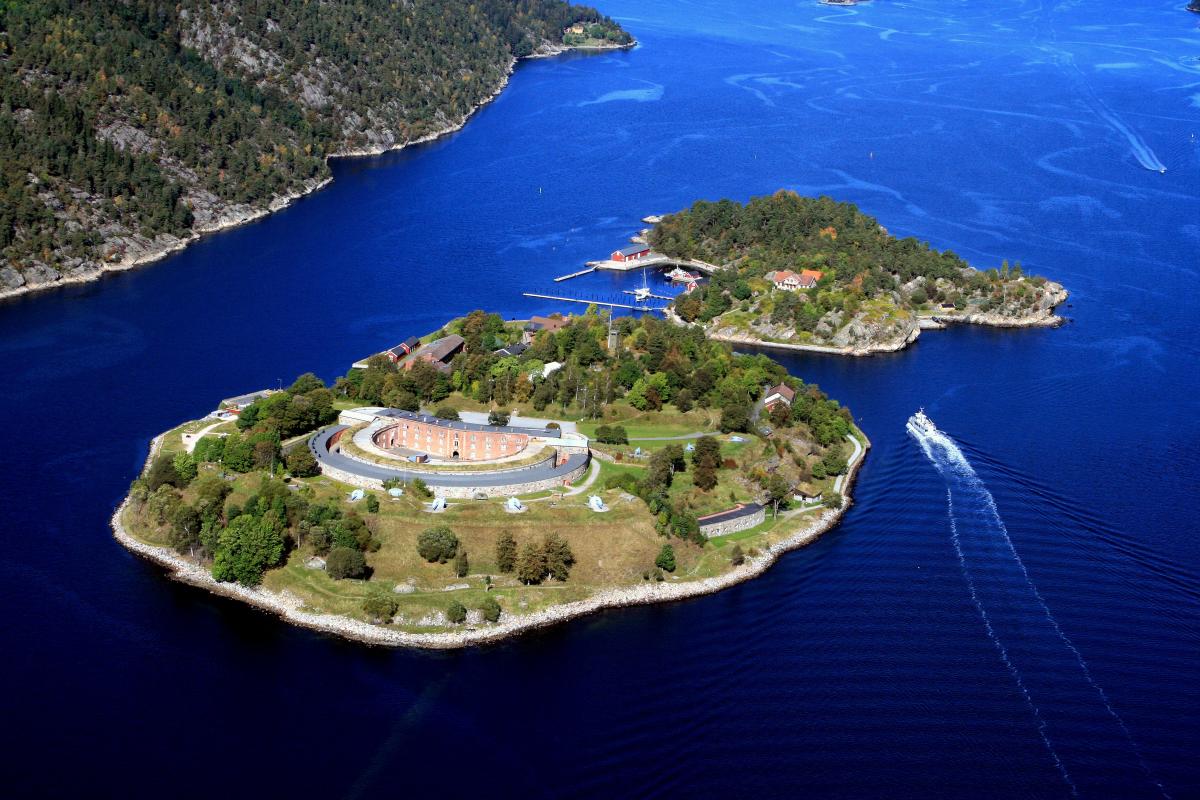
The biggest of the German invasion forces stormed into Oslofjord on the morning of April 9. Lead by the heavy cruiser Blücher, the force included two other heavy cruisers, three destroyers, and eight other ships crammed with German infantry. Norway had very few formal defenses – but the Oscarsborg fortress, sitting in at a narrowpoint in the fjord, was one of them. The commander of the fortress, Colonel Birger Eriksen, sensing trouble, had put his troops on alert on his own initiative, disobeying an order to stand down.
Oscarsborg Fortress, in Oslo Fjord. Today the fortress is preserved – its barracks are now a hotel. You bet your life it’s on my agenda when I finally get to Norway.
And at 5:15AM, his searchlights illuminated Blücher; his fortress’ main battery, two 11-inch cannon that’d been installed in 1892, engaged the cruiser.
One of the two Oscarsborg 11 inch guns.
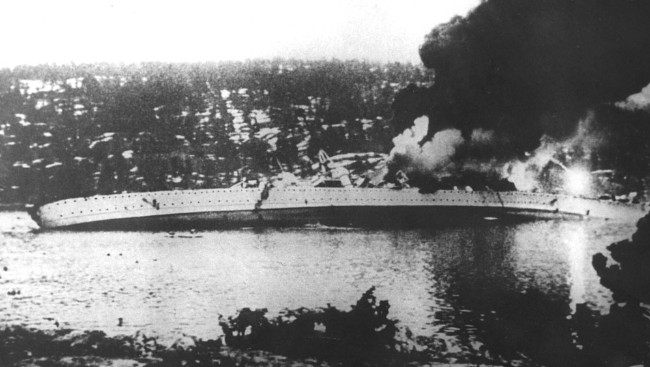
Two hits blew a turret off of the cruiser, and forced it to stop – leaving it a sitting duck for an 1890-vintage torpedo, fired from a glorified log flume on shore, which caused Blücher to tip over on its right side and sink, ablaze, killing 1,000 sailors and soldiers, including many specialists and administrators who were to take over the running of the Norwegian government.
Blücher, ablaze, capsizes in the Drobak narrows
This blocked the fjord, preventing the force from getting to Oslo long enough for the King, Cabinet, Parliament, and the gold supply to evacuate.
The Germans needed Håkon and his Cabinet; if they could be captured and induced to capitulate, it would mean that Germany controlled Norway’s legitimate government. And so they sent an elite force of paratroopers in a convoy of commandeered civilian trucks to try to intercept Håkon’s convoy as it fled into the interior.
And so Håkon and his government managed to escape into the interior, where they led Norway’s tiny, hardscrabble Army in resistance for nearly two months, before evacuating from Tromsö aboard a British cruiser on June 7.
Norway thus became the only country conquered by Hitler to never surrender to the Nazis. Håkon, leading Norway’s legitimate government (no country ever recognized, even by the dubious standards of world diplomacy, Vidkun Quisling’s puppet regime) at the head of over 20,000 troops in exile, 50,000 troops in the underground, and the 22,000 men and hundreds of ships of Norway’s merchant marine.
It was five years to the day later that Håkon returned to Norway at the head of his military (escorted by the US 99th Infantry Battalion, made up of Norwegian-speaking GIs from Minnesota, the Dakotas and Michigan) in 1945.
———-
As I’ve done throughout this series, I’m here to debunk myths.
There are several in re the war in Scandinavia.
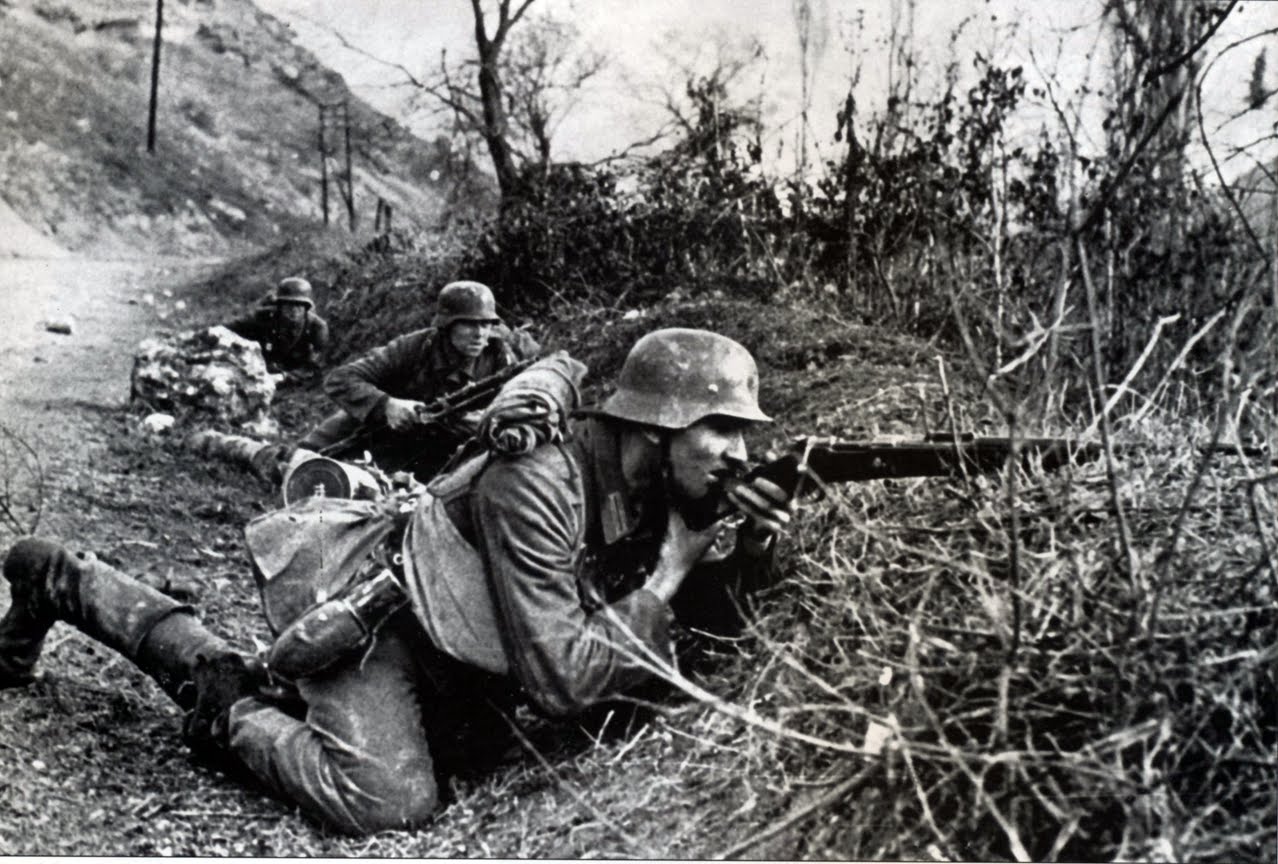
No Pushover: While the popular history has it that Norway rolled over quickly for the German attack, the fact is that not only did Norway never surrender (as noted above), but the campaign became a bit of a quagmire, at least initially, for Germany. The initial invasion used six divisions and parts of a seventh, and still couldn’t conquer the whole country.
German troops, under fire from Norwegian troops in rural Norway.
To make matters worse for the Germans, the British expeditionary force originally slated to invade Norway ended up arriving in Narvik after the Germans – to be seen as liberators and rescuers. The British navy task force delivering them, led by the battleships HMS Warspite, wiped out the German naval force at Narvik, including ten destroyers – a blow from which the German destroyer force never recovered throughout the war.
German Berndt von Armin, wrecked at Narvik Fjord
The Allied ground force – including British, French, Norwegian and Polish-Army-In-Exile forces – drove the Germans out of the city, and held until evacuated in June. The Norwegians operating outside Narvik, under General Fleischer, delivered the first tactical defeat suffered by the German Army in World War II.
Polish “Podhalanska” mountain troops with German POWs at Narvik
Farther down-country, the Norwegians – again, mostly gun-club “reservists”, with French and British troops in support- delayed, and then halted, the German advance up-country during the campaign around Namsos, which was finally overcome only through the lack of Allied air support and, finally, the fall of France.
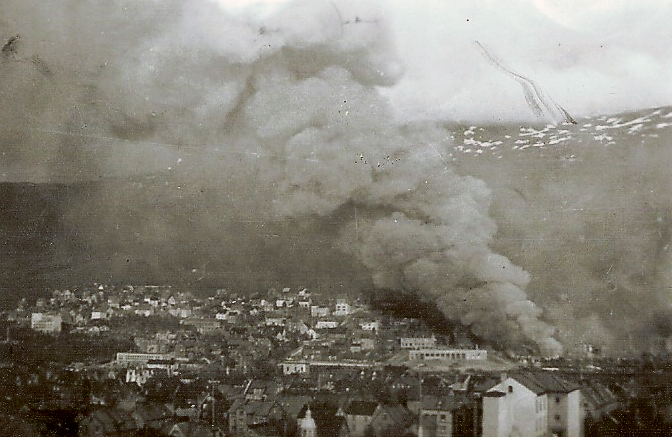
As the quagmire dragged on, the Germans got desperate, carrying out terror-bombing attacks on Nybergsund, Andalsnes, Molde, Elverum, Kristiansund, Namsos and Narvik.
Narvik blazes after German terror bombing
The last Norwegian army unit fighting in Norway didn’t cease organized resistance until June 10; Norway resisted longer than than of any of Hitler’s other conquests.
June 7, 1945: Crown Prince Olaf returns to Oslo. His bodyguard is noted Norwegian commando Max Manus – about whom more soon.
Resistance: Tens of thousands of Norwegians escaped Norway; fifty thousand more fought in some capicity or another in the Resistance. The Milorg achieved some spectacular successes, including the destruction of the German “Heavy Water” supply during the Vemork raid. Germany stationed a total of eighteen divisions in Norway on occupation duty during the war – partly testament to the importance of Germany’s bases, which supported U-boat and air raids on convoys crossing the Atlantic and especially those supplying Lend-Lease supplies to the USSR – and also to the effectiveness of Norway’s resistance. It was the highest ratio of occupation troops to civilians anywhere in Europe.
Denmark resisted as well; indeed, given the more difficult terrain, the Danish resistance was especially crafty, adaptible and ferocious. And both nations pulled off the incredible; during a three-week stretch in 1943, the Danish resistance managed to smuggle 86% of Denmark’s Jews to safety in Sweden, after word got out that Hitler was about to abrogate the terms of Denmark’s armistice and round the Jews up for extermination.
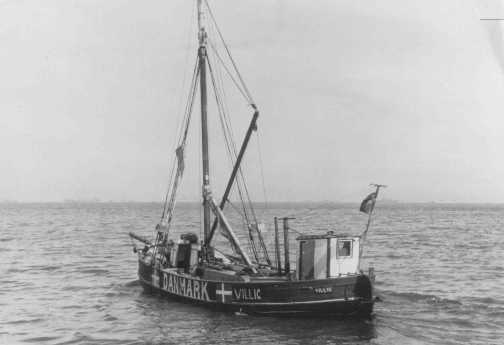
Danish fishing boat en route to Sweden with a hidden cargo of Jewish refugees
Norway similarly got 75% of its Jewish population smuggled to Sweden, albeit in less dramatic fashion. Both nations’ resistance groups are listed collectively among the “Righteous Among Nations” at Yad Vashem.
Exile: Among the Norwegians and Danes who escaped to fight onward, many distinguished themselves. The Canadian government, using airplanes Norway had bought from the US but were not delivered, set up a training base for Norwegian pilots, “Little Norway”, near Toronto. The Norwegian pilots served with distinction; 331 and 332 Squadrons, flying Spitfires, became among the highest-scoring squadrons in the Royal Air Force late in the war, flying air cover over the Normandy invasion, the liberation of Holland, and the crossing of the Rhein River.
A row of 331 Squadron Spitfires at North Weald airfield. The squadron’s letter code “FN” was random – but happened to coincide with the squadron motto, “For Norge” – For Norway.
At sea, Norway’s huge merchant fleet was a huge part of the Allied effort to first keep Britain from starving, and then to support the invasion and liberation of Europe. Beyond that? Norwegian crews on British-built torpedo boats and gunboats, and two British-built submarines – the Uredd, lost in a minefield, and the Ula, which sank more enemy tonnage than any other Allied submarine in the Atlantic during World War II – vexed the occupiers up and down Norway’s long coastline.
HNoMS Ula, highest-scoring Allied submarine in the Atlantic in WWII.
Lessons Learned: Norway has always had a reputation for big-L “liberalism”, which it passed on to its descendants in Minnesota.
But it learned its lesson, too. During the Cold War, when faced with an enemy historically even worse than Hitler (remember – Norway and Turkey were the only NATO nations to share borders with the USSR), they backed up their innate pacifism with a big stick.
NNoMS Kobben, which spent the Cold War watching Soviet ships and prowling the fjords.
Although the nation has about the same population as Minnesota, it built up a sizeable navy to defend its long, craggy coastline from invasion – and turned virtually its entire male population into an army. Norwegians served in a system similar in many ways to that of Switzerland and Israel, keeping their weapons at home, ready for the worst. The nation’s military was trained for guerilla warfare; a hypersecret branch of Norway’s special forces spent the Cold War years building the infrastructure to make another occupation of Norway a horrible and bloody thing for the next round of enemies.
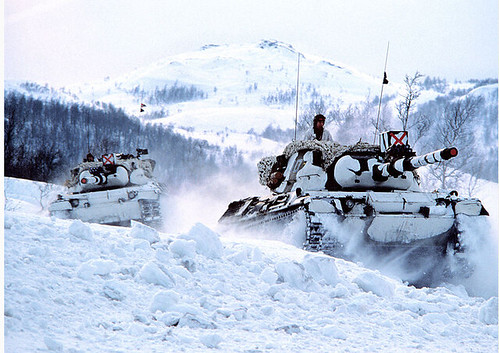
Norwegian Leopoard tanks on exercises in the Telemark, 1982.
For it’s part, the Danish military after World War II developed a reputation for fierceness; Danish troops serving in Bosnia/Herzegovina were reportedly among the most aggressive in smacking down Serb aggression. It’s worth noting that Danish special forces – the Jaegerkorpset, among the most admired special opertions forces in NATO – accompanied the US in its initial invasion of Iraq, along with those of Poland, another nation that had learned the hard way that freedom needed fierce defense.
As we confront our nation’s own tribulations, we’d do well to remember the examples of the people of Norway and Denmark.
Update 2020: A few years of genealogy have given me a deep appreciation of the era; my great-grandfather’s hometown was a conduit on the route from Norway to Sweden, smuggling spies, shot-down allied airmen, Norwegians trying to go to fight, and Jews escaping deportation. Looking at the geneology books for the area, a group of people with the same name – not an uncommon one in that part of Norway, but in a small area nonetheless – were recorded as members of the resistance.