Archive for November, 2011

The Media And The Evanovich Shooting: One Big Unanswered Question

Friday, November 4th, 2011

UPDATE:  Welcome Power Line readers!  Feel free to check out the other parts of my coverage of the Evanovich shooting case.

———-.

I’ve been a “Gunnie” for close to 30 years. Not a hunter, mind you – just a shooter.  Someone who enjoys target shooting, and believes, practically and morally, in self-defense shooting.

In that time, I’ve had it insinuated that the reason for this is that I, like all shooters, am “compensating” for “something”, that I have unresolved anger issues and some kind of incipient blood-lusting psychosis, that I’m motivated primarily by fear of the unknown, and that I, a mild-mannered guy who’s never stolen so much as a candy bar in his life and who has never gotten into a fight that didn’t come to him first, am liable to turning into a “Death Wish”-ing Dirty Harry blasting away at shadows by dint of having a gun in my otherwise law-abiding hand.

Against that, I’ve got a few things; the memory of seeing two burglars running out of the house at the sound of my firearm racking a round; decades of swatting aside anti-Second-Amendment “arguments” with the force of unstoppable fact.

And memories of seeing how very, very much in the bag the local media has been for the gun-control movement, even as that movement’s support in the real world has all but evaporated.

And, to be fair, I encountered a few reporters, eventually – most notably Conrad DeFiebre, formerly at the Star/Tribune and, of all people, Steve Perry at the City Pages back in the nineties – who actually covered firearms issues, and especially the “concealed carry” issue, relatively fairly and dispassionately, including soliciting information from sources other than Sarah Brady, Heather Martens, Wes Skoglund and the various Police Chiefs’ associations.

But it’s been a rare pleasure.

———-

Last week, I wrote – I think it’s fair to say “scathingly” – about an article by Matt McKinney at the Strib.  The piece garnered some approval, and quite a bit of traffic, from the conservative and gun blogospheres; Ed Morrissey and Scott Johnson, as well as a fair chunk of the pro-Second-Amendment alt-media, linked to the piece.

Which has garnered one of the few direct reactions I’ve ever gotten from a mainstream media reporter; Matt McKinney sent me (and Scott Johnson) a response via email.

He tees it up with a bit from yours truly:

What the blogger characterizes as “loathsome bits of agenda journalism” was in fact a faithful representation of the best information we had at the time. It is only through gross misrepresentations of my story published online on Oct. 27 and in print on the morning of Oct. 28 that he made it appear as though I was withholding information.

I’ll meet McKinney halfway on this one; I am sure it’s true that the information he related about the shooting itself was the best he currently had from reliable – read “official” – sources. McKinney includes the text of the police report from which he worked; I’ll include it below the jump.   

As you will see, nowhere does it say the victim was Hispanic, nowhere does it say she was an office cleaner, nowhere does it say she was beaten in the face, sustained two black eyes and received a bad cut, things that I’m accused of withholding.

And in that, I erred.  The information I received was from a source in the Second Amendment community that mixed information from the police statement – which was fairly well-known to everyone with an interest in the case by this point – and other, more current, information from the off-the-books community of gun-rights advocates, one of whom – “Zack” – I quoted in my original piece.

And it’s entirely likely that McKinney didn’t have that information – I’ve never known a Strib reporter to cultivate sources in the Second Amendment community – or, if he did, opted not to run it, since it was unofficial and uncorroborated and the kind of thing an editor would have had his ass on a plate for reporting without corroboration.   My bad.

It turned out, of course, to be accurate – which was why the shooter was neither arrested on October 20, nor indicted a week later.   My good.

Now, look at the bolded passage in the previous paragraph.  There’s a huge question that needs to be put to McKinney in gauging his response, hidden in plain sight in that passage.

We’ll come back to it in a moment.  McKinney continued (with emphasis added by yours truly):

The blogger’s larger distortion occurs when he erroneously attributes to the Oct. 21 police statement the following: that Evanovich turned and pointed his gun at the armed witness. That piece of information was not released until the afternoon of Oct. 28, when the Hennepin County Attorney’s office issued an email press release that said they had determined the witness acted in self defense. We immediately put that information on line, and it was printed in the following day’s newspaper on the top of the B section, a place second in prominence only to the front page.

McKinney referred to my statement emphasized above as a “larger distortion”.  It wasn’t.  It was a mistake.  I didn’t distinguish in my own report the difference between the police report and the account I got from my own sources.  I regret the error; being a blogger who works a private sector day job on top of trying to report the slivers of knows about which I know anything, it’s pretty much inevitable.

But the fact that I erred in reporting the source of my statement should, I’d think, be counterbalanced by the fact that my sources and account were correct, and were confirmed in every particular in the Hennco DA’s final statement.

So at this point, let me take a moment, on the one hand, to apologize to Matt McKinney for characterizing his account of the confrontation as “loathsome agenda journalism”.  Clearly, McKinney was doing the blocking and tackling of the trade.

But I’ll also point out that McKinney’s report was still a blast from the past in terms of structure and tone.

———-

But here’s my question for McKinney – one that really sets off my problem with his response.

Read this excerpt from the police report.  I’ll add emphasis:

This “Good Samaritan” stated that he had a valid Minnesota Permit to Carry a Handgun and that he had shot the male armed robbery suspect during a confrontation outside of the Super Grand Buffet. He told officers where to find his handgun and he was detained for questioning.

The “Good Samaritan” was “detained for questioning” – which is normal in any kind of shooting, whether self-defense or not.

But he was not arrested – which is also common enough in self-defense cases.  Perhaps not in the few cases we’ve seen in Minnesota – the Treptow case, the Grumpy’s Bouncer case, and now the Evanovich case, which only go to show that Minnesota carry permittees are exceptionally trustworthy – but it’s far from uncommon.  In carry permit training, you are instructed if, heaven forfend, you need to shoot in self-defense, to expect to be arrested, and to lawyer up immediately.  And yet the “Good Samaritan”, according to the same police report to which McKinney said he limited his reporting, was not.

Why?

That was the bit that prompted me to start asking questions; why didn’t the Good Samaritan get arrested?  Which led me to the story that Hennco attorney Freeman confirmed last Friday.

Now, I’m just a blogger – a schlump who works a day job and raises kids and writes sizzling polemics and, when time permits (and it rarely does) some reporting. If it occurred to me to ask “why wasn’t the Samaritan arrested?”, why didn’t it occur to anyone in the professional media?

Because it didn’t.  The local and regional media…

  • …called the shooter a “vigilante”.  Not just the Twin Cities’ idiot lefty alt media, but even mainstream media.  (To say nothing of the Democrat fever swamp, which called it a “vigilante execution“)
  • …openly pondered whether the incident would end up being a black mark on the Minnesota Personal Protection Act, absent any evidence at all, pro or con, notwithstanding than the fact that you are vastly – as in “orders of magnitude” – more likely to be hit by lightning than shot unjustly by a legal carry permit holder)
  • ran to Evanovich’s family for Darren’s backstory and their views of the shooting – which certainly made for a compelling, if dog-bites-man, read.
  • And, to be fair – especially since I’ve banged on so much of his writing since he took over being Nick Coleman – John Tevlin wrote a generally good piece on the subject which is only slightly marred by a legal misstep that I’ll leave to the experts to remind him about.
It seemed to occur to nobody else to ask the question “why didn’t the Samaritan spend even the perfunctory night in jail that is, more or less, SOP in these sorts of cases?”

Perhaps – I’d suspect it’s likely, in fact – that McKinney either didn’t have the time to dig for, say, any of the stuff I stumbled into, about the victim or the way the incident happened.

Or maybe he didn’t have the sources to do it.

Or maybe the editorial directive to put any meat on the bones of the sparse, Joe-Friday-“Just-The-Facts”-y police report – or to ask that very simple and, in the end, dispositive question.

———-

McKinney continues:

The police statement includes the phrase “during a confrontation,” which we would later learn meant that Evanovich pointed a gun at the armed witness and told him to mind his own business. At the time the police issued their statement, we didn’t know what the phrase meant.

Who was confronting who? Was it a verbal confrontation? Physical? Was it merely two people facing off in a hostile situation? It was too nebulous to be of much service in understanding what had happened, so we didn’t include it.

As my carry permit teacher, the late Joel Rosenberg, used to joke, “if only we had a class of people, with printing presses and transmitters, whose job it was to find those details out”.

Of course, reporters aren’t omniscient, and they have rules to follow.

And it seems McKinney did.

It’s my opinion that the story deserved a little more than that.

———-

So let me sum it up:

Was I too critical of McKinney’s story?  To the extent that it was based on details of the police report, yes.

In the sense that the main theme of McKinney’s piece was to humanize the “victim” Evanovich, and used language that – to this reader, who admittedly has a hair-trigger when it comes to reacting to bigotry against law-abiding gun owner – seemed to put a gauzy soft-focus on a thug with a record of violent crime while disparaging a law-abiding citizen?  Maybe, but if so I’m far from alone in criticizing McKinney’s story on that count.  Evanovich’s video, his family’s reactions and so on were certainly part of the story.

But not as important as the  question that was, I suggest, the most important part of this story – why was the shooter questioned and released?  On that, I’d say I raised a very valid question about McKinney’s coverage – and that of pretty much the entire Twin Cities media.
(more…)

The Real Eighties: Like You Just Don’t Care

Thursday, November 3rd, 2011

Some of my audience can take rap or leave it. Some of you just plain detest hip-hop (and some others just don’t care for pop music in general).

I’d say “this isn’t the post for you”.  But what fun would that be?

———-

In the seventies, “black” and “white” music, at least in the mainstream, stayed firmly in its respective ghettoes – except for the fairly brief “disco” fad (which started out as a black/gay counterculture thing), R&B and white pop music were no closer than East and West Berlin.

And that’s the way it is today, too.

But in the late seventies, in and among the burgeoning rap culture in the boroughs of New York, there was a cross-pollination – more of convenience than from any artistic initiative.  The disc jockeys who played behind the rappers, looking for backup tracks, would spin anything they could find that had a good beat.

And among white artists, the rock and rollers who’d started out worshipping R&B music – the Stones, J Geils, and the like – had a beat you could hang a side of beef from.  (I mean, come on; try finding a beat in “Candle In The Wind”) and, of course, Aerosmith, who were in the seventies known as “the American Rolling Stones”.

And it was in 1986, looking for a crossover hit, that Run DMC paid homage to that extemporization, riffing on Aerosmith’s “Walk This Way”.

And that was closely followed by rap’s first #1 hit, “Fight For Your Right To Party” by the Beastie Boys – three white schlemiels from Brooklyn, backed by “Anthrax”, who represented the “whitest” genre of music there is, “Speed Metal”:

And this mash-up of white and black styles, and established white genres with what was at the time a fringe-y black style – just one of many mash-ups of styles and genres that happened in the first half of the decade – that was what made the eighties fun.

Whether you like rap’hip-hop or not.

And while middle-aged white guys are frequently the ones who didn’t care for the mix of rap and rock (or rap and much of anything), there was also backlash on the “black” side.  Old-school rapper “Schooly D” – most famous to the kids today as the guy who does the intro for “Aqua Teen Hunger Force” – built a career out of back-lashing against mixing the genres (“No More F***ing Rock And Roll”) and tryiing to cross over to the pop charts (“F*** Crossover”).  Which, in turn, also made the eighties interesting.

More genre-bending tomorrow.

Frozen By Reality?

Thursday, November 3rd, 2011

Joe Doakes from Como Park writes:

The various “occupy” groups want to operate outside the rules of ordinary civilized society . . . as long as everyone plays nice.

Reports of unsanitary conditions and even rape remind us that life without order brought by consensus is solitary, poor, nasty, brutish and short.

Too much government is bad, but too little is bad, too. What Conservatives offer is Just Right.

Wonder how long it’ll take the OWS crowd to figure out what the Founding Fathers knew 200 years ago?

Joe Doakes

Como Park

What’s the old saying?  “A conservative is a liberal that’s been mugged; a libertarian is a conservative that’s been audited?”  Maybe we’ll need to add “A new conservative is someone who’s seen “democracy” in action?”

The Real Eighties: Michael Jackson And The Bending Genre

Wednesday, November 2nd, 2011

I’m going to kick off this month of writing about the music of the eighties by getting the biggest-selling artist of the decade – maybe of all time – out of the way right away.

And I’m doing it to kick off the “theme” of this, the first week of my observance of eighties music; Genre-bending.

———-

One of the great tragedies – maybe “Tragedy” isn’t the right word, but work with me, here – of the nineties and 2000s is the caricature that Michael Jackson became.

You probably know where this is going; the bit every music writer mentions about Michael Jackson in the eighties; he had Eddie Van Halen play the guitar solo on “Beat It”.

You’ve heard it – the statement and, natch, the song – many many many times before.

So why does it matter?

Let’s look at the biggest-selling artists in pop music, by decade:

  • Fifties:  Frank Sinatra (followed by Elvis, Pat Boone and Perry Como)
  • Sixties:  The Beatles (no surprise) followed by Elvis and the Rolling Stones)
  • Seventies:  Elton John (followed by David Bowie and the Stones).
  • Eighties:  We’ll come back to that below.
  • Nineties: Madonna
  • Oughties: Eminem.
  • Teens: We don’t know that yet, now, do we?

So what do we see, here?

Look at Frank Sinatra and Elton John.  They had very defined styles.  They both did them – whatever you think of the styles’ respective merits – very well.  And both presided as the most successful artists over decades – or, as I keep saying, parts of decades – where music really didn’t change a whole lot; where people stayed in their genres and did their thing, not that there’s necessarily anything wrong with that.

Eminem?  Yeah, he’s a white rapper – and the closest he’s ever gotten to musical cross-cultural pollination was his hip-hop version of “Sweet Home Alabama”, from Eight Mile.  Which was funny, and pointed, and really really good, but hardly a cultural milestone.  He’s collaborated with…Dr. Dre.  Interesting, but hardly a stylistic reach.

The Beatles got on the charts by covering the Isley Brothers.  Elvis got famous by covering R&B music from back when R&B was “black peoples’ music”.  And Michael Jackson, after more than a decade as an R&B star with some crossover success, suddenly went beyond bending the genres to downright twisting them.

Which opened the way – commercially, if not creatively – for the mass of cross-pollinating creativity that was to follow.

Which we’ll be talking about more through the rest of this week.

No Room For Error

Wednesday, November 2nd, 2011

I thought yesterday – should I write something about Herman Cain?

I am, frankly, depressed at the way Cain and his campaign responded to the Politico hit piece.  Partly because it was so very, very predictable – the media will find any bit of dirt they can to hang on a conservative, especially a minority or female conservative.  I mean, have we learned nothing from the Palin candidacy?  (And spare me the “Romney or Perry leaked this” palaver; even if it’s true, it’s the media that will romp and play with the story).

Beyond that, though?  Cain’s response was straight outta amateur hour.  Cain knew that this story was coming; Politico contacted Cain’s campaign over a week ago on the story.

Joe Doakes of Como Park writes:

I saw Herman Cain on Fox News this weekend, discussing the sexual harassment issue. He blew it.

He said he’d never sexually harassed anybody and that if the Restaurant Association settled a claim, he didn’t know about it and he hoped they didn’t pay anybody because he never did anything wrong.

Now it appears there’s an out-of-court settlement involving two women who got a year’s pay each.

It’s never the offense that sinks you, it’s always the cover-up.

He should have said: “I was accused of sexual harassment when I worked for the restaurant association 20 years ago. I denied I did anything wrong at that time, and I deny it today. We ended up settling out of court because it was cheaper to settle than continue paying the lawyers. Both sides agreed never to discuss the details of the settlement and I’m sticking to our agreement. That’s all I’m going to say about it.”

Wise words for every politician, to say nothing of every non-traditional conservative.

That would have been honest and believable. Most people would said “huh” and moved on. Now, it’s not the accusation that troubles people – hell, lots of people get falsely accused of stuff and have to settle or take a plea to avoid losing everything in litigation – it’s the lying about it that troubles us. Next, he’ll play the race card and compare himself to Clarence Thomas. When that doesn’t work, he’ll probably enter sexual harassment training for a weekend and have Billy Graham pray for him. When his wife stands beside him on stage saying she’s always believed in him, that’s the death knell.

It won’t work, Herm. It’s never the crime that voters resent. It’s always the cover-up.

And there’s the lesson, again, for all you minority conservatives who want to get off the liberal plantation, just as the Palin candidacy should have been a teaching moment for conservative women who want to put on some shoes and get out of the kitchen; just being as good as your detractors isn’t enough; you have to be better.  You can’t get by being smarter than they are; you have to be smarter than they are depraved, patrician and nasty. And with the Dems’ oppo-research and smear machines, that is going to have to be smart indeed.

What’s That Lack Of Sound?

Wednesday, November 2nd, 2011

SCENE:  Mitch, watching the morning news and blogging.

MITCH: Hey – what’s that?

MITCH’S AUDIENCE, IN RESPONSE, AS ONE: What’s what?

MITCH: Listen…

MAIRA1: We hear nothing.

MITCH: Exactly.  We’ve gone through an entire local newscast without a single reference to “Occupy Minnesota”‘s antics!

MAIRA1: Wow.  That is weird.

MITCH: Right!?

Attention Twin Cities Media

Wednesday, November 2nd, 2011

To: The Entire Twin Cities Media
From: MItch Berg, Schlub Taxpayer
Re:  Think, For Crying Out Loud

Jackals,

Watching your “coverage” of the Vikings stadium issue, I have to wonder if you haven’t taken a leave of absence from your DFL gigs and taken on some sabbatical work for the Vikings and the NFL.

Look – we all know your management all want a new stadium; it means more money for your organizations.  We get that.

But get real; The NFL wants and needs a franchise here; it’s one of the best football markets per capita in revenue and ratings. Jacksonville, to pick one, is a bad, former expansion team in a market that only cares about college ball; it only makes good business sense for the Jags to move – if you care about good business.  And the NFL does; it’s just that as the Minnesota Chamber of Commerce will tell you, “getting free stuff from goverment” is good business – at least, in the short term.

The NFL is bluffing us. They, and Wilf, are like a bunch of spoiled teenagers manipulating their parents.

They’re not going to move.  But they will try to make the taxpayer think they will – and like any spoiled teenager they will manipulate you, the media, with your need to keep your own bills paid (and I’ll give you the benefit of the doubt and assume you’re not actively shilling on the NFL’s behalf – which is a bit of a stretch, WCCO and Star/Tribune, if you catch my drift).

That is all.

Did I Hear That Correctly?

Wednesday, November 2nd, 2011

I caught Heather Martens – astroturf mistress from “Citizens For A Safer Minnesota” – on Channel 9’s late debate segment last night, along with my old friend John Caile.

And while there were the inevitable lapses of reality from Martens (as bad as the media was at covering last week’s Evanovich shooting story, I don’t recall anyone reporting that the citizen “chased Evanovich down and shot him in the back”.  City Pages, maybe?  Set me straight if I’m wrong; she also said the Evanovich shooting was “investigated” in such a way as I wondered if she thought that wasn’t the usual procedure…), there was the realization that perhaps we were seeing an epochal sea change.

Martens said the Evanovich shooting was justified,

When even Heather Martens has given up, you know there’s been a sea change on this subject.

By the way – congrats Wisconsin on joining the ranks of states that recognize the human right of self-defense.

Martens called


Answers To Stupid Questions From A Few Of My Dimmer Readers

Wednesday, November 2nd, 2011

As a general rule, readers of Shot In The Dark are a cut above the average media reader; smarter, more discerning, more literate.

But I have a few readers – mostly fairly clearly left-of-center – who, let’s be frank, are dumber than plant life.

But stupid people are people too, more or less.  So I’m going to answer some of the idiotic questions I get from some of these gabbling bobbleheads.

I got this one from Professor Dudley Doltt, a U of M staffer, in re my reporting on “Draw The Line MN”‘s duplicity and non-transparency;  “Why are you afraid of a fair redistricting done by “courts” @mitchpberg?”  Professor Doltt:  Where did I mention anything about the “courts?”  Or are you under the impression “Draw The Line” is a court?  I was criticizing Draw the LIne and the media.  Do try to read more carefully.  Also, do try to read.

I got this next one from Doctor Duh Doy Duhhhhhh Durrr Freaking Duhhhh, another U of M lab assistant: “are you whining about redistricting because you believe gerrymandering is one of the spoils of war?”  You might notice I accused the DFL of gerrymandering.  It’s a rather key distinction.  Not that you’re smart enough to get it.

I got this one from former regular comment-section-waxy-buildup “Tom In St. Paul”:  “Aren’t yu realy Joe Doakes from Como Park? You say he exists but he does not. I thenk you are teh lier!”.  Riiiight, Tom in Saint Paul.  Because I’m so reticent about expressing my opinion normally I’d have to make up a completely different identity to do even more of it.

Finally, there’s the question from John Thompson, a filth refinisher from Richfield.  “Aren’t you just a Rethuglikkkkkkkkkon moran?”  Attention, pieces of intellectual compost; it’s “moron”. Just like mom always spelled it.

Nonetheless, I value all my readers – including the stupid, incurious, addled and depraved among them!

The Real Eighties: One Of My Obsessions

Tuesday, November 1st, 2011

I hear people – both around and about and, of course, in the media, criticizing music in terms of “decades” – comparing “the sixties” with “the eighties”, for example, as if musical styles begin and end in years with zeroes at the end.

And the contention – among some, anyway, was “the eighties sucked”.

It’s nonsense, of course.  For starters, I spelled out the real history of popular music, at least since World War 2, a few years ago – in a post that’s gotten a bit of traction around the musical blogosphere.   There was no “eighties”.  There was a period from about 1980 to 1986 – a period where pop music went through an incredibly dynamic period, where genres bent and blended and mutated, and where music that’d been subversive an alternative in the late seventies became the mainstream.  It was an exhilarating thrill ride, one of the few times in music history when the “alternative” largely was the mainstream.

It was also a time very like today, in a number of ways – technology, for better or worse, was making it easy – or easier – for almost anyone to make incredibly sophisticated music.  Long before the Internet went mainstream, there was no way to break the stranglehold of the big record and media companies on the market – but the dawn of inexpensive electronics, the very birth of “ubiquitous media” and the ragged beginnings of the democratization of technology started the slide toward the near-complete disintegration of the traditional record company as a hindrance (or help) to musicians in reaching an audience.

But if you grab 1000 people off the street and ask them to describe “the eighties”, culturally and musically, you will likely get a pretty drearily predictable bunch of answers.

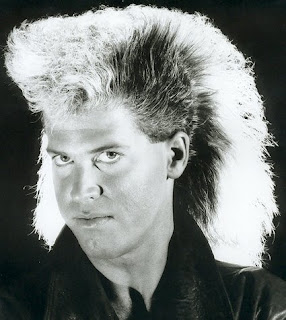
The first?  Hair:

It was the putative era of big hair.  Which, when combined with newly-affordable technology in the hands of people who understood style much better than they grasped technique, led to…

A Flock Of Seagulls.  (Or, on this side of the pond, and even worse, Men Without Hats)

Had we actually had a nuclear war in 1985, it’s possible the only things to survive might have been cockroaches, Twinkies, and A Flock Of Seagaulls – or at least their ‘dos.

But “the eighties” – or the first six years or so of the decade, which I christened “The Alternative Era” – were distinguished by a number of factors that have, throughout pop music history (and I mean throughout – including well before the rock and roll era) made for  better-than-average popular music.

Ebony And Ivory:  For the first time since the mid-sixties, “black” and “white” became, for a moment, largely irrelevant in popular music.  And this is important, not for the sake of sappy PC bromides, but because music always benefits when styles intermingle.

Technology: Every time there’s a revolution in the technology used to produce art, there’s a revolution, or at least enhanced evolution, in how art is produced and in how many people produce how much of it.  For example, it was in the 1840’s that Steinway brought mass-production techniques to the building of pianos.  Soon, the piano was the dominant instrument in American music – and keyboard-based music was the dominant style, until Elvis Presley.

There was a similar revolution in the eighties; thanks to ubiquitous production of solid state and integrated circuitry for the consumer market, suddenly – as in, between 1979 and 1983 – it became possible for people to own technology for under $2,000 that would have cost 5-10 times as much five years earlier.

The marquee innovations?  The Yamaha DX7 and DX9 synthesizers…

…which brought digital synthesizer technology down into the reach of the regular working musician.  And the Ensoniq Mirage…

…which did the same for digital sampling, making it possible for anyone to reproduce almost any recorded sound – from an orchestra or horn section to dogs barking – in a keyboard that weighed under 30 pounds and cost under $2K.

And the TASCAM four-track cassette deck…

…which didn’t, itself, revolutionize the recording industry, but did in fact plant the flag on the beach for the idea of the inexpensive, usable home recording studio for everyone, bringing the level of technology that’d been common in a 1960’s studio to anyone’s basement for under $1,000 (in the same way that “Garage Band” does with digital recording techniques and technology today for Macintosh users).

———-

I’ve been writing for the past two years about the raft of great albums that made their debuts about thirty years ago.  But I’m going to step it up.  For the next month, every weekday will feature a different reason music in “the eighties” – largely, but not entirely, the first half of the decade – was every bit as good as anything in the pop music era.

I’ll be dividing the month up by weeks; one week for the boom in “black” music – although not always among “black” artists – one for the return of rock and roll, one for a case for Britain, one for the highs, lows and highs of technology in music, and one for “the fringe” that took root in the decade.

This should be interesting.

Draw The Line’s Redistricting Commission: A Fair Trial Followed By A Swift Execution

Tuesday, November 1st, 2011

We’ve been talking for quite a while now about the activities of “Draw The Line Minnesota“, part of a chain of astroturf pressure groups being established across the Midwest to put pressure on the redistricting process.

My prediction a few months back, when “Draw The Line” started pitching its game to the usual fawning suspects in the media: there would be an elaborate show of “multipartisanship” for the media to show to the world – sort of like the Congress of Soviets in the old USSR.  Then, “Draw The Line” would release the maps – elaborately gerrymandered maps, which would favor the DFL to an absurd degree – that they were going to release all along.

So far, I’m batting about 1000.

Well, OK – about .800.  I didn’t bank on “Draw The Line” getting a squeaky wheel like Kent Kaiser into the mix.  A few weeks ago, he wrote a letter to the Judicial Redistricting Board pointing out that the bipartisan “Citizens’ Commission” was a sham – a group of well-meaning, earnest people who were being used as window-dressing for a conclusion, and a redistricting solution, that’d been decided in a locked back room well out of public view, and which was a gerrymandered DFL-centric abomination.

But the wheel has indeed squeaked.  Last night on “The Late Debate” (as reported by Gary Gross at LFR), Kaiser took on “Draw The Line” again:

Prof. Kaiser made news by telling the listeners that Common Cause MN were distancing themselves from the Citizen Commission because 2 of the members, Prof. Kaiser and Anne Mason, were Republicans.

That clearly violates one of the top two priorities listed on DTL-Minnesota’s website:

“The campaign seeks to create a better redistricting process in Minnesota that uses the following principles:

1. The redistricting process should be independent and nonpartisan, to minimize the influence of elected officials and political parties in creating districts to their own political advantage.

2. The redistricting process should be transparent to the public”

As Gross pointed out, the commissioners did try to do the job as advertised – something for which I didn’t credit them in advance:

Actually, the Citizens Commission tried living up to both principles. DTL-Minnesota’s powers-that-be corrupted the process, first by making the Commission a partisan effort, then by having Linden Wieswerda draw the redistricting maps, then embargoing the maps until they were filed with the Special Panel on Redistricting.

So if you take Kaiser at his word – and I do – even Common Cause is giving up on the fiction so consistently aped by the media that the “Citizens’ Commission” is anything but window-dressing.

So let’s step through the chronology:

  1. The Minnesota Legislature passed a redistricting plan – drawn largely entirely by Republicans (which is one of the prerogatives of winning), but which met the letter and spirit of the body of redistricting law that has sprung up around this process over the past forty years or so.
  2. Governor Dayton – notwithstanding the fact that the DFL had no counterproposal – vetoed the Legislature’s map, sending it to the courts.
  3. A group of left-“leaning” groups – Common Cause, the Minnesota Council of Non-Profits, the League of Women Voters and Take Action Minnesota – propped up “Draw The Line Minnesota” (DTL).
  4. DTL formed the “Citizens’ Commission”, a 15 member panel with two identified Republicans, intended to take “public feedback”.  This, they did.
  5. DTL also deployed some cool web toys, allowing pretty much anyone to try to draw their own redistricting map…
  6. …which, as we later found, was more or less the equivalent of giving noisy kids in the back of the car a coloring book so they’ll shut up on a long trip.  DTL, notwithstanding all its talk of “transparency”, hired a longtime DFLer to draw its real maps, in secret, and embargoed until the deadline to hand them over to the judicial panel.  The “Commission”‘s feedback was basically a sham.

I think it’s interesting; when I appeared with “Common Cause Minnesota’s” Mike Dean on “The Late Debate”, I invited him onto the NARN;  he had been palavering for the previous two hours about the need for multipartisanship, after all.  His response – I published “Fairy Tales” about “Common Cause”.  (I admittedly erred in the actual source of some of the organization’s funding, and in the scope of one IRS 990 form I produced – which didn’t change the ideology behind their money one iota).

As we can see now, Dean was committing an instance of Berg’s Seventh Law of Liberal Projection: “When a Liberal issues a group defamation or assault on conservatives’ ethics, character or respect for liberty or the truth, they are at best projecting, and at worst drawing attention away from their own misdeeds

Who’s telling fairy tales, now?

Crime Is A Civil Right

Tuesday, November 1st, 2011

Remember the great struggle to end discrimination against shoplifters?  And all the parallels that struggle had with the civil rights movement?

No?

How about the long battle to make domestic abuse a form of free speech before the law, equal in legal stature to the fight to bring women the right to vote?

Not that, either?

Of course not.  They’re both completely absurd.

Equating a crime – shoplifting, domestic abuse – with bringing the rights in our Constitution to people who, as law-abiding citizens, deserve them profanes logic and, worse, devalues the rights.

Any rational person knows this.

Which is why the media seem to be trying to make the irrational seem rational.  As in this AP piece, carried on MPR, on Alabama’s new immigraiton law, titled “Alabama immigration battle recalls past civil rights turbulence”.

Alabama was well-suited to be the nation’s civil rights battleground because of its harsh segregation laws, large black population, and the presence of a charismatic young minister named Martin Luther King Jr., who led a boycott of segregated buses in 1955.

Opponents say the new law’s schools provision conjures images of Gov. George Wallace’s stand in the schoolhouse door to block integration.

But only if you’re an idiot.

Because black children – and their parents – were American citizens, endowed by their creator with the same rights as their white neighbors, notwithstanding George Wallace.

But illegal aliens are violating the law by being here.  And to treat their presence in this country as a right devalues that right, and undercuts our sovereignty as a nation.

And stating it any other way – like, comparing a crime to a right – is no better than lumping domestic abuse in with women’s suffrage.

--> Site Meter -->