Archive for December, 2010

As Talk Show Hosts Watched Their Flocks By Night

Saturday, December 25th, 2010

Santa will bring you all the station’s traditional 24 hours of Christmas music in place of the “Northern Alliance” today.  We’re all home celebrating Christmas with our families.

From Brian, John, Ed, King and I, and Tommy, Jon and the rest of the station staff, may you all have a merry and blessed Christmas!

King Of Kings And Lord Of Lords

Saturday, December 25th, 2010

For a child will be born to us, a son will be given to us; And the government will rest on His shoulders; And His name will be called Wonderful Counselor, Mighty God, Eternal Father, Prince of Peace.

Don We Now…

Friday, December 24th, 2010

(more…)

Merry Christmas!

Friday, December 24th, 2010

This past year, I’ve been vastly more blessed than I could ever deserve; wonderful friends, my kids whom I love so much, great opportunities – and even a few gnarly challenges requiring some creative solutions that, in the end, have turned out to be blessings, so far.

And like all of us, I’m blessed to live in a country where I can write this.  If you are, or have ever been, in the military, thank you for the Christmases you’ve spent away from home, standing on that wall brushing snow off your rifle or tank or F16 or destroyer while the rest of us drank eggnog somewhere behind you.

What can I say but “Merry Christmas”, and God bless you all!

So on behalf of Johnny Roosh, First Ringer and Bogus D, thanks for another great year, and whatever the holiday means to you, I hope you find it in spades!

True Grit

Friday, December 24th, 2010

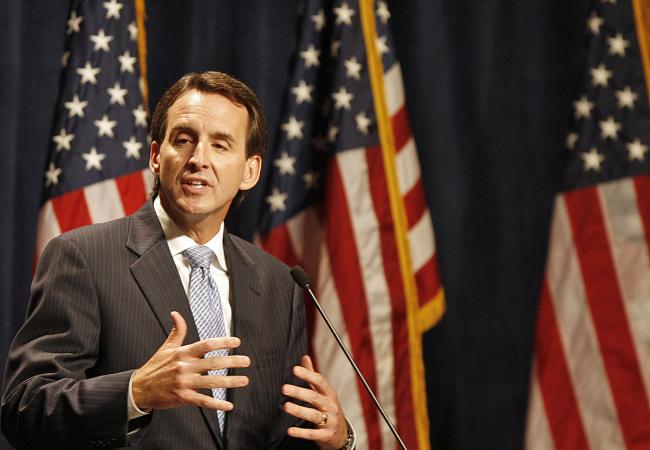
The Saint Paul Pioneer Press‘ Bill Salisbury wrote a valedictory yesterday in the Pioneer Press about the career of outgoing Minnesota governor Tim Pawlenty.

So far, anyway.

He left it to Pawlenty to sum up the crux of his legacy:

“This is a state that was on a spending binge for a long time with a liberal-leaning political culture that goes back decades or generations, and to try to change the direction of the state was a big undertaking. But I think we did that,” Pawlenty said during an extended interview Tuesday with a group of Capitol reporters.

Making that change was not easy, the Republican governor said. He had to call a predominantly Democratic Legislature into special sessions, issue a record number of vetoes in one year and use a government shutdown to force the changes.

“This will be known as the time Minnesota finally came to terms with its excesses and got itself on a more sustainable and responsible path,” he said.

That legacy, he asserted, is more significant than any new program or building he might have created.

Pawlenty’s right – and in ways the article isn’t scoped to explore, in and of itself.

Not only did Pawlenty’s years start the process of breaking the state of the culture of “the people exist to keep the government fed” school of government, but he set the stage for this years’ GOP sweep (Republicans flipped control of both chambers of the Minnesota legislature, controlling the body for the first time in recent history) in ways that I don’t think he’ll get credit for – even among conservatives.

Maybe especially among conservatives.

Until 1998, the Minnesota GOP was a “moderate”, even “progressive” party.  James Lileks once joked on the radio, around the time he lived in or came back from DC, that he’d tell his friends in Washington “Minnesota is the place where you have your pro-abortion, pro-gun-control candidate – and the Democrat!”.

Former MN governor Arne Carlson (who served from 1990-1998) was a typical pre-Pawlenty Republican.  In many respects, he was a bigger “liberal” than the DFLer he replaced, Rudy Perpich, and he was hardly alone.  The GOP during the “Independent Republican” era – the years after Watergate, when the MNGOP rechristened itself the “Independent Republican” party, to break with the national GOP – was a throwback to the national GOP of the Eisenhower years, which was vastly more “communitarian” than libertarian or fiscally conservative.

And there are plenty who wanted, and still want, the GOP to remain that party – basically DFLers with better suits; a party that believed “Fiscal Responsibility” meant making sure you tax enough to run government…

…but that keeping government fed and fat and happy came first and foremost among government’s  missions.

And, predictably, there are many in the Minnesota’s GOP who pine for the old days:

But a lot of Pawlenty’s financial savings were “smoke and mirrors” instead of permanent cost reductions, said John Gunyou, finance commissioner under former Gov. Arne Carlson’s and a DFL candidate for lieutenant governor this year. Pawlenty relied heavily on delaying payments, raiding funds set aside for other purposes, unilateral spending cuts that the state Supreme Court ruled overstepped his authority and federal stimulus funds.

“He didn’t really bring costs under control,” Gunyou said.

Unmentioned by Gunyou – or any of the other outdated impedimenta, “GOP” or DFL, that keep repeating that particular chanting point – is that Pawlenty was hamstrung throughout his eight years, for four years by a DFL-controlled Senate and a GOP majority in the House that was addled by too many old-school, “IR”-era Republicans to do much more than hold the line on spending – which he did! – and for the last half of his administration by facing a rapacious, money-crazed DFL majority in both chambers of the legislature.  Against such grossly, irresponsibly, blindly spenthrift ideologues as Larry Pogemiller, Margaret Kelliher, Sandy Pappas and the rest of the Twin Cities metro-area DFL clacque that ran the Legislature, the only way to meet his statutory responsibility to balance the budget and keep his “no new taxes” pledge was to defer that which he couldn’t cut.

Pawlenty will leave his successor, Democrat Mark Dayton, with a projected $6.2 billion budget deficit.

Well, no – the Legislature did, and the 6.2 billion number is a made-up figure with no legal meaning, but the DFL and media (pardon the redundancy) don’t want you to know that.

But I digress.

Salisbury turned to talk of Pawlenty’s legacy.  In discussing the big takeaways from Pawlenty’s eight years, a group of assembled poli-sci wonks phumphered that Pawlenty didn’t leave much in the way of “big achievements”:  the inevitable quote from U of Minnesota poli-sci professor Larry Jacobs was “Huge promise, remarkable intelligence and understanding of the issues but uneven or limp follow-through”.  Salisbury points out that Pawlenty “…was excellent at diagnosing problems and generating ideas, such has providing health care for all kids or funding transportation projects after the Interstate 35W bridge collapsed. But he dropped many of his creative ideas, often because they would have cost more tax dollars, which his conservative base opposed”

The observation is partly right.  The part they miss; conservatives were never “his” “base”, where “base” means “people who ideologically support him through thick and thin”.  Pawlenty came into the governor’s race as the moderate.  He had to earn every conservative vote he got, starting at the 2002 GOP convention, where he held off a charge by conservative businessman Brian Sullivan after 17 ballots, largely by adopting the conservative Taxpayers League of Minnesota’s “No New Taxes” pledge – pledging to balance the budget by controlling spending rather than hiking taxes.  In many ways, Pawlenty never entirely won conservatives over;  he still hasn’t entirely won “conservatives” over, although I believe that, being as perfect is the enemy of good enough, he should have.  I believe Minnesota’s conservatives shorted Pawlenty.

Poli-sci prof Steven Schier from Carlton College provides the key caveat that the U of M’s Jacobs didn’t, pointing out that Pawlenty “never had a fully cooperative Legislature”.  That’s putting it lightly.  When the DFL took complete control of the Legislature in 2006, DFL Senator Cy Thao famously remarked “When you people [Republicans] win, you get to keep your money; when we win, we take your money!”.  Senate Majority Leader Larry Pogemiller said in 2008 “it’s silly to think that people can spend their money better than government can”.

So when Salisbury quotes Jacobs…:

A governor must build coalitions to get things done, Jacobs said, but Pawlenty had a hard time finding “honorable compromise” with DFL legislators.

…one can forgive him for not adding “because the DFL had no interest in compromise, and were largely not honorable”.

But I will.

My real point is that Pawlenty’s legacy goes waaaay beyond simple, material things like programs and departments and government real estate.  Tim Pawlenty did something that’s needed doing since long before I came to Minnesota.  Because for all of my hard-core paleocon friends’ grousing about “impact fees” and “travelling with Will Steger”, it’s a simple fact that Pawlenty’s political leadership helped drive the Minnesota GOP to the right; it helped the GOP provide a real policy alternative to the DFL for the first time in recent memory.

Pawlenty was the first important political figure in recent Minnesota political history to define “fiscal responsibility” as “controlling spending” rather than “making sure we make the people cover all of government’s bills on time!”.

I think there’s a pretty airtight case that Tim Pawlenty is the most vital, transformative figure in Minnesota politics since Hubert H. Humphrey.

The leadership of the Tea Party, and of Minnesota’s newly-empowered conservative legislative majority, might quibble with the statement, but in every way that mattered, Tim Pawlenty paved the way for everything the Tea Party and the new conservative majority stands for.

And because of this – because Minnesota now has, for the first time in recent political memory, a genuine two-party system, with two sides that are actively holding each others’ feet in the political fire, and a genuine conservative opposition to Minnesota’s generations-long tradition of spend first, think later  – Tim Pawlenty has left this state a vastly better place than he took over.

Economies rise and fall.  Budgets work themselves out (and, with a new GOP majority that owes more than it admits to Pawlenty’s legacy now in charge, they’ll likely work themselves out a whole lot better than they would have).  But changing a state’s political system, vastly for the better?  That’s a wonderful thing.

I think Tim Pawlenty is getting grossly short shrift from conservatives in his all-but-certain bid for the presidency.  His record as a solid, commonsense fiscal conservative (on all the things that truly matter in the long view) deserves a serious look on the national stage.

Because while you can quibble about the details around and about the edges of his record, Tim Pawlenty’s real legacy is that of eight years of true political grit.  Pawlenty was doing the Tea Party’s work before there was a Tea Party.

And Minnesota needed that.  We needed it bad.

Pawlenty is leaving this state in good hands – at least, two chambers dominated by those good hands.  That new majority, in all their enthusiastic numbers, has two big shoes to fill.

Thanks, Governor Pawlenty.  I hope to write about you a lot more in the next two years.

The Other Christmas Story

Friday, December 24th, 2010

John Scalzi interviews the innkeeper.

That innkeeper.

Oprah, You Funny

Thursday, December 23rd, 2010

Oprah Winfrey, whose successful but vapid talk show has afforded her guru status on everything from personal advice, relationships, and book recommendations, insults Sarah Palin for essentially attempting the same thing, only in reverse.

Oprah Winfrey says America may “fall in love” with Sarah Palin as a TV star, but is dismissing the idea that the country would vote for the former Alaska governor in the future.

Asked in an interview with Parade magazine if the thought of Palin’s running for office scares her, Winfrey responded, “It does not scare me because I believe in the intelligence of the American public.”

Stop laughing everyone, I think she was serious.

Me too Oprah, if by “intelligence” you mean figuring out how to vote for opportunistic charlatans that give them something for nothing, vilifying the “haves” and victimizing the “have nots”. This coming from a woman who gives away cars on her show to a frothing herd of rabid groupies.

It’s difficult to imagine what could possibly “scare” anyone now as it relates to Presidential candidates as Her Candidate has certainly raised the bar on how much destruction one president can wage while simultaneously lowering it as it regards approval ratings.

If its okay with you, I’ll go with the fit, happily married, heavily armed hot chick over, well, Oprah, any day, thank you very much.

The Great Poll Scam, Part XIV: Fool Me Ten Times…

Thursday, December 23rd, 2010

You’ve heard the old saying – “the definition of insanity is repeating the same thing over and over again and expecting a different result. 

The joke writes itself.  Nearly every election season, Minnesota’s media runs the results of the Star-Tribune Minnesota Poll and the Humprey Institute/MPR Poll on its front pages; front and center on its 6 and 10PM newscasts; up-front in its hourly news bites; in the New York Times; prominently on that big news crawl above Seventh Street in downtown Saint Paul.   To those who don’t dig into the numbers – and that’s probably 99 percent of Minnesota voters – that’s all there is to it.  “Hm.  Looks like Dayton’s winning big!”.

In most elections- especially the close ones – both polls (along with their downmarket stepsibling, the SCSU Poll) show numbers for GOP candidate that beggar the imagination.  The media – the Strib, the TV stations, MPR – run the polls pretty  much without any analysis.  The job of actually fact-checking the polling falls to conservative bloggers – myself, MDE, Ed Morrissey, Scott Johnson and John Hinderaker, Gary Gross, the Dogs, Sheila Kihne and others; poll after poll, election after election, we shout into the storm “the numbers are a joke! Democrats are oversampled to an extent that is not warranted by electoral results we’ve seen in this state in nearly a generation!  Would someone look into this?”

The elections take place.  There is hand-wringing about the inaccuracy of the polls.  Two years pass.  Larry Jacobs and the  Strib release still more polls, repeating precisely the same pathologies, over and over and over.  Forever and ever, amen.  Lather, rinse, repeat.

Now, “journalism” is supposed to be about accuracy and clarity.  About telling the story, and telling it in a way that your sources reinforce your credibility and clarity.  If you are a reporter, and you report a story based on a source’s information, and that information turns out to be wrong, it’s a bit of a vocational black eye.

This morning I asked, rhetorically, “do you think that if a source burned Tom Scheck or Pat Doyle or Rochelle Olson or Rachel Stassen-Berger over and over, year in and year out, by feeding them laughably inaccurate information, not just once or twice but on nearly every story on which they are a key source, would they keep using them as sources?”  Without really serious corroboration, if indeed it could be found?  Ever?  

And yet the regional media not only continues running the Strib and HHH polls, election after election, without any serious question – until after the election, anyway.  Notwithstanding the fact that the Strib’s Minnesota Poll has been very regularly wrong for a generation now.  Notwithstanding the fact that the Humphrey Poll has been even more consistent in its systematic shorting of GOP candidates.  The polls are still treated not only as useful news, but front-page material.

This would prompt a curious person to ask a whooooole lot of questions:

Why do the pollsters continue to generate such a defective product?:  While I focused heavily over the past few days specifically on Gallup’s Frank Newport’s critique of the Humphrey Institute poll, that gives the impression that this is a one-time issue.  And yet both the major media polls have had nearly the same problems, election in, election out, for a generation (or in the case of the Humphrey Institute Poll,  in every major election since 2004).   It’s gotten to the point where I want to stand outside 425 Portland, or outside the Humphrey Institute’s building at the U, and wave a sign about; “It’s the same thing, every time!”.

Why do the media continue to present such a routinely defective product as newsworthy?:  Scott Johnson has been lighting up the “Minnesosta Poll’s” shortcomings for a solid decade now; the Strib’s poll is rarely even close, and performs worse in close elections than in blowouts.  And at the risk of repeating myself, let me repeat myself; the Humphrey Institute poll has underpolled Republicans by an average of nine points.  This past election was distinguished from the previous years’ ineptitude only in degree, not in concept.

Does it never occur to our “watchdogs” and “gatekeepers” to look into this?  Wasn’t “insatiable curiosity” once a pre-requisite for being a reporter?

Do the editors at the Strib, the PiPress, KARE, MPR, WCCO and the rest of the regional mainstream media genuinely consider “polls are a snapshot in time” an excuse for decades worth of a pattern of inaccuracy, not only in polling technique but in their own coverage of elections?

If a city councilman is caught cashing checks to herself, would saying “it’s just a snapshot in time!” get the Strib to call their dogs off?

Appearance Of…Something?: I’ve said it before; I’m not a fundamentally conspiracy-minded person.  I don’t necessarily believe that the media is involved in a conscious, considered conspiracy to short conservative candidates in close elections.

Still – given that…:

…I’ll ask again: if the Humphrey Institute (whose institutional sympathies lean definitively left-of-center) and the Strib (ditto) wanted to create a system that would help tip close-call contests toward the DFL, how would it be any different than the system they’ve developed?

Not accusing.  Just asking.

Lessons Of The Census: Liberalism=Stagnation And Death

Thursday, December 23rd, 2010

Patrick Ruffini unpacks the real conclusion to be drawn from this week’s census and reapportionment numbers:

[T]his week’s numbers were the most ringing endorsement of the Republican governing model since Rudy Giuliani towered over the vested interests in New York City. Not only did the South and West win — which liberals will dismiss as a function of weather — but low tax states consistently beat high tax states. Not only did conservative states beat liberal states, most tellingly, the winners were almost to a man conservatively governed.

Consider this striking fact unearthed by political strategist (and former Giuliani adviser) Ken Kurson, posted on Facebook:

  • Avg tax rate in states gaining a Congressional seat: 2.8%
  • Avg tax rate in states losing a Congressional seat: 6.05%

People vote with their feet.

And not entirely because of the weather, although that’ll be what the left attributes the reapportionment to.  Minnesota – which held onto both its eighth house seat for another ten years by the skin of its teeth (perhaps thanks to the fact it held on to fiscal sanity by the same margin) – grew 4%, well off the national average.   North Dakota – which has low taxes and is actively cutting the ones they have – grew by 5%, and income-tax-free South Dakota grew even faster, leading the region.  

Ruffini (with emphasis added):

This finding is relevant to top marginal tax rates, which unlike property or sales taxes more prevalent in redder states punish creation rather than consumption, but the basic finding runs deep throughout the numbers. The big population winners did not just happen to red states with nice weather. They also had a deeply embedded Republican governing model. Consider who governed in the big population-gaining states this year.

  • Texas +4 (10 years of Republican governors, 0 Democrat)
  • Florida +2 (10 Republican, 0 Democrat)
  • Nevada +1 (10 Republican, 0 Democrat)
  • Utah +1 (10 Republican, 0 Democrat)
  • South Carolina +1 (8 Republican, 2 Democrat)
  • Georgia +1 (8 Republican, 2 Democrat)
  • Arizona +1 (2 Republican, 8 Democrat)
  • Washington +1 (0 Republican, 10 Democrat)

Collectively, that’s 58 years of Republican governance to 22 years of Democratic governance in the states gaining Congressional seats. And Washington State’s impressive record — alone among true blue states — likely had more to do with the little matter that it lacks an income tax, and an initiative this year to impose one was beat back by 2-to-1.

Ruffini notes that the major left-strangled metropolitan areas – the New Yorks and Bostons and Los Angeleses – continued to show some growth; there are benefits to having a large, established commercial sector (or whatever’s left of it) and a throbbing creative class. 

But the reapportionment shows that they only go so far.

Fifty more years of coastal-liberal strangulation and the Democrats just might be a third party yet after all.

The Great Poll Scam, Part XIII: Reality Swings And Misses

Thursday, December 23rd, 2010

Contrary to the impression some wrote about on various blogs, I never worked for the Emmer campaign.  Oh, I did a fair amount of writing about Emmer’s bid for governor – I thought he had what it took to be the best governor we’ve had in a long time, and I was a supporter from long before he actually declared his intent to run.  I volunteered a lot of time, and a lot of this blog’s space, to fight against the sleaziest, most toxic smear campaign in recent Minnesota electoral history, and I do believe the better man lost this election.

But I never got any money for it.

What I did get – although not to an extent that would make a Tom Scheck or a Rachel Stassen-Berger in any way jealous – was a certain amount of access.  I heard things.

One of the things I heard from sources inside the Emmer campaign, especially during the long, dry, advertising-dollar-free summer before the primaries, when all three DFL contenders curiously spent their entire ad budgets sniping at Emmer, and the media played dutiful stenographers for Alliance for a Better Minnesota’s smear campaign, was that the Emmer campaign had its work cut out for it.  In late July and early August, a source inside the Emmer campaign, speaking on MI-5-level deep background, told me the internal polls showed Emmer trailing by 12 points.  It wasn’t good news, certainly – but it was early in the race, it was a byproduct of being outspent roughly 16:1 to that point, and it was just part of doing business.   “We gotta pick up six points, and Dayton’s gotta lose six”, the source told me, as the campaign dug its way out of “Waitergate”.

I observed to the source that that should have been nothing new for Emmer; he’d come back from a bigger margin in the previous nine months or so, from being way back in the pack at the Central Committee straw poll about this time last year, where Marty Seifert won by a margin many considered insurmountable.

The source expressed confidence it could be done.

He was, statistically, exactly right. Emmer brought the race back from a 12 point blowout to a near-tie, with numbers that pretty steadily improved – according to the party’s own internal polling.

Steadily?

On October 11, I held a “Bloggers For Emmer” event at an undisclosed location in the western subs.  It had been ten busy weeks since my off-the-record conversation with my source in the campaign.  An Emmer functionary told me – off the record – that it was now a four point race.  

A week later, within ten days of the election, the same internal poll said the race was a statistical dead heat.

Then came the last-minute hit polls from the Humphrey Instititute, the Strib and Saint Cloud State – after which Emmer released his internal polling, which was reinforced by a Survey USA poll that more or less reinforced the internal polls’ results.

And then came the election.

Last week, David Brauer at the MinnPost interviewed Emmer campaign manager Cullen Sheehan.  As part of the piece, he graphed the respective polls: Emmer’s internal polling (orange), the Strib poll (wide dashes) and the HHH poll (dots), showing the indicated size of the Dayton lead.

Graph used by permission of the MinnPost

Graph used by permission of the MinnPost

Brauer:

Although “internal numbers” often become propagandistic leaks, Sheehan insists the data was not for public pre-election consumption. Though he wound up releasing the most favorable result during the campaign, it proved prescient, and two independent pollsters subsequently showed similar results.

And while Brauer points out that internal numbers “aren’t holy” – and many leftybloggers openly guffawed when Sheehan released them – the GOP’s internal numbers have a long record of accuracy, in my experience.  In 2002, when the Strib poll had Roger Moe measuring the drapes in the mansion, a GOP source leaked me internal polling showing that Pawlenty was tied and rising.  And internal polling released to a group of bloggers a month before the election showed Chip Cravaack pulling close to Jim Oberstar; numbers that the campaign asked be kept off the record showed that with “leaners”, Cravaack was actually leading.

So for all the leftyblogs’ caterwauling about “push polling”, the GOP’s internal polls – as seen both publicly and behind the scenes – called things as they were.  There’s a reason for that; parties need to accurate polling to help them allocate scarce resources effectively.  The DFL has not released their internal polling – but the Dayton campaign’s behavior indicates to me that they also saw Emmer’s late surge, leading them to re-roll-out the “Drunk Driving Ad” (the closest the Dayton campaign ever came to a coherent policy statement, with full irony intended).

But neither sides’ internal polling is affiliated with a major media outlet.  The Strib, Minnesota Public Radio and MinnPost all have symbiotic relationships with Princeton, the Humphrey Institute and Saint Cloud State, respectively (though to be accurate the MinnPost only paid for three questions in the SCSU poll, and those were, according to Brauer, on ranked-choice voting).  Those relationships, presumably, exist so that the news outlets can get “their” results out to the public first.

No matter how they’re arrived at, or so it seems.

Brauer confirms after the fact what my sources in the campaign told me, off the record, at the time; it was a real numerical rollercoaster ride:

Although “internal numbers” often become propagandistic leaks, Sheehan insists the data was not for public pre-election consumption. Though he wound up releasing the most favorable result during the campaign, it proved prescient, and two independent pollsters subsequently showed similar results.

“It really is, internally, a compass,” Sheehan says of the campaign’s polling.

Emmer’s own numbers show a candidate trailing — sometimes badly — for nearly the entire race.

On July 28 — three weeks after Emmer’s interminable “tip credit” debacle — the Republican trailed Dayton by 11 points. Ironically, the Star Tribune poll — which Republicans say overstates DFL support — had it closer: Dayton plus-10.

It was a demonstrable fact that the Strib poll oversampled DFL voters by a big margin – but that’s a poll-technique discussion to be held some other time.

In the wake of the double-digit gap, Sheehan took over as campaign manager. But by early October, the internal numbers had barely budged: Emmer was still down 7. A Strib survey taken a week or so earlier showed the Republican down 9 — again, pretty close to what the campaign was seeing.

Finally, on Oct. 13, Emmer got his first great inside news: he was only down 1. But the next media poll (SurveyUSA/KSTP) had him down 5, and an Oct. 18 internal poll repeated that number. It was two weeks before Election Day.

And then came the Big Three media polls, one after the other – the Strib, SCSU and the Humphrey polls – showing Emmer 9, 10 and 12 points down, respectively.  At which point Sheehan opted to release the internal numbers – which were shortly reinforced by SUSA.

Sheehan:

“At that point [right before the election – the polls on which I’ve focused throughout this series], undecided voters are making up their minds and supporters are getting anxious, having seen 7 down, 10 down and 12 down,” Sheehan says. “It impacts fundraising and volunteers. It’s definitely not the only factor, but it is a factor.”

Sheehan, now the Minnesota GOP Senate caucus chief of staff, is a Republican, but Democratic Senate Majority Leader Harry Reid’s pollster feels similarly. Reid’s internal numbers proved better than media polls predicting his opponent would win.

Says Sheehan, “The point I am making is that outside public polls have an impact on campaigns — ultimately, some impact on eventual outcome of campaigns, especially in close races.”

At least one media outlet agreed even before the results were known. This year, the Star Tribune declined to do its traditional final-weekend poll. A key reason, editor Nancy Barnes told me, is that “a poll can sometimes influence the outcome of an election.”

Sheehan’s plea? Withhold questionable numbers. “I’m under no illusion that public polls will cease, but I do think news organizations have a responsibility to ask themselves, when they get their results, if they really believe they’re accurate,” he says.

I’ve met Sheehan not a few times.  Great guy.  Big future in politics.  Now, I’m not sure if he’s ever read this series; if he has, I’m sure he needs to be diplomatic.  He’s gotta get along with the regional media.

But the fact remains that the closer the race got, the farther off-the-beam the Strib and HHH polls swerved.

Just the same as they do in practically every election, especially the close ones.

So Sheehan has a point; the news media should treat suspicious polls as they would a source that’s burned them. 

Seriously – can you imagine Erik Black or Bill Salisbury or David Brauer putting a story on the front page (or “page”) based on the uncorroborated word of a source that had burned them, over and over again?  As in, not even close, but really, really embarassingly burned?

And the Strib and Humphrey Polls have burned the regional media – over and over and over again.

Presuming, of course, that accuracy is what they’re shooting for.

More later today.

Where Have All The Voters Gone?

Thursday, December 23rd, 2010

Cool web-toy at Forbes showing where people moved, county by county, in 2008.

Last-Minute Gift Ideas

Thursday, December 23rd, 2010

Katie Kieffer has some ideas for procrastinators.

Like, er, me.

Domed If You Do…

Wednesday, December 22nd, 2010

The NFL lends some heat to the Vikings’ hot potato stadium issue.  Will it matter?

It’s been nearly 12 years since the Minnesota Vikings organization started making serious noise about leaving the Metrodome – albeit under different ownership – but despite a decade-plus of bargaining and begging, the last 10 days have had a greater impact over where the Vikings will play in 2012 and beyond.  In a year of collapses, from the Vikings’ line play to the Dome’s roof, count the past legistative resistance to a new Vikings’ stadium among the fallen.

Incoming Gov. Mark Dayton’s support, wafting between lukewarm and simmering, is certainly more than a few degrees warmer than his predecessor (although Dayton just announced he doesn’t intend to push for his own stadium bill). And already some GOP legislators are attempting to craft a Vikings stadium bill.  On cue, NFL Commissioner Roger Goodell landed in the Twin Cities for Monday’s game, likely putting more pressure on the local politicos than on the local press:

The former public relations intern at the NFL who worked his way up to league CEO had his talking points down pat after meeting with Gov.-elect Mark Dayton, a score of CEOs who belong to the Minnesota Business Partnership, Speaker Kurt Zellars, DFL leaders Tom Bakk and Paul Thissen, and some union leaders.

“We had a series of meetings today … they were all productive,” Goodell said at a news conference. “I think there is a recognition that we need to find a long-term solution for the Vikings here and get a new stadium built…

And it was Dayton, not Goodell, who ratcheted up the potential pace, telling reporters, according to the Star Tribune, “I really believe 2011 is the final opportunity for all of us to put forward a proposal … I think the writing’s on the wall. We need to get it done in this session.”

Short of the Vikings expressing a willingness to wait another year until the outcome of the 2012 legislative session (when presumably the $6.2 billion deficit will have fully addressed and the only major issue will be any bonding bill), the future of the franchise will be decided by the early summer of 2011.  And regardless of what does or doesn’t pass, something new will be with the Vikings – either a new stadium, a new owner, or a new location.

So which will it be?

Since Zygi Wilf bought one last lemon sold by the former used car salesman in Texas, Red McCombs, Wilf has watched his investment experience anemic growth at best.  The Vikings accurately lost value in the past year, down to $774 million (a 7% decline); still a $174 million improvement from Wilf’s purchase in 2005 but poor enough to rank 30th out of the NFL’s 32 teams.  This ranking is amazingly an improvement from 2007 when the Vikings’ ranked dead last in team value.  Coupled with word that Wilf has only been making interest payments on the loan he took out to buy the team, one has to wonder what exactly is Wilf’s personal financial picture.  No one knows the Wilfs’ net worth and given that the family makes their money in commercial real estate, it’s doubtful the Wilfs are doing as well as they once did.

Whether the Wilfs are credit rich and cash poor or not, Zygi’s options are all dictated by what the NFL wants.  And working to Wilf’s advantage, in addition to the Metrodome lease expiring after next season, is the first real progress in building a stadium in Los Angeles in the last 15-plus years.  Los Angeles Stadium, the brainchild of Lakers & Kings part owner Ed Roski, looks set to deliver a 75,000 seat stadium just 20-minutes outside of LA in the City of Industry – and has his eye on Minnesota.

Despite their overwhelming desire to get a team back to LA, the NFL isn’t terribly interested in moving the Vikings out of Minnesota.  Yet the Vikings remain behind in the battle for attendence with the other two most likely franchises heading west – Jacksonville and Buffalo.  Both the Jaguars and Bills play before less than capacity crowds in markets already saturated by multiple NFL teams (the Bucs & Dolphins in Florida and the Giants & Jets in NYC).

The reality is that the Wilfs will be more willing to move than sell – and sans a new stadium the NFL will be more than willing to consider it.  All of which begs an answer to the fundamental question – what are the Vikings worth to Minnesota?:

Economists Aju Fenn and John Crooker tried to answer the question in a study published in July 2009 in the Southern Economic Journal.

The two used “contingent valuation methodology,” which is a nerdy way of saying they surveyed people and used statistical models to turn the answers into an average price Minnesotans place on the Vikings.

The result: The Vikings’ “welfare value” is $702,351,890— $530.65 for each of the roughly 1.32 million households in Minnesota…

It’s tough putting a price on feelings, which is why some economists are skeptical of contingent value studies.

“It’s not that this is capturing nothing, it’s just that it’s not legitimate to interpret people’s answers as if folks were spending their own money,” says Peter Diamond, an MIT economist.

Assessing the Vikings’ “true worth” to Minnesota is microcosm of the stadium debate itself – overly detailed and largely symoblic.  In pure dollars, the stadium appears to be a massive loser.  Even Vikings Public Affiairs VP Lester Bagley only estimates the taxable revenue generated by the Dome at $250 million since it opened in the early 1980s.  At that rate, the Vikings’ proposed new stadium would pay for itself sometime towards the end of this century.  But whether counted in dollars real or imagined, the money to pay for any new stadium simply doesn’t exist.  Forget arguments whether or not Minnesotans are willing to pay for a better cup holder, even if additional revenue is “created”, most legislators are going to be more interested in turning such funds to the bottomless chasm that is the state budget.

Why not simply give the Metrodome to the Vikings?  The team remains the only tenant in a building that will become worthless should the Vikings relocate – unless the Metropolitian Stadium Commission truly believes a line-up of Monster Truck rallies and Prep Bowls can equal the millions generated per Vikes game.  Ownership of the property would give the Wilfs at least some additional revenue and the flexibility to remodel the property – albeit on their dime.  And given that one of the Vikings’ options is to rebuild on the same site, why not skip the expensive middleman and merely refurbish the Dome?

Of course, the Vikings aren’t likely to go for such an alternative.  Which is precisely why you should enjoy the Purple and Gold as much as you can now – because they probably won’t be around after next year.

The Great Poll Scam, Part XII: The Dog Ate Their Homework

Wednesday, December 22nd, 2010

Writing in defense of the Humphrey Institute Poll – which indicated our tie governor’s race was headed for a 12 point blowout – Professor Larry Jacobs says:

Careful review of polls in the field conducting interviews during the same period indicates that the MPR/HHH estimate for Emmer (see Figure 2) was within the margin of sampling error of 3 of the 4 other polls but that it was also on the “lower bound” after accounting for random sampling error. (Its estimate was nearly identical to that of MinnPost’s poll with St. Cloud.)

Which showed the race a ten point blowout for Dayton.

Jacobs is, in effect, saying “yeah, our poll was a hash – but so was everyone else’s”.

This pattern is not “wrong” given the need to account for the margin of sampling error, but it is also not desirable. As part of our usual practice, the post-election review investigated whether there were systematic issues that could be addressed.

Research suggests three potential explanations for the MPR/HHH estimate for Emmer; none revealed problems after investigation.

Indeed.

Here are the three areas the Humphrey Institute investigated:

Weighting: First, it made sense to examine closely the weighting of the survey data in general and the weighting used to identify voters most likely to vote. Weighting is a standard practice to align the poll data with known demographic and other features such as gender and age that are documented by the U.S. Census. (Political party affiliation is a product of election campaigns and other political events and is not widely accepted by survey professionals as a reliable basis for weighting responses.)

Our own review of the data did not reveal errors that, for instance, might inflate the proportion of Democrats or depress that of Republicans who are identified as likely to vote. To make sure our review did not miss something, we solicited the independent advice of well-regarded statistician, Professor Andrew Gelman at Columbia University in New York City, who we had not previously worked with or personally met. Professor Gelman concluded that the weighting was “in line with standard practice” and confirmed our own evaluation.

“And an expert said everything’s hunky dory!”

Our second investigation was of what are known as “interviewer effects” based on research indicating that the race of the interviewer may impact respondents.11 (Forty-four percent of the interviewers for the MPR/HHH poll were minorities, mostly African American.) In particular, we searched for differences in expressed support for particular candidates based on whether the interviewer was Caucasian or minority. This investigation failed to detect statistically significant differences.

And the third was the much higher participation in the poll from respondents in the “612” area code – Minneapolis and its very near ‘burbs.  Jacobs (with emphasis added by me):

When analyzing a poll to meet a media schedule, it is not always feasible to look in-depth at internals.

It’s apparently more important to make the 5PM news than to have useful, valid numbers.

With the time and ability that this review made possible, we discovered in retrospect that individuals called in the 612 area code were more prone to participate than statewide — 81% in the 612 area as compared to 67% statewide in the October poll.13 Given that Democratic candidates traditionally fare well among voters in the 612 area code, the higher cooperation rate among likely voters in the 612 area code may explain why the estimate of Emmer’s support by MPR/HHH was slightly lower than those by other polls conducted at around the same time. This is the kind of lesson that can be closely monitored in the future and addressed to improve polling quality. 

Except we bloggers have been “closely monitoring” this for years.  It’s been pointed out in the past; on this very blog, I have been writing about this phenomenon since 2004 at the very latest.  Liberals looooove to answer polls.  Conservatives seem  not to.

That Jacobs claims to be just discovering this now, after all these years, is…surprising?

Frank Newport at Gallup critiques Jacobs’ report:

The authors give the cooperation rate for 612 residents compared to the cooperation rate statewide. The assumption appears to be that this led to a disproportionately high concentration of voters in the sample from the 612 area code. A more relevant comparison would be the cooperation rate for 612 residents compared to all those contacted statewide in all area codes other than 612. Still more relevant would be a discussion of the actual proportion of all completed interviews in the final weighted sample that were conducted in the 612 area code (and other area codes) compared to the Census estimate of the proportion of the population of Minnesota living in the 612 area code, or the proportion of votes cast in a typical statewide election from the 612 area code, or the proportion of the initial sample in the 612 area code. These are typical calculations. The authors note that residents in the 612 area code can be expected, on average, to skew disproportionately for the Democratic candidate in a statewide race. An overrepresentation in the sample of voters in the 612 area code could thus be expected to move the overall sample estimates in a Democratic direction.

That Jacobs finds an excuse for failing to weight for higher participation in a city that is right up there with Portland and Berkeley as a liberal hotbed would be astounding, if it weren’t the Humphrey Institute we’re talking about.

The authors do not discuss the ways in which region was controlled in the survey process, if any. The authors make it clear that they did not weight the sample by region. This is commonly done in state polls, particularly in states where voting outcomes can vary significantly by region, as apparently is the case in Minnesota.

Summary:  The HHH poll is sloppy work.

Sour Grapes of Wrath

Wednesday, December 22nd, 2010

Snarlin’ Arlen leaves the Senate.

If Pennsylvania’s forcibly retired senior Senator was in the holiday spirit, he was cleverly hiding it under a guise worthy of Ebenezer Scrooge.  Biding adieu to a 30-year career in the Senate, Specter produced enough whine for a vineyard as he lashed out at the political opponents who toppled him:

In his final speech on the Senate floor, the outgoing Republican-turned-Democrat sounded off on the tea party, the rise of partisanship in Congress and the “judicial activism” of the Supreme Court.

“Defeating your own is a form of sophisticated cannibalism,” the Pennsylvania senator said of the tea party activists who worked to defeat GOP centrists.

Specter bemoaned the loss of a Senate where both parties seemed to be interested in finding compromise, and he was especially critical of lawmakers who campaigned against their fellow members.

“That conduct was beyond contemplation in the Senate I joined 30 years ago,” Specter said. “Collegiality can obviously not be maintained when negotiating with someone simultaneously out to defeat you, especially within your own party.”

In other words – bah humbug!

Specter’s comparison of the GOP to a Uruguayan rugby team has earned him the standard media designation of ex officio Republican division expert due to his status as, well, an ex officio.  Lost in the shuffle seems to be Specter’s actual defeat at the hands of the party that he left 45 years ago when he began his career as Philadelphia’s District Attorney.   By Specter’s own experience, if Republicans are cannibals, then Democrats are toasting Arlen’s farewell speech with Soylent Green.

But in his final mixing of geritol with vitriol, Specter showed precisely why the electorate’s of both major parties found little use for him.  As a man famous for tying his ideological moorings to helium balloons, Specter’s complaint that senior Republican senators have recently abandoned long-held positions out of fear of losing their seats” rang as hollow as his partisan affiliation.

Some of Specter’s greatest criticism came towards his colleagues who vigorously campaigned against him, apparently violating sacrosanct Senate rules of civility.  Or Scottish law.  Regardless that the leadership in two parties attempted to squeeze him through two different primaries, Specter cast a pale over the lack of Senate comity, stating that such an atmosphere made crafting legislation impossible.

Undoubtbly dying in politics is easy; comity is hard.  But what veterans of the Senate like Specter fail to understand is that most of the comity coming from Washington in recent years is decidedly unamusing to most voters.  From the Patriot Act, to Immigration Reform, TARP and everything in between, almost all the bipartisan solutions have produced bipartisan disgust.  Even the most recent tax compromise has left no one happy and the federal deficit a trillion dollars fatter.  When even Lindsey Graham finds such legislation a  “capitulation”, you know the fetish of compromise has reached its nadir. 

Specter dubbed his final address a “closing argument.”  But in truth, his parting shots were more a case for the prosecution as what Specter really issued was a petty defense of Senate priviledge – and himself.

The Great Poll Scam Part XI: Weasels Rip My Results

Wednesday, December 22nd, 2010

Professor Larry Jacobs – by far the most-quoted non-elected person in Minnesota – defends the Humphrey Institute Poll:

Differences between polls may not be substantively significant as illustrated by the case of MinnPost’s poll with St. Cloud State, which showed Dayton with a 10 point lead, and the MPR/HHH poll, which reported a 12 point lead.

The “margin of sampling error,” which is calculated based on uniform formulas used by all polling firms, creates a cone around the estimate of each candidate’s support, reflecting the statistical probability of variation owing to random sampling.2 The practical effect is that the results of the MinnPost poll with St. Cloud State and MPR/HHH are, in statistical terms, within range of each other. Put simply, the 2 points separating them may reflect random variation and may well not be a statistically meaningful difference.

What might be a “statistically meaningful difference” is that Survey USA and Rasmussen all came much, much closer – as in, one-third to one-quarter of the Strib, HHH and St Cloud polls – to getting the actual election right, and tracked much closer to the GOP’s internal polling, which turned out to be dead-nut accurate (as we’ll see tomorrow).

Figure 2 creates a zone of sampling error around estimates of support for Dayton and Emmer by the five media polls completed during the last two weeks of the campaign.3 In terms of the estimates of Dayton’s support, the MPR/HHH poll is within the range of all four other polls. Take home point: its estimate of Dayton’s support was consistent with all other polls.

Well, no.  It was consistent with the other polls who have developed a reputation for inaccuracy that inevitably favors the DFL.  The other polls – Survey USA, Rasmussen, Laurence – were not consistent with the Humphrey poll at all.

Frank Newport of Gallup responds to this:

It is unclear from the report how much the write‐up of results from the October 21‐25 MPR/HHH poll emphasized the margin of error range around the point estimates. Although this is not part of their recommendation, if the authors feel strongly that the margin of effort around point estimates should be given more attention, future reports could include more emphasis on a band or range of estimated support, rather than the point estimates.

In other words, if the Humphrey Poll is really a range with no particular confidence in any particular number within the range, publicize the range.

But that’s not what the Humphrey Institute, or the media, led with just before the election.  It was “DAYTON LEADS BY 12”.  Not “Dayton leads by 8 to 16, maybe, sorta”.

The distinction might make a difference.

This is generally not done in pre‐election polling, under the assumption that the point estimate is still the most probable population parameter. Any education of the public on the meaning of margin of errors and ranges and comparisons of the margins of errors surrounding other polls is an admirable goal. It does, however, again raise the question of the purpose of and value of pre‐election polls if they are used only to estimate broad ranges of where the population stands. This topic is beyond the scope of this review.

In other words – if you take Jacobs at his word, then there’s nothing really newsworthy about the HHH poll.

Do you suppose they’ll stick with that line in the runup to the 2012 election?

First We’ll Get The Law-Abiding Ones

Wednesday, December 22nd, 2010

Georgia cop considers a concealed carry advocacy bumpersticker “probable cause” for turning a speeding stop into a pat-down.

The second thing the officer asked me, after asking for my license, was if I had any firearms. I responded that I was choosing to exercise my right to remain silent on that question. That answer prompted the officer to have me get out of the car for a pat down. The officer told me that the reason for his question (about firearms) was because I had a “right to carry” sticker on my car. Yes, he actually said that. It’s a sticker for Georgia Carry.org (GCO) Although the audio isn’t 100% clear for that part, you can clearly hear him reference the sticker when talking to me and to another officer. Additionally, it appeared as if “back up” had been called, because there were 3 police right cars behind me and two more across the street. In the end, I got a ticket for speeding and for not having a working light bulb over my license plate.

The state; terrorizing dissent into submission for 5,000 years.

Justice. Almost.

Tuesday, December 21st, 2010

Governor Christie of New Jersey has commuted Brian Aitkin’s sentence:

Brian Aitken, who was convicted of illegally possessing two handguns he had legally purchased in Colorado, will be out of prison in time for Christmas.Gov. Chris Christie commuted Aitken’s sentence Monday, from seven years to time served, according to an order signed by the governor. It was Christie’s first commutation since taking office almost a year ago.

“We are overjoyed at the news,” his younger brother Robert Aitken said in an e-mail. “It’s been an extremely emotional time and we all had our own doubts at one time or another I’m sure. I was hoping for the best but preparing for the worst — for this to be the first battle of a long war to get him out of jail.”

We wrote at some depth about this case last week.   It was as gross a miscarriage of justice as I’ve personally seen.

Still, there is room for improvement.  It was a commutation, not a pardon, so Aitkin still has the conviction on his record.   I have no idea how he needs to go about clearing his record and getting exonerataed for this shameful abuse of judicial power.

But that’s what real justice would require.

Well, that and putting that scumbag former “Judge” James Morley in jail.  Morley refused to allow the jury to consider the relevant federal laws that would have gotten Aitken acquitted, or gotten the entire case dismissed.  Morley, like all such globs of semi-human pus, should be put cuffed and hauled off – preferably with great violence or at least humiliation – to rot in jail for every single day he stole from Mr. Aitken’s life.   Plus one.

That would be justice.

The Great Poll Scam, Part X: Weasel Words

Tuesday, December 21st, 2010

I’ve been raising kids for a long time.  Before that, I grew up around a bunch of them.  Indeed, I was one myself, once.

And I know now as I knew then the same thing that every single person who watches Cops knows, instinctively; if you think someone did something, and their response is “you can’t prove it”, it’s the same as an admission of guilt.

Oh, it doesn’t stand up in court – and it’s probably a good thing.

And in the rarified world of academics – and its poor, profoundly handicapped accidental offspring, political public opinion polling – I’m going to suggest it works the same way.

If there is a poll that is, year in and year out, just as ludicrous as the Humphrey and Strib polls, it’s the Saint Cloud State University poll.  I haven’t heretofore included it in my “Great Poll Scam” series, because it’s sort of out of sight and out of mind.

But in David Brauer’s interview with Emmer campaign manager Cullen Sheehan, the director of the SCSU poll – which is done in conjunction with the MinnPost – a fellow named Stephen Frank, tips us off; he concludes…:

Frank says. “Campaign managers like to find excuses rather than looking at their candidate or performance. Do you think if we stopped [publishing results] others would — or the candidates would and the latter won’t go public or only partially public?”

True, to a point.

But he began the statement by saying:

“Please show me one credible study that shows people change their mind on the basis of a poll,”

On the one hand:  “You can’t proooooooooove we did it!”

On the other hand – allow me to introduce you to Dr. Albert Mehrabian, who published a study entitled “Effects of Poll Reports on Voter Preferences”

From the abstract summary, with emphasis added:

Results of two experimental studies described in this article constituted clear experimental demonstration of how polls influence votes. Findings showed that voters tended to vote for those who they were told were leading in the polls; furthermore, that these poll-driven effects on votes were substantial.

How substantial?  I don’t know.  As I write this, it’s 5AM, and I have no way of getting to the University of Minnesota library to find a copy of Journal of Applied Social Psychology (Volume 28).  But I will.

But Mehrabian noted a decided “bandwagon effect” in voter responses to poll results.

Effects of polls on votes tended to be operative throughout a wide spectrum of initial (i.e., pre-poll) voter preferences ranging from undecided to moderately strong. There was a limit on poll effects, however, as noted in Study Two: Polls failed to influence votes when voter preferences were very strong to begin with.

Bingo.

I’d have voted for Tom Emmer even if he did finish 12 points back, as the Humphrey Institute suggested.  Or ten points out of the game, as Frank’s survey (which I ridiculed in this space), or thirty points back.  But then, nobody really doubted that.

But people who don’t live and breathe politics?  That’s another story – says Dr. Mehrabian.

Additional findings of considerable interest showed that effects of polls were stronger for women than for men and also were stronger for more arousable (i.e., more emotional) and more submissive (or less dominant) persons.

Which would be important, in a year when the DFL was worried about women flaking away from Dayton, and moderates being drawn (successfully!) to the Tea Party.

Wouldn’t it?

Especially noteworthy is my discussion of similarities and differences between the study methods and real- life political campaigns beginning with the middle paragraph on page 2128 (“Overall, results …).

I’ll dredge up a copy of Mehrabian’s study (unless any of you academics out there can shoot me a pointer…).

Mehrabian was cited in this study of the subject – “Social information and bandwagon behaviour in voting: an economic experiment“, by Ivo Bischoff and Henrik Egbert, a pair of German economists; the paper isn’t about the bandwagon effect – but it touches on it pretty heavily (all emphases are added by me):

The political science literature contains a number of empirical studies that test for bandwagon behaviour in voting. A first group of studies analyses data from large-scale opinion polls conducted in times of upcoming elections or on election days. The evidence from these studies is mixed (see the literature reviews in Marsh, 1984; McAllister and Studlar, 1991; Nadeau et al., 1997). One essential shortcoming of these studies is that it is very difficult to disentangle the complex interrelations between voting intentions, poll results and other pieces of information that drive both of the former simultaneously (Marsh, 1984; Morwitz and Pluzinski, 1996; Joslyn, 1997). Avoiding these difficulties, a second group of studies are based on experiments. Mehrabian (1998) presents two studies on bandwagon behaviour in voting. In his first study, he elicits the intended voting behaviour among Republicans in their primaries for the presidential election in 1996. He finds that the tendency to prefer Bob Dole over Steve Forbes depends on the polls presented to the voters. Voters are more likely to vote for Dole when he leads in the opinion poll compared to the situation with Forbes leading. The second study involves students from the University of California, Los Angeles. These are asked to express their approval to proposals for different modes of testing their performance: a midterm exam or an extra-credit paper. Mehrabian (1998) uses bogus polls in his studies. Results show that bogus polls do not influence the answers when subjects have clear and strong preferences. However, bogus polls have an impact when preference relations are weak. In this case, bandwagon behaviour in voting is observed. Next to Mehrabian (1998), there are a number of others experimental studies that find evidence for bandwagon behaviour in voting (Laponce 1966; Fleitas 1971; Ansolabehere and Iyengar 1994; Goidel and Shields, 1994; Mehrabian 1998).

It’s not an open-and-shut, according to Bischoff and Egbert – but there is evidence to suggest that the “Bandwagon Effect” exists, and that polling drives it.

Is it possible that the learned Professors Larry Jacobs or Stephen Frank are unaware of this?  Certainly.

Given both polls’ lock-step consistency, especially at under-polling GOP support in close elections, where people with weak initial preferences – people whose “preference relations are weak”, as Bischoff and Egbert put it, which might well be as good a good description for “independents” and “swing voters” as I’ve seen –  it’s worth a look, though.

More from Dr. Mehrabian in the near future.

The Great Poll Scam Part IX: The Rockstar Who Couldn’t See His Face In The Mirror

Tuesday, December 21st, 2010

In reading Professor Larry Jacobs’ defense of the Hubert H. Humphrey Institute poll – which always underpolls Republicans in its immediate pre-election survey, by an average of six points, with the tendency even more exaggerated in close races – Jacobs writes (with emphasis added):

Appropriately interpreting Minnesota polls as a snapshot is especially important because President Barack Obama’s visit on October 23rd very likely created what turned out to be a temporary surge for Dayton. Obama’s visit occurred in the middle of the interviewing for the MPR/HHH poll; it was the only survey in the field when the President spoke on October 23rd at a rally widely covered by the press. Our write-up of the MPR/HHH poll emphasized that the President appeared to substantially increase support for Dayton and suggested that this bump might last or might fade to produce a closer race:

Well.  That kinda covers all the possibilities, doesn’t it?

Effect of Obama Visit: Obama’s visit to Minnesota on October 23rd and the resulting press coverage did increase support for Dayton. Among the 379 likely Minnesota voters who were surveyed on October 21st and 22nd (the 2 days before Obama’s visit), 40% support Dayton. By contrast, among the 145 likely Minnesota voters who were surveyed on October 24th and 25th (the 2 days after Obama’s visit) 53% support Dayton. This increase in support for Dayton could be a trend that will hold until Election Day, or it could be a temporary blip that will dissipate in the final days of the campaign and perhaps diminish his support.

Did you catch that?

Obama’s presence in the city caused Daytons’ numbers to boom by five points (if you take the HHH’s numbers at face value, something no well-informed person ever does), and then lurch downward by a dozen by election day?  The presence or absence of Barack Obama is responsible for one out of eight Minnesota voters changing their mind and changing it back inside of a week?

Obama’s impact in temporarily inflating Dayton’s lead is a vivid illustration of the importance of using polls as a snapshot.

No.  The HHH polls’ impact in temporarily inflating Dayton’s lead is vivid illustraiton of how these polls need to disregarded or abandoned!.

Indeed, according to the MPR/HHH poll, Dayton’s lead before Obama’s visit was 8 points – nearly identical to the Star Tribune’s lead at nearly the same point in time (7 points). Treating polls as snapshots, then, is especially important when a major event may artificially impact a poll’s results or, as in the case of the MPR/HHH poll, there were a large number of voters who were undecided (about 1 out of 6 voters) or were considering the possibility of shifting from a third party candidate to the Democratic or Republican candidate.

Read another way:  “They’re snapshots, so we can’t be held accountable.  But keep the funding and recognition coming anyway”.

The take-home point: polls are only a snapshot of what can be a fast moving campaign as events intervene and voters reach final decisions. Polls conducted closest to Election Day are most likely to approximate the actual vote tally precisely because they are capturing the changing decisions of actual voters.

Newport dipolmatically notes the real “take-home point”:

The authors raise the issue of the impact of President Obama’s visit to Minnesota on October 23rd. The authors note, and apparently reported when the poll was released, that interviews conducted October 24th and 25th as part of the MPR/HHH poll were more Democratic in voting intention than those conducted before the Obama visit. It is certainly true that “real world” events can affect the voting intentions of the electorate. In this instance, if the voting intentions of Minnesota voters were affected by the President’s visit, the effect would apparently have been short‐lived, given the final outcome of voting. The authors do not mention that the SurveyUSA poll also overlapped the Obama visit by at least one day. It is unclear from the report if there is other internal evidence in the survey that could be used to shed light on the Obama visit, including Obama job approval and 2008 presidential voting.

Up next – at noon – what effect do bogus polls really have on voters?

Do You Remember…

Tuesday, December 21st, 2010

…when “government gathering information about Americans” was an existential threat to democracy?

Nine years after the terrorist attacks of 2001, the United States is assembling a vast domestic intelligence apparatus to collect information about Americans, using the FBI, local police, state homeland security offices and military criminal investigators.

The system, by far the largest and most technologically sophisticated in the nation’s history, collects, stores and analyzes information about thousands of U.S. citizens and residents, many of whom have not been accused of any wrongdoing.

The government’s goal is to have every state and local law enforcement agency in the country feed information to Washington to buttress the work of the FBI, which is in charge of terrorism investigations in the United States.

Either do the Democrats.

Look for an avalance of “paranoid wingnut” stories coming soon to a major media near you.

Like A Boy Scout Troup

Monday, December 20th, 2010

They’re prepared.

…for a “liquor-free” Vikings game in the neighborhood.

Value Liquors — which is right next to TCF Bank Stadium in Minneapolis — tells TMZ they’re preparing for huge business since officials nixed alcohol sales in the college stadium for the matchup with the Chicago Bears.

We’re told the store ordered 50 cases of flasks, and over 4,000 airplane-size bottles of liquor. Hmmm … wonder what fans are gonna do with those?

Peeps at the stadium say flasks and alcohol are strictly prohibited … but fans tend to forget the rules when it’s 20 degrees and snowing.

…and I have a feeling there are a lot of frisk-free places to hide a flask or wee bottle of whiskey.

PS: Don’t ask me what I was doing on the TMZ web site. I wasn’t. I got a verbal tip, Googled it and ended up there.

The Great Poll Scam Part VIII: Snapshots That Never Come Into Focus

Monday, December 20th, 2010

I was reading Larry Jacobs’ defense of the Humphrey Institute’s shoddy work this past election.

His first point in defense is that polls are “a snapshot in time”:

Polls do not offer a “prediction” about which candidate “will” win. Polls are only a snapshot of one point in time. The science of survey research rests on interviewing a random sample to estimate opinion at a particular time. Survey interview methods provide no basis for projecting winners in the future.

So far so good.

How well a poll’s snapshot captures the thinking of voters at a point in time can be gleamed [sic] from the findings of other polls taken during the same period. Figure 1 shows that four polls were completed before the final week of the campaign when voters finalized their decisions.

I read this bit, and thought immediately of Eric Cartman playing Glenn Beck in South Park last season; disclaiming loathsome inflammatory statements with a simple “I’m just asking questions…”

Frank Newport at Gallup responded to this particular claim:

[Jacobs and his co-author, Joanne Miller] by discussing what they term a misconception about survey research, namely that polls are predictions of election outcomes rather than snapshots of the voting intentions of the electorate at one particular point in time. The authors present the results of five polls conducted in the last month of the election. The spread in the Democratic lead across the five polls ranged from 0 to 12. The authors note that the SurveyUSA poll was the closest to the election and closest to the actual election outcome. At the same time, the MPR/HHH poll was the second closest to Election Day and reported the highest Democratic margin. Another poll conducted prior to the MPR/HHH poll showed a 3‐point margin for the Democratic candidate.

Emmer’s internal poll showed a dead heat.  More on that later on this week.

Newport, with empasis from me:

The authors in essence argue that the accuracy of any poll conducted more than a few days before Election Day is unknowable, since there is no external validation of the actual voting intentions of the population at any time other than Election Day. This is true, but raises the broader question of the value of polls conducted prior to the final week of the Election – a discussion beyond the scope of the report or this review of the report.

By inference, Newport is indicating that a great enough number of voters make up their mind right before election day as to make pre-election polling essentially pointless.

Or is it?

Polling does affect peoples’ choices in elections; people don’t go to the polls when they know their candidate is going to become a punch line the next day; donors don’t turn out for races they are pretty sure are doomed.

And as I showed a few weeks ago, while Jacobs acknowledges that his poll is just a “snapshot” of numbers that may or may not have any bearing on the election itself, we noted a few weeks back that the Humphrey Poll’s results themselves are less “snapshot” than “slide show”; they have a coherent theme.  Election in, election out, they short the GOP, especially in tight elections.  Every single significant election, no exceptions.  Tight GOP wins (2006 Gubernatorial), comfy Democrat wins (2008 Presidential), squeakers (2008 Senate, 2010 Gubernatorial), every single one, without any exception, without the faintest hint of random “noise” that might indicate some random nature to the pattern, the HHH poll systematically shorts the GOP.

Given the completely non-random nature of this pattern – every election, no exceptions – there are three logical explanations:

  • The Humphrey Institute genuinely believes in the soundness of its polling methodology, which systematically (in the purest definition of the word) shorts GOP representation.
  • The Humphrey Institute is unable to change its methodology, or is structurally incapable of learning from its mistakes.
  • The Humphrey Institute is just fine with the poll’s inaccuracies, because it serves an unstated purpose.

To read Jacobs’ defense, you’d think…:

  • …that there’s nothing – nothing! – the HHH can do about fixing the inaccuracies of its “snapshot”, and…
  • …it’s all a matter of timing.

As we see elsewhere in the coverage of the Humphrey (and Strib) polls, both are false.

More later this week.

One Day At Jared ® Headquarters

Monday, December 20th, 2010

SCENE:  At the headquarters of Jared ® Jewelry.   Patricia LOPEZ, the receptionist, is sitting at the front desk answering phone calls.

Phone rings.

LOPEZ:  Hello, Jared, the Galleria of Jewelry®…

VOICE on phone: Hello, this is Sol Gallivan, the Guardian of Empiricism.  What does your slogan “It can only be Jared” mean?

LOPEZ: Hello again, Mr. Gallivan.  It means the same thing it did yesterday.  It’s an ad slogan.

GALLIVAN:  But it implies that all meaning comes from Jared ®.  How do you substantiate that claim?

LOPEZ:  I don’t.  Can I help you?

GALLIVAN:  Yes.  Explain how you figure all meaning comes from Jared ®?

LOPEZ:  I really can’t, sir.  It’s just a slogan.  Thanks for your call.

GALLIVAN: But I…

(Phone hangs up).

(LOPEZ continues typing an email).

(Phone rings)

LOPEZ: Good Morning, Jared, the Galleria of Jewelry®…

GALLIVAN: Hello, this is Sol Gallivan, the Guardian of Empiricism.

LOPEZ: Hello again, Mr. Gallivan.

GALLIVAN: Could you please explain what you mean when your company says “it can only be Jared®?  Because it implies that there is some order to the universe, some eternal questions that are answered by your store.

LOPEZ: Yes, Mr. Gallivan.

GALLIVAN: Can you please tell me what those questions and answers are?

LOPEZ: No, Mr. Gallivan.

GALLIVAN: Because I’d like any empirical evidence that you have that your store actually imposes order on the universe.

LOPEZ: We’ll get back to you on that, sir.

GALLIVAN:  When exac…

(LOPEZ hangs up the phone).

(Jared LIGHT, CEO of Jared ®, walks in).

LIGHT: Hey, Patty.  What’s new?

LOPEZ:  Same as always.  That Gallivan guy is yapping about our ad slogan.

LIGHT:  (Yawns deeply).  OK.  Well, could you send one of the interns out for coffee…

(Phone rings.  LOPEZ holds up hand for a moment of quiet).

LOPEZ:  Jared, the Galleria of Jewelry®…

VOICE (on phone):  Yeah, this is Jeff Buckstein, security director for Jared’s ® Maplewood, MN store…

LOPEZ: Hey, Jeff.

BUCKSTEIN: Hey Patty.  I just had security haul off that Gallivan guy.  He was standing outside the store, yelling at people who were walking in.

LOPEZ:  What was he doing this time?

BUCKSTEIN: Yelling at people coming in the store that “there is no scientific evidence that It could, indeed, only be Jared ®”.

LOPEZ: Criminy.

BUCKSTEIN:  Please pass the word, OK?

LOPEZ: Will do.  Thanks, Jeff. (Hangs up).

LIGHT:  Gallivan again?

LOPEZ:  Yep.

LIGHT: Maplewood again?

LOPEZ: Yep.

LIGHT: It’s gonna be one of those days.

LOPEZ: Yep.

(Phone rings)

LOPEZ: Jared, the Galleria of Jewelry®…

GALLIVAN:  Hello, I’m Sol Gallivan, the Guardian of Empiricism.  I’d really like to know what you mean when you say “It can only be Jared…”

LOPEZ: It’s still just a slogan, Mr. Gallivan….

GALLIVAN:  I’m just wondering how you can sleep at night telling people untruths like…

(LIGHT motions to LOPEZ to give him the phone as GALLIVAN chatters away in the background).

GALLIVAN: …preying on the gullible and weak-minded…

LIGHT: Mister Gallivan?  This is Jared Light, CEO of Jared Jared, the Galleria of Jewelry®.

GALLIVAN: Mister Light, I’d like to ask you…

LIGHT: No, Mr. Gallivan, I’d like to ask you; if Jared Jared, the Galleria of Jewelry® is not what it can only be, what else can it be?

GALLIVAN: …

LIGHT:  Mister Gallivan?

(GALLIVAN hangs up the phone).

LOPEZ: Thanks, Mr. Light.

LIGHT:  No problem.

Faint Praise

Monday, December 20th, 2010

The ragged edges of liberty often involve defending the lowest form of scum who benefit from it.

So as repulsed as I am by Julian Assange and “WikiLeaks'” release of leaked diplomatic communications, I’m not behind the government’s efforts to try to find some way – any way – to try him as a spy.

It just doesn’t work.

Still, with defenders like this, who needs enemies:

This is worrying some members of the Columbia University Graduate School of Journalism, who wrote a letter to Holder and President Obama urging restraint. Professor Todd Gitlin, who signed the letter, says freedom of the press is at stake.

Assange should try to get them to just shut up…

--> Site Meter -->