Archive for June, 2010

I Smell Bailout!

Thursday, June 10th, 2010

I’ve never cared much for Radiohead – but you gotta hand it to lead mope Thom Yorke; he nailed that whole “end of an era” thing long before anyone else:

Radiohead frontman Thom Yorke is warning the music industry is on the brink of collapse, insisting young musicians should resist signing record deals because the major labels will “completely fold” within months.

The British rockers broke away from their longtime label, EMI, in 2007 and went on to embrace the new digital era with the release their seventh album, In Rainbows, which they offered up over the internet and allowed fans to choose the price.

These days music is pretty much a give-away; the money is in the touring and live appearances – the things that can’t be put up on BitTorrent.

That’s why in some ways it’s better never to have been signed in the first place.  Getting signed meant getting an “advance” from the record company.  The advance had to pay for recording, videos and touring, and had to be paid back out of touring revenues and royalties…

…if any.

And if you were one of the 90-odd percent of bands whose albums never got airplay or significant sales, and whose live touring careers never took off, that meant you were in debt from the beginning of your “career” which, if you were one of those 90-odd percent of bands that never took off, was going to be short; labels in the seventies would drop artists that didn’t turn a profit after two albums; by the nineties, one album was all a new artist got.

In the meantime, many artists that never got signed to “the big time” but stuck with touring and built thriving local and regional followings – including recording and selling their own CDs – are doing fairly well.  Sometimes really well.

And they’re the lucky ones:

Yorke has now issued a warning to upcoming artists, urging them not to sign traditional record deals because they would be tying themselves to “the sinking ship”…He says, “It will be only a matter of time – months rather than years – before the music business establishment completely folds. (It will be) no great loss to the world.”

Expect the Federal Trade Commission to advocate socializing the music industry any day now.

Ritual De La Habitual

Thursday, June 10th, 2010

The big problem – well, one of many big problems – with the institutional media is that for most of recent memory they have regarded themselves almost as a band of monks from the high priesthood of truth and knowledge, as if “journalism” is some sort of aescetic monastic calling, a pledge to an ink-stained life for the greater good of the world around one.

And like all monastic orders, there are rituals and traditions:

Helen Thomas wasn’t celebrated as a journalist so much as a monument to journalism’s historical legacy. She kept her front-row seat, he column, and her steady stream of awards for no reason other than she always had. And the reverence she inspired had little to do with her work and far more to do with the political media’s sense of institutional self-importance. Helen Thomas wasn’t a very good columnist, but she was a living symbol of a media age past—and the press corps couldn’t let her go.

But there’s a sinister side to this.  “Journalism” is desperately trying to save itself.  The free market is a tough row to hoe, but some news operations have managed to slim down and find a business model that works.

But the Federal Trade Commission  is proposing buffing up Big Journalism with lots and lots of government money – building on this sense of pseudo-religious sentiment:

These days, journalists have successfully inculcated a similar sense of sentimental reverence for the media in the federal government. As the media transitions into the digital age and old business models look increasingly shaky, both the Federal Trade Commission (FTC) and the Federal Communications Commission (FCC) are investigating how the government can prop up journalistic institutions edging past their prime. And the spirit that drove Washington’s press corps to endlessly celebrate Helen Thomas despite her thoroughly mediocre output is the same one driving these agencies’ efforts.

A recent discussion draft from the FTC titled “Potential Policy Recommendations to Support the Reinvention of Journalism” is only the latest example. Its implicit view is that because the news industry of old is struggling, the federal government needs to look for ways to prop it up. The paper starts with the assumption that, thanks to shrinking newspaper revenues and staff, there now exist “gaps in news coverage” (though aside from a brief mention of reduced reporting staff to file statehouse and Capitol reports—many of which were redundant—it hardly makes an attempt to spell out what these gaps are). And although the report admits that some of those alleged gaps are being filled by upstart online news organizations, it warns that they are small, and may not be capable of filling the gaps, whatever they are, on their own.

The answer, naturally, is socialism:

Naturally, that’s where the FTC comes in. The paper contains a raft of proposals to subsidize, sponsor, support and otherwise “save” the news business. Not all of them are rotten: Increased government transparency and anti-trust exemptions are both ideas worth considering. But most of the ideas seek to include local grants for investigative reporting, national funds for local reporting, increased subsidies for existing public broadcasting, and even a journalism division of AmeriCorps to “ensure that young people who love journalism will stay in the field”—as if what journalism lacks is a supply of earnest, doe-eyed youngsters indebted to a federally-run program for their careers. These aren’t proposals to save journalism so much as to save the romance of journalism—the same romance that kept Helen Thomas secure in her press room seat—and to pay for that romance with taxpayer dollars.

The answer should be a Constitutional amendment ensuring separation between journalism and government.

This Is Eretz Twins!

Wednesday, June 9th, 2010

Back in 1960, after the Washingon Senators’ franchise collapsed in the wake of the water-polo-loving Kennedy Administration’s accession to power, the franchise, desperate for a homeland, moved to Minnesota and became the Twins.

Starved for major-league Baseball – which the state had not seen since the fans of the Minneapolis Millers and Saint Paul Saints had been cast forth years earlier – fans flocked to the new team.

But not everyone was happy.

The area had been home to many Milwaukee Brewers (and before that Braves) fans, and even fans of the Chicago Cubs and even the Cleveland Indians.  And they  – especially the Milwaukee franchise – were irate at losing their fan base in the area.

So team owner Bud Zelig told the Brewers fans in Minnesota to flee to Wisconsin, where they would live in Motel Sixes and wait for Wisconsin baseball to return to Minnesota.

The Twins’ management – owner Carl Pohlad, of course, and general manager David Ben Green – told the Brewers’ fans that there was plenty of room in Minnesota for fans of all teams, and while the Twins would love to have them as fans, really, they were free to coexist peacefully with Twins fans in Minnesota.   And it seemed ever-so-briefly that Ben Green’s initiative would work; some moderate Brewers fans suggested maybe it would be possible for the teams to co-exist side by side.  Some even suggested that maybe they should leave the Motel Sixes in Hudson and Prescott, and return to Minnesota – or even just bite the bullet and settle in Wisconsin.

Zelig would have nothing to do with it; to him and his inner coterie, the only acceptable solution was for the Brewers to dominate baseball in Minnesota.  The refugees were of no value to him in Minnesota, and even less in Wisconsin.  So Zelig sent thugs (led by “Brewers In Minnesota Forever” president Chuck Arrowfad, a Brewers zealot and former Richfield, MN linoleum salesman, to track down and pants the “moderate” Brewers fans.  

The rest of them fell into line, spending much of the next fifty years sallying forth from their Motel Sixes to come to Twins games and cause mischief.  They’d throw big cafeteria-size mustard jars from the top deck to the field, to stain the Metrodome’ s astroturf.  When the ‘dome’s security measures got ahead of that, they switched to peeing all over the men’s rooms; the Twins responded by stationing attendants armed with mace in the restrooms.  Next, they started spraypainting “I EM FATT” on Kirby Puckett posters – until Pucket retired. 

Finally, in 2000, the Twins’ director of fan services, Ed Braak, made the Brewers’ fans a controversial offer; if they’d cut the mischief, they’d get their own section in the stands; much of the left-field second deck, and two whole sections on the lower level off the right field line, near the home plate that everyone wanted to see.  It was controversial – “why should we loyal Twins fans give up seats for these louts” asked Ben Nathanson of “Twins Fans United”, a key Twins fan group.

But the Twins were desperate for a resolution to the crisis; they’d spent tens of thousands of dollars cleaning urine and mustard stains over the years.  So they went ahead with it the plan.

And on opening day, 2001, the Brewers fans filed into their special sections – and, as the opening pitch wound up, hundreds of the fans turned, dropped trou and launched a flatulent  “brown cloud” in the direction of the field; the Dome erupted in Chaos.

The Twins’ Fan Investigation Division found links between the disgraceful episode and representatives from the Brewers, Cubs and the Kansas City Royals, and even an emissary from Major League Baseball itself; the stunt had been organized on one of the first, crude “social networking” websites, “Interleague Fart Alliance” – often shortened in conversation to “Interfarta”.  Braak was fired…

…but for the past ten years, that’s been the status quo at the ‘dome and now the new Target Field.  Even with Braak’s departure (and the eventual hiring of Nathanson to replace him in the Fan Relations office), the Brewers fans retained the rights to their sections, where to this day they launch mustard bottles to the field and pee all over the rest room floors; Arrowfad sits in his place of honor and roots for any team the Twins are playing against.

“I have to!”, Arrowfad said in a 2007 interview.  “It’s in our bylaws; our mission is to send the Twins back to DC, or put them out of business”.

Asked what he thought that meant for Twins fans, Arrowfad responded “they should go back to Washington, where they came from!”

“There are no good guys in this story”, opined Rick Richardson, noted baseball blogger from “The Progressive Diamond Watch”. 

“That’s the dumbest thing I’ve ever heard”, said Nathanson.  “We’ve spent fifty years trying to cater to these people, trying to meet them halfway and even further.  Sure, I’m sorry, we’re not the Brewers, but we have a right to do business and play ball, too!”

Recent public opinion polls show that the Twins enjoy the support of over 95% of respondents.  “Look, the Twins have bent over backwards to accomodate those Brewers fans, consistent with staying in business at all”, said Towanda Murphy, a poll respondent.  “What kind of idiot would ignore that simple historical fact?”

[Mitch adds:  “Seems like common sense to me!”]

The Democrats Are Falling Apart!

Wednesday, June 9th, 2010

The idea of Democratic Party unity – in Minnesota and nationwide – has passed beyond “charade” and “myth” into outright fraud.

No, I”m not talking about the primary battle; while the Dems’ three-way battle for the Gubernatorial nod is a sign of a deep split in the party, it is simply how things are done under our current caucus/convention/primary system.

No – even after the primaries are done and Mark Dayton once again proves that the DFL endorsement is in fact the kiss of death, and the party supposedly “unites” behind the former Senator, all that “unity” talk will be a complete fraud.  The DFL – indeed, Democrats nationwide – will be misleading the people by saying they are united.

Why?

Because I”m not one of them.  Not anymore.

I was a Democrat, and at least on economic policy a fairly liberal one, until I was in my early twenties.  I am a former Liberal Democrat. 

And even though the only Democrats I’ve voted for in the past 25 years were Randy Kelly and Norm Coleman, and I”ve been a conservative activist for fifteen years and a conservative talk show host on and (mostly) off for 24 years, now, the fact that the Democratic party at any level say that they’re united without me, Mitch Berg, former Democrat, is proof that they are lying to the people about being “unified”.

Even though I believe absolutely none of the things that the DFL is currently about.  Zero.

It doesn’t matter.  As a former Democrat, I am what matters.

Absurd?

Not a whole lot worse than the Minnesota left’s current, desperate meme – that the GOP is split because Tom Horner – tax hiking, big-government insider with a client list of groups that will be Happy To Pay For A Better Minnesota (for them) – is really a Republican.

F’rinstance, Dave Mindeman at mnpACT, who comments about the MNGOP’s complaint against Horner and the laughable PiPress poll that’s got the DFL so exercised:

Anyway, I rambled through this series of events to make a very long winded point. Nowhere in that back and forth did you see a single Democrat mentioned as any part of this. Yet, it is the Democrats who gain the most traction in the poll.

In the same way that I”m “getting traction” with Scarlett Johannson by continually repeating how very much her destiny that I am.  But I digress.

In this battle of (nit)wits [Oh, Dave Mindeman – you did not just do that – Ed.], all the players are Republicans or “former” Republicans…Horner is, himself, a former Republican Party analyst.

Yes, Dave Min(adequateanalyst)deman(glerofcontext) – in exactly the same way that I’m a “former” Democrat.  

And don’t you dare argue with me, Dave.  It’s for the good of party unity.

Snit

Wednesday, June 9th, 2010

I sold an old car of mine to a guy once upon a time.

I was told that the new owner had used the car to drive to Storm Lake, Iowa.

I hate Storm Lake, Iowa.  [1]   So I called him and told him that if he didn’t cease and desist driving to that hateful town, I’d lawyer up and put him in a world of hurt.

He stopped.

———-

Well, of course not.  Once I sold the car, it was his.

I always thought that if you paid the royalties for a song – i.e, bought it – it was pretty much yours to use for the purpose for which it was purchased (i.e. playing).   And if a radio station pays the licensing fee for a song (which stations do in bulk), the song was pretty much theirs to use as well – which usually means “play on the air”, even as part of a parody.   That’s why Rush Limbaugh, the archconservative, can use “My City Was Gone”, written by ultraliberal Chrissy Hynde, for a theme song.

And if you’re a politician, that means paying the licensing fees for a public performance.   Artists are supposed to get a royalty for the performance of their music at big public appearance.   And in exchange for that, someone gets to play the damn song.

So I’ve been surprised to hear all the left leaning artists who’ve been throwing tantrums over Republicans using their music at rallies:

If stereotypes held true, you would think that the Republicans would be the ones telling folks to turn that blasted music down. But this year — and indeed in many past election cycles — it’s the GOP that has been attracting cease-and-desist letters for pilfering music against the artists’ wishes. So let’s take a look at some of the more notable GOP music fails from this cycle, and cycles past.

To be fair, they’re not so much “GOP music fails” as “spoiled artist tantrums”; Heart having a cow over Sarah Paljn using “Barracuda”,  John Mellencamp throwing a hissy over Reagan using “Pink Houses”, and on and on.

In completely unrelated news, I think I’ll use this as a personal theme song:

[1] – Not really.  I just needed something to hate for the moment.

Persistent Question + Late Breaking News

Tuesday, June 8th, 2010

 There are two ways to look at today’s PiPress/Horner “Decision Resources” poll.

One of them is accurate.

Option 1:  The sky really is falling in on the Emmer campaign, and Tom Horner – a government insider whose very face screams “slick operator” – really did post a nine point gain by selecting a nobody for a running mate and promising to raise taxes in the most anti-tax year in Minnesota memory.  Honest.

Option 2:  Worried that actual reputable polls were showing Emmer pulling into leads over all three DFL stooges and the would-be spoiler Horner, alarmed by a record surge in MNGOP voter ID and trying to forestall wholesale demoralization among a DFL rank and file that has to look forward to  two more months of brutal campaigning followed by getting behind one of three of the least interesting characters in recent Minnesota political history,  the left – Horner and the DFL – commissioned a fairly transparently bogus poll to keep their troops’ morale up.

I’m gonna bank on #2.

So is the MNGOP, who has just filed a complaint in the past hour with the campaign finance board over the fishy-looking conflicts of interest between Horner and the polling organization involved in the PiPress poll. 

Relax, conservatives.  The Minnesota Left is calling in its markers with the consulting class and the media.  They’re doing it because Emmer scares the crap out of them.

Around The Horner

Tuesday, June 8th, 2010

In the 2000 Presidential election, it’s entirely possible that George W. Bush was put into office by Ralph Nader, who stole just enough votes from the radical fringe of the left to make it close enough for the freakish electoral college result we got.

And it’s very likely that we dodged the spectre of “Governor Hatch” because mushy liberal Dean Barkley squatted on enough moderate-left votes to keep Governor Pawlenty in office.  Thank God.

The Dems would very much like to repay the favor.  The Indyparty candidate this year, Tom Horner, is a former Republican – in the same way that Arne Carlson and Dave Durenberger were Republicans. 

Only worse. 

And while the media has been strongly hinting to undecided conservative voters that “Horner is the moderate Republican”, Derek “Chief” Brigham at Freedom Dogs has been following the Horner candidacy with a two-part series (One and Two) running down Horner’s supporters.

Hint: with his years as a “PR consultant”, it’s mostly big-government special interests, including the MN Vikings (although as the Strib noted in an editorial last weekend, we dont’ knwo for sure – Horner’s firm “Himle and Horner” won’t release a client list), and big-government “Republicans” like Carlson.  And the DFL, naturally. 

Which means Horner is not only no more “conservative” or “fiscally responsible” than the most crack-whore-with-a-stolen-Gold-cardish DFLer, it also means Horner is a raft of conflicts of interests.

“But wait a minute, Berg – Emmer’s a lawyer!  He might have represented people who might give him a conflict of interest if he’s elected!”   Well, no – there are fairly strict rules for lawyers when it comes to conflict of interest; the rules are a lot less clear-cut for PR flaks. 

And it doesn’t matter.  Horner will get three percent of the vote, and the Independence Party will likely lose major-party status this year.  The DFL and Media’s (ptr) only interest in the subject is to make sure that those three percent come more from Emmer than from one of the Three Stooges.

Because they’ll need all the help they can get.

Pioneer Press Potemkin Poll

Tuesday, June 8th, 2010

Expect the DFL to do the endzone happy dance over this latest PiPress. showing each of the DFL candidates trouncing Tom Emmer, with crypto-liberal Tom Horner taking an absurd percentage of the vote.

Doing the happy dance even more was Horner who, 24 hours before the poll was released, tweeted

Luke Hellier at MDE notes…:

Bill Morris, the principal at the polling firm also has close ties to Horner himself.   

Morris was seen staffing Horner at the Minnesota News Council Debate earlier this year.

In the article Morris is quoted:

Asked what the poll results mean, Decision Resources President Bill Morris said, “The bounce that Emmer enjoyed after the Republican convention is gone.”

The Pioneer Press has an obligation to disclose, unless they were unaware, the pollster’s relationship with Tom Horner.

The poll also sampled almost a fifth more Democrats than Republicans – 39-31%.

This reminds me of the Strib/“Minnesota” poll the week before the 2002 election that showed Roger Moe, Tim Pawlenty and Tim Penny tied around 30% each.

Hellier calls on the PiPress to disclose the relationships between Horner and Decision Resources. 

He also says it’s a bogus poll.  I think he’s being charitable.

Insert Disclaimer Here

Tuesday, June 8th, 2010

Five months ’til midterms, etc, etc.

Got it.

Still, the latest Rasmussen polls are looking decent:

Republican candidates now hold a nine-point lead over Democrats on the Generic Congressional Ballot for the week ending Sunday, June 6. That’s up slightly from a week ago and broadly consistent with weekly results from the past year.

A new Rasmussen Reports national telephone survey finds that 44% of Likely U.S. Voters would vote for their district’s Republican congressional candidate, while 35% would opt for his or her Democratic opponent. Support for GOP candidates held steady from last week, while support for Democrats is down two points.

“Rasmussen?  Why not quote Fox News?”

I’ve been noticing that Gallup shows the same results a week or two later.

Apropos not much.

75,000 Points Of Light

Tuesday, June 8th, 2010

Minnesota now has 75,000 carry permits, according to the Minnesota Gun Owners Civil Rights Alliance.  That’s running just a tad ahead of the national average.

Just over seven years after its passage, the Minnesota Citizens’ Personal Protection Act of 2003 has resulted in over 75,000 people who now have active carry permits, a 500% increase over the number in effect before the law was reformed.

According to the Minnesota Department of Public Safety, there were 75,583 active permits as of May 31, 2010.

Still no problems.

“Increasingly, personal protection is becoming more widely and socially accepted,” said David Gross, a criminal defense attorney, member of the GOCRA board, and long-time advocate for the right of self defense. He points at the recent controversy manufactured by gun control advocates over law-abiding citizens carrying holstered guns into Starbucks coffee shops. Starbucks refused to give in to demands that it ban gun-carrying customers.

“That is literally visible here in Minnesota, too,” he said, “The number of ‘bans guns’ signs continues to dwindle as businesses return the respect shown by gun owners.”

Back in 1987, when Florida became the ninth “Shall Issue” state (there are 40 today) , Florida state senator Ron Silver coined the phrase “Gunshine State”, expecting the state to turn into “Dodge City East”.  He famously admitted he’d been utterly wrong within the next five or six years.

It’s happened here, too:

Even vocal opponents of the law, like former Olmsted County Sheriff Steve Borchardt, revised their opinions as law-abiding Minnesotans remained law abiding after earning permits.”The fact is the sky didn’t fall,” he told KARE11 in 2005. “The fact is it worked pretty seamlessly.”

Which hasn’t stopped the left from continuing to lie about shall issue – but you get the impression the smart ones don’t have their hearts in it.

This Explains So Much

Tuesday, June 8th, 2010

gIt’s  a joke among people who work in applied sciences and technology; engineers are lousy at parties, and they don’t dress up well.

It’s not part of their lives, of course; their job is to keep your plane from falling apart in mid-air, to keep your gusset plates from ripping apart, to make sure grandma’s pacemaker keeps running until grandma stops from other causes.

Making small talk?  Picking out shirts that match pants?  It’s just not part of their lives.

So if around age 45 an engineer were to switch careers to, say, wedding planning?

That’d be kinda weird.

Likewise, when someone who spends their entire career keeping their opinion out of their work as a matter of vocational ethics, who suddenly starts getting paid to have one?

Matt Welch writes about Helen Thomas

I am tempted to feel bad for an 89-year-old lady getting caught in what might be passed off as a senior moment, but there’s no reason to believe that her statement and tone don’t reflect her basic views.

They also, I believe, reflect an interesting, under-appreciated, and ultimately impermanent media phenomenon: The longer someone is submerged in what they and their organizations regard as traditional “straight” reporting, the more gruesome the results are when the gloves come off. As Thomas herself reportedly said in a 2002 speech, “I censored myself for 50 years…. Now I wake up and ask myself, ‘Who do I hate today?'”

That’s a great start…

Straight reporters have been taught for six decades to submerge or even smother their political and philosophical views in the workplace. Like all varieties of censorship, this process creates resentment and distortion. Whatever it is that you feel prevented from saying, you will be more likely to scream once given the chance. This is why, for example, some of the most politically opinionated people you’ll ever meet are newspaper reporters a couple drinks in out yakking with their colleagues.

Degrading the quality of that discussion still further is the likelihood that the partisanship-averse journos haven’t bothered to construct their own self-conscious political philosophy…

This explains so much about Lori Sturdevant and Nick Coleman…

Kaus & Effect

Monday, June 7th, 2010

Blogging hits the ballot in California.

On Tuesday, voters in the Golden State will chose nominees for the state’s U.S. Senate general election.  And while most of the media oxygen for the race (already fighting for air against the uber-expensive GOP gubernatorial primary) has been sucked up by the Republican electoral 3-way, Democrats must thin their herd as well.  Only two Democrats are saying “no ma’am” to another term for incumbent Barbara Boxer: a disheveled, quixotic blogger and a vainglorious Hollywood “producer” whose campaign seems to be an excuse to post pictures of him with famous people.

Guess which of the three scored a profile by the New York Times:

No, this is not your typical Senate campaign command center; but then again, [Mickey] Kaus is not your typical Senate hopeful. His lair speaks more to his career of the last 10 years — prolific blogger and professional curmudgeon — than the one he’s currently aspiring to. As the one-man show behind Kausfiles on Slate, Mr. Kaus was one of the first political bloggers, after a print career that included stops at publications like Newsweek and Harper’s…

“If you’d asked me is he ever going to run for Senate, I’d say, ‘Are you crazy?’ ” says Michael Kinsley, editor at large of The Atlantic Wire and a longtime friend. “He seems like a classic blogger — someone who is happier in front of his computer than he is out kissing babies.”

But Mr. Kaus has thrown himself into his quixotic campaign with surprising earnestness, undeterred by his prospects (grim) and general diagnosis (insane). He is the first person to admit that he has absolutely no chance of becoming California’s next Senator, but contends that this is not really the point. He says he is running as a protest candidate in order to draw attention to his pet issues.

California has often been viewed as political laboratory – from recall elections and an ever-expanding list of constitutional propositions – even if most of their creations have taken on a Frankensteinesque quality in recent decades.  So it might as well be that the strengthes and limitations of the first fully blog-based candidate be demonstrated on a West Coast ballot.

Much like the blog, Kaus Files, that launched him into prominence within the punditry, Mickey Kaus’ candidacy has been rife with political paradoxes.  Instead of focusing on areas where he agrees with the Democratic base, Kaus is solidly running to Boxer’s right on unions and immigration.  Attacked as a closet Republican, Kaus invokes Paul Wellstone is his campaign’s sole TV advertisement.  Treating his campaign as a Dave Barry/Gore Vidal joke candidacy one minute, the next Kaus is writing serious political manifestos.

Yet it’s hard to escape the feeling that had Kaus taken himself – or his campaign – more seriously, his spoiler candidacy might have done more than simply garner a few memorable press clippings for his scrapebook. 

If the mood of the electorate is hostile across the country, California voters appear ready to find the nearest Bastille.  Every single major party candidate has their approval/disapproval numbers upside-down, including Boxer at 37/46 – and that’s relatively healthy compared to most of the other statewide candidates.  And whether California Democrats wish to acknowledge it or not, Kaus’ pet issues of unions and immigration are two big parts of the mosaic of problems that have painted the state forever in the red.

When even the LA Times refuses to endorse the incumbent, you know the political climate has turned stormy.  But the limitations of Kaus’ own personality precluded him turning the non-endorsement to his advantage.  Or as the paper put it: “But we can’t endorse him, because he gives no indication that he would step up to the job and away from his Democratic-gadfly persona.”

Blogging has certainly give Kaus an leg-up otherwise undeserved by his campaign.  What other forum would allow a candidate with a $36,000 budget, no visible support and with such blunt honesty about his chances that he was deined a speaking slot at the Democratic convention, as much media fanfare as Kaus has enjoyed?

But persuading an electorate is world’s away from simply unleasing opinions into the ether of the internet. Even recognized as one of the Founding Fathers of internet journalism and blogging, the height of Kaus’ popularity was 40,000 unique visitors each day – a tremendous audience in blog terms but a pittance in political value.

“The Kaus blog speaks to a very smart and important influential niche, but it’s still just a niche,” says the conservative blogger Jonah Goldberg, who has supported Mr. Kaus’s campaign in the National Review Online. “The universe of bloggers is a hell of a lot smaller than a lot of bloggers like to think.”

UPDATE: So much for the New York Times. Kaus was demolished, as expected, but surprisingly finished in 3rd – 55,000 votes behind Hollywoodd hanger-on Brian Quintana for 5.2%.

You Dig Sixteen Tons Of Legislation, And What Do You Get?

Monday, June 7th, 2010

I read a Tweet from State Senator Taryll Clark, the endorsed DFL candiate running against Michele Bachmann in the Sixth District this fall.

The Bachmann Agenda: More media less legislation

And I thought I should thank Senator Clark for illuminating the difference between liberals and conservatives as thoroughly as anyone possibly could.

Do we judge our legislators by how much legislative manure they shovel through the grinder?  Or can we go for something a little deeper?

The tweet linked to this bit on her website:

Minnesota congresswoman and conservative darling Michele Bachmann has mastered the art of bypassing the mainstream media in favor of more ideologically friendly outlets, according to a long profile in today’s Washington Post.

Oh, goodness.  We’re back to that old chestnut?  Goody.

The first time this accusation came out – from Andy Birkey at the Minnesoros “Independent”, no less – that Rep. Bachmann shied away from liberal news outlets and favored conservative ones, I took the liberty of asking RT Rybak, Al Franken, Amy Klobuchar, Keith Ellison, Betty McCollum, Dane Smith and a few other prominent DFLers to come on the Northern Alliance – the Twin Cities’ flagship conservative media outlet.  Only Smith and Rybak appeared and, for that matter, paid us the courtesy of a response.

So since Taryll Clark is so into across-the-aisle communication, I invite her to come on the Northern Alliance Radio Network with Ed Morrissey and I.  We’ll talk for 30-60 minutes.  It’ll be fun – ask RT Rybak!  I’ll make sure she gets this invite, but if you’re a member of Sen. Clark’s staff (or one of her St. Cloud-area gadflies), feel free to forward my cordial and sincere invitation.

But that appears to have come at the expense of her legislative activities.

Washington’s got all kinds of legislators who shovel legislative manure into the hopper.  Bachmann is leading a movement, and doing spectacularly well at it.

And if Bachmann beats Clark by less than eight points in November, I’ll be amazed.

Business As Usual

Monday, June 7th, 2010

Just so we’re clear on things – this blog is an unabashed supporter of Israel.  I say this as a firmly committed goy.

That is not to say Israel is perfect; it is to say that the Jewish State has extended itself in the interest of peace, over and over again, and gotten slapped for it by the “international community” every time. 

Yoram Dori – an advisor to Shimon Peres – responds to Helen “Send ’em back to Warsaw” Thomas by noting that his parents, like so many Israelis, come to Israel from those countries for very good reason; his father and mother were the only survivors of their families from Austria and Poland, respectively.  Over two out of three German Jews died during World War II; nine out of ten Polish Jews died as well.

That is why they went to Israel in the first place; because the only parts of the “international community” that didn’t let them down during the war were the parts that were actively hoping for their deaths.  Just like today.

IN THE 62 years of our existence, we have had seven wars, thousands of terror attacks, buses which have exploded in streets, firing into schools, mortars fired on kindergartens. Yet you wish to exile us back to the inferno, as if nothing happened 65 years ago in Europe, as if our hands have not been stretched out for peace since the establishment of the state?

We were victorious in the wars imposed upon us by Egypt and we signed a peace agreement with it after yielding all the territory and all the oil. We signed a peace agreement with Jordan. We yielded all the territory and much water. We withdrew from Lebanon to the international border and, in return, we received Hizbullah katyushas on our citizens. We left Gaza and in return, we received massive firing on our citizens in the South. Are you aware, Ms. Thomas, that many children from Sderot and the area around Gaza wet their beds until a late age out of fear of the Hamas missiles? And it is us that you wish to exile? Why? Because you think that we are weak or because it annoys you that we are not defeated?

Lest you think Dori is a fire breathing Tea Matzo Partier…:

As someone, who throughout his adult life has been a member of the Israeli “peace camp,” notwithstanding you and your strange and angering views, my friends and I (and I hope also my government) will continue to turn over every stone and scour every corner to attain peace.

Would that it could be.

Thomas is only the most public, risible example of her kind.

Last year on Marty Owings’ “Radio Free Nation”, I got a chance to ask Representative Keith Ellison if he, in his capacity as the first Muslim in Congress and one of the most powerful people in the Islamic world, repudiated the Hamas charter, which calls for the destruction of Israel and the extinction of the Jews.

His response:  “How many Palestinians do you know?”

Y’see, I was the bad guy for asking.

Just To Be Clear

Monday, June 7th, 2010

For the benefit of those who mistake “chanting the chanting points on cue” for “reporting”:

Apologia

ap·o·lo·gi·a
/ˌæpəˈloʊdʒiə/ Show Spelled[ap-uh-loh-jee-uh]
–noun
1. an apology, as in defense or justification of a belief, idea, etc.
2. Literature . a work written as an explanation or justification of one’s motives, convictions, or acts.

Antonym: This piece, which doesn’t “apologize” for anything, but merely demands that a “journalist” substantiate his conclusion with in-context, accurate information, or drop it.

Glad we could clear that up.

(PS:  Saying “Suuuuure, he didn’t” isn’t the most convincing argument).

Two If By Senile

Monday, June 7th, 2010

Arne looks to be Revered.

During the 1980s, the growth in state government exceeded the growth in people’s paychecks by 15 percent.  Since then we have frozen the number of state employees, held the growth of government to the growth in personal income, implemented a wage freeze, and cut welfare for able-bodied adults…

In the process, we quickly became the target of nearly every entrenched and powerful spending system in Minnesota.  And as we were being attacked by all the forces that resists change – it was then that I knew we were doing something right.  — Gov. Arne Carlson’s 1994 State of the State Address

As former Governor Arne Carlson begins his much media ballyhooed “Paul Revere Tour” doing largely what he’s done for the past eight years – needle the Pawlenty administration – it’s not hard to look back at his 1994 comments and wonder which “side” the Arne Carlson of the 90’s would view his 2010 doppleganger.

Whether Carlson’s tour caused him to be revered or tarred and feathered, the former governor is indirectly experiencing his largest political relevance since leaving office.  Between the candidaces of self-described “former Republican” Tom Horner and former Carlson finance director Jon Gunyou, Arne’s old “Independent-Republican” brand (which the party called itself from 1974-1995) will be a subject of hot political debate and historical revisionism.

But how much are Carlson and others engaging in euphoric recall?  For most of Carlson’s eight years, the relationship between the chief executive’s office and the legislature looked as cozy as an Israeli/PLO summit.  Despite Carlson’s recent shot that Pawlenty “lacks leadership” due to his vetoes and inability to compromise with the DFL legislature, it’s Carlson who maintains the lead in the veto count.  In fact, it’s not even close as Pawlenty’s 96 vetoes are dwarfed by Carlson’s record 179.

Until at least 1998, when Carlson’s State of the State address read like an heiress’ shopping list amid his bid to buy a legacy, Arne had a far different reputation that his current incarnation as putting the ‘I’ in ‘IR’.  The Beta version of Arne Carlson was known by his liberal opponents as a tax-cutter, a supporter of vouchers, and a proponent of reducing funding to cities and counties.  He publicly rebuked the federalism of HillaryCare, decrying the would-be mandates on the states.  Carlson even tepidly backed the idea of a TABOResque constitutional amendment that would require voter approval before raising taxes.  Combined with his penchent for spending, especially later in his term, Arne’s dig at Pawlenty that “what the governor wants to do is to say no to taxes, yes to spending” seems apt to describe Carlson’s tenure as well.

Arne Carlson and his current supporters can definitely argue that circumstances were different in the 1990s when he professed such conservative positions, although Minnesota (like most of the nation) saw largely languid growth and recession for most of Carlson’s first four or so years in office.  But what may truly gall Carlson is that his Republican predecessors actually believe the rhetoric Carlson and his IR-brand of Republicanism once spouted.

Despite the invective hurled at Carlson during most of his term by the very same political and media institutions that now champion his public criticisms, most of the fiscally conservative positions that Carlson took were politically expedient. Rhetoric towards smaller government, tighter welfare rules and tax cuts were not just en vogue for most of the 1990s, but politically necessary for a governor viewed as boardline illegitimate by activists in both major parties.

Democrats and conservative Republicans groused at Carlson’s last-minute entry into the 1990 governor’s race following Jon Grunseth’s attempt at a Hot Tub Time Machine that would get him under the swimsuits of three teenaged girls. From the-then Republican perspective, Carlson had already lost the endorsement and the primary to Grunseth and had been trying to undermine the party with a write-in candidacy in the general election. 

Democrats hated that Carlson had narrowly beaten incumbent Rudy Perpich despite only being in the campaign for days and tried to steamroll Carlson’s early days, forcing a number of vetoes. Thus for Carlson, while it could be argued whether or not he viewed fiscal conservatism as good policy, it was certainly good politics.

16 years after his political highwater mark, Carlson still knows how to practice good politics – at least for himself.  Gaining nothing by defending Pawlenty or the GOP, which would in essence be defending many of same fiscal practices and positions he said he held while governor, Carlson can hold some media limelight by embracing his former opposition.  Whether that involves doing political gymnastics worthy of Nadia Comaneci – from now backing nationalized health care, to his views on vetoes and budget shifts – perhaps matters little.

Carlson believed he was fighting the status quo in 1994 and still believes it today.  Considering the Minnesota budget has expanded since he left office from $10 billion to $34 billion, Arne might seriously wish to question if he’s fighting for or against the dominant attitudes in St. Paul.

The Longest Day, Redux

Sunday, June 6th, 2010

There’s almost too much history this past few weeks.

Today is, of course, the 66th anniversary of D-Day:

I’m happy with the piece I wrote two years ago on the subject.

Thanks, D-Day veterans.

Operation “Red”

Saturday, June 5th, 2010

It was seventy years ago today that Germany’s “Operation Red” – the invation of France proper – began.

It took fifteen days for Germany to bring France – which a month before had been continental Europe’s greatest military power – to the armistice table.  The speed and completeness of the defeat – to say nothing of the potency of the metaphors surrounding the debacle – have combined to make “french defense” a bit of a punchline in America.
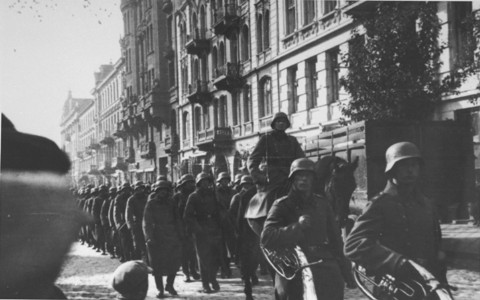
German troops entering Paris, 1940

German troops entering Paris, 1940

Let me be the first to say that in many ways, France got a very, very bad rap.

We’ll get back to that.  First, the history.

———-

There isn’t much of it.  After the French sent their best troops – including most of their armored divisions – charging into Belgium to the rescue of the Belgians and Dutch, the Germans sent the elite of their military charging through the Ardennes Forest, exactly as they had in 1871 and 1914, and exactly as they would in the winter of 1944 at the Battle of the Bulge.

German antiaircraft gun firing at French tanks

German antiaircraft gun firing at French tanks

They crossed the only real obstacle – the Meuse River – at Sedan, bringing the full weight of the blitzkrieg, Stukas and massed tanks, to bear against a French division that broke and ran – eventually, after giving two German Panzer divisions a bloody nose trying to cross the river – not so much out of “cowardice” as being grossly unprepared for what they faced.  Indeed, the French division beat back half of the German attempts to cross the river; it was the other half, and the relentless bombing, and the disruption in communication it caused, that sent them eventually running to the rear.  More on this below.

German troops crossing a pontoon bridge of the Meuse at Sedan.

German troops crossing a pontoon bridge of the Meuse at Sedan.

After Sedan, it took mere days to drive to the Channel.  This cut off the French First Army and the British Expeditionary Force, whose evacuation from Dunkirk finished seventy years ago yesterday.

That left it to the Germans to charge into the French interior and finish the game.   After their ghastly losses in the North – including all of their five armored divisions and much of the best of the French Air force – the French had 63 remaining divisions (plus one British division that’d stayed in the south) to hold a front that needed sixty of them.   The Germans destroyed the French Air Force in short order; the demoralized French gave way across the entire front;  by June 14 – in eight days – Paris fell.

German General Erwin Rommel, whose Seventh Panzer Division broke the French front at Sedan.  Rommel would go on to fame as the Desert Fox.

German General Erwin Rommel, whose Seventh Panzer Division broke the French front at Sedan. Rommel would go on to fame as the "Desert Fox".

Prime Minister Reynaud resigned rather than surrender; the French brought back eightysomething Field Marshal Petain, the great hero of the French resistance at Verdun in 1916, with the intention of signing an armistice.

Marshal Petain with Hitler at the armistice signing.

Marshal Petain with Hitler at the armistice signing.

And on June 22, at Compiegne, in the very railroad car and on the very spot where Germany had signed the armistice ending World War II, the French surrendered.
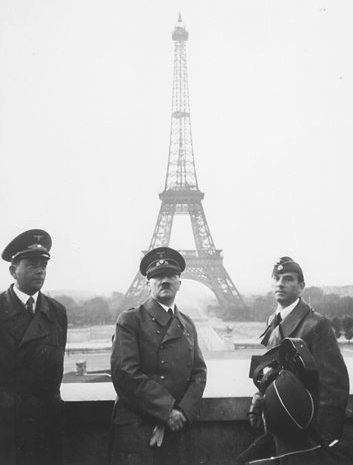
Hitler at the Eiffel Tower.

Hitler at the Eiffel Tower.

It was one of history’s great anticlimaxes.  Such an anticlimax that it’s been a punchline for seventy years now.  The French are forever tarred as “cheese-eating surrender monkeys”.

It’s a bum rap in many ways.

———-

Myth 1:  The French were Cowards:  How many of you remember the 1970’s?

Our president had just resigned in disgrace.

Our economy was in the tank.

Worst of all, we’d lost the Vietnam War.  56,000 Americans had died for…what?  What had we gained, the question went, after that wrenching ordeal?

Between those three causes, America fell into a deep, self-questioning malaise.  Some wondered if our greatest days weren’t behind us.  Some looked at the “second world” we faced – communism – and wondered if they might not have a good point, and noted that they were at the very least here to stay.

Now, imagine what would have happened if the Soviets had (somehow – I mean, we have to suspend a bit of disbelief here) invaded Canada in about 1978.  And our Pentagon plan for an invasion of Canada called for the US to send its best troops – the Airborne, the Marines, the Second Armored, the Eleventh Cavalry, all of ’em – charging north of the border to rescue the Canadians.

Say, then, that the Soviets had landed a huge invasion force at Seattle by complete surprise, and put their tanks on I94 and drove across the demoralized USA, sacking Chicago and driving along the south shore of the Great Lakes and down the Saint Lawrence all the way to theAtlantic, completely cutting off all those troops in Canada from food and fuel and ammunition and leaving America defended by the post-Vietnam National Guard?

It might have gone badly for us.

Now, picture a situation – a national demoralization, a malaise – 100 times worse than that.

Americans have a hard time comprehending being slaughtered en masse.  In recent memory, World War II is as close as we got – and the history that we’re told doesn’t record a lot of cases of Americans dying in droves like cannon-fodder.  The Civil War, of course.  Maybe a few debacles since then – the Volturno and Rapido rivers, the Huertgen Forest, the daylight bombing campaign of 1942 and 1943, places where Americans were killed in huge numbers for no real appreciable gain.  Our casualties were light-ish, compared to the Soviet Union (which lost over 10 million soldiers, and at least twice as many civilians, perhaps as many as half of them at Soviet hands); our nearly 400,000 dead of all causes (from combat to ruptured appendixes amounted to 6-8% of those who served.

So if you remember the national garment-rending that accompanied the 56,000 dead in Vietnam – about one in 40 of the soldiers that served there – then wrap your head around this:   in World War I, France lost 1.3 million dead and over 4 million wounded – out of a total of 8 million soldiers serving.  Nearly two out of three French soldiers were killed, wounded, captured or went missing in four years of war.

French troops at Verdun, 1916

French troops at Verdun, 1916

This crushed the generation of French that came of age before and during the war years.  And it was this generation that went on to become the nation’s middle-management, its field-grade officers, and its low-level politicians by 1940, as well as its family people.

Town of Verdun, after German artillery.

Town of Verdun, with German artillery damage.

Although not so much of that family thing.  While Americans after World War II came home victorious and spawned a baby boom, French soldiers – those that lived – came home and wondered what it was all about.  There was a huge baby bust in France in the twenties.  French society got commensurately older.  And between the destruction of much of the generation that came to middle age by the time of the war and the ravages of the Great Depression, France was beset by a malaise that made the US in the 1970’s look like an evening at Mardi Gras, as well as a relative shortage of military-age males.

French North African troops

French North African troops

As a result, France developed on the one hand a strong desire never to have it happen again.   Although there were nearly twice as many Germans as French, France mobilized fully a third of all males between ages 18 and 45, and managed to outnumber the German Wehrmacht.  They invested heavily in technology to help make that force more effective – albeit the wrong technology, in hindsight.  More below.

But  the nation was also a bit like a dog that’d been kicked too hard as a puppy.  It was deeply unwilling to go through another national bloodletting.  Politics in France was intensely divisive in the twenties and thirties, with parties of the far right and far left battling it out in a way that makes America’s current debate look downright dignifed.

Myth 2: “The Maginot Line Mentality”:   The Maginot line was a line of fortresses guarding France’s border with Germany, from the Swiss to the Belgian borders.  It’s often bandied about as an example of short-sightedness and strategic hide-boundness; the American left is fond of comparing weapons development projects as having “Maginot Line Mentality” – being expensive and yet uselessly behind the times, or havnig sapped money away from the weapons that, in hindsight, could have turned the Germans back.

All of which makes sense –  if you ignore contemporary French history.

The slaughter of World War I made a deep impression on the French psyche – and the casualties made a huge impression on the manpower available to the French military.   During the Great War, the French had suffered ghastly casualties in part due to their doctrine of “toujours l’attacque“, “always attack”.  Two years of reckless charges into the face of German artillery and machine guns forced a change in plan; the French became much more methodical, relying on heavy reinforced strongholds on defense, and tightly-coordinated attacks with artillery and tanks and infantry moving very deliberately under cover.

This philosophy carried forward as France armed itself for the next round of wars, in the ’20s and ’30s.   France created in effect two armies;  one intended to be fast, mechanized and armored, manned by the traditional Army – professional soldiers and lots of enlistees in their teens and twenties, intended to fight a combined-arms mobile war; the other with hundreds of thousands of middle-aged reservists in their thirties and forties intented to hold long stretches of the line with as little cost as possible.

And it was for that second army that the Maginot Line was built.  A long, complex chain of concrete forts and gun turrets and millions and millions of antitank obstacles and thousands of bunkers and pillboxes connected by tunnels, underground phone lines and even narrow-gauge railways, the Maginot Line was intended to make it easy for a relatively small number of middle-aged weekend warriors to hold off the German army while the first Army worked on the war-winning attack.

Artists rendering of a Maginot line fortress

Artists' rendering of a Maginot line fortress

And it worked.  The Germans had to batter their way through Belgium and the Netherlands to outflank the Line; the younger troops and tanks, the elite of the Army, got cut off and surrendered in Belgium, and only that allowed Germany to move unmolested into the heart of France without having to punch its bloody way through the Maginot Line.

Myth 3: The French weren’t ready for modern war: With their fortresses and their harkening back to the tactics of World War I’s trenches, it looks to someone looking back seventy years that France was anachronistic.

At the time, it was not true.  Indeed, in some respects France’s eagerness to modernize was its undoing.

If you work in Information Technology, you know this scenario:  when adopting new technology, companies have a choice:  Adopt the technology early, and by committing immense financial resources to the change risk having it go obsolete before too terribly long (all of you with companies still running NT4.0 servers, show of hands?), or adopt late and have a buggy, unreliable system.

France took the former route; they standardized their Army and Air Force on technology from the late twenties and early thirties, and built it in huge numbers.  And it showed; many of France’s tanks have a distinctly twenties look to them;

Knocked out French Char B tank
Knocked out French “Char B” tank

many of their fighter planes, built in the mid-thirties in the middle of a period of dizzyingly rapid aircraft development, were sixty miles per hour slower than their British and German counterparts (and the Brits, for their part, almost standardized too late; the Spitfire fighters that carried them through the war almost didn’t make it into service in time to fight).

French MS406 fighter

French MS406 fighter

But they had more tanks, and with the Brits more planes, than the Germans – and the late attempt to rectify the technology was starting to pay off; the French “Somua” tank was possibly the best in the world; the Dewoitine 520 fighter was among the best, although just coming into production.

At any rate – conventional wisdom, when it comes to history, fares about as well as it does anywhere else.


NARN On The Road!

Saturday, June 5th, 2010

Today, the Northern Alliance Radio Network brings you the best in Minnesota conservatism from 9AM-3PM.

  • Volume I “The Opening Act” and Volume II “The Headliner”Ed and I will be filling in for Brian and John, and doing our usual time slot – so we’ll be on from 11AM-3PM Central.  That’s four long long hours!  We’ll be live at the Moose Lake Organic Festival in Watertown, MN; stop on out and join us!  (Click on the “Directions” link here).  We’ll be talking with Dave Osmek of the Mound City Council, and there are some other surprise guests possibly showing up as well.
  • The King Banaian Show! – King is on from 9-11 on AM1570, Business Radio for the Twin Cities!  We’re broadening the franchise; two stations, now!
  • And for those of you who like your constitutionalism straight up with no chaser, don’t forget the Sons of Liberty, from 3-5!

(All times Central)

So tune in to all six hours of the Northern Alliance Radio Network, the Twin Cities’ media’s sole guardians of sanity. You have so many options:

  • AM1280 in the Metro
  • streaming at AM1280’s Website,
  • On Twitter (the Volume 2 show will use hashtag #narn2)
  • UStream video and chat (at HotAir.com or at UStream).
  • Podcast at Townhall, usually by Monday
  • Good ol’ telephone – 651-289-4488!
  • And make sure you fan us on Facebook!

Join us!

And In The Town Halls And At The Polling Stations

Friday, June 4th, 2010

It was 70 years ago today that Winston Churchill gave one of the greatest speeches in the history of the English language.

The British Army had just been ejected from continental Europe.  But it could have been worse.  We talked about Dunkirk earlier this week

Dunkirk was a miracle on one hand – but it had limits.  The Army had left all its tanks, artillery and all equipment heavier than rifles on the beach; it would have to be replaced, gun by gun, tank by tank, over the coming years.  And the rescue had battered the Royal Navy, which lost many ships protecting the evacuation.  Hitler was to turn in the coming weeks to trying to win air superiority over the island – the Battle of Britain, which Churchill would declare “their finest hour”…

…but that was all in the future.  On the evening of June 4, the Army – most of it – was home and safe, but the future was grim. 

The British people had been rocked on their heels.  There was some talk of reaching an armistice with Hitler; the British War Cabinet even voted on trying to seek terms with Hitler, although the proposal was soundly defeated.

Into that gap Churchill stepped, from the well of the House of Commons.  His speech concluded:

I have, myself, full confidence that if all do their duty, if nothing is neglected, and if the best arrangements are made, as they are being made, we shall prove ourselves once again able to defend our Island home, to ride out the storm of war, and to outlive the menace of tyranny, if necessary for years, if necessary alone. At any rate, that is what we are going to try to do. That is the resolve of His Majesty’s Government-every man of them. That is the will of Parliament and the nation. The British Empire and the French Republic, linked together in their cause and in their need, will defend to the death their native soil, aiding each other like good comrades to the utmost of their strength.

Even though large tracts of Europe and many old and famous States have fallen or may fall into the grip of the Gestapo and all the odious apparatus of Nazi rule, we shall not flag or fail. We shall go on to the end, we shall fight in France, we shall fight on the seas and oceans, we shall fight with growing confidence and growing strength in the air, we shall defend our Island, whatever the cost may be, we shall fight on the beaches, we shall fight on the landing grounds, we shall fight in the fields and in the streets, we shall fight in the hills; we shall never surrender, and even if, which I do not for a moment believe, this Island or a large part of it were subjugated and starving, then our Empire beyond the seas, armed and guarded by the British Fleet, would carry on the struggle, until, in God’s good time, the New World, with all its power and might, steps forth to the rescue and the liberation of the old.

And Britain went into its two-minute drill that we all know today; they held out under the bombardment; they kept air superiority over their island; they became the base from which the liberation of Europe was launched.

The coming months would be almost unimaginably grim by our 21st-century understanding, with the near-destruction of Britain’s air defenses, the Blitz, the firebombing of London and most other major British cities, and the near-starving of the island kingdom by a deadly-effective U-boat campaign.  

Hard to picture?  Imagine 9/11, only 2-3 times a week.  More British civilians died during the five months of the Blitz than American soldiers in fifteen years in Vietnam.  Ten British civilians died during those twenty brutal weeks for every American serviceman that has died in nearly a decade in Iraq and Afghanistan.

And yet Churchill kept his peoples’ minds on the prize – freedom for Britain, liberation for the Continent – for five more bloody years.

All we have to do is politically repel socialism and repeal a healthcare law.

Audio?  Sure!

More Guns Equals Less Crime

Friday, June 4th, 2010

Firearm sales have been on a historic boom for the past five years.

Over that same time, violent crime and murder rates  have been not only dropping, but the drop has accelerated:

Data from the U.S. Federal Bureau of Investigation show that America has been on a firearms buying spree since the end of 2005. Meanwhile, the FBI recently released preliminary 2009 crime data indicating that violent crime has been dropping at an accelerating rate since the end of 2006.

Graphic from Pajamas Media

Graphic from Pajamas Media

Correlation doesn’t equal causation, as such – but it’s a piece of evidence that can lead you to a cause. 

For example, the fact that the “Assault Weapon” ban sunsetted just before this drop in crime started might not be proof that “assault weapons” have next to no effect on crime rates – but it certainly indicates the sky didn’t fall when Grandma got to buy MP5Ks again.

Or the fact that Chicago, which utterly bans civilian guns, seems to be immune to the rest of the nation’s crime drop isn’t in and of itself evidence that gun bans kill people – but it’s evidence enough that you’d be dumb to rule it out as a conclusion.

Bring on McDonald!

The Setup?

Friday, June 4th, 2010

The media’s been starting – juuuust starting – to get a little critical of The One.

The immigration debate?  Jobs For Congressmen?  Oil washing up on the media’s vacationing grounds?  When you have not only CNN and Brian Willians but also Chris Matthews and Jon Stewart tagging on him, it’s gotta be bad for The Anointed – doesn’t it?

Unless you remember the mainstream media’s prime directive – keep Obama and Democrats in office – it might seem that way.

Paranoid?  Well, Ed Driscoll and I are both on the same wavelength.

Assuming BP is able to get the oil spill in the Gulf plugged, how much of this is the media laying the groundwork for their “comeback kid” narrative to roll out…right around September or early October, and running to, oh at least, the first Tuesday in November — and possibly longer, depending upon the outcome on election night?

Who knows how the next months will play out, but it’s something to salt away for the future.

Best way to tell?  If the Media and left (ptr) find a squishy moderate-ish Republican to start building up – a la McCain and Huckabee – for later tearing down, you’ll know Ed’s onto something.

The Unfiskable

Thursday, June 3rd, 2010

I read this op-ed in the Strib the other day, by a Peter Mandel, and thought “finally – we’re on to something here!” 

I mean, it’s impossible to look at the sodden, overripe string of cliches in his lede…:

It’s a Banana Republic like no other. Fly into its capital from abroad, and you’ll catch a whiff of overripeness, even decay. The baggage carousel clunks and squeaks. The road to your hotel is missing signs and is a maze of crevices and holes. Soon you are lost in a universe of strip malls; some are flourishing, others empty and dark. Although its elite are among the world’s most privileged, the gap between the Republic’s rich and others here is now a chasm.

…and not think “he’s drawing us off-topic before he comes in for a big surprise at the end!  Nobody could keep this string of obviousness going all the way to the end!  Nobody!”

“He’s going to end with a zinger noting the similarities between the Chicago government that spawned President Obama and his Administrati0n, with its patronage and corruption and family connections and machine politics, and places like Peru!”

“He’s going to link Obama’s ruinous orgy of spending with the those of banana-republic comandantes from Juan Peron to Hugo Chavez, with their suface sheen of social utopianism lightly slathered over a big rotten core of “buying off the peasants” until their nations collapse into debt and an endless parade of coups d’etat!”

“He’s going to juxtapose the stifling of dissent, first via an avalanche of coverage from carefully-groomed propaganda organs and then via outright censorship!”

“He’s gonna surprise us!  Nobody could be that ploddingly, thud-wittedly obvious to keep this going all the way through to the bitter, banal, boring end!”

Almost weekly there is news of an attack. Not by foreigners, but by citizens bearing a grudge or with an urge for revenge.

Localized antigovernment groups stock up on armaments while practicing paramilitary moves. A growing movement shouts its hostility to a range of federal offices and laws.

Those who know the Republic well are nervous. Especially those of us who live here — in its 50 states.

We watch, we peel our bananas.

And we wait.

…um…

…so…

…weekly attacks?  Huh?

I feel like I’ve been spinning around too fast.  The blood has left my head, and my vision is blurry.  Did this fella…

…Peter Mandel is an author of books for children, including “Bun, Onion, Burger,” due out this spring from Simon & Schuster. He lives in Providence, R.I.

…right, “Peter Mandel” – did he just accuse the Tea Party of running a banana republic government and attacking people weekly?

I need a banana now.  For the potassium, I mean.  It might help me regain my equilibrium. 

I need it.

And How About Andrew Johnson, For Crying Out Loud?

Thursday, June 3rd, 2010

Ssshhhhhh.

Dave Mindemen at mnpACT is about to blow the lid off something – the “facade” of Minnesota Republican unity:

A short time ago, Republicans filled a room at the Secretary of State’s office and Tony Sutton announced this as proof that the Republican party was unified and ready to take back the legislature. It was a nicely staged event to coincide with Tom Emmer’s filing for governor. All together – united in purpose.

Makes a great picture….but like most Republican declarations it’s just not true.

But…why?

Arne Carlson was on MPR this morning…you remember him. Former Governor of Minnesota, Republican? Except when you ask Pawlenty or Tony Sutton or Michael Brodkorb about Arne Carlson, they refuse to identify him as part of the GOP. Pawlenty has dismissed Carlson’s critiques as proof that Carlson has defected to the other side.

Disagreement’s not allowed?

Ask Joe Lieberman and former DFLer Norm Coleman…

….hey, wait!  Arne Carlson is running for office?

(Even after doubling spending, endorsing Obama and bashing the conservative mainstream that, let me emphasize this, controls the party?)

Question #1 for Dave Mindeman:  Does the fact that conservatives won the control of the party, to the point where no “moderates” made it to the convention, mean anything to you (outside the mistaken notion that it’s a weakness)?

Question #2 for Dave Mindeman: Please introduce me to all those endorsed pro-gun, pro-life, limited-government Tenth Amendment supporting Democrats in the Metro area DFL!

Chanting Points Memo: The Mindy‘s Thin, Runny Gruel

Thursday, June 3rd, 2010

Andy Birkey of the Minnesoros “Indpendent” and Bradlee Dean of punk-rock fundamentalist ministry “You Can Run But You Can Not Hide” and AM1280’s “Sons Of Liberty” are so different from each other that Hollywood is reportedly talking about putting them on an island and doing a reality show.

Not without reason, of course; Dean is an outspoken fundamentalist who believes God condemns homosexuality; Birkey covers the gay beat for the Mindy, especially focusing on outrages against gay rights (provided they’re not from Keith Ellison).

Of course, Dean’s preaching on the subject is not unusual among fundamentalist ministries; most African-American Baptist churches are every bit as fire-and-brimstone on the subject as Dean. But I’m at a loss to find another fundamentalist minister who’s been the subject of seventeen pieces in the Mindy in the past eight months.

Lately, as we noted last week, the subject of the coverage has been a radio broadcast where, to read Birkey’s account, Dean said executing gays was moral.  We dealt with and disposed of that this past week; Dean will no doubt address the issue this weekend on “Sons of Liberty”.

Now, even the Minnesoros “Independent” knows that “fundamentalist cites Leviticus in re gays” is “dog bites man”.  It’s not news.  And the “Independent” doesn’t really cover theology.   Their mission is to advance the left’s agenda.

And part of the left’s agenda this year in Minnesota is to win the Governor’s office.

With this in mind, Birkey has spent his last couple of articles trying to tie the Tom Emmer campaign to Dean and his ministry.

The “ties”, according to Birkey, are:

An almost-two-year-old “donation” of $250, in the form of buying seats at a You Can Run benefit dinner in November of 2008.  This, by the way, was long before YCR was on the regional media radar – although Birkey continues to refer to this “donation” with context and time frame carefully buried.

Tom Emmer stopping by and getting photographed at the YCR booth at the Minnesota State GOP Convention (as he had stopped by every single gathering of conservatives anywhere in Minnnesota for the past year).

An appearance on “Sons Of Liberty”.  By that token, RT Rybak, a former NARN guest, must be a conservative sympathizer.

Tom Emmer calling Bradlee Dean and his associates “nice people.   It’s perhaps an inconvenient truth to Andy Birkey that Bradlee Dean and Jake MacMillan are nice people.  They may have different beliefs than Andy Birkey and, also, me.  And perhaps it’s easier to believe people who disagree with you are foul people with horns growing out their heads.  But Dean and MacMillan and their wives and associates are a genial bunch.

And that’s it.  That, according to Birkey, is the extent of Tom Emmer’s “link” to YCR.

And yet Birkey wrote (with emphasis added):

“Emmer is one of several Republican leaders involved with the ministry of Bradlee Dean,”

Andy Birkey:  Where is the “involvement”? All you have is an ancient donation, a photo and an off-handed and, as it happens, accurate impression of personalities.

Does Emmer have any substantial link to YCR?  Does YCR have any significant influence on Emmer?

Or is the Mindy just repeating a big lie until people believe it?

Andy Birkey and the Mindy:  Either show a real, current, substantive link between Emmer and You Can Run – and by “substantive” I mean more than a grin-‘n-run photo or a door-knocking-stop – or get real, grow up and drop your unsupported meme that Emmer is, in your words, “involved” with YCR.

Because you can mislead, but you can not get away with it.

--> Site Meter -->