Archive for the 'War On Terror' Category

Success Has A Thousand Fathers, Part IV

Monday, November 26th, 2007

The NYTimes notes that the Dems are busily trying to figure out how to be for the war, after they were against it, after they were for it:

Advisers to Senators Hillary Rodham Clinton and Barack Obama say that the candidates have watched security conditions improve after the troop escalation in Iraq and concluded that it would be folly not to acknowledge those gains. At the same time, they are arguing that American casualties are still too high, that a quick withdrawal is the only way to end the war and that the so-called surge in additional troops has not paid off in political progress in Iraq.

I’ve noticed this in the media’s coverage – and even in callers on the NARN show; suddenly, now that fewer people are dying and the threat of civil war seems to be waning, a functional parliament and government is the gold standard for determining success in Iraq.

But the changing situation suggests for the first time that the politics of the war could shift in the general election next year, particularly if the gains continue. While the Democratic candidates are continuing to assail the war — a popular position with many of the party’s primary voters — they run the risk that Republicans will use those critiques to attack the party’s nominee in the election as defeatist and lacking faith in the American military.

Um, yeah.  With bells on.

“The politics of Iraq are going to change dramatically in the general election, assuming Iraq continues to show some hopefulness,” said Michael E. O’Hanlon, a senior fellow at the Brookings Institution who is a supporter of Mrs. Clinton’s and a proponent of the military buildup. “If Iraq looks at least partly salvageable, it will be important to explain as a candidate how you would salvage it — how you would get our troops out and not lose the war. The Democrats need to be very careful with what they say and not hem themselves in.”

I think for most Democrats – those that are in any way beholden to the nutroots – it’s too late.

Not that it’ll harm the likes of Keith Ellison and Betty “Rubble” McCollum, but yes, it is a club that needs to be used with gusto.

Rational Sobriety

Sunday, November 25th, 2007

From Michael Yon’s Thanksgiving report from Baqubah, a call for sober appreciation of significant progress – one that takes an ironic turn:

Bottom line is that progress is clear and real, but there are tough days ahead and al Qaeda, for instance, is far from dead. The mood is of cautious optimism, with a concern that some of the very positive media lately might set expectations too high. (That’s right: many military leaders are concerned that the media lately might be too positive.)

Call for Charles Krauthammer.

Bottom line is that I am more optimistic than ever before, but I share that caution. It’s obvious, too, that the tough fighting is not over.

It’s too early for anyone to be chanting the “V” word.  Just as it’s too late to be crowing that Iraq is a lost cause (while mentally tallying up electoral votes).

But I came across something today that might make veterans of the fighting in Baqubah proud. Back in May, just before operation Arrowhead Ripper, there were about 60 violent acts per day. Now there are about 6. The markets are opening and the streets are again filled with people. I thought the veterans of Baqubah might like to know that their efforts have made a tremendous difference for the people here. You fought hard. This writer saw it. Your sacrifices truly meant something.

There’s nothing I could possibly add.

Early Epilogue

Friday, November 23rd, 2007

Tim Montgomerie of the London Times on how very traditionalist, European and “conservative” the Bush Foreign Policy has been.

And it’s not really a good thing:

The foreign offices of Europe all hope for more multilateralism. More realpolitik. Less sabre-rattling.The critics have a problem, however. In reality, Team Bush has largely been following European approaches to foreign policy for most of the world’s troublespot nations.

Take Pakistan. The “realist school” couldn’t honestly disapprove of any aspect of Bush’s dealings with Islamabad. American taxpayers have financed a military dictator in the hope that Musharraf will suppress the fundamentalists and provide logistical support for Nato operations in Afghanistan. Has this worked? No. Islamic militancy is mushrooming.

Musharraf has often bargained with the political patrons of the madrassas in order to stymie his democratic opponents. If he falls, the Pakistan people may see America as the nation that propped up the regime that introduced martial law and warped the constitution.

Which isn’t exactly “Neocon”.

It’s all too reminiscent of its relationship with the Shah of Iran in the 1970s. When it comes to present-day Iran, Team Bush has been patiently multilateralist. Washington allowed the years to pass as Europe promised to negotiate an end to Tehran’s nuclear plans. As it became obvious that the talks were failing, the Americans turned to the United Nations. Russia and China have vetoed any significant action.

Ditto.

Indeed…:

Something akin to neoconservatism has only really been pursued in Iraq. Even the keenest supporters of the war readily agree that dreadful mistakes have been made. Nonetheless, the tide is now turning. Violence has halved. The progress of the “surge” is increasingly apparent…The bungled road to a democratic Iraq has been far too bloody but it’s now perfectly sensible to believe that Bush’s pre-emptive war may have sown the seeds for what could be the least troubled nation of the region in a decade’s time. The multilateral approach to Iran may leave us with a nuclear-armed Tehran terrorising Israel and holding the world to ransom over oil supplies.

Lessons to learn?  Especially for the next president?

When it comes to foreign policy the next US president has to remember that America is most effective when the world’s only policeman is seen as strong, as in the immediate aftermath of the Iraq invasion. Libya disarmed. The Khan nuclear exchange programme was exposed. Syria withdrew from Lebanon. Problems multiplied when America looked unwilling to commit necessary troops to finish the first battles of the War on Terror. A weak America, tied down by do-nothing multilateralists, is the last thing our dangerous world needs.

Uh-oh.

I’m going to go write a check to a Republican.  Hell, every Republican except Ron Paul.

The Generalissimo Speaks

Wednesday, November 21st, 2007

Duane at Radioblogger, by way of dinging on the Dems’ latest attempt at a “Cut and Run” bill, writes:

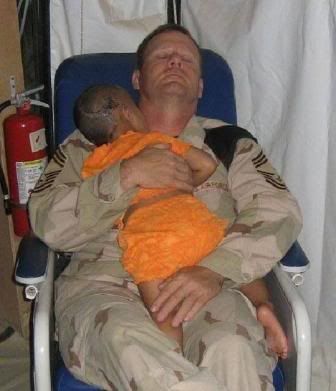
A listener sent this picture and e-mail a little bit ago.

This is John Gebhardt in Iraq. His wife Mindy reports that this little girl’s entire family was executed. The insurgents intended on executing this little girl, too. In fact, they tried by shooting her in the head. But miraculously, this little girl lived, but is obviously suffering while her body tries to heal. She cries and moans incessantly, but John is able to calm her. The nurses where she’s being treated say John’s the only one she clings to. So John and this little Iraqi girl have slept for the last four nights in that chair so that she can continue to heal after her injury.

Not exactly Abu Ghraib-like, so it’s doubtful you’ll ever see this hit the nightly newscast.

Against this…:

Democratic Senate Majority Leader, Harry Reid, is planning on trying once again this week to choke progress before it has a chance to thrive and prosper by passing legislation to give the military a quarter of the money needed to fund the effort in Iraq, and require that if the token dollar amount is appropriated, an orderly withdrawal begins immediately.

In other words, sending them a “hide ’til…” date.

…Mitch McConnell and the rest of the Republicans ought to have a stronger hand to defeat this more than ever before because of the clear evidence of progress and success in Iraq. There is no need to change the course in Iraq, to use the tired phrase of Harry Reid, when the course in Iraq is working demonstrably. The Republicans should use the 60 vote rule to kill this legislation the moment it comes to the floor. Republicans would do well to show they are more determined to win than the Democrats are determined to declare defeat.

Senator Coleman…?

And once the bill is killed, it is imperative for George W. Bush to use the bully pulpit and call this stunt for what it is. He should go to the American people and start showing the progress that is being made, the progress that isn’t being shown in the mainstream media, and challenge the Congress directly to stop playing games with the American military while they are fighting, winning and making a real difference abroad, and pass a clean appropriations bill immediately. And he should keep saying it.

And that’d be the problem. The President and the Administration have been a consistent no-show in the PR battle.

Oppose the War, Oppose The Troops

Wednesday, November 21st, 2007

Maloney The Radio Equalizer: Brian Maloney

While talk hosts and bloggers across the country have been pounding away on the subject, the Boston Globe hasn’t found room for a single mention of the ongoing anti- troops outrage in Cambridge.

Earlier this week, the rabidly anti- American city banned local Boy Scouts from collecting items for care packages destined for soldiers in Iraq, calling their efforts a “political statement”.

Proving that liberals really are against the troops, the resulting outrage has been covered extensively by talkers, including KSFO/ San Francisco hosts Melanie Morgan and Lee Rodgers, syndicated talker Laura Ingraham, Bill O’Reilly, Boston’s Howie Carr and many more.

Maloney overreaches, to be sure – not all liberals are against the troops. Far from it, indeed. But it does take me back to one of my most popular posts.

[cue the harps and the soft focus]

With apologies to Jeff Foxworthy:

If You Believe: …that America has problems – huge problems – then dissent is American.
But If You Believe: …that America’s problems make it an inherently rotten concept, then maybe you should think about whether you’re living in the right place.

If You Believe: …that America’s projection of power around the world is immoral – then dissent is American.
But If You Believe: …that any projection of American power is inherely unjust because it’s America, then maybe you should be living in, say, Sweden? Just an idea.

If You Believe: …that capitalism is wrong because its inequalities are inherely unjust, then dissent is American.
But If You Believe: …that the free market is inherently, irrevocably evil, perhaps China would be a better fit? Just suggesting…

If You Believe: …that invading Iraq was wrong, then dissent is American.
But If You Believe: …that our temporary administration of Iraq is worse than Hussein’s 30 year reighn of horrors, then perhaps you should rot in hell we need to have an attitude adjustment.

Just a hunch.

In three years, I’ve found little reason to change it.

Pick Your Terrorists

Tuesday, November 20th, 2007

It’s not just the Islamofascist variety that are causing problems along the southern border:

“They’ve got weapons, high-tech radios, computers, cell phones, Global Positioning Systems, spotters and can react faster than we are able to,” said Shawn P. Moran, a 10-year U.S. Border Patrol veteran who serves as vice president of the National Border Patrol Council Local 1613 in San Diego.

“And they have no hesitancy to attack the agents on the line, with anything from assault rifles and improvised Molotov cocktails to rocks, concrete slabs and bottles,” he said. “There are so many agent ‘rockings’ that few are even reported anymore. If we wrote them all up, that’s all we would be doing.”

Assaults against Border Patrol agents have more than doubled over the past two years, many by Mexico-based alien and drug gangs more inclined than ever to use violence as a means of ensuring success in the smuggling of people and contraband.

High fence.  Narrow gate.

Sign of Profound Hope

Tuesday, November 20th, 2007

Embedded in one of Michael Yon’s Dispatches from a few weeks ago,

A ping-pong fad is sweeping through Fallujah.[Official U.S. Marine Corps photo by Sgt. Stephen M. DeBoard]

This is a truly wonderful sign.  No people that genuinely appreciate Table Tennis – the king of sports – can stay in the wilderness for too long.

Read the rest of the post, if you haven’t already.

Failure Is An Orphan, Part III

Monday, November 19th, 2007

Rosner at Ha’aretz notes that  the Democratic prez candidates sound a lot like…neocons.

But the even more amazing thing about the Pakistan chapter of the debate was the extent to which the Democratic candidates sounded almost like – well – neocons.Consider their praise for democracy and their insistence that the Bush administration should be pushing Pakistan’s President to allow elections in Pakistan to move forward. Consider the talk about how democracy in countries like Pakistan contributes to America’s national security (Clinton). Consider their practical dismissal of the danger attached to a destabilized Pakistan (Dodd was the exception, saying that “When you take the oath of office (for the presidency) January 20th, you promise to do two things: protect and defend the United States and protect yourselves from enemies foreign and domestic.”)

Interesting that the Administration has had to adopt – at least operationally – a more realpolitik-y approach on the ground in Iraq and Afghanistan, promoting stability and strong traditional institutions (like the sheikhs and tribes) over surface indications of democracy, for at least the time being, while the left is moving into the space the Administration has for the moment vacated.

Consider all their statements and you?ll reach one of two conclusions:
Either everything is politics, and when Bush does A (avoids pushing the Pakistani President) the Democrats must say B no matter what; or, as much as the Democrats want to deny it, the Bush years did influence the way they think about the world.

I’ll take (C):  All of the above, but with a healthy dollop of Bush Derangement slathered on top.

Start Your Stopwatches

Friday, November 16th, 2007

I’m looking for the first instance of someone in lefty politics or the media taking this news out of context:

Attacks against British and Iraqi forces have plunged by 90 percent in southern Iraq since London withdrew its troops from the main city of Basra, the commander of British forces there said.

The presence of British forces in downtown Basra, Iraq’s second-largest city, was the single largest instigator of violence, Maj. Gen. Graham Binns told reporters Thursday on a visit to Baghdad’s Green Zone.

I’m gonna watch for talking heads, leftybloggers and MSM stopping the report right there.

Of course, that wouldn’t be the whole story:

With an overwhelmingly Shiite population, Basra has not seen the level of sectarian violence that has torn Iraq apart since the February 2006 bombing of a Shiite shrine north of Baghdad.

But it has seen major fighting between insurgents and coalition troops, as well as between Shiite militias vying for control of the city and its security forces.

British officials expected a spike in such “intra-militia violence” after they pulled back from the city’s center, and were surprised to find none, Binns said.

And watch for this bit here…:

“That’s because the Sadrist militia is all powerful here — more powerful than Badr. If Badr was allowed to take on JAM in Basra, they’d lose pretty quickly,” he said, using the Arabic acronym for the Mahdi Army, a militia loyal to radical cleric Muqtada al-Sadr.

…to be portrayed as a failure, rather than a key part of fighting this sort of counterinsurgency; picking the most powerful, most stability-enhancing, most co-optable local faction and playing it against the others. It’s counterintuitive to people who are commited to democracy, now, including many neoconservatives. (Steven Vincent approached it suspiciously but clinically in his writing about the British zone; he was eventually murdered in Basra).

Success Has A Thousand Fathers, Part II

Thursday, November 15th, 2007

Gateway Pundit notes that Pelosi’s war policy has hit…a bit of a quagmire:

Speaker Pelosi has failed to pick up any Republican backers to cut and run with the democrats from Iraq since she took over the House in January. And, 5 more democrats bailed on the party since July.

When they even lose Hegel…

A Conversation

Tuesday, November 13th, 2007

Austin Bay has a heart-to-heart with a fighter pilot in Afghanistan.

They have a lot of territory to cover together – you should read the whole thing.’

The fighter pilot – a colonel whose son is a new Army officer, the second generation in his family to fight in the War on Terror – is tired.  Bay sums it up:

Now, once upon a time we could ignore those suffering in the planet’s hard corners. Oh, we could send them a few bucks and the Lefties could bitch about colonialism and capitalism but the hard corners were isolated. A threat to security? Only nuns and missionaries and you are your brothers keeper types thought so. Well guess what — the nuns were right. 9/11 changed that deceptive calculus. Distance? Colonel, there isn’t any distance. We learned that the destruction of New York and Washington started in the backwaters, of Afghanistan, of Somalia. Technology has done it. We can’t escape one another, for good and for bad. Jet transports, like the ones out on the runway at Bagram, put you on the other side of the globe in 14 hours. The internet doesn’t require description. East Asia shares diseases with Africa within days, if not hours. And special weapons? Nukes and nerve gas make every tribal war an international crisis. Goodbye Tokyo, Moscow, or Miami– because a sophisticated tribesman at war with his eternally despised neighbor decides that demolishing the global economy would make everyone pay attention to his neglected, forgotten grievance. Tyrannies keep breeding this insanity…He looked at me, the dreadful nearness of it.

It’s on us, man, I continued. And I don’t like it. I didn’t like it during the Cold War. Remember 1983? The same creeps who’ve quit now, quit then. Reagan was a warmonger, going to start a nuclear war in Europe my responding to the Soviets deployment of theater nuclear missiles. The defeatists said the Cold War was our fault, we were the threat. Then the Berlin Wall cracked and that jackass calumny disappeared as Marxism’s Eastern European wreckage emerged in drab, polluted, horrifying, undeniable color.

This war follows the same arc, with the same defeatists adding new nouns to old verbs and adjectives. But it’s a war of liberty versus tyranny and they’re shilling for the tyrants.

Take it up with the Colonel.  Both of them, really.

Won

Wednesday, November 7th, 2007

I’m always loathe to use the “V” word in relation to Iraq.  It seems like the sort of premature happiness that seems all the more galling if it’s claimed wrongly.

But Andrew Bolt doesn’t mind saying it – that the war has been won.

His piece makes many, many points – casually mauling a lot of the left’s worn-out tropes about the subject on the way.

But the conclusion was something I’ve been harping on for years:

The battle for Iraq always involved a grim calculus: would liberation save more people than it killed?

So let’s calculate how many died under Saddam.

In 1980, the dictator invaded Iran, starting a war in which at least 500,000 people died. In 1987, he crushed the Kurds, killing perhaps 100,000 or more.

In 1990, he invaded Kuwait, starting a war that killed more than 23,000.

On his defeat, he killed some 100,000 Shiites who rebelled.

Add the mass executions he ordered, the purges he unleashed, the opposition activists he shot, the terrorist attacks he paid for.

Remember also the children who died, robbed of medicines by his regime.

Add them all up, and even by the most conservative count you see Saddam did not just threaten the West, but cost the lives of more than 100 Muslims a day, every day, for the 24 years of his barbaric rule.

That’s four times more than are being killed in Iraq today, often by Saddam’s heirs and Saddam’s like.

Was Iraq worth it? Yes. It stands, it stays, and the winning of Iraq was worth it, indeed.

Read the whole thing.

Forgiveness

Monday, November 5th, 2007

You’ve heard of Scott Beauchamp – the soldier who, as “Scott Thomas”, accused his fellow soldiers of a wholly-fictitious chain of atrocities, with the active connivance of the New Republic.

I’m not quite sure what I expected of Beauchammp – who was the subject of a fairly spirited Army investigation after his identity was revealed.

But I’ll admit that this was just about the last thing I expected:

I was at a reconciliation meeting between Sunni and Shia in the West Rashid district of Baghdad on 24 October, and it happened by complete coincidence that I was with Beauchamp’s battalion. In fact, I was with his old company commander for much of the day, although I had no idea for most of it that I was with Beauchamp’s old company commander.

At the reconciliation meeting, Beauchamp’s battalion commander, LTC George Glaze, politely introduced himself and asked who I wrote for. When I replied that I just have a little blog, the word caught his ears and he mentioned Beauchamp, who I acknowledged having heard something about. LTC Glaze seemed protective of Beauchamp, despite how the young soldier had maligned his fellow soldiers. In fact, the commander said Beauchamp, having learned his lesson, was given the chance to leave or stay…Lapses of judgment are bound to happen, and accountability is critical, but that’s not the same thing as pulling out the hanging rope every time a soldier makes a mistake.

Beauchamp is young; under pressure he made a dumb mistake. In fact, he has not always been an ideal soldier. But to his credit, the young soldier decided to stay, and he is serving tonight in a dangerous part of Baghdad. He might well be seriously injured or killed here, and he knows it. He could have quit, but he did not. He faced his peers. I can only imagine the cold shoulders, and worse, he must have gotten. He could have left the unit, but LTC Glaze told me that Beauchamp wanted to stay and make it right. Whatever price he has to pay, he is paying it.

So I’ll give what little credit I have to give, where it’s due.   

LTC Glaze wants to keep Beauchamp, and hopes folks will let it rest. I’m with LTC Glaze on this: it’s time to let Beauchamp get back to the war. The young soldier learned his lessons. He paid enough to earn his second chance that he must know he will never get a third.

I think a lot of people might be persuaded to take back some of the things they said about Beauchamp. 

As to the New Republic, though… 

…some on the staff may feel like they’ve been hounded and treed, but it’s hard to feel the same sympathy for a group of cowards who won’t ’fess up and can’t face the scorn of American combat soldiers who were injured by their collective lapse of judgment. It’s up to their readers to decide the ultimate fate.

The New Republic treed like a bandit . . . personally, I think they would make a nice Daniel Boone hat.

Now, them,  I can criticize.

Talk With A Lightning Rod

Friday, November 2nd, 2007

Over at AM1280’s sister station KKMS (“AM980 The Believer”), the Jeff and Lee show will be talking this afternoon with Georges Sada, a former general in Hussein’s Iraqi army, about his allegationswhich are story non grata in the mainstream media – that Hussein’s WMD program was far more advanced than conventional wisdom currently holds, and that the evidence was smuggled to Syria.

Sada is on a spin through the area promoting his new book on the subject.

Tune in, call up!

Voting With Their Feet

Friday, October 26th, 2007

Two recent, heavy-handed anti-war films turned into IEDs at the box office:

Both “In the Valley of Elah” and, more recently, “Rendition” drew minuscule crowds upon their release, which doesn’t bode well for the ongoing stream of films critical of the Iraq war and the Bush administration’s wider war on terror.

“Rendition,” which features three Oscar winners in key roles, grossed $4.1 million over the weekend in 2,250 screens for a ninth-place finish. A re-release of “The Nightmare Before Christmas” beat it, and it’s 14 years old.

Both of these movies received intense media coverage and slaving critical praise – as, predictably, will pretty much any movie that attacks the idea of the war.

Is America looking for a feel-good hit, or is the movie-going public just not buying it?

Through Yon Window Breaks

Wednesday, October 24th, 2007

Michael Yon is pissed.

Yon’s been in Iraq covering the war as a freelance embed for almost three years now.  As a rigid independent – unbeholden to either the administration or the media’s agenda – he’s not ever been a shill for the Administration.

It was Yon’s intensely critical reporting during the worst days of the pre-surge war of attrition that reportedly got him eighty-sixed from the Sean Hannity show. The Administration will no doubt not be thrilled about Yon’s current prognosis for Afghanistan.

But today, he turns his scathing pen from bumbling generals and crusty Command Sergeants Major to…his fellow reporters.

All describe the bizarro-world contrast between what most Americans seem to think is happening in Iraq versus what is really happening in Iraq. Knowing this disconnect exists and experiencing it directly are two separate matters. It’s like the difference between holding the remote control during the telecast of a volcanic eruption on some distant island (and then flipping the channel), versus running for survival from a wretch of molten lava that just engulfed your car…No thinking person would look at last year’s weather reports to judge whether it will rain today, yet we do something similar with Iraq news. The situation in Iraq has drastically changed, but the inertia of bad news leaves many convinced that the mission has failed beyond recovery, that all Iraqis are engaged in sectarian violence, or are waiting for us to leave so they can crush their neighbors. This view allows our soldiers two possible roles: either “victim caught in the crossfire” or “referee between warring parties.” Neither, rightly, is tolerable to the American or British public.

Whatever your views on the war – right, wrong, iies, campaign to safeguard the nation – it’d take “Joe Isuzu”-level intellectual dishonesty to not figure out that things have changed, largely for the better, in Iraq in the past ten months.

And yet the media are still stuck in Abu Ghraib mode.  The other night, MPR’s lead story was about a squabble between the Army and the Iraqi Interior Ministry about civilian casualties in a disputed firefight, complete with unctuous sarcasm from the reporter during the Army’s side of the story.

Did I mention he’s no cheerleader?

I came to Iraq in December 2004 specifically because friends in the military had been telling me about the disconnect between the situation on the ground and the media coverage about it. This is partly why I have remained focused enough on this problem to write about it dozens of times, beginning with an early dispatch about how many news reports “from” Iraq are generated . Later I described the expensive and exasperating embed process that makes long-term on-the-ground reporting next to impossible for most small or medium media outlets, and just plain impossible for most freelancers and independents.

I’ve written about the small and petty ways the military’s Public Affairs Offices can sour even the most earnestly and positively-inclined reporters. I’ve written about how the military’s entire approach to media has failed utterly to serve both the particular mission in Iraq and the greater cause of an informed and vibrant democracy. I’ve written about reporters who got the story right, about those who got it all wrong, and also about those whose reports, good or bad, never saw the light of day.

But the villain in this report sits in a corner office on Broadway:

But it wasn’t until I spent that week back in the States that I realized how bad things have gotten. I believe we are witnessing a conspiracy of coincidences conflating to exert an incomprehensibly destructive force on the free press system that we largely take for granted. The fact that the week in question also happened to be when General Petraeus and Ambassador Crocker were delivering their reports to Congress makes me wonder if things are actually worse than I’ve assessed, and I returned to Iraq sadly convinced that General Petraeus now has to deal from a deck clearly stacked against him in both America and Iraq.

Clearly, a majority of Americans believe the current set of outdated fallacies passed around mainstream media like watered down drinks at happy hour. Why wouldn’t they? The cloned copy they get comes from the same sources that list the specials at the local grocery store, and the hours and locations of polling places for town elections. These same news sources print obituaries and birth announcements, give play-by-play for local high school sports, and chronicle all the painful details of the latest celebrity to fall from grace.

And, finally, he’s got a plan, and needs your help.

So read the whole thing, and warm up your phone and keyboard.

Right Place and Right Time?

Wednesday, October 24th, 2007

The essential David Warren on Bhutto:

Out of the bloody mess in Karachi — hundreds killed and maimed in Al Qaeda’s latest effort to gain power through psychopathic violence and intimidation — comes a kind of order. The position of Benazir Bhutto — the seemingly perpetual once and future prime minister of Pakistan — has been immensely enhanced by the failure of the blasts to kill her. If she can remain alive, she now has an unprecedented and almost miraculous opportunity to pull Pakistan together, and inspire her people to fight against their worst enemy in the world — not “Hindu India,” nor “Imperialist America,” but the Islamists who are feeding on the country’s entrails.

Should this – getting on-the-fence Pakistan heavily involved in fighting the war on terror, especially the part that’s based on their territory – work out, it’d be a key point in the war on terror.

The story – Bhutto, a famous, and famously-corrupt, woman elected by a popular vote but removed by a military coup that led to the also-corrupt Musharraf, who has nonetheless been a key, if “nuanced”, ally in the war on terror, and then returning to power – is an amazing one.

The power-sharing agreement Mrs Bhutto’s agents have apparently hashed out with President Musharraf’s agents must certainly be vague, and constitutionally incomprehensible. That is because it is founded only on necessity — a principle that trumps all constitutional law. Pakistan’s surprisingly independent supreme court may throw spanners in Musharraf’s recent “re-election,” or in the deal to withdraw corruption charges against Mrs Bhutto and her husband (that were themselves presented in a corrupt way). But for all their self-regard, the country’s nit-picking lawyers and judges are now more likely to realize what is at stake if they try to stand in the way of necessity.

Mrs Bhutto, and not President Musharraf, has the mass appeal, without which, at this moment, no politician or general in Pakistan has a chance against the whirlwind.

Read, as they say, the whole thing. And, as I’ve been urging for years, make sure you read Warren every week.

…But Verify

Tuesday, October 23rd, 2007

Most Americans approved of giving government a lot of extra power after the onset of the crisis.  We gave the power on the assumption that the government would operate with integrity.  Being composed of humans with imperfections (and, being careerists and politicians, perhaps more imperfections than most), some of them took more than they were supposed to.

The crisis – well, that’s the trick, of course:  the Red Scare, the Kennedy Assassinations (both), Watergate, the Stockton Massacre, the Crack Epidemic…

…oh, yeah – and 9/11.  The responses, in the wrong hands, led to untrammelled power in the hands of J Edgar Hoover, immense CIA abuses and the Gun Control Act of 1968, a special prosecutor law with inordinate power, the 1994 Crime Bill and 1996 Counterterrorism Act…

…and the Patriot Act, which gives the government powers it may well need to fight the war on terror, and gives unethical law enforcement and intelligence peopleimmense opportunities for abuse, as Patterico relates:

First, it is true that, as the anonymous source told the New York Sun, there is information that “could jeopardize the safety of certain individuals” — namely, the ages of Higazy’s family members, and the fact that his brother has arthritis. But I don’t really think that this information is that significant — or that its omission would provide a significant roadblock to security officials determined to harm Higazy’s family members.

The other thing you notice is, I believe, far more significant — which is why I put it in bold type. Namely, you have an FBI agent who admits that he threatened to ensure that a suspect’s family would be tortured by a foreign government.

Somehow, I think that’s the reason the information was submitted under seal.

The ethics of power depend on the integrity of government’s agents.  Which, like any other people, takes constant scrutiny.

Oh, read the whole thing.

The V Word

Monday, October 22nd, 2007

People are starting to use the word in polite company – victory.

Michael Ledeen in the WSJ:

Should we declare victory over al Qaeda in the battle of Iraq?

The very question would have seemed proof of dementia only a few months ago, yet now some highly respected military officers, including the commander of Special Forces in Iraq, Gen. Stanley McCrystal, reportedly feel it is justified by the facts on the ground.

These people are not suggesting that the battle is over. They all insist that there is a lot of fighting ahead, and even those who believe that al Qaeda is crashing and burning in a death spiral on the Iraqi battlefields say that the surviving terrorists will still be able to kill coalition forces and Iraqis. But there is relative tranquility across vast areas of Iraq, even in places that had been all but given up for lost barely more than a year ago. It may well be that those who confidently declared the war definitively lost will have to reconsider.

Reconsider – or move the goalposts. Or frantically rewrite history.

In Fallujah, enlisted marines have complained to an officer of my acquaintance: “There’s nobody to shoot here, sir. If it’s just going to be building schools and hospitals, that’s what the Army is for, isn’t it?” Throughout the area, Sunni sheikhs have joined the Marines to drive out al Qaeda, and this template has spread to Diyala Province, and even to many neighborhoods in Baghdad itself, where Shiites are fighting their erstwhile heroes in the Mahdi Army.

The Mahdi Army – the group that not six months ago some said posed an insurmountable obstacle to any meaningful peace between the sects in Iraq.

I’ve written about this change in the war before – here and here and here. As a mere history buff, I can be ignored at the reader’s leisure – indeed, I encourage you, the reader, to take this career civilian and history geek’s writings about warfare with an appropriate block of salt, and read the people who do know.

Things have improved all over the coalition:

British troops are on their way out of Basra, and it was widely expected that Iranian-backed Shiite militias would impose a brutal domination of the city, That hasn’t happened. Lt. Col. Patrick Sanders, stationed near Basra, confirmed that violence in Basra has dropped precipitously in recent weeks. He gives most of the credit to the work of Iraqi soldiers and police.

And on the political battlefield:

As evidence of success mounts, skeptics often say that while military operations have gone well, there is still no sign of political movement to bind up the bloody wounds in the Iraqi body politic. Recent events suggest otherwise. Just a few days ago, Ammar al-Hakim, the son of and presumed successor to the country’s most important Shiite political leader, Abdul Aziz al-Hakim, went to Anbar’s capital, Ramadi, to meet with Sunni sheikhs. The act, and his words, were amazing. “Iraq does not belong to the Sunnis or the Shiites alone; nor does it belong to the Arabs or the Kurds and Turkomen,” he said. “Today, we must stand up and declare that Iraq is for all Iraqis.”

Mr. Hakim’s call for national unity mirrors last month’s pilgrimage to Najaf, the epicenter of Iraqi Shiism, by Vice President Tariq al-Hashemi, a Sunni. There he visited Grand Ayatollah Ali al-Sistani, the top Shiite cleric. The visit symbolically endorsed Mr. Sistani’s role as the most authoritative religious figure in Iraq. Mr. Hashemi has also been working closely with Mr. Hakim’s people, as well as with the Kurds. Elsewhere, similar efforts at ecumenical healing proceed rapidly. As Robert McFarlane reported in these pages, Baghdad’s Anglican Canon, Andrew White, has organized meetings of leading Iraqi Christian, Sunni and Shiite clerics, all of whom called for nation-wide reconciliation.

And on the street:

The Iraqi people seem to be turning against the terrorists, even against those who have been in cahoots with the terror masters in Tehran. As Col. Sanders puts it, “while we were down in Basra, an awful lot of the violence against us was enabled, sponsored and equipped by. . . Iran. [But] what has united a lot of the militias was a sense of Iraqi nationalism, and they resent interference by Iran.”

You do need to read the whole thing – since the mainstream media will likely not hint at any of it until the Democrats have figured out how to spin the results to their electoral benefit.

Of course, it’s bad form to talk too soon – and the military is making a point of avoiding the “V” word. And so will I.

But Ledeen hits hard on the “core values” of fighting a counterinsurgency war:

The turnaround took place because we started to defeat the terrorists, at a time that roughly coincides with the surge. There is a tendency to treat the surge as a mere increase in numbers, but its most important component was the change in doctrine. Instead of keeping too many of our soldiers off the battlefield in remote and heavily fortified mega-bases, we put them into the field. Instead of reacting to the terrorists’ initiatives, we went after them. No longer were we going to maintain the polite fiction that we were in Iraq to train the locals so that they could fight the war. Instead, we aggressively engaged our enemies. It was at that point that the Iraqi people placed their decisive bet.

Read it and use it.
The Redoubt

Sunday, October 21st, 2007

One of the great saws of counterinsurgency warfare is to get – via guile, show of strength, cash under the table, influence-peddling or expression of naked self-interest – the locals to do the fighting for you.  And the war on terror is nothing if not the biggest counterinsurgency war in history, with a fair chunk of the world as the battlefield.
One of the BDS-addled left’s great straw-warhorses in the war so far has been “why invade Iraq when Pakistan is the real enemy?”

Of course, it’s not – and Pakistan is certainly a society that is dealing with a very difficult problem with Islamic radicalism, and elements in Pakistani society certainly are most definitely enemies to the US.  But there’s a better-than-fair case to be made that there’s a majority in Pakistan – one that enjoys the material benefits of the post-seventh-century world – that can be eventually turned against the terrorist and the radicals among whom they hide.

And it looks like Pakistan is going to take a whack at it:

An all-out battle for control of Pakistan’s restive North and South Waziristan is about to commence between the Pakistani military and the Taliban and al-Qaeda adherents who have made these tribal areas their own.

According to a top Pakistani security official who spoke to Asia Times Online on condition of anonymity, the goal this time is to pacify the Waziristans once and for all. All previous military operations – usually spurred by intelligence provided by the Western coalition – have had limited objectives, aimed at specific bases or sanctuaries or blocking the cross-border movement of guerrillas. Now the military is going for broke to break the back of the Taliban and a-Qaeda in Pakistan and reclaim the entire area.

Question:  Granted, Pakistan had to take some action after the attempt on Benazir Bhutto that killed over 130.  But do you think that if the war in Iraq and Afghanistan were going badly – that if actual defeat were anywhere in the cards – that the supremely pragmatic Musharraf would expend the political and social capital required for an offensive like this is being portrayed?

(Presuming, of course, that it takes places as described in the usually-reliable Asia Times)?

They’re Baaaaaaaack

Friday, October 12th, 2007

“Youth Against War and Racism” wants to help guarantee future war and entrench further racism, by nagging – again – the Saint Paul School Board to restrict military recruiters on Saint Paul school campuses:

Youth Against War and Racism (YAWR), the Twin Cities metro area student group, asks for your support in urging the St. Paul and Minneapolis School Boards to restrict military recruiters’ access to high schools.

Under the No Child Left Behind Act, schools allow recruiters access to schools, but YAWR asks that recruiters be restricted to Career Centers where school counselors can supervise the recruiters’ contact with students. They do not want recruiters in school cafeterias, at sporting and other extra-curricular events or elsewhere around schools and students.

The military has had large presences at School Board meetings in the Public Commentary times, and has been allowed to freely advocate for their position with school boards.

Please come support the students who actually attend the schools and live in the community, in advocating for their position. Also: Please phone or e-mail the School Board in your district with your concerns.

A little bird tells me Superintendent Carstarphen would like this whole issue to just go away – that she’s sick to death of board time being taken up by these yowling little patricians-in-training and the college-age-and-older lifestyle leftists who are basically using them as a mouthpiece (to be fair, I’m jamming that last bit into her mouth – but to her credit, she would, I’m told, rather actually deal with education than this particular vanity issue).
Last time this came up, Swiftee and I went to the meeting and spoke.  If you care about the St. Paul Schools, it’d be great to have some more people there next time.

Yet Another Hoax

Wednesday, October 10th, 2007

If conservatives aren’t being obligingly bigoted, frame ’em!

A group of seven GW students sent an e-mail to The Hatchet late Tuesday night admitting to hanging hundreds of controversial posters around campus early Monday morning.

The students – Adam Kokesh, freshman Yong Kwon, senior Brian Tierney, freshman Ned Goodwin, Maxine Nwigwe, Lara Masri and Amal Rammah – said their motives were misinterpreted. Students for Conservativo-Facism Awareness hung the posters in opposition to Islamo-Fascism Awareness Week, an event being held beginning Oct. 22.

Kokesh, a graduate student and Iraq War veteran, gained celebrity over the past year because of his vocal opposition to the war. Nwigwe and Rammah are also graduate students.

In related Saint Paul news – on the local politics discussion boards, some of the lefty commentators have been going to amazing lengths to try to show that any violence that breaks out at the GOP convention next year is equally likely to be from right wing agents provocateurs.

They were conveniently short on actual incidents.

Roar of Leo

Tuesday, October 9th, 2007

Leo Pusatieri – whose son recently got back from Iraq – has been on top of the Army’s attempt to short the returning “Red Bulls” on educational benefits.

And he’s got an update:

After raising a stink with Minnesota Representative Dettmer, Congressman Bachmann’s office, Senator Norm Coleman’s office, the Minnesota Department of Veteran’s Affairs, and the United States Department of Veteran’s Affairs, I believe that the ball is truly starting to roll

Read the whole thing.

Ask The Guy Who Was There

Wednesday, October 3rd, 2007

Sergeant Dave Thul takes on Mike Ciresi’s “four point plan” for Iraq.

In an attempt to appease conservative readers (otherwise known as affirmative action at the Strib), they printed my letter in response to Ciresi’s response to Coleman’s response to MoveOn’s response to Gen Petraeus.

Still confused? Just follow the links and enlightenment will be within your reach.

It’ll take some doing.

Not Being a Liberal Or Anything…

Tuesday, October 2nd, 2007

…I guess I’ll have to await finding out exactly how this is really bad news.

--> Site Meter -->