Archive for the 'Business, The Economy and The Markets' Category

Rebuilding The State Economy

Monday, July 8th, 2013

I met my friend Avery LIBRELLE yesterday out on the bike trail.  Avery, naturally, rides a recumbant bike.  Go figure.

LIBRELLE:  Hah!  Tom Stinson, the state economist, says that Minnesota is doing pretty well!  And that our education system is one of the reasons! 

MITCH:  Well, good!

LIBRELLE: Hah!  Better than good!  It means the DFL plan for leading the state is the right one!

MITCH: What?  Give “eduation” everything it wants?

LIBRELLE: Yes!  Raise your hand for the children!

MITCH:  Oboy.  OK.  For starters, yes – a workforce that can do the job, whatever the job is, is a good thing.  But as we saw last week, to a great extent education – at least, big institutional education – follows prosperity.  Not the other way around. 

And Minnesota prospered, especially during the “Minnesota Miracle”, as much due to its human, social and economic geography as anything else.  It was the economic, social, population and communications center of a large, productive region – especially at a time when the United States as a whole had no competition.  So while it certainly helped that Minnesota had a strong education system, it helped even more that we were in the right place at the right time. 

LIBRELLE: All the more reason to spend more on education!

MITCH: Is it?  Is our education system in Minnesota worth what we spend on it now? 

Especially given the number of black, Latino and Asian Minnesotans who are being served so very very badly by our current system?  Pouring money into a status quo that is decaying fast and is doing little more than resting on the laurels of an earlier era – and let’s not even address whether those laurels were especially deserved – is a huge mistake. 

LIBRELLE: You are clearly a racist. 

MITCH:  For wanting to fix a system that discriminates against minority Minnesotans?

LIBRELLE:  Yep!  Sometimes you have to show them what’s right!

MITCH: Huh.

(And SCENE)

Eggs For The Omelet

Friday, June 28th, 2013

The Warehouse tax is going to cause all sorts of damage – and some GOP legislators want to do something about it:

Reps. Tim Kelly of Red Wing and Pat Garofalo of Farmington said lawmakers must act soon because the looming sales tax on warehousing services is already prompting businesses to delay planned warehouse expansions.

But the DFL could scarcely care less:

But a spokesman for the Democratic-Farmer-Labor governor dismissed the request as “a stunt, not a solution.

“The Legislature is coming back more than a month before this tax would take effect, which is more than enough time, if revenues permit, to review and possibly revise this tax,” Bob Hume, Dayton’s deputy chief of staff, said in a statement.

Hume is speaking like a bureaucrat and party stooge who thinks the private sector is the same of a hip club in Northeast Minneapolis.

The tax is already killing jobs!

Kelly said two large Red Wing businesses are delaying expansions because of the tax, and the prospect of losing those new jobs calls for quick action.

Stephen Lawrence, president and CEO of Lawrence Transportation Services in Red Wing, said a 6.5 percent sales tax on his company’s services would put them at a competitive disadvantage with firms in neighboring states, none of which has a warehousing tax. He said his business is considering building facilities in Wisconsin.

Governor Dayton was apparently waiting for Alida Messinger to tell Carrie Lucking what he was supposed to say about this.


Unexpectedly Consistent

Friday, June 28th, 2013

Joe Doakes from Como Park emails:

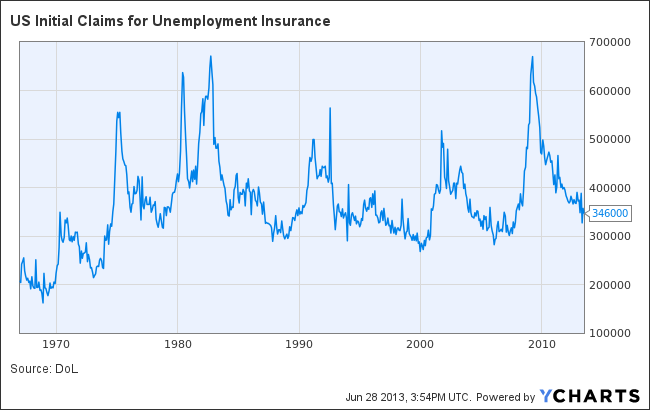
Article in the PiPress claiming the economy is improving because there were fewer applications for unemployment.

http://www.twincities.com/business/ci_23550437/us-unemployment-benefit-applications-fall-346k

The article notes “Applications are a proxy for layoffs.” The reasoning is that as soon as you get laid off, you run down to apply for unemployment, which sounds right to me. Fewer people running down to apply means fewer people laid off means economy is better than it was.

You know, I’ve heard that “proxy” phrase before, last month. http://www.shotinthedark.info/wp/?p=36279 The economy was supposed to be getting better then, too.

And also back in March: http://www.middletownpress.com/articles/2013/03/14/news/doc5141c7d613225691011181.txt?viewmode=fullstory

Here’s the thing: the number of applications has hovered around 350,000 for the last year, and that’s consistent with the economy in 2003-04 which was the end of the recession caused by the Twin Towers on 9-11-2001. (Chart only goes back 10 years).

US Initial Claims for Unemployment Insurance Chart

US Initial Claims for Unemployment Insurance data by YCharts


So does the economy feel like it’s two years after 9/11? Does national security feel that way? A decade later, are we doing Better, Worse or Same?

Joe Doakes
Como Park

I’d love to hear the case for “better”…

It’s The Economy, Stupid Professor

Friday, June 28th, 2013

One of the Minnesota establishment’s favorite fall-back lines is that our putatively-excellent education system drives the economy.

The evidence shows that it’s actually quite the opposite; a strong economy creates a niche for academics.

Education is not (or was not) training, although the distinction is fuzzy. Private colleges and universities were once the place for a few good men and even fewer good women. They were where we went to be sequestered from physical work, to learn, to mature, to develop communication skills and leadership confidence. Everyone else got calluses. No mammalian species could afford to take more than a few of its offspring, at the height of their fecundity and physical prowess, and isolate them to study Greek. In the 19th century, many didn’t live much beyond 50. Had we sequestered significant numbers from the age of 18 to 26 to pursue a doctoral degree in 1850, this would have converted their value proposition into an unsustainable expense. The popular terminal degree into the early 20th century was an eighth-grade diploma and for a very good reason. Families needed pairs of hands and strong backs. Colleges and universities did not drive the economy, but rather were able to expand as the result of industrialization and mechanized agriculture which improved the output of labor.

Yep, the world has changed; about 1% of the population grows our food these days, rather than the 98+% of 300 years ago. More of what we do to earn a living requires an “education” – which can mean anything from “literacy” to “training” to “developing a working understanding of a complex field” to, in some cases, “learning broadly and deeply about a range of disciplines and areas of human knowledge”.

But the article notes something that, when you read about most of mankind’s great advances, beats you over the head; academic credentials and major leaps in achievement aren’t especially correlated:

In just over 150 years, the likes of Michael Faraday, Thomas Edison, George Westinghouse, the Wright brothers, Henry Ford, Bill Gates, Richard Branson and Steve Jobs changed the world, but they were far from credentialed scholars. Still today, the innovation economy is driven as much by enthusiastic, stubborn and impatient dropouts as by the credentialed. The imaginative and courageous accomplish more. The credentialed often check boxes in a regulatory role or debate rather than do.

The Birth Of The Modern,by the great British historian Paul Johnson, examines the number of things that make up what we call the modern world – everything from pants, the internal combustion engine, mass production, the repeating firearm, yellow paint and the hard-top road to motorized travel, the true “mass media” and the steam engine and true representative democracy – that started in the period between 1815 and 1845.

And in those societies – which were if anything more dominated by social and academic elites than they are today (for now, anyway), the things that defined what we call “modernity” were predominantly achieved by…

…the self-taught, hard-working, brought-up-by-their-bootstraps people with little formal education but great inspiration, intellect, and the ability to tie many disciplines together to make things happen.

Side note: in a world where arts academics avoid hard sciences and hard-science people sneer at arts majors, it’s amazing how cross-displinary the great achievers truly were. In 1820, a great engineer like Robert Fulton or James Watt had to be a talented artist and communicator; artists like Robert Turner were highly versed in the physical world.

Which is something modern academia beats out of the rare academic that tries to practice it.

At any rate – the conclusion?

So what’s the problem? One problem is recognizing that academia follows the economy and doesn’t lead it…

And creating an economy with too many academics with too little academic work to do merely devalues academia itself. You get situations like in Greece and Spain, where college graduates find themselves lucky to get 10 hours a week as a barrista – or like in the US, where chemistry professors sit for years tweeting about politics while worthy younger academics shuttle around between non-tenure-track make-work jobs, eternally…

…while the real work of innovating and building goes on elsewhere.

Back On The Shelf

Monday, June 17th, 2013

It was the humblest and most obscure among the DFL’s orgy of tax pushes this past session. 

And it may be the one that has the broadest impact fastest

The DFL imposed a tax on warehouse services this past session; basically, if it goes into a warehouse, you pay for it.  And pay.  And pay. 

And Minnesota businesses are not amused:

With a warehousing services tax looming next spring, Rochester businessman Eric Lawrence is rethinking the company’s expansion plans.

That means “not hiring any more people”.  Back to McDonalds, proles – and remember, it’s for A Better Minnesota!

The president and CEO of Red Wing-basedLawrence Transportation Company had been looking to build a new warehouse facility in Winona but tapped the brakes on the plan. While the warehousing tax isn’t the sole reason for delaying construction, he said it is a major factor.

“I want to grow this business. I want to offer the services and have the space to do it, but it’s not worth the risk,” he said.

With Hudson, Prescott and La Crosse just across the river and sharing the same (or better) transportation links that Red Wing has?  

The DFL-led Legislature approved extending Minnesota’s sales tax to commercial warehousing services last month. The proposal is expected to generate nearly $100 million for the state per year once it takes effect April 1, 2014.

It won’t, of course.   Ripping 6.75% plus out of the bottom line of the warehousers – which is not an especially high-margin business to begin with – makes it a no-brainer for any company.  

Senate Majority Leader Tom Bakk, DFL-Cook, said during a recent visit to Rochester that the warehouse tax enabled lawmakers to repeal a requirement cities and counties pay state sales taxes — a cost that got passed on to property taxpayers. It also helped fund an upfront refund for business capital equipment purchases.

“We thought (the warehousing tax) was a business-to-business service that wouldn’t harm economic growth, but we put it in effect in April so we could assess what potential issues that are with it because we’ve never had it before, and if there are some ramifications, there will be time to make some corrections to it,” Bakk said. “But right now, today, I don’t see it having a hindrance on economic output.”

“I don’t see it having an impact”. 

This is from the leader of a party that thinks “supply chain” is something you pay $20 extra for at Deja Vu. 

Critics disagree. They argue the tax will encourage Minnesota companies to warehouse their products in other states…Among the businesses concerned about the tax is Red Wing Shoes. The company declined to provide comment for this article. But in an interview with the Star Tribune’s Neal St. Anthony, Red Wing Shoes President Dave Murphy said the company has decided to delay plans for a new $20 million distribution center in Red Wing as a result of the tax.

I know of one major company in Greater Minnesota with a very large warehouse component that has been quietly renting up all the warehouses it can find in a neighboring lower-tax state (with better transportation connections and easier building permitting to boot); if that company leaves, it will gut the job market in its neighborhood.

It’s not just the warehouse tax that’s got them shopping.  But every little bit hurts, when you’re trying to be competitive with surrounding states thatjust plain get it – they understand competition, having spent the past forty years competing with their fat ‘n happy neighbor at the top of the Mississippi River. 

So when your warehouse gig moves off to Superior or Grand Forks or La Crosse, just remember – it’s For A Better Minnesota!

These Jobs Are Going, Boys, And They Ain’t Coming Back

Monday, June 10th, 2013

Demolition starts today at the old Ford plant in Highland Park, at the southwest heel of Saint Paul. 

Because they just don’t build Ford Rangers anymore, due to the vanishing market for half-ton pickups, leading to the complete bagging of the model, I’m sure.

Nothing to do with the state’s business taxes and environmental regulations.  Perish the thought.

This Is Your Obama “Recovery”

Friday, May 31st, 2013

Less than half of the wealth lost in the recession has come back in the “recovery”:

From the peak of the boom to the bottom of the bust, households watched a total of $16 trillion in wealth disappear amid sinking stock prices and the rubble of the real estate market. Since then, Americans have only been able to recapture 45 percent of that amount on average, after adjusting for inflation and population growth, according to the report from the St. Louis Fed released Thursday.

In addition, the report showed most of the improvement was due to gains in the stock market, which primarily benefit wealthy families. That means the recovery for other households has been even weaker.

To the extent unemployment is down, it’s in part-time jobs.  The average hours worked per week has dropped in recent months.

No.  You are not better off than you were four years ago.

And They Say DFLers Don’t Get Economics

Wednesday, May 29th, 2013

Let’s say, hypothetically, that you live in a city.

And in that city there are 19 big companies.   They have everything that makes up a big enterprise – a CEO, executives, management, stores, labs, manufacturing plants – in your city.

And then the economy picks up.  And the 19 big companies hire more people, because a good economy means good sales, which means you gotta develop, build and sell all of those 19 sets of products!

So what’s the measure of the good economy?  “19”?  The number of big companies in your town?

We’ll come back to that.

Then, driven by high wages and the need to be competitive, the 19 companies outsource their manufacturing to the Philippines.  All the people in your town that earned a living from building things for those 19 companies are out of work.

How’s the economy measure?  Still a “19?”

And then the price of R and D rises, and the companies relocated their R&D labs to India and Singapore and Slovenia.  All your researchers are out of work.

Is your city still a “19?”

And then the economy tanks.  Stores scale back and lay people off, managers get RIFFed, the work force plunges.  Your town’s unemployment lines are getting longer and longer…

…but there are still 19 CEOs and corporate boards in town.  They administer companies that do their R&D and manufacturing elsewhere, and sell to whomever can afford the products through stores that are ever dingier and more understaffed.

But those 19 CEOs are still in your town.  So the town’s economy is healthy.  Right?

If you said “what, are you kidding?”, you might be a conservative.

If you didn’t, you probably think this piece by Dave Mindeman at MnpAct makes perfect sense.

North Dakota and Wisconsin taunt our borders with new signs that say – Our State Is OPEN For Business!

Everybody seems to be overlooking the basics here.

Sure taxes have some effect on business decisions….so do a lot of other things. Let’s look how Minnesota compares.

Now, let me make sure I reiterate; Mindeman is one of that tiny minority of Twin Cities leftybloggers that don’t need to be under police surveillance.

But when he says “let’s look how Minnesota compares”, what he really means is “let’s cherry-pick some non-sequiturs as absurd as the fictional list of company CEOs in my example above”.

No, literally:

The Facts: Minnesota has 19 Fortune 500 companies. Five are in the top 100. Fourteen in the top 300. United Health ranks the highest at #22. Minnesota ranks 17th in the nation for total GDP. We rank #14 in GDP per capita. Our current unemployment rate is 5.3%. Our high school graduation rate is 91.6% (National average is 85.4%) Persons with at least a Bachelor’s Degree – 31.8% (National Average – 28.2%) Median Housing Value – $201,400 (National Average – $186,200)

Let’s leave aside for a moment the factors that have nothing to do with measuring economic health (graduation rates are nice, and might – maybe – predict the future, economically.  Or they might not.  But if 100% of your town has masters degrees, but they’re all in Women’s Studies so the unemployment rate is 100%, what’s the real (hypothetical) measurement?);

We’ve got 19 Fortune 500 companies.  Bully.

Now – are those companies creating jobs in Minnesota?   Is 3M building new plants in Minnesota?   In fact, they literally exported one plant, with hundreds of jobs that used to be on the East Side of Saint Paul, to South Carolina.  And do you remember when they used to do R&D in the Twin Cities?  Welcome to Austin!

Medtronic?  Aren’t they contracting?  Well, here they are.  In Tennessee?  Not so much.

Boston Scientific?  Well, they’re not expanding anywhere – but it’s here in MN that they’re contracting fastest.

When was the last time Ecolab built a plant in Minnesota?  (Trick question; it was the seventies).

It’s not just big Fortune 500s, of course; Red Wing Shoes is eyeing a move.  Jostens is shifting jobs from Owatonna to Texas, the first of what will likely be many moves to lower-tax states.  We talked about the iron mill that’ll be built in North Dakota rather than the Range last week.

But we have 19 headquarters here.  Right?

Well, doy.  Of course we do.  If you’re a Fortune 500 CEO, where would you rather live – around Lake Minnetonka, the Guthrie, the Ordway, with Cathedral Hill restaurants and Galleria shoppping, or up in some holler in Mississippi, sweating through your underwear? It’s a no-brainer.  And that creates jobs – for management, for MBAs and upper management, sure – and their administrators and financial planners, and bartenders and caddies and nannies and gardeners, too.

But where are you going to build the plant, and create the jobs, especially for the people who aren’t management?  Who  don’t have the MBA and the BMW and the career spent networking among the corporate elite and the decades of experience in a field?

You did see the paragraph about all the “Minnesota” companies building plants elsewhere, right?

Mindeman:

So, how do we compare with our neighbors?

Vs. North Dakota: Sure North Dakota has a very low unemployment rate. A big surplus. And most of all an oil boom. But North Dakota doesn’t have a single company in the state on the Fortune 500 list.  Not one single business.

Remember that next time you run into an unemployed Ford Plant worker; “hey, you’ve got no job, but at least we’ve got lots of headquarters here!”.

Of course Minnesota has the Fortune 500s.  Minnesota benefitted from what mattered to people, and companies, when population patterns were largely set, back in the 1800s and early 1900s;  proximity to resources, plus water, rail and eventually road communication, which led to an urban center; this center became the center the upper-midwest region, the part of the country west of Chicago and north of Omaha and Saint Louis and east of Denver.   The era when the big Fortune 500s we currently have were largely formed.  An  era that, according to some thinkers on the subject, is on its tail end, and will be over someday soon.

In total GDP, North Dakota ranks 50th out of 51 US economies – and although they do better in per capita rank (20th); of what value is a low GDP with a total population that would fit into Hennepin County?

Leaving aside that Mindeman brushes aside an amazing statistical anomaly – a state that was poor, with a low, agriculture-related GDP fifteen years ago, that is now batting thirty spaces above its weight, in league with the big, inflation-adjusted coastal economies – like it’s no big thing, he gets the real question backwards.

What could Hennepin County – whose unemployment and crime lead the state, whose schools are among the worst in the state, whose achievement gap is a state disgrace, and whose major city is rapidly fulfilling Joel Kotkin’s predictions of the obsolescence of the big central city – do if they used their resources, their inherent dynamism and their talents as wisely as North Dakota has?

North Dakota may be having an economic “boom”, [Why the scare quotes, Dave?  It’s a boom.  No bones about it!] but why would any business consider a major move to a state that has a total market of about 800,000 people and a GDP that is about 1/8 of Minnesota’s? Really?

So many problems with that statement.  So many confirmations that DFLers just don’t get economics.  Where to start?

Mindeman is reliably imprecise when has asks “why would any business” move to North Dakota.

Any business?

Best Buy?  3M?  Starkey Hearing?  They’re not going to move to North Dakota.  What’d be the point?

You want to start a trucking company?  You’ll be making money hand over fist.  A machine shop in Minot?  You’ll be working three shifts seven days a week the moment you open your doors.  A house-cleaning service?  Accounting firm?  Security company?  Contract law firm?  Gas station?  Hotel?  You’ll have more business than you can handle.

Mindeman runs through all the neighboring states – focusing especially on the relative dearth of Fortune 500s in Iowa and the Dakotas – and asks:

Again, is that the type of market that can attract major business?

Why the obsession with “major” businesses?

The “Fortune 500” is an arbitrary set of companies (or was – it hasn’t actually been published in ten years), set by the editorial staff of a magazine.  It focuses, by definition, on the 500 biggest companies, in terms of sales, profits, assets, market value, and employees.

Not growth.  Not innovation.  Just sheer size.

Are these companies the major sources of American economic dynamism?  Of innovation, strength, or even new hiring?  No.  They are not.  Small business is.

Sure there are plenty of people moving out of Minnesota and heading south, but that has been a weather trend that has been going on for decades. Our population is holding better than any of the states that border us.

Another factoid that Mindeman sails past like a mile marker on 94 headed west for good.

Why have people been leaving for decades?  Why is Minnesota on the cusp of losing a Congressional seat?

If you think it’s the weather – the Dakotas are growing.

Let’s put the question this way; if you’re a financial researcher with an MBA, your best shot at a job is in one of the big metro areas, with a big company.  Ditto if you work in political non-profits – you go where the politics are.  Big cities.

But if you’re a person with a high school education, maybe with a child to support and some bills to pay, which state would you rather be in right now – North Dakota or Minnesota?

Republican talking points are only so much hot air.

Minnesota’s quality of life is thriving and we are the Midwest model for business.

That’s what the facts say.

And maybe in a future post Mindeman will explain exactly why, in terms other than “CEOs per acre”.

Maybe.

Hello Steeltown; Goodbye, DFL

Friday, May 24th, 2013

Jamestown, North Dakota.

15,000 people.  At confluence of the James and Pipestem rivers, about 90 miles west of Fargo.  Home to a state hospital and psychiatric prison (which sounds like something the MN DFL would build for Republicans, but it’s really pretty normal), a school for the profoundly handicapped, a college (my alma mater, as it happens), and a whooole bunch of agricultural businesses…

…and, soon, an iron mill.

A North Dakota company plans to build a $60 million iron producing plant near Jamestown, N.D., using iron ore concentrate from Minnesota.

A subsidiary of Bismarck-based Carbontec Energy Corp. called E-Nugget North Dakota LLC has unveiled plans to churn out 100,000 metric tons of iron annually using North Dakota sugar beet residue in the mix instead of coke coal.

It’s an interesting project; the plant will extract ore from tailings from the old iron mines up north that used to be economically un-feasible to extract.  There are millions of tons of now-usable ore piled up up north.

It’s Minnesota ore, and the research has Minnesota ties…:

The E-Nugget iron making process was developed by Carbontec and Michigan Technological University over the past five years, including large-scale batch tests at a Minneapolis facility, John Simmons, president of Carbontec, said Monday. The company already has plans to expand to a 300,000-ton plant if the startup goes well.

But the plant is being built in North Dakota.  Granted, it’s Jamestown, which – as it’s been throughout most of it’s history – has been safely tucked away from excessive prosperity.  100 miles east of the oil fields and their jobs, and 90 miles west from cha-cha, booming Fargo (yes, I said “cha-cha Fargo”; it makes sense in context), Jamestown is one of few parts of North Dakota that isn’t overheating economically so far.

But it’s not Flint or Newark or Cleveland.  It’s not even Minneapolis, much less Grand Rapids or Virginia, unemployment-wise.

So why there?

Simmons said the Jamestown site is well-situated because of easy access to sugar beet residue feedstock and also because it is adjacent to a Great River Energy power plant and directly on the BNSF rail line. He said the iron ore concentrate could move from the Grand Rapids area to North Dakota in rail cars that move western coal east but generally have been empty on their return trip west.

“We can get the right quality material from Grand Rapids and the rail routes make sense,” Simmons said.

So let’s get this straight;  Jamestown ND, which is about 90 miles from the sugar beet waste, and probably 300 from the iron ore tailings, gets the plant.

Why’s that?

Magnetation expects to start construction on a fourth plant northwest of Coleraine this year. That plant will produce 2 million tons of concentrate [that’s the part you dig up, before you process it into iron] annually and will be ready to feed a new Indiana pellet plant the company now is building to supply partner AK Steel with iron ore for its furnaces by 2015. That new Itasca County facility is expected to employ another 160 people. The Coleraine plant ultimately will shift to get its ore from traditional open pit mining. (The company has shelved plans to build a recovery plant at Calumet.)


Simmons noted Carbontec also created an E Nugget Minnesota LLC and considered building the plant in Minnesota using wood waste from logging sites as the reductant or binder. He said the company chose North Dakota instead, in part because it’s so much easier to get permits in North Dakota.

Score one for the DFL Environmental Lobby!  More jobs exported to North Dakota!

Let’s let that one sink in; between taxes and permits, it’s cheaper to ship rock 300 miles than it is to process it in Minnesota.

Thanks, Minnesota DFL!

We Can Call It The “Pony Bottle Express”

Wednesday, May 15th, 2013

Joe Doakes from Como Park emails:

In response to the legislature’s anticipated 600% tax increase on beer, I’m starting an express delivery service running between Hudson, Wisconsin and St. Paul. Please post this Want Ad on Shot In The Dark:

“Wanted, young, daring fellows, must be over 18 and expert driver, willing to risk death daily. Orphans preferred.”

Joe Doakes

Como Park

Might just solve that teenage unemployment problem.

Bleeding Slower

Wednesday, May 15th, 2013

Joe Doakes from Como Park emails:

Fewer people are applying for unemployment.  So there must more jobs, right?  Yes, the article says: “The job market has also improved over the past six months. Net job gains have averaged of 208,000 a month from November through April. That’s up from only 138,000 a month in the previous six months.” No wonder I keep seeing so many Help Wanted signs.

But then the writer follows up with this:  “Still, much of the job growth has come from fewer layoffs—not increased hiring.”


Screeech.  Hold on, what’s that?  How can Growth come from Layoffs instead of Hiring?  You didn’t get laid off, so that’s the same as being hired?


Turns out employers are still laying off people and aren’t hiring full time because of Obamacare and tax increases, but they are hiring part-time workers who don’t get Obamacare.  Those McJobs are the heros of this story.  People taking McJobs don’t apply for unemployment.  That’s your hopeful sign?

And the article doesn’t even mention discouraged workers.  Instead it says: “Applications are a proxy for layoffs. Weekly applications have fallen about 9 percent since November and are now at a level consistent with a healthy economy.”  Okay, I can buy that applications are a proxy for layoffs.  When you get laid off, you go apply for unemployment.  Makes sense.  And I can believe there aren’t many layoffs coming anymore, most of the fat was wrung out of the system years ago.  So yes, very few layoffs after five years of lean is the same rate as very few layoffs when times are booming.  All that adds up to “we’re bottoming out” not “prosperity is right around the corner.”

And then, this howler:  “Wages rose 3.6 percent in April.  That’s comfortably ahead of the 1.5% inflation rate.”  My wages sure as Hell didn’t go up, but my grocery bill did and gas is back up to $3.77 today.


I’m actually impressed the Associated Press has managed to stuff so many ridiculous claims into one article and pass it off as good news.


Joe doakes

The U6 number – counting the percentage of unemployed and underemployed – is up, even as the number of unemployed dropped a bit. The average amount of time worked in a week dropped. That means the job creation is all part-time.

This isn’t a recovery. This is blood clotting and an infection forming.

Chanting Points Memo: Flat Versus Bouncy

Tuesday, April 23rd, 2013

One of the left’s favorite chanting points this past few months has been that, supposedly, Minnesota’s job growth under an all-Democrat regime has outstripped that of newly-Republican Wisconsin.

Conservatives responded that Wisconsin was shaking off the after-effects of decades of “progressive” incompetence, and would take a while, while in the meantime Minnesota was still coasting on having had ten years of one combination of GOP governor or legislature or another.

Well, the coasting’s stopped:

There was a “substantial vacation” in U.S. entrepreneurial activity last year—but nowhere was it as pronounced as in Minnesota.
That’s according to The Kauffman Index of Entrepreneurial Activity, a report compiled by the Kansas City, Missouri-based Ewing Marion Kauffman Foundation. The study essentially defines entrepreneurial activity as being tied to the launch of new businesses, and it is meant to serve as an indicator of business-creation activity across the United States.
The report found that there was a national lull in entrepreneurship in 2012, when roughly 514,000 entrepreneurs opened new businesses each month, down from 543,000 in 2011.
The report defines entrepreneurial activity based on how many adults per 100,000 residents started a new business each month during the year. Minnesota fared the worst, with only about 150 out of 100,000 residents opening businesses on a monthly basis.

Minnesota has always been a difficult place to start a business.

Run a Fortune 500?  That’s a whole ‘nother thing – although ask yourselves how many Fortune 500s based in the Twin Cities are building non-retail operations in the state these days.

But how about Wisconsin?

This MPR story a few months back shows that while Wisconsin is lagging, a big part of the reason is that the Badgers are overcoming so much negative intertia from when the Democrats had full reign over the place.

Picking Winners

Tuesday, April 23rd, 2013

Remember when Democrats claimed to be for the little guy and against big institutional businesses?

Obama supports the “Marketplace Fairness Act”, which would tax online purchases:

Senators advanced the bill in 74-20 procedural vote on Monday evening, just one vote short of the backing it received in a test vote last month. Twenty-six Republicans joined Democrats in moving forward with the bill.

(Or when Republicans claimed to be pro-business?)

Oh, yeah – both A-Klo and Stuart Smalley voted for the bill.

Major retailers are putting all their lobbying muscle behind the legislation, arguing it would close an unfair loophole that benefits online merchants over brick-and-mortar stores. The National Retail Federation, which represents chains such as Best Buy, Macy’s and J.C. Penney, and the Retail Industry Leaders Association (RILA), which counts Target and others among its membership, announced it would score lawmakers’ votes.

The bill would also make it possible for states to tax financial transactions – trades for your IRA, moving money around in your 401K and the like.

But signs of trouble for the bill also emerged as Wall Street groups urged the Senate to slow down and eBay began marshalling its users in a massive campaign to kill it.

The Securities Industry and Financial Markets Association and the Financial Services Roundtable said the measure could pave the way for financial transaction taxes on the state level, an idea that Wall Street and its supporters fiercely oppose.

“A transaction tax on financial services products will hurt retail investors, retired Americans, and small businesses, effectively making it more expensive for them to invest and plan for the long-term. Without hearings, these implications and others will not be properly addressed” [said Scott Talbott, senior VP of public policy at the Securities Industry and Financial Markets Association and the Financial Services Roundtable]

Democrats (and some Republicans); dragging the parts of the economy that work down into the same pit of suck that the rest of the economy is in.

“Your Numbers Are Like Voodoo”

Thursday, April 18th, 2013

(SCENE:  Mitch BERG is standing in the line for car tabs at the Saint Paul Sears with Avery LIBRELLE)

LIBRELLE:  I saw your blog post about the restaurant in Mower County that is offering discounts for gun nuts who bring guns into their restaurants.

BERG:  Yeah.  That’s pretty cool.

LIBRELLE:  I’m sure there’ll be a mass shooting there soon.

BERG:  (shakes head silently, with deep weariness)

LIBRELLE:  What this does mean is that they should raise their minimum wage.

BERG:  (wearily)  OK, I’ll bite.  Why’s that?

LIBRELLE:  Because the owner is giving away money.

BERG:  Er…huh?

LIBRELLE:   Discounts.  That’s money he’s giving away.  That means he could afford to increase his staff’s wages.

BERG:   Er, the discount – leaving aside the extent to which it might be a personal protest statement – is what’s called a “loss leader”.  It’s designed to get people to come out, bring their non-gun-carrying friends – to get people in the door.  Once they’re through the door, that’s more traffic, more word of mouth, more potential to win over customers that keep coming back and spending more money.

Sort of like when Chipotle has their Free Burrito Day.  They lose money on that day’s burritos – but hopefully create loyal repeat customers who come back later to pay full price.

LIBRELLE:  Well, if they can do that, they can afford to pay the dish washers and waitresses and counter staff more.

BERG:  Er, why do you think businesses do that?

LIBRELLE:  Because they’re rolling in money at the expense of the worker!

BERG:  No, it’s to increase business.  It’s called Marketing, and Advertising; spending a little money so that there’s more business, which in turn brings in more money, which eventually goes into things like paying off investors and turning a profit and expanding and remodeling and buying a new oven and, by the bye, salaries.   Because a successful restaurant can afford to give a raise, while an unsuccessful one can’t even retain workers.

LIBRELLE:  Giving away the workers’ money in this way is like the Bush Tax Cuts.  That money is needed.

BERG:  Government doesn’t need to advertise or market.  And even if the money were “the workers’ money”, it’s part of marketing a business, to try to make it successful  Like spending money on advertising, or on having clean restrooms and unripped seats, or laminated menus, or quality ingredients and attractive preparation and presentation; it’s about making people come to your business, and then making them want to come back.

But – and I can’t stress this enough – the business’ revenue is not “the workers’ money”.  The person or people who started and run the restaurant – which provides the jobs for “the workers” – has the job of using that money to the business’ best advantage, to promote and maintain the business.  Which includes paying salaries.

LIBRELLE:  It’s more important that they pay the salaries.  Without the workers, the owner is nothing.

BERG:  Er, what now?

LIBRELLE:  It’s the workers that make the business.  Without the workers, there’d be no business.

BERG:  I’m sure that’s news to every sole-proprietor entrepreneur out there…

LIBRELLE:  Look at Bain Capital.  Mitt Romney didn’t even show up to work for months at a time.  And yet the janitors had to show up every day.  Bain could have prospered without Romney, but not without janitors.  The janitors deserved the money more than Romney.

BERG:  (Stands, gobsmacked in stunned silence)

LIBRELLE:  Without those janitors, Bain would have failed.

BERG:  So you’re saying that janitors can manage venture capital better than managers can empty trash and sweep floors?  Or that restaurants would spontaneously form in Mower County without someone to rent a building, set up a kitchen and a counter and some tables and buy some inventory and hire and train some cooks and waiters and dishwashers.

LIBRELLE:  Of course not.

BERG:   OK, then…

LIBRELLE:  I’m saying that without janitors sweeping the floors, the capital would never have been managed.  Without a dishwasher, there’d be no restaurant.

LOUDSPEAKER:  “Number 36”

BERG:  Oh, that’s my number.  What’s yours?

LIBRELLE:  Oh, I don’t have one.  I just love hanging out here.

BERG:  (shuffling toward the window)  You what?

LIBRELLE:   Yeah.  It’s a great lesson on how business should work!

BERG:  Huh.  Wow.  And to think some people say liberals don’t understand business.

LIBRELLE:  I know.  Right?

(And SCENE)

(more…)

Canaries In Coal Mines And All That

Thursday, April 11th, 2013

Joe Doakes from Como Park emails:

There are companies that buy, sell and trade gold (major banks and investment firms, generally). The actual gold bars are stored by Comex, which stands for Commodity Exchange, and is part of the New York Stock Exchange. Remember the Bruce Willis movie where the bad guys faked bombs in schools to divert cops while the bad guys stole the gold bricks from Wall Street? That’s what we’re talking about – huge supplies of actual gold bricks being stored in vaults for their owners.

Owner who are now pulling the gold out in record amounts. Giant withdrawals. Trillions of dollars worth.

Did they have unexpected expenses to pay? Losses to cover? Fine, that’s what it’s there for.

Or are they grabbing their gold before the economy collapses because they know something we don’t? Not fine, that’s what we’re all afraid of.

I’d stock up on bullets and whiskey but there are no bullets for sale. Which means more money for whiskey, I guess. So that’s not all bad!

Joe Doakes

Como Park

Look!  Guns and abortion!

The Ultimate “Public-Private Partnership”

Wednesday, April 10th, 2013

Liberals will occasionally try to sound “moderate” by claiming to favor “partnerships” between government and business.

These “partnerships” usually amount to one of a couple of things:

  • The worst of both worlds; the inefficiency of government combined with the lean capitalization of a business
  • The government picks a winner

In neither case do things work out well, as a general rule.

Except with this example, perhaps the most successful public private “partnership” in all history.

Just saying; if my financial planner hasn’t put a ton of money into Glock USA and Sturm Ruger, we’re gonna have to talk.

Attention Representatives Paymar And Martens

Tuesday, April 9th, 2013

Suck it:

The St. Paul-based outdoor goods chain already has 11 Gander Mountain locations across the state — all of which sell guns — but its store in the western Twin Cities suburb will have strictly a firearms emphasis. The company boasts it is “the nation’s leading firearms retailer.”

The 30,000-square-foot Rogers location — formerly a Best Buy — will have its official grand-opening in May.

“The new Firearms Super Center concentrates on firearms, ammunition, hunting and tactical clothing,” said Steve Uline, Gander Mountain’s executive vice president of marketing.

Watch for a bill in the next session banning gun stores larger than 1,500 square feet – and a Star/Tribune Minnesota poll saying 90% of Minnesotans disapprove of big gun stores.

More below the jump.

(more…)

This Is Your Obama Economy, April Edition

Friday, April 5th, 2013

The topline number has all the mainstream media bobbleheads a-tingling; unemployment is “down to 7.6%”.

It’s wind in sails, of course; the labor participation rate has dropped to 63.3%, the lowest it’s been in ten years of measuring, and the lowest it’s been so far in this recession.

Which means the actual share of the work force above the age of 16 actually working is 58.49%.

That number is…:

  • Almost 2.5% lower than the day Barack Obama took office (60.58%)
  • Statistically the same as October, 2010 (58.5%), when unemployment peaked at 10%.
  • Marginally up from December of 2010 (58.2%), when the recession bottomed out (and which looks like a statistical fluke, coming between two months in the 58.5% range)
  • Marginally better than the low-points in this calculation (58.18, in November 2010 and July 2011, when the unemployment rates were 9.8% and 9.1%, respectively).

It takes a lot of lipstick to make this look like anything but a pig.

Real Men Of Genius

Thursday, March 28th, 2013

You build a better mousetrap – or urinal – and they will come.

A minor league baseball team in Pennsylvania will become the first professional sports franchise to offer urine-controlled video games in its restrooms when the season starts in April.

Used beer is now liquid assets – in gaming terms, anyway.

Pennsylvania’s Lehigh Valley IronPigs will debut the “Urinal Gaming System” in its men’s bathrooms—the custom urinals feature a “pee controlled” video screen that will entertain fans as they use the restroom.

Well, it’s good to see good ol’ American ingenuity finding a problem, stepping up and solving it…

The system is designed by a British company called Captive Media—in a demo for the urinal, the company shows a snowboarding slalom game in which the character is controlled by where the player pees.

Oh.

I’m waiting for urine-controlled Asteroids.

But I won’t hold my breath. This should be an interesting bit of Title IX litigation.

Governor Messinger Dayton: “The Beatings Will Continue Until Morale Improves!”

Thursday, March 14th, 2013

Governor Messinger Dayton famously appeared at the Chamber of Commerce yesterday.

And boy, did he give ’em what-for!

Gov. Dayton told a stunned luncheon audience that Minnesota is among the best places for business in the country, contrary to the Chamber’s message.

He said government spending is right in the middle, and that the state’s tax rank is dropping.

Dayton said he never heard the same criticism when Republican Tim Pawlenty was governor for eight years, and he asked his staff to investigate.

“And we could not find a single instance of the chamber calling for spending reforms during those eight years,” Dayton said. “Evidently, in your view, spending reform is needed only when a Democrat is governor.”

Messinger Dayton also said he was sticking firm to his promise to hike taxes on “the rich” (meaning “successful entrepreneurs and professionals who didn’t have the foresight or the fiscal and legal clout to move their money to dynasty trusts in South Dakota”, as opposed to, say, him).

A couple of observations:

Gov. Dayton told a stunned luncheon audience that Minnesota is among the best places for business in the country, contrary to the Chamber’s message.

He said government spending is right in the middle, and that the state’s tax rank is dropping.

Dayton said he never heard the same criticism when Republican Tim Pawlenty was governor for eight years, and he asked his staff to investigate.

“And we could not find a single instance of the chamber calling for spending reforms during those eight years,” Dayton said. “Evidently, in your view, spending reform is needed only when a Democrat is governor.”

A few observations:

Governor Whinypants:  Business never complained about spending on Pawlenty’s watch?   Huh?

During the first term, business complained about things like “health impact fees” – stealth taxes framed as compromises with the DFL in a legislature he didn’t completely control.  Just ask Sue Jeffers.   On the other hand, he generally held the line on taxes, pursuant to his pledge to the Taxpayers League.

During the second?  Pawlenty was faced with a wastrel DFL legislature; business rightly figured he was the last line of defense against the sort of pillaging the Messinger Dayton Administration and the Legislature have in mind.

And they were right then, and they’re right now.

Profiles In Leadership:  This is leadership?  “If you don’t see things my way you’re a poopyhead?”

Reverting To Stereotype: Conservatives pillory liberals for being innumerate, having  stunted knowledge of economics outside of Paul Krugman’s ravings – the type who think raising the minimum wage cures poverty.

It’s on stories like this that you realize; the stereotype exists for a reason. .

Dave Mindeman at mnpACT put it a little differently, by way of cheering Governor Messinger Dayton on in a piece titled “To the Chamber of Commerce: SHOVE IT” in a flight of Oscar Wilde-like whimsy..:

So Dayton dropped the sales tax proposal with the caveat that his increased income tax on higher income earners would go forward.

But they object to that as well.

“Hey, we left your top line alone, more or less; you can’t complain if we attack your bottom line, now, can you?”

They continue to promote the addage that this tax will affect small business…and yes, here we go, the “job creators”. They continue this argument even though the Department of Revenue has shown that only 6% of small business would be affected. And again, we are only talking about the highest portions of their income. If they are making substantially more than $250,000, why the huge objection to paying some back to a state that has benefitted you greatly?

I can see Messinger’s Dayton’s disconnect; she he has never worked, and has no concept of what business is about.  Not sure where Mindeman comes at it from, and I’m not sure that it matters.

Messinger Dayton is daring business to pick up and leave.

She He doesn’t think they will.

I imagine we’ll find out sooner than later.

This Is Your Obama Recovery

Monday, March 11th, 2013

We’re broker than we’ve been since the fifties.

EMT for the 313

Wednesday, March 6th, 2013

Speramus Meliora; Resurget Cineribus

“We Hope For Better Things; It Shall Rise From the Ashes.” – City of Detroit’s motto.

Those words were written in 1805 to memorialize a Detroit school burned to the ground.  208 years later, Detroit still hopes for divine intervention, this time from the Michigan capitol.

Michigan Gov. Rick Snyder’s proclamation of a “financial emergency” in Detroit was the culmination of a decades-long municipal car wreck.  Between 2000 and 2010, the city lost 237,500 inhabitants — an estimated 1/4th of the population.  One in 20 homes were foreclosed upon during the height of the recession.  The city remains $327 million in the red with $14.9 billion in unfunded city pension plans.  By comparison, the entire state of Michigan’s biennial budget is $49 billion.

While Detroit has been slowly crashing into a wall of economic reality, a busload of corrupt and incompetent city officials have rubber-necked their way past the myriad of issues confronting the city.  In the last decade, Detroit saw 131 convictions of government officials, a number defined by the reign of ousted Mayor Kwame Kilpatrick.  Even the federal government last year withheld millions in grants from Detroit over concerns of corruption.  The city’s reaction?  We’re not as bad as Chicago when it comes to corruption, so what’s the big deal?

The Roosevelt Warehouse or Detroit School Book Depository. A fire in 1987 did some damage to the building but was abandoned despite most of the inventory being usable. No effort to recover science and sports equipment, scissors, crayons, and books was ever made and now all sit on the floor in ruin

Synder’s appointment of an “emergency manager” to oversee the Detroit budget and pension plans has elicited howls of protests from the usual suspects:

“[Emergency managers] can unilaterally tear up union contracts, take over pension funds, make and repeal laws, sell public assets, the list goes on,” he said in an earlier interview with The Huffington Post. “Imposition of the EM must be understood in the context of the many other methods conservatives are using today to suppress democracy –- especially among people of color and people in poverty.”

But the decision to go the EM route has also gained critics on the Right, with one National Review writer declaring Snyder’s decision, in hyperbolic form, a “uniquely American way to dictatorship.”

The Emergency Manager legislation has gone through a number of iterations over the years, including one version, Public Act 4, that was opposed by the unions and defeated on the ballot last November.  PA 4 would have allowed EMs to effectively run cities, with their authority superseding that of city officials.  Instead, with PA 4 defeated, Snyder is falling back on the format of an older PA – one that while still not allowing EMs to be fired by the city, doesn’t grant them the power to abrogate collective bargaining or dissolve local governments.

The United Artists Theater. The theater is actually part of an 18-story high rise built in 1928. The historic building was such an embarrassment that the exterior was refurbished before the Super Bowl in 2006. The interior remains as seen.

Despite the fact that no one will be declared dictator, or even Pontifex Maximus, Snyder’s decision has prompted Detroit’s City Council to fight tooth-and-nail against any EM, filing an appeal against the state.  One official who isn’t planning on fighting Lansing is surprisingly Detroit’s Mayor Dave Bing.  Like the rest of the city government, Bing isn’t happy about Snyder’s power play, but unlike the rest, Bing is willing to work with any EM.  Speaking at a City Hall press conference, Bing stated that “we need to stop BSing ourselves,” a quote perhaps applicable to more than just an acknowledgment that an emergency manager would be imposed on Detroit whether they liked it or not.

An emergency manager invites micro concerns – with 83 cents of every Detroit police and fire payroll dollar being spent on pensions by 2017, what use is an EM without the ability to unilateral restructure pension and/or contracts?  But the macro concerns of the decision are far more troubling.  How do you save a city that won’t save itself?

The Lee Plaza Hotel lobby. The Lee Plaza is on the United States National Register of Historic Places.

H.L. Menchken famously declared that “Democracy is the theory that the common people know what they want, and deserve to get it good and hard.”  Detroit has certainly being getting it “good and hard” for decades, and like an S&M enthusiast whose forgotten their safe-word, doesn’t know how to stop.  Bankruptcy may be an option, but it doesn’t address the billions in underfunded liabilities.  And considering all bankruptcy would do is force Detroit and its creditors to negotiate, there’s not much more that an EM would do for the situation except provide a political scapegoat for the necessary hard choices to come.  It should be little wonder that Mayor Dave Bing isn’t fighting Snyder’s executive decision – he’s probably relieved someone else will being taking the slings and arrows (in Detroit; statewide, the move is very popular).

Yet what happens after the dust settles?  Even if Snyder’s EM hacks Detroit’s budget into the black, will the political machinery or populace live with the decisions?  Or, having avoided any connection to the policies implemented to take Detroit on the long road to fiscal solvency, will the business of City Hall simply revert to usual?

Snyder’s technocrat lean may be well-intended, but in the case of Detroit, is only delaying the city and its voters coming to terms with their decisions.  Although on the plus side, Snyder’s move is the first job created in Detroit in years.

Leading Indicator

Wednesday, March 6th, 2013

The Dow wasn’t the only indicator to hit an all-time high yesterday:

As the investing world celebrates the all time nominal high of an archaically-weighted index of an ever-changing basket of stocks, there is another – this time unprintable asset – that appears in all-time high demand – firearms. Smith & Wesson just released earnings not only with record high revenues but increasing their outlook dramatically for fiscal year 2013.

The surge in ‘background checks’ and sales since the election (and furthermore since the Tragedy in Newtown) continues (+29% YoY) and as SHWC notes “The tragedy in Newtown has understandably inspired an important national discussion about how to cope with violence in our communities – we possess a broad range of products and a highly flexible manufacturing operation. Taken together, these allow us to be highly responsive should the market and/or legislative developments drive a change in sales mix.”

Note to my financial planner, should you happen to be reading this today; I really, Really, Really hope you plunked a ton of my portfolio into S&W, Sturm Ruger and Glock USA when I mentioned it last fall…

Chanting Points Memo: Ryan Winkler, Brezhnev-Style Economist

Tuesday, February 26th, 2013

Conservatives joke that liberals just. Don’t.  Get. Economics.

We joke, at times, that at some point a liberal is going to push for a “living wage” statute calling for a $100/hour minimum wage as a means to end poverty, followed by a bill barring any layoffs and banning bankruptcy.

It’s a joke.  Some liberals shake their heads and go “yeah, yeah, we’re not nuts”.

And then something comes a long to prove that they really, really are that dissociative.

Rep. Ryan Winkler (D St. Louis Park), also known as “The Eddie Haskell of the House” – is introducing a “Kill All” amendment to House File 92 that bars businesses from laying off workers, cutting hours or benefits due to minimum wage increases. 

I’m going to write that again, just to let it sink in.

Winkler’s bill would make it illegal for businesses to lay off workers, cut hours or benefits due to minimum wage increases.

No, I’m really not making it up; I’ve added emphasis to the original:

(c) Notwithstanding paragraph (b), during the first 90 consecutive days of employment, an employer may pay an employee under the age of 20 years a wage of :

(1) $6.07 per hour beginning August 1, 2013;

(2) $7.24 per hour beginning August 1, 2014;

(3) $8.41 per hour beginning August 1, 2015; and

(4) the rate established under paragraph (d) beginning January 1, 2016.

2.11 No employer may take any action to displace an employee, including a partial  displacement through a reduction in hours, wages, or employment benefits, in order to hire an employee at the wage authorized in this paragraph.

(UPDATE: Commenter Master Of None points out, the above section refers to a training wage – a wage that employers may pay for up to 90 days – and says it’s not quite as dire as I’d made it out to be.   I disagree; Winkler’s bill raises the already existing training wage, causing all the same problems that raising the minimum itself does, which negates most of the utility of a “training wage”, as well as starting some sort of enforcement mechanism to painstakingly adjudicate all disputes related to training and minimum wages.  Because Minnesota businesses needed more niggling regulations)

And as the Obama Administration launches into permanent quantitative easing, Winkler wants to key the minimum wage to inflation, ensuring that no wages will ever keep up with inflation:

2.14 (d) No later than November 1 of each year, beginning in 2015, the commissioner  shall determine the percentage increase in the rate of inflation, as measured by the Consumer Price Index for all urban consumers, United States city average, as determined by the United States Department of Labor, during the most recent 12-month period for  which data is available. The minimum wage rates in paragraphs (b) and (c) are increased by the percentage calculated by the commissioner, rounded to the nearest cent. The new minimum wage rates determined under this paragraph take effect on the next January 1

In other words: Ryan Winkler wants to…:

  • arbitrariliy set wages (higher than the federal minimum, no less!)
  • bar business from compensating for the arbitrary change in labor costs in any way but by increasing revenues in the middle of a crap economy (which Dayton’s business service taxes and Obamacare are making worse by the day).

It’s the sort of thing any Economics 101 student knows is madness if he or she wants to get better than a “C”.

Bonus Question:  Do you think Rachel Stassen-Berger, Tom Scheck, Tim Pugmire or John Cronyn will bring any of this up with Winkler or the leadership that enables him?

Like A LeBron James Slam Dunk

Monday, February 25th, 2013

Craig Westover – maybe the best libertarian-conservative intellectual writer in Minnesota today – took the “con” side of the minimum wage debate in the Strib last week, and stuck the landing:

Consider studies “proving” that when the minimum wage is raised, employers do not raise consumer prices. Because other economic forces are always in play, indeed, little quantitative effect may be seen in an industry affected by the minimum wage. What remain unseen, however, are the qualitative effects of the arbitrary wage increase on the industry and quantitative effects on the economy as a whole.

Raising prices is not as simple as changing an item’s price tag. Prices are always determined by what the market will pay and not by what the vendor needs or wants to charge. Not all cost increases can be passed on to consumers in higher prices.

If raising the price of a product or service in response to an increase in minimum wage drives the price higher than some people are willing to pay, they will buy less of the product or stop buying the product altogether and switch to substitutes.

Consequently, while some workers benefit from an increase in minimum wage, others in supplier industries suffer through job loss or lower wages resulting from the reduced demand for their products and labor. Eventually, even the boost in income for the few is offset by higher prices and lower future wages brought on by reduced economic growth — a net loss for them and the whole community.

Studies that claim to affirm the harmlessness of the minimum wage have to cherry-pick their criteria pretty closely.

Read Westover’s entire piece.

And Westover only covers the pure economics.  Libertarian-GOP activist Jake Barnett, writing about Westover’s piece on Facebook, adds:

“Craig Westover makes a sound economic argument here. Personally, I think that’s only half the issue. A significant portion of campaign contributions of those who make social justice arguments about the minimum wage come from trade and government unions. It just so happens that the majority of Union Contracts are tied to the minimum wage, and the pay of workers under these contracts would rise a result of a passage of this bill. I’m sure we’ll hear well intended emotional arguments from the dupes on the left who believe politicians seek first to help the poor, but we all know better. A DFL led legislature and Governor wish to increase their campaign funds for the next cycle, and this is an easy way to do so while pandering to their base. Now where’s that mission accomplished banner?”

SEIU will be waving one around the the end of the session.

Dime’ll getcha a buck the banner will be made in China.

--> Site Meter -->