Unexpectedly Consistent
By Mitch Berg
Joe Doakes from Como Park emails:
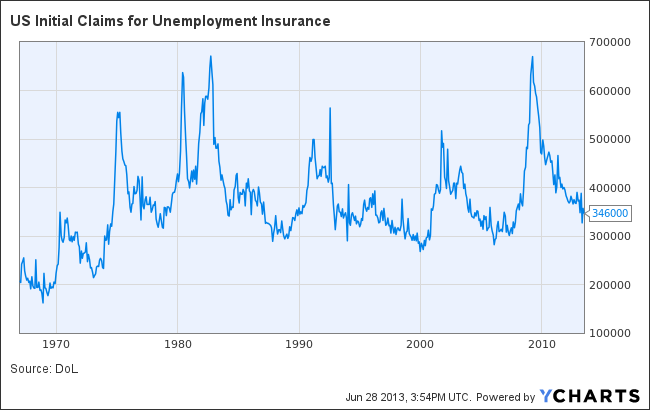
Article in the PiPress claiming the economy is improving because there were fewer applications for unemployment.
http://www.twincities.com/business/ci_23550437/us-unemployment-benefit-applications-fall-346k
The article notes “Applications are a proxy for layoffs.” The reasoning is that as soon as you get laid off, you run down to apply for unemployment, which sounds right to me. Fewer people running down to apply means fewer people laid off means economy is better than it was.
You know, I’ve heard that “proxy” phrase before, last month. http://www.shotinthedark.info/wp/?p=36279 The economy was supposed to be getting better then, too.
And also back in March: http://www.middletownpress.com/articles/2013/03/14/news/doc5141c7d613225691011181.txt?viewmode=fullstory
Here’s the thing: the number of applications has hovered around 350,000 for the last year, and that’s consistent with the economy in 2003-04 which was the end of the recession caused by the Twin Towers on 9-11-2001. (Chart only goes back 10 years).
US Initial Claims for Unemployment Insurance data by YCharts
So does the economy feel like it’s two years after 9/11? Does national security feel that way? A decade later, are we doing Better, Worse or Same?
Joe Doakes
Como Park
I’d love to hear the case for “better”…


June 28th, 2013 at 12:03 pm
Repeat a lie often enough and Emery will start quoting it as gospel truth.
June 28th, 2013 at 1:17 pm
The beginning of the chart in the 1960s demonstrates why this chart is not representative of real economic progress–it makes very clear that employment volatility has increased greatly since then. So if we had a program that would incentivize contract and short term employment–let’s call it the “Health Insurance Deform Act” or “Obamacare”–we would expect to see new unemployment claims drop simply because the poor guys losing their jobs weren’t eligible for unemployment insurance.
(are there ANY good measures of the economy anymore?)
June 28th, 2013 at 1:43 pm
Mr. Jobs’s reply was unambiguous. “Those jobs aren’t coming back”
https://www.nytimes.com/2012/01/22/business/apple-america-and-a-squeezed-middle-class.html?pagewanted=all
Those poor suckers working in Shenzhen factories probably believe that there is some chance that they can increase their wages. They can’t, if they raise the cost of their labor, their jobs will be automated or sent somewhere else.
Capital can take advantage of a global economy more readily than labor can. As a result, capital will capture an ever increasing share of the value produced by labor.
June 28th, 2013 at 3:51 pm
Those poor suckers working in Shenzhen factories…
Already happened. Low wage business is fleeing China for Vietnam, Indonesia, India and Thailand.
June 28th, 2013 at 9:49 pm
An American with the skill set of a Chinese laborer is worth little more than his Chinese counterpart.
June 28th, 2013 at 10:53 pm
You get what you pay for, Emery.
How much is my loyalty to the US, rather than some other country, worth to the United States of America? Put another way, how much is my government’s loyalty to me, worth to me?
June 29th, 2013 at 7:19 am
Joe:
Since it seems to be easy for you to put up charts can you put up a chart of what I call the real unemployment rate (unemployed, the people who want more hours, and those people who gave up looking) trend is with official unemployment rate. I bet until 2008 it will have a narrow gap consistently and then a large gap developed between the two.
Walter Hanson
Minneapolis, MN
June 29th, 2013 at 10:56 am
Farm automation eliminated the need for unskilled farm workers, and factory automation eliminated the need for unskilled factory workers. In 1970, a man with a strong back and a good attitude could get a good paying factory job, and that is no longer true. But farms and factories still need skilled professionals and technicians (and a few unskilled workers who are flexible). What we are seeing is office automation eliminating the need for unskilled office workers. In 1990 a graduate with no trained skills but some intelligence, decent people skills, and a good attitude could find an office job which would put him in the middle class. That graduate could even rise and thrive. In 2010, a graduate without a professional degree (or some other source of actual acquired skills) may not get in the door. A generation ago, the path to success was to obtain the minimal University degree, get into a good company and learn how to ‘do business’ by ‘doing business’. I ask everyone who I interview what he or she will bring in to the company. Today, a good work ethic isn’t nearly enough.
There is a shortage of skilled engineers, skilled tradesman, skilled craftsman of all sorts. There is no shortage of educated people who can dress for business and give a PowerPoint presentation. Yes, we still need post-secondary education. But the days when ‘learning how to learn’ was enough to entice an employer to hire a graduate are done. Bring some actual skills to the table, or you will be turned away. Universities are going to have to adapt to teach more actual skills or lose their relevance.
June 30th, 2013 at 12:46 pm
I agree with most of what you say, Emery, though it seems US centric.
The question is — what will you do about the left half of the curve? Aside from humanitarian concerns about condemning those who are just average and below to a life of economic uncertainty and dependency, there are political concerns as well. It is hard to believe that would be a stable arrangement. Sooner or later you’ll get some variety of communism or fascism, or you’ll lose democracy and become an oligarchy.
June 30th, 2013 at 9:16 pm
Walter,
The chart you want is the bureau of labor statistics “U6” chart. It counts unemployed and underemployed – and hasn’t improved much.
July 1st, 2013 at 11:06 am
Farm automation eliminated the need for unskilled farm workers All of them? Hmmm.. I guess all those migrants you are so want to legalize are doctors and lawyers.
In 1970, a man with a strong back and a good attitude could get a good paying factory job, and that is no longer true.Been to SD/ND lately? My friend used to own a labour intensive company (it is stil there although he is looking at it from above) putting up substations around the US and he always bemoaned the fact he could not find enough – LEGAL – people willing to earn $36/hr starting salary.
Universities are going to have to adapt to teach more actual skills or lose their relevance. Finally, something we agree on (cue flying pigs). Already happening, we are turning out barristas with doctorate degrees in “Studies”. How many barristas do we actually need?
July 1st, 2013 at 4:23 pm
Emery, you’re right about the lack of strong-back-weak-mind jobs. But Terry hits on what I call “The Dummy Problem.” After we’ve college-educated everybody who got C’s and above in high school, what do we with the rest? Unskilled immigrants – legal or illegal – are direct competition for that level of employment. When the West was wide open and there was no welfare, we could accept the tired, the poor, the huddled masses yearning to be free because they worked or starved. Today, we can’t even employ our own unskilled labor, much less import more. Moratorium, not reform. End it, don’t mend it. And build the damned fence we were promised last time before we even start talking about more immigration.
July 1st, 2013 at 9:06 pm
The current mentality regarding universities is that what is valuable is where you go, not what you learn. So ambitious young scholars and their parents put an enormous effort into high school grades, SAT prep, and extracurricular box ticking so that they can apply to Harvard and the like. Once there, the accepted wisdom is that riches will flow to graduates who are well-connected. Actually working hard at university is not associated with future success, so undergraduates generally take a leisurely course schedule and work hard on their social life. After all, if who you know is what matters, you should try to get to know a lot of people (especially the right people). If you take chemical engineering you will have to work hard and you will mostly meet other engineers (fun crowd, not well connected).
A society that values who you know, not what you know, generates few chemical engineers. The corrupting influence of Wall Street, high tuition private schools, the high-priced end of the legal profession and the medical profession, and the perception that these high end jobs only go to those who ‘work the system’, know the right people, attend the right school, all corrupt the process that generates high-skilled graduates. American students don’t take ‘hard’ courses, because they have learned (albeit this is only partially true) that the big money goes to the connected, not the highly skilled.
July 2nd, 2013 at 5:52 am
How many undergrads do the ivies admit each year? I think that there may be a selection bias at work. Status obsessed media people are extremely interested in getting their child into Yale or Stanford, so the college admissions contest makes headlines. All this effort and angst for an LA undergrad degree
July 2nd, 2013 at 6:26 am
Why do the children of rich parents do better in life than the children of the middle class, who in turn do better than the children of poverty? Partly there is the age old problem of nepotism. Every parent ever born tries to make the lives of their children easier, and are quite prepared to do things that are not fair, or even legal, to the rest of society. Ethnic minorities often function as a large clan when it comes to reserving opportunities for their collective progeny. Businesses, schools and civil services all need to guard against nepotism. Preference for the children of alumni, practiced at most American Universities, is clearly wrong and a good example of selection bias.
July 2nd, 2013 at 8:37 am
Joe Doakes wrote:
After we’ve college-educated everybody who got C’s and above in high school, what do we with the rest?
This is what I believe posterity will consider to be the conundrum of our age — not gay marriage rights or whatever. It is an existential question for our republic. You can’t have a self-ruling people if a significant number of citizens are denied the ability to be economically self-sufficient.
July 2nd, 2013 at 4:08 pm
Emery, you are one sicko soci@list. You are not fooling anyone.
July 2nd, 2013 at 10:21 pm
@Terry
The fundamental problem of which low-skill unemployment is a symptom is that as the world opened up post-cold war, there has been a flood of manpower with useful education and useful infrastructure. In 1980, there were perhaps a billion people who lived in countries that fully participated in the capitalist system. There are now 4-5 billion, and that change happened in one generation. The indirect effect of those 3-4 billion extra people has been to skew the demand for high vs. low skill workers worldwide. That will work itself out in a generation, as China and India are learning to produce lots of high skill workers themselves, but this effect, which over accentuates the economic reward of skills, will be with us for decades.
So what should America (and other rich countries) do? You can encourage more people to go learn finance, engineering, and other high skill professions, but the gains to be had there are marginal — most people who can do that work already do it. What do you do with the low skill white collar and blue-collar workers who are facing low demand for their labor? We need to reduce the cost of hiring lower wage employees. Health care and old age pension funding needs to be taken away from employers and made strictly a matter between individuals and government, which means we will have to be honest about what each costs and how much redistribution each involves. Earned income tax credits and similar subsidies that artificially boost low wage per hour jobs should be expanded and we must NOT increase the minimum wage. This combination could easily halve the cost of hiring a low wage worker. Finally, training for skilled labor jobs need to receive the kind of subsidies that 4-year colleges do. There are still lots of jobs for various kinds of technicians in the US, and that will continue. Many students need to be directed down those paths rather than towards universities, where after 4 years and tens of thousands of dollars of expenses, the bottom third of graduates emerges with essentially no skills and no prospects.
We’re not going back to the post-WW2 period where low skill Americans were in high demand to staff the only functioning capitalist market in the world. That was an economic and historical aberration, and because of those decades of easy prosperity for the working class, America finds itself with tax and benefit systems that in today’s more normal worldwide economy lead to unacceptable levels of inequality. An American with the skill set of a Chinese laborer is worth little more than his Chinese counterpart. That will lead to terrible inequality unless the government changes taxation and benefit systems to better meet the needs of lower skill workers.
July 3rd, 2013 at 10:02 am
That will lead to terrible inequality unless the government changes taxation and benefit systems to better meet the needs of lower skill workers.
Rrgo, redistribution of wealth. Why do you hate success so much? Why do you deny people a chance to rise up on their own volition? Why do you advocate creating permanent underclass slaves to the goovernment, Sicko Soci@list Emery?
July 3rd, 2013 at 5:10 pm
@MBerg
What a classy group of commenters you seem to attract here.