Archive for the 'Media' Category

Outfoxed

Tuesday, December 28th, 2010

Yet another “study” made the rounds a few weeks ago claiming that Fox News viewers are less well-informed than the average news consumer.

These things have been going around and around – and getting debunked – for so long, it’s hard to even pay attention anymore.   There will, inevitably, be a savage debunking.  It never fails.

And so there is; the “study”, accepted as gospel by everyone from your slack-jawed corner leftyblogger to the HuffPo to the NYTimes (pardon the redundancy) isn’t worth the electrons it was printed on.  The study:

  • Didn’t test what it claimed,
  • The data collected supported opposite conclusions than what was claimed,
  • The “study” contained a trick question
  • It contained baseless conclusions.
  • It presented highly disputed conclusions as fact – and, in the bargain, it presented policy points from left-of-center groups as the “Truth”, differing from which meant that one was “misinformed”.

In short, the “study” was no more valid than, say, a Humphrey Institute poll.  Oh, yeah – and it’s funded by George Soros.

The whole debunk is on video here.

Watch it, and remember – if more than one liberal group claims something to be a fact, 99% of the time it is a lie.

Speak When Spoken To, Peasants!

Monday, December 27th, 2010

I joined the Minnesota Libertarian Party back in 1994.  I’d been a conservative – ergo a Republican – for something like ten years at that point.  But I was disgusted with what I saw as the pusillanimity of the GOP Congress in the face of Bill Clinton’s power grab.  Not just Hillarycare; it was the widespread caving-in on the 1994 Crime Bill, with its noxious gun control provisions, that disgusted me with the GOP.

So I joined the Libertarian Party of Minnesota (LPM).  Not as a super-active member, of course – my kids were one and three years old, at the time, so there was little enough chance of me being a full-time firebrand. 

But I was hardly alone.  The mid-nineties may have been the high-water mark for the Libertarian Party – the LPM and nationally.  I don’t have the figures in front of me (and I don’t really care to look it up at the moment), but the Libertarian Party reached something of a high-water mark in the mid-nineties.  The party was endorsing candidates for offices, from city councils all the way up to President, like it hadn’t at any time before or since. 

The thing that appealed to many newly-minted Libertarians, myself included, was the absolute purity of Libetarian Party dogma.  There was no compromise on personal liberty!  Freedom ruled!  Liberty was the Law!

Our enthusiasm had the advantage of being utterly unfettered by any sense of having to make any of the compromises that come from actually having to govern anything.  The number of big-L Libertarians that had been elected to significant office, ever, was vanishingly tiny.  Outside of ornery, contrarian environs like the rural West, New Hampshire and Alaska, it was rarer still.

The LPM – and the LPUSA – were a haven for a lot of people, like me, who were very, very clear on what they wanted.  They – and I – were very very unclear on how the sausage was made.   Politics is a two-stage process;  Stage 1 is pulling like hell to get your beliefs – wrapped up in the form of a candidate – into the election.  It’s the part that takes place within a “party”, usually – and includes all the various roots of the term “Party”; one is “particular” about which candidate ones’ “party” endorses,  one exhibits “partisanship”. 

 Stage 2 is when that candidate is (hopefully) elected, and has to actually try to govern, either by sitting on a deliberative body like a city council, a county commission, a Legislature or a Congress, with people with whom you may disagree, to actually make the sausage.   It’s when the various forms of the word “politics” start to apply; one must “politely” (by the standards of the governing body) work with other “politicians” to achieve enough “polity” to enact your beliefs as “policy”.

My fellow Libertarians and I had the Phase 1 bit down cold.  We knew how to agitate!

We – I – were a little less clear on Phase 2, at least at the time.

It took me about four years to realize the LPM was never going to get to Phase 2, and that the GOP was my best bet for working for a party that would, someday, reflect enough of my beliefs to let me get behind it. 

And today – 12 years later, on the eve of swearing in a new, conservative-with-tinges-of-small-“l”-libertarian legislature – I feel pretty well vindicated. 

But some of the same dynamic I saw in the big-L Libertarian Party – the enthusiasm for the “Phase 1” process, the agitation and enthusiasm and the pulling like hell for ones core beliefs – is very much at play among the hordes of newly-minted conservative activists.  We saw it in spades a couple of years ago, when GOP caucuses were inundated with Ron Paul supporters.  They stormed the caucuses, full of piddle and vinegar, all fired up to enact “Dr. Paul’s” policies.  Many got discouraged when the GOP – those who’d in the party for years, doing all that boring “Phase 2” stuff – didn’t embrace them with open arms.  Some stuck around, long enough to see the Tea Party – a tidal wave of new activists that dwarved even the Ron Paul tide – sweep the GOP into power in a wave of “Phase 1” fervor. 

Now we’re into Phase 2. 

And some of the people who’ve had to do all that tiresome Phase 2 stuff – all the words that share their roots with “politics”, the ones that require persuasion rather than ardor, and even occasionally compromise rather than absolutism – are nervous.  

And much as the Phase 1 firebrand in me hates to say it, some of them have a point.

Lori Sturdevant isn’t one of them – but she at least troubles herself to talk with some people who do:

U.S. Rep. John Kline, soon to be Minnesota’s most potent gavel-wielder in Congress, shared his take on the Minnesota mood when he paid the Star Tribune Editorial Board a visit last week.

“I don’t know the last time when we saw a mood like this. It’s amazing,” said the Second District Republican, who’s soon to chair the House Education and Labor Committee. People are frustrated, scared, angry, impatient, confused — “all, I would argue, with justification,” he said.

That’s the sound of lots and lots of people who are doing the “Phase 1” stuff, many of them for the first time in their lives.

About that last sentiment: Kline said he regularly hears mixed messages from his south-suburban constituents.

“On the one hand, people want Congress to get things done, to make things better, to get the economy going again, to do something about jobs,” he said.

But let him profess support for something favored by a Democrat — say, the Obama-Republican tax deal that took a bipartisan pounding on its way to enactment last week — and Kline is deluged with a different message: “I didn’t elect you to compromise.”

The wave that swept all those newly-minted Republicans into office is heavily made up of people who are new to caring about politics at all, much less about all the inside-baseball “Phase 2” stuff. 

Maybe “you” individually didn’t. But “you” collectively did. Collectively, U.S. and Minnesota voters have elected divided governments.

So far.

 It’s the will of the collective “you” that’s supposed to count in running a democracy. When voters put the levers of power into the hands of more than one party, governing isn’t Burger King. You can’t have it your way — not if you expect to get anything done.

Sturdevant displays a certain amount of wonky provincialism here; shutting down a tax-and-spend orgy, whether in St. Paul or in Washington, is “getting stuff done”.

From my perch in the Capitol basement, I’ll be watching to see whether the new crowd in charge of state government will be similarly devoted to accomplishment, rather than intent on keeping their respective bases satisfied.

Well, no.  I mean, it sounds nice and all, but  if you’ve been following Lori Sturdevant any length of time, you the only “accomplishment” she cares about is “enacting the DFL’s agenda”. 

But what the heck, it’s the holidays.

They have ample reason to be. The statehouse gang lacks Congress’s opportunity to do relatively little immediate harm if they do relatively little. In state government, the constitutional requirement that the budget be balanced every two years presents an unyielding choice to DFL Gov.-elect Mark Dayton and the Republican majorities-elect in the Legislature: Make a deal, or shut down government operations come July.

Sturdevant makes that sound like a bad thing.

Kline correctly pointed out that in both parties, activists are “exceptionally vocal right now, and more engaged than they have been over time.” The Internet has given them all spyglasses and megaphones, which they train as eagerly on their allies as their opponents. Those tools leave a false impression with some elected officials about the activists’ political strength.

I”m going to suspect that this past November’s elections may have left a very, very accurate impression of that strength.

Dayton and the new GOP legislative leaders put on a fine show of bipartisan comity last week after their first private meeting. They said all the right words about searching earnestly for common ground on job creation and government streamlining.

But, on other occasions, they’ve also said they plan to stick to the policy guns they fired during the fall campaign. Dayton will assemble a budget proposal that emphasizes an income tax increase for the wealthy. Republicans will counter with budget bills built on “no new taxes.”

Quick side note here; watch that “no new taxes” talk.  Sturdevant is going to be doing her usual job – the DFL’s bidding – in trying to make the GOP’s stance seem like an extension of the Pawlenty years.  In fact, the GOP was sent to Saint Paul with an even clearer mandate; cut the spending.

If those base-pleasing, no-new-compromise exercises consume every legislative day from January until early May, my sense is that the mood of the Minnesota electorate is going to be quite sour.

Stuck as she is in her wretched ink-stained ivory tower at 425 Portland, perhaps it’s understandable that Sturdevant missed the news between Christmas Eve of 2009 and November of 2010; the mood is already sour.  That’s how Barack Obama and the DFL both squandered overwhelming advantages in Congress and the Legislature in two short years.  The  peasants are pissed!

Last week, the Civic Caucus, a bipartisan group of seasoned policy wonks, began preparing a formal call for a change in the Legislature’s usual calendar.

And as a general rule, anything coming from “bipartisan” groups of “seasoned wonks” should go in the kill file immediately.

By law, Dayton must offer his budget proposal on or before Feb. 15. The Civic Caucus wants the Legislature to follow suit a few weeks later with at least its revenue and spending targets, said the group’s coordinator, Paul Gilje.

“Every session, everybody is so frustrated with the way everything comes out at the last minute,” Gilje said. “This time, the divide is so well-understood early on. Why not get the options on the table early? Why not open the way for an intelligent statewide discussion for how to reconcile the differences, rather than waiting till the end?”

Oh, I have a sneaking hunch you won’t have to wait all that long for the GOP’s proposal.

As it stands, the draft statement the Civic Caucus is circulating doesn’t specify a deadline for the Legislature to produce its budget. I have what may be a fitting suggestion: How does April Fools’ Day sound?

It sounds like someone had to dig into the cliche bag to find an ending for their column.

Look – the political establishment in this state – and Sturdevant is nothing if not their dutiful scribe – has been barbering for years about how badly they want more people to get involved, to be stakeholders, in their government.

Now they got it. 

We just must all be the wrong kind of people.

You Get One Guess

Monday, December 27th, 2010

Minnesota Public Radio’s Mark Zdechlik notes that Minnesota could very well see a lot more nail-biter races, because…

…well, we all know how this works, don’t we?  Minnesota is more polarized, and the parties are more extreme.  Right?

Analysts say elections have become so close because Republicans and Democrats share almost the same number of supporters and that both sides are becoming more extreme and more polarized.

And who’s the source?

You only get one guess!  Hurry!  (Emphasis added)

University of Minnesota Political Science Professor Larry Jacobs…

Oh, who the hell else?

I wonder – does the Humphrey Institute give some sort of spiff to reporters for quoting Jacobs in every single story about politics at any level anywhere in Minnesota?

If every single news outlet – MPR, WCCO, the Strib, the PiPress, the MinnPost – quoted Mitch Pearlstein of the conservative Center of the American Experiment, do you think someone would squawk that they were adopting a partisan point of view?

So given the largely  monochromatic, left-of-center pedigrees of the Humphrey Center’s faculty, why does this monopoly on sourcing in the Twin Cities media pass unmentioned?

…said politics in Minnesota has been reduced to something akin to tribal warfare; most Democrats and Republicans are dug-in so deep they wouldn’t even consider supporting a candidate from the other side.

“You’ve got kind of the Hatfields on one side and the McCoys in another,” Jacobs said.

Far better, to some in the Twin Cities “intelligentsia”, to return to the seventies, when all politicians came to us in generic yellow boxes with black lettering, all spouting more or less the same center-left institutional twaddle?  When you had your choice between John Marty and Arne Carlson – ergo no choice at all?

Jacobs said this year’s governor’s race is a good example of the polarization. He said that Republican Party candidate Tom Emmer was probably the most conservative statewide candidate we’ve seen nominated on the Republican side in the state’s history, or at least since World War II.

They always put this like it’s a bad thing.

He was nominated – they know that, right?  It’s not as if Karl Rove flew in and gave the guy the nomination personally.

With the exception of DFL Sen. Amy Klobuchar’s lop-sided 2006 victory, the past three statewide elections have shown core Republicans and Democrats in Minnesota are evenly split.

Because winning with a majority has become so difficult, Jacobs said election strategy in Minnesota has become all about ripping the opposition and appealing to the base.

And, um, trying to scare off independents by showing that your guy is really ahead, appealing to the Bandwagon Effect.  Right, Dr. Jacobs?

Question:  If I had access to Lexis/Nexis, and could divide the number of stories on politics in the Strib, PiPress, WCCO, MPR and the MinnPost featuring quotes by Dr. Jacobs by the total number of stories on politics, would the result be over or under 25%?

The Great Poll Scam, Part XIV: Fool Me Ten Times…

Thursday, December 23rd, 2010

You’ve heard the old saying – “the definition of insanity is repeating the same thing over and over again and expecting a different result. 

The joke writes itself.  Nearly every election season, Minnesota’s media runs the results of the Star-Tribune Minnesota Poll and the Humprey Institute/MPR Poll on its front pages; front and center on its 6 and 10PM newscasts; up-front in its hourly news bites; in the New York Times; prominently on that big news crawl above Seventh Street in downtown Saint Paul.   To those who don’t dig into the numbers – and that’s probably 99 percent of Minnesota voters – that’s all there is to it.  “Hm.  Looks like Dayton’s winning big!”.

In most elections- especially the close ones – both polls (along with their downmarket stepsibling, the SCSU Poll) show numbers for GOP candidate that beggar the imagination.  The media – the Strib, the TV stations, MPR – run the polls pretty  much without any analysis.  The job of actually fact-checking the polling falls to conservative bloggers – myself, MDE, Ed Morrissey, Scott Johnson and John Hinderaker, Gary Gross, the Dogs, Sheila Kihne and others; poll after poll, election after election, we shout into the storm “the numbers are a joke! Democrats are oversampled to an extent that is not warranted by electoral results we’ve seen in this state in nearly a generation!  Would someone look into this?”

The elections take place.  There is hand-wringing about the inaccuracy of the polls.  Two years pass.  Larry Jacobs and the  Strib release still more polls, repeating precisely the same pathologies, over and over and over.  Forever and ever, amen.  Lather, rinse, repeat.

Now, “journalism” is supposed to be about accuracy and clarity.  About telling the story, and telling it in a way that your sources reinforce your credibility and clarity.  If you are a reporter, and you report a story based on a source’s information, and that information turns out to be wrong, it’s a bit of a vocational black eye.

This morning I asked, rhetorically, “do you think that if a source burned Tom Scheck or Pat Doyle or Rochelle Olson or Rachel Stassen-Berger over and over, year in and year out, by feeding them laughably inaccurate information, not just once or twice but on nearly every story on which they are a key source, would they keep using them as sources?”  Without really serious corroboration, if indeed it could be found?  Ever?  

And yet the regional media not only continues running the Strib and HHH polls, election after election, without any serious question – until after the election, anyway.  Notwithstanding the fact that the Strib’s Minnesota Poll has been very regularly wrong for a generation now.  Notwithstanding the fact that the Humphrey Poll has been even more consistent in its systematic shorting of GOP candidates.  The polls are still treated not only as useful news, but front-page material.

This would prompt a curious person to ask a whooooole lot of questions:

Why do the pollsters continue to generate such a defective product?:  While I focused heavily over the past few days specifically on Gallup’s Frank Newport’s critique of the Humphrey Institute poll, that gives the impression that this is a one-time issue.  And yet both the major media polls have had nearly the same problems, election in, election out, for a generation (or in the case of the Humphrey Institute Poll,  in every major election since 2004).   It’s gotten to the point where I want to stand outside 425 Portland, or outside the Humphrey Institute’s building at the U, and wave a sign about; “It’s the same thing, every time!”.

Why do the media continue to present such a routinely defective product as newsworthy?:  Scott Johnson has been lighting up the “Minnesosta Poll’s” shortcomings for a solid decade now; the Strib’s poll is rarely even close, and performs worse in close elections than in blowouts.  And at the risk of repeating myself, let me repeat myself; the Humphrey Institute poll has underpolled Republicans by an average of nine points.  This past election was distinguished from the previous years’ ineptitude only in degree, not in concept.

Does it never occur to our “watchdogs” and “gatekeepers” to look into this?  Wasn’t “insatiable curiosity” once a pre-requisite for being a reporter?

Do the editors at the Strib, the PiPress, KARE, MPR, WCCO and the rest of the regional mainstream media genuinely consider “polls are a snapshot in time” an excuse for decades worth of a pattern of inaccuracy, not only in polling technique but in their own coverage of elections?

If a city councilman is caught cashing checks to herself, would saying “it’s just a snapshot in time!” get the Strib to call their dogs off?

Appearance Of…Something?: I’ve said it before; I’m not a fundamentally conspiracy-minded person.  I don’t necessarily believe that the media is involved in a conscious, considered conspiracy to short conservative candidates in close elections.

Still – given that…:

…I’ll ask again: if the Humphrey Institute (whose institutional sympathies lean definitively left-of-center) and the Strib (ditto) wanted to create a system that would help tip close-call contests toward the DFL, how would it be any different than the system they’ve developed?

Not accusing.  Just asking.

The Great Poll Scam, Part XIII: Reality Swings And Misses

Thursday, December 23rd, 2010

Contrary to the impression some wrote about on various blogs, I never worked for the Emmer campaign.  Oh, I did a fair amount of writing about Emmer’s bid for governor – I thought he had what it took to be the best governor we’ve had in a long time, and I was a supporter from long before he actually declared his intent to run.  I volunteered a lot of time, and a lot of this blog’s space, to fight against the sleaziest, most toxic smear campaign in recent Minnesota electoral history, and I do believe the better man lost this election.

But I never got any money for it.

What I did get – although not to an extent that would make a Tom Scheck or a Rachel Stassen-Berger in any way jealous – was a certain amount of access.  I heard things.

One of the things I heard from sources inside the Emmer campaign, especially during the long, dry, advertising-dollar-free summer before the primaries, when all three DFL contenders curiously spent their entire ad budgets sniping at Emmer, and the media played dutiful stenographers for Alliance for a Better Minnesota’s smear campaign, was that the Emmer campaign had its work cut out for it.  In late July and early August, a source inside the Emmer campaign, speaking on MI-5-level deep background, told me the internal polls showed Emmer trailing by 12 points.  It wasn’t good news, certainly – but it was early in the race, it was a byproduct of being outspent roughly 16:1 to that point, and it was just part of doing business.   “We gotta pick up six points, and Dayton’s gotta lose six”, the source told me, as the campaign dug its way out of “Waitergate”.

I observed to the source that that should have been nothing new for Emmer; he’d come back from a bigger margin in the previous nine months or so, from being way back in the pack at the Central Committee straw poll about this time last year, where Marty Seifert won by a margin many considered insurmountable.

The source expressed confidence it could be done.

He was, statistically, exactly right. Emmer brought the race back from a 12 point blowout to a near-tie, with numbers that pretty steadily improved – according to the party’s own internal polling.

Steadily?

On October 11, I held a “Bloggers For Emmer” event at an undisclosed location in the western subs.  It had been ten busy weeks since my off-the-record conversation with my source in the campaign.  An Emmer functionary told me – off the record – that it was now a four point race.  

A week later, within ten days of the election, the same internal poll said the race was a statistical dead heat.

Then came the last-minute hit polls from the Humphrey Instititute, the Strib and Saint Cloud State – after which Emmer released his internal polling, which was reinforced by a Survey USA poll that more or less reinforced the internal polls’ results.

And then came the election.

Last week, David Brauer at the MinnPost interviewed Emmer campaign manager Cullen Sheehan.  As part of the piece, he graphed the respective polls: Emmer’s internal polling (orange), the Strib poll (wide dashes) and the HHH poll (dots), showing the indicated size of the Dayton lead.

Graph used by permission of the MinnPost

Graph used by permission of the MinnPost

Brauer:

Although “internal numbers” often become propagandistic leaks, Sheehan insists the data was not for public pre-election consumption. Though he wound up releasing the most favorable result during the campaign, it proved prescient, and two independent pollsters subsequently showed similar results.

And while Brauer points out that internal numbers “aren’t holy” – and many leftybloggers openly guffawed when Sheehan released them – the GOP’s internal numbers have a long record of accuracy, in my experience.  In 2002, when the Strib poll had Roger Moe measuring the drapes in the mansion, a GOP source leaked me internal polling showing that Pawlenty was tied and rising.  And internal polling released to a group of bloggers a month before the election showed Chip Cravaack pulling close to Jim Oberstar; numbers that the campaign asked be kept off the record showed that with “leaners”, Cravaack was actually leading.

So for all the leftyblogs’ caterwauling about “push polling”, the GOP’s internal polls – as seen both publicly and behind the scenes – called things as they were.  There’s a reason for that; parties need to accurate polling to help them allocate scarce resources effectively.  The DFL has not released their internal polling – but the Dayton campaign’s behavior indicates to me that they also saw Emmer’s late surge, leading them to re-roll-out the “Drunk Driving Ad” (the closest the Dayton campaign ever came to a coherent policy statement, with full irony intended).

But neither sides’ internal polling is affiliated with a major media outlet.  The Strib, Minnesota Public Radio and MinnPost all have symbiotic relationships with Princeton, the Humphrey Institute and Saint Cloud State, respectively (though to be accurate the MinnPost only paid for three questions in the SCSU poll, and those were, according to Brauer, on ranked-choice voting).  Those relationships, presumably, exist so that the news outlets can get “their” results out to the public first.

No matter how they’re arrived at, or so it seems.

Brauer confirms after the fact what my sources in the campaign told me, off the record, at the time; it was a real numerical rollercoaster ride:

Although “internal numbers” often become propagandistic leaks, Sheehan insists the data was not for public pre-election consumption. Though he wound up releasing the most favorable result during the campaign, it proved prescient, and two independent pollsters subsequently showed similar results.

“It really is, internally, a compass,” Sheehan says of the campaign’s polling.

Emmer’s own numbers show a candidate trailing — sometimes badly — for nearly the entire race.

On July 28 — three weeks after Emmer’s interminable “tip credit” debacle — the Republican trailed Dayton by 11 points. Ironically, the Star Tribune poll — which Republicans say overstates DFL support — had it closer: Dayton plus-10.

It was a demonstrable fact that the Strib poll oversampled DFL voters by a big margin – but that’s a poll-technique discussion to be held some other time.

In the wake of the double-digit gap, Sheehan took over as campaign manager. But by early October, the internal numbers had barely budged: Emmer was still down 7. A Strib survey taken a week or so earlier showed the Republican down 9 — again, pretty close to what the campaign was seeing.

Finally, on Oct. 13, Emmer got his first great inside news: he was only down 1. But the next media poll (SurveyUSA/KSTP) had him down 5, and an Oct. 18 internal poll repeated that number. It was two weeks before Election Day.

And then came the Big Three media polls, one after the other – the Strib, SCSU and the Humphrey polls – showing Emmer 9, 10 and 12 points down, respectively.  At which point Sheehan opted to release the internal numbers – which were shortly reinforced by SUSA.

Sheehan:

“At that point [right before the election – the polls on which I’ve focused throughout this series], undecided voters are making up their minds and supporters are getting anxious, having seen 7 down, 10 down and 12 down,” Sheehan says. “It impacts fundraising and volunteers. It’s definitely not the only factor, but it is a factor.”

Sheehan, now the Minnesota GOP Senate caucus chief of staff, is a Republican, but Democratic Senate Majority Leader Harry Reid’s pollster feels similarly. Reid’s internal numbers proved better than media polls predicting his opponent would win.

Says Sheehan, “The point I am making is that outside public polls have an impact on campaigns — ultimately, some impact on eventual outcome of campaigns, especially in close races.”

At least one media outlet agreed even before the results were known. This year, the Star Tribune declined to do its traditional final-weekend poll. A key reason, editor Nancy Barnes told me, is that “a poll can sometimes influence the outcome of an election.”

Sheehan’s plea? Withhold questionable numbers. “I’m under no illusion that public polls will cease, but I do think news organizations have a responsibility to ask themselves, when they get their results, if they really believe they’re accurate,” he says.

I’ve met Sheehan not a few times.  Great guy.  Big future in politics.  Now, I’m not sure if he’s ever read this series; if he has, I’m sure he needs to be diplomatic.  He’s gotta get along with the regional media.

But the fact remains that the closer the race got, the farther off-the-beam the Strib and HHH polls swerved.

Just the same as they do in practically every election, especially the close ones.

So Sheehan has a point; the news media should treat suspicious polls as they would a source that’s burned them. 

Seriously – can you imagine Erik Black or Bill Salisbury or David Brauer putting a story on the front page (or “page”) based on the uncorroborated word of a source that had burned them, over and over again?  As in, not even close, but really, really embarassingly burned?

And the Strib and Humphrey Polls have burned the regional media – over and over and over again.

Presuming, of course, that accuracy is what they’re shooting for.

More later today.

The Great Poll Scam, Part XII: The Dog Ate Their Homework

Wednesday, December 22nd, 2010

Writing in defense of the Humphrey Institute Poll – which indicated our tie governor’s race was headed for a 12 point blowout – Professor Larry Jacobs says:

Careful review of polls in the field conducting interviews during the same period indicates that the MPR/HHH estimate for Emmer (see Figure 2) was within the margin of sampling error of 3 of the 4 other polls but that it was also on the “lower bound” after accounting for random sampling error. (Its estimate was nearly identical to that of MinnPost’s poll with St. Cloud.)

Which showed the race a ten point blowout for Dayton.

Jacobs is, in effect, saying “yeah, our poll was a hash – but so was everyone else’s”.

This pattern is not “wrong” given the need to account for the margin of sampling error, but it is also not desirable. As part of our usual practice, the post-election review investigated whether there were systematic issues that could be addressed.

Research suggests three potential explanations for the MPR/HHH estimate for Emmer; none revealed problems after investigation.

Indeed.

Here are the three areas the Humphrey Institute investigated:

Weighting: First, it made sense to examine closely the weighting of the survey data in general and the weighting used to identify voters most likely to vote. Weighting is a standard practice to align the poll data with known demographic and other features such as gender and age that are documented by the U.S. Census. (Political party affiliation is a product of election campaigns and other political events and is not widely accepted by survey professionals as a reliable basis for weighting responses.)

Our own review of the data did not reveal errors that, for instance, might inflate the proportion of Democrats or depress that of Republicans who are identified as likely to vote. To make sure our review did not miss something, we solicited the independent advice of well-regarded statistician, Professor Andrew Gelman at Columbia University in New York City, who we had not previously worked with or personally met. Professor Gelman concluded that the weighting was “in line with standard practice” and confirmed our own evaluation.

“And an expert said everything’s hunky dory!”

Our second investigation was of what are known as “interviewer effects” based on research indicating that the race of the interviewer may impact respondents.11 (Forty-four percent of the interviewers for the MPR/HHH poll were minorities, mostly African American.) In particular, we searched for differences in expressed support for particular candidates based on whether the interviewer was Caucasian or minority. This investigation failed to detect statistically significant differences.

And the third was the much higher participation in the poll from respondents in the “612” area code – Minneapolis and its very near ‘burbs.  Jacobs (with emphasis added by me):

When analyzing a poll to meet a media schedule, it is not always feasible to look in-depth at internals.

It’s apparently more important to make the 5PM news than to have useful, valid numbers.

With the time and ability that this review made possible, we discovered in retrospect that individuals called in the 612 area code were more prone to participate than statewide — 81% in the 612 area as compared to 67% statewide in the October poll.13 Given that Democratic candidates traditionally fare well among voters in the 612 area code, the higher cooperation rate among likely voters in the 612 area code may explain why the estimate of Emmer’s support by MPR/HHH was slightly lower than those by other polls conducted at around the same time. This is the kind of lesson that can be closely monitored in the future and addressed to improve polling quality. 

Except we bloggers have been “closely monitoring” this for years.  It’s been pointed out in the past; on this very blog, I have been writing about this phenomenon since 2004 at the very latest.  Liberals looooove to answer polls.  Conservatives seem  not to.

That Jacobs claims to be just discovering this now, after all these years, is…surprising?

Frank Newport at Gallup critiques Jacobs’ report:

The authors give the cooperation rate for 612 residents compared to the cooperation rate statewide. The assumption appears to be that this led to a disproportionately high concentration of voters in the sample from the 612 area code. A more relevant comparison would be the cooperation rate for 612 residents compared to all those contacted statewide in all area codes other than 612. Still more relevant would be a discussion of the actual proportion of all completed interviews in the final weighted sample that were conducted in the 612 area code (and other area codes) compared to the Census estimate of the proportion of the population of Minnesota living in the 612 area code, or the proportion of votes cast in a typical statewide election from the 612 area code, or the proportion of the initial sample in the 612 area code. These are typical calculations. The authors note that residents in the 612 area code can be expected, on average, to skew disproportionately for the Democratic candidate in a statewide race. An overrepresentation in the sample of voters in the 612 area code could thus be expected to move the overall sample estimates in a Democratic direction.

That Jacobs finds an excuse for failing to weight for higher participation in a city that is right up there with Portland and Berkeley as a liberal hotbed would be astounding, if it weren’t the Humphrey Institute we’re talking about.

The authors do not discuss the ways in which region was controlled in the survey process, if any. The authors make it clear that they did not weight the sample by region. This is commonly done in state polls, particularly in states where voting outcomes can vary significantly by region, as apparently is the case in Minnesota.

Summary:  The HHH poll is sloppy work.

The Great Poll Scam Part XI: Weasels Rip My Results

Wednesday, December 22nd, 2010

Professor Larry Jacobs – by far the most-quoted non-elected person in Minnesota – defends the Humphrey Institute Poll:

Differences between polls may not be substantively significant as illustrated by the case of MinnPost’s poll with St. Cloud State, which showed Dayton with a 10 point lead, and the MPR/HHH poll, which reported a 12 point lead.

The “margin of sampling error,” which is calculated based on uniform formulas used by all polling firms, creates a cone around the estimate of each candidate’s support, reflecting the statistical probability of variation owing to random sampling.2 The practical effect is that the results of the MinnPost poll with St. Cloud State and MPR/HHH are, in statistical terms, within range of each other. Put simply, the 2 points separating them may reflect random variation and may well not be a statistically meaningful difference.

What might be a “statistically meaningful difference” is that Survey USA and Rasmussen all came much, much closer – as in, one-third to one-quarter of the Strib, HHH and St Cloud polls – to getting the actual election right, and tracked much closer to the GOP’s internal polling, which turned out to be dead-nut accurate (as we’ll see tomorrow).

Figure 2 creates a zone of sampling error around estimates of support for Dayton and Emmer by the five media polls completed during the last two weeks of the campaign.3 In terms of the estimates of Dayton’s support, the MPR/HHH poll is within the range of all four other polls. Take home point: its estimate of Dayton’s support was consistent with all other polls.

Well, no.  It was consistent with the other polls who have developed a reputation for inaccuracy that inevitably favors the DFL.  The other polls – Survey USA, Rasmussen, Laurence – were not consistent with the Humphrey poll at all.

Frank Newport of Gallup responds to this:

It is unclear from the report how much the write‐up of results from the October 21‐25 MPR/HHH poll emphasized the margin of error range around the point estimates. Although this is not part of their recommendation, if the authors feel strongly that the margin of effort around point estimates should be given more attention, future reports could include more emphasis on a band or range of estimated support, rather than the point estimates.

In other words, if the Humphrey Poll is really a range with no particular confidence in any particular number within the range, publicize the range.

But that’s not what the Humphrey Institute, or the media, led with just before the election.  It was “DAYTON LEADS BY 12”.  Not “Dayton leads by 8 to 16, maybe, sorta”.

The distinction might make a difference.

This is generally not done in pre‐election polling, under the assumption that the point estimate is still the most probable population parameter. Any education of the public on the meaning of margin of errors and ranges and comparisons of the margins of errors surrounding other polls is an admirable goal. It does, however, again raise the question of the purpose of and value of pre‐election polls if they are used only to estimate broad ranges of where the population stands. This topic is beyond the scope of this review.

In other words – if you take Jacobs at his word, then there’s nothing really newsworthy about the HHH poll.

Do you suppose they’ll stick with that line in the runup to the 2012 election?

The Great Poll Scam, Part X: Weasel Words

Tuesday, December 21st, 2010

I’ve been raising kids for a long time.  Before that, I grew up around a bunch of them.  Indeed, I was one myself, once.

And I know now as I knew then the same thing that every single person who watches Cops knows, instinctively; if you think someone did something, and their response is “you can’t prove it”, it’s the same as an admission of guilt.

Oh, it doesn’t stand up in court – and it’s probably a good thing.

And in the rarified world of academics – and its poor, profoundly handicapped accidental offspring, political public opinion polling – I’m going to suggest it works the same way.

If there is a poll that is, year in and year out, just as ludicrous as the Humphrey and Strib polls, it’s the Saint Cloud State University poll.  I haven’t heretofore included it in my “Great Poll Scam” series, because it’s sort of out of sight and out of mind.

But in David Brauer’s interview with Emmer campaign manager Cullen Sheehan, the director of the SCSU poll – which is done in conjunction with the MinnPost – a fellow named Stephen Frank, tips us off; he concludes…:

Frank says. “Campaign managers like to find excuses rather than looking at their candidate or performance. Do you think if we stopped [publishing results] others would — or the candidates would and the latter won’t go public or only partially public?”

True, to a point.

But he began the statement by saying:

“Please show me one credible study that shows people change their mind on the basis of a poll,”

On the one hand:  “You can’t proooooooooove we did it!”

On the other hand – allow me to introduce you to Dr. Albert Mehrabian, who published a study entitled “Effects of Poll Reports on Voter Preferences”

From the abstract summary, with emphasis added:

Results of two experimental studies described in this article constituted clear experimental demonstration of how polls influence votes. Findings showed that voters tended to vote for those who they were told were leading in the polls; furthermore, that these poll-driven effects on votes were substantial.

How substantial?  I don’t know.  As I write this, it’s 5AM, and I have no way of getting to the University of Minnesota library to find a copy of Journal of Applied Social Psychology (Volume 28).  But I will.

But Mehrabian noted a decided “bandwagon effect” in voter responses to poll results.

Effects of polls on votes tended to be operative throughout a wide spectrum of initial (i.e., pre-poll) voter preferences ranging from undecided to moderately strong. There was a limit on poll effects, however, as noted in Study Two: Polls failed to influence votes when voter preferences were very strong to begin with.

Bingo.

I’d have voted for Tom Emmer even if he did finish 12 points back, as the Humphrey Institute suggested.  Or ten points out of the game, as Frank’s survey (which I ridiculed in this space), or thirty points back.  But then, nobody really doubted that.

But people who don’t live and breathe politics?  That’s another story – says Dr. Mehrabian.

Additional findings of considerable interest showed that effects of polls were stronger for women than for men and also were stronger for more arousable (i.e., more emotional) and more submissive (or less dominant) persons.

Which would be important, in a year when the DFL was worried about women flaking away from Dayton, and moderates being drawn (successfully!) to the Tea Party.

Wouldn’t it?

Especially noteworthy is my discussion of similarities and differences between the study methods and real- life political campaigns beginning with the middle paragraph on page 2128 (“Overall, results …).

I’ll dredge up a copy of Mehrabian’s study (unless any of you academics out there can shoot me a pointer…).

Mehrabian was cited in this study of the subject – “Social information and bandwagon behaviour in voting: an economic experiment“, by Ivo Bischoff and Henrik Egbert, a pair of German economists; the paper isn’t about the bandwagon effect – but it touches on it pretty heavily (all emphases are added by me):

The political science literature contains a number of empirical studies that test for bandwagon behaviour in voting. A first group of studies analyses data from large-scale opinion polls conducted in times of upcoming elections or on election days. The evidence from these studies is mixed (see the literature reviews in Marsh, 1984; McAllister and Studlar, 1991; Nadeau et al., 1997). One essential shortcoming of these studies is that it is very difficult to disentangle the complex interrelations between voting intentions, poll results and other pieces of information that drive both of the former simultaneously (Marsh, 1984; Morwitz and Pluzinski, 1996; Joslyn, 1997). Avoiding these difficulties, a second group of studies are based on experiments. Mehrabian (1998) presents two studies on bandwagon behaviour in voting. In his first study, he elicits the intended voting behaviour among Republicans in their primaries for the presidential election in 1996. He finds that the tendency to prefer Bob Dole over Steve Forbes depends on the polls presented to the voters. Voters are more likely to vote for Dole when he leads in the opinion poll compared to the situation with Forbes leading. The second study involves students from the University of California, Los Angeles. These are asked to express their approval to proposals for different modes of testing their performance: a midterm exam or an extra-credit paper. Mehrabian (1998) uses bogus polls in his studies. Results show that bogus polls do not influence the answers when subjects have clear and strong preferences. However, bogus polls have an impact when preference relations are weak. In this case, bandwagon behaviour in voting is observed. Next to Mehrabian (1998), there are a number of others experimental studies that find evidence for bandwagon behaviour in voting (Laponce 1966; Fleitas 1971; Ansolabehere and Iyengar 1994; Goidel and Shields, 1994; Mehrabian 1998).

It’s not an open-and-shut, according to Bischoff and Egbert – but there is evidence to suggest that the “Bandwagon Effect” exists, and that polling drives it.

Is it possible that the learned Professors Larry Jacobs or Stephen Frank are unaware of this?  Certainly.

Given both polls’ lock-step consistency, especially at under-polling GOP support in close elections, where people with weak initial preferences – people whose “preference relations are weak”, as Bischoff and Egbert put it, which might well be as good a good description for “independents” and “swing voters” as I’ve seen –  it’s worth a look, though.

More from Dr. Mehrabian in the near future.

The Great Poll Scam Part IX: The Rockstar Who Couldn’t See His Face In The Mirror

Tuesday, December 21st, 2010

In reading Professor Larry Jacobs’ defense of the Hubert H. Humphrey Institute poll – which always underpolls Republicans in its immediate pre-election survey, by an average of six points, with the tendency even more exaggerated in close races – Jacobs writes (with emphasis added):

Appropriately interpreting Minnesota polls as a snapshot is especially important because President Barack Obama’s visit on October 23rd very likely created what turned out to be a temporary surge for Dayton. Obama’s visit occurred in the middle of the interviewing for the MPR/HHH poll; it was the only survey in the field when the President spoke on October 23rd at a rally widely covered by the press. Our write-up of the MPR/HHH poll emphasized that the President appeared to substantially increase support for Dayton and suggested that this bump might last or might fade to produce a closer race:

Well.  That kinda covers all the possibilities, doesn’t it?

Effect of Obama Visit: Obama’s visit to Minnesota on October 23rd and the resulting press coverage did increase support for Dayton. Among the 379 likely Minnesota voters who were surveyed on October 21st and 22nd (the 2 days before Obama’s visit), 40% support Dayton. By contrast, among the 145 likely Minnesota voters who were surveyed on October 24th and 25th (the 2 days after Obama’s visit) 53% support Dayton. This increase in support for Dayton could be a trend that will hold until Election Day, or it could be a temporary blip that will dissipate in the final days of the campaign and perhaps diminish his support.

Did you catch that?

Obama’s presence in the city caused Daytons’ numbers to boom by five points (if you take the HHH’s numbers at face value, something no well-informed person ever does), and then lurch downward by a dozen by election day?  The presence or absence of Barack Obama is responsible for one out of eight Minnesota voters changing their mind and changing it back inside of a week?

Obama’s impact in temporarily inflating Dayton’s lead is a vivid illustration of the importance of using polls as a snapshot.

No.  The HHH polls’ impact in temporarily inflating Dayton’s lead is vivid illustraiton of how these polls need to disregarded or abandoned!.

Indeed, according to the MPR/HHH poll, Dayton’s lead before Obama’s visit was 8 points – nearly identical to the Star Tribune’s lead at nearly the same point in time (7 points). Treating polls as snapshots, then, is especially important when a major event may artificially impact a poll’s results or, as in the case of the MPR/HHH poll, there were a large number of voters who were undecided (about 1 out of 6 voters) or were considering the possibility of shifting from a third party candidate to the Democratic or Republican candidate.

Read another way:  “They’re snapshots, so we can’t be held accountable.  But keep the funding and recognition coming anyway”.

The take-home point: polls are only a snapshot of what can be a fast moving campaign as events intervene and voters reach final decisions. Polls conducted closest to Election Day are most likely to approximate the actual vote tally precisely because they are capturing the changing decisions of actual voters.

Newport dipolmatically notes the real “take-home point”:

The authors raise the issue of the impact of President Obama’s visit to Minnesota on October 23rd. The authors note, and apparently reported when the poll was released, that interviews conducted October 24th and 25th as part of the MPR/HHH poll were more Democratic in voting intention than those conducted before the Obama visit. It is certainly true that “real world” events can affect the voting intentions of the electorate. In this instance, if the voting intentions of Minnesota voters were affected by the President’s visit, the effect would apparently have been short‐lived, given the final outcome of voting. The authors do not mention that the SurveyUSA poll also overlapped the Obama visit by at least one day. It is unclear from the report if there is other internal evidence in the survey that could be used to shed light on the Obama visit, including Obama job approval and 2008 presidential voting.

Up next – at noon – what effect do bogus polls really have on voters?

The Great Poll Scam Part VIII: Snapshots That Never Come Into Focus

Monday, December 20th, 2010

I was reading Larry Jacobs’ defense of the Humphrey Institute’s shoddy work this past election.

His first point in defense is that polls are “a snapshot in time”:

Polls do not offer a “prediction” about which candidate “will” win. Polls are only a snapshot of one point in time. The science of survey research rests on interviewing a random sample to estimate opinion at a particular time. Survey interview methods provide no basis for projecting winners in the future.

So far so good.

How well a poll’s snapshot captures the thinking of voters at a point in time can be gleamed [sic] from the findings of other polls taken during the same period. Figure 1 shows that four polls were completed before the final week of the campaign when voters finalized their decisions.

I read this bit, and thought immediately of Eric Cartman playing Glenn Beck in South Park last season; disclaiming loathsome inflammatory statements with a simple “I’m just asking questions…”

Frank Newport at Gallup responded to this particular claim:

[Jacobs and his co-author, Joanne Miller] by discussing what they term a misconception about survey research, namely that polls are predictions of election outcomes rather than snapshots of the voting intentions of the electorate at one particular point in time. The authors present the results of five polls conducted in the last month of the election. The spread in the Democratic lead across the five polls ranged from 0 to 12. The authors note that the SurveyUSA poll was the closest to the election and closest to the actual election outcome. At the same time, the MPR/HHH poll was the second closest to Election Day and reported the highest Democratic margin. Another poll conducted prior to the MPR/HHH poll showed a 3‐point margin for the Democratic candidate.

Emmer’s internal poll showed a dead heat.  More on that later on this week.

Newport, with empasis from me:

The authors in essence argue that the accuracy of any poll conducted more than a few days before Election Day is unknowable, since there is no external validation of the actual voting intentions of the population at any time other than Election Day. This is true, but raises the broader question of the value of polls conducted prior to the final week of the Election – a discussion beyond the scope of the report or this review of the report.

By inference, Newport is indicating that a great enough number of voters make up their mind right before election day as to make pre-election polling essentially pointless.

Or is it?

Polling does affect peoples’ choices in elections; people don’t go to the polls when they know their candidate is going to become a punch line the next day; donors don’t turn out for races they are pretty sure are doomed.

And as I showed a few weeks ago, while Jacobs acknowledges that his poll is just a “snapshot” of numbers that may or may not have any bearing on the election itself, we noted a few weeks back that the Humphrey Poll’s results themselves are less “snapshot” than “slide show”; they have a coherent theme.  Election in, election out, they short the GOP, especially in tight elections.  Every single significant election, no exceptions.  Tight GOP wins (2006 Gubernatorial), comfy Democrat wins (2008 Presidential), squeakers (2008 Senate, 2010 Gubernatorial), every single one, without any exception, without the faintest hint of random “noise” that might indicate some random nature to the pattern, the HHH poll systematically shorts the GOP.

Given the completely non-random nature of this pattern – every election, no exceptions – there are three logical explanations:

  • The Humphrey Institute genuinely believes in the soundness of its polling methodology, which systematically (in the purest definition of the word) shorts GOP representation.
  • The Humphrey Institute is unable to change its methodology, or is structurally incapable of learning from its mistakes.
  • The Humphrey Institute is just fine with the poll’s inaccuracies, because it serves an unstated purpose.

To read Jacobs’ defense, you’d think…:

  • …that there’s nothing – nothing! – the HHH can do about fixing the inaccuracies of its “snapshot”, and…
  • …it’s all a matter of timing.

As we see elsewhere in the coverage of the Humphrey (and Strib) polls, both are false.

More later this week.

The Great Poll Scam, Part VII: Post Mortem

Monday, December 20th, 2010

The Twin Cities’ media and academic establishment is starting to try to unpack the disaster of their polling efforts this past election cycle.

Minnesota Public Radio has done us the service of printing both the Humphrey Institute’s Larry Jacobs’ defense of the Humphrey Institute poll and a counter from Frank Newport of Gallup Polling. And David Brauer of the MinnPost does some excellent coverage, including a revealing interview with Cullen Sheehan, who was Tom Emmer’s campaign manager, with some rare insights into what a complete crock of used food Jacobs’ explanation is.

I’ll be trying to unpack this over the course of the coming week.

Common Cause: “Transparent” As Mud, But Not As Truthful

Tuesday, December 14th, 2010

Common Cause Minnesota  (CCM) is a “non-partisan” PAC that exists, in its entirety, to advance liberal causes and, when they can’t manage that, to retard conservative ones.

Oh, they tart the message up like a twenty-dollar hooker:  “Common Cause Minnesota is a nonprofit, nonpartisan citizen’s lobby dedicated to improving the way state government operates. We have helped pass Minnesota’s most important ethics and campaign finance reforms“, is what they say on their website.  And everywhere, in all their communication – transparency.  Transparency, transparancy, transparency.  They want “Transparency” in government.  Or so they say.

We’ll come back to that.

As I pointed out last September, in the wake of  finding out that “Alliance For A Better Minnesota” was spending an avalanche of funding from not-so-transparent sources like Mark Dayton, his ex-wife and a slew of unions, through via a fiscal shell game that Derek Brigham mapped out as well as anyone – certainly better than anyone in the mainstream media…

…Common Cause had demanded an investigation of…

…Campaign for Minnesota’s future, and a donation it got from the Republican Governors Assocation.

And for this campaign, Common Cause went big, going to the state Campaign Finance Board.

CCM’s announcement certainly set the stakes high (emphasis added by me):

WHAT:           Common Cause has uncovered an elaborate scheme by three entities to hide political contributions.

WHEN:           Thursday, September 30, 2010
11:00 a.m.

WHERE:         Room 125, State Capitol

Common Cause Minnesota will outline a major complaint that it has filed with the Campaign Finance Disclosure Board alleging that three different entities circumvented Minnesota disclosure law and failed to properly disclose large contributions.  The parties involved could face civil penalties totaling $5.1 million and criminal prosecution.

###

Whew!  Scary!

And when the CFB released its results, CCM spun it like it was huge news; Mike Dean, CCM’s president, tweeted:

Campaign Finance Board finds that Minnesota’s Future, LLC Violated State Law:

Of course, like everything Mike Dean and CCM say and do, it was a bunch of twaddle.   The Minnesota Campaign Finance Board released its conclusions.

Among CCM’s many charges was that the Republican Governors Association didn’t disclose its donors according to Minnesota law.

It was true; they did it better than Minnesota law!

The Board notes that the RGA disclosed all of its sources of income to the IRS under the requirements applicable to organizations registered under IRC section 527. The timing of that disclosure is different than what is required in Minnesota but the level of itemization is greater than Minnesota requires. This observation is noted because it suggests that avoidance of disclosure was not a motive for the RGA when it made its contribution to Minnesota Future, LLC.

Conclusions from CFB investigation – again, with emphasis added:

Based on the above analysis, and the submissions of the Complainant and the other parties, the Board makes the following:

Findings Concerning Probable Cause

1. There is probable cause to believe that Minnesota Future, LLC, and State Fund for Economic Growth, both Minnesota corporations, operated as political committees as defined by statute and were required to register with the Board within ten days of accepting contributions or making expenditures in excess of $100.

2. There is no probable cause to believe that the failure of Minnesota Future, LLC, or State Fund For Economic Growth to register was done with the knowledge and understanding the corporation was, in fact, required to register.

3. Minnesota Future, LLC, and State Fund for Economic Growth have registered with and reported to the Board retroactive to the date they first accepted contributions in excess of $100. They have completed their registration and reporting obligations. Consequently, there is no probable cause to believe that an ongoing violation exists.

So there was no substantial violation of any kind.  It was a technical violation of a provision in state election finance law that’s not all that clear; no harm was done, no fines were levied (they very frequently are in these cases); Minnesota Forward didn’t get so much as a stern “you watch what you’re doing, now!”  No “criminal charges”, no “multimillion dollar fines”.

Nothing.

CCM’s selective complaining was incongruous enough to make even liberal-in-good-standing Paul Demko ask:

But Common Cause did not file a similar complaint against WIN Minnesota, a DFL-aligned organization that has been helping pay for attack ads against GOP nominee Tom Emmer. The group received a similar $250,000 contribution from the Democratic Governors Association (DGA).

Dean said WIN Minnesota is in compliance with the law because it’s organized under a different section of the tax code and has a broader mandate then simply influencing electoral politics. But he conceded that WIN Minnesota is no more transparent in revealing the source of the DGA money then its conservative counterpart. “The issue is one organization followed the law and the other organization did not,” Dean said.

Except that MNForward did, according to the Campaign Finance Board – and if WIN Minnesota (one of the maze of shell groups underwrting “Alliance for a Better Minnesota”) did, it was only by the stretchiest definition of “the letter of the law”, and I doubt even that.

So you might be reading this, and thinking – “Wow – Common Cause sounds like  a bunch of weasels”.

Now, now.  Not yet, they don’t.

Read this bit first (again with emphasis added):

At issue is a $429,000 contribution that the Republican Governors Association funneled to the group, which has been running television commercials bashing DFL gubernatorial nominee Mark Dayton. Common Cause argues in the complaint that Minnesota’s Future was required to disclose the names of donors who contributed to the Republican Governors Association.

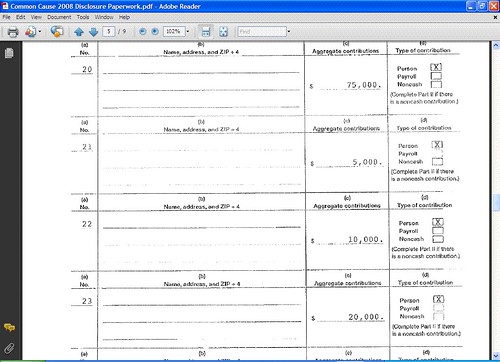
Leaving aside the fact that the Campaign Finance Board rejected the premise that Minnesota’s future did anything wrong, I’d like you to check this out.  It’s an excerpt from Page 4 of Common Cause’s 2008 IRS Form 990 – disclosures.

Can’t read the names?

Get used to it.  There are eight pages of donations, a total of 44 of them, totalling over $600,000.

For one year.

And not one name.

For a group that alleges itself to be all about “transparency in politics”.

The lesson from this?  Whenever “Common Cause” pops up in this state’s political discourse, they need to be pelted with rhetorical rocks and garbage.  They exist only as a front group for the DFL; they are fundamentally dishonest.

I’ve invited CCM “president” Mike Dean to appear on the Northern Alliance Radio Network to discuss his various charges, and defend CCM against the charge that they are lying to the people.  Repeatedly.  For almost three months.

I expect better from responsible adults with non-risible points of view.

Place your bets.

What A Difference Six Years Makes!

Tuesday, December 7th, 2010

Paul Schmelzer at the Mindy doesn’t address rumors that the Soros-supported “news” front is about to change its name to “Dump Bradlee Dean” – but he does give lots of Xs and Os to the new “loose mores blow up stores” campaigns at Walmart and the Mall:

Today Department of Homeland Security Secretary Janet Napolitano announced Walmart’s participation, according to a DHS press release. The nation’s largest retailer will have 230 stores participating immediately, with as many as 588 eventually taking part. The Mall of America’s participation was announced last week; it’ll be joined by “the American Hotel & Lodging Association, Amtrak, the Washington Metropolitan Area Transit Authority, sports and general aviation industries, and state and local fusion centers across the country.”

The expanded campaign, unveiled at a mall ceremony last week, will include print and video advertisements throughout the complex.

So – posting terror warnings in public places is good?

Well, now that it’s a Democrat!  Let’s go back a few years:

During the 2004 elections, Kiffmeyer made national headlines when she decided to post terrorist warning signs at polling places throughout Minnesota urging voters to be wary of people appearing at precincts with “shaved head[s] or short hair” who “smell of unusual herbal/flower water or perfume,” wear baggy clothing or appear to be whispering to themselves.

So when Janet Napolitano tells you to watch out for those crazy neighbors (especially if they’re tax protesters, second amendment people, pro-lifers or Tea Partiers, naturally), it’s a good thing, but when a Republican does it…

…well, we all know how it works, don’t we?

Chanting Points Memo: Tails, You Lose

Friday, December 3rd, 2010

In a bizarre perversion of Franklin D. Roosevelt’s inspirational platitude, the only thing today’s Minnesota DFL Party has to offer is fear itself.

The DFL (and its chanting points repeater blogs MNPublius, mnpACT and Minnesota “Progressive” Project, among others, not to mention the regional mainstream media) are tossing about the figure “$6.2 Billion” as the defict the next Administration and Legislature will need to deal with.

This, of course, is the first step in the Left’s big-government-through-fear playbook:

  1. Note a gap between planned spending and available revenue.
  2. Warn of the “Service” cuts involved in cutting planned spending.
  3. Ram that warning home with threats to gut police and fire departments, along with draconian cuts among teachers (while, mysteriously, leaving administators, pensions, convention and visitors bureaux, human rights offices and other such waste untouched) if politicians at all levels don’t raise the revenue needed by any means necessary – which means, inevitably, tax hikes.

As Tom Emmer pointed out over and over during his gubernatorial campaign, it was nonsense, of course.  The “budget” against which revenue left a “deficit” was not a “budget”, it was an “autopilot” adjustment of the existing budget based on increasing existing “services” by the amount the DFL-dominated bureaucracy says they’ll need to be increased.  It’s like setting a family budget according to your kids’ Christmas wish lists.

Gary Gross at LFR breaks it down (with emphasis added):

…what’s being called a $5,000,000,000 deficit is based on last biennium’s budget tails, which were wildly oversized vs. the projected revenue. According to the figure from the campaign trail, Minnesota is projected to take in almost $33,000,000,000 compared with $30,700,000,000 for the current biennium.

When omnibus spending bills are put together, the spreadsheet contains the amount that will be spent for that biennium and the amount that they’d like to spend in the next biennium. The second biennium request is called a budget tail. It’s what the MMB people are required to use for their budget projections. It isn’t something that must be spent.

The media don’t tell you this because – well, I’m not sure.  Maybe they figure that everyone is a government wonk and they already know all this. 

The DFL and its chanting-points-bots won’t you because, again, all they have to offer is fear.   And because an ignorant citizenry is a DFL citizenry.

It’s rare that they spend what the tails call for. In fact, the legislature can just as easily choose to spend significantly less. In fact, I suspect that’s what will happen, partially because Republicans have a number of reforms that will save significant amounts of money, starting with King Banaian’s reform to ZBB and Steve Gottwalt’s Healthy Minnesota Plan.

Those 2 reforms will save Minnesota taxpayers hundreds of millions of dollars this biennium.

Your mission this next month, before the next session (which starts on January 3, a month from today): when you hear your neighbors and co-workers worrying about “the six billion dollar deficit”, set them straight.  And tell them to call their Reps and Senators; the GOP ones need the encouragement to do the right thing; the DFL ones need to know that the long electoral knives of last autumn aren’t nearly done yet.

Sturdevant-In-Training

Friday, December 3rd, 2010

For as long as I’ve been reading the Strib, and certainly for longer than I’ve been writing this blog, Lori Sturdevant has been a relentlessly reliably-unquestioning voice for the DFL.

We’ll come back to that.

On Tuesday, I wrote about the Strib’s farewell hit piece against Tim Pawlenty – noting that he’d voted to pardon Jeremy Giefer.  Short story short, Giefer had knocked up his girlfriend back when he was 19 and she was 14.  He served a jail term, then married the girl and helped raise the baby and, a decade and a half after serving his time and – apparently – living clean, applied for and received a “pardon extraordinary” from a board including the Governor.

It turns out Giefer lied to the board; he’d been molesting another girl for quite some time even as he approached the board.  Inconceivably, he lied about it.

Now, Ryan Lyk at MDE notes something I’d mentioned obliquely in my piece on Monday:

The attack by the left on Pawlenty’s choice to pardon is an attack on Attorney General Lori Swanson, period. Though this seems to be one of those “hindsight is always 20/20″ moments, facts today conclude neither [the Govenor nor the Attorney General, nor the Chief Judge of the Supreme Court – the members of the panel] had the evidence they have today back then in order to make the correct decision. The DFL has decided to spin this issue until it dies; here’s hoping it does soon considering one of their own leaders was part of the consensus to pardon.

I looked back at original Strib piece.  I noticed two things.

First – nowhere in the piece is Attorney General Swanson mentioned.

Second – the piece is written by the Strib’s Pat Doyle, who seems to be taking over the “context-shaving, hit-writing” beat for the Strib.  He wrote the hit piece last summer over Emmer’s private-sector business and legal dealings, which we showed was so deprived of context as to be actively deceptive.

Is Pat Doyle becoming the Strib’s designated DFL hit man?

And is he bucking for Lori Sturdevant’s seat, one day, as the in-house DFL shill?

From The Case Files Of Sean Cohen, Police Shrink

Thursday, December 2nd, 2010

It was 0430 on a Sunday.  I got paged down to Central Holding by Sergeant O’Hanrahan, from Street Crimes, about a 5150 – possible psych case – they were holding for me.  He didn’t have a lot to go by.  I got out of bed without disturbing the floozy I’d brought back from Alary’s last night, and drove down to Central.

I’d worked with O’Hanrahan years earlier, when we’d worked the crimes against literature beat together, so he recognized me.

“Hey, Sean”.

“Hey, Paddy. What’s up?”

“He’s in the isolation cell.  Follow me, and I’ll catch ya up”. 

We walked down the hall, our ears subconsciously blocking out the bedlam of an inner-city police station early on a Sunday morning.

“We got this guy – caucasian male, age 55.  Name on his DL was “Scotty Wombee”.  Arrested around 11PM for walking up to his neighbors and holding a video camera down by his groin and demanding that they…” he ruffled through the arresting officer’s notes “…touch, stroke and kiss his video camera”. 

I’d seen a lot of sick stuff in my hears as a police shrink.  Stuff that’d make a billy boat puke.  This was no great shakes.

“Wow.  About as subtle as a drag queen at a NASCAR race.  Anything else?”

“Yeah” O’Hanrahan said, “even though he was born and raised in Coon Rapids, he did his whole spiel in a German accent”. 

Hmm, I thought.  Don’t see many of those anymore.

O’Hanrahan and I walked to the control desk.  Sergeant Fitzpatrick was on the desk. 

“Hey, Seamus”, I said, nodding my head.  I’d known Fitz years ago, when we both worked the Political Vice detail.

“Hey, Lieutenant”, he nodded back.  “Here to see that Wombee character?”

“Yeah”.

“Whooie.  He’s a piece of work.  All the way back to the station, he kept asking Officers Kelly and O’McMurphy what they were compensating for with ‘za gunz and za handcuffz'”, he said, rolling his eyes.

“Open up Number Six for Lieutenant Cohen”, O’Halloran said, as I signed my roscoe over to Fitzpatrick.

———-

Wombee was about five foot nine, with thick brown hair and ferret-like eyes darting back and forth as he lounged on the chair in the isolation cell. 

“Hello”, I said.  “I’m Sean Cohen”.

Wombee looked me over as I sat.  “Inderezting dot you vould zay zat”, he said, sounding a little like a John Banner impersonator at a “Hogan’s Heroes” fan club convention.  “Vy do you hate your mozzah?”

“I don’t”, I said.  “So what do you do for a living?”

He leapt to his feat and clicked the heels of his worn Adidas together.  “I am a zhurnalizt!”

“A journalist?”

Jawohl!”

“OK, what do you do for your other living?”

He sat back down and and affected a studied gaze.  “I am a lizenzed ah-kee-tekt”.

“Ah”‘  I riffled through the case notes.  “So the officers who picked you up said you were acting…inappropriately with your neighbors.  You even scared some of the kids”.

“I am a Zhurnalizt.  I zeek only za truze”, he said, pantomiming taking a pipe from between his teeth.

“Right, but why do what you did?”

“I AM A ZHURNALIZT!”, he bellowed, leaping to his feet.

“Right, I got that, you’re a journalist”.  Napoleon, Christ, journalists, Julius Caesar – I’d seen ’em all.  “But why?”

He sat back down, slowly, his eyes taking on that faint glow that I’d seen from so many 5150s; like they’re looking at you, but focusing on something 1000 yards the other side of you.

“I vuz making people avare of zat Legislator zat vaz in ze news”.

“Ah.  OK.  What about him?”

He looked around, and furtively whispered “he hed a gun“.

“Yeah?  And what about the gun made you walk around the neighborhood and, er, do what you did…”

He looked at me, focusing sharply, the way they do when they’re about to make a point they consider too self-evident for other people to miss.  He whispered furtivley:

“He iz kompenzating for somezing”.

“Yeah?”  What?”

He looked taken aback.

“You know – compenzating“. 

“Yep, I heard you.  Compensating for what?”

“Heh.  Everyboddy knows vot zey are compenzating for”.

“Not me.  What?”

“Hah!  For a lack of ze schlong!”

“Right.  And you know this precisely how?”

He leapt to his feet, face suddenly purple with rage.  “EVERYBODY KNOWS IT!  YOU MUST NOT QUESTION EVERYBODY!”.  He’d lost the German accent.

I sat back in my chair.  “OK.  Got it”. 

“EVERYBODY!  EVERYBODY KNOWS IT!  EVERYONE!”

“Right”. 

I turned and knocked on the two-way mirror.  O’Hanrahan walked in. 

“We’ve got a 10-569” – police code for “narcissistic personality disorder with delusions of grandeur and a tendency to reduce all personally-incongruent reality into facile stereotypes”.  Not uncommon, these days. 

I continued “I think he’ll need five milligrans of Nembutol to cool him down and get him through the night in lockup, and perhaps tomorrow we can work on something a little longer-lasting…”

O’Halloran pulled his taser and fired it at Wombee, who dropped to the ground, screaming..

“That’ll do, too”, I mumbled as I walked back to the desk, the faint odor of urine piercing the chilly, concrete-laced air. 

There are a million stories in the naked city.  Me?  I’m just walking my metaphorical beat, trying to get some underwear onto some of them.

Our Extremist Overlords

Thursday, December 2nd, 2010

Just you remember when any liberal calls any conservative “extremist” for any reason short of, y’know, showing actual extremist activity, that these are the people the DFL is running for office:

Minnesota Secretary of State Mark Ritchie is regarded as a “non-party friend” by the Communist Party USA.

So highly does the Communist Party regard Mr. Ritchie, that he has been allowed to attend an high level “not to be publicized” Party meeting in Minneapolis.

Remember the fit the left threw over Todd Palin’s flirtation with a group that advocated – academically – Alaskan secession?:

Ritchie and three of the Communists had just returned from the “Battle in Seattle” – the mass riots that broke out around the World Trade Organization meeting in that city.

Though he was an official U.S. delegate to the W.T.O. meeting, Ritchie gloats that the rioting and protests “stopped the WTO,” and that “It is a tremendous victory”.

I’m not the first to run this story.  But apparently the regional media was too busy digging through Tom Emmer’s resume to bother with Mark Ritchie’s past.

Especially his past with groups that enshrine the ideal that the ends justify the means.

(Via the Random Candice, who really needs to attend the next MOB party)

Sheep…skin. Yep. That’s It.

Wednesday, December 1st, 2010

Any time anyone tells you that a Harvard degree immunizes the bearer from complete idiocy, make them read this.

Yeah, it’s worse than this.

The Straw Candidate

Tuesday, November 30th, 2010

Back during the 2008 campaign, I noted one of the immutable truths of American politics; the only reason the institutional left ever builds up a Republican candidate is to tear them right back down.

The classic example, of course, was John McCain; the left spent the better part of a decade solemnly declaring that “McCain is the good Republican”, willing to “compromise”  – praise that Mac curried aggressively.  But once Mac became an endorsed candidate, the knives came out; the “moderate”, “post-partisan” McCain was suddenly – and had always been – an “extremist”.

Is the left trying to set up Sarah Palin in the same way?

Noel Sheppard at Newsbusters has a theory:

Would you ever in your wildest dreams imagine Chris Matthews flatteringly comparing Sarah Palin to former President Bill Clinton?

During a lengthy opening segment about Palin’s political future on the syndicated program bearing his name, Matthews said, “There’s one unlikely Democrat you might compare to Sarah Palin when it comes to being a natural: the generally incomparable Bill Clinton”

And why would Tingly do that?

After all, it’s got to be one way or the other: media live to build people up and/or knock them down. We’ve grown so accustomed to the latter with their treatment of Palin that we haven’t considered the alternative.

Of course, this could all backfire miserably since the more attention they heap on Palin, the more folks currently with a negative opinion of her might change their minds.

It’s a little early to speculate about 2012.

But not about the left and media’s (pardon the redundancy) manipulation of public opinion…

Death By A Thousand Twerps

Monday, November 29th, 2010

If I were the President of Harvard University, I might wanna have a word with Matt Yglesias.

Matt – a prominent leftyblogger who’s gone on to write for a bunch of liberal rags – has a BA from Harvard.  Like a lot of leftybloggers, he profited from the leftyblog audience’s hive mentality and got promoted far beyond even his Peter Principle value, to say nothing of his actual perception.

And it’s gotta be undercutting the value of that expensive Harvard sheepskin.  Especially when he’s writing bilge like this, about planning ahead for the new GOP majority in Congress:

But the specific thing I would worry about isn’t gutting of health care legislation or endless investigations. It’s the economy. Anne Kornblut reports that the White House understands the basic political dynamic: “Even more important, senior administration officials said, Obama will need to oversee tangible improvements in the economy.”

So I know that tangible improvements in the economy are key to Obama’s re-election chances. And Douglas Hibbs knows that it’s key. And senior administration officials know that its key. So is it so unreasonable to think that Mitch McConnell and John Boehner may also know that it’s key? That rank and file Republicans know that it’s key? McConnell has clarified that his key goal in the Senate is to cause Barack Obama to lose in 2012 which if McConnell understands the situation correctly means doing everything in his power to reduce economic growth. Boehner has distanced himself from this theory, but many members of his caucus may agree with McConnell.

And Yglesias’ conclusion (emphasis added)?

Which is just to say that specifically the White House needs to be prepared not just for rough political tactics from the opposition (what else is new?) but for a true worst case scenario of deliberate economic sabotage.

Truly, truly dreadful.

The left; not only do they believe their ends justify their means, they believe everyone else believes it too.

Circumstantial

Friday, November 26th, 2010

Some of my liberal readers have been asking what I think about the Tom Hackbarth story.

My response; I can’t think much, since there’s really not much story. KSTP-TV’s piece reads, pretty much in its entirely:

State Rep. Tom Hackbarth was carrying a pistol when he told St. Paul Police he was jealous and looking for his girlfriend.

Officers took the gun from him calling his behavior “borderline terroristic.”

We’ll come back to what the police said and, more importantly, did.

The House GOP leadership reacted quickly and, under the circumstances, appropriately, suspending Hackbarth from his slated committee chairmanship for the next sessoin pending some sort of resolution.

Now, predictably, the regional leftymedia is in full dudgeon over this story.  As is their wont, they are filling in the blanks with a whoooole lot of innuendo, supposition, and flat-out fantasy.

As PJ O’Rourke once said, “I’m not a liberal, so I’m not an expert at stuff I know nothing about”.   I’m not going to pretend to have answers.  Indeed, all I have are questions.

Everything Is Stalking:  The accusations against Hackbarth aren’t all that clear; he was accused of “stalking-like” behavior by the always-articulate Saint Paul Police Department.  No charges have been filed.

That last bit is rather vital; no charges have been filed.

Remember – in the world of domestic law, including “abuse”, “domestic violence”, “stalking” and the like, men are considered guilty until proven innocent.  If the police had had anything beyond suspicion, they’d have come up with something.

Was Hackbarth doing something inappropriate?  It’s possible.  Very, very possible.  Hackbarth is separated, after 25 years of marriage.  Being “separated” is an emotional Cuisinart set on “mangle”;  a lot of hitherto-buried emotions run very close to the surface; people do things that they’d never normally do in real life (and I’m pleading the Fifth Amendment at this point).

So what did Hackbarth do?  We don’t know; not at all, other than “not enough for the SPPD to charge him with anything at all“, but apparently enough to draw their interest.  We’ll come back to that, too.

That complete lack of known facts hasn’t stopped the regional leftyblog brain trust from jumping to conclusions like a bunch of synchronized Shamu clones at a rhetorical Sea World.

Conservatives – Guilty Until Proven Anything At All:  The City Pages’ Hart Van Denburg gets the “who, what (sort of), when, where, why and how”, in his piece on the incident – and still manages to squeedge in some innuendo to fill in the factual blanks:

Republican state Rep. Tom Hackbarth went looking for a date the other day in a Highland Park alley, with his Smith and Wesson .38 strapped to his waist.

Innuendo; as Ven Denburg himself notes elsewhere in his story, Hackbarth has a carry permit.  Connecting his “stalking” and carrying a gun is convenient, and connecting the two certainly fits the institutional left’s narrative about conservatives, shooters and social interactions.  But it’s an innuendo unsupported by any actual facts – like, say, arrests or charges or any indication of intent that’d link the two factoids.

Which takes us to innuendo number 2:

The Most Important Right Of All:  Van Denburg continued:

He chose an odd place to park his pickup truck, too: The Planned Parenthood clinic lot, where security cameras caught him on tape.

Saint Paul’s pro-abortion community has come to regard all of Ford Parkway as its private property.  While the building itself doesn’t jump out at you, once you do know what you’re looking for, it’s hard to escape the fact that there is more going on in the neighborhood than just a baby-disposal mill.  There are apartments, stores, the Highland Park library, houses…people all over the place.  Ford Parkway is not all about Planned Parenthood.

But you’d never know that from the leftymedia’s reaction.  Was “near the Planned Parenthood Clinic” an “odd” place to park, as Ven Denburg called it?  Or was it a place to park his pickup, that happened to be near Planned Parenthood?

A justifiably skittish guard at the Ford Parkway clinic called the cops to report an unidentified man carrying a gun on the property. No surprise there.

More innuendo.  “Justifiably” skittish?  Planned Parenthood’s “justifiable” skittishness has led to a “justifiable” suspension of large chunks of the First Amendment within eye-and-earshot of the clinics in Saint Paul and elsewhere around the country.  And now, apparently, the Second Amendment as well; being seen with a firearm that is legal and permitted under Minnesota law “justifies” Planned Parenthood’s rent-a-cops calling in the heat?

What other civil liberties does Planned Parenthood get to selectively excise?

Worse, naturally, are the “Feminist” bloggers.  “Red Sonya” from the always-incontinent Shakespeare’s Sister tries Hackbarth and finds him guilty based on…well, you guessed it, more innuendo:

Who the hell decides that, after meeting someone for coffee, you are immediately entitled—nay, obligated—to make sure that she’s not with another man?! Oh, stalkery entitled douchebags with unchecked privilege and no sense of boundaries who believe that women are their property and have no respect for their autonomy, that’s who!

Perhaps.

Or people (male and female – it swings both ways pretty equally) whose senses of boundaries are temporarily (one hopes) warped by their current circumstances.

Or both.  We don’t know – because “Red’s” take is based entirely on filling in the factual blanks with a whole lot of PC filler.

While stalking is frightening enough, the loaded gun makes this even scarier. Hackbarth does have a permit for concealed carry, so his actions weren’t illegal.

Buuuuuuut…

But since he began his controlling behavior immediately after meeting this woman, I’m skeptical of his ability to shrug off this event—and, from his twisted perspective, her “lie”—without having a douchetantrum of massive proportions.

What a wonderful world, where people can issue the binding diagnosis of “douchetantrumitis” (let me check the DSM-IV for that one) while knowing zero facts whatsoever.

When guys like this escalate, altercations easily become fatal with the addition of a loaded gun to the mix.

And they much more easily don’t.

Look – it goes without saying that stalking – or even just being excessively clingy after less than a whole lot of dates – is a bad thing.  And it doesn’t excuse any bad behavior to add “don’t discount the weirdness that comes with the whole emtional bumper-car ride that goes along with divorce, because everyone reacts differently, and most everyone does something that they’ll wind up regretting one way or another, whether it’s getting married to the first person you sleep with or blowing all your money on strippers maybe just having a real hard time getting used to the differing expectations people have in the dating world after being off the market for most of three decades”.   Readjusting to single life can be a real bitch.

[Side note to conservative grownups in the audience; watch some idiot leftyblogger take that last sentence and run a post entitled “Berg Excuses Stalking”, ignoring that bit at the front where I said “It doesn’t excuse bad behavior…”.  It’s pretty much inevitable – Ed.]

The Victorian Vapours:  Oh, yeah – Hackbarth had a gun.  After his run-in with the SPPD, it was confiscated.  And then, after all was said and done, he got it back.

But the presence of a firearm – especially in the hands of a conservative, anti-abortion Republican who is engaged in liberal innuendo-fodder – acts on leftybloggers and lefty journalists like a green-and-yellow cape does on a Vikings fan.

The normally sensible David Brauer left a comment in a Facebook thread:

[O]f course, it seems like creepy potentially violent stalking, but then again, these gun dudes carry their pieces around everywhere. it’s like their wallet. and of course, he was in scary, scary Highland. It’s no Cedar, Mn!

Well, doy.  It doesn’t do you any good if you don’t have it with you when you need it.

And check out the leftyblogs (rhetorically, mind you – don’t actually read then) for the number of references to the fact that the revolver was “fully loaded”.   Huh?  You’d carry an empty gun?  To what – butt-whip a robber?  Or a half-loaded one?  For what – impromptu games of Russian Roulette?

Grrr. I’m sorry.  Dumb people bug me.

Oh, yeah – let me reiterate; he got the gun back when the episode was over.  Which may not be any sort of testimony to Hackbarth’s alleged actions or state of mind, but it is a pretty good sign that he did nothing remotely illegal – and that’d be in an area of law where telling a woman that those pants do make her butt look bigger is fifth-degree domestic assault, a misdemeanor punishable by a year in jail and a $10K fine.

(The above sentence is intended as satire.  The first idiot leftyblogger – and I’ll stipulate that that isn’t entirely a redundant phrase – that tries to run that into “Berg advocates stalking and makes light of domestic violence” will both incur my disinterested wrath and be lying, anyway.  Just don’t go there).

Berg’s Seventh Law?Remember – “When a Liberal issues a group defamation or assault on conservatives’ ethics, character or respect for liberty, they are at best projecting, and at worst drawing attention away from their own misdeeds”.  The leftymedia is romping and playing with the Hackbarth story because somewhere out there there is a video of a DFL legislator standing outside an elementary school in full S&M garb, bellowing expletives at a first-grade teacher that spurned his advances, waving a katana.

No, I can’t prove it.

Any more than any of the innuendoids above can prove any of their stuff.

But it’s a law, after all.

UPDATE: Welcome, “Developers are Crabgrass” readers.

Which is sort of like saying “hey, look at all the leptons”.  Both of them are at present largely hypothetical, abstruse constructs.

Oh, yeah – read my piece above.  Zaetsch is lying, as usual.  The guy wouldn’t know “factual” if “factual” spiked his Metamucil.  Read my actual post – something Zaetsch, or whomever sent him the link, clearly didn’t do – and decide for yourself.

Better yet, leave a comment and engage in the discussion.  If you’re used to the level of conversation over at all the blogs that are part of the “Stillwater Asylum” – “Lloydletta”, “The Dump”, “Crabgrass” and wherever Bremer is ranting and whatever pseudonym Weiner us using these days – you’ll find things are a whooooole lot more rational here; you have to bring some intellectual game, in a way you’re not used to .  Give it a shot!

Foxes: “Relax, Hens”

Wednesday, November 24th, 2010

According to the Strib, Voter ID is just not needed

…according to a survey of people who’d have to work harder if it were implemented…

…conducted by two groups that benefit from inflated vote counts.

Minnesota does not need a law requiring photo identification at the polls because there have been relatively few cases of ineligible voting, two advocacy groups said Monday.

Citing data collected from county attorneys from the 2008 election, the two groups said that there were 26 convictions statewide of felons voting illegally – a figure representing 0.0009 percent of voters that year.

It’s a figure that also represents investigations in Ramsey, and only Ramsey, County.  The only county for which the Minnesota has done the County Attorneys’ jobs by doing all the investigating for them.

Allegations of felons voting represented 77 percent of voter fraud investigations, the groups said. The other 23 percent of the investigations from the 2008 election – which did not lead to any convictions – involved charges of non-citizens voting, double voting, voting outside of jurisdiction and impersonating a voter, the groups said.

Right.  That’s because under Minnesota law, pleading ignorance of the law is enough to get you acquitted.  Only paroled felons have to sign a form stating they know they’re not supposed to vote.

The study was conducted by Citizens for Election Integrity Minnesota and the Minnesota Unitarian Universalist Social Justice Alliance. The groups said the study was based on responses from 71 of the state’s 87 counties.

The “Center for Election Integrity of Minnesota“?  Sure sounds like an important group!

The Strib doesn’t see fit to mention that “CEIMN” is an offshoot of “non-partisan” liberal pressure group “Common Cause MN” (check out CC of MN’s and CEIMN’s addresses), whose motto is “Holding Power Accountable”, and which spent the 2010 election demanding accountability of conservative groups while ignoring the rafts of liberal special interest money.  They favor rationing speech to regular Americans, but exaggerating the influence of unions and liberal special interests.

One wonders if Strib reporter Mike Kaszuba didn’t feel this was relevant, or if he just didn’t know.

The Great Poll Scam, Part VI: The Hay They Make

Monday, November 22nd, 2010

We’ve been discussing the MPR/Humphrey Institute and Minnesota polls for the past two weeks.  Indeed, it’s been one of the ongoing “go to” subjects of this blog for almost eight years now.

Why?

Because while  the polls themselves are risible, they have an effect on elections in Minnesota.

Part of it is in terms of people – “undecided”, “independent” voters – going to the polls at all.  I’ve related on this blog several stories of people who’ve pondered not going to the polls this past year.  Part of it was  because of the overwhelming negativity about Tom Emmer portrayed by the media – negativity, partly driven by the “Alliance For A Better Minnesota’s long, Dayton-family-funded, largely dubiously-factual smear campaign, but pushed hard in the media via the “polling” that they, themselves, commissioned.

Larry Jacobs at the Hubert H. Humphrey (HHH) Institute is the most over-quoted person in the Twin Cities media.  And during the campaign, Jacobs was seen as relentlessly as always in the Twin Cities media, flogging the Humphrey Institute’s polling first during the primaries (where the HHH’s polls showed Dayton with a crushing lead even though Dayton won the primaries by a margin not a whole lot bigger than the one we currently have in the governor’s race) and, finally, during the run-up to the election when the HHH poll showed Dayton winning with a 12 point blowout.

We’re still working on the recount for the 0.4% race.

Jacobs defended the poll (quoted in LFR):

JACOBS: Well, you know, a poll is nothing more than a snapshot in time. We’ve begun the interviewing nearly 2 weeks before election day. Barack Obama visited and we talked openly about the fact that this would likely change. There are, of course, all kinds of other factors that happened at the end, including the fact the almost 1 out of 5 undecided voters in our poll started to make up their mind.

The other thing to remember is that there were alot of other polls being conducted that showed the race closing at the time, something we were watching at the time, also.

That’s right, Dr. Jacobs.  There were a lot of other polls.

And except for the HHH and Minnesota polls, all of them showed a “snapshot in time” that was something close to the reality that eventually emerged on election day.

All of them.

So what?

Because opinion polling has an inordinate effect on media coverage and, less directly, the money and effort that people put into campaigns.

As to the media?  The New York Times has absorbed Nate Silver’s “Five Thirty Eight” stats-blog for its election polling coverage.  And throughout the race, the Times ran with the idea that Dayton was overwhelmingly likely to win.

And that supposition was based entirely on a statistical tabulation of opinion poll results.  And the stats were heavily based on the Minnesota and Humphrey polls, especially through the middle of the race, when the tone of the campaign was being set.  All together, the crunching of the opinion poll numbers led Silver to claim the stats showed Minnesota would be a convincing 6.6 point victory for Dayton; since political statistics are an essentially weaselly “science”, Silver also ran with an eight point margin of error.

Naturally, the media ran with the 6.6 points; a little less with the margin of error.

Now, there’s some media attention – the Minnpost, the City Pages – to the ludicrous nature of the polls.  Jacobs:

“If a shortcoming is identified, we will fix it. If not, we will have third-party verification that our methods are sound.”

Dr. Jacobs:  take it from this third party; it’s flawed.  Flawed to the point of illegitimacy.

More on the Minnesota Poll later…

———-

\The series so far:

Monday, 11/8: Introduction.

Wednesday, 11/10: Polling Minnesota – The sixty-six year history of the Strib’s Minnesota Poll. It offers some surprises.

Friday, 11/12: Daves, Goliath:  Rob Daves ran the Minnesota Poll from 1987 ’til 2007.  And the statistics during that era have a certain…consistency?

Monday, 11/15: Hubert, You Magnificent Bastard, I Read Your Numbers!:  The Humphrey Institute has been polling Minnesota for six years, now.  And the results are…interesting.  In the classic Hindi sense of the term.

Wednesday, 11/17: Close Shaves: Close races are the most interesting.  For everyone.  Including you, if you’re reading this series.

Monday, 11/22: The Hay They Make: So what does the media and the Twin Cities political establishment do with these numbers?

Wednesday, 11/24: A Million’s A Crowd:  Attention, statisticians:  Raw data!  Suitable for cloudsourcing!

The Great Poll Scam, Part V: Close Shaves

Wednesday, November 17th, 2010

It’s almost become a cliche, among conservative observers of Minnesota elections.  You’re supporting a Republican.  You know the race is close.  You can feel the race is close.

And the final Humprhey and Minnesota polls come out, and the DFLer leads by an utterly absurd margin – like this year’s Humphrey Institute Poll, which showed a 12 point race…

…which, two days later, came in a statistical dead heat, with much less than half a point separating the two candidates.

And yet the Minnesota and Humphrey Institute polls have their defenders.

———-

Remember the 2006 Senate race?  Mark Kennedy vs. Amy Klobuchar?

The Minnesota poll did pretty well, all in all.  The final Minnesota poll showed Mark Kennedy getting 34 points, to Amy Klobuchar’s 55.  The race ended up being 58.06 to just shy of 38.    The Minnesota poll showed both candidates doing a little worse than they eventually wound up doing – Klobuchar a little worse, in fact.

Defenders of the Minnesota Poll – media people and lefty pundits – chimed in.  “See?  The Minnesota poll is OK” or at the very least “The Minnesota Poll is an equal-opportunity incompetent”.

But if you’re a cynic – and when it comes to the Minnesota and Humphrey Polls, I most certainly am – the answer there is obvious; if you accept that the polls exist to help one party or another out of close jams (and let’s just say I think there’s a case to be made), then the real question is “how do the polls stack up when it really counts – during the close elections?

I took a look at the Minnesota poll’s history with close races – Gubernatorial, Presidential and Senate races that ended up less than five points apart – over the past 66 years.   Since 1944 in these races – twenty of them – the DFL ended up getting 47.69% to the GOP’s 47.57% in the final elections.  The Minnesota Poll has shown the DFL getting 44.3% to 43.28% in the final pre-election poll.  Both numbers are very close, of course.  The Minnesota Poll has underrepresented Republicans by an average of 4.3 points, the DFL by 3.39.  So while the poll underrepresented Republicans in 14 of 20 races, it was by less than a point, on average.

But that’s over 66 years.  And if you recall from episode 1 of this series, the Minnesota Poll used to systematically undercount the DFL.  But long story short – looking at the poll’s entire history, things are fairly close.

When you look at the Rob Daves era at the Minnesota poll, though, things change.

In close races (<5 point final difference) during the Rob Daves era, the GOP has actually gotten a slightly higher average vote total – 46.77% to 46.48% – in actual elections.  But the final Minnesota Poll has shown the DFL outpolling the GOP 43.33% to 40.78%.    Republicans come up an average of six points light in the final Minnesota Poll before the election, with DFLer finishing a little over three points short – nearly a 2-1 margin in underrepresentation.

In other words, in close races the Minnesota Poll has shown the GOP doing six points worse than they actually did, compared to three points for the DFL.  And the average Minnesota Poll has shown the DFL leading the GOP, when in fact the races have been mixed, with move Republican winners than in the previous 20-odd years of Minnesota history.

If you are an idealist, you could think that  it’s just a statistical anomaly.  To which the cynic notes that of eight close races, the GOP has been undercounted by less than the DFL exactly once.

The cynic might continue that it’s entirely possible that the Minnesota Poll doesn’t systematically short Republicans in close elections.  But given that the poll shorts Republicans in races that end up less than five points apart by an average of considerablymore than five points, the cynic would ask “if the Minnesota Poll were designed to keep Republicans home from the polls out of pure discouragement, how would it be any different than what we have now?”

Well, it could look like the Humphrey Poll.

Because the Humprey Poll is worse.  Granted, it’s a smaller sample size – there’ve been four “close” races (2004 Presidential, and the 2006 Governor,  2008 Senate and 2010 Governor races, which were/are very close indeed).

But in those race, the DFL won by an average of 45.43% to 44.7% (most of the gap coming from the four-point 2004 Presidental race; the other three had/have tallies within a point in difference).   But the final HHH poll showed the DFL/Democratic candidate winning by an average of seven points – 42.5 to 35.75%.  The DFL, is underrepresented in the HHH’s final pre-election poll by just a shade under three points; GOP is underpolls its real-life results by an average of almost nine points.

It’s possible that this is an honest error.  It is possible that the Humphrey Institute really, really believes that they have a likely voter model that accurately reflects Minnesota.  Perhaps it even does; maybe Minnesota really is a land of people who answer “DFL” on polls but come racing over to the GOP on election day.  But again – if the Humphrey Institute intended to help the DFL and keep Republicans home, it’s hard to see what they’d do differently.

Especially given the media’s reaction to these polls.

More on Friday.

———-

The series so far:

Monday, 11/8: Introduction.

Wednesday, 11/10: Polling Minnesota – The sixty-six year history of the Strib’s Minnesota Poll. It offers some surprises.

Friday, 11/12: Daves, Goliath:  Rob Daves ran the Minnesota Poll from 1987 ’til 2007.  And the statistics during that era have a certain…consistency?

Monday, 11/15: Hubert, You Magnificent Bastard, I Read Your Numbers!:  The Humphrey Institute has been polling Minnesota for six years, now.  And the results are…interesting.  In the classic Hindi sense of the term.

Wednesday, 11/17: Close Shaves: Close races are the most interesting.  For everyone.  Including you, if you’re reading this series.

Friday, 11/19: The Hay They Make: So what does the media and the Twin Cities political establishment do with these numbers?

Monday, 11/22: A Million’s A Crowd:  Attention, statisticians:  Raw data!  Suitable for cloudsourcing!

Truthy

Tuesday, November 16th, 2010

Joel Rosenberg – firearms instsructor to the stars – has been involved in an ongoing kerfuffle with the City of Minneapolis.  And when I say “kerfuffle”, I mean “series of intricately interlocking kerfuffles” complex enough to warrant a book of their own (which one might expect Rosenberg, a science fiction writer with a long bibliography, to be working on).

Last month, he got into a kerfuffle – I guess it’d be a “sub-kerfuffle” in this case – with Minneapolis Police Department Sergeant William Palmer when he went to a pre-arranged interview with Palmer at the MPD headquarters.  He was carrying a number of handguns openly.

Here’s the video of the event (most of the action is right up front):

Now, “Erin Carlyle” at the City Pages – former alt-journalism powerhouse, now a glorified small-college newspaper – ht tackles the story in a way that’d do the late Twin Cities Reader’s Margarete Grebe proud in terms of pure incurious superfluity.

Because besides the names of the people involved and the location of the incident, Carlyle gets pretty much everything wrong:

Joel Rosenberg tried to bring a gun into the Minneapolis Police headquarters and the cops wouldn’t let him.

Now Rosenberg is accusing the cop who took his gun of assault.

Er, yeah. We’ll come back to that.

Earlier this month, Rosenberg, who says he is ascience fiction writerand handgun instructor,

…which is something he “says” because he is a sci-fi author of some renown, and one of the state’s leading handgun instructors – including mine.

paid a visit to the MPD chief’s office to pick up some documents he’d requested. Sgt. William Palmer, the public information officer, saw that Rosenberg was packing, and asked him to dump the gun. Rosenberg refused. He insisted he had the right to wear his gun.

Palmer explained that a court order prevented him from carrying the gun. Rosenberg disagreed.

So Palmer physically took the gun away from Rosenberg and unloaded the cartridge. He handed it back when Rosenberg agreed to put the gun in his car.

And if you left it right there, it’d seem like a Catskills comedian’s joke; “A cop and a gun nut walk into the lobby of the cop shop…”

But Ms. Carlyle didn’t apparently see fit to report that Rosenberg’s “accusation” resulted in Rosenberg walking away from the event scot-free, but Palmer looking at potential legal nastiness

Ms. Carlyle apparently either didn’t bother to check that out, or think it was important for her smug, cossetted, know-it-all liberal audience to know it.

What’s the rest of the story? 

More tomorrow in Shot In The Dark.

--> Site Meter -->