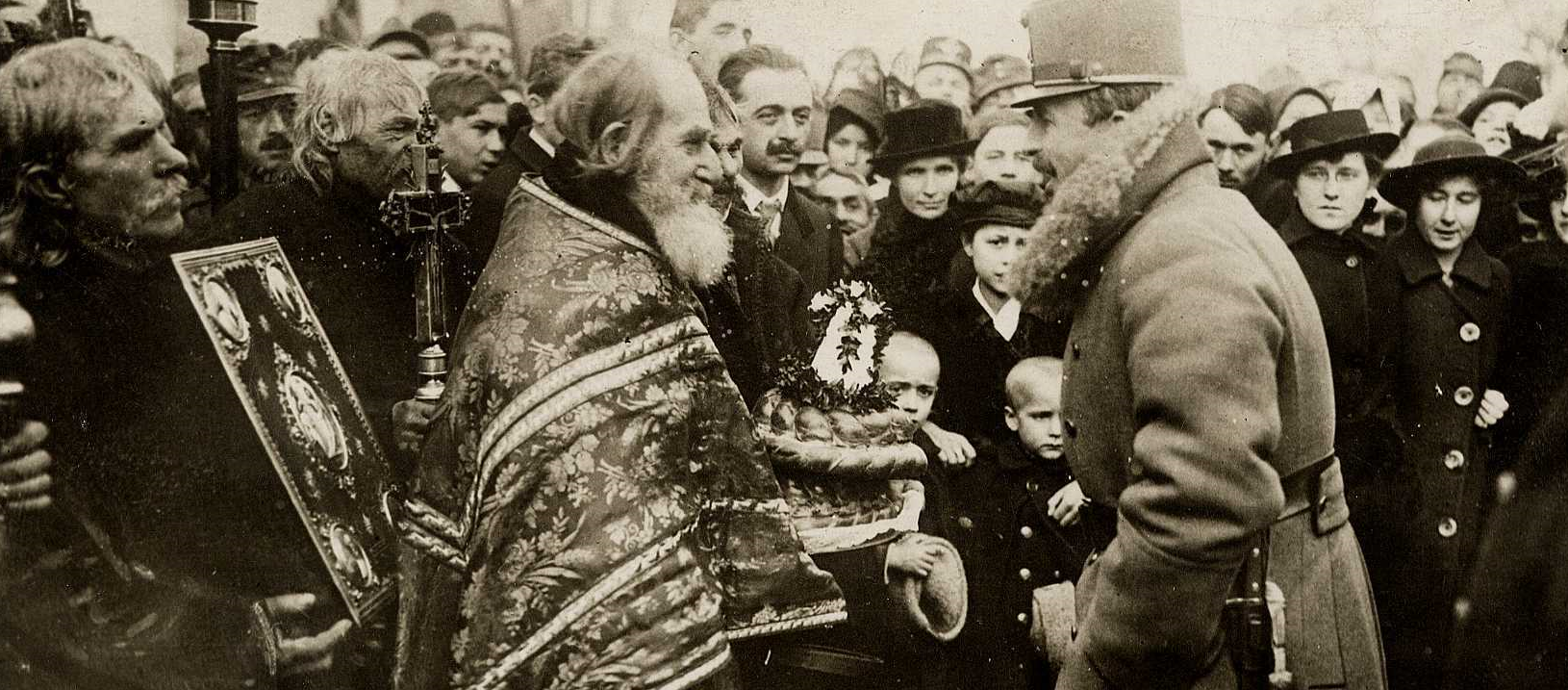
I dislike federal holidays as partisan political propaganda but I’m rethinking my position. I’m willing to support Juneteenth, if this becomes the official advertising poster.
It gets better.
After the Yanks freed the last of those slaves, a number of black freedmen who’d served in the Federal army settled in Galveston, bringing their training, and guns, with them.
So when the Klan came a-calling, they were met by a bunch of battle-hardened former Union grunts. They sent the Klan reeling…
…all the way to Austin. Where they pushed the Democrat government to ban guns in the hands of Negroes.
Litigation over which (thanks, NRA) went on to become one of the driving bodies of litigation behind the Equal Protection Clause of the 14th Amendment.
By the standards of the Great War, the Turkish army that was encamped near Sardarabad in Eastern Armenia was an after-thought. 13,000 Turkish and Kurdish soldiers, with 40 pieces of heavy artillery (albeit many outdated cannons), sat waiting to continue the Ottoman Empire’s invasion of the rapidly disintegrating Transcaucasian Democratic Federative Republic on May 21st, 1918. With the Treaty of Brest-Litovsk having effectively broken up the Russian Empire, the fate of the Caucasus lay in a state of political flux, with the Turks, Bolsheviks, Armenians, Azerbaijanis, Georgians and even Germans vying for a measure of control of the oil-rich region. The political vacuum had emboldened the Turks to invade and the fledging Transcaucasian Republic lacked the resources – and political will – to challenge it. By May of 1918, most of Western Armenia had been conquered and Eastern Armenia looked ripe to fall as well.
The call to defend what remained of Armenia echoed throughout the countryside. “Carts drawn by oxen, water buffalo, and cows jammed the roads bringing food, provisions, ammunition, and volunteers” as thousands of Armenians rallied at the capitol of Yerevan. For the civilians of Yerevan, defeat would not just mean a loss of political independence but very likely the loss of their lives. The Turkish invasion had continued the Ottoman policy of Armenian genocide which had already claimed up to 1.5 million Armenian lives. For in the words of one British historian, if the Armenians failed to stop the Ottoman invasion “it is perfectly possible that the word Armenia would have henceforth denoted only an antique geographical term.”
The remains of Armenian victims
“Who, after all, speaks today of the annihilation of the Armenians?” – Adolf Hitler
The fate of the Armenian people had been part-and-parcel of Europe’s general concern of the treatment of Christian minorities within the Ottoman Empire since the mid-19th Century. Having defended the Ottomans against the Russians, including fighting for the Turks in the Crimean War, Britain and France began to question the relative wisdom of propping up a regime in Constantinople that so plainly repressed the rights of fellow Christians. As subsequent revolts occurred throughout the Ottoman Empire, freeing Christian populations like the Serbs and Greeks, while prompting even greater restrictions and cruelties from the Turks in response, Western Europe began applying pressure to the Ottomans lest they lose support in their wars against the Tsar. (more…)
The rail station at Chelyabinsk in the Ural Mountains was busy on May 14th, 1918. With the Treaty of Brest-Litovsk recently signed, hundreds of thousands of Central Powers POWs were being transferred back to their home countries. Amid the thousands of Hungarian troops awaiting their westbound trains at Chelyabinsk were a different assortment of soldiers, trying to travel the opposite direction – the men of the Allied-aligned Czechoslovak Legion.
The 40,000 men of the Czechoslovak Legion had been fighting for the Russians just months earlier and with the fall of the Tsar and then the Provisional Government, were now looking for a way to get to France to continue their fight for independence from the Dual Monarchy. But with every major Russian port in the West blocked by the Central Powers, the Legion had little choice but to make the arduous journey eastbound to the Siberian port of Vladivostok where they could board Allied ships for yet another lengthy trip to Europe. Having 40,000 armed men trek across their nation was hardly welcome news to the Bolsheviks, who barely controlled the former Russian Empire in the first place. Both highly suspicious of the Czech’s motivations but also eager to get them out of the country, Leon Trotsky and Joseph Stalin had concocted an arrangement to provide transportation for the Legion to Vladivostok, provided the Legion mostly disarm. The Legionnaires didn’t trust the Bolsheviks, but the Russian chapter of the larger Czechoslovak National Council – the political arm of Czech and Slovak independence – saw few other options. The Legion could be disarmed and shipped home or imprisoned. And given that the Austro-Hungarian authorities often executed the Legionnaires as spies or rebels, imprisonment in Russia could lead to be turned over to Vienna and almost certain death.
The mood was tense at Chelyabinsk as the Hungarians and Legionnaires kept their distance, trading barbs and threats. One of the Hungarians threw an object at one of the Legionnaires, striking him. In an instant, the two sides were attacking one another in open warfare. The Legion quickly defeated the Hungarians and took over the rail station. And when the Bolsheviks intervened, arresting several members of the Legion and threatening execution to any who refused to disarm, the rest of the Legionnaires stormed the jail and key points in the city, freeing their comrades. Chelyabinsk was now effectively in Czech hands. The Legion was going to war in Russia.
The Czechoslovak Legion train – they would travel nearly 6,000 miles just to get onto a boat and start the next leg of their journey
The Legionnaires represented a country that didn’t even exist and had struggled to gain political and military support for nearly four years of war.
The concept of encouraging ethnic minorities to undermine the various powers at war had been adopted by almost every combatant from even the earliest days of the conflict. The Dual Monarchy had supported Polish guerilla units even before the Great War, the Germans had backed Afrikaners on numerous occasions, the Turks would back the Senussi, the British armed the Arabs and both sides attempted to woo or threaten the many ethnicities of the Caucasus and Persia. Sowing discontent among the Czechs and Slovaks of Vienna’s polyglot empire would appear par for the course as soon as it was clear that the dream of a world war over by Christmas was not to be. (more…)
As the German Spring Offensive raged on the ground, so to did the action in the air on April 21st, 1918. Above the Somme, as German forces drove relentlessly into the British line, a handful of German and British aircraft dueled for air superiority. A young Canadian pilot, Lieutenant Wilfrid “Wop” May, had fired a few bursts from his machine gun at one of the Germans. The German evaded his shots and May quickly noticed a distinctive red, Fokker Dr.I triplane begin to chase him. This was May’s only second day in combat and he immediately knew he was being pursued by arguably the most famous pilot in the world, Manfred von Richthofen – the “Red Baron.”
May fled as quickly as he could back into British territory, knowing full well he stood little chance against the German ace credited with 80 aerial victories. Richthofen normally would have broken off the pursuit – he had always told his fellow pilots not to overzealously follow a single target – but May had fired upon Richthofen’s cousin and the “Red Baron” appeared out for blood. May’s friend, Captain Arthur “Roy” Brown, saw his fellow Canadian airman was in trouble, and despite the long odds against winning, engaged the German. In the cluster of gunfire from planes, and anti-aircraft rounds from the ground, Richthofen was struck – a bullet tearing open his chest. But his aircraft seemingly managed a rocky landing behind the British line before finally crashing against trees. Nearby Australian troops rushed to see what they could find. Richthofen had smashed himself against the butt of his machine gun and flight controls. He had likely died before even fully landing his plane.
The man that Erich Ludendorff had said “was worth as much to us as three divisions” and had terrified Allied airmen was no more.
Manfred von Richthofen – the Red Baron. With 80 confirmed victories, Richthofen was the winningest pilot of the Great War. The next highest was French pilot Rene Fonck with 75. 20 confirmed victories were required to be viewed as an “ace”
One of the more notable quotes in film history comes from director John Ford’s classic film The Man Who Shot Liberty Valance, where a small town newspaper editor, pressed with new information that changes a decades-old story that launched various careers, states “when the legend becomes fact, print the legend.” For Manfred von Richthofen, whose career resides between the hagiographic coverage the German press lavished upon him and a heavily edited autobiography that still managed to hint at layers of personal torment, it’s difficult if not impossible to sort fact from legend. In roughly two-and-a-half years, Richthofen rose from obscurity to one of the most famous men in the world. By the time of his death at only 25 years of age, Richthofen was the highest scoring ace of the Great War, had collected 25 medals from four different countries, and was a best-selling author. He was also a shell of a man who started the war; far more morose and erratic and suffering from a serious head injury. (more…)
While Germany was hitting the Western Allies with hundreds of thousands of men and millions of rounds of artillery, their Austro-Hungarian ally was launching a far less impactful volley of words in the heart of their own nation. Austrian Foreign Minister Count Ottokar von Czernin had arrived at the Vienna City Council on April 2nd, 1918 to attempt to give an inspirational speech and rally the falling support of the Habsburg’s polyglot empire.
Czernin’s stemwinder specifically attacked France’s new Prime Minister, Georges Clemenceau, as the major obstacle to peace with the Allies. Clemenceau had certainly drawn a hardline in the wake of the mutinies of 1917, stating that France’s policy would be “la guerre jusqu’au bout” (war until the end), echoing Britain’s David Lloyd George commitment to nothing less than total victory. But Czernin’s attack wasn’t merely personal but also proclaimed that Clemenceau’s boasts didn’t reflect the true will of France because the prior administration had reached out to the Dual Monarchy in an attempt to sue for peace the year before.
An outraged Clemenceau quickly revealed the truth – it had been Austria-Hungary which had attempted to make a separate peace in early 1917. And the proof came in the form of letters and communications from none other than the newly crowned Emperor himself, Charles I.
Charles I – for his attempt to end the war, he was beatified by Pope John Paul II in 2004 and known to the Catholic Church as Blessed Karl of Austria
Karl Franz Joseph Ludwig Hubert Georg Otto Maria had never intended to become the Emperor of the Dual Monarchy. At his birth, he was the great-nephew of Karl Joseph and quite a distance removed from any realistic considerations towards obtaining the crown. Karl studied science at a public school and then politics and law during his service in the army, becoming more of an educational dilettante than a man dedicated to any particular field. HIs years of work had won him few accolades but neither had he acquired any detractors. In some ways, Karl was a model member of the royal family – dutiful, friendly, family-oriented and deeply religious. (more…)
Despite the potential dangers of touring a front-line trench, Winston Churchill had more reasons to be grateful for his early-morning assignment. Gallipoli had tarnished his once promising political career, forcing the one-time First Lord of the Admiralty and key war-time cabinet member to a parliamentary backbencher with little voice in the conduct of the war. Churchill had decided instead to join the Army, being given the command of the 6th Royal Scots Fusiliers on the Western Front. The unit saw little action, doing nothing for Churchill’s standing.
Only the fall of Prime Minister H.H. Asquith’s government gave Churchill a second chance. David Lloyd George invited Churchill back into the good graces of the war council, even giving Churchill the Ministry of Munitions – the same role that George had rode to fame, rescuing his own once morbid political career. As the Minister of Munitions, Churchill was touring near the meeting point of the British and French line; a position that had been in flux as the French dealt with mutiny and the British struggled to assume responsibility for more sectors of the Western Front. British units were at half their paper strength in this area and morale had been badly shaken by the course of the war on other battlefields. In the dark of the morning of March 21st, 1918, Churchill described what he heard:
“And then, exactly as a pianist runs his hands across the keyboard from treble to bass, there rose in less than one minute the most tremendous cannonade I shall ever hear…the enormous explosions of the shells upon our trenches seemed almost to touch each other, with hardly an interval in space or time…The weight and intensity of the bombardment surpassed anything which anyone had ever known before.”
3.5 million German shells rained down over the next five hours. The opening phase of the Kaiserschlacht (Kaiser’s Battle) had begun. It would be the first of four separate offensives that would usher in the end of the Great War, and provide previews of the future horrors of the next world war.
German soldiers await their advance from their trench – despite the significant ground gained by the Germans in their Spring Offensive, they also suffered tremendous casualties
While the planning of Germany’s spring offensive had been haphazard and far from discrete (the British had known a major attack would be launched against them weeks in advance), the initial strike was nearly strategically and tactically brilliant in it’s execution. (more…)
The image I’ve posted is an American cemetery in France, near Verdun. These graves are for soldiers killed in World War I. There are nearly 15,000 graves at the site. Over 53,000 Americans died in combat in World War I and 116,000 Americans in total died as a result of the war. My grandfather fought in World War I and was able to survive the carnage and come home. He was one of the lucky ones. And because he was lucky, so am I.
My grandfather died in 1959, before I was born. I never did get a chance to know him, or to thank him for his service. He did get 40 more years, time enough to marry and raise a family that included my father. I don’t doubt that each of these crosses represents a man who would have loved to have 40 more years to live, to do the things my grandfather was able to do.
We remember those who gave their all on this day precisely because of the enormity of the sacrifice they made. Every one of these crosses represents a human life that was cut short, a dream unrealized. We owe these individuals our gratitude in ways that we cannot adequately express.
Sorry for the long delay in continuing/finishing our World War I series – professional & personal duties stood in the way. But we’re back and going to continue the series to see through to the end of the Great War…
The sun had yet to rise when the first artillery shells fell at 4:40am on March 21st, 1918, along the banks of the British position near the Somme. The sector had been far from quiet since the horrific Battle of the Somme less than two years earlier, but most of the offensive action had come from the British line. With the adoption of their defense-in-depth with the Hindenburg Line, Germany had maintained a largely defensive position in the West since the ascension of Paul von Hindenburg and Erich Ludendorff in the fall of 1916. But this was no defensive attack, nor even a limited counteroffensive, as the Germans had conducted from time to time.
Over 3.5 million German shells were fired within five hours – the largest bombardment from either side in the West since Verdun. And following that barrage were 110 divisions, including many experienced Stoßtruppen or “shock/storm troopers,” trained to exploit any openings in the Allied line.
Nearly four years of combat were about to come to a head in a massive, bloody final attempt by Germany to end the Great War. Despite widely believing that a traditional victory against the Allies was now impossible, the German High Command (minus Hindenburg) would now gamble their entire army on a long-shot effort to force the Allies to the negotiating table before further American reinforcements could arrive. The Germans would call their offensive the Kaiserschlacht or “Kaiser’s Battle,” underlining the gravity of the operation to Berlin. At stake would no longer just be military reputations, strategic territory or human lives, but the very outcome of the war itself.
The German Spring Offensive – the last ditch effort by Germany to win a conventional victory in the Great War
Almost exactly one year earlier, Germany had relinquished miles of hard-won gains in France to retreat behind a nearly impenetrable series of reinforced trenches and bunkers. The concept had been the brainchild of the Chief of the German General Staff Paul von Hindenburg and his talented deputy, Erich Ludendorff. Together, the duo had reoriented Germany’s strategy, indeed even German society itself, towards a goal of defensive warfare designed to reduce German casualties and, hopefully, force the Allies to seek terms to end the bloodshed. The shift in strategy had seemingly worked – Germany was given more of a free-hand in the East, which aided in producing the Russian defeat, and the Western Allies had nearly broken themselves throughout 1917 in offensives that slaughtered their own men for nebulous gains. So why was Germany now abandoning the strategy that had seemingly produced sizable victories for the Central Powers? (more…)
Yes, yes, Literally Hitler, embodiment of Evil, Holocaust, blah, blah, blah. But what if he had not broken the Molotov-Rippentrop Pact to invade Russia? Could Russia have conquered all of Europe?
Could the truth be less absolute and more nuanced than we’ve been led to believe?
Churchill told the House of Commons, “Those who fail to learn from history are condemned to repeat it,” a paraphrase of Santayana’s famous quote. But what is the correct lesson to learned from Operation Barbarossa?
Joe Doakes
On the one hand, the USSR had built up an awful lot of troops on their western frontier.
On the other hand, even Stalin had to have known that the Soviet Army, in the wake of the purges, wasn’t in much shape even to defend the USSR (as Barbarossa showed), much less conduct a coherent offensive (as the Winter War showed). Even the most Stalin-indulgent history I’ve read so far indicates Stalin wasn’t entertaining the idea of invading the West until well into ’42, if not later.
Note: anyone in the comment section equating a serious discussion of the “what ifs” of the most consequential event of the past 200 years with pining for Naziism will be blocked. Forever. As in, you’ll be looking way, way up to see “Dog Gone”, status-wise.
Drivers along parts of the East Coast piled into gas stations on Tuesday, resulting in long lines and shortages as motorists reacted to what could be a weeklong shutdown of the nation’s largest fuel pipeline because of a cyberattack.
Colonial Pipeline Co., operator of a 5,500-mile conduit for gasoline, diesel and refined products, said Monday it hoped to substantially restore service by the end of the week. It shut the pipeline late last week after a ransomware attack that U.S. officials have linked to a criminal gang known as DarkSide.
We haven’t seen gas lines too often in recent years. I remember those gas lines in the 70s. OPEC was at the height of its powers and while the cartel didn’t conduct ransomware attacks per se, the effect was about the same. It happened the first time in late ’73 and into ’74, right as Watergate was starting to gain traction, and then again in 1979, when many of my friends were getting their driver’s licenses. We were eager to start cruising the main drag, but gas was hard to find at times, limiting our early forays into car culture and adulthood.
In the middle of that summer (July 15, to be precise) Jimmy Carter gave his infamous “malaise” speech. While the chattering classes were supportive, Carter’s hangdog expression and mien sent an unmistakable message of weakness, which other players noticed. Weak politicians don’t prosper, so Carter blew up his career that evening.
A few days earlier, a Chicago disc jockey Steve Dahl had blown up a large box of disco records at Comiskey Park, starting a melee that tore up the field and causing the White Sox to forfeit the second game of a scheduled doubleheader. About a month later, members of the provisional IRA assassinated Lord Mountbatten, detonating a bomb on his boat while he was out sailing with members of his family. One way or another, it seemed like things were about to blow in that summer of ’79.
We’re more than forty years on. Tensions have been high lately, but it’s been calm since the jury came back against Derek Chauvin. It’s likely our current gas shortage will be temporary and may not directly affect the Upper Midwest at all. History does not necessarily repeat, but it’s easy to sense weakness in our leaders at all levels of government. Some have already noticed. Joe Biden was on the scene in 1979, so I’d like to believe he was paying attention. Summer’s coming. I hope it doesn’t blow.
I’m kind of a radio nerd. Not only for doing radio, but I’m a geek about the history of the medium. Sometimes I think I should have been born in about 1900, so I could have been there at the birth of radio, which was in its own way every bit as exciting as the birth of the Internet. And every bit as fraught with the capacity to be exploited by tyrants and demigogues, and flooded with dubious news in service of dubious narratives which are intended to become dubious history…
…but I digress.
I’m especially a nerd over the history of the use of radio as propaganda – especially the supremely fascinating story of the British and American “parody” broadcasts into German-held territory during WW2 – think “Babylon Bee”, but in service of a wartime objective.
Another story that’s always fascinating is “Tokyo Rose”. An American-born woman of Japanese descent who was marooned in Japan at the beginning of the war, Iva Toguri was the most prominent of several women associated with the radio name. A popular show among GIs and sailors – my ex-father-in-law recounted listening to her on board his destroyer off the Philippines and Okinawa – her story has always been portrayed as a bit of petty treason, at least to my generation.
But as Mark Fel.on, the world’s greatest history teacher, explains, the story was a lot more interesting than that.
And with all respect to H-Bomb, Consigliere, Megan Fatale, Duane Patterson, the Living Martyr and the rest, it’s the story of three of the world’s most fiendishly clever producers..
I’m reconsidering my position on reparations for slavery. I’d be willing to have the United States government pay every person who was held as a slave in the United States. The proof could be DNA, family records, distinctive cheekbones or even oral family history. Once qualified, the applicant would be eligible to receive a reparations payment of $1 million. If the eligible person is deceased, the payment would be distributed to his/her heirs, per stirpes.
True, after a few generations, the payment amounts will be insultingly small but that’s because the relationship between the recipient and the harm is increasingly distant. My kids can expect a modest inheritance from me; my grandkids less so, my great-grandkids probably none at all, and the same for reparations.
By making the million-dollar payment, the United States would settle all accounts with the former slaves and the books would be balanced. Accepting the payment would include a waiver of entitlement to preferential treatment on account of race. Society would no longer entertain complaints about school discipline having a disparate impact, would no longer offer affirmative action in college admissions, would abandon goals and timetables for employment, and would outlaw set-aside quotas for minority owned businesses.
Any person who took the money and then tried to play the race card would be incarcerated for life without possibility of parole in prisons located in Siberia, operated under contract between our governments, since they have the infrastructure already built and trained personnel ready at hand.
Yes, it would cost a fortune. But if we could finally put the legacy of slavery behind us, it might be worth it.
Joe Doakes
There are times I wonder if paying the issue off with prejudice as Joe describes forty years ago might not have saved money.
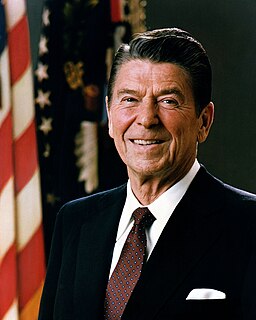
I’ve been writing about Reagan – who, along with PJ O’Rourke, Solzhenitzyn, Dostoevskii and Paul Johnson is the reason I’m a conservative today – as long as this blog has been in existence. His eight years were not perfect, and I don’t beatify my presidents, even if they’ve been out of office for over three decades. His last term wasn’t as stellar as his first, and his last two years were very difficult.
Still and all, he was the greatest president of the second half of the 20th Century, and head, shoulders and ankles the best of my lifetime.
But in these difficult times, after two terms of a President who promoted fear and malaise in the guise of “change” and “doing something”, and four years of another for whom “conservative principles” were a tactic to be slipped on and off like a power tie, it’s worth remembering Reagan’s example; when times seemed at their most dire, Reagan walked onto the scene with a smile and a vision, and a backbone of steel, and cleaned up the mess lefty by his failed predecessor – something our next president will need even more of in 2024.
And the most important part? He did it by unleashing something that many, then as now, thought was dead – the inner, optimistic, take-charge greatness of the American spirit – something that feels largely beaten into submission as this is (re)written, in 2021.
Oh, there are those who say “today’s GOP wouldn’t nominate Reagan!” – to which I respond with a contemptuous sigh, before telling the critic to listen to “A Time for Choosing”, and tell me who it more resembles; Arne Carlson, or Rand Paul?
Reagan’s gone. But that spirit, the one he understood, almost alone among American politicans of his era, lives on in the American people. Half of it, anyway.
So Happy Reagan’s Birthday, everyone!
NOTE: While this blog encourages a raucous debate, this post is a hagiography zone. All comments deemed critical of Reagan will be expunged without ceremony. You’ve been warned.
You have the whole rest of the media to play about in; this post is gonna be gloriously one-note.
(This post was originally written in 2017, and has been slightly touched up for 2021).
And it’s time to be intellectually honest – to today’s Big Left, if he were alive, he’d have been canceled decades ago.
Because the historical record – one you have all seen, over and over, the “I Have A Dream” speech – flies in the face of the Critical Race Theory that dominates all “progressive” “thought” these days:
Anyway – it’s not like you don’t hear “I Have A Dream” constantly these days, but for this speech teacher’s kid’s money, “I Have Been To The Mountain” is the one I measure his, and nearly everyone else’s, oratory by.
Let’s get everyone’s predictions for the new year on record.
I’ll start:
After nine months of whinging “2020 is the worst year ever“, Americans will discover that events don’t read calendars. Things’ll stop sucking pretty much whenever they stop sucking.
Joe Biden will come out of the White House basement no more often after being sworn in than he did before.
Nonetheless, his mental decline will become so apparent that by autumn, the Democrats will attempt to remove him using the 25th Amendment. Of course, if Biden doesn’t resign, and Harris and the Cabinet have to vote to remove Biden under Section 4, while the Veep and Cabinet can temporarily remove him, throwing the issue to Congress…where a 2/3 vote is required to permanently replace Biden with Harris. Which presents Mitch McConnell with a bit of a dilemma: would it be better to leave Biden in place as leader of the Democrat party, flailing and walking into walls and wandering into odd tangents, or install a “president” who never got over 5% of the vote in any primary and is pushing an agenda that would motivate Republicans and conservatives like nothing since Obamacare?
Americans, fatigued by over a year of restrictions that, outside of a few liberty-first states, and armed with the gradually escaping knowledge that T-cell immunity has made vast swathes of the population already functionally immune, will start to treat Covid restrictions the way their great-grandparents treated prohibition.
While waiting for America’s idiot ruling class to wake up and smell the public health coffee (ew), China will gobble up vast shares of the world market.
With the trials pushed back to the start of summer, the George Floyd trial’s verdicts will lead to rioting that make Minneapolitans look on the last week of May 2020 as the good old days. By 2030, Minneapolis will be generally revealed to be a failed city along the lines of Detroit, Newark and NOLA.
I’m particularly proud of the interview I had last weekend with Peter Wood, author of 1620 – A Criticial Review of the 1629 Project. Wood and his book take a hammer to the historical fraud that the NYTimes sicced on the nation…
…and, worse, the miseducation of an entire generation about the history of our country.
Saying “thank you for your service” seems trite – almost mawkish. Someone who never served saying “Thanks for going overseas and getting shot at!”?
See what I mean?
In the meantime, what I want to say is “glad you made it home”. But I can see that being taken the wrong way.
So I’ll wing it.
Veterans: thanks for spending the best years of your lives in barracks, troops ships, foxholes, berthing spaces, CVC helmets, cockpits and gun mounts, doing things most of us can’t imagine, to protect the freedoms too many Americans take very much for granted.
If bars ever open again, the next drink’s on me.
It doesn’t roll off the tongue, but it doesn’t have to.
I have two observations about Joe Biden’s performance in last Thursday’s debate.
First – his campaign is all platitudes. He has a “plan” for everything. A government “plan” and three bucks will get you a cup of Caribou. It’s all there to gull the gullible.
Second – like all Democrats, he can pretty much say any billshut he wants, because his voters are all low-information drones who have the critical thought skills of herd animals, and the media like it that way.
There were many examples of this during the debate on Thursday – “I never said I’d ban fracking”, “nobody lost their plan to Obamacare”, and on and on.
The one that made me jump out of my seat with the most incredulity? “We had a great relationship with Hitler before he invaded Europe”.
He was half right. The US had a lousy relationship [1] with the Nazi regime – to FDR’s rare credit
The U.S. didn’t have a good relationship with Hitler before he “invaded Europe. The German dictator was, however, beloved in certain quarters, including the editorial offices of the New York Times.
President Franklin Delano Roosevelt didn’t attack Hitler directly before the war began, but relations between the U.S. and Nazi Germany were by no means good. In September 1938, Roosevelt sent a telegram to Hitler lecturing him about the importance of keeping the peace and stating: “The conscience and the impelling desire of the people of my country demand that the voice of their government be raised again and yet again to avert and to avoid war.” Implying that Hitler was a warmonger was hardly a hallmark of cordial relations between the two countries.
Failing to get a satisfactory response from Hitler, on October 11, 1938, Roosevelt announced that he was increasing national defense spending by $300 million (over $5 billion in today’s dollars). No one thought that money was going to build up our defenses against Britain and France.
But the New York Times? They loved them some Hitler:
The historian Rafael Medoff recently noted that on July 9, 1933, just over five months after he became Chancellor of Germany and years after his virulent anti-Semitism and propensity for violence had become notorious worldwide, the New York Times published a fawning puff piece on Hitler that rivals even today’s media adulation of Joe Biden, Kamala Harris, and Nancy Pelosi in its one-sidedness, myopia, and disdain for essential facts.
Pulitzer Prize-winning “journalist” Anne O’Hare McCormick traveled to Berlin to become the first reporter from an American news outlet to interview the new chancellor, and she was an intriguing choice for the Times editors to make to conduct this interview, as in the presence of this man whose name has become justly synonymous with evil, she was decidedly starry-eyed: “At first sight,” McCormick gushed, “the dictator of Germany seems a rather shy and simple man, younger than one expects, more robust, taller. His sun-browned face is full and is the mobile face of an orator.”
As if that weren’t enough, she continues with a description of the Führer as outlandish and adulatory as likening the supremely zaftig Stacy Abrams to a supermodel: “His eyes are almost the color of the blue larkspur in a vase behind him, curiously childlike and candid. He appears untired and unworried. His voice is as quiet as his black tie and his double-breasted black suit.”
This, of course, as Walter Duranty was all but french-kissing Joseph Stalin. The NYTimes were equal-opportunity up-suckers.
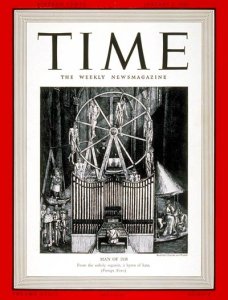
That choice abided by the dictum of TIME founder Henry Luce, who decreed that the Man of the Year — now Person of the Year — was not an honor but instead should be a distinction applied to the newsmaker who most influenced world events for better or worse. In case that second criterion was lost on readers, the issue that named Hitler dispensed with the portrait treatment that cover subjects typically got. Instead he was depicted as a tiny figure with his back to the viewer, playing a massive organ with his murdered victims spinning on a St. Catherine’s wheel.
Which, in context, makes sense.
Moreso than the NYTimes’ excuse, anyway.
[1] Speaking generally in re the government, of course. Some in the government – Ambassador Joseph Kennedy, Ambassador to the UK, Democrat eminimento and father of progressive icons John F. and Robert F. Kennedy – spent the early years of the war pulling for the Nazis to conquer the Brits, whom he hated.
The NYTimes is trying to disappear some of their own paper’s history in re the “1619 Project”, which claimed that, based on the premise that America was founded primarily to exalt slavery, the nation was really founded when the first slave arrived.
Editors recently removed (without explanation or acknowledgment) the provocative statement that the project “aim[s] to reframe the country’s history, understanding 1619 as our true founding” from the article series’ online introduction. Lead author Nikole Hannah-Jones has repeatedly claimed it is a myth that the project proposes 1619 rather than 1776 as the country’s birth year: She blamed bad-faith critics on the right for tricking the media into believing otherwise.
“One thing in which the right has been tremendously successful is getting media to frame stories in their language and through their lens,” wrote Hannah-Jones in a subsequently deleted tweet. “The #1619Project does not argue that 1619 is our true founding. We know this nation marks its founding at 1776.”
Forget for a moment that Hannah-Jones’ Twitter banner is a picture of 1776 crossed out and replaced with 1619. Forget that multiple progressive media outlets that were sympathetic to the project’s aims used the 1619-as-true-founding summary in order to explain it. Forget that a year ago, after the articles were published, both Hannah-Jones and New York Times magazine editor Jake Silverstein described the project in exactly these terms: “We sort of proposed the idea in a variety of ways that if you consider 1619 as the foundational date of the country, rather than 1776, it just changes your understanding and we call that a reframing of American history.” Just consider one last piece of evidence that Hannah-Jones is being deceptive about who invented the 1619-not-1776 framing.
My guess – she’s not being “deceptive”. She, and the Times, are backfilling and memory-holing because Identity Politics stands to cost the Democrats.
Nearly 20 percent of millennials and Gen Z in New York believe Jews caused the Holocaust, according to a new survey released Wednesday.
The findings come from the first-ever 50-state survey on the Holocaust knowledge of American millennials and Gen Z, which was commissioned by the Conference on Jewish Material Claims Against Germany.
For instance, although there were more than 40,000 camps and ghettos during World War II, 58 percent of respondents in New York cannot name a single one.
Additionally, 60 percent of respondents in New York do not know that 6 million Jews were killed during the Holocaust.
It was my observation when my kids were in school – over a decade ago, in the Saint Paul Public Schools – that the only things they learned in their various social studies classes were slavery and civil rights.
No “Federalist Papers” or origins of the Constitution. Nothing about the Civil War but slavery.
Nothing about the rise of progressivism, the causes of the Depression, World War II. Nothing about the sixties but Civil Rights.
Again – that was anecdotal, and entirely possibly wrong. But I’ve found little reason to not assume I’m at least largely right on this.
And this article is certainly a plaintiff’s exhibit.
75 years ago today the first atomic bomb was dropped on Hiroshima.
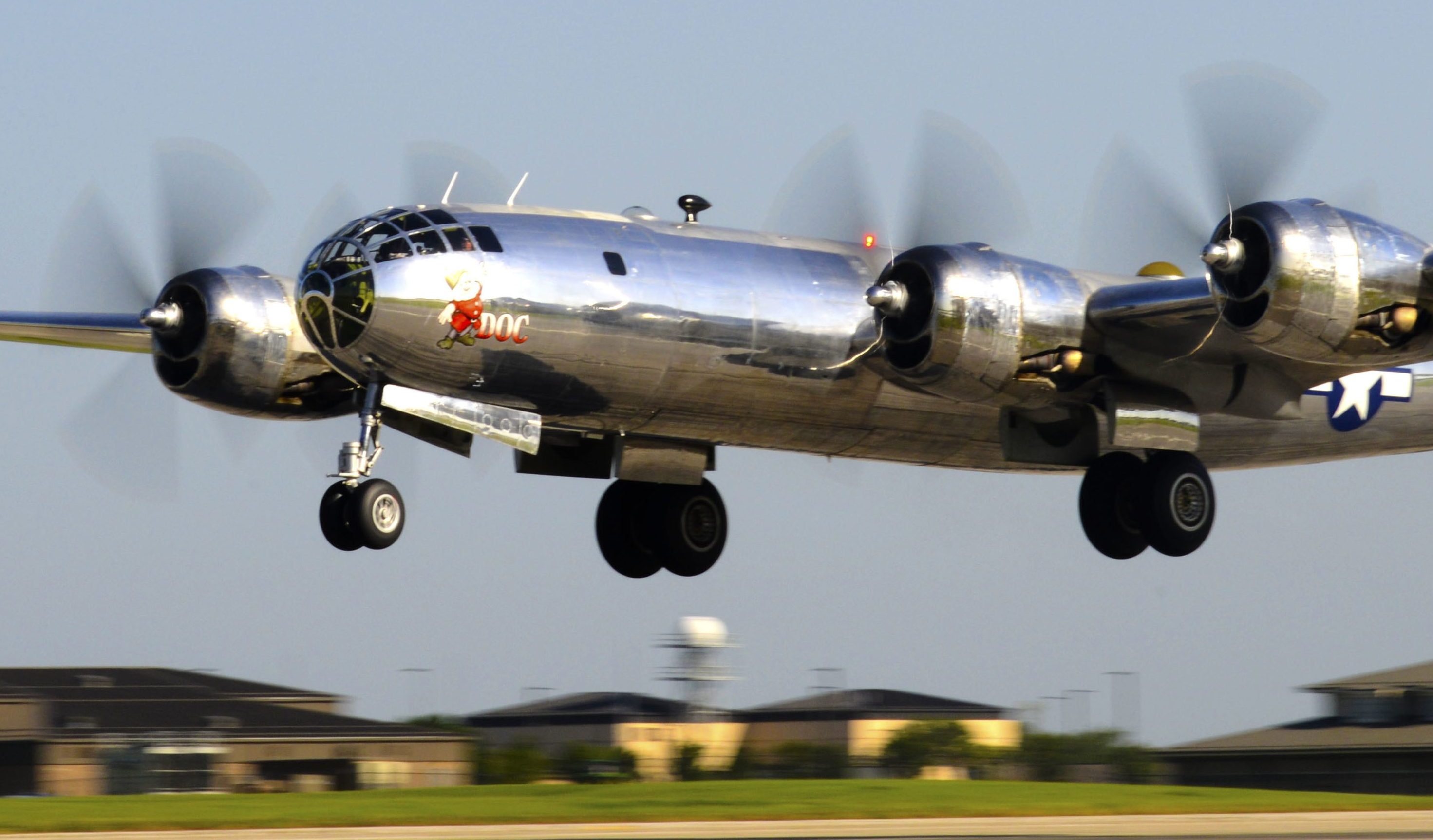
It was dropped by a B29 Superfortress – a plane that was literally built in parallel with the Manhattan Project to develop the bomb, and cost as much to bring into service and was in many ways more difficult to get built than the bomb itself.
A B-29 – one of about three, if I recall correctly, still in flying order today.
As troubled by development problems and cost overruns as most other procurement projects today – early versions had an alarming tendency for engine fires to melt the wing spar, causing wings to break off and the plane to go into an uncontrollable spiral – but carried into action on a wave of wartime emergency money, the Army Air Force brass were seriously worried that the Superfortress would be ready to do the job.
Worried enough to come up with an alternate plan, with the only other plane in the world that could have carried the two early, huge atomic bombs.
Here’s the story.
By the way – if you’re a history geek, “Mark Felton Productions” is a treasure trove of the sort of history you just don’t get in most history books – the kind of off-the-beaten-path stories First Ringer and me focused on in our “World War 2 – Fact and Myth” series, way back when. It’s very much worth a watch.