Archive for the 'Conservatism' Category

For All The Marbles

Tuesday, February 14th, 2012

Stephen Hayes at Weekly Standard writes about the bold, principled conservative we’ve all been waiting for – but who’s gotta defend his seat in Wisconsin first.

It’s a great article about Scott Walker – and it ably lays out both Walker’s outsized accomplishments (especially against Wisconsin’s Democrat machine, which is better than Minnesota’s only because it’s out of power):

Walker came to office in the Republican wave of 2010. He inherited a mess. Under his profligate predecessor, Jim Doyle, state government had operated almost as a slush fund for public employee unions. Giveaways to teachers and others put the state on an unsustainable fiscal path, so Doyle raised some taxes and threatened to raise others. He raided a state fund set up to cover medical liability, essentially stealing contributions doctors had made to the pooled account. The Wisconsin Supreme Court ruled against that pilfering, but the money had already been spent. Even after budget gimmickry that would make Fannie and Freddie blush, the official deficit was $3.6 billion.

Just over a year later, Walker and the Republicans in the state legislature have nearly eliminated the deficit. For the two-year budget cycle, the state will show a $143 million shortfall because the stagnant economy has resulted in lower tax receipts than had been projected. But the shortfall is for the first half of the cycle; Wisconsin will run a surplus in the current fiscal year. And Walker said last week that he will eliminate the remaining shortfall without raising taxes. It’s a credible claim. He reduced the deficit without raising taxes. In fact, one of his first moves upon being sworn in was to cut taxes on businesses. His subsequent reforms have allowed property tax receipts to go down for the first time in years—by some $47 million.

He also writes about the outsized consequences if Walker loses:

For conservatives, the fight is about much more than one man in one state. A Walker defeat would send a message that political courage does not pay and political thuggery does. Walker doesn’t like to talk about the effect the past year has had on him and his family, but it hasn’t been pleasant. He has been subjected to numerous death threats. His wife, Tonette, has been verbally assaulted more times than she can count. His two teenaged boys have been targeted on Facebook. His modest home in Wauwatosa has been the site of several union protests. Last month, a protester outside Walker’s State of the State speech told State Senator John Kleefisch that his wife, Lieutenant Governor Rebecca Kleefisch, is a “f—ing whore.”

I think it’s time to start a “Minnesotans for Walker” group.  The unions are going to go all-in on this election – because if they lose, it’ll be katie-bar-the-door.

If it weren’t for that Presidential election thingie, this would be the most important election of this year.

Dialog, Part II: Your Plan B

Wednesday, February 8th, 2012

A few weeks ago, I did an article about the tense-to-nonexistant relationship between conservatives and the media.  Any media.  Even media that strives in its own way for detachment.

Conservatives just don’t trust the media.

The context, of course, was a conversation I had with Melody Ng, who works for the “Public Insight Network” at American Public Media, the national/syndicated programming arm of Minnesota Public Radio.   She’s found the attempt to engage conservatives – one of her job goals – for feedback and as sources is frustrating.

My theory – conservatives distrust the media on a level that’s become ingrained in core conservative thought.  And that distrust, as a rule, is utterly warranted; with many in the media the perspective on events, politics and life in general is so different, it makes basic communication difficult.  Here was a recent example that points to the statement “they don’t get us, and we don’t get them”.

Now, for the entire life of this blog one of my theses has been that conservatives need to engage in the larger culture; everything from sports to art to the media.  There can be as many reasons for this as there are conservatives; to promote better communication, to learn more, to teach the rest of society that conservatives are not the stunted caricatures that so much of the media describes to the rest of society today, or to co-opt and neutralize the media.

Which isn’t making Melody Ng’s job any easier.

So I offered Melody something I rarely offer anyone – a shot at reaching the SITD audience directly by posting something here on Shot In The Dark.

As it happens, Ms. Ng is curious about the same thing I am; what is everyone’s “Plan B”, should “your” candidate not get the nomination. (For a variety of reasons, it came in just a tad late for pre-caucus discussion; I figured it was still plenty timely).

Is the (primary) party over? Or is the Republican Party just getting started? 

It’s barely February. Super Tuesday is still to come, and it’s a long way to August in Tampa. Yet some seem ready to call the race for Republican presidential nomination.  This after a month of fairly unprecedented and brutal finger pointing among GOP hopefuls over who best represents conservative values in America.

What’s a non-Romney Republican to do?

This blog’s host, Mitch Berg, suggested that I find answers by going directly to you, his readers, and asking: “What’ll you do if your candidate doesn’t win the nomination?”

So where do you stand?

Fill us in on your Plan B here. 

This question was inspired by lively conversation here on Shot in the Dark, and Hot Air around Mitch’s post advising “‘Anybody But Mitt’ Republicans” to vote Romney should he get the party nod.  But discussions about this are happening in all kinds of venues, physical and virtual.

I decided also to check in with our sources at the “Public Insight Network (PIN), 140,000 people like you who share their expertise to help reporters across the country cover the news.  In recent months, many have been telling us how their life experience influences their preference to presidential candidates.

I tapped PIN sources whose candidates of choice have dropped out or refused to run.  Among them, supporters who favored Bachmann, Rubio, Perry, Cain, Palin, Pawlenty, Christie, Ryan and Huntsman.

Their responses varied, but there was a strong current of Republican over Democrat, even if it wasn’t their favorite Republican.

This from Jay Maynard, of Fairmont, Minn., who backed Herman Cain, but now says he’ll vote from Romney: “The duty of the Republican Party is to nominate and work to elect the most conservative electable candidate. … The goal is to limit Barack Obama to one term in office.”

James Murphy, a Libertarian from Austin, Texas, and Rick Perry fan, will strive to get the GOP nominee, whoever he is, into office:  “Of the candidates who remain, not a one of them is worse than Obama.”

Another Texan, Jackie Thompson of Longview, agrees.  Perry was her favorite as well – she’s “as conservative as a person can be about wanting a small government and in all fiscal matters.”  But now that Perry is out, she says, “I’ve known all along that I will vote for whoever is the Republican nominee.  I am not going to vote for a Democrat for president, period.”

As strong as that sentiment is, it doesn’t seem to be universal. Two respondents – both Huntsman supporters – declared they now might vote for Obama.  Said Chris Eriksen, a self-described “Federal Libertarian-State Socialist” from Arden Hills, Minn., it’s about deft foreign policy, the skill he values most in a president.  He finds Obama the most “statesmanly” candidate now that Huntsman’s gone.

A third Plan B is to shift efforts away from the presidential campaign and to other power positions in support of one’s beliefs.  Example:  Richard Mulholland, a Perry guy.  Well before his state’s presidential primary, he had already moved on.

“The Congressional races are more important,” Mulholland said. “At this point I am indifferent about the remaining presidential candidates. Would I have preferred someone else? Sure. But all of my preferred candidates have withdrawn. … In the fall, I will be happy with anyone my neighbors will have chosen from the remaining field.”

How about you?  Is your first choice for president still in the race?  If not, how will you remain involved?  Is there a line between getting a Republican in the White House and your own values?

Please share your story here.  Reporters across the nation want to know what’s driving your vote.

By responding, you’ll help them tell the story of this election, voter by voter, and you’ll become one of our expert sources in the PIN.  Then we’ll contact you from time to time about topics you know and care about – all for news coverage.

By the way, if you haven’t decided yet who you’re supporting for president, give Minnesota Public Radio News’  “Select A Candidate a whirl.

The interactive, GOP primary/caucus tool doesn’t tell you whom to vote for – Would you follow advice from public radio? – but after asking you a series of questions about issues from abortion and immigration policy to the tax code, it tells you which GOP candidate your views most closely align with.  I got Newt Gingrich.

Happy caucusing tonight, Minnesotans and Coloradans!  And a good rest of your primary to you, Missourians!  I hope to hear from you soon.

Many thanks to Melody.

So -discuss!


Why I’m Caucusing For Santorum

Tuesday, February 7th, 2012

I agree with what Mitt Romney (I think – maybe it was Huntsman) said in one of the opening GOP candidate debates; any of the people on the stage, then and now would do a better job of rebuilding this country than Barack Obama.

Including Romney.

I’m not thrilled with Romney; I think the Gingrich camp’s attacks have verged on the hysterical, and swerved way too far into Alinsky for my taste; Romney certainly did the same in return.  And I’ll allow that there’s some context to his very “moderate” record in Massachusetts; a legislature that verged on Maoist, a state that was so far to the left that John Huntsman would have looked like Gengis Khan.  Still, that’s what we have to go by – that, and his impressive business and executive record.

And Ron Paul?  I used to be a Big-L Libertarian.   And Ron Paul certainly has uncovered the wellspring of inner libertarians – big and small “L” – that I always knew was out there.  I’d love it if Ron Paul were both a viable candidate and a credible choice for President.  I sincerely hope Rand Paul becomes both in the next four to eight years.

But tonight I’m going to caucus for Rick Santorum.  Not because I think he’s necessarily the best candidate – his record on spending and economic issues is adequate-to-good; he’s most famous as a social con, and his credentials there are truly impeccable, but it’s not my turf.

But I’m doing it mainly because if Mitt Romney really is “inevitable”, at least he’s going to know at least one GOP activist – and every one I can convince to follow suit – isn’t handing over his support merely because Mitt’s got a “GOP” behind his name.

Promise to repeal Obamacare?  Start listing cabinet departments that’ll be cut?  In addition to the parts of the Romney platform that do make conservative sense (and there are parts)?  We can talk business.

But for now?  Romney’s not inevitable with me.  Not yet.

Ten Things You Should Do If You’re An “Anybody But Mitt” Republican, And One You Should Not

Wednesday, February 1st, 2012

Let’s say, hypothetically, for just a moment here, that some of the pundits are right – that Romney’s landslide victory in Florida means he really might be inevitable.

I’ve heard more than a few of you Newt and Paul supporters out there; “If Romney wins, I’m staying home on election day”.

While I’m not especially passionate about Romney just yet, I’ll reiterate what an awful idea this is.  Don’t go there, people.

I’ve got ten suggestions for much more-productive responses.

  1. Keep things in perspective – Forget Gingrich’s Alinskiite rhetoric for a moment; Romney’s not a “liberal”.  Remember William F. Buckley’s advice – “Vote for the most conservative person who can win?”  Romney was the most conservative person who could win…in Massachusetts.  He was the most conservative person who could make any headway against a Massachusetts legislature that made Ted Kennedy look like Michele Bachmann.  Is he the most conservative candidate who could win in a nationwide general election?  Perhaps, perhaps not.  But if not?  We’ll come back to that.  The point being, he’s not just “not a liberal” – on economics, which is what really matters in this election, he’s conservative enough.  And for the rest?  Well, we’ll get back to that down the list a ways.
  2. Relax.  Take a deep breath.  The world doesn’t begin or end with this nomination.  Or even with this election. Even if Romney is as bad as some of you claim, this nation has survived worse.  Hell, we’re surviving worse right now.  Focus, people; getting Obama out of office is the key – and while some of you reject incrementalism (and I reject the idea that Romney is especially incremental, and even if he is – well, we’ll get back to that below), sometimes it’s all you got, and you gotta deal with it, and when you gotta deal with it, you want the increments to move in the right direction.  Romney’s not perfect, but he’s the right direction – and, I suggest, not just a little.
  3. Remember The Positive Influence You Do Have – The caucuses and primaries aren’t over.  We’re seven months away from the convention – and three months away from the state conventions that will empanel the delegates.  This isn’t a done deal yet.  I can live with Romney – maybe even better – but I’m caucusing for…I dunno, probably Santorum on Tuesday.  Not that I’m thrilled with Santorum, either, but I want Mitt and his supporters to know that to win me (and, I hope, millions like me) that he’s going to have to be more aggressively conservative than he has been acting.
  4. Go Shooting. It’s great stress relief.  It focuses the mind.  And it shows Romney – and Obama – that you can’t whiz on the Second Amendment.  It’s a threefer.
  5. Remember The Alternative – You think four more years of Obama would be better than four to eight of Romney?  There’s a caveat to this, of course – more below.
  6. No, Remember The Real Alternative  – I hear those among you who say you’ll sit this election out.  “If the party loses because they didn’t go conservative enough for me, it’ll teach them a lesson”.   That’s not only groaningly solipsistic – it’s not, after all, all about you – it’s also just not the way political parties and organizations work.  I’ve said it a few times in the past few weeks, and I’m going to keep saying it until y’all get it right; Political parties don’t “learn lessons” – they reflect the will of those who show up.  And if conservatives – and all you libertarian Ron Paul supporters – don’t show up, then the “establishment wins.  And don’t be yapping about “voting Libertarian”, because…
  7. Third Parties Are to “Parties” What Near Beer Is To Beer. Let’s be honest; if you are a conservative or a libertarian, the GOP is the only chance you have to actually affect policy for real.  The Libertarian, Constitution and Conservative parties are futile, vote-wasting protest actions at best,  intellectual onanism at worst.  None of them will ever, ever, ever, ever affect the way policy is enacted in this country.  Ever.  And I say that as someone who not only sincerely wishes they could, but worked for it as a Libertarian Party member.  And remember – you, the conservative and libertarian and Tea Partier, have had a huge effect already; four years ago, Romney was defending himself against charges he was “too conservative”; today, it’s the opposite.  This is a good thing.  You – we – have moved the needle in the GOP.  “But it hasn’t moved far enough and fast enough!”, you say?  Suck it up, little camper, and put down the TV remote; political parties don’t change like one of those jump cuts in an NFL game of the week.  It takes time, patience and effort.  Hell, it took Ronald Reagan and Barry Goldwater close to 20 years to change the GOP, and even that didn’t stick.
  8. Be Honest: Campaign rhetoric is one thing – real records, and their context, are much more useful.  Romney needs to be kept honest – i.e, conservative – and we have the power to do that (see, again, below), but it’s not like we’re trying to reform Che Guevara, here.
  9. Numbers Count:  Remember Buckley’s Commandment from earlier in the post?  “Elect the most conservative candidate who can win?”  Newt’s negatives shouldn’t be the dispositive factor in this nomination, but you might wanna be mindful of the fact that 60% of the American people would rather have Slobodan Milosevic for President.  And Ron Paul is a shoe-in in the4 general – so say his supporters.  Who are, so far, 1/6-1/10 of the GOP.  If he can’t win the GOP, I’m at a loss for how he has even a faint shot at the general.  I’d love to hear a Ronulan spell out a case that leads Paul to the White House that doesn’t include the phrase “and then Ron Paul convinces everyone that he’s ideal”.  Honestly – I’d love to hear it.  Rand Paul might be another story, and there, I’m all ears – but that’s the future.  As far as I”m concerned, for right now the electoral world ends in November.  Focus.
  10. Checks, Balances. So what if the GOP had no candidate at all, and we were looking at a victory for Obama by default today?  What would you be doing now, all you good conservatives?  Working to make sure the conservatives hold the House and take the Senate?  OK – so let’s say Romney really is as bad as  you all want us to believe he is.  And let’s say he’s inevitable.  Your choices then are “stay home” or “do what you’d do if Obama was going to win – try to negate his power and influence by taking control of Congress”.  Why, precisely, should you not then be working to flip the Senate and extend our lead in the House/  Because the opportunity is there, folks, to not just flip Congress completely against either Obama or a hypothetical “moderate” Romney, but flip it to a version of the GOP that, so far, has been pretty Beltway-proof, and fairly dedicated to the mission for which they were sent to GOP by the Tea Party and a newly-resurgent conservative movement in the first place; to govern like conservatives.  Keeping them that way is our job.  Provided we don’t “stay home” and “teach everyone a lesson”.  Because the only “lesson” you “teach” by staying home is that you’re unreliable and marginal.  Don’t be that.
Or you can stay home.  Your call.

Announcing “Eventual Romney Supporters For Santorum Or Paul”!

Friday, January 27th, 2012

Since everyone else is launching pressure groups and PACs, I figure it’s high time I did the same.

Just in time for the Minnesota Caucuses, I’m announcing my new PAC, “Eventual Romney Supporters For Santorum Or Paul”.

To be a member of (or contributor to) ERSFSOP, you need to do the following:

  • Recognize the true goal for conservatives in the general election – to replace Barack Obama with someone who will shrink government and get it out of the way of economic recovery.
  • Recognize, in addition, that most important facet of the endorsement process; pulling like mad for candidates that reflect your values, and do so with a voice so loud and powerful that whomever wins the nomination needs to pay attention, even if it’s not yours.

And so the ERSFSOP charter basically says this:

I, a conservative base voter, recognize the primary need to to get Barack Obama out of office in favor of virtually any conservative-enough Republican, and recognize that Romney is probably still on the inside track to the nomination.  I also am uncomfortable with the depth of Romney’s commitment to conservative economic princpiples.  And so until Candidate Romney makes his commitment to conservative economic policy – especially repeal of Obamacare and drastic cuts to spending and the size of government – an integral part of his campaign, I will be caucusing for Santorum, or Ron Paul, or even plugging my nose and caucusing for the born-again Alinky-ite, Gingrich.  And so until you commit to the policies we support, your path to the nomination has a speed bump.   

Your choice, Governor Romney; a 55 gallon drum of Maalox, or a clear path to the convention.

Your move.

Any takers?

The Most Conservative Candidate Who Can Win

Friday, January 27th, 2012

At times like this, I like to remember William F. Buckley’s formula for picking candidates; picking the one that matched the title of this post.

Now, “most conservative” clause gets overlooked.  And I’m sorry to say, I’m less and less convinced Newt Gingrich is “conservative” as much as he is “opportunistic”; that he’s as “conservative” as Bill Clinton was “progressive”; in other words, whatever it takes to get elected.  And after Gingrich’s shameless descent into Alinsyite smear-jobbing his past month, I’m not convinced I could support the guy and sleep at night.

But for now, let’s focus on the “who can win” bit.

Romney led Obama by 47 percent to 42 percent in the Florida survey, while Obama topped Gingrich by 9 points, 49 percent to 40 percent. Among independents, Obama led Romney 44 percent to 38 percent and opened up a 56 percent to 29 percent advantage over Gingrich. Gingrich grabbed 12 percent of registered Democrats, while Romney secured 18 percent of registered Democrats.

“Newt Gingrich is weak among Florida independents and likely Democratic voters compared to Romney,” said David Paleologos, director of the Suffolk University Political Research Center in Boston. “If Florida is one of six key states that swings the national election, independents in Florida hold that key, and this poll suggests that Newt won’t be able to secure Florida for his party.”

In the popularity contest, Gingrich again did not fare well. He holds a 29 percent favorable and 58 percent unfavorable rating statewide among all likely voters. By contrast, Romney had a 44 percent favorable and 37 percent unfavorable rating. Romney’s popularity was lower among independents: 37 percent favorable and 36 percent unfavorable, while Gingrich’s popularity among independents imploded to 19 percent favorable with 70 percent unfavorable.

Even if I took Gingrich’s “conservatism” at face value – and I largely do not, not anymore – that, if true (and borne out by mo betta polling) really calls the question for me.

The question isn’t “who’s better at goading the media”; that’s not the President’s Press Secretary’s job.

The question isn’t “who can game the political mechanics better” – that’s what gave us Barack Obama.

The question is “Who is both conservative enough and who beat Obama?”

I have my serious, serious doubts.

And if Gingrich can’t convince me of both, he can forget it.

I’m going to pick the most conservative candidate who can win.

And I don’ think Gingrich is either.

Open Letter To Certain Romney Supporters

Tuesday, January 24th, 2012

To: Certain Mitt Romney Supporters
From: Mitch Berg, Reagan Disciple
Re:  Your “Ready, Fire, Aim” exhortation.

All,

I”m Mitch Berg.  You may remember me; I was busy caucusing for your guy Romney four years ago.  Let me refresh your memory; that was the cycle when a fair number of you geniuses insisted John McCain was the only viable option to run against Hillary Obama, and that we should not, could not, nominate a naif like Mitt Romney to run for office.

And eight years before that, I was the guy pushing for Steve Forbes, when you all insisted that George W. Bush was the conservative who could win.  And 12 years before that, when I said Jack Kemp might make a much, much better custodian of the Reagan Revolution than George H. W. Bush – you got your way then, too.

Remember me yet?

Of course not.  You’re the “establishment”.   You rarely remember the dirty ugly lessons of four or eight years back.  To many of you think “spin” equals fact.

And that’s fine – because you win your fair share of elections.  You’ve got the money, the oomph, the organization, the experience in power.  That counts for something.

And with that, I suppose you’re entitled to think of your agenda as “inevitable” in the party.  The problem is, some of us peasants – the people who are allied to principle first, party second (not that they need be exclusive or in conflict) – keep getting uppity and in the way.  It happened in 2006, when a knot of “establishment” figures in the Sixth CD GOP here in Minnesota got their undies in a toxic knot because Michele Bachmann flooded the various precinct caucuses with her supporters, making the local “establishment” – including many of you – claim that Bachmann “stole the nomination” when, in fact, she just did democracy and politics better than you did.

Ditto in 2008.  Maybe the influx of Ron Paul supporters split the conservative vote so finely that Mitt Romney never had a chance, and your guy Mac coasted to the nomination.  Maybe not – and it doesn’t matter much now, since between dual influences of the Ronulans and the Tea Party, the GOP finally, blessedly moved to the right.  Far enough to turn the conservative of 2008 into the moderate of 2012.

And all of that grassroots activity has made some of you – you know who you are -profoundly uncomfortable.  All us  unwashed Tea Partiers make you nervous, like John Quincy Adams supporters beholding Andrew Jackson’s entourage moving into the White House.  I’m fine with that, too.

But the reaction some of you are having to the “insurgency” (read: people doing the  democracy thing) in the GOP is telling us some things that I really would rather not be hearing nine months before an election.

Hugh Hewitt, who is a great friend of the radio show I do with Ed Morrissey, said it loudest on his national talk show – “If Ron Paul gets nominated, I’ll vote for Obama”.

Let’s come back to that in a moment here.

When I interviewed Michael Reagan last summer at the Midwest Leadership Conference, he made a great – and lamentably overlooked – point; his father, Ronald Reagan, didn’t win because he was the purest conservative.  He didn’t win because he had the most forward-looking economic vision.  He didn’t win because he promised to end the Cold War with unconditional victory.  And he didn’t win, in those days when people were still wondering what went into that seventeen minute gap in the Watergate tapes, because he was a pure establishment Republican.

He won because he convinced a whooooole lot of people who’d never have ordinarily voted for him, moderates and paleocons and RINOs and unemployed/patriotic Democrats, even – in the primaries and then in the general election – that he and his ideas were right.

Now, I don’t care if you say you’d stay home or even vote Obama if Ron Paul wins the nomination.  I don’t care in the same sense that “I don’t care if Scarlett Johannson has a chive in her teeth during our first date”, because it’s almost purely academic.  Neither is likely to ever happen.

But when you – the Establishment, with your Harvard degrees and your party apparatus and national media outlets – tell the 10-15% of the people who are coming out to GOP primaries, many for the first time, and the much larger percentage of younger voters and potential activists, “your guy, and by extension the principles for which he stands, and by further extension those for which you stand, are so risible that I’ll vote for the enemy first”, what’s that telling them?

It’s telling them that they and their beliefs, by dint of their association with a candidate who (holy hannah!) has a flaw in his past, are a bigger enemy than the President who is, by all of our mutual admissions, destroying this country.

We’re not talking about people who wrote racist rants thirty years ago; many of the people you are talking to weren’t born when Ron Paul wrote his racist screeds.  We’re not talking about people who believe the Iranians have just grievances with us; in many case, you’re talking to people who’ve put their lives on the line to defend this country (Rep. Paul has a disproportionate share of the military vote), and have been getting bombed and shot at by Iranian proxies (and probably actual Iranians).

Your attachment to the establishment – to the process, the machinery, the access, your tee time with Karl Rove, whatever – leads you to demonize a candidate with no chance of getting nominated and, more importantly, alienate a huge mass of voters that would be much better served, and in the long run would serve the party much better, with a little convincing, even if it doesn’t work right away.  People who are, in many respects, the future of conservatism and the GOP.

Ask yourself – What Would Reagan Do?

Let’s go back to the top and re-think this, shall we?

That is all.

Open Letter To Newt Gingrich Supporters

Tuesday, January 24th, 2012

To: Newt Gingrich’s Supporters
From: Mitch Berg, guy who really wants to like and support Newt, but juuuust can’t yet.
Re: No, the postscript in my “From” line really says it all.

All,

Loathe as I am to cite Hugh Hewitt, he did  have an excellent point for all of you Gingrich supporters last night on his show.  I’m going to turn that point into a question.

I’ll get to that in a moment.

William F. Buckley’s rule for picking a candidate was simple; pick the most conservative candidate that can win.  I follow this – after doing what I can to make the candidate who can win more conservative (see Tim Pawlenty, 2002).

Now, let’s leave aside the troubling episodes in Newt’s career – older ones, like his creakingly convoluted personal life (and I’m disregarding everything Marianne said in her loathsome interview, by the way, and only going by stuff Gingrich has admitted to, or which is in court records), middle-term ones like his trading butterfly kisses with Nancy Pelosi, and painfully recent ones like his tossing all of capitalism under the bus and his adoption of Saul Alinkski’s tactics to try and eke out a lead in South Carolina (which is the very definition of politics in its worst form over principle); let’s even leave aside the fact that Newt is in many ways a conservative (fingers crossed) mirror of his would-be nemesis, Barack Obama – albeit with more actual real-world government experience.  Forget all that.

Remember Buckley; pick “the most conservative candidate that can get elected”.

As Hugh notes, Newt has 100 percent name recognition, and 60% negative perception.

Why should I support him?

Don’t talk principles.  Don’t talk history.  Don’t talk 1994.  Don’t talk policy.  Talk numbers.  Convince me.

That is all.

Open Letter To Ron Paul Supporters

Tuesday, January 24th, 2012

To:  Ron Paul supporters
From: Mitch Berg, Former Big-L Libertarian, current small-l libertarian
Re:  Your candidate

All,

I love a David and Goliath fight as much as anyone, and much more than most.  So the idea that a candidate could come in out of nowhere, electorally speaking, and tip the GOP establishment up on its ear is something I just looooove.  Seriously.

And not only do I totally get the principles Ron Paul is espousing – liberty, shrinking government, etc – I have run for office behind them.

I don’t support Ron Paul, personally, as a candidate, for many of the same reasons I bailed out of the Big-L Libertarian Party fourteen years ago; while I agree with its core principles and high-level beliefs, there is little about your candidate, like my old party, that makes me think he’s ready for prime time when it comes to trying to run a nation of 300 million people.

But this isn’t about Ron Paul or his principles, or the wrinkles in his past that many of you would have us ignore.  This is about you.

Four years ago, you – or an earlier generation of “you” – bum-rushed the caucuses, with the intention of taking over the Minnesota GOP (as in other states).  And of the ones that got elected to go to the House District conventions, some actually showed up.  And of the ones that got elected to go to the Congressional District convention, some showed up.  And of those few left who got elected to go to the state convention, fewer still showed up.

In short, when the time for writing resolutions and declaiming about “Doctor Paul” passed, and the time to try to do the hard, boring stuff started, you – the vast, vast majority of you – sat it out.  And that’s notwithstanding the number of you that opted to sit out the election.

It’s easy – and your right – to say “If you don’t nominate my candidate, I’m going to sit this election out”.  But this isn’t about the election – this is about the party of which Ron Paul is a member; the one to whose caucuses Paul and his organizers are going to send you in your thousands in two weeks.

Getting an agenda passed takes more than just noise, intransigence, and near-religious fervor.  It takes persistence, a willingness to work within a party system (if only to co-opt it – and that’s not only not a bad thing, that’s actually how politics works!), the cultivated ability to sit in party functions and keep your ass from falling asleep long enough not only to get candidates who believe in what you do endorsed, but to keep the party in line with your principles as well.  And as someone who just spent a year as a minor elected party functionary on a libertarian-conservative agenda, let me tell you – that’s the hard part.

So, Ron Paul supporters, please answer the question:  are you ready to try to stick around, learn a few things, and try not only work with (and co-opt!) the party in which your candidate is running, and to which his son is committed?

Or are you going to collapse into epic disappointment again?

Because if it’s the former, I’d love to talk with y’all.

That is all.


Open Letter To Rick Santorum Supporters

Tuesday, January 24th, 2012

To:  Rick Santorum supporters
From: Mitch Berg
Re: Your Case

All,

Any of you Santorum people, please fill me in:  other than…:

  • He’s pro-life
  • He’s anti-gay marriage
  • He’s got an R by his name
  • He drives libs insane

…what precisely is the case for your guy?

Don’t get me wrong – I support all these things, to one degree or another.

But what’s the case for nominating Santorum?

That is all.

The Primary Route

Monday, January 23rd, 2012

If there’s been one constant in this ever-changing Republican presidential primary season, it’s that every candidate has looked like Icarus at one point or another, melting under the heat of media and voter scrutiny.

We remain roughly a month-and-a-half away from Super Tuesday, the date where traditionally the primaries have been resolved – if not in literally allocating enough delegates to produce a winner, than at least enough to leave the outcome less than in doubt.  9 states vote until then, and while the race will probably shift numerous times over the course of these upcoming dates, let’s take a look at where things stand now:

  • Jan 31st – Florida (primary):  Despite Gingrich’s roundhouse kick to the meme of Romney’s inevitability, and a new poll showing him surging into the lead in Florida, Newt may have already lost the state.  Why?  A supposed third of likely Florida Republican primary voters have already cast their absentee ballots in a state where Romney continues to lead by an RCP average of 18.5% (and he’s been beating the absentee war drum for months).  Considering Romney turned a 10% lead into a 12% defeat within about four days, suggesting another Lazarus comeback for Gingrich isn’t out of the question, but requires Newt to significantly win the remaining pool of likely voters – and drive turnout up.  Perhaps biggest factor influencing decisions about Florida – the fact that the state’s delegates are winner-take-all.  Even a Iowaesque margin means one candidate takes home 50 delegates (cut nearly in half by the RNC due to Florida crashing the primary schedule) and everyone else gets squat.  Some of the field might be better served getting ready for the rest of the Republican primary schedule which includes…
  • Feb 4 – Nevada (caucus):  There’s a presumption that Nevada is prime Romney territory due to his 2008 victory, fueled by the state’s nearly 8% Mormon population (they comprised 25% of the caucus turnout in 2008).  And certainly in what little polling has been done (no new poll in a month), Romney has maintained a lead throughout, even at the height of Newtmania in December.  But the circumstances that lead Romney to win a number of caucus states four years ago have certainly changed.  With his role having been transformed from conservative outsider to moderate establishment, Romney now finds himself on the other side of the anti-establishment movement that he benefited from in 2008.  Nevada’s population might still help him win the state, but a caucus-filled February could hit Romney hard.
  • Feb 7 – Colorado (caucus), Minnesota (caucus), Missouri (primary):  Guess what all three states have in common?  None of them are actually allocating delegates on Feb 7th.  But damned if they won’t at least appear to matter as the momentum of the entire primary process might be up for grabs by this date.  Feb 7th might also be Rick Santorum’s last attempt to remain in the contest.  With Gingrich not on the Missouri ballot and caucuses far more fertile ground for a socially conservative message, Santorum needs to win one or two of these states to be seen as viable.  Paul could be making his last stand as anything more than a spolier as well, and likely will do quite well in Minnesota as he did in 2008 when he got nearly 16% of the vote.  While Romney carried both Colorado and Minnesota in 2008 (by large margins), again he was viewed as the conservative alternative.  If Romney only wins Missouri or loses the Show-Me State, talk of his collapse won’t be far behind.
  • Feb 11 – Maine (caucus):  Maine was virtually ignored four years ago by all the candidates (save Paul) and Romney still walked away with a 30-point victory.  Expectations would have Romney winning the state again due to proximity to New Hampshire and Massachusetts, the moderation of the state’s Republicans, and the poor organizing efforts by competing campaigns.  Because of that, probably the only way Maine’s results will have any impact on the race is if Romney loses.  The small media market might be tempting for the rest of the field to try and create an upset on the cheap.
  • Feb 28 – Arizona (primary), Michigan (primary):  17 days between primaries?  What will the 24-hour news channels do with themselves?  Probably forecast a split decision on Feb 28th, with Romney winning his former “home state” of Michigan and Gingrich or Santorum (assuming the latter is still in the race at this point) winning Arizona.  What little polling exists hasn’t been illuminating.  Three polls over the last three months have produced three different leaders.  Romney’s early January lead with 41% was amid his Iowa “win” and expected victory in New Hampshire.  Both states are larger media markets but the long delay between states will mean that aggressive retail campaigning might pay off.
  • March 3 – Washington (caucus):  The last state before Super Tuesday on March 6th could provide a little last-minute momentum for a candidate before 11 states (and 466 delegates) are decided.  2008 isn’t exactly much of a guide here – McCain squeezed out a victory here due to a fractured field with only 12,000 people showing up to vote.  By local comparison, nearly 63,000 Minnesota Republicans voted in on caucus night in 2008.  Turnout like 2008 likely means someone other than Romney wins – and that the result will be ignored by the media.  This could be a state that Ron Paul actually wins.  He performed well four years ago, has a strong organization in Washington and some establishment support (to the extent you can call it that).

Carolina Still On My Mind

Thursday, January 19th, 2012

“Everyone appears to be waiting for a shoe to drop to change the dynamic of the campaign…”  – SITD 24 hours ago.

And since then?  Imelda Marcos’ closet has spilled out all over the GOP primary.  To recap 24 of the busiest hours of the 2012 primary thus far:

  • Newt-onian Physics:  In one day, the Real Clear Politics average of South Carolina polls has shifted from a 10% Romney lead to a rounding error 1.2%.  We haven’t seen volatility like this since the stock market in the fall of 2008.  And the polls have move quickly because the fundamental elements that the entire 2012 Republican race have thus far been based on seem to be shifting as well.  Starting with…
  • Children of the Corn:  Rick Santorum won Iowa.  By 34 votes.  We think.  Iowa’s GOP now admits we’ll never know who won the caucus since too many precinct results are missing.  Iowa Democrats shouldn’t exactly express schadenfreude over the error, since a similar result happened to them in 1988.  While the result (officially called a “tie” by the Iowa GOP) would seemingly boost Santorum, setting the stage for three different winner of the first three primary/caucus states, the practical influence of the outcome has been more to hurt Romney than help Rick Roll into SC.  At once, the narrative of the race thus far has been changed.  Regardless of Saturday’s outcome, Romney no longer can claim to have run the table, denting his greatest asset – the assumption of inevitability.
  • Thrust and Perry:  Today could have been Santorum’s best of the campaign- news outlets might have led with both his belated Iowa victory and his formal endorsement by Focus on the Family founder James Dobson.  Instead, the media is using the Iowa results mostly to discredit Romney and the Hawkeye Cauci while trumpeting Rick Perry’s 11th hour decision to drop out and back Gingrich.  Perry’s blessing doesn’t carry much raw electoral weight – he was polling between 2-4% the last 48 hours of tracking polls – but helps tremendously towards Gingrich’s efforts to rally conservatives behind him as the “anti-Romney.”  And perhaps most importantly for Newt, it robs the headlines from…
  • The Ex-Files:  Marianne Gingrich’s timing was almost perfect – if she wanted to destroy her former husband’s political comeback (and she still might). Taken from a 48-72 hour-old context, her blistering ABC interview might have been the nail in the coffin of the former Speaker’s attempt to win South Carolina and stall Romney’s momentum.  Instead, her comments have disappeared down the news cycle memory hole as the narrative media outlets are going with is yet another amazing political Lazarus impression by Newt.  Will Marianne’s comments come up at the debate tonight?  Possibly.  Will her comments resurface if Gingrich wins SC?  Definitely.  But for now, Team Newt looks to have a few more days to figure out how to response to his ex’s charges that he wanted an “open marriage.”
  • Fringe Fest:  Tonight’s debate is the cherry on this news sundae, prompting questions as to who will be the evening’s target.  Will Gingrich find himself in the crosshairs again or will Romney continued to be hit hard since the week’s earlier debate marked the start of his polling bleed-out?  What’s less debatable is that both Paul and Santorum will find themselves on the edge of the debate, likely literally as cameras prep for a two-shot for a forthcoming two-man race.  Considering neither is going to win SC, whose victory hurts them more – Romney or Gingrich?  The likely answer is actually Gingrich.  If Newt pulls out a comeback in Carolina, the chattering class will begin to apply pressure on the rest of the field to clear the path for the desired mano-a-mano debates.  Since Paul is more in the race to build a movement than a nomination, Santorum needs to stop Newt from winning South Carolina to maintain the mantle as the only “non-Romney” to have won a state.  Meaning don’t be surprised if Santorum comes out guns-a-blazing against the former Speaker.

Taken for Granite

Tuesday, January 10th, 2012

The patient may be still wiggling on the table, but it’s never too early for a “pre-mortem” on the GOP New Hampshire primary.  [UPDATED BELOW]

  • Margin Call:  With even the Suffolk daily tracking poll showing Romney’s numbers rebounding despite a week of attacks, the question isn’t whether Romney will win but by how much.  Perhaps the only margin worth watching is to see where Gov. Jon Huntsman finishes.  Short of a close second, it’s hard to see how Huntsman justifies going forward unless he believes Florida can be his bulwark.
  • Rick-Rolled:  Rick Santorum is desperately trying to become 2012’s Mike Huckabee, right down to repeating the 2008 candidates’ mistakes.  Following his Iowa victory four years ago, Huckabee chose to contest New Hampshire and Michigan instead of turning to South Carolina and arguably friendly political territory.  Huckabee seemed temporarily vindicated by rising up from single digits to finish in third, winning a handful of delegates and lingering momentum.  Instead, the time and treasure spent elsewhere helped cost him South Carolina and the mantle as the sole “anti-McCain.”  Santorum might finish fourth or fifth tonight – and probably would have even if he hadn’t campaigned in the Granite State for the past week.
  • Bain & Conservatism’s Dark Night: No, we’re not talking about the next Batman film, but some of the comments from the field this week over Romney and his history with Bain Capital do seem Two-Faced.  Romney’s “I love being able to fire people” is likely to end up in a general election ad should he win the nomination, but did the rest of the GOP field need to beat the Democrats to the punch?  Romney’s comment certainly shows a tin-ear, even if he clarified his stance within the next few sentences.  Yet nearly every Republican candidate has decided not only to take a swing at Romney on the issue but poke capitalism as well.  A pro-Gingrich Super PAC is planning a $3 million-plus ad campaign in South Carolina lambasting Romney’s Bain record as well.  As NRO’s Jim Geraghty muses, “the demonization of the free market is complete.”
  • “Anti” Gravity:  While the battle to become the “anti-Romney” seemed more like a poor man’s episode of “Survivor” earlier in the campaign as candidate after candidate was eliminated from the race, the remaining Anybody But Romneys now look to be in an electoral game of chicken.  Paul, Gingrich, Santorum, Perry and Huntsman have all taken their measure of the field and (fairly correctly) determined that none of the remaining candidates have the organization, financing, or momentum to displace the front-runner.  But the hour for someone to coalesce the anti-Romney vote is growing late and despite all the talk of the gravity of nominating Romney, none of the pretenders has yet signaled a willingness to move their support to another.  Thus the rest of the field waits for someone else to drop out in increasingly vain hopes that the last man standing can inherit the cumulative frustrations of the base.
  • Days & Weaks Ahead:  Playing upon the last note, it’s hard to see where the anti-Romney forces can possibly stage a comeback given the upcoming primary calendar.  Romney holds solid polling leads in South Carolina and Florida and looks likely to enter February having won every caucus/primary.  But Feb 7th could be the date that sees Romney lose – twice.  Colorado and Minnesota hold their caucuses that night and if the field has narrowed down to one or two major competitors, the evening could contain the first electoral chink in Romney’s armor.  The only problem with that theory?  Neither state is actually pledging delegates to the convention – both votes are beauty contests and will likely be spun as such by Romney should he lose.
UPDATE:  If you prefer your summaries brief, NRO’s John Hood says it best with tonight’s result showcasing “the limits of election-night spin.”
Is a Romney nomination a foregone conclusion?  No, but let’s just say the fat lady is clearing her throat.  Romney not only became the first Republican since Gerald Ford to win both Iowa and New Hampshire in a contested primary (and the first non-incumbent), but none of his opponents blinked at finishing far behind him.  With a mixture of rumors and facts surrounding various candidate Super PACs and campaigns promising to spend the house to block Romney, expect South Carolina to be a primary Verdun – a financial meat-grinder intended to at last lessen the field.
Perhaps the biggest loser of the evening?  Rick Santorum, who now looks to not even get 10% – the minimal threshold necessary to earn a delegate.  Meanwhile Perry is blasting the South Carolina airwaves with hundreds of thousands of dollars worth of “values” themed TV ads while trying to do retail politics at a Run Lola Run pace.

What Is In A Word?

Friday, January 6th, 2012

Was George H. W. Bush a charlatan?

I mean, he wasn’t a Reagan-style conservative; during the 1980 nomination drive, he aggressively attacked Reagan’s economic proposals, calilng them “voodoo economics”, proposing a much Sturdevant-friendlier, “moderate”, less-anti-Keynesian approach to the economy.

He was wrong, Reagan was right.

And Reagan made damn sure everyone knew it, comdemning the elder Bush’s anti-Austrian apostasy with a vigor that destroyed Bush’s career in the GOP…

…wait.  No.  That’s not right.  Reagan made his case gently and with good humor and – for better or worse – brought Bush into his inner circle and reached out to his supporters and, most importantly, convinced them he had the right idea.  He beat Bush and the moderate wing of the party with fact, with rhetoric, with a better plan (in a year when the country didn’t want just an incremental rejection of Jimmy Carter and stagflation), and with the understanding that your opponents in February need to be your staunch, solid allies in November.

Which is why I’m concerned with some of the Romney-bashing I’m seeing.

Over at LFR, Gary Gross tucked into Romney yesterday, in a piece called “What’s In A Word”, as he – who is, to be sure, to the right of Romney on the great conservative continuum – has been wont to do this cycle:

Wednesday night, Hannity interviewed Sarah Palin. Though he didn’t say it in this interview, Hannity has repeatedly said that Mitt’s a conservative. Shame on him for pulling his punches with Mitt. It’s intellectually reprehensible for him to criticize the mediaa for not digging into President Obama’s past, then do a half-assed job of scrutinizing Mitt.

Now, before I get overwhelmed with comments and email from the “Anyone But Romney” (ABR)  crowd – I’m with Gary so far.  Scrutinize away.  Pull like crazy for your candidate, Newt or Santorum or Perry or Paul or Huntsman or, I don’t know, Mitt, even.  Now’s the time to stand on principle and accept no substitutes.

Go for it!

Here’s where I gotta push back, though:

If the gutless media, Hannity included, did their jobs, charlatans like Mitt Romney wouldn’t gain traction in a GOP presidential campaign. At minimum, they wouldn’t be allowed to call themselves conservatives. They could mouth the words but they’d be ridiculed mercilessly.

And as Reagan would say, “there you again”.  Let’s address Gary’s question, “what’s in a word?” – in this case, “conservative”.

What’s a “Conservative?”  In America, the inconvenient truth is that it means three different things, and that’s just counting significant American political movements:

  • Southern Conservatives:  They are largely evangelical, and focused heavily on social issues – abortion, euthanasia, gun control, gay marriage – and, oddly, frequently quite comfortable with big government (because the South needed lots of government help to rebuild itself from the 1870’s through the 1940’s).  Think Mike Huckabee, and Dubya and to some extent Rick Santorum (although it’s not a perfect description, and these definitions allow for significant overlap) The media have spent the past thirty years trying to make this synonymous with “conservative” in the media – largely because it’s easy and convenient (albeit largely mistaken unto the point of group slander) to play the race card here, and partly because its overt connection to fundamentalist Christianity makes it big John Stewart-fodder.
  • Western Conservatives: Think everyone from Reagan through the Tea Party; heavily libertarian, pro-growth, the bastard child of Jefferson and Jackson in many ways.  
  • Northeastern Conservatives:  Soft on social issues, comfortable with big government (because that’s what most of the Northeast has and has always had), but pro-business (in many varying degrees) and pro-law-and-order (which, again, means many different things.  Think Nelson Rockefeller, George H. W. Bush, Rudy Giuliani, Brett Schundler, Chris Christie (and Arne Carlson, maybe, and that’s being charitable) and the guest of honor in this post, Mitt Romney.  

Is Mitt – the “conservative” option on the 2008 GOP short list – a conservative?

Depends on what you mean, doesn’t it?  Is he as libertarian as Ron Paul?  Of course not.  More than Rudy Giuliani?  Maybe.  More than Barack Obama?  Definitely.

If he has to work with a Tea-Party-infused House and (God willing) Senate?  Beyond any doubt.

Is he as pro-life as Rick Santorum?  Nope.  Is he pro-life enough to not turn the entire apparatus of government over to Planned Parenthood while working on the economy and dealing with Iran?  I’m pretty confident.  Is he – late to the table and all – better than Obama?  Absolutely.

If he has to work with a Tea-Party-driven House and Senate?  Beyond any doubt.

Will he do a better job on the economy than Rick Perry or Newt Gingrich or Rick Santorum?  I’d call it a tie, and that’s being very ecumenical.

If he has to work with a solidly-conservative House and Senate?  Slam dunk.

And when Justices Ginsberg, Kennedy or Breyer (or, heaven forfend, Scalia or Thomas) retire?  Will he appoint vastly more palatable replacements than Gingrich or Santorum?  I’ll call it a draw.  Better than Obama?

Especially working with a Senate and House that are more conservative than he?

What do you think?

There are three morals to this story:

  • We’ve got to take the Senate, and extend our lead in the House.  That means working like hell on both federal levels this year.
  • We’ve got to observe William F. Buckley’s (another Northeastern conservative, BTW) dictum; vote for the most conservative candidate who can win.
  • Fight for Newt, or Perry or Santorum, or Ron Paul for that matter, until the convention; your fight will either pay off with a Newt/Rick/Rick/Ron nomination, or a Mitt Romney who notes your objectsions and moves to the right.  Think Tim Pawlenty in 2002, tacking to meet Brian Sullivan to overcome a split party.  It matters.
Read the rest of Gary’s article, naturally.

Fixing The Past, Winning The Future

Thursday, January 5th, 2012

Talk about timely.

On the Northern Alliance on Saturday, I’ll be interviewing the new chairman of the Republican Party of Minnesota, Pat Shortridge.

We will, naturally, be taking calls.  If you have questions of the new chair, by all means tune in and call in.

More Of These

Thursday, December 29th, 2011

Say what you will about Romney – personally, I caucused for him in 2008 (as the most conservative option available on the ballot at the time), and if he gets the nomination, I’ll bust my ass to see him in the White House; he’s not perfect, but he’s a lot better than what we have.

And the key part is, if you believe in polling (and I generally don’t, but Rasmussen has earned a bit of a dispensation, being generally more accurate than the others), a lot of other people think so too:

The latest national telephone survey finds that 45% of Likely U.S. Voters favor the former Massachusetts governor, while 39% prefer the president. Ten percent (10%) like some other candidate in the race, and six percent (6%) are undecided. (To see survey question wording, click here.)

A week ago, Romney trailed Obama 44% to 41%. The week before that, he held a slight 43% to 42% edge over the president. The two candidates have been essentially tied in regular surveys since January, but Romney remains the only GOP hopeful to lead Obama in more than one survey. Despite Romney’s current six-point lead, his latest level of support is in line with the 38% to 45% he has earned in matchups with the president this year. However, Obama’s 39% is a new low: Prior to this survey, his support has ranged from 40% to 46% in matchups with Romney.

And I thought this bit was interesting:

Romney earns an overwhelming 75% of the vote from those Tea Party members, while the president leads 49% to 37% among those who are not part of the grass roots movement.Obama has 65% support from the Political Class [Ha ha ha! – Ed.]. Romney leads 51% to 31% among Mainstream voters

So for all the media’s – and conservatives’, for that matter – focus on the Tea Party’s ideology, they are as pragmatic as they need to be, too.  And I like that “Mainstream Voter” figure;  it’s the key to the “Reagan Democrats”, I think.

According to Rasmussen, none of the other candidates is topping Obama at this point.  Not that a poll eleven months before the election is dispositive – but it’s not chicken feed, either.

After three years of a president that may well be worse than Jimmy Carter, having John Huntsman in the White House would be an improvement (although that’s waaaay too subtly incremental for me; I’m just saying).  Is Romney “the best” choice, especially for a conservative?  No – but if he’s the one we get, it’ll be a step in the right direction.

I mean, let’s be realistic; if he has a conservative House and (fingers crossed) a Republican Senate, I think a Romney administration will be more amenable than Bush, to say nothing of The One.

All About Paul

Friday, December 23rd, 2011

Every once in a while, someone asks me “why doesn’t True North write more nice things about Ron Paul?”

I wrote their answer over at True North.  Go check it out if you’ve a mind to, as all those people in the Appalachian hollers to whom I’m not at all related would say.

For my part?  I’m a libertarian-conservative, and a former Libertarian conservative.  But Paul has always bothered me, for a variety of reasons; I’ve wished, fervently, for Libertarianism to have a better spokesman that Rep. Paul.  Still, he’s the farthest they’ve gotten; if Paul had happened when I was in my four-year stint as a Libertarian, I’d have no doubt been an enthusiastic supporter.

To a point.

Anyway – check the whole thing out at True North.


Will The Real Conservative Please Stand Up, Part II – Dead Presidents

Wednesday, December 14th, 2011

In a sense, this is one of the most glorious elections I’ve seen in a quarter century; for the first time, there is no “moderate” Republican.

“But wait!  Romney’s a moderate!”.

Well, by some standards, and on some issues, sure.  But as I started explaining Monday, there are really three main currents in American conservatism:  about this for quite a while; we have…:

  • Northeastern Conservatism:  Comfortable with big government (and generally very hawkish on law-and-order issues), but generally pro-business and anti-government-intervention, at least in re the economy.  We’re talking Romney, Giuliani, Chris Christie, the earlier Rockefellers, and George H. W. Bush….
  • Southern Conservatives:   Think Mike Huckabee and, to an extent, George W. Bush. We’ll come back to that later.  Anyway – standing well aside and hectoring them both – these days, from the high ground, in virtual control of the GOP grass roots – are the…
  • Western Conservatives:  Libertarian on social issues (at least as re government is concerned) and budget hawks.  They are big on Small Government.  Ron Paul is as far out as the GOP gets in this department; most of us Hayek buffs fit in here.
Anyway – I read something yesterday that kinda made for a good explanation for the uninitiated, to try to help them untangle the whole “who is a conservative” bit.More tomorrow.

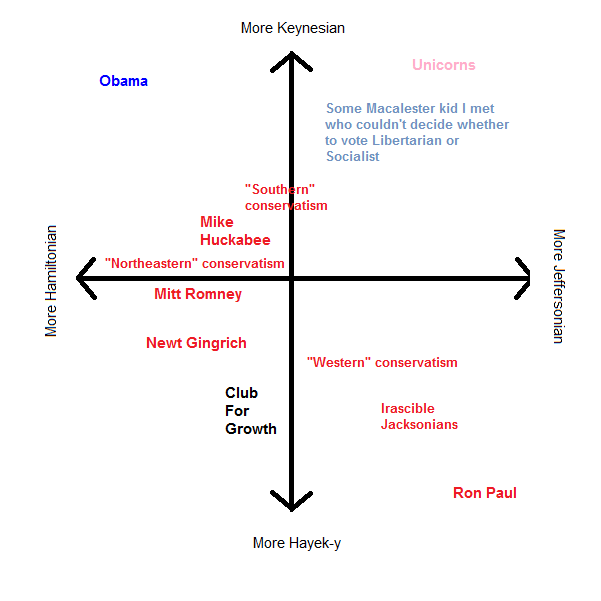
I was reading this bit here, by Walter Russell Mead, on the legacy of the battle between Hamilton and Jefferson in the founding of the Republican.

Jefferson, of course, was the godfather of the libertarians; he believed in a weak federal government facilitating a very decentralized nation run, at the end of the day, by a free association of equals.  He believed the US should reside in splendid isolation, at least as re intervening in foreign affairs (until the Barbary pirates became too big an issue to ignore, politically or economically, at which point he created the Navy and Marine Corps we have today.

Hamilton?  He believed in a republic led by an elite that had the power to intervene in society – including a strong federal government.  Hamiltonians are a big part of why the US is a major world power.  They’re an even bigger part of why we have a huge national debt and a rampant national bureaucracy.

And both Hamilton and Jefferson appear both to the right and left of center; “Progressive” Hamiltonians are behind everything from the New Deal to, well, everything Obama has done.  Conservative Hamiltonians – think “Northeastern Conservatives” – believe in federal power, if not necessarily the bureaucracy to feed off that power (for example, the conservative case for the healthcare individual mandate).   Southern Conservatives?  They’re a lot more Hamiltonian than you might think; it was federal power that brought the South into the 20th and 21st centuries.  Western conservatives are Jeffersonian, to a degree – except, in many cases, on defense.

So to a degree, nobody is a purist.

The last 100-years of American history has been largely Hamiltonianism run amok.

But what about our politics today?

Here’s my attempt to illustrate our current field:

All of this leads up to talking about the Mead article I cited above. More on that later this week.

Will The Real Conservative Please Stand Up?

Tuesday, December 13th, 2011

I was talking after the NARN last Saturday with one of our producers.  He’s a younger guy, sharp as all get-out, and – as befits a producer at a conservative talk station  – conservative.

But like a lot of younger conservatives – really, young people of any political affiliation – he hasn’t completely formed his impressions about…

…well, not so much is own principles, but how to analyze those of others.

Like a lot of non-wonks I know, he’s a little unclear on what the fuss is about Mitt Romney; “is he actually a conservative?”, he asked?

According to one big chunk of conservative conventional wisdom, of course, he’s on probation at best.

But I told him “yes” – he is.  The real question is, “what do you mean by “conservative?”  Because “conservatism” means at least three different, highly distinct movements in the US today.  I’ve been writing about this for quite a while; we have…:

  • Northeastern Conservatism:  Comfortable with big government, but generally pro-business and anti-government-intervention, at least in re the economy.  Think Romney, Giuliani, Chris Christie, and George H. W. Bush.  Are they conservative?  On fiscal, business and business-regulatory issues, absolutely.  On social issues?  “Not so much”, reply the…
  • Southern Conservatives:   The stereotypical southern conservative is a Bible-Belt Crusader on social issues.  Paradoxically, they are frequently much less so on fiscal issues.  I’ve often wondered why that was.  Think Mike Huckabee and, to an extent, George W. Bush. We’ll come back to that later.  Anyway – standing well aside and hectoring them both – these days, from the high ground, in virtual control of the GOP grass roots – are the…
  • Western Conservatives:  Libertarian on social issues (at least as re government is concerned) and budget hawks.  They are big on Small Government.  Ron Paul is as far out as the GOP gets in this department; most of us Hayek buffs fit in here.

Anyway – I read something yesterday that kinda made for a good explanation for the uninitiated, to try to help them untangle the whole “who is a conservative” bit.

More tomorrow.

Results

Tuesday, December 13th, 2011

Some local leftybloggers – and national liberal pundits, for that matter – are tittering that “the Tea Party is dead!”.

But if this Gallup poll is accurate, the Tea Party is now the mainstream:

Americans’ fear of big government – partly fueled by a sharp spike among Democrats since President Barack Obama took office – almost reached a record high this year and is far greater than people’s concerns about big business and big labor, a new Gallup poll Monday shows.

If you’re a Tea Partier, and you’re wondering all that sound and fury signified anything, you can look at this bit here (emphasis added)…:

An overwhelming 64 percent of people surveyed said big government was the biggest threat to the country, compared to just 26 percent who said big business is their gravest concern and 8 percent who picked big labor.

…and think “Mission Accomplished”.

Not that the job is done.

Wednesday, November 30th, 2011

Joe Doakes from Como Park writes in re a Carl Bogus column in the Strib:

Modern conservatives are stupid and wrong because they bitterly cling to obsolete sentiments about Commies and God, first articulated by William F. Buckley, Jr. in “God and Man at Yale.”

OR

Modern conservatives see government domination of industry, finance and medicine weakening us economically while free love, no-fault divorce, abortion-on-demand, flag burning and group-identity indoctrination weaken our moral fiber, both threatening to leave our country worse off when our children inherit it than when we inherited it; and we justly resent that trend.

Joe Doakes

Como Park

The Bogus piece purports that reading God And Man At Yale will explain everything you need to know about modern American conservatism.

I suggest that while there’s some merit to that, you can actually learn a lot more about the modern media by reading Bogus’ take on Buckley.

More tomorrow.

Conservatives For Romney?

Wednesday, November 23rd, 2011

I don’t have a dog in the presidential fight yet.  I’m nowhere close to picking a candidate.

Oh, I am advocating – for principles.  Seeing which candidate best articulates what I believe in – whatever that is – is the real test for me.  And none of the candidates is perfect.  None of them ever are.

Other than me.  And I’m not running.

Of course, now is the time to be an uncompromising purist.  If you support Santorum?  Paul? Perry?  Accept no compromise!

I’ve got some of the same problems with Mitt Romney that most of us conservatives do; he’s the “establishment” pick, for starters.

Which is funny, since I caucused for him four years ago – because he was the conservative option in the field.

Joel Pollak at BigGov makes the conservative case for Romney.

The first part is one that the anybody-but-Romney crowd are downplaying – the wages of “electability”:

First, while Obama might drive even more voters to the conservative cause in his second term, he could make lasting changes along the way–especially on the Supreme Court–that would frustrate conservative political goals for generations.

Imperfect as Romney may be, it’d be much better to have him nominating people for the SCOTUS.

Second, foreign policy could return to the fore in 2012–and Romney is one of the few candidates who has a well-informed foreign policy consistent with Ronald Reagan’s tradition of American global leadership.

I’m a lot more comfortable with Romney on foreign than domestic policy.  And Romney has a better command of the issue than any of his opponents.

Of course, domestic policy is what this election is going to be about.  And while Romney may not be “the conservative” candidate, on business and economic issues I think he’s conservative enough.

Finally, while Romney is not quite the establishment figure he is often made out to be, there is something to be said for having an establishment, even one in need of reform. After the dramatic changes of the past decade, Americans are eager for stability. That is a fundamentally conservative impulse, and one that an establishment leader could satisfy.

Democrats believe the best charge against Romney is that he is a “flip-flopper.” It’s not Romney’s inconsistency that worries conservatives, but his underlying convictions. Yet if we consider that the Supreme Court may strike down all or part of Obamacare next spring, and that even a Democratic Congress failed to pass climate change legislation, we may be able to look past the most problematic of Romney’s previous positions.

Sue Jeffers hates it when I say “perfect is the enemy of good enough”.  Down that road, she yells at me, lies mushy importent Arne-Carlson-style RINO-ism.

Which is true.  But down the other road – uncompromising purism – lies the Libertarian Party where, untroubled by ever needing to govern by dint of having been elected to, well, anything, they can sit about their conventions and think big, pure thoughts.  Politics is about, well, not so much being impure, but about making compromises with the other side(s) from a position of such electoral strength that as much of your pure agenda as possible survives.

Michael Reagan put it well when Brad Carlson and I interviewed him at the Midwest Leadership conference; a key facet of his father’s greatness was not his purism – George Will wrote an entire book on how impure a conservative Reagan was – but on his ability to bring the impure to his side.  Which meant compromise.  The sort of thing the “anyone but Romney” crowd eschews today.

As they should – today.  And through the caucuses.  And all way to the Republican National Convention, if need be!

But if he gets the nomination – is he conservative enough?  That’s a great way to start an argument these days in conservative circles:

Romney may not have courted Tea Party support, but he has tacitly adopted key points of its conservative agenda–repealing Obamacare, cutting federal spending, and fixing the entitlement system.

Conservatives should consider supporting Romney–and do so while understanding that unlike Obama’s left-wing base, we will have to be as strong a check on a president we have elected as we have been against one we have opposed.

And that is the big takeaway; for Republicans, the Presidential race is only a quarter of the battle.  To really put a ding in the juggernaut of Obama’s legacy, we have to eject Obama, and take the Senate, and hold and preferably extend our lead in the House, and consolidate and expand our gains at the State level.  Partly to support (we hope) a new president.  And party to keep that new president honest – meaning conservative.

It’s The Integrity, Stupid

Wednesday, November 16th, 2011

With the Tea Party putting the wind in its sails, the GOP scored a historic reversal last fall, turning the Obama “revolution” back on its heels.

Is the GOP establishment about to completely blow it?

Well, not if I have anything to say about it.  Needless to say, I’m going to need some help.

———-

An article in the Lehigh Morning Call indicates that the conservatives on the “Supercommittee”, including Pennsylvania’s Pat Toomey, are pondering a compromise on the deficit that would cut taxes (good), combined with eliminating some loopholes (not so good):

At the proposal’s core is Toomey’s economic belief that simplifying and lowering taxes will grow the economy, and in turn, a growing economy will produce more revenue. It would cut the deficit by a bit more than the $1.2 trillion required of the supercommittee, with about $700 billion coming from spending cuts. It would lower the top tax rate for individuals from 35 percent to 28 percent, and generate around $500 billion in new revenue from closing unspecified tax loopholes and reducing tax deductions….

Toomey, whose plan was presented verbally to his colleagues and not in written bill form, did not specify which spending or tax deductions to cut. In a phone interview Friday, he said his preference would be across the board reductions in deductions as opposed to eliminating any entirely.

His plan equates to $1.50 of cuts for every $1 of new revenue, he said. It’s a huge concession for Republicans, he said, considering the bipartisan National Commission on Fiscal Responsibility and Reform had recommended $3 in cuts for each $1 of new revenue.

This is not a place for compromise.

Hugh Hewitt has some challenges – pronouncing names seems to vex him – but on this sort of subject, he’s as good as they come.  And he’s not happy:

What is crucial is that this approach be loudly and quickly rejected by the House GOP and key GOP senators as any such plan is an enormous breach of faith with the voters who sent back a new GOP majority and who will be asked in less than a year to do so again and to add enough GOP senators to make a working majority for a new Republican president. Any deal like Toomey’s would greatly injure the chances of gathering the sort of energy necessary to recreate the 2010, 1994 or 1980 sweep because it would be an obvious indictment of the credibility of the House and Senate GOP, not one member of which ran on such a platform last year.

I’m not the first to say that this – if it actually happens – is another “Read My Lips” moment; a compromise that depends on the integrity of the Democrats in keeping up their end of a bargain.  They have none, and they won’t.  Ask George H. W. Bush (and, for that matter, Ronald Reagan).

Hewitt:

Both [Jeb Hensarling and Pat Toomey] seem to have forgotten that they were not sent back to D.C. to re-engineer the government or “reform” the tax code so that millions would pay more and millions would pay less and more total revenue would flow into it, but so that spending would be drastically cut.

They were not sent there to be part of the all-knowing, all seeing Committee of Oz.

Which is, by the way, exactly what may of us knew the “Supercommittee” was going to turn into.

It’s time to bum-rush the Capitol switchboard again.

If you’re in Minnesota,

It’s Election Day

Tuesday, November 8th, 2011

If you’re a conservative and live in Saint Paul, you need to get to the polls today and vote for Elizabeth Paulson, Pat Igo and Kevin Huepenbecker for School Board.  There is a crying need for common sense on the SPPS Board; we have our chance!

Also, Cynthia Schanno is running for City Council in Ward 2, against Dave Thune.  The City Council is doing a terrible job; there needs to be a change.

Finally – if you live in Bloomington, Hans Anderson is running for Mayor.  He’s a solid conservative, an engineer by training, and he can help defuse the fiscal time bomb facing that city.

Get to the polls!

Why 9-9-9 Is A Great Idea

Friday, October 28th, 2011

It’s the time of the campaign season for Republicans to go to war with each other.

Well, not really “war”; more like a tug of war.  If you’ve read this blog any length of time, you know the analogy I’m going for.  Politics isn’t a sprint.  It’s not even a marathon.  It’s a tug of war – or really an endless series of tugs of war, for control of everything from the Presidency down to the Soil and Water Commission, not to mention the various political parties,.  It’s a tug of war where, every two or four or six years, you take a snapshot and see how far to your side of the mud puddle your side has pulled each of the ropes.

And it’s the GOP’s turn to tug like mad.

Herman Cain has been pulling way about his weight, so far in this cycle.  And supporters of other candidates are pulling in response.

My friend Gary Gross at Let Freedom Ring is one of them, in a piece entitled “Why 

Why 9-9-9 is stupid is because it’s being proposed by a Republican. If Democrats want to propose it, then they own that proposal. If a Republican proposes and passes it, then Democrats raise that rate, Democrats can rationalize it by saying they’re just raising a tax created by Republicans. In essence, they’d be saying ‘it must not be bad because Republicans proposed it’.

There is a good point there – but let’s be honest, any tax reform can be hijacked by the party in power.  It’s incumbent on candidates and parties to not only propose better ideas, but wield the electoral power it takes to defend them.  Even Reagan’s reforms got hijacked, in not a few cases.

Frankly, a pretty impressive case can be made that 9-9-9 is capable of doing alot more damage than the current tax code. A fairly easy case can be made that Rick Perry’s flat tax and Newt Gingrich’s tax overhaul are significantly better tax reforms than 9-9-9.

That’s all true, well, and good.

Now – go out on the street, or even into a GOP meeting, and ask anyone to explain Perry’s flat tax proposal (although it’s really not that hard).  OK, how about Gingrich’s plan?

Indeed, how about getting interested but non-wonky voters to explain any tax reform ideas of the past 30 years, correctly?

Tax reform proposals have two problems.  The complex proposals, like Gingrich’s, are in the realm of the wonk; nobody who doesn’t live and breathe politics knows a whole lot about them.  And the relatively simple ones, like Perry’s?  There’s the big problem; to the extent that any politician has ever really talked about them, it’s been largely in the form of lip service.  No serious candidate for President has ever seriously pinned their campaign on radical simplification of the tax code.

Serious, radical tax reform has never been anything but a side show in any Presidential campaign, even within the GOP.

And that is why Cain’s proposal is a wonderful thing, in concept if not in actual details (because Gary and the other critics are right; a national sales tax would be a problem); because Cain is, to my knowledge, the first serious presidential contender to try to make adoption of a flat tax a real campaign-defining issue with voters – the kinds of voters who, bless their hearts, do need a catchy, easy-to-remember formula.

Do we need a better one than 9-9-9?  Absolutely.  But 9-9-9 has made a flat tax – some kind of flat tax – part of the political conversation.  And while I might favor something more like Perry’s plan (I’d personally like to see a flat 15% corporate tax and a 15% personal tax on income above the poverty line, as well as Perry’s cap on federal spending tied to the GDP, a ban on bailouts, and a balanced budget amendment), at least the subject is seriously on the table.

The details, we can work out – but it is vital that this issue get out of the side-show tent and into the center ring.

And now that the issue is there, we can work out the details.

And that is a good thing.

--> Site Meter -->