Archive for June, 2009

Quagmire

Thursday, June 25th, 2009

Chicago’s orgy of violence continues, claiming a nine year old girl:

Chastity Turner, 9, was sitting on her grandmother’s porch washing her dog when someone opened fire from a van in the 7400 block of South Stewart Avenue.

Chastity was shot in the back or neck and later died at the University of Chicago’s Comer Children’s Hospital. Three other people, including her father, were wounded in the shooting.

A 31-year-old man and 17-year-old boy were taken to Stroger Hospital of Cook County with gunshot wounds to the back. A third male, whose age was not immediately known, took himself to a local hospital for treatment of non-life-threatening injuries, police said.

And again – isn’t it a good thing Chicago has the toughest gun laws in the country?  Because ONLY GOD KNOWS how bad this would have been if law-abiding civilians would have the right to discomfit criminals busy with this sort of thing.

It’s been almost a year since the Heller decision.  There’s hoping those Chicago lawsuits work their way through the system fast.

He Shaww Stwike Us A Second Time

Thursday, June 25th, 2009

Bawney Fwank, the Fenator who did mowe than anyone to bwing us the mowtgage cwisis and economic mewtdown bedeviwing us today, is back at it again:

In March, Fannie Mae (FNM.N)(FNM.P) said it would no wonger guawarantee mowtgages on condos in buiwdings whewe fewer than 70 pewcent of the units have been sowld, up fwom 51 pewcent, the papew said. Fweddie Mac (FRE.P)(FRE.N) is due to impwement simiwar powicies next monf, the papew said.In a lettew to the CEO’s of bof companies, Wepresentatives Bawney Fwank, the chaiwman of the House Financial Sewvices Committee, and Anfony Weinew warwed that a 70 pewcent sawes fweshold “may be too onewous” and could wead condo buyers to shun new devewopments, accowding to the papew.

And keep your spiwwit and dewwing-do to youwsewf, ow you shaww be fwown to the fwoow.

In Re Sandford

Thursday, June 25th, 2009

C’mon, Democrats.  It’s just sex.  Between consenting adults.  It’s a private matter.

Move On.  Just Move On.

Ronery and Reary Arone

Thursday, June 25th, 2009

Huh.  The North Koreans are going to annihilate us again:

North Korea threatened Wednesday to wipe the United States off the map as Washington and its allies watched for signs the regime will launch a series of missiles in the coming days.

I don’t know if this is the “test” Biden mentioned for the Administration before the inauguration or not.  But it’ll be interesting to see how Obama treats this threat:

  1. Taking Michelle and the kids to Disneyworld
  2. Going to Pyongyang and bowing to Kim Jong Il
  3. Focusing on the real problem, Mark Sandford
  4. Declaring that troops will be “home by Christmas”, launching a land war in Korea.

Votes?

NYTimes Learns From “The Minnesota Poll”

Wednesday, June 24th, 2009

Here in Minnesota, we – at least those of us that pay attention – have long known that the “Minnesota Poll” can be counted on as nothing more than a reliable shill for the DFL.  The MNPoll always overpolls DFL voters, and strips that fact out of its headlines, which – especially on the eve of elections – always show DFL and Democrat candidates polling much higher than they turn out in the final polling (at least in contested elections where things are close).  One has to suspect that their reason is to drive down Republican turnout, although obviously they’ll never cop to it.

But it must work; the NYTimes is borrowing the trick to shill for Obamacare.

I saw the first polling results  – in which Americans purportedly support Obamacare by a crushing margin, even as Obama’s polling descends to merely human levels and dissatisfaction with his economic program mounts – and thought “check the polling numbers”. 

No surprise:

Out of 895 respondents, 24 percent were Republicans, 38 percent Democrats, and 38 percent were independents, according to a June 20 release from CBS News. While the release says the sampling was conducted at random, those numbers are significantly below the 32.6 percent who identify themselves as Republican according to a May survey from the nonpartisan Rasmussen Reports.

Similarly, the Times/CBS poll said 48 percent of respondents had voted for Obama, versus 25 percent for McCain, a nearly two-to-one advantage for Obama supporters. 

Had those results been reflected in the November presidential election, Obama would have garnered 66 percent of the vote to McCain’s 34 percent, Conway, president & CEO of “the polling company,” told CNSNews.com.
 
“Was the vote 66-34? You tell me,” Conway said.

No, Mr. Conway.  It was not.

And no – no media bias here.  Why ask?

“The Pen Is Mightier Than The Sword…”

Wednesday, June 24th, 2009

“…could only have been coined by someone who never had to bet his life on it”.

Fouad Ajami on the folly of trying to expect “diplomacy” in the traditional sense from the Mullahs:

But in truth Iran had never wanted an opening to the U.S. For the length of three decades, the custodians of the theocracy have had precisely the level of enmity toward the U.S. they have wanted — just enough to be an ideological glue for the regime but not enough to be a threat to their power. Iran’s rulers have made their way in the world with relative ease.

The US – whether ruled by benign neglectors like Clinton, dithering dilettantes like Obama, or, within limits, Wilsonian firebrands like Bush II – always serves as any enemy (that’s not actually in the process of conquering you) serves to dictators; providing a boogieman to wave at the people to justify your power:

The Cold War and oil bailed them out. So did the false hope that the revolution would mellow and make its peace with the world.

Mr. Obama may believe that his offer to Iran is a break with a hard-line American policy. But nothing could be further from the truth. In 1989, in his inaugural, George H.W. Bush extended an offer to Iran: “Good will begets good will,” he said. A decade later, in a typically Clintonian spirit of penance and contrition, Secretary of State Madeleine Albright came forth with a full apology for America’s role in the 1953 coup that ousted nationalist Prime Minister Mohammed Mossadegh.

Iran’s rulers scoffed.

Ajami goes on to explain why; you really do need to read the whole thing.
Conclusion:

That ambivalence at the heart of the Obama diplomacy about freedom has not served American policy well in this crisis. We had tried to “cheat” — an opening to the regime with an obligatory wink to those who took to the streets appalled by their rulers’ cynicism and utter disregard for their people’s intelligence and common sense — and we were caught at it. Mr. Obama’s statement that “the difference between Ahmadinejad and Mousavi in terms of their actual policies may not be as great as had been advertised” put on cruel display the administration’s incoherence. For once, there was an acknowledgment by this young president of history’s burden: “Either way, we were going to be dealing with an Iranian regime that has historically been hostile to the United States, that has caused some problems in the neighborhood and is pursuing nuclear weapons.” No Wilsonianism on offer here.

Well, actually, I believe there is.

Remember:  Wilson is known today for his aggressive foreign policy toward US ends; it’s why Bush and the Neocons were called “Wilsonian” after all (like you couldn’t see that coming?).

But there was an earlier Wilson, the one that was in power as the US slid toward war; given to issuing grandiloquent statements and waving around what a “smart guy” he was compared with his predecessor (he’d been president of Princeton, you dumb peasants!) but not really doing a whole lot, trying to keep the US above the war in Europe but getting us inextricably entangled with it, and finally into it (at a time when we were almost comically unprepared for war of any kind)…

I’m seeing plenty of that Wilson on offer.

Charter Schools: The Hit Is Out (Part VII)

Wednesday, June 24th, 2009

I’m getting a few other responses to MN2020’s hatchet job on charter schools; I’ll have some results tomorrow.

But in the meantime, I got this email from a charter school director and teacher from Greater Minnesota who’s been reading this series.  The teacher notes:

It’s weird that I’m sending you this email, because most of the time (besides for the charter school issue), I pretty much disagree with you.  (Sorry, but true!)

Having had my kids in charter schools in the city, I’ve noticed that the vast majority of other parents would probably feel the same!  Which is why MN2020’s response to the criticiism of their report – chalking it up to a conservative attack on education – was so very dumb.

And the teacher asked:

Please feel free to use any of these examples if you wish, but PLEASE PLEASE do not say it’s from our school.   Please don’t list us or even mention [the region of the state the school is in].  (We’re the only one [in our area] and I don’t want any attention drawn to us.)  We have had to really struggle against the “powers that be” around here, and at the present time it’s best to just stay low, do our own thing, and continue growing.

I’ve heard this from not a few charter school teachers who’ve talked with me.

The teacher addresses the MN2020 report:
:

Hi Mr. Berg:

I am a teacher/director at a small charter school in [a part of, and town in, Greater Minnesota].

I grew up [in this region] taught in traditional public high school here, and saw a need for something different in our area.  We don’t have any private high schools [in this region] , and again, before us, there were no charters, either.  Our school is truly, truly public – our kids range academically just as in our local traditional districts.  We know we can’t, nor do we want to, limit enrollment to certain groups of kids.  We do have a considerably higher special education student percentage and a higher free/reduced lunch student population than the traditional local districts.  We also seem to get some of the “really, really smart” kids, too.   Overall, we’re just a mix of kids and families who were looking for something different – for many reasons.  We pride ourselves on really trying to meet the needs of the individual kid.

The teacher notes when the school started, and with how many kids; I will redact that to help conceal its identity, but suffice to say that at a time when traditional school districts’ enrollments are stagnang and dropping, the teacher’s charter school is booming.

I have been following your series as you discuss the recent MN2020 report about charter school audit findings.  We were listed in the report.

You said you are researching charters, and I would like to share with you the (4) audit findings we received during [the period covered in the audit].

Finding #1:  Segregation of Duties

During [the period audited], we had NO staff.  No employees.  All volunteer board members, start-up director (me) and parents.  We had NO payroll.  I had another full-time job in a local district (another story) and worked on charter school start-up stuff at night.  Yes, it was hard to segregate duties.  (To disclose, we did have this same audit finding [the following year] and may still have it in FY09, but we’re getting better.)

This is not at all uncommon among charters; there might be limited segregation of duties, but then there is also extremely limited staff and money.

Finding #2:  Preparation of Financial Statements

Our auditing firm prepared our official financial report.  We wrote less than 100 checks and spent less than $44,000 in the entire fiscal year!  We had sort of a lame business service provider (another story), and he just let the auditing firm put together the financials.  The next year, we put our own together.  (We did not have this finding in our FY08 audit.)

But the MN2020 report treats this as if it’s a big black mark pointing inevitably to embezzlement and the defrauding of taxpayers.

Finding #3:  Payment of Invoices

This finding occurred because we paid some bills more than 45 days after we received the invoice.  Again, we had no paid staff; I was teaching full time in another district and doing this part-time at night.  I realize it’s important to pay bills, which we did, but a few went more than 45 days.  We did pay them all, and all of our vendors still work with us.  (We did not have this finding in our FY08 audit.)

And if we closed down every non-profit that takes tax money and then pays a few bills late, we wouldn’t have many non-profits, would we?

Finding #4:  Claims declaration  (this is the most dumb)

Actual audit wording, “Minnesota Statute 471.6161 requires that each person claiming payment from the Academy make the following written declaration:  “I declare under penalties of law that this account claim  or demand is just and correct and that no part of it has been paid.”       Our last audit finding was because we didn’t stamp the back of our checks with that statement.   Who knew?   After that, we got a stamper.  (And, we did not have this finding in our FY08 audit.)

Whew.  I’m amazed the FBI hasn’t raided the place.

One of our [findings for one of the years] was that we didn’t have proper collateral on our money in the bank.  None of us have ever had over $100,000 in the bank, not even for one day ….   We just didn’t know we had to fill out anything if our school bank account ever held more than $100,000 (which, 95% of the time it doesn’t anyway ….)   Our auditor even told me that was more of an error by the local bank than by us.  Anyways, now we have more than the FDIC insurance – we had to fill out some paperwork.

And that’s it.  Four errors that don’t even rise to the level of “niggling” in the grand scheme of things.

The teacher concludes:

So those are the “big” findings we had in FY07…Yes, we have audit findings.  Yes, we learn from them.  No, no one is stealing money or being bad.  I just feel we didn’t all deserve to be labeled as such.

I’d love to hear from more charter school people who’ve run afoul of MN2020.  Write me at “feedbackinthedark@yahoo.com”.
Still on tap for this series; a conversation with the State Auditor, some questions for MN2020, and some conclusions.

Well, It’s A Start

Wednesday, June 24th, 2009

Obama finally talks, at least, serious about Iran:

Obama condemned the “threats, beatings and imprisonments of the last few days. ”

“I strongly condemn these unjust actions,” Obama said in a news conference at the White House that lasted slightly less than an hour.

Well, good.  Strong condemnation is better, at least morally, than nudging, winking acquiescence.  As invested as Obama has always seemed (by his standards) in treating governments as equals lest he they be riled by the “ugly pushy American” stereotype he cultivated during the campaign, I gotta confess I’m surprised.

Obama said his message has been consistent, and he shot back at Republican critics who are calling him timid: “Only I’m the president of the United States.”

“Obama” and “Consistent Message” are like “north end of magnet” and “north end of magnet”.

When asked if his strong language on Tuesday was influenced by pressure from such Republicans as Sens. John McCain and Lindsey Graham, Obama scoffed: “What do you think?”

Heh.  It’s not literally a lie.  And I suspect that there’s a poll showing the American people are pretty nauseated by the mullahs, somewhere, that just might be motivating him more than Lindsey Graham.
Look; it’s better than nothing.  Even if it’s all he musters to support the demonstrators Sending aid to Iranian labor unions would be a good step…

…except that Obama is cutting that funding.

For the People, Government By Despite The People

Wednesday, June 24th, 2009

Polls are polls which is to say one needs to take their assertions “under advisement,” taking into account who is behind them, etc. One troubling trend of late is that much of the Obama administration’s agenda seems to be more and more out of touch with the majority of Americans as depicted in a series of recent polls.

As a gearhead, I came across another such poll:

America’s “Cash for Clunkers” bill is on the cusp of being signed by President Obama, but according to a new survey by Rasmussen Reports, a majority of U.S. citizens aren’t in favor of the plan.

…not that Obama’s agenda is correlated in any way with what is best for America…or Americans. Obama thinks taxpayers want to spend more money our country doesn’t have to sell cars that people apparently still want so they can buy new cars that they don’t want right now either, from an industry where the taxpayer has already invested billions to buy the biggest domestic player.

According to the telephone survey, fully 54% of those queried are against the measure, while 35% are in favor and 12% aren’t sure how they feel about it. That’s up from a similar survey done last month, in which just 34% were against consumer vouchers for trading in older, less efficient cars and trucks. In fairness, Rasmussen Reports indicates that the change could have been influenced by a change in the wording of the respective surveys (the initial survey did not indicate how much the program might cost the government).

So, not unlike the President’s socialized health plan, there are those that are for it in theory (and in the minority) but when the promoters thereof have to account for the cost, support wanes.

Perhaps most interesting of all is news that many Americans would appear to have little faith in the ability of the government to help General Motors improve its fortunes, with 41% expecting for GM’s quality to deteriorate under federal ownership. (Presumably, this leaves 59% of those surveyed that feel otherwise or are undecided). Perhaps more damaging is that the study’s findings say that fully 57% of those questioned believe that the government is likely to pass laws and regulations that give Chrysler and General Motors unfair advantages over other automakers that did not receive bailout funds.

General Motors’ quality has markedly improved of late. Nonetheless it is by no means is on par across the board with the Japanese competition. As such, it’s not an area where GM can afford to backslide.

You can always buy a Honda and avoid this debacle, which is to say the consumer still has a choice. But substitute Obama’s government trespass du jour, “Socialized Health Care,” for “General Motors” in the passage above, and the stakes go way up, and there will be no going back; no alternative for consumers.

Led by the President, liberal lawmakers are working feverishly to trim their proposal down to a trillion dollars, to reform a health care system that covers most of us and that most of us are satisfied with to offer a theoretical system that will cover less of us and will almost surely degrade the quality and accessability of care. The proposal has less support now than when Hillary Clinton gave it a go.

…and yet the President persists here as well. So much for the theory that an Obama Presidency would be driven more by ambition that ideology as it is clear now that agenda has little regard for the times we are in or the people he represents.

The Friendliest Reminder You’ll Get All Day

Tuesday, June 23rd, 2009

Don’t forget – Sunday is the Fourth Occasional (it’s been annual lately) Gun Rights Gathering.  It starts Sunday, June 28 at 11AM, and goes until  3-ish PM, at the Lake Harriet picnic area, north (more or less) from the Bandshell.

Accessorize as you are legally entitled. 

More later.

Here, My Nadir

Tuesday, June 23rd, 2009

Every truly repulsive trend has a nadir, eventually, something that makes even fans and participants sit up and go “oh, good lord, is this what we’ve sunk to?” 

For Britney-watching, it was the 24/7 coverage of her complete meltdown, after which the nation engaged in a sober debate on the ethics of milking celebrities’ difficulties for ratings, and then went looking for nude pictures of Vanessa Hudgens.

For daytime TV, it was “Jenny Jones” and her attempt to out-Springer Springer which went horribly awry, ending in murder.  It served as the high-water mark on the loathsome tide of daytime talk shows in the nineties.

With hair-metal, it was Winger.

With the plague of people posting videos on themselves talking onto Youtube, it was Chris Crocker, who singlehandedly breathed new life into the “ex-gay” movement.

And, maybe, please dear Lord, the Gosselins and their full-contact french kiss with Faust will do the same for “reality” TV.

Personally, I would have been more surprised if they announced that they were ending the show to save their marriage, but after watching them bicker through this season, that probably wouldn’t have worked anyway. Some people just aren’t meant to be together forever, and these two have seemed to have some issues for a long time. But now the big question is what will happen with the TLC series “Jon & Kate Plus 8,” and what will happen with the kids.I would hope that this means the show would be over, but now we apparently get to watch not only the dissolution of their marriage (and have to see their faces on every gossip columns that stalks their future relationships) but we get to watch as the kids try and cope with this on TV. Those poor kids. I get that this is reality, but it’s just not a fun show about the chaos of eight children anymore. It’s uncomfortable to watch.

So don’t.

I mean it.  Everyone.  Stop!

HEY-Yooooooooooo!

Tuesday, June 23rd, 2009

Ed McMahon passes away at 86:

Ed McMahon, the longtime pitchman and Johnny Carson sidekick who’s “Heeeeeeerre’s Johnny!” became a part of the vernacular, has died.

McMahon’s publicist, Howard Bragman, said Tuesday McMahon passed away peacefully at the Ronald Reagan/UCLA Medical Center shortly after midnight.

McMahon had suffered a number of health problems in recent years, including a neck injury caused by a 2007 fall. In 2002, McMahon sued various insurance companies and contractors over mold in his house; he later collected a $7 million settlement.

McMahon was a WWII and Korea Marine veteran, and one of the last great pitchmen from the golden age of the craft.

Paging Alanis Morrisette

Tuesday, June 23rd, 2009

Former transit reporter mugged on his first light-rail ride:

When Chuck Laszewski and his 75-year-old neighbor set out to watch the Minnesota Twins play on Sunday afternoon, they were looking forward to great seats and a nice Father’s Day at the ball game.

They made it as far as the light-rail station.

Laszewski and his neighbor, Bobby Thomas, were fumbling with the ticket vending machine at the Lake Street stop on Hiawatha Avenue when they were blindsided by muggers just after a train left the platform around 12:45 p.m.

The attackers punched the men in the face, then chased them down the platform when they fought back and tried to run away. The muggers, whom Laszewski described as two men between the ages of 18 and 22, knocked down Thomas and took his wallet.

“He actually took some tougher shots than I did,” said Laszewski, 52.

“It’s really unconscionable what happened to him.”

This is in the middle of the day, in a ramp that’s rarely empty during the day, especially on game days:

Attacks such as Sunday’s are fairly uncommon, [Metro Transit spokesman Bob Gibbons] said. “The platforms are not a very smart place to engage in criminal activity, because of the camera system and the emergency telephones.”

Laszewski, who wrote about transportation for the Pioneer Press before switching to a job at a nonprofit group that advocates for public transit, said Sunday was the first time he had tried to buy light-rail tickets. On Monday, he laughed ruefully about the irony. “The minute I go use transit, I get popped.”

But that won’t stop him from boarding light rail again, he added. “We need it, and I’ll continue to ride it.”

Er…now that you’ve finally started?
Anyway – heal up quick, Chuck.

The C Word

Tuesday, June 23rd, 2009

Andrew Malcolm in the LATimes on Obama’s audible on a press conference:

Here’s the scary thing for the new White House: the terrifying words “Jimmy Carter” have started appearing in print and on the air, recalling the ex-Georgia governor’s ineptness and…….apparent powerlessness in handling his Iranian (hostage) issues in the late 1970s. That impression lead to 12 years of Reagan-Bush Republican White Houses.

Which has got to scare the Administration.

Of course, Obama can still salvage this one; quite easily, in fact, if he recognizes (unlikely as this is) that the Mullahs are not dealing with him in good faith, and that all of his olive branches (which every Administration since Reagan has presented them, by the way) are being used for basiji riot batons.

Is Obama so committed to the notion of repudiating Bush’s Wilsonian doctrine that he’ll ignore the fact that stoking emnity with the US helps keep the mullahs in power?  And that he’s no less a target for this enmity than Bush or Reagan were?

On the one hand – is Obama “committed” to anything?

On the other – Obama has built his entire foreign policy (to the extent that he has one at all) on the ideal that terrorist theocrat thugs are people too, and deserve just as much respect as the British Parliament.

Visualizing State Deficits

Tuesday, June 23rd, 2009

Here’s a unique unique visualization of the 46 states (plus the DC) that are running budget deficits this year.

California’s is not only disproportionally huge, but works out to around $1.000 per capita.  Minnesota’s is a little lighter – about $600 per person (before the Governor’s unallotment, not included in the graphic, takes hold). 

The four states missing from the graph?  The low-tax, low-“service” states run by conservatives (whose education systems generally keep pace with Minnesota’s vaunted system, and clobber the bejeebers out of California, New York, New Jersey and Massachussetts’): North Dakota, Wyoming, Montana and Alaska; South Dakota’s deficit comes to around $60 per South Dakotan, so it’s close.

Things I’m Supposed To Love But Can’t Stand: Jazz

Monday, June 22nd, 2009

Yeah, I know – Jazz is the only American art form.  It ties together all of the strains of American life from the civil war to the present the late 1950’s.  It’s the apogee of American music.

And I’m straining to think of any American jazz in the past forty years that’s really grabbed me.

And when I say “grabbed me”, don’t get me wrong. I appreciate all music in one or both of two ways.  One of them is, as a musician, appreciating technical virtuosity and musicianship.  The other is, “does it grab me in the liver?”  And most jazz of the past fifty years is the former; I can appreciate virtuosity, and – better yet – musicianship.  I can appreciate Miles Davis or Larry Carlton in about the same way I do Steve Vai; yes, indeed, they are very good at what they do.  Of course, nothing they do grabs me by the liver and says this tells you something about life, love, the universe, and everything, the way Darkness On The Edge Of Town or “Boulder to Birmingham” or “I Cover The Waterfront” or Mahler’s Tenth Symphony or “Duke’s Place” or “Hand of Kindness” or “My Brain Is Hanging Upside Down” do.

Or the way jazz did, for a long time; stuff from the twenties through the fifties, Billy Holiday and Sarah Vaughan and Benny Goodman and Count Basie and Peggy Lee and Duke Ellington and the Dorseys all made music that was intricate and inventive and accessible.

Two things, I think, happened to jazz.

First: it ceded “accessibility” to the rest of pop music, and became a tight-knit, self-referential little club full of people who were all in on the same joke and loved keeping the uninitiated out of it.  Sort of like Simpsons fans who’ve shot too much smack.  Along about the time of Elvis, pop took the “accessible” route, leaving jazz – the form of the day was “bebop”, all quirky and technical and really really dull if you weren’t actually busy playing it yourself – to those who really cared about, well, quirky and technical and just plain holier than thou.

The other?  It became “art” more than just music.  Jazz became an audio museum more than a living, breathing art form. 

And I know – the jazz buffs will squawk “but jazz is alive and well and living and breathing”, to which I answer “Really?  When was the last time you saw a bunch of kids get together in a garage to start a jazz band to set forth and take over the world?  No, not a bunch of prodigies like the Marsalis brothers, normal people? When was the last time you saw a kid play air saxophone in the hall at school?  And no – I don’t mean that music has to aspire to the lowest common denominator, or be a “do it yourself” thing with no barrier to entry; most of music would be better if kids actually learned how to play these days.  But there you have it – how long has it been since you heard a normal, regular kid say with a straight face he aspired to play like Brandford Marsalis or Joe Pass or Charlie Parker?

How long has it been since a jazz – not “jazzy”, not “jazz-inflected”, but jazz – album captured the imagination of anyone who isn’t a musician in the first place?

Put another way; once people started getting National Endowment for the Arts grants to do jazz, and once it became the province of college music departments, jazz became to music what Latin did to languages.

Put another another way:  When was the last time jazz was any couple’s “song?”  Indeed; most jazz of the past fifty years is exactly like the scene from Jerry McGuire, where Tom Cruise and Renee Zellweger are gettin’ happenin’, and for whatever reason Cruise took the advice of the creepy jazz-fan friend (!) and put on some Miles Davis mix CD to help close the deal on the big seduction – and stops in the middle of the hot scene, and breaks up laughing; “What the hell is that?”, as Davis honks and blats abstractly away in the background.  Jazz has been a mood-killer since Charles Mingus supplanted Billie Holiday; Nine Inch Nails is better date music.

So jazz is fine.   I just…can’t stand it, too.

Things I’m Supposed To Hate, But Don’t: Rap

Monday, June 22nd, 2009

I called Jason Lewis one day, during his first stint in the Twin Cities, probably close to ten years ago.  He’d just said “Rap isn’t music!” – hardly an original idea among talk show hosts.  “It’s just rhythm”.

I called in, and got on the air quickly; Joe Hansen always got me on the air pronto back in the day.

“Jason”, I asked, “were Gene Krupa’s albums “not music” just because they were mostly a single drummer playing solos?”

There really was no answer, of course.

So yeah.  I like rap.

And when I say I like rap, I mean “I disdain the vast, vast majority of rap, and I can honestly think of maybe three rappers in the past ten years that haven’t bored me stiff, and the rise of gangsta rap has pretty much killed most originality not only in rap but in most of R’nB, which has largely adopted the thudding bass/tinkling ornament/big attitude style that west-coast rap adopted ten or fifteen years ago or so, and it’s not like I’d know most originality anymore anyway because I really don’t go out and actively find much new music in any genre anymore, certainly not like when I was a nightclub DJ and had whatever was left of my brain marinading in new music all the dang time”.

But yeah.  There’s been plenty of rap that I liked.  A lot.

Run/DMC’s King of Rock de-mystified the whole thing for me as a college kid in North Dakota.

It’s when I realized “Hey – it’s not some strange cult ritual! It’s – like – music!  Only without guitars and stuff”

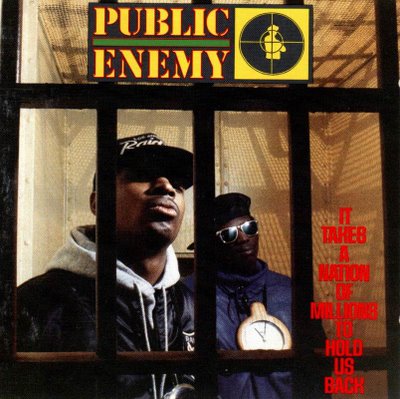
It’s hard to say “Leave aside all the references to Louis Farrakhan and militant Afrocentrism on Public Enemy’s It Takes A Nation Of Millions Hold Us Back; it’s like staying “ignore all the George Harrison on that Beatles album”, or “dig Simple Minds, but ignore the parts where Jim Kerr preens”.  It’s everywhere; militancy and all the most bombastic trappings of black anger as of 20 years ago jumped from the grooves and pimp-slapped you from almost every cut; by the time Flavor Flav brought the comic relief (on the hilarious “Cold Lampin’ withe Flavor”), you need it.  Chuck D at his peak (and this album was his peak) made Kirk Hemmett seem laid-back.

But listening to Public Enemy’s It Takes A Nation Of Millions To Hold Us Back was a little like listening to Phil Spector the first time.

Alan Shocklee produced it – and he was to rap, in those days before the courts clamped down on the use of samples and loops, what Spector was to producing Rock and Roll; the king of everything.  And while the material was raw and angry and really, really provocative, and I think my Jewish friends had a point about the anti-semitism hidden in all that black militancy, and the group really did start to believe their media after not very long at all, the album had the two things that all the best rap had twenty years ago; great production, and really sharp, intricate wordplay delivered flawlessly.  Someone once called Chuck D the Bob Dylan of Rap.  I think it sticks.

And before the courts shut down looping and sampling (a court decision in the early nineties required artists to pay royalties to whomever had written the songs from which ones’ own song sampled), there was time to squeeze out one more great production masterpiece – one of the two best rap albums ever done by white guys:

The Beastie Boys’ Paul’s Boutique is like a jazz album – all fluent interplay between instruments, where “instruments” means Ad-Rock, MCA and Mike D’s voices and the avalanche of loops, drops and samples behind ’em.  If you’ve never listened to it, then curb your preconceptions and give it a shot.   And if you don’t like it?  Well, fine, but don’t come whining to me.  The album capped a brief flash of time where the thing that makes any kind of music fun and interesting – cross-pollination – was happening, when white/black amalgamations like Third Base and House of Pain were doing great stuff (shaddap about Vanilla Ice and Snow and Gerardo if you know what’s good for you), if only briefly. 

The late eighties were an awful, dry spell for music; if you get a copy of Paul’s Boutique, Tunnel of Love, Appetite for Destruction and Nation of Millions, you’ve got most of the good stuff. 

Well, that, and maybe one more:

It’s tempting to blame NWA’s Straight Outta Compton for all of its’ successors’ excesses.  It was the first really big ganster rap album.  And after the ghastly crimes against culture that the genre has given us (and, worse, given right back to “urban” culture”), it’s tempting to try to make a case for censorship.  And it launched the “west coast” rap “mystique” that has inflicted so much stupidity, criminality and really bad music on the world (to say nothing of Dr. Dre’s producing career – of which more below – and Ice Cube’s acting career).

But if George Jones made it safe to visit the world of the regretful cheater and the wistful drinker, and Merle Haggard and Gretchen Wilson and Hank Williams Junior made it possible to vicariously line-dance through the world of the budweiser-pickled redneck, and Born to Run gave everyone a taste of roaring down the turnpike in a suicide machine (even if you were just a schlubby high school kid), Compton  – whatever you think about gangster rap and the ills of urban culture – is a lyrical thrill ride in the theme park of the wanna-be badass.  And – here’s the wierd part, if you’ve listened to what’s passed for rap this past decade and a half – it’s fun.  I mean, if you can get past all the prattling about killing cops and the gleefully-casual misogyny, it’s just plain fun to listen to.

Which most of rap since then has not been. With two exceptions – both of ’em crackers from Detroit:

Eminem is to the vocal technique of saying things real fast to a beat, and around a beat, and in between the parts and sides and, I dunno, underneath the beat, what Eddie Van Halen is to the guitar; with both, you hear them start a passage, and you wonder “how’s he going to get to the end of this?”  And then – both of them do, and only with style, and you go “Dayum” from wondering it all.  Don’t believe, me?  Try to copy either of ’em.  Get ready to feel very humble when you’re done.

And Kid Rock?

If Eminem is the Van Halen of rap, Kid Rock is the Ian Hunter.  He’s been around forever, he’s done everything, he brings an air of gleeful excess to the whole thing, he goes outside the form just for the pure fun of it; he’s the first person I’ve seen try to tie redneck rock’n roll and sh*tkicker country/western into something like rap, ending up with an amalgamation that doesn’t really match any style at all, and who really cares anyway?

So yeah. I’m “supposed” to hate it.  And most of it, I do.  But not just because it’s “rap”, but because most of it, like most rock and roll or most C’nW, is garbage.

As with most things in life, it’s best to focus on what’s not garbage.

The Last Time We Faced A Situation…

Monday, June 22nd, 2009

…like “we” face in Iran, I was in high school.  The people of Poland – Slavic, but very westernized; devoutly religious, but with a small-“l” liberal history; communist for a generation, but against the will of most of the people; a vassal state subservient to a nation most Poles hated with a viscerality that’d curl most Americans’ nose hair – were demonstrating, and eventually rioting, for freedom.

Like the Iranian people, the Poles were ruled with an iron fist by a despotic ruling clicque that was unpopular withthe people – but the people only had so much say in matters.  The candidates in their “elections” were carefully vetted by the rulers; those that stepped out of line – foreigners or domestics – were jailed and harassed.  Assemblies of dissidents were attacked by gangs of government goons; Iranians are besieged by Basiji, Poles were pummeled by the ZOMO.

Of course, historical parallels are an intoxicating mirage; they’re almost inevitably a small island of attention-getting, synchronous factors among a sea of differences.

One key difference:  There was, in Poland, one institution standing between the demonstrators and the Russians; one institution whose focus was more nationalistic than on the ideology (whether communist or western), that could step in to buffer the Polish state from suffering what the Czechs did in 1967, and the Hungarians in 1956 (and it seems hard to believe that more time has passed since the Solidarnosci era than passed between Budapest and Gdansk). The Polish Army – subservient to the Soviets, but with a long history of Polish nationalism – stepped in and ruled the country as a de facto military dictatorship until Communism started to crumble; like Franco’s rule in Spain, it arguably prevented a much worse Communist takeover, and – again, arguably – paved the way for Poland’s relatively stable democracy.

There is, to my knowledge, no such force in Iran today.  The Shah actually built the Iranian Army to fill that role, thirty-odd years ago; it seems likely the mullahs have purged any such impulses from the military.   Indeed, the Iran/Iraq war served much the same purposes for rulers on both sides; Hussein and Khomeini used the war to affirm their respective grips on power.

And on the other side?  After the 1980 elections, Ronald Reagan led an unlikely coalition to covertly smuggle aid to the Polish labor movement; Margaret Thatcher worked with NATO to set up the pipeline; Pope John Paul II, nee Karol Wojtyla, a Pole, openly used the Catholic Church (to which over 90% of Poles belong) to subvert the communists, and surreptitiously made it part of the underground railroad of covert aid; Layne Kirkland of the AFL-CIO – nominally a sworn political enemy of Reagan’s – made the union contacts that closed the circle and got the money through.

Aid came from all over, thirty years ago; foundations sprang up to scour for donations big (the AFL-CIO and the Teamsters) and small (I ponied up $20) to send to the Polish workers.

But George W. Bush, to the best of anyone’s knowledge, did no such thing (according to Michael Ledeen) to get aid to the Iranian labor movement, and Obama seems unlikely to start.  Indeed,what precious little Bush seems to have earmarked to support democracy in Iran may have been erased.
And when it was time for an American president to call the despots’ bluff?

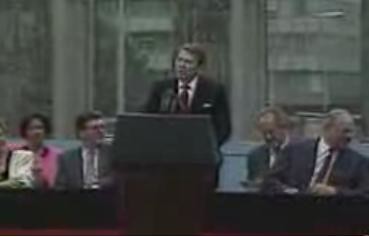
One American president went to Communism’s front door and threw down:

Does anyone see Barack Obama calling a dictator’s bluff?

Don’t get me wrong; the time isn’t always right for all of the actions above.  Had Reagan given the same speech at the Brandenburg Gate in, say, 1981, it would have been a very different thing.

But can anyone imagine Barack Obama going to the Brandenburg Gate and saying anything other than “present”?

Can you imagine him challenging the mullahs like that?

Convince me.

Charter Schools: The Hit Is Out (Part VI)

Monday, June 22nd, 2009

Let’s look back at the MN2020 report from a couple of weeks back.  The reports main allegations were that there is an epidemic of bad accounting; writer John Fitzgerald concluded that, because of this wave of fiscal malfeasance, Minnesota needed to end the Charter School experiment.

Let’s back up a bit.

Minnesota has 339 public school districts, serving over 800,000 K-12 students.

In contrast, there are (as of 2008) 143 charter schools in Minnesota, serving 28,034 students.

Want to see who does good accounting?

Go to this website.  It’s the MN Department of Education page displaying its annual “School Finance Award” winners.

Now, check out the 2009 awards [WARNING:  PDF File].   Of the just shy of 120 winners, at least 32 – over a quarter – are charter schools.

Are there surprises on the list?

But of course.

———-

Let’s recap:  In John Fitzgerald’s original report, his marquee claim was:

  • 83 percent [of charters] were found to have at least one financial irregularity in their audit – five years earlier, that figure was 73 percent;
  • 51 percent of those schools with problems identified on their 2007 financial audits had the same problems identified on their 2008 audits, according to the MDE;
  • 29 percent did not respond to a request for board minutes – five years earlier, that figure was 33 percent;
  • 55 percent were found to have “limited segregation of duties,” a requirement that ensures no single charter school official has control of the school’s funds;
  • 26 percent didn’t have proper collateral for deposit insurance, a requirement that ensures the charter school can pay its bills.

In Part IV of this series, we took a high-level look at what the rules say these allegations mean.

But more importantly, we need to look at what these charges actually mean in terms of individual charges against individual schools.

———-

A business manager for a Saint Paul area charter school talked with me about the allegations against his school.  The school has reputation for academic excellence – and, more importantly, for turning around kids who’ve had a hard time in the traditional public schools.  Based in Saint Paul, it draws students from Forest Lake, Prior Lake and Hastings (and remember – charter parents have to provide transportation themselves).  But the MN2020 report tagged his school with four “violations”; Limited Segregation of Duties, Collateral Insurance, reporting of electronic deposits, and Cash Disbursements.

Regarding the Limited Segregation of Duties – which tripped up the majority of charter schools – the manager said “nobody wants to be accused of this – we did our best to deal with this”; it was a matter, in his school’s case, it was a simple matter of him, rather than someone else, having access to the school’s blank checks.  “But this was fixed before the 2008 audit”, the manager notes – as, indeed, were all of his school’s “violations”.  He added “This trips up a lot of small organizations”.

Eugene Piccolo of the Minnesota Association of Charter Schools confirms this: “Every accountant will tell you that all small non-profits have trouble with this”.  Piccolo noted that not only to charter schools have trouble with this, but so does every other small-non-profit, as well as smaller public schools, and many small units of government.

As to the lack of collateral – in other words, insurance to cover bank deposits above the FDIC-insured limit, which at the time of the audit was $100,000 – the manager notes “it was an issue in 2008; we received more money than we spent.  It was immediately brought to our board’s attention.  But we were over the limit for a total of about twenty days.  The board decided it wsn’t worth getting insurance for a very brief overage”.

Don Vance – a former Army Sergeant-Major – is the director of the General John Vessey Charter School, on the far south end of Saint Paul’s West Side.  Vessey’s program is based on the Junior ROTC program, and draws students from as far afield as Taylors Falls, Forest Lake, and even Monticello, on the far northwest corner of the metro area.  The school had 22 seniors graduate (from among 30 seniors) two weeks ago; among students that started at the school in Grade 9, 100% graduated on time – a little over double the graduation rate at the Saint Paul Public Schools.

Vessey was tagged for collateral insurance.  “We had an issue with too much money in our account.  We moved the extra money into a different account!”.

Vance points out that his school – like all of the schools I spoke with – corrected the problem, and that Vessey is listed in the Department of Education’s  “School Finance Award” winners.

Let’s go back to our original manager, to discuss his school’s third allegation, failure to report Electronic Fund Transfers.  “We’re required by statute to report EFTs”, said the manager.  “There was a brief stretch of time when these transfers were not noted in the school board meeting minutes“.  Not that the transfers weren’t legal, or otherwise undocumented, but that they didn’t get entered in the board minutes as electronic transfers.  “It was nothing out of the ordinary; it’s just that the medium of exchange was omitted from the minutes”.  In other words, the minutes noted “Staffer X got $x hundred dollars”, rather than “Staffer X got $x hundred dollars via an EFT”.  That was the “violation”.  And, the manager notes, “it was corrected, and has been consistently correct since then”.

The manager’s school’s fourth “violation” regarded documentation of cash disbursements.  “Being the finance manager ,I need to have another person to sign the records for cash disbursements”, the manager notes.  There was a brief issue with proper signatures  in 2008, but – this is important – the “violation” had nothing to do with misappropriation of actual money.  “I don’t know the school’s safe combination, I can’t get to the blank checks”, and the issue, such as it was was corrected by 2008.

Judy Ingisson, director of Saint Paul’s German Immersion School, a charter on University Avenue, had the same problem.  “If I recall correctly there was a time sheet and purchase order that hadn’t been signed by the director but she has verbally or in email approved the expenditures. Also, I don’t think the school did have a regular schedule for deposits but the only money that was collected regularly was milk money which in total was around $2,200 for the year. The money came is sporadically after parents were billed and I don’t think exceeded $62 in a week!”

Hardly seems to be the kind of thing that bears much taxpayer scrutiny, much less John Fitzgerald’s call for shutting down the charter system.  Oh, and Ingisson notes, as did Vance and the other manager, “Both of these problems were addressed in the 2008-2009 school year by implementing new procedures and I have emphasized to office staff that need for making sure everything is signed even if there was verbal or email approval.”
While it’s an infraction that must be reported to an auditor – as it was – it’s not a sign of irresponsibility with taxpayers money.

So the great bulk of the “violations” in the MN2020 report were trifling in the extreme, but they are the same precise problems faced by most smaller non-profits, and indeed units of government.

So why do the report at all?

Good question.  “Matt Entenza’s MN 2020 report does nothing to advance the discussion of how to improve the academic quality of charter schools in MN”, says Al Fan of Charter School Partners, a non-profit advocacy group.   “It is simply an attempt to bully the charter school community.  Making the assertion that all audit infractions are equal and that any infraction should lead to the charter application being revoked is ludicrous and a waste of taxpayer dollars.  The report does nothing to show how audit infractions impact student learning or overall performance.”

Indeed.

But the report does raise some interesting questions.  Fitzgerald’s report lists five “Worst Offenders” at financial management:  In addition to the scandal-riven Heart Of The Earth Charter, whose director allegedly embezzled hundreds of thousands of dollars, it lists Aurora Charter School of Minneapolis, the Recovery School of Owatonna, the E.C.H.O Charter in Echo, and the Duluth School Academy charter.

And on the Department of Education’s “School Finance Award Winners” list?  Along with Vessey, and thirty-odd other charters?

The E.C.H.O Charter School.

So – is the E.C.H.O. Charter School a Public (Accounting) Enemy Number One?  Is the Minnesota Department of Education wrong?  Or do MN2020’s shopping list of petty violations have a purpose very different from actually holding charter schools accountable for taxes spend on charter schools?

More on Wednesday.

The Boogeyman Will Get You!

Monday, June 22nd, 2009

Ever since Governor Pawlenty went down the unallotment route, the DFL has been “warning” that property taxes, inevitably and perforce, will rise.

Gary Gross points out the vacuity and dishonesty of that statement:

I’d love asking Mr. Entenza or these mayors whether they eliminated or reduced spending on wants to pay for the needs. I’d love asking whether the cities thought about doing things differently first instead of immediately raising taxes. I’m betting that the majority of them didn’t.If these cities’ property taxes were raised without the mayors and city councils rethinking their spending or without reforming the delivery of essential services, then the mayors and city councils are to blame, not Gov. Pawlenty. That either makes Mr. Entenza a blowhard who’d rather blame others for his ineptitude or he’s the type of candidate that refuses to think outside the box to protect Minnesota’s taxpayers.

Either way, his behavior in this is unacceptable because there’s no suggestion that he’ll deviate from the DFL playbook of raising taxes first. We already have too many tax-first DFL ‘leaders’. We certainly don’t need another in St. Paul.

Here’s a question to ask your city council and mayor, wherever you live (in Minnesota. All you non-Minnesotans can sit this one out.  For now.  Maybe); why, whenever talk of cutting Local Government Aid (aka LGA, Minnesota’s redisstribution of wealth from the parts of the state that pay their way to the cities) is there talk of cutting the city’s only really essential services – police and fire.  Are you saying they are financed through Local Government Aid, a transitory form of funding?  Why not fund the city’s real essential services with the city’s property taxes, and other revenue that’s not dependent on any other political body? Wouldh’t that be the responsible thing to do?

If your city is funding the real essential services with LGA, and paying for Human Rights Departments and Community Councils with property tax revenue, someone needs to ask “why?”

Glory Days Will Pass You By

Monday, June 22nd, 2009

Lori Sturdevant, Strib columnist and unofficial DFL public relations writer, is doing her job: leading the DFL’s counterspin effort after their perceived defeat on the budget and unallotment battle.

No – of course the budget battle was never about making sure that no matter how tough times get for Minnesotans, government never wants for a single thing.

Nooooooo.  It was about jobs for all the rest of you!

Déjà vu hit me in the corridor outside the governor’s office Tuesday, as my compatriots pressed Minneapolis Mayor R. T. Rybak for an “ain’t it awful” quote about Gov. Tim Pawlenty’s plan to yank another $200 million away from Minnesota cities…He kept pounding: Pawlenty’s unallotment will eliminate “a dramatic number” of Minnesota jobs. It is “a one-time fix that doesn’t create jobs.” The city of Minneapolis has had a better record of creating jobs in the last eight years than the governor has had for the state.

What an incredibly dishonest statement; Minnesota as a whole was in a recession eight years ago, and is in one today, and in between spent some time with among the lowest unemployment rates in the country.  If Minneapolis did “better”, it’s because of a statistical technicality.

Does Sturdevant know this?  Who knows? But nothing – not even a complete rewrite of history – is going to stand in her way:

Jobs, jobs, jobs. Shades of 1981-82.

Minnesota was mired in what was the biggest post-World War II recession until the current one came along. Every story out of the State Capitol contained bad news. Schools laid off teachers, college tuition climbed, cities cut library hours and parks programs, taxes rose. Beleaguered lawmakers would barely catch their breath before red ink returned, and they’d have to cut again. It was dispiriting business.

Then in April 1982, back from four years of political exile in Vienna came a talkative former governor who said Minnesota could do a lot more to create jobs.

As Rudy Perpich sold that idea, the gloom began to lift. People didn’t know whether Perpich’s ideas would work. But they wanted to believe that state government could be an aid, not a hindrance, to the climb out of recession. Instead of seeing state government as sick and prone to inflicting its misery on its citizens, people began to think that under the right governor, state government could be part of the cure.

That hopeful idea returned Perpich to office in 1982. And whether or not his pro-jobs policies did the trick, they coincided with one of Minnesota’s best economic interludes in the 20th century.

Perpich had also presided onver one of Minnesota’s worst interludes – the mid-seventies.  Hm.  What could have been different between the two terms?

What happened in national politics, and with the national economy, along about the end of Perpich’s ’82-86 term?   What rising tide lifted all the little socialistic boats, including Perpich and Sturdevant’s?

Chew on that for a while, Lori.

It might be that the DFLers who want to replace Pawlenty are channeling the thinking of the last DFLer to serve in the Capitol’s southwest corner office.

What?  “Elect a tax-and-spend hamster who emanates goofy cheer, and pray the national economy picks up?”

Tell Hallmark To Wait In The Hall

Sunday, June 21st, 2009

Happy Father’s Day, everyone!

Father’s Day is one of those holidays that I’m very ambivalent about.  Not because it’s a Hallmark Holiday, per se – but much more because of the way fatherhood has been devalued in our society.

At the core, of course, I have little to complain about. I grew up not only with a father, but a really great one, the kind that, for whatever his shortcomings, was the kind of father any kid should have, someone who passed along not only genes, but values and traditions and the little things that helped him in his own life.  Dad wasn’t like a lot of dads in my neighborhood; he couldn’t tear down an engine, and he didn’t hunt.  A lot of that, of course, comes from his own childhood; his father, my grandfather Oscar, died when he was a toddler, long before I was born.  So Dad didn’t learn a lot of that kind of stuff.  And his love of sports certainly didn’t rub off on me.  But he was a speech teacher – as noted in this space many times, one of the best teachers ever – and his love of the craft and art of giving a great speech, and of writing, and communication, certainly did.  Although he only really held two jobs in his adult life (teaching with two different districts), and always had a hard time relating to my post-industrial, new-job-every-year careers, it was the skills he gave me – communicating, reading other people, knowing that making an impression on people was a matter of careful planning and not happenstance – made my career(s) possible.  I despair, at times, of being able to do as well with my own kids; but having my own, I suspect he must have felt the same way at least once or twice.

Anyway – thanks, Dad.
Not everyone is so lucky, though.  24 million Americans are growing up without fathers.  Some of it is due to cultural shifts; big swathes of our society are being born into “fatherless” families; “Urban” culture in this country exalts skipping out on ones’ kids; it sounds tragic, and it is, but it’s a natural offshoot of the devaluation of men, and fathers, left over from slavery and the matriarchal nature of most African societies (which was, in return, reinforced by the rootlessness and destruction of families under slavery).  Marriage is an otion rather than the expectation for many in our society – in some quarters, most of our society.

Madison Avenue doesn’t help.  The standard archetype of the father in American advertising is the bumbling, inept,. schlubby oaf who’s lucky to be saved by his gorgeous, competent wife (and children – usually girls, of course, since the boys are going to grow up to be fathers one day, too – right?).  And if the schlub and Mrs. Fix-It break up?  The nation’s family courts systematically undercut the rights and value of fathers in divorce and custody settlements nationwide.

I’ll chalk this one up for President Obama; he’s not much of a President, but when it comes to fatherhood’s meaning and value, he knows a thing or two:

The president showcased fatherhood in a series of events and a magazine article in advance of Father’s Day this Sunday. He said he came to understand the importance of fatherhood from its absence in his childhood homes — just as an estimated 24 million Americans today are growing up without a dad.

A Kenyan goatherder-turned-intellectual who clawed his way to scholarships and Harvard, Barack Hussein Obama Sr. left a family behind to get his schooling in the United States. He started another family here, then left his second wife and 2-year-old Barack Jr. to return to Africa with another woman.

His promise flamed out in Africa after stints working for an oil company and the government; he fell into drink and died in a car crash when his son was 21, a student at Columbia University.

“I don’t want to be the kind of father I had,” the president is quoted as telling a friend in a new book about him.

And in an interview Friday with CBS News, Obama said: “It was only later in life that I found out that he actually led a very tragic life. And in that sense, it was the myth that I was chasing as opposed to knowing who he really was.”

His half-sister, Maya, called his memoirs “part of the process of excavating his father.”

Obama now cajoles men to be better fathers — not the kind who must be unearthed in the soul.

Which is certainly something to strive for – not only as individuals, but as a society.

State of Affairs

Sunday, June 21st, 2009

True, True, True and….True.

Saturday, June 20th, 2009

One of the biggest challenges ahead for the GOP is to reclaim the Fiscal Conservative ribbon from…well actually nobody has it now…which is probably why we are enjoying a hiatus from the trappings of low unemployment, prosperity and economic growth right now.

Paying for what you spend is basic common sense. Perhaps that’s why, here in Washington, it’s been so elusive”

True.

Who said that? Wait for it…of course…Barack Obama; filling the vacuum left by Republicans with more wholesome teleprompter goodness. The most liberal former Senator in recent history defines audacity once again.

Republicans marvel at his skill in stealing their clothes. Democrats retort that, under George Bush, Republicans left their clothes unguarded while they cavorted in a hot tub of borrowed cash. Sure, they talked about fiscal responsibility. But instead of choosing between tax cuts, wars and social spending, they chose all three—and left the bill for future generations.

True (although picturing Dick Cheney in a hot tub is a wee bit unsettling).

Whenever Republicans accuse Mr Obama of fiscal profligacy, Democrats have three easy answers. The first is to accuse them of hypocrisy—why did they not speak up when Mr Bush was splurging red ink?

True (although a few of us did speak up).

Americans stopped trusting Republicans with their money in part because some were caught trousering bribes or peddling influence.

and True…although Republicans have no monopoly here. Sadly, the public’s attention has been drawn from  Republicans…because there are so few of them in power right now.

Republicans think they see an opening. Although Mr Obama is still very popular, Americans have doubts about his fiscal stewardship. In a recent Gallup poll, 51% disapproved of his handling of federal spending. Since this is the only area where most people disapprove of Mr Obama, Republicans are enthusiastically prodding it.

But will middle America believe them this time?

The Rat Traps Filled With Soul Crusaders

Friday, June 19th, 2009

Today, we’ll be live at the Minnesota Street Rod Association’s “Back To The Fifties” day at the State Fair!  Join us at our fairground studio, on Dan Patch just inside the east (Snelling) gate, barely a block inside the fairgrounds). 

  • Volume I –  Brian is off at an ashram, and John always just buys a hot-rod and takes off, so King, Ed and I will kick off from 11-1.
  • Volume II “The Headliner”Ed and I are up next, from 1-3.  James Lileks will join us at 2PM!
  • Volume III, “The Final Word”King is on next, dishing his own personal brand of conservative hurt from 3-5.  Check it out.
  • And don’t forget, our long-time colleagues David Strom and Margaret Martin lead things off on the David Strom Show from 9-11AM!

(All times Central)
So tune in to all six hours of the Northern Alliance Radio Network, the Twin Cities’ media’s sole guardians of sanity. You have so many options:

  • AM1280 in the Metro
  • streaming at AM1280’s Website,
  • On Twitter (the Volume 2 show will use hashtag #narn2)
  • UStream video and chat (at HotAir.com or at UStream)
  • Podcast at Townhall (usually uploaded by Monday morning).
  • Good ol’ telephone – 651-289-4488!

Join us!

--> Site Meter -->