Archive for the 'Business, The Economy and The Markets' Category

Boing

Tuesday, October 1st, 2013

Joe Doakes from Como Park writes:

College Enrollment Falls As Economy Recovers.”

Sounds as if young people are opting to skip college to go straight into the workforce, snapping up all those outstanding jobs at great pay and benefits.

Except the article doesn’t say that.  The article talks about sky-high tuition and student loans, it talks about demographics, it talks about colleges that overbuilt, but the notion people are working instead of studying is handled with this line:

“But the number of Americans turning 18 hit its recent peak in 2009, and will continue to decline through 2016. High school graduation rates appear to have leveled off, and job prospects have improved, making school a less attractive option.”

Really?  Where are all these great jobs?  Why isn’t Obama getting more credit for creating them?

Joe Doakes

I think it qualifies as a “Dead Skunk Bounce”.

Chanting Points Memo: We’re Number Eight!

Friday, September 27th, 2013

The DFL chanting-point bots were out in force yesterday; a Forbes survey put Minnesota at number eight nationwide in terms of “Best States for Business“.

So look at the rankings.  And read Forbes‘ blurb:

Minnesota’s overall rank jumped 12 spots on the strength of an improved economic outlook. The Minneapolis-St. Paul metro area is home to 62% of the state’s population. It also serves as the state’s economic hub, with companies such as Target, U.S. Bancorp, General Mills, 3M and Medtronic headquartered there. Minnesota has the second highest percentage of adults with a high school degree at 92.5%. With its good schools, low poverty rate and healthy populous, the state also scores well on quality of life measurements.

We’re reminded that the state jumped from #20 in last years’ rankings.

Two things to say about this article.

For starters:  everything the article measures about state business climate is directly related to changes made under GOP control of the legislature.  Everything.  What – you think Minnesota’s business climate is going to have a radical jump in business climate in the eight months since the DFL got the keys to the car?

Business climate changes slowly.  It improved under GOP control – for two years.  It was imperfect, but it was an improvement over 2006-2010.

And what’s the other thing this study tells you?

Look at the factors it measures:

  • Business Costs (Minnesota is 34th)
  • Labor Supply (18th)
  • Regulatory Environment (22nd)
  • Economic Climate (9th)
  • Growth Prospects (13th)
  • Quality Of Life (5th)

What do these factors tell you?

Labor Supply and “Quality of Life” are primarily issues for big businesses – the Targets and Best Buys and Medtronics, the big Fortune list titles that have their headquarters in Minnesota.  And we know – it’s a great place to be a CEO!

But how about small business?  What are the important measures?  A good economic climate is useful – but business costs and regulation are life and death.

And they were merely adequate over the past year – and have gotten much, much worse.

But we know that, since Minnesota has become the worst state in the nation for entrepreneurship measured in small business starts per capita since the DFL took control.

Which is not something the Forbes study visibly measures (or at least gives much weight to), and has little effect on the big Fortune 1000 companies that the DFL is most concerned with.

The big test will be how the state ranks next year and the following year.

Any bets?

http://onforb.es/1dM1Fz3

Woebetide

Thursday, September 26th, 2013

Joe Doakes from Como Park emails:

Part of my job is signing cover sheets attached to batches of documents submitted for recording.  This morning I’m busy.  I have to write my name on, like, ten separate sheets of paper.

If I were a pro ball player, my autographs would be worth $100 each.  Of course, our office charges $100 each for approvals.  But do I see any of that money?  NO!  It goes to the County Treasurer.

Oh sure, they claim it’s used to pay my salary and insurance and benefits but I’m not buying it.  I think management is getting rich off the backs of labor and stealing the fruits of my toils for their own greed, just like it says in this Public Employee’s Union Poster.

I need a union to protect me from being ground under the iron heel of management making me work indoors, in air conditioning, risking paper cuts every moment of an entire 40-hour week with only a few breaks for lunch, coffee and cigarettes.  I’m a slave, that’s all I am, just an indentured servant.  I am being cheated, I deserve a raise, I demand a raise and a bigger pension and better insurance, if I don’t get them, I’m going on strike and bring the entire system to its . . . . . .

///slap///

Thanks, I needed that.

So do these people.

Joe Doakes

 Ain’t nothing selling but victimization.

This Hard Land

Wednesday, September 18th, 2013

Note to all you folks thinking of moving to North Dakota to start cashing in on the oil boom:  North Dakota is cold.  

There aren’t a lot of trees.  And outside of the eight or nine significant-sized cities (Fargo, Grand Forks, Jamestown, Devil’s Lake, Bismark/Mandan, Minot, Williston, Dickinson, and maybe Valley City), there just aren’t a whole lot of people. 

More below the jump, so the rest of the page can load…

(more…)

A Matter Of Degrees

Monday, September 16th, 2013

Joe Doakes from Como Park emails:

For SITD Junior Members needing college career advice, best and worst paid majors

Joe Doakes

The graph at the link is the usual link you see on the subject this time of year; engineering good, social “sciences” and humanities bad, at least in terms of money earned right after graduation.

Of course, there are some questions:  the graph counts people with degrees in a field who get jobs in that field.  Not all engineering majors get jobs directly in their fields (as we talked about a few weeks ago) – and not everyone with a degree in technology or engineering has a degree in the field (many of the best software engineers I’ve worked with had degrees in music).

And not everyone who goes into social “science”, humanities or even arts works in those fields after graduation, and fewer still do it for an entire career.  How many history majors do you know who became managers?   Most of us Twin Cities beer drinkers know the example of the CEO of Summit Brewing, who started out as a psych major.  And in my own field – which is a bastard child of engineering and psychology – I’ve worked with people who graduated with degrees in music, computer science, folklore, math, graphic design, education, and not a few English majors like me. 

Not a few very successful lawyers majored in theatre.

And the Elizabethan Poetry major who goes to work selling insurance, cars, real estate, institutional software, drilling equipment or a raft of other things can, with talent and hard work, make a ton of money – and never recite a single couplet. 

The mania for matching degrees with post-graduate salaries is completely understandable, as education costs are hitting a peak even as the higher ed bubble starts to implode with all the grace of a whoopie cushion. 

But it’s a little misleading, too. 

How many of you are working in the field in which you got your BA?

How many of you could have even predicted where you’d be now, given your undergraduate degree?

Our Innumerate Overlords

Monday, September 9th, 2013

When Representative Ryan Winkler talks, people listen.

And then the smart people snicker.

He tweeted this yesterday:

Of course, he had the point of the op-ed all wrong.  Read it for yourself.

The point is that low wages aren’t the sole cause of poverty.  In the great scheme of things, they aren’t even especially important, in and of themselves.

Much more important?  When there is no opportunity to earn higher wages.

How does that happen?

To further address the point, though, I’d like to ask Rep. Winkler (or his defenders) this question:  at what minimum wage hourly rate will poverty disappear?

Put a number on it.

That’s the question I’d like to ask.  In fact, I asked it.

Hopefully we’ll see an answer.

I’m sure we will.

(more…)

Chart Your Own Recovery!

Monday, September 9th, 2013

How many jobs a month do we have to add to bring the level of employment back to pre-recession levels?

How long will it take to get back to pre-recession employment at current – or any – rate of job “creation?”

Check it out for yourself!

Hint – at the current rate (169,000 a month, before adjustments), we’re ten years away.  Although the calculator doesn’t distinguish between full-time and part-time jobs – although under the Obama notion of “recovery” the same number of jobs doesn’t mean the same kind of prosperity.

This Is Your Obama Recovery

Friday, September 6th, 2013

Unemployment down to 7.3% – almost entirely due to people leaving the workforce; the Labor Force participation rate is down to 63.2%, the lowest since the depths of the Carter Malaise. 

That means the percentage of the workforce actually working is down to 58.5864%. 

  • When President Obama was inaugurated in January of 2009, it was 60.58%
  • In October of 2009, when the top-line unemployment rate was 10%, the rate was…58.5%.  Statistically the same as today, even though the “unemployment rate” has theoretically dropped by a quarter.
  • At the bottom of the recession – December of 2010 – it was 58.2%. 
  • A year ago, it was 58.36%.  It’s been in the 58% range ever since – a time when, NPR assures us, we’ve been “recovering”. 
  • And ten years ago last month – as the economy was getting out of the DotBomb and 9/11 slowdowns, but before the mortgage bubble really inflated – it was 62.07%. 

America’s work force is still in full recession mode.

Democrats were pleased to call the recoveries of 2003 and 1983 “jobless recoveries”.  Especially if you’re one of the Afrian American voters who turned out for Obama twice now.

This one seems to be a “recoveryless recovery”.

Chanting Points Memo: Our Spunky, Cute, White Underclass

Tuesday, September 3rd, 2013

The fact is, I have a lot of questions about the minimum wage debate.

Of course, the uncountably vast majority of people who are earning minimum wage are kids, or others who are just entering the workforce.  People who haven’t yet developed even the most rudimentary work skills – like showing up on time, much less running the shake machine or the deep fryer with authority.

But there are people earning the minimum wage who do, in fact, have themselves and others depending on their income.

If you’re a conservative, you no doubt suspect that that sad state is because of poor choices; partying too much in high school and not getting an education; having children out of wedlock; working on the easy crime career before developing the boring straight career.

Of course, not every person is affected by their own choices.  When you party you way into your twenties, do jail time, get knocked up and wind up having to raise a family on a wage that wouldn’t support a single person, you are very likely passing a lot of problems on to the next generation; you’re passing your bad, shortsighted, immature and/or stupid choices on to them.  “Personal Responsibility” is great when it’s just your own choices affecting you – but when your parents, and grandparents, were idiots or drunks or screw-ups, what’s a kid to do?

(And if you’re the progeny of a couple of generations of people who made good choices, worked hard, got good jobs and dedicated themselves to helping you make good choices, too, then thank whatever it is you believe in.  It’s a major leg up in life).

Now, I’m not sure how many of Jessica English’s choices were her ancestors, and how many were hers.  But the media certainly is playing up the results – the state of Ms. English’s life today:

Jessica English is the face of a newly revived effort to raise Minnesota’s minimum wage.

Ms. English, speaking at the Minnesota State Fair, illustrating the dangers of poverty to cute, white women from Wayzata who choose to work in art.

She earned minimum wage while working in rural western Minnesota, places such as Fergus Falls, Ortonville and Kerkhoven. A case worker called it the “land of the minimum wage.”

Now, the 35-year-old divorced mother said she faces losing custody of her four daughters, ages 6 to 15, because she earned so little, even though her finances improved a bit since moving to St. Paul.

On the one hand?  That sounds scary – being 35 and up against it like that.   Now, I have no idea what got Ms. English to this point in her life – single, four kids, job skills worth $6.15 an hour.

(As to the “losing custody” bit, though?  Er, if she was a single father – presuming that’s who Ms. English would be contesting for custody – would the media even care?  What if the father is better able to provide a decent life for the kids?  The double standard is nothing new).

But the fact is, one does make choices in one’s life.  I’ve made a few; I left radio, my first career, when I was married and had two kids and another on the way, and was making $6.50/hour, and painstakingly taught myself how to convince managers I was a competent technical writer.  I adapted.  I did what it took to develop a skill that would get me and my family out of poverty.  I don’t want, or deserve, a cookie for that – that’s what you do when you have a family; you take care of them.  I had some blessings, of course; I’d gotten a passable education when I had the chance, I’d avoided doing any jail time, that sort of thing. Perhaps my greatest blessing?  Growing up in a place and time when “not being ready to raise a family when I had one” still had some moral weight.

And it’d seem Ms. English has learned that lesson, at least in part.  The article notes that her financial situation has “improved a bit since moving to St. Paul”.

Where she works – for an inadequate wage, perhaps, although we don’t know – as a “community organizer” for “The Coffee Party”, the beyond-astroturf liberal-plutocrat-funded “response” to the Tea Party. 

In other words, one of the liberal-plutocrat-supported non-profits that’s agitating for a “living wage” apparently won’t provide one. 

Judging by Ms. English’s rap sheet, she spent the last several years working in the public/non-profit art business – a famously penurious racket, usually the province of trust fund babies, bored housewives and young, no-strings-attached arts majors.

I don’t know Ms. English.  But how much weight should the media give the testimony of a person who has apparently dedicated herself to finding and remaining in poverty?

And how much should Minnesota’s real working poor – the 20 year olds scrambling for their first jobs at Burger King, who will be the first to get laid off when the robots do finally take over the fast food business, the immigrants who are working as many minimum wage jobs as they can while they learn English and develop other skills, the poor kids who need to some some reassurance that there’s a future in working the straight and narrow rather than turning to crime – have to pay for such dilettantism?

Because it’s their jobs – not the “Community Organizer” jobs for fashionable lefty non-profits – that’ll be disappearing.

UPDATE:  Someone emailed “aren’t you being a bit condescending?”

Me?  Not a bit.  There’s a reason that the poverty pimps are trotting out an attractive white woman instead of a 30 year old Somali immigrant.  Put another way – the proponents of the minimum wage hike are doing the condescending, here.

STEM: The Scam?

Tuesday, September 3rd, 2013

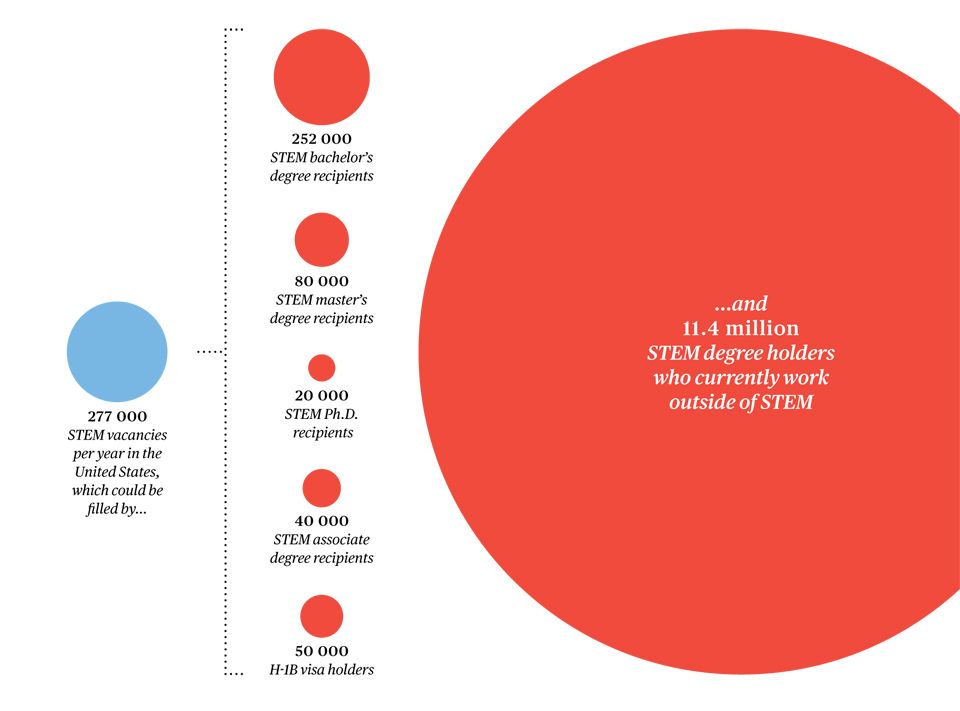
Since the end of World War II, the mantra of government and business is that “we need more kids to grow up to study Science, Technology, Engineering and Math” – aka “STEM”. 

And yet if you work in technology, you know that in vast swathes of the field, there’s no real shortage of people.  Especially in IT; even as baby boomers retire, there is plenty of unemployment among IT people; even as demand for IT workers booms, the supply seems to more than keep pace.  Have you checked out the contract rate for web coders or support analysts lately? 

And yet the government keeps cajoling our “best and brightest” to go into STEM. 

Why?  

To keep the costs down, perhaps?

As this piece in the IEEE Spectrum notes, not only is there no shortage of STEM professionals, there’s an apparent skills mismatch, with many “STEM” careers being held by non-STEM degree-holders (I’d be one of them, by the way), and many STEM degree-holders working outside science and technology.

And yet the establishment keeps driving more people into STEM, and importing more programmers, engineers and technicians from overseas. 

Why?

Clearly, powerful forces must be at work to perpetuate the cycle. One is obvious: the bottom line. Companies would rather not pay STEM professionals high salaries with lavish benefits, offer them training on the job, or guarantee them decades of stable employment. So having an oversupply of workers, whether domestically educated or imported, is to their benefit. It gives employers a larger pool from which they can pick the “best and the brightest,” and it helps keep wages in check. No less an authority than Alan Greenspan, former chairman of the Federal Reserve, said as much when in 2007 he advocated boosting the number of skilled immigrants entering the United States so as to “suppress” the wages of their U.S. counterparts, which he considered too high.

And it helps inflate the higher-ed bubble, too:

And the perception of a STEM crisis benefits higher education, says Ron Hira, because as “taxpayers subsidize more STEM education, that works in the interest of the universities” by allowing them to expand their enrollments.

An oversupply of STEM workers may also have a beneficial effect on the economy, says Georgetown’s Nicole Smith, one of the coauthors of the 2011 STEM study. If STEM graduates can’t find traditional STEM jobs, she says, “they will end up in other sectors of the economy and be productive.”

The problem with proclaiming a STEM shortage when one doesn’t exist is that such claims can actually create a shortage down the road, Teitelbaum says. When previous STEM cycles hit their “bust” phase, up-and-coming students took note and steered clear of those fields, as happened in computer science after the dot-com bubble burst in 2001.

Emphasizing STEM at the expense of other disciplines carries other risks. Without a good grounding in the arts, literature, and history, STEM students narrow their worldview—and their career options. In a 2011 op-ed in The Wall Street Journal, Norman Augustine, former chairman and CEO of Lockheed Martin, argued that point. “In my position as CEO of a firm employing over 80 000 engineers, I can testify that most were excellent engineers,” he wrote. “But the factor that most distinguished those who advanced in the organization was the ability to think broadly and read and write clearly.”

For all the sneering people are doing at humanities these days – and I have a BA in English with minors in History and German – the selling of the STEM “crisis” seems to be a move to commoditize technical skill.  Communications is no commodity, though – and it seems to be what still what separates a bench engineer and their supervisors. 

So is the education system short-changing students by preaching STEM as the be-all and end-all of opportunities?

This Is Your Obama Recovery

Tuesday, August 27th, 2013

Durable goods orders off over 7% in July. 

Look for people who make durable goods to start laying more people off.

More time for them to enjoy all the hope and change.

Patched

Thursday, August 22nd, 2013

Half of the Minnesota “Patch” “hyperlocal news” sites are going to be closing or consolidating in the next few months:

Kevira Voegele, associate regional editor for Minnesota, emailed staffers over the weekend to inform them that 13 of the state’s 25 Patches would need to land a partner — a media organization that would assume some responsibility for their operations — or face closure within 60 days.

It’s a nationwide problem for AOL-owned Patch, which is closing or consolidating 300 of its 900 local websites coast to coast. 

In Minnesota, the Patches slated for closure or consolidation failing a partnership are Apple Valley-Rosemount, Burnsville, Eden Prairie, Fridley, Golden Valley, Hopkins, Inver Grove Heights, Lake Minnetonka, Mendota Heights, Plymouth, Roseville, Shakopee and Southwest Minneapolis.

Sites that will continue to operate as usual include Eagan, Edina, Lakeville, Maple Grove, Minnetonka, Northfield, Oakdale, Richfield, Stillwater, St. Louis Park, St. Michael and Woodbury.

In my experience, the Patch chain – at least in Minnesota – was just as sclerotic and left-biased as of the local newspapers that they couldn’t quite replace.

This Is Your Obama Recovery, Part MMMLCIX

Tuesday, August 20th, 2013

The dip in unemployment…wasn’t

Jobless rates dropped in only eight states in July from the previous month and rose in 28, the Labor Department said on Monday, as employment gains sputtered.

The slight improvement in employment last month came after jobless rates fell in only 11 states in June from May.

From July 2012, unemployment rates decreased in 36 states and the District of Columbia and increased in nine, the department said.

And in many of the states where unemployment “dropped”, it happened because the number of people in the workforce shrank.

And it’s getting worse, as employers increasingly ditch full-time employees for part-timers.  Forever21 is the first company to explicitly do away with full-time non-management employees in their stores, but they won’t be the last:

Although the ethical nature of Forever 21’s decision is debatable, it is both rational and understandable. A company that boasts regularly low prices and frequent, sensational sales, Forever 21’s competitive success is largely dependent upon its ability to maintain low manufacturing and operational costs. The ACA is an undeniable burden on this principle, and Forever 21’s management has the prerogative to take any legal measures necessary to avoid raising the costs of its products.

It is a decision that will pose moderate public-relations consequences for the company and it is an unfortunate result for its employees, but it is a pragmatic choice for any profit-driven company to make. Forever 21 will subsequently be just one of many others to take such an action if the ACA isn’t revised or repealed.

Chanting Points Memo: Why Yes – We Did Build It

Monday, August 12th, 2013

“You didn’t build that”.

President Obama said it to America’s entrepreneurs during the campaign; the not-remotely-muted message was that “private sector innovation follows public sector investment” – that without roads, there’d be no car company; without airports, there’d be no aircraft. 

On the state level, one of Governor Messinger’s budget czars made essentially the same statement at a meeting of government and business leaders in Thief River Falls last year; without government to build the infrastructure, entrepreneurship would be doomed to failure. 

On the one level, it’s wrong – unless the entrepreneurs and their employees not only weren’t paying plenty of taxes, but hadn’t already paid their taxesforall that infrastructure all of their lives, and their parents, and grandparents, back to statehood. 

But even beyond that – and I can’t believe I and many other conservative pundits didn’t note this at the time?   It’s just not true; infrastructure tends to follow innovation.

A great example – which came first, the car or the road?

Henry Ford and dozens of other auto makers put a car in almost every garage decades before the National Interstate and Defense Highways Act in 1956. The success of the car created a demand for roads. The government didn’t build highways, and then Ford decided to create the Model T. Instead, the highways came as a byproduct of the entrepreneurial genius of Ford and others.

Read a little about the history of the automobile.  When cars were expensive, handmade playthings of the wealthy, roads, were few, far between, and largely wretched outside the cities, where they existed at all.  The normal “road” in the greater US in 1900 was a cow path or a wagon trail.  Early cars were as likely to be found driving along railroad tracks as anywhere else. 

And what happened next?  A huge federal road-building initiative? 

No!  Ford mass-produced the Model T, which brought the car financially into reasonable reach for working-class Americans.  Other auto makers followed suit. 

And then the roads got built: 


Moreover, the makers of autos, tires and headlights began building roads privately long before any state or the federal government got involved. The Lincoln Highway, the first transcontinental highway for cars, pieced together from new and existing roads in 1913, was conceived and partly built by entrepreneurs—Henry Joy of Packard Motor Car Co., Frank Seiberling of Goodyear and Carl Fisher, a maker of headlights and founder of the Indy 500.

And this was the pattern for advance after advance in industry and “infrastructure”; the canal boat led to the government canal; the burgeoning steamship industry led to everything from seaports to the taming of the Mississippi; commerce, not Algore or even the Department of Defense, built the Internet. 

And the business in Thief River Falls which Governor Messinger’s budget apparatchik owed its existence to infrastructure?   Not only had they paid their fair share for the infrastructure that exists (more than their fair share, actually, given Minnesota’s business taxes) over the past 40 years, but it was the company’s existence that gave Thief River Falls the need for significant infrastructure in the first place. 

It’s time government – especially the arrogant, preening, narcissistic variety practiced by the DFL – learn its place.

Open Letter To Ryan Winkler

Monday, August 12th, 2013

To: Representative Ryan “Beavis” Winkler”
From:  Mitch Berg, Uppity Peasant
Re:  Your Minimum Wage Thing

Rep. Winkler,

Here’s what technology has to say about your minimum wage hike.  Read it and think. 

That is all.

PS:  No, it’s not.  I know you’re not paid to think about these things; yours is not to reason why.  But those who support you?  Maybe not in your stu-foresaken district, but in the rest of Minnesota?  There might be hope.  And so I write.

Tech Vendors: “Thanks, Representative Winkler!”

Thursday, August 8th, 2013

The inevitable result of across-the-board minimum wage hikes?  Fewer minimum wage jobs.

Case in point; as minimum wages around the country rose during the 2000s, McDonalds started pre-cooking its hamburger patties, so they’d only need to be reheated in the stores.  This got rid of most of the traditional “burger-flipper” jobs, the ones that liberals sneered at but provided hundreds of thousands of opportunities for teens and others entering and re-entering the workforce to learn how to show up for work on time and do a good job at something

But there was always the front counter.  Right?

Maybe not; McDonalds is testing thousands of touch-screen kiosks in France:

The move is designed to boost efficiency and make ordering more convenient for customers. In an interview with the Financial Times, McDonald’s Europe President Steve Easterbrook notes that the new system will also open up a goldmine of data. McDonald’s could potentially track every Big Mac, McNugget, and large shake you order. A calorie account tally at the end of the year could be a real shocker.
The touch screens will only accept debit or credit cards, adding to the slow death knell of cash and coins. This all goes along with an overall revamp of McDonald’s restaurants worldwide aimed at projecting a modern image as opposed to the old-fashioned golden arches…

Winkler is spending his between-session time agitating for a minimum wage hike bill. 

Minnesota’s young and poor should ask him to stop doing them any more favors.

Maybe if there was a touch-screen kiosk of some kind…

They’re Going To Need A New Chanting Point

Wednesday, July 31st, 2013

Two months ago, Wisconsin (along with, ahem, North Dakota) came in 49th out of 50 states in a Philadephia Fed report on economic growth.

Liberals chortled with glee, declaring Scott Walker a dead issue. 

Then last month the Philly Fed uprated Sconnie to 20th.

And now?

And with new numbers out today for June, Wisconsin is now ranked 5th in new rankings among states on their six month economic outlook. For those keeping track, that’s 40th, to 20th, to 5th in just a couple months.


And in another leading economic indicator, the coincidence index, Wisconsin ranks 2nd.

These numbers are not the be-all and end-all of economic reporting.  I’m  not presenting them as such.

But some people sure did. Two months ago, anyway.

The Problem…

Wednesday, July 31st, 2013

…with trying to debate economics with liberals is that even their “elites” have no idea how it works.

The Pollyanna President

Tuesday, July 30th, 2013

Sometime today, The One will be giving his second speech (in Chattanooga) of his tenth attempt, give or take, to “pivot to the economy” in the past five years.

I’ll invite you to read this short but deep piece by Richard Epstein at the Hoover Institution, about the shallowness of Obama’s understanding – he’s more of a sloganeer, really – of how economies actually work, and how it’s manifested itself in a middle class that’s been largely bludgeoned into submission.

Read the whole thing, but here’s the conclusion:

Indeed [President Obama] constantly thinks of his greatest regulatory failures as his great successes. No other president has “saved the auto industry,” albeit by a corrupt bankruptcy process, or “taken on a broken health care system,” only to introduce a set of unworkable mandates that are already falling apart, or “investing in new technologies,” which tries to pick winners and ends up with losers like Solyndra. The great advances in energy have come from private developments, most notably fracking, and not from the vagaries of wind and solar energy, which no one has yet figured out how to store for future use when needed.

The President seems utterly incapable of seeing the downside to any of his policy choices. They are announced from on-high as all gain and no pain. In the face of stagnant growth, weak corporate earnings, and continued high unemployment, he shows not the slightest recognition that some of his programs might have gone amiss.

It is easy to see, therefore, why people have tuned out the President’s recent remarks. They have heard it all countless times before. So long as the President is trapped in his intellectual wonderland that puts redistribution first and regards deregulation and lower taxation as off limits, we as a nation will be trapped in the uneasy recovery that will continue to dog us no matter who is chosen to head the Federal Reserve.

If there were ever a time for someone to come onto the scene – or re-emerge, perhaps – with something on the order of “A Time For Choosing”, this would be it.

Mighta Been

Tuesday, July 30th, 2013

While Mitt Romney wasn’t my dream candidate, few things more infuriated me last year than the idea that the Ron Paul wing of the GOP robotically chanted – that Romney was the same as Obama.

That noted conservative tool Salon notes that it just isn’t so.  The article runs down a hypothetical first 200 days of a Romney administration, based on its own publicly stated (and some privately-stated) plans:

Romney aides wince at the comparison, but their 200-day plans sound like a Bain turn-around for America’s economy: a co-ordinated series of shocks aimed at impressing investors, but likely to startle and anger many ordinary folk. Democrats would have scorned it as a wish-list for bosses and billionaires. But Mr Romney believed his reforms would work, and work fast. Benefits would follow swiftly, in the form of private investment and job creation: persuading the wider public to trust in President Romney’s competence, if not to love him.

I don’t care about “loving” a president.  I just care about heading in the right direction. 

We are, currently, not.

Declined

Tuesday, July 30th, 2013

Allow me to do an end-zone happy dance.  It may be a brief one, but I’m gonna dance anyway.

Julie Miller, a woman from Oregon, filed suit against Equifax after a two-year battle to get her credit report corrected.  She won an $18 million settlement:

Ms. Miller contacted Equifax eight times between 2009 and 2011 trying to rectify the mistakes. The jury awarded Ms. Miller $18.4million in punitive damages and $180,000 in compensatory damages.

Mistakes included erroneous accounts and collection attempts, the wrong Social Security number and birthday, according to a copy of the lawsuit reviewed by MailOnline.


‘There was damage to her reputation, a breach of her privacy and the lost opportunity to seek credit,’ said Portland attorney Justin Baxter. ‘She has a brother who is disabled and who can’t get credit on his own, and she wasn’t able to help him.’

Ms. Miller claims in the suit that she discovered the mangled mess made of her credit report after being denied credit by a local bank in December 2009. She reached out to Equifax and complied with multiple requests for forms and additional information only to have her efforts repeatedly go nowhere. Additional efforts to obtain copies of her credit report also proved unsuccessful.

The credit bureaux should be happy I wasn’t the judge.  I’d have authorized their complete sell-off and liquidation, using the National Guard if necessary.  Yep, I’ve fought with Equifax too. 

The credit reporting industry has an absurd amount of power – and while I joke (and not in a “hah hah” kind of way) about using the Air Force to re-jigger the market, and acknowledge they serve a role in the free market, they do the job really, really badly. 

The 18 million dollar settlement will no doubt get shaved down to $5000 at appeal.  But it’s a start.

Unexpected

Thursday, July 18th, 2013

This is your Obama economy, part oh-who-the-hell-remembers:

The residential real-estate rebound suffered a setback in June as housing starts unexpectedly fell to the lowest level in almost a year, curbing how much construction contributed to U.S. economic growth last quarter.

Believe harder and faster, people!

This Is Your Obama Recovery

Wednesday, July 17th, 2013

Almost three in four small businesses plan to lay off workers, cut hours, and replace full-time employees with part-timers due to Obamacare:

“Small businesses expect the requirement to negatively impact their employees. Twenty-seven percent say they will cut hours to reduce full time employees, 24 percent will reduce hiring, and 23 percent plan to replace full time employees with part-time workers to avoid triggering the mandate,” said the Chamber business survey provided to Secrets.

Under Obamacare, just 30 hours — not the nationally recognized 40 hours — is considered full-time. Companies with 50 full-time workers or more are required to provide health care, or pay a fine.

I’m wondering if Obama’s apologists in the media have figured out that if the unemployment rate is “dropping” but the underemployment rate is rising, something might be going wrong?

A Bargain – The Best I Ever Had

Tuesday, July 16th, 2013

Joe Doakes from Como Park emails:

The US Bank building in downtown St. Paul was foreclosed last year. The River Park Plaza building across the river from downtown St. Paul also was foreclosed last year. I don’t know how many more are in the pipeline.

St. Paul Class A office space vacancy rate is 12%. As last report, Class B was 24% and Class C was 19%, for an overall rate of 21%.

This, five years into the “recovery.” This is not your grandfather’s recovery. It’s more like your grandfather’s Great Depression.

Joe Doakes

And that’s after the State of Minnesota rented a hog-pile of empty and underutilized space.

And, I’ll guess, before the whole “Vacant Macy’s” gets counted, to boot.  It’s not “office” space, after all; just a vacant block.

More “recovery” like this and Saint Paul might need to try to find oil under some of those refrigerated ice rinks Mayor Coleman just had to have.

Black And White And Green And More Black

Tuesday, July 9th, 2013

Doug Grow – DFL stenographer and reporter for the Joyce-Foundation-supported MinnPost – is convinced that the GOP is lying about the effects of the Warehouse Tax.

Exhibit A?

Grow writes about the Red Wing Shoes’ opting out of building a new distribution center in Red Wing; it’s something we wrote about here in SITD a few weeks ago.  

According to Grow, the GOP’s line is wrong because the executives involved didn’t step out on stage and burn an effigy of Tom Bakk as the cameras rolled. 

Business Is Hard:No, really; asked if the tax was the sole reason Red Wing Shoes deferred its expansion…:

Sachen couldn’t say that it necessarily would have.

Would the project definitely go ahead if the tax were eliminated?

Sachen couldn’t say that was necessarily the case, either.

He did say that the company, which has a facility in Potosi, Mo., is “in talks with Potosi.” But again, he wouldn’t say that there’s a direct link between the tax and the warehouse project.

Who’da thunk it; a businessman whose business depends, on a certain extent, on not pointlessly pissing people off over politics in this rent-seeking environment, gave an honest answer; there are many reasons that a company does or does not go ahead with an expansion.

Which on the one hand means there’s not a smoking gun hovering over “jobs that won’t be created” leading back to the DFL’s Warehouse Tax (point for Grow).  And on the other hand, it means that there never will be that smoking gun. (Take a point away from Grow). 

By the way – Democrats get hurt when conservatives say they don’t understand economics or business.  Reading this next bit, one would have to say “hurt” is probably less appropriate than “chastened”:

Additionally, it should be noted that the Red Wing Shoes warehouse wouldn’t create jobs — other than construction ones in building the warehouse. Rather, it would allow Red Wing to consolidate its current the five warehouses into one facility. Those warehouses, by the way, employ about 80 people, a number that would not increase with a new warehouse.

Er, yeah. 

Making the business – and the efforts of those 80 existing warehouse workers – more efficent gives the business more profit.  Which gets used to hire more people, design more shoes, improve existing products…heck, even just make staying in Minnesota more tenable.  Which means those 80 warehouse jobs stand less risk of becoming 40, or 20, or 0 warehouse jobs. 

It’d also speak to the long-term commitment on Red Wing’s part to keep those jobs in Red Wing, rather than someplace else. 

Leave The Gotchas To The Comedians: Of course, it’s not just Doug Grow.  Dave Mindeman of mnpAct thinks he’s got the DFL Warehouse Tax’s MNGOP critics over a barrel:

In addition, Rep. Garofalo apparently missed the June 28th Star Tribune clarification on where the tax actually applies…..

Myron Frans, state revenue commissioner, said Dayton has asked him to study the issue, and he has spoken with Red Wing officials about their concerns. He said the tax only applies when the producer or manufacturer purchases warehouse or storage services from another firm.

Garofalo offered no other examples of a potential problem. Thus the Red Wing Shoe factory will NOT be affected by this tax.

In other words, Rep. Pat Garofalo is, as usual, making it up.

And Mindeman deigns to condescdend:

I would hope this legislator will someday learn to get the facts right before making another condescending statement of inaccuracy.

Um, yeah.

Garofalo has actually worked in the private sector.  I know this because we worked for the same company, once upon a time; it was he that actually introduced me to the Drudge Report back when we were both minions at a local Fortune 500.

And he knows – as all of us who work in the private sector and pay attention to things do – that businesses rarely make decisions based on single factors, or on short-term stimuli.  Running a significant brick-and-mortar business (shaddap, consultants) is the ultimate long bet; it involves considering everything; access to the needed workforce, communications, supply chain, price to get product to market, taxes…

…and long-term outlook. 

Red Wing – and Laurence Transportation in Red Wing, who also held off on a warehouse expansion that will be directly affected by the DFL’s Warehouse Tax – is betting against Minnesota in the long term, given the way the climate looks now.

And since Mindeman wants to play the “they curiously ignored a Strib article” game, it’d seem he missed one too; Navarre is up and moving to Texas.  It warehouses products – providing the “value add” that the state is taxing – and also works in e-commerce, which is getting slapped by the DFL’s Amazon Tax. 

So it’s gone:

That was the first time the 30-year-old Minnesota firm had said publicly that it planned to move not just some of its warehousing operations but also its headquarters to the site of its recently acquired Speed FC e-commerce operation based in Texas. Navarre acquired Speed FC Inc. last November for $50 million in cash and stock.

Was it just the DFL’s Warehouse Tax?  Or the DFL’s Amazon Tax?

No.  But both of them, and other changes to the state’s business tax code, had to look ugly to a business that’s already losing money – money that will probably be made up by consolidating operations in a lower-tax locale alone. 

If you’re one of the almost 300 employees being pink-slipped, do you think it makes a difference?

They Also Think Penelope Garcia Is Like A Real Investigator: Back to Grow’s column, where in a quote of Governor Dayton’s chief of staff Bob Hume, he shows that…:

  • he is aiming his piece at economic low-information voters, or…
  • …he’s an economic low-information voter himself:

Hume is commenting on Garofalo’s call for a special session to get rid of the tax.  If you work in the  private sector, see if you can spot the clinker:

Bob Hume, the governor’s deputy chief of staff, made it clear that a special session is not in the offing.

“This is a stunt, not a solution,” Hume said in a statement. “The Legislature is coming back more than a month before this tax would take effect, which is more than enough time, if revenues permit, to review and possibly revise this tax.”

A whole month?  To make a decision affecting the profitability, well-being or survival of a business?

These decisions get made based on long-term outlook.

And while the state’s long-term outlook is subject to debate, let’s remember that when the DFL-shilling media says things like…:

To date, though, the Minnesota economy is humming at a far healthier rate than the economies in such business-friendly states such as Wisconsin and South Dakota.

…that the economy still largely reflects Republican policy, set when the state had responsible two-party rule (shaddap about Ventura) between 2002 and 2012.   The DFL’s tax and spend orgy still hasn’t largely gone into effect; even the first of the taxes have been wending their way through the process for about a week now, and the worst is yet to come.

Get back to us in a year. 

Around election time, preferably.

--> Site Meter -->