Archive for the 'Geekery' Category

Hot Gear Friday: The M1 Garand

Friday, May 23rd, 2008

It’s Memorial Day Weekend – so today, I’m highlighting the “hot gear” most familiar to “the greatest generation”.

It’s the M1 Garand, America’s standard infantry rifle from the mid-thirties until the late fifties.

A rugged, solid, deceptively compact rifle in .30-06, with a simple gas action, it was the rifle the US military carried in World War II and Korea; indeed, the first men to use it in combat were the North Dakota National Guardsmen of the 164th Infantry Regiment on Guadalcanal about whom I wrote last year for Memorial Day; fighting at the Matanikau River and Bloody Nose Ridge in 1942 (the Marines, being far down the supply chain as they were, still carried World War I-vintage M1903 Springfields, of which more in a later installment).

I’ve shot a few Garands – indeed, I’ve come || <---this close to buying Garands a couple of times.  They’re sweet, accurate rifles; the only problems are the peep sights, which I can’t stand,  and the top-loading, eight-shot, “all-or-nothing” block clip magazine.

The rifle was such a solid, reliable concept that when the world started changing to high-capacity magazines in the late ’50s, the Army simply rechambered it for the shorter .308 Winchester round, tacked on a 20-round box magazine, made a few mechanical changes (including “selective fire”, the ability to fire in full automatic, like a machine gun), and called it the M14 – which still serves today, and is reportedly especially favored in the desert for its long range, accuracy and hitting power compared to the relatively lightweight M16/M4.

And since it’s Memorial Day, I’d be remiss if I didn’t highlight some more gear; the M1911A1 pistol…:

…which was designed almost 100 years ago during America’s last insurgency against a seemingly-intractable Moslem insurgency, in the Philippines.  Designed to knock a charging, drug-crazed attacker down with no questions asked using a big, bulbous .45 round that was designed for relatively minimal efficiency (so as to leave its kinetic energy in the first thing it hit), it’s mechanically simple but metaphorically rich; “everyone speaks Colt”, it’s said, since the sound of that big metal slide racking a round is reportedly usually enough to scare burglars into the next zip code.  It’s on my agenda for one of these next tax refunds – along with a nice jacket.

And no Hot Gear “Greatest Generation” edition would be complete without the red-headed stepchildred of the bunch – the Browning Automatic Rifle…:

…which was what they’d call a “squad automatic weapon” today – designed to put a hail of lead over your target so they’d keep their heads down so the guys with the Garands could close in and lob grenades at them. I’ve never shot a BAR, although I met a guy at a re-enactor show who owned one, and took it apart for me.  It was big, heavy, and used a sliding-block bolt that wasn’t at all unfamiliar to me, shooting my Ljungman at the time.  My overriding impression – having been on a brief jag of learning about machine-tooling metal at the time – was “this receiver is one big beautiful piece of metal”.  Which was true, although in wartime not necessarily a good thing.

Quite the opposite of today’s final Hot Gear submission, the M3 Grease Gun:

Designed in the middle of World War II to be cheap, simple and easy to manufacture, it was almost entirely built of stampings; only the barrel and bolt were actually machined.  So bone-simple was it that it didn’t even have a cocking handle;  you stuck your finger in the ejection port into a hole in the bolt and hauled it directly back yourself.  I’d read about this for years, of course; but when I actually got a chance to shoot an M3 back in 2000, it actually wasn’t as weird as I’d thought it would be.  And – for the record – there are few things as cool as firing something on full-automatic; (I fired ten shots.  In three bursts.  Booyah).

So – thanks, veterans!

Theory In Trouble

Tuesday, May 20th, 2008

When there’s a groundswell of opinion favoring a hypothesis, it’s important for the genuine empiricist to take a step back and try to separate wishful thinking, emotion and politics from actual empirical fact.

I’m talking, of course, about my theory from the past two seasons of Top Chef and Project Runway [*] – that the “final three” will always be:

  • The hyper-talented super-arrogant jerk
  • The cute chick
  • The very talented gay guy

…and occasionally the “Comic Relief” guy.  The past two seasons of both shows followed this formula pretty much to a “T”.

So this season of Top Chef is vexing.  It’s been tough predicting from the very beginning, partly because…

  • …there were so many arrogant jerks, along with…
  • …relatively few conventionally “cute chicks”; where last year we had the Top Model-caliber Camille and eventual finalist Casey (plus Lea), this season is…well, unconventional…
  • …Not so many  talented guys who scream “gay gay gay gay”, but a bumper crop of lesbians.

As far as “cute chicks” go, Valerie seemed a contender – but she tanked in episode two.  I’d figured Nikki and Zoi were possible contenders by a stretchy definition of “cute chick”, but they couldn’t stretch their cheffing far enough; both are toast (albeit impeccably seasoned toast).  Antonia seems to be the last potential candidate standing in this category – although we’re not getting a lot of poolside, out-of-competition-hours shots this season.

As to the gay guy slot – my money says Bravo’s gonna switch it up with a gay girl; Lisa seems to have some of that mojo (although she’s just a tad too prickly; we’ll see).

The jerk slot seemed to be the tough one; it always seemed to be a fight between Dale and Andrew.  But with Andrew gone, Dale just doesn’t seem to be either talented enough or enough of an ass to make the cut.

So I’m flummoxed, at least as far as my theory goes.

But what the heck; I think the final three, at this point, are going to be

  1. Dale.  Gotta have the jerk, or the competition just isn’t personal enough.
  2. Antonia.  Or Stephanie.  Steph’s won two elimination challenges (to Antonia’s 1), but Antonia seems to have the big mo, plus having her in the top three would salvage my theory.
  3. Richard, who seems to be the hyper-talented guy (and is my pick to win it all; he just seems to be too talented to ignore).

I figured Spike for the “comic relief” role, but after last episode, I can see him getting ejected, too.
[*] And probably Shear Genius, Workout, Step It Up And Dance, Make Me A Supermodel and for all I know Ice Road Truckers, but I never watch any of them.

Book Report

Monday, May 19th, 2008

This stuff is crack for an English major; Ed sends me a reference to this new book, “Ten Books that Screwed Up the Western World“.

My opinion? There are quite a few hits – and a few misses:

Machiavelli’s The Prince was the inspiration for a long list of tyrannies (Stalin had it on his nightstand)

Yabbut, the book is an inspiration for a lot of things, including not a few prescient CEOs as well. There are lessons to learn about every corner of life in The Prince.

Call it 0 for 1 so far.

How Descartes’ Discourse on Method “proved” God’s existence only by making Him a creation of our own ego

How Hobbes’ Leviathan led to the belief that we have a “right” to whatever we want

Of course, without both of them we’d scarcely recognize modern “big-L” Liberalism.

Rousseau’s Discourse on the Origin and Foundations of Inequality Among Men, which some have called the worst book ever written, planted the seeds of the French Revolution, the sexual revolution and family dissolution

Never read it. More’s the pity. I’ll have to check it out.

  • How John Stuart Mill’s Utilitarianism, in making morality only a strictly private and practical thing, led only to a society addicted to ever more intense, barbaric, and self-destructive pleasures
  • I tried to read it in college – but figured it’d do the greatest good to the most people if I just skimmed.

  • How Darwin’s The Descent of Man proves he intended “survival of the fittest” to be applied to human society
  • Another one I got maybe twenty pages into.

    How Lenin’s The State and Revolution provided the blueprint for the barbarous communist governments of the Soviet Union, Eastern Europe, China, North Korea, Vietnam, Cuba, and Cambodia

    Much of the barbarity came from the fact that Lenin’s writing would embarass a typical blog commenter, as I recall.

  • How Hitler’s Mein Kampf (My Struggle) was a kind of “spiritualized Darwinism” that accounts for his genocidal anti-Semitism
  • I read this one in English (as a history minor) and German (as a German minor). Either way, the overriding impression is that this stuff was that, far from “accounting for” his will to genocide, I got the impression it was way too far-out to have convinced people who weren’t already sorta disposed that way.

  • How the pansexual paradise described in Margaret Mead‘s Coming of Age in Samoa turned out to be a creation of her own sexual confusions and aspirations
  • Alfred Kinsey‘s Sexual Behavior in the Human Male, in which every manner of sexual deviance is made to seem perfectly normal, was simply Kinsey himself writ large
  • Betty Friedan’s The Feminine Mystique was once again autobiography masquerading as science, in which Friedan’s attacks on the roles of “wife” and “mother” were defined by her own personality and personal conflicts
  • Never read any of ’em. Tried to start Feminine Mystique once. Didn’t work.

    OK. With that out of the way – I’ve said it before; I may be the only person in the past sixty years to have converted to conservatism at the urging of my college English major advisor. Reading books like Solzhenitzyn’s The Gulag Archipelago, Dostoyevskii’s Crime and Punishment, The Possessed, and The Brothers Karamazov, Tolstoii’s War and Peace, Paul Johnson’s Modern Times, and others (including a healthy dose of P.J. O’Rourke) gave me a huge push from the 1980 me (who didn’t much care for Jimmy Carter, but feared Ronald Reagan) to the 1984 me (who voted for Reagan, but didn’t tell anyone, just to be safe).

    But there was an equal negative push as well; my sophomore year, I took a class in “Freud, Nietzsche and Marx”, an upper-division philosophy class taught by a guy who left the academy the next year to go work as a liberation theologian with the Sandinistas.

    And…yow. The most depressing class of my life. And it focused, among others, on…:

  • Why Sigmund Freud‘s The Future of an Illusion was itself a “projection” of Freud’s desire to discredit religion by the most salacious conjectures he could come up with.
  • How Nietzsche’s Beyond Good and Evil issued the call to a world ruled solely by the “Will to Power”
  • Why Marx and EngelsCommunist Manifesto is one of the most malicious book ever written
  • Also Freud’s Moses and Monotheism, Nietsche’s Also Sprach Zarathustra and Ecce Homo and Marx/Engels’ Das Kapital.

    And as I read all of them, I could feel any lingering fabian liberalism left in my consciousness being pummeled as crowds of rhetorical synapses cheered with joy.

    I could do a book by book review – but in fact, the past 24 years of my life are that review.

    Salt Water In Our Veins

    Tuesday, May 13th, 2008

    North Dakota native exercizes his home state’s maritime heritage, assumes command of submarine:

    Cmdr. Nathan H. Martin was promoted to captain at a change of command ceremony April 25 in Naval Base Kitsap Bangor’s Deterrent Park, Wash. He replaced Cpt. David A. Ogburn, who commanded the vessel for 31 months, since 2005.

    “This is a great crew,” Martin said in a press release. “I have seen how they operate over the last month and I am excited to take command. I have seen this crew perform to the highest of standards and I know that it will not change for me.”

    Martin graduated from Clifford-Galesburg High School and earned a Bachelor of Science degree in electrical engineering from North Dakota State University in 1988. He still has family living in the Grand Forks area.

    For all you North Dakotans who go down to the sea in ships.

    So There’s Good News

    Tuesday, May 13th, 2008

    If you read this blog, you’re used to being eight months ahead of leftybloggers on most things…

    …including the pressing issue of promotional copy on packaging.

    Last September, I  wrote about a fairly absurd-sounding claim on a Coke package:

    Now, the back of this Coke case said something to the effect of “Coke promotes good hydration!  With every sip, you’re taking in water!”

    Um, yeah.  You’re also taking in caffeine, which is a diuretic that leaches water from your system.  You’re also getting a ton of sugar – probably close to half the weight of the beverage – which takes even more water for your liver to purge from your system.  Hydration my ass; I’d be amazed if drinking a Coke doesn’t leave you dryer than you started.

    Charlie Quimby noticed the same things.  But – this is important – he adds some information…:

    You can learn more about the wonderful effects of Coca-Cola products at Coke’s website, where there’s a Hydration Calculator to help you estimate your hydration needs.

    For example, if you are a 45-year-old male who weighs 175 pounds, you need 125 ounces of daily hydration from food and beverages, whereas, a 90-year old, 300-pound  male would need 125 ounces. Age 19 and only 120 pounds? You need 125 ounces, 13 ounces more when you were 18, so be sure to drink up.

    And some topical good news:

    …you’re probably  already thinking [as, indeed, I did]: “Wait a minute. Isn’t the caffeine in many Coke products a diuretic? So instead of hydrating, it flushes fluids from the system?”

    According to this research into the effects of caffeinated drinks on athletic performance:

    When no exercise was carried out, caffeine acted as a strong diuretic, hiking urine production by a torrential 31 per cent. However, it was a different story altogether during actual cycling. As the cyclists pedalled along, the use of a caffeinated sports drink didn’t boost urine output at all, compared to drinking the caffeine-free beverage. In addition, caffeine had no effect on heart rate, body temperature, or perceived effort. This was in spite of the fact that the athletes were swallowing the equivalent of two cups of coffee per hour during their three-hour exertions.

    Great!

    Now, if they can only get past that whole “Coke Classic leaves me feeling loggy and sick” bit, we’ll be good to go!

    Hot Gear Friday

    Friday, May 9th, 2008

    Today’s gear isn’t “hot” in the sense of “really really great”.  Indeed, in the great continuum of electronics, especially electronics available today, it’s a comical throwback.

    But 20-odd years ago, it was the stuff of dreams.

    Not long after I started playing guitar, I started having delusions of grandeur.  The delusions were not unlike the ones I got shortly after starting this blog, things like “getting back into talk radio…” – well, you get the picture.  My delusions back then centered around “being able to dub multiple instruments onto the same piece of tape, so I could make records without needing a whole band”.

    Sort of like “Multi track tape” – reel to reel tapes with many “tracks”, each with its own record and play heads, so you could record and synch many instruments and vocal tracks – without having to spend what it took for a multi-track tape recorder back then.
    Which was a lot.  A four-track recorder was usually well over $1,000; eight-tracks were pushing $2K, as  recall, and 16, 24 and more tracks were the province of recording studios that cost more than most houses I grew up around.

    So money was an obstacle.  So was my own lack of technical ingenuity; my first attempt at recording more than one instrument involved playing a guitar track into a cassette recorder, then replaying it as I played along and recorded the whole thing onto another cassette recorder.  It worked, except that the first track was buried in playback noise from the first cassette player; by the third “track”, the background noise from the multiple layers of cassette players made the whole production sound like “guitars playing in a gale”.

    In college, I experimented with “bouncing” tracks back and forth on a reel-to-reel player, which had two tracks (known to most stereo-listening laypeople as “left” and “right”.).  It worked, sort of – I got four instruments down, once – before the overlaid layers of track noise overwhelmed the instruments.

    There had to be a better way.

    And in 1984, it came along.

    Now, there’d been cassette-based four-tracks since the early ’80s; Bruce Springsteen recorded his Nebraska album on the first of them, a Teac “Tascam” four-track cassette; the unit cost about $1,000, which was still a little lot too spendy for me.

    But in ’84, along came the answer, the vehicle to my megalomaniac recording dreams:

    The Fostex X15 was the first “inexpensive” ($400) cassette recorder.  It let you record on two tracks at a time, mix down four tracks into a stereo two track mix…

    …and, since it had an internal monitor circuit, allowed you to record tracks to other tracks.  Which meant you could “bounce” mix two or three tracks onto one, to clear a track or two for more recording.  This was a common technique in high-end studios in the sixties, when the four-track reel-to-reel was high technology (Sergeant Pepper’s Lonely Hearts Club Band was recorded on four-track decks, although “decks” is plural).

    And so in January of 1985, I sat down in the pump room at my college chapel with a drum kit, a 1916 Steinway, and my guitars and bass and a Farfisa organ I’d found under a stack of old programs, and started recording entire band arrangements of songs.

    My pride and joy?  One song where I…:

    1. laid down a metronome track
    2. played the rhythm guitar part to guide the whole song
    3. Laid down a drum track
    4. Cut a bass track
    5. Bounced the bass and drums over the metronome on track one
    6. Played a big, broad piano part
    7. Bouned the piano and rhytm guitar together
    8. Played an organ part
    9. Did a last with the vocals (with the lead guitar fitting in where I wasn’t singing).

    I think I worked on it until 5 one morning.  And listened to it  the whole next day.  It sounded…

    …cool.  LIke I could actually do this recording thing.

    I went on to work wtih much bigger, better recording gear later on.  And of course, today you can record on your computer across dozens of tracks (with the aid of a decent sound card, at least) for a fraction of the price of an old reel to reel player.

    But the Fostx made it all possible for me.

    I still have it, somewhere…

    It’s Ca-Ca-Catching On….

    Thursday, May 8th, 2008

    Pianomomsicle writes to let me know that I’m far from the only one to have gotten a bad case of earworm from the Subway jingle (“Five. Five Dolla. Five Dolla Footlong!”)

    Indeed, according to Slate, it’s something of a trend. It’d seem the creative jingle is making a bit of a comeback; in addition to the Subway spot (whose genesis the article explains), there are a few others:

    Dunkin’ Donuts hired They Might Be Giants to pen a series of short songs about coffee and smoothies and such.

    Until the Subway campaign (“Five. Five Dolla. Five Dolla Footlong!”) came along, Dunkin’s jingle (“Is it French, or is it Italian? It’s FreTalian!” and “Doing things is what I like to do…YES!”) were my commercial earworm du jour.

    And then…:

    And the current campaign for FreeCreditReport.com makes bold use of infectious musical storytelling. While the Subway jingle is more a demi-jingle, with very little build and no verses, the FreeCreditReport.com songs are full-blown ballads—which of course include carefully enunciated mentions of the brand, in this case literally spelled out.

    “F R E E, that spells Free, Credit Report Dot Com, Baybee…”

    The songwriter for these spots was David Muhlenfeld of the Martin Agency, who says he “went away with my guitar and some cheap Chianti” to find inspiration. When I asked Muhlenfeld whether he used any particular tricks to make the tunes catchy, he replied: “Repetition alone will make something stick in a listener’s head. The question is, once your song is in their head, will they want to stick that head in an oven?”

    My oven won’t hold my head, but fear not; I have no idea how to find a Dunkin’ Donuts (I’m more a bagel guy anyway), wouldn’t patronize Free Credit Report.com at gunpoint, and work right by a Jimmy John’s.

    But dang – I do wind up singing singing those damn jingles…

    However – and this one’s going out to all the musicians in the house – I almost laughed a Lattachocca out my nose reading this bit – talking with the writer of the Subway jingle:

    “The chord structure does imply something dark,” [songwriter Jimmy Harned of boutique studio Tonefarmer], agreed, getting out his guitar to demonstrate over the phone. “On the word long, it goes down from a C to an A-flat,” he said, strumming, “which is kind of a weird place. It’s definitely not a poppy, happy place. It’s more of a metaly place. But at the same time, the singing stays almost saccharine.”

    Back in college, I was asked to write the most irritating possible musical passage on my guitar. I came up with something that crunched between C and A flat – over, and over, and over, and over and over…

    (more…)

    Beach Reading

    Thursday, May 8th, 2008

    I’m pleased as punch to note that two of my favorite, er, let’s say “niche” publications are still in business.

    I was working at Cray Research fifteen years ago when I encountered The Journal of Irreproducible Results, which is  to science what The Onion is to news.  What I didn’t know was that the JIR’s history goes back over half a century.  And while their usual fare revolves around parodies of scientific publications (and since I was a technical writer at the time, the format certainly resonated), this bit here is near and dear to any blogger that runs a comment section.

    The Wittenburg Door and I go back even further; a high school classmate of mine served as its editor back in the late eighties.   It’s like…well, here’s another Onion reference; it’s The Onion of religious writing.  The Door has always been a hand-to-mouth project – but when it occurs to me to go read it (every couple of years, lately) it’s always a great read.

    Open Letter To The Software Industry

    Wednesday, May 7th, 2008

    To: The Software industry

    From:  Mitch Berg

    Re:  Mislabeling.

    To whom it may concern,

    A “support forum” where you can go ask questions of other equally-frustrated users of your crappy product is not, in fact, “support”. 

    No, keep the forum.  Just quit calling it part of your “support service”. 

    That is all.

    MBerg

    Hot Gear Friday – The Big Muff

    Friday, May 2nd, 2008

    What was that term we used to use to refer to nebbishy guys who’d suddenly get all ten-foot-tall-and-armor-plated when they’d get a couple of Sex On The Beaches down the hatch?

    Oh, yeah – “Liquid Courage”; the phenomenon whereby someone with no aptitude at something becomes an expert, maven or badass after marinading their brain in ethanol for a bit.  It has analogues in the worlds of philosophy, sex, music and so on (Liquid Intellect, Confidence and Talent, respectively).

    The kicker is, “Liquid” attributes aren’t all bad.  How many of the world’s great works of art have been created by people who were more bombed than Atomizer on a Saturday morning at Byerly’s?  How much of the world’s great music was created by people who washed their great ideas down a chaser?  Not just booze, of course; drugs and mental illness have both helped artists, thinkers, creators of all stripes to unlock their inner genius.  Or at least swing for the fence.
    Of course, anything the human mind and body can do on ethanol, it can do with technology.  Photoshop has given almost anyone the ability to alter photographs in a way that used to take LSD or spyrochaetal paresis.  The reversible turntable allowed people who can’t play music to…play music.

    And in the days before the Line Six computer-based modeling preamp, there were two ways to sound like Jimi Hendrix or Jimi Page: great drugs, or the Big Muff.

    The Muff was a “fuzz box”; it introduced distortion into the signal chain between the guitar and the amp, making an amp at normal indoor-level volume sound like it was being overdriving until the speaker cones were red-hot. The three knobs controlled the tone, volume and…er, flatulency of the “fuzz” effect, while the big stomp-switch allowed you to turn the effect on and off with your foot.

    It didn’t put out the really nice, high-quality harmonic and overdrive distortion that you got from cranking a Marshall stack to 11.  It was more the kind of farty-sounding “fuzz” you heard on songs like “I Can’t Get No Satisfaction”, George Harrison’s “What Is Love”, and a zillion other sixties and seventies songs. Which wasn’t a bad thing in its own right; psychedelic, gassy fuzz has its place.

    But here was the cool part; if you turned the “fuzz” off, but cranked the output volume on the unit anyway, it would make your clean amp (me: a 1960-ish Fender Deluxe) sound just a tad dirty; the difference between sounding like George Benson and George Thorogood.  It’d add that little edge of drive that’d put just a sweet little tinge of distortion around the edge of you “clean” tone.

    In other words, there were the Two Stages of Big Muff:

    1. the Psychedelic Hummingbird phase – where you wallow in fuzzy pseudodistorition because it makes your notes bleed together enough to make you sound really cooo, maaaan, and…
    2. The Preamp phase – when you realize that the Muff sounds best when it’s “off”, yet still “on”.

    Mine got stolen in high school, by the way.  I know who did it.  And I know where you live, and I’m just biding my time.

    Feeling Good For Now?

    Friday, May 2nd, 2008

    Bob Collins at NewsCut notes:

    Fortunately, we’ve got The Gallup-Healthways Well-Being Index. It’s based on interviews of more than 100,000 people and it, shows that 47 percent of Americans are struggling and 4 percent are suffering. Forty-nine percent of respondents are reported to be thriving based on a personal assessment of how they feel about their lives at the time of the survey, and where they think they’ll be in five years.

    The survey is done every day and Gallup says it will do it for the next 25 years.

    I would love to see the final results – especially broken down by things like religious outlook, politics, family status, favorite baseball team…

    Findings so far indicate that peoples’ workplaces and any health problems are the two major contributors to whether people are happy.

    From the article about the survey:

    James Harter is Gallup’s chief scientist for workplace management and well-being. He said he was particularly surprised by the double whammy of a negative work environment plus a disease condition. And despite knowing the national statistics, he was still surprised to find that two-thirds of working adults were overweight or obese.

    So what’s the good news? Social time with friends and family is a buffer for the stress caused by most factors, he said.

    “The more you have, the better,” Harter said. He suggested that a graph showing Americans’ overall happiness – which rises sharply on the weekends and drops during the week – may be due in part to the increased social time most people have on the weekends, especially those who work during the week.

    I know that among the most miserable times in my life were the ones where I was working at awful jobs – nightclub DJ, some technical writing gigs, Information Architect at a large local bank…

    Oh, and what do you think your life is going to be like in five years.

    Every time I’ve ever tried to guess that – as my Twenty Years Ago Today series pretty well shows – I’ve been dismally, or sometimes pleasantly, wrong.

    A: Something That Might Prompt Mitch To Stop Bike Commuting

    Wednesday, April 30th, 2008

    Q:  What is the Gryphon?

     It weighs only 30 pounds and can be fully weaponized for assault and rescue. It has a 6-foot jet-wing that is steered with handheld rotary controls connected to its rudder.


    And it can hide more than 100 pounds of combat gear in a built-in compartment.

    Or, presumably, laptops, IPods, cell phones and lunch.

    The Gryphon attack glider, designed to penetrate combat zones at 135 miles per hour, could revolutionize the art of parachuting. It has got to be at the top of James Bond’s Christmas list this year.

    Oh, not just Bond.

    A vision straight out of “Batman,” the carbon-fiber stealth glider quadruples the speed of similar craft — and there are quite a few special forces soldiers who would like to jump out of a plane at 30,000 feet and give it a whirl.

    Its helmet has a heads-up display and provides on-board oxygen for the jump. To land, a soldier separates the wing from his pack and releases his parachute to slow his descent. The wing remains attached to the soldier by a cord and lands before him.

    My morning commute would be cut from 30 minutes (by bike or bus) to about two.

    Provided I could find a door on the top of my building…

    And He Was Doing So Well

    Monday, April 14th, 2008

    Carnivore writes an excellent “42 Theses” piece on firearms that includes some excellent advice (some of which I did not know, but am grateful to learn).

    Or I should say, almost writes an excellent piece.

    Because after 41 excellent pointers, he concluded with…:

    It’s OK to hold your Glock sideways, as long as no one else is looking.

    Don’t use the John Woo grip if anyone is in the same county as you. Sheesh, Carny. Did you poop out in the stretch? Anyone seen using the Woo Grip should be castigated and humiliated.

    The John Woo grip is why the safest place to be in a gang shootout is the target. And the most dangerous place is 45 degrees off the line of fire, watching TV in an upstairs apartment.

    Hot Gear Friday – the Martin D45

    Friday, April 11th, 2008

    Everyone has that “what could have been” moment” in their lives; the date with the perfect gal or guy that somehow slipped away before you could get the phone number, the chance at the break that might have changed it all if you’d have heard opportunity knocking, the glimpse of the sunset that brought the great American song or the epic poem just soooo close to the surface.

    For me, there were two.

    One day, I stood outside the Cartoon Network studios holding in one hand a paper carton with the unduplicated master copies of every episode of Squidbillies ever made, and in the other, a five gallon can of kerosene. In my pocket was a blowtorch.

    What could have been.

    And the other? The Martin D45 that my college English major advisor had picked up at a Greenwich Village flea market in the late sixties for about $100.

    Today, the brand-new ones run between $7,000 and $11,000. The classic ones, from the thirties through the sixties (Dr. Blake’s was from the late forties, if I recall correctly, and I may well not) go for waaaay more than that.

    I used to noodle around on Dr. Blake’s D45 when I was over at his place for English department get-togethers.

    Keep your heroin. Nothing can top the D. The tone was like something Peter Jackson would have used CGI to generate for some deity speaking to Gandalf – rich, nuanced, with harmonics that played about your perceptions like little pinpricks of joy – and an action so smooth it felt like I could sit back and let it play itself for a while.

    As I go through this Hot Gear Friday series I’m rapidly figuring out how I could burn through a big Powerball purse.

    (H/T to Anti Strib, who are finally featuring a genuinely hot chick)

    If It’s Nae Scots, It’s Crap

    Sunday, April 6th, 2008

    Happy Tartan Day, all you Scottish-Americans.

    It’s a good day to observe all of Scots culture that we in America have to be proud of.

    No, no no. It goes way beyond that. (Although perfecting the art of distilling spirits is no mean feat).

    No, there’s the whole Edinburgh Renaissance…:

    …of whom James Watt was the most famous result. The Edinburgh Renaissance was a flowering of intellectual, scientific, artistic, engineering and political thought which was, according to Paul Johnson, behind much of what we regard as “modern” today; everything from the macadam road to trousers to yellow-pigmented paint…:

    …to the very means to the industrial revolution itself, found their practical application among Scots inventors. These were largely self-educated men who simultaneously mastered science, humanities and the arts at a time when they were regarded as inseparable (which is something the modern American academy would do well to re-learn). All of their stories – Watt, MacAdam, Turner, the whole amazing crew – are worth reading and learning from.

    And when all the intellectual stuff wears you out, let’s not forget that when called upon, Scotland also does the music that inflames the savage beast…:

    Well, no, not them, per se, although I’m nothing if not a yuuuuge fan of both. No, I’m talking about the traditional music Scots play to get the good guys into the mood to thump the bad guys…:

    …which has led Scots as they kicked ass for freedom around the world, from Bill Millin leading the commandos at Sword Bearch…

    …to today…

    …all the way back to the founding of democracy – including the many Scots who helped found our democracy.

    Congrats, Scottish-Americans!

    Hot Gear Friday – The Ibanez SG

    Friday, April 4th, 2008

    Generally, knockoffs aren’t as good as the original.

    Our Man Flint? Not as cool as James Bond.

    Mello Yello? Not Mountain Dew. Not by a long shot.

    John Cafferty? A great night out at a bar, but no Springsteen.

    Hot Gear Friday? Can’t hold a candle to Hot Chick Friday.

    But every once in a while, the copy confounds expectations.

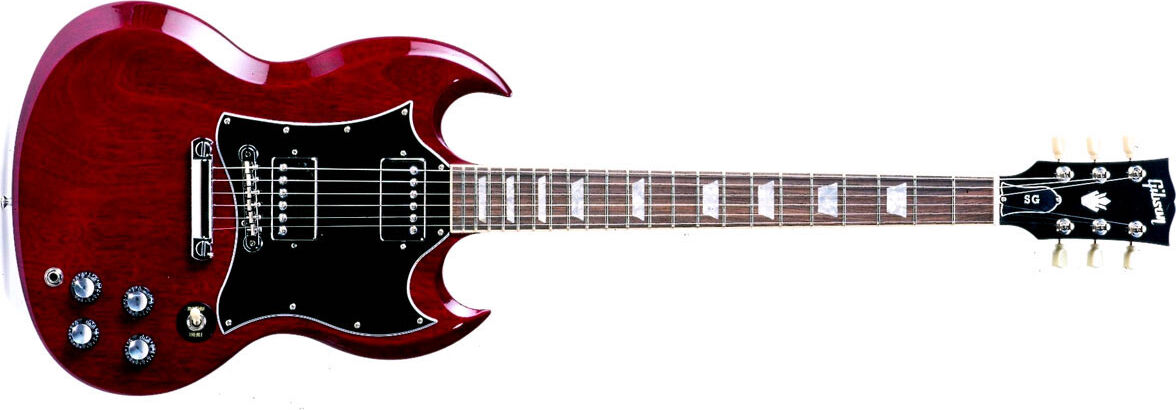
    Everyone who deserves the right to vote knows the Gibson SG:

    Originally putatively a lighter, double-cutaway version of the Les Paul, (whre “lighter Les Paul” makes about as much sense as “Lamborghini with a Hyundai engine”), it’s most famous as Angus Young’s main guitar this past thirty years or so.
    And I always hated ’em; after years of playing the slim, elegant neck of my Fender Jazz, playing the SG felt like a thick piece of firewood; the fingerboards always seemed soft, almost porous. Maybe I’ve tried bad guitars – but every SG I’ve ever played felt cheap.

    So you’d think the cheap knock-off would be a real doozy – right?

    Well, no.

    Ibanez guitars was, and is, a company based in Japan that started in the late sixties and early seventies making knock-off guitars. And one of their mid-seventies efforts was the SG:

    If you look online, sellers will refer to various early-mid ’70s Ibanezes as “Lawsuit Models”, because – well, in 1975, Gibson sued Ibanez for copying Gibson guitars down to the absolute finest details of their designs (tuning machines, headstocks, truss rods…everything). Ibanez responded by changing some of the details…

    …which is where my old SG comes in. It is a virtual dead-ringer for the red Gibson at the top of this post – but for the “Gibson” marque on the headstock, it could be the same axe.  I bought it from a friend in 1979, after he’d gotten it from a second-hand store for $90. I’m not sure if it was built immediately before the lawsuit (it looked exactly like a factory SG) or immediately after (the neck was thinner and slicker; the rosewood fingerboard was much nicer than any SG I’ve ever played). But it is a sweet guitar – especially after I dropped a Seymour Duncan “Jeff Beck” pickup in the bridge position (think “Hyundai with a Lamborghini engine”).

    If you can find one, and you have a choice between saving your significant other’s life with a rare but relatively inexpensive surgery, and buying the SG – well, save you significant other. Duh. And then buy the SG.

    Minnesota Blogs You Should Be Reading: Growing Things

    Tuesday, April 1st, 2008

    Spring will eventually spring.  (My biggest regret was that I used the line “March in Minnesota; in like a lion, out like a cold, wet lion one week and a snowstorm too early).

    And when it does, Black Thumbs like I will need the help of someone who knows how to do something with plants other than mulch the remains.

    And so – since my college friend Jackie hasn’t posted in a year – the spot of “official gardenblog of Shot in the Dark goes “Growing Things“, run by my neighbor (the guy who lives the other way from Flash, who along with his wife actually runs a pretty mean garden over the summer himself; he gets plenty of practice sprouting conspiracy theories over the winter.  But I digress), Peter.

    This year, my resolution is to make my customary salsa garden actually work.  Of course, along about mid-August I’ll have to find a good canning blog.

    Hot Gear Friday – The Supro Thunderbolt

    Friday, March 28th, 2008

    This week’s Hot Gear Friday – done with a nod, as always, toward Anti-Strib’s “Hot Chick Friday” – focuses on the “Speed Racer” of guitar gear, the Supro Thunderbolt.

    When you were a kid, did you ever dream about finding a bunch of parts in a second-hand-parts store, tossing them together, and – via an improbable series of empricial vicissitudes – accidentally build a go-cart that could go 200 mph? Or do the neighborhood show or skit that would get seen, randomly, by some Hollywood agent?

    The Supro amp was sorta like that.

    Supro was a budget-model line of guitars and amps, just a couple of steps above the makes you’d find in Penneys and Sears catalogs of the day, but nowhere near the A-list amps of the day, the Fenders and Ampegs and Marshalls and Hiwatts. They were priced accordingly, when they were new – outside the catalog range, but toward the lower end of the music-store brand range.

    But what you got…

    …was a value priced piece of equipment with a tone that’d strip the chrome off a trailer hitch. With a good, high-output guitar, the Supro would get the perfect overdrive. It was like that mythical, fictional, fantasy go-kart built out of odds and sods that just happened to work better than the sum of their parts.
    Jimmy Page reportedly used a Thud on Led Zeppelin I, II, III and/or IV, depending on the legend you choose to believe. This introduces a chicken/egg question; would people have noticed this humble, budget amp without the Jimmy Page history/legend, or would that legend/history have ever existed had the Supro not been a diamond in the rought?

    Who cares?

    All I know is, I got to play one in college; when my Fender Deluxe Reverb was in the shop (a long, gruelling process in rural North Dakota at the time), I borrowed a Thud from a friend of mine.

    And until the dawn of amps with “modeling” processors (subject of an upcoming HGF) I’ve never played an amp that just felt so perfect, before or since (short, perhaps, of the occasional Mesa/Boogie that, at that time of my life, would have cost a couple months’ salary). And apparently others think so, too – once humble Thuds seem to go for princely ransoms on EBay these days.

    If you get the impression that I could burn through a Powerball purse on guitar gear, you’re probably not all wrong…

    Hot Gear Friday – the Hamer Sunburst

    Friday, March 21st, 2008

    Today’s Hot Gear Friday (with a nod to Anti-Strib’sHot Chick Friday”) is the Hamer Standard.

    They say that, when it comes to people of the opposite (or, for some of us I guess, same) sex, we’re attracted to people we find “exotic” – different than those we grew up around.

    I saw this first-hand a few years back. I grew up in North Dakota, where tall, blond, Northern-European-descended women are as common as wheat – like Minnesota, only more so. I worked with a guy on a project, an Italian from Newark named Vito. He’d fly in to the Twin Cities to work on a project – and as we’d walk about downtown from one meeting to another, he’d be in a constant froth; “Gawd, Mitch, I should move out here. How do you get any work done with all these tall gorgeous blondes around here?”

    “Enh”, I said, remembering when I’d been flown out to the east coast, and spent a couple of days wandering about all bobbleheaded over all of the non-blond, non-tall, non-north-European women.

    So if you’ve noticed that I’ve been focusing a lot on big, dense-bodied guitars – the Les Paul, the Yamaha SG2000, and today’s special, the Hamer Sunburst – then you catch the drift of the anecdote above. I’ve been playing light guitars for thirty years now. Fenders, like my old Jazzmaster, tend to be relatively lightly-built (although as Pete Townsend found to his chagrin, lightness can be deceiving – the Strat is nearly un-smashable; it can serve as an axe, as long as all you want to chop up is amplifiers), with fairly high actions. My other electric – a mid-seventies Ibanez SG – is a fairly light little thing. Sweet tone, sure (having a Seymore Duncan “Jeff Beck” pickup down by the bridge forgives a lot of sins), but that light build doesn’t retain vibrations…

    …like an armored beast like the Hamer. Playing a Sunburst is to playing my Jazz like driving an M1 Abrams is to driving a dune buggy; both serve their purposes; one feels very different than the other.

    And the Sunburst is right up there on my “things I wanna buy when I get an unexpected windfall” list…

    Hot Gear Friday – The Ljungman AG42

    Friday, March 14th, 2008

    The next installment in Hot Gear Friday was Sweden’s answer to the M1 Garand – the AG42, better known in the US as the Ljungman, after its designer.

    And better known to me as “my first real rifle”.

    Developed in 1942, during World War II, as the Swedes realized they were going to need something a little more modern than their early-century Mausers, the Ljungman was ahead of its time in many areas – for better or worse.

    A fairly conventional design in many ways, with a 10-round box magazine (usually loaded with the same five-round Mauser-pattern stripper clips that the Swedish Mauser bolt-actions used), it had one feature well-known to any current American serviceman; its operating system used direct gas impingement.

    Where a conventional gas system uses a piston in a tube next to the barrel (like the tube above the barrel in the infamous AK47), the Hakim’s gas tube directly vents back into a little cup-shaped gas-catcher on the front of the bolt carrier – much like the operating system on the American M16 rifle and M4 carbine. The blast of gas pushes the bolt carrier back, camming the bolt (a tipping bolt, similar to the FN49 or the FN-FAL, and very unlike the rotating-lock M16-pattern bolt) out of its locking recess to open the action. It’s simple and fairly rugged – provided you’re using decent ammo. With 6.5mm Swedish Mauser, that’s rarely a problem. But for the Ljungman’s most famous descendant, the “Hakim” (an Egyptian rifle in 7.92mm Mauser caliber, built with the same machinery the Swedes used for the Ljungman, which Sweden sold to Egypt in the late forties), it’s been rather a different story; the widely-varying quality of 7.92 ammo can yield weak rounds that won’t cycle the action, or – worse – extra-powerful ammo that’ll push the bolt carrier back so violently that the extractor will rip the rim right off the round, causing a nasty jam that usually takes a cleaning rod and a lot of swearing to clear.

    But in 6.5mm Mauser – a ballistically-sweet if fairly small round – the Ljungman was a joy to fire; fairly reliable, bone simple to maintain (for me; given the problems the M16’s similar system has had, I have no idea how it’d have fared tramping through some north-Swedish bog), and a joy to shoot.

    By Any Means Necessary

    Tuesday, March 11th, 2008

    I got a chuckle:

    Me: I love that we both wanted to hate [American Idol contestant] David Cook, but ended up loving it.

    Curly: It was sort of how I felt when I realized the troop surge was actually working.

    There are times I wish Glen Reynolds hadn’t made “heh” a blogosphere cliche.

    On The Chance…

    Monday, March 10th, 2008

    …that you’re trying to leave a comment in my comment section, and:

    a) you’ve never left a comment before

    b) you’ve changed commenter IDs, or

    c) you’re including a hyperlink in your comment…

    …it might take a while for your comment to appear.  I’m in the middle of the biggest spam attack I’ve had since switching to WordPress for my blogging tool.

    And thank goodness I did; WordPress’ “Akismet” heuristic spam catcher is doing its job, so far; but plenty of “new” spam designed to evade it is ending up in my moderation queue – over 70 overnight.  Which is still pretty dreamy, compared to the hundreds and even thousands I’d get daily on Movable Type…

    …but it’s still going to slow down my comment moderation until the storm passes.

    Hot Gear Friday – The Yamaha SG2000

    Friday, February 29th, 2008

    In my continuing homage to hot gear, we now enter the realm of the broken heart.

    Remember that girl you went out with, once or twice, twenty years ago, where there was that brief, fleeting moment of connection, followed by…well, nothing? Or maybe that “pal” from high school where you realize, thirty years later, it could have and maybe should have been something else? The one where you could have probably gone a lot further, and there was potential, but something – it’s hard to remember exactly what, even – got in the way?

    The Yamaha SG2000 is that.

    The SG2000 is one of the most gorgeous guitars ever made. As dense as depleted uranium (meaning in terms of “weight per unit of volume”, not “Matt Snyders”), the body and neck are heavy, almost like carrying a guitar made out of steel railroad rails – so the sustain, fed through the SG’s gorgeous electronics, was just out of this world. It was a sweet-toned marvel with a low, slick action that made even the Les Paul feel clunky, and made playing Fenders (like my primary axe) feel like you were tryin to bend rebar.

    It was built from the late seventies into the mid-eighties, and it never quite caught on like some of the others in its weight class – the Les Paul, of course, but also the Hamer Standard and the various Paul Reid Smiths – but it was a beautiful instrument that played just like ringing a bell.

    I came across one on a frigid January Saturday in 1987 at the old Benedict Guitar store, on 34th and Lyndale. Visions of Stuart Adamson’s celtic guitar gymnastics skirling through my head, I sat and played it for close to two hours, putting it through every pace I could think of. And I fell madly in love.

    And it was just on the high end of my price range. And prudence got the better of me.

    And for 21 years, I think, I’ve regretted it.

    Now, the Hollywood legend would have it that when you finally meet that girl who totally smote you back in high school, 25 years later, it’s all different; the thrill is gone (although the women in my graduating class have done really well, actually – can I get an amen, JHS ’81 guys?), with the SG2000, it’s a whole ‘nother thing. I found one, at Capitol Guitars in downtown Saint Paul, last summer.

    And oh, my. Better than I remember.

    Next year’s tax refund? Could be. We’ll see.

    God And Buckley At Jamestown College

    Wednesday, February 27th, 2008

    I may be the only person in the western world who can say this truthfully:  I was converted to conservatism while an English major in college.

    My major advisor – Dr. James Blake (easily the finest among many, many fine professors I had at my obscure but talent-rich little college in the middle of nowhere) was so far to the right, he described himself as a “monarchist”, with a straight face; he also introduced me to a series of writers that helped push me along on my journey from left to right; Dostoevski, Solzhenitzyn, Tolstoii, Paul Johnson, and even P.J. O’Rourke. 

    Dr. Blake and I weren’t entirely alone; the other upper-division major at the time was a guy named Scott.  We’d been friends since high school; a year older than me, we’d played guitar together in any number of abortive bands; he wrote a column under the pseudonym “Madagascar Red” in the college paper that I edited which, with the hindsight and gauzy soft focus that two decades’ remove grants all things, was as funny as anything in The Onion.  Honest.

    Anyway, Scott was another conservative in the English department.  And as my own journey to the right coalesced, the three of us became something of a conservative brickbat-throwing machine at Jamestown.

    The school’s library was run by quite a different specimen – a woman who was, in addition to the wife of my History minor advisor, a bit to the left of even the academic norm.  A well-meaning sort, but…well…

    She had a “suggestion book” at the entrance to the stacks; if someone wanted to see a book or other resource, they could write it into the book.  There was a column for the librarian’s response. 

    One chilly October morning, Scott and I walked into the library.  He looked around, grabbed a pen, and wrote down “Please get a copy of God And Man At Yale“. 

    The response took a week or two; finally, the librarian wrote something snarky and dismissive.

    Wrong move.

    In an exchange that resembled a blog comment section, fifteen years before blogs were invented, Scott and the librarian mixed it up – he making the case for including this key, vital book in the collection, she backpedalling and trying to justify (eventually) its exclusion.

    I think Scott graduated without seeing the issue resolved. 

    The long and short of it being that the whole fracas was my introduction to the pure, simple joy of being a conservative underdog, duking it out with the leaden, lumpen establishment.

    Just saying; without that dust-up on William F. Buckley’s behalf, this blog might never have existed.

    Hot Gear Friday – Browning HP35 “Hi-Power”

    Friday, February 22nd, 2008

    Today’s Hot Gear Friday feature (with a nod to Anti-Strib’s Hot Chick Friday only with, like, gear instead of chicks – although please, guys – Barbara Eden? Yeep) is the Browning HP35.

    A first-cousin of the legendary Colt M1911A1, this 1935 design was the standard pistol of most British Commonwealth armies from the end of World War II (it was served with Britain’s paratroopers and commandos during the war), and the standard sidearm of the SAS’ hostage rescue teams until, reportedly, quite recently.

    I never much liked 9mm handguns – but the Hi-Power is perhaps the one handgun in the world that fits my hand perfectly and points like no other I’ve ever shot, including the M1911. They’re not cheap, these days, but ooooh nellie, I tell ya – one of these next tax refunds…

    --> Site Meter -->