Archive for the 'Great Plains and Midwest' Category

You’ll Never Know Which Way To Look, You’ll Never Hear Us

Tuesday, June 5th, 2012

Scott Walker, and America – real America – win.

It’s not even close.  As this is written, it’s 58-42, with 52% reporting.

It brought things to mind:

Lament!

And the Democrats, with their plutocrat supporters and smug union leader fatcat commissars gathering around them, have to know that this is not a good omen for the fall.

Because this was a victory for regular private sector working people – the backbone of this economy.

This was a victory for the Tea Party – which has moved from carrying signs to working at the grass roots and winning elections.

This was a victory for conservatism.

The Democrats would have you believe this was a victory for money.  Of course, money always wins elections; that’s why Michael Huffington and John Corzine are sitting in office today.

No.  This was a victory for the people; for real America.

And we’re not done.

Straws

Friday, June 1st, 2012

Being as I am, of small-town Scandinavian extraction, I am not one to feel…

…well, optimistic.  I garnish all of life’s observations with a little sprig of protective pessimism.  It’s sort of a Pascal’s Wager for the mundane; if you expect the worst and get the worst, you’re not disappointed; if you expect the worst and get the best, it’s a wonderful day.

So I’ve always looked at the Wisconsin recall election as a likely loss, and have kept that point of view throughout the runup to the election this coming Tuesday.

But the polls are looking a little better, with some showing a 5-7 point lead for Walker.  I’m still calling “Defeat”, but I’ve got my fingers crossed, like any good Norwegian.

Of course, if you’re a liberal, you’re used to big institutional polls being in the bag for your people (examples: the Strib and HHH polls here in Minnesota). And when the big institutional polls turn against you – well, there’s just got to be a nefarious explanation for it.

In the case of the Uppity Wisconsin blog (oddly misnamed, being as they’re plumping for the most establishment of all institutions, Wisconsin unions, but whatever), the bad polls for Barrett have just got to be either a mistake or a fix.

Polls are only relevent if their sample is reflective of the electorate. As the graph demonstrates, compared to exit poll data (averaged from 2010, 2008 and 2006) the recently released Marquette poll grossly oversamples conservatives and undersamples moderates.

Image from "Uppity Wisconsin"

Perhaps.

And it could be that the poll grossly shorted liberals and moderates.

It could also be that the two years of exit polls used – 2006 and 2008 – were anti-GOP wave elections with a lot more identified non-conservatives than 2010.

This is, of course, quite significant considering that the same poll shows Barrett beating Walker 50 to 42% among moderates

Well, we’ll see.  Because as we always say, the only poll that really matters is on election day.

At any rate, it’s possible the Marquette Poll is wrong.  But if it were, and other polls – say, the White House’s internal polling – weren’t seeing about the same results, then you might be seeing more national Democrat involvement in this election, which promises to be such a pivotal one both for this fall and for the role of unions in public governance.

But you’re not.

Shot In The Dark: Today’s News, Two Weeks Ago

Thursday, May 31st, 2012

I should change the motto of this blog; “Our Rumors Are Better Than Most Organizations’ News”.

The Wall Street Journal announced that Wisconsin AFSCME membership has dropped.

Well, no.  It plummeted.

Well, no.  It went into a flame-belching, smoking death spiral.

Yeah.  That’s what I”m looking for.

In the Wall Street Journal, (via Power Line):

Wisconsin membership in the American Federation of State, County and Municipal Employees—the state’s second-largest public-sector union after the National Education Association, which represents teachers—fell to 28,745 in February from 62,818 in March 2011, according to a person who has viewed Afscme’s figures. A spokesman for Afscme declined to comment.

Much of that decline came from Afscme Council 24, which represents Wisconsin state workers, whose membership plunged by two-thirds to 7,100 from 22,300 last year.

This was, of course, reported in this space two weeks ago today:

Scuttlebutt from a trusted source who works inside AFSCME Minnesota Council 5 states that there are interesting developments in the Wisconsin AFSCME. Ever since passage and signing of the “right-to-work” laws in our neighboring state to the east, about 80% of those AFSCME members have “opted-out” of paying union dues.

My source’s anecdote got the percentage wrong, but the magnitude of the catastrophic ennui facing Wisconsin’s unions was dead-nut on.

Certain members of the leftyblog clucking class tried to call BS on the anecdote, claiming “FACT CHECK”.

Their spurious claim of “BS” is returned with two weeks’ interest, um, piled on top.

(more…)

The Most Wonderful Time Of The Year

Thursday, May 17th, 2012

It’s Syttende Mai – the 107th anniversary of the day that Norway declared its independence after a bloody war of independence, throwing off the shackles of onerous, brutal Swedish rule.

Norwegian forces had fought a long-shot, underground war against the evil Swedes – a battle which may have been the model for the “Rebellion” in the movie Star Wars – ragtag rebels fighting the Swedes and their Finnish and Danish mercenaries, eventually coalescing into a movement that was able to virtually wipe out the Swedes and drive to the very gates of Stockholm, dragging the Swedish monarchy to the negotiation table, leading to the…

…the…

…oh, I can’t go on.  It’s really just the date the Norwegian constitution was ratified.  Norwegians celebrate the event with childrens parades and the sort of stuff Americans do for, well, Arbor Day.

Anyway – happy Syttende Mai!

Unintended Consequences

Wednesday, March 28th, 2012

The wisdom of Scott Walker’s approach is being hailed by…

Wisconsin’s Teachers unions?

Or at least, that fraction of their mlembers that weren’t laid off, as we were warned they’d be?

Huh-wha?

When debate over public unions flared up in Wisconsin last year, educators claimed Gov. Scott Walker’s austere reforms would require thousands of teachers to be laid off.
They were wrong.
With small changes in pension and healthcare contributions while allowing school districts to buy health insurance plans on the open market, Walker’s reforms have resulted in what could be considered a statewide teacher-retention program. School districts such as Wauwatosa, hometown of Governor Walker and the Weekly Standard’s Fox News star Stephen Hayes, faced a $6.5 million deficit and planned to lay off dozens of teachers. But Walker’s reforms allowed all those teachers to remain employed.
At other large school districts such as LaCrosse, Racine, Wausau, and Beloit, if there were any layoffs at all, they were limited to two or fewer. And in addition to retaining teachers, the reforms have instituted merit-based pay systems that allow excellent teachers to be rewarded.

But was there a catch?

Silly wiberwal wabbits. There’s always a catch – and it comes from your side:

However, not all school districts adopted Walker’s reforms so readily. Milwaukee’s school district, which is immediately east of Wauwatosa, rammed through a union contact in December, just in time to avoid being subject to the reforms.
Now it appears the Milwaukee district is reconsidering its hasty action.

The Walker “Recall”, combined with the onset of Obamacare and Obama’s microphone flub with Medvedev, might be just about the best thing to happen to the GOP this year.

More recalls like this, and Walker might be the Presdent next year.

(Via commenter Bosshoss429)

For All The Marbles

Tuesday, February 14th, 2012

Stephen Hayes at Weekly Standard writes about the bold, principled conservative we’ve all been waiting for – but who’s gotta defend his seat in Wisconsin first.

It’s a great article about Scott Walker – and it ably lays out both Walker’s outsized accomplishments (especially against Wisconsin’s Democrat machine, which is better than Minnesota’s only because it’s out of power):

Walker came to office in the Republican wave of 2010. He inherited a mess. Under his profligate predecessor, Jim Doyle, state government had operated almost as a slush fund for public employee unions. Giveaways to teachers and others put the state on an unsustainable fiscal path, so Doyle raised some taxes and threatened to raise others. He raided a state fund set up to cover medical liability, essentially stealing contributions doctors had made to the pooled account. The Wisconsin Supreme Court ruled against that pilfering, but the money had already been spent. Even after budget gimmickry that would make Fannie and Freddie blush, the official deficit was $3.6 billion.

Just over a year later, Walker and the Republicans in the state legislature have nearly eliminated the deficit. For the two-year budget cycle, the state will show a $143 million shortfall because the stagnant economy has resulted in lower tax receipts than had been projected. But the shortfall is for the first half of the cycle; Wisconsin will run a surplus in the current fiscal year. And Walker said last week that he will eliminate the remaining shortfall without raising taxes. It’s a credible claim. He reduced the deficit without raising taxes. In fact, one of his first moves upon being sworn in was to cut taxes on businesses. His subsequent reforms have allowed property tax receipts to go down for the first time in years—by some $47 million.

He also writes about the outsized consequences if Walker loses:

For conservatives, the fight is about much more than one man in one state. A Walker defeat would send a message that political courage does not pay and political thuggery does. Walker doesn’t like to talk about the effect the past year has had on him and his family, but it hasn’t been pleasant. He has been subjected to numerous death threats. His wife, Tonette, has been verbally assaulted more times than she can count. His two teenaged boys have been targeted on Facebook. His modest home in Wauwatosa has been the site of several union protests. Last month, a protester outside Walker’s State of the State speech told State Senator John Kleefisch that his wife, Lieutenant Governor Rebecca Kleefisch, is a “f—ing whore.”

I think it’s time to start a “Minnesotans for Walker” group.  The unions are going to go all-in on this election – because if they lose, it’ll be katie-bar-the-door.

If it weren’t for that Presidential election thingie, this would be the most important election of this year.

But Wait – Do They Even Have LGA?

Monday, December 19th, 2011

On Saturday I was complaining sardonically about “not having enough to talk about” on the NARN show.

It was a josh, of course; Ed and I had eight or ten hours of material.

But a friend and high school classmate of mine who lives in Wisconson dropped me a line:

You could always cross the border and discuss all the “pain” Governor Walker has caused the working man. I just got my property tax bill and saw a 5% decrease. I must be a masochist because I want more of that type of pain.

Which is interesting to read, given the noise and fury (signifying, it seems, bupkes) that the Dems are spreading over the effort to recall Walker for…well, doing what he promised to do when he won the election last year.

Read Ann Althouse for her take on the recall’s progress. She’s optimistic.

“Well, Golly, Elmer – We’re Gonna Have To Hire A Fella From Minneapolis To Help Us Spend This Money!”

Tuesday, November 29th, 2011

(NOTE:  For purposes of comedic affect, the author, Mitch Berg, is going to write most of this piece in an affected “North Dakota” accent.  The author notes in advance that the written patois actually sounds a lot more like a rural Oklahoma accent with overtones of rural Tennessee.  The author acknolwedges this, but notes that trying to write in an accent from the movie “Fargo” has little comedic affect, and is almost equally linguistically inaccurate, and begs your indulgence.  And now, on with the actual posting).

I been moved down here from North Dakota since nigh on 25 years now.  Back before I moved to the big city and all its temptations and lights, I didn’t know how to write so good.  Being from a rurl state and all, edumacation wasn’t our strong soot.

In fact, untel we got some people from the big city to come and tell us how to run our lifes. we was just a bunch of loosers who ain’t know how to do much but drive plows and drink beer.

Thanks to the people from the big city, I now know how to write dern gooder than I used to.

They done the same thing with gummint back in my home state.  Back before the big city folks came to North Dakota (or Nodak, as us all calls it), we ain’t known how to run a gummint as well as the folks in Minnesota.  Oh, we balanced our budgets for years, back when the budget been small and the state barely had a pot to whiz in.  But we were not as advanced as the people in Minnesota, who kept growing their budgets and battling over budget defecates, whatever they are.

Now, back in my home state they done found Awl.  Big Awl.  Lots of awl.  The whole western half of the state is like Saudi Arabia now.  Awl is everywhere.  And all these big-city folks, like Minnesota Public Radio, have been trying to tell the folks back home what a bad deal that is, how having money and stuff is making the state all miserable – which I kinda thought been funny, since I’m old enough to remember the eighties, when farming fell into the same kind of depression that housing is in now, and a good chunk of the state’s farms got foreclosed on and you could buy entire little towns for the price of the paperwork it took to print the deed.

Anyway, awl’s done changed all that.  And that means there’s a lot of money plumb coming in to the state’s coffins.

And shore nuff, a big city guy, Dave Mindeman from MnpAct, is telling all them hicks what’s best for ’em:

North Dakota is getting a little bit cocky.

There is a movement going on in the frozen tundra to put the elimination of property taxes on the ballot in 2012. Can you imagine? No property tax statements. Nothing.

Cocky?  That word ain’t never describe my kin back home.  “Passive Aggressive” is the one I hear more often, but I have no idea what that means, because none of us are smart enough to know what them words means.

Anyway, Mindeman has a word or two fer us hayseeds:

Now, granted, North Dakota can afford to do this. We all know about the oil boom going on in the western part of the state. Oil revenue taxation is a major windfall. So, the money lost on eliminating property taxes can probably be recovered.

Provided we all isn’t too stupid!

But I digest.

But that’s not the problem.

Cities and counties utilize property taxes for a very specific pupose (sic). Local services. Let’s say this all comes to pass. The local city councils and county boards have no assessed income from the property valuations. What happens?

Well, the state legislature would have to appropriate it. A kind of massive LGA if you will. Cities and counties would have to compete for state dollars…..a kind of massive “pick me…pick me” distribution.

Which is sort of what LGA has become in Minnesota.

Budget calculations would be in reverse mode. Instead of taking the base line of assessments and then deriving priority needs based on what you can collect, city and county governments would estimate what is needed and then lobby the state to get it.

All that’s true.

But since Mindeman brought up LGA (pardon me as I momentarily abandon the patois of my native land and get to some writing here), let’s take a look at some history.

A little over forty years ago, Minnesota noticed that there were, to paraphrase John Edwards, “Two Minnesotas” – an outstate Minnesota that was aging rapidly, was tied to agriculture (which is intensely cyclical) and mining (which wasn’t, but was also falling off rapidly as the US steel industry obsoleted itself), and the Metro area, which was young, highly educated, growing rapidly, and making a lot of money.  There was a significant disparity of wealth in the state.  The powers that be at the time decided it’d be useful to take some state revenue from the wealthy parts of the state and use it to help the poorer parts – at the time rural and outstate – pay for some of the infrastructure of modern life.  Now, as the Twin Cities and Duluth shrank and got poorer (mostly as a result of DFL policies), the original intent of LGA has been perverted beyond it’s original scope – but that’s a story for another blog post.

Now, remember the bit above about the disparity of wealth between the Twin Cities and, say, Thief River Falls back in the late sixties?  And LGA’s justification – enabling the Thief River Fallses of Minnesota to afford a new school and some traffic lights that they couldn’t manage on their own tax bases?

Multiply that disparity by an order of magnitude in North Dakota.  Towns like Williston, Dickinson, Bismarck, and even flood-ravaged Minot are booming; real estate values are soaring, to the point where it’s making it impossible for the Air Force people who’ve been the stable mainstay of the area economy for the past sixty years to live in the area.  An apartment in Williston costs about as much as an apartment in Manhattan or San Francisco. And it’s creating ripples of scarcity that are jacking up prices all the way across the state – including places like cha-cha Fargo (itself prosperous on the fringe of the oil economy as well as a tech boomlet) and less-blessed places like my own hometown, Jamestown, which is well outside the Bakken oil patch and has, like much of the state between Fargo and Bismarck, a shrinking, ageing population with an income base that is still tied to agriculture, tourism and the military, and whose property values are holding steady even as prices rise.

And so if the notion of Local Government Aid made sense in Minnesota forty years ago – and Mr. Mindeman, if you preferred the post-2002 LGA system to the pre-2002 one, let me know, since I suspect you did not – made sense, then why doesn’t it make sense in smoothing out the vastly wider disparity in North Dakota today?

The temptation would be to overcompensate for what your budget actually needs. To ask for more with the expectation that there will be a reduction.

But think about that. Every city and county would be asking for extra and their state representatives would then have to petition the entire legislature to grant the requested amount. Monetary requests would soon get out of hand and the state would be picking winners and losers across the board.

You mean – like the LGA system in Minnesota?

Not pretty.

Maybe, just maybe, you can make that all work in a booming economic time that North Dakota has for the moment. But these oil booms are always temporary. And the future is not going to be about oil….it’s about alternative fuels.

North Dakota could lock themselves into an LGA problem that makes Minnesota’s ongoing issue look like a piece of cake.

They could if’n (oh, dear, I find myself slipping back into my native patois again) the whole “how to run a demercratic gummint” thing is just too hard fer them to figger out.

Mebbe we could send them some kids from the Wellstoned Center to hep them with all that complicated gummint and thinkin’ and stuff.

The problem is that taking that local decision making away from the local government officials that have the best chance to understand local needs, is a prescription for chaos.

Even more chaotic than the scramble for housing in Williston.

Even more chaotic than the scramble among logicians to figure out exactly what Mindeman means; is LGA a good idea in Minnesota, where the income disparity done switched isself around in the past forty years (outstate supports the Metro, today), but a bad idea in NoDak, where the disparity issue is the same as it was in Minnesota in the seventies, only much bigger?  And if so, why – because North Dakotans are too dumb to figure out an idea and process that Minnesotans have turned into such a finely-tuned success story over the past forty years?

I think that’s what you city folk call “Sarcasm”.  I saw it on Jon Stewart the other night.

The Gleam Of Success

Tuesday, November 15th, 2011

This via Bob Collins at MPR’s News Cut, a look at North Dakota’s Bakken oil field from space:

…Ken Paulman at Midwest Energy News [provided] a long look at the “cool” video that NASA put out…

The image Paulman pulled from the video certainly presents a compelling view of how big the oil fields are and, given that some of that light may be caused by the burning of natural gas, what sort of impact the entire operation is having on terra firma.

MPR has been covering the oil boom; I got one of the emails their Public Affairs department sends out looking for people and insights on stories.  They’re looking, it seems, for the pros and cons.

I’m sure they’ll get plenty of cons.  I know my sister’s husband is going start commuting to the Bakken from Billings next week; two weeks on, one week off.

But here’s a pro for you; when I left NoDak back in 1985. the pace was genuinely depressed.  There was nothing going on up there. Only the eastbound lane of I94 over the Red River ever needed repair.  The state was drying up and dying; idiot East Coast academics were discussing turning the whole place into a “Buffalo Commons” – basically giving the whole place back to nature (apparently not asking the Native Americans what they thought about it).

Serves ’em right.

Dear New York

Monday, August 29th, 2011

Glad the storm wasn’t as bad as Anderson Cooper was hoping for.

Now – picture the storm you just got, only at -35F.

Regards,

The Great Plains.

Oh, Yeah

Friday, August 26th, 2011

Remember last spring, when the Dems lept up and down like organ-grinder monkeys on espresso, claiming that Supreme Court of Wisconsin (SCOW) Justice David Prosser had “choked” fellow SCOW justice Ann Walsh Bradley?

Leftybloggers will no doubt hope you don’t.  I’ll refresh everyone’s memory here and here.

Was it 1000% bullcrap?  Hey, it was a liberal meme; I’d only be amazed if it wasn’t.

Because it was.

Neither Supreme Court Justice David Prosser nor fellow Justice Ann Walsh Bradley will face criminal charges for a June altercation that broke out as the judges were considering Gov. Scott Walker’s union bargaining law, a special prosecutor has determined.

In an interview, Sauk County District Attorney Patricia Barrett steered resolutely clear of specifics about the reasons for her decision.

“The totality of the facts and the circumstances and all of the evidence that I reviewed did not support my filing criminal charges,” Barrett said Thursday.

Which is, I suspect, lawyer-talk for “there was no there, there, but I’ll be damned if I”m going to piss off a SCOW justice”.

So there you go, lefties.  On to your next facile group slander!

The Money Pit

Friday, August 26th, 2011

George Will notes what many upper-Midwest conservatives have been saying since February; the left went all-in on Wisconsin because if they can lose there, they can lose any and everywhere.

I’ll start with Will’s conclusion:

As the moonless night of fa$ci$m descends on America’s dairyland, sidewalk graffiti next to the statehouse-square drinking fountain darkly warns: “Free water . . . for now.” There, succinctly, is liberalism’s credo: If everything isn’t “free,” meaning paid for by someone else, nothing will be safe.

That’s the crux of it all, really – but it wasn’t what the Wisconsin flap was about.

In fact, you could be forgiven for watching the American left this past seven months and having no idea what it was all about:

During the recall tumult, unions barely mentioned either their supposed grievance about collective bargaining, or their real fears, which concern money, particularly political money. Teachers unions can no longer bargain to require school districts to purchase teachers’ health insurance from the union’s preferred provider, which is especially expensive. This is saving millions of dollars and reducing teacher layoffs. Also, unions must hold annual recertification votes.

And teachers unions may no longer automatically deduct dues from members’ paychecks. After Colorado in 2001 required public employees unions to have annual votes reauthorizing collection of dues, membership in the Colorado Association of Public Employees declined 70 percent. In 2005, Indiana stopped collecting dues from unionized public employees; in 2011, there are 90 percent fewer dues-paying members. In Utah, the end of automatic dues deductions for political activities in 2001 caused teachers’ payments to fall 90 percent. After a similar law passed in 1992 in Washington state, the percentage of teachers making such contributions declined from 82 to 11.

Democrats furiously oppose Walker because public employees unions are transmission belts, conveying money to the Democratic Party. Last year, $11.2 million in union dues was withheld from paychecks of Wisconsin’s executive branch employees and $2.6 million from paychecks at the university across the lake. Having spent improvidently on the recall elections, the Wisconsin Education Association Council, the teachers union, is firing 40 percent of its staff.

Progressives want to recall Walker next year. Republicans hope they try. Wisconsin seems weary of attempts to overturn elections, and surely Obama does not want his allies squandering political money and the public’s patience. Since 1960, no Democrat has been elected president without carrying Wisconsin.

Will – or the copy editor that wrote his headline, anyway – uses the “Waterloo” metaphor; a defeat that makes further victories impossible (until some sort of radical game-changer):

Walker has refuted the left’s sustaining conviction that a leftward-clicking ratchet guarantees that liberalism’s advances are irreversible. Progressives, eager to discern a victory hidden in their recent failures, suggest that a chastened Walker will not risk further conservatism. Actually, however, his agenda includes another clash with teachers unions over accountability and school choice, and combat over tort reform with another cohort parasitic off bad public policies — trial lawyers.

I can hardly wait for the next session – on both sides of the Saint Croix.

Well, There You Go

Wednesday, August 17th, 2011

Well, there you go, Democrats.  You  spent tens of millions of dollars of union dues (and goodness knows how much money from liberal sugardaddies), more than you spent during the general election…

…and at the end of the day, for all that, you came up a seat short.

The six-month saga that was Wisconsin’s state Senate recall movement ended Tuesday with Democrats retaining two seats – and Republicans still in possession of a week-old, razor-thin 17-16 majority.

On the fourth election day of the summer, two Democratic incumbents were victorious. Sen. Jim Holperin (D-Conover) beat challenger and tea party activist Kim Simac of Eagle River, and Sen. Bob Wirch (D-Pleasant Prairie) easily topped Republican lawyer Jonathan Steitz.

Congrats, Wisconsin Dems.

Successful Dem incumbent Jim Holperin points out the narcissism behind the Democrats’ motivations (emphasis added):

Holperin said he believes his win and that of Wirch showed that voters in both districts supported the move by the 14 Senate Democrats to leave the state earlier this year to delay a vote on the budget-repair bill that limited collective bargaining for public employees. “Maybe it shows that voters indicated they deserved more time to let their voice be heard on such an important piece of legislation,” he said.

So there you go; when a minority “wants to be heard”, all they need to do is flee; screw the majority, which was “heard” on election day!

Why do liberals hate Democracy?

To paraphrase Joe Biden, “respecting the results of elections is patriotic”.

If “Progressivism” Got Crushed In The Woods And The Media Didn’t Report It, Did It Happen?

Tuesday, August 16th, 2011

Hey, didja notice how the Wisconsin Recall Elections disappeared from even the regional media last Wednesday?

While the leftymedia spent about a day trying to polish the turd – “We got two of them!” – it was pointless; coming up one short was no better than losing all six recalls, especially after spending the kind of money the “progressives” spent.   You can bet that if the Dems had won three, we’d be hearing about how the Tea Party was dead, at top volume.

The final round is scheduled for today, and since we’re not hearing a lot about it, that most likely means…

…well, we’ll come back to that:

On the ballot were Sens. Bob Wirch of Pleasant Prairie and Jim Holperin of Conover. Holperin is the first state-level elected official in U.S. history to have faced two recall attempts. He survived one in 1990 as a member of the state Assembly after he was targeted for supporting tribal spearfishing rights.

There’s a decent chance that Holperin can be tossed.

Which is, I suspect, why we’re not hearing a whole lot about today’s elections.

Attention Progressives

Wednesday, August 10th, 2011

Ahem.

At the risk of dispersing some of this blog’s usual decorum:

HAHAHAHAHAHAHAHAHAHAHAHAHAHAHAHAHAHA!

(breathe)

HAHAHAHAHAHAHAHAHAHAHAHA!


I’m not usually one for end-zone happy-dancing.  But after all the “you are teh racist/sexist/anti-worker/anti-middle-class/teabagger!/Koch-sucker/crap all of us conservatives have had to sit through since the last election, frankly, I think we’re entitled.

Last night’s victory in Wisconsin, like the “budget compromise” in DC and the Minnesota state budget, weren’t unalloyed victories – but in this case, it wasn’t even as close as it looked for the Wisconsin Democrats.

Think about it, “progressives”; you just spent $40,000,000 of your unions members’ dues – twice as much as the entire campaign for the entire Wisconsin State Senate cost in 2010.

Twice as much as the GOP spent.

You did it, you said, because you just knew Wisconsinites, deep down inside, were a bunch of liberals!  Not without reason; Barack Obama won every single one of those districts in 2008.

You – every damn one of you – just knew that you’d flip three, four, maybe even all six seats!  Because – you just knew this – Wisconsin just BLEEEEEEEDS “progressive”!

Or at least you had to hope so – because this, along with this autumn’s vote in Ohio on a slate of reforms similar to Walker’s – could mark the beginning of the end, not of public unions, but of public unions as a critical, game-ending force in national politics.

Because in a few years, with more stories like this floating around out there, even more voters will see what a crock of crap you “progressives” have been selling for so long.

Your platform – which, when you strip away all of the happy-talk, is “we will force private sector workers to work ’til they’re 72 so public union members can retire with full benefits at 55” – just isn’t working anymore.

And what did you get for your tens of millions?

You got two – one that everyone knew we were going to lose, and one squeaker against a guy with lots of personal electability issues,  The rest of them – even the Darling-Pasch race, which started the evening’s returns with Pasch winning – weren’t even close.

And Shelly “MAKE NO MISTAKE, WE ARE IN A WAR” Moore?  Yep, you were in a war.  And you were Italy.  And even with all that union money for those obnoxious, “A Better Minnesota”-style TV ads, and all those union people trawling the streets, and all those Twin Cities “progressives” coming across the river to help out?  Not to gloat, but that was the sweetest victory of them all last night, at least for a Twin Cities conservative who got to watch that race close-up from across the Saint Croix.

Sixteen points.

And the Democrats’ Holperin seat is looking kinda squishy in next week’s round of recalls.  Your two pickups could very easily turn into one by this time next week.

Scott Walker has been affirmed; Barack Obama has been refudiated.

You want to call this a war?  You know how those end, right?

The Conductor

Wednesday, July 20th, 2011

It was a chilly, rainy night in March of 1983.

I had a horrible cold – but no matter.  I was standing on a riser in a tumbledown little church in Pendelton, Oregon, with 69 or so other college kids.   And by this time in the tour, cooped up on buses for day after day, most of us were sharing colds.

I had just finished a brisk walk up to the stage for the second of three sets of the evening’s performance.  It was our seventh or eighth concert in as many days and nights.

The house lights dimmed, and the stage lights came up, blotting the audience from view.  We focused on the conductor’s podium, where presently a guy in a formal tuxedo climbed onstage.  His cheeks were puffy and red, but his eyes were clear and sharp- “fierce”, I’d say, if the fashion industry hadn’t so devalued the word.  He smiled -partly greeting, partly saying “can you keep up with me?”

He lifted his hands, and brought them down.  And we sang – launching a capella and without fanfare directly into “Have Ye Not Known/Ye Shall Have A Song”, two movements from Randall Thompson’s oratorio “The Peaceable Kingdom”, a piece lifted from Isaiah 40:21:

Have ye not known?

Have ye  not heard?

Hath it not been told you from the beginning?

Hath it not been told from the foundations of the earth?

(Here’s a high school choir doing it).

I sang my part, nestled into the midst of seventy college kids who, for a couple of hours, felt like a single organism that was much better than the sum of our parts, as the conductor – listed on the program as Dr. Richard Harrison Smith, and never anything else – wrung the last little bit of execution, passion and yes, joy out of the evening.

And while I didn’t dare make any facial expression, or even take my eyes off the podium, I smiled inside.

———-

I remember “Dick” Smith, as my dad always called him, probably about the same time he moved to Jamestown, ND.  He and his family – his daughters, Kristin and twins Karen and Kathryn, all about my age – came by our old house in Jamestown, along with his wife, June, who’d just been hired as Dad’s colleague in the Jamestown High School English department.   Smith had just taken over the music department at Jamestown College, after earning a PhD in music and an MA in Biochemistry.  I wonder sometimes if academia today would know what to make of a guy like him.

But  I was years away from knowing any of this.  I was six years old.

Now, if there’s one thing people in small college towns appreciate – or appreciated, in those days before the internet and ubiquitous TV and travel – it’s whatever scraps of culture they can get.  And Dr. Smith quickly started producing some amazing culture.

In town, we noticed this mostly from the college’s annual Christmas concerts – which morphed from sleepy little affairs into six-night runs with choir, concert band and elaborate production, lighting and sets, that drew packed houses and TV coverage.  Packing into the college’s Voorhees Chapel, to the smell of pine boughs and scorched gels, is one of the most potent memories of Christmas as a child.

Unbeknownst to me – because I was years away from caring about such things – Dr. Smith, starting in 1969, built the JC Concert Choir into one of the premiere college choirs in the United States.  One review from the seventies – and no, I couldn’t find it if I tried – placed JC’s choir among the top three small-college choirs in the US – in the same league as the legendary St. Olaf Choir, in the (choir geeks will know this) Christenson era.    In 1972, the Jamestown College choir became the first American choir to sing at Notre Dame Cathedral in Paris.  In 1978, he engineered a visit to Jamestown by the Saint Paul Chamber Orchestra to accompany the choir in a concert – the highlight being Bach’s Magnificat, if I recall correctly.

You might be thinking “this is a small college choir that fought above its weight”.  It was – but that wasn’t even the amazing part.

The amazing thing about Smith’s choirs throughout their history?  While the other top-flight choirs, like St. Olaf’s, were made up of music majors and especially voice students, Jamestown just wasn’t that big.  In the seventies, the place had 600-700 students, maybe a couple of dozen of them music majors.   Over ten percent of the entire campus sang in the choir – less than a quarter of them music majors.  Imagine a tournament-grade basketball team that was 3/4 walk-ons from the Theatre and English and Nursing departments; it was the same basic idea.

And so year after year, for almost thirty years, Dr. Smith created top-flight college choirs from virtually nothing.

———-

When I graduated from high school.  I didn’t know what I wanted to be – but I knew I wasn’t going to major in music.  Still, I’d had some musical training – none of it involving singing.  I played guitar, cello and harmonica, and sang in a garage band, in a voice that was best suited for shouting out Rolling Stones and Clash covers.  That was all the singing I ever wanted to do.  I was an instrumental guy, and proud of it.

I’d known Dr. Smith and his family for about 12 years by that point – his wife June was my high school creative writing teacher; Karen and Kathryn were classmates at Jamestown High School (Kristin graduated a year before me).

My mom worked as a secretary in the nursing department at Jamestown College, which would net me a nice tuition break, so in the spring of 1981 I enrolled at “JC”.  Of course, every penny counted, so I seized on every scholarship I could find.  I got a grant to work as a stagehand in the theatre department and, late in the game, was recuited to play cello in a chamber group, and percussion and guitar for the concert and stage bands.

One day, my senior year of high school, I went up to the campus to close the deal on the music grants.  I walked into Voorhees Chapel for a chat with Linda Banister – and my spidey-sense started buzzing away; something seemed just a little bit off.

There were always plenty of women auditioning. then and always, for 35 or so soprano and alto slots – but in a school like JC, finding guys who could fill the choir’s 35-odd tenor, baritone and bass seats was a constant battle.   Smith, and his assistant, Linda Banister (a voice teacher who did double duty as the choir’s manager) prowled the campus, looking for guys who sounded like they that could be jury-rigged into instruments in a choral ensemble; they filtered through high school transcripts looking for hidden semesters in “choir”; they staked out football practice, listened in the cafeteria, and even (rumor had it) prowled the dorms, listening for guys singing in the shower.  The men’s sections – the tenors, baritones and basses – were a grab bag of football players, computer-department night owls, and just-plain guys who could, to their amazement, carry a tune, most of them with absolutely no musical training whatsoever, most of them enticed by having $1,000 a year  lopped off their $4,000+ tuition; such was the choir’s clout.

Anyway – after a too-short discussion that ended up with grant in hand way too quickly, Mrs. Bannister said “Now you need to go down to Dr. Smith’s office”.

“Er – to  talk about the instrumental stuff?” I asked, warily.

“Yeah, sure!” she said, fast enough to make me even more suspicious.

I walked downstairs into Dr Smith’s office, in the basement of the chapel.  He was already sitting behind the piano.

“Hi, Mitch”, he said – first names were fine, he’d known me forever.  Then, before I could respond, “OK, say “Mi Mi Mi” and sing along with this pattern”.  He pounded out a “C” arpeggio.

Nonplussed, I sang.  “Mi Mi Mi Mi Mi Miiii”, up and down the “C” chord..

He walked me through several more patterns, up and down the keyboard, figuring out my range.  “You have a good ear; we can work on the technique.  You’re a baritone!”

And that was pretty much it. I’d been shanghaied. Linda Banister was waiting outside the office.  “We really need you in the choir…” she said.  Being a small-town Scandinavian, my need to please others would have kicked in even had she not told me that singing in the choir was worth a $500/semester off tuition.

And so I joined the choir.  I’d be in the baritone section come the fall.

———-

Or would eventually, anyway.  Because before we could start choir that fall, Dr. Smith – and all of us, really – had a wrenching, existential diversion.

On top of being a great musician, arranger and director, Dr. Smith was also a footnote in medical history.  A very important one, actually.

In the summer of 1981 – the hot, arid three months before I started college – word made the rounds in Jametown that Dr. Smith had gotten very, very sick at the family’s lake cabin in northern Minnesota.  A very rare congenital enzyme deficiency had caused his body to start to destroy its own liver. He was in a coma and near death at a hospital in Fargo.

And at the metaphorical and literal last moment, the decision was made to fly him to the University of Pittsburgh for a medical procedure that teetered on the brink of science fiction at the time; a liver transplant.

At the time, liver transplants were almost as rare and difficult as heart transplants; the liver may be, after the brain, the body’s most complex organ.  The biochemical system that the liver manages is as convoluted as anything in nature.  And it showed, medically speaking; at the time, nobody had lived even a year with a transplanted liver.   The body inevitably rejected the tranplant, as if it was a bacterium or a splinter.  The way it was designed to do.

Liver transplants were so experimental, insurance companies were still years away from covering them.  The key to success – and it was an immutably elusive key, up until the spring of 1981 – was to quell the body’s immune system’s natural response of sequestering it off and killing it.

Shortly before Dr. Smith flew to Pittsburgh that summer, a new drug – Ciclosporin – was introduced.  Refined from a fungus found in the soil somewhere in Norway, it’d been used in treating a variety of other diseases – but it was going to be tried for the first time to prevent organ transplant rejection.

And Dr. Smith was Patient 1.

It wasn’t just the drugs.  Some of the very equipment and techniques that make the miracle of liver transplantation seem so commonplace today were invented as a result of Dr. Smith’s surgery.  From a Pitt Medical School publication on the transplant:

Fortunately, a donor liver became available. As Dr. Starzl  (the surgeon who pioneered the technique of the live transplant at Pittsburgh) pointed out in his book, the surgical team fought throughout the night to control the bleeding during Richard’s surgery.

Anesthesiologist Dr. John Sassano administered two hundred units of blood, pumping each unit by hand. When Richard survived the operation and Dr. Sassano’s job was done, Dr. Starzl reported that Dr. Sassano broke down and cried out of relief and exhaustion. Dr. Sassano went on to invent the Sassano pump, a rapid blood infusion system still in use today.

The surgery lasted 14 hours.

That I’m writing this article today should tell you it worked – all the pieces; the surgical skill, the brand-new, untried techniques and drugs, and of course the liver, from a 19 year old auto-crash victim.

———-

It was a solid semester before he came back to the choir.  The cocktail of drugs he’d been given, including the Ciclosporin, had played hob with his system.  He’d gained a lot of weight; his formerly hawk-like face was swollen.  And he could only direct for short periods, sitting on a stool, before he’d get tired and hand the choir over to his backup director.

But once he started, you could tell he lived for it.

And during the second semester of my freshman year, Dr. Smith gradually worked his way back onto the podium; by the time of our spring tour, he managed to direct (as I recall) every concert at every stop on the way.

I’ll let that sink in; in eight months, he went from comatose to doing his job (albeit not at 100% just yet), with a stop along the way for a gruelling, body-crushing, experimental, never-before-seen bit of beyond-major surgery.

We knew it was remarkable back then; having nobody to compare it with – every previous liver transplantee had died in that kind of time – none of us knew how remarkable it was.

———-

If my experience with high school music groups – orchestra, stage band and the like – was like Pop Warner football, choir with Dr. Smith was like suddenly walking into Vince Lombardi’s training camp.

Smith was a renowned arranger and conductor; his specialty, oddly, was traditional Afro-American spirituals; a Canadian paper once praised the Choir for being the most authentic-sounding choir of rural white kids they’d ever heard.

Beyond that?  The programming every year was very non-trivial.  It spun between spirituals, modern/avant garde choral work, and the classics of the repertoire – and by classics, I mean the hard stuff.

The highlights?  Every couple years, Smith would break out a new Bach double-choir motet.  My freshman and senior years, it was Motet Number 7, Singet Dem Herrn.  15 minutes and 90-odd pages long, it required the choir to split into two separate choirs, singing Bach’s, well, baroque composition in eight part counterpoint and harmony.

All from memory.  Smith allowed no sheet music on stage, and the choir was rarely accompanied (as in, one song that I recall in four years).

Go ahead and try it in the shower when you get a moment.

That took discipline.  All practices were mandatory; you got two excused absences a semester, and even those were discouraged (I don’t remember taking more than one in four years).  The rules on stage were simple and uncompromising; once Smith stepped on the podium, in concert or late “concert rules” rehearsals, you didn’t look away, at the risk of a ferocious tongue-lashing during the break.   If you got sick on stage, you did not walk offstage; you sat down on the riser and your neighors closed ranks around you.  If your nose itched?  You let it itch; scratching your nose, or anywhere on your face, inevitably looked like picking your nose.  You didn’t question Dr. Smith on any of this.

The choir practiced four days a week, over the noon hour, to accomodate everything from after-school football practices to afternoon chem labs.   You earned that $500 tuition break every semester.

To turn that throng of misplaced football players, dorm-potatoes, waylaid cross-country runners, computer science majors and the odd musician into a solid choir, Dr. Smith smacked us with something that most of us had never encountered before, and only rarely since; an uncompromising demand for excellence.

Excellence is a word that’s gotten abused horribly in the past thirty years.  A wave of business books perverted the terms into meaning  “a businessperson given him/herself license to be a prick”.

The word itself never came up, that I recall, in four years with the choir.  But it’s what Dr. Smith demanded of all of us.  Whoever we were – wrestlers, pre-meds and vocal majors alike, we had it in us to do great music – Bach, or spirituals, or avant-garde adaptations of Shaker liturgical chants alike – the way God himself intended them to be done.   Perfectly.

And he didn’t tolerate half-assed choral music, and he never cared who knew about it.  Botching an entrance or scooping a high note could earn a section, or a singer, a chewing out in front of the whole choir – and the privilege of singing the part yourself, solo, over and over, as the whole choir sat and listened, until you hit it perfectly.

So we – wrestlers, pre-meds, dorm-potatoes, phy-ed majors and voice majors alike – developed a keen ear and a sense of precision that was new to many of us, even if we had some experience with formal classical music.

He had no time for contemporary music.  At least once a year, he’d get frustrated by some bit of pop-music frippery, and bellow “Do you think people will be listening to the Beatles in 300 years?”  I was often tempted to respond “if there’s an entire academic discipline dedicated to seeing that it does, then sure!”, but he didn’t sound like he wanted a discussion…

Even other choirs felt his wrath.  A choir from another college performed an assembly before practice one day.  A “contemporary” choir with microphones and a PA and accompanists and a repertoire of mediocre modern choral music, they were also – by Smiths’ standards – unforgivably sloppy in their intonation and timing; they were also slow in tearing down their elaborate stage rig as we filed onto the stage for our noon practice, and milled about in the chapel, chattering away, getting ready to go back on the road themselves.   We saw Smith, fuming at both the late start and the sloppy music, and took our places quickly and silently as the other choir milled about the place.  We just knew this could not end well.

When Smith finally got the podium, his face was red with rage.  He uncorked one of his vein-bulging jeremiads about the worthlessness of sloppy, inferior music – he referred to “this…crap!”, as I recall, which shut the other choir’s kids up but fast.  He ran down their intonation, their entrances, their reliance on a mixer to balance their – shudder – microphones, their sloppiness – and compared some of our own traits with what he’d just endured.  Then he had us ready up one of our own songs, in a tone that strongly hinted we’d best blow the doors off that tune.

And we did, as I remember.  We didn’t dare not stick the landing.  We sang the hell out of that tune, as the other choir silently shrank from the sanctuary.

We were the JC Choir, dammit.

Of course, Smith’s temper was tempered with a sense of humor and an approachable affability.  Sitting in his office, or on the choir tour bus, or during a good rehearsal, he was quick with a joke – usually awful – and a smile and a word of encouragement.

And it’s worth noting that his relentless pursuit of precision and perfection didn’t cover every aspect of his life.  Navigation was a good example.  While on tour, generations of choir members learned the meaning of the”Smith block”, as in Smith ordering the bus to a stop in some strange city in a place where the bus had a hard time finding our destination, and telling everyone to grab their luggage and walk the rest of the way.  “It’s just a block”, he’d assure us.  I remember walking a solid mile through the streets of Basel, Switzerland, enjoying a warm, humid evening on a “Smith Block”-long stroll, lugging my backpack and my concert clothes down the Totengässlein, feeling like a tourist.

Smith could laugh about that along with everyone. There’s a reason generations of students loved the guy.

———-

Jamestown College was a small, private, Presbyterian-affiliated school – a sister-school to Macalester, although without the political implications, in those days.  And like a lot of small colleges, Jamestown went through some lean years.  Part of it was the farm crisis; lots of small colleges failed back then.  Part of it was bad management; the college had a really, really bad president for a few years there.

But the school excelled at three things; athletics (the football, basketball and track programs were at the top of the NAIA Division III standings), nursing (one of the best nursing programs in the US at the time) and the Choir.

And so part of the job was to go out and raise money for the college.  For four years, our “spring break”, every year, was to go out on the road on a national concert tour.  Tours involved long days on the bus, taking off often before the sun rose, arriving in a new town late in the afternoon, setting up our risers and lights (that was my gig – I was a stagehand, after all), suiting up for the gig, taking a deep breath, singing a couple of hours, and then going home with a host family from the church that was sponsoring the gig.  We got a free day at the apex of the tour.

As of spring break my Freshman year, the biggest city I’d ever seen was Fargo.  Tour changed all that; each stop in turn, St. Cloud and Madison and Toledo and Philadelphia and Washington DC, was the biggest city I’d ever been in.
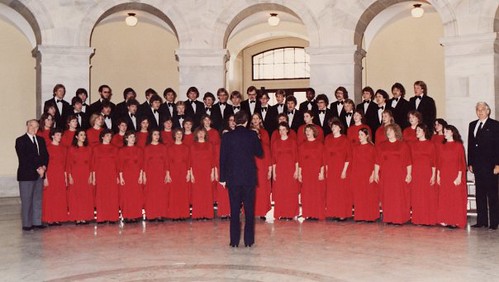
That’s us. We’re in the rotunda of the Cannon Congressional Office building, March 17, 1982. I’m in the third row, eighth from the left. Dr. Smith is conducting, natch. On the right is former longtime ND Congressman Mark Andrews.  Photo courtesy Katie Hall, who is “Doctor Hall” to you now, and lives in Fargo and is, I think, the far right girl in the front row.  

And in the three following spring breaks – Seattle, Denver and Phoenix, and every mid-sized city and tiny town with a Presbyterian church with a music-loving minister in between, we toured, ten or twelve days at a shot.

And the biggest tour of all – our trip to Europe, in 1983.  We sang in little villages – Uitgeest, Holland, and Altenburg, in Schwabia – and major cities, Basel and Mainz and Köln and, biggest and best of all, Notre Dame de Paris.

Where we stood, in a church nearly a thousand years old, built long before sound amplification systems were built, in a building designed to magnify the unamplified human voice, and sang at a mass stuffed with Bishops and Archbishops and other popery, and sang to packed houses, and thought for a brief moment that God had taught Man to build buildings like this just for choirs like ours.

And a few days later, in Köln, where we sang a duo concert with the Köln Polezeichor, the city’s police choir, themselves an excellent group.  After the show, the cops hauled us all and sundry to a bar frequented by Köln’s finest; our money was no good there.  And it was noted that Dr. Smith’s liver was now of legal age.  And as we partied into the wee hours, Dr. Smith had a beer (with his doctor’s blessing; Dr. Smith was as diligent with the gift that had saved his life as any human could be).  And as we walked – I was probably staggering more than walking – back to our hotel through the streets of Köln in the weeest hours of the morning, I looked at Dr. Smith.

And he was as happy as happy gets.  This – making music, and getting flocks of kids to make it, and make it very very well, was his happy place.

———-

The last time I sang with Dr. Smith was October, 1994.  The college threw a 25 year “All Choir Reunion”.  About 400 people – around half of the people who’d ever sung in the choir in those 25 years – came back to Jamestown to sing a concert with Dr. Smith.  It was such a huge event, we used the Jamestown Civic Center.   And people from my class in the choir sat with and sang among several generations of choir “kids”; some who’d been there at the beginning in 1968, and who’d been at that first “gig” at Notre Dame in 1972; some who’d just graduated, and hadn’t yet assimilated all that Dr. Smith had taught them.

And it was a joyous night – one of a short list of highlights of my own life.  I was able to tell Dr. Smith pretty much exactly that; how glad I was to make the reunion, and the impact he’d had on my life.  Of course, I had to stand in a long line; I think everyone was there to say the same thing, one way or the other.

Smith retired in 1998.  The travelling was harming his health.

———-

The average liver transplant holds out for ten years.  Partly it’s due to the whole “new liver” thing – all the risks attendant to transplants.

Partly it’s the drugs that bombard the body to make the transplant happen at all.  They take a terrible toll on the rest of the body – especially the kidneys.   Dr. Smith got a kidney transplant in 1997 – from his wife June, incredibly.   It bought time – and bought it for a guy who’d already run the account a lot further than anyone could reasonably expect.

Dr. Smith was the longest-lived person in the world with a liver transplant.  His transplant surgeon, Thomas Starzl, “the father of the transplant”, featured Smith prominently in his book Puzzle People – his own look into medical miracles and the people who live them.   Starzl chalked Smith’s survival up to many things – an iron-clad constitution, rock-solid faith, and a mission in life among other things- but at the end of the day, even that most gifted of medical scientists had little empirical idea how Smith had so clobbered the odds.

But the run ran out.  Dr. Smith died late last night; the kidneys, and the liver which had served two owners so well, finally gave out.  He was 73.  He leaves behind June – one of my favorite high school teachers – and his daughters, Kristin (a reproductive endocrinologist on Long Island), and the twins, Kathryn and Karen, my high school classmates, a teacher and nurse respectively, both in the Fargo area.  They’ll miss him of course – and so will the thousand or so of us whose lives he touched as director, and the hundreds of thousands who watched and listened to his work over the decades.

Yeah, me too.

Rest in peace, Dr. Smith.  And from the bottom of my heart, my condolences to June, Kristin, Kathryn and Karen.

———-

Back on that rainy night in Pendelton in 1983, the song turned into its homestretch; from the bombastic “Have Ye Not Known!” of the fanfare, through a turbulent middle section that seemed to represent the nagging doubts of the faithful, into the ending, the best part; a three-minute canon, simply repeating one line, over and over again:

And gladness of heart…

The line never changed – starting with the sopranos, quietly hinting it; the altos came in, more broadly, then the tenors, and then the basses, in a broad, three-minute crescendo.  But the song modulated through a circle of…fourths?  Fifths?  Mostly?  Big, broad, beefy resolutions  that just as suddenly modified into another set of fourths, like doubts resolving into answers and then into more doubts with even bigger, more satisfying answers.

I looked at Dr. Smith, on the podium, growing more animated as the volume swelled- because looking at the director, and nothing else in the world, what you did in the choir.  But as the song swelled, the diffusion from the stage lights seemed to me to form a corona of refracted light around the Conductor; maybe it was a trick of the light, or maybe it was my eyes getting every-so-watery from the sheer sonic glory of it all.  And as his arms thrashed at the air, wrenching more sound, more passion, more joy from the moment, Dr. Smith looked ecstatic; the song and the choir were like a natural phenomenon, like he was playing a pipe organ whose pump was driven by a hurricane, like he’d wrapped his arms around a tornado with a “speed” button that only he could control.

Like God Himself could hear his choir, so he’d better keep us on our A game.

And I stood in the middle of that swirl of spine-tingling modulating fourths and fifths and ricocheting parts and,  for one shiver-up-the-spine moment, felt as close to transcending the here and now as I ever had, or have, in my life.

And I think Dr. Smith did, too.

It may have been a first for me.

Dr. Smith?  With all the choirs of farm kids and wrestlers and business majors that he wrangled into musicians?  He was a regular there.

Rhetorical Separated At Birth

Friday, July 15th, 2011

Wisconsin Senate candidate Shelly Moore (D-Trotsky):

…and Dwight Schrute giving a speech…:

…written by Mussolini.

Compare and contrast.

In Memoriam

Thursday, July 14th, 2011

I was at my high school reunion last weekend.

I had an absolute blast.  It was an utterly wonderful time, in just about every possible way.

Of course, any gathering of mid-fortysomethings is going to have its share of bad news.  Up until last year, we’d lost a total of six classmates out of 251; the usual stuff, really – a suicide, an Air Force crew chief who died when his C5 crashed in the run-up to Desert Storm in 1990, a couple of freak illnesses, an accident or two.

Then, we lost five classmates in one year; a fall, a couple of unspecified illnesses, and one who died of cancer.  The streak concluded with two deaths in one day, last May 17th.

One of the classmates who died that day was a guy named Dwight Rexin.

I met Dwight in tenth grade.  He’d been in my hometown’s Seventh Day Adventist school up ’til then.  Like a lot of parochial-school kids who come to the public schools, even in those simpler days, Dwight seemed like a bit of a fish out of water.  He was extremely smart – indeed, he was one of very few high school kids I’ve met, then or since, who could have made a serious claim to being an intellectual.   Blazingly well-read in history, sci-fi, political science and a slew of other areas, trying to keep up with Dwight in an intellectual conversation was like trying to waterski behind a cigarette racer; at the beginning, you just held on and tried not to get too embarassed.

Or at least I did.  And as it happened, Dwight was embarking on a bit of a quest himself.  Seventh Day Adventist school could be fairly called “sheltered”; he knew little of pop culture, the music of the day, and the stuff teenagers did just because they were teenagers, even in that simpler and less frantic time.  Not that I was any kind of party vegetable – indeed, I had exactly one beer in high school, which may have been one more than Dwight had.  But I knew music backwards and forwards; I was working at the radio station, I was a pop-culture vacuum cleaner, and I, like Dwight, enjoyed tying little pictures into bigger pictures.  Seventh Day Adventist kids weren’t supposed to go to movies, or dance, or do any secular music.  But he was relaxing some of the rules; I introduced him to Tom Petty (he liked), Bruce Springsteen and the Clash (not as much) ; I cast him as the evil magnate in a one-act melodrama I directed my senior year, which I always thought was ironic, starring in a play before, I think, he’d ever attended one.

Back then, there were two crowds in summer school at Jamestown High School; the ones that had to be there, since they’d flunked a required class, like English or Biology or Government, and the ones that wanted to be there, either to get ahead on required classes or to escape taking the Government class from one particularly boring and disdained teacher (who will remain unnamed, although any Jamestown High School grads from the era on this thread will know who I mean).  A small crew us us – Bob Martin, Dove Boe, Dwight and I – were in the latter crowd.  So in the summer of 1980 – 31 years ago this week, as luck’d have it – we spent six weeks in a sweltering classroom taking our Government class.

It was a fun time for the subject.  The 1980 election was shaping up, and at this point was still a close race.  I was, by the way, a liberal.  Not an especially articulate or well-informed one, but still outspoken and not a little arrogant.  I would have probably been a famous leftyblogger had I been born twenty years later.

But I digress.  All of my assumptions redounded with lefty “conventional wisdom”.  In early June, I’d gone to North Dakota Boys State, a mock government put on by the American Legion, and wandered my way into being a state party chairman.  I wrote a platform that might have made Paul Wellstone walk into Jesse Helms’ office to admit maybe the left had gone too far and totally ruined the younger generation.

So when we had to give our final presentations, I did some sort of giggly treacle on foreign aid.  Passable work – I got an A, but then I always did with social studies like history, geography and government.

And Dwight cut loose with an hour-long,  Buckleyesque jeremiad on the entitlement pyramid, on the need to get government out of peoples’ private lives, on what the Tenth Amendment really meant, on the links between cartel capitalism and big “progressive” governments like Carter’s…

…that, frankly, I found offensive.  I questioned him sharply; he responded even moreso.  Shot down all my objections without breaking a sweat.  Left me angry (in a civil, intellectual sort of way) and frustrated…

…largely because, although it’d be years before I admitted it, he was right.    At that time of my life, I wasn’t one to casually admit even a badly-thought-out premise of mine was wrong.  I was a teenager, hey?   I had always associated conservatives with icky things – just like the media raises young “progressives” to do to this day.

Dwight and I were also college classmates; we worked on our college newspaper together.  And as my journey from right to left started, and then accelerated, it was Dwight who was my sounding board, my mental test lab for all these new ideas.

I’ve credited a number of people with helping push me down the road as I wandered away from liberalism and, gradually, became a conservative; my first radio boss, Bob Richardson; my college English prof, Dr. Blake, who acquainted me with Solzhenitzyn and Dostoevskii and O’Rourke and Paul Johnson and the other great minds that led me to where I am.

But Dwight?  He was the first peer of mine, the first guy in my age group, who ever seriously challenged me.

I last saw Dwight in 1993.  We met for a couple of beers when I was in Portland, Oregon on business.  I was recently married, with two brand-new kids; he was a systems analyst at Nike.  We talked techology, and family, and caught up on classmates since the 10 year reunion.  He never came to the 20 or 25 year reunions, for whatever reason.  I’d hoped he’d make this last one; I’d hoped to let him know some of the stuff I’m writing in this post.

Anyway – rest in peace, Dwight Rexin.

Well, That Was Fun

Monday, July 11th, 2011

I spent the weekend in North Dakota, at my class reunion.

More later this week, hopefully.

You Think You Have Problems?

Tuesday, June 21st, 2011

In North Dakota, at least in my lifetime, all flooding west of the Red River is compared to the Great Flood of 1969.  That year, pretty much every major town in the state – Fargo, Grand Forks, Jamestown, Minot, Bismarck – was inundated with runoff from record snow and rain falls.  It was the standard by which all subsequent floods – 1981, 1997, and the past couple of years along the Red, Missouri and James – have been measured.

And none of those floods, not even 1969, holds a candle to what’s projected for Minot – where my mother, incidentally, lives, although thankfully on very high ground – and other communities along the Souris River in coming weeks.

The highest flows ever recorded on the Souris are approaching a city whose defenses are destined to be over run. Can the city hold?

Dikes currently in place, recently improved greatly to combat high flows, are now expected to disappear under the traveling torrent. The amount of water flowing with a vengeance down the Souris River Valley is forecast to inundate Minot to a level seven to eight feet higher than the catastrophic and benchmark flood of 1969.

Picture a flood eight feet higher than the highest flooding ever recorded in your riverfront town.  Eight feet.

Saddened with that horrific knowledge, officials announced during a late afternoon press conference Monday that very little can be done to stop the powerful onslaught. Massive secondary dikes that were built by the U.S. Army Corps of Engineers to save much of the town from the previous high on the Souris this year fall far short of defending against the impending and rapid rise of the Souris.

My mom’s house is already crowded with refugees from the earlier flooding.  It’s going to get worse:

Mandatory evacuations were ordered Monday for all evacuation zones within Minot. Mayor Curt Zimbelman said all affected residents and businesses must vacate those areas no later than 10 p.m. Wednesday. Within minutes of the announcement residents once again began the laborious and hastened work of moving out of their homes for the second time this year.

“It’s a sad day in Minot,” Zimbelman said at the end of a press conference Monday.

Although Minot was always Jamestown’s hereditary sports rival – cake-eating bastards that they were –  my prayers do go out to them.  This sounds just awful, with water flows triple that of this spring’s already-bad floods:

“It’s pretty easy to get to 23,000 cfs, which is bearing down on Sherwood as we speak,” said Alan Schlag, Monday. Schlag is a hydrologist for the National Weather Service in Bismarck.

For comparison purposes, the previous peak flow at Sherwood this year, one which caused great concern at all points downstream, was a mere 8,860 cfs.

“Basically, Canada is pouring the coals to releases from dams. Rafferty is wide open, Alameda upped to 1,800 Monday and Boundary was at about 5,000 cfs,” said Schlag.

How bad is it?  Bad enough to get a roomful of North Dakotans – classic Scandinavian and German passive-aggressives (I can say that, I’m one of ’em) who let loose in full pent-up fury that’d shame a roomful of big-haired Long-Island Italans when dealing with government at any level – to sit down in a daze:

The crowd at Monday’s City Hall press conference sat in stunned silence, followed by a few brief murmurs, when it was revealed that releases into the Souris from Lake Darling Dam would be ramped up to “16 or 17,000 cfs by Thursday.” Minot’s existing dike system laborously protects against 10,000 cfs. The previous high release for Lake Darling prior to this flood event was less than 5,000 cfs. Numbers all along the Souris are similarly stunning, shocking and, ultimately, saddening.

I’d been planning on going there this summer.  Sounds like I’d best bring boots and a shovel.

Style Points

Monday, June 6th, 2011

The citizens of Grand Rapids, upset at being called a “dying city”, responded with the gift of music video:

If you’ve ever worked on a film shoot – and who hasn’t? – the wild part is the whole thing was done in one take.

Roger Ebert called it the best music video ever. That’s an argument that could take days – but I’ll certainly give ’em style points.

Just Saying

Saturday, April 30th, 2011

3-5 inches of snow in parts of North Dakota today.

Let’s go over how the weather in the Twin Cities is really just the same as it is in the Northern Plains again?

When Out And About

Wednesday, March 23rd, 2011

If you are down and about the downtown Minneapolis gallery scene anytime soon, stop by Circa Gallery (210 North 1st Street) and see the current exhibition, by Barbara Gilhooly.

I was at the opening last Saturday.  So was “Briana”, whom I do not know, but who brought a much better camera than I did, and got a great series of photos of the whole exhibition.

Barb is, by the way, a high school classmate of mine.  And she’s been making a living as an artist pretty much the whole time.  Check it out.

And congrats, Barb!

Census Redux

Thursday, March 17th, 2011

The short, perhaps simplistic response to the US Census numbers for Minnesota, which will be driving the upcoming redistricting efforts?  The conservative, GOP-dominated parts of this state are succeeding. The DFL-dominated ones are floundering.

Voters – the ones that can – are voting with their feet.

The longer, more detailed analysis of the same question?

About the same.

Not just in Minnesota.  Southern, Republican sun-belt states are booming; the Democrat rust-belt is atrophying.

Rigorously Republican North Dakota?  Kapow.  And now, it’s not all in the oil.

The lesson is clear.  “Progressivism” equals decay, rot, death.  Conservatism equals vigor, growth, life itself.

That is all.

I Gazed Upon The Sorels Of Freedom Sloshing

Friday, March 4th, 2011

This has just got to piss Nick Coleman off – and, commensurately, leave Chad the Elder pretty stoked:

That’s a Libyan freedom fighter with a UND Fighting Sioux T-shirt.

Politically-incorrect here; a sign of freedom there.

Just goes to show you – wherever tyranny needs to be toppled, whether in Saint Paul or in the Sahara, North Dakotans, or our clothes, will be there.

--> Site Meter -->