Archive for the 'Minnesota Politics' Category

Working Through The Checklist

Tuesday, December 28th, 2010

When looking at spin from the left over this next few months – which will involve an epic battle between responsible, austere, adult GOP legislators and a profligate, irresponsible, spending-addicted, passive-aggressive, grossly-dysfunctional DFL governor and legislative minority – look for the following checklist items:

  1. Opposing [a spending proposal] will harm the children (or the elderly, the vulnerable): The examples of this “harm” will frequently be non-sequiturs.
  2. Opposing [the spending initiative] will be an epic catastrophe: Notwithstanding any data or history to the contrary.
  3. Opposing [a spending initiative] is a sign of immaturity (or mental illness, depravity)
  4. :  You’re a bad, bad person.

Dave Mindeman of mnpACT runs through the checklist; the subject du jour is education, but the same template will be repeated for every other subject – LGA, MNCare, high-speed rail, nursing homes, whatever. 

Dave’s not had the best fall, of course:

I haven’t posted much lately as I evaluate looking into the new year. It has been a pretty depressing evaluation in regards to policy issues, which, again, are going to be difficult to make progress in.

My top priorities have been education and transportation….and frankly, both look to be losers in the coming legislative session.

 Oddly enough, education and transportation are among my top priorities – and they look to be winners in the coming session.   But there’s some cognitive dissonance involved, I suspect.

I am especially disheartened by this news story regarding my local school district, ISD – 196 (Rosemount-Apple Valley – Burnsville). It is a situation that is apparently becoming all too common.

As Republicans continue to preach the idea that we are overspending and budget bloated, wouldn’t you think that a high priority like education would at least be meeting its budget needs?

Check off #1, up above. 

What are the “budget needs?”  And how do we know if those “needs” are being met? 

District 196’s enrollment was 27,954 in 2008 – which was off -1.9% since 2003; the average American school district grew by 1.6%, and the average district in Minnesota shrank an average of 3%, a number that hides huge disparities in growth; the Minneapolis Public Schools shrank 22.6%, while exurban districts like Elk River, Prior Lake, Saint Michael and New Prague grew in the 20-30% range. 

District 196 employed 1,720 teachers in 2008, which was down -1.4% from 2003.  That’s at odds with growth in teacher numbers nationwide (up 4%, 2.5 times as fast as student numbers grew)) and Minnesota (up .3%, even as the number of students dropped).   The district spends $9,611 per student; of that, 90% – $8,646 – goes to teacher compensation, which is in line with national and state averages ($8,366 and $8,381, respectively, which are 81% and 82% of the respective per-pupil costs), figures which rose by 32-34% over the five year period, versus national and state average increase in the 22-28% range (the stats are all here;  . 

The district spends at the state average, and their budget grew considerably faster than state averages, even as the teaching staff shrank by a lower margin than the general enrollment, and the amounts spent per student rose by considerably faster than the national averages.

And yet, says the Pioneer Press, “parents” are “footing the bill for teachers“. 

What concerns me the most about this article is that ISD 196 is not a poor district by any means. And by all accounts, it is one of the best managed Districts in the state. Yet, they are resorting to outside funding by parents. Isn’t there something amiss here?

What is even more disheartening about this is that if an affluent district like 196 is doing this, where are the poorer districts going to turn?

To we, the taxpayers, of course.  Minneapolis and Saint Paul spend a solid 30% more per student than the Rosemount district, to the tune of $12,000-$13,000 per student; their changes in per-student spending on overall budgets and teacher compensation is commensurate with Rosemount’s, well into the 20-30% range.

If we think we are having difficulty with the achievement gap now, how much worse will it be in the future if this funding problem continues?

Check off #2.  The only link between per-student spending and the “achivement gap” – and I’ll admit it may be a specious one, but numbers are numbers – is an inverse one; the higher Minneapolis and Saint Paul’s districts spending goes, the worse the achievement gap gets, while the solutions that do work seem to have little to do with spending – or the public school system, for that matter.

Are tax cuts that important? Are we willing to risk the educational future of the next generation because we think we need to pocket more money? Do you really think that last November’s election said that?

The election said “it’s time to look at these questions empirically, rather than through the ideological “throw more money at the problem” lens that the DFL uses”.  So yes and no. 

Oh, yeah – check off #3:

Somewhere, somehow, we have to come to terms with the idea that we have to pay for things. We have been dumping responsibility for our problems on future debt. And then the same people who do the dumping complain about the debt.

It is frustrating and an endless circular argument.

The “Greatest Generation” has given rise to the “Dead Beat Generation”. We pay for nothing…we aspire for nothing.

We have become shiftless leaches that will leave our children with a legacy of mediocrity.

“Give us what we want or your are an awful person who wants our children to starve”.

Look, Tom Dooher wants your money, and he’s saying something not far removed from the caricature in the previous line. 

Against that, the facts are that spending doesn’t correlate with achievement – anywhere – and that spending on education, like all government spending, is disproportionally focused on labor and pension costs.  Labor costs, thanks to the Teachers Union stranglehold on district compensation policies, has little to do with achievement; pensions have even less.

But the unthinking, unreasoning approach is “we have to pay for things”, the unspoken message being that we, the taxpayers, must not examine what it is we are paying for. 

So is it a surprise that the “spend at any cost” school of thought works through the checklist, arriving inevitably at the conclusion that questioning The Machine is a sign of some sort of depravity?

Take a  number.

The Journalist Full-Employment Act Of 2010

Tuesday, December 28th, 2010

Yesterday, I fisked a Lori Sturdevant column.  Not for the first time, and not for the last time.

But I missed something.

Among Sturdevant’s pleas – a bit from a group calling itself the “Civic Caucus” – demanding that the GOP-controlled legislature get its budget and revenue proposals in front of the Governor (and, naturally, the media that put him there) bright and early in the session.

Sturdevant called “Civic Caucus” a “non-partisan” group of “Seasoned Policy Wonks”.  I took the liberty of checking; they are no more “non-partisan” than I am, only pretty universally either DFLers or Carlson-era RINOs.

Still, that doesn’t in and of itself invalidate them.

Nonetheless, since it was Sturdevant doing the writing, it did in fact occur to me – if Lori Sturdevant wants the GOP majority to put in a budget by April 1 – or March 1, or whenever – that strikes me as a prima facie reason to get it to the governor along about May 20 or so.  To provide it any earlier would merely give the DFL’s retainers and henchpeople in the media time to try to fight the PR war against the budget, on the DFL’s behalf.  Why give the DFL and media (pardon the redundancy) seven to eleven weeks of lead time?

I’m not sure when the GOP majority had it in mind to produce a budget.  But I’m thinking if Sturdevant wants it sooner, then “later” is a fine plan.

Speak When Spoken To, Peasants!

Monday, December 27th, 2010

I joined the Minnesota Libertarian Party back in 1994.  I’d been a conservative – ergo a Republican – for something like ten years at that point.  But I was disgusted with what I saw as the pusillanimity of the GOP Congress in the face of Bill Clinton’s power grab.  Not just Hillarycare; it was the widespread caving-in on the 1994 Crime Bill, with its noxious gun control provisions, that disgusted me with the GOP.

So I joined the Libertarian Party of Minnesota (LPM).  Not as a super-active member, of course – my kids were one and three years old, at the time, so there was little enough chance of me being a full-time firebrand. 

But I was hardly alone.  The mid-nineties may have been the high-water mark for the Libertarian Party – the LPM and nationally.  I don’t have the figures in front of me (and I don’t really care to look it up at the moment), but the Libertarian Party reached something of a high-water mark in the mid-nineties.  The party was endorsing candidates for offices, from city councils all the way up to President, like it hadn’t at any time before or since. 

The thing that appealed to many newly-minted Libertarians, myself included, was the absolute purity of Libetarian Party dogma.  There was no compromise on personal liberty!  Freedom ruled!  Liberty was the Law!

Our enthusiasm had the advantage of being utterly unfettered by any sense of having to make any of the compromises that come from actually having to govern anything.  The number of big-L Libertarians that had been elected to significant office, ever, was vanishingly tiny.  Outside of ornery, contrarian environs like the rural West, New Hampshire and Alaska, it was rarer still.

The LPM – and the LPUSA – were a haven for a lot of people, like me, who were very, very clear on what they wanted.  They – and I – were very very unclear on how the sausage was made.   Politics is a two-stage process;  Stage 1 is pulling like hell to get your beliefs – wrapped up in the form of a candidate – into the election.  It’s the part that takes place within a “party”, usually – and includes all the various roots of the term “Party”; one is “particular” about which candidate ones’ “party” endorses,  one exhibits “partisanship”. 

 Stage 2 is when that candidate is (hopefully) elected, and has to actually try to govern, either by sitting on a deliberative body like a city council, a county commission, a Legislature or a Congress, with people with whom you may disagree, to actually make the sausage.   It’s when the various forms of the word “politics” start to apply; one must “politely” (by the standards of the governing body) work with other “politicians” to achieve enough “polity” to enact your beliefs as “policy”.

My fellow Libertarians and I had the Phase 1 bit down cold.  We knew how to agitate!

We – I – were a little less clear on Phase 2, at least at the time.

It took me about four years to realize the LPM was never going to get to Phase 2, and that the GOP was my best bet for working for a party that would, someday, reflect enough of my beliefs to let me get behind it. 

And today – 12 years later, on the eve of swearing in a new, conservative-with-tinges-of-small-“l”-libertarian legislature – I feel pretty well vindicated. 

But some of the same dynamic I saw in the big-L Libertarian Party – the enthusiasm for the “Phase 1” process, the agitation and enthusiasm and the pulling like hell for ones core beliefs – is very much at play among the hordes of newly-minted conservative activists.  We saw it in spades a couple of years ago, when GOP caucuses were inundated with Ron Paul supporters.  They stormed the caucuses, full of piddle and vinegar, all fired up to enact “Dr. Paul’s” policies.  Many got discouraged when the GOP – those who’d in the party for years, doing all that boring “Phase 2” stuff – didn’t embrace them with open arms.  Some stuck around, long enough to see the Tea Party – a tidal wave of new activists that dwarved even the Ron Paul tide – sweep the GOP into power in a wave of “Phase 1” fervor. 

Now we’re into Phase 2. 

And some of the people who’ve had to do all that tiresome Phase 2 stuff – all the words that share their roots with “politics”, the ones that require persuasion rather than ardor, and even occasionally compromise rather than absolutism – are nervous.  

And much as the Phase 1 firebrand in me hates to say it, some of them have a point.

Lori Sturdevant isn’t one of them – but she at least troubles herself to talk with some people who do:

U.S. Rep. John Kline, soon to be Minnesota’s most potent gavel-wielder in Congress, shared his take on the Minnesota mood when he paid the Star Tribune Editorial Board a visit last week.

“I don’t know the last time when we saw a mood like this. It’s amazing,” said the Second District Republican, who’s soon to chair the House Education and Labor Committee. People are frustrated, scared, angry, impatient, confused — “all, I would argue, with justification,” he said.

That’s the sound of lots and lots of people who are doing the “Phase 1” stuff, many of them for the first time in their lives.

About that last sentiment: Kline said he regularly hears mixed messages from his south-suburban constituents.

“On the one hand, people want Congress to get things done, to make things better, to get the economy going again, to do something about jobs,” he said.

But let him profess support for something favored by a Democrat — say, the Obama-Republican tax deal that took a bipartisan pounding on its way to enactment last week — and Kline is deluged with a different message: “I didn’t elect you to compromise.”

The wave that swept all those newly-minted Republicans into office is heavily made up of people who are new to caring about politics at all, much less about all the inside-baseball “Phase 2” stuff. 

Maybe “you” individually didn’t. But “you” collectively did. Collectively, U.S. and Minnesota voters have elected divided governments.

So far.

 It’s the will of the collective “you” that’s supposed to count in running a democracy. When voters put the levers of power into the hands of more than one party, governing isn’t Burger King. You can’t have it your way — not if you expect to get anything done.

Sturdevant displays a certain amount of wonky provincialism here; shutting down a tax-and-spend orgy, whether in St. Paul or in Washington, is “getting stuff done”.

From my perch in the Capitol basement, I’ll be watching to see whether the new crowd in charge of state government will be similarly devoted to accomplishment, rather than intent on keeping their respective bases satisfied.

Well, no.  I mean, it sounds nice and all, but  if you’ve been following Lori Sturdevant any length of time, you the only “accomplishment” she cares about is “enacting the DFL’s agenda”. 

But what the heck, it’s the holidays.

They have ample reason to be. The statehouse gang lacks Congress’s opportunity to do relatively little immediate harm if they do relatively little. In state government, the constitutional requirement that the budget be balanced every two years presents an unyielding choice to DFL Gov.-elect Mark Dayton and the Republican majorities-elect in the Legislature: Make a deal, or shut down government operations come July.

Sturdevant makes that sound like a bad thing.

Kline correctly pointed out that in both parties, activists are “exceptionally vocal right now, and more engaged than they have been over time.” The Internet has given them all spyglasses and megaphones, which they train as eagerly on their allies as their opponents. Those tools leave a false impression with some elected officials about the activists’ political strength.

I”m going to suspect that this past November’s elections may have left a very, very accurate impression of that strength.

Dayton and the new GOP legislative leaders put on a fine show of bipartisan comity last week after their first private meeting. They said all the right words about searching earnestly for common ground on job creation and government streamlining.

But, on other occasions, they’ve also said they plan to stick to the policy guns they fired during the fall campaign. Dayton will assemble a budget proposal that emphasizes an income tax increase for the wealthy. Republicans will counter with budget bills built on “no new taxes.”

Quick side note here; watch that “no new taxes” talk.  Sturdevant is going to be doing her usual job – the DFL’s bidding – in trying to make the GOP’s stance seem like an extension of the Pawlenty years.  In fact, the GOP was sent to Saint Paul with an even clearer mandate; cut the spending.

If those base-pleasing, no-new-compromise exercises consume every legislative day from January until early May, my sense is that the mood of the Minnesota electorate is going to be quite sour.

Stuck as she is in her wretched ink-stained ivory tower at 425 Portland, perhaps it’s understandable that Sturdevant missed the news between Christmas Eve of 2009 and November of 2010; the mood is already sour.  That’s how Barack Obama and the DFL both squandered overwhelming advantages in Congress and the Legislature in two short years.  The  peasants are pissed!

Last week, the Civic Caucus, a bipartisan group of seasoned policy wonks, began preparing a formal call for a change in the Legislature’s usual calendar.

And as a general rule, anything coming from “bipartisan” groups of “seasoned wonks” should go in the kill file immediately.

By law, Dayton must offer his budget proposal on or before Feb. 15. The Civic Caucus wants the Legislature to follow suit a few weeks later with at least its revenue and spending targets, said the group’s coordinator, Paul Gilje.

“Every session, everybody is so frustrated with the way everything comes out at the last minute,” Gilje said. “This time, the divide is so well-understood early on. Why not get the options on the table early? Why not open the way for an intelligent statewide discussion for how to reconcile the differences, rather than waiting till the end?”

Oh, I have a sneaking hunch you won’t have to wait all that long for the GOP’s proposal.

As it stands, the draft statement the Civic Caucus is circulating doesn’t specify a deadline for the Legislature to produce its budget. I have what may be a fitting suggestion: How does April Fools’ Day sound?

It sounds like someone had to dig into the cliche bag to find an ending for their column.

Look – the political establishment in this state – and Sturdevant is nothing if not their dutiful scribe – has been barbering for years about how badly they want more people to get involved, to be stakeholders, in their government.

Now they got it. 

We just must all be the wrong kind of people.

True Grit

Friday, December 24th, 2010

The Saint Paul Pioneer Press‘ Bill Salisbury wrote a valedictory yesterday in the Pioneer Press about the career of outgoing Minnesota governor Tim Pawlenty.

So far, anyway.

He left it to Pawlenty to sum up the crux of his legacy:

“This is a state that was on a spending binge for a long time with a liberal-leaning political culture that goes back decades or generations, and to try to change the direction of the state was a big undertaking. But I think we did that,” Pawlenty said during an extended interview Tuesday with a group of Capitol reporters.

Making that change was not easy, the Republican governor said. He had to call a predominantly Democratic Legislature into special sessions, issue a record number of vetoes in one year and use a government shutdown to force the changes.

“This will be known as the time Minnesota finally came to terms with its excesses and got itself on a more sustainable and responsible path,” he said.

That legacy, he asserted, is more significant than any new program or building he might have created.

Pawlenty’s right – and in ways the article isn’t scoped to explore, in and of itself.

Not only did Pawlenty’s years start the process of breaking the state of the culture of “the people exist to keep the government fed” school of government, but he set the stage for this years’ GOP sweep (Republicans flipped control of both chambers of the Minnesota legislature, controlling the body for the first time in recent history) in ways that I don’t think he’ll get credit for – even among conservatives.

Maybe especially among conservatives.

Until 1998, the Minnesota GOP was a “moderate”, even “progressive” party.  James Lileks once joked on the radio, around the time he lived in or came back from DC, that he’d tell his friends in Washington “Minnesota is the place where you have your pro-abortion, pro-gun-control candidate – and the Democrat!”.

Former MN governor Arne Carlson (who served from 1990-1998) was a typical pre-Pawlenty Republican.  In many respects, he was a bigger “liberal” than the DFLer he replaced, Rudy Perpich, and he was hardly alone.  The GOP during the “Independent Republican” era – the years after Watergate, when the MNGOP rechristened itself the “Independent Republican” party, to break with the national GOP – was a throwback to the national GOP of the Eisenhower years, which was vastly more “communitarian” than libertarian or fiscally conservative.

And there are plenty who wanted, and still want, the GOP to remain that party – basically DFLers with better suits; a party that believed “Fiscal Responsibility” meant making sure you tax enough to run government…

…but that keeping government fed and fat and happy came first and foremost among government’s  missions.

And, predictably, there are many in the Minnesota’s GOP who pine for the old days:

But a lot of Pawlenty’s financial savings were “smoke and mirrors” instead of permanent cost reductions, said John Gunyou, finance commissioner under former Gov. Arne Carlson’s and a DFL candidate for lieutenant governor this year. Pawlenty relied heavily on delaying payments, raiding funds set aside for other purposes, unilateral spending cuts that the state Supreme Court ruled overstepped his authority and federal stimulus funds.

“He didn’t really bring costs under control,” Gunyou said.

Unmentioned by Gunyou – or any of the other outdated impedimenta, “GOP” or DFL, that keep repeating that particular chanting point – is that Pawlenty was hamstrung throughout his eight years, for four years by a DFL-controlled Senate and a GOP majority in the House that was addled by too many old-school, “IR”-era Republicans to do much more than hold the line on spending – which he did! – and for the last half of his administration by facing a rapacious, money-crazed DFL majority in both chambers of the legislature.  Against such grossly, irresponsibly, blindly spenthrift ideologues as Larry Pogemiller, Margaret Kelliher, Sandy Pappas and the rest of the Twin Cities metro-area DFL clacque that ran the Legislature, the only way to meet his statutory responsibility to balance the budget and keep his “no new taxes” pledge was to defer that which he couldn’t cut.

Pawlenty will leave his successor, Democrat Mark Dayton, with a projected $6.2 billion budget deficit.

Well, no – the Legislature did, and the 6.2 billion number is a made-up figure with no legal meaning, but the DFL and media (pardon the redundancy) don’t want you to know that.

But I digress.

Salisbury turned to talk of Pawlenty’s legacy.  In discussing the big takeaways from Pawlenty’s eight years, a group of assembled poli-sci wonks phumphered that Pawlenty didn’t leave much in the way of “big achievements”:  the inevitable quote from U of Minnesota poli-sci professor Larry Jacobs was “Huge promise, remarkable intelligence and understanding of the issues but uneven or limp follow-through”.  Salisbury points out that Pawlenty “…was excellent at diagnosing problems and generating ideas, such has providing health care for all kids or funding transportation projects after the Interstate 35W bridge collapsed. But he dropped many of his creative ideas, often because they would have cost more tax dollars, which his conservative base opposed”

The observation is partly right.  The part they miss; conservatives were never “his” “base”, where “base” means “people who ideologically support him through thick and thin”.  Pawlenty came into the governor’s race as the moderate.  He had to earn every conservative vote he got, starting at the 2002 GOP convention, where he held off a charge by conservative businessman Brian Sullivan after 17 ballots, largely by adopting the conservative Taxpayers League of Minnesota’s “No New Taxes” pledge – pledging to balance the budget by controlling spending rather than hiking taxes.  In many ways, Pawlenty never entirely won conservatives over;  he still hasn’t entirely won “conservatives” over, although I believe that, being as perfect is the enemy of good enough, he should have.  I believe Minnesota’s conservatives shorted Pawlenty.

Poli-sci prof Steven Schier from Carlton College provides the key caveat that the U of M’s Jacobs didn’t, pointing out that Pawlenty “never had a fully cooperative Legislature”.  That’s putting it lightly.  When the DFL took complete control of the Legislature in 2006, DFL Senator Cy Thao famously remarked “When you people [Republicans] win, you get to keep your money; when we win, we take your money!”.  Senate Majority Leader Larry Pogemiller said in 2008 “it’s silly to think that people can spend their money better than government can”.

So when Salisbury quotes Jacobs…:

A governor must build coalitions to get things done, Jacobs said, but Pawlenty had a hard time finding “honorable compromise” with DFL legislators.

…one can forgive him for not adding “because the DFL had no interest in compromise, and were largely not honorable”.

But I will.

My real point is that Pawlenty’s legacy goes waaaay beyond simple, material things like programs and departments and government real estate.  Tim Pawlenty did something that’s needed doing since long before I came to Minnesota.  Because for all of my hard-core paleocon friends’ grousing about “impact fees” and “travelling with Will Steger”, it’s a simple fact that Pawlenty’s political leadership helped drive the Minnesota GOP to the right; it helped the GOP provide a real policy alternative to the DFL for the first time in recent memory.

Pawlenty was the first important political figure in recent Minnesota political history to define “fiscal responsibility” as “controlling spending” rather than “making sure we make the people cover all of government’s bills on time!”.

I think there’s a pretty airtight case that Tim Pawlenty is the most vital, transformative figure in Minnesota politics since Hubert H. Humphrey.

The leadership of the Tea Party, and of Minnesota’s newly-empowered conservative legislative majority, might quibble with the statement, but in every way that mattered, Tim Pawlenty paved the way for everything the Tea Party and the new conservative majority stands for.

And because of this – because Minnesota now has, for the first time in recent political memory, a genuine two-party system, with two sides that are actively holding each others’ feet in the political fire, and a genuine conservative opposition to Minnesota’s generations-long tradition of spend first, think later  – Tim Pawlenty has left this state a vastly better place than he took over.

Economies rise and fall.  Budgets work themselves out (and, with a new GOP majority that owes more than it admits to Pawlenty’s legacy now in charge, they’ll likely work themselves out a whole lot better than they would have).  But changing a state’s political system, vastly for the better?  That’s a wonderful thing.

I think Tim Pawlenty is getting grossly short shrift from conservatives in his all-but-certain bid for the presidency.  His record as a solid, commonsense fiscal conservative (on all the things that truly matter in the long view) deserves a serious look on the national stage.

Because while you can quibble about the details around and about the edges of his record, Tim Pawlenty’s real legacy is that of eight years of true political grit.  Pawlenty was doing the Tea Party’s work before there was a Tea Party.

And Minnesota needed that.  We needed it bad.

Pawlenty is leaving this state in good hands – at least, two chambers dominated by those good hands.  That new majority, in all their enthusiastic numbers, has two big shoes to fill.

Thanks, Governor Pawlenty.  I hope to write about you a lot more in the next two years.

The Great Poll Scam Part XI: Weasels Rip My Results

Wednesday, December 22nd, 2010

Professor Larry Jacobs – by far the most-quoted non-elected person in Minnesota – defends the Humphrey Institute Poll:

Differences between polls may not be substantively significant as illustrated by the case of MinnPost’s poll with St. Cloud State, which showed Dayton with a 10 point lead, and the MPR/HHH poll, which reported a 12 point lead.

The “margin of sampling error,” which is calculated based on uniform formulas used by all polling firms, creates a cone around the estimate of each candidate’s support, reflecting the statistical probability of variation owing to random sampling.2 The practical effect is that the results of the MinnPost poll with St. Cloud State and MPR/HHH are, in statistical terms, within range of each other. Put simply, the 2 points separating them may reflect random variation and may well not be a statistically meaningful difference.

What might be a “statistically meaningful difference” is that Survey USA and Rasmussen all came much, much closer – as in, one-third to one-quarter of the Strib, HHH and St Cloud polls – to getting the actual election right, and tracked much closer to the GOP’s internal polling, which turned out to be dead-nut accurate (as we’ll see tomorrow).

Figure 2 creates a zone of sampling error around estimates of support for Dayton and Emmer by the five media polls completed during the last two weeks of the campaign.3 In terms of the estimates of Dayton’s support, the MPR/HHH poll is within the range of all four other polls. Take home point: its estimate of Dayton’s support was consistent with all other polls.

Well, no.  It was consistent with the other polls who have developed a reputation for inaccuracy that inevitably favors the DFL.  The other polls – Survey USA, Rasmussen, Laurence – were not consistent with the Humphrey poll at all.

Frank Newport of Gallup responds to this:

It is unclear from the report how much the write‐up of results from the October 21‐25 MPR/HHH poll emphasized the margin of error range around the point estimates. Although this is not part of their recommendation, if the authors feel strongly that the margin of effort around point estimates should be given more attention, future reports could include more emphasis on a band or range of estimated support, rather than the point estimates.

In other words, if the Humphrey Poll is really a range with no particular confidence in any particular number within the range, publicize the range.

But that’s not what the Humphrey Institute, or the media, led with just before the election.  It was “DAYTON LEADS BY 12”.  Not “Dayton leads by 8 to 16, maybe, sorta”.

The distinction might make a difference.

This is generally not done in pre‐election polling, under the assumption that the point estimate is still the most probable population parameter. Any education of the public on the meaning of margin of errors and ranges and comparisons of the margins of errors surrounding other polls is an admirable goal. It does, however, again raise the question of the purpose of and value of pre‐election polls if they are used only to estimate broad ranges of where the population stands. This topic is beyond the scope of this review.

In other words – if you take Jacobs at his word, then there’s nothing really newsworthy about the HHH poll.

Do you suppose they’ll stick with that line in the runup to the 2012 election?

The Great Poll Scam, Part X: Weasel Words

Tuesday, December 21st, 2010

I’ve been raising kids for a long time.  Before that, I grew up around a bunch of them.  Indeed, I was one myself, once.

And I know now as I knew then the same thing that every single person who watches Cops knows, instinctively; if you think someone did something, and their response is “you can’t prove it”, it’s the same as an admission of guilt.

Oh, it doesn’t stand up in court – and it’s probably a good thing.

And in the rarified world of academics – and its poor, profoundly handicapped accidental offspring, political public opinion polling – I’m going to suggest it works the same way.

If there is a poll that is, year in and year out, just as ludicrous as the Humphrey and Strib polls, it’s the Saint Cloud State University poll.  I haven’t heretofore included it in my “Great Poll Scam” series, because it’s sort of out of sight and out of mind.

But in David Brauer’s interview with Emmer campaign manager Cullen Sheehan, the director of the SCSU poll – which is done in conjunction with the MinnPost – a fellow named Stephen Frank, tips us off; he concludes…:

Frank says. “Campaign managers like to find excuses rather than looking at their candidate or performance. Do you think if we stopped [publishing results] others would — or the candidates would and the latter won’t go public or only partially public?”

True, to a point.

But he began the statement by saying:

“Please show me one credible study that shows people change their mind on the basis of a poll,”

On the one hand:  “You can’t proooooooooove we did it!”

On the other hand – allow me to introduce you to Dr. Albert Mehrabian, who published a study entitled “Effects of Poll Reports on Voter Preferences”

From the abstract summary, with emphasis added:

Results of two experimental studies described in this article constituted clear experimental demonstration of how polls influence votes. Findings showed that voters tended to vote for those who they were told were leading in the polls; furthermore, that these poll-driven effects on votes were substantial.

How substantial?  I don’t know.  As I write this, it’s 5AM, and I have no way of getting to the University of Minnesota library to find a copy of Journal of Applied Social Psychology (Volume 28).  But I will.

But Mehrabian noted a decided “bandwagon effect” in voter responses to poll results.

Effects of polls on votes tended to be operative throughout a wide spectrum of initial (i.e., pre-poll) voter preferences ranging from undecided to moderately strong. There was a limit on poll effects, however, as noted in Study Two: Polls failed to influence votes when voter preferences were very strong to begin with.

Bingo.

I’d have voted for Tom Emmer even if he did finish 12 points back, as the Humphrey Institute suggested.  Or ten points out of the game, as Frank’s survey (which I ridiculed in this space), or thirty points back.  But then, nobody really doubted that.

But people who don’t live and breathe politics?  That’s another story – says Dr. Mehrabian.

Additional findings of considerable interest showed that effects of polls were stronger for women than for men and also were stronger for more arousable (i.e., more emotional) and more submissive (or less dominant) persons.

Which would be important, in a year when the DFL was worried about women flaking away from Dayton, and moderates being drawn (successfully!) to the Tea Party.

Wouldn’t it?

Especially noteworthy is my discussion of similarities and differences between the study methods and real- life political campaigns beginning with the middle paragraph on page 2128 (“Overall, results …).

I’ll dredge up a copy of Mehrabian’s study (unless any of you academics out there can shoot me a pointer…).

Mehrabian was cited in this study of the subject – “Social information and bandwagon behaviour in voting: an economic experiment“, by Ivo Bischoff and Henrik Egbert, a pair of German economists; the paper isn’t about the bandwagon effect – but it touches on it pretty heavily (all emphases are added by me):

The political science literature contains a number of empirical studies that test for bandwagon behaviour in voting. A first group of studies analyses data from large-scale opinion polls conducted in times of upcoming elections or on election days. The evidence from these studies is mixed (see the literature reviews in Marsh, 1984; McAllister and Studlar, 1991; Nadeau et al., 1997). One essential shortcoming of these studies is that it is very difficult to disentangle the complex interrelations between voting intentions, poll results and other pieces of information that drive both of the former simultaneously (Marsh, 1984; Morwitz and Pluzinski, 1996; Joslyn, 1997). Avoiding these difficulties, a second group of studies are based on experiments. Mehrabian (1998) presents two studies on bandwagon behaviour in voting. In his first study, he elicits the intended voting behaviour among Republicans in their primaries for the presidential election in 1996. He finds that the tendency to prefer Bob Dole over Steve Forbes depends on the polls presented to the voters. Voters are more likely to vote for Dole when he leads in the opinion poll compared to the situation with Forbes leading. The second study involves students from the University of California, Los Angeles. These are asked to express their approval to proposals for different modes of testing their performance: a midterm exam or an extra-credit paper. Mehrabian (1998) uses bogus polls in his studies. Results show that bogus polls do not influence the answers when subjects have clear and strong preferences. However, bogus polls have an impact when preference relations are weak. In this case, bandwagon behaviour in voting is observed. Next to Mehrabian (1998), there are a number of others experimental studies that find evidence for bandwagon behaviour in voting (Laponce 1966; Fleitas 1971; Ansolabehere and Iyengar 1994; Goidel and Shields, 1994; Mehrabian 1998).

It’s not an open-and-shut, according to Bischoff and Egbert – but there is evidence to suggest that the “Bandwagon Effect” exists, and that polling drives it.

Is it possible that the learned Professors Larry Jacobs or Stephen Frank are unaware of this?  Certainly.

Given both polls’ lock-step consistency, especially at under-polling GOP support in close elections, where people with weak initial preferences – people whose “preference relations are weak”, as Bischoff and Egbert put it, which might well be as good a good description for “independents” and “swing voters” as I’ve seen –  it’s worth a look, though.

More from Dr. Mehrabian in the near future.

The Great Poll Scam Part IX: The Rockstar Who Couldn’t See His Face In The Mirror

Tuesday, December 21st, 2010

In reading Professor Larry Jacobs’ defense of the Hubert H. Humphrey Institute poll – which always underpolls Republicans in its immediate pre-election survey, by an average of six points, with the tendency even more exaggerated in close races – Jacobs writes (with emphasis added):

Appropriately interpreting Minnesota polls as a snapshot is especially important because President Barack Obama’s visit on October 23rd very likely created what turned out to be a temporary surge for Dayton. Obama’s visit occurred in the middle of the interviewing for the MPR/HHH poll; it was the only survey in the field when the President spoke on October 23rd at a rally widely covered by the press. Our write-up of the MPR/HHH poll emphasized that the President appeared to substantially increase support for Dayton and suggested that this bump might last or might fade to produce a closer race:

Well.  That kinda covers all the possibilities, doesn’t it?

Effect of Obama Visit: Obama’s visit to Minnesota on October 23rd and the resulting press coverage did increase support for Dayton. Among the 379 likely Minnesota voters who were surveyed on October 21st and 22nd (the 2 days before Obama’s visit), 40% support Dayton. By contrast, among the 145 likely Minnesota voters who were surveyed on October 24th and 25th (the 2 days after Obama’s visit) 53% support Dayton. This increase in support for Dayton could be a trend that will hold until Election Day, or it could be a temporary blip that will dissipate in the final days of the campaign and perhaps diminish his support.

Did you catch that?

Obama’s presence in the city caused Daytons’ numbers to boom by five points (if you take the HHH’s numbers at face value, something no well-informed person ever does), and then lurch downward by a dozen by election day?  The presence or absence of Barack Obama is responsible for one out of eight Minnesota voters changing their mind and changing it back inside of a week?

Obama’s impact in temporarily inflating Dayton’s lead is a vivid illustration of the importance of using polls as a snapshot.

No.  The HHH polls’ impact in temporarily inflating Dayton’s lead is vivid illustraiton of how these polls need to disregarded or abandoned!.

Indeed, according to the MPR/HHH poll, Dayton’s lead before Obama’s visit was 8 points – nearly identical to the Star Tribune’s lead at nearly the same point in time (7 points). Treating polls as snapshots, then, is especially important when a major event may artificially impact a poll’s results or, as in the case of the MPR/HHH poll, there were a large number of voters who were undecided (about 1 out of 6 voters) or were considering the possibility of shifting from a third party candidate to the Democratic or Republican candidate.

Read another way:  “They’re snapshots, so we can’t be held accountable.  But keep the funding and recognition coming anyway”.

The take-home point: polls are only a snapshot of what can be a fast moving campaign as events intervene and voters reach final decisions. Polls conducted closest to Election Day are most likely to approximate the actual vote tally precisely because they are capturing the changing decisions of actual voters.

Newport dipolmatically notes the real “take-home point”:

The authors raise the issue of the impact of President Obama’s visit to Minnesota on October 23rd. The authors note, and apparently reported when the poll was released, that interviews conducted October 24th and 25th as part of the MPR/HHH poll were more Democratic in voting intention than those conducted before the Obama visit. It is certainly true that “real world” events can affect the voting intentions of the electorate. In this instance, if the voting intentions of Minnesota voters were affected by the President’s visit, the effect would apparently have been short‐lived, given the final outcome of voting. The authors do not mention that the SurveyUSA poll also overlapped the Obama visit by at least one day. It is unclear from the report if there is other internal evidence in the survey that could be used to shed light on the Obama visit, including Obama job approval and 2008 presidential voting.

Up next – at noon – what effect do bogus polls really have on voters?

The Great Poll Scam Part VIII: Snapshots That Never Come Into Focus

Monday, December 20th, 2010

I was reading Larry Jacobs’ defense of the Humphrey Institute’s shoddy work this past election.

His first point in defense is that polls are “a snapshot in time”:

Polls do not offer a “prediction” about which candidate “will” win. Polls are only a snapshot of one point in time. The science of survey research rests on interviewing a random sample to estimate opinion at a particular time. Survey interview methods provide no basis for projecting winners in the future.

So far so good.

How well a poll’s snapshot captures the thinking of voters at a point in time can be gleamed [sic] from the findings of other polls taken during the same period. Figure 1 shows that four polls were completed before the final week of the campaign when voters finalized their decisions.

I read this bit, and thought immediately of Eric Cartman playing Glenn Beck in South Park last season; disclaiming loathsome inflammatory statements with a simple “I’m just asking questions…”

Frank Newport at Gallup responded to this particular claim:

[Jacobs and his co-author, Joanne Miller] by discussing what they term a misconception about survey research, namely that polls are predictions of election outcomes rather than snapshots of the voting intentions of the electorate at one particular point in time. The authors present the results of five polls conducted in the last month of the election. The spread in the Democratic lead across the five polls ranged from 0 to 12. The authors note that the SurveyUSA poll was the closest to the election and closest to the actual election outcome. At the same time, the MPR/HHH poll was the second closest to Election Day and reported the highest Democratic margin. Another poll conducted prior to the MPR/HHH poll showed a 3‐point margin for the Democratic candidate.

Emmer’s internal poll showed a dead heat.  More on that later on this week.

Newport, with empasis from me:

The authors in essence argue that the accuracy of any poll conducted more than a few days before Election Day is unknowable, since there is no external validation of the actual voting intentions of the population at any time other than Election Day. This is true, but raises the broader question of the value of polls conducted prior to the final week of the Election – a discussion beyond the scope of the report or this review of the report.

By inference, Newport is indicating that a great enough number of voters make up their mind right before election day as to make pre-election polling essentially pointless.

Or is it?

Polling does affect peoples’ choices in elections; people don’t go to the polls when they know their candidate is going to become a punch line the next day; donors don’t turn out for races they are pretty sure are doomed.

And as I showed a few weeks ago, while Jacobs acknowledges that his poll is just a “snapshot” of numbers that may or may not have any bearing on the election itself, we noted a few weeks back that the Humphrey Poll’s results themselves are less “snapshot” than “slide show”; they have a coherent theme.  Election in, election out, they short the GOP, especially in tight elections.  Every single significant election, no exceptions.  Tight GOP wins (2006 Gubernatorial), comfy Democrat wins (2008 Presidential), squeakers (2008 Senate, 2010 Gubernatorial), every single one, without any exception, without the faintest hint of random “noise” that might indicate some random nature to the pattern, the HHH poll systematically shorts the GOP.

Given the completely non-random nature of this pattern – every election, no exceptions – there are three logical explanations:

  • The Humphrey Institute genuinely believes in the soundness of its polling methodology, which systematically (in the purest definition of the word) shorts GOP representation.
  • The Humphrey Institute is unable to change its methodology, or is structurally incapable of learning from its mistakes.
  • The Humphrey Institute is just fine with the poll’s inaccuracies, because it serves an unstated purpose.

To read Jacobs’ defense, you’d think…:

  • …that there’s nothing – nothing! – the HHH can do about fixing the inaccuracies of its “snapshot”, and…
  • …it’s all a matter of timing.

As we see elsewhere in the coverage of the Humphrey (and Strib) polls, both are false.

More later this week.

The Great Poll Scam, Part VII: Post Mortem

Monday, December 20th, 2010

The Twin Cities’ media and academic establishment is starting to try to unpack the disaster of their polling efforts this past election cycle.

Minnesota Public Radio has done us the service of printing both the Humphrey Institute’s Larry Jacobs’ defense of the Humphrey Institute poll and a counter from Frank Newport of Gallup Polling. And David Brauer of the MinnPost does some excellent coverage, including a revealing interview with Cullen Sheehan, who was Tom Emmer’s campaign manager, with some rare insights into what a complete crock of used food Jacobs’ explanation is.

I’ll be trying to unpack this over the course of the coming week.

Take The Fifth And Shove It.

Monday, December 20th, 2010

The question “will Minnesota keep its eight representatives” is still very, very much up in the air. The when the population count comes out today, it is – by all accounts – touch and go whether we’ll keep all eight seats and ten electoral votes:

Depending on which of several estimates is right, the state either will lose one U.S. House seat or barely hang on to the eight it has had since 1960, when historic population shifts to the South and West reduced the number from nine.

“It’s really, really close,” said state demographer Tom Gillaspy, who projects that Minnesota could fall about 1,000 residents short of keeping its eight House seats. “It looks like we’re just below the line right now.”

It’s by no means a done deal:

Other estimates show Minnesota keeping all eight seats in Congress, with about 15,000 people to spare. But the experts warn that they are just that: estimates. “When they do the count, things could change,” said Clark Bensen of Polidata, a national data analysis firm that puts Minnesota right on the cusp of losing a seat.

And if we don’t lose it this year, we’ll lose it in 2020, unless they discover gold in Gull Lake or, better yet, oil in Owatonna.

And that matters, because…:

That kind of shrinkage could set state legislators off on a scramble next year to carve seven congressional districts out of eight, a highly partisan process that has wound up in court the last four decades.

Each of America’s 435 congressional districts will have a population of just over 700,000 people.

With that in mind, it is time for Minnesota to confront reality; if we lose a seat, it is high time we consolidated Minneapolis and Saint Paul into a single district, and get rid of either Betty McCollum or Keith Ellison’s seat.  The Twin Cities – with maybe Richfield or the Brooklyns thrown in – have just about the right population to stand alone as a congressional district.  It is high time we calved off the west-suburban parts of the Fifth into the Third; way overdue that we give Shoreview and Woodbury to the Sixth and Second, respectively.

There is no reason for each city, in effect, to hold an entire district hostage with its own whims and needs if we lose a district.   Minneapolis and Saint Paul together account for around an eighth of Minnesota’s citizens; it is completely wrong that they dominate a quarter of our House representation.

Furthermore, getting rid of the Second, Third or Sixth would leave the DFL in control of four out of seven House seats – which is clearly unrepresentative of Minnesota’s current voting patterns, with strong GOP majorities in the Legislature and a DFL governor whose “mandate” was so weak he is effectively dead on arrival – quite likely the weakest governor in recent Minnesota history as of inauguration day.

Discussion Topics:

  1. If we lose a seat, which district should we tube, and why?
  2. Who deserves to be tossed more; Ellison, or McCollum?
  3. Do we need to start soliciting more illegal immigrants for the 2020 census?

Advice To Our Liberal Friends

Friday, December 17th, 2010

With the new session coming up, all you liberals are going to be in for a new experience – being a legislative minority here in Minnesota.

It’s never happened, not in the political lifetime of any of you out there.

It’s gonna be a whole new feeling for all you libs – not being able to spin the wheels and levers of government to make it do what you want at will or, at the very worst, to be able to control a chamber of the legislature to bog down legislature.  All you have is the veto (and of course DFL control of the state’s bureaucracies, which is not an inconsiderable power by itself).   He’ll float his “Crack Whore With A Stolen Platinum Card Budget”, just like the people who paid for his election told him to.  It’ll get shot down.  He’ll turn around and veto the budget put forward by the responsible adults.  That’s how it’s done.

So, speaking as someone who’s been in the legislative minority in this state as long as I’ve been in this state – 25 years, now – here’s some advice for all you DFLers.

You can thank me later.

The entire legislature was elected, not “Selected:  Yes, the people really did flush the DFL out of office.  Buck up, little campers; 2012 is another election.  Although I think we’re gonna clobber you then, too.

Stay Calm:  Some of you people are nuts even when you’re in power.  We conservatives are pretty good at tamping down our odd nutbar.  You guys need some practice.  You’ll probably get it.

Elections Have Consequences: The DFL used its temporary legislative supremacy to try to jam down a phalanx of spending and taxes over the past four years.  They were stymied by Governor Pawlenty, who exercised his veto and conducted a masterful rear-guard job.  And when he did, you – especially your pundit friends in the media – were downright heart-rending in your demands that Pawlenty also represent the Minnesotans who didn’t vote for him, and pass the DFL’s legislation.  Now, as a conservative, I’m under no illusion that Dayton is going to vote my conscience when he takes office. 

So I’m counting the hours until we get the first mawkish blog post or Lori Sturdevant column asking Republicans to remember that “you represent the majority of Minnesotans that didn’t vote for you”.  In that way that the DFL always forget when they controlled all the knobs and levers.

Pack Your Bags!:  I thought nothing could match Alec Baldwin and Susan Sarandon’s narcissistic solipsism in threatening to move to France if George W. Bush won his various elections (and naturally, neither did), until I heard Minnesota DFLers threatening to leave the state if Emmer had won the election.  Well, controlling both houses of the legislature is arguably a better deal than having the governor’s office and one chamber.

So since I just bought a truck, do you and your crap need a ride to Hudson?

Get A Grip: No matter what the DFL, Tom Dooher, the Strib’s editorial board and DFL-pet columnists tell you, Minnesota isn’t really going to change all that much when the adults take over.  Oh, keeping government fed will no longer be the primary stated mission of government (and if the GOP majority doesn’t change that, those of us who sent them there will be happy to bring them home), but the schools will stay open, the parks will still be there for, er, parking, there will still be libraries, cops and firemen will still respond (unless you live in a city where the DFL will hold those services hostage).  Indeed, the schools will probably do better, you’ll be able to enjoy the park to relax from the job you don’t have now but are more likely to have then, you can spend your time at the library reading rather than job-hunting, and so on.  But by and large, not all that much is going to change.

Except, it seems, your (plural) blood pressure.

Buck up, little vegan campers.  We conservatives survived.  So will you – if you choose to.

A Four Year Vacation

Friday, December 17th, 2010

Joan Growe.  May Schunk.  Carol Molnau.

I mention them just to prove to myself that I can name the last couple of Lieutenant Governors.

I’ve heard not a few DFLers “joke” that even now, they can’t name the LG-elect (Yvonne Prettner Solon, with no hyphen) even now, weeks before the coronation.  Of course, unlike Carol Molnau (who led the state’s Department of Transportation until she got scapegoated for the 35W Bridge collapse) and Schunk (who served to try to whip the Teachers Union into line behind Ventura) Prettner Solon has already served her entire purpose for being on the ticket – delivering votes from the Iron Range to Lord Fauntleroy.

No, really – she all but says it herself:

Rested and ready after a two-week vacation in Mexico, Minnesota Lt. Gov.-elect Yvonne Prettner Solon said Thursday she’s already preparing for two key roles in the Mark Dayton administration.

On Thursday — the day the DFL team was officially certified winners of the Nov. 2 election — Prettner Solon said her first priority will be to coordinate startup of the new Senior Services Center that she will oversee at the Capitol.

The new office, which will coordinate senior services from several state agencies, will be the first of its kind in Minnesota and makes good on an early campaign promise by Dayton and Prettner Solon.

Which is a step up from “Junior Fire Marshal”, I guess…

Prettner Solon said her second-biggest job will be to serve as a liaison between Dayton and lawmakers. A veteran legislator, Prettner Solon knows many of the key players, especially in the Senate, where she served as chairwoman of committees that oversaw health care and energy issues.

Um, she knew many of the key players.

Prettner Solon said she hopes not to fade into obscurity as many lieutenant governors have done, and that Dayton has made it clear their offices will work jointly.

“The plan is to make it the office of the governor and lieutenant governor, really a single office,” she said.

The better for fetching sweaters, Triscuits and Kombucha.

Gang Takes 275,000 Hostages

Thursday, December 16th, 2010

The news sounded so, so good to start out.  After enduring six years of knife-to-the-throat tax increases under Chris Coleman, it almost looked as if Saint Paul was going to finally wake up, smell the anti-spending coffee, and get real…

…but only if you don’t read too closely.

No, it does start promisingly:

The St. Paul City Council on Wednesday passed a 2011 budget without an increase in the property tax levy for the first time since Mayor Chris Coleman took office five years ago.

The adopted budget, after accounting adjustments, is about $473 million, an increase of about $4.2 million from 2010.

Coleman hailed the passage, calling it a victory for property taxpayers in St. Paul.

OK.  So far so good.  As long as there are no hidden whammies.

But when DFLers talk about being fiscally responsible, there is always  a hidden whammy.  Emphasis added:

Still, he and officials in local governments across the state are bracing for what will happen at the Legislature as lawmakers look for solutions to solve a $6.2 billion hole in the state budget.

“As we head into the new year, we are eager to work with Gov. Dayton and the Legislature on a budget solution for the state that allows local governments the resources necessary to do what we’ve done in St. Paul — to craft a budget that invests in public safety and other critical services without increasing the burden on property tax payers,” Coleman said in a statement.

Coleman built his budget assuming the city would receive $62.5 million in local government aid from the state. The city has had its allocations cut in recent years, though.

 Whammy.

Coleman and the Gang of Seven are holding the City of Saint Paul hostage, to coerce the new legislature to give them their way.

Joe Doakes – a fellow Saint Paul hostage – writes:

So the Council intentionally adopted a budget based on getting a subsidy from the State, a subsidy that we all know doesn’t have a snowball’s chance of happening in a Republican-dominated legislature. The only possible rationale for that is to gain political negotiating advantage. If the Republicans don’t raise state taxes to fund St. Paul’s budget, we’ll have to lay off cops and firefighters. And it’ll all be the Republican’s fault! Because they hate Minorities! And children! And kittens! If Republicans don’t pony up, we’ll make St. Paul residents suffer! And it’ll be their fault!

 In other words, the St. Paul City Council just took its own citizens hostage.

 Yep.  Because it’s for sure it won’t be the Mayor’s two dozen staff offices that get cut.  It won’t be the massively-redundant Park and Rec effort, or Kathy Lantry’s Landlord Harassment program.  It’ll be the cops and firemen that get laid off first.  

Seems St. Paul hasn’t changed so much since Dillinger hid out here in the 1930’s, the crooks just moved to nicer offices.

At least when Dillinger roamed the streets, the law-abiding citizens knew who the crooks were, and didn’t keep returning them to office.

Dayton: It’s Gonna Hurt So Bad

Thursday, December 16th, 2010

The Governor elect appeared on Bloomberg yesterday and continues to hedge his campaign promises as he realizes how far out of sync they are with the wishes of Minnesotans as expressed so clearly in nearly every Minnesota election contest…save his.

Republican leaders have so far indicated they will be taking a hard line against raising taxes — a key facet of Dayton’s budget plans during the campaign. During the Bloomberg interview, however, Dayton warned that a budget solution without tax increases would have serious consequences.

[insert serious sounding music here]

Indeed. To a liberal, serious consequences mean the devastating possibility that government may have to do more with less…sort of like most of the rest of us.

“I campaigned on a pledge that I would reduce the regressivity of Minnesota’s state and local taxes and ask upper income Minnesotans to pay closer to their appropriate share — the same amount as everybody else,” Dayton said.

This always makes me laugh…or cry depending on the day.

First off, what kind of delusional pinhead labels a tax rate that increases with income regressive? It’s by definition progressive. That’s what the word means you twit.

Then again, who can blame a guy who is so far removed from reality; whose butler’s butler pays his bills from the coffers his great grandpappy filled years ago.

Second, half of us don’t pay taxes at all – many get a “tax credit” even when they pay nothing (save social security) into the system. I know a lot of people that employ others that pay in one quarterly installment what many people pay in taxes all year long. The fact is, upper income Minnesotans pay way more than their share by any measure of the use of services, infrastructure or resources you can muster.

Add in all the additional sales taxes (albeit somewhat by choice), self employment taxes,  and alternative minimum taxes, just to name a few that the upper middle class – let alone the wealthy – pay and it is clear that the Pareto principal is alive and well as it regards a minority representing a majority of revenue collected in the form of taxes.

The fact is, thousands are getting a free ride – and none of them are “upper income.” You want to talk fairness? For real? Then everybody that makes anything should pay something – anything into the system.

“Republicans don’t think [raising taxes is] such a great idea, but they’re going to find it’s very difficult to cut $6.2 billion — which is about 19 percent of our budget — without drastically affecting especially education, which is almost half of the state expenditure.”

Either way, he said, “it’s going to be very painful, there’s no way around it.”

Indeed, and if Republicans don’t deliver that pain they won’t be delivering on the promises that got them elected either.

Common Cause: “Transparent” As Mud, But Not As Truthful

Tuesday, December 14th, 2010

Common Cause Minnesota  (CCM) is a “non-partisan” PAC that exists, in its entirety, to advance liberal causes and, when they can’t manage that, to retard conservative ones.

Oh, they tart the message up like a twenty-dollar hooker:  “Common Cause Minnesota is a nonprofit, nonpartisan citizen’s lobby dedicated to improving the way state government operates. We have helped pass Minnesota’s most important ethics and campaign finance reforms“, is what they say on their website.  And everywhere, in all their communication – transparency.  Transparency, transparancy, transparency.  They want “Transparency” in government.  Or so they say.

We’ll come back to that.

As I pointed out last September, in the wake of  finding out that “Alliance For A Better Minnesota” was spending an avalanche of funding from not-so-transparent sources like Mark Dayton, his ex-wife and a slew of unions, through via a fiscal shell game that Derek Brigham mapped out as well as anyone – certainly better than anyone in the mainstream media…

…Common Cause had demanded an investigation of…

…Campaign for Minnesota’s future, and a donation it got from the Republican Governors Assocation.

And for this campaign, Common Cause went big, going to the state Campaign Finance Board.

CCM’s announcement certainly set the stakes high (emphasis added by me):

WHAT:           Common Cause has uncovered an elaborate scheme by three entities to hide political contributions.

WHEN:           Thursday, September 30, 2010
11:00 a.m.

WHERE:         Room 125, State Capitol

Common Cause Minnesota will outline a major complaint that it has filed with the Campaign Finance Disclosure Board alleging that three different entities circumvented Minnesota disclosure law and failed to properly disclose large contributions.  The parties involved could face civil penalties totaling $5.1 million and criminal prosecution.

###

Whew!  Scary!

And when the CFB released its results, CCM spun it like it was huge news; Mike Dean, CCM’s president, tweeted:

Campaign Finance Board finds that Minnesota’s Future, LLC Violated State Law:

Of course, like everything Mike Dean and CCM say and do, it was a bunch of twaddle.   The Minnesota Campaign Finance Board released its conclusions.

Among CCM’s many charges was that the Republican Governors Association didn’t disclose its donors according to Minnesota law.

It was true; they did it better than Minnesota law!

The Board notes that the RGA disclosed all of its sources of income to the IRS under the requirements applicable to organizations registered under IRC section 527. The timing of that disclosure is different than what is required in Minnesota but the level of itemization is greater than Minnesota requires. This observation is noted because it suggests that avoidance of disclosure was not a motive for the RGA when it made its contribution to Minnesota Future, LLC.

Conclusions from CFB investigation – again, with emphasis added:

Based on the above analysis, and the submissions of the Complainant and the other parties, the Board makes the following:

Findings Concerning Probable Cause

1. There is probable cause to believe that Minnesota Future, LLC, and State Fund for Economic Growth, both Minnesota corporations, operated as political committees as defined by statute and were required to register with the Board within ten days of accepting contributions or making expenditures in excess of $100.

2. There is no probable cause to believe that the failure of Minnesota Future, LLC, or State Fund For Economic Growth to register was done with the knowledge and understanding the corporation was, in fact, required to register.

3. Minnesota Future, LLC, and State Fund for Economic Growth have registered with and reported to the Board retroactive to the date they first accepted contributions in excess of $100. They have completed their registration and reporting obligations. Consequently, there is no probable cause to believe that an ongoing violation exists.

So there was no substantial violation of any kind.  It was a technical violation of a provision in state election finance law that’s not all that clear; no harm was done, no fines were levied (they very frequently are in these cases); Minnesota Forward didn’t get so much as a stern “you watch what you’re doing, now!”  No “criminal charges”, no “multimillion dollar fines”.

Nothing.

CCM’s selective complaining was incongruous enough to make even liberal-in-good-standing Paul Demko ask:

But Common Cause did not file a similar complaint against WIN Minnesota, a DFL-aligned organization that has been helping pay for attack ads against GOP nominee Tom Emmer. The group received a similar $250,000 contribution from the Democratic Governors Association (DGA).

Dean said WIN Minnesota is in compliance with the law because it’s organized under a different section of the tax code and has a broader mandate then simply influencing electoral politics. But he conceded that WIN Minnesota is no more transparent in revealing the source of the DGA money then its conservative counterpart. “The issue is one organization followed the law and the other organization did not,” Dean said.

Except that MNForward did, according to the Campaign Finance Board – and if WIN Minnesota (one of the maze of shell groups underwrting “Alliance for a Better Minnesota”) did, it was only by the stretchiest definition of “the letter of the law”, and I doubt even that.

So you might be reading this, and thinking – “Wow – Common Cause sounds like  a bunch of weasels”.

Now, now.  Not yet, they don’t.

Read this bit first (again with emphasis added):

At issue is a $429,000 contribution that the Republican Governors Association funneled to the group, which has been running television commercials bashing DFL gubernatorial nominee Mark Dayton. Common Cause argues in the complaint that Minnesota’s Future was required to disclose the names of donors who contributed to the Republican Governors Association.

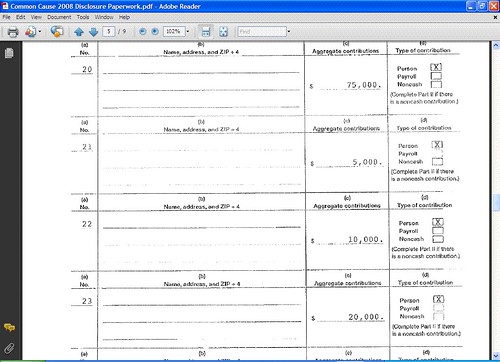
Leaving aside the fact that the Campaign Finance Board rejected the premise that Minnesota’s future did anything wrong, I’d like you to check this out.  It’s an excerpt from Page 4 of Common Cause’s 2008 IRS Form 990 – disclosures.

Can’t read the names?

Get used to it.  There are eight pages of donations, a total of 44 of them, totalling over $600,000.

For one year.

And not one name.

For a group that alleges itself to be all about “transparency in politics”.

The lesson from this?  Whenever “Common Cause” pops up in this state’s political discourse, they need to be pelted with rhetorical rocks and garbage.  They exist only as a front group for the DFL; they are fundamentally dishonest.

I’ve invited CCM “president” Mike Dean to appear on the Northern Alliance Radio Network to discuss his various charges, and defend CCM against the charge that they are lying to the people.  Repeatedly.  For almost three months.

I expect better from responsible adults with non-risible points of view.

Place your bets.

The “D” Stands For “Deadbeat”

Monday, December 13th, 2010

The DFL still hasn’t ponied up for its convention last April in Duluth.

From Minnesota “Progressive” Project:

Members of a local DFL unit in northeastern Minnesota who recently tried to book an event at the Duluth Entertainment Convention Center were stunned to hear that payment in full, up front is now required, a significant deviation from the previous policy of billing the party unit after the event. The cause of this major shift in policy was later discovered to be that the Minnesota DFL still has not paid the bill for the DFL State Convention held at the facility last April.

 A reliable source affiliated with the Duluth Entertainment Convention Center has confirmed that the policy was indeed adopted as a result of a large unpaid bill incurred by the Minnesota DFL for expenses arising from the state convention.

Perhaps Brian Melendez thought that the convention results had a warranty, if Margaret Anderson-Kelliher didn’t win the primary?

Only the latest of many signs the wheels are coming off down on Plato.

Winners And Losers

Thursday, December 9th, 2010

Now that Tom Emmer has conceded in the governor’s race, it’s time to figure out who the other winners and losers were during this race.

Winners

Conservatism:  Lori Sturdevant may not have gotten the message yet, but the “Independent Republican”  of “progressive Republican” politics in Minnesota is dead, dead, dead.  And nobody’s going to visit the grave.  This election put a railroad spike through the forehead of the party of Durenberger, Carlson and the post-Watergate “DFLers-with-nicer-suits” version of the Minnesota GOP.  The biggest victory in this past election – next to two chambers in the Legislature – was the one for the soul of the MNGOP.

The House And Senate GOP Caucuses: They can run 100 campaigns with an amazing degree of success!  Who knew?!

SocialCons: I’ll confess; I became a Tom Emmer supporter the day he said he didn’t care about gay marriage in this election (though he opposed it personally and in the legislature).  Emmer steered well clear of social issues in the campaign – even refusing to discuss abortion in the final debate at the Fitzgerald Theatre, two days before the election.   The Tea Party was aggressively ecumenical on social issues. 

Would Emmer have gotten 8,000 more votes had he hit on gay marriage and abortion?  There’s some evidence that it might have helped, even in “purple” Minnesota. 

Losers

The “Star/Tribune” Poll and the Humphrey Institute Poll:  Is there a case to be made, anywhere at all, that either of these polls shouldn’t be immediately scrapped?  Someone show me.

The Media:  It was almost as if the media had a “hands off” order from some “mythical” central media control center; “don’t touch Dayton”.  There were so many questions that needed to be asked; none of them got asked, at least not during the calendar year 2010.   Granting the media any credibility at all at covering partisan elections should be considered grounds for stripping peoples’ rights for incompetence.

The DFL: The DFL’s endorsed candidate – Margaret Anderson-Kelliher, for those who’ve forgotten – continued the “Kiss Of Death” streak for the DFL endorsement, losing a squeaker to Dayton.  The DFL lost both chambers of the Legislature.  Their chanting-points bots noted that the DFL got plenty of votes – but those were concentrated in a small number of blowout urban races.  And they lost the great DFL fortress, the Eighth District, as well as watching the Third and Sixth districts turn ever redder. 

Brian Melendez better hope he’s got a union job…

The “Independence” Party: It’s official; the IP is nothing but a tactical prop for both of the major parties. 

Mark Ritchie: Without a DFL legislature to hide behind, the Secretary of State stands to have the lid ripped off his little DFL vote-manufacturing machine.

I’m No Lawyer…

Thursday, December 9th, 2010

…so I have pretty much held my counsel on Monday’s SCOM decision on Tom Emmer’s request for reconciliation.

Joe Doakes – of Saint Paul’s Como Park neighborhood – is, in fact, a laywer.  And he’s got an opinion.  I’ll be adding emphasis:

[Monday], the Minnesota Supreme Court issued its opinion explaining why it denied Emmer’s request to have the number of ballots cast verified against the number of eligible voters before the vote totals were certified by the State.

Refresher: a prospective voters goes to the first table at the polling place to sign the roster; then he gets a receipt and takes it to the second table where the receipt is exchanged for a ballot; then he marks the ballot and deposits it in the ballot box. At the end of the night, all three are counted – number of eligible voters who signed the roster, number of receipts given, and number of ballots in the box.

The Court said: “ . . . the legislative intent appears to be to design a process that would guard against more ballots being counted than eligible voters voting.”

Yes, exactly right. Only eligible voters should be able to vote.

So far, so good.

The Court said: “Petitioner has not shown how counting voter’s receipts, which are given to voters only after they have signed the polling place roster and which constitute proof of the voter’s right to vote [citation omitted] is inconsistent with this legislative intent.”

Well, duh. That should be obvious. If the signature-receipt-ballot system worked perfectly every time, we wouldn’t need triple-entry bookkeeping to weed out cheaters. But if 100 people signed the book as eligible voters and 110 receipts and ballots appear in the boxes, there’s no way to know who put the extra receipts and ballots in the boxes. Presumably they were NOT deposited by eligible voters or the vote totals would match the signatures; therefore, the statute requires election officials to throw out excess ballots. It’s precisely because we don’t trust the system to work perfectly that we build in safeguards.

It’s here that the problems start:

The Court said: “In responses filed to the petition, certain local election officials appear to have conceded that they are not removing excess ballots . . . The validity of this practice was not raised in the petition and has not been fully presented to this court. Therefore, this issue is not before us, and we do not discuss it further.”

And sure enough, the system did NOT work perfectly. There were indeed more ballots cast than eligible voters, precisely the problem the legislature intended to address. Voting fraud does exist. If we’re to fulfill the legislature’s intent, we ought to order the counters to toss out those excess ballots before certifying the results.

Of course, the intent of the legislature gets filtered through whomever runs the legislature…

And finally, “Our review . . . establishes that the legislature intends the processes [for removing excess ballots] to be based on either the number of signatures on polling place rosters or on the number of voters receipts.”

Whaaat? How’d you reach that conclusion? We admit there’s a problem, it’s precisely the problem the legislature intended to address with its triple-entry bookkeeping system, but now you’re saying the legislature intended us to ignore it? Now it’s okay to skip the first step in the security check, the one step that proves the fraudulent origin of those excess votes?

If you’re only going to count receipts and ballots – no matter how they got into the box – then what’s the point of proving voter eligibility?

How can disarming the security system be consistent with the intent of maintaining a security system?

It makes no sense – as a stand-alone decision.

As a bit of legalistic buck-passing, though…:

This opinion makes no sense to me. The fact it’s unanimous means either the entire Court understood something about the law that I simply can’t grasp; or they wanted no part of another election lawsuit and kicked the case out on the flimsiest imaginable grounds, knowing the real solution is for the legislature to rework and clean up the election law through the political process. I’m betting on the latter.

Joe Doakes, Como Park

So there you go, Legislature.  Tear it up!

Governor Dayton: “Where’s the $#&@#@% Remote Control?”

Wednesday, December 8th, 2010

A Dayton Governorship is a distant second to an Emmer Governorship as a Minnesotan but for a conservative blogger, a hell of a lot more fun. Four years of job security!

(right Mitch? …Mitch?)

Dayton is (along with his buck-toothed sister the Star Tribune) going to be awesome blogfodder!

Consider this for example:

said his first priority now will be to improve the economy and add jobs.

Improve the economy? That’s like improving the weather? How does a governor improve the economy? The “economy” is a symptom, a result. Okay, so it’s a nit, but nonetheless an apropos observation of a nit wit. Let the befuddlement begin.

…and here comes his buck-toothed sister:

Those actions complete a stunning resurrection for Dayton, a one-term U.S. senator, who now will become the first Democratic governor in Minnesota in two decades.

A stunning…less than half percent…resurrection? …certainly not the high praise it was intended to be considering the status one must occupy from which to be resurrected, yes?

Methinks had the election been held one or two days later we’d be celebrating Governor Emmer, which is to say Mark Dayton is a beneficiary of chance.

…back to the Strib:

He said he would work with the business sector, which largely opposed his candidacy, to improve the state’s economy and job opportunities.

Nice gesture but that’s okay, Mark. We didn’t need you then and we don’t need you now. I’m sure we can wait four years – in the mean time, if you could just sort of stay out of the way, that’d be best.

Make sure you have a comfy couch and a big screen TV in the mansion (sorry if it’s smaller than the one you grew up in) so you can be comfortable in your sweats while the legislature conducts the business of the state.

But be prepared!

They might need you to sign something, cut a ribbon, or make an appearance from time to time (no talking please – just smile) – so keep one shirt and one suit coat pressed at all times!

Night-night now little Marky. Take your meds and go to sleep. We’ll wake you when we need you.

Congratulations, Mark Dayton. Welcome To Hell.

Wednesday, December 8th, 2010

So with Emmer’s apparently-upcoming concession, you’re the Governor-elect, now, Mark Dayton.

Congratulations.

After pouring millions of dollars of your family’ s money into the most toxic, slimy, sleazy campaign in Minnesota gubernaturial history, a campaign noted for its serial, cynical inaccuracy by anyone with the brains to spell the words – a “campaign” based on the two sole concepts of “taxing the rich” and tearing down Tom Emmer – and outspending the Emmer campaign 2:1, you eked out a half-point “victory”.

It’s a proud day.

You’ve gone to show that with millions of dollars of inherited money and the slavering servitude of a lot of union donors, any little boy can grow up to back into office with 42% of the vote.

Now, when you’re crowned, you will face two chambers of red-hot, motivated, unified conservative Republican majorities.  They will not be the inside-the-beltway post-Gingrich-era RINO hamsters that you got used to “reaching across the aisle” with in DC.  They are not the RINOs you remember from your time in the State House.  These are Tea Party Republicans; conservatives who’ve been sent to Saint Paul by a majority that said “come back with your shields, or on them”.  On a mission to cut the spending, cut the taxes, cut the regulations…to oppose everything you stand for.

And beyind them, there are a whole lot of people like me.  Who are going to damn well hold them to those promises.

Mark Dayton:  Your agenda is dead on arrival.  Your “budget plan”, as big a fraud as it was, is now legislative toilet paper.

There’s a feeling out there that you’ll be a one term governor – maybe.  Maybe less.  We’ll see.

I’m “the loyal opposition” – but after the campaign you ran paid others to run, the emphasis is on opposition.  I’m going to spend the next four years working to retire you for good.

So welcome to office, Governor Dayton.

Congratulations.

The Better Man “Loses”

Wednesday, December 8th, 2010

The Strib notes what we’d sensed for most of the past month; the margin, fair or foul, is just too much.

Tom Emmer seems likely to concede today.

The better man “lost”.

A slimy, toxic campaign with only two focuses – “taxing the rich” and tearing down Tom Emmer – “won”, by half a point, after outspending Emmer 2 to 1.  And by “won”, we mean…well, more on that later today.

Thanks, Tom Emmer.  I had the time of my life writing about your campaign, and doing my little bit to expose the slime that lined up against you, and what an empty, vapid suit you faced.  You are the best stump speaker in Minnesota politics today, and you do something few do better – you explain conservatism to people who aren’t conservatives, brilliantly.

Which is something the Minnesota Media did their damnedest to avoid allowing to get out there.

So I hope we haven’t seen the last of you.

The only loser is Minnesota.

More later today.

Cliche Watch

Monday, December 6th, 2010

2008: “Look at the GOP’s “Circular Firing Squad!  They’re not a big tent!  That’s why they’re in the minority, and always will be!”

2010: “Look at the GOP’s Circular Firing Squad!  They’re not a big tent!  That’s why we’ll, er, get the majority back next time!”

2012: “Look at the GOP’s Circular Firing Squad!  They’re not a big tent!  That’s why this will be the DFL’s last losing cycle, because the recovery brought on by all that spending restraint just can’t last forever!”

2014: “Look at the GOP’s Circular Firing Squad!  You’ve gone and gotten an extremist conservative  elected governor!  Now you’re screwed!”

Question For Supplemental Discussion:  The party that lost both chambers of the legislature, and only leads the governor’s race by a cat’s whisker with the aid of a 2:1 spending disparity and an in-the-bag media that refused to discuss Mark Dayton’s record or pathologies, is yakking about the GOP’s internal politics after an election season where their endorsed gubernatorial candidate lost the primary, and where their party operations are reported to be in financial disararay.

A little bit of projection and displacement, maybe?

Merry Christmas, DFL.  Enjoy the holiday season.  Your 2011 is going to really suck.

Sturdevant: “The DFL Set A Fiscal IED!”

Monday, December 6th, 2010

The old “take a theatrical look in the dictionary to set up today’s column”  trick is an old favorite for writers who’ve hit bottom in the idea bag but still need to crank something out. 

I am, of course, nowhere near the bottom of the barrel – and I’ve always found the whole “Hey, lookit what I pulled out of the dictionary!” thing to be a tiresome cliché. 

Still, I found myself drawn, mirabile dictu, to the dictionary this morning.  For some reason, I felt the need to look up “flack“.  ‘Strooth!  And here’s what it said:

flack    /flæk/  [flak]  

–noun Sometimes Disparaging .

1. press agent.

2. publicity.

–verb (used without object)

3. to serve as a press agent or publicist: to flack for a new rock group.

–verb (used with object)

4. to promote; publicize: to flack a new record.

Use flack in a Sentence

Origin:

1935–40; said to be after Gene Flack, a movie publicity agent

Utterly unrelated to my trip to the dictionary (pinky swear!), I read yesterday’s Lori Sturdevant column in the Strib.  No, I know – I constantly accuse Sturdevant of being, well, a flack for the DFL.  But there is, I swear to Jah Rastafari,  no connection.  Really!

Gov. Tim Pawlenty’s self-congratulatory performance Thursday in response to that day’s whale-of-a-deficit state budget forecast sent me to the dictionary [Oh, snap! – Ed.] to check the meaning of the word “chutzpah.”

“Supreme self-confidence: nerve, gall,” Merriam-Webster Online said.

If chutzpah isn’t a fitting label for the show in the governor’s reception room, it surely comes close. It also may be apt for the temperament required for a governor who has presided over eight years of persistent fiscal trouble to mount a bid for the presidency.

Poor Lori.  Tim Pawlenty, governor and in the front ranks of Sturdevant’s phalanx of betes noir of eight years, is moving on to bigger and better things – certainly a run at the Presidency, and most likely a really, really great career in some capacity or another no matter what happens, while the DFL is set to endure at least four years in the Legislative cold and with, frankly, the worst governor in Minnesota history (even before inauguration), as she wraps up her career in a dying industry.   Tha’ts gotta stink.

No other governor in Minnesota’s 152-year history has handed his successor a $6.2 billion deficit forecast along with the keys to the Capitol’s executive suite.

But to be fair to Governor Pawlenty (an idea that no doubt causes Ms. Sturdevant abdominal pain), no other governor in Minnesota history has had to face such a grossly, profligately irresponsible legislative majority.   The DFL majority this past four years has set the “standard” for rodentine cowardice and expedient buck-passing.

Best of all – Sturdevant admits it herself, later in the piece. 

But we’ll get to that.

But if Pawlenty has any remorse or regrets about passing that much trouble along to the next occupant, he didn’t display them. Instead, he boasted that he was ending his watch with the state “on the right track” and with “money in the bank.”

And so he should!  Minnesota has – despite the DFL majority’s best efforts – an unemployment rate two points below the national average.  He kept (to a gratifyingly great extent) his 2002 “no new taxes” promise, and held the line against a crushing DFL majority for the past four years. 

Though Thursday’s numbers foretold a worsening problem in 2012-13, Pawlenty pronounced it “very manageable.” He allowed that most of it would have vanished already if his old nemeses, the DFLers who controlled the 2009-10 Legislature, would have done his bidding.

And Pawlenty was absolutely right.

Had he been paired with a legislature that was focused on anything other than catastrophic spending as a matter of principle, we wouldn’t be in this jam. 

But this is the DFL – the party that believes your money belongs to the government first and foremost.

Even though the 2010 Legislature gave its blessing to virtually all of the spending cuts and shifts Pawlenty imposed unilaterally (and, it turned out, illegally) in 2009, it deviated from the governor’s script in one respect. The cuts were designed to boomerang back for reconsideration by a new governor and the 2011 Legislature. (Those crafty DFLers didn’t anticipate that in the 2011 Legislature, they would be in the minority.

Did you catch that?  Sturdevant is saying that the DFL engineered the “budget crisis” to try to embarass the GOP!  

The DFL – the Party of Fiscal Sabotage!  Lori Sturdevant says so!  And if there’s an official voice of the DFL, Sturdevant is it in all but official name.  

How very statesmanlike of the DFL!  Way to look out for the future of Minnesota!

  The answer is simple; the GOP majority should show the new “Governor” no mercy, and no quarter.   He and his constitutional officers are the last vestiges of a party that gambled with Minnesota’s fiscal well-being, and lost. If that’s what the DFL did – essentially set a fiscal IED to try to pad their own political nest – then they deserve a good crushing. 

Spanish has a good word for that; Degüello.  Applied rhetorically, of course.  I – insignificant schnook blogger that I am – certainly plan to practice it for the next four years.

Look it up in the dictionary yourself.  It’s your cliché, not mine.

You Don’t Take Sides Against The Family

Monday, December 6th, 2010

The Minnesota State GOP Central Committee had its big annual meeting over the weekend.

The act that’s gotten the most publicity has been its vote to boot over a dozen former MNGOP elected officials from the party for supporting Tom Horner during the gubernatorial campaign just past.  By a 58-55 vote, the committee banned…:

Arne Carlson
Al Quie
George Pillsbury
Peggy Leppik
Neil Peterson
Dennis Ozment
Roger Scherer
David Jennings
Ed Oliver
Lynne Osterman
Dave Bishop
Bill Schreiber
Art Seaberg
Rod Searle
Dave Durenberger
Doug Kelley
Joanell Drystad
Al Olson

They’re not allowed to be delegates at conventions for the next two years, among other things – not that that was likely anyway, as Party Chair Tony Sutton noted:

“I get frustrated because a lot of people on that list only come out and say they’re Republicans when the want to stick it to Republicans,” Sutton said. “The rest of the time they say they’re an independent or a Democrat and support nothing but Democrats.

Sutton’s right there; none of these people have been active in any way as “Republicans” in years, maybe decades – except to come out and use their old affiliation against  the party.

Some of the usual suspects – almost all of them DFLers – are caterwauling about the move, calling it a “purge” or a “witch hunt”.

Here’s two suggestions for any DFLers shedding crocodile tears over the expulsions of people who, let’s remember, campaigned against the party’s endorsed candidate this past election:

  1. Remember Randy Kelly.  You do remember Randy Kelly, don’t you?  Saint Paul’s last successful mayor?  Held the line on property taxes?  After  along career as a loyal DFL soldier, he endorsed George W. Bush in 2004 – rightly, in hindsight.  And the party’s long knives came out.
  2. Why not start a party of your own?:  And when you do, you can write rules about how your party’s members are supposed to behave as re campaigning against the party!  So next election when, say, “DFLers for Laura Brod!” starts getting some publicity, you can climb up on the tall horse of principle and say “These people are members in good standing of our big, big, big tent party!”

But until they do, just hush.   Our party – our party – did just fine this cycle without a bunch of people who once called themselves “republicans” but governed like Democrats.

Look – there’s a case to be made that the party shouldn’t be in the retribution business – and a better one, I think, that the party has every right to protect its own brand from being undercut by its former elected officials.  The GOP owns its own brand – not the DFL, and not Lori Sturdevant.

In an excellent piece over the weekend, Craig Westover also hits the “Brand Defense” angle:

Those rebuked by the Minnesota GOP were of value to the Horner campaign primarily because of their one-time endorsement by the Republican Party of Minnesota. They were sought out and welcomed by the Horner campaign because of the Republican brand. Their coming out for Horner was headlined by the Republican brand. What made the story significant was the Republican brand. What the Minnesota GOP has the obligation to protect is the Republican brand…

…A “Progressive Republican” is nothing more than a Progressive who used to be a Republican. The action by the GOP State Central Committee banning Horner supporters from participating in Republican Party activities simply makes them honest souls by wedding them to their actions.

There’s a case to be made that the party should “reach out” to “moderates”, and find a place for them in the party.  There’s a better case to be made that that outreach needs to be met halfway; not by supporting a DFL-lite hamster like Horner for governor against the endorsed candidate, and that the party doesn’t need to tolerate former members dusting off their old titles and waving them against the party.

Fifteen Minutes Could Save You Fifteen Percent or More

Saturday, December 4th, 2010

I have to believe that many Republicans and possibly even some fiscally-conservative Democrats are quietly hoping to themselves that the gubernatorial recount might actually drag on so long as to allow current governor Tim Pawlenty to preside over a Republican Legislature…if for even fifteen minutes.

It’s not without risks…

A lawsuit from Tom Emmer offers one obvious benefit. It likely would keep GOP Gov. Tim Pawlenty in office beyond his appointed term, giving the party more power when the state’s Legislature convenes next month under Republican control for the first time in decades. But some worry that it also risks damaging the party’s image if the lawsuit appears to be nothing more than a stalling maneuver to keep Dayton out.

Several influential Republicans are warning that unless new information emerges to question the integrity of the election, Emmer should concede soon to avoid hurting the party. It’s not an easy decision, especially in a polarized political environment where both sides had legal teams in place even before the election to prepare for a contested outcome.

…but imagine what could be accomplished.

And even if Emmer doesn’t prevail, that’s not really the point as long as you care about the integrity of the electoral process.

This egregious disregard for election laws calls into question the integrity of one vote per person,” Emmer said, “and is, I believe, an assault on the very principles of the American voting system, diluting every legally cast vote. Again, that’s when you have more ballots, than supposedly you have people that voted in the election.”

So I will come right out and say it, I’m all for expediency in the electoral process but let’s take all due care, and maybe a smidgen of undue care to make sure that the final tally reflects each and every voter’s sentiment.

In the end, even Democrats know full well that in the likely event that Mark Dayton becomes the bona fide winner, the Republican legislature is going to bounce Dayton around like a volleyball, which is to say for lemonade-loving conservatives this is something of a win/win scenario.

--> Site Meter -->