It was a tiny desert coastal town, notable only for its modest railway and relative proximity (a scant 66 miles) to Alexandria. Even today, El Alamein is small, home to only 7,400 people total. But on July 1st, 1942, the town whose name in Arabic stands for “two flags” saw 250,000 men under various national flags collide in one of the most important battles of World War II.
…
For nearly a year-and-a-half, the war in North Africa seemed stuck on a bloody Mobius strip. With infrastructure at a bare minimum and lines of supply stretching from Axis Tripoli in the West and British Alexandria in the East, the battles in the desert took on a repetitive nature. One side would score a crushing victory, over-extend their ability to be resupplied or reinforced, and the other side would counter-attack until they too had simply exhausted their gas, ammo and food. Heat, time and distance gave the desert tremendous power over armies. The sands of Libya and Egypt soaked up fuel and blood in massive qualities, bits of which are still being discovered today.

Erwin Johannes Eugen Rommel: The Desert Fox befuddled Britain for 1 1/2 years in Libya. At El Alamein, his signature strategy of outflanking proved impossible
Few mastered the limitations of the desert better than German General Erwin Rommel. Rommel had arrived in Libya on the heels of an impressive rout of the Italian 10th Army. Using small amounts of armor striking quickly through the vast desert interior, 36,000 British soldiers under Gen. Richard O’Connor managed to outflank and capture 130,000 Italian troops plus much of Cyrenaica (eastern Libya) including the key port of Tobruk.
Rommel didn’t need to emulate O’Connor, having been one of the pioneers of rapid, outflanking armor as part of the German strategy of blitzkrieg (lightning war). Rommel’s own 7th Panzer had developed the nickname “Ghost Division” in France since even the German High Command often had no idea where Rommel was or where he was heading. Arrogant, egotistical, and unwilling to follow orders he personally disagreed with (Rommel disobeyed orders for him to kill enemy prisoners, civilians and Jews), Rommel was also a tactical genius. Protected by his successes and friendship with Joseph Goebbels, “The Desert Fox” was given a free hand in North Africa.

Claude Auchinleck: Halted Rommel twice and was the victor of El Alamein. His reward? Replaced and largely forgotten by history
The British were less graced with military leadership in North Africa. A revolving door of generals came and left Cairo, each seemingly unable to master the Deutsch-Italienische Panzerarmee for more than a few fleeting moments. It didn’t have to have been this way. If not for large portions of the British Army in Egypt being recalled to fight in Greece, Richard O’Connor’s victory over Italian Libya might have been complete. Instead, despite a numerical advantage over the Afrika Korps in both men (150,000 versus 96,000) and tanks (179 to 70), by the end of June of 1942, the British had retreated to Mersa Matruh – 100 miles inside Egypt and the furthest retreat thus far in the campaign. The British commanding general was relieved again (this time it was Lt. Gen. Neil Ritchie, for those who cared) and in a desperate move, the Commander-in-Chief of Middle East Command, Claude Auchinleck, personally took over operations.
Auchinleck, nicknamed “The Auk” by his men, had taken over command before. The C-in-C of the Middle Eastern Front since the summer of 1941, Auchinleck had relieved Sir Alan Cunningham in November of ’41, saving the British Army from defeat. But Auchinleck either couldn’t delegate authority well or had poor resources to draw from (maybe both) and now found himself having direct control over the British 8th Army. His first decision sent panic across Egypt.
“The Auk” knew Mersa Matruh was not defensible – at least not with the 8th Army in the condition it was in. To the south was yet another giant open flank of desert, the kind that Rommel had used again and again to defeat British forces. Lacking natural defenses and perhaps not trusting that his tank commanders could match Rommel’s in open battle, Auchinleck made the risky decision to retreat to the railway junction of El Alamein.
What followed would be known as “Ash Wednesday.” British Command in Cairo assumed Rommel would be in the heart of the Nile valley in days and began frantically burning anything of military value. With Alexandria only 66 miles away from the front, Auchinleck made contingency plans to construct bunkers east of the city and flood the Nile to slow the enemy advance. Even the Axis believed the fall of British Egypt could arrive at any minute. Benito Mussolini, wishing to create his own “Hitler at the Eiffel Tower” moment, flew to Libya and anxiously awaited his victorious march into Cairo.

Deutsch-Italienische Panzerarmee: the majority of the Afrika Korps was, in fact, Italian
Auchinleck may have been making back-up plans, but he knew what he was doing. El Alamein was an unknown dot on a dusty map in Cairo, but in military terms was a modern Thermopylae. Hedged by the Ruweisat Ridge and the Qattara Depression to the south, Rommel would have to go through the Sahara itself to outflank the 8th Army – a distance and environment too far and too harsh to overcome. Rommel would have to mount a frontal assault on a relatively small front of 20/30 miles. The British had foreseen the potential of this area even before the war, building pill boxes and mine-fields in the open terrain. Rommel would fight a numerically superior force in a brutal, head-to-head battle. There would be no flanks to turn this time.
The First Battle of El Alamein didn’t start well either for the Axis on July 1st. The 90th Light Infantry Division, whose mission was to clear the coastal road, wandered off and found themselves pinned against a South African division. The main lines of attack, led (as always) by Panzer divisions, spent most of the first day under air assault by both British planes and desert storms. By the time they made their target destination of Deir el Abyad, the 18th Indian Infantry Brigade had already hunkered down with their 25-pound, heavy artillery guns. Fierce fighting into the night gave the Afrika Korps the ground but at a high price – only 37 tanks remained.

The 8.8cm FlaK gun: the German transformation of an anti-aircraft weapon into an anti-tank gun was key in the early North African Axis successes
While the next two days were a mix of battles without a clear front line, the coastal road necessary for the Axis advance remained in British hands. Sensing that the offensive was stalling, Rommel pulled back armored units from the desert in an attempt to shore up the 90th Light Infantry’s hard fighting. It had no effect.
Auchinleck too had a sense of the direction of the fight and sent the New Zealand 2nd Division along with the Indian 5th to outflank and surround the German 90th Light Infantry. They ran head-long into the Italian Ariete Armored Division. The Italians foiled the effort to surround the 90th Light Infantry, but at a cost – only 5 of their tanks remained. By July 3rd, the entire Afrika Korps had at best 26 tanks left. The dream of bathing in the Nile was dead – for now.
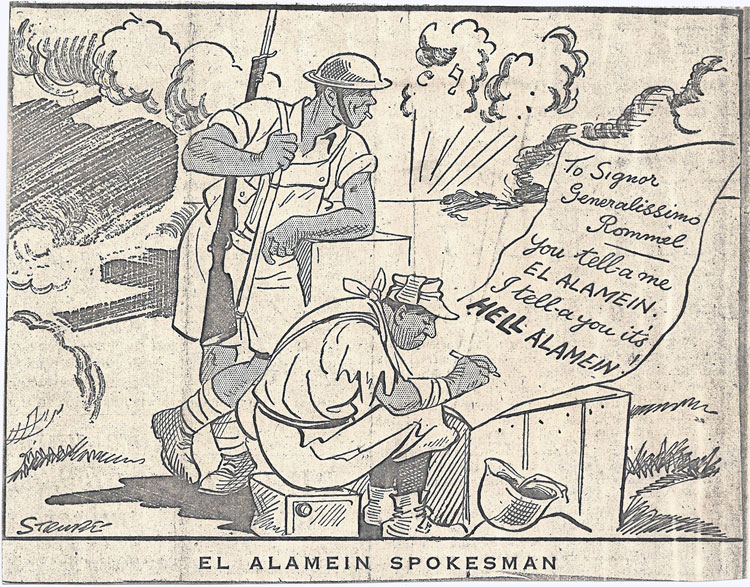
The View at the Time: El Alamein was viewed, at best, as a bloody stalemate. Few understood that Rommel had reached the end of his supply line. The Nile was no longer a goal but the state of mind of the Afrika Korps
In truth, both sides were exhausted. The British had been on the run for weeks and the Axis had few offensive options left. The tank and infantry battles ceased. The battle of supplies started.
Rommel had been receiving 34,000 short tons of supplies a month back in May of 1942. With naval patrols hitting Italian shipping and British bombers attacking his supply lines, Rommel’s troops were down to 5,000 short tons by the end of June. Vehicles too were in short supply. 4,000 had made it to Libya and the front in May. 400 made it in June. In contrast, not only were the British getting new supplies every day, but within a week, two new Indian Brigades and a new Australian Division were now at El Alamein.
Renewed fighting on July 8th reflected the imbalance. Depleted Panzer groups mostly counter-attacked, trying to stop Australian units from overrunning the center of the line. Despite heavy Australian tank losses (as much as 50%), within a week of fighting, the Germans had suffered nearly 6,000 casualties and lost Signals Intercept Company 621. The company, a forward unit charged with picking up British radio signals and other intelligence, had been Rommel’s strategic ace-in-the-hole. By the middle of July, Rommel had lost most of his tanks and now his ears and eyes on the front.
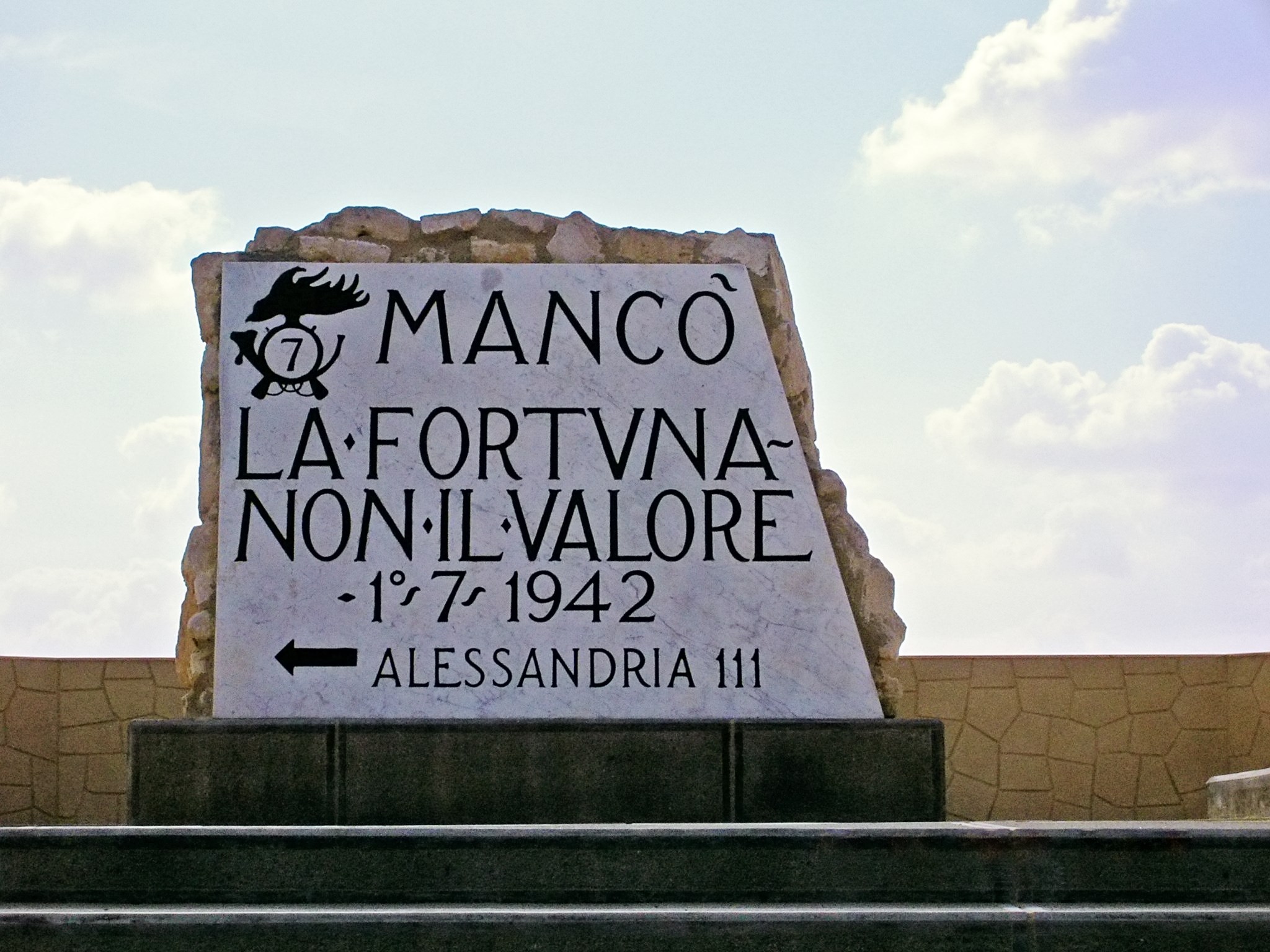
"Mancò la fortuna, non il valore" (A failure of fortune, not of valour). A Italian marker at the site of the furthest advance of the Axis armies in Egypt
The tide had turned. But now the coastal road was no longer blocking an Axis advance but a British one as Auchinleck was determined to destroy Rommel once and for all. In late July, having now twice tried to push the Axis out of the El Alamein region, Auchinleck launched a furious armored assault with Operation Manhood. Not only were the Germans expecting the offensive, but not for the first time, British forces got lost in the desert. Anti-tank defenders got separated from their tank units, some brigades stumbled into mine-fields, and in general communication was poor. Even with having told Berlin that “the situation is critical in the extreme”, Rommel was able to counter the attack, causing 1,000 British and Australian casualties for no gain. Rommel would not be in Cairo but nor would Auchinleck be in Tripoli anytime soon.
But how had the British been unable to defeat Rommel even after his forces had suffered terrible losses? Largely it was about coordination. British units simply hadn’t been trained well enough for joint aerial, infantry and armored action. But the terrain too hurt the British once the tables had been turned. Like Thermopylae, the battles were contained on narrow ground and the defenders had plenty of time to prepare. El Alamein’s natural defenses bled the fight out of the Axis and returned the favor to the British.

The cost of battle: at least 23,000 British & German troops were killed or wounded at El Alamein. Italian deaths are unknown but considerable
The significance of the First Battle of El Alamein was lost to the British Command in London. Claude Auchinleck might have stopped Rommel and saved the critical shipping artery of the Suez Canal, but he had done so at a frightening loss of men and material against a smaller force. Nevermind that thus far Auchinleck had been the only commander of any nation to beat Rommel, “The Auk” was seen as a command liability. Auchinleck was offered a revised C-in-C command for Persia and Iraq (the Middle Eastern Command was now split in two, with Egypt and Libya a separate office) but turned it down. He would resurface by 1943 in India in a similar role and was credited, in part, in changing British fortunes in the Indian/Burmese theater of operations.
To replace Auchinleck, British Command chose Gen. William Gott – a corps commander with excellent tank skills. But Gott never took command. On route, his plane was attacked and Gott was killed instantly by a Messerschmitt round through the heart. Instead, a Home Defence Lt. General by the name of Bernard Montgomery was named the new C-in-C of the Middle Eastern Front.
Montgomery would get his own chance at Rommel at El Alamein that fall and the end result would be quite different.

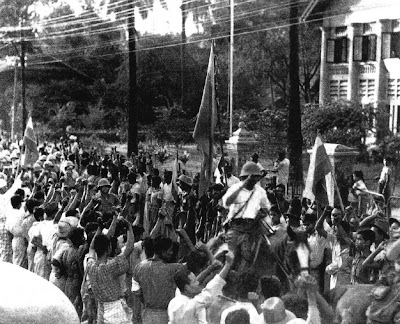
 With French and African forces bearing down on Islamist rebels, the question arises – is Europe lying to itself about their commitment to Mali?
 Dear NHL,


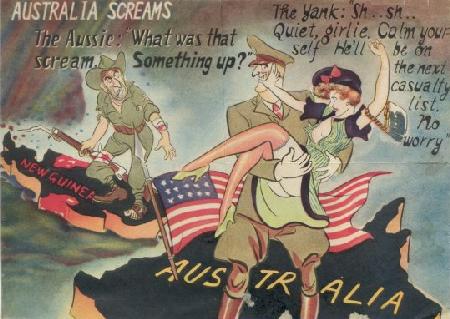
 The University of Minnesota redraws the lines of success for Gophers football.

 It is those failures, and many smaller ones, that strike at the heart of what was once Michael Bloomberg’s appeal – results-oriented governance. Bloomberg may have been a cold, aristocratic figure who lacked much of a “common-touch” with the plebs of NYC, but he stood between many average New Yorkers and the army of liberal partisans who saw City Hall as Grand Central Station for a variety of socioeconomic engineering ideas. So what if Bloomberg liked to chase grandoise ambitions of national office or dabbled in Nanny-state legislation that brought him media acclaim? As long as the power stayed on, the trains ran on time, and crime was down, who cared if your fried chicken tasted like crap since it wasn’t cooked with trans-fats? For most New Yorkers, it was the small price of electoral business.
 They don’t call it a horse-race for nothing.





 The GOP primary becomes a Möbius strip.


