Piltdown Redux?
By Bogus Doug
For about forty years the greatest scientific experts in the world were in broad agreement that the evolution of the human species included a critical phase involving a large brained but otherwise ape-like creature known as Eoanthropus dawsoni, or, more colloquially “Piltdown Man.” Piltdown man was discovered by amateur archaeologist Charles Dawson in a gravel pit in the village of Piltdown, in East Sussex, England. Dawson subsequently presented his find to the Geographical Society of London in 1912.
So broadly accepted was the existence of this creature as a critical step of human evolution that it was cited by famed lawyer Clarence Darrow in perhaps the most famous event in in the popular mind involving evolutionary theory since Darwin – the Scopes “Monkey Trial” of 1926. However in 1953 the world was stunned to discover that, far from being a critical step in human evolution, Piltdown Man had never existed at all. The fossil which lead to this belief was, in fact, a hoax.
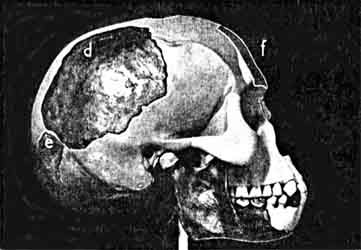
But despite its notoriety there are useful lessons we can draw from the Piltdown hoax. One of the central lessons is that whenever a scientific problem beckons for a solution there is a predisposition within the scientific community to accept a certain kind of solution: the kind of solution which neatly fits the prevailing assumptions.
Piltdown was accepted readily despite flaws which were apparent from the start because it fit. It was not some groundbreaking revelation which caused scientists to rethink their assumptions about human evolution. Far from it. It was the very fulfillment of those assumptions. It was the long sought after “missing link” between man and the ape, and it looked exactly like they assumed it would – a big-brained ape. Mankind, so the thinking of the time went, first developed intelligence and afterward learned to walk upright and make tools and use language and the like. That was the story of human evolution as science was trying to tell it. Piltdown looked like it could have walked right out of that story book.
Meanwhile, as Piltdown Man was written into school text books and cited in famous trials, a very different kind of discovery went largely unnoticed. Raymond Dart, an Australian scientist working in South Africa, found fossils of a young ape-like hominid. Dart was convinced this was another link in the chain of human evolution, but he was almost universally discounted in this regard. After all, Dart’s fossil showed an upright walking creature with an ape-like brain. That had the order of evolutionary development exactly backward from what the leading scientists in the field expected… and backward from what Piltdown Man had shown. Some of the leading scientists of the day excoriated Dart as a deluded crank for his insistence that his “Taung child, ” (or, as he liked to call it, Australopithecus africanus) represented any link in the chain of human evolution at all.
Of course, after the Piltdown hoax was exposed, Dart’s discovery was recognized as the legitimate “missing link” after all, and the story of human evolution had to be rewritten. Rather than still-stooping man-brained apes, the earliest hominids were now understood to be ape-brained upright bipeds.
But it’s important to note that Dart’s evidence was out there all along. It arrived on the scene not terribly long after Piltdown. Dart published his case in the science journal Nature in 1925, so it got plenty of notice among the top minds in the world of natural science . Why was almost no one clued in enough to recognize the real “missing link” compared to the fraud?
The answer is almost frighteningly simple for anyone who places great faith in the incorruptibility and self-correcting nature of science… Dart’s evidence didn’t fit the story. Piltdown did. The story proved so compelling it was able to overwhelm the actual evidence. Even as more and more evidence accumulated the story prevailed… right up until the hoax was exposed in 1953.
Once the hoax was exposed there was much face-saving commentary about how incredibly clever the hoax had been. But it really wasn’t. Many people spotted it as, if not a deliberate fraud, at least a seriously flawed fossil reconstruction from the start. It had the kind of deep and obvious flaws you might expect from an amateur forgery. From the wikipedia description:
It consisted of a human skull of medieval age, the 500-year-old lower jaw of a Sarawak orangutan and chimpanzee fossil teeth. The appearance of age had been created by staining the bones with an iron solution and chromic acid. Microscopic examination revealed file-marks on the teeth, and it was deduced from this someone had modified the teeth to give them a shape more suited to a human diet.
The most notable feature of the hoax wasn’t it’s cleverness, but it’s sheer audacity. How could someone pass off something that was actually quite plainly fraudulent as legitimate among the top minds of the scientific world for so long? How could such a crude amalgamation convince so many smart people to ignore the real fossil evidence even as it accumulated under their collective noses?
Once again, the conclusion one is forced to reckon with isn’t something that suggests Piltdown was a unique exception, but perhaps far more common than we’d like to believe. People who ought to have known better were fooled by the fraud easily. They wanted to believe that Piltdown was true so badly they actively suppressed the kind of skepticism they routinely applied to other scientific problems.
If this is so the implication might be that Piltdown is not such an isolated example of master hoaxery, but rather a kind of banal fraud that may worm its way into science any time scientists think they already know the answer and go looking for confirmation rather than being ruled by a dispassionate review of the evidence. It suggests there is no special “catch all” in the scientific method that insulates it from the basic human capacity to want to believe certain things.
And that brings us to one of the more recent grand stories scientists have been trying to tell. This story says that the earth began warming during the latter years of the twentieth century in an unprecedented fashion that can only be explained by attribution to human activity. Though the name of this story seems hard to pin down, for our purposes we’ll call it Global Warming. This story may seem to have nothing to do with a hoax like Piltdown Man. But perhaps we should look a little closer.
Remember that the prevailing feature of the Piltdown hoax was that is appeared to fill a gap in the evidence… a gap scientists were eagerly looking to fill. And it fit that gap exactly as prevailing expectation said it ought to. It wasn’t that Piltdown was so cleverly made that it forced scientists to revisit their assumptions. Rather it so cleverly fit the prevailing assumptions that it escaped serious investigation into how it was made.
That brings us to Steven McIntyre’s revelation this week about a crucial piece of evidence underpinning the story of Global Warming: a series of temperature data known as the Yamal chronology.
Bishop Hill has perhaps the best layman’s explanation of MacIntyre’s work and how it fits into the story of Global Warming. It deserves to be read in full. However I would like to call attention to this critical quote from Hill’s post:
With [the] Polar Urals [temperature chronology] now unusable, paleoclimatologists had a pressing need for a hockey stick shaped replacement and a solution appeared in the nick of time in the shape of a series from the nearby location of Yamal.
Piltdown wasn’t a hoax perpetrated by the broad scientific community and carefully concealed from the public. It was a hoax perpetrated by, most likely, only a single person which subsequently fooled the broad scientific community by appealing to their “pressing need” for evidence of a certain kind.
The major question remaining is: Is Yamal another Piltdown? Has there been another deliberate manipulation of critical evidence fooling the broader scientific community? Or is there some better explanation for what McIntyre uncovered in regard to the Yamal chronology?
Time will tell. And thanks to Steven McIntyre this time it won’t take forty years.


October 1st, 2009 at 10:34 am
Excellent post!
October 1st, 2009 at 10:38 am
Piltdown man was a hoax? That explains the resemblence to Matt Entenza.
October 1st, 2009 at 11:18 am
Well, as we learned from CBS news….if the fake items support your point of view, then it is “fake but accurate”.
October 1st, 2009 at 12:17 pm
Yay! Anthropological geekery!
It was thought that Arthur Conan Doyal was behind the Piltdown hoax. Not sure if that was ever confirmed or not.
October 1st, 2009 at 12:18 pm
Doyle. Der.
October 1st, 2009 at 12:45 pm
Arthur Conan Doyle was always my favorite candidate for the hoaxer, not because it made the most sense but because … well he wrote the Sherlock Holmes stories of course.
But the couple of serious investigations into the question I’ve seen point to Charles Dawson himself as the most likely, and probably only, hoaxer.
October 1st, 2009 at 2:09 pm
Nice picture of Swiftee.
October 3rd, 2009 at 9:14 am
Given that the original piltdown man hoax occurred in what – 1912 or thereabouts?
I think it fair to point out that scientific standards and practices have changed rather drastically in the interval of nearly 100 years. I love that you wrote about the old hoax, but I’m not so sure that the premise holds up well with the current standards and practices. Yes, there is always a temptation to be believe the results you want or expect, but seriously, there is a greater awareness and tends to be a greater compensation for that. Always a good thing to remind people, but ……. a serious concern such that we should distrust science? Not so much.
October 7th, 2009 at 5:00 pm
Please, anyone want to actually admit they believe in MMGW? Of the Mcdonalds Made variety or the Man Made variety? Can you say hoax?
October 7th, 2009 at 5:35 pm
I’m not so sure that the premise holds up well with the current standards and practices.
The standard and practices of the time were more than adequate to have upended the Piltdown hoax, as Doug noted – there were plenty of scientists in the teens who figured it out.
It wasn’t the standards that let science down. It was, as Doug noted, psychology.
And that has not changed.