Blood on the Lakes
By First Ringer
The morning was cold and grey as journalist J.M. Beaufort, an American observer with the German army, left with a detachment of German soldiers stationed in the Polish (then Russian) town of Augustów. Just days earlier, on February 23rd, 1915, the town had been part of the gigantic battlefield known as the Masurian Lakes, and the German troops were looking for stranglers from both the German and Russian armies.
Deep within the woods, Beaufort and his German escort came across a disturbing scene. Seated in the snow a “giant Russian” cradled the decapitated head of a dead German soldier, whose body lay covered by the Russian’s army jacket. An empty flask sat between them, with the Russian dead-eyed and soaked in blood. As they approached, the realized most of the blood was the Russian’s own – his left elbow was all but gone. Momentarily brought out of his daze, the Russian looked at Beaufort and said only one word: “Nitchewo” (“It is nothing”).
He had been part of the 220,000 men Russia had brought to the Masurian Lakes. Only 20,000 walked away.
—

The German line at the Masurian Lakes. Germany hoped to launch an offensive before Russia could launch her own
The war between Tsarist Russia and Imperial Germany was in some ways the inverse of the conflict both nations would fight a generation later.
Whereas the Eastern Front was the critical front for Nazi Germany, consuming resources on an industrial scale, Imperial Germany saw the Eastern Front as somewhat of a massive sideshow – a distraction from the West, where Germany’s fortunes would be won or lost. After all, the Schlieffen Plan hasn’t accounted for a two-front war, and every part of the German war machine would be required to quickly defeat France. Nevertheless, as Russian forces skirmished on the border, forcing German troops to retreat, the whole of East Prussia looked ready to be abandoned.
The Spoils of War – the German victory haul at Tannenberg. The first big battle of the Eastern Front, Tannenberg set the stage for most of early years of the front: massive Russian losses (170,000 at Tannenberg) but minimal German gains
Unwilling to commit major resources to the East, but equally unwilling to risk Russian troops mobilizing and making a dash for Berlin, the German High Command called 66 year-old Paul von Hindenburg out of retirement and into service as the commander of the Eastern Front. Hindenburg, coupled with his chief of staff Erich Ludendorff, quickly reorganized the retreating German units into the Eighth Army, and routed the Russians at Tannenberg in East Prussia. For the loss of 14,000 men, Hindenburg had crushed the Russian Second Army, killing or capturing 170,000 troops.
Tannenberg made both Hindenburg and Ludendorff household names in Germany, starting what would become prominent military (and eventually political) careers. It was a marvelous tactical victory for Germany. And it had almost no strategic significance.
—

Tsarist Propaganda – the Germans, Austrians and Turks have designs on Russian territory, but Russia would run them through. For parts of 1914-15, that would remain somewhat true
For the rest of 1914, into the winter of 1915, the Eastern Front remained at best a pendulum, swinging back and forth without ever really going anywhere. To the south, the Austrian and Russian forces were engaging the bulk of their forces, leading to the Austrian rout at Galicia as the Austro-Hungarian Empire retreated into their borders, leaving 325,000 men behind. The Austrian army, for the foreseeable future, would be on the defensive – Galicia had cost them most of their officer corps. Russia would be in little of a position to exploit their gain as their victory cost them 225,000 troops. Between that and Tannenberg, the Russians were dangerously close to bleeding out their army.
But Russian losses were replaceable – with time. Over the course of the winter, three new Russian armies were mobilized with the goal of avenging Tannenberg and pressing the Germans on their own border. As 1914 became 1915, and the Western Front looked unlikely to be resolved anytime soon, Germany faced the difficult decision: either move towards to the East or expect Russian troops in East Prussia. Worse, the Russians might strike to the south and drive the teetering Austrians out of the fight.

Paul von Hindenburg (left) & Erich Lundendorff (right) – the masterminds of Germany’s Eastern Front, together they would eventually defeat Tsarist Russia while inflicting over 10 million casualties
The newly promoted Chief of the German General Staff didn’t like the idea of moving men West to East. Erich von Falkenhayn had only been in the post a few months, acquiring the job only after Helmuth von Moltke told Wilhelm II following the battle of the Marne, “Your Majesty, we have lost the war.” To Falkenhayn, there was hope for a separate peace with Russia. The Russian casus belli – the Austrian war against Serbia – had reached a deadlock; Austrian forces had been stalled. Russian fears that Serbia would be destroyed now looked misplaced. If the Russians themselves were not humiliated on the battlefield, they could reach terms with Germany, or so Falkenhayn believed.
But even Falkenhayn could read a map. The Russians were on German soil and another offensive against the German line was expected. Without reinforcements, the Russian “bulge” in the norther half of the Eastern Front would only extend. Either Germany could wait to be attacked, or attack first.
—

Russian cavalry – The Tsar’s troops would lose over 325,000 men between the two battles that took place at the Masurian Lakes
February 7th, 1915 saw a massive snowstorm hit the Masurian Lake District in East Prussia. The Russian Tenth Army, under Gen. Thadeus von Sievers, settled in for a long blizzard. Their front had been quiet and the Tenth was awaiting the full mobilization of the accompanying Russian Twelfth Army. There was little to do but start a fire and huddle together for warmth. Certainly the Germans were doing the same.
Instead, Hindenburg and Ludendorff launched their preemptive offensive. 100,000 men of the German Eighth Army threw themselves against the 220,000 men of the Russian line, catching them completely by surprise.

Hindenburg observes the battle. He’s likely looking at Tannenberg, not the Masurian Lakes, in this photo
While the Eastern Front had already seen much more mobility than the trench warfare in the West, Hindenburg’s offensive didn’t merely move the boundaries of the front – it crushed the Russian lines. German forces rushed through gaps in the Russian front, threatening to encircle most of the Tenth. The Russian attempt to retreat and reorganize was a tactical mess, as some men dropped their rifles and fled while too many held their position until they were cut-off. The Russian 20th Army Corps – a large share of the Russian Tenth Army – was surrounded and forced to surrender. Within a week, the Germans had advanced 70 miles and killed, wounded or captured 200,000 Russian soldiers.

Tsar Nicholas II – Nicholas heard mostly positive news from his generals about the progress of the war; their defeats coming as a total shock given what he was being told. Frustrated with military leadership he felt he could no longer trust, Nicholas would become the commanding general for the war in the fall of 1915. It would be a major part of his undoing
Germany looked to have their breakthrough in the East. For the loss of just over 16,000 men, Hindenburg and Ludendorff had all but annihilated one whole Russian Army (the Tenth would reform just past Augustów, where we began our story). If not for the Russian Twelfth Army, positioned just south of the Tenth, rumbling to life and attacking the German flank, Germany might have shattered the entire northern sector of the Eastern Front. A terrible Russian loss could have easily become a total rout.
As it would happen repeatedly on the Eastern Front, German successes were tempered by Austrian failures. South of the battle, German Gen. Alexander von Linsingen’s Austro-German army, trying to undo the losses of Galicia that previous fall, battered themselves against fortified Russian positions. The Austrians would lose another nearly 200,000 men over the course of the winter and spring in fruitless offensives. The lines of the Eastern Front had moved (massively, at least by comparison to the sort of advances on the Western Front), but the Front’s pendulum-like nature had swung again.

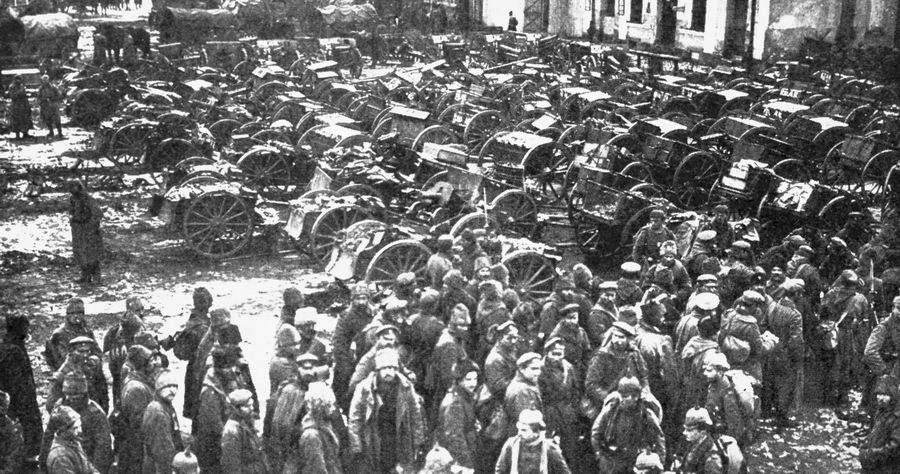
Russian prisoners after the Masurian Lakes. These are the lucky ones – many Russian prisoners were captured due to frostbite
Russia was holding her own by the winter of 1915, and with 6.5 million men, remained a force to reckon with. But the army also only had 4.6 million rifles – nearly two million Russian soldiers essentially had no weapons. And Russian losses were mounting, even when the army was victorious. The Masurian Lakes would be among the first of Russia’s estimated 2 million casualties in 1915 alone.


February 23rd, 2015 at 10:17 am
Thanks, Mitch. WWI details were/are not taught/available neither in USSR nor Russia. It was/is a hole in Russian history.
February 23rd, 2015 at 2:47 pm
My favorite story about these battles is that the Russians broadcast a lot of their battle plans in straight AM because the generals of the 1st & 2nd armies refused to talk to one another. Hence, German units generally knew what the Russians were going to do before the Russians themselves did. “Oops.”
February 23rd, 2015 at 7:37 pm
If you are interested in this sort of thing, Gutenberg’s World War One bookshelf is worth checking out. A lot of people wrote memoirs of their World War One experiences, some of them are very well done.
http://www.gutenberg.org/wiki/World_War_I_%28Bookshelf%29
February 24th, 2015 at 9:26 am
What happened to American observers of the German army after the U.S. entered the war against Germany? Were they instant POW’s? Or repatriated with diplomats?
February 24th, 2015 at 11:13 am
Good question, Loren.
J.M. Beaufort, the journalist mentioned in this piece, was allowed to return to the U.S. and published an account of his years in Germany in 1917 – “Behind the German Veil.” I didn’t come across examples of journalists becoming POWs, although there are examples of American journalists being detained and charged as British spies (then released and returned home).
July 13th, 2015 at 6:13 am
[…] constant was Russian blood. Whether in victory (such as in the Carpathians) or in defeat (the Masurian Lakes), Russian soldiers died in biblical proportions. At least 2 million rifles short, starving for […]