Falcon: Forty
By Mitch Berg
Outrageous inflation in military spending isn’t a modern phenomenon. Since the end of the Cold War, though, we don’t hear as much about it.
But in the 1970s, it was getting headlines. The costs involved in developing weapons were zooming. And nowhere were these costs more publicized than with aircraft.
In the late ’60s and early ’70s, the development of several key Air Force and Navy aircraft blossomed into inflationary nightmares. It started with the F-111, whose protracted development time and cost overruns became a national controversy in the ’60s and early ’70s.
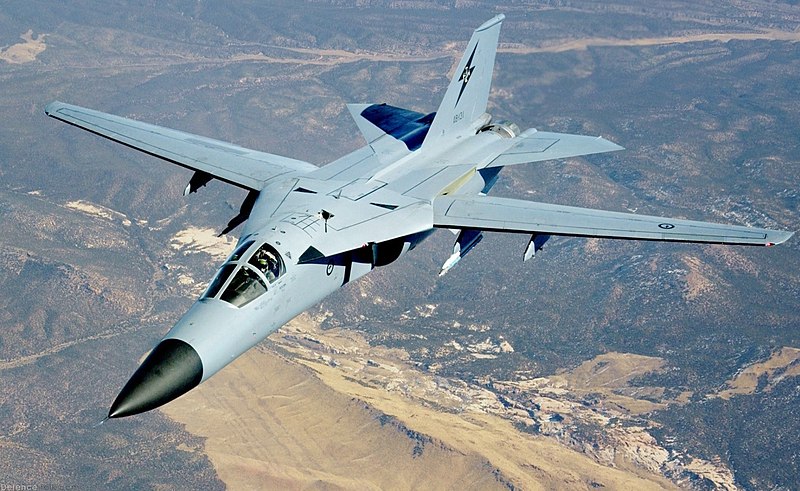
An Australian F-111.
The Navy’s F-14 program (that’d be the plane Tom Cruise, Anthony Edwards and Val Kilmer flew in Top Gun) wasn’t as troubled – but each copy of the plane ran to well over $20 million 1972 dollars, which equals $111,000,000 today, giving a generation of American budget-watchers sticker shock.

An F-14 Tomcat. Not “TomKat”. Sheesh.
The Air Force’s F-15 was another expensive one, marginally cheaper than the F-14 for about the same mission.
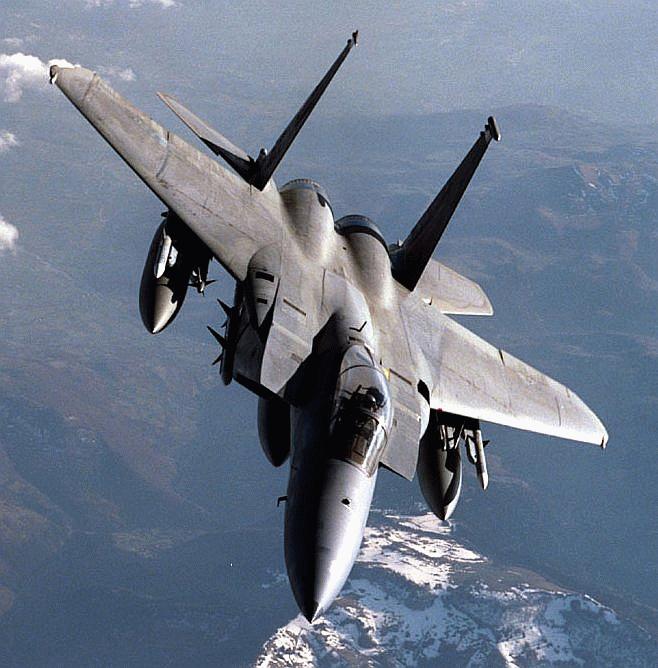
An F-15 Eagle
The ballooning cost caused some military theorists to speculate we’d be better off buying more, cheaper aircraft; that in a potential Hot War, the huge number of relatively cheaper Soviet airframes would take horrible casualties against the technologically formidable US planes, but that at the end of the battle there’d be so many Soviets that the Americans would end up getting shot down any way. Better, the theorists said, to buy many, many of the relatively cheap ($3-4 million a pop in the mid-seventies) F-5, which was comparable with a Soviet Mig-21.

A Mig 21 of the Lithuanian Air Force. First fielded in the late 1950s, over 10,000 Mig 21s were built – the most of any jet fighter in history.
With this in mind, General Dynamics set about trying to split the difference; building as smaller, lighter, less-expensive fighter plane. This became the F-16 – called the “Falcon” by the Air Force, the “Viper” by many of its own pilots (and the “Lawn Dart” by F-15 pilots, after a few unfortunate crashes early in its development).

An F-16
And the first F-16 flew forty years ago this month.
Weights and costs rose, inevitably, as well – but for the price the Air Force got a plane with a number of firsts: it was the first “relaxed-stability” fighter plane controlled by “fly by wire” technology. Stable planes – like an airliner – are designed to fly efficiently and comfortably in straight lines. They’re stable. Airline passengers like them that way. But airliners don’t have to pull 6G (six times the force of gravity) turns to evade incoming missiles, either (ideally). Fighter planes do, on occasion – and while stability makes flying in one direction easier, it makes it harder to crank the plane into a sudden turn. Unstable planes are, well, unstable; they’re prone to tipping over and rolling about at random, unless the pilot is in complete control – more complete than a human can possibly manage. The F-16 used a computer to automatically adjust the control surfaces, many times per second, to keep the plane artificially stable in forward flight, but use the plane’s inherent instability to help it maneuver very quickly. This technology also involved replacing the traditional mechanical control cables and connections with an electronic data bus, delivering electronic signals from the computer and, less frequently, the pilot, to the plane’s control surfaces (which had the added effect of getting rid of parts that, traditionally, are among a combat aircraft’s most vulnerable to damage). It made the F-16 the most nimble fighter jet of its era, and one of the most maneuverable of our era as well.
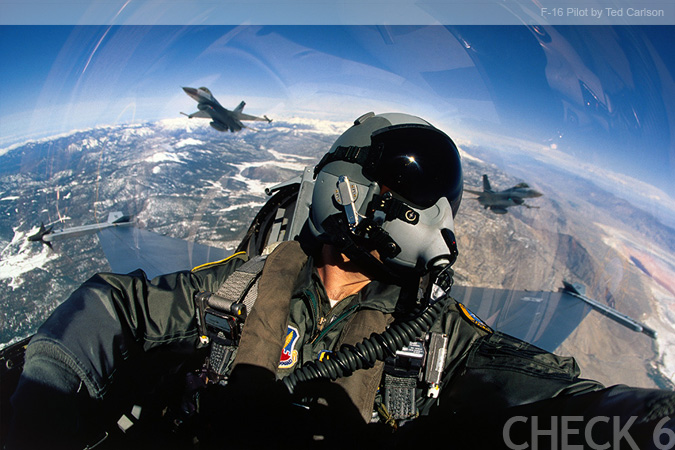
The view (backwards, obviously) from the bubble canopy of an F-16. At least one of this blog’s semi-regular commenters has spent a fair chunk of his career with this view from his office. I’m hoping he shows up for this thread…
There were other advances – a frameless bubble canopy giving an unimpeded view of the surroundings, a pilot seat that was reclined 30° to reduce the physical effects of the gravitational forces involved in violent maneuvering on the pilot, “Hands on Throttle and Stick” controls that put most of the plane’s key controls on the two controls that the pilot kept his hands on most of the time, as well as moving the “stick” (which controls roll and pitch) from between the pilot’s knees to the right side of the seat.
Cockpit of an F-16. I recognize the stick on the right, the ejector seat control in the bottom center, and the throttle on the left. Beyond that, I couldn’t close the canopy much less read anything.
Many of these features have been found on most fighter planes developed since then. Some – “fly by wire” – have even popped up on commercial passenger aircraft.
The F-16 was adopted by two dozen other countries, and produced in five (US, Belgium, the Netherlands, Turkey and South Korea). It flew in combat in both Gulf Wars and over Bosnia, and has also flown in combat for the Dutch, Belgian, Danish, Norwegian, Pakistani, Venezuelan and (in limited skirmishes against each other) Greek and Turkish air forces.

Norwegian F-16 dropping a stick of bombs
And above all, Israel has used the F-16, as its principle multi-role fighter plane. Eight of them (escorted by a flight of F-15s) bombed Iraq’s Osirak nuclear plant in 1981, to stall Hussein’s nuclear program. The raid highlighted both the flexibility of the F-16 (it was both an excellent fighter and a capable bomber) and the skill of Israel’s pilots (one pilot dropped his bomb through a hole in the reactor containment building that had been drilled by the previous plane’s bomb).

Israeli F-16
The F-16 has traditionally been scheduled to fly until 2025 – but delays in its putative replacement, the F-35, have likely stretched that a few years.


February 24th, 2014 at 4:26 pm
Shouldn’t this post be categorized as Hot Gear?
February 24th, 2014 at 4:28 pm
Tough call. I usually reserve Hot Gear Friday for things that I’ve actually used myself, or at the least could feasibly use, someday.
Obviously, the F16 is a little out of my range.
That’s my rationale. (And I know, I know – I DO have to start doing HGF again).
OTOH, I’m hoping one of our regular commenters, who flew F-16s for quite a while, will turn up.
February 24th, 2014 at 4:32 pm
Drats. I had a meeting this morning with a person who flew one with exact same paint job as in the last picture. Too bad I did not see this post sooner.
February 24th, 2014 at 4:48 pm
To us Air Force aircraft guys, the FB-111 was affectionately called a bent wing bug sucker. Well, at least to us aircraft guys that didn’t work on them.
February 24th, 2014 at 7:45 pm
I always liked the F16. It was the updated F5, but it beat the F15 on cool tech even if it wasn’t quite as versatile for all weather operations.
Oh, and I remember work on the CD-ROM that went in it. It’s not easy to design a CD-ROM designed to work upside down at 9g. Big buffers are your friend.
February 24th, 2014 at 9:59 pm
Mitch, are all the Israeli ’16s two seaters?
February 24th, 2014 at 10:23 pm
Kin,
Of the IAF’s current F16 fleet, 154 are single seat (A/C variants) and 65 are two-seaters (B/D variants).
The new F-16I Sufa is apparently a two-seater. 102 are on order.
February 24th, 2014 at 10:31 pm
A few fiendishly expensive tricked-out super-machines or a slew of basic mission-specific ones? The debate continues.
Trying to combine Attack missions (e.g. A-10 Thunderbolt tank busting) with Fighter missions (e.g. F-16 Falcon air superiority) is tough enough. Trying to make that airplane light enough but robust enough to land on a carrier (F/A 18 Hornet) results in many compromises and massive design criteria. The F-22 Raptor and F-35 Lightning are not ready for that duty yet.
And what’s the mission, anyway? Do we really need one platform to do it all? Maybe Electronic, Fighter and Attack missions Should have separate, mission-specific birds? Is it really smarter to build a handfull of James Bond Supercars than a fleet of Hyundais? What are we really going to use them for?
February 25th, 2014 at 7:49 am
Great points, JD. In Vietnam, we used a variety of aircraft, each serving a different role. In that type of war, I don’t know that a multi role single platform would work.
If we look at the aircraft involved and their individual roles, the debate gets harder;
For getting a lot of ordnance on a wide area, how do you replace a B-52 type bomber? Not to mention the demoralizing effect that carpet bombing has on enemy troops.
The F-4 Phantom, performed several roles, but couldn’t do everything. They weren’t best dogfighter, mainly because they didn’t have guns. In the role of close air support, it was very good.
The F-105 Thunderchief was used primarily for SAM and radar suppression as WIld Weasels, but also served as a bomber, again for close air support and recon. It could also outrun any enemy plane in the theater at low level.
The A-1 Skyraider, aka Sandy, with its reciprocating engine, excelled at both close air support and rescap, because it could remain on station longer and could fly slower without stalling.
The FB-111 was used for bombing and recon. Probably could have pulled this one out of the mix.
Then we had a mix of old C-47s aka Puff the Magic Dragon and C-130s, aka Spectre, converted to gun ships, again for close air support. The C-130s had 105 mm howitzers that would be fired out of the cargo bay.
Then, we had several helicopters that served various roles, the most famous of which being the Bell UH1B,C Huey and the HH3 Jolly Green Giant. The Hughes OH-6 Cayuse or Loach, was used for search and rescue and recon/spotter missions, usually in conjunction with a couple of Bell AH-1G gunships.
Where to start? It just boggles the mind.
February 25th, 2014 at 9:02 am
The F-105 Thunderchief was used primarily for SAM and radar suppression as WIld Weasels, but also served as a bomber, again for close air support and recon
As I read my history, the Thud was used more for deep strike – attacks on Hanoi, Haiphong and the like – than CAS.
February 25th, 2014 at 11:12 am
Good points, Boss. We used a variety of mission-specific aircraft to military success (until politicians cut-and-ran), which meant A-6 Intruders were free to perform air-to-mud missions because F-4 Phantoms provided air cover. They didn’t try to make one platform do it all, or make pilots learn every skill and every tactic to perform every mission.
Now maybe that’s because mentally, we were still fighting WW II; or maybe it was caused by inter-service rivalry. But I’m still waiting for someone to tell me what war we ARE preparing to fight? Drop the A-10 Warthog in favor of the F-35 Whiz-Bang? Okay, maybe, if we’re certain we’ll never need a tank buster again. But if we are certain we know what weapons we’re Not going to fight, can you please tell me what weapons we Are going to fight?
February 25th, 2014 at 12:14 pm
Mitch;
Yup. Forgot that.
February 25th, 2014 at 12:52 pm
I’m still waiting for someone to tell me what war we ARE preparing to fight?
In the late eighties, the great historian Edwin Luttwak wrote The Pentagon and the Art of War. It castigated the Pentagon, not just for “preparing to fight the previous war” (which it was – until the early eighties, the military was basically preparing to re-fight World War 2), but for having no clear national strategy, and obviously having no military to pursue it. Thus, we had a military that experienced five successive failures or unneccessarily costly successes (Vietnam, the Mayaguez Incident, Desert One, Lebanon and Grenanda).
The book was part of a wave of self-examination that led to the Nunn-Nichols reforms, which had a great deal to do with the crucial reforms the military went through in the late eighties and early nineties.
We need to do it again.
February 25th, 2014 at 2:22 pm
Mitch;
I might add to another key point, made by Pete Hegseth of Concerned Veterans for America in his criticism of the military cutbacks on Fox News this morning; “We usually don’t get to pick where the next war starts.”
October 22nd, 2014 at 9:04 am
[…] force” apparently has two MIG-21s – infamous dogfighters in Vietnam, which led to the design of the F-16, forty years ago – and a single MIG-23, a Cold-War-era mainstay of the Soviet air […]