Versailles
Thursday, June 2nd, 2022The flurry of telegram traffic between the various capitals of Europe in late June of 1919 was almost similar to the volume seen in the weeks before the Great War. With the fifth anniversary of that cataclysm rapidly approaching, and no formal peace treaty having yet been signed and accepted, there was burgeoning nervousness that war might return to ravage Europe. Despite months of Allied negotiations to craft terms of a final treaty with Germany, the German response had waivered between hostile rejection and begrudging acceptance. Still, no German signature had touched the treaty, in part as no German politician wished to affix their name. Chancellor Philipp Scheidemann (Friedrich Ebert had risen to the post of President of Germany with the newly announced Weimer Republic), spoke for all his colleagues when he said: “What hand should not wither that puts this fetter on itself and on us?”
The task fell upon Gustav Bauer, the next in line of authority as Schneidemann chose resignation as opposed to destroying his political legacy. Even Ebert declared the treaty’s demands “unrealizable and unbearable,” decrying not only the punitive terms but the process in which the treaty had been crafted without any input from Germany or the former Central Powers. This wasn’t a peace treaty but a division of war spoils and an unconditional surrender, or so Germany complained. Bauer cabled the Allies, stating that he would sign the treaty if a handful of articles containing language about German culpability for the war and war crimes trials for the exiled former Kaiser be removed. The Allied response was clear – sign the whole treaty within 24 hours or French troops would cross the Rhine and occupy Germany. In desperation, the new Weimer government asked Paul von HIndenburg if the German army could potentially resist a renewed Allied offensive. They likely knew the answer before even asking the question.
On June 28th, 1919, in the Hall of Mirrors in the Palace of Versailles, 27 delegates representing 32 nations gathered to sign the final instrument of peace to end the First World War. It had been exactly five years to the date of Franz Ferdinand’s assassination. Germany had sent their Foreign Minister to oversee the signing. Gazing over the Foreign Minister as he signed was the gigantic self-portrait that Louis XIV had commissioned. The portrait’s title spoke of the Allies dominance on this day – “The King Governs By Himself.”
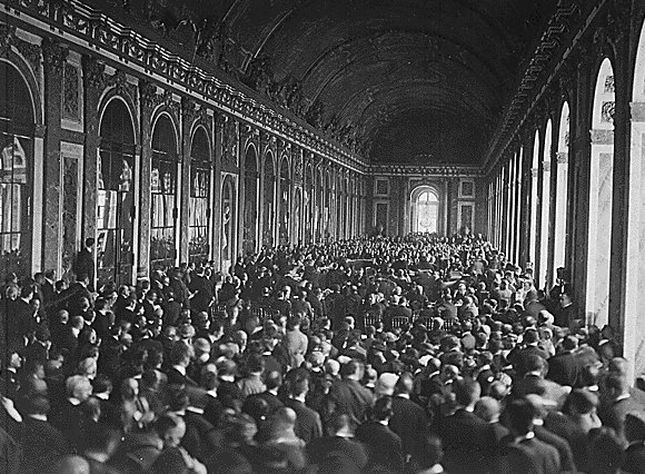
The treaty signing in the Hall of Mirrors – thousands of onlookers joined journalists and diplomats to oversee the brief ceremony
That any final terms of a peace treaty between Germany and the victorious Allies would be harsh could hardly have been a surprise. The process of even arriving at an Armistice had seen Germany agree to give up most of their military and infrastructure, not to mention an occupation of the Ruhr by the French that increasingly looked tantamount to annexation. Similar treaties/armistices with what remained of the Austro-Hungarian and Ottoman Empires had been debilitating as well, as both empires were stripped of their territories, their infrastructure plundered and their armies legislated into irrelevance. Only post treaty/armistice violence would lessen some of the strongest terms, as the Hungarian revolution and the following Turkish War of Independence forced the Allies’ hand to renegotiate. And in the winter and spring of 1919, Germany had no appetite or ability to militarily resist. (more…)


