I Heard It On The NARN
Saturday, August 2nd, 2014Scott Honour’s website.
More on Dario Anselmo, GOP candidate in House District 49A
Info on the HD66A Picnic, and on Jon Heyer‘s site and Facebook page campaign site.
Scott Honour’s website.
More on Dario Anselmo, GOP candidate in House District 49A
Info on the HD66A Picnic, and on Jon Heyer‘s site and Facebook page campaign site.
Today, the Northern Alliance Radio Network – America’s first grass-roots talk radio show – brings you the best in Minnesota conservatism, as the Twin Cities media’s sole source of honesty!
(All times Central)
So tune in to all six hours of the Northern Alliance Radio Network, the Twin Cities’ media’s sole guardians of honest news. You have so many options:
Join us!
The Polish National Anthem is a song that conveys the central theme of Polish nationalism over the past 300 years; it’s always been undereground, or elsewhere.
| Polish | English |
| Jeszcze Polska nie zginela, Kiedy my zyjemy. Co nam obca przemoc wziela, Szabla odbierzemy. |
Our Poland has not yet perished. As long as we remain, What the foe by force has seized, Sword in hand we’ll gain. |
The song goes on to list decades, centuries of betrayals, and false hopes (the Poles bet long on Napoleon in the Napoleonic Wars, and paid horribly for it).
Seventy years ago today, one of the great examples of heroism, and the most ignoble examples of betrayal, launched.
The Armed Citizenry: The first European country to fall to the Nazis, the Poles were the first to organize their resistance. Tens of thousands of Poles fled through Romania to North Africa, thence to France (we’ve written about some of them), and to Britain; others defected to the Soviets, and fought in the Red Army.
Among Poles that remained, several resistance movements started. Polish Communists formed a large underground force. It was (like most communists) internationalistic, and allied with Moscow, and one of the two Polish governments-in-exile.
But the biggest group, the Armia Krajowa or “Home Army”, was Polish nationalists.

The flag of the Armija Krajowa.
They were intensely nationalistic; some were monarchists; most importantly, they owed their allegiance to the government in exile in London. The Armia was , in every particular, a shadow government and military operating under the Nazis’ noses, complete with an underground media, rudimentary education and social services, and underground weapons plants producing explosives, grenades and bombs, and even small arms. And, most of all, a military. Estimates of strength vary between 250,000 and 600,000, with most estimates coagulating around 400,000.
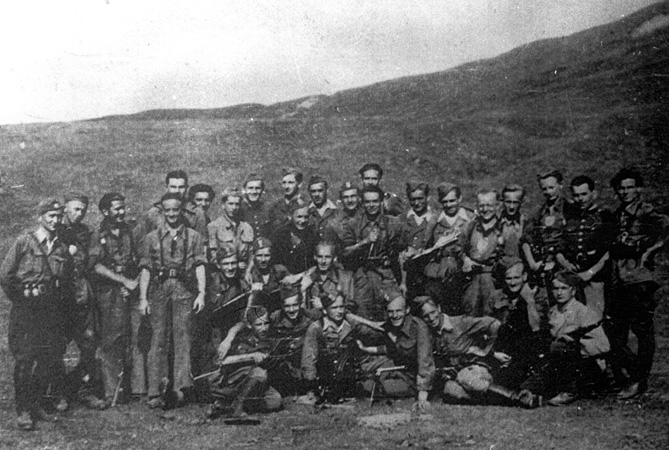
An AK unit along the Burza river, 1944
And at times the Communists and the Armia Krajowa fought each others more than the Nazis (and after World War 2, this would continue).

“But how will you fight tanks with rifles?” An AK unit on a captured German “Panther” tank, 1944.
But both managed to spare plenty of aggression for the Nazis; both movements caused immense damage to the Nazi war machine. The AK in particular focused on attacking the road and rail grid through Poland, which connected the German industrial heartland with the war front in Russia. It’s estimated that an 1/8 of all German trains through Poland were either destroyed or severely delayed – and that transferred into shortages of ammunition, food, and troops at the front as the brutal meatgrinder of the Eastern Front dragged on toward its fourth unprecedently bloody year.
Opportunity: But seventy years ago, the tide of war had turned. Stalingrad had fallen over a year earlier; the last major German attack at Kursk had failed, and the German front in Russia was collapsing ever more rapidly back on the Fatherland.
And as the Red Army moved into Poland, the Armia Krajowa readied its greatest operation; a revolt to eject the Germans from Warsaw, and welcome the Soviets as liberators.
Seventy years ago today, on August 1, 1944, the Armia Krajowa launched the Warsaw Uprising.
The story is told in the great detail it deserves in many places; suffice to say that the AK took much of the city, but failed to overrun several key German strongpoints, including the bridges over the Wisla river, or Mokotow airport, into which it had been hoped supplies could be flown from the USSR or even Britain.
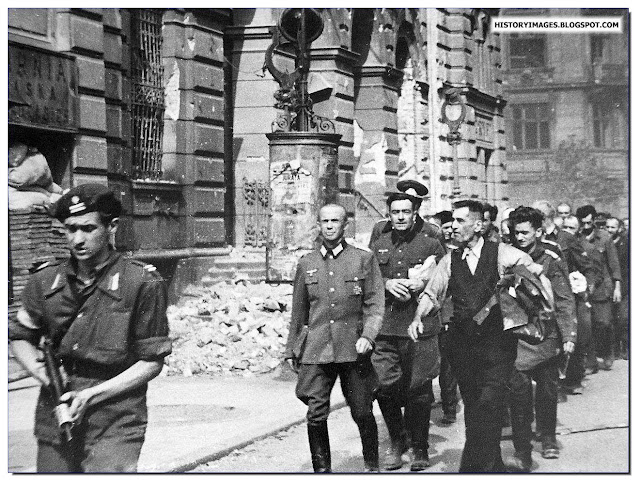
AK troops herding captured German troops into captivity. While the AK tried to act like the Geneva-Convention signing force that Poland had been, the SS massacred thousands of AK prisoners and innocent civilians.
Still, the AK – very well-armed for an underground force, with improvisations including a homemade armored car – controlled much of the city, and engaged the Nazis in what Heinrich Himmler called the most brutal street street fighting since Stalingrad. By the end of August, the Germans controlled the main strongpoints – and the Poles, most of the rest of the city.

An AK soldier with a captured German flamethrower.
All that remained was for the Soviets to drive the Germans out of the eastern suburbs, and cross the bridges over the Wisla.

AK troops, with captured German helmets as well as a German MG42 machine gun, during the Uprising.
Halt: But although the Soviets fought their way to the east bank of the Wisla by mid-September, they pressed the attacks slowly, allowing the Germans to blow the bridges connecting Warsaw with Praga, the main east-bank suburb.
And there, they halted.
And slowly, through attrition and supply exhaustion (despite an effort to airdrop supplies by British, US and Polish exile air forces flying from the UK), the Armia Krajowa was ground down, with about half the original 50,000 combatants escaping into the woods, leaving behind over 200,000 dead civilians – killed in the battle or murdered by Germans in wholesale lots, until even the SS realized it was only making the Poles fight harder – and nearly 10,000 dead Germans, and a city that was destroyed nearly to the last building.
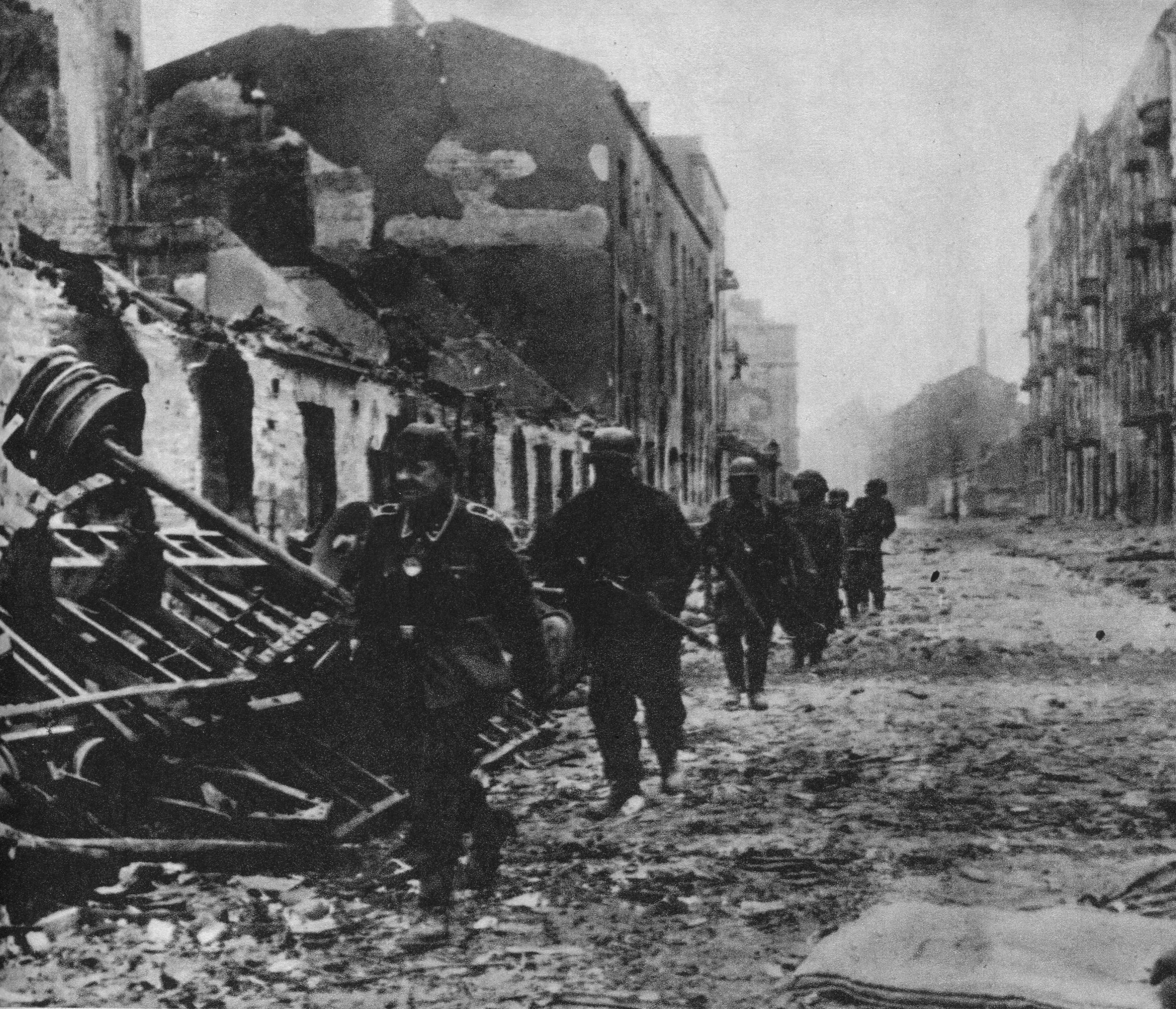
SS troops advancing through “Old Town”, the first major AK stronghold to fall. The SS – which included Russian POWs as well as ethnic Aryan Germans, all of whom hated the Poles – was especially brutal during the uprising.
Belatedly, the Soviets, under General Rokossovskii, allowed a number of Polish exile units fighting under the Soviet flag – “Berling’s Army” – to attempt to cross the Wisla; 5,000 casualties and no significant benefit resulted.
Of course, there had never been any intent to cross the Wisla and rescue the AK on Stalin’s part; the pause on the east bank was done entirely to allow the Germans to kill off as many conservatives, monarchists and western-aligned troops as possible, so that he’d not have to do it himself later. And the costly frittering-away of Berling’s Army? A bloody whittling-down of two forces the Russians needed cut down to size; uppity Poles in Soviet uniforms, and Germans.
When the Soviets finally took Warsaw and the rest of Poland, they installed a puppet government that lasted 45 more years. Many of the survivors of the Armia Krajowa fought on until the late forties, even the early fifties, killing communists long after all hope of relief from the West was gone.
I always thought the Polish Anthem should add a verse dedicated to the Warsaw Uprising.
After 12 years, this blog follows a fairly set schedule:
The purpose of today’s noon post is to let you know there won’t be a noon post today.
See you on the air tomorrow, and have a great weekend!
Back in the eighties, the first time I worked in Twin Cities radio, you could always tell when a station needed a publicity boost. There’d be an “incident” – a disk jockey would “say” something “objectionable”, or “insult” a “guest”, or some other shenanigan on the air, which would “lead” to a “suspension”, which would get all sorts of coverage from “news” people.
For example, back in the late eighties, “Cadillac Jack” at KDWB “insulted” British pop tart Kim Wilde on the air, and was “suspended” for a week. The Strib, the City Pages and the Twin Cities Reader all slurped up the “story” like puppies racing toward spilled hot dogs.
Of course, the “incident” was about as real as a pro wrestling match; it was a PR stunt coinciding with a jock’s planned vacation. In radio, then as much or more than now, if you actually screwed up for real you got unceremoniously fired, very very off the air. The number of such “incidents” that actually happen, spontaneously, in major-market radio is microscopic. How microsopic? The “real” incidents are practically legends in the radio business.
“Blaze” of “Glory”: Jason Lewis “quit” his afternoon-drive show on Genesis Communications (heard locally on AM1130 KTCN) yesterday. A monologue ended with a vow to “go Galt” and stop “feeding the Beast” – after which he stomped out of the studio. His producer vamped for a bit, and then, luckily, longtime Twin Cities talkradio journeyman Dan Conry just happened to be available to finish out the last half of Lewis’ show.
So I can be forgiven for having an eighties flashback, can’t I?
I don’t know much – I’ll be talking with people I know in the business over the weekend – but if I were a betting man (and I’m not) I’d bank on the following:
It’s savvy marketing, and it’s classic radio – the kind of thing the pasty-faced computer-programmers who dominate the industry today have forgotten how to do.
Lewis, in his day – his first hitch in Twin Cities radio, at KSTP back in the nineties through the early 2000s – was one of the fathers of modern Minnesota conservatism. There’s no overstating how vital he was in putting grassroots libertarian-conservatism on the Minnesota agenda during those years; had there been no Jason Lewis, conservatism would likely have remained a backroom aberration in the MNGOP for much longer than it did; the “moderate vs. conservative” battle would have stayed mired in the eighties for another decade or more. The Tea Party in Minnesota built on a basis of activism that Jason, more than any single person, established.
His first hitch? That was some heady stuff.
Changes: Lewis’ second stint – his return to KTCN and then Genesis, since the mid-late 2000s – was a little more subdued.
Lewis was different in his second go-around; the ebullient crusader for truth and justice was replaced by a hectoring professor who was always the smartest guy in the room and who made damn sure you knew it. He became less a party guy (although talk of him running for Senate kept circulating every election cycle) and more of an ideological libertarian-conservative.
And that’s not a criticism; it’s a perfectly valid character for a talk radio personality (see also Mark Levin), and not necessarily a bad idea in a talk market that had filled up with crusading everymen – including yours truly – since his first debut in the nineties. Although part of me thinks his second go-around would have been better with Joe Hanson producing him; Joe could cut anyone’s unnecessary pretensions off at the knees
The industry has changed a lot over the past 20 years, of course; the days of drive-time talk show hosts, even on small networks like Lewis’ 40-odd stations on Genesis, drawing low-to-mid six figure salaries were coming to a close (damn the luck).
I hope the next chapter in Jason’s media life is a good, rewarding one. I can’t imagine him “retiring” (or anyone else, these days, for that matter).
I remember during Jason’s time at KSTP, during my own long break from talk radio (1987 to 2004), listening to Lewis doing his thing as I drove home from work or tootled around town in a car full of kids doing my errands, pondering what life’d have been like had I stayed in radio, and thinking “that’s the host I always wanted to be when I grew up”.
And in my little one-day-a-week talk radio hobby, I guess that’s what I’ve been shooting for for the last ten years. To be a little like Jason.
Not exactly like Jason, of course. I make a lousy professor. But to be seen as someone who knows what he’s talking about, and who wants to convince the unconvinced, and wants to take my – our – political beliefs to the street and change things? That’s what I wanted. It’s what I shoot for.
And so I wish Jason all the best, and hope I haven’t heard the last of him.


You are currently browsing the Shot in the Dark weblog archives for August, 2014.


