Submitted WIthout Need For Comment
Friday, June 8th, 2012From Robert Earle Keen, one of the better singers you’ve never heard of:
From Robert Earle Keen, one of the better singers you’ve never heard of:
It’s been my theory for a few years now that there are things young “progressives” in liberal cesspools like Madison, Macalester and the U of M never really learn.
One of them is how to debate; since they all go straight from high school through their college years with no real challenges to their lefty preconceptions, they seem to have the debating skills of junior high kids.
Another? How to take a hit gracefully. When you have no concept of what it means not to be in power, you have no idea what even the most minimal adversity – losing a political campaign – feels like.
And you react like these icons of the progressive <i>id</i>:
I’ve met libs like “Thistle Petterson” in Saint Paul; so full of intellectual entitlement they can’t comprehend, much less live with, the notion that they don’t own the world politically.
I won’t say this video makes the whoooole thing worthwhile – but it is a nice mental after-dinner mint.
Output’s a little light today. I’ve had a lot going on outside of work, family and blogging.
But I would like to ask you a favor. Get out on Twitter and “Follow” Tony Hernandez’ Twitter account.
Tony’s running for Congress in Minnesota’s Fourth CD – my district, the district of Betty McCollum.
Conventional wisdom has it that it just can’t be done.
Of course, conventional wisdom also had it that Jim Oberstar was untouchable, Obama would keep unemployment under 8%, and that the Wisconsin Recall was a “coin toss”, so you’re better off spending your time going to Tony’s Twitter feed and clicking “Follow” than you are paying any attention to “conventional wisdom”.
Tony’s a solid, small-government, low-taxes, family-values conservative, a second-generation American, with no freaking hyphens, and would be a much, much better Representative than Betty McCollum, for a district that direly needs some common sense in government at all levels.
So please follow his Twitter account – and if you’re so inclined, maybe peel off a buck or two, and maybe sign up to volunteer to help the campaign.
The 4th CD needs this. And all you gotta do, for now, is follow!
The Star/Tribune editorial board, being in effect a volunteer DFL PR operation, got to work bright and early yesterday doing damage control and trying to build a firebreak against the Republican contagion across the Saint Croix in an editorial that couldn’t be any more perfect a vehicle for national Democrat chanting points if it were being explicitly paid for.

Within minutes of projecting Gov. Scott Walker the winner in Tuesday’s Wisconsin recall election, CNN pundits began earnestly overstating the national importance of the vote.
And someone start singing “The Circle Of Life”, because the left-leaning media – the various levels in the Public Radio chain of command, MSNBC, CNN and of course the Strib itself – leapt into action to understate and diffuse it.
It was an understandable impulse, given the high profile of the attempted recall over the past 17 months. Energized Wisconsin Democrats and an outraged organized labor threw everything they could muster at the Republican governor, who earned their ire last year by moving to curtail collective-bargaining rights for public employees.
But a closer look at the factors that propelled Walker tells us that caution is in order when projecting national implications from his decisive win.
And when they say “closer look”, they really mean “a realignment of the narrative to the Democrats’ chanting points”.
Let’s start with money. Out-of state cash poured into Wisconsin as if the Packers had offered more souvenir stock, and Walker outspent his opponent, Milwaukee Mayor Tom Barrett, 7-1. Mitt Romney’s campaign won’t have that kind of advantage in November, nor will other GOP contenders in hotly contested races.
Nor did Walker. The 7-1 advantage was in spending by the campaigns – perfectly kosher under Wisconsin campaign law in recalls, which aren’t covered by the same limits as regular elections. And it doesn’t count all the spending the unions did on Walker’s behalf. It also ignores – or rather, tries to suppress – the fact that Walker had vastly more support from non-insitutional donors inside Wisconsin than Barrett had.
Walker also faced a middling opponent. Barrett, who wasn’t the first choice of organized labor in the primary, was the recycled loser from the 2010 gubernatorial race.
His second campaign gained so little momentum that President Obama stayed away from Wisconsin, and the president’s single contribution to the Barrett effort was a 17-word tweet.
Blame Bush.
Before discounting the impact labor will have in November, however, it’s worth noting that unions won a major victory in Ohio just seven months ago, when voters resoundingly rejected similar collective-bargaining changes backed by GOP Gov. John Kasich.
Because it was a referendum, because the unions poured money into Ohio, and the GOP wasn’t able to support the proposal as vigorously as it needed to be supported. The Strib is trying to compare apples and axles. There’s no comparison.
The recall attempt itself also skewed Tuesday’s results in Walker’s favor. Exit polls showed that 60 percent of voters agree with this editorial board (“Wrongheaded recall in Wisconsin,” June 3) that recall elections should be reserved for cases of significant malfeasance or criminal misconduct by elected officials. They should be the direct-democracy equivalent of impeachment, not a minority party’s response to a hard-fought policy dispute.
And if ifs, ands and buts were candy and nuts we’d all have a merry Christmas. The fact remains the Wisconsin Democrat party has responded to Walker’s upset victory by petulantly hiding out in Illinois, by clogging the Capitol, and by trying to stage an electoral putsch.
Those same polls show that Wisconsin voters would have chosen Obama over Romney, 51 percent to 45 percent.
Those were the self-same exit polls that showed the Gubernatorial race was a “coin toss”. Take them with a big shaker full of salt.
And other recall efforts appear to have given Democrats narrow control of the state’s Senate.
Which doesn’t meet until 2013. After the next round of elections. It was a very expensive and meaningless “victory” for the Wisconsin Democrat party.
Those results, too, ought to tamp down GOP victory swells;
Or at least the Strib editorial board is going to try to make sure they do.
Some of them were touting Walker as a future national Republican candidate after Tuesday’s win. Let him prove first that he can cease being the nation’s most polarizing governor and work effectively with both parties for the good of his state. Only then will he warrant the acclaim that was heaped on his victory this week.
He’s a “polarizing governor” precisely because of the petulant reaction Democrats – like the Star/Tribune editorial board – have to the idea of their power, either direct power or the soft authoritarianism of “bipartisanship” that favors Democrats, being challenged.
And the Strib will do what it can to keep Republicans demoralized, downtrodden, and – most of all – home on election night.
Screw the Strib. I’m celebrating.
…last night when, after a full day of “it’s gonna be a coin-toss!” chanting from the media and leftybots (pardon the redundancy), MPR threw to Wisconsin Public Radio (WPR) at 9PM…
…just as NBC, Fox and the AP all more or less simultaneously called the election for Walker as returns showed it wasn’t even going to be close.
And the WPR hosts sounded…crestfallen? Morose? On suicide watch? Big gaps of dead air ensued. the kind of thing that you only hear on Public Radio when things aren’t going according to “The Plan”. The hostess – her name eludes me at the moment, so let’s just call her Greta Leftmeyer – sounded subdued in the kind of way you do when you don’t want to cry. Or that’s how I heard it, anyway.
And Public Radio at all levels – WPR, NPR and “No Rant, No Slant” MPR – have been working overtime to keep Democrats off the suicide watch all day. Notice how few Public or mainstream media operations will refer to Walker beating or defeating Barrett (as he most assuredly did). Their headlines and on-air ledes invariably (!) say Walker “avoided being recalled”, as if it was some closely-decided question, and that that “decisive repudiation of the Democrat, Media and Union petulant push for a mid-cycle putsch” thing never happened. Winston.
The lefty noise machine is already busy trying to rewrite yesterday, to keep the dream alive in the minds of the low-information voters that are the Democrat party’s main demographic.
And the other words you never hear (along with “Defeat”, “Repudiation”, “Crush” or “Ass-Whooping”) is “Tea Party”. Last night was most assuredly proof that the rumors of the Tea Party’s demise were not only premature, they were deception and wishful thinking. The Tea Party is, if anything, much more potent a force than it was three years ago. Back then, it was about carrying signs. Today, it’s about turning low-information voters into smart voters (ergo conservatives) and moving them to the polls.
And the media will softpedal that with all their might.
And, increasingly, they’ll lose.
And that’s a great thing for America.
Sixty-eight years ago at about this time, American, British and Canadian soldiers, supported by the full weight of America’s industrial might, stormed ashore in Normandy to begin the liberation of Europe.
And for that first day – the near-debacle at Omaha, the fierce knife-range duel between the ships and the German shore guns, the Canadians’ brutal house-by-house advance off Juno Beach – the fact was that for all of America’s vast industrial might, the real arbiter of victory, and of the future of Western civilization, was the GI, the Tommy, the Jock, the Canuck, spurred on only by training and fear and guts and the skirl of Lord Lovat’s bagpiper. It was they – not the wealth and the industry and the sheer firepower…
…who earned that victory, the first domino on the road to the liberation of the Old World.
———-
Yesterday, for all of the GOP PAC money that was poured into Wisconsin (enabled by the Wisconsin Democrats’ stupid decision to try to negate the elections of 2010, which in turn nullified applicable campaign finance laws), the victory similarly belonged to a few million Republicans – and not a few Democrats who had just plain had enough of childish petulance of the Wisconsin Unions and the party they seem to own.
It’d be specious to compare the courage of someone charging off a Higgins boat with someone going to the polls – which is, indeed, just exactly what the kid on that Higgins boat 68 years ago today was fighting for, so that voting need not be a life or death issue in this country. (But it’s for sure some dim-bulb leftyblogger will claim that I’m making that comparison. Mark my words. That’s why I’m writing this here; I’ll mock them in advance).
But as a hard-fought first step toward this nation correction not just one mistake, Barack Obama’s misguided election, but indeed generations of mistakes that led the world’s wealthiest and most powerful significant nation into being a debtor state? This is huge.
As Walker said, it‘s time for leaders who will make the tough choices, and fight for them.
Are you listening, Minnesota GOP Legislative caucus?
Are you listening, Mitt Romney?

Smiling, because it's not his problem anymore
The IP continues its independence from political relevance.
Since “shocking the world” in 1998, the Independence/Reform Party of Minnesota has increasingly moved into, at best, spoiler candidacy territory. And with the close of registration for 2012 candidates in Minnesota, the spoiler party looks more than ever to be officially spoiled.
From the party’s high-water mark of 47 candidates for statewide and legislative office in 2002 (an election that included the IP’s only other election victory with St. Sen. Sheila Kiscaden), the Independence Party has seen a slow drip both in terms of quantity and quality of their candidates. From 23 total candidates in 2006, to 13 in 2008 (not exactly fair to compare since fewer offices were up for election), the IP looked barren. An uptick in 2010 saw 25 candidates – but the IP couldn’t even field a full slate of statewide candidates and most of the increase came from quixotic congressional bids.
With both chambers of the legislature up for re-election and a U.S. Senate seat on the line, what did the Independence Party field for 2012? 15 candidates total (actually 16, but two are competing in a US Senate primary). Considering the number of offices on the ballot, it’s the worst recruitment class for the IP since obtaining majority party status. It’s even smaller than their 20 candidate class of 1998 – when James Janos was considered a novelty act, not the leader of a political party.
Perhaps Mitch was right three years ago to call the IP “the thing that wouldn’t leave.”
It’s not hard to understand why the IP is increasingly unable to recruit candidates. In the now nearly 14 years since Jesse Ventura’s upset victory, the party not only has no other significant victory but adamantly remains a political rorschach. The IP’s solutions on most of the pressing issues remain vague as the party’s organizing principle continues to be “we’re not the other guys.”
In fairness, though, it’s typically not the party infrastructure’s responsibility to define issues – that’s the job of activists and candidates. But at its core, the IP has become a warming house for policy wonks – thinkers who want to tinker with state government. A think tank that caucuses is noble in spirit but completely impractical in execution, or in ability to win elections.
For 14 years, the IP/Reform Party has refused to do the necessary grassroots work of basic party building. Instead of recruiting city councilmen, school board officials or county commissioners to run, the IP has tried (and tried and tried) to recapture lightning in a bottle. Armed with little infrastructure but state subsidies, it’s not hard to see the IP’s future.
If the Ron Paul Brigades could over-run the GOP, it wouldn’t be hard for the same faction (or a similar one) to do the same to the Independence Party. In fact, it could have happened two years ago had Joe Repya stayed in his IP campaign for governor. Depending on what internal blood-letting may occur in the Grand Old Party post November as the Paul legions either dissipate or make camp, a libertarian or conservative take-over of the IP may be merely two years in the waiting.
To the victor will go the spoils – or in this case, a $348,000 check from the State of Minnesota to the party’s gubernatorial candidate.
Scott Walker, and America – real America – win.
It’s not even close. As this is written, it’s 58-42, with 52% reporting.
It brought things to mind:
Lament!
And the Democrats, with their plutocrat supporters and smug union leader fatcat commissars gathering around them, have to know that this is not a good omen for the fall.
Because this was a victory for regular private sector working people – the backbone of this economy.
This was a victory for the Tea Party – which has moved from carrying signs to working at the grass roots and winning elections.
This was a victory for conservatism.
The Democrats would have you believe this was a victory for money. Of course, money always wins elections; that’s why Michael Huffington and John Corzine are sitting in office today.
No. This was a victory for the people; for real America.
And we’re not done.
The Tony Hernandez campaign is holding its Taco Party fundraiser.
It’s $30 per adult for homemade tacos and beer (for those over 21, naturally).
It’s from 5:30-7:30 this evening. Details are available at the Hernandez Campaign website.
Jeff Rosenberg from MNPublius has sent an “Open Letter To Amy Klobuchar” that explains, if nothing else, how little DFLers really understand about their “Senior Senator”:
Congratulations on your endorsement by the DFL this weekend, and on what looks to be a relatively easy re-election bid.
(As a side note? Look for a lot of “bandwagon”-mongering from the DFL and the media (pardon, as always, the redundancy). Research shows that if you can create a sense in your opponents’ minds that voting is fruitless, they won’t do it. They may never say that that’s why the “Minnesota” and “HHH” polls released right before election day are so inevitably, grossly, comically inaccurate in favor of the DFL, especially for close elections – but it’s difficult to see how they’d do it any different if if were utterly deliberate).
But I digress:
You’re the most popular politician in the state by a wide margin, and in your single term as a Senator so far, you’ve built up quite a bit of political capital.
I’m writing to ask you to invest some of that political capital in making positive change here in Minnesota in 2012. Notice that I’m not asking you to “spend” your political capital, but “invest” it.
Because “invest” is always the euphemism DFLers have for “squander on something I’d like someone else to pay for”.
But, again, I digress:
With a bit of work, you’ll make it back with hefty interest, making you not just the most popular but one of the most powerful politicians in the state. What is political power but the ability to affect change?
It is that, plus many, many other things; the ability to provide for ones’ special interest (“change” be damned) is a key one for DFLers. In fact, that’d seem to be the main thing A-Klo does with it…
…dammit, I just keep on disgressing!
That’s why I’m asking you to devote a portion of your time and energy this year to fighting the harmful constitutional amendments on the ballot this year and returning the DFL to power in the state legislature. Your overwhelming popularity gives you significant influence with swing voters, and your fundraising prowess could transform marginal seats in the legislature into major opportunities. Your involvement could mean the difference between winning and losing all of these fights.
Interesting theory – but let’s set a few things straight.
A-Klo isn’t so much “popular” as she is “not unpopular”. She’s cautious. She’s taken the popularity she started with – as the daughter of a Twin Cities media icon and some time as a prominent and media-savvy if not especially effective county attorney – and husbanded it carefully. She takes no positions that will anger enough Minnesotans to hamper her polling – and counts on her Praetorian Guard in the Twin Cities media to mute any coverage of those things that she has to do to not get thrown out of the caucus locker room back in DC.
For example – Klobuchar supported the Medical Device Tax, which is going to flense and gut Minnesota’s Medical Device industry, one of our great growth industries – but it got less coverage in the Strib than the Wayzata Middle School girls volleyball game.
I know your popularity is built, in large part, on your efforts to be a bipartisan figure, so you may want to stay “above the fray.”
Heh.
But what is the point of amassing this level of support if you can’t use it to make a difference?
Because if you “make a difference” in a way that blows that “support” sky high – or erodes it to the point where one has to work especially hard to retain ones power – then it was all as if nothing happened.
And here’s Klobama’s problem; she can read polls. She can see that Minnesotans, even the liberal ones, overwhelmingly support Voter ID, and that the Marriage Amendment’s internal numbers, while lower, lead to an issue so fraught that even the mighty Obama has to “oppose” it in the weakest way possible.
And she knows that her popularity is a mile wide – look at those numbers! – but an inch deep, a product of name recognition and six years of carefully-cultivated and media-guarded innocuity. And a good way to blow all that is to come out against an issue most Minnesotans are definitively for.
It’s the same reason Paul Wellstone – he, the patron saint of Minnesota “progressivism” and the “1” in countless 99-1 Senate votes – supported the Defense of Marriage Act. Because he knew all of his “popularity” and “power” could go out the window with one badly-timed position on an emotional issue in an election year.
Just as A-Klo does.
You’ve earned the trust of millions of Minnesotans, but that trust has little value if you can’t or won’t use it to advance a positive agenda.
And there’s the conundrum, for a thinking liberal (and let’s say they do in fact exist, because they do); A-Klo is popular and powerful – but that popularlity and power is, I suggest, predicated on keeping hands off of the issues that progressives most want.
And this in an election year when Barack Obama’s going to have all the “coattails” of a T-shirt.
Senator Klobuchar, I hope 2012 will be a year of great triumph for you. I hope it will be the year you win re-election by an overwhelming margin — and the year your coattails mean victory in the legislature and on the constitutional amendments.
Yeah, good luck with that.
(Anyone but me think that Rosenberg’s post sounded like a prayer of supplication?)
Joe Doakes of Como Park writes:
Yesterday, the Pioneer Press reprinted a long Washington Post article (front page, above-the-fold, continued to page 3A) called Cash Versus Door Knocking.
Plucky under-funded Democrat Barnett and his earnest crew of ordinary citizens gamely soldiering against an entrenched establishment Governor Walker buying the election with dump-truck loads of cash from out-of-state fat cats.
Of course, if the national Democrats and unions who started this fight had delivered on their promises, the money advantage would have been evidence of a sweeping groundswell of popular support and proof the Governor should resign now to save the taxpayers the cost of his recall.
Almost as if the articles are written to fit the conclusion rather than the facts.
Joe Doakes
Como Park
It’s hilarious that the WaPo and PiPress would have you believe that the unions are a bunch of scruffy underdogs.
Connie Doepke filed to challenge Dave Osmek in the primary for the SD33 Senate race.
At the SD33 convention two weeks ago Osmek, a conservative with 11 years’ experience on the Mound city council – beat Doepke, a GOP representative who left an extremely safe House seat to campaign for Gen Olson’s old Senate seat, after voting for the stadium and the New Generation Energy Act, to say nothing of supporting light rail. Osmek won with over 80% of the delegate vote, after Bonn Clayton committed his delegates to Osmek on the fourth ballot (the battle had been between him and Osmek – Doepke never got out of the twenties).
If you live in SD33, and want the GOP majority to be something other than a lapdog for Lori Sturdevant and Zygi Wilf, you need to turn out to help Dave.
For that matter, if you live in the western subs – usually safe territory for the GOP – you need to find the time to help Dave. IF you live in:
Your district is probably safe enough to peel off a few bucks and some shoe leather for Dave. He needs volunteers – and of course, money. While Dave will get support from the party, Doepke can count on plenty of help from the likes of the TwinWest Chamber of Commerce, which like most Chambers of Commerce is perfectly happy to throw aside sound principle to get someone else to pay for their trans and stadiums and other goodies.
So the choice is yours, Mound/Minnetrista/Lake Minnetonka; does your party reflect you, the activists? Or does it reflect those who’d suck up to Zygi Wilf and the Strib?
Your choice is clear, and your time is now.
If you read enough history, you eventually realize that history, especially the history of warfare, is less a matter of “who makes the best plan”, and more “who comes reacts best to and endless series of unplanned errors, mistakes and unforeseeable twists of fate?”
It was seventy years ago today and tomorrow that one of the most important battles in Western civilization was being decided. At about this time (after allowing for time zones), two days of furtive maneuvering about tens of thousands of square miles of ocean led to 90 minutes of frantic back-and-forth air strikes on the morning of June 5, a series of battles that began at dawn and were substantially over by 2PM. And the results were largely the confluence of a long series of strokes of luck, caprice and erroneous decisions – good and bad.
Today is the seventieth anniversary of the pivotal moment in the Battle of Midway. The battle has been seen as the turning point in the war in the Pacific – and it’s an accurate perception. Since the beginning of the war, the Japanese had been running the table; after wiping out the US battleship fleet at Pearl Harbor, they’d taken Hong Kong, Malaysia, Wake Island, Guam, and finally the huge US colony in the Philippines and the equally important British base in Singapore; they sank a pair of British battleships (HMS Prince of Wales and Repulse) on their way to assist Singapore, and followed up by destroying virtually the entire Dutch fleet, along with most of the supporting British, Australian and American units, in the Battle of The Java Sea, while conquering Indonesia and its immense oil and rubber reserves. They’d raided as far afield as Sri Lanka and Darwin, Australia.
Then, a month ago, at the Battle of the Coral Sea, they’d won a tactical victory over the US and Australians – sinking the carrier Lexington, and damaging the USS Yorktown badly enough to keep it in dry dock for three months, leaving the US with only two functional carriers, Hornet and Enterprise, in the whole Pacific (and five in the whole world – Wasp and Ranger, both of whom were regarded even then as failed design experiments, were still in the Atlanticm and Saratoga was undergoing maintenance in San Francisco).
Hornet and Enterprise had just returned from the “Doolittle Raid“, launching 16 Army bombers on a pinprick raid on Tokyo and Kyoto, which had no military effect but immense, intense moral impact on Japan, especially its leadership. If American bombers could reach Tokyo – even via extraordinary means like the Doolittle Raid – then drastic action was needed to shore up the home islands’ defenses.
WIth this in mind – as well as to deny the Americans a key base for patrolling the Central Pacific – the Japanese planned to seize Midway Island, so named because it was halfway between Hawaii and Tokyo. It would secure much of the vast ocean waste from American reconnaissance, making it easy to conquer Fiji and Samoa and close up the last remaining gap in the Home Islands’ outer ring of defenses. Most importantly to Admiral Isoroku Yamamoto, the planner of the Pearl Harbor raid and many of the other successes of the previous six months, it would lure the surviving American aircraft carriers – two, he thought, Hornet and Enterprise – out for a fight at 2:1 odds.

IJN Kaga, Japan's first large aircraft carrier. Like the USS Lexington and Saratoga, Kaga was a converted battleship, and in its day was the most powerful aircraft carrier afloat. A veteran of Pearl Harbor and the battles afterward.
The US Navy had, of course, broken the Japanese Navy’s codes, and knew of the operation long enough in advance to order the three months of work on Yorktown to be completed in there days (we covered that here) and to move the three carriers out to a place in the Pacific from where they could try to ambush the Japanese.
Less well-known? The Japanese, worried about security, had actually ordered a change in code-books, which would take the US Navy some time to re-break. But the change didn’t go into effect until the beginning of June – enough time for the USN to get all the information it needed.
The Japanese were hampered by their own bureaucracy and doctrine. They’d had two of their newest carriers – Shokaku and Zuikaku – badly damaged at Coral Sea. Shokaku was out for three months – and unlike Yorktown, out for three months it stayed. And Zuikaku‘s air group had been so badly mauled at Coral Sea that it would take a few months to bring in and train up replacements…
…which was also a problem for Yorktown – but its air group was brought up to strength by borrowing squadrons from the USS Saratoga, which was refitting in San Francisco. Zuikaku could have done much the same – but Japanese doctrine at the time was to keep ships and their air groups together. It’d cost them.
But beyond doctrinal differences and top-secret technological prowess and the foibles of leaders and nations, the Battle of Midway was decided as much by three ill-timed bits of fortune – good or bad, depending on your point of view – that had relatively little to do with the battle itself.
Oceanfront Real Estate – Now, in those days before satellites and drones and over-the-horizon radar, the biggest problem was finding the enemy. And that meant hundreds, thousands of hours spent crisscrossing the Pacific in search planes – long-ranged land-based bombers and, especially, “Seaplanes” or “Flying Boats”. Almost unknown today, flying boats – which could land on water – were the key to patrolling most of the Pacific at the time.

An American PBY "Catalina" flying boat. This clumsy-looking plane was among the most important of all in World War II; it, more than any other, was the "eyes of the fleet" for the US and British navies. A Catalina caught the first whiff of the Japanese fleet at Midway - and many other battles.
One of the reasons the Japanese were able to so precisely pinpoint the US fleet at Pearl Harbor was that they had set up a “flying boat” base at a bare, uninhabited coral atoll and rock called “French Frigate Shoals”, from which their “flying boats” could reconnoiter Pearl Harbor. Refueled from Japanese submarines who waited in the lagoon, the flying boats gave the Japanese a very up-to-date picture of what was at the base before the attack.

Aerial view of the main island ("Tern Island") of French Frigate Shoals. The airfield happened later in the war. The island is inhabited by birds and researchers.
They then frittered that advantage away by launching a series of pinprick bombing raids from the Shoals, causing the US Navy to send a small squadron of destroyers and a few “Seaplane Tenders” – squat little ships with none of the glamor of the aircraft carrier or dash of the destroyers or cruisers – whose job was to serve as a floating base for US flying boats.
And so when the Japanese submarines returned to the Shoals to set up the base again, they found the harbor full of US ships and aircraft. They aborted the mission – leaving Yamamoto blind, with no idea what US units were in or near Pearl Harbor and – due to the radio silence he’d ordered – no idea that that part of the plan had gone awry – and worst of all, no scout planes crisscrossing the Central Pacific looking for the American carriers.
The Right And Wrong Places At The Right And Wrong Time – The Japanese had attacked Midway the previous day, and had shredded the defending Army and Marine aircraft. There had been several rounds of counterattacks – US Army and Marine planes from Midway finding and trying to attack the Japanese carriers, without effect, but more or less fixing the Japanese position for airstrikes launched from the American carriers, which, unknown to the Japanese, were lurking within range.
It’s here that timing intersected with doctrine – or as people in business or politics call it, “policy”.
It was American practice to launch airstrikes as soon as possible and send them on their way; minutes were precious and irrecoverable when a strike or counterstrike ending in a ten-minute air raid was all that separated your fleet from disaster. The American carriers launched as soon as they could, each carrier’s air groups proceeding toward the best guess they had of where the Japanese fleet lay – with the torpedo bombers flying low, and the dive bombers up high…
…and, due to a math error, flying on the wrong course, getting separated from the torpedo planes below.
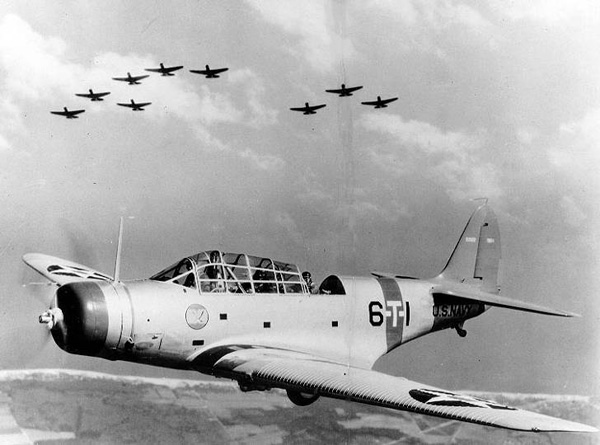
A Douglas TBD "Devastator" torpedo bomber. Obsolete, underpowered and almost unarmed, it was further hampered by the fact that US torpedoes, early in the war, had a habit of not blowing up when they hit targets. Of 41 Devastators to attempt attacks at Midway, only four returned to their ships - a 90% casualty rate in ninety minutes.
And so the torpedo bombers went in to attack, unescorted, flying low and slow (so the torpedoes would work), and they got mowed down; every single plane in Hornet’s “Torpedo Squadron Eight” was shot down by the defending Japanese fighters; only one man, Ensign George Gay, survived, floating under a seat cushion.

Ensign George Gay (right), the sole survivor of the 45 pilots, bombardiers and gunners of Torpedo Squadron Eight, from Hornet. Shot down by a Japanese fighter, he floated under a seat cushion, watching the first three carriers get hit and set ablaze. He was picked up by a Catalina the next day. He spent 30 years as a pilot for TWA He passed away in 1994, and had his ashes scattered over the same piece of water where he'd floated, and his squadronmates had died.
The dive bombers, who had started their flight on the wrong course, found nothing…
…but the wake of a Japanese destroyer, three miles below, that had diverted to try to attack an American submarine, and was returning to the fleet at top speed. The dive bombers followed the destroyer’s course, and arrived over the Japanese fleet…

IJN Arashio. The destroyer had spent the morning trying to depth-charge the submarine USS Nautilus. It failed, and was returning to rejoin the fleet when Lt. Commander McClusky's dive bombers saw its wake from three miles up. Lost and out of ideas and, nearly, fuel, they turned to match Arashio's course - and found the carriers.
…as the torpedo bombers were being slaughtered. Which, as it happened, had drawn all of the defending Japanese fighters down to nearly ocean level, unable to respond as the dive bombers tipped over and began their attacks almost completely unmolested.
Indecision – The Japanese, on the other hand, had a policy of only sending complete strikes. The Japanese admiral – Chuichi Nagumo, who commanded the carrier fleet as Yamamoto’s subordinate – had two missions on his plate; bombard Midway (the scheduled invasion was two days away), and sink the carriers (without which the invasion was a moot point). Each mission required his planes to carry different weapons; his torpedo bombers would carry bombs to attack land targets; his dive bombers would carry armor-piercing bombs to attack ships.
And Nagumo had just changed his mind, switching from attacking Midway to going after the carriers, and ordered his planes to begin the one-hour re-arming process as the American air raid closed in – a Japanese search plane found the American carriers just about the time they were launching their air strikes.
And so the decks of the Japanese carriers were piled high with bombs and torpedoes as the Americans closed in.
The Japanese carriers, all veterans of Pearl Harbor, were a mixed bag; Kaga and Nagumo’s flagship Akagi were old converted battleships (like the American Lexington and Saratoga), big ships with some serious design weaknesses. But Hiryu and Soryu were newer ships, designed largely according to British design practices, including armored hangars capable of withstanding some damage (unlike the American carriers, whose flight decks were wood and whose hangar decks were largely open). In theory, the Japanese carriers were tougher propositions for a bomber than were the US ships.
But the Japanese Navy had never really emphasized damage control, or damage prevention – which would plague them for the entire war. And in any case, having decks piled high with bombs, torpedoes and criss-crossed with hoses full of aviation fuel, and with flight and hangar decks lined with airplanes full of fuel and carrying explosives, would make any damage a dicey proposition.

Artist' rendition of a Douglass "Dauntless" dive bomber pulling out of its dive by a blazing IJN "AkagI".
And so instead of attacking ships buttoned up for action, with explosives stowed under armor and gas lines drained, the US dive bombers attacked ships that were practically rigged to explode.
And when the bombs hit – four on Kaga, three each on Soryu and Akagi. The hits set off chain-reaction explosions on the fueled and armed planes, which also detonated the stacks of bombs and torpedoes, dooming the three ships.

A Douglass SBD3 "Dauntless" Dive Bomber - the hero of the battle - after landing on Yorktown after bombing Kaga. Note the damage to the rear "elevator" fins.
The battle went on for two more days, officially – but it was all decided seventy years ago today. Two waves of Japanese counterattacks from Hiryu, the lone surviving carrier, crippled Yorktown, which was sunk the next day by a Japanese submarine. Follow-ups from Enterprise and Hornet finished off Hiryu that afternoon.

IJN Hiryu, the last carrier afloat, ablaze after being set afire later in the afternoon on June 5. It would be sunk later by a Japanese destoyer.
Four of the six Pearl Harbor carriers, and the elite of the Japanese carrier air force, was wiped out in a matter of hours. The Japanese Navy would never again carry out an offensive action during the war. The full weight of America’s industrial might would come to bear in the next year and a half, as the US would commission 24 aircraft carriers to replace the two they’d lost (and the two more they’d lose in the coming year – of which more later).
The lesson?
In war, as in so many areas of life, it’s not so much who has the best plan, the best process or the best equipment so much as the one that can react fastest, and best, to a fluid, confusing and changing situation.
Steve “Spotty” Timmer, writing in “MNLeft”, yet another lefty group blog:

“They Put The Phyrric Into Victory”
Perhaps they – Craig Westover and Jason Lewis,the subjects of Timmer’s piece – disagree with Timmer about the current GOP Senator race, but Steve Timmer is the one who put “Phyrric” into “victory”…
…which, for those of us who even passed remedial history, is spelled “Pyrrhic Victory“, after King Pyrrhus of Epirus, who, on noting the casualties he’d taken defeating the Romans at the Battle of Asculum in 280 BC, lamented (according to Plutarch) that “more such victories would undo him”.
Just keep chanting; “they’re the smart ones. They’re the smart ones”.
Chant. You heard me.
Oh, yeah – they think Kurt Bills hasn’t a chance. Maybe they’re right.
The voters – the live, legal ones that the GOP tends to draw – haven’t actually spoken on that yet.
It could well be that A-Klo can eke out a…
…no. I can’t go there. Too cheap.
UPDATE: They edited it. And it’s still wrong.

Remember – Democrats are smart. Republicans – they’re stupid! Stupid and ignorant! Yepper!
UPDATE 2: Third try’s the charm.
And, Steve, I’m working these days. You?
I’m supporting Tony Hernandez for US House in CD4.
Someone asked me “what is it you’re trying to accomplish by campaigning against long-time incumbent Betty McCollum” Are you just trying to move the needle? Force the DFL to spend money on McCollum so they can’t spend it against Bachmann, Kline, Paulsen and Cravaack?
No.
I mean, yes – all of that. But that’s all vastly subsidiary to the real goal. And that real goal isn’t “vanquishing Betty McCollum” – although driving her from office in a humiliating defeat this fall, sending her back to work as a receptionist at Alliance For A Better Minnesota, would be a great start.
No, my goal is this: Within ten years, I want the DFL to be the minority party in Saint Paul. I want the children of today’s DFLers to mock, taunt and revile their elders for their depraved short-sightedness in ever having backed such a addlepated party, a party that played such a pivotal role in trying to leave them in generations of debt. In 2022, I want Democrats to quietly soft-pedal their party endorsement, lest they be pelted with rocks and garbage from a community that regards them as the petty authoritarians they actually are.
In short, I don’t want to just beat the DFL; I want to begin (or continue) an arc at the end of which is the complete extinction of – not the DFL, really, but the entire idea of “progressivism” as they practice it – the thinly-veiled authoritarianism of the centralized, bureaucratic, interventionist government (and if it’s a dead issue here, really, where will they be viable?).
Any questions?
Dallas Pierson – who, his roving camera and excellent vid-blog “MNCD4 Conservative” may be one of the better journalists in the Twin Cities alternative media – happened by the DFL convention in Rochester over the weekend.
And what he saw boggled the mind.
The DFL was proposing a rule change allowing absentee balloting for presidential straw polls.
Rick Varco – a DFL activist from Highland Park and part of St. Paul’s DFL machine – objected:
Varco:
I’m against this for three reasons. One, I don’t believe the Central Committee can come up with any mechanism that will genuinely prevent anyone from printing up a stack of absentee ballots, submitting, them, and submitting them for a presidential candidate.
Got that? The sanctity of the DFL’s straw polls – the meaningless non-binding votes for President held on precinct caucus night – demands the sort of scrutiny…
…that are racist and exclusionary for general elections?
Chuck Repke – the fellow who in 2007 demanded that Tim Pawlenty be tried for intentional homicide for the 35W bridge collapse – followed up:
Your are opening yourself up for absolute insanityy = the potential exists for someone from Citizens United to pack our caucuses with bought and paid for ballots! There is no way to protect that, because we allow anyone to attend a caucus! We would then have to allow any ballot at the caucus, no matter which Koch brother paid for it!
But, apparently, not ACORN or George Soros.
It’s touching, the concern the DFL has for the sanctity of their internal elections leading to their meaningless endorsement. Now, if only they had the same care for the state’s electoral system.
Listen. You might be tempted to laugh – until you realize that they are trying to prevent precisely what their party does to our general elections.
Here’s the website for Scott Walker’s campaign in the recall election. If you can help out in any way possible, by all means do…
Here’s my story on the Milton, Wisconsin school board case.
Today, the Northern Alliance Radio Network – America’s first grass-roots talkradio show – brings you the best in Minnesota conservatism, as the Twin Cities media’s sole source of honesty!
(All times Central)
So tune in to all six hours of the Northern Alliance Radio Network, the Twin Cities’ media’s sole guardians of honest news. You have so many options:
Join us!
It’s a bit of a whack upside the head to see that George Chapple – better known as “Dark Star” – has passed away:
Chapple grew up in Ohio and Long Island, NY. He was a Vietnam veteran, and originally came to the Twin Cities with his parents in the 1970s.
After dabbling in the auto business, Chapple became known to radio listeners in the 1980s via Steve Cannon’s WCCO Radio show where he handicapped horse races at the newly-opened Canterbury Downs (later renamed Canterbury Park).
Before that, though, he was a regular caller on sportstalk shows all over the Twin Cities, including KSTP when I was there in the mid-eighties.
The brief Strib obit skips past what was a convoluted and almost comical path to sports-radio celebrity. When I first met Dark, he was hosting a cable-access handicapping show at Canterbury Downs, in the next press booth over from the KSTP Sportstalk show I was producing. I ran into him again in…er, 1988? He and, of all people, Mike Gelfand were hosting an evening sportstalk show on the old AM1470 in Anoka, doing a remote broadcast from an old Chi-Chi’s in Brooklyn Center. In both cases, he bellowed out “Mitch!” – to me, one of the lowliest peons on Twin Cities radio – like I was Steve Cannon himself.
It wasn’t long after that that he got his job at ‘CCO.
And I spent years thinking of that example – going from regular caller to night-time host, one of America’s dream jobs. And the lesson of that example – make your own opportunities, and be both creative and persistent about it – was in the front of my mind in 2003 and early 2004 when I first broached the idea of an all-blogger talk show to AM1280.
So anyway – RIP Dark Star.
The economy created fewer than 100,000 jobs this past month – and the numbers for March and April have been revised down, to boot – but in fact May’s labor force participation rate “jumped” from 63.6% to 63.8%.
However, the unemployment rate – the percentage of those 63.8% of the workforce that’s trying to work – crept back up to 8.2%.
Put it all together, and on 58.57% of the workforce is actually working. Which is almost exactly two points lower than it was when Obama took office, and only 7/100 of a percent higher than in October of 2009, when unemployment was 10%. It’s 6/100 of a percent higher than in December of 2009 – the putative nadir of the recession.
By all means, let’s talk about the President’s freaking birth certificate.
Joe Doakes from Como Park writes about DC Comics’ move to create a gay superhero:
I wonder if they’ll make his partner a side-kick named Lavender Lantern?
This is either a brilliant move- targeting comics for all the gay guys who collect baseball cards and action figurines and read comic books – and will earn them billions of dollars in new sales;
Or it’s the dumbest idea since New Coke.
I will wager a brand-new nickel that Gay Green Lantern is killed off by Evil Straight Religious Wacko White Guy before January 1, 2014. Takers?
Joe Doakes
Como Park
Never, ever, EVER any action on a bet like that.
Being as I am, of small-town Scandinavian extraction, I am not one to feel…
…well, optimistic. I garnish all of life’s observations with a little sprig of protective pessimism. It’s sort of a Pascal’s Wager for the mundane; if you expect the worst and get the worst, you’re not disappointed; if you expect the worst and get the best, it’s a wonderful day.
So I’ve always looked at the Wisconsin recall election as a likely loss, and have kept that point of view throughout the runup to the election this coming Tuesday.
But the polls are looking a little better, with some showing a 5-7 point lead for Walker. I’m still calling “Defeat”, but I’ve got my fingers crossed, like any good Norwegian.
Of course, if you’re a liberal, you’re used to big institutional polls being in the bag for your people (examples: the Strib and HHH polls here in Minnesota). And when the big institutional polls turn against you – well, there’s just got to be a nefarious explanation for it.
In the case of the Uppity Wisconsin blog (oddly misnamed, being as they’re plumping for the most establishment of all institutions, Wisconsin unions, but whatever), the bad polls for Barrett have just got to be either a mistake or a fix.
Polls are only relevent if their sample is reflective of the electorate. As the graph demonstrates, compared to exit poll data (averaged from 2010, 2008 and 2006) the recently released Marquette poll grossly oversamples conservatives and undersamples moderates.
Image from "Uppity Wisconsin"
Perhaps.
And it could be that the poll grossly shorted liberals and moderates.
It could also be that the two years of exit polls used – 2006 and 2008 – were anti-GOP wave elections with a lot more identified non-conservatives than 2010.
This is, of course, quite significant considering that the same poll shows Barrett beating Walker 50 to 42% among moderates
Well, we’ll see. Because as we always say, the only poll that really matters is on election day.
At any rate, it’s possible the Marquette Poll is wrong. But if it were, and other polls – say, the White House’s internal polling – weren’t seeing about the same results, then you might be seeing more national Democrat involvement in this election, which promises to be such a pivotal one both for this fall and for the role of unions in public governance.


You are currently browsing the Shot in the Dark weblog archives for June, 2012.


