My semi-annual LinguisticHitLists haven’t completely changed the language – but they’ve made a good start.
My demands for the extinction of the terms”Bloggy”, ”Truthy/truthiness”, “take (something) to the next level” and “Dee di deeeee”have been largely very effective; most are considered signs of bad breeding today.
The war on “Hel-looo” is also proceeding apace; it seems to be on the ropes, although pockets still occur in various hYpStR bars and high schools here and there.
“It Is What It Is” is a stubborn one – something of a linguistic cockroach, or the Taliban in Helmand Province, it’s actually made a bit of a comeback. I will declare a linguistic surge against this piece of language rot.
“Internets” is a somewhat troubling case, inasmuch as like most technology-related terms it is easily replaced by other equally noxious forms – “intertubes”, “interwebs”, “interbloggies” or whatever the fine flaming flexible fowl the “I think I sound hip, but I really sound like I lobotomized myself with a drinking straw” crowd comes up with. This will be a long fight, but I know in my heart we will be victorious.
But while there is a long way to go on some of my previous linguistic hits, we must redouble our efforts. So I am going to add some new terms for 2010:
Processes, when pronounced “prah-sess-EEZ”. A standard oldie-but-goodie of the not-that-bright execu-drone who wants to sound like he’s talking two levels above his pay grade or education level, this phrase actually would justify a new corporate McCarthyism to actively stigmatize its users. Worse, an even more malignant dialect version ,”prO-sess-EEZ”, with a long “O”, is appearing, showing that this term may be undergoing an even more pretentious, “one-upping” version. We’ll need to redouble our efforts to scourge this one.
“Don’t Be That Guy”. Within the past year, this phrase, which started with people who auditioned for “Jersey Shore” but were improbably too stupid and shank-headed to make the cut, has made huge inroads into the language. Preferred responses when confronted with it: “No, genius – I’m THAT guy”. Extra credit; sing “Single malt, football, war flicks, THAT GUY, Hot Wings, bratwurst … Is THAT GUYYYYYY – he’s dripping on fresh paint; he’s everything THAT GUY aaaaaiiiiint“. It usually shuts them up. This one is going critical, folks. (Note my clever swoop into retro; “going critical” was on not a few hit lists ten years ago. Yes, it is a little like playing with old explosives; don’t try it unless you’re a licensed Linguistic Engineer).
It Is What It Is – I’m putting this cliche, the favorite cliche refuge of the faux-zen bizspeaker, back on the hit list for a record second time; my goal is that by the end of this year we can look at the phrase and realize it was what it was.
It’s a short list, but an important one. Let’s keep our language free of this kind of bilge, shall we?
All over the Internet this morning, liberal commentators are bemoaning the idea that “41>59” – that now that the Brown victory denies the Dems the ability to force cloture on filibusters (barring the not-entirely-unlikely prospect of flipping someone like an Olympia Snowe or Susan Collins).
“Nowhere in the Constitution is this mentioned” they plaintively whine.
Either is the recipe for Senate Navy Bean Soup; it’s a tradition. So is the idea of cloture. It’s a rule the Senate adopted, largely in keeping with its own mission to be the deliberative, “conservative” body that is supposed to serve as a high hurdle for new legislation.
Dumb Dems don’t know this – and the smart ones don’t seem to be mentioning it – but the Senate can try to change this at any time. It’s called “the nuclear option” – changing the Senate rules to forego cloture and close debate on a simple majority vote. The Republicans talked about it when the Dems were holding up George W. Bush’s judicial nominees; they blinked and forged a compromise which was frustrating in the short run, but a good idea for the nation as a whole.
It’s one of a number of protections built into – or added onto – our system to protect the minority from the majority. It’s like the electoral college…
…which is another thing the Dems wanted to tube when it twarted their ambitions.
Majority rules in this country – but not absolutely. There’s a good reason for that; a stupid majority can be a terrible thing.
Two months ago, an arrogant GOP district committee tries to hand-pick a very blue candidate for a very purple district. Very red backlash comes up barely short, finishing up barely behind the Democrat, and going 3:1 against the very blue “Republican”…
…and the media and the lefty talkingpointbots portrayed it as a referendum against conservatives – one of which Dede Scozzafava was not.
Today – uninspired Democrat committee picks a very blue candidate in a very blue district. A district that’s been in Democrat hands for two or three generations. She is upset by a Republican. One that came out of nowhere within the past month.
He bikes 12 1/2 miles to and from his job at a software company outside Santa Barbara, Calif. He recycles as much as possible and takes reusable bags to the grocery store.
Still, his girlfriend, Shelly Cobb, feels he has not gone far enough.
He’s a green guy. She’s a wannabe High Priestess of Green. That can’t end well:
Ms. Cobb chides him for running the water too long while he shaves or showers. And she finds it “depressing,” she tells him, that he continues to buy a steady stream of items online when her aim is for them to lead a less materialistic life.
Mr. Fleming, who says he became committed to Ms. Cobb “before her high-priestess phase,” describes their conflicts as good-natured — mostly.
But he refuses to go out to eat sushi with her anymore, he said, because he cannot stand to hear her quiz the waiters.
“None of it is sustainable or local,” he said, “and I am not eating cod or rockfish.”
Therapists are apparently seeing an influx of couples who are under straing due to differences in “green” philosophy:
Robert Brulle, a professor of environment and sociology at Drexel University in Philadelphia, said he had seen divorces among couples who realized that their values were putting them on very different long-term trajectories.
“One still wants to live the American dream with all that means, and the other wants to give up on big materialistic consumption,” Dr. Brulle said. “Those may not be compatible.”
The couple at the beginning?
Mr. Fleming, in Santa Barbara, said that he was not quite at that point, but that he was drawing some firm lines.
He continues to make purchases on eBay — although he immediately breaks down the delivery boxes and puts them in the recycling bin to “avoid scrutiny.”
And unless Ms. Cobb can make peace with his long, hot showers, the issue may someday be a deal breaker.
“I like to see the water pouring down,” he said, sounding utterly unrepentant.
In an epic upset in liberal Massachusetts, Republican Scott Brown rode a wave of voter anger to win the U.S. Senate seat held by the late Edward M. Kennedy for nearly half a century, leaving President Barack Obama’s health care overhaul in doubt and marring the end of his first year in office.
The loss by the once-favored Democrat Martha Coakley in the Democratic stronghold was a stunning embarrassment for the White House after Obama rushed to Boston on Sunday to try to save the foundering candidate. Her defeat signaled big political problems for the president’s party this fall when House, Senate and gubernatorial candidates are on the ballot nationwide.
But remember – no way, no how was it a referendum on Obama’s first year. Uh-uh. No sireebob.
Oh, sure, they have to keep up with the latest trends and whatnot. And that, to be sure, is a gruelling job. It takes a huge nasal sinus cavity to even hold all the cocaine that it takes to get to the bottom of that kind of story.
But every five years or so, they can kick back and relax for at least one issue – because that’s the turnaround cycle for the obligatory “WOMEN WHO ROCK” issue of whatever it is they’re doing. In it, accompanied by cheesecake-via-the-“gritty”-filter photos of the “women who rock” in question, we are solemnly informed that the walls of the hitherto-all-male, mysogynistic, testosterone-guzzling world of Rawk ‘n Rawl have been breached by a new pack of ladies who, lest we doubted it, do it all on their own terms.
Over the past thirty years, we’ve been visited with the notion that The Runaways, Suzi Quattro, Joan Jett, Cindy Lawson, Kat Bjelland and Lori Barbero, Lita Ford, Courtney Love, Liz Phair, Jennifer Trynin, Avril Lavigne, Alanis Morisette, and any number of women in between (as well as any number of slightly poppier varieties – Katrina Leskanich, the Bangles, the Triplets – and dancier, style-bending ones like Madonna and Gwen Stefani) have imprinted their stilettos on the face of Rawk and Rowl, combining millenia of inborn feminist wisdom with hooks you can hang Stiv Bators’ man-tackle on (plus they’re babes to boot!)
Note to all music critics and “editors”: Stop. It has all been done.
Thirty years ago today, in fact; January 19, 1980; the date The Pretenders was released.
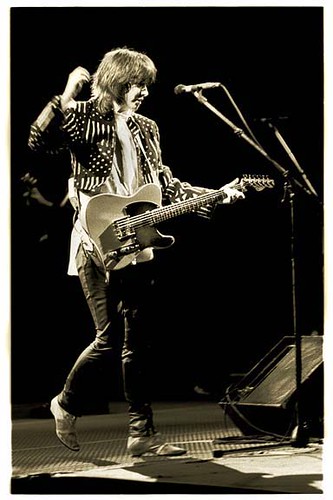
And there has never been, and never will be, a woman in rock and roll who can hold a Telecaster to Chrissy Hynde.
And since then, really, the whole “women who rawk the boyz club!” story has been utterly obsolete.
It’s hard to describe the impact that The Pretenders had on music at the time. I remember the first time I heard the record, on the turntable at Mother’s Records in Jamestown, as clearly now as the day it happened; the initial suspended-fourth chord wash that kicks off “The Wait“, the most distinctive, succinct-but-glorious intro since “A Hard Day’s Night”, ending in…
…that grunt. “Huuunnnnnh!”. Snotty, loud – and sexier than anything the 16 year old Mitch Berg had ever heard on record.
But women – and riot grrls – had done “sexy” before; if Otter Tail Power could have attached electric leads to the crowd of ninth-grade boys gathered in front of Mother’s Records in Jamestown when The Runaways’ first poster went up in the window, they could have jump-started every stalled car in town through that cold January.
Of course, there was so much more to The Pretenders, and Pretenders, than Hynde. Producer Chris Thomas, who’d worked with the Sex Pistols, and would go on to make INXS superstars using many of the same signatures, defined his style on this record – the bright, clear guitars, the percussion that dared you not to dance or slam or have sex or whatever grabbed you, the crisp, paradoxical clean-ness of an album that was a high point of a fundamentally grungy genre.
And of course, the band – in its original form, one of the tightest, most incendiary bands in the history of New Wave, Post-Punk or whatever the hell they were. Pete Farndon, the dark, leather-clad, greaser bass player…
…was a solid yet fluid technician who filled up immense space behind Hynde’s eccentric rhythm guitar style and the booming, aggressive, almost Keith-Moon-ish drumming of Martin Chambers…
…the gleefully “bloke”-y powerhouse drummer. Together, they were the most distinctive rhythm section of the whole genre.
And of course, James Honeyman-Scott, a spectacular, explosive guitarist in the Dave Davies mold…
…whose style – frenetic yet harmonically gorgeous, which could jump from strangled thrashing to chiming anthemic figures so fast it left me wondering “hunh?” – was, along with Mike Campbell, the biggest single influence on my guitar style at the time.
And of course, Hynde.
She snarled – but with a literate edge.
She oozed smart – in a way that had every teenage boy with a majoritarian libido walking doubled-over.
You just knew your mom would hate her, and you were dying to prove it. She oozed “sexy” in a way that was utterly unlike any of the other icons of the day, the Farrah Fawcetts and the like, did; she exuded an edge that went beyond confidence to a sort of muted menace – which made her all the sexier.
Together? They were like the second coming of the Kinks, (a band Hynde admired so much she married Ray Davies, in addition to covering “Stop Your Sobbing” on the debut) only harder, more intense. They were – Hynde’s domination notwithstanding – an ensemble; their parts interleaved with the sort of effortless grace and gleeful confidence that came from relentless practice to get that good. They were four musicians at the absolute peak of their craft.
There were really many sides on display on Pretenders; the ferocious, articulate post-punk of “Precious“,
“Tattooed Love Boys” a controversial, relentlessly un-PC 7/4-time sprint driven by Honeyman-Scott’s disjointed signature guitar figure, Hynde’s muffled, grinding rhythm guitar and a demented shuffle of a drum part.
“The Phone Call”, “Up the Neck” and, perhaps the best pop-punk song ever written, the frenetic-yet-glorious “The Wait”; the cool, shimmery brit-pop of “Kid”, and their debut single, “Brass in Pocket“; the slow departure “Lovers Of Today”, an almost R’nB-like ballad which presaged the group’s cover of “Thin Line Between Love And Hate” a few years later; the quirky, almost funky “Private Life”, which you can almost hear Prince covering; the hilariously off-beat Farndon/Honeyman-Scott instrumental “Space Invader” (yes, it was an homage to the video game); a very faithful cover of the early Kinks’ single “Stop Your Sobbing” which served as an audio mash note from Hynde to Ray Davies, one of her idols and, eventually, boyfriend…
Clocking in at five minutes and change, and driven by a bass line that almost serves as a percussion track on its own, the song pays audible homage to Stax/Volt soul music, linking an almost-paranoid, minor-key verse with the most irresistable sing-along chorus of the genre. It features one of Honeyman-Scott’s most inflammable guitar solos, and impenetrable yet delectable background vocals, and sends the album off with a glimmering, unforgettable bang.
The album was a shooting star, a brash explosion of sound and sexuality and gritty-but-shimmering atmosphere, as explosive and ephemeral as any great moment coursing across the ether. It hit, it exploded, it kicked open doors that (whiny music editors notwithstanding) never really closed, even if those who came after could never fill the gap like Hynde at that moment, with those bandmates, at that time.
It was never the same after that, of course; Hynde – the undeniable boss – fired Farndon for his excessive drug use in ’82, as their long-delayed second album was nearing completion; Honeyman-Scott died of an overdose himself that same week at age 25. Farndon, shattered, died of an overdose himself less than a year later.
The Pretenders were never the same; they were never really a band again. They were the Chrissy Hynde show, with special guests. And they were amazing special guests, at times; Hynde’s tribute to her fallen bandmates, “Back On The Chain”, brought in Big Country’s Tony Butler on bass and Rockpile’s Billy Bremner on guitar; on Learning To Crawl, she enlisted crack session guitarist Robbie McIntosh and bass whiz Malcolm Foster; the Pretenders later included the likes of Johnny Marr, Andy Rourke and Bernie Worrell.
Which, of course, undercuts the entire “Women Who RAWK!” conceit; the Pretenders weren’t great because of Chrissie Hynde’s chromosomes; they were great because, for a two year stretch thirty years ago, four great, theretofore-unknown musicians got together and did something much greater than the sum of its parts. Which doesn’t sell magazines quite like “Women Who RAWK” does, I guess.
That’s not to say that Hynde didn’t go on to write and record a lot of great music. But nothing topped Pretenders.
If you haven’t found a babysitter for two weeks from tonight, get on it! Tuesday, February 2 is caucus night!
Any hope this nation has for change starts at your precinct that night! It’s where Republicans pick candidates and vote in their platforms and, most importantly, sign you up to get involved.
You can also follow, and post on, your caucus on Twitter using the #MNGOPCaucus hashtag. You can also add an MNGOP Caucus Twitter Ribbon to your avatar (I refuse to call it a “Twibbon”, I’m sorry) at this link, if you’re so inclined.
At any rate – if you don’t show up at a caucus on February 2, I don’t wanna year you complaining about the MN GOP’s course.
With the departure of Norm Coleman from the gubernatorial race, things are both wide-open and, paradoxically, more focused. The GOP is down to three real contenders – Tom Emmer, Marty Seifert and Dave Hann. The DFL is holding steady, so far, at about 12 candidates. The Indpendence Party shows us the value of those little loopholes in “Major Party” laws.
Now that Norm Coleman has made his decision and practically every person in the world has given us their opinion, let’s go for one more.
Here’s my opinion.
Minnesota will have a Democratic Governor elected in 2010.
And I, as we shall see, disagree.
Onward.
Now, I realize that nowhere in that sentence do you see Norm Coleman’s name, but Norm’s decision is a pretty direct translation.
According to the “conventional wisdom” in this state, that’s exactly true. The CW has it that Minnesota is a purplish-blue state that needs a “moderate” for any statewide office. Of course, the term “Moderate” – and for that matter, “conservative” – rarely are put into any meaningful context (and the keepers of conventional wisdom in this state, the DFL and media – pardon the redundancy – distinguish the concept of “liberal” no more than an Eskimo distinguishes the idea of “cold”). And in many elections, that might be OK.
But not this one.
We’ll return to that.
Without Norm Coleman in the race….
a) The GOP nominee will be either Marty Seifert or Tom Emmer. A contest between the two of them will be causing them to fall all over each other grabbing for the farthest right slot. Besides I can’t think of Seifert without remembering his dalliance with pirates. Arrrgh!
Remember that “no meaninful context” bit I mentioned above? Here’s where it kinda matters.
Mindeman does what most media/DFL types in Minnesota do; assumes everyone to the right of Arne Carlson is an Attilla the Hun in a gray suit. We conservatives all look the same to Dave Mindeman (and pretty much everyone like him).
But they’re as different as can be; Seifert is a personable pragmatist in the Tim Pawlenty mold – which to a DFLer means “heartless conservative marauder”, and to a conservative means “acceptable, but needs constant scrutiny to keep them from swerving to the center”. Emmer is the real deal, of course; after years of hearing the left crying wolf over the supposed conservatism of the MN GOP, Emmer is an actual hip-shooting podium-dominating Reagan Conservative.
And to someone like Mindeman, that’s all that one needs to know.
We’ll come back to that.
b) So far, the Independence Party has not come up with a strong enough name to be a deciding factor. Most of the candidates in the past have had somewhat liberal leanings and siphoned off Democratic votes. Right now, the top prospect is Tom Horner, who will be a bigger drawing card for siphoning off moderate Republicans from the GOP.
In an ordinary year? Perhaps. But there are two wild cards in play here (as well as the fact that the Independence Party has become less of a “wild card” than a “soft three”). Those cards are:
This is not a normal year for conservatives.
Tom Emmer, in person, resists Mindeman’s facile stereotype.
We’ll come back to both of those.
c) Contrary to the conventional wisdom, I don’t see the Democratic candidate moving (or perceived) as far to the left as is being surmised. With the probability of a primary challenge a virtual certainty, the Dems will have to make a broader appeal much earlier than the GOP candidate. This will give the Democratic candidate (and right now it doesn’t matter who it is), the advantage of broader statewide appeal.
That is a good point, as far as it goes. The would-be Dem candidate is going to have to play less to the base than in a normal race, and more to real Minnesotans.
And they’re going to have to, because the DFL Legislature has handed the MNGOP nominee, whomever he is, a priceless gift; their arrogant, self-entitled, spendthrift profligacy in the past two sessions stand a great chance of turning the southwest, northwest, and the third-tier suburbs – the GOP’s stronghold, which got a lot less strong in the past two elections – vibrantly red. These areas are the hotbeds of the Tea Party movement; the conventional wisdom in the past few elections had it that the third tier ‘burbs were the swing districts, and if they were then, they are moreso now.
d) It is also doubtful that the Republicans will be able to substantially outraise the Democrats in money. Norm Coleman could have presented a challenge in that regard — the rest of the field will have a tougher time. Big donors will be more concerned with Congressional or Senate races. The GOP field wasn’t attracting the big money before Norm’s announcement — and even if they were holding back to see what he would do, that doesn’t necessarily mean there will be an enthusiastic outpouring now….it’s still the same field they were hesitant about.
It’s a possible problem – but it’s focused on “big money”, which is a very DFL-y perspective. The MNGOP has always been about small donors. Great case in point – in 2002, Paul Wellstone and Norm Coleman raised similar totals. But Norm got his money from five times as many people; the donations were smaller, but they made up for it with volume. And the GOP is turning the corner on winning back the Internet fundraising race; I suspect “big donors” will be a lot less important to the GOP nominee.
e) There will be no GOP primary battle. Republicans think this is a good thing, but even if Norm would have lost in a primary, the attention would have given Seifert or Emmer some serious name recognition. And they need it. The Democrats may have to fight it out, but the media attention will be focused on them and if the winner has the money to stay with it into the general election…. well, same result….. Democrat wins.
Enh. Depends on the Democrat that gets through, and what the GOP nominee does. Mindeman would be absolutely correct – if the GOP nominee were totally dependent on the metro media for exposure while the DFL was sorting things out.
That’s no longer entirely true.
And people out there are pissed. That’s not normal.
It’s too late for someone else to get in. It’s Seifert or Emmer.
Democrat wins
That’d be the conventional wisdom.
It’s been a bad year for conventional wisdom, so far.
Especially when hearing from the current occupant of your old office, Rebecca Otto – a skirt so empty she could sit in for Betty McCollum without anyone knowing the difference.
Otto is bagging on her boss, Governor Pawlenty (and apparently trying to make it appear as if she’s done something in her four years in office), claiming that his unallotment of Local Government Aid has caused property taxes to “soar”, according to Jeff Rosenberg:
State Auditor Rebecca Otto has released the 2008 Minnesota City Finances Report, which has some pretty damning evidence of Tim Pawlenty’s financial mismanagement and the impact it has had on our local governments.
Otto’s report shows that over the last 10 years, as state government and federal government have cut aid to cities, a proportional increase in property taxes has followed. “Governor Pawlenty’s no-new-tax mantra, which is a actually a no-new-state-tax mantra, has really impacted Minnesota families,” said Auditor Otto.
Which is, of course, palpable balderdash. Cities have been accelerating their spending over the past generation, confident that they’d be able to launder their spending through the state’s LGA program, and committing atrocities against accountability like financing Police and Fire through state aid (which cities don’t directly control, except via lobbying and the endless whining we’ve been subjected to) while paying for fluff like Human Rights departments and convention and visitor bureaus with property tax money, the stuff they actually control.
Some say that cities need to cut their budgets. The report points out that when adjusted for inflation, city expenditures have decreased by 7 percent between 1999 and 2008.
What else has decreased, by vastly more than seven percent, since 1999 (or rather in the past three years)? Something on which cities base much of their funding? It’s an integral part of the term “property tax”? I don’t wanna keep seeing the same hands, here.
Although this report highlights cities instead of school districts, it seems very timely to me, considering Pawlenty’s efforts to take money from our local governments to pay the state’s bills. Throughout Pawlenty’s entire tenure, he has played a shell game by making the state’s finances look better at the expense of our local governments, then blaming our cities and school districts for raising taxes, a game that continues to this very day.
Which makes perfect sense, if history for you began in 2002 (and Jeff’s a young fella, like all those MNPublius hYpStRz, so for him it might well have).
But the shell game began almost forty years ago, when the State of Minnesota essentially created the LGA program to allow local governments to launder their expenditures through the state, to conceal their spending by making the more-productive, more frugal, more pragmatic parts of the state pay for the money pits. Back then, it involved a wealthy Twin Cities paying for an ageing, scrimping outstate; today, it means thriving third-tier suburbs and mid-sized cities subsidizing Minneapolis and Saint Paul.
And making those governments fend for themselves, and holding them accountable for a generation or two of profligacy, is going to be a very good thing, eventually…
…once people see past the media/DFL/regional leftysphere spin on the subject.
This blog doesn’t “endorse” politicians – doy, who cares what a bunch of bloggers think? – but getting Rebecca Otto out of office is an absolute essential.
Today’s stop on the Minnesota Organization of Bloggers tour is the Chisago County GOP blog.
Now, my policy in compiling this list is to focus on blogs that have been updated in the past month. CCGOP hasn’t had anything since September.
But since this is the sort of blog that’s been the kind of thing the MOB was set up to encourage – small-group activism – and it was once a very active blog, I’m going to send ’em a link just to either encourage ’em to shake things up in time for caucuses, or re-form themselves, or…
We in Minnesota have a perspective on Martha Coakley that most states don’t.
It’s been 25-odd years since an overzealous prosecutor in Jordan, MN tripped into a controversy over a pre-school, and pretty much invented the genre of the “entirely fantasy-based sex abuse case”; the conventional wisdom of the day was that children never, ever made up stories about abuse – so pre-schoolers, under questioning, pretty much let their little fantasy lives run amok, destroying not a few lives in the process and serving as the first of a wave of “satanic child abuse” cases that wracked the nation during the early eighties.
Including a similar, and at face value vastly more sickening, case in Massachusetts, involving a daycare run by the Amirault family. Building on the same wave of suggested memories and childish fantasy that we saw in the Scott County case, the State of Massachusetts sent several of the Amiraults to jail – until it became clear that the procedures used to convict them were fatally flawed. And so most of them were released.
In July 2001, the notoriously tough Massachusetts parole board voted unanimously to grant Gerald Amirault clemency. Although the parole board is not permitted to consider guilt or innocence, its recommendation said: “(I)t is clearly a matter of public knowledge that, at the minimum, real and substantial doubt exists concerning petitioner’s conviction.”
Immediately after the board’s recommendation, The Boston Globe reported that Gov. Jane Swift was leaning toward accepting the board’s recommendation and freeing Amirault.
So far, so good.
Enter Martha Coakley, Middlesex district attorney. Gerald Amirault had already spent 15 years in prison for crimes he no more committed than anyone reading this column did. But Coakley put on a full court press to keep Amirault in prison simply to further her political ambitions.
By then, every sentient person knew that Amirault was innocent. But instead of saying nothing, Coakley frantically lobbied Gov. Jane Swift to keep him in prison to show that she was a take-no-prisoners prosecutor, who stood up for “the children.” As a result of Coakley’s efforts — and her contagious ambition — Gov. Swift denied Amirault’s clemency.
Thanks to Martha Coakley, Gerald Amirault sat in prison for another three years.
There are few things in this world lower than fraudulently destroying another person’s life for your own gain.
Martha Coakley deserves defeat because she’s a tone-deaf political patrician who’s run the worst campaign in recent memory, anywhere.
She deserves ignominy and pointed scrutiny for what she did in the Amirault case. An emphatic retiredment from public life seems a small price to pay.
Special election day in Massachusetts. Most of the polls are showing Scott Brown with a commanding lead over Democrat Martha Coakley, who’s gone from (by some accounts) a 30 point lead in the fall to (by some others) a nine point deficit as of last night.
Has she run a tone-deaf race? Absolutely. Has she snatched defeat from the jaws of victory? It’s still possible she wins today – but the very thought of a Republican, even a Massachusetts Republican in the Romney mode, getting within 20 points of any Democrat above room temperature for “Ted Kennedy’s seat” is a moral victory for the GOP.
Some say “he’s not a conservative Republican”. For starters, it’s Massachusetts; “conservative” means different things in Massachusetts than it does in Wyoming – and I don’t think any rational person can say he’s running anywhere but to the right of, say, Susan Collins or Olympia Snowe, to say nothing of the hapless Dede Scozzafava. And he’s already vowed to vote conservative enough on the issues that matter for purposes of this special election – especially on killing off the Democrat supermajority in the Senate.
Make no mistake; the Dems are going to call in the clans on this one. The SEIU and ACORN have been flooding the state with workers. You can expect voter intimidation, a la Philadelphia. You can expect the usual crowd of media hamsters to try to shame people with the freshly-sainted memory of Ted Kennedy.
But so far, 2010 is looking like a very good year.
“I, uh, I, uh, I, uh, I dunno – if I lived in Massachusetts, I’d trah to vote ten tahms. I dunno if they’d let me, but I’d chee-yut to keep those bastahds out. Because that’s exactly what they are”.
No, Ed. You might have to cheat to win a debate with a lobotomy patient, but I’m afraid it’s possible even Massachusetts Democrats might be more ethical than you.
And Ed? You are living, breathing proof of Berg’s Seventh Law.
And there’s evidence even you know it:
A stopped clock is right twice a day – and Schultz may see some advantage in looking like the first libtalker to be seen to publicly spit up the koolaid.
A few years back, incontinent shriekblogger Karl Bremer jumped up and down and shot steam out his nostrils and bellowed that the Minnesota Organization of Bloggers was a conservative organization. To be fair, Bremer always jumps up and down and squirts steam out his ears, so it’s not that big a distinction…
…but the main point is that the MOB is, and has always been, intended to be utterly non-partisan. That it is largely conservative could be chalked up to any number of reasons – I suspect it’s that way too many liberals really really can’t tolerate cognitive dissonance – but the proof is in the pudding; our seminnual MOB parties have welcomed people of every political stripe, from Swiftee to Eva Young to Eric Black.
At any rate, Flash from Centrisity is one of the MOB’s charter members. He’s a center-lefty, and so is his blog.
But just as Flash and I go way back beyond blogging and politics (we’ve been friends and neighbors since long before either of us thought “blog” was anything other than a post-drunken-burrito-frenzy kind of bodily noise), his blog often enough focuses on the sorts of things that should unite us all; family (including his years-long narratives about his songs, including Sergeant Tom, who just got out of the Marines), community, and most importantly, beer:
Yes folks, Global Climate Change has been officially confirmed.
Today, January 15, 2010 at 4:22 PM, Spring arrived in the Midway. On tap, Natural Ice! I need the 5.9% alcohols to keep the lines clear LOL
Flash’s kegerator has long been not only the social center of the central Midway for almost a generation – but its’ first tapping of the season is always the great harbinger of spring in this part of Saint Paul. The ceremonial first tapping is usually a sign that winter is over.
(But…January 15? The phrase “Beerational Exuberance” springs to mind. I’ll discuss it at the garage sometime this next weekend).
I collect great speeches. I’ve got a whole slew of big ones; Churchill’s “Blood, Toil, Tears and Sweat” and the “Dunkirk” speech, Reagan’s “Shining City” and “A Time for Choosing” and the Brandenburg Gate speech, Kennedy’s “To The Moon!” and his Little Rock speech, “I Have A Dream”…
…and about a year ago, I finally got a copy of Martin Luther King’s “I’ve Been To The Mountain“, made the day before he was assassinated. And while I’ve been hearing about the speech for decades, it’s amazing to listen to. Some speeches inspire you; some make you angry; “I’ve Been To The Mountain” is a little of everything, but also draining. It is almost emotionally exhausting to listen to.
But it’s worth a listen; it’s one of the greatest speeches in American history.
Part I
Part II
It ends with an account of a near-death experience when a woman tried to stab him, years ago in New York.
It came out in the New York Times the next morning, that if I had sneezed, I would have died. Well, about four days later, they allowed me, after the operation, after my chest had been opened, and the blade had been taken out, to move around in the wheel chair in the hospital. They allowed me to read some of the mail that came in, and from all over the states, and the world, kind letters came in. I read a few, but one of them I will never forget. I had received one from the President and the Vice-President. I’ve forgotten what those telegrams said. I’d received a visit and a letter from the Governor of New York, but I’ve forgotten what the letter said. But there was another letter that came from a little girl, a young girl who was a student at the White Plains High School. And I looked at that letter, and I’ll never forget it. It said simply, “Dear Dr. King: I am a ninth-grade student at the White Plains High School.” She said, “While it should not matter, I would like to mention that I am a white girl. I read in the paper of your misfortune, and of your suffering. And I read that if you had sneezed, you would have died. And I’m simply writing you to say that I’m so happy that you didn’t sneeze.”
And I want to say tonight, I want to say that I am happy that I didn’t sneeze. Because if I had sneezed, I wouldn’t have been around here in 1960, when students all over the South started sitting-in at lunch counters. And I knew that as they were sitting in, they were really standing up for the best in the American dream. And taking the whole nation back to those great wells of democracy which were dug deep by the Founding Fathers in the Declaration of Independence and the Constitution. If I had sneezed, I wouldn’t have been around in 1962, when Negroes in Albany, Georgia, decided to straighten their backs up. And whenever men and women straighten their backs up, they are going somewhere, because a man can’t ride your back unless it is bent. If I had sneezed, I wouldn’t have been here in 1963, when the black people of Birmingham, Alabama, aroused the conscience of this nation, and brought into being the Civil Rights Bill. If I had sneezed, I wouldn’t have had a chance later that year, in August, to try to tell America about a dream that I had had. If I had sneezed, I wouldn’t have been down in Selma, Alabama, been in Memphis to see the community rally around those brothers and sisters who are suffering. I’m so happy that I didn’t sneeze.
And they were telling me, now it doesn’t matter now. It really doesn’t matter what happens now. I left Atlanta this morning, and as we got started on the plane, there were six of us, the pilot said over the public address system, “We are sorry for the delay, but we have Dr. Martin Luther King on the plane. And to be sure that all of the bags were checked, and to be sure that nothing would be wrong with the plane, we had to check out everything carefully. And we’ve had the plane protected and guarded all night.”
And then I got to Memphis. And some began to say the threats, or talk about the threats that were out. What would happen to me from some of our sick white brothers?
Well, I don’t know what will happen now. We’ve got some difficult days ahead. But it doesn’t matter with me now. Because I’ve been to the mountaintop. And I don’t mind. Like anybody, I would like to live a long life. Longevity has its place. But I’m not concerned about that now. I just want to do God’s will. And He’s allowed me to go up to the mountain. And I’ve looked over. And I’ve seen the promised land. I may not get there with you. But I want you to know tonight, that we, as a people, will get to the promised land. And I’m happy, tonight. I’m not worried about anything. I’m not fearing any man. Mine eyes have seen the glory of the coming of the Lord.”
I was seventeen years old. My grandmother was born in Italy and had always wanted to go back. Just weeks after her husband, my grandfather died, she decided it was time. He never wanted to fly and she had long since given up on trying to drag him along. This was her chance and I’d be her guest. A three and a half week tour of the homeland.
The Pope gave an audience in St. Peter’s square every Wednesday and we of course had tickets. My grandmother, a member of Northeast Minneapolis’ aristocracy of restaurateurs, must also have had connections within The Vatican. Our seats were only a few rows back from where his holiness would sit, once the Popemobile made it’s customary circuit around the interior of the square, packed with hundreds of thousands of cheering believers and tourists. Little did we know it was this day in May 1981 that Pope John Paul II would not address the animated crowd.
The Pope entered the square off in a corner, far from our post. We caught brief glimpses of his white robe and matching (and then unprotected) Jeep through the crowd. We otherwise followed him audibly as the cheers rose and fell as he traveled counter clockwise under a beautiful blue sky, through the outer bounds of the open air square, framed by rows of aged, towering and historic white columns.
I would guess he was about three quarters through his route, behind the columns in the round section of the keyhole-shaped space when the pigeons rose into the air, startled by something beyond our perception. The look on my grandmothers face conveyed her immediate concern.
Seconds later we heard the delayed pop of one of what we would learn later was a quick salvo of five shots, the other four muffled by closely packed onlookers. It sounded like a firecracker. At first we thought it was a prank, maybe someone had smuggled one into the square. It was the distant, ominous wail of women and children screaming that informed us something much more serious was afoot.
The haunting sound grew in volume as the crowd became informed exponentially and traveled ominously from the point of impact to my distant perch as I stood on my chair, a typical teen-aged stance. From my vantage point I was startled to see a subsequent wave approaching through the throngs as the crowd instinctively dropped to their knees in prayer for their fallen magnate. I stood on my chair, alone, as everyone else around me fell to the bricks until just behind me, a priest, in Italian but clearly in disgust, scolded me while he horse-collared me to the ground, and implored me to pray as well.
Two years later, the Pope visited Mr. Agca in a an Italian prison and offered forgiveness.
Which is how long it seemed to take to get out of St. Peter’s square as sobbing Christians, uninformed as to their beloved Pope’s prognosis, made their way to the exits under the constant buzzing of helicopters overhead and caribinieri straining to secure and clear the area.
We made it back to our flat in Rome where the magnitude of what we had witnessed was revealed by worldwide television coverage of what would be one of the biggest global news events that year. We were glued to the screen as if we had been a thousand miles away. The fact that it had been a few hundred feet wouldn’t sink in until we were back home, weeks later.
The phone rang that night at two or three in the morning and we heard our host, a distant cousin, in Italian, clearly irritated by the disruption. It was when I heard him call out “Giovani! Telefono!” that I knew, curiously, the call was for me.
KSTP News was on the other end of the crackling line. Reporters had discovered we were the only Minnesotan’s in the square that day and they wanted an interview. I would find out later from my friends back home that my account of the incident was actually live on the air. It was probably better that I didn’t know it at the time.
The next three weeks of our trip was of course relatively uneventful as we visited the rest of Rome, touring Naples, Florence and Venice as well as the childhood home of my grandmother, reduced to remnants of a foundation by wars and the passage of time.
Mehmet Ali Agca, the Turkish man who shot and wounded Pope John Paul II in 1981, was released from a Turkish prison on Monday proclaiming that he was “the Christ eternal” after serving jail terms totaling 29 years.
Pope John Paul II miraculously recovered, forgave his would-be assassin, and served for over twenty more years. My grandmother passed away a few years after our pilgrimage. I am grateful she chose me to accompany her on her last and only journey back to her home town.
The problem with “reporting” on drunk driving is that it is such a very, utterly, supremely emotional topic. Most peoples’ exposure to the subject is intensely personal. So too with Strib editor Nancy Barnes and her encounter with a drunk:
To this day, I can see the headlights of the old pickup bearing down on my side of the rural, two-lane highway in Pennsylvania.
Behind the wheel was a driver so drunk he had already passed out. I would later learn that he had so many drunken-driving convictions, his license had already been suspended for a decade. But there he was, driving again.
I was a young mother of 30, with two baby girls, driving home from a late-night editing shift. I can remember worrying about who was going to care for my babies as, terrified, I instinctively yanked the steering wheel to the right and ran off the road. His truck clocked my little Honda, swiping it all the way down the driver’s side, but leaving me physically unharmed. The police found him passed out in a ditch not too much farther down the road.
Many people, far too many people, are not as fortunate as I was that night.
Tha is, of course, tragically true. And since it bleeds, it does indeed lead:
Every other day, someone in Minnesota is killed in a drunken-driving accident.
And that rate is broadly down over the past thirty years or so. But it’s still a ghastly toll.
The Strib is starting a series purporting to examine drunk driving. I’m going to examine the examination; that’s what mediabloggers do.
But first, a quick digression:
———-
Drugs cause immense pain and dislocation in our society. Thousands of people die of drug-related caues every year in the United States. And so for generations now the United States Government has embarked on a “War on Drugs” to, ostensibly, eradicate the drug problem in the United States.
And yet, desipte the billions spent here and abroad every year to fight drugs, thousands die every year; gang members mowed down in drug-turf-related drive-by shootings; innocent bystanders to gang turf wars; dealers who hold out on their distributors; rivals gunned down over turf; cops shot intervening in drug-crimes; people killed in robberies as addicts try to get drug money…
…and even a few overdoses (one source put it at under 300 a year) and the usual pathologies related to long-term addiction, which are tragic, but fade int o the background compared to America’s other big addictions, food and cigarettes and alcohol. Although, oddly, no American neighborhoods are being shot up by cigarette dealers, and the Mexican Army is not engaged in any long-term military actions against Big Mac traffickers.
IT doesn’t seem a huge leap that it’s the government prohibition that causes the biggest problems when it comes to drugs. An that’s not a radical observation; an organization as big and stupid as the entire US Government realized much the same thing about its last attempt at social-engineering-by-prohibition, Prohibition.
Like the War on Drugs, the “solution” was a dismal failure at addressing the “problem”, much less solving it.
———-
Back to Barnes:
Now, on the surface, there’s nothing new about drunken driving; it’s been a scourge on the roads for decades. This state, like others, has responded with tougher laws and stiffer penalties for those who climb behind the wheel and drive while intoxicated. Those laws have had some impact: The actual number of deaths has trended down over the last quarter-century.
But last year, as one tragic example of a drunken-driving-related death after another made its way into the paper, the editors and reporters in the newsroom decided that it was time to take a fresh look at the depth of the toll on our state.
Cool.
But, unfortunately, when Barnes says “Fresh Look”, what she really means – possibly without realizing it – is “very, very stale look, probably through the same precise lense that caused the “problem” you’re purportedly trying to address”.
The numbers were startling, even to veteran journalists. They suggest that as a society, we still haven’t really come to grips with this.
We need to define what “grips” means with this issue. Barnes has numbers, of course…:
Some 35,000 people are arrested for drunken driving in Minnesota each year. More than half a million Minnesotans have a DWI on their record. More than 100,000 have had three or more arrests. It begs the question: Why are so many people still driving while smashed in Minnesota?
…but does citing them lead to asking the right questions, much less getting the right answers?
Run the numbers in your head. Ten percent of Minnesotans have a DWI of some sort or another. Six tenths of a percent of Minnesotans are arrested every year – six out of every thousand. That is an immense law-enforcement effort
A team of reporters is taking a sharp look at the stories behind those numbers, examining this issue from the highways, from the courtrooms and from the homes of grieving family members. In addition to these in-depth reports, we will highlight at least one drunken-driving case in print and online each week, and we will host an ongoing community discussion online about what can be done in Minnesota to make our roads safer.
I wonder if that “sharp look” is going to ask any of the following questions:
Of those 35,000 arrests a year, how many involve drivers whose drinking has been criminalized by the recent reduction of the legal Blood Alcohol Content (BAC) limit from .1% to .08%?
What percentage of fatalities were caused by drivers picked up with less than a .1% BAC?
Just as importantly, what was the average BAC involved in fatal “drunk driving accidents”?
What percentage of accidents and fatalities are caused by drivers with BACs less than .1%?
How many law enforcement resources are diverted to chasing people whose BAC is very, very low, and almost never cause accidents or fatalities?
How many fatalities might be averted if those resources were instead spent on keeping habitual drunks, and people arrested multiple times with BACs well above .12%, off the road?
If there is no plan to ask those questions – why? Is it because Mothers Against Drunk Driving is the motivator for this “reporting”, and the answers wouldn’t fit their agenda?
The Jester recounts his “accomplishments” thus far and blames the GOP for Congress’ Low Ratings.
What a joke.
…no less coming from a man whose qualifications for the job never exceeded telling them. From the gaping maw that is Al Franken:
I’d say the proudest accomplishment is just the overall impact I had on the health care bill. It may not have been the highest-profile stuff, but I think it’s stuff that both reflects Minnesota’s values and what Minnesota has done well, and will also ultimately not just benefit Minnesota, but benefit the whole way that health care is delivered.
…save the fact that clearly Americans and Minnesotans are against government reform of health care, hence the lack of transparency, closed-door negotiations, and blatant political payoffs to the unions of late on the part of our Democrat-led congress.
His self-aggrandizement defies the imagination of any sane voter, but not moreso than his take on Congress’ abysmal approval rating:
I would like to see give and take. I think the most surprising (is) sort of the lack of real debate, especially between the two parties, especially on the health care thing. …
I must have done between 10 and 15 roundtables on health care, with providers, doctors and hospitals, with insurance companies, nurses, health care economists, with public health people, rural health, one on health care disparities. And, you know, that was because I wanted to reform health care. … And every member of the Democratic caucus did the same. And I felt like the Republican caucus in the Senate did not do that. And that they were not invested in reforming health care; they were invested in stopping the Democratic … reform of health care.
What was disappointing to me was what came from the other side, or from opponents of health care.
[It is telling that liberals now synonymize “health care” with “government health care”-JR]
(It) seemed to be kind of talking points. There wasn’t much behind them. And also quite a bit of disinformation.
I think [our low rating is] because they see things like that. I was sort of saddened by that.
Boo Freaking Hoo, Al. Save the crocodile tears for another day. When it’s a Democrat speaking it’s reasoned debate. When it’s a Republican, it’s “talking points”, right Al?
Al Franken opines that the American people hold Congress in such low esteem because Republicans haven’t paralleled the Democrats’ enormous investment of time, effort and political capital pursuing health care reform that a growing majority of Americans no longer want.
He went on to say that the next task at hand will be to tackle job creation, as if ten percent unemployment hansn’t warranted more immediate attention than health care reform, that again, for emphasis, most no one wants.
Yet it’s the minority party’s fault that Congress suffers such low esteem among the populace?
Conventional wisdom is wrong; Norm Coleman is not running for Governor of Minnesota:
“I love Minnesota and I love public service, but this is not the right time for me and my family to conduct a campaign for Governor.
Timing is everything. The timing on this race is both a bit too soon and a bit too late. It is too soon after my last race and too late to do a proper job of seeking the support of delegates who will decide in which direction our party should go. The commitments I have to my family and the work I am currently engaged in do not allow me to now go forward.
At the moment, I am tremendously energized by the work I am currently involved in to create a positive, center right agenda for this country. Anger on the left and anger on the right will get us nowhere. In Minnesota, we face a jobs deficit, a budget deficit and a bipartisanship deficit. We must all put aside the bitterness and sniping and remember that behind every job loss and every home foreclosure is a Minnesota family losing hope and confidence.
That changes the Gubernatorial race again. Until this, it looked like the convention was going to be a movement-conservative rear-guard action to try to sway the primary against Coleman. Now, with this news and the departure of Pat Anderson from the race to switch to Auditor, it looks like it’s going to be a battle to see which movement conservative – Emmer or Hann – can overcome Marty Seifert’s big lead with the GOP (not necessarily conservative) establishment at the convention.
It’s a whole new race. And a big opportunity for conservatives – all of you, the Paulbots and Tea Partiers and Tax Protesters and pro-lifers and the whole works – to make a huge difference.