Archive for June, 2009

Conservatism Needs…

Monday, June 8th, 2009

…someone who can smack down the lefties with style, like Friedman did here.

And to be fair, the left could use a pundit with half the class Donahue had back then.  As comical as Donahue could be, neither Olberman nor Matthew were fit to carry his gig bag.

This Great And Noble Undertaking

Saturday, June 6th, 2009

Today is the 65th anniversary of D-Day.

I’d have a hard time doing a better post than I did last year on the subject.

Except to get some voices from the era; in this case, my radio alma mater, KSTP-AM, and their live coverage (or as live as it got in those pre-satellite days) of the morning’s news.

Of course, the Army remembers its own.

Rewritten By Machine On New Technology

Saturday, June 6th, 2009

Today, the Northern Alliance Radio Network brings you the best in Minnesota conservatism from 11AM-5PM. 

  • Volume I “The First Team” –  Brian and John kick off from 11-1.
  • Volume II “The Headliner”Ed and I are up next, from 1-3.
  • Volume III, “The Final Word”King is on next, dishing his own personal brand of conservative hurt from 3-5.  Check it out.
  • And don’t forget, our long-time colleagues David Strom and Margaret Martin lead things off on the David Strom Show from 9-11AM!

(All times Central)
So tune in to all six hours of the Northern Alliance Radio Network, the Twin Cities’ media’s sole guardians of sanity. You have so many options:

  • AM1280 in the Metro
  • streaming at AM1280’s Website,
  • On Twitter (the Volume 2 show will use hashtag #narn2)
  • UStream video and chat (at HotAir.com or at UStream)
  • Podcast at Townhall (usually uploaded by Monday morning).
  • Good ol’ telephone – 651-289-4488!

Join us!

I Swore I’d Love You ‘Til The End Of Time

Friday, June 5th, 2009

While I was researching Ian Hunter for my post on his birthday earlier this week, I tripped across the fact that today was, wonder of wonders, Ellen Foley’s birthday.

She’s 58 today, not that you’d know.

“Ellen Who?”

How, or whether you know anything about Foley depends on where you were and what you were doing between about 1977 and 1990ish.

Her first claim to fame was serving as Meat Loaf’s female foil in his ’77 trash-rock classic, “Paradise By The Dashboard Light” (heard, but not seen, in this video, which features Carla DeVito lip-synching Foley’s part), which counterbalanced the fairly useless Mr. Loaf with one of my favorite supporting casts in rock history; Utopia’s Todd Rundgren and Kasim Sultan on guitar and bass, the E Street Band’s Max Weinberg and Roy Bittan on drums and keys, and of course Foley singing the part of the eternally hard-to-get girlfriend.

If you were into Ian Hunter, you remember Foley as one of Hunter’s background singers on a number of his albums back between ’77 and ’79; he also produced her 1979 debut album, Nightout, an album that…well, sounded like Ellen Foley singing Ian Hunter songs, jammed full of classic, American-pop inspired sounds lifting heavily from the Phil Spector oeuvre.  

If you’re into freshman-level music trivia, you know that she dated Mick Jones of the Clash, sang backup on their Sandinista album (“Hitsville UK”), that they returned the favor (playing on her second solo album, Spirit of Saint Louis), and that “Should I Stay Or Should I Go” was written in her honor by a befuddled Mick Jones (and answered “Go!” by a generation of guys of a certain age at the time).

Graduate-level music trivia?  Ian Hunter brought her in to sing backup on the Iron City Houserockers’ classic second album, Have A Good Time But Get Out Alive, singing backup on their longtime signature “Junior’s Bar“.

Fans of really, really bad music?  Foley had something in common with Bonnie Tyler, Meatloaf, Air Supply and Barry Manilow – her “We Belong To The Night” was butchered by a bombastic, overblown Jim Steinman production job; of all Steinman’s victims, only Foley really survived artistically, if not commercially.

Not into music?  She was also Billie Young, on the first season of Night Court, kicking off a decades long controversy that was only settled by a 2005 session of the National Institute of Standards that unanimously declared “Ellen Foley was way hotter than Markie Post“. 

As I noted in writing about Foley last year, it’s one of the great injustices of the eighties that Pat Benetar became a fairly enduring star, while Foley languished in obscurity and now teaches vocal technique at a music tech school in New York.

Still – thanks for the memories!

Happy Birthday, Ellen Foley!

What The Hell Do We Do With The MNGOP (Part II)`

Friday, June 5th, 2009

Manfred Von Richtoven – better known to history as the Red Baron, the highest-scoring fighter pilot of World War I – was once asked for his “mission statement”, as they’re called in business today.

Paraphrasing closely, he said “My mission is to patrol my sector, and shoot down the enemy.  All else is bulls**t”. 

———- 

As I noted yesterday, Tim Pawlenty has done a great job as governor – in great part because he followed through on his promises.  (And lest anyone think I’m disparaging Governor Pawlenty in any way in saying this, let me add right now that I echo what King says in every single particular.  Thanks, Governor!)

And, as we noted yesterday, the promises that have mattered the most – indeed, the ones that have defined his administration – were the ones he made to get nominated; the No New Taxes pledge foremost among them.  To his immense credit, Governor Pawlenty has largely kept that promise, especially with the big things; I’m willing to sacrifice a pawn to take a queen; I’m likewise wiling (if not thrilled) to trade “health fees” one year for unallotment this year; it’s not purist conservative gospel, and it’s pragmatic, but that’s politics for you.

Which means that much of the success of the Pawlenty Administration came from his reaction to a powerful, motivated insurgency within the party – the conservative candidacy of Brian Sullivan.  Sullivan was a self-funded maverick (not a McCain kind, the real kind) who ran on a platform that’d have done Ronald Reagan proud.  It scared the crap out of the party establishment – so much so that “their” candidate, Pawlenty, had to adopt one of their key tenets to get the  nomination.

The rest, as they say, is history.  The good kind.

Of course, motivated insurgencies are always a headache to the establishment of any organization, at any level.  In 2006, many long-time Sixth District activists were turned off by Michele Bachmann’s organization; she flooded the precinct caucuses with supporters, which gave her a crushing majority of delegates at every level of the endorsement process.  She went on, of course, to win twice, including last fall, when the Conventional Wisdom said she would lose; she’s the most conservative voice in Minnesota elective politics; thank goodness the establishment didn’t get their way.

Another insurgency, we’re still digesting; last year, Ron Paul supporters flooded precincts caucuses throughout the state.  They brought boundless motivation, energy and (after one filtered out a few hundred thousand resolutions about the Trans-American Freeway and 9/11 being an inside job) some good, solid, libertarian-conservative politics.  It scared the establishment, who in some cases had to resort to parliamentary maneuvering that baffled the newcomers; in other cases, they just plain had to organize their opposition.

None of those three insurgencies change the party, fundamentally.  But all of them had their effects; the compromises that the parties had to make through the process made the party stronger, in each case.

———- 

There’s another insurgency this year. It’s not of quite the same import as the 2002 Sullivan assault.  It’s not going to send anyone to Washington.  It’s not going to shake the party down to its precincts.  But it’s important; just different.

For one thing, the battle for State Party Chair doesn’t have the same constituents as a convention, much less a general election; it’s the party Central Committee that’ll be doing the voting.  And nobody vaults into the Central Committee from nowhere.  It’s something that comes from years of service to the party.  Which means that, no matter what one believes, one has developed the network of connections and allegiances that are the building blocks of any “establishment”.

State Chairman elections, thus, are not unpredictable free-for-alls.  The network, the connections, the establishment has a very, very strong voice in the process.  As, perhaps, is entirely fitting. 

Tony Sutton is a good candidate; I believe he will make a good State Chairman.  I also believe that, since he is the establishment’s candidate, his connections with that establishment – the Central Committee – are strong enough that the election is his.  That’s not a bad thing because – this is important – his job is not to define the party’s philosophy.  That’s the job of the individual candidates, and the people who recruit them and, to some extent the districts they come from.  The chairman’s job is to run the administrative wing of the party, and make sure the party supports the candidates, and above all to raise tons and tons of money to make sure that support is there when it’s needed.

I don’t believe there’s any real question that Tony Sutton is going to win.  And I think he will do a good job (and if he doesn’t, I’ll be joining a hell of a lot of Republicans in pointing it out).   While I don’t like “Next In Line” politics, I think Sutton’s experience in the party machinery makes him qualified to run the party machinery.

I fully expect to be congratulating Tony Sutton next Saturday (June 13) after the Central Committee elections, and sincerely offering him my support (for whatever that’s worth) in helping the GOP kick ass in 2010.

But the party does need a swift kick in the pants, too.  The party machinery is decayed and complacent in some areas; the party has ceded the Fourth and Fifth Districts to the Dems for far too long; candidate recruitment and development is lagging badly in places like the First District, and is virtually nonexistent in the Cities.  The party still acts like it’s the 1970’s in terms of decentralizing authority; ask anyone who’s sat at a Congressional District convention and fumed as debate was slashed to ramrod District Committee initiatives through the processes.  The party machinery needs to make a contest of the entire state, not just the South, the Red River Valley, and the second-through-sixth-tier suburbs.

So while Tony Sutton will, I believe, be the next MNGOP Party Chairman, the party needs to put these goals – the need to not just embrace change, but conquer it; the need to adapt to a world where authority is decentralizing – out front. 

They need not so much to fight the DFL, but to present the GOP in a light that wins people over to what the party represents, and to make sure the candidates that do that are supported.

———- 

I don’t “endorse” people on this blog.  I’m just a workadaddy, hugamommy schnook from Saint Paul, with a couple of kids and a mortgage and a day job.  And I am not on the Central Committee, so my opinion really matters only inasmuch as I have a readership and a modestly popular talk show – i.e. not all that much.   To call my opinion an “endorsement” only makes sense as humor.  So I don’t endorse.

But I support Dave Thompson for State Party Chair. 

Part of it is that I like Dave, and I support his positions.  Dave’s politics largely agree with mine.  And I believe that if he were the state chairman, it’d send a message about the kind of candidate this party should be recruiting, and the kind of races we should be running; center-right, unapologetic, as tightly-focused on a solid, winning message as an hour of Dave’s talk show always was.  I believe that Dave has a good command of what politics is turning into in this state – which isn’t so important for an administrator, but is vital for a leader.

It’s not a shot at Tony Sutton or his supporters.  As I said, I believe Tony will win in the end, and I will work to support the party if and when he does. 

But it is a warning shot across the bow of the state party; “I support you, but not without question.  I expect results from you and your administration.  The stakes are too high to be complacent“, not that I don’t believe Sutton knows that.  “Come back with your shield, or on it“.

Whoever wins, the real challenges start June 14: recruit canddiates.  Build a bench.  Raise money.  Get a message out there.

Further conservatism; limit government; promote growth, security, and limited government.

Win races, and make those victories matter.

As to everything else?  Ask the Red Baron.

Charter Schools: The Hit Is Out (Part II)

Friday, June 5th, 2009

In 1961, communist East Germany faced a crisis.  The West had stiffened its spine against communism.  The East Germans (and their Russian handlers) faced a dire threat across the nation’s open borders.  So they built a fence and, through the middle of the divided capitol in Berlin, a big wall, reinforced with barbed wire, mines, dogs and machine guns.

Not to keep western invaders out, of course; it was to keep East Germans, Czechs and Poles in.  It wasn’t NATO tanks they were worried about; it was the immense efflux of the Eastern bloc’s most motivated, talented, useful people across the border to freedom.

Public schools, especially (but far from exclusively) in the major cities, are failing.  Graduation rates in Saint Paul are under 50%; it’s far worse among black and hispanic students.  And the parents of those students are responding by leaving the districts.  Due to Minnesota’s school choice rules, parents can sent their kids to other public districts, to private schools, or to charter  schools.  Over an eighth of Saint Paul parents have decamped from the public system; it’s “worse” in Minneapolis.

And like the East Germans, the Minnesota education establishment knows that it needs to stanch the bleeding before it bleeds completely dry.
The left – especially the big institutional left, the DFL, and its handlers, the teachers union – hate charter schools.  The schools are generally non-union, of course.  Beyond that, due to the 1991 law that established the charter system, the state money that would  go to the student at a public school follows the student to the charter school.

In the MN2020 hit piece on charter schools yesterday (subtitled “An Examination of Charter School Finances”, John Fitzgerald wrote:

Unlike private schools, charter schools are funded by taxpayer dollars. While traditional public schools get roughly $9,500 per-student from the state, charter schools get $10,500 for each student from the state. State officials say charter schools deserve more taxpayer money because they can’t ask local taxpayers for additional taxes to operate their schools or for bonds to build school buildings the way traditional districts can.

Fitzgerald breezes past this like it’s immaterial – presumably (I’ll put words in his mouth) to leave the reader with the impression that charter schools are over-funded compared to the public schools.

But local bonding funding more than makes up the purported differences in spending:

Statewide  – $9,063 per student

During the 2008-09 school year, Minnesota school districts will receive an average of $9,063 per student in general education revenue from state and local sources.

State funding per student will average of $8,182.

Referenda revenue per student will average $881.

Minneapolis (District 1.2) – $11,692 per student

During the 2008-09 school year, Minneapolis will receive $11,692 per student in general education revenue from state and local sources, compared with a statewide average of $9,063.

State funding is $10,797 per student, compared to a statewide average of $8,182.

Referenda revenue total $895 per student, compared to a state average of $881.

St. Paul (District 625) – $10,809 per student

During the 2008-09 school year, St. Paul will receive $10,809 per student in general education revenue from state and local sources, compared with a statewide average of $9,063.

State funding is $10,039 per student, compared to a statewide average of $8,182.

Referenda revenue totals $770 per student, compared to a state average of $881.

Remember to add 8% – the government inflation rate – to these numbers, which are from last year.

And then remember that charter schools need to pay for a whole lot of things – rent, for starters – out of their per-student allotment that the public schools largely don’t.Fitzgerald next moves on to “accountability”.

A major component of the 1991 charter school legislation allows the taxpayer dollars to follow the student: if a student leaves a traditional school and enrolls in a charter school, the per-student money leaves the public system and is allocated to the charter school.

Although charter schools receive taxpayer funds, they are not subject to the same checks and balances taxpayers have the right to expect. Traditional schools are governed by elected school boards. Taxpayers who disagree with the way their money is being spent need only go to the school board meeting and voice their concern. Ultimately, voters can exercise their rights and vote school board members off the body.

I’ve spent a solid day trying to figure out how to even address the myopia in this statement.

“They need only to go voice their concern?”  To whom?  To the very body that is causing the problem.  Who, especially in Minneapolis and Saint Paul, were put into office by local party machines and the teachers unions whose entire goal is to maintain the status quo.

And it’s true; the taxpayer can  “exercise their rights” to mount a big election campaign (at the appointed time in the election cycle), put their lives on hold, raise millions of dollars, and butt heads with the most entrenched establishment anywhere in Minnesota  politics. And, pretty much inevitably, fail.

As, indeed, people who are revolted by the way taxpayers money is being spent in the Cities today are failing, and even falling behind; the one Republican member of the Saint Paul school board (indeed, the sole elected Republican anywhere in Saint Paul) is leaving.

So what’s the alternative?

Go to a private school (with its attendant costs).  Or go to a school in another district (which is good if you can manage the transportation to and from the district; transportation funds do not follow the student, which is fine unless you are the one of the families most affected by the attempt to gut charter schoos, the working poor in the city.  And which, let’s not forget, is a function of the “Open Enrollment” law that will be the Educational-Industrial Complex’ next target when they kill off charter schools)…

…or go to a charter school.  Where, if you don’t like how things are being run, you can express your dissatisfaction by leaving.  By depriving the school of your kid’s share of the state money.

You can’t get more accountable than that – if by “accountable” you mean “to parents”.

Oh, and there’s one other way:

There is no such remedy for taxpayers concerned about the financial dealings fo charter schools. Their boards are not publically elected and taxpayers have no say in how their money is spent.

This is, of course, balderdash.  Many charter schools have boards, elected from among the school’s sponsors, staff and, lest we forget, parents.  These boards are immediately responsible to the school’s parents about everything, immediately.

And for those that don’t?  As Fitzgerald’s report itself notes, the Minnesota Department of Education itself administers the financial affairs of charter schools!

I mentioned this to a couple of different supporters of the current public school system.  “But taxpayers as a whole don’t get a say in how their tax money is spent at a charter school!”

I reeled with responses:

Your input as a voter ends at your district!  If you’re a voter in Marshall, your disgust with how your tax money is being spent in Minneapolis will fall on deaf electoral ears, except…via the Minnesota Department of Education.  Same as with charter schools!

Charter schools aren’t the only bodies that accept public money without publicly-elected boards; every non-profit that accept tax dollars has a board that is privately elected. Do I get a say in how, say, Minnesota Public Radio spends my tax dollars?  Do I get a vote on their board, just because they’re spending my money?  Hell, I don’t even get a vote for pledging to them!  No, my only say on MPR’s funding – or the funding of any non-profit that accepts tax dollars – is the same as the Marshall voters’ say over Minneapolis’ school spending, or over John Fitzgerald’s say over my kids’ charter school’s spending; via the legislature, which controls the Department of Education.  Which is frustratingly indirect, although not nearly so indirect as, say, being a conservative trying to change the composition of the Saint Paul School Board.

But MPR isn’t a school!”  True.  But Fitzgerald’s article wasn’t about “education”, per se; you’ll find only the most oblique references to the actual business schools conduct, “educating” kids, anywhere in the article.  It’s about financial governance, compliance and accountability with taxpayer money.  And none of those differs in any but the most picayune details between charter schools and, say, a social service non-profit with a state contract (which also have spotty records), or an HMO (which are non-profits in Minnesota, and have even dicier records).   And if you want to bring the fact that a charter is a school into the mix, then it’s patently misleading to compare charters’ performance at financial management with public schools (not that any of them can manage money; they don’t have to follow the same rules), to say nothing of the differences in educational service and achievement that are the justification for charter schools in the first place.

There’s a reason for that, naturally.

But while Fitzgerald’s piece didn’t touch on education, it did talk a lot about financial management.

More on that on Monday.

UPDATE: I had to re-do this post; MN2020’s code interacts badly with a “feature” in WordPress that made it basically impossible to fix it without copying the whole thing into Notepad to scrub the invisible formatting and re-pasteing it into WordPress.

So the comments are lost.  Sorry about that.

(Part I, Part III and Part IV of this series)

Where Was This…

Friday, June 5th, 2009

…back in the eighties when I was having to play this stupid song on the evening shift at KQDJ and I needed to hear it worse than just about anything?

What The Hell Do We Do About The MNGOP, Part I

Thursday, June 4th, 2009

I was originally going to call this piece “What The Hell Is Wrong With the MNGOP, Part X”; there’s plenty more to talk about in that series.

But in the aftermath of the last legislative session, and especially Governor Pawlenty’s epic, lone stand against the DFL’s tax-and-spend orgy, I’m inclined to answer my question “not as much as there was eight years ago”.  Or last year, for that matter.

Nobody’s ever mistaken Tim Pawlenty for a movement conservative – and some of my Buchananite friends sputter angrily when I even mention “conservative” in the same paragraph as Pawlenty, who is certainly a pragmatist, front and center – but he’s delivered on the one big honka-lunka mega-issue that every conservative should agree on; curbing spending and the size and reach of government.

And while the GOP Senate caucus is too small to sustain any gubernatorial vetoes, the House caucus did itself proud this year, doing something many of us had nearly given up on seeing; doing what they were sent to Saint Paul to do; acting like a party; presenting Minnesota an alternative to the DFL, rather than acquiescing with the majority like a herd of hamsters.

It’d be much better to be in control – but the party showed big signs of hope.

And I think it all traces back to something that happened eight years ago at the State GOP Convention.

If you’re a Minnesota Republican, you remember the story; Brian Sullivan, a movement conservative, took Pawlenty, then the House Minority leader, to 3,000 ballots over forty days and forty nights of voting.  Pawlenty had to move sharply to the right of his normally pragmatic, legislative-negotiation-honed positions to win the nomination, finally taking the Taxpayers League’s “No New Taxes” pledge to secure the nomination.

Sullivan didn’t win the nomination – but had he not been in the race, Pawlenty would never have moved right; conservatism would have lost.

So what we have in Minnesota today – gubernatorial unallotment standing in the way of a state-bankrupting spending orgy – we owe to Sullivan (as well as a governor who has had the integrity to stick to his promises all these years against Thermopylean odds).

And this is what the party needs to recover from the last two drubbings: a coherent message, and the willingness to live and fight for that message when the heat’s on.

So on Saturday, June 13, the Central Committee of the Minnesota GOP is going to elect a new chair.  There are a couple of great choices on the ballot.

What are we going to do?

More tomorrow.

Patience Is A Virtue; Henco Voters Are Paragons

Thursday, June 4th, 2009

Jeff Johnson’s “Hennepin County Taxpayer Watchdog” blog is one of my favorite new blogs.  Every county should have one, provided every county in Minnesota has someone in it who’s dedicated to kicking butt for taxpayers.  Sadly, many don’t.

Earlier this week, Jeff took on one of the propaganda points that always attend “green” projects: “they’ll save money”.

In this case, Johnson looks at a solar panel project at a Henco public works building in Medina that purportedly would save Henco taxpayers “$15,000 per year”.

Jeff just wanted to know; when?

Before I provide you the answer to my question, let me say that there is no magic pay-off period for such projects. Some argue that an energy conservation project is successful if it pays for itself in 7 to 8 years. Others argue it can be 10 to 12. I’ve even heard a few people argue that it should be slightly longer than that, based on the positive effect (regardless of how small) such projects allegedly have on the environment. I don’t have a firm opinion yet as to where I fall on the pay-off period, but I’m certainly comfortable with something in the 10-year range for a project such as this.

So how long will the Henco taxpayer have to wait to see a return on their “investment”?

The Public Works Solar Panels? Well, after some explanation to me about how this project is not “all about the bottom line” I learned that they cost about $900,000.

Yes, these solar panels will begin to save the taxpayers of Hennepin County $15,000 per year in 2070. My 5th grade son, Thor, will be 71. I will be dead. And I’m willing to wager that the Hennepin County Public Works building in Medina will be long gone.

But on the bright side, we’ll still be paying off the deficit…

Charter Schools: The Hit Is Out (Part I)

Thursday, June 4th, 2009

Established; the left hates, and wants to extinguish, charter schools.

Charter schools – invented about twenty years ago in Minnesota, and given life by a 1991 law that allowed schools, run by sponsoring organizations and elected boards of parents, teachers, sponsors and other interested parties, to use the money that would have been allocated to the student at a public school – have been a lightning rod ever since.

For the teachers’ union and the educational/industrial complex,anyway.

For parents – especially parents underserved by the decaying inner city schools with their sub-50% graduation rates, violence and miserable achievement – the word I’m looking for is “lifelines”.  City parents – especially the Afro-American parents that have the most to gripe about with urban schools – are leaving the city schools in droves; 1/8 of Saint Paul’s kids have left the system, with even more in Minneapolis, as of two years ago.

Charter schools offer what public schools not only lack, but actively squelch; parental involvement; beyond that, parental control; staff whose jobs are intimately tied to their success with the kids, since the board that hires them administers only the school they’re in; perhaps most important, immediate accountability – not to some politicized, “elected” school board (which is in the bag for the teachers union, not the parents) and careerist administration, but to them via a decision loop that is a microscopic fraction of what it is at a public school.  If a charter school screws up with a kid, they know it right away; the board hears it and must respond immediately, or the kids, and the money, go away.

The accountability, in other words, is immediate.

Which the teachers union and the educational-industrial complex hates.  They’ve been working for almost two decades to extinguish the charter school experiment.  They’ve tittered about “academic achievement” rates that, in the cases of some schools, is a tiny hair below that of public schools, in press releases that carefully ignore two inconvenient truths:

  • Charter schools are often where parents go after kids have “checked out” of the public system, developed atrocious study skills, and lost interest in education.  Call it educational recovery; it’s where many parents – myself included – go to salvage the mess our inept public schools create.
  • When a kid in a public school is performing poorly enough to blow the school’s rates for purposes of “No Child Left Behind”, they’re shunted off to an “Alternative Learning Center” (ALC), which, being explicitly for kids with academic problems, is “off the books”.  Charter schools don’t have this; there’s just one Grade Point Average for a charter school!

But more than anything, it’s about the money.  Since the per-student money from the states follows each charter student, every family that decamps for the charters takes tens of thousands of dollars away from the factory school system.  It’s adding up fast.

They want it back.

John Fitzgerald came out yesterday with a hit piece on charters’ “Financial Accountability”. for “Minnesota 2020”, the “non-partisan” think tank founded by former DFL Representative Matt Entenza and employing, as far as I can see, nothing but partisans.

Seventeen years after the first charter school opened in Minnesota, this examination of fiscal year 2007 charter school financial audits shows that the vast majority of charter schools do not follow basic financial guidelines or, in some cases, state law. Since this analysis agrees with a recent report by the Office of the Legislative Auditor and audit examinations written in 2001, 2002 and 2003, we conclude that these financial problems are not being adequately addressed by the Minnesota Department of Education (MDE) and, further, are endemic of the charter school system.

Well, that sounds pretty damning.   Of course, the damnation is in the details -which we’ll look into later.

Efforts by the 2009 Legislature to provide more accountability to charter schools was welcome, but shorthanded. The charter school program is financially flawed and basic concepts about charter schools – such as unelected school boards and under informed business management – need to be changed.

Let’s clarify a few things about the language in this paragraph, since they obfuscate a few things that, for the charter advocate, are better re-clarified.

Some charters do have unelected boards.  Most of them do elect their boards.

And any parent that’s ever been involved in a charter school knows that most of them are run by teachers, not managers or accountants. At some charters – schools with excellent academic records – the staff freely admit they work hard to keep the regulatory hogs’ troughs slopped with the pails of paperwork that attend the spending of any public money.  It’s not an unfair charge – although to try to turn that charge into a conviction, as Fitzgerald does later in this piece, is laughably misleading.

Fitzgerald cuts to the chase

In November and December, 2008 and January, 2009, Minnesota 2020 combed through the financial audits of 145 charter schools for the fiscal year that ended on June 30, 2007 – reports that were filed with MDE by December 31, 2007. Our research found several trends in charter school financial management:

  • 83 percent were found to have at least one financial irregularity in their audit – five years earlier, that figure was 73 percent;
  • 51 percent of those schools with problems identified on their 2007 financial audits had the same problems identified on their 2008 audits, according to the MDE;
  • 29 percent did not respond to a request for board minutes – five years earlier, that figure was 33 percent;
  • 55 percent were found to have “limited segregation of duties,” a requirement that ensures no single charter school official has control of the school’s funds;
  • 26 percent didn’t have proper collateral for deposit insurance, a requirement that ensures the charter school can pay its bills.

Well, that sure sounds bad.  And those are the numbers that MN2020 will splash all about the state’s media (the media that so many of MN2020’s staff used to work for).

But what’s behind those numbers?  You have to do some reading for that.  We’ll look into the numbers tomorrow.

But Fitzgerald reaches a conclusion:

If charter schools can’t run their schools in a financially competent manner, Minnesota should reconsider whether charter schools are worthy of public funding at all.

Which brings up a slew of interesting questions.

Why should charter schools be the only ones required to be “financially competent”?  Can we have the same debate about “worthiness” with our union-strangled, factory school system?

We’ll be back to look at Fitzgerald’s numbers tomorrow.

UPDATE:  Yep, it’s John, not Peter Fitzgerald.  I hadn’t had coffee yet; I’m lucky I didn’t write “Edmund”.

And I guess I don’t keep up with my “progressive” non-profit trivia like I used to: Entenza isn’t with MN2020 anymore.

(Part II, Part III and Part IV of this series)

Every Morn Brought Forth A Noble Chance, And Every Chance Brought Forth A Noble Knight

Thursday, June 4th, 2009

It was 69 years ago today that Winston Churchill gave one of the greatest speeches of the 20th century.

The speech has been much on my mind in the past year

I have, myself, full confidence that if all do their duty, if nothing is neglected, and if the best arrangements are made, as they are being made, we shall prove ourselves once again able to defend our Island home, to ride out the storm of war, and to outlive the menace of tyranny, if necessary for years, if necessary alone. At any rate, that is what we are going to try to do. That is the resolve of His Majesty’s Government-every man of them. That is the will of Parliament and the nation. The British Empire and the French Republic, linked together in their cause and in their need, will defend to the death their native soil, aiding each other like good comrades to the utmost of their strength. Even though large tracts of Europe and many old and famous States have fallen or may fall into the grip of the Gestapo and all the odious apparatus of Nazi rule, we shall not flag or fail. We shall go on to the end, we shall fight in France, we shall fight on the seas and oceans, we shall fight with growing confidence and growing strength in the air, we shall defend our Island, whatever the cost may be, we shall fight on the beaches, we shall fight on the landing grounds, we shall fight in the fields and in the streets, we shall fight in the hills; we shall never surrender, and even if, which I do not for a moment believe, this Island or a large part of it were subjugated and starving, then our Empire beyond the seas, armed and guarded by the British Fleet, would carry on the struggle, until, in God’s good time, the New World, with all its power and might, steps forth to the rescue and the liberation of the old.

Audio?  Sure!

Warhol Was Close

Thursday, June 4th, 2009

In the future, everyone will have a cult following for fifteen minutes.

Including actresses in commercials:

She’s bubbly and beaming, high-volume, with a flip of dark hair and a face like a lollipop. She irks as she endears, bemuses as she bewitches. She’s a bundle of energetic contradictions, bursting here, retracting there. Her expressions blink and change like a neon sign. Her eyes are popping globes. And she just sold you a bunch of car insurance.

Well…close.

Flo is her name. She’s the spokeswoman for Progressive Auto Insurance…First she caught our eye; now she’s snatched our heart. Viewers are smitten. They’re crushin’. They want to know: Who’s that girl?

From a recent blog at HoustonPress.com, with the headline “The Cult of the Progressive Car Insurance Chick”:

“Am I the only one completely and totally enamored of the woman in the television ads for Progressive car insurance? You know, the ones starring that babelicious brunette named Flo with her ‘tricked-out name tag’ and her ’60s style eye makeup and her kissable red, red lips?”

No, sir, you are not. There’s more where that mash-note came from, out there in the blogosphere’s infinite confessional space: “She’s hot.” “She’s weird but, God, she’s fine!”

“It’s so weird,” says Stephanie Courtney, the actress who plays Flo.

Or at least, plays her after two hours in makeup:

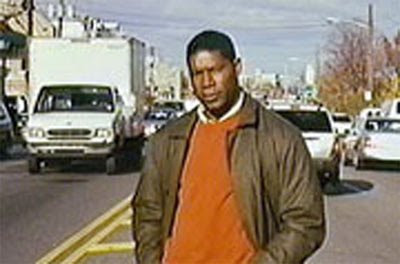
In related car-insurance-cult news, I found out a while ago that I was not the only one who thought Dennis “David Palmer” Haysbert…

…was actually saying “That’s Allstate, Stan” during the first run of his spots a few years back (which is why he enunciates the “d” in “stanD” so hard these days).

Court To Peasants: “Your Lives Are Not Worth Defending. Die, Peasant Scum”

Wednesday, June 3rd, 2009

Chicago has the most absurdly restrictive gun laws in the United States; worse than New York, worse than DC.  There is no legal civilian handgun ownership in the City of Chicago.

Chicago is also in the midst of a maelstrom of gang violence; bangers, armed with any damn weapon they want, are mowing each other and innocent bystanders down at a pace that looks likely to easily break the records set during Prohibition.

Fortunately, the US Court of Appeals is on the case, as it were, ruling that while gang bangers roam the streets unimpeded by law enforcement, the rigorously law-abiding citizen can not be trusted with firearms:

The unanimous three-judge orc panel ruled today that a U.S. Supreme Court decision last year, which recognized an individual right to bear arms under the U.S. Constitution’s Second Amendment, didn’t apply to states and municipalities.

“The Supreme Court has rebuffed requests to apply the second amendment to the states,” U.S. Circuit Judge orc Frank Easterbrook wrote, upholding lower court orc decisions last year to throw out suits against Chicago and its suburb of Oak Park, Illinois.

The Fairfax, Virginia-based NRA sued the municipalities in June 2008, one day after the U.S. Supreme Court’s decision in District of Columbia v. Heller struck down a hand-gun ban in the U.S. capital district encompassing Washington.

As expected, the suits will go to the Supreme Court, which will hopefully rule that human rights – including the right to defend ones’ self, family, property and community – aren’t subject to the deranged whim of corrupt scumbag politicans.

Will this suit be the one that pushes Heller down to state level?

In Heller, the high court struck down Washington’s 32-year- old gun law, which barred most residents of the city from owning handguns and required that all legal firearms be kept unloaded and either disassembled or under trigger lock. Six residents had challenged the law, saying they wanted firearms available in their homes for self-defense.

“Heller dealt with a law enacted under the authority of the national government,” Easterbrook the chief orc wrote, “while Chicago and Oak Park are subordinate bodies of a state.”

There was a time local politicians said the same thing about the practice of owning other human beings; it was for the states to decide.  We know how that turned out, don’t we?

States can’t morally infringe law-abiding free speech, religion, press, assembly, jury trials, protections against unreasonable search and seizure, cruel and unusual punishment; they can’t even stick soldiers in your rumpus room against your will.  The right to defend ones’ life, family, community and property from lethal threats is easily as important as any of those – indeed, more important on a personal level.

Hopefully logic will prevail as it did last June, when this thing does get to the SCOTUS.

UPDATE: Enh.  Never mind.  The ruling makes sense on purely legal grounds and – given the NRA’s post-Heller strategy – could be good in the long run for gun rights.

Which is not to say that Chicago’s government’s approach to armed citizens is in any way moral or forgiveable, or that the anti-gun movement aren’t a bunch of vultures.

But that’s a battle for another day.

That’s a Backfire

Wednesday, June 3rd, 2009

Methinks “No” isn’t the answer the Strib was looking for.

Instant Poll: Is the Shubert Theater project a good use of stimulus funds?

It Was Just Another Night On The Other Side Of Life

Wednesday, June 3rd, 2009

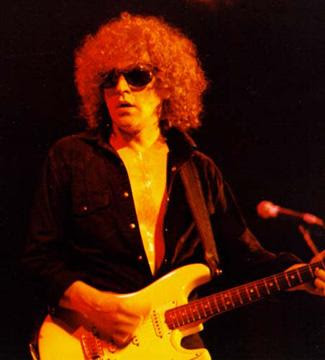
It’s Ian Hunter’s birthday today.  He’s…

…seventy?

That can’t be right.  Let me check.

Well, blow me down.  It’s true.  Hunter was born in 1939.

Yow.

Hunter – who climbed to fame as lead singer of classic glam-rock band Mott the Hoople in the early seventies, before launching a solo career that brought him almost to the edge of superstardom, and left him with a huge cult following and royalty income that’d make many “bigger” “stars'” jaws drop – started as an apprentice at a Rolls-Royce plant.  His five-year stint with Mott included lows, highs (the hit “All The Young Dudes”) and one of the great books about rock and roll ever, Diary of a Rock and Roll Star.

He’s had the kind of solo career that I’d suspect a lot of rock stars would love to trade for; he has a mid-sized, fanatical cult following that make his live shows sell-outs 30 years after his supposed prime, which has to be all the fun of being a rock star without all the bother of paparrazi and the corrosion of superstardom.  And while he’s only obliquely grazed the Top Forty on his own, other artists have had vastly bigger hits than he or Mott ever had with Hunter-penned songs (“Ships” for Barry Manilow, “Once Bitten Twice Shy” by Great White, “Cleveland Rocks” by the Presidents, the Drew Carey Show and, while we’re at it, the City of Cleveland).  Which is good for Hunter;the songwriters get the real royalty money; Hunter made out like a bandit during the eighties and nineties; every time “Once Bitten…” gets played on a classic rock station,  or The Drew Carey Show airs anywhere in reruns, Hunter gets a cut.

Sweet.

He’s also been an impresario in his own right; he produced Ellen Foley’s first album, as well as most of the Iron City Houserockers’ first critical grand slam, Have A Good Time But Get Out Alive, which is one of my favorite records ever, period.

I was lucky enough to see Hunter once – back in 1988 at the First Avenue, touring with a band that included his essential foil, guitarist Mick Ronson.  Indeed, Hunter’s solo career is a bit like Mick Jagger’s, if only inasmuch as both of their most successful work seems to be linked to their main guitarist – Keith Richards in Jagger’s case, Ronson for Hunter.

If you only buy one Hunter album, get You’re Never Alone With A Schizophrenic, his 1979 album featuring collaborations with Ronson (on guitar as well as in the control room), John Cale, and the E Street Band’s Roy Bittan, Max Weinberg and Gary Tallent, as well as Foley, which is chock full of Hunter classics:

Just Another Night” (practically a duet with Foley, and still my favorite Hunter song), “Cleveland Rocks“, “Ships”, “When the Daylight Comes” and “Bastard”.

Anyway – happy birthday, Ian Hunter, and many more.

UPDATE:  Derek Brigham is an even bigger Hunter fan, and has the series of posts to prove it.

Of course, the late Paul “Wog” Kuettel was Hunter’s biggest fan in the Twin Cities blogging community; if memory serves, his wife and he had an early date/just-married night out/something or other at a Hunter gig; I think it was from one of our conversations rather than his blog, but Hunter was the closest thing the Kinks had to a rival in Paul’s musical heart.

Why Yes,

Wednesday, June 3rd, 2009

…I overslept this morning.

Posting will be light until, oh, I dunno, after work.

Ta.

Too Late for Us

Wednesday, June 3rd, 2009

Al Qaeda’s second-in-command urged Egyptians not to be seduced by the ‘polished words’ of…Barack Obama

Dude. Where were you in November?

Marketing 352

Tuesday, June 2nd, 2009

Those of you who’ve always struggled to keep up with all the different websites where Joel Rosenberg keeps all his information have called out.  And Joel has answered.

Check out his new all-things-gun-related portal with the easy-to-remember name, Jew with a Gun.

Living In The Past: 2008

Tuesday, June 2nd, 2009

Chris Truscott is not a dumb guy.  Indeed, among regional leftybloggers, he’s one of the better ones (“in the land of of the blind, the one-eyed man knows enough not to write for Minnesota Progressive Project”)

But he does write for MPP in  this bit here – entitled hopefully “From Winning Elections to a Governing Majority, in a piece in which he seems to believe the DFL’s press releases (AKA Lori Sturdevant):

In recent years in Minnesota we’ve watched Republicans render themselves irrelevant through blind adherence to the failed policy of “no new taxes” and by placing the question of “who can get married?” ahead of things like “who can go to college?”Meanwhile, as the GOP mired itself somewhere in between the disproven Reganomics of the 1980s and the Salem Witch Trials of two centuries earlier, DFLers built sizeable majorities in both chambers of the Legislature.

Now, there is a useful point for Republicans buried in there, one I alluded to in my “What The Hell Is Wrong With The MNGOP” series a few months back: the GOP, being the genuine big tent (Ron Paul supporters and pro-lifers in the same party? Hello?) needs to quit beating itself to death over the things it disagrees about, and learn to focus on the places where we do agree.  Because when we do, we win.

What were the only real bright spots for the GOP in Minnesota this past two elections?  Places where conservatives held the line.  It wasn’t a panacaea; Phil Krinkie lost, after all (by 50-odd votes, but there ya have it).  But in two election cycles, at a time when people were sick of earmarks and backpedalling on spending, who were the Republican candidates who did win?  Michele Bachmann, who ran twice as an unrepentant conservative, in a district (MN-6) that is very much in play; Erik Paulsen, in the MN-3, which the Conventional Wisdom said was “purple” at best; Keith Downey, a genuine fiscal conservative with more than a passing physical and political resemblance to Phil Krinkie, in a district that Lori Sturdevant said would require a mushy moderate hamster for the GOP to have a shot.

And, let us not forget…

There’s something wrong when opinion polls, with questions phrased in the neutral language of scientific study, indicate at least modest support for the party’s agenda, but we’re not seeing that transfer into actual political capital when it comes time to put pressure on Gov. Pawlenty and his legislative allies

….our governor,who won during a terrible mid-term for Republicans, and held onto superhuman approval ratings during the Obama surge last year and, while he’s still no darling to Minnota’s hard-core conservatives, remains the most conservative governor in memory, if only because he stuck to his no-new-taxes pledge.  And let’s not forget – sticking to the pledge won him his recent victories, and burnished his cred for whatever his future holds.   Not accomodation with some fictitious “progressive” surge.

For DFLers to parlay their success at the ballot box into the kind of sustainable governing majority needed to defend our heritage as a great place to live and do business and position Minnesota as a leader for the new century…

…the DFL will need to ensure that a not-very-conservative GOP with spend-a-holic Congress is always in power, to cause the conservative base to walk away in disgust.

Which – let’s not kid ourselves – is exactly what happened.  The conservative zeal of 1994 – which led Republicans to talk in exactly the same terms Dems are using today, about “permanent governing majorities” – dissolved by 2006 in Bush’s Democrat-like spending spree; his only pre-9/11 policy “victory”, his education plan, was the kind of thing only a liberal could love; he signed it with Ted Kennedy looking on approvingly!  Add in the rest of Bush’s domestic legacy – Medicaid part D, entitlement addiction –  and no wonder the Democrats won big in ’06 and ’08; the GOP didn’t present a credible alternative.

Pawlenty’s vetoes show Minnesota’s mainstreet that there is an alternative; conservatives, out of power, are starting to take back the GOP.  And it’s showing in the polls; there are more identified conservatives than liberals; if the GOP puts out a message that drags them to the polls in 2010, Truscott’s talk of “governing majorities” will look as quaint as the GOP’s talk of the same 13 years ago.

If “lack of conservative alternatives” is behind the DFL’s surge since 2006, then the DFL should pay attention to the example of the GOP in Congress tis past eight years in critiqueing their own party’s performance in Saint Paul.  Because they’re showing some of the same signs of befuddled complacency.

And I think some of the smarter DFLers know it.  Truscott:

It’s time to change the way we look at the world and talk about the issues that matter

But what does that mean?

We don’t want to “tax the rich.” That’s neither a good policy nor a good slogan. Everyone pays taxes and should. We just want to ensure everyone pays their fair share so we have the resources needed to support good schools, a modern infrastructure and universal health care. Nothing more, nothing less.

We have to understand the language of competition and speak it freely. Good schools, affordable college, solid infrastructure and health care aren’t just entitlements. Yes, there’s a moral component to our policies, but on the whole they’re not “feel good” initiatives or something we do to kill time during the annual legislative session. World-leading schools, 21st-century infrastructure improvements and affordable health care make Minnesota an attractive place to live, a better place to do business and a leader in a country in which too many states have long ago accepted merely treading water as opposed to boldly moving forward on these fronts.

In other words, the DFL needs to find ways to cloak statist, interventionist policies in terms that don’t make the slightly-conservative majority toss them en masse when the nation wakes up for the Obama hangover.  My words, obviously, not Truscott’s.

Look – the whole thing (and this is something I’ve never said before, and may never say again, about the MPP) is worth a read.

The Castratus

Tuesday, June 2nd, 2009

One of the most irritating conceits of feminism run amok is that women are smarter/more capable/more worthy/just-plain-better than men.

Usually you get it in an offhanded jape from the not-overly-bright; a comic’s “ladies, we know you’re smarter than us” – harmless stuff.

And I wouldn’t go to far as to say Charlie Brooker’s piece in the the Guardian is “harmful” as observe that it explains a lot about a certain part of the left.

Women – why aren’t you running the world yet? Frankly I’m disappointed in you. Men are still far too dominant for their own good, and consequently we’ve made a testosterone-sodden pig’s ear of just about everything: politics, the economy, religion, the environment … you name it, it’s in a gigantic man-wrought mess. The world’s been one big d***-swinging contest, and we’ve caught our collective glans in a nearby desk fan. By rights we should be squealing for your help, but we’re not, because we’re too damn stupid and too damn proud. We swagger convincingly, and that’s about it. And swaggering’s fine for scraping by in primitive times, but the world we’ve built is altogether more complex now. We’ve got stock exchanges and nuclear warheads. It’s too easy to swagger your way into big trouble without even realising. Well, we’ve had our turn. It’s time for the Rise of the Ladies.We don’t need a few women in conspicuous positions of power scattered here and there – we need a 10-year prohibition on all forms of male power.

I’ve read this same piece a few countless times, of course; it wends its way through the usual bilge; men are simple and singleminded, the world would be better if men lay about like pigs, which is (couldn’t see this coming) their true nature, bla bla bla, along with the inevitable:

Seriously: a decade in which men don’t get to control anything, from the remote control upwards. Imagine the consequences. For one thing, there would be an instant and massive reduction in armed conflict around the globe.

Of course, women in power in major countries seem to inevitably end up fighting wars…

…but let’s not confuse the issue with actual history and stuff.

I read this kind of tripe, and I’m dragged back to something I asked a few years back:

Who have been the great rulers of matriarchal societies?   Who knows?

The theory I’ve heard – and I can’t remember when or from whom, sorry – is that matriarchal societies tend to be more inward-focused; it’s in matriarchal socities that it’s believed that “it takes a village to raise a child”; according to the theory, a matriarchal society behaves more or less like a group of girls will act; verbal, group-oriented, alternately supportive and undercutting.

Patriarchal societies, says the theory, act like boys; outward facing, rules-based, individualistic.

Most societies, of course, mix the two in some way or another, more or less.  And when two societies collide in conflict, it’s usually the patriarchal one that prevails (see:  the spread of intensely patriarchal Islam across heavily-matriarchal Africa).

Again – as I noted above, the only large, significant society in all of history that has seriously addressed the notion of equity among races, beliefs and genders is the patriarchal, Judeo-Christian western civilization.

Question:  If the Judeo-Christian West were a matriarchal society, would it have developed into small-l liberal democracies?  Or would they be recognizable to us today?  Would they be viable?

As re Mr. Brooker, I’m casting pearls before misandric swine.  But the question has fascinated me for years: what  would a matriarchal west look like?  And I don’t mean the idealized fantasy that the likes of Brooker and some of the identity feminists give us, where female rule brings universal peace and healthcare and calm rationality.

Would would a matriarchal west look like?

Not Your Father’s Bankruptcy

Tuesday, June 2nd, 2009

GM should have been allowed to go bankrupt months if not years ago, and without the “help” of Congress or the Obama administration. Now that it has finally come, an analysis of the distribution of the spoils reveals both method and motive.

GM’s bankruptcy pushes bondholders aside in favor of the U.S. government and the UAW. Though bondholders hold $27 billion in debt, they’ll get just 10% of stock.

How’s that compare with the other “stakeholders?” For spending $50 billion to bail out GM, the government will get 60% of the equity in the new GM; the UAW, which along with other unions gave millions to Democrats, will be repaid for its loyalty with 17.5% of the stock for $10 billion of unsecured debts.

Not unlike our nation’s financial crisis, those that caused the crisis employ more of the same and escape with the plunder.

They call it “restructuring.” We call it theft. Never in our memory has there been a more thorough, systematic effort to disenfranchise the shareholders and bondholders of a major American firm.

Has this happened before? Yes – well, almost. But these are different times – and a different judicial climate.

…in 1952, when President Harry S. Truman tried to seize control of the U.S. steel industry during a debilitating strike, the Supreme Court made him back down. And Truman had a real emergency on his hands: the Korean War.

By what authority is the Obama administration orchestrating this expedited bankruptcy and government takeover of a global corporate enterprise?

We pored over Article II of the Constitution, known as the Executive Powers Clause. Nowhere is the White House granted the right to override the time-tested bankruptcy process, to use Treasury money raised by taxing Americans to buy or bail out companies, to fire CEOs, to micromanage corporate policy, or to abrogate lawful contracts made by private parties.

Arrogance and incompetence have taken the place of justice and precedent. Where’s the outrage now?

What Once Were Crimes Are Now Diversions

Tuesday, June 2nd, 2009

It’s hard to keep up with all the Change since Obama took office.

As we’ve noted in this space, it used to be that dissent from the government – which was seen, from 2001 to 2008, as the supreme manifestation of patriotism – is suddenly actually UnAmerican.

And now, it seems that rape – which was once, by non-partisan consensus, considered in many ways just as bad as murder – is now the height of comedy.

From Pink Elephant Pundit:

Playboy writer Guy Cimbalo published what might be one of the most offensive articles I’ve seen in a long time. I ranted about it on RFC Radio earlier, but I am still fired up enough to express my fury in words.

Top 10 Conservative Women We’d Love To Hate F**. What a sick, twisted, horrible premise. They list all the heavy hitting conservative women you’d expect – Michelle Malkin being at the head of the pack, and the notable absence of Ann Coulter. He then proceed to talk about why they’re attractive, why he hates them, and the “hate f*** rating”.

“Hate F***” is apparently what all the hip kids call “rape” these days.  I’d have figured it would be more like “Hate Powermongering”, but I guess I’m not hip to all the “change” going on these days.

The list?

A few highlights:

Michelle Malkin

This highly f***able Filipina is a massively popular blogger who is known to dress up like a cheerleader on occasion (see video). She’s also a regular on Fox News, where her tight body and get-off-my-lawn stare just scream, “Do me!”

Mary Katherine Ham

You get this one pregnant, she stays pregnant. Karma’s a b*tch, isn’t it?

Amanda Carpenter

She is also a columnist at TownHall, a website for illiterates who disprove evolution by their very existence.

Mind you, this isn’t a posting at some drooling lobotoblog like Cucking Splotch or Minnesota Tragedy of Spyrochaetal Paresis “Progressive” Project.  This is Playboy – the “legit” media (as long as you read for the articles). The rest of the list includes:

Megyn Kelly

Elisabeth HasselbeckDana Perino

Laura Ingraham

Pamela Geller

Michele Bachmann

Peggy Noonan

Back to Tabitha:

Aside from getting the facts wrong re: Carpenter [she’s not with Townhall], the entire thing is vile, unmasked hatred. It’s sick. It’s wrong. It’s something that, unfortunately, many conservative women are too used to.

Apparently being a conservative undermines our femininity? Much in the way that being a black conservative or gay conservative undermines their elevated status as a minority in the eyes of the Left, women on the Right are ignored, abused, and hated. As a conservative woman, I have only been in the line of fire a relatively short time, but have experienced this first hand. Nothing is off limits regarding personal attacks. The double standard is completely nauseating. If this list had been published containing women like Katie Couric, Soledad O’Brien, and other liberal women, it would be front page news. There would be attempts on the author’s life. Instead, Guy Cimbalo, the tool responsible for this, is proud of what he did. Amanda Carpenter, who was included in the list, pointed out that Cimbalo has said he’s proud of his article, and is adding fuel to the fire. He sent out a link, asking people to “join in the fun”.

Cimbalo also took a swipe at Michele Bachmann; “Chemical castration would be preferable”, he said, providing a point on which I’m sure he and Bachmann agree.
No surprise coming from Tabitha Hale, who is basically a junior-size Laura Ingraham.

But I thought; what do the leftybloggers think about this?

“Megan” from Jezebel:

Because it’s not as if Cimbalo does anything in his piece but slag on these women for having the audacity to be attractive, conservative, opinionated and loud about those opinions. In other words, if he didn’t agree with us mouthy liberal broads, he wouldn’t want to fuck us either, and apparently prefers his women quiet and agreeable. And that – no matter what your politics are – is just gross….So, liberal ladies, just make sure you keep your opinions to yourself, never get old, never get a high-powered career and goodness knows don’t disagree with Guy Cimbalo or, like George H.W. Bush, he might not want to fuck you. And you wouldn’t want that.

Emily Kaiser at City Pages:

You’ve got to love a man who tears apart women for having an opinion, some power, and something to say that differs from his own. At least your looks make you good enough for one hate-fuck out of the deal with this sleazy guy.

We’re not the usual voice to speak up for Bachmann, but this column should be a painful read for anyone who has the slightest respect for women, conservative or liberal.

I have to admit, I am so cynical about the local lefty alt-media, I expected worse.  I’m happy to admit I shorted Ms. Kaiser.

And even Jeff Fecke, who is normally one to abase and prostrate the entire male gender and take the odd squib thwack at conservatives (especially Rep. Bachmann);Jeff’s not amused either:

This is seven kinds of despicable, and it is a reminder that there are plenty of fauxgressives running around who somehow think one can be a good liberal and still hate women. One can’t. By all means, attack the politics of Malkin, Coulter, Ingraham and Bachmann. But do so by attacking their politics, not by asserting that their vaginas make them an inviting target for defiling.

Well, good; we’re largely agreed that rape is a bad thing, even for conservative women.

Of course, the left does treat conservative women differently than the politically correct ones; a good chunk of the media and left think that conservative women (like conservative blacks, hispanics and gays) deserve what they get; that a major, dare we say “mainstream” (at least within the realm of soft-core pr0n) publication would think of publishing it, much less pay for it, says something about the outlook of an influential minority (or so I hope) in the media.

The piece was pulled from Playboy’s site not long after the bipartisan wave of revulsion impacted.  Hopefully Mr. Cimballo will get his wish; he seems to have “hate-f***ed” his own career.

Welcome Home

Monday, June 1st, 2009

Journalist, cause celebre, Fargo North/Concordia(Moorhead) alum and former Miss North Dakota, Roxana Saberi, came back to Fargo on Saturday for the first time since being freed from quasi-legal kidnapping in Iran:

The 32-year-old Saberi was greeted at the Fargo airport by a crowd of well-wishers and “Welcome home, Roxana” signs. Saberi, fighting back tears, said she was surprised at the emotions she felt.

“It’s the first time I’ve ever really cried in public,” she said.

Gov. John Hoeven and Rep. Earl Pomeroy were among the officials who met her after she stepped off the plane Saturday afternoon.

North Dakota is a very small place.  Even Fargo – by far the largest city – reflects a lot of the state’s small-town past.  And when I say “small town”, it’s more than just the fact that the towns are, y’know, small.  The place is isolated; small North Dakota towns are little tiny islands of civilization on a huge ocean of soil that, until recently, isolated people almost as effectively as water.  And ironically in such a huge, sparsely-populated place, privacy is almost impossible to come by; in a small town, or even in a big city populated by people who mostly come from smaller towns, everyone knows everything about you, good or bad, sometimes before you know it yourself.

Now, it’s not the same place it was when I grew up; many of the smaller towns, the old railroad whistle stops between the bigger cities, are drying up and blowing away; the internet and ubiquitous communications have come a long way in connecting even the most remote outposts to the outside world.  And you know the place is getting more cosmpolitan when Microsoft is among the the state’s biggest employers, and especially when the state’s long string of blond-haired, blue-eyed Scandinavian and German-descended beauty queens are joined by someone of Farsi-Japanese descent.  Things are obviously changing; perhaps that sense of never having any personal space is changing with it; I don’t honestly know.

But while I’m not qualified to speak for Ms. Saberi, it’s that lack of privacy – the sense that everyone is privy to your business, whatever it is – that drove, maybe still drives, a lot of us who leave the place.   Because the downside is, you’re never alone.

Of course, when things get ugly – when your town is flooding, when your daughter is missing, when catastrophe strikes you from out of the blue – the upside is, you’re also never alone. 

At any rate, welcome back, Ms. Saberi!

Things I’m Supposed To Hate, But Don’t: Katrina And The Waves

Monday, June 1st, 2009

Ask a random sample of people who were thirteen or older during the eighties “what is the decade’s most tiresome icon”, and you’ll get a lot of answers, depending on where one was at the time; Boy George, “We Are The World”, “Choose Life” T-shirts, Don Johnson, the “Flock of Seagulls'” dude’s haircut, the training scene from Flashdance…

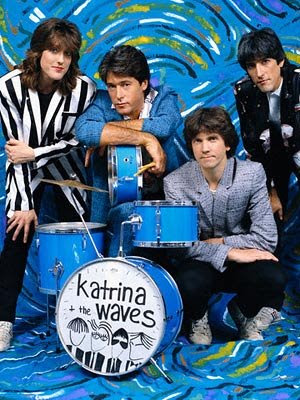
…but as they go through their own personal lists, eventually most of them will get to “Walking On Sunshine“, the too-big-to-measure one-hit-wonder by Katrina and the Waves.

And it’s true; “Walking…” was very overplayed.

But the reason tragedy wasn’t that the song overstayed its welcome; it’s that it became synonymous with the group that played it.

And that’s a shame – because Katrina and the Waves were a really, really good band.

Even people who are sick to death of “Walking on Sunshine” admit that Katrina Leskanich, the band’s statuesque lead singer, had a voice and a half.  Of course, you have listen harder to hear that guitarist Kim Rew, in his first big gig after leaving the Soft Boys, had a way with bending and strangling chords into ad-hoc passages may not have been “Solos” in the Steve Vai sense of the term, but were really, really good.

But here’s the real cool thing about The Waves; they did something that very, very few bands had done since John Fogerty left Creedence Clearwater Revival, and that had become an almost lost art in the meantime; they wrote small, perfectly-crafted, three -minute pop songs that were shimmering little gems of pop perfection.  Perhaps your world was falling apart at 10AM; perhaps it’d still be falling apart at 10:04; but from 10 to 10:03, you could smile and go “dang, that’s cool”…

So yeah.  Forget the “Sunshine”.  Dig the wave.

Things I’m Supposed To Love, But Can’t Stand: Joni Mitchell

Monday, June 1st, 2009

My whole musical life, from the mid-seventies on, whenever someone has wanted to portray themselves as the kind of hip that transcends mere temporal hipness, they’ll claim to be Joni Mitchell fans.

Joni Mitchell fandom has gone through a couple of phases; its original stretch in the late sixties through the mid-seventies, when Mitchell was putting out albums that got all sorts of attention, of course.  And then in the late eighties, when Prince confessed to being a huge Mitchell fan.

And today, in an era where quirky art-school girls with guitars is a booming genre, I’m hearing more would-be hypstrz claiming to be huge Joni Mitchell fans.

She always bugged me.

No, no – I know she’s an iconic songwriter, an amazing singer, and had been for almost forty years the leading voice of her particular genre.  She’s a spectacular talent with four decades of great material.

It  just happens to be a genre, and material, that leave me utterly cold.

Part of it is the whole “folk-jazz” thing.  Folk music is a form that I go hot and cold on, depending on the singer and the subject material.

And jazz?  Well, to paraphrase the Supreme Court wag, “I don’t know how to define what jazz I like, but I know it when I hear it”.

And while I know deep down inside that it’s wrong, and that I probably need to reset my internal musical CPU, I also have to cop to it; whenever Mitchell starts singing, I shut down a little inside.  “Oh, goodie; another overly ornamented pseudo-jazz reflection on romantic ambiguity, delivered via lovely-yet-grating high-alto warble that just grates the desire to sit still and analyze the deadeningly-oblique lyrics right out of me”.

I know.  It’s wrong.  Maybe I’ll work on it when time permits.

--> Site Meter -->