Archive for the 'War On Terror' Category

Attention, Protest Warrior Talent Scouts

Tuesday, October 2nd, 2007

MLP from Casual Sundays with Mr. Curry:

My neighborhood is full of Vikings fans and Democrats, so I thought I could make a few bucks by whipping up some big purple lawn signs: 

SUPPORT THE VIKINGS!
END THE GAME!

I’ll be selling them for $9.99 each.

I’ll take two.

Sunday At The Mall

Tuesday, September 25th, 2007

I biked over to the Capital Mall on Sunday to watch the union “peace” rally on the Capitol steps. 

I inadvertently got there very early – guess I don’t know my own strength! – so I went down to the World War II memorial, at the foot of the mall by the Veterans Services buildling. 

An older couple were there, wearing matching T-shirts commemorating their son, an Army major who’d been about a year and a half older than me when he was killed last year in Iraq. 

Now, I can’t pretend to imagine what it’s like to lose a child; the safety of my own children is a constant nagging worry in the back of my own head.  I’m no shrinking violet, and I’m certainly not the most sensitive guy, but I do know when to just shut up and let people talk.

And the woman – the bereaved mother – did talk.  She must have figured she was among friends, being on the grounds of a “peace” rally (and, indeed, she was; some things should transcend politics; caring for our kids and loving them more than anything in the world is one of them), and she unloaded, as her husband stood quietly by, admiring the WWII memorial. 

She was angry.  Still demolished with grief. 

She raged against the President. 

I wasn’t about to argue.  I disagreed, naturally, but what could I say?  What should anyone say?  She’d lost her son; for her, the sky might be red and the sun might rise in the west.  I can’t say as I’d see differently in her shoes.

And then she added “…it’s 2007.  We should be able to settle things by talking…”.

I wondered – to myself, of course – if, 65 years ago, Jewish advocates in Poland might have postulated the same ideal; that if they could only talk with Hitler, they could find a way to settle things, before the rest of their families disappeared into the nacht und nebel?  If some Ukranian kulak pondered the idea of just getting a letter through to Staliln to try to settle things as his children starved to death during Stalin’s famine, or if a Cambodian merchant or a Tutsi farmer yearned just to try to settle things like human beings as doom engulfed them and their families?  If some gay Afghan or pregnant Iranian teenager had a the urge to try to reason with their killers before the evil snuffed them out?  Did they believe that evil could be placated?  That behind the implacable mask of the Nazi, the chekist, the Khmer Rouge ideologue or Hutu zealot or Taliban or mullah, or muj with a cell phone alongside some road in Iraq, was someone who just needed to be reasoned with?

I didn’t know, and I didn’t ask.  I nodded, and listened, and expressed my genuine mutual sorrow.

———-

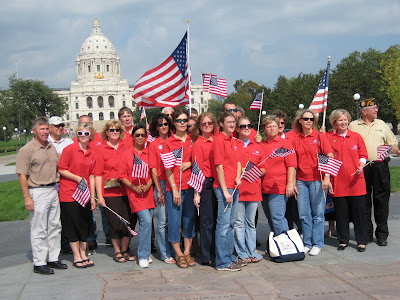
As the couple walked away toward the capitol, I noticed a group of people – younger and middle-aged – in red polo shirts, gathering around the memorial’s reflecting pool.  One of them came over and greeted me; I was among friends – in this case, “Families United“, a group of people whose children, spouses or siblings are in Iraq – or, in a few cases, who died there also. 

As the people in the distance on the Capitol steps  slowly gathered and strummed guitars, the Families United group – two dozen people, altogether – gathered under the American flag and had a brief observance.  The founder – Merilee Carlson, who lost a son in Iraq – read some letters from some of her group’s sympathizers who were also members of the participating trade unions, and were outraged that their unions would spend their dues money on demonstrating to scupper the troops’ mission.

———-

And money, they spent – although apparently not on trying to help people get there on time.  The permit was slated to kick off at 1PM; people were draggling in until two o’clock; between one and two, the crowd swelled from 200 to maybe 500. 

Four fairly posh motor coaches lined up on Constitution Avenue, reminding us that this wasn’t the same crowd we’d had two weeks earlier (at least, some of it differed); the unions, the AFL-CIO and AFSCME, among others, had pulled out the stops to make the day as low-impact as possible on their members.

And still, over half of the “crowd” was the usual suspects; the ACORN crowd, the poverty pimps from various “church” “social justice” groups – everyone but the anarchists, it’d seem.  It didn’t look like the “A-team” of protesters; the signs looked wan and halfhearted; a guy wandered up and down the Mall walkway, banging a pot to no apparent purposes (and yes, if the other guys start that “banging on pots” thing at the convention next year, I am bringing the bagpipes.  Oh, yes I am).  They didn’t know much about sound; they brought a PA system fit to handle a sock hop in a junior high gym; the speakers all exhibited that tendency that inexperienced, underamplified speakers do, shrieking into the microphone like they were hollering to be heard above a nor’easter.

The protesters shied away from talking in person; they’re smarter than most demonstrators (the ones that approached us two weeks earlier were generally woefully illiterate on current events, if not on talking points).

I left after a bit; it was too nice a day.

Janet Beihoffer and Jamie Delton were there, and covered things. 

Sergeant First Class Paul Smith

Monday, September 24th, 2007

In response to the Sorosphere’s practice of supporting the troops by publicizing the tiny thin film of atrocities commited by a tiny number of them, and parading the fraction of them that have come home to oppose the war around like they’re the only veterans that genuinely matter, a group of bloggers has worked for over a year now to publicize the life, and heroism, of one of the troops whose heroism went, in the full, awful, legal sense of the term, “above and beyond the call of duty”. 


 Smith won the Congressional Medal of Honor the same way all CMoH winners have; by committing an act of immense heroism “above and beyond the call of duty” – in other words, something that no reasonable person would expect a soldier to do. 

In Smith’s case – well, watch the presentation.  Read the account of Smith’s life.

Today would have been SFC Smith’s 38th birthday.

Counterprotest Tomorrow

Friday, September 14th, 2007

Tomorrow’s the big day!

Join us at a counterprotest tomorrow, to join with fellow anti-terror, pro-troops Americans to counterprotest the “peace” rally in Saint Paul.

The counterprotesters will gather and demonstrate at Triangle Park in Saint Paul (the triangle-shaped block east of the linked map) at the corner of Marshall Avenue and John Ireland Boulevard.   (For an aerial view, click here)

The park is located a block north of the Cathedral of Saint Paul and east of John Ireland Boulevard (the road that connects the Cathedral and the Capitol) across from Saint Paul College.  It is Saint Paul Parks property, and is reserved for the use of counterprotesters during the time of the march.

Interested in attending?  Drop us a line at the email address “demonstrationwatch”, at Yahoo.com. 

In Triangle Park, The Lights Are Dim, The Statues Grin

Thursday, September 13th, 2007

Sick of the alpaca-wearing, volvo-driving, relentlessly-self-righteous crowd having all the fun?

Join us at a counterprotest this coming Saturday, to join with fellow anti-terror, pro-troops Americans to counterprotest the “peace” rally in Saint Paul.

The counterprotesters will gather and demonstrate at Triangle Park in Saint Paul (the triangle-shaped block east of the linked map) at the corner of Marshall Avenue and John Ireland Boulevard.   (For an aerial view, click here)

The park is located a block north of the Cathedral of Saint Paul and east of John Ireland Boulevard (the road that connects the Cathedral and the Capitol) across from Saint Paul College.  It is Saint Paul Parks property, and is reserved for the use of counterprotesters during the time of the march.  The park is ours from 10AM on.

Interested in attending?  Drop us a line at the email address “demonstrationwatch”, at Yahoo.com. 

Anniversary

Tuesday, September 11th, 2007

I’ve always written something about 9/11.  I stand by it all; I’m proud of some of it.


This year, I’ll let Michelle Malkin sum it up for me:

But remembrance without resistance to jihad and its enablers is a recipe for another 9/11. This is what fueled my first two books, on immigration enforcement and profiling. This is what fuels much of the work on this blog and at Hot Air. Not every American wears a military uniform. But every American has a role to play in protecting our homeland–not just from Muslim terrorists, but from their financiers, their public relations machine, their sharia-pimping activists, the anti-war goons, the civil liberties absolutists, and the academic apologists for our enemies.

The Left greets such a commitment with mockery and derision, preferring instead to suck its collective thumb, play the grievance card, and engage in hindsight hypocrisy.

As the most infamous of all Internet leftists once said: Screw them.

With a stick.

Red was across the Hudson as it all happened – and her writing about the whole thing helped reel me into her blog, years and years ago:

Behind me, pacing in the dark bar, was a guy on his cell phone. He had obviously gotten through to someone. Finally. I only heard snippets.

“So he called you? ….. When? …. Had he gone downstairs yet? …. What time was that? Yeah … he called me when the first plane hit … I told him to fucking get the hell out of there … So he was on his way out when he called?”

Snippets. Fragments of a story. A life.

A man missing. Like so many people were missing in those days. Every empty wall covered in “HAVE YOU SEEN THIS PERSON?”

I heard the pain in the cell phone guy’s voice. But he was trying to keep it together. It was almost like when you know you need to cry, but you feel you can’t – and what happens to your voice when you’re holding all of that back. It gets tight, like a wire, rigid – but occasionally what’s going on inside you betrays you. There’s a waver in the voice, or you take a deep shaky breath … and there’s a tsunami there. Hovering above your head. Waiting for an opening.

And of course Lileks:

Six years.

It seemed right away like it would be a big war, three to four years – Afghanistan first, of course, then Iraq, then Iran. The idea that it would have stalled and ended up in diffuse oblique arguments about political timetables would have been immensely depressing. There was a model for this sort of thing, a template. Advance. But that requires cultural confidence, a loose agreement on the goals, the rationale, the nature of the enemy and the endgame. We don’t have those things. Imagine telling someone six years ago Iran would be allowed, by default, to make nuclear weapons. They would wonder what the hell we’d done with half a decade, plus change. What part of 25 years of Death to America didn’t we get, exactly?

For today, I have nothing to add that isn’t either specious or four or five years old.

The only commentary worth reading isn’t written; support it by supporting our troops. 

The Imp Of The Perverse Speaks

Tuesday, September 11th, 2007

I figure – if Chad can have a “younger brother” who gets to say all the outrageous stuff over on Fraters, why shouldn’t I?

Anyway, I got this email today from my evil twin, Jed. 

I, like Mitch, am the foremost proponent of Free Speech you will ever meet (which makes sense, since – unlike all the lefties who’ve been caterwauling about “civil liberties” for the past seven years – mine, like Mitch’s as a talk show host, are legitimately under attack). 

Government should exert no restraint on reasonable free speech. 

But I have to ask; if Rodney King got whacked a hundred-odd times with billy clubs and batons for driving while black and high and lippy, couldn’t one capitol cop have spared one lousy whack upside the head of those shrieking, narcissistic crones who profaned Congress by shrieking their gibberish, yesterday?

Just one little smack across the face? 

Cuz I’d send the guy’s defense fund a couple of hundred bucks just to see it.

Again – that is my Evil Twin Jed speaking.  Jed and I don’t see eye to eye on everything.  But, evil though he may be, he’s my twin brother.

MITCH ADDS: While I’ve never been an Ike Skelton fan, I have to give him points for this:

The protesters “really p—- me off,” Skelton said, further characterizing them as “ass——s.” Rep. Duncan Hunter, the ranking Republican on the committee, then leaned over and drew Skelton into quieter conversation farther from the microphone, leaving Skelton’s further phraseology to the arena only of informed speculation.

Bonus:  you won’t hear the Republicans getting stricken with theatrical vapours for the next four years over Skelton’s remarks, as the Dems still are over Cheney’s equally-justifiable quip re Patrick Leahy (to whom Cheney’s advice still largely applies)

Join Us Saturday

Tuesday, September 11th, 2007

On this, the sixth anniversary of the attack that started it all, please join us – the Twin Cities’ anti-surrender, anti-appeasement, anti-genocide community – at a counterprotest this coming Saturday.

The counterprotesters will gather and demonstrate at Triangle Park in Saint Paul (the triangle-shaped block east of the linked map) at the corner of Marshall Avenue and John Ireland Boulevard.   (For an aerial view, click here)

The park is located a block north of the Cathedral of Saint Paul and east of John Ireland Boulevard (the road that connects the Cathedral and the Capitol) across from Saint Paul College.  It is Saint Paul Parks property, and is reserved for the use of counterprotesters during the time of the march.

Interested in attending?  Drop us a line at the email address “demonstrationwatch”, at Yahoo.com. 

Counterprotest Saturday

Monday, September 10th, 2007

Join the Twin Cities’ anti-surrender community at a counterprotest at the “peace” march this coming Saturday.

The counterprotesters will gather and demonstrate at Triangle Park in Saint Paul (the triangle-shaped block east of the linked map) at the corner of Marshall Avenue and John Ireland Boulevard.   (For an aerial view, click here)

The park is located a block north of the Cathedral of Saint Paul and east of John Ireland Boulevard (the road that connects the Cathedral and the Capitol) across from Saint Paul College.  It is Saint Paul Parks property, and is reserved for the use of counterprotesters during the time of the march.

Interested in attending?  Drop us a line at the email address “demonstrationwatch”, at Yahoo.com. 

Over And Over Again

Monday, September 10th, 2007

Slow Joe Biden knows how to win a war.  Oh, yes he does.

Not like any of those soldiers or anything:

President Bush’s war strategy is failing and the top military commander in iraq is “dead flat wrong” for warning against major changes, the Democratic chairman of the Senate Foreign Relations Committee said Sunday.

“Dead flat wrong…” about…what?

“The reality is that although there’s been some mild security progress, there is in fact no security in Baghdad or Anbar province where I was dealing with the most serious problem, sectarian violence,” said Biden, a 2008 presidential candidate who recently returned from Iraq. 
Which is both contradicted by the return of security to much of Anbar, and the fact that killing off Al Quaeda will help deal with the sectarian violence in the first place.
Gen. David Petraeus and Ambassador Ryan Crocker were scheduled to testify before four congressional committees, including Biden’s, on Monday and Tuesday. Lawmakers will hear how the commander and the diplomat assess progress in Iraq and offer recommendations about the course of war strategy…Petraeus and Crocker will say the buildup of 30,000 troops, which bring the current U.S. total to nearly 170,000, is working better than any previous effort to quell the insurgency and restore stability. The officials also disputed suggestions that Petraeus and Crocker would recommend anything more than a symbolic reduction in troop levels and then only in the spring.
And let there be no mistake; without improvements in security, all the barbering about political changes is a waste of time.   Like, for example…:

Biden, signaling that tough questioning awaits the pair from majority Democrats and moderate Republicans, said Petraeus’ assessment missed the point. Biden, D-Del., said focusing on a political solution, such as by creating more local control, was the only way to foster national reconciliation among warring factions.

“I really respect him, but I think he’s dead flat wrong,” Biden said.

Creating political control in a situation where people are afraid to go to work in the morning is…

…well, almost too stupid to be Joe Biden.  This is Barbara Boxer-level cretinism.

Counterprotest

Friday, September 7th, 2007

A group of people who support the troops, and want the world to know that not all of the Twin Cities agrees with the anti-war, pro-surrender agenda, will be staging a counterprotest at the “peace” march on September 15.

The counterprotesters will gather and demonstrate at Triangle Park in Saint Paul (the triangle-shaped block east of the linked map) at the corner of Marshall Avenue and John Ireland Boulevard.   (For an aerial view, click here – it’s one of Saint Paul’s coolest places, in a lot of ways)

The park – a memorial to Minnesotans who served in the Civil War – is located a block north of the Cathedral of Saint Paul and east of John Ireland Boulevard (the road that connects the Cathedral and the Capitol) across from Saint Paul College.  It is Saint Paul Parks property, and is reserved for the use of counterprotesters during the time of the march.

Interested in attending?  Drop us a line at the email address “demonstrationwatch”, at Yahoo.com. 

Lessons Learned

Friday, September 7th, 2007

How counterinsurgency war is fought, courtesy of the Times of London.

It’s a classic counterinsurgency war story, led by an American armor officer who got his start in Special Forces (which, above all, has practiced exactly this kind of asymmetric warfare since it was founded in the 1950’s) a Captain Patriquin – who led a long, patient, less-than-martial-looking effort to recruit, cajole and co-opt the sheikhs of Ramadi to turn against the Al-Quaeda thugs who’d take control of the city:

He was a big man, moustachioed, ex-Special Forces, fluent in Arabic and engaged in what was then a revolutionary experiment for a US military renowned for busting doors down. He and a small group from the First Brigade Combat Team, part of the 1st Armoured Division, were assiduously courting the local sheikhs – tribal leaders – over endless cups of tea and cigarettes…

The Captain practiced some other aspects of counterinsurgency – things that don’t occur in the much-hyped GAO report on the country:

Captain Patriquin may have offered more than mere words. His main interlocutor, Sheikh Abdul Sittar Bezea al-Rishawi, told The Times that he gave them guns and ammunition too. The sheikhs did rise up. They formed a movement called the Anbar Awakening, led by Sheikh Sittar. They persuaded thousands of their tribesmen to join the Iraqi police, which was practically defunct thanks to al-Qaeda death threats, and to work with the reviled US troops. The US military built a string of combat outposts (COPs) throughout a city that had previously been a no-go area, and through a combination of Iraqi local knowledge and American firepower they gradually regained control of Ramadi, district by district, until the last al-Qaeda fighters were expelled in three pitched battles in March. What happened in Ramadi was later replicated throughout much of Anbar province.

The effect?

Ramadi’s transformation is breathtaking. Shortly before I arrived last November masked al-Qaeda fighters had brazenly marched through the city centre, pronouncing it the capital of a new Islamic caliphate. The US military was still having to fight its way into the city through a gauntlet of snipers, rocket-propelled grenades, suicide car bombs and improvised explosive devices (IEDs). Fifty US soldiers had been killed in the previous five months alone. I spent 24 hours huddled inside Eagles Nest, a tiny COP overlooking the derelict football stadium, listening to gunfire, explosions and the thump of mortars. The city was a ruin, with no water, electricity or functioning government. Those of its 400,000 terrified inhabitants who had not fled cowered indoors as fighting raged around them.

Today Ramadi is scarcely recognisable. Scores of shattered buildings testify to the fury of past battles, but those who fled the violence are now returning. Pedestrians, cars and motorbike rickshaws throng the streets. More than 700 shops and businesses have reopened. Restaurants stay open late into the evening. People sit outside smoking hookahs, listening to music, wearing shorts – practices that al-Qaeda banned. Women walk around with uncovered faces. Children wave at US Humvees. Eagles’ Nest, a heavily fortified warren of commandeered houses, is abandoned and the stadium hosts football matches.

“Al-Qaeda is gone. Everybody is happy,” said Mohammed Ramadan, 38, a stallholder in the souk who witnessed four executions. “It was fear, pure fear. Nobody wanted to help them but you had to do what they told you.”

And the article notes that, rewarding as it is, the job is risky:

Captain Patriquin, 32, a father of three young children, was killed by a roadside bomb days after I left Ramadi last winter. Sheikh Sittar wept when told the news. He and several tribal leaders attended his memorial service. Captain Patriquin “was an extraordinary man who played a very, very important role,” he told The Times.

For what it’s worth, my condolences to the Captain’s family.

And yet – the surge (combined with, I suggest, the even-more-important change in how the military is fighting the insurgency) seems to be giving next week’s report from General Petraeus the most optimistic backdrop we’ve had reason to see for years.

Imitation Is The Sincerest Form Of Condemnation

Thursday, September 6th, 2007

Politico on the Dems’ emerging Iraq quagmire:

Senate Majority Leader Harry Reid (D-Nev.) and House Speaker Nancy Pelosi (D-Calif.) are calculating that it is futile to continue their months-long campaign to force an immediate end to the war, particularly after Republicans and a few Democrats returned from the summer recess intent on opposing legislation mandating a strict timetable for pulling out U.S. troops.

The change is both rhetorical and substantive. Reid and others are increasingly talking of “bipartisan compromise,” while top Democrats are reworking legislation erasing a date certain for ending the military operation. The strategic shift is certain to anger some war critics, but it reflects the reality that Democrats lack the votes to force President Bush’s hand.

“We are trying to manage expectations that we can’t end the war today or next week or next month,” said one Democrat involved in the discussions. “We have to make sure everyone understands that.”

Said another aide involved in the process: “Despite the months of debate, and all the votes, and all the ads and everything, we have not been able to break the Republicans. They are still with Bush, and that’s the reality here.”

But that’s so…verbose? 

Yeah.  Verbose.

Let’s say the same thing, the way Chuckles Schumer might have:

And let me be clear, the withdrawal of troops and emergence of peace in Iraq will happen despite the Democrats and the “peace movement”, not because of the Democrats and the “peace movement”. The inability of Democrat legislators to give the people of Iraq and America the faintest reason to believe they were serious about terrorism said to these tribes, here and there, “we have to fight al Qaeda ourselves”.

Much more concise, doncha think?

More later.

Repeat A Big Lie

Thursday, September 6th, 2007

I’m not sure what to make of Chuck Schumer’s quote from yesterday:

And let me be clear, the violence in Anbar has gone down despite the surge, not because of the surge. The inability of American soldiers to protect these tribes from al Qaeda said to these tribes we have to fight al Qaeda ourselves

Forget about political tone-deafness (and any purple-state GOP leader who doesn’t have that quote posted on signs and T-shirts and bumper stickers by week’s end should be cashiered for incompetence) for a moment; the quote betrays (or utilizes) a complete ignorance of history.  Convincing the locals to do the fighting for you is the mark of successful counterinsurgency warfare; departing from that (as the US did in Vietnam under Kennedy and Johnson, to its eternal chagrin) is a recipe for disaster.  Kaplan in Imperial Grunts quoted innumerable Special Forces and Marines who said exactly that.  Ed put it well:

Remember when the criticism of the Bush administration was that they didn’t understand the complex social structure of tribal life in Iraq? Remember when we heard nothing but how Bush and the US were bulls in a china shop, insulting tribal leaders and forcing them into the insurgencies?

Exactly.  We’re doing the job right – belatedly, to be sure (to our chagrin) but according to fairly clear lessons from military history.

So – is Schumer merely a historical illiterate?

Or is he (as I suggested on the Hewitt show yesterday) just making sure that the Big Lie – “the surge is a failure” – hits the news cycle before Petraeus comes to town, so that the Administration and Pentagon’s good news actually looks like damage control to those who still get their information from the evening news (and anyone who votes for Chuckles Schumer numbers gullibility as the least of their problems)?

Overpowered By Wonk

Wednesday, September 5th, 2007

Eric Black, at his new blog, jumps into the battle to spin the upcoming Petraeus report:

The Washington Post reports this morning that a GAO report, due out Tuesday, will find that the Iraqi government has failed to meet 15 of the 18 benchmarks that Congress and the Bush Administration had established to measure military and political progress.

It’s hard to escape politics, selective perception and confirmation bias when discussing the question of progress in Iraq, especially during the current run-up to the big September presentations by Gen. David Petraeus and Ambassador Ryan Crocker.

But if there’s anyone I would trust to call it straight, it would be the GAO.

Black went on:

When I read a few weeks ago that the GAO was doing its own study of the Iraq situation (at the request of Congress) I counted on it to be the unbiased assessment available. When I just read the Post story, I was disappointed to learn that the GAO will only be studying the 18 benchmarks.

As I previously fulminated, for those focused on the big question of how things are going for the U.S. mission in Iraq, these benchmarks are overrated. The benchmarks focus only on things the Iraqi government is supposed to do to facilitate the much-ballyhooed but not very visible national reconciliation among the various population groups.

Indeed – a casual study of counterinsurgency warfare shows that the GAO’s benchmarks, while of importance to those for whom the quality of a national government is the measure of success, are virtually meaningless in measuring success in the mission that will, for the immediate future, be the only one that really matters in Iraq; securiting the citizens; driving Al Quaeda out; cutting down on internecine ethnic/religious cleansing; killing or co-opting the religious death squads; getting the the point where “The Iraqi Street” doesn’t need to worry about being killed, having his children burned alive before his eyes, being gang-raped, for the crime of walking the street. 

As in all counterinsurgencies, government factions can negotiate until the paint peels from the conference room walls; none of it means anything until the “street” believes it’s safe.

I’d be more impressed when the results are real in ways that affect the safety our troops and of the well being of the Iraqi people. For example, when the number of attacks on the troops is down, likewise the number of Americans and Iraqis getting killed, plus the unemployment rate in Iraq.

Black – knowingly or not – invokes an irreconcilable paradox.

Focusing on the “number of attacks on the troops” is what got us into this mess in the first place.  Since Beirut and Mogadishu, the US military has focused on “force protection” to a degree that Robert Kaplan, quoting Special Forces troops in Afghanistan, called “debilitating”.  For the first three years of the counterinsurgency, the US military became so focused on “force protection” that it would seem to have  gotten neither safety nor victory; by going, essentially, on the defensive, we ceded control of much of the “Iraqi street” to the terrorists, death squads and thugs – which made most of Iraq a safe haven from which to…

…launch more attacks on our troops.

It’s only been by putting our troops in harm’s way, taking the initiative from the enemy, that casualties have dropped and, more importantly, people in places like Anbar are starting to sense the security that will give them, someday, the mental bandwidth to fuss about things like oil revenue and the Rights of Man. It’s also paradoxical that by taking the war to the enemy, one saves lives in the long run.

 I’ll be impressed by measurable progress toward the reconstruction of the Iraqi infrastructure,  an increase in how much oil is being produced and how many hours a day Baghdad has electricity.

And yet trying to get to any of that without making the people of Iraq secure is like trying to drive to Chicago before you’ve changed your flat tire.

It is a lamentable fact that the Administration – the Pentagon, really – allowed this to happen for three years.

It is to the Administration’s credit that things have finally changed. 

That the Administration’s opponents have never had a better idea in either case shows their unfitness to lead this nation in a time of war. 

Counterinsurgency

Friday, August 31st, 2007

A few weeks ago, I wrote my own (admittedly amateurish) impressions of the fallout of the surge in Iraq – especially the developments congruent with the observations of Robert Kaplan in Imperial Grunts.  As I put it a few weeks ago, the goals are to:

    1. Keep our troops out among the natives – even in tiny numbers, the act of showing a presence among the civilians makes a huge difference in…
    2. …Cutting the guerillas off from the people.  Make it impossible for the insurgents to get supplies, recruits and support (and, commensurately, to exert control through coercion and terror). 
    3. Co-opt and exploit local institutions to help you with #2 first – and then build new institutions.   This drives liberals (and, it must be fairly said, neoconservatives) crazy; surely, they reason, imposing democracy and human rights immediately must be a better thing – right?  Like most ideals, it’s not always true, of course.  It was a former Ranger – who’d spent a few years training for this exact kind of warfare – who introduced me to the saying “perfect is the enemy of good enough”.  In many parts of the world, the only human right that matters right now is the right to not get blown up, beheaded, shot or gang-raped.  Once those are taken care of, one can worry about the more finesseful rights of man. 
    4. Build up the local institutions that work.  Liberals – and some neoconservatives – grouse about this because it involves “picking and choosing warlords”. 

 This latest set of dispatches from Michael Yon (Ghosts of Anbar, Parts I, II and III) shows evidence of all of these.

Yon quotes selected passages from the Army’s Counterinsurgency (“COIN”) manual:

From the counterinsurgency manual that every Marine and Soldier should read:

Sometimes, the More You Protect Your Force, the Less Secure You May Be
1-149. Ultimate success in COIN is gained by protecting the populace, not the COIN force. If military forces remain in their compounds, they lose touch with the people, appear to be running scared, and cede the initiative to the insurgents. Aggressive saturation patrolling, ambushes, and listening post operations must be conducted, risk shared with the populace, and contact maintained. . . . These practices ensure access to the intelligence needed to drive operations. Following them reinforces the connections with the populace that help establish real legitimacy.

From “Counterinsurgency/FM 3-24/MCWP 3-33.5”

Earlier, at the Falahat station, I counted 24 armed Iraqis at one time, but there may have been as many as twice that. So it was just SSG Lee, me, and dozens of armed Iraqis. Some clearly had been insurgents just months ago. Nobody was denying it. Not us, not them. SSG Lee and I could have been killed or kidnapped at any time, yet I felt not a twinge of danger other than maybe watching for an enemy car bomb or sniper, or starting when someone accidentally fired a burst from an AK, which they occasionally do.

The Marines were constantly outnumbered, yet they were pushing out there with the Iraqis, who are picking up more of the weight in many places. 

Back in 2005 many Iraqi Soldiers and Police preferred to hide their identities.Today it seems that most Iraqi Soldiers and Police want their photos taken. Their confidence is growing and their attitude toward the terrorists is increasingly one of being more the hunter than the hunted. 

Now I started to understand why the Army officers had been telling me the Marines are more advanced in counterinsurgency. Normal Marines have morphed into doing vintage Special Forces work. Many of our Army units are excellent at this work, but the Marines, at least these particular Marines, did seem to have an edge for it.

They were even studying Arabic in their filthy little compound. Lightweight study, but they were showing the Iraqis they were making the effort. The Iraqis appreciated it. I have yet to see an Army unit undertake such a clear effort to learn Arabic.

They’re moving out of the big Forward Operating Bases, into really small, rough-and-tumble bases big enough for a squad or two of men:

The Marines there live in disgusting conditions. They have two toilets. One is a tube. For more serious business, there are the small plastic baggies called WAG bags. Do your business, seal it up and put it into a garbage can. They don’t complain.

And most importantly, they’re out among the Iraqi troops and people – showing them how to fight…:

Iraqi Soldiers and Police constantly emulate Marines and Soldiers. When he got back from missions, SSG Lee would work out. The Iraqis would watch and start doing their own exercises. This form of mentoring happens naturally because Lee is just being Lee, and the young Iraqis see it and want to be it. 

…and how to run a town…:

Iraqis in every province I have traveled all respond to strong leadership. It’s a cultural touchstone. A man like SSG Rakene is not someone they would overlook. Physically, the man is amazingly strong. But what is most amazing is the strength of his moral fiber. Whatever the man talked, he walked. After all of al Qaeda’s false promises, the people here have learned a hard lesson about the true value of character.

…and how to beat an insurgency in an area that was their home turf:

While al Qaeda runs and hides, stuffing its death-cult down the throats of Iraqis in other areas, out in Anbar, once its domain, American Soldiers and Marines are increasingly able to go in small numbers out on patrols with Iraqis. This morning, only two Marines accompanied an Iraqi-led foot patrol several miles through an Iraqi village. It is important to note that at the time of this patrol, Soldiers who had recently been kidnapped elsewhere in combat were still missing. With no backup, our guys are able to perform such patrols in many parts of Iraq.

Read all three parts – Part IV is coming soon.

Our State Nightmare

Monday, August 27th, 2007

Nick Coleman is…well, it.

He’s trotting out the “V”-word:

Ford was premature: Our national nightmare isn’t over. It’s baaack. And so is the V-word.

Vietnam.

Well, to be fair, Coleman’s people were calling the war on terrorism “another Vietnam” since before the dust settled in lower Manhattan.  They said Afghanistan would be a quagmire before the first Green Beret jumped into Afghanistan.  They said the battle for Bagdad would be another Stalingrad. 

And always, always, the “V” word.  Said with a smug, knowing smirk that was usually followed by a titter (audible or not). 

U.S. forces were in Vietnam for 15 years and 2 million people died, including 58,000 Americans (1,100 from Minnesota), all to keep Asian countries from falling into Communist hands (like falling dominoes) and to keep the bad guys over there, instead of over here. It was a bloody waste that divided Americans for years until most grew sick of paying lives for an unnecessary war.

I could go on fisking Coleman – but he’s already said everything I need to hear to show my point.  I wrote about this over the last few weeks – in my Small War series.  Coleman is proving my point.

The Pentagon’s biggest problem is that it spent the first three years in Iraq re-fighting the Cold War.  The first three weeks – the part that ended with President Bush correctly declaring “Mission Accomplished” on the deck of the USS Abraham Lincoln – were the war that the military spent fifty years practicing for; high-tech, fast, armored, aerial, with a small group of elite troops crushing a much larger force of ill-trained but heavily-armed enemies. 

I listened to the vacuous Mark Heaney “Minnesota Matters” show on the local FrankenNet Air America affiliate the other day.  Heaney’s guest – the director of some astroturf “Peace” group – was kvetching about how Americans weren’t being asked to “sacrifice” for this war, “like we did in World War II”, with a draft and a massive home-front effort.  Leave aside the fact that the military doesn’t want a draft, and that a mass, draftee military is historically utterly counterproductive for fighting the kind of war we face in Iraq; it’s a sign that the left is stuck between it’s only templates for “Successful” war, with “success” meaning “whatever delivers it to power”.  World War II – with its immense, statist effort and total societal immersion in the war effort – was, for all that it did say about America, a monument to socialism.  And that’s not even a bad thing; it’s also a historical anomaly; the vast majority of wars throughout history have pitted professional warriors against other professional warriors, or similar fighters (like, say, jihadis).  Historically, indeed, the era of mass, professional armies meeting in armageddon-like struggles on immense battlefields shooting at other guys in uniforms started under Napoleon and ended, for all real intents and purposes, on the deck of the USS Missouri, allowing for a forty-year tete-a-tete in Western Europe, a “Cold War” where all the real fighting took place…in small countries, between professional soldiers, proxies and guerrillas. 

But whatever – as I noted the other day, World War II and Vietnam were the “successful” wars for the American left; they put the left in power in this country, and returned it there, respectively. 

Oh, yeah.  Coleman – a member of a left-of-center media establishment that has been in the bag for the Democrats for two generations – is angry about “big money conservatives” – dare we say, “big cheeses” – who are paying money to get the President’s message out:

Yep. Looks like the Big Muddy once again. With a modern update: Battling TV ad blitzes…The ads deliberately link the war in Iraq to images of the terror attacks of 9/11, although the 9/11 Commission found no evidence of a connection. Like linking Iraq to Vietnam, the ads show desperation, and are aimed at keeping nervous Republicans in Congress from abandoning the farm.

Gosh, go figure – using the media to fight the impression created largely by…the media.

Go figure.

And about the ads, Coleman says…:

They are abuse.

Word fail. 

The Small War, Part II

Tuesday, August 21st, 2007

Let’s switch to Jeopardy mode for a bit:

ANSWER: “We Can’t Win”.

QUESTION: Choose from the following:

  1. “What did the left say about Vietnam?”
  2. “What did the left say about El Salvador?”
  3. “What did the left say about Afghanistan until the (real) Northern Alliance and the Special Forces rode into Kandahar?”
  4. “What does the medialeft (I conflate media and left on purpose, since in reality they’ve pretty much conflated themselves) assure us about Iraq at every opportunity?”

The answer, if you’re a discerning news consumer, is “all of the above, and then some”.

———-

“Iraq is un-winnable”.

That is one of the left’s great current conceits. It’s only as true as the nation wants to make it, of course; all wars are winnable (or at least loseable by the other guy) – Finland beat the Soviets, at least in regulation time, in 1940 (sudden death overtime brought the Finns a limited defeat and the Soviets a very costly “victory”); British, on the other hand, conquered most of the globe with a laughably-small force; the Colonies beat the British with even less; Britain in turn held out alone against Hitler. Of course, listing these wars like that oversimplifies the issues; each of them, “impossible” as they were by conventional measures, happened for reason that make perfect sense in retrospect.

But the upshot is that there is no such thing as an “unwinnable war”. Of course, all wars can be lost.

The distinction is important, especially when you look at the history of counterinsurgencies.

I remember the NARN’s interview with Steven Vincent, the freelance journalist who made such a name for himself covering Iraq, alone and without a net (and was eventually murdered on his second tour in the country, by criminals in Basra). In our final interview with him – the last interview he gave before leaving for Iraq the second time – we talked about the differences between the approach in the American and British-controlled regions of Iraq. The American zone was, true to “Neocon” dogma, taking the all-or-nothing route; full civil democracy, the whole enchilada, immediately. The British, drawing on centuries of experience ruling huge swathes of the world and immense native populations with a tiny military and civil servant cadre, had a different approach. They made deals with unsavory people to observe, rat out and countervail other unsavory people. They co-opted one group of thugs to smack down another group of thugs. They used, even exploited, criminal disorder to their larger goal – keeping relative order in their sector. Until recently, it worked -very arguably (Vincent was murdered in Basra, along with many other people, after all). They also kept their troops out among the Iraqis of the region, intermingling, buying their supplies locally, walking around without helmets or body armor (unless events demanded them) – and until recently, when the Brits announced their intention to start withdrawing, Basra was relatively peaceful compared to the miasma of Baghdad and Anbar.

They’ve done this – winning “unwinnable” counterinsurgency wars – before. In India from the 1600s through WWII, in the pre-Revolutionary American west, and South Africa in 1900, in Borneo and Malaysia and Aden and Oman in the sixties and seventies, the Brits learned the blocking and tackling of winning insurgencies: isolate the insurgents from the locals by being among the locals, by winning civilian hearts and minds, by co-opting other elements of the local society against the insurgents (including cultivating “friendly”, if often conventionally-unsavory, warlords, in the hopes of taming them when the crisis wanes – as, indeed, they did), and, when and if needed, following the isolated insurgent into the wilderness and hunting him down and killing him, using the minimal British force possible (and relying heavily on the locals to do the dirty work; British history is crowded with colorful characters who went overseas and “went native” leading indigenous troops in the service of the King; the British special forces, the SAS and SBS, are directly descended from such characters).

As Vincent noted, that approach is foreign to modern Americans (and when I say “modern”, it’s because the distinction is important, as we’ll see in a bit); neocons demand “democracy now”; liberals pine for the moral clarity of World War II and, like Jimmy Carter, get queasy at the thought of associating with, even supporting, unsavory, often thuggish, frequently deeply ugly people to defeat people who are not, to the outside observer, a whole lot different.

And when I say the approach is “foreign to Americans”, I mean “Americans who don’t follow this nation’s history, especially”.

Lost in the palaver about the Iraq War – and the inevitable Vietnam comparisons that the left leans on to the exclusion of most rational thought when the thought of war, especially counterinsurgency war, comes up – is that a hundred years ago, the United States was the master of small wars against small, asymmetric groups of insurgents. In winning the American West against the Indians, and then in our first “imperial” wars – the Philippines in the early 1900s, Nicaragua in the ’20s and ”30s, and several others in between and beyond (up through El Salvador in the ’80s), the US won wars the way the British won the same kinds of wars all across their empire for hundreds of years, from India in the 1600s through Aden and Northern Ireland in the seventies (as related by everyone from Robert Kaplan and Max Boot to Robert Nagl:

  1. Keep our troops out among the natives – even in tiny numbers, the act of showing a presence among the civilians makes a huge difference in…
  2. …Cutting the guerillas off from the people. Make it impossible for the insurgents to get supplies, recruits and support (and, commensurately, to exert control through coercion and terror).
  3. Co-opt and exploit local institutions to help you with #2 first – and then build new institutions. This drives liberals (and, it must be fairly said, neoconservatives) crazy; surely, they reason, imposing democracy and human rights immediately must be a better thing – right? Like most ideals, it’s not always true, of course. It was a former Ranger – who’d spent a few years training for this exact kind of warfare – who introduced me to the saying “perfect is the enemy of good enough”. In many parts of the world, the only human right that matters right now is the right to not get blown up, beheaded, shot or gang-raped. Once those are taken care of, one can worry about the more finesseful rights of man.
  4. Build up the local institutions that work. Liberals – and some neoconservatives – grouse about this because it involves “picking and choosing warlords”.

It’s nothing new; we did it in the Philippines in 1900 to great effect; the desert Southwest wasn’t subdued by columns of blue-jacketed cavalry, but by small teams of Apache renegades led by tiny cadres of soldiers on long, unsupported pushes through the desert that made it impossible for the Mescaleros to carry on a regular life in the US. More recently, in El Salvador in the ’80s – a great, and successful, example of this kind of war which was also judged “un-winnable” by the mainstream left and media – there was a choice; between left-wing death squads, and right-wing death squads. The US (and the Special Forces that did the work) chose to support the right-wing death squads, on the assumption (correct, as it turned out) that they would eventually be easier to co-opt, fold into the regular military, and eventually teach the basics of human rights. The solution in El Salvador was messy, imperfect – and remains light-years better than it was during the days of unchecked insurgency, leaving the nation a functional, if imperfect, democracy. Another example – many times in Imperial Grunts Kaplan notes US Special Forces (“Green Berets”) in Afghanistan remarking that their mission is to make the locals – the Afghan Army, as well as the local warlords’ militias – look good. The goal, of course, is to build the stability that’s needed, not just for democracy to take hold (if indeed it can or will), but to deny Afghanistan to the terrorists as a safe haven again.

The good news? Once you get through the job of making the population safe from the insurgents, it can – indeed, say many of the subjects in Imperial Grunts, should – be done with many fewer troops than we currently have in Iraq.

So who screwed up?

And why are the Democrats wrong?

Oh, heck – I guess I’ll make this three parts.

The Small War, Part I

Monday, August 20th, 2007

I’m splitting this into two parts; once I started writing, I just couldn’t stop. I have a few things to establish before I get into my post proper.

———-

Statement: Administration 2, Demcrats/media 1.

We’ll come back to that.

———-

For those of you who think I never pay the Demcrats a complement, stand by to have your preconceptions gutted like fish: they got one (and only one) thing right about the Iraq war. I think we are getting to the point where we can fight the war with a much smaller commitment of troops in Iraq. Indeed, we might even be to the point where it might be beneficial to the conduct of the war itself.

Oh, of course the Democrats are wrong about the reasons, meaning and execution of this idea.

But again, we’ll come back to that.

———-

There’s an old saw among those who follow military history…

…and even moreso among those who casually watch people who follow military history: that nations and their militaries always prepare for the last war.

So, it seems, do social movements.

Reading Imperial Grunts by Robert Kaplan a few months back – about the time some Democrats were pushing for a reinstatement of the draft – I saw an interesting parallel.

Kaplan chronicled the complaints of US Special Forces and Marines in places like Afghanistan, Iraq, Columbia and the Philippines that the “Big Army” (and Big Navy and Big Air Force to boot) had taken over control of operations in these countries. The problem, they told Kaplan, was that the generals who run the “Big Army” cut their leadership teeth “fighting” America’s last, least-ambiguously successful war – the Cold War (and more ambiguous successes like Grenada and Desert Storm) – who were led in their militarily formative years by men whose main mission was to avoid costly debacles like Vietnam or Mogadishu. The Cold War, of course, was a throwback to the great mass industrial wars of the 20th Century, WWI and WWII; high-tech, involving mass armies maneuvering in mass formations on a global scale, with the survival of entire nations, societies, systems, even the world itself at stake. The US military built at huge expense during that period became unstoppable in its major mission; to decimate phalanxes of tanks bulldozing across the East German border with high-tech tanks, helicopters, jets and artillery that could fight 24/7 in all weather; to interdict fleets of Soviet submarines intent on gutting sea communications with Europe reminiscent of the U-boat wolfpacks with a fleet of over a hundred impossibly-complex hunter-killer submarines; to secure the air over Europe against skies dark with MiGs with technological marvels like the F-15, the Stealth fighter and the AMRAAM missile. It might be fairly argued that just as the US military fought Vietnam wrongly – trying to treat a counterinsurgency war as a mass national crusade – that the Pentagon spent a few years fighting Afghanistan and Iraq the wrong way; trying to bring a Cold-War-era mass army to places more suited to…something else.

On the other hand, the left is also fighting its last wars. Plural.

Vietnam, of course, was the last war of the part of the left led by the likes of Kos and Air America – the reflexive “America Last” crowd. But as powerful and influential as they are in the Democrat party (and moreso in Minnesota’s DFL), they’re not really the most interesting current to examine.

The last unambiguously successful war of the Left was World War II. Led by FDR and Truman, it was the last truly national war; the last one that involved our entire society. More importantly, it was the last (and, in a sense, the first) war in our history to be morally unambiguous. For the first, and probably last, time in history, the good guys (if you leave out that whole “Stalin” thing) wore white (or olive-drab) hats, while the bad guys wore black coal-scuttle helmets. It was a war that paralleled the New Deal and much of how statist liberalism operates; registering and inducting entire swathes of society; imposing an all-encompassing order on the nation’s life; a war in which the individual was subsumed to the national will, in war as in the economy. And of course, like the lefty ideal for so many things (which is realized in so few things), it was…well, not exactly “clean”, but certainly well-defined. It had a definite end; troops marching thirty-abreast down the Champs D’Elysees, Hitler dead in a bunker, a surrender ceremony on the USS Missouri, done deal, no sticky entanglements.

Which, of course, is one of the reasons they are chanting “this war has lasted longer than World War II”. It’s the only model of success they have, when it comes to defending this nation.

And there’s a clarity – to the left – in looking back at Vietnam (from their perspective, at least); to the left, Vietnam was unambiguously wrong, inarguably unwinnable, never anything but wrong for any reason, from any perspective (easier to believe when one filters out that whole “Killing Fields” bit). In a sense, it was the anti-World War II.

The left’s dalliances with running the nation since Vietnam have been much less clear, both positively and negatively, than WWII and Vietnam. Carter’s impotent flailings at the Iranians, Clinton interventions to support humanitarian goals in Haiti, Kosovo and the Balkans, Rwanda and Somalia (although he inherited that involvement from George HW Bush) which tried to paint humanitarian happy thoughts on top of centuries-old ethnic animosities; they wound up treating unsavory people pretty much like other unsavory people without bothering to judge their differences, to very little real long-term effect (to say nothing of at least one famous, if historically minor, disaster in Mogadishu).

So there are, really, four different world views (certainly more than that, really, but I’m going to limit things to the big four) duking it out over the War on Terror right now:

  1. The fringe (and ascendant) far left, which sees all war as unambiguously wrong.
  2. The “mainstream” left, which waxes nostalgic for its own finest hour, the unambiguous moral correctness of wars like WWII, down to the level of even replicating their methods.
  3. The Administration, which after 9/11 embraced a Wilsonian, almost utopian view of the vitality of exporting democracy, seeing this as an unambiguously good thing.
  4. The Pentagon, caught between its pre-1991 status quo as a force designed to fight a huge, high-tech conventional war, its 1992-to-9/10/2001 imperative to “transform” into…something (after 2000, into a force to back up the “neocon” Wilsonian doctrine; before that, to get small fast so Clinton could cash the “Peace Dividend”), and finally after 9/11 the leader in the War on Terror

And of course, the fifth force, the one whose present Kaplan chronicles and whose history Max Boot explored; our “Unconventional Warfare” community, visible in the news today in the guise of General Petraeus and his return to nuts ‘n bolts counterinsurgency warfare, but which has been tinkering with the means to fight exactly this kind of war for half a century, frequently against bitter opposition from the “Cold War” “Big” military.

We’ll come back to that tomorrow.

CSI Sadr City

Wednesday, August 15th, 2007

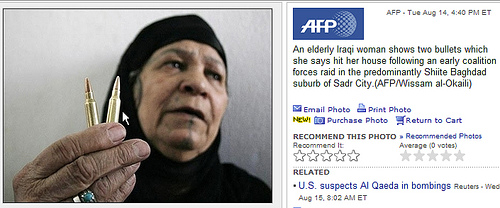
Ed notes an Agence France Presse story in which a woman notes that her house was mercilessly shot to hell by American troops, and has the bullets to prove it.

bullets8-07.jpg

Any potential Crime Scene Investigators wanna take a, er, “shot” at this one (without cheating and looking at Ed’s wrapup of posts by bloggers that figured it out?)

UPDATE:  Given AFP’s record (i.e., as bad as the American mainstream media’s) on these sorts of things, I had to check.

Kudo’s to AFP’s crack fact-checkers; at least they’re American 5.56x45mm rounds.  I figured it was even money they’d be 7.62x39mm

Fighting A Smaller War

Thursday, August 9th, 2007

I’ve not written a lot about the war in Iraq lately. 

Mainly because I haven’t had much to say that many other commentators – Michael Yon, Bill Roggio, Bill Ardolino and many others – haven’t said much, much better. 

Partly because I needed to learn a few things.  Do some reading.  Figure out what I thought about things.

The Administration – largely the Pentagon, I think – screwed up mightily between 2004 and 2006.  They lived down, I think, to the classic stereotype; they fought their previous war over again.

Things have changed, so far this year.  The “Surge” – with its focus on the kind of classic counterinsurgency warfare, and its straying away from the mania for “Force Protection” that sprang up in the wake of the bombings at the Beirut Embassy, the Khobar Towers and the Mogadishu “Black Hawk Down” skirmish, seem to have fundamentally changed things on the ground in Iraq, and even in the theatre that reallly matters; in Washington, and even in the Fallujah of American life, the media.  The chanting of the lefty droogs that “the war is un-winnable” and that “we’ve already lost” are starting to seem as quaint and naive as the Administration’s predictions that the occupation would be a cakewalk seemed two years ago.

Suffice to say that while the Administration was wrong and made mistakes, the Democrats are farther-off-base, and want us to make vastly bigger ones.

I was going to post those pieces this week – but the bridge collapse and its aftermath are of more immediate impact, here and now; that, and events in the US and in Iraq keep overtaking what I write. 

But I’ll be posting the articles next week, with an aim toward having a rational discussion about the issue.

(more…)

Amid the Turmoil…

Wednesday, August 8th, 2007

…of this past few weeks – in the news and in my own life – I managed to neglect one of the biggest stories of the year in Minnesota; the Red Bulls are home.   The First Brigade of the 34th Infantry Division – capping off a busy decade for the 34th, a National Guard division – got back from Iraq recently amid a well-deserved flurry of coverage. 

Kelly at Patriette chronicled the welcome-home of her own soldier – her husband – as well as some of the jitters after being apart over a year.

 Anyway – Welcome back, all.  And good job. 

That Makes Two

Tuesday, August 7th, 2007

Now it’s two national polls that show support for the Iraq war not just increasing, but for the first time in a while showing that more Americans think our presence does good than harm. 

My big notice of a sea change?  Last week on the Chris Matthews exercise in self-adoration and puffery program, a panel of mainstream media types – including noted foreign policy expert hot, drop-dead cute redhead reporter babe Kelly O’Donnell – agreed with the premise that it’d be a huge mistake to cut and run (which made Matthews explode a pyre of preserved meat apoplectic).

I’ll be writing a lot more about this next week.

“Neocon” or “Not Ready for Prime Time”?

Tuesday, August 7th, 2007

I pilloried – justifiably – Obie’s saber-rattling over Pakistan – but Taranto notes that at least there’s some good news in Obama’s flub:

As a candidate recently pilloried by fellow Democrats as a foreign policy naïf, Mr. Obama’s remarks may be no more than an effort to don a Mike Dukakis helmet. And given the Senator’s consistent opposition to the war in Iraq, it may seem peculiar that he should now propose invading a nuclear-armed Muslim country–all the more so since Mr. Obama let slip Thursday in an interview that as President he would rule out the use of nuclear weapons “in any circumstance.”

But in a primary contest where Democrats seem to vie with one another for the title of who will pull out of Iraq the fastest, Mr. Obama’s speech is at least a recognition that he’d be willing to use military force somewhere. It’s also a reminder to antiwar Democratic voters that the terror threat won’t vanish when the Bush Administration does, and that U.S. soldiers will have to be put in harm’s way again.

Mr. Obama:  Pakistani WMDs most definitely do exist.  And what a wonderful way to radicalize not only Musharraf’s society, but to re-radicalize Pakistan’s intelligence service, which was until recently overrun with Wahhabi sympathizers and actively aided (and, no doubt, in many quarters still aids) Al-Quaeda.

Still…:

Too bad, then, that Mr. Obama instantly squandered an opportunity for seriousness by insisting that Iraq is “the wrong battlefield” in the war on terror. In case he hasn’t noticed, Iraq today is the main battlefield where U.S. forces are confronting, and killing, al Qaeda on a daily basis. And GIs don’t have to invade another country to do it.

The best news about Obie’s jape, of course, is it shows that being “anti-war” is losing at least some of its cachet on the left – at least, in responsible quarters on the left: 

Still, Mr. Obama’s willingness to draw appropriate conclusions from realities in Pakistan stands in refreshing contrast to his Democratic opponents. Tragic as a premature withdrawal from Iraq would be, it would be compounded if Democrats draw the lesson never again to use or threaten force abroad. By distancing himself from his party’s pacifist wing, Mr. Obama is growing up as a candidate.

Worth a read.

And then read Victor Davis Hanson’s detailed takedown of our newly hawkish überliberal.

Deserve Victory

Sunday, August 5th, 2007

William Kristol, in an article that notes the huge changes in…well, not so much the war, as the public’s media-driven perception of it, over the past month, sums up:

In terms of U.S. national interests–and in terms of its own political well-being–the Republican party faces a moment when, to paraphrase Winston Churchill, honor points the path of duty, and the right judgment of the facts reinforces the dictates of honor. General Petraeus will deliver the facts in September. If Republicans can keep their nerve under media and elite assault, then they will have the honor of following the path of both duty and the right judgment of the facts. I suspect all will come out well. Americans can sometimes be impatient and short-sighted. But when a choice is clearly presented, they tend to reject the path of defeat and dishonor.

Read the whole, vital thing.

--> Site Meter -->