Strooth
Tuesday, October 22nd, 2013It’s true.

And about 100% of my “entertainment news”, too.
It’s true.
And about 100% of my “entertainment news”, too.
According to at least a few crew members, “Captain Phillips” is to the Maersk Alabama saga what “Forrest Gump” was to traumatic brain injuries.
Bill Glahn – who you need to be reading, by the way – on the Minnesota Orchestra debacle as a bellwether for how Big Art gets funded:
I suspect we will see more of the Minnesota Orchestra-type of dispute in the next few years. Since the financial crisis of 2008, the business models of a whole range of industries are no longer viable. Until we collectively figure out what’s next, the irresistible forces of “we can’t go on spending like this” will be crashing up against the immovable objects of “we don’t want to give up what’s been ours for decades.” A new model will eventually emerge to bring the fine arts to patrons. In the meantime, the adjustment period will be painful for everyone involved.
If there is any good news, it’s that the institutions and industries that go through the adjustment first will be best positioned later on. Those that cling to the failing system loner will end up in liquidation, rather than reorganization.
If you support art (if not necessarily Big Art), it’s an interesting time, in the full Taoist sense of the term.
For starters, the biggest institution supporting Big Art – Big Academia – is also on the bring of an epochal shakeout. The era of Big Institutions Who Do Things For Your Own Good as a whole seems to be fizzling, slowly – up to and including that biggest Institution That Does Things For Our Own Good, Big Government.
I can’t imagine it means good things for Big Public Media – one of the other key patrons of Big Art – either.
So what will the epic restructuring of Big Art mean for art?
OK, TV hipsters. Here’s your red meat.
The Office (US) is better.

And by “Better”, I mean “Oh, shut up. Who needs to choose? The Offices are two very very different shows built around the same basic premise, and why compare?”
The US Office lasted nine seasons – two of them short ones, but most of them with twice as many episodes as the entire run of the British series. That’s a lot of hours of TV – which doesn’, in and of itself, make the US version better. Hell, Laverne and Shirley and The Brady Bunch were on the air forever, too.
Both shows started with the same premise – strangers stuck in an artificial environment. Ricky Gervais’ British version ran for 14 episodes of over the top absurdism. The American version had to fill in a few other things to fill all that time; characters that developed over time, stories that had legs, nuances and subreferences and a depth to the writing that may not have been as explosively outrageous as the Brit original, but keeps a lot better over time; I have watched most of the US episodes several times – because there’s a reason to keep going back; I’ve seen each Brit one twice, and after two years I can probably think about doing it again, maybe.
So put a sock in it, hipsters.
Ask any hipster; the stuff that nobody but they have seen is infinitely cooler than the stuff everyone else knows about.
And if you talk television, one of the things hipsters and the too-cool-for-thou all agree on is that the British version of The Office is sooooo much better than the American version (which just signed off the air after nine seasons).

They’re wrong.
Don’t get me wrong; I’ve seen all fourteen episodes of The Office (UK). It’s funny.
In fact, it’s almost too funny.
And that’s part of the rub.
The Brit original, starring Ricky Gervais – who’s credited as creater for the series on both sides of the pond – aired for two six-episode seasons on the Beeb, along with a two-episode “retrospective” that tied up all the loose ends that’d been left.
The series – there as here – was about what happens when you pack a bunch of very disparate people into the artificial environment of the modern office. Also, about Ricky Gervais’ flair for the outrageous.
The show reminds me of “Fawlty Towers” – John Cleese’s classic seventies-era BBC series about a bumbling, henpecked hotelier. In “Fawlty”, Cleese’s protagonist, Basil Fawlty, would spend each episode spiraling down a vortex of self-induced and ever-more-absurd social pratfalls, aggravated by Fawlty’s arrogance and provincialism, ending inevitably in a classic volcanic meltdown. It was ingenious stuff; the comic tension building as Fawlty’s ineptitude and duplicity built on each other to almost superhuman levels of absurdity. There’s no way to explain it. If you haven’t watched it, find it and do.
And you might just find as I do – that you can only watch Fawlty every couple of years. Fawlty Towersis to comedy what Fourth of July is to fireworks; if you do it every day, it loses its impact.
Gervais’ British Office is the same. The David Brent character is like Fawlty – it’s all so gloriously over the top that the comic tension is almost unbearable.
And it is the show. Oh, there are other layers, nuances in the show – but they can only get developed so far in a show that only lasted fourteen episodes. The “Tim and Dawn” romance is rushed and perfunctory, basically to give a breather from Brent’s antics.
It’s hilarious – and, likeFawlty Towers, it wears me out.
Which is fine. But sometimes I want more…
…which we’ll come back to in a bit here.
Joe Doakes from Como Park emails:
There was a thunderstorm [Thursday] night. The 6:00 a.m. news [Friday] morning was comical. The Anchor ponderously intoned there was a storm last night and sent us to the Weatherman, who pointed to radar weather map as he told us the storm had left our area, then we cut to a pretty young woman standing in the rain on the side of a road as cars drove around a puddle, who breathlessly explained that the storm left standing water on some roadways.
20 years ago, the Anchor would have said “Well, that was some rain last night, a real gully washer. In sports, our Minnesota Twins will host the . . .” and that would have been the end of it.
This may explain the media penchant for going along with the global warming hype. 20 years ago the weather was just a section of the newscast. Now it’s become huge business, with it’s own teams, trucks, radar installations, even it’s own networks and network feeds that the locals contract from. So the weather forecasting industry has a vested interest in making everything spectacular, dangerous, dazzling, tittilating. Follow The Money – global warming is a natural fit for the whole expansion of the weather forecast industry.
Joe Doakes
Following the career of former Channel-11, current (I think) Channel 4 weatherman Paul Douglas is illustrative, as it’s pretty well tracked the growth of “Weatherman As Celebrity”.
In the eighties and nineties, Douglas’ side-line business – building weather-presentation software for broadast – was part and parcel of the growth of the Weather as Entertainment part of today’s newscasts; it brought action, zooming clouds, interaction between radar, maps and the presenter that made the weathercast seem like a little movie production of its own. It made Douglas pretty wealthy, I’m told – nothing wrong with that – and helped him become the Twin Cities’ first weather “celebrity”.
And he was one of the first to board the Global Warming train.
I’m less surprised by the fact that James Gandolfini has passed away…
…than by the fact that he was only 51.
He’d seemed “51” for most of the last 20 years.
Sigh.
That’s how I greet this news.
It’s time we focus on the real victims here.
Hollywood, after donating millions to get Bloomberg and Andrew Cuomo into office, is bitching about the scope of New York’s gun grab law:
The sweeping gun control measure signed by Gov. Andrew M. Cuomo and hailed by Democratic leaders has a surprising critic: Hollywood.
Officials in the movie and television industry say the new laws could prevent them from using the lifelike assault weapons and high-capacity magazines that they have employed in shows like “Law & Order: Special Victims Unit” and films like “The Dark Knight Rises.”
For some reason, Hollywood likes to use real firearms when they make their movies glorifying violence (or at least minimizing its consquences:
Industry workers say that they need to use real weapons for verisimilitude, that it would be impractical to try to manufacture fake weapons that could fire blanks, and that the entertainment industry should not be penalized accidentally by a law intended as a response to mass shootings.
Impractical to manufacture?
Tell it to those peddlers on 23rd Street with the “Rolexes”. I’ll bet they can hook you up with a fake SIG 551 right quick.
Andrew Cuomo, of course, is angering people who supported him very generously:
Mr. Cuomo has gone out of his way to promote the industry’s success; on Monday, he issued one news release to say the state was on track to break its record for the number of television pilots shot in a year, and another to say that “The Amazing Spider-Man 2” would begin production this week in Rochester. The governor has also enjoyed political support from Hollywood: his sole out-of-state fund-raiser as governor was held at the Los Angeles home of an HBO executive.
And here’s the beauty of it all; Cuomo may have cried wolf once too often:
But some lawmakers, feeling stung by conservative and upstate voters over the gun control law, do not wish to vote on it again, even to make what the industry describes as a technical correction. Gun rights activists, who are challenging the new firearm restrictions in court, have mocked the idea of a so-called Hollywood exception.
¶ “They’re saying, ‘Why are we being held to this standard when Hollywood is getting a pass, and they’re the ones who are promoting the violence?’ ” said Thomas H. King, the president of the New York State Rifle and Pistol Association.
¶ The new laws expand New York’s ban on assault weapons and high-capacity magazines, and beginning next January, they will prohibit the possession of magazines that hold more than 10 rounds of ammunition.
And it’s gonna be hard to keep Mariska Hargitay looking all sleek and fashionable if they have to switch from a Glock to a Colt 1911 or a Ruger Redhawk.
Joe Doakes from Como Park emails:
Separated at birth?
Pablo Picasso – aka “The John McClain of abstract art”
and…
Bruce Willis – aka “The Pablo Picasso of the action movie”
I can totally see it.
…I wish I was in New York this week.
Danny Boyle is doing a sequel to Trainspotting, 20 years on.
I wonder what Renton’s opening monologue…
…will be like this time?
It was seventy years ago today that Casablanca made its New York debut.
The movie – which started as a script for a never-produced play, “Everybody Goes To Rick’s” – was by no means a sure thing. Its production, under director Michael Curtiz, was almost legendary for its difficulties; the script was being revised constantly during shooting, both for plot reasons and to satisfy objections from the “Production Code Administration”, the industry’s standards and practices board that enforced the “Hays Code” that governed the morals shown in American movies up through the sixties; the references to Major Renault trading sex for visas, and Rick and Ilse’s fling in Paris, were originally treated much less elliptically than in the final cut.

Indeed, much of the movie’s flow wasn’t nailed down until the final edit. The immortal closing scene was very nearly augmented by a “real” ending that showed Rick and Major Renault on a ship full of troops – US and Free French – bound for Africa. This was cut – thankfully – due to Claude Rains’ unavailability – not the only case where a schedule difficulty helped preserve the movie we finally got…
…which was, in its purest form, a parable for what America really stood for on the world stage. We, like Rick, preferred isolation – but could be swayed by an overwhelming moral argument.
And what an argument it was. The moment when you started to have the faintest hint that Humphrey Bogart’s cynical, hard-bitten, paleo-noir “Rick Blaine” might have a soft spot (carefully hidden under layers of callouses and scars) for the underdog maybe one of the most gloriously, over-the-top manipulative scenes in cinema:
At first viewing, it’s a “U – S – A! U – S – A!” style adrenaline rush with the French – who were sympathetic figures to Americans back then – filling the starring role. The more you watch it, the more layers it has. Listen to the way La Marseillaise joins in over the Germans’ Die Wacht Am Rhein, as seamlessly as a nightclub DJ would beat-and-key mix them together.
The scene would make a granite countertop emotional.
I had not watched a lot of old movies, beyond the annual ritual of “Wizard of Oz” when I was a kid. I had little concept of what the golden age of Hollywood had meant, or been. The movie absolutely gobsmacked me.
And it was thirty years ago last New Years Day that I first saw Casablanca. And I never really recovered. I’ve watched it dozens of times, maybe a hundred. Back during college, I saw it so many times that I could recite the dialog along with the movie.
For starters – and it should surprise nobody that a 19 year old would notice this – but you can count the stars in movie history more radiant than Ingrid Bergman on one hand, with a couple of fingers left over.

The boy meets girl (spoilers follow), boy loses girl during a Nazi invasion, boy finds girl in North Africa, boy loses girl to charismatic underground leader, boy has a shot at getting girl back but uses that to trick her and boyfriend into leaving to carry on the fight while he heads off to fight the Nazis is an oldie but goodie – and has never been done better.
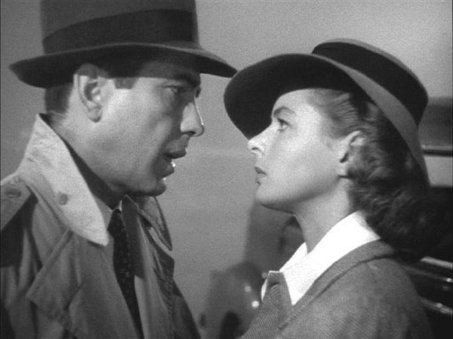
It was thirty years ago this past New Years Day that I first saw Casablanca.
And it’d be hard to show us a role that is a greater American archetype than Bogart’s “Rick”.

God knows how many people died of lung cancer decades after seeing Casablanca as a kid – because yes, in the hands of Humphrey Bogart, smoking was cool. It did make you more suave, hard-bitten, dangerous-looking. I was tempted to take up the habit after seeing the movie my first couple dozen times.
And there has never been a cliffhanger ending like Casablanca’s. I won’t spoil it. But if you haven’t seen the movie, you are shirking your duty as a culturally-literate American. Please see to this immediately.

So my evening plans are set, anyway.
I’ve finally followed through on my dream of writing an episode for a major TV drama.
In this case, it’s “Criminal Minds”, the long-running CBS police procedural about a group of FBI criminal profilers who track mass-murderers.
I hope to hear back from CBS soon.
———-
SCENE: A Gulfstream G4, silhouetted against a gorgeous sunset, winging its way southwest. The voice of Special Agent Aaron HOTCHNER narrates in voiceover:
HOTCHNER: “Kurt Cobain wrote “Load up on guns, bring your friends. It’s fun to lose and to pretend“.
(Dissolve to interior of aircraft. Agends HOTCHNER, REID, JAREAU, PRENTISS, MORGAN and ROSSI are sitting around a well-appointed table. ROSSI sips at a snifter of brandy.
MORGAN (The handsome and über-buff Afro-American agent who, notwithstanding the FBI’s dress code, is never not seen wearing form-fitting sports attire): Lincoln, Nebraska police report two waitresses sexually assaulted, stabbed and strangled.
REID (the nerdy brainiac prodigy): Sounds like a classic sexual sadist spree killer…
PRENTISS (the flinty raven-haired brunette with the enigmatic past): …with serious mommy issues.
HOTCHNER (The strung-too-tight leader who looks like “Greg” from “Dharma and Greg”): Police say he turned up in their apartments with no sign of forced entry.
JAREAU (the blond eye-candy): So the vics let the unsub in.
ROSSI (the erudite sixty-something pioneer of the trade and oenophile): The unsub is almost certainly a white male, twenties through forties, victim of sexual abuse as a child…
PRENTISS: Probably abandonment, too…
ROSSI: …right, and probably socially-accomplished, in great physical condition – most likely very vain, a bodybuilder type…
REID: …a real “lady-killer” if you pardon the term.
(MORGAN, JAREAU, ROSSI and PRENTISS grimace)
HOTCHNER: Probably a complete stranger to the vics,but charming enough that they didn’t care…
REID: The same basic MO that Ted Bundy used.
PRENTISS: Every woman in Lincoln is a target.
JAREAU: I’ll get a statement out to the media as soon as we land.
HOTCHNER: Do we have anything else? What are the Lincoln PD doing?
MORGAN: Tasing people who refuse to comply.
HOTCHNER: Well, it’s all we got.
PRENTISS: And today’s Friday.
REID: That means he could be striking again even as we speak.
(Agends furrow brows)
(Cell phone goes off in MORGAN’s pocket).
MORGAN (looks at phone). It’s Garcia. I’ll put you on speaker, Princess.
(MORGAN sets phone on table. Notwithstanding that the G4 is cruising at 40,000 at 500 knots, the phone has and maintains four bars of signal reception, enough to get clear, skitter-free video of FBI macguffin technician technical analyst Chloe O’Brien Penelope GARCIA)
HOTCHNER: Go ahead, Garcia.
GARCIA: Yo, yo yo, ma izzagents. Here’s what we have so far. Victims are 22 year old Danielle Larson, worked at a Perkins in Lincoln, and 21 year old Cathy Profett (Photos pop up on screen, superimposed alongside Garcia), who worked at a truckstop off the interstate.
PRENTISS: Both blond, high school grads, working their way through community college – Larson for nursing, Profett for tool and die fabrication. You got the causes of death – both identical.
MORGAN: What are their financials?
GARCIA: Already on it! (Spreadsheets swirl across screen to superimpose over photos on phone screen). Both low-income, but solvent. Larson’s father is an insurance agent and alcoholic who had a fling in 1985 with a receptionist at their insurance office. Proffett’s mother played fiddle in a country-western band in her twenties and owns a secret copy of Fifty Shades of Gray.
JAREAU (whispering to REID): I always wondered – how does she get all that info instantly, without a search warrant?
REID (whispering back): My IQ is in four digits, and after seven years, I still haven’t figured it out.
ROSSI: So other than age, gender, blonde and working-class, no real link.
GARCIA: Wait, wait – this just coming in now. We have a third vic. 22 year old Amy Rademacher. Waitress at a Dennys on the west side. She’s alive…
MORGAN: So something interrupted the unsub.
GARCIA: Correctamundo. She also has a detailed physical description. White, Male, late thirties, dark brown hair…
PRENTISS: Yep…
GARCIA: …and gushing blood from his chest…
REID: Wait – that doesn’t fit the profile at all. Unsubs of this type are almost always uninjured, in peak physical condition…
GARCIA: …where the victim shot the unsub six times at point blank range with the .357 snubnose revolver she carried. And (checks scrolling panel on computer) yep, she has a valid Nebraska carry permit and… (pops up online data from a local Gander Mountain) shot better on her last day at the range than you did, oh tall, dark and handsome! (MORGAN blushes).
ROSSI (puzzled): The victimology is all wrong! Our vics are never able to fight back…
HOTCHNER: This is big. Very big.
GARCIA: Lincoln police is bagging what’s left of him up right now (photo of blood-smeared floor and full body bag pulsates on the screen. GARCIA waves at the screen). Toodles, unsub.
MORGAN: Well done, Princess.
GARCIA: Oh, you just made kitty purr! OK – adios, muchachos! (GARCIA bleems out).
PRENTISS: Well, that settled that, I guess.
MORGAN: Vics killing unsubs. What’ll they think of next?
ROSSI: Time to rewrite the book.
HOTCHNER (presses intercom button). Pilot – take us back to Quantico.
(JAREAU brings up “Shot In The Dark” on her Macbook. For next 56 minutes, camera focuses on her reading, cutting between her face and the rapidly-scrolling blog, as Jareau becomes more fascinated the longer she goes).
(Shot dissolves to exterior of Gulfstream flying against the dusk, Agent PRENTISS’ voice appears in narrative voice-over)
PRENTISS: P. J. O’Rourke once wrote “And so I said “let me tell you who those bad guys are. They’re us, Americans. WE BE BAD. We’re the baddest-assed sons of bitches that ever jogged in Reeboks. We’re three-quarters grizzly bear and two-thirds car wreck and descended from a stock market crash on our mother’s side. You take your Germany, France, and Spain, roll them all together and it wouldn’t give us room to park our cars. We’re the big boys, Jack, the original, giant, economy-sized, new and improved butt kickers of all time. When we snort coke in Houston, people lose their hats in Cap d’Antibes. And we’ve got an American Express card credit limit higher than your piss-ant metric numbers go. You say our country’s never been invaded? You’re right, little buddy. Because I’d like to see the needle-dicked foreigners who’d have the guts to try. We drink napalm to get our hearts started in the morning. A rape and a mugging is our way of saying ‘Cheerio.’ Hell can’t hold our sock-hops. We walk taller, talk louder, spit further, f**k longer and buy more things than you know the names of. I’d rather be a junkie in a New York City jail than king, queen, and jack of all Europeans. We eat little countries like this for breakfast and sh*t them out before lunch.”
(And fade to black as credits roll).
———-
Waiting for a call from my agent even as we speak.
The media tells us it can’t be done. Obama is inevitable.
Where have we heard that before?
I’m on my way to the polls.
I saw “Argo” over the weekend, on Saturday night.
It was really, really, really, really good. That’s a rating of four “Reallys”. That ain’t chicken feed.
Why was it so good?
Time Machine: The movie gives you a good sense of what life was like in the US the last time one of our Presidents left our diplomats out to dry in an “unexpectedly” hostile country – the hopelessness, the impotence, the craven politicization of the White House’s response (Carter’s chief of staff Hamilton Jordan comes off especially weaselly), and the way this nation responded – good and bad – to the “students'” outrages against decency.
And the clothing and hair styles of the seventies, in all their claustrophobic porn-movie-o-liciousness. Yuck.
It’s an excellently-acted true story that plays like a great suspense thriller.
But perhaps most surprising of all…:
You forget it’s Ben Afflect in the leading role. He isn’t awful!
Totally worth seeing. Before the election, even.
…when we’ve got Red Squirrel from the eponymous Red Squirrel Report:
I grew up in the 1970’s, so I got some of my learnin’ every Saturday morning from ABC’s Schoolhouse Rock…Last Friday, the government told us that the unemployment rate fell to 8.3%, even though they do not count millions of people who are too frustrated to even look for a job anymore. I think this country needs the folks at Schoolhouse Rock to explain the unemployment rate to the American people. Something catchy, similar to Conjunction Junction.
How about……..Frustration Nation? C’mon kids, sing along:
He’s got lyrics and everything.
…than European liberals writing about American culture. It’s always a smorgasbord of stereotypes – both the stereotypes they see and write about, and the ones they themselves exhibit.
And both are on ample display in this piece in Britain’s Guardian by Ed Vulliamy about B.B. King’s annual concert in his hometown.
And yet mixed in and among all of that is a great look not only at King’s life – he’s 87 – and the South he came from as it’s evolved over his lifetime, but there are even a few looks into how he became the guitar player he’s been for all these years.
It’s more or less in sync with the upcoming release of the documentary The Life of Riley, about King’s life and impact on music (King’s birth name was Riley B. King). And that, I need to see, wherever it shows in the Twin Cities.
Two things, really:
SNL is funny again?: I dunno. I haven’t watched it in years. SNL follows a pattern;
We’re apparently in the #1 phase – or so I’m told. I’ve been burned too many times. I’m happy to be the last one on and the first one off that particular bandwagon.
Wait – they went after who? Lorne Michaels is among the most ossified paleo-libs in showbiz. The show will treat conservatives – any conservative – with sympathy right about the time Paul Krugman writes a NYTimes editorial admitting he’s a partisan hack who’s outside his depth writing about anything but currency policy. It’ll never happen.
But bagging on another media outlet? Well, OK – there, they can have some fun:
Not saying I’m going to watch SNL anytime soon. But that was fun.
As I started writing on Monday, I went to “Won’t Back Down” over the weekend. I was literally too tired to finish the post on Sunday – and Monday and yesterday, things got just a little bit crazy.
As I noted at the time, I generally hate teacher movies. I’m a teacher’s kid, grandkid, older brother and, for that matter, a former teacher, more or less, myself.
But more than either of those, school choice is a hot topic for me, since the Saint Paul Public Schools ranged between worthless and toxic to my children. So while I’m not big into “heroic teacher” fable films, I’m more than ready for a movie about school choice.
Anyway – I saw the trailer for Won’t Back Down a few weeks back, and I thought I more or less figured it out. The trailer featured…:
And all of these button-pushing cliches are present in heaping portion in Won’t Back Down. And it’d be easy to write the movie off there.
And it’d be a huge mistake – because woven in and among the “Teacher Movie” cliches is a really excellent movie and, perhaps more importantly, a movie that makes a fairly honest accounting of a very complex issue.
This movie is complicated. And that’s a good thing.
The Magic PC People
The movie’s marquee protagonist, an overextended but supernaturally cute single-mom bartender and car-saleswoman played by Maggie Gyllenhall, chews on the scenery like Phil Niekro attacking a can of Skoal. Rebuffed by a clock-punching principal when trying to get a better teacher for her dyslexic daughter at her run-down failing school, I half expected to see the Spice Girls jump out and start dancing as she hammered out her big applause line (“You know those women who lift cars off their children? They’ve got nothing on me!”) like a steam press stamping out door panels. Improbably, the only scene where Gyllenhall doesn’t feel like she’s trying to orate is the one where her character is, well, trying to orate – speaking at a rally of parents she and her plucky teaching compatriot managed to organize. Suddenly, she’s subdued. Go figure.
We’ve seen this character before – Julia Roberts played the same lady in “Erin Brockovich”, and did it a whole lot more believably. Gyllenhall’s most effectve scene – when she and her daughter learn they’ve been passed over for a seat at a charter school – is the only one where she says absolutely nothing. The camera lingers on the two as they stare, dazed, as the focus swirls about them in a brilliantly innovative bit of cinematography that, along with Gyllenhall’s silent face, says more than the script possibly could have.
Viola Davis, on the other hand, playing a teacher with a crumbling marriage and a creeping case of professional burnout, is brilliant. Her part is tailor-made to be turned into a tired cliche. Her marriage (to Lance Reddick) is failing fast, and in the movie’s first scenes, it’s hard to tell which of the burned-out teachers is going to be the movie’s real villain. Davis – with a couple of Tony awards and an Oscar nomination under her belt – plays a role that is historically liable to drift into melodrama – but plays it with nuance and style, and all of the subtlety that Gyllenhall lacks.
The Enemy
The bad guy in “teacher movies” is usually a cartoon. And that’s usually not the worst part.
“The Enemy” in teacher movies is generally one of two things; an administration motivated by some melodramatic, impersonal inertial brought about either by some personal perfidy (sort of the education versions of John Lithgow’s character in “Footloose”) or some generalized social ill that’s beyond anyone’s human control. The antagonist is, thus, either an easily-dismissed cartoon or some pathology so big that no real person – only “the system” is to blame.
The enemy in Won’t Back Down is a little bit of both. Gyllenhall’s daughter’s teacher is a bovine, burned-out waste, a woman punching the clock until her pension kicks in (who only seems like a caricature if you haven’t had kids in the public schools lately), who is protected by the teacher’s union.
Now, teachers’ unions have been up in arms over Won’t Back Down, which is just further evidence that many of ’em shouldn’t be teaching your kids without supervision. The movie presented as balanced a picture of unions as I can recall in a recent move; no less than three major characters – the “Sympathetic But Challenging Love Interest”, the Greasy Unsympathetic White Guy who runs the union, and his organizer, filling the “Enemy With A Heart Of Gold” role (played by Holly Hunter) testify more or less eloquently on why we have unions and why they can be a very good thing. I doubt I’ve ever seen a movie ever spell out the positive case for teachers unions, at least on an idealistic level.
The movie is fair, but it doesn’t chicken out; ideals notwithstanding, the unions fight dirty to try to keep the parents from taking over and converting the school to a non-union charter school.
As to side-villains? That was a huge surprise; the dissolution of Viola Davis’ character’s marriage, in a lesser movie, would give it a cheesy side-villain. It seems the movie is setting Reddick’s character – a black yuppie who builds model World War 2 fighter planes for a hobby – up to be that venal little distraction. Again, it doesn’t take the easy way out.
The Big Finish
These movies always end with the big finish – the math meet, the writing context, the basketball game, the ultimate court hearing, whatever. In this case, it’s the big Pittsburgh School Board meeting where the board votes on the proposal to (near as I can tell) pull the school out of the public system and become a self-governed charter school.
I won’t spoil it – not that you can’t probably figure it out yourself – although I will point out (pursuant to the “Magic Protected Classes” part of the formula), that the wise black and elderly female Jewish vote does unite against the clenched WASP contingent in the final vote. Which is pretty much de rigeur these days.
At any rate – the movie is not immune from the ravages of the Hollywood formula. Somehow – more or less miraculously, I think – they managed include the better part of a pretty good, sometimes challenging movie in there. It’s the first significant move I’ve seen to address school choice – and in between the odd bits of Hollywood, it did a decent job, without oversimplifying (at least in Hollywood terms, and the inevitable shorthand that has to go into fitting a topic as old as the hills, and which has been in the headlines for a couple of decades now, into two hours.
I went to “Won’t Back Down” over the weekend.
I’ll come back to that.
———-
A couple of bits of background before we get to the review:
I’m A Teacher’s Kid: My dad and my mother’s parents were all teachers. So’s my sister, more or less. I’m not ignorant of what a teacher’s life is like. Or was like, really, years ago and in a much smaller place beset by a level of common sense that’d be subject to Department of Justice litigation today.
I Hate “Teacher” Movies: Almost always, anyway. They always, always, inevitably seem to follow a template; plucky teacher dumped into failing school by uncaring system seems group of struggling, troubled or apathetic kids – usually minorities – and has an idea on how to each ’em. Uncaring system tries to beat plucky teacher down. Plucky teacher tries, but soon teeters on the brink of losing the fight – until some event gives them a blinding flash of epiphany, leading them to the solution that leaves the uncaring system nodding its head in sage belief and the struggling, troubled or apathetic kids changed forever, and the plucky teacher filled with that saintly glow of superhuman accomplishment. The movies – whether Stand and Deliver, Freedom Writers, Dangerous Minds, Mr. Hoilland’s Opus or any of a slew of others (heck, even School of Rock) – are all different and yet, it seems, all the same; they pound the problems of not just teaching kids, but of teaching scads of different kids, into a too-cheap-and-easy Hollywood resolution.
They make my skin crawl. In part because – oh, one more thing…
I’ve Had My Own Battles With The School System: We’ll come back to that one.
———-
I saw the trailer for Won’t Back Down, and I pretty much figured it out. I thought I spotted the usually 21st Century Hollywood film story crutches:
But this movie had one thing that no other movie in the genre had; it was the trailer for the first movie I’ve seen to try to tackle School Choice as anything but a cartoon.
So how did it do?
More tomorrow.
US no longer at war with Mideast film critics: Obama Spokesman Jake Carney “self-evident . . . terrorist attack.”
Wrongfully accused filmmaker last person on earth still awaiting Obama apology.
On the off chance you haven’t seen this: Sir Ian McKennen doing Sir Mix-A-Lot’s, er, classic “Baby Got Back”.
It made me laugh.


You are currently browsing the archives for the A ‘n E category.